

Submitted:
06 April 2026
Posted:
06 April 2026
You are already at the latest version
Abstract
The antagonistic pleiotropy (AP) mechanism of aging was first proposed by G.C. Williams in 1957. However, practical application of this theory for the targeted search of longevity interventions has lagged, owing to a lack of clear understanding of the conditions under which the same gene or trait may have opposite effects on fitness in young versus old organisms. We propose that changes in the somatic environment may result from allometric growth, physiological differences between adult and juvenile life stages beyond those caused by aging, and ontogenetic niche shifts, and we provide well-documented examples of AP mechanisms corresponding to these conditions. We then test this understanding through testable predictions. Specifically, we demonstrate that (1) traits that have diverged the most between developmental stages contribute the most to aging; (2) organisms with negligible senescence exhibit minimal differences between adult and juvenile life stages; and (3) among taxonomically close organisms, stronger differences between adult and juvenile stages are associated with higher aging rates, while greater similarity is associated with lower aging rates. This understanding opens opportunities for the targeted identification of AP mechanisms based on the analysis of organisms' developmental trajectories. Additionally, it suggests two potential approaches for mitigating AP: suppression of adverse genes or traits in late life, or prevention or reversal of alterations in the somatic environment that convert previously beneficial traits into detrimental ones.
Keywords:
development
; trade-off
; growth arrest
; metamorphosis
; allometry
; ontogenic niche
; mTOR
1. Introductions
The antagonistic pleiotropy (AP) mechanism of aging was first proposed by the prominent American evolutionary biologist, George C. Williams, in 1957 (Williams, 1957). According to his hypothesis, if the same gene/trait favors reproductive success at a younger age but leads to the deterioration of health later in life, natural selection will support this trait (Williams, 1957). As older organisms enter the “selection shadow” (Medawar, 1952) due to population numbers decreasing from external causes, this trait will be favored. Many lines of research from laboratory models (Austad and Hoffman, 2018a; Promislow, 1995; Wu et al., 2022) and population studies (Albin, 1988; Carter and Nguyen, 2011; Lockwood et al., 2024) have demonstrated evidence supporting the AP theory of aging. Among them, AP provides an explanation for the sustained prevalence of many disease-associated alleles in the general population. For example, BRCA mutations are associated with an increased incidence of cancer mortality; however, they are not eliminated from the population due to the increased fertility of both male and female carriers (Kwiatkowski et al., 2015). Similarly, superior cognitive performance (Schultz and Nopoulos, 2025) and increased fecundity among carriers of the mutant huntingtin gene (Albin, 1988; Morton et al., 2019) at a young age result in persistence of Huntington’s Disease (HD) despite its deleterious nature. Aging-associated polygenic diseases, like coronary artery disease (Byars et al., 2017) or type 2 diabetes (Stern et al., 2021), also follow the AP pattern. Many examples of antagonistic pleiotropic genes with their roles in aging-associated conditions, including cancer, cardiovascular disease, chronic obstructive pulmonary disease, and Alzheimer’s disease, were discussed in a recent review (Gems and Kern, 2024).
Although the role of AP in aging is now well established and supported by a significant amount of evidence (Austad and Hoffman, 2018b), the practical application of this theory for the targeted search of longevity interventions is lagging. We hypothesize that, at least partly, this is due to the lack of a clear understanding of conditions in which the same gene or trait may have opposite effects on fitness in young and old organisms. Presence of such genes is a basic assumption of the theory and was formulated by G.C. Williams as follows: “It is necessary to postulate genes that have opposite effects on fitness at different ages, or, more accurately, in different somatic environments” (p. 400) (Williams, 1957). The key term here is “different somatic environment”, as it is a necessary condition for AP to develop. However, we could not find any substantiative discussion of what may constitute “different somatic environments”. We assume, however, that this discussion is important as it may help to detect AP traits and to target our efforts for the development of anti-aging therapy. Additionally, this line of research may help generate falsifiable predictions from the AP theory to further test this evolutionary model of aging.
2. Why Do Same Gene Have Opposite Effects on Fitness at Different Ages?
2.1. Does AP Result from Aging?
It was suggested that different somatic environments can only be a result of aging process itself, and AP hypothesis was criticized for the circular logic (Kirkwood and Holliday, 1979; Podlutsky, 2019; Sacher, 1982). Although the explanation of aging by AP resulting from prior aging is indeed circular logic, we will try to demonstrate below that different somatic environments in young and old organisms may have a different nature than aging.
2.2. AP Resulting from Allometric Growth
G.C. Williams (Williams, 1957) proposed a hypothetical example of AP onset, where an allele favoring calcification of bone during development continues calcification of tissues later in life, leading to deleterious calcification of arteries. This model may refer to two different mechanisms of changes in somatic environments. In organisms with determinate growth, the activity of the gene following growth cessation may gain adversity as continuous calcification of tissues is no longer matching the needs of growing bones. In this case, the change in somatic environment is explained by the natural progression through physiologically different life stages (growing vs non-growing). This case of AP is considered in more detail in the next section.
In organisms with indeterminate and isometric growth, continuous activity of the gene providing bone calcification will always meet the demand of growing bones, and this type of development will not favor AP formation. However, most organisms have allometric growth where different parts of the organism grow at different rates, leading to a change in body proportions over time. Thus, allometric growth, assuming constant activity of the gene responsible for calcification, may result in a mismatch between the demand of growing bones and the calcium supply. Although the Williams’s example was entirely theoretical, in the real world, the mismatch between the mechanism of tissue calcification and allometric growth will result in a shortage of calcium, as the proportion of bone to soft tissue increases as the organism grows larger (Brianza et al., 2007; Lindstedt and Hoppeler, 2023). This example illustrates that AP resulting from changes in somatic environments caused by different mechanisms (e.g., growth arrest vs allometric growth) may have very different and even opposite physiological effects.
Allometric scaling is most often used for the analysis of age-dependent changes in relation to body part sizes and shapes. It may be similarly applied to any physiological or molecular function, however (van Valkengoed et al., 2025). Thus, the mechanism of AP development due to allometric changes suggests that differences in the rates of growth and development in body parts and shapes as well as molecular, physiological, and behavioral functions, may result in gradual emergence of a mismatch between parts and functions, negatively affecting fitness of older organisms.
AP resulting from allometry can be illustrated by gill-oxygen limitation theory (GOLT) which suggests that the respiratory surfaces (e.g., gills) of aquatic ectotherms, as two-dimensional structures, cannot keep up with the growth of their three-dimensional bodies. Hence, oxygen uptake at the gills limits aerobic metabolism and ultimately, growth and other processes that rely on the energy produced by aerobic metabolism (Bignami, 2010; Pauly, 2021; PAULY, 1981). Reduction of oxygen supply with growth affects almost every aspect of physiology and behavior, including decelerated growth, preference for lower temperatures (deepwater habitats), reduced activity, reduced food consumption and food conversion efficiency, transition from mostly oxidative to mostly glycolytic metabolism, and an increase in fat content, among others (Pauly, 2021). Although GOLT was predominantly developed and tested on fish models, it is applicable to many other aquatic organisms. For example, in the planktonic fresh-water crustacean, Daphnia, body size increases faster than surface area such that oxygen uptake through the body surface becomes limiting in large individuals (Coone et al., 2023). That allometry may result in a significant decline in activity and overall fitness in larger/older organisms, especially in hypoxic conditions (Michiyori, 1982). Thus, AP resulting from allometric relations between breathing surfaces and body volume may contribute to age/size-dependent health and fitness decline in water-breathing aquatic ectotherms.
Another example of allometry-driven AP is a hypothesis of the conflict between operative and conservative subsystems of the organisms, which was proposed to describe growth-dependent physiological limits in terrestrial snails (Suvorov, 1999) and other organisms with spiral shells. Growth of many types of spiral shells is associated with faster increase in the internal shell volume (three-dimensional) than the shell aperture area (two-dimensional). As a result, older snails have a smaller ratio of aperture area to shell volume. Aperture area determines the size of cephalopodium (operative subsystem), which includes the head, foot, and all sensory organs, and is responsible for most interactions with the environment, including information gathering, locomotion, foraging, and reproductive behavior. The shell (conservative subsystem) provides protection to the visceral mass, and its protective properties increase with growth reducing risks of desiccation and/or predation. Thus, allometric growth ensures a transition from the initial dominance of the operative subsystem associated with higher locomotory activity, exploration, and foraging, to the dominance of the conservative subsystem associated with reduced locomotion and passive strategies of avoidance of adverse environmental influences (Suvorov, 2002). The described allometry sets a physiological growth limit beyond which a too-small cephalopodium cannot move a too-heavy shell efficiently enough to efficiently feed and avoid unfavorable conditions. It was suggested that many directions of evolution of terrestrial gastropods are driven by various attempts to resolve this conflict (Suvorov, 2002). At the level of the individual organism, it is likely that the described allometry reduces organisms’ fitness with growth and contributes to their aging.
2.3. AP Resulting from Differences in Lifecycle Stages
AP may have stronger grounds in organisms with biologically distinct life stages. For example, molecular mechanisms polished by natural selection to optimize the survival of a caterpillar may not be optimal for the fitness of a later-stage butterfly. Explanation of AP via differences in life stages directly matches Williams’s basic assumption, that pleiotropic genes have opposite effects on fitness in different somatic environments (Williams, 1957). Not surprisingly, to provide real (not hypothetical) examples of AP, he referred to several studies done with fruit flies – holometabolous insects characterized by drastic differences in life stages: egg, larvae, pupa, and imago. Many later studies on AP were also done on fruit flies (Everman and Morgan, 2018; Khazaeli and Curtsinger, 2013; Leichter et al., 2025; Snoke and Promislow, 2003).
It is important to mention here that the difference between two last life stages – the last juvenile stage and the adult stage may contribute most directly to AP development. This is illustrated by Figure 1, adopted from Williams’s paper, in which the proportion of total reproductive probability remains maximal for all ages or life stages before sexual maturity (Williams, 1957). According to Williams, any effect of a gene before the start of reproduction will be multiplied by the proportion of reproductive probability = 1. Thus, if the effect of a gene is antagonistic for two immature life stages, selection will balance its effect between the two stages as any fitness decrease at these stages have equally adverse effect on the ability of the organism to reach the adult stage and reproduce. Given that reproductive probability decreases for sexually mature organisms due to the increasing cumulative probability of death (“selection shadow”), AP as an aging mechanism will develop if an antagonistic effect is seen in adult and previous stages.
These theoretical considerations suggest that intensely distinct juvenile and adult lifecycle stages form a strong basis for the evolution of AP, while the similarity of these life stages provides minimal grounds for AP traits development. This possibility was criticized by pointing out that natural selection can optimize traits that control opposing effects separated in time and space (Lidsky et al., 2022). However, such criticism is not supported by evidence. For example, around one third of 6384 transcripts analyzed in fruit flies demonstrated positive correlation in expression in larvae and adult fruit flies. Yet, only 12 transcripts showed negative correlation (Collet et al., 2023). While given the striking difference in morphology, physiology, and ecology of maggots and imago flies one might expect random nature of correlations, and thus overall low number of correlated transcripts and close to equal number of positively and negatively correlated transcripts. Another illustration of the inability to completely decouple the evolution of different life cycle stages is illustrated by constraints in the evolution of vertebral number in salamanders (Bonett and Blair, 2017). Lineages with simple, aquatic-only (paedomorphic) or terrestrial-only (direct developing) life cycles have high rate of vertebral column diversification. However, in lineages with a complex, aquatic-terrestrial (biphasic) life cycle vertebral number is often “locked” due to the trade-offs between different selective pressures at aquatic and terrestrial stages of development (Bonett and Blair, 2017).
2.4. AP Resulting from Ontogenic Niche Shifts
Above, we argued that development not associated with significant changes in body parts and function will not favor AP formation. One potential exception, however, may arise from ontogenic niche shifts, when linear changes in shapes and functions result in abrupt shifts of ecological preferences (Post, 2003; Werner and Gilliam, 1984). Indeed, it is well recognized that many indeterminately growing organisms that do not experience significant changes in body plan between juvenile and adult stages change their dietary habits with growth. For example, many fish species switch from invertebrate to fish prey as they grow (Mittelbach and Persson, 1998). Changes in prey composition with size were shown for many species with indeterminate growth, such as sharks (Kim et al., 2012), alligators (Gignac and Erickson, 2016), and turtles (Figgener et al., 2019), for example. Additionally, body-size associated shifts in habitat preferences were documented for many animal species. For example, many coral-reef fish species use different ecosystems (mangroves, seagrass, macroalgae) as nursery habitats when juveniles (Nagelkerken et al., 2015; Rogers and Mumby, 2019; Sievers et al., 2020). The data from the MarTurtSI database suggests that among sea turtles, juveniles may be represented by the oceanic stage, while adults by the coastal stage (Figgener et al., 2019). Obviously, changes in diet and environmental conditions associated with habitat change may result in changes of somatic environment via changes in the composition and abundance of nutrients, pathogens, ambient temperature, water salinity, and numerous other abiotic and biotic factors, and thus may provide conditions for AP development.
One example of such AP broadly discussed in the literature consists of niche shifts in freshwater fish, where juveniles remain in vegetated habitats protective of predation but with scarce food resources, and adults move to open water habitats where foraging efficiency is much better (Anaya-Rojas et al., 2023; Arendt and Wilson, 1997; Post, 2003; Werner and Gilliam, 1984; Werner and Hall, 1988). Transition to a niche with higher resources is size-dependent, and therefore, selective pressure shapes a life history predicated on “optimistic growth” (Arendt and Wilson, 1997). Such “grow now, pay later” strategies (Metcalfe and Monaghan, 2001) are associated with multiple trade-offs, including decreased reproduction (Case, 1978), reduced functional maturity of muscles (Ricklefs et al., 1994), developmental instability (Leamy and Atchley, 1985), reduced resistance to pathogens (Kirpichnikov et al., 1993; Smoker, 1986), reduced resistance to starvation (Gotthard et al., 1994), and reduced longevity (Jonsson et al., 1991).
3. Testable Predictions
As discussed above, “changes in somatic environments” as a requirement for the AP development may have different sources, and some organisms may be partially protected from AP (and thus aging?) if these sources are absent in their development. Several testable predictions may be derived from these considerations.
3.1. Traits That Are Highly Distinct Between Developmental Stages Contribute the Most to Aging
In mammals, the adult stage differs from the preceding juvenile life stage in two major aspects: (1) growth arrest (Figure 2) and corresponding redirection of resources from growth to energy storage; and (2) development of reproductive function. Thus, our theoretical considerations suggest that mechanisms responsible for growth and reproductive function are the most plausible candidates for AP contributing to aging in mammals.
The central mechanism of growth promotion consists of hypothalamic-pituitary-liver endocrine control of cellular anabolic programs (Figure 3). The hypothalamus secretes growth hormone-releasing hormone (GHRH), which stimulates the production of growth hormone (GH) by the pituitary. GH in turn, stimulates secretion of insulin-like growth factor 1 (IGF-1) into circulation by the liver and production of IGF-1 by other tissues for paracrine and autocrine signaling. Finally, IGF-1 is a highly potent activator of the mechanistic target of rapamycin (mTOR) cascade in the cell, which is a conserved mechanism of caloric intake conversion into growth via activation of biogenesis programs and cellular growth. Thus, our testable prediction assumes that the GHRH/GH/IGF/mTOR signaling is an AP mechanism that drives aging in mammals.
This prediction matches extensive evidence that demonstrates that suppression of the GHRH/GH/IGF/mTOR cascade at any node extends health span and lifespan in mammals (Barardo et al., 2017; Bartke, 2019; Bitto et al., 2016; Blagosklonny, 2019; Duran-Ortiz et al., 2021; Ehninger et al., 2014; Junnila et al., 2013; Kim and Lee, 2019; Liang et al., 2003; Papadopoli et al., 2019; Rincon et al., 2005; Salmon, 2019; Selvarani et al., 2021) (Figure 3). To name some examples from experimental research, female and male mice with lit/lit mutation of GHRH receptor live 23% and 25% longer than their wildtype (WT) counterparts respectively (Flurkey et al., 2001). Mice with the Snell mutation resulting in decreased production of GH show 42% lifespan extension (Flurkey et al., 2001), while Ames mice with another mutation suppressing production of GH have 49% and 68% increase in lifespan of males and females, respectively (Brown-Borg et al., 1996). Deactivation of the GH receptor due to a mutation extends lifespan by 40% in males and 21% in females (Coschigano et al., 2003). Deletion of pregnancy-associated plasma protein A (PAPP-A) that regulates free IGF-1 in blood results in 38% lifespan extension in mice (Conover and Bale, 2007). Overexpression of Klotho repressing intracellular signals of IGF-1 results in 19-30% extension of mouse lifespan (Kurosu et al., 2005). Finally, suppression of mTOR by rapamycin increases mouse lifespan by 60% (Harrison et al., 2009; Miller et al., 2014, 2011; Wilkinson et al., 2012).
The negative role of growth-promoting mechanisms on rates of aging is additionally well supported by research in dogs, where the biggest dog breeds have around two-fold shorter lifespan compared to the smallest breeds (Selman et al., 2013). Human data also support the role of AP in growth-promoting mechanisms (Chmielewski, 2016; Samaras, 2014). Population research demonstrated that low IGF-1 levels predict greater life expectancy in exceptionally long-lived individuals (Milman et al., 2014; van der Spoel et al., 2015), while higher IGF-1 levels predict higher mortality and morbidity risks (Tumati et al., 2016; Zhang et al., 2020). Similarly, genetic mutations that attenuate IGF1R signaling (Suh et al., 2008) or reduce GH production are associated with extreme longevity (Bartke, 2019). Analysis of UK Biobank serum IGF-1 and aging-associated disease concluded interaction consistent with AP, where younger individuals with high IGF-1 are protected from disease, while older individuals with high IGF-1 are at increased risk for incident disease or death (Zhang et al., 2021). Not surprisingly, among 15 compounds that demonstrated lifespan improvement by the US National Institute of Aging Interventions Testing Program (ITP), three are mTOR complex 1 inhibitors (rapamycin (Harrison et al., 2009; Miller et al., 2014, 2011; Wilkinson et al., 2012), meclizine (Harrison et al., 2024), and mitoglitazone (Strong et al., 2025)) and two are diabetes drugs that regulate glucose metabolism (acarbose (Harrison et al., 2019, 2009; Strong et al., 2016) and canagliflozin (Miller et al., 2020)) – the major input for growth-promoting pathways. Overall, our first testable prediction that traits most diverged between juvenile and adult life stages (growth/growth arrest) is very well supported by extensive experimental and population research.
The second most diverged trait between juvenile and adult life stages in mammals is the onset of the mature reproductive system. Obviously, this trait is not unique to mammals but represents a universal demarcation between developmental and adult stages across Animalia. Although reproductive function is universally diverged between these life stages, it does not represent a good “substrate” for AP development. Indeed, AP is shaped by life history trade-offs, maximizing reproductive success. Therefore, fitness decrease due to reproductive function contradicts the goal of this maximization function. That principle may not equally apply to males and females, however, as selection pressure has different vectors in the two sexes (Min et al., 2012). The classical study by W.D. Hamilton (Hamilton, 1967) demonstrated that in some conditions, few males are sufficient to inseminate many females - a mechanistic explanation for why male numbers can be reduced with little demographic cost. Further research showed that female fertility depends primarily on offspring production, while male fertility depends on the number of mating partners (Bateman, 1948). In other words, that observation indicates some “redundancy” in male numbers and suggests a potentially low sensitivity of the overall reproductive potential of a population to the loss of males to aging or other causes. Recently, these findings were generalized using data from many species, including mammals and humans, suggesting that males experience much reduced fecundity selection than females (Janicke et al., 2016; Winkler et al., 2021) suggesting that AP development based on reproductive function may be possible in males.
Analyses of castration effects on lifespan provide direct evidence to test this prediction (Garratt et al., 2025a; Hamilton and Mestler, 1969; Min et al., 2012). Specifically, one study analyzed data from the Chosun Dynasty, which ruled Korea from 1392 to 1897, and kept records of 81 eunuchs. Their average lifespan was 70 years, 14-19 years longer than that of other men from the same time and similar social rank. Importantly, three out of the 81 eunuchs lived longer than 100 years (Min et al., 2012). Castration of male sheep was recently shown to decelerate epigenetic aging rate as compared to intact males (Sugrue et al., 2021). In a mouse study, male castration eliminated the longevity disparity between sexes by increasing male lifespan (Jiang et al., 2023). This finding can be interpreted as a result of the elimination of AP mechanisms caused by male reproductive system development (Jiang et al., 2023). A recent metanalysis compared data from zoo records for 117 vertebrate species to identify changes in their lifespans associated with sterilization and contraception (Garratt et al., 2025b). The study concludes that both sterilization and contraception have a positive effect on longevity, with sterility increasing survival by approximately 17.7% across both sexes.
Androgen receptor (AR) polymorphism also supports the AP of male reproductive signaling, as AR variants with higher androgen sensitivity (shorter CAG repeat length) increase reproductive fitness in males but also increase prostate cancer incidence (Butovskaya et al., 2015; Dowsing et al., 1999; Ingles et al., 1997). Finally, among compounds extending mouse lifespan in ITP tests, two are estrogens: 16-hydroxyestriol (Snyder et al., 2025) and 17α-estradiol (Harrison et al., 2021, 2014; Strong et al., 2016), both extending male lifespan to equalize it with female longevity.
Evidence of the negative impact of the functional reproductive system on longevity, especially among males, is consistent with the idea of AP development based on traits divergent between the two last life stages. These observations should be interpreted with caution, however, as “adverse” role of reproduction may stem from a different aging mechanism – resource reallocation from somatic maintenance in a juvenile organism to reproduction in adults (Suvorov, 2022). The most striking example of the impact of such reallocation is accelerated aging associated with “suicidal reproduction” in semelparous organisms.
Additionally, to growth arrest and reproductive system development, individual organs and systems may have their specific turning points between developmental stages, thus providing changes in somatic environments needed for AP development. Among human organs, the brain is the most underdeveloped organ at birth, and in postnatal life it experiences significant changes, including rapid growth, neuronal migration, intense synaptogenesis, synaptic pruning, myelinization, and functional networks development (Cainelli et al., 2025; Seraji et al., 2025; Sorrells, 2024; Tierney and Nelson, 2009). These differences between immature and adult brain physiology may provide rich grounds for AP traits that drive aging-associated neurological disorders. For example, in HD, young subjects with a mutated huntingtin gene demonstrate significantly better cognitive, behavioral, and motor scores versus healthy controls, along with larger cerebral volumes and cortical features decades before the clinical onset of HD (Neema et al., 2024) indicating developmental advantages of mutant huntingtin. However, a prolonged functional and structural brain deterioration occurs for decades following this “cognitive peak” in HD patients (Neema et al., 2024).
Interestingly, patients with autosomal dominant Alzheimer’s disease (AD) have a distinct signature of cerebrospinal fluid proteomic markers 30 years before the onset of disease symptoms (Johnson et al., 2023). Similar results were recently obtained for sporadic AD (Rathore et al., 2025). Additionally, brain electro-encephalogram studies in carriers of the APOE ɛ4 allele, the strongest genetic risk factor for developing sporadic Alzheimer’s disease, showed that functional brain differences are present decades before the clinical symptoms of AD and can be registered in 6-15-year-olds (Alexander et al., 2007). Based on all these findings one might hypothesize that, similarly to HD, AD result from mechanisms involved in early stages of brain development (Kulminski et al., 2023; Provenzano and Deleidi, 2021). This hypothesis is supported by known AP of APOE ɛ4 allele, which is associated with improved infant mental development (Wright et al., 2003), semantic and phonetic fluency in kids (Alexander et al., 2007), memory performance (Jochemsen et al., 2012) , intelligence scores(Yu et al., 2000), and attention in young adults (Rusted et al., 2013), but increased risk of Alzheimer’s and cardiovascular disease later in life. Because humans are born with highly immature brains as compared with other mammals, it can be hypothesized that changes of “somatic environment” that occur in human postnatal development are a source of AP mechanisms of neurological conditions unique to humans, such as Alzheimer’s and advanced Parkinson’s diseases. The analysis of evolutionary AP mechanisms of neurological disorders is hindered by very high complexity of the nervous system, asynchronous changes in different parts and functions of the brain during normal development, and many knowledge gaps.
3.2. Organisms with Negligible Senescence Have Minimal Differences Between Juvenile and Adult Life Stages
According to published literature, some sexually reproducing animals demonstrate negligible senescence. For example, a quahaug clam (Arctica islandica) collected from the North coast of Iceland was estimated to be 507 years old (Butler et al., 2013). Vestimentiferan species Escarpia laminate, Seepiophila jonesi, and Lamellibrachia luymesi can survive for multiple centuries (Cordes et al., 2007; Durkin et al., 2017). Greenland sharks (Somniosus microcephalus) can reach an age of 400 years (Nielsen et al., 2016). American lobster, Homarus americanus, is another species with a negligible rate of senescence. Its lifespan is not well quantified, but some studies suggest lobsters can reach 100 years of age (Polinski et al., 2021). Many species of fish demonstrate increasing fitness with age, produce exponentially greater quantities of eggs, and produce larvae that have higher survival and growth rates (Berkeley et al., 2004). That observation is reflected in the BOFFF (Big Old Fat Fecund Female) hypothesis, suggesting that fish stock productivity depends on older specimens (Longhurst, 2001; Walsh et al., 2006). Crocodilia (Siddiqui et al., 2021) and Testudinate (da Silva et al., 2022) are well-recognized groups of long-lived tetrapods. For example, a recent study of 52 species of turtles and tortoises based on husbandry records from zoos and aquariums demonstrated that across species 74.5% of females and 79.5% of males exhibit zero aging rates (the slope of the logarithm of mortality over time) (da Silva et al., 2022). Similar results were obtained in another study based on field mark-recapture datasets (Reinke et al., 2022).
All listed animals have common features in their lifecycle: they all have indeterminate growth (no growth arrest), and mature animals and preceding immature life stages have the same body plan, except for the presence or absence of reproductive organs, respectively.
Among mammals, the naked mole rat (Heterocephalus glaber) is known for its exceptional longevity. Interestingly, growth arrest does not demarcate the boundary between juvenile and adult organisms in this species, as growth capacity is never suppressed completely. By 2 years of age, non-breeding animals stop growing, but they experience a growth surge if a dominant animal is removed from the colony (Buffenstein et al., 2012). The ability for indeterminate, although interrupted, growth in H. glaber is also supported by a very large range of body weights (25–110 g) among captive adult animals, an uncommon phenomenon among small mammals (Jarvis, 1991). The development of a functional reproductive system is also not a good divergent trait between juvenile and adult naked-mole rats, as most adult specimens in the colony do not participate in the reproduction and have an underdeveloped, pre-pubescent reproductive system (Bennett et al., 2022). Thus, H. glaber holds an intermediate position between organisms with indeterminate and determinate growth, which makes adult and juvenile life stages less diverged in the naked-mole rat as compared with other mammals.
Overall, we conclude that the majority of long-lived animals do not have growth arrest, metamorphosis, or other changes that may produce significant differences in somatic environments between the last juvenile and adult life stages. On the contrary, these stages are very similar in organisms with negligible aging, making AP hardly possible.
3.3. In Taxonomically Close Organisms, Stronger Differences Between Adult and Juvenile Stages Are Associated with Higher Aging Rates, While Higher Similarity Between Juveniles and Adults Is Associated with Lower Aging Rates
Caudata (salamanders and newts) and Anura (frogs and toads) are two amphibian orders with very different developmental trajectories, thus providing an opportunity to test this prediction. In both groups, transition from juvenile to adult organisms occurs via metamorphosis associated with transition from aquatic to semiaquatic/terrestrial life. Caudata juveniles have generally the same body plan as adults, and metamorphosis involves relatively minor changes, including loss of external gills and transition to respiration through skin and lungs, skin keratinization, degeneration of fins and lateral line, some remodeling of feeding apparatus, shift from ammonia to urea excretion, and others. On the contrary, metamorphosis in Anura is additionally associated with drastic body plan changes, as they transition from tadpoles to frogs. During the phase of rapid coordinated restructuring (metamorphic climax) they experience completion of hind limb development and emergence of forelimbs, tail resorption, drastic head and feeding apparatus transformation, remodeling of digestive system from a long herbivorous gut to a short carnivorous gut with major restructuring of intestine, liver, and pancreas, tympanum development for airborne sound detection, and other. Thus, our hypothesis predicts that because of drastic differences between developmental stages in Anura, this group have higher rates of aging than Caudata.
We tested this prediction using data from a recent study, which provides high quality estimates of aging rates (computed as the slope of the relative rate of age-specific mortality) in ectothermic tetrapods, including 23 Anura and 15 Caudata species (Reinke et al., 2022). Concordant with our prediction, the aging rate was 2.5 times higher in Anura (0.43±0.09) than in Caudata (0.17±0.06) (Mean ± SE, T-test p = 0.017) (Figure 4). The original study, used as a source of data for this analysis, established that species of ectothermic tetrapods with a protective phenotype (presence of skin toxins in the case of amphibia) age more slowly than species without protection, while animals that start reproducing at a younger age and smaller species age faster. Thus, we tested whether the described differences in aging rates between Anura and Caudata are due to differences in body sizes, ages at first reproduction, and the shares of species with skin toxins. There were no significant differences between Anura and Caudata in the age at first reproduction. The general linear model with protective/non-protective phenotype as covariate showed significance of aging rates differences between Anura and Caudata, higher than in the T-test (p<0.001). Finally, Caudata species had around 4.1 times smaller body mass than Anura (36.9±8.5 vs 8.9±2.7, respectively, Mean ± SE). Thus, slower aging rates of Caudata go against the established negative association between body sizes and aging rates and provide even stronger support of our prediction.
These finding are also supported by previous research, which reported higher maximum longevity in Caudata then Anura among 75 amphibian species (Berkel and Cacan, 2021). According to that study, Caudata had the second-highest positive skewness (3.26) of maximum longevity values distribution among 30 Chordata orders, indicating the tendency of species to live longer in contrast to live shorter in the course of evolution, while Anura positive skewness was almost two-fold lower (1.68) (Berkel and Cacan, 2021). All together, these findings provide evidence matching our prediction for aging rates based on the understanding of the role of changes in somatic environments in AP development.
4. Translational Implications
T.B.L Kirkwood wrote “Because aging occurs for nonintuitive reasons and unfolds in complex ways, theory plays an unusually pivotal role in its research” (2005, Cell, V.120, p 437) (Kirkwood, 2005). Indeed, without a clear understanding of the evolutionary causes of aging the search for molecular targets for anti-aging interventions occurs in the dark. A clear understanding of conditions causing AP may provide a tool for the identification of such mechanisms and may help to identify anti-aging strategies. Specifically, allometric relations between body parts and functions, genes and traits diverged between adults and juveniles, and ontogenic niche shifts are the primary indicators of potential AP mechanisms.
As discussed above, in humans, the central AP mechanism, namely the growth-promoting cascade, has already been discovered. It is shared by most laboratory organisms, such as fruit flies, nematode C. elegans, and laboratory rodents, as the adult life stage in all these organisms is characterized by arrested growth. The smaller, organ- or tissue-specific AP mechanisms are not yet well characterized. The search for such mechanisms may be facilitated by the theoretical framework discussed in the current study.
We suggest that the concept of “different somatic environment” bears additional clues for the development of anti-aging therapies. Indeed, the idea that some gene or trait acquires adversity due to changes in the somatic environment suggests that there could be at least two alternative approaches to mitigate this adversity. One consists of suppression of the adverse gene or trait in late life (e.g., suppression of mTOR or the upstream growth-promoting cascade). The other strategy is to prevent or reverse alterations in the somatic environment that convert a previously beneficial trait into an adverse trait. In the case of AP of the growth cascade, that approach suggests suppression of growth arresting mechanisms. To our knowledge, this approach has never been tested by longevity research, although theoretically it may be as effective as the first approach, and hypothetically, a combination of both will provide the highest efficacy in mitigation or removal of the AP and extension of health span and lifespan.
5. Limitations and Potential Pitfalls
Further search of AP traits needs to proceed with caution, as many biological phenomena resemble AP while not being it. For example, traits associated with wear and tear of existing structures (e.g., teeth) may demonstrate gradual change over a significant part of organisms’ lifespan. However, fitness decrease in this case is not coming from AP, but instead, the wear and tear decreases fitness of an organism due to the shutdown of the teeth renewal process, which operates in young organisms but stops in adults. Health decline due to evolutionary mismatches arising from rapid technological progress in recent centuries represents another class of phenomena that may be mistaken for AP or work synergistically with AP. For example, an increasing proportion of fat to lean body mass with age results from growth arrest and redirection of calories from growth to storage (Suvorov, 2022). However, this process is significantly exacerbated by an evolutionary mismatch resulting from the availability of excessive calories after the Industrial Revolution (Wu and Xu, 2023). In that case, AP works in concert with the evolutionary mismatch leading to the epidemic of obesity and associated health conditions. Similarly, an artificial environment may be a source of phenomena that superficially resemble AP in animals. Some examples include overgrowth of tusks in babirusa to the extent that they puncture its scull in the absence of natural wear (MacKINNON, 1981) or the overgrowth of hoofs in domesticated animals kept on soft ground (Deeming et al., 2023).
A high level of generalization cannot capture nuances of evolutionary forces and molecular mechanisms involved in aging process of every species. Specifically, adaptation to different environmental conditions may result in broad differences in lifecycles, including longevity, even in phylogenetically close organisms. Most importantly, AP is not the sole mechanism responsible for age-dependent health deterioration in animals (Gems and Kern, 2024; Suvorov, 2022), and therefore some organisms with lifecycle not favoring AP formation may still have short lifespan while organisms with lifecycle theoretically favoring AP may have a long lifespan. Additionally, different evolutionary mechanisms of aging may work in concert. For example, it is plausible that the short adult lifespan in many insects with different adult and juvenile life stages does not stem from AP only. Reduced fitness of adults due to AP in these organisms may result in a rapid decline in adult numbers with age and therefore may direct evolution towards semelparity – a strategy where organisms invest all resources into a single bout of reproduction before death. This hypothesis is supported by the fact that in many groups of insects with short-lived adults, adults have underdeveloped mouth parts and/or feeding behavior (e.g., Ephemeroptera, male Strepsiptera, some species in Lepidoptera, Diptera, Plecoptera, Megaloptera, and Trichoptera). Underdeveloped feeding cannot be explained via the AP mechanism directly; however, it may result from a selective pressure towards semelparity triggered by reduced adult fitness due to AP. Specific adaptations that increase survival of adults may break this “triggering” effect of AP as illustrated by Coleoptera, in which evolution of very hard exoskeleton increased their survival (most likely despite AP), insured extended adult lifespan, often exceeding 5 years (Thiele, 1977; Wei et al., 2007), and ultimately ensured the evolutionary success of the group indicated by the highest species-richness among all insects and animals on Earth.
6. Conclusions
Here we argue that AP is one potent mechanism contributing to aging. The development of AP requires changes in somatic environments as the organism progresses from a juvenile to an adult life stage. Changes in the somatic environment may result from allometric growth, differences in the physiology of adult and juvenile life stages other than those caused by aging, and ontogenic niche shifts. This understanding opens opportunities for the targeted search of AP mechanisms based on the analysis of organisms’ developmental trajectories. Additionally, this understanding provides two potential ways for the mitigation of AP: via suppression of adverse genes or traits in late life or via prevention or reversal of alterations in the somatic environment that convert previously beneficial traits into adverse ones.
Author Contributions
TL- Validation, Visualization, Writing – review and editing; LAP - Validation, Writing – review and editing; AS - Conceptualization, Data curation, Formal analysis, Funding acquisition, Investigation, Methodology, Project administration, Resources, Supervision, Validation, Visualization, Writing – original draft, Writing – review and editing.
References
- Albin, R.L. The pleiotropic gene theory of senescence: Supportive evidence from human genetic disease. Ethology and Sociobiology 1988, 9, 371–382. [Google Scholar] [CrossRef]
- Alexander, D.M.; Williams, L.M.; Gatt, J.M.; Dobson-Stone, C.; Kuan, S.A.; Todd, E.G.; Schofield, P.R.; Cooper, N.J.; Gordon, E. The contribution of apolipoprotein E alleles on cognitive performance and dynamic neural activity over six decades. Biological Psychology 2007, 75, 229–238. [Google Scholar] [CrossRef]
- Anaya-Rojas, J.M.; Bassar, R.D.; Matthews, B.; Goldberg, J.F.; King, L.; Reznick, D.; Travis, J. Does the evolution of ontogenetic niche shifts favour species coexistence? An empirical test in Trinidadian streams. J Anim Ecol 2023, 92, 1601–1612. [Google Scholar] [CrossRef] [PubMed]
- Arendt, J.D.; Wilson, D.S. Optimistic Growth: Competition and an Ontogenetic Niche-Shift Select for Rapid Growth in Pumpkinseed Sunfish (lepomis Gibbosus). Evolution 1997, 51, 1946–1954. [Google Scholar] [CrossRef] [PubMed]
- Austad, S.N.; Hoffman, J.M. Is antagonistic pleiotropy ubiquitous in aging biology? Evol Med Public Health 2018a, 287–294. [Google Scholar] [CrossRef] [PubMed]
- Austad, S.N.; Hoffman, J.M. Is antagonistic pleiotropy ubiquitous in aging biology? Evol Med Public Health 2018b, 287–294. [Google Scholar] [CrossRef]
- Barardo, D.; Thornton, D.; Thoppil, H.; Walsh, M.; Sharifi, S.; Ferreira, S.; Anžič, A.; Fernandes, M.; Monteiro, P.; Grum, T.; Cordeiro, R.; De-Souza, E.A.; Budovsky, A.; Araujo, N.; Gruber, J.; Petrascheck, M.; Fraifeld, V.E.; Zhavoronkov, A.; Moskalev, A.; de Magalhães, J.P. The DrugAge database of aging-related drugs. Aging Cell 2017, 16, 594–597. [Google Scholar] [CrossRef]
- Bartke, A. Growth Hormone and Aging: Updated Review. World J.Mens.Health. 2019, 37, 19–30. [Google Scholar] [CrossRef]
- Bateman, A.J. Intra-sexual selection in Drosophila. Heredity 1948, 2, 349–368. [Google Scholar] [CrossRef]
- Bennett, N.C.; Faulkes, C.G.; Voigt, C. Socially Induced Infertility in Naked and Damaraland Mole-Rats: A Tale of Two Mechanisms of Social Suppression. Animals 2022, 12, 3039. [Google Scholar] [CrossRef]
- Berkel, C.; Cacan, E. Analysis of longevity in Chordata identifies species with exceptional longevity among taxa and points to the evolution of longer lifespans. Biogerontology 2021, 22, 329–343. [Google Scholar] [CrossRef]
- Berkeley, S.A.; Chapman, C.; Sogard, S.M. Maternal Age as a Determinant of Larval Growth and Survival in a Marine Fish, Sebastes Melanops. Ecology 2004, 85, 1258–1264. [Google Scholar] [CrossRef]
- Bignami, S. Gasping Fish and Panting Squids: Oxygen, Temperature and the Growth of Water-Breathing Animals. Bulletin of Marine Science 2010, 86. [Google Scholar]
- Bitto, A.; Ito, T.K.; Pineda, V.V.; LeTexier, N.J.; Huang, H.Z.; Sutlief, E.; Tung, H.; Vizzini, N.; Chen, B.; Smith, K.; Meza, D.; Yajima, M.; Beyer, R.P.; Kerr, K.F.; Davis, D.J.; Gillespie, C.H.; Snyder, J.M.; Treuting, P.M.; Kaeberlein, M. Transient rapamycin treatment can increase lifespan and healthspan in middle-aged mice. Elife 2016, 5, 16351. [Google Scholar] [CrossRef] [PubMed]
- Blagosklonny, M.V. Rapamycin for longevity: opinion article. Aging (Albany NY) 2019, 11, 8048–8067. [Google Scholar] [CrossRef] [PubMed]
- Bonett, R.M.; Blair, A.L. Evidence for complex life cycle constraints on salamander body form diversification. Proceedings of the National Academy of Sciences 2017, 114, 9936–9941. [Google Scholar] [CrossRef] [PubMed]
- Brianza, S.Z.M.; D’Amelio, P.; Pugno, N.; Delise, M.; Bignardi, C.; Isaia, G. Allometric scaling and biomechanical behavior of the bone tissue: an experimental intraspecific investigation. Bone 2007, 40, 1635–1642. [Google Scholar] [CrossRef]
- Brown-Borg, H.M.; Borg, K.E.; Meliska, C.J.; Bartke, A. Dwarf mice and the ageing process. Nature 1996, 384, 33. [Google Scholar] [CrossRef]
- Buffenstein, R.; Park, T.; Hanes, M.; Artwohl, J.E. Naked Mole Rat; The Laboratory Rabbit, Guinea Pig, Hamster, and Other Rodents, 2012; pp. 1055–1074. [Google Scholar] [CrossRef]
- Butler, P.G.; Wanamaker, A.D.; Scourse, J.D.; Richardson, C.A.; Reynolds, D.J. Variability of marine climate on the North Icelandic Shelf in a 1357-year proxy archive based on growth increments in the bivalve Arctica islandica. Palaeogeography, Palaeoclimatology, Palaeoecology, Unraveling environmental histories from skeletal diaries - advances in sclerochronology 2013, 373, 141–151. [Google Scholar] [CrossRef]
- Butovskaya, M.L.; Lazebny, O.E.; Vasilyev, V.A.; Dronova, D.A.; Karelin, D.V.; Mabulla, A.Z.P.; Shibalev, D.V.; Shackelford, T.K.; Fink, B.; Ryskov, A.P. Androgen Receptor Gene Polymorphism, Aggression, and Reproduction in Tanzanian Foragers and Pastoralists. PLOS ONE 2015, 10, e0136208. [Google Scholar] [CrossRef]
- Byars, S.G.; Huang, Q.Q.; Gray, L.-A.; Bakshi, A.; Ripatti, S.; Abraham, G.; Stearns, S.C.; Inouye, M. Genetic loci associated with coronary artery disease harbor evidence of selection and antagonistic pleiotropy. PLoS Genet 2017, 13, e1006328. [Google Scholar] [CrossRef]
- Cainelli, E.; Stramucci, G.; Bisiacchi, P. A light in the darkness: Early phases of development and the emergence of cognition. Developmental Cognitive Neuroscience 2025, 72, 101527. [Google Scholar] [CrossRef]
- Carter, A.J.R.; Nguyen, A.Q. Antagonistic pleiotropy as a widespread mechanism for the maintenance of polymorphic disease alleles. BMC Med Genet 2011, 12, 160. [Google Scholar] [CrossRef]
- Case, T.J. On the evolution and adaptive significance of postnatal growth rates in the terrestrial vertebrates. Q Rev Biol 1978, 53, 243–282. [Google Scholar] [CrossRef]
- Chmielewski, P. The relationship between adult stature and longevity: tall men are unlikely to outlive their short peers - evidence from a study of all adult deaths in Poland in the years 2004-2008. Anthropological Review 2016, 79(4), 439–460. [Google Scholar] [CrossRef]
- Collet, J.M.; Nidelet, S.; Fellous, S. Genetic independence between traits separated by metamorphosis is widespread but varies with biological function. Proc Biol Sci 2023, 290, 20231784. [Google Scholar] [CrossRef]
- Conover, C.A.; Bale, L.K. Loss of pregnancy-associated plasma protein A extends lifespan in mice. Aging Cell 2007, 6, 727–729. [Google Scholar] [CrossRef]
- Coone, M.; Vanoverberghe, I.; Houwenhuyse, S.; Verslype, C.; Decaestecker, E. The effect of hypoxia on Daphnia magna performance and its associated microbial and bacterioplankton community: A scope for phenotypic plasticity and microbiome community interactions upon environmental stress? Front. Ecol. Evol. 2023, 11. [Google Scholar] [CrossRef]
- Cordes, E.E.; Bergquist, D.C.; Redding, M.L.; Fisher, C.R. Patterns of growth in cold-seep vestimenferans including Seepiophila jonesi: a second species of long-lived tubeworm. Marine Ecology 2007, 28, 160–168. [Google Scholar] [CrossRef]
- Coschigano, K.T.; Holland, A.N.; Riders, M.E.; List, E.O.; Flyvbjerg, A.; Kopchick, J.J. Deletion, But Not Antagonism, of the Mouse Growth Hormone Receptor Results in Severely Decreased Body Weights, Insulin, and Insulin-Like Growth Factor I Levels and Increased Life Span. Endocrinology 2003, 144, 3799–3810. [Google Scholar] [CrossRef] [PubMed]
- da Silva, R.; Conde, D.A.; Baudisch, A.; Colchero, F. Slow and negligible senescence among testudines challenges evolutionary theories of senescence. Science 2022, 376, 1466–1470. [Google Scholar] [CrossRef] [PubMed]
- Deeming, L.E.; Beausoleil, N.J.; Stafford, K.J.; Webster, J.R.; Cox, N.; Zobel, G. Evaluating the long-term conformation and hoof growth effects of starting hoof trimming at 5 months of age in New Zealand dairy goats. Journal of Dairy Science 2023, 106, 1065–1077. [Google Scholar] [CrossRef]
- Dowsing, A.T.; Yong, E.L.; Clark, M.; McLachlan, R.I.; de Kretser, D.M.; Trounson, A.O. Linkage between male infertility and trinucleotide repeat expansion in the androgen-receptor gene. Lancet 1999, 354, 640–643. [Google Scholar] [CrossRef]
- Duran-Ortiz, S.; List, E.O.; Basu, R.; Kopchick, J.J. Extending Lifespan by Modulating the Growth Hormone/Insulin-like Growth Factor-1 Axis: Coming of Age. Pituitary 2021, 24, 438. [Google Scholar] [CrossRef]
- Durkin, A.; Fisher, C.R.; Cordes, E.E. Extreme longevity in a deep-sea vestimentiferan tubeworm and its implications for the evolution of life history strategies. Sci Nat 2017, 104, 63. [Google Scholar] [CrossRef]
- Ehninger, D.; Neff, F.; Xie, K. Longevity, aging and rapamycin. Cell Mol Life Sci 2014, 71, 4325–4346. [Google Scholar] [CrossRef] [PubMed]
- Everman, E.R.; Morgan, T.J. Antagonistic pleiotropy and mutation accumulation contribute to age-related decline in stress response. Evolution 2018, 72, 303–317. [Google Scholar] [CrossRef] [PubMed]
- Figgener, C.; Bernardo, J.; Plotkin, P.T. MarTurtSI, a global database of stable isotope analyses of marine turtles. Sci Data 2019, 6, 16. [Google Scholar] [CrossRef]
- Flurkey, K.; Papaconstantinou, J.; Miller, R.A.; Harrison, D.E. Lifespan extension and delayed immune and collagen aging in mutant mice with defects in growth hormone production. Proc Natl Acad Sci U S A 2001, 98, 6736–6741. [Google Scholar] [CrossRef]
- Garratt, M.; Lagisz, M.; Staerk, J.; Neyt, C.; Stout, M.B.; Isola, J.V.V.; Cowl, V.B.; Driver-Ruiz, N.; Franklin, A.D.; McDonald, M.M.; Powell, D.M.; Walker, S.L.; Gaillard, J.-M.; Conde, D.A.; Lemaître, J.-F.; Colchero, F.; Nakagawa, S. Sterilization and contraception increase lifespan across vertebrates; Nature, 2025a; pp. 1–9. [Google Scholar] [CrossRef]
- Garratt, M.; Lagisz, M.; Staerk, J.; Neyt, C.; Stout, M.B.; Isola, J.V.V.; Cowl, V.B.; Driver-Ruiz, N.; Franklin, A.D.; McDonald, M.M.; Powell, D.M.; Walker, S.L.; Gaillard, J.-M.; Conde, D.A.; Lemaître, J.-F.; Colchero, F.; Nakagawa, S. Sterilization and contraception increase lifespan across vertebrates; Nature, 2025b; pp. 1–9. [Google Scholar] [CrossRef]
- Gems, D.; Kern, C.C. Biological constraint, evolutionary spandrels and antagonistic pleiotropy. Ageing Research Reviews 2024, 101, 102527. [Google Scholar] [CrossRef]
- Gignac, P.M.; Erickson, G.M. Ontogenetic bite-force modeling of Alligator mississippiensis: implications for dietary transitions in a large-bodied vertebrate and the evolution of crocodylian feeding. Journal of Zoology 2016, 299, 229–238. [Google Scholar] [CrossRef]
- Gotthard, K.; Nylin, S.; Wiklund, C. Adaptive variation in growth rate: life history costs and consequences in the speckled wood butterfly,Pararge aegeria. Oecologia 1994, 99, 281–289. [Google Scholar] [CrossRef] [PubMed]
- Hamilton, J.B.; Mestler, G.E. Mortality and Survival: Comparison of Eunuchs with Intact Men and Women in a Mentally Retarded Population. Journal of Gerontology 1969, 24, 395–411. [Google Scholar] [CrossRef]
- Hamilton, W.D. Extraordinary Sex Ratios. Science 1967, 156, 477–488. [Google Scholar] [CrossRef] [PubMed]
- Harrison, D.E.; Strong, R.; Alavez, S.; Astle, C.M.; DiGiovanni, J.; Fernandez, E.; Flurkey, K.; Garratt, M.; Gelfond, J.A.L.; Javors, M.A.; Levi, M.; Lithgow, G.J.; Macchiarini, F.; Nelson, J.F.; Sukoff Rizzo, S.J.; Slaga, T.J.; Stearns, T.; Wilkinson, J.E.; Miller, R.A. Acarbose improves health and lifespan in aging HET3 mice. Aging Cell 2019, 18, e12898. [Google Scholar] [CrossRef]
- Harrison, D.E.; Strong, R.; Allison, D.B.; Ames, B.N.; Astle, C.M.; Atamna, H.; Fernandez, E.; Flurkey, K.; Javors, M.A.; Nadon, N.L.; Nelson, J.F.; Pletcher, S.; Simpkins, J.W.; Smith, D.; Wilkinson, J.E.; Miller, R.A. Acarbose, 17-α-estradiol, and nordihydroguaiaretic acid extend mouse lifespan preferentially in males. Aging Cell 2014, 13, 273–282. [Google Scholar] [CrossRef] [PubMed]
- Harrison, D.E.; Strong, R.; Reifsnyder, P.; Kumar, N.; Fernandez, E.; Flurkey, K.; Javors, M.A.; Lopez-Cruzan, M.; Macchiarini, F.; Nelson, J.F.; Markewych, A.; Bitto, A.; Sindler, A.L.; Cortopassi, G.; Kavanagh, K.; Leng, L.; Bucala, R.; Rosenthal, N.; Salmon, A.; Stearns, T.M.; Bogue, M.; Miller, R.A. 17-a-estradiol late in life extends lifespan in aging UM-HET3 male mice; nicotinamide riboside and three other drugs do not affect lifespan in either sex. Aging Cell 2021, 20, e13328. [Google Scholar] [CrossRef]
- Harrison, D.E.; Strong, R.; Reifsnyder, P.; Rosenthal, N.; Korstanje, R.; Fernandez, E.; Flurkey, K.; Ginsburg, B.C.; Murrell, M.D.; Javors, M.A.; Lopez-Cruzan, M.; Nelson, J.F.; Willcox, B.J.; Allsopp, R.; Watumull, D.M.; Watumull, D.G.; Cortopassi, G.; Kirkland, J.L.; Tchkonia, T.; Choi, Y.G.; Yousefzadeh, M.J.; Robbins, P.D.; Mitchell, J.R.; Acar, M.; Sarnoski, E.A.; Bene, M.R.; Salmon, A.; Kumar, N.; Miller, R.A. Astaxanthin and meclizine extend lifespan in UM-HET3 male mice; fisetin, SG1002 (hydrogen sulfide donor), dimethyl fumarate, mycophenolic acid, and 4-phenylbutyrate do not significantly affect lifespan in either sex at the doses and schedules used. Geroscience 2024, 46, 795–816. [Google Scholar] [CrossRef]
- Harrison, D.E.; Strong, R.; Sharp, Z.D.; Nelson, J.F.; Astle, C.M.; Flurkey, K.; Nadon, N.L.; Wilkinson, J.E.; Frenkel, K.; Carter, C.S.; Pahor, M.; Javors, M.A.; Fernandez, E.; Miller, R.A. Rapamycin fed late in life extends lifespan in genetically heterogeneous mice. Nature 2009, 460, 392–395. [Google Scholar] [CrossRef]
- Ingles, S.A.; Ross, R.K.; Yu, M.C.; Irvine, R.A.; La Pera, G.; Haile, R.W.; Coetzee, G.A. Association of prostate cancer risk with genetic polymorphisms in vitamin D receptor and androgen receptor. J Natl Cancer Inst 1997, 89, 166–170. [Google Scholar] [CrossRef]
- Janicke, T.; Häderer, I.K.; Lajeunesse, M.J.; Anthes, N. Darwinian sex roles confirmed across the animal kingdom. Science Advances 2016, 2, e1500983. [Google Scholar] [CrossRef]
- Jarvis, J.U.M. Reproduction of naked mole rats. In The Biology of the Naked Mole Rat; Princeton, NJ, 1991; pp. 384–425. [Google Scholar]
- Jiang, N.; Cheng, C.J.; Gelfond, J.; Strong, R.; Diaz, V.; Nelson, J.F. Prepubertal castration eliminates sex differences in lifespan and growth trajectories in genetically heterogeneous mice. Aging Cell 2023, 22, e13891. [Google Scholar] [CrossRef]
- Jochemsen, H.M.; Muller, M.; van der Graaf, Y.; Geerlings, M.I. APOE ε4 differentially influences change in memory performance depending on age. The SMART-MR study. Neurobiol Aging 2012, 33, 832.e15–22. [Google Scholar] [CrossRef] [PubMed]
- Johnson, E.C.B.; Bian, S.; Haque, R.U.; Carter, E.K.; Watson, C.M.; Gordon, B.A.; Ping, L.; Duong, D.M.; Epstein, M.P.; McDade, E.; Barthélemy, N.R.; Karch, C.M.; Xiong, C.; Cruchaga, C.; Perrin, R.J.; Wingo, A.P.; Wingo, T.S.; Chhatwal, J.P.; Day, G.S.; Noble, J.M.; Berman, S.B.; Martins, R.; Graff-Radford, N.R.; Schofield, P.R.; Ikeuchi, T.; Mori, H.; Levin, J.; Farlow, M.; Lah, J.J.; Haass, C.; Jucker, M.; Morris, J.C.; Benzinger, T.L.S.; Roberts, B.R.; Bateman, R.J.; Fagan, A.M.; Seyfried, N.T.; Levey, A.I. Cerebrospinal fluid proteomics define the natural history of autosomal dominant Alzheimer’s disease. Nat Med 2023, 29, 1979–1988. [Google Scholar] [CrossRef]
- Jonsson, B.; L’Abée-Lund, J.H.; Heggberget, T.G.; Jensen, A.J.; Johnsen, B.O.; Næsje, T.F.; Sættem, L.M. Longevity, Body Size, and Growth in Anadromous Brown Trout (Salmo trutta). Can. J. Fish. Aquat. Sci. 1991, 48, 1838–1845. [Google Scholar] [CrossRef]
- Junnila, R.K.; List, E.O.; Berryman, D.E.; Murrey, J.W.; Kopchick, J.J. The GH/IGF-1 axis in ageing and longevity. Nat.Rev.Endocrinol 2013, 9, 366–376. [Google Scholar] [CrossRef]
- Khazaeli, A.A.; Curtsinger, J.W. Pleiotropy and life history evolution in Drosophila melanogaster: uncoupling life span and early fecundity. J Gerontol A Biol Sci Med Sci 2013, 68, 546–553. [Google Scholar] [CrossRef] [PubMed]
- Kim, S.L.; Tinker, M.T.; Estes, J.A.; Koch, P.L. Ontogenetic and Among-Individual Variation in Foraging Strategies of Northeast Pacific White Sharks Based on Stable Isotope Analysis. PLOS ONE 2012, 7, e45068. [Google Scholar] [CrossRef] [PubMed]
- Kim, S.S.; Lee, C.K. Growth signaling and longevity in mouse models. BMB Rep. 2019, 52, 70–85. [Google Scholar] [CrossRef]
- Kirkwood, T.B.; Holliday, R. The evolution of ageing and longevity. Proc R Soc Lond B Biol Sci 1979, 205, 531–546. [Google Scholar] [CrossRef]
- Kirkwood, T.B.L. Understanding the odd science of aging. Cell 2005, 120, 437–447. [Google Scholar] [CrossRef] [PubMed]
- Kirpichnikov, V.S.; Ilyasov, Ju.I.; Shart, L.A.; Vikhman, A.A.; Ganchenko, M.V.; Ostashevsky, A.L.; Simonov, V.M.; Tikhonov, G.F.; Tjurin, V.V. Selection of Krasnodar common carp (Cyprinus carpio L.) for resistance to dropsy: principal results and prospects. Aquaculture, Genetics in Aquaculture IV 1993, 111, 7–20. [Google Scholar] [CrossRef]
- Kulminski, A.M.; Feng, F.; Loiko, E.; Nazarian, A.; Loika, Y.; Culminskaya, I. Prevailing Antagonistic Risks in Pleiotropic Associations with Alzheimer’s Disease and Diabetes. J Alzheimers Dis 2023, 94, 1121–1132. [Google Scholar] [CrossRef] [PubMed]
- Kurosu, H.; Yamamoto, M.; Clark, J.D.; Pastor, J.V.; Nandi, A.; Gurnani, P.; McGuinness, O.P.; Chikuda, H.; Yamaguchi, M.; Kawaguchi, H.; Shimomura, I.; Takayama, Y.; Herz, J.; Kahn, C.R.; Rosenblatt, K.P.; Kuro-o, M. Suppression of aging in mice by the hormone Klotho. Science 2005, 309, 1829–1833. [Google Scholar] [CrossRef]
- Kwiatkowski, F.; Arbre, M.; Bidet, Y.; Laquet, C.; Uhrhammer, N.; Bignon, Y.-J. BRCA Mutations Increase Fertility in Families at Hereditary Breast/Ovarian Cancer Risk. PLoS One 2015, 10, e0127363. [Google Scholar] [CrossRef]
- Leamy, L.; Atchley, W. Directional selection and developmental stability: evidence from fluctuating asymmetry of morphometric characters in rats. Growth 1985, 49, 8–18. [Google Scholar]
- Leichter, S.; Ahmad, K.; Henikoff, S. Polycomb misregulation in enterocytes drives tissue decline in the aging Drosophila intestine. Genome Res 2025, gr, 281058.125. [Google Scholar] [CrossRef]
- Liang, H.; Masoro, E.J.; Nelson, J.F.; Strong, R.; McMahan, C.A.; Richardson, A. Genetic mouse models of extended lifespan. Exp Gerontol 2003, 38, 1353–1364. [Google Scholar] [CrossRef]
- Lidsky, P.V.; Yuan, J.; Rulison, J.M.; Andino-Pavlovsky, R. Is Aging an Inevitable Characteristic of Organic Life or an Evolutionary Adaptation? Biochemistry (Mosc) 2022, 87, 1413–1445. [Google Scholar] [CrossRef]
- Lindstedt, S.L.; Hoppeler, H. Allometry: revealing evolution’s engineering principles. J Exp Biol 2023, 226, jeb245766. [Google Scholar] [CrossRef]
- Lockwood, C.; Vo, A.S.; Bellafard, H.; Carter, A.J.R. More evidence for widespread antagonistic pleiotropy in polymorphic disease alleles. Front Genet 2024, 15, 1404516. [Google Scholar] [CrossRef]
- Longhurst, A. Viewpoint Murphy’s law revisited: longevity as a factor in recruitment to fish populations. 2001. [Google Scholar]
- MacKINNON, J. The structure and function of the tusks of babirusa. Mammal Review 1981, 11, 37–40. [Google Scholar] [CrossRef]
- Medawar, P.B. An Unsolved Problem of Biology: An Inaugural Lecture Delivered at University College, London, 6 December, 1951; H.K. Lewis and Company, 1952. [Google Scholar]
- Metcalfe, N.B.; Monaghan, P. Compensation for a bad start: grow now, pay later? Trends Ecol.Evol 2001, 16, 254–260. [Google Scholar] [CrossRef] [PubMed]
- Michiyori, K. Influence of body size on haemoglobin concentration and resistance to oxygen deficiency in Daphnia magna. Comparative Biochemistry and Physiology Part A: Physiology 1982, 72, 599–602. [Google Scholar] [CrossRef]
- Miller, R.A.; Harrison, D.E.; Allison, D.B.; Bogue, M.; Debarba, L.; Diaz, V.; Fernandez, E.; Galecki, A.; Garvey, W.T.; Jayarathne, H.; Kumar, N.; Javors, M.A.; Ladiges, W.C.; Macchiarini, F.; Nelson, J.; Reifsnyder, P.; Rosenthal, N.A.; Sadagurski, M.; Salmon, A.B.; Smith, D.L.; Snyder, J.M.; Lombard, D.B.; Strong, R. Canagliflozin extends life span in genetically heterogeneous male but not female mice. JCI Insight 2020, 5, e140019, 140019. [Google Scholar] [CrossRef] [PubMed]
- Miller, R.A.; Harrison, D.E.; Astle, C.M.; Baur, J.A.; Boyd, A.R.; de Cabo, R.; Fernandez, E.; Flurkey, K.; Javors, M.A.; Nelson, J.F.; Orihuela, C.J.; Pletcher, S.; Sharp, Z.D.; Sinclair, D.; Starnes, J.W.; Wilkinson, J.E.; Nadon, N.L.; Strong, R. Rapamycin, but not resveratrol or simvastatin, extends life span of genetically heterogeneous mice. J.Gerontol.A Biol.Sci.Med.Sci. 2011, 66, 191–201. [Google Scholar] [CrossRef]
- Miller, R.A.; Harrison, D.E.; Astle, C.M.; Fernandez, E.; Flurkey, K.; Han, M.; Javors, M.A.; Li, X.; Nadon, N.L.; Nelson, J.F.; Pletcher, S.; Salmon, A.B.; Sharp, Z.D.; Van Roekel, S.; Winkleman, L.; Strong, R. Rapamycin-mediated lifespan increase in mice is dose and sex dependent and metabolically distinct from dietary restriction. Aging Cell 2014, 13, 468–477. [Google Scholar] [CrossRef]
- Milman, S.; Atzmon, G.; Huffman, D.M.; Wan, J.; Crandall, J.P.; Cohen, P.; Barzilai, N. Low insulin-like growth factor-1 level predicts survival in humans with exceptional longevity. Aging Cell 2014, 13, 769–771. [Google Scholar] [CrossRef]
- Min, K.-J.; Lee, C.-K.; Park, H.-N. The lifespan of Korean eunuchs. Curr Biol 2012, 22, R792–793. [Google Scholar] [CrossRef]
- Mittelbach, G.G.; Persson, L. The ontogeny of piscivory and its ecological consequences. Can. J. Fish. Aquat. Sci. 1998, 55, 1454–1465. [Google Scholar] [CrossRef]
- Morton, A.J.; Skillings, E.A.; Wood, N.I.; Zheng, Z. Antagonistic pleiotropy in mice carrying a CAG repeat expansion in the range causing Huntington’s disease. Sci Rep 2019, 9, 37. [Google Scholar] [CrossRef]
- Nagelkerken, I.; Sheaves, M.; Baker, R.; Connolly, R.M. The seascape nursery: a novel spatial approach to identify and manage nurseries for coastal marine fauna. Fish and Fisheries 2015, 16, 362–371. [Google Scholar] [CrossRef]
- Neema, M.; Schultz, J.L.; Langbehn, D.R.; Conrad, A.L.; Epping, E.A.; Magnotta, V.A.; Nopoulos, P.C. Mutant Huntingtin Drives Development of an Advantageous Brain Early in Life: Evidence in Support of Antagonistic Pleiotropy. Annals of Neurology 2024, 96, 1006–1019. [Google Scholar] [CrossRef]
- Nielsen, J.; Hedeholm, R.B.; Heinemeier, J.; Bushnell, P.G.; Christiansen, J.S.; Olsen, J.; Ramsey, C.B.; Brill, R.W.; Simon, M.; Steffensen, K.F.; Steffensen, J.F. Eye lens radiocarbon reveals centuries of longevity in the Greenland shark (Somniosus microcephalus). Science 2016, 353, 702–704. [Google Scholar] [CrossRef] [PubMed]
- Papadopoli, D.; Boulay, K.; Kazak, L.; Pollak, M.; Mallette, F.; Topisirovic, I.; Hulea, L. mTOR as a central regulator of lifespan and aging. F1000Res 2019, 8. [Google Scholar] [CrossRef] [PubMed]
- Pauly, D. The gill-oxygen limitation theory (GOLT) and its critics. Sci Adv 2021, 7, eabc6050. [Google Scholar] [CrossRef]
- PAULY, D. The relationship between gill surface area and growth performance in fish: a generalization of von Bertalanffy’s theory of growth. Meeresforsch 1981, 28, 251–282. [Google Scholar]
- Podlutsky, A. Running out of developmental program and selfish anti-aging: a new hypothesis explaining the aging process in primates. GeroScience 2019, 41, 243–253. [Google Scholar] [CrossRef]
- Polinski, J.M.; Zimin, A.V.; Clark, K.F.; Kohn, A.B.; Sadowski, N.; Timp, W.; Ptitsyn, A.; Khanna, P.; Romanova, D.Y.; Williams, P.; Greenwood, S.J.; Moroz, L.L.; Walt, D.R.; Bodnar, A.G. The American lobster genome reveals insights on longevity, neural, and immune adaptations. Sci Adv 2021, 7, eabe8290. [Google Scholar] [CrossRef]
- Post, D.M. Individual Variation in the Timing of Ontogenetic Niche Shifts in Largemouth Bass. Ecology 2003, 84, 1298–1310. [Google Scholar] [CrossRef]
- Promislow, D.E.L. NEW PERSPECTIVES ON COMPARATIVE TESTS OF ANTAGONISTIC PLEIOTROPY USING DROSOPHILA. Evolution 1995, 49, 394–397. [Google Scholar] [CrossRef]
- Provenzano, F.; Deleidi, M. Reassessing neurodegenerative disease: immune protection pathways and antagonistic pleiotropy. Trends Neurosci 2021, 44, 771–780. [Google Scholar] [CrossRef]
- Rathore, S.; Dammer, E.B.; Shantaraman, A.; Wu, F.; Duong, D.M.; Fox, E.J.; Johnson, E.C.B.; Lah, J.J., I; tiative, A.D.N.; Seyfried, N.T.; Levey, A.I. CSF Proteomics and Machine Learning Reveal Distinct Stages Across the Alzheimer’s Disease Continuum, 2025. [CrossRef]
- Reinke, B.A.; Cayuela, H.; Janzen, F.J.; Lemaître, J.-F.; Gaillard, J.-M.; Lawing, A.M.; Iverson, J.B.; Christiansen, D.G.; Martínez-Solano, I.; Sánchez-Montes, G.; Gutiérrez-Rodríguez, J.; Rose, F.L.; Nelson, N.; Keall, S.; Crivelli, A.J.; Nazirides, T.; Grimm-Seyfarth, A.; Henle, K.; Mori, E.; Olson, D.H. Diverse aging rates in ectothermic tetrapods provide insights for the evolution of aging and longevity. Science 2022, 376, 1459–1466. [Google Scholar] [CrossRef]
- Ricklefs, R.E.; Shea, R.E.; Choi, I.-H. Inverse Relationship Between Functional Maturity and Exponential Growth Rate of Avian Skeletal Muscle: A Constraint on Evolutionary Response. Evolution 1994, 48, 1080–1088. [Google Scholar] [CrossRef] [PubMed]
- Rincon, M.; Rudin, E.; Barzilai, N. The insulin/IGF-1 signaling in mammals and its relevance to human longevity. Exp.Gerontol 2005, 40, 873–877. [Google Scholar] [CrossRef] [PubMed]
- Rogers, A.; Mumby, P.J. Mangroves reduce the vulnerability of coral reef fisheries to habitat degradation. PLOS Biology 2019, 17, e3000510. [Google Scholar] [CrossRef]
- Rusted, J.M.; Evans, S.L.; King, S.L.; Dowell, N.; Tabet, N.; Tofts, P.S. APOE e4 polymorphism in young adults is associated with improved attention and indexed by distinct neural signatures. Neuroimage 2013, 65, 364–373. [Google Scholar] [CrossRef] [PubMed]
- Sacher, G.A. Evolutionary theory in gerontology. Perspect Biol Med 1982, 25, 339–353. [Google Scholar] [CrossRef]
- Salmon, A.B. INTERVENTION WITH RAPAMYCIN TO IMPROVE HEALTHY AGING AND LONGEVITY IN A NON-HUMAN PRIMATE. Innovation in Aging 2019, 3, S108. [Google Scholar] [CrossRef]
- Samaras, T.T. Evidence from eight different types of studies showing that smaller body size is related to greater longevity. Journal of Scientific Research and & Reports 2014, 3(16), 2150–2160. [Google Scholar]
- Schultz, J.L.; Nopoulos, P.C. Early life functional advantage coupled with accelerated aging: The case for antagonistic pleiotropy in Huntington’s disease. J Huntingtons Dis 2025, 18796397251391069. [Google Scholar] [CrossRef]
- Selman, C.; Nussey, D.H.; Monaghan, P. Ageing: it’s a dog’s life. Curr Biol 2013, 23, R451–453. [Google Scholar] [CrossRef]
- Selvarani, R.; Mohammed, S.; Richardson, A. Effect of rapamycin on aging and age-related diseases—past and future. GeroScience 2021, 43, 1135–1158. [Google Scholar] [CrossRef]
- Seraji, M.; Shultz, S.; Li, Q.; Fu, Z.; Calhoun, V.D.; Iraji, A. Spatial development of brain networks during the first six postnatal months. Commun Biol 2025, 8, 1514. [Google Scholar] [CrossRef]
- Siddiqui, R.; Maciver, S.; Elmoselhi, A.; Soares, N.C.; Khan, N.A. Longevity, cellular senescence and the gut microbiome: lessons to be learned from crocodiles. Heliyon 2021, 7, e08594. [Google Scholar] [CrossRef]
- Sievers, K.T.; Abesamis, R.A.; Bucol, A.A.; Russ, G.R. Unravelling Seascape Patterns of Cryptic Life Stages: Non-Reef Habitat Use in Juvenile Parrotfishes. Diversity 2020, 12, 376. [Google Scholar] [CrossRef]
- Smoker, W.W. Variability of embryo development rate, fry growth, and disease susceptibility in hatchery stocks of chum salmon. Aquaculture, Genetics in Aquaculture II 1986, 57, 219–226. [Google Scholar] [CrossRef]
- Snoke, M.S.; Promislow, D.E.L. Quantitative genetic tests of recent senescence theory: age-specific mortality and male fertility in Drosophila melanogaster. Heredity (Edinb) 2003, 91, 546–556. [Google Scholar] [CrossRef]
- Snyder, J.M.; Harrison, D.E.; Korstanje, R.; Ginsburg, B.; Reifsnyder, P.C.; Nelson, J.; Leiser, S.; Kaczorowski, C.; Imai, D.M.; Salmon, A.B.; Strong, R.; Ladiges, W.; Miller, R.A. End-of-life pathology in UM-HET3 mice treated with 16 α-hydroxyestradiol or late-start canagliflozin. Geroscience 2025. [Google Scholar] [CrossRef]
- Sorrells, S.F. Which neurodevelopmental processes continue in humans after birth? Front Neurosci 2024, 18, 1434508. [Google Scholar] [CrossRef] [PubMed]
- Stern, A.J.; Speidel, L.; Zaitlen, N.A.; Nielsen, R. Disentangling selection on genetically correlated polygenic traits via whole-genome genealogies. Am J Hum Genet 2021, 108, 219–239. [Google Scholar] [CrossRef]
- Strong, R.; Miller, R.A.; Antebi, A.; Astle, C.M.; Bogue, M.; Denzel, M.S.; Fernandez, E.; Flurkey, K.; Hamilton, K.L.; Lamming, D.W.; Javors, M.A.; de Magalhães, J.P.; Martinez, P.A.; McCord, J.M.; Miller, B.F.; Müller, M.; Nelson, J.F.; Ndukum, J.; Rainger, G.E.; Richardson, A.; Sabatini, D.M.; Salmon, A.B.; Simpkins, J.W.; Steegenga, W.T.; Nadon, N.L.; Harrison, D.E. Longer lifespan in male mice treated with a weakly estrogenic agonist, an antioxidant, an α-glucosidase inhibitor or a Nrf2-inducer. Aging Cell 2016, 15, 872–884. [Google Scholar] [CrossRef]
- Strong, R.; Nelson, J.F.; Bogue, M.A.; Colca, J.R.; Denzel, M.; Diaz, V.; Finck, B.N.; Gladyshev, V.N.; Horvath, S.; Jiang, N.; Keller, T.; Kletzien, R.F.; Korstanje, R.; Kumar, N.; Leeuwenburgh, C.; Fernandez, E.; Galecki, A.; Ginsburg, B.; Han, M.; Kaczorowski, C.; Leiser, S.; Lopez-Cruzan, M.; Raj, K.; Reifsnyder, P.C.; Rosenthal, N.A.; Rosi, S.; Shindyapina, A.; Stacpoole, P.; Salmon, A.B.; Tyshkovskiy, A.; Walter, P.; Whitman, M.; Miller, R.A.; Harrison, D.E. Extension of lifespan by epicatechin, halofuginone and mitoglitazone in male but not female genetically heterogeneous mice. Geroscience 2025. [Google Scholar] [CrossRef]
- Sugrue, V.J.; Zoller, J.A.; Narayan, P.; Lu, A.T.; Ortega-Recalde, O.J.; Grant, M.J.; Bawden, C.S.; Rudiger, S.R.; Haghani, A.; Bond, D.M.; Hore, R.R.; Garratt, M.; Sears, K.E.; Wang, N.; Yang, X.W.; Snell, R.G.; Hore, T.A.; Horvath, S. Castration delays epigenetic aging and feminizes DNA methylation at androgen-regulated loci. Elife 2021, 10, e64932. [Google Scholar] [CrossRef]
- Suh, Y.; Atzmon, G.; Cho, M.-O.; Hwang, D.; Liu, B.; Leahy, D.J.; Barzilai, N.; Cohen, P. Functionally significant insulin-like growth factor I receptor mutations in centenarians. Proc Natl Acad Sci U S A 2008, 105, 3438–3442. [Google Scholar] [CrossRef]
- Suvorov, A. Modalities of aging in organisms with different strategies of resource allocation. Ageing Res Rev 2022, 82, 101770. [Google Scholar] [CrossRef]
- Suvorov, A. The Conflict between Operative and Conservative Subsystems of Organism in the Evolution of Terrestrial Snails (Stylommatophora, Pulmonata). Vol 3, No 3. [Original research]. 1999, 78, 778–787. [Google Scholar]
- Suvorov, A.N. Prospects for Studies of Morphological Variability of Land Pulmonate Snails. Biology Bulletin 2002, 29, 455–467. [Google Scholar] [CrossRef]
- Thiele, H.-U. Carabid Beetles in Their Environments; Springer, 1977. [Google Scholar] [CrossRef]
- Tierney, A.L.; Nelson, C.A. Brain Development and the Role of Experience in the Early Years. Zero Three 2009, 30, 9–13. [Google Scholar] [PubMed]
- Tumati, S.; Burger, H.; Martens, S.; van der Schouw, Y.T.; Aleman, A. Association between Cognition and Serum Insulin-Like Growth Factor-1 in Middle-Aged & Older Men: An 8 Year Follow-Up Study. PLoS One 2016, 11, e0154450. [Google Scholar] [CrossRef]
- van der Spoel, E.; Rozing, M.P.; Houwing-Duistermaat, J.J.; Slagboom, P.E.; Beekman, M.; de Craen, A.J.M.; Westendorp, R.G.J.; van Heemst, D. Association analysis of insulin-like growth factor-1 axis parameters with survival and functional status in nonagenarians of the Leiden Longevity Study. Aging (Albany NY) 2015, 7, 956–963. [Google Scholar] [CrossRef]
- van Valkengoed, D.W.; Krekels, E.H.J.; Knibbe, C.A.J. All You Need to Know About Allometric Scaling: An Integrative Review on the Theoretical Basis, Empirical Evidence, and Application in Human Pharmacology. Clin Pharmacokinet 2025, 64, 173–192. [Google Scholar] [CrossRef]
- Walsh, M.R.; Munch, S.B.; Chiba, S.; Conover, D.O. Maladaptive changes in multiple traits caused by fishing: impediments to population recovery. Ecol Lett 2006, 9, 142–148. [Google Scholar] [CrossRef]
- Wei, J.R.; Yang, Z.; Ma, J.H.; Tang, H. Progress on the research of Dastarcus helophoroides. Forest Pest and Disease 2007, 26, 23–25. [Google Scholar]
- Werner, E.E.; Gilliam, J.F. The Ontogenetic Niche and Species Interactions in Size-Structured Populations. Annual Review of Ecology and Systematics 1984, 15, 393–425. [Google Scholar] [CrossRef]
- Werner, E.E.; Hall, D.J. Ontogenetic Habitat Shifts in Bluegill: The Foraging Rate-Predation Risk Trade-off. Ecology 1988, 69, 1352–1366. [Google Scholar] [CrossRef]
- Wilkinson, J.E.; Burmeister, L.; Brooks, S.V.; Chan, C.C.; Friedline, S.; Harrison, D.E.; Hejtmancik, J.F.; Nadon, N.; Strong, R.; Wood, L.K.; Woodward, M.A.; Miller, R.A. Rapamycin slows aging in mice. Aging Cell. 2012, 11, 675–682. [Google Scholar] [CrossRef]
- Williams, G.C. Pleiotropy, Natural Selection, and the Evolution of Senescence. Evolution 1957, 11, 398–411. [Google Scholar] [CrossRef]
- Winkler, L.; Moiron, M.; Morrow, E.H.; Janicke, T. Stronger net selection on males across animals. eLife 2021, 10, e68316. [Google Scholar] [CrossRef] [PubMed]
- Wright, R.O.; Hu, H.; Silverman, E.K.; Tsaih, S.W.; Schwartz, J.; Bellinger, D.; Palazuelos, E.; Weiss, S.T.; Hernandez-Avila, M. Apolipoprotein E genotype predicts 24-month bayley scales infant development score. Pediatr Res 2003, 54, 819–825. [Google Scholar] [CrossRef] [PubMed]
- Wu, D.; Wang, Z.; Huang, J.; Huang, L.; Zhang, S.; Zhao, R.; Li, W.; Chen, D.; Ou, G. An antagonistic pleiotropic gene regulates the reproduction and longevity tradeoff. Proc Natl Acad Sci U S A 2022, 119, e2120311119. [Google Scholar] [CrossRef]
- Wu, T.; Xu, S. Understanding the contemporary high obesity rate from an evolutionary genetic perspective. Hereditas 2023, 160, 5. [Google Scholar] [CrossRef] [PubMed]
- Yu, Y.W.; Lin, C.H.; Chen, S.P.; Hong, C.J.; Tsai, S.J. Intelligence and event-related potentials for young female human volunteer apolipoprotein E epsilon4 and non-epsilon4 carriers. Neurosci Lett 2000, 294, 179–181. [Google Scholar] [CrossRef] [PubMed]
- Zhang, W.B.; Aleksic, S.; Gao, T.; Weiss, E.F.; Demetriou, E.; Verghese, J.; Holtzer, R.; Barzilai, N.; Milman, S. Insulin-like Growth Factor-1 and IGF Binding Proteins Predict All-Cause Mortality and Morbidity in Older Adults. Cells 2020, 9, 1368. [Google Scholar] [CrossRef] [PubMed]
- Zhang, W.B.; Ye, K.; Barzilai, N.; Milman, S. The antagonistic pleiotropy of insulin-like growth factor 1. Aging Cell 2021, 20, e13443. [Google Scholar] [CrossRef]
Figure 1.
The relationship between age and the probability of reproduction, adopted from Williams 1957. The solid curve represents the distribution of reproductive probability, and the dashed curve indicates the proportion of total probability that remains at any given age.
Figure 1.
The relationship between age and the probability of reproduction, adopted from Williams 1957. The solid curve represents the distribution of reproductive probability, and the dashed curve indicates the proportion of total probability that remains at any given age.

Figure 2.
Growth arrest is a central event in mammalian ontogenesis, which changes the somatic environment and generates the possibility for AP development.
Figure 2.
Growth arrest is a central event in mammalian ontogenesis, which changes the somatic environment and generates the possibility for AP development.

Figure 3.
Major growth promoting cascade (right side of the figure) also promotes aging in organisms with arrested growth. The figure illustrates longevity gains in different mouse models (left side of the figure) following suppression of different nodes of the cascade (horizontal arrows).
Figure 3.
Major growth promoting cascade (right side of the figure) also promotes aging in organisms with arrested growth. The figure illustrates longevity gains in different mouse models (left side of the figure) following suppression of different nodes of the cascade (horizontal arrows).

Figure 4.
Aging rates in Anura (n = 23) and Caudata (n = 15) amphibians based on data from (Reinke et al., 2022). Box represents the interquartile range (IQR), spanning from the 25th to the 75th percentile. A line inside the box indicates the median, and X mark indicates the mean value. Whiskers extend to the minimum and maximum values within 1.5 × IQR from the quartiles. Outliers outside the whisker range are plotted as individual dots.
Figure 4.
Aging rates in Anura (n = 23) and Caudata (n = 15) amphibians based on data from (Reinke et al., 2022). Box represents the interquartile range (IQR), spanning from the 25th to the 75th percentile. A line inside the box indicates the median, and X mark indicates the mean value. Whiskers extend to the minimum and maximum values within 1.5 × IQR from the quartiles. Outliers outside the whisker range are plotted as individual dots.
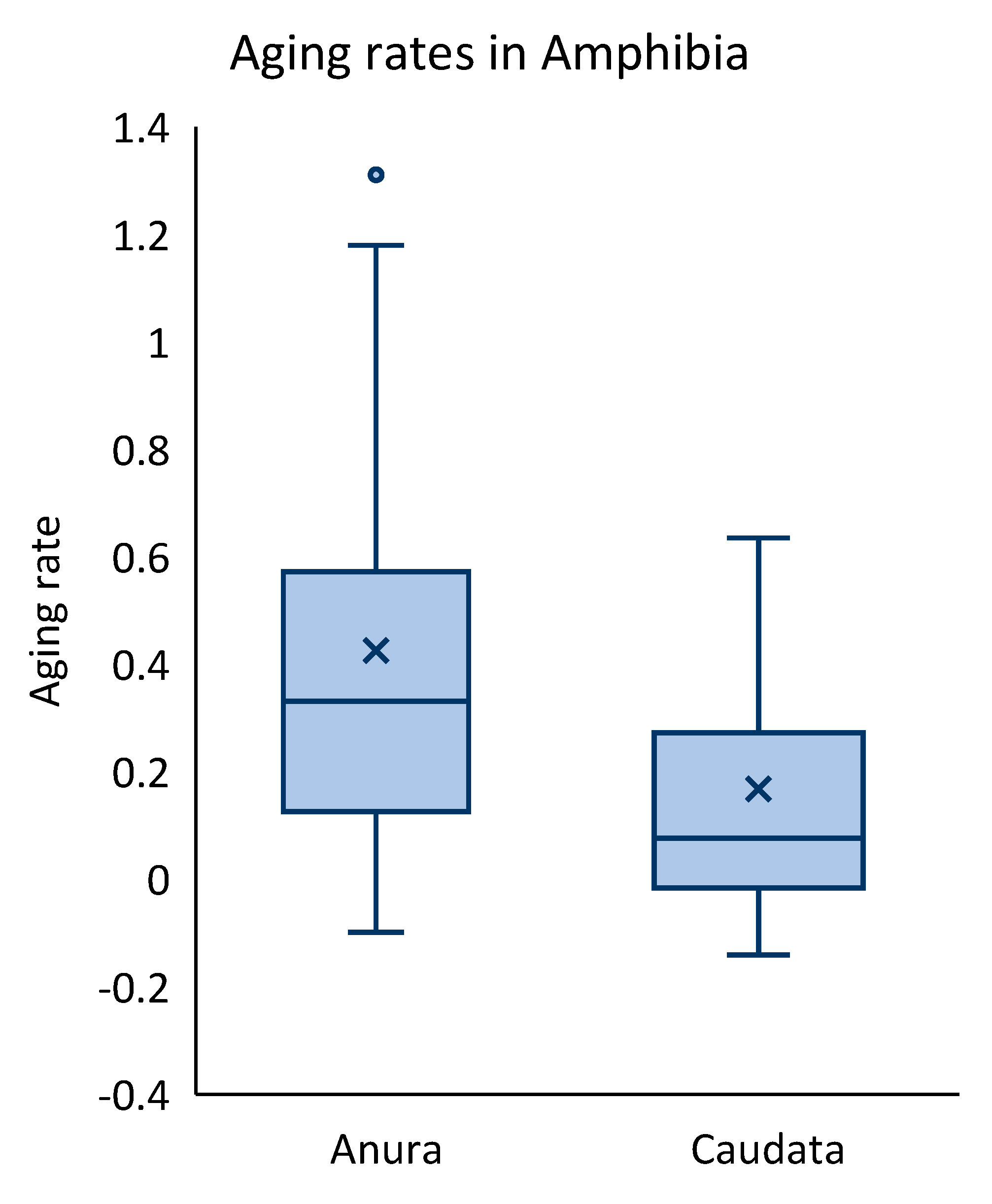
Disclaimer/Publisher’s Note: The statements, opinions and data contained in all publications are solely those of the individual author(s) and contributor(s) and not of MDPI and/or the editor(s). MDPI and/or the editor(s) disclaim responsibility for any injury to people or property resulting from any ideas, methods, instructions or products referred to in the content. |
© 2026 by the authors. Licensee MDPI, Basel, Switzerland. This article is an open access article distributed under the terms and conditions of the Creative Commons Attribution (CC BY) license (http://creativecommons.org/licenses/by/4.0/).
Copyright: This open access article is published under a Creative Commons CC BY 4.0 license, which permit the free download, distribution, and reuse, provided that the author and preprint are cited in any reuse.


