

Submitted:
02 April 2026
Posted:
07 April 2026
You are already at the latest version
Abstract
Southern Chinese lion dance (nanshi) in Bangkok moves between temple ritual, community representation, school training, and judged competition, yet these domains are rarely analyzed together. Focusing on recent institutional transformation within one influential Teochew-centred ecology, this article examines how ritual governance, competition, and heritage-making have become mutually reinforcing. The study combines multi-sited historical ethnography in Bangkok and Guangdong (2022-2023) with documentary traces from the 2000s-2020s, including temple and association commemorative publications, municipal school records, Thai cultural and competition reporting, heritage registers, and transnational rule texts. It finds that huiguan and temples stabilize calendars, patronage, and authority, while judged competition introduces auditable norms of time, safety, team composition, and difficulty. These regimes do not simply displace ritual; they reorganize it. Certificates, trophies, lion heads, photographs, and anniversary volumes turn performance credentials into community archives that narrate continuity, merit, and public legitimacy. Rather than a linear shift from ritual to sport, the Bangkok case shows how codification, temple-linked patronage, and heritage discourse jointly reshape a diasporic ritual practice.
Keywords:
lion dance
; Bangkok
; Chinese temples
; Teochew diaspora
; ritual governance
; community archives
; heritage
1. Introduction
Research on Chinese religion and diaspora has long shown that temples, regional associations, and festivals stabilize communal life across migration and political change. Southern Chinese lion dance illuminates this nexus. In Bangkok, lion dance moves between temple ritual, huiguan representation, school training, and judged competition. These movements make it difficult to classify the practice as merely folklore, entertainment, or sport. They instead raise questions central to the study of religion: how ritual authority is organized, how institutional patronage shapes embodied performance, and how archives of merit and lineage are assembled in public (Ho 1995; Skinner 1957).
Lion dance’s meanings have never been stable. Across southern China and its diasporas, it has been framed—sometimes simultaneously—as ritual protection, martial training, communal representation, public entertainment and, increasingly, competitive sport and cultural heritage. These framings are institutional: they shape who may perform, what counts as ‘proper’ technique, and how legitimacy is distributed.
‘Southern lion dance’ is used here as an analytical shorthand for a broad family of practices (often grouped as nanshi) rooted in southern China’s ritual and martial ecologies, but diversified through regionally specific lineages and diaspora histories. The analysis does not treat ‘southern’ as a coherent tradition; rather, it tracks how particular institutional ecologies stabilize certain repertoires, training regimes, and claims of authenticity. Empirically, the study centres on Bangkok’s Teochew/Chaoshan-linked ecology and reconstructs a recent institutional transformation primarily from 2022-2023 fieldwork and documentary materials from the 2000s-2020s; mid-twentieth-century histories enter mainly through secondary scholarship and commemorative traces rather than a full archival reconstruction.
The core question, then, is not whether lion dance is ‘really’ ritual, sport, or heritage, but how institutions and rule regimes make it legible and governable across these registers - especially when ritual obligation, public accountability, and bodily risk converge.
By the early twenty-first century, lion dance is increasingly celebrated as heritage and, in many places, organized as a competitive sport. In China, ‘lion dance (Guangdong awakening lion)’ appears on the first batch of the national intangible cultural heritage list announced in 2006; related southern-lion forms such as ‘lion dance (qingshi)’—registered for Jieyang in the Chaoshan/Teochew region—appear as expansion items in 2011 under the same project number (Ⅲ-5). These official categories are less a taxonomy to be replicated than a repertoire of public legibility: Bangkok’s Teochew-centred ecology draws on Chaoshan lineages while strategically invoking the broader ‘awakening lion’ label when negotiating state-recognized heritage and competitive legitimacy (Ministry of Culture, PRC 2006; IHChina 2011).
Figure 1 summarizes selected milestones in the governance of southern lion dance as competitive heritage: diasporic institution-building in twentieth-century Bangkok, the rise of transnational rulebooks, and the recent alignment of heritage listing with municipal and federation programming.
Bangkok’s relevance lies partly in its diasporic demography and institution-building. Thai Chinese communities have long organized through regional associations (huiguan), temples and schools, which stabilize philanthropy, mutual aid and public representation. Teochew organizations have been particularly prominent in Bangkok’s Chinatown, shaping a dense infrastructure of community governance that intersects with ritual performance. When lion dance is performed in Bangkok, it is therefore rarely ‘just performance’: it is simultaneously institutional representation, youth discipline and public-making.
Historical scholarship on Bangkok’s Chinese temples shows that formal speech-group associations did not become legible and durable simply through ‘culture’ alone, but in interaction with state registration regimes. Thai laws requiring legal registration of Chinese organizations began to be enforced in the early twentieth century; before that, temples often functioned as mutual-aid associations, tribunals, and commercial infrastructures for particular speech groups. These institutional histories matter because they help explain why lion dance in Bangkok is routinely organized through durable infrastructures that can sustain training cycles, competitions, and public claims over time (Ho 1995; Skinner 1957).
Bangkok municipal documentation also frames lion dance as organized youth training rather than an ad-hoc festive act. A Bangkok Metropolitan Administration (BMA) Department of Education ‘Best Practices’ entry for Wat Samphanthawong School traces a programme begun in 2007, describing the purchase of five Chinese drums, the hiring of an external instructor, and routine weekly training for a cohort of interested pupils; later sections record sponsorship for lion heads and public performances in Yaowarat festival settings, including a 2019 performance for Princess Sirindhorn. Such documents show municipal education institutions treating lion dance as a managed programme—with targets, process charts, and public dissemination through social media—rather than as spontaneous ‘cultural display’ (Bangkok Metropolitan Administration n.d.a).
At the same time, international and regional competitions codify southern lion dance into repeatable and auditable formats: teams compete under standardized time limits, team-size requirements, safety rules, and judging criteria. Rather than treating this as a simple ‘modernization’ of tradition, the analysis examines how institutions translate a ritual performance ecology into commensurable competitive form while preserving enough meaning to keep communities invested.
Bangkok offers a strategic site for addressing this issue, not because the case covers every lion-dance formation in the city, but because it contains a durable Teochew-centred institutional ecology in which competitive governance, diasporic institution-building, and heritage-making are visible at once. Lion dance is visible in Bangkok’s temples, festivals, weddings, and commercial celebrations; within the ecology traced here, troupes increasingly resemble sport associations, complete with coaches, recruitment pathways, age-grouped training, and competition schedules. The city thus concentrates three dynamics that are often studied separately: diaspora institution-building, competitive governance and rule-based comparison, and heritage-making.
Southern lion dance in the Bangkok ecology examined here has been governed through overlapping rule regimes and heritage practices that together produce a public history of community sport. The argument therefore concerns not an undifferentiated “Bangkok lion-dance field” but one influential Teochew-centred institutional ecology within it: rule regimes translate lineage repertoires into commensurable, publicly auditable performances, and the credentials produced in competition become materials later curated as community history. Governance and heritage are therefore not sport’s afterlife but part of how community sport is made and historically narrated.
Huiguan and temple infrastructures anchor resources and authority, competitions reorganize practice through auditable rules, and community archives convert competitive credentials into publicly narratable histories.
Empirically, the analysis draws on historical ethnography combining multi-sited fieldwork in Bangkok (Dec 2022-Apr 2023) and southern China (Guangdong; Aug-Oct 2022) within the broader southern lion-dance ecology, participant observation, and documentary analysis of community publications, catalogued institutional histories, official heritage registers, municipal cultural programming, and competition regulations. The historical claim is deliberately delimited: rather than offering a continuous archival history of Bangkok lion dance from the mid twentieth century onward, the study reconstructs a recent institutional transformation and its longer enabling histories.
1.1. Lion Dance, Diasporic Religion, and Heritage Politics
Scholars have approached lion dance through multiple disciplinary lenses, producing rich but uneven literatures. Folklore studies and performance scholarship have emphasized origins, mythic genealogies and regional stylistic variation. Work in dance ethnography and musicology has reconstructed movement vocabularies, drum patterns, costume aesthetics and the dramaturgy of auspicious interaction with spectators. These studies demonstrate that lion dance is not a single ‘tradition’ but an ecology of lineages and local histories, particularly within the broad family of southern (nanshi) practices.
A second body of scholarship examines lion dance as diasporic identity work. In Southeast Asia, lion dance frequently appears in accounts of Chinese migration, temple patronage and community institution-building. Performances are read as claims to belonging in urban public space: they materialize communal presence through noise, colour, disciplined bodies and the capacity to mobilize resources. In this literature, the lion is often treated as a semiotic technology of ethnicity and a ritual instrument for managing auspiciousness in commercial and domestic life.
A third strand focuses on heritage policy and the politics of recognition. Since UNESCO’s 2003 Convention for the Safeguarding of the Intangible Cultural Heritage, scholars have examined how ICH frameworks reshape local practices: they can generate new resources and visibility, but they also produce new orthodoxies of ‘authenticity’, institutional gatekeeping and performative standardization. Lion dance has been a recurring case because it is widely practiced across diasporic settings and easily staged for festivals, tourism and cultural diplomacy.
In Thailand specifically, lion dance has been studied both as Chinese cultural performance and as an emerging sport-club ecology nested within wushu governance. Thai-language scholarship and policy-oriented reports document how clubs, schools, provincial organizers, and federation actors build competition circuits and, crucially, how international judging frameworks for high-pole routines are translated, taught, and debated in Thai ‘wushu-lion’ events. These accounts are valuable because they show that competitive governance is not an external analytical imposition; it is an emic framing present in Thai discourse around lion dance as ‘sport’, ‘championship’, judge training, and ‘international standard’ (Thai Science Research and Innovation n.d.; Viphatphumiprathes 2015; Wattanaboonya et al. 2024).
However, most analyses still treat these domains as adjacent rather than mutually constitutive. Using Bangkok as a case where all three are visible at once, the analysis addresses that gap.
Taken together, these literatures explain why lion dance is culturally salient. Yet they often treat ritual, institutional patronage, and competitive regulation as adjacent rather than mutually constitutive.
Scholarship on religion, ritual studies, and Chinese diasporas offers strong tools for analyzing temple networks, authority, patronage, and embodied practice. What it less often explains is how judged competition, documentary auditing, and codified safety rules are folded back into ritual life.
Conversely, work on codification, comparison, and governance helps explain how performances become commensurable and publicly legible. Bringing these perspectives together clarifies how temple-linked practices are transformed without becoming simply secular.
Bangkok offers a way to bridge these literatures because the Teochew-centred ecology traced here is both deeply institutional and increasingly organized through competitive circuits and rule regimes. Teochew and other Chinese associations in Bangkok provide enduring infrastructures of community governance—schools, temples, philanthropic projects, and a dense public calendar. These institutions also sponsor and stage lion dance, making performance obligations and training cycles predictable (Ho 1995; Skinner 1957).
At the same time, Thailand has developed competition infrastructures that increasingly treat lion dance—especially high-pole ‘mei hua zhuang’ formats—as a regulated sport-like discipline. Provincial public-relations releases for the Roi Et Thailand International Acrobatic Lion Dance Championship describe a multi-country championship staged in public space and, in 2025, explicitly record that provincial authorities co-organized the event with the Wushu Association of Thailand. Such documents provide a concrete institutional trace of how lion dance governance is nested within recognized sport-administrative structures, even when public-facing competitions are staged as cultural festivals (Roi Et Provincial Public Relations Office 2024, 2025).
Lion dance is also publicly framed as a competitive cultural event by state cultural bodies, as seen in the Ministry of Culture’s calendar listings for international lion dance competitions, which specify codified categories (e.g., caiqiang and mei hua zhuang) and name Bangkok-based teams among participants (Ministry of Culture (Thailand) 2024).
These developments suggest that lion dance is not merely ritual that later acquires public visibility; it is a diasporic ritual practice increasingly codified, judged, and credentialed. The analytical challenge is to explain how this codification travels through institutions that remain deeply entangled with temples, schools, and regional associations.
Bangkok also highlights a methodological point. If communities produce their own histories through trophy displays, commemorative books, temple collections, and online archives, then scholars of religion must treat these materials as primary evidence for recent institutional transformation.
1.2. Ritual Governance, Competition, and Community Archives
This framework connects ritual studies, governance, and critical heritage studies. Rather than treating heritage as something that merely follows codification, it traces how rule-making and archival curation stabilize legitimacy for a practice that remains at once ritual, performative, and competitive.
Rule regimes as translation. Classic accounts of modern sport emphasize codification, quantification, bureaucratic organization, routinized training, and the production of comparable performances. For lion dance, the analytical challenge is not to prove that it can be ‘sport’, but to show how competitive rule regimes translate heterogeneous lineage repertoires into auditable formats that can travel across venues and communities (Guttmann 1978; Elias and Dunning 1986).
To analyze this translation, the framework draws on commensuration: the work of turning qualitatively diverse performances into comparable units. In competitive lion dance, commensuration is built through time limits, prescribed elements, safety requirements and judging categories. These devices do not erase meaning; they make performance publicly evaluable, allowing rivalry and shared standards to coexist (Espeland and Stevens 1998).
This approach draws attention to the evaluative technologies that sit beneath ‘competition’: how organizers specify what counts; how judges are trained; how safety is operationalized; and how teams learn to perform for an audit. Rule regimes thus become historical sources. They reveal what communities at particular moments wanted lion dance to be—spectacle, discipline, ritual service, athletic risk, or some negotiated mixture.
Rule-governed competition is not necessarily the opposite of ritual. Ritual calendars can stabilize training cycles; temple patronage can finance equipment; and lineage authority can legitimate judging criteria. The relevant historical question is therefore how these modes of authority are articulated, not which one is more authentic.
An infrastructure lens remains necessary because huiguan offices, temples, schools, and competition circuits organize resources, scheduling, training, and public visibility across time.
Competitive governance also produces portable credentials—trophies, rankings, certificates, and media coverage—that institutions display to patrons and community leaders as proof of excellence.
Competitive heritage names the process through which rule-governed evaluation and documentary curation reinforce one another. Rulebooks and judging sheets translate embodied technique into comparable scores; titles, certificates, and trophies make those evaluations portable; and commemorative or municipal documentation narrates them as public evidence of excellence. The term is meant to specify this linkage, not to multiply labels unnecessarily (Smith 2006).
Infrastructure is not neutral. It shapes what a practice becomes by determining what kinds of labour are required and what kinds of evidence count. When a huiguan funds a troupe, performance is not merely an aesthetic act; it is institutional representation. When a competition requires a routine to include caiqing and limits it to a timed window, narrative and technique are reorganized around adjudication. When a temple displays trophies and lion heads, it curates a public memory of achievement.
Heritage and community archives. Heritage studies emphasize that heritage is produced through selection and narrative framing, often under an authorized discourse that privileges certain institutions and forms of expertise. Community archives scholarship likewise shows how non-state actors curate documents, objects, and memories to make collective pasts public (Aikawa-Faure 2009; Smith and Akagawa 2009).
Lion dance in Bangkok sits at the intersection of these debates. It is framed through intangible cultural heritage discourse, anchored in temple and huiguan institutions, and increasingly organized through rule-governed competition and event economies that generate auditable traces.
A heuristic relation can be stated without implying a single sequence. Infrastructures organize resources and authority; rule-regime translation turns practice into commensurable display; and community-archive materialization stores the resulting claims to merit, continuity, and public value.
The point is not to posit a linear path from ritual to sport. Rather, multiple regimes - ritual obligation, competitive evaluation, and heritage recognition - interlock in practice. The same performance can be simultaneously a temple obligation, a judged routine, and an archival trace of community standing.
2. Materials and Methods
ecause the evidentiary core concerns a recent institutional transformation rather than a continuous serial archive, lion-dance governance survives in dispersed institutional traces. Reconstructing it therefore requires historical ethnography: fieldwork that follows institutions in action, alongside documentary reading that treats programmes, school files, commemorative publications, and rule texts as historical evidence of how practice has recently been reorganized. For a transformation carried through municipal school programmes, competition calendars, federated PDFs, commemorative volumes, and community display practices, such born-digital and institutional traces are not auxiliary to the archive; they are among its primary historical records.
Fieldwork moved across huiguan-affiliated troupes, temple committees, school-based teams, and competition-linked settings. The evidentiary core comprises 30 key-informant interviews with association leaders, teachers, judges, senior performers, committee members, and organizers; approximately 100 ethnographic conversations with students, parents, donors, volunteers, and spectators; and 20 general-informant interviews with institutional stakeholders and cultural officers. Repeated observation at rehearsals, ritual performances, competitions, school sessions, and meetings supplied the main evidence for recent governance routines.
Observations and interviews were conducted across huiguan-affiliated troupes, temple committees, school-based teams, and competition-related events in Bangkok, with supplementary field visits in the Chaoshan region to contextualize lineage narratives and cross-border training networks. Claims about rule uptake and training routines rest chiefly on observation, interviews with coaches and judges, BMA school files, and Thai competition reporting; claims about community history and archival display rest chiefly on commemorative publications, anniversary materials, and trophy/certificate displays; claims about the mid-twentieth-century background rely more modestly on secondary scholarship and commemorative traces. Triangulation across these materials made it possible to compare what institutions claimed with how training and performance were actually organized.
The contrast between ritual performances, commercial bookings, and competition-oriented rehearsals was especially revealing. In temple settings, interaction with patrons and spectators often governed pacing and sequence; in competition rehearsals, the same performers broke routines into timed modules, safety drills, and scoring-sensitive passages. Watching actors move between these settings made visible the practical work of translation between ritual obligation and judged display.
Documentary materials were read with different evidentiary weights. Published historical scholarship and community compilations provide the longer background, especially where pre-2000 records survive unevenly; they establish conditions of possibility and governance change rather than a continuous serial archive.
Huiguan and temple publications—anniversary volumes, event programmes, commemorative special issues, and catalogued institutional histories—show how institutions narrate continuity, claim legitimacy, and curate proof of achievement. Because some also survive in library catalogues or stable facsimiles, they can be checked beyond the immediate field site (MANGU n.d.; University of Tokyo Asia Research Library n.d.; Lee 2018).
Rulebooks and competition regulations were used differently again: not as proof that every Bangkok troupe follows one named code, but as evidence of the evaluative grammar through which timing, roster, safety, and judging expectations became locally operative. Read against Thai competition reporting, municipal school files, and interviews, they show how mediated uptake became visible in practice (CTDLDA 2008; USDLDF 2018a, 2018b; CanAm International 2025; China Dragon and Lion Dance Sports Association n.d.).
Reading across these materials made it possible to assemble a recent institutional history from dispersed traces. Fieldnotes and interview transcripts were checked against municipal records, commemorative narratives, and competition documents; where possible, interpretive summaries were discussed informally with coaches and organizers so that internal categories of value were not misstated.
Such cross-reading mattered most where institutional self-descriptions were aspirational: commemorative narratives could be tested against observed training routines, and claims about competition standards could be checked across multiple rule documents and Thai reporting.
Because lion dance in Bangkok operates across multiple languages (Thai, Teochew, Mandarin and other Chinese varieties), translation is not merely a research technique but a feature of the field. Terms such as ‘sport’, ‘art’, ‘heritage’ and ‘tradition’ do not map neatly across languages and institutions. Interviews and observations therefore attended to how actors themselves translated these categories when addressing different publics (temple committees, sport officials, school administrators and media audiences).
What can be taken beyond this case is not a claim that all southern-lion worlds look like Bangkok, but a mechanism: competitive governance and heritage practice can become mutually reinforcing when diasporic institutions provide durable infrastructures for training, commemoration, and public accountability.
3. Results
3.1. Diasporic Infrastructures: Temples, Huiguan, and Schools
Huiguan-temple infrastructures anchor ritual and competitive governance
In Bangkok, lion dance is sustained through infrastructures that are simultaneously ritual and organizational. Huiguan and temples provide three stabilizing functions that are prerequisites for a stable competitive ecology: they stabilize time, resources and authority.
Stabilizing time. The ritual calendar creates predictable performance demand. Lunar New Year blessings, temple festivals, processions and funerary obligations structure an annual rhythm. This rhythm matters because competitive governance requires repetition: skills must be practiced, refined and demonstrated under pressure. When performances are scheduled predictably, troupes can build training cycles and recruitment routines. In interviews, organizers described how rehearsal intensity increases before New Year, then shifts toward specific temple festivals and competition seasons.
Stabilizing resources. Costumes, drums, gongs, lion heads and apparatus require investment. So do coaches and travel to competitions. Huiguan, temples and school programmes pool resources through committee budgets and earmarked funds for equipment and instruction. Community publications and association records describe Teochew institutional portfolios spanning education, religious sites and philanthropy, helping explain their capacity to sponsor large public events and sustained youth training (MANGU n.d.; Bangkok Metropolitan Administration n.d.a, n.d.b).
Material infrastructures matter. High-pole routines (plum blossom poles) require not only skilled bodies but also expensive apparatus and secure spaces for rehearsal. Institutions that can provide courtyards, halls, or school grounds with sufficient clearance effectively determine whether a troupe can pursue high-difficulty competitive pathways. Several Bangkok troupes described negotiating rehearsal access through temple committees or affiliated schools, illustrating how spatial governance is part of competitive governance. Within this ecology, huiguan and temples, school programmes, federation-linked organizers, and public authorities together form the main nodes through which resources, schedules, visibility, and legitimacy are coordinated.
Stabilizing authority. Competitive governance requires authoritative adjudication: someone must decide what counts as ‘good’ and who has the right to represent the practice in public. In Bangkok, authority is distributed. Lineage leaders (masters and senior performers) claim technical authority. Temple committees claim ritual authority. Huiguan executives claim organizational authority. Rather than competing, these authorities often interlock: a troupe’s legitimacy is strengthened when it is recognized by both lineage and institution.
Authority negotiations are sometimes tense. Competition-oriented coaches may prioritize routines that score well, while temple committees may prioritize ritual appropriateness and community service. Lineage elders may criticize ‘showy’ movements as inauthentic, while younger performers may see competition as a path to recognition and travel. These tensions are typically negotiated institutionally—through scheduling (separating ritual and competition rehearsals), through symbolic compromises (including ritual blessing sequences within competition routines), and through leadership roles that bridge domains (masters who also hold association positions).
The infrastructure’s disciplining effects are visible in troupe organization. Bangkok lion dance teams often operate under two organizational models. In a ‘sports association’ model, troupes are structured like clubs: they have designated coaches and managers, recruit through schools and community organizations, and organize members into age groups with systematic training and competition schedules. In a ‘family style’ model, transmission remains largely within kin and neighbourhood networks, with emphasis on continuity and community cohesion. The key point is that the club-like model is not simply imported from Western sport; it is assembled through local infrastructures - schools, huiguan youth groups, and temple patronage - that provide the organizational resources needed for sustained training and public accountability.
Municipal education documents provide a rare window into how school-based infrastructures narrate and operationalize governance. In a BMA Department of Education best-practice entry, Wat Samphanthawong School describes Chinese drumming and lion dance as a Thai–Chinese cultural programme embedded in bilingual education. The document records equipment purchases and sponsorship (drums and multiple lion heads), routine weekly instruction slots, and explicit quantitative indicators for participation, alongside qualitative goals of making lion dance the school’s ‘identity’. It also specifies a flow-charted process—from planning and curriculum design to public performance and ‘quality maintenance’—and explicitly instructs staff to record video and disseminate performances to the public (including via YouTube) (Bangkok Metropolitan Administration n.d.a).
Institutions also shape what is valued. In ritual contexts, success is often judged through auspicious interaction: the lion’s ability to ‘bless’ shops, respond to patrons, and enact moral order in public space. In competition contexts, success is judged through commensurable technique: timing, synchronization, difficulty and safety. Huiguan and temples mediate between these regimes by framing lion dance as both cultural service and disciplined training. Organizers frequently described lion dance as a technology of youth governance: an embodied practice through which young people learn punctuality, hierarchical respect and collective responsibility.
The infrastructural ecology is also archival. Huiguan and temples curate the evidence through which performances are remembered and legitimized: photographs, event programmes, trophy and certificate displays, and commemorative publications. This matters because competitive governance and heritage-making require documentary traces that can be publicly shown, circulated and cited.
Archival accumulation has feedback effects. When trophies and certificates are displayed in huiguan halls or temple foyers, they create a public metric of excellence. Young performers see a visible ladder of achievement; patrons see evidence of institutional prestige; organizers can mobilize these displays to justify funding. In this sense, the infrastructure does not merely host lion dance - it produces a public memory and an evaluative environment that pushes practice toward performance-oriented commensuration.
Finally, infrastructural anchoring explains why competitive governance in Bangkok cannot be reduced to state sport policy or market entertainment. Even when performances are commissioned for commercial venues, performers often interpret them through the moral geography of huiguan–temple obligations. The infrastructure therefore produces a distinctive hybrid: a practice that is simultaneously ritual labour, community representation and competitive preparation. This hybridity is not a transitional stage; it is a durable feature of lion dance’s public life in Bangkok.
3.2. Rule Regimes in Motion: Competition, Safety, and Ritual Translation
Rulebooks and competitions translate vernacular repertoires into commensurable performances
If huiguan–temple infrastructures anchor practice, competitions and rulebooks translate it into commensurable form. In Bangkok, the clearest evidence points not to a single universally named rulebook, but to a mediated rules ecology in which coaches, judges, federations, and organizers broker comparable standards across events. Competitive governance therefore requires commensuration: the ability to compare performances across teams, events and judges. In lion dance, commensuration is built through rule regimes that specify team composition, timing, required narrative elements, difficulty categories and safety standards.
Rule regimes. Competition regulations specify, for example, how many performers may constitute a team, how assistants are managed, how time is measured, what equipment or props are permitted, and what incurs deductions. In several widely circulated rulebooks, competition time limits are specified alongside protocols for when time starts and stops, penalties for over- or under-time routines, and provisions for set-up time and arbitration (CTDLDA 2008; USDLDF 2018a, 2018b; CanAm International 2025).
These documents are remarkably specific. International-style rules typically fix the number of performers in the lion and the number of assistants allowed on the competition floor, define when time starts and stops, and specify point deductions for over- or under-time routines. For pole routines, rules also outline safety provisions—spotters, apparatus checks and fall-prevention measures—reflecting the transformation of lion dance into an activity managed through risk governance as well as aesthetic judgement. Figure 2 renders Article 12’s venue specification: a 20 m square competition field (18 m minimum in special circumstances), a 0.05 m boundary line whose inner edge defines the field, a minimum 1 m obstacle-free zone around the boundary, wood-board or carpeted surface, and at least 8 m of overhead clearance (CanAm International 2025).
As a comparative benchmark, the CanAm 2025 rulebook—used here because it explicitly adopts an International Dragon and Lion Dance Federation framework—specifies a 7–9 minute competition window (including entrance and exit), with timing linked to the lion’s movement into and out of the competition area.
Judging rubrics commonly separate ‘difficulty’ from ‘artistry’ and ‘teamwork’, mirroring evaluative logics in sports such as gymnastics and figure skating. This separation is not culturally neutral: it privileges routines that can demonstrate difficulty in auditable ways, often favouring elevated apparatus and acrobatic sequences. At the same time, the presence of artistry categories preserves space for lineage expression—drum cadence, expressive head work, comedic play—within a quantified framework.
Regulation has not disappeared; it has changed form. Where earlier governance was exercised through huiguan and temple committees managing ritual calendars and behavioural norms, contemporary competitive lion dance is managed through risk governance and auditability: mats, spotters, equipment checks, explicit prohibitions on hazardous props and dedicated arbitration procedures. The shift is visible in how Bangkok schools and municipal programmes frame lion dance as a structured, timetabled extracurricular activity rather than an ad hoc festivity, bringing the competition rubric into everyday training routines (CTDLDA 2008; Bangkok Metropolitan Administration n.d.a).
Such rules do not simply constrain; they produce a shared grammar through which diverse styles can be evaluated. Southern lion dance is internally plural—Cantonese ‘awakening lion’ lineages, Teochew repertoires, hybrid routines influenced by Malaysian and Singaporean competition circuits. Rulebooks create ‘difference within standardization’: teams can retain stylistic signatures (drum patterns, head design aesthetics, comedic sequences) while conforming to shared timing and safety rules.
Thai competition infrastructures. Within Thailand, competitive governance is carried by a mix of sport federations, cultural ministries, and local authorities. Provincial public-relations reporting on the Roi Et Thailand International Acrobatic Lion Dance Championship describes the event as a wushu-lion-dance competition staged by provincial bodies together with the Wushu Association of Thailand, indicating how lion-dance competition is institutionally nested within sport-administrative structures even when framed as festival culture. Thai policy-oriented reports also flag uneven standards and highlight rule interpretation, translation, and judge training as recurring practical concerns. The mechanism that emerges is not simple rule importation but mediated uptake: federation and judge-training channels translate international commensuration into locally operable practice (Roi Et Provincial Public Relations Office 2024, 2025; Thai Science Research and Innovation n.d.).
Competitions are also visible as public cultural events in state cultural programming. The Thai Ministry of Culture’s event calendar listing for the 10th International Lion Dance Competition (April 28–29, 2024) specifies two judged categories—formation routines (ground choreography) and “plum blossom pole” routines (elevated apparatus)—and lists participating troupes from seven countries, including Bangkok-based teams named in the programme. This is a concrete local trace: transnational competition categories are named in Thai public programming and tied to identifiable Bangkok entrants, rather than remaining abstract features of foreign rulebooks (Ministry of Culture (Thailand) 2024).
Competitive governance is reinforced through education policy as well. In Bangkok, interviewees described government encouragement for schools and communities to include lion dance in curricula and to organize competitions to stimulate youth interest. Such initiatives embed lion dance within institutional time and evaluation structures familiar from sport and education, further normalizing the idea that lion dance can be ‘trained’ and ‘competed’ rather than only performed.
Municipal documentation makes this routinization visible. A Bangkok Metropolitan Administration (BMA) “best practice” entry for a primary school’s lion-dance programme records twice-weekly practice sessions and earmarked school budgets for equipment (lion heads, drums, cymbals and uniforms). It frames lion dance as both cultural pride and a pathway to public performance in Yaowarat’s Chinese New Year events, indicating how civic education and public culture intersect with competitive preparation. Read historically, the file shows how competition-style discipline enters everyday training not through a single named rulebook but through timetables, procurement lines, measurable participation targets, and expectations of public dissemination (Bangkok Metropolitan Administration n.d.b).
These infrastructures reshape training in concrete ways. At school-based sites, twice-weekly sessions recorded in municipal files fed into pre-competition periods of timed run-throughs, role allocation, equipment checks, and coach-led full simulations. A repeated sequence ran from scheduled practice, to simulated judged performance, to public competition or festival appearance, and then back into institutional display through certificates, trophies, and publicity. Across interviews, coaches described training plans that moved from conditioning to technique work, then to routine assembly and timed full-run simulations - a sequence closer to sport periodization than to ad hoc festive preparation.
Translation work. Performers must translate lineage repertoires into the grammar of competitive scoring. Temple ‘blessing’ sequences are oriented to auspicious interaction with spectators and patrons; competition routines are oriented to difficulty points and deduction avoidance. Translation therefore involves re-ordering narrative and technique. A troupe might keep a recognizable lineage ‘flavour’—a particular drum cadence or comedic play—but insert codified difficulty elements, adjust tempo to fit time limits, and plan caiqing sequences to maximize scoring potential.
Standardization also produces new forms of authority. In ritual contexts, lineage elders and temple committees often adjudicate quality through reputation and moral standing. In competition contexts, authority shifts toward certified judges, coaches trained in rule interpretation, and federated bodies that define categories. This does not eliminate lineage authority; rather, it creates layered authority. A master’s legitimacy may now be enhanced by their ability to interpret rules, train competition routines, and produce trophies that can be publicly displayed.
Inequality and patronage. Rule-based competitive governance can intensify inequality because high-difficulty routines require apparatus, travel and specialized coaching. This makes huiguan and temple patronage even more consequential. Institutions that can finance equipment and transport effectively subsidize competitive governance. Conversely, troupes without institutional backing may be confined to low-cost festival performance circuits. Competitive governance therefore reconfigures, rather than dissolves, the moral economy of patronage.
Transnational circuits. The Bangkok ecology examined here is shaped by rule documents circulating across the wider southern-lion world. Across widely circulated rulebooks and participation/organization guides (CTDLDA, USDLDF, CanAm, and China Dragon and Lion Dance Sports Association), a recognizable commensuration grammar recurs: roster caps, routine time windows measured to the second, named support roles, safety protocols for elevated apparatus, and deduction-based judging. Table 1 summarizes this convergence, coding Bangkok linkages as D (direct adoption), M (mediated uptake), or A (alignment). Because publicly accessible Bangkok documents rarely name a single authoritative rulebook for all troupes, the argument rests chiefly on mediated uptake: Thai actors adopt and translate a shared rules ecology through competition categories, judge training, federation channels, and school programmes. In China, event-operation guides translate competition into administrative templates (identity checks, medical examinations, standardized procedures), showing governance travelling as bureaucracy as well as technique (CTDLDA 2008; USDLDF 2018a, 2018b; CanAm International 2025; China Dragon and Lion Dance Sports Association n.d.).
Close reading across these rule documents shows commensuration at work in three linked places. Table 1 summarizes the rule texts with the clearest Bangkok linkage; CanAm 2025 remains in the surrounding discussion only as a later comparative benchmark aligned with the same evaluative grammar. First, timing protocols define when the clock starts and stops and specify deductions for under- or over-time routines. Second, roster rules define who counts as a legitimate team and who may appear on the floor. Third, safety protocols define how risk is made governable through mats, spotters, apparatus checks and arbitration procedures.
Credentials as portable capital. Competitions produce portable credentials—trophies, certificates, ranked titles—that circulate as cultural capital. These credentials can be displayed in huiguan halls and temple foyers, used in recruitment, and mobilized in institutional storytelling. In this way, competitions connect directly to heritage-making: winning becomes public proof of excellence that can be narrated as institutional achievement and cultural value.
In short, rule regimes and competitions translate lion dance into commensurable performance without erasing local meaning. They do so by building a shared evaluative grammar, reorganizing training around judged categories, and producing credentials that travel across institutional contexts. Competitive governance is therefore not a superficial ‘modern layer’; it is a deep reconfiguration of how performance is governed, evaluated and remembered.
Professionalization accompanies standardization: as competitions expand, federated systems offer courses, accreditation and judge training, making rule knowledge portable expertise. Thai policy reporting describes uneven standards, disputed judging, and the need to translate English- and Chinese-language competition rulebooks. A peer-reviewed study of Bangkok’s Thonburi scene identifies the Wushu Federation of Thailand as the principal association and notes four major annual competitions (Thailand Championship, National Games, Youth National Games, Student National Games); it also reports that Singapore-based associations have sent instructors four to five times per year since 2015 to teach technique and competition rules. Interview and Thai-language research materials also distinguish association-linked “official” championships from more flexible family-style contests, suggesting that Bangkok actors themselves recognize different degrees of rule formalization. Thai scholarly writing reproduces IDLDF scoring and deduction tables for pole-jumping routines, while a TSRI report treats translation and judge training as pressing issues. Taken together, these materials do not prove uniform one-to-one adoption of a single foreign rulebook at every Bangkok event. They do, however, show a Bangkok rules ecology concretely shaped by named competitions, recurring training channels, IDLDF-style categories, translated judging logics, and federated brokerage (Thai Science Research and Innovation n.d.; Senthong and Chumat 2021; Viphatphumiprathes 2015).
3.3. From Competitive Credentials to Community Archives
Heritage practices make lion dance legible as community history
Competitive governance alone does not explain why lion dance is increasingly claimed as heritage. The third process is heritage-making: the active production of public narratives, archives and displays that position lion dance as a valuable community past. In the Bangkok ecology traced here, this heritage work is only partly formalized through state bureaucracy; the clearest local evidence lies in municipal cultural calendars, school best-practice discourse, official invitations, and community curation through huiguan, temples, schools and media publics.
A key background condition is the rise of intangible cultural heritage frameworks. The inclusion of lion dance on China’s national ICH list illustrates how ‘tradition’ is reframed through authorized recognition (Ministry of Culture, PRC 2006; IHChina n.d.).
Heritage descriptions already speak the language of disciplined difficulty. The national register distinguishes between Guangdong ‘awakening lion’ and Chaoshan/Teochew-centred ‘qingshi’ as separate items under the broader lion-dance category (project number Ⅲ-5), reminding us that ‘southern lion’ is not a single heritage object but a field of lineages made legible through official labels. The official project entry for Guangdong awakening lion frames lion dance as a composite of martial arts, dance and music, and it foregrounds high-pole repertoires valued for being ‘new, high, difficult and risky’. Read alongside contemporary rulebooks that enumerate difficulty actions and standardize apparatus dimensions, heritage recognition does not sit outside sport governance; it draws on many of the same evaluative idioms—skill, danger, and auditable technique (IHChina n.d.; IHChina 2011).
Heritage frameworks matter in Bangkok because they provide a language of value that can travel across communities and states: heritage becomes a way to justify public funding, to claim respectability, and to align practice with education and civic contribution. In the Thai case examined here, the relevant public infrastructure is lighter than a formal national heritage-inscription regime but still consequential: municipal school discourse, cultural-event listings, and public invitations help translate lion dance into a civic and pedagogical asset.
Community curation. In the Bangkok ecology examined here, heritage-making occurs through anniversary publications, museum-like trophy walls, online archives and commemorative events. Such publications include long-running association anniversary volumes—some catalogued in research libraries (e.g., a Teochew Association 30th-anniversary commemorative publication, Bangkok, 1968)—alongside contemporary special issues and digital reposts. Community publications narrate lion dance as both cultural tradition and public spectacle, embedding it within institutional timelines of philanthropy, education and religious patronage and treating competitive titles as documentary proof of continuity (Lee 2018; MANGU n.d.; University of Tokyo Asia Research Library n.d.).
Cross-reading authorized heritage texts and diasporic commemorative publications clarifies whose past becomes public history. State-adjacent intangible-heritage narratives anchor officially categorized southern-lion lineages in national lineage and place-based transmission; Bangkok community publications translate these recognitions into local histories of discipline, merit, philanthropy, and belonging.
This narration is not merely descriptive. It produces community history by curating what is remembered. Artefacts such as lion heads, drums, banners, certificates, and trophies are displayed as evidence of lineage and achievement. Oral histories are stabilized into institutional timelines. Photographs and videos are organized as proof that performance, patronage, and recognition have accumulated through time (Bangkok Metropolitan Administration, Public Health Center 63 2024).
Many huiguan and temples curate what can be called micro-museums: a wall of framed photographs, a shelf of trophies, a display of lion heads and drums, sometimes accompanied by explanatory captions. At several Bangkok sites, certificates and cups stood beside lion heads in reception or shrine-adjacent areas, so that visitors encountered competitive achievement as part of institutional self-presentation. These displays honour elders and donors, provide pedagogical material for youth, and present the institution to visitors as a custodian of culture. Trophies and certificates thus work as quantified traces of achievement, making skill legible to publics who may not understand lineage nuance.
Digital documentation intensifies this publicness. Video recordings of performances and competitions circulate on social media and messaging platforms, where they can be shared with diaspora networks beyond Bangkok. Teams use video archives for technique correction, recruitment and sponsorship. In this sense, digital platforms become both training tools and public-history infrastructures: they stabilize memory through searchable archives and they shape what is considered a ‘good’ performance by privileging visually spectacular sequences.
Governance is not new; what changes is the regime of legitimacy. Where earlier narratives remember official suspicion or moral anxiety about noisy performances, contemporary municipal discourse frames lion dance as youth development, cultural education and publicly disseminated civic programming. In the BMA Department of Education best-practice narrative for Wat Samphanthawong School, for example, lion dance is embedded in curriculum planning and performance targets; the document explicitly directs staff to ‘record video’ and ‘disseminate to the public’ (e.g., Facebook, Line, YouTube), and it notes that a provincial municipality issued an official invitation after watching the school’s performances online. Heritage-making bridges these regimes by narrating continuity while recoding earlier ambivalence as endurance and transformation (Bangkok Metropolitan Administration n.d.a).
The Teochew institutional archive is a key example. During fieldwork, community institutions collected commemorative special issues and Chinese-language newspapers alongside trophies and certificates, producing a vernacular record of competitive achievement. Importantly, some of these commemorative volumes also exist as catalogued items in research-library collections, providing an external trace of what otherwise appears as an internal community archive (Lee 2018; University of Tokyo Asia Research Library n.d.).
Such collections enable a distinctive mode of public history: a vernacular archive built through community governance rather than through state cultural bureaucracy alone. Methodologically, this suggests that writing lion dance’s recent history requires treating huiguan libraries, temple collections, school files, commemorative books, certificates, and vernacular digital repositories as primary archives rather than supplementary illustrations.
Public spectacle and diplomacy. Contemporary commemorative events show how heritage and competitive governance intersect in public spectacle. Commemorative special issues and institutional media produced by Bangkok Teochew organizations (published on official platforms and mirrored in commercial flipbook repositories) document temple anniversaries and Sino–Thai commemorations; municipal photo documentation also records such events staged at association venues. Field observation shows that these calendrical occasions routinely assemble multiple lion teams under association banners, framing lion dance as a marker of communal vitality and public legitimacy. In this way, the public event is also an archival event: it produces the photographs, programmes and records through which competitive achievement becomes community history (MANGU n.d.; Bangkok Metropolitan Administration, Public Health Center 63 2024).
These events are not only performances; they are demonstrations of organizational capacity and disciplined bodies. The ability to mobilize dozens of teams, coordinate movement in public space, and stage spectacle under institutional banners is itself a form of infrastructural power. It is also a form of public history-making: the event produces documentation (photos, videos, programmes) that becomes part of the archive.
Re-reading ambivalence. Heritage-making also re-reads earlier ambivalence. Where lion dance could be framed as noisy, unruly or risky, contemporary narratives emphasize discipline, health, artistry and civic contribution.
The shift is not merely ideological; it is infrastructural. Rulebooks and competition circuits help materialize lion dance as a disciplined performance practice, making it easier to claim as educationally valuable, ritually respectable, and publicly legitimate. In Thailand, policy reporting on standards and training, school files, and community commemorations all register this revaluation (Thai Science Research and Innovation n.d.; Senthong and Chumat 2021; Viphatphumiprathes 2015).
Co-production of heritage and regulation. Heritage and competitive governance are co-productive. Competitive regulation supplies criteria of excellence and documentary traces (scores, rankings, certificates) that heritage narratives mobilize. Heritage recognition legitimates investments in coaching, equipment and institutional sponsorship. The result is regulated sport heritage: a practice maintained through ritual obligations and community identity while increasingly governed by competition-ready standards.
Tensions and futures. Co-production does not erase tension. Communities debate whether competition routines ‘over-competitive’ the practice, prioritizing acrobatics and difficulty over ritual blessing and communal interaction. Others argue that competition keeps youth engaged, provides pathways for skill development, and enhances public visibility. These debates are not abstract; they are institutional choices about resource allocation, training time, and what kinds of bodies and narratives will represent the community in public.
The implication is clear. Lion dance’s recent institutional history is archived not primarily in state ministries or professional organizations, but in huiguan trophy cabinets, temple courtyards, commemorative books, school programmes, and community websites. Writing this history therefore requires following the documentary afterlives of ritual performance across multiple community sites.
4. Discussion
Lion dance in contemporary Bangkok demonstrates that a ritual practice can be reshaped through the same institutions that sustain it. Within one influential Teochew-centred ecology, temple networks, huiguan infrastructures, competitions, and community archiving have become historically inseparable.
The case clarifies codification as translation rather than simple secularization or Westernization: judging, safety, and competition emerge through diasporic institutions and translocal circuits rather than through a total break with temple-based authority. Huiguan-temple infrastructures are foundational because they stabilize calendars, resources, and legitimacy, enabling both ritual performance and auditable training. Heritage-making and regulation are likewise mutually reinforcing: certificates, trophies, anniversary books, and displays turn evaluated performance into narratable community history.
Scope conditions remain clear. The analysis is anchored in one influential Teochew-centred institutional ecology within Bangkok and in the southern Chinese networks most salient to that ecology. It therefore offers a recent institutional history of how infrastructures, commensuration devices, and documentary practices came to reinforce one another within that ecology, while providing a mechanism that can be tested comparatively across other cities, lineages, and ritual regimes.
The argument also has practical implications. Communities seeking to sustain lion dance must navigate tensions between ritual obligations and competitive demands, between inclusive participation and resource-intensive high-difficulty routines. Recognizing that ritual and competition are both institutional processes can support more nuanced governance and more equitable heritage practices.
5. Conclusions
More broadly, the case suggests that scholarship on religion should broaden what counts as a religious archive. Association publications, temple displays, commemorative compilations, school files, and rulebooks are not peripheral to religious life; they are central to understanding how embodied practices become public, regulated, and historically meaningful in diaspora.
Future research can build outward by comparing other Southeast Asian cities and other southern-lion lineages, tracing how different mixes of huiguan, temples, state cultural agencies, and federations generate distinct forms of ritual governance, competition, and community archiving.
Author Contributions
Conceptualization, L.C., F.L., K.W., and X.M.; investigation, L.C., F.L., and K.W.; formal analysis, L.C.; writing-original draft preparation, L.C.; writing-review and editing, L.C., F.L., K.W., and X.M.; supervision, X.M. All authors have read and agreed to the published version of the manuscript.
Funding
This research received no external funding.
Institutional Review Board Statement
Ethical review and approval were waived for this study due to its low-risk ethnographic design, anonymized reporting, and the use of non-invasive observation and interviews, in accordance with applicable institutional guidance.
Informed Consent Statement
Informed consent was obtained from all interview participants involved in the study.
Data Availability Statement
Public documentary sources used in this study are cited in the References. Interview materials and fieldnotes are not publicly available due to privacy and ethical considerations. De-identified materials may be made available from the corresponding author on reasonable request, subject to applicable ethics and privacy requirements.
Acknowledgments
Acknowledgments are omitted in the submission files to preserve anonymous review and may be restored after peer review.
Conflicts of Interest
The authors declare no conflicts of interest.
References
- (Aikawa-Faure 2009) Aikawa-Faure, Noriko. 2009. From the Proclamation of Masterpieces to the Convention for the Safeguarding of Intangible Cultural Heritage. In Intangible Heritage. Edited by Laurajane Smith and Natsuko Akagawa. London: Routledge, pp. 13-44.
- (Bangkok Metropolitan Administration n.d.a) Bangkok Metropolitan Administration. n.d.a. Department of Education “Best Practice” Narrative for Wat Samphanthawong School (id=502). SAR Online Portal (School Self-Assessment Reports). Available online: https://saronline.bangkok.go.th/web/portal.htm?id=502&mode=searchPortal (accessed on 9 March 2026).
- (Bangkok Metropolitan Administration n.d.b) Bangkok Metropolitan Administration. n.d.b. Department of Education “Best Practice” Narrative for Wat Kanlayanamit School (id=1163). SAR Online Portal (School Self-Assessment Reports). Available online: https://saronline.bangkok.go.th/web/portal.htm?id=1163&mode=searchPortal (accessed on 9 March 2026).
- (Bangkok Metropolitan Administration, Public Health Center 63 2024) Bangkok Metropolitan Administration, Public Health Center 63. 2024. Kitjakam Trut Chin Samakhom Taechiu Haeng Prathet Thai [Chinese New Year Activity of the Thailand Chaozhou Association]. Photo Activities (sub/5252), 7 February 2024. Available online: https://webportal.bangkok.go.th/healthcenter63/page/sub/5252/ (accessed on 9 March 2026).
- (CanAm International 2025) CanAm International. 2025. Lion Dance CanAm2025 Rules. Available online: https://canaminternational.com/canam2025-rules/ (accessed on 9 March 2026).
- (China Dragon and Lion Dance Sports Association n.d.) China Dragon and Lion Dance Sports Association. n.d. Participation Guide and Event-Organizing Guide. General Administration of Sport of China. Available online: https://www.sport.gov.cn/stzx/n5439/c23466298/part/23466467.pdf and https://www.sport.gov.cn/stzx/n5439/c23466298/part/23466468.pdf (accessed on 9 March 2026).
- (CTDLDA 2008) Chinese Taipei Dragon and Lion Dance Association (CTDLDA). 2008. Nanshi Jingsai Guize [Southern Lion Dance Competition Rules]. Available online: https://ctdl.org.tw/%E7%8D%85%E8%88%9E%E7%AB%B6%E8%B3%BD%E8%A6%8F%E5%89%87/ (accessed on 9 March 2026).
- (Elias and Dunning 1986) Elias, Norbert, and Eric Dunning. 1986. Quest for Excitement: Sport and Leisure in the Civilizing Process. Oxford: Basil Blackwell.
- (Espeland and Stevens 1998) Espeland, Wendy Nelson, and Mitchell L. Stevens. 1998. Commensuration as a Social Process. Annual Review of Sociology 24: 313-343.
- (Guttmann 1978) Guttmann, Allen. 1978. From Ritual to Record: The Nature of Modern Sports. New York: Columbia University Press.
- (Ho 1995) Ho, W. 1995. The Dialectic of Ethnicity and Religion: Chinese Temples in Bangkok (1850-1950). Journal of the Siam Society 83: 29-56.
- (IHChina 2011) IHChina. 2011. Lion Dance (Qingshi). Project details 12882. Available online: https://www.ihchina.cn/project_details/12882.html (accessed on 9 March 2026).
- (IHChina n.d.) IHChina. n.d. Lion Dance (Guangdong Awakening Lion). Project details 12870. Available online: https://www.ihchina.cn/project_details/12870 (accessed on 9 March 2026).
- (Lee 2018) Lee, Khai Sin. 2018. Sino-Thai Modern Architecture: A Case Study of Tio Chew Cemetery Hall, 1936. Sarasatr 2/2561: 381-382. Available online: https://so05.tci-thaijo.org/index.php/sarasatr/article/view/123109 (accessed on 9 March 2026).
- (MANGU n.d.) MANGU. n.d. Mangu zazhi [Bangkok Magazine], Issue 200. Available online: https://atmangu.com/cn/article/888 (accessed on 9 March 2026).
- (Ministry of Culture (Thailand) 2024) Ministry of Culture (Thailand). 2024. Kankhaengkhan Choet Singto Nanachat Khrang Thi 10 [10th International Lion Dance Competition]. Cultural Calendar, 28-29 April 2024. Available online: https://calendar.m-culture.go.th/events/103913 (accessed on 9 March 2026).
- (Ministry of Culture, PRC 2006) Ministry of Culture, PRC. 2006. Notification on the First Batch of National Intangible Cultural Heritage Items (First Batch). 9 June 2006. Available online: https://www.mct.gov.cn/whzx/bnsj/dfycs/200606/t20060609_797041.htm (accessed on 9 March 2026).
- (Roi Et Provincial Public Relations Office 2024) Roi Et Provincial Public Relations Office. 2024. Thai-Language News Report on the 4th International Plum-Blossom-Pole Lion Dance Championship. 9 November 2024. Available online: https://roiet.prd.go.th/th/content/category/detail/id/877/iid/338497 (accessed on 9 March 2026).
- (Roi Et Provincial Public Relations Office 2025) Roi Et Provincial Public Relations Office. 2025. Thai-Language News Report on the 5th International Plum-Blossom-Pole Lion Dance Championship. 29 November 2025. Available online: https://roiet.prd.go.th/th/content/category/detail/id/877/iid/449906 (accessed on 9 March 2026).
- (Senthong and Chumat 2021) Senthong, Pacharawat, and Meedian Chumat Management of Lion Dance and Thai-Chinese Network Culture. Journal of Graduate Studies Valaya Alongkorn Rajabhat University 2021, 15, 82–88.
- (Skinner 1957) Skinner, G. William. 1957. Chinese Society in Thailand: An Analytical History. Ithaca: Cornell University Press.
- (Smith 2006) Smith, Laurajane. 2006. Uses of Heritage. London: Routledge.
- (Smith and Akagawa 2009) Smith, Laurajane, and Natsuko Akagawa, eds. 2009. Intangible Heritage. London: Routledge.
- (Thai Science Research and Innovation n.d.) Thai Science Research and Innovation (TSRI). n.d. RDG62T0077V03_full.pdf [Thai-Language Research Report on Bangkok/Thonburi Lion Dance Troupe Management, Competition Standards, and Rule/Judge Training]. Available online: https://elibrary.tsri.or.th/fullP/RDG62T0077/RDG62T0077V03/RDG62T0077V03_full.pdf (accessed on 9 March 2026).
- (University of Tokyo Asia Research Library n.d.) University of Tokyo, Asia Research Library. n.d. ARLseries9.pdf [Catalogue entry for Taiguo Chaozhou Huiguan Sanshinian (Bangkok, 1968) in the Suehiro Akira Collection]. Available online: https://repository.dl.itc.u-tokyo.ac.jp/record/2013927/files/ARLseries9.pdf (accessed on 9 March 2026).
- (USDLDF 2018a) United States Dragon and Lion Dance Federation (USDLDF). 2018a. 2018 Nationals Freestyle Rules. Available online: https://usdldf.com/2018-nationals-freestyle-rules (accessed on 9 March 2026).
- (USDLDF 2018b) United States Dragon and Lion Dance Federation (USDLDF). 2018b. 2018 Nationals Traditional Rules. Available online: https://usdldf.com/2018-nationals-traditional-rules (accessed on 9 March 2026).
- (Viphatphumiprathes 2015) Viphatphumiprathes, Thuntuch. 2015. Lion Dance: A Performance in a Traditional Chinese Culture and an International Sports Competition. Rajamangala University of Technology Srivijaya Research Journal 7: 90-91. Available online: https://rdi.rmutsv.ac.th/rmutsvrj/download/year7/issue2-2558/download.php?file=81 (accessed on 9 March 2026).
- (Wattanaboonya et al. 2024) Wattanaboonya, Thaworn, Saifon Songsiengchai, and Sorrasith Lerdkajornsuk. 2024. The Study of the Artistic Identity of the Lion Dance to Enhance Lion Dance Performance Skills in Thonburi Area. The Fine & Applied Arts Journal 17: 78. Available online: https://so05.tci-thaijo.org/index.php/fineartstujournal/article/download/270847/184926/1162034 (accessed on 9 March 2026).
Figure 1.
Selected milestones in the governance of southern Chinese lion dance in Bangkok’s Teochew institutional ecology (not to scale). Sources synthesized from Ho 1995; Skinner 1957; Ministry of Culture, PRC 2006; IHChina 2011; Bangkok Metropolitan Administration n.d.a; CTDLDA 2008; USDLDF 2018a, 2018b; Ministry of Culture (Thailand) 2024; and Roi Et Provincial Public Relations Office 2024, 2025.
Figure 1.
Selected milestones in the governance of southern Chinese lion dance in Bangkok’s Teochew institutional ecology (not to scale). Sources synthesized from Ho 1995; Skinner 1957; Ministry of Culture, PRC 2006; IHChina 2011; Bangkok Metropolitan Administration n.d.a; CTDLDA 2008; USDLDF 2018a, 2018b; Ministry of Culture (Thailand) 2024; and Roi Et Provincial Public Relations Office 2024, 2025.

Figure 2.
Author’s rendering of competition-space requirements (plan view), adapted from art. 12 of CTDLDA, Nanshi Jingsai Guize [Southern Lion Dance Competition Rules] (2008).
Figure 2.
Author’s rendering of competition-space requirements (plan view), adapted from art. 12 of CTDLDA, Nanshi Jingsai Guize [Southern Lion Dance Competition Rules] (2008).
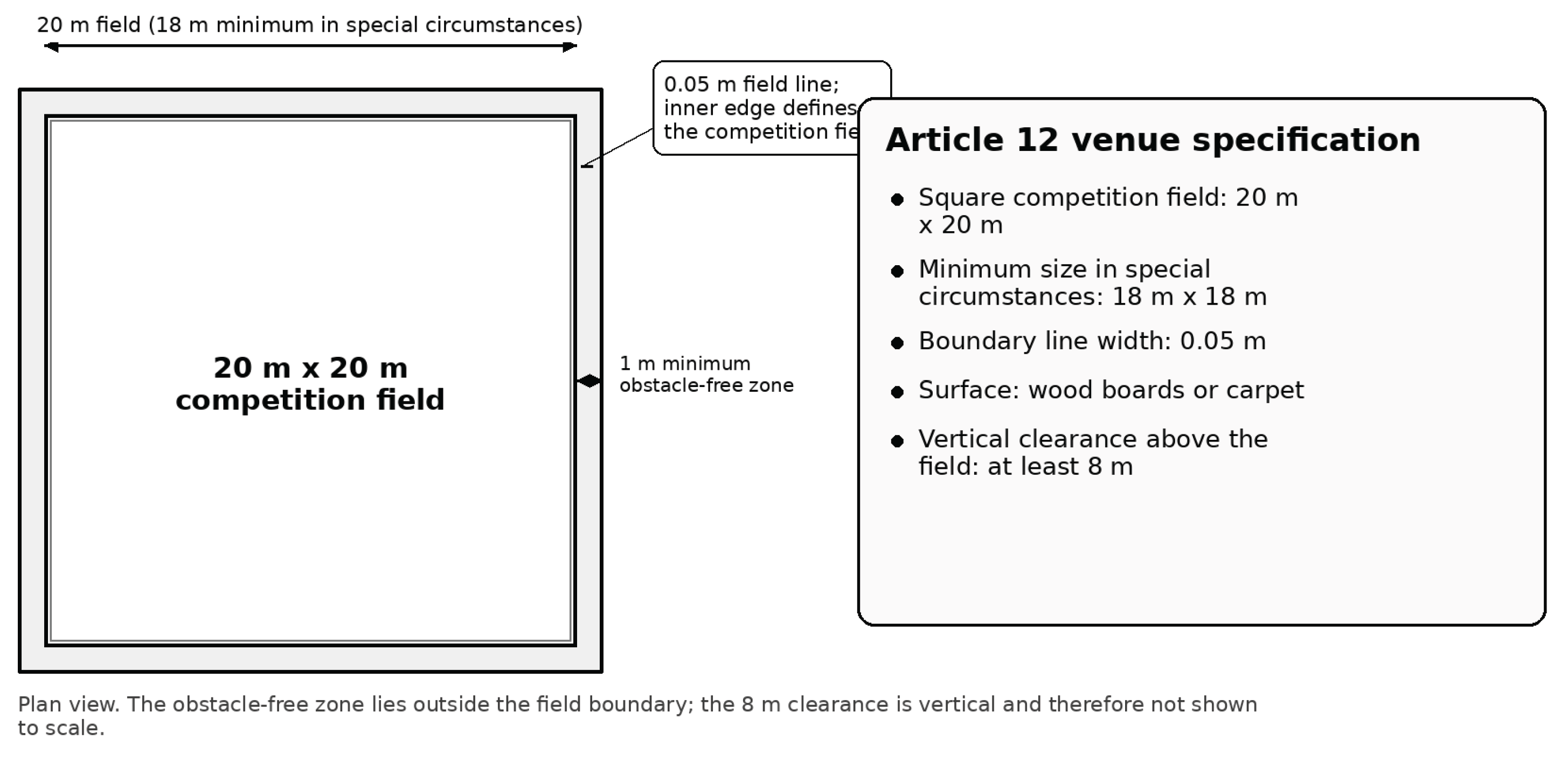

Table 1.
Selected rule texts and forms of Bangkok linkage evidence (illustrative; emphasis on mediated uptake rather than single-text adoption; D = direct adoption; M = mediated uptake; A = alignment).
Table 1.
Selected rule texts and forms of Bangkok linkage evidence (illustrative; emphasis on mediated uptake rather than single-text adoption; D = direct adoption; M = mediated uptake; A = alignment).
| Bangkok Linkage (D/M/A) |
Selected Specifications (Time, Roster, Safety, Scoring) |
Rule Text (Year) |
|---|---|---|
| M: Thai reporting and scholarship describe IDLDF-style translation and judge training in Thai/Bangkok circuits; A: Thai Ministry of Culture event calendars list Bangkok teams in caiqing and mei hua zhuang categories. | Time: second-based penalties Roster: <=8 athletes; <=4 protection staff Safety: 0.05 m boundary line; >=1 m obstacle-free zone; mats; 8 m clearance Scoring: space/time/deductions + judge scoring |
IDLDF/CTDLDA, Nanshi Jingsai Guize [Southern Lion Dance Competition Rules] (2008) |
| A: BMA school files show roster/process controls; administrative alignment rather than direct adoption. | Time: standard championship procedures Roster: ID/health checks + coach/leader Safety: medical and venue checks Scoring: administrative templates make competition auditable |
China Dragon and Lion Dance Sports Association, Participation/Event-Organizing Guides |
| A: Bangkok publicity foregrounds timed routines and judging panels; comparative category convergence. | Time: 7-10 min; setup <=10; ‘drum hit’ start Roster: registered team; musicians specified Safety: standard jongs; penalties; disqualification Scoring: graded criteria + tie-breakers |
USDLDF Nationals, Freestyle Rules (2018) |
| M: Thai scholarship discusses judge training and reproduces scoring tables. | Time: schedule + under/over penalties; setup <=15 Roster: registered team; attire/equipment checks Safety: penalty schedule + redo/forfeit + apparatus checks Scoring: categories + deductions make ‘traditional’ routines comparable |
USDLDF Nationals, Traditional Rules (2018) |
Disclaimer/Publisher’s Note: The statements, opinions and data contained in all publications are solely those of the individual author(s) and contributor(s) and not of MDPI and/or the editor(s). MDPI and/or the editor(s) disclaim responsibility for any injury to people or property resulting from any ideas, methods, instructions or products referred to in the content. |
© 2026 by the authors. Licensee MDPI, Basel, Switzerland. This article is an open access article distributed under the terms and conditions of the Creative Commons Attribution (CC BY) license (http://creativecommons.org/licenses/by/4.0/).
Copyright: This open access article is published under a Creative Commons CC BY 4.0 license, which permit the free download, distribution, and reuse, provided that the author and preprint are cited in any reuse.


