

Submitted:
02 April 2026
Posted:
03 April 2026
You are already at the latest version
Abstract
Fatigue is a frequent, disabling and difficult to treat symptom of multiple sclerosis (MS). Low grade inflammation and energetic dysfunction have been proposed as mechanisms underlying the pathogenesis of this symptom. Owing to its anti-inflammatory and metabolic properties, there is a rational for ketogenic diet (KD) application in this setting. We conducted a single arm open label interventional study on a strictly selected group of 16 non-obese patients with multiple sclerosis who were prescribed KD for three months. With respect to baseline, at 3 months we observed a significant reduction of fatigue severity scale (5.18 ± 1.02 vs. 4.16 ± 0.98; p = 0.042), Epworth Sleepiness Scale (5.64 ± 2.46 vs. 8.46 ± 3.05; p < 0.001), Pittsburgh Sleep Quality Index (5.64 ± 3.53 vs. 7.62 ± 2.59; p = 0.009), Depression Anxiety Stress Scales-21 depression (3.18 ± 2.93 vs. 6.15 ± 3.81; p = 0.036) and anxiety (5.15 ± 4.10 vs. 1.55 ± 1.92; p = 0.019) sub-scales, and an improvement in energy sub-scale of Multiple Sclerosis Quality of Life-54 (52.49 ± 12.83 vs. 37.43 ± 14.26; p = 0.042). These findings suggest that KD might be useful for the treatment of fatigue and they raise the interest for the use of KD in the treatment of other symptoms frequently encountered in multiple sclerosis.
Keywords:
ketogenic diet
; ketosis
; ketones
; multiple sclerosis
; fatigue
; sleepiness
; sleep
1. Introduction
Multiple sclerosis is an inflammatory and demyelinating disease of the central nervous system, characterized by focal lesions mediated by the adaptive immune system and by progressive neurodegenerative processes [1]. MS affects approximately 2.8 - 2.9 million people worldwide [2] and more than 140,000 people in Italy, with approximately 3,600 new diagnoses each year. The prevalence is around 227 cases per 100,000 inhabitants in mainland Italy and predominantly involves women, with a female-to-male ratio of about 3 to 1. Diagnosis typically occurs in young adulthood, between 20 and 40 years of age [3]. Fatigue is the most common symptom in patients with MS, with ad incidence of up to 90% of patients, having often a significant impact on everyday life activities [4,5]. In MS, chronic fatigue has been defined as “fatigue that is present for any amount of time on 50% of days for more than 6 weeks, that limits functional activities or quality of life” Multiple Sclerosis Council [6].
Disease-modifying therapies (DMTs) are currently the gold standard for the treatment of MS and their effectiveness has been assessed through randomized clinical trials (RCTs). However, there is limited information regarding the impact of DMTs on fatigue in patients with Multiple Sclerosis (pwMS) [7]. Consequently, increasing attention has been directed toward non-pharmacological interventions aimed at improving fatigue and quality of life in pwMS [8].
Starting from the recognition of the so called “sickness behaviour” induced by pro-inflammatory cytokines, some observations suggest that inflammation may be one of the processes underlying fatigue [9]. Moreover, patients with conditions associated with fatigue, such as chronic fatigue syndrome and depression, may present altered levels of cytokines in the peripheral circulation, generally expressing a predominant Th1 pro-inflammatory profile [10]. Many studies have suggested higher levels of pro-inflammatory factors also in fatigued pwMS, although there are also some negative findings [11,12]
Another aspect of interest in fatigue pathogenesis is the possible existence of an energetic dysfunction in the CNS of MS fatigued patients, as suggested by some imaging [13,14] and laboratory findings. Demyelination in MS causes important changes from the neuronal energetic point of view, given that the loss of saltatory conduction determines a greater need for ATP consumption by Na+/K+ ATPase. In addition, the mitochondrial damage secondary to the inflammatory process contributes to create this unfavourable energetic state which has been defined “virtual hypoxia” [15,16,17,18].
Considering these premises, intervention with anti-inflammatory properties and the ability to restore CNS energetic dysfunction may be a reasonable option for fatigue treatment.
Ketogenic diet (KD) is a nutritional strategy initially introduced by Russell Wilder in 1920 as a non-drug treatment for epilepsy. He also coined the term “ketogenic diet” at that time [19,20]. This diet gained popularity in the 1970s, emerging as a potential therapy for various health conditions and as an effective short-term approach to weight loss [21,22]. By drastically reducing carbohydrates intake and increasing the consumption of fats and proteins, this dietary approach induces a metabolic state known as “ketosis”, where fats become the primary energy source instead of carbohydrates.
Recent research highlights the potential benefits of ketogenic diet in lowering the risk of certain diseases, including type 2 diabetes, hyperlipidemia, cardiovascular conditions, and cancer [23]. The ketogenic diet is characterized by a high intake of fats, a moderate amount of protein, and a low consumption of carbohydrates. Typically, the macronutrient composition includes fats making up 60-90% of the total energy intake (commonly 70-75%), carbohydrates limited to less than 50g per day (about 5-10% of total caloric intake), and proteins ranging from 1.0-1.2 to 1.7 grams per kilogram of body weight (accounting for around 20% of daily caloric intake) [24].
The primary objective of all ketogenic diets (KDs) is to stimulate ketone production while ensuring that the body receives adequate caloric intake. KDs exhibit notable anti-inflammatory properties through various molecular pathways and have shown promising results in the management of neurological conditions in which inflammation plays a key role [25].
Additionally, ketone bodies generated during this diet serve as a highly efficient energy source, significantly increasing the ATP/ADP ratio in the brain [17,20]. Ketone bodies are also preferred energy substrate for oligodendrocytes, supporting energy production and myelin synthesis [26,27].
The effect of KD on sleep quality and daytime somnolence has been examined in an exploratory study of patients affected by Multiple Sclerosis [28,29].
Building on this theoretical foundation, the present study aimed to assess the effects of KD on fatigue and other symptoms, such as sleepiness and sleep disturbances, in a carefully selected group of individuals with MS.
2. Materials and Methods
2.1. Study Design and Participants
This was a prospective, single-center, non-pharmacological study conducted in volunteers.
From January 2020 to November 2022, we selected and enrolled patients who attended our multiple sclerosis and demyelinating diseases clinic (Clinical Neurology Unit, S. Maria della Misericordia University Hospital, Udine, Italy).
2.2. Inclusion and Exclusion Criteria
Participants were individuals with relapsing-remitting multiple sclerosis (RRMS) who were non-disabled or minimally disabled according to the 2017 McDonald criteria [30], who were treated with disease-modifying therapies (DMTs) for at least one year, and had no clinical or neuroradiological relapses in the six months prior to or during the study. Additionally, participants had no significant contraindications to the ketogenic diet (KD).
We excluded patients with conditions that could interfere with sleep and fatigue in individuals with MS, including those at intermediate or high risk for obstructive sleep apnea (OSA) as assessed by the STOP-Bang questionnaire [31], those who met the international diagnostic criteria for restless legs syndrome (RLS) [32], and patients diagnosed with depressive or anxiety disorders according to the DSM-V criteria [33,34]. Furthermore, patients taking antidepressants, benzodiazepines, or other sedative medications were excluded from the study.

Table 1.
inclusion and exclusion criteria for study participation.
| Inclusion Criteria | Exclusion Criteria |
|---|---|
| Diagnosis of (RR)MS following revised McDonald criteria (CIT) Age between 18 and 65 years EDSS < 2.5 at enrolment Patients on DMD for at least 1 year In treatment with one of the following DMDs: glatimer acetate, teriflunomide, dimethyl fumarate, interferons Clinically relevant fatigue (FSS ≥ 4) BMI between 19 and 35 kg/m2 |
Renal failure (estimated glomerular filtration rate with Cockroft-Gault formula < 60 ml/min) History of urinary stone Hepatic failure Known cardiopathies History of arrhythmia or conduction abnormalities on baseline electrocardiogram (not including right branch block and type I atrio-ventricular block) Diabetes mellitus Porphyria Known deficit of pyruvate carboxylase Known disorders of lipid metabolism Ischaemic stroke or transient ischaemic attack in the previous 6 months Pregnancy and lactation History of acute or chronic pancreatitis Severe osteoporosis Known thyroid disfunction Alcohol abuse Eating disorders Diagnosis of epilepsy or seizure in the past 2 years Diagnosis of major depressive disorder Treatment with anti-depressants, benzodiazepines or hypnotic drugs Relapses of MS in the last 6 months Steroid treatment in the last 6 months New MRI demyelinating lesions in the previous 6 months |
2.3. Ethical Aspects
Patients were provided with comprehensive written information about the study, including details on the study design, expected benefits, and potential adverse events associated with the ketogenic diet (KD). All patients provided written informed consent to participate in the study. The study was conducted in accordance with the Declaration of Helsinki and approved by the Comitato Etico Unico Regionale del Friuli Venezia Giulia (CEUR-2020-SPER-124).
2.4. Dietetic Intervention and Nutritional Evaluations
Following enrolment, each patient underwent an initial nutritional assessment, during which height, weight, and Body Mass Index (BMI) were recorded. Body composition was assessed using bioelectrical impedance analysis with the BIA 101 BIVA PRO (Akern) device. Based on these data and the individual characteristics of each patient, a 2:1 ketogenic diet was prescribed, which patients were instructed to follow for three months, provided it was well tolerated.
The dietary regimen was individualized according to patients’ preferences and body composition parameters (BMI, Fat Mass and Fat Free Mass). The protein and fat content of each diet was determined using anthropometric measurements, bioelectrical impedance data, and the patient’s daily level of physical activity. Carbohydrate intake was fixed at 30g/day. Protein intake was calculated primarily on the basis of fat free mass (FFM), with conversion into grams taking into account activity level and ideal body weight.
Patients were re-evaluated after 1 and 3 months from the start of the diet. During follow-up visits, anthropometric and body composition measurements were repeated; adherence to the dietary regimen was assessed, and practical advice was provided to improve correct implementation. To ensure adherence to the ketogenic dietary plan, patients were instructed to measure capillary blood ketone levels at least twice per week. Finally, telephone support was made available throughout the entire intervention period to address any diet-related questions or concerns.
2.5. Outcomes
Clinical and demographic characteristics were collected at baseline. Data regarding adverse events or relapses were collected during follow-up by means of monthly phone calls and subsequent medical examination, if deemed necessary by study investigators.
The primary objective of the study was to assess the change in fatigue severity from baseline to 3 months, as measured by the Fatigue Severity Scale, in a group of patients with relapsing remitting multiple sclerosis undergoing a ketogenic diet.
Secondary objectives were to evaluate, in the same patient population, the differences between baseline and the 3-months follow-up with respect to the following aspects: sleep quality, mood disturbances and quality of life. Thus, at baseline and 1 and 3 months after diet initiation, the following questionnaires were administered, all in their validated Italian version: Fatigue severity scale (FSS) [35,36], Epworth Sleepiness Scale (ESS)[37,38], Pittsburgh Sleep Quality Index (PSQI) [39,40], Depression Anxiety Stress Scales-21 (DASS-21)[41,42], Multiple Sclerosis Quality of Life-54 (MSQOL-54) [43,44].
2.6. Fatigue Severity Scale (FSS)
Fatigue is a symptom assessed through self-reporting. The Fatigue Severity Scale (FSS) is a 9-item tool that evaluates the average level of fatigue experienced by patients in the previous days. It gauges both the intensity of fatigue and its impact on a person’s daily activities and quality of life under various conditions. Originally developed for multiple sclerosis and systemic lupus erythematosus, it has also been applied to migraines [45]. This scale assesses how fatigue in chronic conditions affects cognitive and physical functioning. Patients rate the severity of their fatigue symptoms for each item, with lower scores indicating disagreement and higher scores indicating agreement. Each statement is scored on a 7-point scale, from 1 (strongly disagree) to 7 (strongly agree). The total score is calculated by summing the individual responses and dividing by nine, although some studies use the total sum score instead. A score of at least 4 (or 36) is considered indicative of pathological fatigue [46].
2.7. Pittsburg Sleep Quality Index (PSQI) and Epworth Sleepiness Scale (ESS)
The Epworth Sleepiness Scale (ESS) is a questionnaire widely used worldwide to subjectively assess the tendency to fall asleep in specific daytime situations, such as reading, watching TV, or being a passenger in a car.
The ESS is an 8-item test developed by Murray J. in 1991 [47]. It is self-administered and provides a score on a numerical scale ranging from 0 to 24. A score greater than 10 is generally accepted as indicative of Excessive Daytime Sleepiness.
The PSQI (Pittsburgh Sleep Quality Index) is a rating scale designed to provide a reliable, valid, and standardized measure of sleep quality. The scale consists of 19 items self-assessed by an individual. These 19 items are grouped into seven composite components that represent subjective sleep quality, sleep latency, sleep duration, habitual sleep efficiency, sleep disturbances, use of hypnotic medication, and daytime dysfunction [48].
2.8. Data and Statistical Analysis
Statistical analysis was performed using JASP version 0.14.1 for macOS (University of Amsterdam, Netherlands). A descriptive analysis was conducted to report the means and standard deviations. The Shapiro-Wilk test correction was used to assess the normal distribution of the data. For comparisons between baseline and following time points, the paired samples t-test or Wilcoxon’s test was used as appropriate. Two-tailed p-values of <0.05 were considered statistically significant.
3. Results
Sixteen patients were enrolled in this study at the end of February 2023.
Eleven (68.75%) patients were females and five (31.25%) were males. Mean age was 46.31±10.63 years, and mean time from MS diagnosis was of 10.31±7.14 years. All patients had a basal EDSS scores between 1 and 2. The DMDs distribution was as follow: 7 (43.75%) dimethyl fumarate, 3 (18.75%) teriflunomide, 3 (18.75%) glatiramer acetate, and 3 (18.75%) interferons.
Four patients did not complete the 3 months study period. One patient stopped the study because of difficulties in following the diet due to the necessity of frequently not eating at home for work reasons, and one found the diet too restrictive. Two patients abandoned the diet due to side effects: one patient experienced weight loss that was perceived as excessive by the patient, but with a BMI still in the range of normality, while another reported abdominal pain soon after diet initiation.
In addition to the cases that dropped due to excessive weight loss and abdominal pain, other adverse events reported by the patients included: dermatitis, observed in one patient, which resolved in a few days and was considered by the investigators not related to the diet; and muscle cramps, observed at the third month of diet in one patient who was not correctly assuming the prescribed food supplement and resolved after it was correctly assumed.
None of the patients experienced an MS relapse during the 3 months of diet.
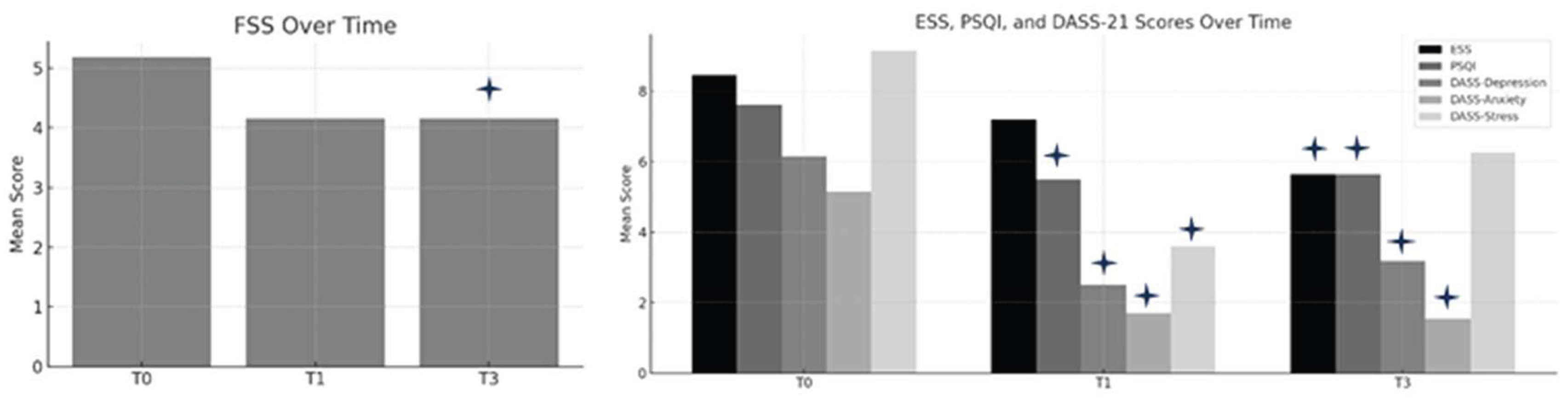
Considering our primary outcome of fatigue, we observed a trend for reduction in FSS scores after 1 month of diet (4.16±1.37 vs. 5.18±1.02; p=0.052) which became significant at 3 months (4.16±0.98 vs. 5.18±1.02; p=0.042). Considering the other outcome measures, ESS scores also improved reaching a statistically significant reduction at 3 months. The PSQI and the subscales for depression and anxiety of the DASS-21 all showed a better score during KD with a significant reduction at both 1 and 3 months. The stress subscale of the DASS-21 showed an initial improvement which was not consistent at 3 months. Table 1 shows the results of the fatigue, sleep and mood scales during the diet.
Figure 1.
Results of questionnaires at baseline and after one and three months of KD. Results are expressed as means±SD. P values reported are expression of a paired sample comparison between baseline and the considered time-point. FSS: Fatigue Severity Scale; ESS: Epworth Sleepiness Scale; PSQI: Pittsburgh Sleep Quality Index; DASS 21: Depression Anxiety Stress Scale 21. Significant results.
Figure 1.
Results of questionnaires at baseline and after one and three months of KD. Results are expressed as means±SD. P values reported are expression of a paired sample comparison between baseline and the considered time-point. FSS: Fatigue Severity Scale; ESS: Epworth Sleepiness Scale; PSQI: Pittsburgh Sleep Quality Index; DASS 21: Depression Anxiety Stress Scale 21. Significant results.
Despite a trend toward better scores, we did not observe any significant modification of the physical health composite score or mental health composite scores of the MSQOL-54. The only MSQOL-54 subscale that showed a significant change from the baseline was that of energy at 3 months (37.43±14.26 at baseline, 52.49±12.83 at three months, p=0.042). Table 2 shows the MSQOL-54 subscales variations during the study period.
From a nutritional point of view, we observed a significant reduction in body mass index (BMI) and fat mass (FM) at both 1 and 3 months, while lean mass was preserved at 1 month and even increased after 3 months of KD (Table 3)
4. Discussion
In the present study, 4 of 16 patients (25%) discontinued the diet because of tolerability issues. Globally, these are good adherence rates, since in the setting of epilepsy a 2014 review that considered only adults found a drop-out rate of 51% when considering classic KDs and of 42% when considering a modified Atkins diet [49]. In our experience, in a group of patients affected by migraine, treated with a KD with the same ketogenic ratio, we observed a dropout rate of 18%, which is quite similar to the findings of the present study [50], thus not suggesting specific limitations of application of this approach in the MS population.
All the side effects observed in our study were transient, and KD was discontinued because of adverse events only in two cases. Muscle cramps and excessive weight loss are frequent side effects of KD, and abdominal pain has also been described, although more rarely [51]. The dermatitis reported was not deemed related to KD by the study investigators.
We did not observe any clinical relapse of MS during the study period. In the previous studies using ketogenic diet in MS, Choi et al. reported only one relapse in their group of 20 patients, while Brenton et al. did not observe relapses in their group of 56 patients [52,53]. Both studies lasted for 6 months. The small number of patients considered in these studies and in our study and the short time of observation make it impossible any consideration about diet efficacy in reducing the relapse rate in MS.
Considering our primary outcome measure, we observed a reduction in fatigue as measured by FSS, which was statistically significant after 3 months of diet. Similarly, we observed an improvement at 3 months in the energy subscale of the MSQOL-54. To our knowledge, two studies by the same American group have evaluated the effect of KD on MS symptom, with similar positive results [52,54]. However, since in both studies the majority of the sample was formed by overweight or obese patients [52,54], and given that higher BMI has been associated with higher fatigue scores both in pwMS [55] and in people not suffering from this disease [56], the findings of these studies must be taken with caution. It must also be noted that in these studies the dietary intervention was very simple, and subjects were only instructed to restrict carbohydrates to <20 g/day and to consume more healthy fats [52]. The results of our study, which excluded obese patients and instructed patients to follow a precise diet regimen, offer amore robust evidence of the usefulness of KD in reducing the disabling symptom of fatigue in pwMS.
We also observed a consistent reduction in excessive daytime sleepiness as measured by ESS, and an improvement in sleep quality as measured by PSQI. To our knowledge, this is the first study to assess sleep in patients with pwMS receiving KD, although sleep disturbances are a common problem in the MS population [57,58]. In addition, also considering the application of KD in other settings, data about sleep and sleepiness remains scarce [59,60].
Many mechanisms by which KD may act on sleep have been proposed, including orexinergic neurons activation by means of relative hypoglycaemia provoked by KD, an increase in galanin expression and consequent monoaminergic arousal systems inhibition or an increase in the GABA/glutamate ratio [61,62,63,64].
In our study, we found that patients with MS and KD showed a significant reduction in depression and anxiety scores. Considering KD studies in patients with MS, the only other studies that evaluated the effect of this dietary approach on mood disturbances are those already mentioned by Brenton et al. [52,65], in which pwMS receiving a KD reported a reduction in Beck Depression Inventory scores. In addition to MS, KD has been shown to improve negative affect also in overweight but otherwise healthy patients [66] and in a mixed cohort of psychiatric inpatients [67]. KD application in the treatment of depression and anxiety is supported also by animal data [68,69]. The mechanism by which KD ameliorates depression and anxiety is not clear, but modulation of GABAergic and monoaminergic systems may be involved, along with chronic low grade inflammation reduction and mitochondrial function restoration [70,71]. Our finding of a reduction in depression and anxiety symptoms in pwMS receiving a KD are relevant in relation to the extent of the phenomenon, since depression and anxiety prevalence among pwMS can be as high as 30.5% and 22.1% respectively [72], and depression, together with fatigue and disability, is one of the most important determinants of quality of life in these patients [73].
Although an in-depth description of the effect of KD on weight and fat mass reduction is beyond the scope of this study, we have at least to comment that the observed reduction in BMI and FM with lean mass preservation corroborates the already known possibility of KD utilization for weight loss [74,75]. As previously discussed, we did not include obese patients in this study, and the median BMI of the study group was within the normal range before and after the dietary intervention.
5. Conclusions
After the great results reached in the prevention of relapses and disability worsening in MS with the introduction of many disease modifying drugs, the research focused on treating more subtle, but still very disabling symptoms, such as fatigue. Although the exact processes behind this symptom remain partially unclear, persistent inflammation and neuronal energetic dysfunction are suggested to be involved [76,77,78]. In this study, we aimed to evaluate the application of KD in a group of RRMS patients, given the anti-inflammatory and energetic properties of this diet [79].
First, we found that ketogenic intervention is applicable to MS patients with limitations similar to those of other dietary interventions and with a higher adherence than that described for KD in other disorders.
Regarding our primary outcome, we observed an improvement in fatigue during KD. In parallel, KD resulted in the significant amelioration of sleep and daytime somnolence, and a reduction in depression and anxiety symptoms.
We are aware that the present study has several limitations. First, the sample size was limited and, given the chronic nature of MS, longer observation times are required to assess long-term efficacy and tolerability of KD. Another limitation is the lack of a control group. The use of laboratory and instrumental outcomes may also help corroborate KD utilization in this field, and studies including these targets are ongoing at our center.
The present study also has some strengths, dependent on accurate the sample selection, which gave us the possibility of excluding many confounding factors, and on the precise diet prescriptions adopted.
Further studies with longer follow-up periods, larger sample sizes and a control group are needed to firmly establish KD efficacy on MS symptoms and course.
Author Contributions
F.F: Conceptualization, Investigation, Data Curation, Visualization, Writing—Original Draft, Statistical Analysis, Project Administration; S.L.: Writing—Review and Editing, Statistical Analysis; R.G.: Investigation, Data Curation; E.L.: Investigation, Data Curation; I.D.N.: Investigation, Data Curation; A.N.: Investigation, Data Curation; S.P.: Investigation, Data Curation; G.L.G.: Conceptualization, Supervision, Resources, Validation, Writing—Review and Editing; M.V.: Conceptualization, Supervision, Resources, Validation, Writing—Review and Editing, Project Administration. All authors have read and agreed to the published version of the manuscript.
Funding
This research received no external funding.
Institutional Review Board Statement
The study was conducted in accordance with the Declaration of Helsinki, and approved by the Unique Regional Ethics Committee of Friuli Venezia Giulia on November 17th 2020, approval code CEUR-2020-SPER-124.
Informed Consent Statement
All patients involved in the study gave written informed consent for study participation.:
Data Availability Statement
Not applicable.
Conflicts of Interest
The authors declare no conflict of interest.
Abbreviations
| MS | Multiple Sclerosis |
| KD | Ketogenic Diet |
| DMTs | Disease-Modifying Therapies |
| RCTs | Randomized Clinical Trials |
| pwMS | Patients With Multiple Sclerosis |
| CNS | Central Nervous System |
| RRMS | Relapsing Remitting Multiple Sclerosis |
| FSS | Fatigue Severity Scale |
| ESS | Epworth Sleepiness Scale |
| PSQI | Pittsburg Sleep Quality Index |
| DASS-21 | Depression Anxiety Stress Scale-21 |
| MSQOL-54 | Multiple Sclerosis Quality of Life - 54 |
| BMI | Body Mass Index |
| BIA | Bioelectrical Impedance Analysis |
| FM | Fat Mass |
| FFM | Fat Free Mass |
References
- Scalfari, A.; Traboulsee, A.; Oh, J.; Airas, L.; Bittner, S.; Calabrese, M.; Garcia Dominguez, J.M.; Granziera, C.; Greenberg, B.; Hellwig, K.; et al. Smouldering-Associated Worsening in Multiple Sclerosis: An International Consensus Statement on Definition, Biology, Clinical Implications, and Future Directions. In Ann Neurol; STRING:PUBLICATION: WGROUP, 2024; Volume 96, pp. 826–845. [Google Scholar] [CrossRef]
- Wang, L.Y.; Wang, W.F.; Hui, S.Y.; Yang, L.; Liu, Y.X.; Li, H.J. Emerging Epidemiological Trends of Multiple Sclerosis among Adults Aged 20–54 years, 1990–2021, with Projections to 2035: A Systematic Analysis for the Global Burden of Disease Study 2021. Front Neurol 2025, 16, 1616245. [Google Scholar] [CrossRef]
- AISM Alla Camera Dei Deputati. La Sclerosi Multipla in Italia: Un’emergenza Sanitaria e Sociale. | AISM | Associazione Italiana Sclerosi Multipla. Available online: https://www.aism.it/aism-alla-camera-dei-deputati-la-sclerosi-multipla-italia-unemergenza-sanitaria-e-sociale (accessed on 9 December 2025).
- Ayache, S.S.; Serratrice, N.; Abi Lahoud, G.N.; Chalah, M.A. Fatigue in Multiple Sclerosis: A Review of the Exploratory and Therapeutic Potential of Non-Invasive Brain Stimulation. Front Neurol 2022, 13, 813965. [Google Scholar] [CrossRef]
- Yeni, K.; Terzi, M.; Yeni, K.; Terzi, M. Multiple Sclerosis-Related Fatigue: An Updated Review of Pathophysiology and Associated Variables Contributing Factors. Journal of Multiple Sclerosis Research 2025, 5, 33–42. [Google Scholar] [CrossRef]
- Fatigue and Multiple Sclerosis | Open Library. Available online: https://openlibrary.org/books/OL19177863M/Fatigue_and_multiple_sclerosis (accessed on 9 December 2025).
- Cruz Rivera, S.; Aiyegbusi, O.L.; Piani Meier, D.; Dunne, A.; Harlow, D.E.; Henke, C.; Kamudoni, P.; Calvert, M.J. The Effect of Disease Modifying Therapies on Fatigue in Multiple Sclerosis. Mult Scler Relat Disord 2023, 79. [Google Scholar] [CrossRef]
- Miller, P.; Soundy, A. The Pharmacological and Non-Pharmacological Interventions for the Management of Fatigue Related Multiple Sclerosis. J Neurol Sci 2017, 381, 41–54. [Google Scholar] [CrossRef]
- Patejdl, R.; Penner, I.K.; Noack, T.K.; Zettl, U.K. Multiple Sclerosis and Fatigue: A Review on the Contribution of Inflammation and Immune-Mediated Neurodegeneration. Autoimmun Rev 2016, 15, 210–220. [Google Scholar] [CrossRef]
- Malekzadeh, A.; Van De Geer-Peeters, W.; De Groot, V.; Elisabeth Teunissen, C.; Beckerman, H.; Study Group, T.A. Fatigue in Patients with Multiple Sclerosis: Is It Related to pro- and Anti-Inflammatory Cytokines? Dis Markers 2015. [Google Scholar] [CrossRef]
- Ayache, S.S.; Serratrice, N.; Abi Lahoud, G.N.; Chalah, M.A. Fatigue in Multiple Sclerosis: A Review of the Exploratory and Therapeutic Potential of Non-Invasive Brain Stimulation. Front Neurol 2022, 13. [Google Scholar] [CrossRef]
- Gilio, L.; Buttari, F.; Pavone, L.; Iezzi, E.; Galifi, G.; Dolcetti, E.; Azzolini, F.; Bruno, A.; Borrelli, A.; Storto, M.; et al. Fatigue in Multiple Sclerosis Is Associated with Reduced Expression of Interleukin-10 and Worse Prospective Disease Activity. Biomedicines 2022, 10. [Google Scholar] [CrossRef] [PubMed]
- Zaini, W.H.; Giuliani, F.; Beaulieu, C.; Kalra, S.; Hanstock, C. Fatigue in Multiple Sclerosis: Assessing Pontine Involvement Using Proton MR Spectroscopic Imaging. PLoS One 2016, 11. [Google Scholar] [CrossRef] [PubMed]
- West, K.; Sivakolundu, D.; Maruthy, G.; Zuppichini, M.; Liu, P.; Thomas, B.; Spence, J.; Lu, H.; Okuda, D.; Rypma, B. Baseline Cerebral Metabolism Predicts Fatigue and Cognition in Multiple Sclerosis Patients. Neuroimage Clin 2020, 27. [Google Scholar] [CrossRef]
- Campbell, G.; Mahad, D.J. Mitochondrial Dysfunction and Axon Degeneration in Progressive Multiple Sclerosis. FEBS Lett 2018, 592, 1113–1121. [Google Scholar] [CrossRef]
- Zambonin, J.L.; Zhao, C.; Ohno, N.; Campbell, G.R.; Engeham, S.; Ziabreva, I.; Schwarz, N.; Lee, S.E.; Frischer, J.M.; Turnbull, D.M.; et al. Increased Mitochondrial Content in Remyelinated Axons: Implications for Multiple Sclerosis. Brain 2011, 134, 1901–1913. [Google Scholar] [CrossRef]
- Mahad, D.J.; Ziabreva, I.; Campbell, G.; Lax, N.; White, K.; Hanson, P.S.; Lassmann, H.; Turnbull, D.M. Mitochondrial Changes within Axons in Multiple Sclerosis. Brain 2009, 132, 1161–1174. [Google Scholar] [CrossRef]
- Trapp, B.D.; Stys, P.K. Virtual Hypoxia and Chronic Necrosis of Demyelinated Axons in Multiple Sclerosis. Lancet Neurol 2009, 8, 280–291. [Google Scholar] [CrossRef] [PubMed]
- Kim, J.M. Ketogenic Diet: Old Treatment, New Beginning. Clin Neurophysiol Pract 2017, 2, 161–162. [Google Scholar] [CrossRef]
- Masood, W.; Annamaraju, P.; Suheb, M.Z.K.; Uppaluri, K.R. Ketogenic Diet. StatPearls 2023. [Google Scholar]
- McGaugh, E.; Barthel, B. A Review of Ketogenic Diet and Lifestyle. Mo Med 2022, 119, 84. [Google Scholar] [PubMed]
- Bachar, A.; Birk, R. Ketogenic Diet Intervention for Obesity Weight-Loss- A Narrative Review, Challenges, and Open Questions. Curr Nutr Rep 2025, 14, 43. [Google Scholar] [CrossRef] [PubMed]
- Rajiyah, T.; Pannain, S. The Ketogenic Diet in Health and Disease. Dietary Sugar, Salt and Fat in Human Health 2020, 557–619. [Google Scholar] [CrossRef]
- Di Lorenzo, C.; Ballerini, G.; Barbanti, P.; Bernardini, A.; D’Arrigo, G.; Egeo, G.; Frediani, F.; Garbo, R.; Pierangeli, G.; Prudenzano, M.P.; et al. Applications of Ketogenic Diets in Patients with Headache: Clinical Recommendations. Nutrients 2021, 13, 2307. [Google Scholar] [CrossRef] [PubMed]
- Ji, J.; Fotros, D.; Sohouli, M.H.; Velu, P.; Fatahi, S.; Liu, Y. The Effect of a Ketogenic Diet on Inflammation-Related Markers: A Systematic Review and Meta-Analysis of Randomized Controlled Trials. Nutr Rev 2025, 83, 40–58. [Google Scholar] [CrossRef]
- Veech, R.L. The Therapeutic Implications of Ketone Bodies: The Effects of Ketone Bodies in Pathological Conditions: Ketosis, Ketogenic Diet, Redox States, Insulin Resistance, and Mitochondrial Metabolism. Prostaglandins Leukot Essent Fatty Acids 2004, 70, 309–319. [Google Scholar] [CrossRef] [PubMed]
- Prins, M.L. Cerebral Metabolic Adaptation and Ketone Metabolism after Brain Injury. J Cereb Blood Flow Metab 2008, 28, 1–16. [Google Scholar] [CrossRef]
- Sun, W.; Wang, Q.; Zhang, R.; Zhang, N. Ketogenic Diet Attenuates Neuroinflammation and Induces Conversion of M1 Microglia to M2 in an EAE Model of Multiple Sclerosis by Regulating the NF-ΚB/NLRP3 Pathway and Inhibiting HDAC3 and P2X7R Activation. Food Funct 2023, 14, 7247–7269. [Google Scholar] [CrossRef]
- Merlino, G.; Garbo, R.; Dal Bello, S.; Del Negro, I.; Lamon, E.; Filippi, F.; Bernardini, A.; Lorenzut, S.; Ceccarelli, L.; Cella, A.; et al. Ketogenic Diet May Improve Sleep Quality and Daytime Somnolence in Patients Affected by Multiple Sclerosis. Results of an Exploratory Study. Sleep Med 2023, 112, 181–187. [Google Scholar] [CrossRef]
- Thompson, A.J.; Banwell, B.L.; Barkhof, F.; Carroll, W.M.; Coetzee, T.; Comi, G.; Correale, J.; Fazekas, F.; Filippi, M.; Freedman, M.S.; et al. Diagnosis of Multiple Sclerosis: 2017 Revisions of the McDonald Criteria. Lancet Neurol 2018, 17, 162–173. [Google Scholar] [CrossRef]
- Cho, T.; Yan, E.; Chung, F. The STOP-Bang Questionnaire: A Narrative Review on Its Utilization in Different Populations and Settings. Sleep Med Rev 2024, 78. [Google Scholar] [CrossRef]
- Allen, R.P.; Picchietti, D.L.; Garcia-Borreguero, D.; Ondo, W.G.; Walters, A.S.; Winkelman, J.W.; Zucconi, M.; Ferri, R.; Trenkwalder, C.; Lee, H.B. Restless Legs Syndrome/Willis-Ekbom Disease Diagnostic Criteria: Updated International Restless Legs Syndrome Study Group (IRLSSG) Consensus Criteria - History, Rationale, Description, and Significance. Sleep Med 2014, 15, 860–873. [Google Scholar] [CrossRef]
- American Psychiatric Association. Diagnostic and Statistical Manual of Mental Disorders. In Diagnostic and Statistical Manual of Mental Disorders; 2022. [Google Scholar] [CrossRef]
- American Psychiatric Association. Diagnostic and Statistical Manual of Mental Disorders. In Diagnostic and Statistical Manual of Mental Disorders; 2013. [Google Scholar] [CrossRef]
- Krupp, L.B. The Fatigue Severity Scale. Arch Neurol 1989, 46, 1121. [Google Scholar] [CrossRef] [PubMed]
- Ottonello, M.; Pellicciari, L.; Giordano, A.; Foti, C. Rasch Analysis of the Fatigue Severity Scale in Italian Subjects with Multiple Sclerosis. J Rehabil Med 2016, 48, 597–603. [Google Scholar] [CrossRef]
- Johns, M.W. A New Method for Measuring Daytime Sleepiness: The Epworth Sleepiness Scale. Sleep 1991, 14, 540–545. [Google Scholar] [CrossRef] [PubMed]
- Vignatelli, L.; Plazzi, G.; Barbato, A.; Ferini-Strambi, L.; Manni, R.; Pompei, F.; D’Alessandro, R. Italian Version of the Epworth Sleepiness Scale: External Validity. Neurological Sciences 2003, 23, 295–300. [Google Scholar] [CrossRef]
- Buysse, D.J.; Reynolds, C.F.; Monk, T.H.; Berman, S.R.; Kupfer, D.J. The Pittsburgh Sleep Quality Index: A New Instrument for Psychiatric Practice and Research [Índice de Calidad Del Sueño de Pittsburgh: Un Nuevo Instrumento Para La Práctica y La Investigación Psiquiátrica]. Psychiatry Res 1989, 28, 193–213. [Google Scholar] [CrossRef]
- Curcio, G.; Tempesta, D.; Scarlata, S.; Marzano, C.; Moroni, F.; Rossini, P.M.; Ferrara, M.; De Gennaro, L. Validity of the Italian Version of the Pittsburgh Sleep Quality Index (PSQI). Neurological Sciences 2013, 34, 511–519. [Google Scholar] [CrossRef]
- Lovibond, P.F.; Lovibond, S.H. The Structure of Negative Emotional States: Comparison of the Depression Anxiety Stress Scales (DASS) with the Beck Depression and Anxiety Inventories. Behaviour Research and Therapy 1995, 33, 335–343. [Google Scholar] [CrossRef]
- Bottesi, G.; Ghisi, M.; Altoè, G.; Conforti, E.; Melli, G.; Sica, C. The Italian Version of the Depression Anxiety Stress Scales-21: Factor Structure and Psychometric Properties on Community and Clinical Samples. Compr Psychiatry 2015, 60, 170–181. [Google Scholar] [CrossRef]
- Vickrey, B.G.; Hays, R.D.; Harooni, R.; Myers, L.W.; Ellison, G.W. A Health-Related Quality of Life Measure for Multiple Sclerosis. Quality of Life Research 1995, 4, 187–206. [Google Scholar] [CrossRef]
- Solari, A.; Filippini, G.; Mendozzi, L.; Ghezzi, A.; Cifani, S.; Barbieri, E.; Baldini, S.; Salmaggi, A.; La Mantia, L.; Farinotti, M.; et al. Validation of Italian Multiple Sclerosis Quality of Life 54 Questionnaire. J Neurol Neurosurg Psychiatry 1999, 67, 158–162. [Google Scholar] [CrossRef] [PubMed]
- Seo, J.G.; Park, S.P. Significance of Fatigue in Patients with Migraine. Journal of Clinical Neuroscience 2018, 50, 69–73. [Google Scholar] [CrossRef] [PubMed]
- Armutlu, K.; Cetisli Korkmaz, N.; Keser, I.; Sumbuloglu, V.; Irem Akbiyik, D.; Guney, Z.; Karabudak, R. The Validity and Reliability of the Fatigue Severity Scale in Turkish Multiple Sclerosis Patients. Int J Rehabil Res 2007, 30, 81–85. [Google Scholar] [CrossRef]
- Johns, M.W. A New Method for Measuring Daytime Sleepiness: The Epworth Sleepiness Scale. Sleep 1991, 14, 540–545. [Google Scholar] [CrossRef] [PubMed]
- Quantification of Subjective Sleep Quality in Healthy Elderly Men and Women Using the Pittsburgh Sleep Quality Index (PSQI) - PubMed. Available online: https://pubmed.ncbi.nlm.nih.gov/1947597/ (accessed on 22 December 2025).
- Klein, P.; Tyrlikova, I.; Mathews, G.C. Dietary Treatment in Adults with Refractory Epilepsy: A Review. Neurology 2014, 83, 1978–1985. [Google Scholar] [CrossRef]
- Valente, M.; Garbo, R.; Filippi, F.; Antonutti, A.; Ceccarini, V.; Tereshko, Y.; Di Lorenzo, C.; Gigli, G.L. Migraine Prevention through Ketogenic Diet: More than Body Mass Composition Changes. J Clin Med 2022, 11. [Google Scholar] [CrossRef] [PubMed]
- Di Lorenzo, C.; Ballerini, G.; Barbanti, P.; Bernardini, A.; D’arrigo, G.; Egeo, G.; Frediani, F.; Garbo, R.; Pierangeli, G.; Prudenzano, M.P.; et al. Applications of Ketogenic Diets in Patients with Headache: Clinical Recommendations. Nutrients 2021, 13. [Google Scholar] [CrossRef] [PubMed]
- Brenton, J.N.; Lehner-Gulotta, D.; Woolbright, E.; Banwell, B.; Bergqvist, A.G.C.; Chen, S.; Coleman, R.; Conaway, M.; Goldman, M.D. Phase II Study of Ketogenic Diets in Relapsing Multiple Sclerosis: Safety, Tolerability and Potential Clinical Benefits. J Neurol Neurosurg Psychiatry 2022, 93, 637–644. [Google Scholar] [CrossRef]
- Choi, I.Y.; Piccio, L.; Childress, P.; Bollman, B.; Ghosh, A.; Brandhorst, S.; Suarez, J.; Michalsen, A.; Cross, A.H.; Morgan, T.E.; et al. A Diet Mimicking Fasting Promotes Regeneration and Reduces Autoimmunity and Multiple Sclerosis Symptoms. Cell Rep 2016, 15, 2136–2146. [Google Scholar] [CrossRef]
- Brenton, J.N.; Banwell, B.; Christina Bergqvist, A.G.; Lehner-Gulotta, D.; Gampper, L.; Leytham, E.; Coleman, R.; Goldman, M.D. Pilot Study of a Ketogenic Diet in Relapsing-Remitting MS. Neurology(R) neuroimmunology & neuroinflammation 2019, 6. [Google Scholar] [CrossRef]
- Weiland, T.J.; Jelinek, G.A.; Marck, C.H.; Hadgkiss, E.J.; Van Der Meer, D.M.; Pereira, N.G.; Taylor, K.L. Clinically Significant Fatigue: Prevalence and Associated Factors in an International Sample of Adults with Multiple Sclerosis Recruited via the Internet. PLoS One 2015, 10. [Google Scholar] [CrossRef]
- Jarosz, P.A.; Davis, J.E.; Yarandi, H.N.; Farkas, R.; Feingold, E.; Shippings, S.H.; Smith, A.L.; Williams, D. Obesity in Urban Women: Associations with Sleep and Sleepiness, Fatigue and Activity. Women’s Health Issues 2014, 24. [Google Scholar] [CrossRef]
- Merlino, G.; Garbo, R.; Dal Bello, S.; Del Negro, I.; Lamon, E.; Filippi, F.; Bernardini, A.; Lorenzut, S.; Ceccarelli, L.; Cella, A.; et al. Ketogenic Diet May Improve Sleep Quality and Daytime Somnolence in Patients Affected by Multiple Sclerosis. Results of an Exploratory Study. Sleep Med 2023, 112, 181–187. [Google Scholar] [CrossRef]
- Strober, L.B. Fatigue in Multiple Sclerosis: A Look at the Role of Poor Sleep. Front Neurol 2015, 6. [Google Scholar] [CrossRef]
- Ünalp, A.; Baysal, B.T.; Sarıtaş, S.; Güzin, Y.; Edizer, S.; Akışın, Z.; Yılmaz, Ü. Evaluation of the Effects of Ketogenic Diet Therapy on Sleep Quality in Children with Drug-Resistant Epilepsy and Their Mothers. Epilepsy and Behavior 2021, 124. [Google Scholar] [CrossRef]
- Hallböök, T.; Lundgren, J.; Rosén, I. Ketogenic Diet Improves Sleep Quality in Children with Therapy-Resistant Epilepsy. Epilepsia 2007, 48, 59–65. [Google Scholar] [CrossRef] [PubMed]
- Qiao, Y.N.; Li, L.; Hu, S.H.; Yang, Y.X.; Ma, Z.Z.; Huang, L.; An, Y.P.; Yuan, Y.Y.; Lin, Y.; Xu, W.; et al. Ketogenic Diet-Produced β-Hydroxybutyric Acid Accumulates Brain GABA and Increases GABA/Glutamate Ratio to Inhibit Epilepsy. Cell Discov 2024, 10. [Google Scholar] [CrossRef]
- Tabb, K.; Szot, P.; White, S.S.; Liles, L.C.; Weinshenker, D. The Ketogenic Diet Does Not Alter Brain Expression of Orexigenic Neuropeptides. Epilepsy Res 2004, 62, 35–39. [Google Scholar] [CrossRef]
- Yudkoff, M.; Daikhin, Y.; Melø, T.M.; Nissim, I.; Sonnewald, U.; Nissim, I. The Ketogenic Diet and Brain Metabolism of Amino Acids: Relationship to the Anticonvulsant Effect. Annu Rev Nutr 2007, 27, 415–430. [Google Scholar] [CrossRef]
- Valenzano, A.; Polito, R.; Trimigno, V.; Di Palma, A.; Moscatelli, F.; Corso, G.; Sessa, F.; Salerno, M.; Montana, A.; Di Nunno, N.; et al. Effects of Very Low Calorie Ketogenic Diet on the Orexinergic System, Visceral Adipose Tissue, and ROS Production. Antioxidants (Basel) 2019, 8. [Google Scholar] [CrossRef] [PubMed]
- Brenton, J.N.; Banwell, B.; Christina Bergqvist, A.G.; Lehner-Gulotta, D.; Gampper, L.; Leytham, E.; Coleman, R.; Goldman, M.D. Pilot Study of a Ketogenic Diet in Relapsing-Remitting MS. Neurology(R) neuroimmunology & neuroinflammation 2019, 6. [Google Scholar] [CrossRef]
- Joseph McClernon, F.; Yancy, W.S.; Eberstein, J.A.; Atkins, R.C.; Westman, E.C. The Effects of a Low-Carbohydrate Ketogenic Diet and a Low-Fat Diet on Mood, Hunger, and Other Self-Reported Symptoms. Obesity (Silver Spring) 2007, 15, 182. [Google Scholar] [CrossRef] [PubMed]
- Danan, A.; Westman, E.C.; Saslow, L.R.; Ede, G. The Ketogenic Diet for Refractory Mental Illness: A Retrospective Analysis of 31 Inpatients. Front Psychiatry 2022, 13. [Google Scholar] [CrossRef]
- Ari, C.; Kovács, Z.; Juhasz, G.; Murdun, C.; Goldhagen, C.R.; Koutnik, A.M.; Poff, A.M.; Kesl, S.L.; D’Agostino, D.P. Exogenous Ketone Supplements Reduce Anxiety-Related Behavior in Sprague-Dawley and Wistar Albino Glaxo/Rijswijk Rats. Front Mol Neurosci 2016, 9. [Google Scholar] [CrossRef]
- Murphy, P.; Likhodii, S.; Nylen, K.; Burnham, W.M. The Antidepressant Properties of the Ketogenic Diet. Biol Psychiatry 2004, 56, 981–983. [Google Scholar] [CrossRef]
- Operto, F.F.; Matricardi, S.; Pastorino, G.M.G.; Verrotti, A.; Coppola, G. The Ketogenic Diet for the Treatment of Mood Disorders in Comorbidity With Epilepsy in Children and Adolescents. Front Pharmacol 2020, 11. [Google Scholar] [CrossRef] [PubMed]
- Brietzke, E.; Mansur, R.B.; Subramaniapillai, M.; Balanza-Martínez, V.; Vinberg, M.; González-Pinto, A.; Rosenblat, J.D.; Ho, R.; McIntyre, R.S. Ketogenic Diet as a Metabolic Therapy for Mood Disorders: Evidence and Developments. Neurosci Biobehav Rev 2018, 94, 11–16. [Google Scholar] [CrossRef]
- Boeschoten, R.E.; Braamse, A.M.J.; Beekman, A.T.F.; Cuijpers, P.; van Oppen, P.; Dekker, J.; Uitdehaag, B.M.J. Prevalence of Depression and Anxiety in Multiple Sclerosis: A Systematic Review and Meta-Analysis. J Neurol Sci 2017, 372, 331–341. [Google Scholar] [CrossRef] [PubMed]
- Solaro, C.; Gamberini, G.; Masuccio, F.G. Depression in Multiple Sclerosis: Epidemiology, Aetiology, Diagnosis and Treatment. CNS Drugs 2018, 32, 117–133. [Google Scholar] [CrossRef] [PubMed]
- Bachar, A.; Birk, R. Ketogenic Diet Intervention for Obesity Weight-Loss- A Narrative Review, Challenges, and Open Questions. Curr Nutr Rep 2025, 14. [Google Scholar] [CrossRef] [PubMed]
- Sumithran, P.; Proietto, J. Ketogenic Diets for Weight Loss: A Review of Their Principles, Safety and Efficacy. Obes Res Clin Pract 2008, 2, 1–13. [Google Scholar] [CrossRef] [PubMed]
- Ormstad, H.; Simonsen, C.S.; Broch, L.; Maes, D.M.; Anderson, G.; Celius, E.G. Chronic Fatigue and Depression Due to Multiple Sclerosis: Immune-Inflammatory Pathways, Tryptophan Catabolites and the Gut-Brain Axis as Possible Shared Pathways. Mult Scler Relat Disord 2020, 46. [Google Scholar] [CrossRef]
- Derache, N.; Grassiot, B.; Mézenge, F.; Emmanuelle Dugué, A.; Desgranges, B.; Constans, J.M.; Defer, G.L. Fatigue Is Associated with Metabolic and Density Alterations of Cortical and Deep Gray Matter in Relapsing-Remitting-Multiple Sclerosis Patients at the Earlier Stage of the Disease: A PET/MR Study. Mult Scler Relat Disord 2013, 2, 362–369. [Google Scholar] [CrossRef] [PubMed]
- Chalah, M.A.; Ayache, S.S. Is There a Link between Inflammation and Fatigue in Multiple Sclerosis? J Inflamm Res 2018, 11, 253–264. [Google Scholar] [CrossRef] [PubMed]
- Di Lorenzo, C.; Ballerini, G.; Barbanti, P.; Bernardini, A.; D’arrigo, G.; Egeo, G.; Frediani, F.; Garbo, R.; Pierangeli, G.; Prudenzano, M.P.; et al. Applications of Ketogenic Diets in Patients with Headache: Clinical Recommendations. Nutrients 2021, 13. [Google Scholar] [CrossRef] [PubMed]
Table 1.
Results of questionnaires at baseline and after one and three months of KD. Results are expressed as means±SD. P values reported are expression of a paired sample comparison between baseline and the considered time-point. FSS: Fatigue Severity Scale; ESS: Epworth Sleepiness Scale; PSQI: Pittsburgh Sleep Quality Index; DASS 21: Depression Anxiety Stress Scale 21.
Table 1.
Results of questionnaires at baseline and after one and three months of KD. Results are expressed as means±SD. P values reported are expression of a paired sample comparison between baseline and the considered time-point. FSS: Fatigue Severity Scale; ESS: Epworth Sleepiness Scale; PSQI: Pittsburgh Sleep Quality Index; DASS 21: Depression Anxiety Stress Scale 21.
| Baseline (mean±SD) | 1 month (mean±SD) | 3 months (mean±SD) | |
| FSS | 5.18±1.02 | 4.16±1.37; p=0.052 | 4.16±0.98; p=0.042* |
| ESS | 8.46±3.05 | 7.20±4.19; p=0.127 | 5.64±2.46; p<0.001* |
| PSQI | 7.62±2.59 | 5.50±3.27; p=0.011* | 5.64±3.53; p=0.009* |
| DASS-21 depression | 6.15±3.81 | 2.50±3.95; p=0.045* | 3.18±2.93; p=0.036* |
| DASS-21 anxiety | 5.15±4.10 | 1.70±2.31; p=0.033* | 1.55±1.92; p=0.019* |
| DASS-21 stress | 9.15±4.51 | 3.60±4.09; p=0.003* | 6.273±4.63; p=0.208 |
Table 2.
MSQOL-54 subscales scores at baseline and after different months of KD. Results are expressed as means±SD.
Table 2.
MSQOL-54 subscales scores at baseline and after different months of KD. Results are expressed as means±SD.
| Baseline (mean±SD) | 1 month (mean±SD) | 3 months (mean±SD) | |
| Physical health | 78.57±16.81 | 85.46±10.59; p=0.057 | 84.09±13.38; p=0.146 |
| Role limitations due to physical problems | 41.07±38.74 | 77.27±28.41; p=0.148 | 72.73±34.38; p=0.138 |
| Role limitations due to emotional problems |
50.00±48.48 | 75.76±36.79; p=0.191 | 66.67±42.16; p=0.893 |
| Pain | 70.64±22.31 | 80.30±18.47; p=0.400 | 84.85±19.73; p=0.172 |
| Emotional well-being | 58.57±16.12 | 69.46±17.28; p=0.128 | 67.09±16.13; p=0.314 |
| Energy | 37.43±14.26 | 50.90±17.54; p=0.056 | 52.49±12.83; p=0.042* |
| Health perceptions | 45.71±17.08 | 53.18±13.65; p=0.271 | 52.78±14.73; p=0.276 |
| Social function | 66.67±21.68 | 82.58±15.57; p=0.072 | 82.58±16.86; p=0.288 |
| Cognitive function | 66.07±18.42 | 72.27±12.12; p=0.125 | 75.00±15.65; p=0.120 |
| Health distress | 73.21±15.01 | 78.64±12.67; p=0.916 | 78.18±13.83; p=0.945 |
| Sexual function | 69.23±30.13 | 64.82±33.02; p=0.732 | 75.00±28.87; p=0.138 |
| Change in health | 44.64±20.05 | 56.82±22.61; p=0.414 | 61.36±23.36; p=0.177 |
| Satisfaction with sexual function |
53.57±32.31 | 50.00±35.36; p=1.000 | 56.82±33.71; p=0.726 |
| Overall quality of life | 63.33±16.27 | 69.88±12.97; p=0.629 | 72.39±13.76; p=0.207 |
| Physical health composite score |
60.87±12.91 | 73.32±11.34; p=0.316 | 72.18±13.22; p=0.178 |
| Mental health composite score |
59.90±15.35 | 72.75±14.95; p=0.130 | 69.77±17.72; p=0.770 |
Table 3.
nutritional data at baseline and after 1 month of KD. Results are expressed as means±SD.
| Baseline (mean±SD) | 1 month (mean±SD) | 3 months (mean±SD) | |
| Body Mass Index (BMI) (kg/m2) | 23.54±2.98 | 22.56±2.49; p=0.004* | 23.26±2.04; p=0.004* |
| Fat mass (kg) | 18.73±8.26 | 16.31±7.70; p=0.002* | 17.43±7.70; p=0.034* |
| Lean mass (kg) | 49.52±8.37 | 47.67±6.24; p=0.064 | 49.94±8.43; p=0.010* |
| Intracellular water (L) | 18.99±4.42 | 18.87±4.65; p=0.248 | 19.30±4.25; p=0.059 |
| Extracellular water (L) | 17.33±2.05 | 17.21±5.58; p=0.170 | 17.31±2.22; p=0.014* |
Disclaimer/Publisher’s Note: The statements, opinions and data contained in all publications are solely those of the individual author(s) and contributor(s) and not of MDPI and/or the editor(s). MDPI and/or the editor(s) disclaim responsibility for any injury to people or property resulting from any ideas, methods, instructions or products referred to in the content. |
© 2026 by the authors. Licensee MDPI, Basel, Switzerland. This article is an open access article distributed under the terms and conditions of the Creative Commons Attribution (CC BY) license (http://creativecommons.org/licenses/by/4.0/).
Copyright: This open access article is published under a Creative Commons CC BY 4.0 license, which permit the free download, distribution, and reuse, provided that the author and preprint are cited in any reuse.


