

Submitted:
02 April 2026
Posted:
03 April 2026
You are already at the latest version
Abstract
Background: Paranasal sinuses and mastoid air cells have been attributed to multiple functions-voice resonance, cranial lightening, and pressure regulation-yet their potential role in local thermal homeostasis remains underappreciated. The thermoregulatory hypothesis, first proposed by Proetz (1953), was largely abandoned after mid-century, when anthropological findings of climate-correlated variation seemed contradictory. Hypothesis: We propose that pneumatized skull regions form a three-component craniofacial biothermal system that maintains thermal stability in the ocular vitreous and vestibular endolymph, two avascular, temperature-sensitive structures that lack intrinsic thermoregulatory capacity. This represents a novel integration that explicitly links paranasal and mastoid pneumatization into a coordinated system that protects sensory organs, distinct from previous brain-cooling hypotheses. Mechanism: The system comprises: (1) passive thermal insulation via air spaces, providing ~15× greater thermal resistance than bone; (2) active cold protection via mucosal heat delivery (estimated 2-5 W capacity); and (3) active heat dissipation via evaporative cooling (estimated 0.3-0.5 W capacity). This architecture provides asymmetric protection, with cold buffering exceeding heat dissipation by approximately 5-15×, consistent with thermodynamic constraints and putative evolutionary priorities. Evidence: Supporting observations include the anatomical proximity of pneumatized regions to the vitreous and labyrinth, intranasal selective brain cooling studies, and recent clinical evidence showing a 40% reduction in thermal buffering among post-mastoidectomy patients. Climate-correlated pneumatization patterns can be reinterpreted as bidirectional thermal adaptation. Implications: We present five falsifiable predictions that can be tested with thermographic imaging, pharmacological manipulation, and computational modeling. Validation could inform surgical planning, explain postoperative thermal-sensitivity symptoms, and provide evolutionary insights into craniofacial adaptation.
Keywords:
paranasal sinuses
; mastoid air cells
; skull pneumatization
; thermoregulation
; vitreous
; endolymph
; vestibular
; ocular
1. Introduction
The Enduring Puzzle of Skull Pneumatization
The human skull contains several interconnected air-filled spaces: the paired paranasal sinuses (frontal, ethmoid, sphenoid, and maxillary) and the mastoid air cell system within the temporal bone. Traditional explanations include voice resonance, skull weight reduction, pressure regulation, and airflow conditioning. However, none fully accounts for three key observations: (1) significant individual variation-healthy adults show 10-fold differences in total sinus volume; (2) climate-correlated population differences-Arctic populations display smaller frontal sinuses, while equatorial populations show greater pneumatization; and (3) evolutionary persistence-why maintain infection-prone air cavities across diverse environments?
Historical Context and Reappraisal
The thermal function hypothesis has deep historical roots. Proetz (1953) proposed that sinuses serve as "thermal jackets" that protect vital cranial structures [1]. However, anthropological studies by Koertvelyessy (1972) [2] and Negus (1958) [3] found that Arctic populations showed reduced frontal sinus pneumatization compared with warm-climate populations, seemingly contradicting the thermal function hypothesis.
This interpretation may have been premature. A bidirectional thermoregulatory model resolves the apparent contradiction: large sinuses facilitate heat dissipation in warm climates (acting as evaporative radiators), whereas small sinuses minimize heat loss in cold environments (reducing thermal windows) [4]. Climate-adaptive patterns may support rather than refute the thermal function hypothesis.
Recent work has revived interest in specific aspects of thermal function. Magnuson (2003) proposed that the mastoid autoregulates middle ear temperature [5]. Gallup and Hack (2011) hypothesized that the sinuses act as "brain radiators" [6]. Švagan et al. (2025) provided direct clinical evidence: patients undergoing mastoidectomy exhibited 40% less thermal buffering and increased caloric sensitivity [7].
What Has Been Missing: The Novel Integration
A unified framework that integrates the sinuses and mastoid into a coordinated system protecting sensory organs has been lacking. Previous work focused on brain cooling [6], mastoid function in isolation [5], or general anatomical observations [1]. None explicitly addressed the unique vulnerability of avascular sensory structures-vitreous and endolymph-which lack intrinsic thermoregulatory capacity yet require precise thermal stability.
Our work aims to contribute in the following ways: (1) We propose that the avascular properties of the vitreous and endolymph may make them important sites for pneumatic thermal protection, potentially more so than the brain; (2) We suggest that pneumatization involves three mechanistic elements, rather than serving solely as an insulating process; and (3) We present an integrated model that considers both the sinuses and mastoid region, along with quantitative and testable predictions.
2. Materials and Methods
Anatomical Background
Paranasal Sinuses: The Periorbital Thermal Envelope
The paranasal sinuses create a nearly complete air-space enclosure around the orbital cavity. The frontal sinus is located above the orbit (3-10 cm³); the ethmoid air cells are medial to the orbit, separated by the paper-thin lamina papyracea (0.2-0.5 mm); the maxillary sinus is below (10-20 cm³); and the sphenoid sinus is behind, close to the optic nerve (2-5 mm apart). The total mucosal surface area ranges from 150-200 cm², with an overall air volume of 30-40 cm³. This configuration offers about 270-300° of circumferential coverage of the orbital cavity [8]. (Figure 1)
Mastoid Air Cells: The Labyrinthine Thermal Shield
The mastoid is made up of a honeycomb network of air cells within the temporal bone (total volume 2-20 cm³, which varies greatly). The system connects to the middle ear through the aditus ad antrum, lined with respiratory epithelium. Its mucosal surface area is about 100 cm², with a 2-8 mm gap to the vestibular labyrinth through the otic capsule. The sigmoid sinus, a major vein, is located immediately next to it [9]. (Figure 2)
Target Structures: Vitreous and Endolymph
The ocular vitreous (4 mL, avascular gel) and vestibular endolymph (0.2 mL, avascular fluid) share a key trait: their lack of vascular perfusion means they cannot regulate their own temperature. The vitreous fills the optical path and needs stable refractive properties; temperature changes can affect its viscosity and refractive index. Endolymph sensitivity to temperature changes is shown clinically: caloric testing uses only 7°C temperature differences to provoke strong vestibular responses within 20-40 seconds [10].
3. Results
Proposed Mechanism: Three-Component Architecture
Critical distinction: Pneumatized regions may not simply act as "passive insulation working both ways." We suggest three functionally separate components, each with different physical mechanisms, control, and capacity limits. This three-part structure sets our hypothesis apart from previous models and could explain observations that simpler models cannot. Full derivations and sensitivity analyses for all calculations are available in Supplementary Appendix S1.
Component 1: Passive Thermal Insulation
Physical mechanism: Air-filled spaces provide low-conductivity barriers that impede heat flow equally in both directions. Air’s thermal conductivity (k = 0.026 W/m·K at 37°C) is approximately 15× lower than that of cortical bone (k = 0.32-0.47 W/m·K) [11,12]. For equivalent thickness, this yields ~15× greater thermal resistance (a range of 12-18× across physiological bone conductivity values; see Appendix S1, Section 3). Heat flux reduction approaches 93% compared with solid bone of equal thickness.
Key characteristics: Always active (structural), symmetric (blocks both directions), predictable (obeys Fourier’s law), and physiologically independent. This component provides baseline buffering that persists even when active mechanisms are compromised.
Component 2: Active Cold Protection
Physiological mechanism: When ambient temperature drops, mucosal blood flow may increase, delivering core body heat to the sinus and mastoid air spaces. The respiratory system warms inspired air from ambient temperature (potentially −20°C) to nasopharyngeal temperature (32-34°C), resulting in a total heat transfer of 7-11 W during cold exposure [13]. The sinonasal contribution is estimated at 20-40% of this total (see Appendix S1, Section 4.2 for justification), yielding approximately 2-5 W capacity (estimated range 1.4-4.4 W).
Key characteristics: Requires metabolic energy, is autonomically regulated, can modulate 3-5× via vasoactive control, and is mainly limited by cardiac output. This describes active heating, similar to a radiator delivering heat to a space, not just insulation.
Component 3: Active Heat Dissipation
Physiological mechanism: During heat stress, mucosal evaporation and venous pre-cooling can remove excess heat. Evaporation from mucosal surfaces absorbs latent heat (2.4 kJ/g). Estimated sinonasal evaporation of 10-20 mL per day produces approximately 0.3-0.5 W of continuous heat removal. Additional cooling may happen through venous blood returning via the cavernous sinus, although the efficiency of countercurrent exchange in humans remains uncertain [14].
Key characteristics: Needs water (impaired when dehydrated), requires a humidity gradient (ineffective above 90% RH), and has a limited surface area. These traits are the main limits on heat dissipation capacity.
Asymmetric Architecture: Thermodynamic Rationale
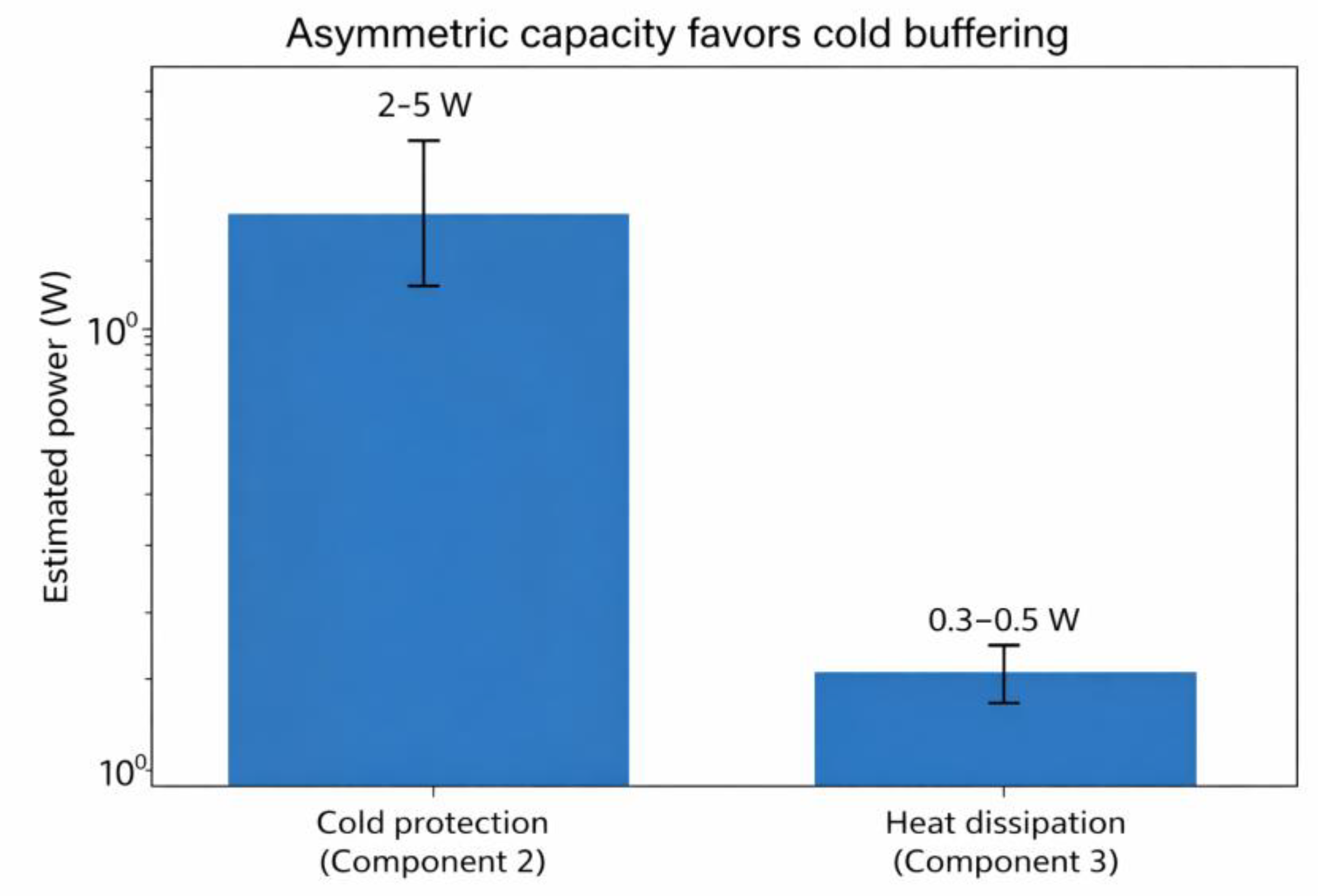
Cold-protection capacity (2-5 W) exceeds heat dissipation (0.3-0.5 W) by about 5-15× (see Appendix S1, Section 6 for a detailed analysis). This asymmetry results from fundamental thermodynamics: temperature gradients during cold stress (40-60°C from core to ambient) greatly surpass those during heat stress (5-10°C). Additionally, core metabolic heat is abundant, while evaporative capacity is surface-limited. Sensitivity analysis shows this asymmetry remains consistent across physiologically plausible parameter ranges. (Figure 3).
Evolutionary interpretation (speculative): Preventing hypothermia in temperature-sensitive neural and sensory tissues might have been more vital than controlling mild hyperthermia because behavioral thermoregulation (seeking shade, reducing activity) works better against heat but is less effective for cold. Natural selection may have favored systems with a high capacity for cold buffering.
4. Discussion
Supporting Evidence
Clinical Evidence: Post-Mastoidectomy Thermal Sensitivity
Švagan et al. (2025) [7] studied 30 adults with unilateral childhood mastoidectomy, comparing operated ears with intact contralateral controls. Key findings: thermal insulation capacity decreased by 38% (p < 0.001), caloric threshold increased by 5.5°C (p < 0.001), and cold-induced vertigo occurred in 27% of operated ears compared to 3% of intact ears (p < 0.01). Pressure regulation remained normal, confirming the dissociability of thermal and pressure functions. These findings directly support prediction 1 (see testable predictions later in the discussion).
Physiological Evidence: Selective Brain Cooling Studies
Intranasal cooling studies show that the nasal/sinus route can influence intracranial temperature [14,15]. Animal research demonstrates that selective brain cooling of 2-4°C can be achieved within 10-15 minutes using cooled air or liquid delivered through the nasal passages, while core body temperature remains the same. These results confirm the anatomical heat-exchange pathway, although the studies use extreme cooling; whether physiological differences can cause meaningful effects remains to be tested.
Anatomical Evidence: Climate Correlation Reinterpreted
The inverse climate-pneumatization correlation (smaller sinuses in cold climates), previously seen as evidence against thermal function [2,3], can now be reinterpreted as supporting bidirectional adaptation [4]: in cold climates, smaller air spaces limit "thermal windows" that could leak valuable body heat; in warm climates, larger air spaces offer more evaporative surface area for heat dissipation. This reflects an optimization for the main thermal challenge in each environment.
Why Sensory Organs Rather than the Brain?
Brain parenchyma exhibits strong intrinsic thermoregulation: high blood perfusion (50-60 mL/100 g/min), autoregulation, a CSF thermal buffer (150 mL), and multiple alternative cooling pathways [16]. In contrast, the vitreous and endolymph have zero perfusion, extremely low thermal inertia, and lack intrinsic regulation. Quantitative vulnerability analysis (Appendix S1, Section 9) shows that these avascular structures are 4-5× more susceptible to thermal perturbation than brain tissue, making them likely primary targets for pneumatic thermal protection.
Ocular Implications
Although direct measurements of vitreous temperature are currently unavailable, we can be certain that even minor thermal fluctuations can have significant effects on the eye’s optics. The vitreous is a gel without blood vessels, and its refractive index and viscosity depend on temperature, suggesting that brief cooling might impact light scattering or the movement of microstructures within the vitreous. Anecdotal clinical observations-such as brief blur or increased floaters during cold exposure-may indicate subtle thermal changes in the vitreous. We note that these are still hypotheses; however, if the proposed thermoregulatory model is accurate, differences in periorbital air spaces could explain why some individuals are more sensitive to cold-related visual disturbances. This offers a testable clinical prediction that has not been previously explored.
Testable Predictions
The following predictions are meant to be testable. Not confirming any prediction would weaken certain parts of the hypothesis while possibly keeping others intact.
Prediction 1: Structural-Thermal Correlation
Pneumatization volume should inversely correlate with temperature variability around the eyes and ears during thermal stress. Proposed test: CT-based volumetry in 90 subjects divided by pneumatization tertile, with IR thermography during a standardized cold/heat challenge. Expected: r = −0.5 to −0.8.
Prediction 2: Directional Asymmetry
Cold protection capacity should exceed heat dissipation by 5 to 15 times. Proposed test: Measure respiratory heat delivery during cold exposure and evaporative water loss during heat exposure. Expected ratio: 5 to 15 times (consistent despite parameter variability; see Appendix S1, Section 8).
Prediction 3: Autonomic Modulation
Pharmacological intervention should selectively impact active components. Proposed test: Vasoconstrictors should decrease cold protection (Component 2) without affecting passive insulation (Component 1). Dehydration should reduce heat dissipation (Component 3). Expected outcome: targeted components should be selectively impaired.
Prediction 4: Clinical Phenotype
Loss of pneumatization should affect the thermal stability of sensory organs more than brain temperature. Proposed test: Post-FESS patients assessed with periorbital thermography and caloric testing compared to EEG and cognitive measures. Expected outcome: Sensory effects surpass neural effects.
Prediction 5: Comparative Anatomy
Cross-species analysis should reveal a stronger link between pneumatization and eye/vestibular parameters than with brain mass. Proposed test: Phylogenetically controlled regression across 30-50 mammalian species. Expected outcome: eye diameter and vestibular volume will more accurately predict pneumatization than brain mass.
5. Conclusions
We suggest that the paranasal sinuses and mastoid air cells form a three-part craniofacial thermal system that shields temperature-sensitive avascular structures, such as the vitreous and endolymph, from environmental thermal changes.
The three components consist of: (1) Passive insulation providing roughly 15 times greater thermal resistance than bone; (2) Active cold protection with an estimated capacity of 2-5 W; (3) Active heat dissipation with an estimated capacity of 0.3-0.5 W. The 5 to 15 times asymmetry favoring cold protection reflects thermodynamic constraints rather than design flaws.
Novel contributions: This framework (1) identifies avascular sensory organs as primary targets for protection based on vulnerability analysis; (2) distinguishes three mechanistically distinct components; (3) integrates the sinuses and mastoid into a unified system; (4) generates quantitative, testable predictions; and (5) reinterprets climate correlations as supportive rather than contradictory to thermal function.
Clinical implications (if validated): Thermal-aware surgical planning may be necessary; postoperative cold sensitivity symptoms might have a physiological rather than psychological cause; protective strategies could be devised for at-risk patients.
We emphasize that this remains a hypothesis requiring thorough experimental testing. The significance lies not in claiming certainty but in providing a testable framework that can inspire new research directions. We encourage the scientific community to test these predictions, understanding that even partial validation would improve understanding, while refutation would clarify the true roles of these mysterious structures.
Supplementary Materials
The following supporting information can be downloaded at the website of this paper posted on Preprints.org.
Author Contributions
E.A. and I.M. contributed equally to this manuscript.
Funding
No external funding.
Ethics Approval
Not applicable (theoretical manuscript).
Data Availability
Not applicable. Supplementary Appendix S1 contains all calculations.
Running Title
Skull Pneumatization and Thermoregulation.
Conflicts of Interest
The authors declare no conflicts of interest.
References
- Proetz, AW. Applied Physiology of the Nose, 2nd ed.; Annals Publishing Company: St. Louis, 1953. [Google Scholar]
- Koertvelyessy, T. Relationships between the frontal sinus and climatic conditions. Am J Phys Anthropol. 1972, 37(2), 161–172. [Google Scholar] [CrossRef] [PubMed]
- Negus, VE. The Comparative Anatomy and Physiology of the Nose and Paranasal Sinuses; E. & S. Livingstone Ltd: Edinburgh, 1958. [Google Scholar]
- Rae, TC; Koppe, T; Stringer, CB. The Neanderthal face is not cold adapted. J Hum Evol. 2011, 60(2), 234–239. [Google Scholar] [CrossRef] [PubMed]
- Magnuson, B. Functions of the mastoid cell system: auto-regulation of temperature and gas pressure. Acta Otolaryngol. 2003, 123(2), 122–129. [Google Scholar] [CrossRef] [PubMed]
- Gallup, AC; Hack, GD. Human paranasal sinuses and selective brain cooling: A ventilation system activated by yawning? Med Hypotheses 2011, 77(6), 970–973. [Google Scholar] [CrossRef] [PubMed]
- Švagan, M; Battelino, S; Gros, A; et al. Evaluating the sequelae of mastoidectomy for acute mastoiditis: Long-term follow-up study of mastoid function. J Clin Med. 2025, 14(19), 6689. [Google Scholar] [CrossRef] [PubMed]
- Standring, S (Ed.) Gray’s Anatomy: The Anatomical Basis of Clinical Practice, 42nd ed.; Elsevier: Edinburgh, 2021. [Google Scholar]
- Bluestone, CD; Klein, JO. Otitis Media in Infants and Children, 4th ed.; BC Decker Inc: Hamilton, 2007. [Google Scholar]
- Baloh, RW; Honrubia, V; Kerber, KA. Baloh and Honrubia’s Clinical Neurophysiology of the Vestibular System, 4th ed.; Oxford University Press: New York, 2011. [Google Scholar]
- Duck, FA. Physical Properties of Tissues: A Comprehensive Reference Book; Academic Press: San Diego, 1990. [Google Scholar]
- Cengel, YA; Ghajar, AJ. Heat and Mass Transfer: Fundamentals and Applications, 5th ed.; McGraw-Hill: New York, 2015. [Google Scholar]
- Eccles, R. Nasal airflow in health and disease. Acta Otolaryngol. 2000, 120(5), 580–595. [Google Scholar] [CrossRef] [PubMed]
- Baker, MA. A brain-cooling system in mammals. Sci Am. 1979, 240(5), 130–139. [Google Scholar] [CrossRef] [PubMed]
- Koehler, RC; Traystman, RJ; Bhardwaj, A. Rapid selective cerebral cooling with extracorporeal circulation. Crit Care Med. 2009, 37, S291–S296. [Google Scholar]
- Morrison, SF; Nakamura, K. Central mechanisms for thermoregulation. Annu Rev Physiol. 2019, 81, 285–308. [Google Scholar] [CrossRef] [PubMed]
Figure 1.
Anatomical relationship between paranasal sinuses and the orbital cavity. CT images in sagittal (left) and coronal (right) planes show the distribution of paranasal sinuses around the orbit. Color overlays indicate the frontal sinus (pink), ethmoid air cells (yellow), maxillary sinus (teal), and sphenoid sinus (brown). White circles mark the position of the eyeball, illustrating the nearly complete air-space enclosure surrounding the orbit (270-300 degrees of circumferential coverage). Note the close proximity of the ethmoid air cells to the medial orbital wall (lamina papyracea, 0.2-0.5 mm thick).
Figure 1.
Anatomical relationship between paranasal sinuses and the orbital cavity. CT images in sagittal (left) and coronal (right) planes show the distribution of paranasal sinuses around the orbit. Color overlays indicate the frontal sinus (pink), ethmoid air cells (yellow), maxillary sinus (teal), and sphenoid sinus (brown). White circles mark the position of the eyeball, illustrating the nearly complete air-space enclosure surrounding the orbit (270-300 degrees of circumferential coverage). Note the close proximity of the ethmoid air cells to the medial orbital wall (lamina papyracea, 0.2-0.5 mm thick).
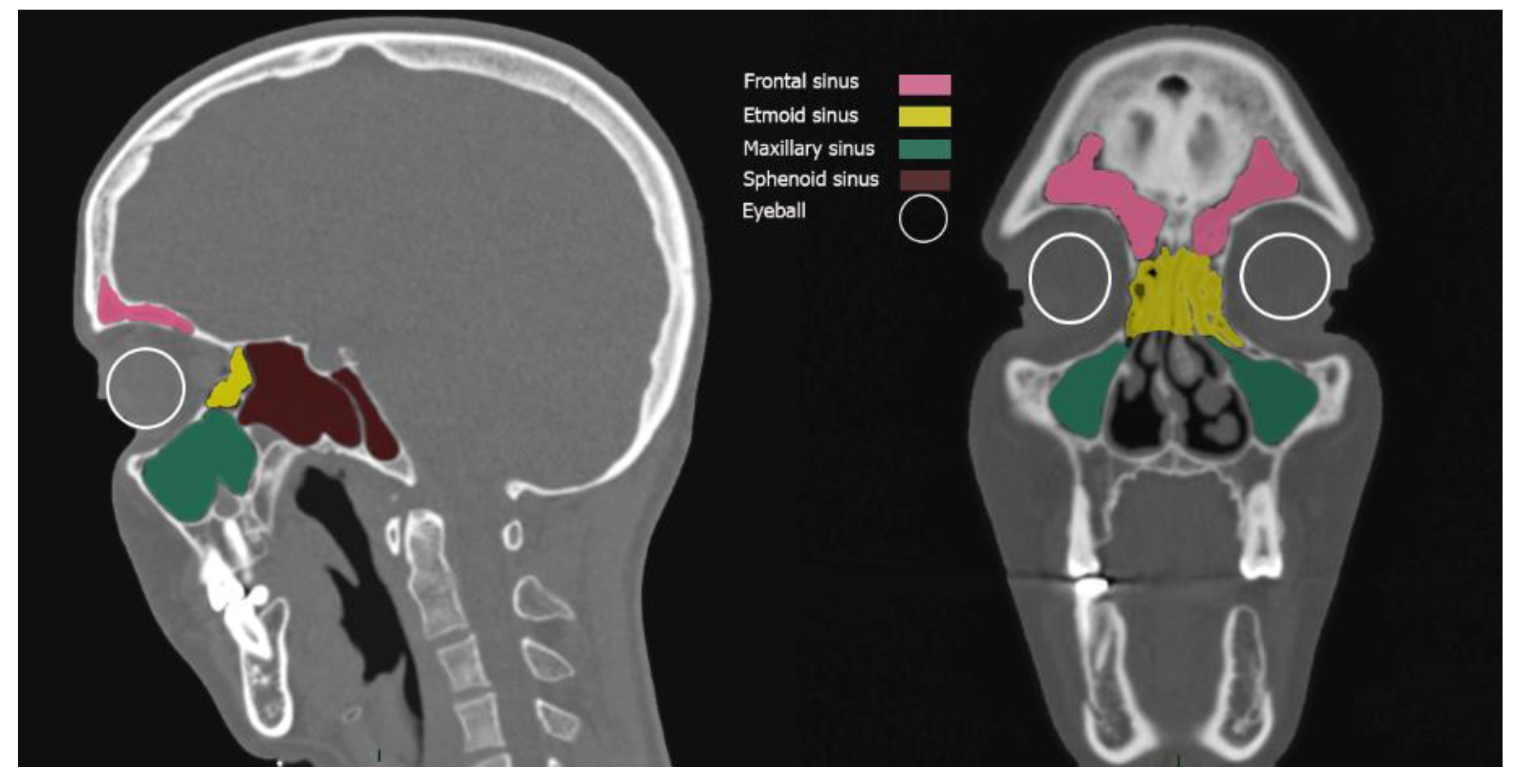
Figure 2.
Mastoid air cells and their relation to vestibular structures. An axial CT image at the level of the temporal bone shows the mastoid air cell system (highlighted in blue on the left side). The labeled key anatomical landmarks include the cochlea and lateral semicircular canal, demonstrating the close proximity (2-8 mm) between the pneumatized mastoid and the vestibular labyrinth, which contains temperature-sensitive endolymph.
Figure 2.
Mastoid air cells and their relation to vestibular structures. An axial CT image at the level of the temporal bone shows the mastoid air cell system (highlighted in blue on the left side). The labeled key anatomical landmarks include the cochlea and lateral semicircular canal, demonstrating the close proximity (2-8 mm) between the pneumatized mastoid and the vestibular labyrinth, which contains temperature-sensitive endolymph.
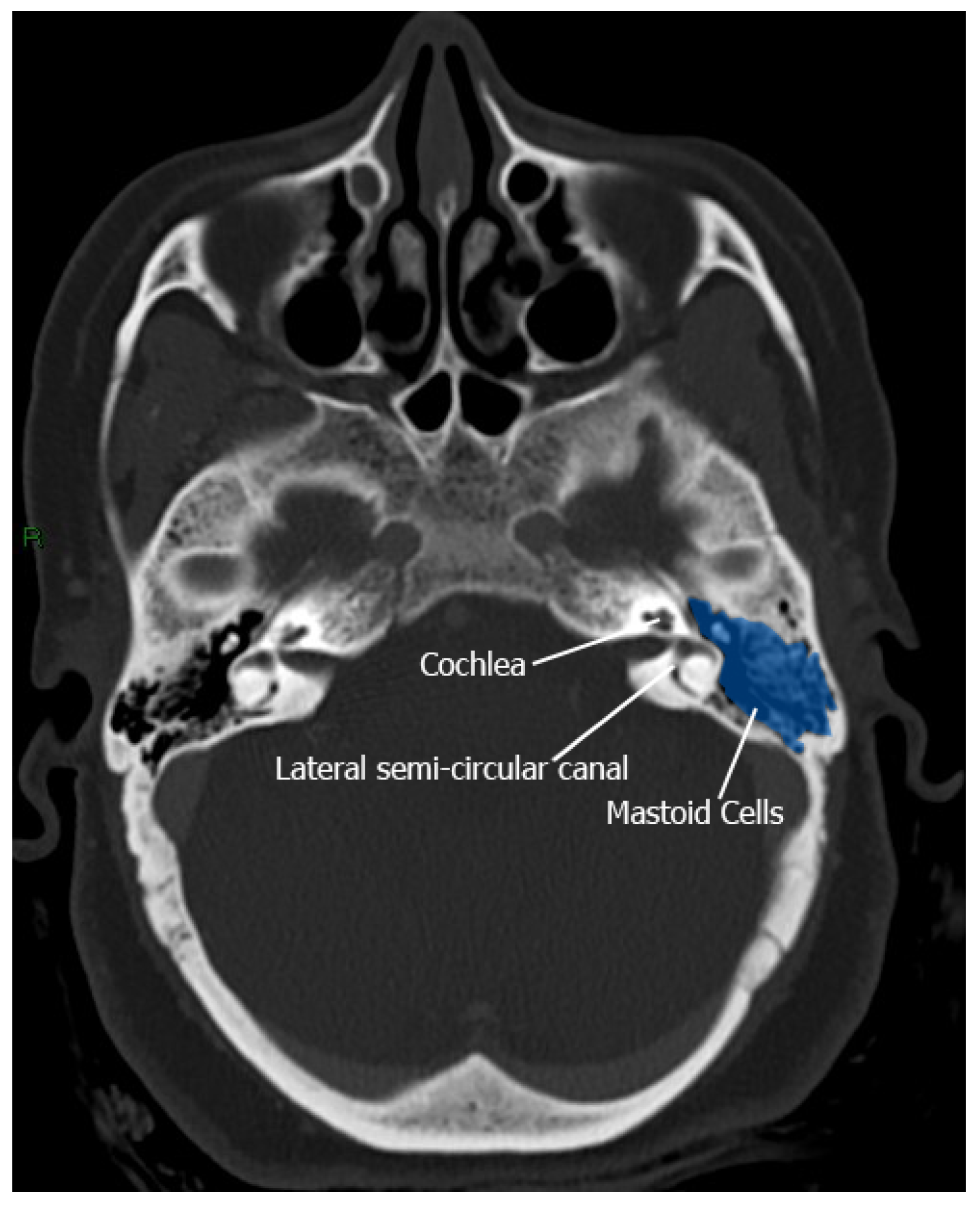
Figure 3.
Asymmetric capacity favors cold buffering. Bar graph comparing the estimated thermal protection capacities of the two active components. Cold protection (Component 2, left bar) provides 2-5 W of capacity through mucosal heat delivery, while heat dissipation (Component 3, right bar) offers only 0.3-0.5 W through evaporative cooling. This 5-15x difference reflects key thermodynamic constraints: larger temperature gradients during cold stress and abundant core metabolic heat compared to surface-limited evaporative capacity. Error bars show estimated parameter uncertainty ranges. The Y-axis uses a logarithmic scale.
Figure 3.
Asymmetric capacity favors cold buffering. Bar graph comparing the estimated thermal protection capacities of the two active components. Cold protection (Component 2, left bar) provides 2-5 W of capacity through mucosal heat delivery, while heat dissipation (Component 3, right bar) offers only 0.3-0.5 W through evaporative cooling. This 5-15x difference reflects key thermodynamic constraints: larger temperature gradients during cold stress and abundant core metabolic heat compared to surface-limited evaporative capacity. Error bars show estimated parameter uncertainty ranges. The Y-axis uses a logarithmic scale.
Disclaimer/Publisher’s Note: The statements, opinions and data contained in all publications are solely those of the individual author(s) and contributor(s) and not of MDPI and/or the editor(s). MDPI and/or the editor(s) disclaim responsibility for any injury to people or property resulting from any ideas, methods, instructions or products referred to in the content. |
© 2026 by the authors. Licensee MDPI, Basel, Switzerland. This article is an open access article distributed under the terms and conditions of the Creative Commons Attribution (CC BY) license.
Copyright: This open access article is published under a Creative Commons CC BY 4.0 license, which permit the free download, distribution, and reuse, provided that the author and preprint are cited in any reuse.


