

Submitted:
02 April 2026
Posted:
03 April 2026
You are already at the latest version
Abstract
Background and Clinical Significance: Autosomal dominant tubulointerstitial kidney disease caused by mutation in uromodulin gene (ADTKD-UMOD) is a rare kidney disorder characterized by progressive tubulointerstitial damage and slowly progressive loss of renal function. ADTKD is often under-recognized in the clinical setting. In fact, diagnosis of ADTKD-UMOD can be challenging due to its nonspecific symptoms, being confirmed by genetic testing only. Case presentation: We report the case of a 42-years-old male patient referred for evaluation of renal dysfunction, incidentally discovered in routine laboratory checks. He had no significant medical history and no known familiarity for kidney disease or gout. Physical examination was unremarkable. Renal dysfunction was confirmed, with serum creatinine 1.44 mg/dl and eGFR 59.5 ml/min/1.73 m2. Urinalysis was within physiological limits, with proteinuria of 75 mg/day. Uric acid was mildly elevated (7.5 mg/dl) without gout history. Other laboratory findings including autoantibodies were in normal range. Patient underwent kidney biopsy, which however was not diagnostic showing mild focal tubular atrophy and interstitial fibrosis without glomeruli involvement. Immunofluorescence staining was negative for complement and immunoglobulins. Based on above nonspecific findings, the patient was suspected of a possible diagnosis of ADTKD. Genetic investigation using a clinical exome next-generation sequencing approach identified a novel heterozygous missense variant in the UMOD gene (c.409T>C; p.Cys137Arg). Patient is in regular clinical-laboratory monitoring. After one year, his overall health is good, renal function stable with no proteinuria, uric acid mildly increased without gout attacks. Conclusions: Increased clinical awareness is crucial for detecting ADTKD-UMOD. Genetic testing can help to solve clinical diagnostic challenges in patients with unexplained decreased kidney function.
Keywords:
ADTKD-UMOD
; autosomal dominant tubulointerstitial kidney disease
; chronic kidney disease
; uromodulin
; genetics
; genetic testing
; mutation
1. Introduction
There is increasing evidence to show the important role of genetic testing in the diagnostics of adults with chronic kidney disease (CKD) of unknown cause, who would otherwise remain without a definitive diagnosis [1]. Genetic analysis is currently the only way for definitive diagnosing autosomal dominant tubulointerstitial kidney disease (ADTKD), a heterogeneous group of rare kidney disorders that share the common feature of progressive tubulointerstitial damage [2,3,4]. ADTKD is characterized by slowly progressive loss of renal function, normal- or small-sized kidneys, bland urinalysis, and tubular damage with interstitial fibrosis in renal histopathology with no significant specific findings [2]. Hyperuricemia often accompanied by gout is frequent and usually precedes CKD, which leads to kidney failure in adulthood [4].
The classification of ADTKD, due to the overlap in phenotype characteristics, was revised into a classification system based on the underlying genetic defect, which also encompasses conditions formerly known as medullary cystic kidney disease and familial juvenile hyperuricemic nephropathy [2]. Genes with disease-causing variants which cause most, though not all, cases of ADTKD include uromodulin (UMOD), renin (REN), hepatocyte nuclear factor 1b (HNF1B), mucin-1 (MUC1) and, most recently, SEC61A1 and DNAJB11 [5]. The most prevalent causative gene of ADTKD has been identified as being gene encoding uromodulin, also known as Tamm-Horsfall protein [3,4,6].
Uromodulin, the most abundant protein in normal urine, is a kidney-specific glycoprotein with pleiotropic roles in physiology and pathology, which may play a role in several kidney disorders including acute kidney injury, CKD and ADTKD [7]. A list of UMOD pathogenic mutations obtained from literature, collaborators, and referral families has been recently reported [8]. Most UMOD mutations are missense variants, clustered in exons 3 and 4, with more than half resulting in the addition or loss of a cysteine residue leading to misfolding of the uromodulin protein [4,5,8].
We report here a case of ADTKD-UMOD with a novel heterozygous missense variant (c.409T > C: p.Cys137Arg) in UMOD gene. The nucleotide change T>C in position 409 of exon 3 had not been previously identified.
2. Detailed Case Description
A 42-years-old male patient was referred to the nephrology clinic for the recent incidental finding of abnormal renal function. On occasion of annual medical and laboratory checkups, reduction of renal function was found (serum creatinine 1.6 mg/dl, eGFR 52.7 ml/min/1.73 m2), associated with mild hyperuricemia (8 mg/dl); the urinalysis was unremarkable. Patient was asymptomatic, and no abnormalities could be detected in previous laboratory investigations, including urinary tests. Impairment of renal function was confirmed one month later, with serum creatinine values of 1.67 mg/dl and eGFR 50.1 ml/min/1.73 m2; hyperuricemia also was present (uric acid 8.3 mg/dl), while 24-hour proteinuria was 150 mg. Blood electrolytes were in normal range. A renal ultrasound showed kidneys of normal size with normal thickness and echogenicity of the parenchyma, a right upper polar parenchymal cyst, and no anatomical abnormalities in the urinary system. Patient was then referred to our hospital.
On admission, physical examination revealed blood pressure 115/75 mmHg, with no signs of lower leg edema, or abnormalities in the heart, lungs, or abdomen. He had no significant medical history including possible gout attack and was not taking any medication. His father suffered from type 2 diabetes mellitus, while his brother suffered from arterial hypertension. There was no known familiarity for kidney disease or gout. Serum levels of creatinine (1.44 mg/dl, with eGFR 59.5 ml/min/1.73 m2) and uric acid (7.5 mg/dl) were slightly elevated. Serum cystatin C level was 1.11 mg/L. Chemical-physical analysis of urine showed no proteinuria or hematuria. Urine sediment analysis was within physiological limits, and 24-h urine protein was 75 mg/day. Arterial blood gas analysis proved unremarkable. Serum complement (C3, C4) and immunoglobulin (Ig) levels (IgG, IgA, IgM) were in the normal range. Search for antinuclear antibodies, anti-DNA antibodies, ENA, and anti-neutrophil cytoplasmic antibodies, was negative. No monoclonal bands were disclosed by electrophoresis of serum proteins. Main laboratory findings are shown in Table 1.
To identify the etiology and the severity of renal involvement, after obtaining informed consent, renal biopsy was performed in the absence of complications. Light microscopic examination of the kidney biopsy specimen revealed 12 glomeruli per section of cortical parenchyma, one of which was globally sclerotic. The remaining glomeruli showed focal thickening of Bowman’s capsule in the absence of further morphological alterations. Additional findings included mild focal tubular atrophy and interstitial fibrosis (<10%) (Figure 1A). In very few tubular profiles of the thick ascending limb of Henle’s loop, hyalin inclusions in the cytoplasm of tubular epithelial cells were noticed on Masson’s trichrome staining (Figure 1B). No significant vascular abnormalities were observed. Immunofluorescence staining was negative for C3, C4, C1q, IgG, IgA, IgM, fibrinogen, κ and λ light chains.
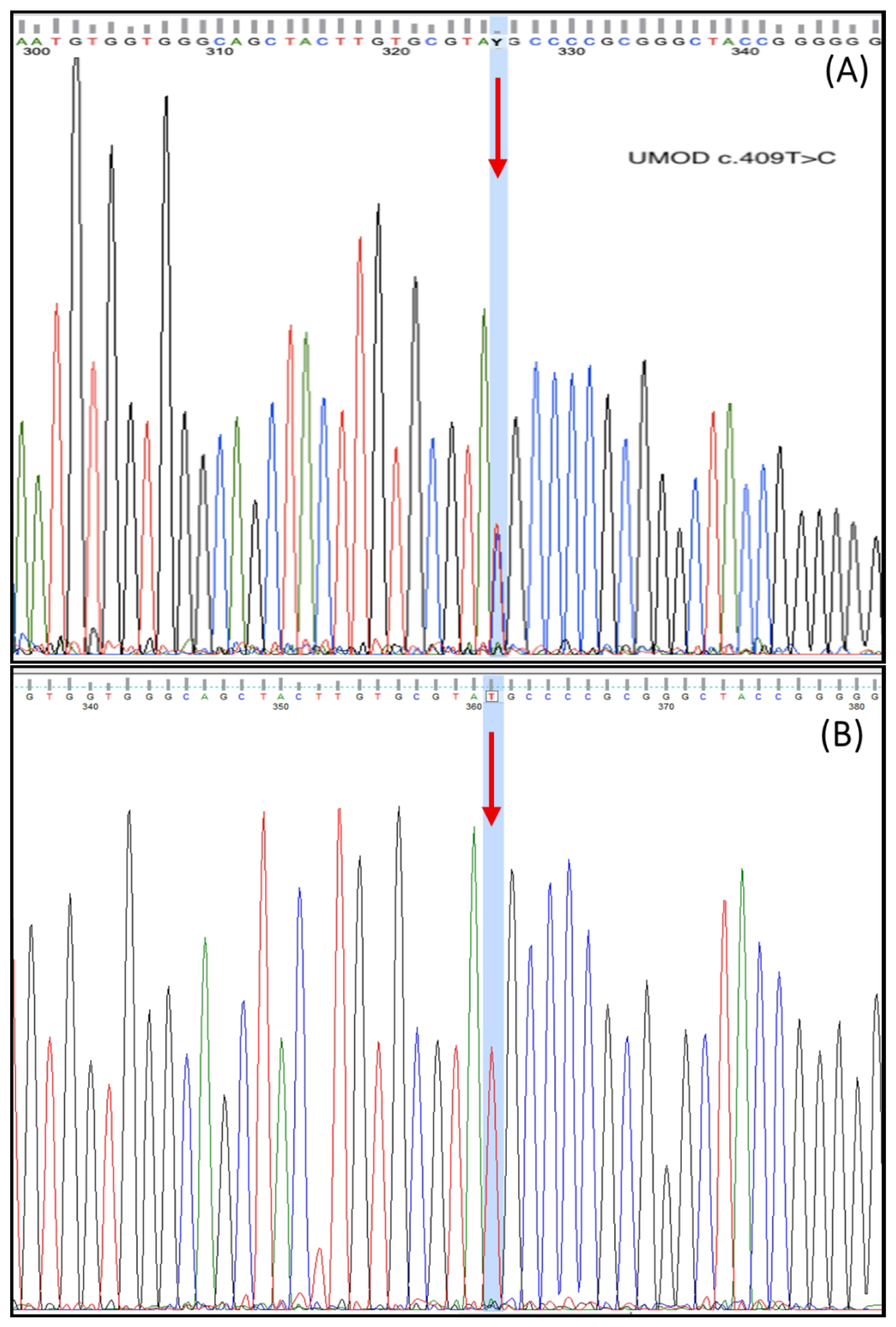
Based on the above nonspecific findings, the patient was suspected of a possible diagnosis of ADTKD. Thus, blood sample was taken for genetic investigation after informed consent of the patient. Clinical exome sequencing using a next-generation sequencing (NGS) approach identified a heterozygous UMOD variant (c.409T>C; p.Cys137Arg). The result was confirmed by PCR amplification followed by direct Sanger sequencing of exon 3 of the UMOD gene. The analysis achieved a mean coverage of 100× for 98.2% of the targeted regions, and variant interpretation was performed using Geneyx Analysis (CE-IVD) software. This variant has not been previously reported in literature or in publicly available databases, including ClinVar and LOVD. According to ACMG/AMP variant interpretation guidelines, supported by in-silico predictions from Franklin Genoox and VarSome, the variant was classified as likely pathogenic. Genetic counseling was therefore recommended to address personal, family, and reproductive risk. Genetic testing of the patient’s parents could not be performed because they were deceased. Segregation analysis in the patient’s sister did not reveal the presence of the c.409T>C variant, and she does not show any clinical signs or symptoms suggestive of ADTKD-UMOD.
At discharge, no drug therapy was prescribed after discussion with the patient and his wife. Inhibitors of the renin-angiotensin-system were not started according to blood pressure values and the absence of proteinuria. Patient preferred not to begin uric acid-lowering therapy. A regular clinical and biochemical follow up was established.
One year after the diagnosis, patient maintained overall good health. Renal function proved stable, with serum creatinine 1.5 mg/dl and eGFR 51 ml/min/1.73 m2. Uric acid is slightly increased (7.6 mg/dl) with no gout attack occurring. Urinary tests did not show significant abnormalities. Blood pressure maintained around 120/75 mmHg.
Figure 2.
Identification of the UMOD c.409T>C variant by Sanger sequencing. (A) Chromatogram of the patient showing the heterozygous T>C substitution in the UMOD gene (arrow). (B) Sister wild-type chromatogram showing the reference nucleotide T at the same position.
Figure 2.
Identification of the UMOD c.409T>C variant by Sanger sequencing. (A) Chromatogram of the patient showing the heterozygous T>C substitution in the UMOD gene (arrow). (B) Sister wild-type chromatogram showing the reference nucleotide T at the same position.
3. Discussion
ADTKD-UMOD is defined by the presence of a heterozygous pathogenic variant in UMOD gene, which encodes uromodulin [2]. Uromodulin is expressed in the cells of thick ascending limbs of the loop of Henle and early distal convoluted tubules and is secreted bidirectionally into the urine and circulation. Uromodulin is a multi-functional protein, and its function depends on its site of action and form. In urine, uromodulin maintains the homeostasis of the urinary space protecting against urinary infections and kidney stones. Various protective roles of uromodulin in the interstitium, circulation, and intracellular have been reported [7].
In ADTKD-UMOD, most experimental evidence suggests that the mechanism of action of UMOD pathogenic variants is a gain-of-toxic function [9], with intracellular accumulation of mutant uromodulin [10,11,12,13] inducing endoplasmic reticulum stress and the unfolded protein response pathway, leading to interstitial fibrosis [7]. Several molecular mechanisms have been implicated in the connection between intracellular accumulation of uromodulin and interstitial fibrosis, including inflammation [10,11], apoptosis [11], mitochondrial dysfunction [12], impaired autophagy [13], and the cyclic GMP–AMP synthase—stimulator of interferon genes (STING) pathway [13]. Recent observations suggest other pathogenic mechanisms unrelated to endoplasmic reticulum stress, such as complement system activation [14]. Uromodulin can bind to complement factor H, enhancing its activity to inhibit complement activation [15]. In a patient with ADTKD-UMOD, deposition of complement C3 and complement factor B was detected by immunofluorescence staining in renal tissue [14]. Moreover, patient-derived uromodulin demonstrated reduced binding to complement factor H and limited ability to assist in C3b degradation and hemolysis inhibition. Since hyperactivation of the complement system contributes to tubulointerstitial damage [16], complement activation might represent a potential link between uromodulin and tubulointerstitial fibrosis [14].
The case reported here represents in our opinion a frequent challenge to practicing nephrologist: an adult patient with unexplained decreased kidney function. There was no family history for renal disorders, clinical and laboratory findings were largely nonspecific, and kidney biopsy performed for determining the presence of renal pathological findings was unrevealing, showing nonspecific interstitial fibrosis and tubular atrophy. Despite the absence of a positive family history for CKD or gout, ADTKD was considered for the occurrence of characteristic nonspecific findings including compatible histology [2]. Comprehensive genetic testing disclosed the heterozygous missense variant c.409T > C: p.Cys137Arg. The nucleotide change T>C in position 409 of exon 3 represents a novel observation. Segregation analysis showed that the patient’s sister does not carry the variant and does not present clinical manifestations suggestive of ADTKD-UMOD. Although a missed diagnosis in other individuals within the family cannot be unequivocally ruled out (genetic testing could not be performed in patient’s parents due to their death), genetic defect in the case reported here might represent a de novo mutation [17].
The c.409T>C (p.Cys137Arg) variant affects a conserved cysteine residue in uromodulin. Cysteine residues are essential for the formation of intramolecular disulfide bonds required for correct protein folding, and variants affecting these residues are a well-established pathogenic mechanism in ADTKD-UMOD, leading to misfolding and intracellular retention of mutant uromodulin. The variant is absent from population databases and predicted to be deleterious by in-silico tools; together with the compatible clinical phenotype, this supports classification as likely pathogenic according to ACMG criteria (PM1, PM2, PP3, PP4). Notably, cysteine substitutions account for more than half of reported UMOD mutations, further supporting the pathogenic role of the p.Cys137Arg variant. To our knowledge, this is the first report of the UMOD c.409T>C (p.Cys137Arg) variant, expanding the mutational spectrum of ADTKD-UMOD.
Demonstration of a mutation in UMOD gene allowed establishing the diagnosis of ADTKD. Such amino acid change (replacement of cysteine with arginine) without identification of the nucleotide change was previously reported in a single case, reaching ESRD at the age of 48 years, which is close to the mean age (45 years) of kidney failure in ADTKD [8]. Renal dysfunction, however, was milder in the case presented here and stable over time. Of note, kidney disease progression in ADTKD shows a high variability, not only interfamilial but also within families, which hampers to establish accurately the genotype-phenotype correlation [5].
Our patient is in regular clinical and biochemical monitoring. During a 1-year follow-up, renal function (assessed by eGFR) and uric acid levels (mild hyperuricemia) proved to be stable, with persistent absence of proteinuria. Patient is in good clinical condition, blood pressure remains within the normal range, and no gout attack developed. Altogether, these findings did not prompt the start of any treatment, as discussed with the patient.
No disease-specific therapeutic options are currently available for ADTKD- UMOD, and management primarily focuses on slowing CKD progression and treating complications [6]. The main treatment strategies for individuals affected by ADTKD-UMOD are based on established guidelines for CKD [18]. To be noted however that no data is currently available on the potential benefits of renin-angiotensin-system inhibitors in slowing CKD progression in ADTKD patients (6). For patients who develop gout, allopurinol or febuxostat (when allopurinol cannot be tolerated) should be started after the first attack of gout has resolved [2]. Whether uric acid-lowering intervention can slow the progression of kidney disease remains unclear. In patients progressing to kidney failure, renal transplantation is the treatment of choice, as genetic disease does not recur in the graft [2,4].
Higher genetically driven levels of urinary UMOD in the general population are associated with lower eGFR and an increased risk of developing CKD [19,20]. This is opposite to observations in clinical studies of urinary UMOD in CKD [21], a discrepancy that may be explained by residual confounding and reverse causation since UMOD is also a marker of tubular mass. Mendelian randomization in population-based cohorts of European descent confirmed higher levels of urinary UMOD as risk factor for CKD and eGFR decline, independently of blood pressure [19]. A recent substudy of the EMPA-KIDNEY study (Study of Heart and Kidney Protection with Empagliflozin) assessed the effects of empagliflozin on a wide range of urinary biomarkers [22]. The randomized analyses included CKD patients treated with empagliflozin 10 mg daily (n=1357) or placebo (n=1395) with at least one measurement at 2- and 18- month follow-up visit. The two groups were balanced, including genotyping data for UMOD variants which are associated with the excretion of urinary UMOD. Allocation to empagliflozin induced a marked reduction (- 63%) in urinary UMOD, independently of primary kidney disease, diabetes status, albuminuria, and eGFR level. Mediation analyses showed that lowering urinary UMOD accounted for 19% of the beneficial treatment effect on the chronic slope of eGFR, comparable to the effect of reductions in albuminuria (15%). This potential novel nephroprotective effect of empagliflozin might be mediated by reducing UMOD production and/or processing leading to reduced metabolic demands of the thick ascending limb segment [22], which produces UMOD and is critical for kidney metabolism [23]. However, a recent prospective study in 6 ADTKD-UMOD patients treated with sodium-glucose cotransporter-2 inhibitors (empagliflozin or dapagliflozin) for more than 1 year showed no amelioration in the decline of renal function [24]. The slope of eGFR (ml/min/1.73m2) over time was -1.33 ± 1.58, not significantly different from values before initiation of treatment (-1.03 ± 1.90) or to propensity-matched controls (-1.93 ± 4.51). While these findings may indicate that these medications may not be effective, the few participants presented the decline in kidney function at initial therapy that has been associated with future nephroprotection [24]. Further investigation is therefore required to ascertain the potential benefits of sodium-glucose cotransporte-2 inhibitors in ADTKD-UMOD patients.
Some recent studies show novel potential therapeutic opportunities in ADTKD-UMOD. Clearance of the intracellular aggregated mutant protein seems a promising therapeutic approach. Inhibition of mammalian target of rapamycin complex 1 (mTORC1) reduced in vitro the aggregation of uromodulin through activation of autophagy (11). Overexpression of mesencephalic astrocyte-derived neurotrophic factor (MANF), which is a protein of endoplasmic reticulum, was found to promote autophagy and clear mutant uromodulin, mitigating renal injury in vitro and in mouse models [13]. Likewise, BRD4780 (a small molecule targeting the cargo receptor TMED9) promoted the removal of mutant UMOD improving the disease phenotype [25]. Clearly, for clinical application these potential therapeutic opportunities need to demonstrate their specific ability to degrade mutant uromodulin rather than other essential proteins (7). Further investigation showed that anti-inflammatory treatment with an inhibitor of tumor necrosis factor-alpha reduced disease progression in a mouse model of ADTKD-UMOD [11]. Inhibition of the complement alternative pathway activity, according to recent findings [14], might represent a novel therapeutic approach worthy to be explored. Finally, gene editing technologies, particularly CRISPR/Cas9, can produce opportunities for treating ADTKD-UMOD (6).
4. Conclusions
The estimated prevalence of CKD of unknown origin is 10% to 20%, with up to 20% attributable to a genetic cause [26]. In the absence of evidence for kidney disease of other etiology, and even without a positive family history, ADTKD should be considered in single cases (like our patient) presenting nonspecific clinical and histological findings [2]. ADTKD is being increasingly recognized with enhanced availability for genetic testing and a better understanding of this condition, and accounts for approximately 5% of all monogenic kidney disorders [3]. The present report shows that genetic testing can help to resolve clinical diagnostic challenges in unexplained CKD. Although ADTKD has no effective specific treatment, reasons to pursue definitive diagnosis by genetic testing may include confirmation of the diagnosis in the affected patient, information on disease prognosis and clinical management, and indication to genetic counseling in family members. Genetic testing also holds potential to direct patients to suitable clinical trials and targeted therapies [27]. The landscape of ADTKD-UMOD research is evolving [6], hopefully leading to effective clinical approaches for the proper management of the disease.
Author Contributions
Conceptualization M.B. and V.V.; Writing—original draft M.B.; Supervision L.S. and L.D.L.; Investigation V.G., M.R., and V.V.; Writing—review and editing M.B., and V.V.; Validation L.S., V.G., M.R., and L.D.L. All authors have read and agreed to the published version of the manuscript.
Funding
This research received no external funding.
Institutional Review Board Statement
The study was conducted in accordance with the Declaration of Helsinki. Ethical review and approval were waived for this study due to the nature of a single retrospective case report.
Informed Consent Statement
The study participant provided written informed consent to publish this paper and agreed to the use of his DNA in studies that identified genetic risk variants for kidney function.
Data Availability Statement
The data presented in this study are available on request from the corresponding author.
Conflicts of Interest
The authors declare no conflicts of interest.
Abbreviations
The following abbreviations are used in this manuscript:
| ADTKD | Adult Dominant Tubulointerstitial Kidney Disease |
| CKD | Chronic Kidney Disease |
| eGFR | estimated Glomerular Filtration Rate |
| UMOD | Uromodulin |
References
- Schott C, Lebedeva V, Taylor C, Abumelha S, Roshanov P. Connaughton DM. Utility of genetic testing in adults with CKD: a systematic review and meta-analysis. Clin J Am Soc Nephrol 2025, 20, 101-115, 2025. [CrossRef]
- Eckardt KU, Alper SL, Antignac C, et al. Autosomal dominant tubulointerstitial kidney disease: diagnosis, classification, and management—a KDIGO consensus report. Kidney Int 2015, 88, 676–683. [CrossRef]
- Mabillard H, Sayer JA, Olinger E. Clinical and genetic spectra of autosomal dominant tubulointerstitial kidney disease. Nephrol Dial Transpl. 2023, 38, 271–82. [CrossRef]
- Devuyst O, Olinger E, Weber S, Eckardt KU, Kmoch S, Rampoldi L, Bleyer AJ. Autosomal dominant tubulointerstitial kidney disease. Nat Rev Dis Primers. 2019, 5, 60. [CrossRef]
- Econimo L, Schaeffer C, Zeni L, Cortinovis R, Alberici F, Rampoldi L, Scolari F, Izzi C. Autosomal dominant tubulointerstitial kidney disease: an emerging cause of genetic CKD. Kidney Int Rep. 2022, 7, 2332-2344. [CrossRef]
- Qiao P, Wang Z, Xie J. Autosomal dominant tubulointerstitial kidney disease-UMOD: a short review. Orphanet J Rare Dis 2025, 20, 405. [CrossRef]
- Nanamatsu A, de Araújo L, LaFavers KA, El-Achkar TM. Advances in uromodulin biology and potential clinical applications. Nat Rev Nephrol. 2024, 20, 806-821. [CrossRef]
- Bleyer AJ, Kidd KO, Živná M, Kmoch S. Autosomal dominant tubulointerstitial kidney disease: a review. Am J Kidney Dis 2025, 86, 677-689. [CrossRef]
- Schiano G, Lake J, Mariniello M, Schaeffer C, Harvent M, Rampoldi L, Olinger E, Devuyst O. Allelic effects on uromodulin aggregates drive autosomal dominant tubulointerstitial kidney disease. EMBO Mol Med. 2023, 15, e18242. [CrossRef]
- Trudu, M., Schaeffer, C., Riba, M. et al. Early involvement of cellular stress and inflammatory signals in the pathogenesis of tubulointerstitial kidney disease due to UMOD mutations. Sci Rep. 2017, 7, 7383. [CrossRef]
- Johnson BG, Dang LT, Marsh G, Roach AM, Levine ZG, Monti A, Reyon D, Feigenbaum L, Duffield JS. Uromodulin p.Cys147Trp mutation drives kidney disease by activating ER stress and apoptosis. J Clin Invest. 2017, 127, 3954-3969. [CrossRef]
- Kemter E, Fröhlich T, Arnold GJ, Wolf E, Wanke R. Mitochondrial dysregulation secondary to endoplasmic reticulum stress in autosomal dominant tubulointerstitial kidney disease-UMOD (ADTKD-UMOD). Sci Rep 2017, 7, 42970. [CrossRef]
- Kim Y, Li C, Gu C, et al. MANF stimulates autophagy and restores mitochondrial homeostasis to treat autosomal dominant tubulointerstitial kidney disease in mice. Nat Commun 2023, 14, 6493. [CrossRef]
- Xie Q, Bai L, Gong K, Hu N, Chen Y. Mutations in UMOD contribute to the pathogenesis of ADTKD-UMOD by influencing the function of complement factor H. J Cell Mol Med. 2026,30, e71025. [CrossRef]
- Liu M, Wang Y, Wang F, Xia M, Liu Y, Chen Y, Zhao MH. Interaction of uromodulin and complement factor H enhances C3b inactivation. J Cell Mol Med. 2016, 20, 1821-8. [CrossRef]
- Hsu SI, Couser WG. Chronic progression of tubulointerstitial damage in proteinuric renal disease is mediated by complement activation: a therapeutic role for complement inhibitors? J Am Soc Nephrol. 2003, 4(7 Suppl 2), S186-91. [CrossRef]
- Li M-S, Li Y, Jiang L, Song Z-r, Yu X-j, Wang H, Ren Y-l, Wang S-x, Zhou X-j, Yang L, Zhang H. ADTKD-UMOD in a girl with a de novo mutation: A case report. Front Med. 2022, 9:1077655. [CrossRef]
- Madero M, Levin A, Ahmed SB, Carrero JJ, Foster B, Francis A, et al. Evaluation and management of chronic kidney disease: synopsis of the kidney disease: improving global outcomes 2024 clinical practice guideline. Ann Intern Med. 2025, 178, 705–713. [CrossRef]
- Ponte B, Sadler MC, Olinger E, Vollenweider P, Bochud M, Padmanabhan S, Hayward C, Kutalik Z, Devuyst O. Mendelian randomization to assess causality between uromodulin, blood pressure and chronic kidney disease. Kidney Int. 2021, 100, 1282-1291. [CrossRef]
- Turner M, Staplin N. UMOD-ulating CKD risk: untangling the relationship between urinary uromodulin, blood pressure, and kidney disease. Kidney Int. 2021, 100, 1168-1170. [CrossRef]
- Steubl D, Block M, Herbst V, et al. Urinary uromodulin independently predicts end-stage renal disease and rapid kidney function decline in a cohort of chronic kidney disease patients. Medicine (Baltimore). 2019, 98: e15808. [CrossRef]
- Malijan GB, Sardell RJ, Staplin N, Devuyst O, Chapman D, Hill M, Nägele N, Moffat S, Wijayaratne D, Donovan K, Zhu D, Steubl D, Hauske SJ, Petrini M, Ng SYA, Pontremoli R, Cherney DZI, Tuttle KR, Landray MJ, Wanner C, Baigent C, Shlipak MG, Haynes R, Judge PK, Ix JH, Herrington WG; EMPA-KIDNEY Collaborative Group. Effects of empagliflozin on urine biomarkers in EMPA-KIDNEY. Am J Kidney Dis. 2025, S0272-6386(25)01107-2. Article in press. [CrossRef]
- Nanamatsu A, Rhodes GJ, LaFavers KA, et al. Alternative splicing of uromodulin enhances mitochondrial metabolism for.
- adaptation to stress in kidney epithelial cells. J Clin Invest. 2025, 135, e183343. [CrossRef]
- Kidd KO, Williams AH, Elhassan EAE, Taylor A, Martin L, Kim A, Rocco MV, Choi MJ, Zivna M, Kmoch S, Conlon PJ, Bleyer AJ. An observational study of SGLT2 inhibitors and their use in autosomal dominant tubulointerstitial kidney disease. Res Sq [Preprint] 2025, Sep 25:rs.3.rs-7482366. [CrossRef]
- Bazua-Valenti S, Brown MR, Zavras J, Riedl Khursigara M, Grinkevich E, Sidhom EH, et al. Disrupted uromodulin trafficking is rescued by targeting TMED cargo receptors. J Clin Invest. 2024, 134, e180347. [CrossRef]
- Vivante A. Genetics of chronic kidney disease. N Engl J Med. 2024, 391, 627–639. [CrossRef]
- Groopman EE, Marasa M, Cameron-Christie S, Petrovski S, Aggarwal VS, Milo-Rasouly H, Li Y, Gharavi AG. Diagnostic utility of exome sequencing for kidney disease. N Engl J Med. 2019, 380, 142–151. [CrossRef]
Figure 1.
Renal biopsy findings. (Top) Low magnification of renal biopsy showing mild interstitial fibrosis and tubular atrophy along with focal fibrous thickening of Bowman’s capsule without any other glomerular change (Masson’s trichrome). (Bottom) Hyalin inclusions (black arrows) in the cytoplasm of tubular epithelial cells of a thick ascending limb of Henle’s loop (Masson’s trichrome).
Figure 1.
Renal biopsy findings. (Top) Low magnification of renal biopsy showing mild interstitial fibrosis and tubular atrophy along with focal fibrous thickening of Bowman’s capsule without any other glomerular change (Masson’s trichrome). (Bottom) Hyalin inclusions (black arrows) in the cytoplasm of tubular epithelial cells of a thick ascending limb of Henle’s loop (Masson’s trichrome).
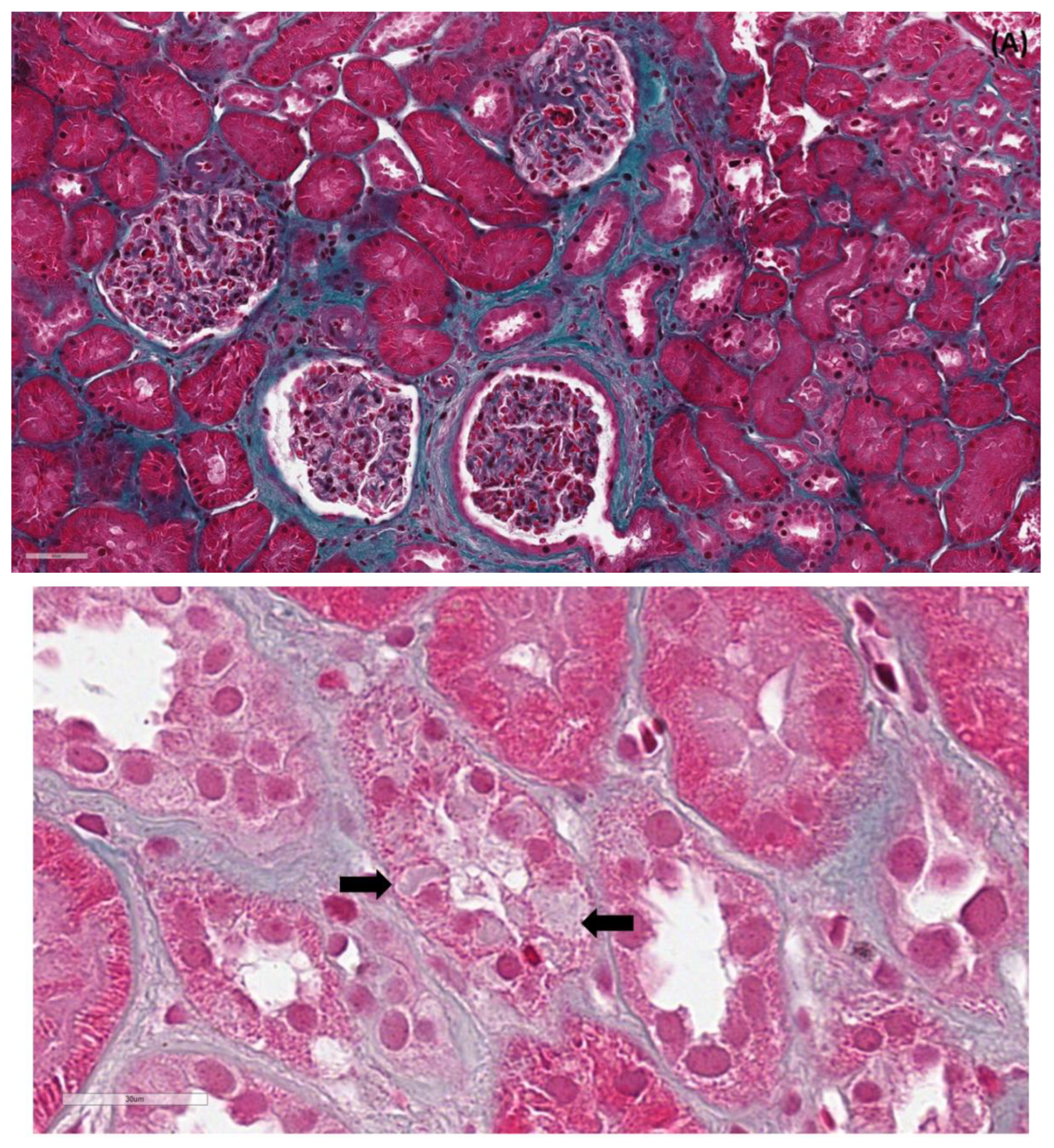

Table 1.
Laboratory data.
| Item | Value | Normal range |
|---|---|---|
| Creatinine | 1.34 mg/dl | 0.6-1.3 mg/dl |
| Urea | 40 mg/dl | 17.1-49.2 mg/dl |
| Cystatin C | 1.11 mg/L | 0.65-0.9 mg/L |
| Uric acid | 7.5 mg/dl | 3.5-7.2 mg/dl |
| Glycemia | 80 mg/dl | 70-100 mg/dl |
| Hemoglobin | 14.5 g/dl | 13-17 g/dl |
| Total protein | 7.4 g/dl | 6.4-8.3 g/dl |
| Albumin | 4.8 g/dl | 3.5-5.2 g/dl |
| Total cholesterol | 222 mg/dl | 0-200 mg/dl |
| LDL cholesterol | 159 mg/dl | 0-100 mg/dl |
| HDL cholesterol | 46 mg/dl | 40-60 mg/dl |
| Triglycerides | 141 mg/dl | 0-150 mg/dl |
| Sodium | 140 mmol/L | 136-145 mmol/L |
| Potassium | 3.9 mmol/L | 3.5-5.1 mmol/L |
| Calcium | 9.2 mg/dl | 8.4-10.2 mg/dl |
| Magnesium | 1.71 mg/dl | 1.6-2.6 mg/dl |
| Platelets | 198 x103/mmc | 150-450 x103/mmc |
| White blood cells | 8010/mL | 4000-10000/mL |
| HS C-reactive protein | 0.59 mg/L | 0-5 mg/L |
| Lactate dehydrogenase | 170 IU/L | 125-220 IU/L |
| Fibrinogen | 243 mg/dl | 180-400 mg/dl |
| Complement factor C3 | 99 mg/dl | 82-113 mg/dl |
| Complement factor C4 | 20 mg/dl | 15-57 mg/dl |
| Urinary β2MG | 0.15 mg/L | 0.10.0.32 mg/L |
HS, high sensitivity; β2MG, beta-2 microglobulin.
Disclaimer/Publisher’s Note: The statements, opinions and data contained in all publications are solely those of the individual author(s) and contributor(s) and not of MDPI and/or the editor(s). MDPI and/or the editor(s) disclaim responsibility for any injury to people or property resulting from any ideas, methods, instructions or products referred to in the content. |
© 2026 by the authors. Licensee MDPI, Basel, Switzerland. This article is an open access article distributed under the terms and conditions of the Creative Commons Attribution (CC BY) license (http://creativecommons.org/licenses/by/4.0/).
Copyright: This open access article is published under a Creative Commons CC BY 4.0 license, which permit the free download, distribution, and reuse, provided that the author and preprint are cited in any reuse.


