

Submitted:
01 April 2026
Posted:
03 April 2026
You are already at the latest version
Abstract
Background: Pulse measurement and heart rate are one of the most basic medical skills and yet, is the most important skill that has be learned by all medical professionals. The duration of how long that should be measured is variable depending on the learning of individual medical student. Aim: To assess accuracy of pulse calculation done manually to decide the cutoff on how long pulse should be measured. Methodology: An observational study was conducted after due IRB permission where included patients’ pulse was calculated for different time intervals and extrapolated to calculate the beats per minute. At the same time, patient’s pulse was taken by a calibrated pulse oximeter 6 times during that 1 minute. Average of the Oximeter data was compared against the extrapolated data was compared for their averages and standard deviation across all time fields using T-test and statistical significant difference was found. Result: Presence of statistical difference between the extrapolated data and oximeter data represents that calculating pulse for that long actually yields statistically significant deviation. Calculating pulse for 12 seconds and extrapolating it yields p-value of 0.0002 representing a significant difference but calculating higher than 12, i.e., for 15 seconds and then extrapolating yields p-value of 0.0612 which represents a nonsignificant difference compared to average oximeter pulse reading. Conclusion: This research paper although simple has been a way to answer the age old question on how long pulse should be measured. This concludes that any measurements higher than 15 seconds does yield a nonsignificant difference. Hence, the pulse should at least be measured for 15 seconds or higher.
Keywords:
Introduction
Methodology
- Patients whose Radial Pulse can be palpated and calculated
- Patients who are willing to give consent for the study
- Patients with R-R delay
Results

| Total Sample Size N = 435 | |||
| Females | Males | ||
| N = 156 | Avg = 45.730 | N = 279 | AVG = 43.047 |
| Minimum Age | 8 years | Minimum age | 10 years |
| Maximum Age | 85 years | Maximum age | 88 years |
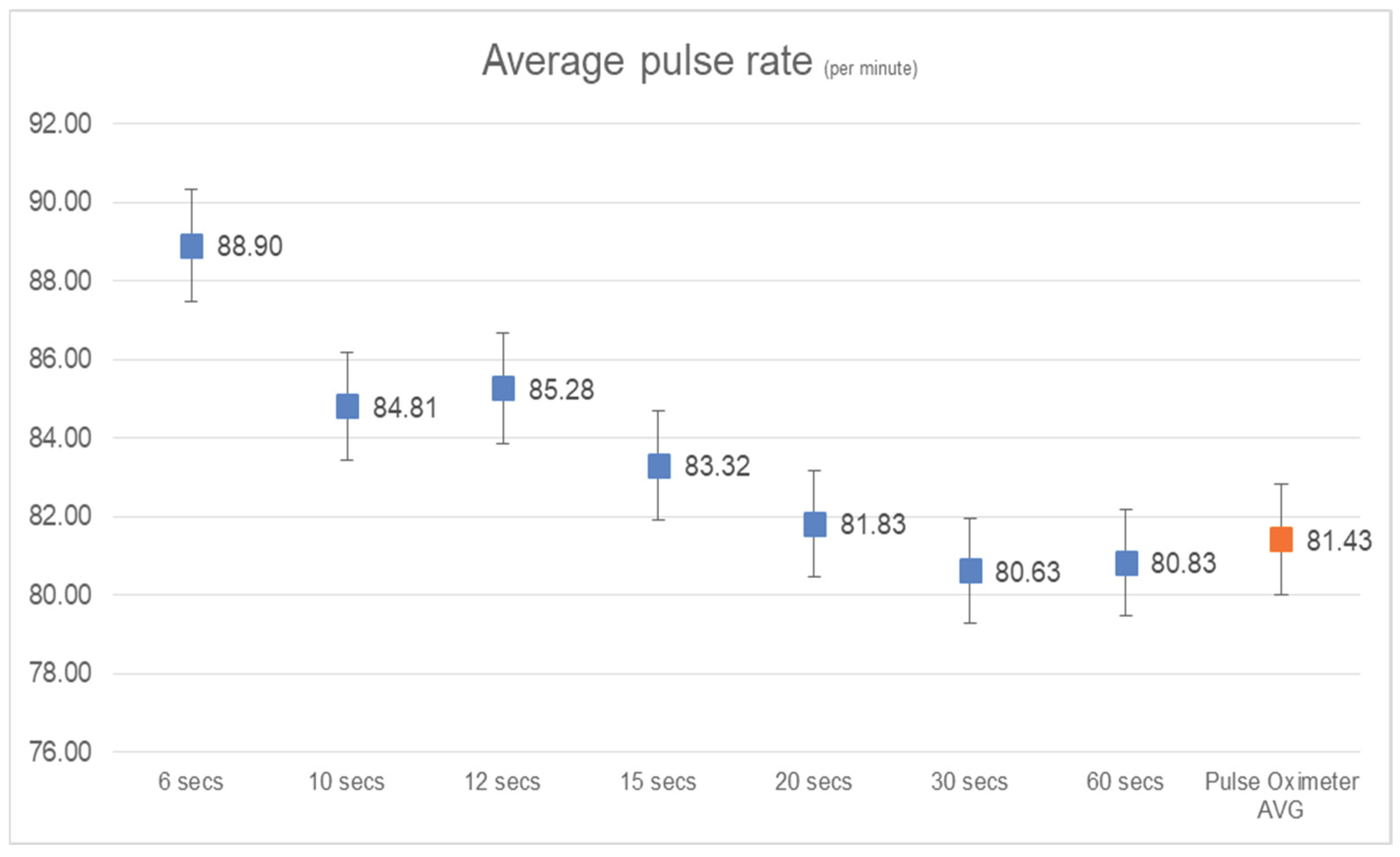
| Pulse taken for | Average ± CI95 |
PP-value for t-test (vs Pulse Ox) |
Correlation coefficient (vs Pulse Ox) |
| 6 secs | 88.897 ( 87.458 ± 90.335 ) | <0.0001 | 0.856 |
| 10 secs | 84.814 ( 83.449 ± 86.179 ) | 0.0008 | 0.895 |
| 12 secs | 85.276 ( 83.87 ± 86.681 ) | 0.0002 | 0.895 |
| 15 secs | 83.32 ( 81.933 ± 84.706 ) | 0.0612 | 0.901 |
| 20 secs | 81.83 ( 80.49 ± 83.17 ) | 0.6868 | 0.908 |
| 30 secs | 80.625 ( 79.281 ± 81.97 ) | 0.4209 | 0.908 |
| 60 secs | 80.828 ( 79.49 ± 82.165 ) | 0.545 | 0.952 |
| Pulse Oximeter AVG | 81.43 ( 80.022 ± 82.838 ) | 1.000 |
Discussion
Conclusions
Declarations
References
- Alexander, RW. The Arterial Pulse. In Clinical Methods: The History, Physical, and Laboratory Examinations, 3rd ed.; Walker, HK, Hall, WD, Hurst, JW, Eds.; Butterworths: Boston, 1990. [Google Scholar]
- Ghasemzadeh, N; Zafari, AM. A brief journey into the history of the arterial pulse. Cardiology research and practice 2011, 2011, 164832. [Google Scholar] [CrossRef] [PubMed]
- Pickering, D. How to measure the pulse. Community eye health 2013, 26(82), 37. [Google Scholar] [PubMed]
- Inoue, H; Kumagai, S; Makae, H. Effect of measurement duration on accuracy of pulse-counting. Journal of Physiological Anthropology 2013, 32(1), 1. [Google Scholar]
- Marcus, G. Evaluation and Management of Premature Ventricular Complexes. Circulation 2020, 141(17), 1404–18. [Google Scholar] [CrossRef] [PubMed]
- The Rational Clinical Examination: Evidence-Based Clinical Diagnosis; McGraw-Hill Education: New York, 2008.
- Bickley, LS; Szilagyi, PG; Hoffman, RM. Bates’ Guide to Physical Examination and History Taking, 13th ed.; Wolters Kluwer: Philadelphia, 2020. [Google Scholar]
- Hollerbach, AD; Sneed, NV. Accuracy of radial pulse assessment by length of counting interval. Heart & lung: the journal of critical care 1990, 19(3), 258–64. [Google Scholar]
Disclaimer/Publisher’s Note: The statements, opinions and data contained in all publications are solely those of the individual author(s) and contributor(s) and not of MDPI and/or the editor(s). MDPI and/or the editor(s) disclaim responsibility for any injury to people or property resulting from any ideas, methods, instructions or products referred to in the content. |
© 2026 by the authors. Licensee MDPI, Basel, Switzerland. This article is an open access article distributed under the terms and conditions of the Creative Commons Attribution (CC BY) license (http://creativecommons.org/licenses/by/4.0/).


