

Submitted:
01 April 2026
Posted:
02 April 2026
You are already at the latest version
Abstract
Patients with cardiovascular diseases often require cardiac surgery with cardiopulmonary bypass (CPB), which triggers inflammation and increases the risk of postoperative atrial fibrillation (POAF). This study assessed the predictive value of inflammatory biomarkers and clinical and surgical variables for POAF in patients undergoing coronary artery by-pass grafting (CABG; n = 36), valve surgery (n = 40), or combined CABG and valve surgery (n = 13), all of whom utilized CPB. Levels of IL-6, IL-8, IL-10, and C-reactive protein (CRP) were measured preoperatively, at 24 and 48 hours postoperatively, and at discharge. Sta-tistical analyses included t-tests, Mann–Whitney U tests, correlation analysis, logistic regression, and receiver operating characteristic (ROC) curve analysis. Sixteen of 89 patients (18%) developed POAF between 48 and 72 hours after surgery. The Society of Thoracic Surgeons (STS) score and hemoglobin at 24 hours were significantly different (p < 0.05) between the POAF and non-POAF groups. At 24 hours, POAF patients had significantly higher IL-6, IL-8, and IL-10 levels (p < 0.02); IL-6 remained elevated at 48 hours (p < 0.05), while CRP declined at discharge (p = 0.05). A multivariable model including STS score, IL-6 at 24 hours, and postoperative magnesium yielded an AUC of 0.82, with an optimism-corrected AUC of 0.77 after internal bootstrap validation. Integrating inflammatory and clinical variables produced a robust predictive model.
Keywords:
atrial fibrillation
; cardiac surgery procedures
; cardiopulmonary bypass
; risk factor
; comorbidity
; biomarkers
; inflammation mediators
1. Introduction
Cardiovascular diseases (CVDs) remain the leading cause of morbidity and mortality worldwide. These conditions represent a major public health burden due to their substantial clinical and socioeconomic impact (1,2). Coronary artery disease, valvular heart disease, heart failure, and arrhythmias often require surgical intervention at advanced stages (1). Cardiac surgery has significantly improved patient survival and quality of life. However, it is often accompanied by postoperative complications, with postoperative atrial fibrillation (POAF) as the most common sustained arrhythmia. POAF occurs in 20–50% of patients, depending on procedure type and patient characteristics. It is associated with prolonged hospital stays, thromboembolic events, heart failure, and higher mortality, which increase healthcare costs (3–6).
POAF results from a combination of preoperative vulnerability, surgical stress, and postoperative disturbances (7). Key risk factors include advanced age, male sex, hypertension, diabetes, heart failure, structural atrial abnormalities, and higher surgical risk scores. Intraoperative factors, like longer cardiopulmonary bypass time and atrial manipulation, also increase risk (7,8). Current clinical and surgical risk scores have limited predictive value for POAF, highlighting the need for better tools (9).
Evidence increasingly supports inflammation’s central role in POAF pathophysiology, especially after cardiac surgery with CPB (10–12). Surgical trauma, ischemia–reperfusion injury, contact with extracorporeal circuits, and endothelial activation trigger systemic inflammation. This inflammation is characterized by cytokines, acute-phase proteins, and oxidative stress mediators (11–13). These changes promote atrial electrical and structural remodeling, alter ion channel function, impair conduction, and create a transient proarrhythmic substrate. This substrate favors atrial fibrillation, particularly in the first 48–72 hours post-surgery (10,12,14).
Cytokines such as interleukin-6 (IL-6), interleukin-8 (IL-8), interleukin-10 (IL-10), and C-reactive protein (CRP) have been studied as POAF biomarkers (15–18). IL-6 and IL-8 are proinflammatory cytokines involved in neutrophil recruitment, endothelial activation, and myocardial dysfunction. IL-10 reflects anti-inflammatory mechanisms tied to overall response (16,17,19). CRP, an acute-phase reactant, is associated with cardiovascular risk and atrial fibrillation in both surgical and non-surgical settings (20,21). However, past studies report inconsistent findings. Most focus on single biomarkers, single-time measurements, or small groups, without integrating clinical and surgical factors (17,22).
The timing of inflammatory biomarker changes can reveal mechanisms behind POAF. Early postoperative cytokine surges, followed by either rapid resolution or persistent levels, may indicate varying degrees of inflammation, compensatory responses, and atrial vulnerability (23). Few studies examine multiple biomarkers at different time points alongside clinical and surgical variables. Data from Latin America remain limited (9,22)
This study aimed to assess the predictive value of inflammatory biomarkers (IL-6, IL-8, IL-10, and CRP) at different time points, in combination with clinical and surgical factors, for the development of POAF in patients undergoing cardiac surgery with cardiopulmonary bypass. By integrating molecular mediators with clinical and surgical data, we aimed to develop a comprehensive predictive model for early POAF risk stratification.
2. Results
2.1. Baseline Clinical, Surgical, and Biochemical Characteristics According to POAF Status
Of the total cohort of 89 patients included in the study, 16 developed postoperative atrial fibrillation (POAF), representing an overall incidence of 17.9%. Depending on the type of surgical intervention, POAF occurred in three patients (3.3%) undergoing coronary artery bypass grafting (CABG), nine patients (10.1%) undergoing valvular surgery, and four patients (4.5%) undergoing combined surgery. Regarding the chronology of the arrhythmic event, POAF onset occurred at 24 hours postoperatively in one patient, peaked at 48 hours in nine patients, and occurred after 72 hours in the remaining six patients.
The baseline clinical, biochemical, and surgical characteristics of the population, stratified by the development of POAF, are summarized in Table 1. The univariate analysis was performed on the total cohort without subdividing by type of surgery.
The studied cohort exhibited multiple comorbidities with varying impacts on POAF development (Table 1). Hypothyroidism (9/89) was significantly more prevalent in patients who developed POAF (31.3%) compared to those without POAF (5.5%). Systemic arterial hypertension (SAH) and type 2 diabetes mellitus (T2DM) were the main comorbidities among CABG patients. Obesity (grades I and II) and normal weight were distributed similarly between groups. Overweight status was more frequent in the POAF group (P = 0.07). Both POAF and non-POAF groups had comparable rates of dyslipidemia, chronic coronary syndrome (CCS), chronic cardiac insufficiency (CCI), and acute myocardial infarction (AMI).
For patients needing valve replacement or repair, severe aortic valve stenosis, insufficiency, or damage was most common (n = 41), followed by mitral valve involvement (n = 19) and tricuspid valve involvement (n = 4). No pulmonary valve repairs occurred in this cohort.
Table 2 summarizes clinical, biochemical, and surgical variables by POAF status. Most intraoperative parameters did not differ significantly between groups. These include cardiopulmonary bypass time, aortic cross-clamp time, activated clotting time, bleeding volumes, left ventricular ejection fraction, and STS score.
EuroSCORE II was significantly higher in the POAF group than in the non-POAF group (p = 0.032). Baseline laboratory values were similar between groups. At 24 hours after surgery, hemoglobin was significantly lower in the POAF group (p = 0.007). Other postoperative biochemical parameters did not differ significantly.
Supplementary Table S1 presents correlation analyses of biochemical and surgical variables associated with atrial fibrillation. A strong inverse correlation was seen between left ventricular ejection fraction and intraoperative bleeding (r = −0.67, p = 0.004). Aortic cross-clamp time and cardiopulmonary bypass time correlated strongly and positively (r = 0.90, p = 0.001). Preoperative hematocrit and hemoglobin correlated strongly and positively (r = 0.74, p = 0.001). Postoperative creatinine correlated significantly with both pre- and postoperative urea (r = 0.53–0.57, p ≤ 0.034).
No significant differences were found between pre- and 24-hour post-surgery electrolyte levels in POAF or non-POAF patients for calcium (1.9-11.2 mg/dL), sodium (126-157 mmol/L), chloride (93-116 mmol/L), potassium (3.1-5.3 mEq/L), magnesium (1.92-2.07 mEq/L), and total proteins (1.6-9.0 g/dL). Postoperative chloride and calcium were inversely correlated (r = −0.58, p = 0.019). Albumin/total protein and preoperative sodium were significantly correlated (r = 0.50–0.62, p ≤ 0.047). Pre- and postoperative albumin/total protein levels also correlated significantly (r = 0.59, p = 0.021).
2.2. Inflammatory Biomarkers: Cytokines and C-Reactive Protein
Table 3 details the progression of inflammatory biomarkers. Preoperatively, POAF patients had significantly higher IL-10 levels, while IL-8 and IL-6 were similar between groups. After surgery, the POAF group showed a marked 24-hour surge in IL-8, IL-10, and IL-6. At 48 hours, only IL-6 remained significantly elevated in POAF patients. CRP showed no significant group differences early after surgery. At discharge, CRP was significantly higher in the non-POAF group.
The kinetic profiles of inflammatory markers are illustrated in Figure 1. The POAF group exhibited a distinct ‘rapid-response’ pattern for cytokines (IL-8, IL-10, and IL-6), which are known mediators of POAF-associated inflammation. This pattern featured an abrupt, high-magnitude spike at 24 hours, in contrast to the blunted response in the Non-POAF group. In contrast, CRP behavior, reflecting a later phase of systemic inflammation, showed a slower, progressive accumulation in both groups, peaking later at 48 hours. The curves overlapped during the rising phase. This pattern differs from the rapid kinetics of interleukins.
Correlation analyses of inflammatory biomarkers are shown in Supplementary Table S2, clarifying their interactions in POAF. Significant consistency over time was observed for individual markers, especially for postoperative levels of IL-8, IL-6, and CRP, which strongly correlated with their preoperative or earlier postoperative values, indicating ongoing inflammatory activity. Notably, IL-10 levels at discharge were closely linked to baseline preoperative levels, suggesting a regulated anti-inflammatory response associated with POAF. Regarding relationships between markers, significant positive correlations were found between IL-6 and IL-10 at several perioperative time points, reflecting simultaneous pro- and anti-inflammatory activity relevant to arrhythmia risk. In contrast, CRP levels showed different behavior, demonstrating inverse correlations with specific cytokines, which supports its limited specificity for POAF-related inflammation.
Since metabolic comorbidities are common in patients undergoing various surgical procedures, we compared inflammatory biomarkers between those who had only CABG (CABG group, n = 36) and only valvular surgery (valvular group, n = 40) (see Table S3, Supplementary Material). Patients who underwent combined procedures were excluded from this analysis to prevent confounding effects. The comparison focused solely on circulating inflammatory biomarkers measured at specific perioperative time points. Preoperative IL-8 levels were significantly higher in the valvular group compared to the CABG group (p = 0.01), as were preoperative IL-10 levels (p = 0.027). No significant differences were seen between groups for postoperative IL-8, IL-10, or IL-6 levels at 24 h, 48 h, or at hospital discharge. Preoperative IL-6 levels showed a non-significant trend toward higher values in the valvular group (p = 0.068). Regarding C-reactive protein (CRP), a significant borderline difference was noted at 24 h postoperatively, with higher values in the CABG group (p = 0.050), while no differences were found at other time points. Overall, these findings suggest distinct preoperative inflammatory profiles between the surgical groups, while postoperative inflammatory responses were mostly similar.
2.3. Clinical-Surgical and Biomarker-Based Predictive Models for POAF
The predictive performance of the variable blocks was evaluated utilizing the Receiver Operating Characteristic (ROC) curve analysis (Figure 2A). Key intraoperative variables, including cardiopulmonary bypass (CPB) duration, aortic cross-clamp time, surgical procedure type (CABG versus valve surgery), and postoperative electrolyte concentrations, were analyzed using univariate analyses. Nevertheless, these variables failed to remain statistically significant as independent predictors in the multivariable model and were consequently excluded from the final predictive model.
To further identify independent predictors of POAF, a multivariable logistic regression model was developed, including clinically relevant variables and those showing associations in univariate analyses. The final model consisted of the STS score, interleukin-6 (IL-6) levels at 24 hours, and postoperative magnesium concentrations (Table 4). Among the individual variable categories, clinical-surgical parameters demonstrated the greatest discriminative ability (AUC = 0.906), outperforming models based solely on laboratory data, including biomarkers (AUC = 0.843), blood chemistry (AUC = 0.841), and complete blood count (AUC = 0.752). Additionally, combining these parameters into a single predictive model (Figure 2B) improved overall accuracy, with an apparent AUC of 0.82. This highlights the synergistic effect of combining clinical and biological markers for risk stratification. Internal validation via bootstrap resampling (1000 iterations) yielded a mean optimism of 0.046, resulting in an optimism-corrected AUC of 0.77, indicating moderate yet reliable predictive performance (Table 5). Optimal cutoff points for individual predictors and performance metrics of the combined model are detailed in Supplementary Tables S4 and S5.
3. Discussion
3.1. Contribution of Comorbidities to POAF Development
The comorbidities to consider when evaluating their contribution to POAF have been described elsewhere. It has been reported that each 1-unit increase in BMI is associated with a 3-7% increase in POAF incidence, a finding we observed among overweight patients in our study. We compared these findings with those reported by Bowdish et al. (24), who studied a population of patients who developed POAF (695/2,104 = 33%) and found no differences in cardiac history or age. Unexpectedly, hypothyroidism was more common in POAF patients (31.5%) than in non-POAF patients (5.5%) (p=0.0018); in contrast, another study reported rates of 12.7% versus 8.6%, respectively (p=0.003) (24). Thyroid hormone imbalance significantly affects the cardiovascular system. According to a review by Higa et al. (25), major risk factors include diabetes mellitus (DM) and thyroid diseases, with hyperthyroidism being the most common metabolic condition among studied patients. Interestingly, the cardiac effects of altered T3 and T4 levels, along with elevated TSH, have been examined in a thyroidectomized rat model (26), where hormones were manipulated to induce either euthyroid or hyperthyroid states: hyperthyroidism resulted in increased ventricular contractility, cardiac hypertrophy similar to that caused by physical exercise, and may influence ion channel expression and function. Hyperthyroidism affects 10-25% of patients with AF (non-post-surgical). Conversely, studies on hypothyroidism in animal models have shown that heart rate, atrioventricular conduction time, and atrial effective refractory period tend to be slower compared to euthyroid rats (26).
A meta-analysis by Dell’Aquila et al. (27) is based on literature from 1946 to 2024 (Ovid Medline) and 1974 to the present (Ovid Embase), as well as the Cochrane Library. They identified 3445 patients, including 2594 euthyroid patients and 851 (24.7%) diagnosed as subclinical hypothyroidism (SCH). The clinical outcomes after cardiac surgery were operative mortality (stronger in the isolated CABG cohort), prolonged hospital length of stay, and renal complications. Although the hypothyroidism findings were interesting, they had no impact on the POAF predictive model; however, we consider this work offers novel insights into hypothyroidism associated with POAF.
3.2. Impact of Clinical Risk Scores and Postoperative Hemodynamic Status
In our study, STS score and 24-hour postoperative hemoglobin levels proved to be the most statistically significant factors linked to the development of POAF. While most surgical and intraoperative variables showed no significant differences between groups, these findings indicate that baseline clinical status and early hemodynamic response are crucial determinants of this arrhythmia (28). However, we recognize that in patients with valvular heart disease, the lack of detailed echocardiographic parameters such as left atrial volume or diastolic function is a limitation, as these structural factors inherently carry a risk for arrhythmia (29). Although left ventricular ejection fraction (LVEF) was analyzed and showed no significant differences between groups (p > 0.05), including more detailed echocardiographic data could have enhanced the predictive profile within the valvular subgroup. Nonetheless, incomplete medical records prevented their inclusion in the final multivariate analysis.
3.3. Serum Inflammatory Biomarkers Across Perioperative Time-Points of Cardiac Surgery with Cardiopulmonary Bypass
The biomarker analysis results for IL-6, IL-8, IL-10, and CRP support the hypothesis that an early, intense, and sudden inflammatory response—primarily within the first 24 hours after surgery—promotes the development of atrial arrhythmias in the immediate postoperative period. This pattern aligns with studies showing that IL-6 and IL-8 act as mediators of temporary electrical and structural atrial remodeling, driven by a localized proinflammatory microenvironment in the nearby atrial myocardium (30,31).
IL-10 can exhibit pro-inflammatory and immunostimulatory effects depending on the cellular context, timing, and specific immune environment (31). According to the physiological-surgical phenomenon studied, we interpret its role as an anti-inflammatory interleukin that is activated in response to atherosclerotic processes and is mainly produced by CD4+ T lymphocytes, macrophages, and B lymphocytes (31). In this study, we observed that patients who developed POAF had significantly higher preoperative IL-10 levels than those who did not (p < 0.05), indicating activation of a compensatory system to reduce underlying chronic inflammation before surgery. This response was even more evident as an acute reaction 24 hours after surgery (p = 0.003; Table 3).
Furthermore, the observed decrease in IL-10 levels at 48 hours in patients with POAF indicates an inadequate anti-inflammatory response to the concurrent rise in IL-6 and IL-8 (Table 3). This imbalance between proinflammatory and anti-inflammatory cytokines has been proposed as a mechanism promoting postoperative atrial arrhythmogenesis. In contrast to our results, Kota et al. (23) did not find significant differences in these interleukins, and their temporal profiles were quite similar between patients with and without POAF.
The behavior of CRP, better visualized in the plot across the different surgical time points (Figure 1), shows a difference in the slope of decline between groups (p = 0.05), Table 3, suggesting an important phenomenon: in patients who developed POAF, CRP not only reached values similar to the non-POAF group at the inflammatory peak (6- to 70-fold above baseline), but also showed a more pronounced decrease by 72 hours after surgery. These findings align with studies indicating that postoperative POAF is not necessarily associated with higher absolute CRP levels, but rather with more rapid fluctuations and an interaction with proinflammatory interleukins (such as IL-6 and IL-8) that amplify the initial response (32).
3.4. Systemic Inflammatory Response and Inflammatory Biomarkers Profile in the Physiopathology of POAF
Based on the biomarker behavior observed in our study and in the literature (30,31,33), we propose an integrated pathophysiological mechanism to explain POAF in our cohort (Figure 3). Surgery with cardiopulmonary bypass (CPB) acts as the primary trigger; factors such as ischemia–reperfusion injury following aortic cross-clamping and blood contact with non-endothelial surfaces activate the innate immune system. As shown on the left side of Figure 3, this activation prompts monocytes and endothelial cells to initiate the inflammatory cascade. Our results confirm the critical phase of this cascade at 24 hours postoperatively, indicated by the significant peaks in IL-6 and IL-8, illustrated in the central part of Figure 3.
I. The elevation of IL-8 (peaking at 24 h in the POAF group) suggests massive neutrophil recruitment to cardiac tissue, promoting local inflammation and oxidative stress.
II. IL-6, acting as the main mediator, not only stimulates hepatic synthesis of CRP (whose levels remain elevated at 48 h), but also exerts direct effects on the myocardium.
III. A distinctive finding of our study is the behavior of IL-10. Rather than being suppressed, its preoperative elevation and further increase at 24 h indicate an attempted immunologic counter-regulation (“anti-inflammatory brake”) that nevertheless is insufficient to contain the magnitude of the proinflammatory response (IL-6/IL-8) in patients with POAF.
We found that inflammatory biomarkers show significant correlations at different stages of the surgical process, suggesting a role for inflammation in the pathophysiology of POAF (Table S2).
This indicates an intensified IL-6–mediated inflammatory response caused by the surgical procedure, lasting into the postoperative period and until hospital discharge, with IL-10 providing an anti-inflammatory effect to counterbalance it. This aligns with previous research suggesting that prolonged inflammation may increase the risk of POAF (28). It also implies that immune system activation involves both proinflammatory and regulatory responses, which could influence the severity of inflammation and the likelihood of POAF (34). Prior studies have shown that elevated levels of IL-6 and other proinflammatory interleukins are similarly linked to patient outcomes in the ICU. Since this period is critical for the onset of arrhythmias (first 24–48 hours), it is notable that in our cohort, POAF occurred at 24 hours (one patient), 48 hours (nine patients), and in the remaining six patients after more than 72 hours postoperatively, highlighting the importance of managing systemic inflammation in the ICU for preventing POAF, as suggested by Yan et al. (35).
Regarding the link between biomarkers and POAF, IL-6, IL-8, and IL-10 levels did not reach statistical significance in our logistic regression analysis, although IL-6 showed a noticeable trend (p = 0.058). This lack of significance is likely due to the small sample size of the study and the low incidence of arrhythmia in our cohort, which aligns with findings by Kota et al. (23), indicating that factors beyond interleukins may contribute to POAF development. In contrast, CRP levels at discharge were significantly associated with POAF (p = 0.045), probably because of the sharp decline in CRP levels observed in patients with arrhythmia. This supports its role as a strong marker of systemic inflammation and as a useful predictor of POAF, as demonstrated in the meta-analysis by Weymann et al. (32).
Finally, it is important to recognize that the postoperative inflammatory response is closely linked to oxidative stress caused by cardiopulmonary bypass. Although directly assessing the redox balance was beyond this study’s scope, recent research, such as the study by Saetang et al. (36), indicates that antioxidant therapies could be a promising preventive strategy. These researchers found that combining vitamin C and thiamine in cardiac surgery may not only reduce myocardial damage but also significantly lower key inflammatory markers like IL-6. These results suggest that proactively targeting oxidative stress might serve as an additional approach to decrease the early systemic inflammatory response in our cohort and, consequently, lower the risk of POAF.
3.5. Integrative Synthesis: Proposal of a Multidimensional Risk Model for POAF Development
Unlike non-valvular atrial fibrillation, for which risk stratification scores are well-established (e.g., CHA2DS2-VASc), the prediction of POAF lacks a universally validated gold standard. Previous attempts to adapt chronic risk scores to the acute perioperative setting have produced inconsistent results, likely because they fail to account for the acute inflammatory and metabolic stress specific to cardiac surgery (37). In this context, our study demonstrates that a multimodal approach is superior to isolated clinical assessment. The key finding is the development of a combined predictive model that achieved an Area Under the Curve (AUC) of 0.82 (Figure 2B). After internal validation with bootstrap resampling, the optimism-corrected AUC was 0.77, indicating moderate but reliable discriminative ability. This performance greatly surpasses that of isolated variable blocks (Figure 2A), suggesting that POAF arises from a complex interplay between baseline clinical susceptibility and the acute biological response to surgical trauma.
The biological plausibility of our model is supported by the specific predictors identified, as detailed in Supplementary Table S4. Notably, the significant predictive factors from a univariate analysis—namely, the STS score, IL-6 (24 h), and Magnesium (24 h)—demonstrate the influence of intraoperative factors and early post-surgery biochemical and inflammatory disturbances. This highlights both the multifactorial nature of the risk factors involved in developing POAF and the importance of identifying independent predictors, which were incorporated into a multivariate predictive model.
From a clinical standpoint, the final model demonstrated high sensitivity and moderate specificity (Supplementary Table S5), suggesting its potential as an early screening tool to identify patients at increased risk of POAF during the immediate postoperative period. Although its specificity was lower than that of the initial exploratory combined model, the more streamlined model is simpler and methodologically more robust for a cohort of this size. The high specificity of our model enables a precision medicine approach, emphasizing a “high-risk phenotype” that needs intensive monitoring or targeted prophylaxis, while safely avoiding unnecessary interventions in most patients who will remain in sinus rhythm.
Although our sample size was limited, the multivariable model showed acceptable discrimination after internal validation, with an optimism-corrected AUC of 0.77. We recognize that the relatively few POAF events in our cohort may increase the risk of overfitting. To address this, the final model was intentionally limited to three predictors, resulting in an events-per-variable ratio of 5.3. While this straightforward approach and internal bootstrap validation enhance the model’s robustness, the findings should still be interpreted cautiously and require validation in larger, independent cohorts (38,39). This underscores the importance of combining clinical and inflammatory variables but also highlights the need for cautious interpretation until external validation is completed. It demonstrates that detailed biological data, especially active cytokines and metabolic markers, provide greater power for risk stratification than large clinical datasets alone. The consistent results across various surgical procedures (CABG, Valve, and Combined) further suggest a shared inflammatory mechanism underlying POAF, rather than a procedure-specific artifact.
3.5. Clinical Application of the Predictive Model
The practical use of this model in the 24-hour post-surgery period can help clinicians identify high-risk patients early. This allows for targeted preventive measures, such as initiating prophylactic antiarrhythmic therapy (like amiodarone) or extending and intensifying telemetric monitoring in intensive care units, ultimately optimizing hospital resources.
In conclusion, we present a proof-of-concept predictive model that combines clinical-surgical and inflammatory data for early POAF risk assessment. Although the model showed moderate but consistent performance during internal validation, additional multicenter studies with independent cohorts are necessary to confirm its wider applicability.
4. Materials and Methods
4.1. Study Design and Population
A prospective, analytical, longitudinal cohort study was carried out between June 2022 and December 2025. Patients aged 50 or older undergoing cardiac surgery with cardiopulmonary bypass (CPB) were consecutively enrolled at the Cardiac Surgery Service of the UMAE Hospital de Especialidades, Centro Médico Nacional de Occidente (IMSS), Guadalajara, Mexico. Eligible procedures included coronary artery bypass grafting (CABG), valve replacement surgery (aortic, mitral, and/or tricuspid), and combined CABG–valvular surgeries. Participants were referred from Jalisco and the western region of Mexico.
4.2. Inclusion and Exclusion Criteria
Patients were included if they had no prior history of atrial fibrillation, as confirmed by their clinical histories. Additionally, they were verified as non-AF through a 12-lead electrocardiogram and 12–24-hour Holter monitoring performed preoperatively (Holter Mod. TCL5000, Contec, China), and, if complete clinical, echocardiographic, laboratory, and surgical records were available. Exclusion criteria included hemoglobinopathies, acute and chronic kidney or liver diseases, autoimmune disorders, coagulation abnormalities, heparin-induced thrombocytopenia, asthma, active malignancy, or inability to obtain preoperative baseline samples. Patients were excluded during follow-up if samples were inadequate or insufficient for analysis, if they withdrew consent, or if major intraoperative or postoperative complications occurred, including severe CPB-related events, reoperation for bleeding, intra-aortic balloon pump requirement, or infectious or inflammatory complications. Death during follow-up was not considered an exclusion criterion; all available data collected before death were included in the analysis.
4.3. Clinical, Laboratory, and Surgical Data Collection
Clinical data were gathered using a standardized questionnaire and included demographic information, cardiovascular diagnoses, comorbidities, anthropometric measurements, and surgical risk scores such as EuroSCORE II and STS. Laboratory parameters were recorded before surgery and 24 hours afterward, including hemoglobin, hematocrit, platelet count, leukocytes, glucose, urea, creatinine, electrolytes (calcium, sodium, potassium, chloride, magnesium), and total proteins. Surgical variables covered CPB duration, aortic cross-clamp time, number of grafts or valves replaced, prosthesis type, activated clotting time (initial and final), and perioperative bleeding volumes.
4.4. Blood Sampling and Biomarker Analysis
Peripheral blood samples were collected at four predefined time points: preoperative baseline (T1), 24 hours (T2), 48 hours (T3), and at hospital discharge (T4).
Intraoperative sampling was excluded to prevent analytical bias from cardiopulmonary bypass-induced hemolysis, focusing only on the 24–48-hour post-surgery period to capture the peak of the acute inflammatory response. At each time point, 5 mL of blood was drawn into tubes without anticoagulant, centrifuged at 3500 rpm for 15 minutes, and the serum was aliquoted and stored at −80 °C until analysis. Serum levels of IL-6, IL-8, and IL-10 were measured using a multiplex immunoassay (Bio-Plex Pro™ Human Cytokine-8 Panel; Bio-Rad Laboratories, Hercules, CA, USA) on a Luminex-based platform, following the manufacturer’s instructions. C-reactive protein (CRP) levels were determined using a turbidimetric method (BioSystems, No. Cat. 31321, Spain) with an automated clinical chemistry analyzer (Mindray® BS-200; Mindray Bio-Medical Electronics Co., Shenzhen, China).
4.5. Outcome Definition and Follow-Up
Postoperative atrial fibrillation was defined as any episode lasting at least 30 seconds, documented by continuous telemetry monitoring or confirmed by a 12-lead electrocardiogram during the hospital stay. Patients were followed from surgery until hospital discharge or death.
4.6. Statistical Analysis
Descriptive statistics summarized clinical characteristics. Continuous variables were expressed as mean ± standard deviation or median (interquartile range), as appropriate, and categorical variables as frequencies and percentages. Normality was assessed using the Shapiro–Wilk test. Group comparisons employed Student’s t-test or Mann–Whitney U test for continuous variables and χ2 or Fisher’s exact test for categorical variables. Associations between inflammatory biomarkers, clinical and surgical variables, and POAF were evaluated with Spearman’s correlation and binary logistic regression. To identify independent predictors of POAF, multivariable logistic regression models were built, including clinically relevant variables and those showing associations in univariate analyses. A backward stepwise selection was used to develop a parsimonious model appropriate for the number of events observed. Multicollinearity was checked using the variance inflation factor (VIF), with no significant collinearity detected. Considering the limited number of POAF events, the possibility of model overfitting was addressed by restricting the number of predictors in the final model. The final model included three predictors, resulting in an events-per-variable ratio of 5.3. Receiver operating characteristic (ROC) curves assessed the predictive ability of individual and combined variables. Internal validation was performed with bootstrap resampling (1000 iterations) to estimate model optimism. Statistical analyses were conducted with SPSS version 25, with p < 0.05 indicating significance.
5. Conclusions
The integration of inflammatory mediators with clinical and surgical variables produced a predictive model with moderate but robust discriminative ability (apparent AUC = 0.82; optimism-corrected AUC = 0.77).
Supplementary Materials
The following supporting information can be downloaded at the website of this paper posted on Preprints.org, Table S1. Correlations between clinical, biochemical, and surgical parameters. Table S2. Significant correlations among inflammatory biomarkers at different pre and postoperative times. Table S3. Comparative analysis of inflammatory biomarkers in different pre and postoperative times and surgery types. Table S4. Optimal cutoff values of predictors included in the postoperative atrial fibrillation risk model. Table S5. Sensitivity and specificity of the combined predictive model for postoperative atrial fibrillation.
Author Contributions
Conceptualization, R.M.M.C., M.M.J.R.P., E.P.B., R.A.T. and A.R.J.C.; methodology, R.M.M.C., K.M.B.V., A.K.S.S., G.A.M.B., M.M.J.R.P. and A.R.J.C.; validation, R.M.M.C., M.M.J.R.P. and A.R.J.C.; formal analysis, R.M.M.C., K.M.V.B. and M.M.J.R.P.; investigation, R.M.M.C., M.M.J.R.P., K.M.B.V., A.K.S.S., E.P.B., G.A.M.B., R.A.T., J.M.M.C., J.S.C., J.R.S. and A.R.J.C.; resources, ARJC; writing—original draft preparation, R.M.M.C, M.M.J.R.P, KMBV and A.R.J.C; writing—review and editing, R.M.M.C, M.M.J.R.P, E.P.B. and A.R.J.C; supervision, A.R.J.C; project administration, A.R.J.C; funding acquisition, A.R.J.C and M.M.J.R.P. All authors have read and agreed to the published version of the manuscript.
Funding
This research was funded by “Fundación IMSS, A.C.” with a grant to conclude the PhD thesis project carried out at the IMSS (register number R-2022-785-029), and by the support program “PROSNII” (editions 2022 to 2025) from Universidad de Guadalajara.
Institutional Review Board Statement
The study was conducted in accordance with the Declaration of Helsinki and approved by the Institutional Review Board “National Committee of Scientific Research” (CNIC, IMSS), integrated by Ethics, Biosecurity, and Research committees, with approval report register F-CNIC-2022-019, dated June 29, 2022.
Informed Consent Statement
Informed consent was obtained from all subjects involved in the study.
Data Availability Statement
The original contributions presented in this study are included in the article/supplementary material. Further inquiries can be directed to the corresponding author.
Artificial Intelligence: During the preparation of this manuscript, R.M.M.C. used Gemini, Google v.3.1 Pro, February 2026, to generate Figure 3, which is based on our own study data and on related information from previous reports. The authors have reviewed and edited the output and take full responsibility for the content of this publication.
Acknowledgments
We acknowledge the valuable contribution of the medical residents, McMartin Betancourt, Joel Aguilar, Armando González, and Felipe Torres, for their support in patient recruitment and follow-up throughout the study. We also thank the anesthesiology team, surgical nursing staff, and perfusionists of the UMAE Hospital de Especialidades, CMNO, IMSS, for their assistance in the operating room, which was essential to conducting this research. In addition, we acknowledge Dr. Alejandra Sepúlveda, Dr. Raúl Orozco, and Dr. Salvador Limón from the Intensive Care Unit for their collaboration in the postoperative follow-up of the patients. We are indebted to Dr. Caridad Leal Cortés for her kind support and advice on methodology and analysis. We thank Dr. José Francisco Muñoz Valle and Dr. Samuel García Arellano from CUCS, Universidad de Guadalajara, for facilitating access to specialized equipment for biomarker analyses. We thank Dr. Horacio Rivera for his valuable support with the English edition of the manuscript. This work is especially dedicated to the participating patients and to future cases with cardiovascular disease, and we hope it may help prevent POAF through optimized medical management.
Conflicts of Interest
The authors declare no conflicts of interest.
Abbreviations
| ACT | Activated Clotting Time |
| AMI | Acute Myocardial Infarction |
| AUC | Area Under the Curve |
| BMI | Body Mass Index |
| CABG | Coronary Artery Bypass Grafting |
| CCI | Chronic Cardiac Insufficiency |
| CCS | Chronic Coronary Syndrome |
| CPB | Cardiopulmonary Bypass |
| CRP | C-Reactive Protein |
| CVDs | Cardiovascular Diseases |
| EuroSCORE II | European System for Cardiac Operative Risk Evaluation II |
| IL-6 | Interleukin-6 |
| IL-8 | Interleukin-8 |
| IL-10 | Interleukin-10 |
| IQR | Interquartile Range |
| LVEF | Left Ventricular Ejection Fraction |
| POAF | Postoperative Atrial Fibrillation |
| ROC | Receiver Operating Characteristic |
| SAH | Systemic Arterial Hypertension |
| STS score | Society of Thoracic Surgeons score |
| T2DM | Type 2 Diabetes Mellitus |
References
- Tsao, CW; Aday, AW; Almarzooq, ZI; Alonso, A; Beaton, AZ; Bittencourt, MS; et al. Heart Disease and Stroke Statistics—2022 Update: A Report From the American Heart Association. Circulation 2022, 145(8). [Google Scholar] [CrossRef] [PubMed]
- Sánchez-Arias, AG; Bobadilla-Serrano, ME; Dimas-Altamirano, B; Gómez-Ortega, M; González-González, G. Enfermedad cardiovascular: primera causa de morbilidad en un hospital de tercer nivel. Rev Mex Cardiol 2016, 27(S3), 98–102. [Google Scholar]
- Filardo, G; Damiano, RJ; Ailawadi, G; Thourani, VH; Pollock, BD; Sass, DM; et al. Epidemiology of new-onset atrial fibrillation following coronary artery bypass graft surgery. Heart;PubMed 2018, 104(12), 985–92. [Google Scholar] [CrossRef] [PubMed]
- Fleet, H; Pilcher, D; Bellomo, R; Coulson, TG. Predicting atrial fibrillation after cardiac surgery: a scoping review of associated factors and systematic review of existing prediction models. Perfusion 2023, 38(1), 92–108. [Google Scholar] [CrossRef]
- Gaudino, M; Di Franco, A; Rong, LQ; Piccini, J; Mack, M. Postoperative atrial fibrillation: from mechanisms to treatment. In Eur Heart J; PubMed Central, 21 Mar 2023; Volume 44, 12, pp. 1020–39. [Google Scholar] [CrossRef] [PubMed] [PubMed Central]
- Shah, SM; Shah, J; Lakey, SM; Garg, P; Ripley, DP. Pathophysiology, emerging techniques for the assessment and novel treatment of aortic stenosis. Open Heart;PubMed 2023, 10(1). [Google Scholar] [CrossRef]
- Muehlschlegel, JD; Burrage, PS; Ngai, JY; Prutkin, JM; Huang, CC; Xu, X; et al. Society of Cardiovascular Anesthesiologists/European Association of Cardiothoracic Anaesthetists Practice Advisory for the Management of Perioperative Atrial Fibrillation in Patients Undergoing Cardiac Surgery. Anesth Analg. PubMed. 2019, 128(1), 33–42. [Google Scholar] [CrossRef] [PubMed]
- Liu, Y; Li, D; Yu, D; Liang, Q; Chen, G; Li, F; et al. Comprehensive Analysis of Hemophilia A (CAHEA): Towards Full Characterization of the F8 Gene Variants by Long-Read Sequencing. Thromb Haemost PubMed. 2023. [Google Scholar] [CrossRef] [PubMed]
- Rezaei, Y; Peighambari, MM; Naghshbandi, S; Samiei, N; Ghavidel, AA; Dehghani, MR; et al. Postoperative Atrial Fibrillation Following Cardiac Surgery: From Pathogenesis to Potential Therapies. Am J Cardiovasc Drugs PubMed. 2020, 20(1), 19–49. [Google Scholar] [CrossRef] [PubMed]
- Dobrev, D; Aguilar, M; Heijman, J; Guichard, JB; Nattel, S. Postoperative atrial fibrillation: mechanisms, manifestations and management. Nat Rev Cardiol PubMed. 2019, 16(7), 417–36. [Google Scholar] [CrossRef] [PubMed]
- Burrage, PS; Low, YH; Campbell, NG; O’Brien, B. New-Onset Atrial Fibrillation in Adult Patients After Cardiac Surgery. In Curr Anesthesiol Rep.; PubMed Central, Jun 2019; Volume 9, 2, pp. 174–93. [Google Scholar] [CrossRef] [PubMed] [PubMed Central]
- Giacinto, O; Satriano, U; Nenna, A; Spadaccio, C; Lusini, M; Mastroianni, C; et al. Inflammatory Response and Endothelial Dysfunction Following Cardiopulmonary Bypass: Pathophysiology and Pharmacological Targets. Recent Pat Inflamm Allergy Drug Discov. PubMed. 2019, 13(2), 158–73. [Google Scholar] [CrossRef] [PubMed]
- Zakkar, M; Guida, G; Suleiman, MS; Angelini, GD. Cardiopulmonary bypass and oxidative stress. In Oxid Med Cell Longev.; PubMed Central, 2015; Volume 2015, p. 189863. [Google Scholar] [CrossRef] [PubMed] [PubMed Central]
- Packer, M. Characterization, Pathogenesis, and Clinical Implications of Inflammation-Related Atrial Myopathy as an Important Cause of Atrial Fibrillation. In J Am Heart Assoc.; PubMed Central, 7 Apr 2020; Volume 9, 7, p. e015343. [Google Scholar] [CrossRef] [PubMed] [PubMed Central]
- Akintoye, E; Sellke, F; Marchioli, R; Tavazzi, L; Mozaffarian, D. Factors associated with postoperative atrial fibrillation and other adverse events after cardiac surgery. The Journal of Thoracic and Cardiovascular Surgery 2018, 155(1), 242–251.e10. [Google Scholar] [CrossRef] [PubMed]
- Boriani, G; Valenti, AC; Vitolo, M. Biomarkers in atrial fibrillation: a constant search for simplicity, practicality, and cost-effectiveness. Kardiol Pol. 2021, 79(3), 243–5. [Google Scholar] [CrossRef] [PubMed]
- Wu, ZK; Laurikka, J; Vikman, S; Nieminen, R; Moilanen, E; Tarkka, MR. High postoperative interleukin-8 levels related to atrial fibrillation in patients undergoing coronary artery bypass surgery. World J Surg;PubMed 2008, 32(12), 2643–9. [Google Scholar] [CrossRef] [PubMed]
- Anatoĺevna, RO; Veniaminovich, FO; Mikhaylovich, KS. Predictors of new-onset atrial fibrillation in elderly patients with coronary artery disease after coronary artery bypass graft. J Geriatr Cardiol. 2016, 13(5), 444–9. [Google Scholar] [CrossRef] [PubMed] [PubMed Central]
- Xu, S; Zhang, J; Liu, J; Ye, J; Xu, Y; Wang, Z; et al. The role of interleukin-10 family members in cardiovascular diseases. International Immunopharmacology 2021, 94, 107475. [Google Scholar] [CrossRef]
- Sproston, NR; Ashworth, JJ. Role of C-Reactive Protein at Sites of Inflammation and Infection. Front Immunol 2018, 9. [Google Scholar] [CrossRef]
- Olesen, OJ; Vinding, NE; Østergaard, L; Butt, JH; Gislason, GH; Torp-Pedersen, C; et al. C-reactive protein after coronary artery bypass graft surgery and its relationship with postoperative atrial fibrillation. EP Europace 2020, 22(8), 1182–8. [Google Scholar] [CrossRef]
- Canbaz, S; Erbas, H; Huseyin, S; Duran, E. The role of inflammation in atrial fibrillation following open heart surgery. J Int Med Res. PubMed. 2008, 36(5), 1070–6. [Google Scholar] [CrossRef] [PubMed]
- Kota, R.; Gemelli, M.; Dimagli, A.; Suleiman, M.-S.; Moscarelli, M.; Dong, T.; Angelini, G.; Fudulu, D.P. Patterns of Cytokine Release and Association with New Onset of Post-Cardiac Surgery Atrial Fibrillation. Front. Surg. Correction in Front. Surg. 2024, 11, 1320769. 2023, 10, 1205396. [Google Scholar] [CrossRef]
- Bowdish, ME; Bagiella, E; Giustino, G; Atluri, P; Alexander, JH; Thourani, VH; et al. Prospective Study of Risk Factors for Postoperative Atrial Fibrillation After Cardiac Surgery. In J Surg Res.;PubMed; PubMed Central, Feb 2024; Volume 294, pp. 262–8. [Google Scholar] [CrossRef] [PubMed] [PubMed Central]
- Higa; Maesato; Ishigaki; Suenari, Et. A. Diabetes and Endocrine Disorders (Hyperthyroidism/Hypothyroidism) as Risk Factors for Atrial Fibrillation. Cardiac Electrophysiology Clinics 2021. [Google Scholar] [CrossRef] [PubMed]
- Zhang, Y; Dedkov, EI; Teplitsky, D; Weltman, NY; Pol, CJ; Rajagopalan, V; et al. Both hypothyroidism and hyperthyroidism increase atrial fibrillation inducibility in rats. Circ Arrhythm Electrophysiol 2013, 6(5), 952–9. [Google Scholar] [CrossRef] [PubMed] [PubMed Central]
- Dell’Aquila, M; Rossi, CS; Caldonazo, T; Cancelli, G; Harik, L; Soletti, GJ; et al. Subclinical hypothyroidism and clinical outcomes after cardiac surgery: A systematic review and meta-analysis. JTCVS Open 2024, 18, 64–79. [Google Scholar] [CrossRef]
- Nso, N; Bookani, KR; Metzl, M; Radparvar, F. Role of inflammation in atrial fibrillation: A comprehensive review of current knowledge. J Arrhythm. 2021, 37(1), 1–10. [Google Scholar] [CrossRef] [PubMed] [PubMed Central]
- Perić, V; Golubović, M; Stošić, M; Milić, D; Lazović, L; Stojanović, D; et al. Echocardiographic Predictors of Postoperative Atrial Fibrillation After Cardiac Surgery: Assessing Atrial Mechanics for Risk Stratification. In J Cardiovasc Dev Dis.; PubMed Central, 17 Apr 2025; Volume 12, 4. [Google Scholar] [CrossRef] [PubMed] [PubMed Central]
- Karakasis, P; Pamporis, K; Theofilis, P; Milaras, N; Vlachakis, PK; Grigoriou, K; et al. Inflammasome Signaling in Cardiac Arrhythmias: Linking Inflammation, Fibrosis, and Electrical Remodeling. International Journal of Molecular Sciences 2025, 26(13), 5954. [Google Scholar] [CrossRef]
- Spicer, S; Hasheminia, A; Kandi, S; Abu-Omar, Y; Fernández, ÁL; El-Diasty, M. Cardiac and pericardial inflammatory changes and post-cardiac surgery atrial fibrillation. Cytokine & Growth Factor Reviews 2025, 85, 158–64. [Google Scholar] [CrossRef]
- Weymann, A; Popov, AF; Sabashnikov, A; Ali-Hasan-Al-Saegh, S; Ryazanov, M; Tse, G; et al. Baseline and postoperative levels of C-reactive protein and interleukins as inflammatory predictors of atrial fibrillation following cardiac surgery: a systematic review and meta-analysis. Kardiol Pol. 2018, 76(2), 440–51. [Google Scholar] [CrossRef] [PubMed]
- Huang, M; Huiskes, FG; de Groot, NMS; Brundel, BJJM. The Role of Immune Cells Driving Electropathology and Atrial Fibrillation. In Cells; PubMed Central, 8 Feb 2024; Volume 13, 4. [Google Scholar] [CrossRef] [PubMed] [PubMed Central]
- Fatehi Hassanabad, A; Schoettler, FI; Kent, WDT; Adams, CA; Holloway, DD; Ali, IS; et al. Cardiac surgery elicits pericardial inflammatory responses that are distinct compared with postcardiopulmonary bypass systemic inflammation. JTCVS Open;Precision Therapy in Lung Cancer 2023, 16, 389–400. [Google Scholar] [CrossRef]
- Yan, Y; Yu, Z; Lu, J; Jin, P; Tang, Z; Hu, Y. Predictive values profiling of interleukin-2, interleukin-8, tumor necrosis factor-α, procalcitonin, and C-reactive protein in critical gastrointestinal cancer patients. J Gastrointest Oncol.;PubMed 2021, 12(4), 1398–406. [Google Scholar] [CrossRef] [PubMed] [PubMed Central]
- Saetang, M; Wasinwong, W; Oofuvong, M; Tanasansutthiporn, J; Rattanapittayaporn, L; Petsakul, S; et al. Effect of Combined Vitamin C and Thiamine Therapy on Myocardial and Inflammatory Markers in Cardiac Surgery: A Randomized Controlled Clinical Trial. Nutrients 2025, 17(6), 1006. [Google Scholar] [CrossRef] [PubMed Central]
- Hindricks, G; Potpara, T; Dagres, N; Arbelo, E; Bax, JJ; Blomström-Lundqvist, C; et al. 2020 ESC Guidelines for the diagnosis and management of atrial fibrillation developed in collaboration with the European Association for Cardio-Thoracic Surgery (EACTS): The Task Force for the diagnosis and management of atrial fibrillation of the European Society of Cardiology (ESC) Developed with the special contribution of the European Heart Rhythm Association (EHRA) of the ESC. Eur Heart J PubMed. 2021, 42(5), 373–498. [Google Scholar] [CrossRef] [PubMed]
- Steyerberg, EW; Harrell, FE. Prediction models need appropriate internal, internal-external, and external validation. J Clin Epidemiol. 2016, 69, 245–7. [Google Scholar] [CrossRef] [PubMed] [PubMed Central]
- Collins, GS; Reitsma, JB; Altman, DG; Moons, KGM. Transparent Reporting of a multivariable prediction model for Individual Prognosis Or Diagnosis (TRIPOD): The TRIPOD Statement. Ann Intern Med. 2015, 162(1), 55–63. [Google Scholar] [CrossRef] [PubMed]
Figure 1.
Assessment of inflammatory cytokines and CRP levels in patients with and without POAF. (A) IL-8 levels, (B) IL-10 levels, (C) IL-6 levels, and (D) CRP levels were measured at baseline and at different postoperative time points. Time points with significant differences of inflammatory biomarkers between POAF and non-POAF patients are indicated with asterisks ( *p ≤ 0.05; **p ≤ 0.01). Cytokine concentrations are expressed in pg/mL and CRP concentrations in mg/L. POAF= postoperative atrial fibrillation; IL-8= Interleukin-8; IL-10= Interleukin-10; IL-6= Interleukin-6; CRP= C-reactive protein; pg/mL= picograms per milliliter; mg/L= milligrams per liter.
Figure 1.
Assessment of inflammatory cytokines and CRP levels in patients with and without POAF. (A) IL-8 levels, (B) IL-10 levels, (C) IL-6 levels, and (D) CRP levels were measured at baseline and at different postoperative time points. Time points with significant differences of inflammatory biomarkers between POAF and non-POAF patients are indicated with asterisks ( *p ≤ 0.05; **p ≤ 0.01). Cytokine concentrations are expressed in pg/mL and CRP concentrations in mg/L. POAF= postoperative atrial fibrillation; IL-8= Interleukin-8; IL-10= Interleukin-10; IL-6= Interleukin-6; CRP= C-reactive protein; pg/mL= picograms per milliliter; mg/L= milligrams per liter.
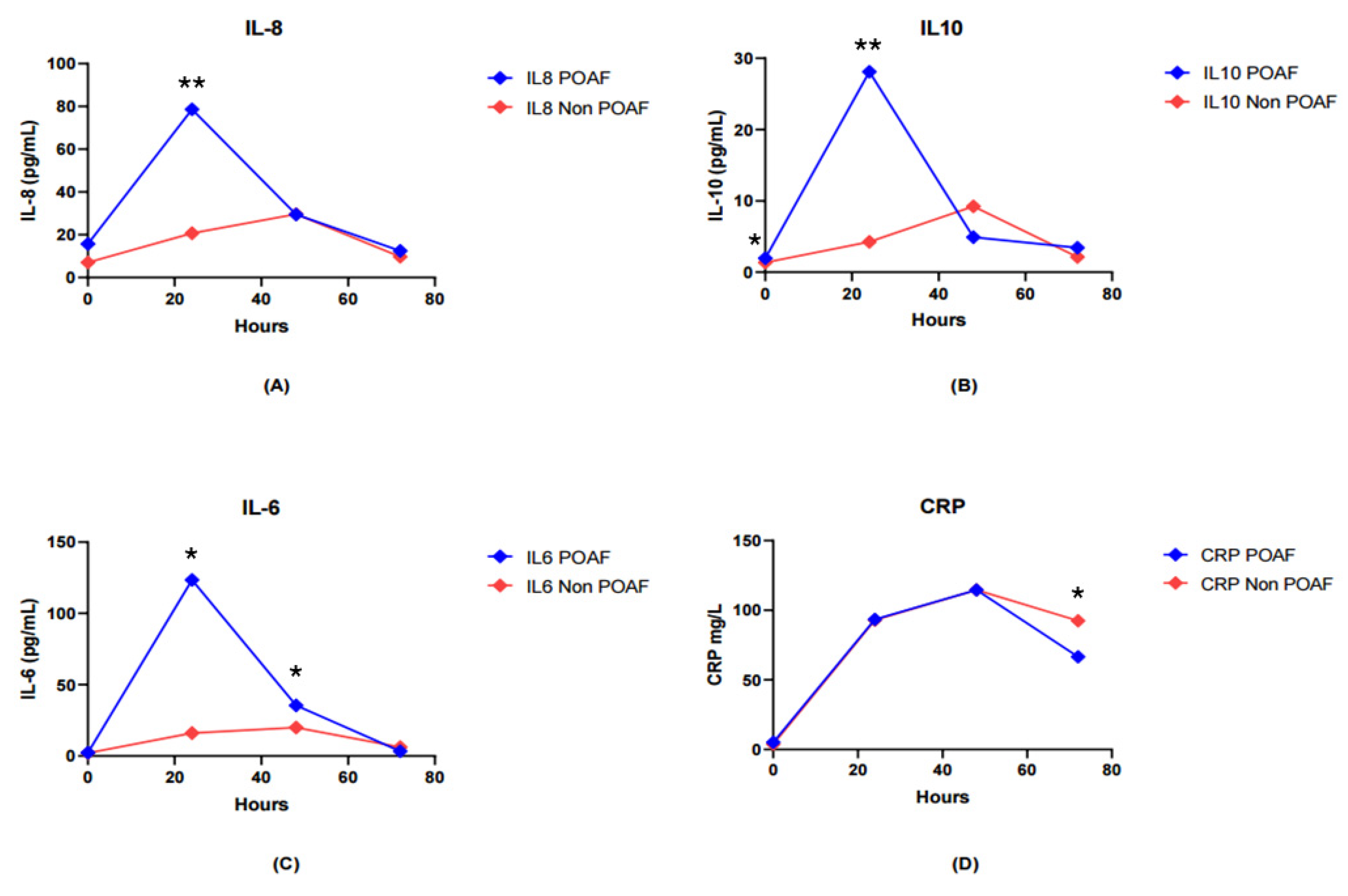
Figure 2.
ROC analysis of variable blocks and the combined predictive model for POAF. (A) ROC curves illustrating the classification performance of distinct sets of variables, including biomarkers, complete blood count, blood chemistry, and clinical–surgical parameters. (B) The ROC curve of the integrated predictive model, constructed with selected predictors and bootstrap resampling, summarizes its overall ability to distinguish patients with and without POAF.
Figure 2.
ROC analysis of variable blocks and the combined predictive model for POAF. (A) ROC curves illustrating the classification performance of distinct sets of variables, including biomarkers, complete blood count, blood chemistry, and clinical–surgical parameters. (B) The ROC curve of the integrated predictive model, constructed with selected predictors and bootstrap resampling, summarizes its overall ability to distinguish patients with and without POAF.
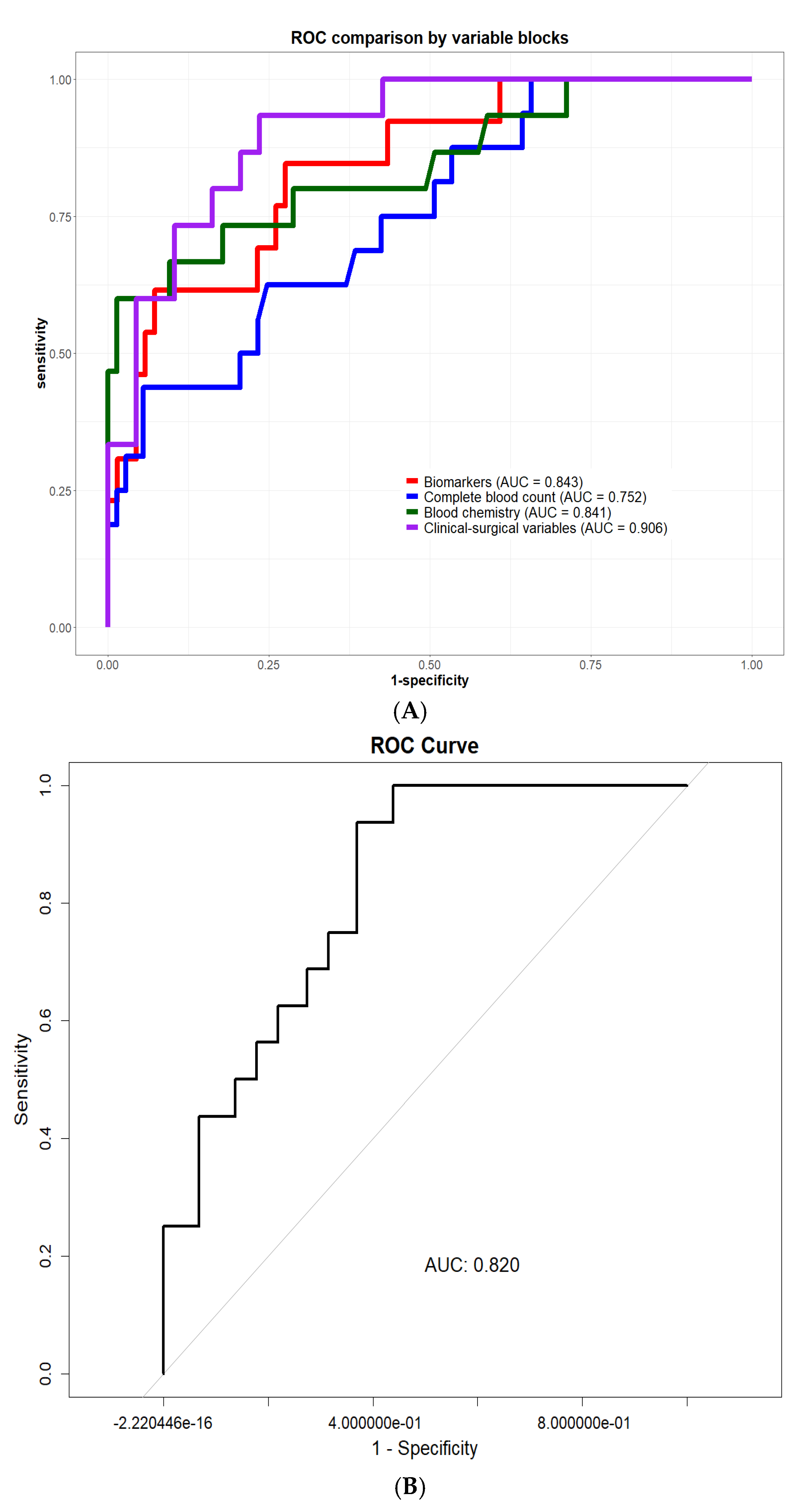
Figure 3.
Systemic inflammatory response and inflammatory biomarkers profile in the physiopathology of POAF. The figure was designed by the authors based on the present study data and mechanisms described in previous studies (30,31).
Figure 3.
Systemic inflammatory response and inflammatory biomarkers profile in the physiopathology of POAF. The figure was designed by the authors based on the present study data and mechanisms described in previous studies (30,31).
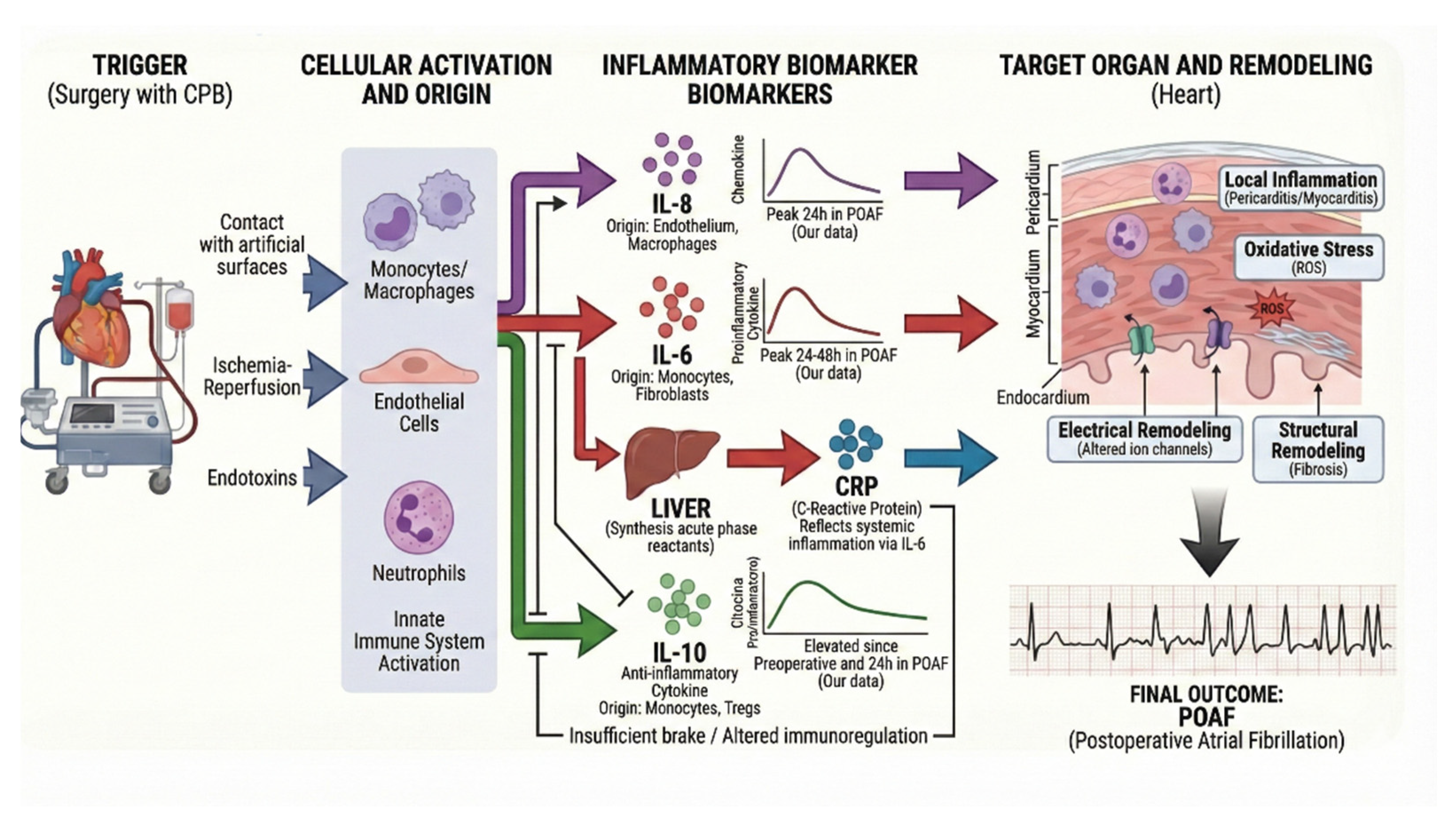

Table 1.
Demographic and clinical characteristics of the study population with and without POAF.
| Variable | POAF Group (n=16) |
Non POAF Group (n=73) |
p-Value |
|---|---|---|---|
| Anthropometric data | |||
| Age (years)b | 67 (50-76) | 65 (50-78) | 0.684 |
| Malea | 10 (62.5%) | 51 (69.9) | 0.574 |
| Femalea | 6 (37.5) | 22 (30.1) | |
| BMI (kg/m2) b | 26.8 (19.7-31.9) | 27.1 (19.71-39.0) | 0.589 |
| Comorbidities | |||
| Previous myocardial infarctiona | 4 (25) | 20 (27.4) | 0.872 |
| Type 2 diabetes mellitusa | 6 (37.5) | 37 (50.7) | 0.339 |
| Systemic arterial hypertensiona | 13 (81.3) | 52 (71.3) | 0.474 |
| Obesitya | 4 (25) | 20 (27.4) | 0.847 |
| Dyslipidemiaa | 3 (18.75) | 24 (32.9) | 0.266 |
| Hypothyroidism a | 5 (31.3) | 4(5.5) | 0.0018 |
BMI= body mass index; POAF= postoperative atrial fibrillation. ᵃ Chi-square test or Fisher’s; frequencies and percentages. ᵇ Mann–Whitney U test; median (range).
Table 2.
Surgical and biochemical variables of the study population with and without POAF.
| Variable | POAF Group (n=16) |
Non POAF Group (n=73) |
p-Value | |
|---|---|---|---|---|
| Surgical data | ||||
| Cardiopulmonary bypass time (min) b | 123 (73-217) | 120 (64-255) | 0.712 | |
| Aortic cross-clamp time (min)b | 91 (60-193) | 92 (24-202) | 0.634 | |
| Initial ACT (s)b | 111.50 (79-143) | 118 (76-171) | 0.352 | |
| Final ACT (s)b | 115 (103-138) | 116 (84-167) | 0.881 | |
| Number of graftsa | 0 | 9 (56.3) | 31 (42.5) | - |
| 1 | 3 (18.8) | 6 (8.2) | ||
| 2 | - | 8 (11.0) | ||
| 3 | 4 (25) | 15 (20.5) | ||
| 4 | - | 12 (16.4) | ||
| 5 | - | 1 (1.4) | ||
| Number of repaired valvesa | 0 | 4 (25%) | 33 (45.2%) | - |
| 1 | 10 (62.5%) | 32 (43.8%) | ||
| 2 | 1 (6.3%) | 6 (8.25%) | ||
| 3 | 1 (6.3%) | 1 (2.7%) | ||
| Pre-CPB blood loss (mL)b | 160 (15-300) | 200 (20-400) | 0.286 | |
| Intra-CPB blood loss (mL)b | 132.5 (0-400) | 100 (0-640) | 0.430 | |
| Post-CPB blood loss (mL)b | 325 (165-615) | 300 (o-800) | 0.348 | |
| EuroSCORE II (%)b | 1.36 (0.50-8.84) | 1.09 (0.50-11.37) | 0.168 | |
| Left ventricular ejection fraction (LVEF, %)b | 53 (20-73) | 55 (24-86) | 0.608 | |
| STS score (%)b | 1.70 (0.19-16) | 0.94 (0.22-6.61) | 0.032* | |
| Blood count and biochemical parameters | ||||
| Hemoglobin (g/dL), preop b | 13.75 (10.20-16.6) | 14.20 (8.80-18.80) | 0.175 | |
| Hemoglobin (g/dL), 24 h b | 9.80 (6.20-12.10) | 10.8 (5.60-15) | 0.007** | |
| Hematocrit (%), preop b | 39.35 (31-50) | 41 (26.8-58.1) | 0.148 | |
| Hematocrit (%), 24 h b | 30 (21.1-42) | 32.75 (24.3-51.4) | 0.061 | |
| Platelets (×103/µL), preop b | 202 (136-352) | 210 (37-471) | 0.560 | |
| Platelets (×103/µL), 24 hc | 182 (124-301) | 181 (75-345) | 0.638 | |
| Leukocytes (×103/µL), preop b | 6.5 (3.50-9.25) | 6.8 (2.5-17.20) | 0.361 | |
| Leukocytes (×103/µL), 24 hb | 11.6 (7.87-23.70) | 12.30 (1.60-23) | 0.795 | |
| Glucose (mg/dL), preop b | 96 (75-156) | 101 (75-171) | 0.426 | |
| Glucose (mg/dL), 24 hb | 176 (85-589) | 148 (75-324) | 0.478 | |
| Urea (mg/dL), preop b | 29 (20-65) | 31 (17-66) | 0.915 | |
| Urea (mg/dL), 24 hb | 38 (21.6-95.9) | 34 (16.8-93) | 0.566 | |
| Creatinine (mg/dL), preop b | 0.85 (0.50-1.36) | 0.80 (0.51-1.40) | 0.940 | |
| Creatinine (mg/dL), 24 hb | 0.85 (0.60-1.33) | 0.9 (0.51-2.30) | 0.696 | |
BMI = body mass index; POAF = postoperative atrial fibrillation; preop = preoperatory ᵃ Chi-square test or Fisher’s; frequencies and percentages. ᵇ Mann–Whitney U test; median (range). ** Statistically significant value < 0.01; * Statistically significant value < 0.05.
Table 3.
Inflammatory biomarkers of the study population with and without POAF at selected surgical time points.
Table 3.
Inflammatory biomarkers of the study population with and without POAF at selected surgical time points.
| Variable | POAF Group (n=16) |
Non POAF Group (n=73) |
p-Value |
|---|---|---|---|
| Proinflammatory interleukins | |||
| Preoperative IL-8 (pg/mL)a | 6.73 (3.6-143.3) | 5.35 (0.5-34.3) | 0.205 |
| Postoperative IL-8 at 24 h (pg/mL)a | 21.85 (5.3-512.1) | 11.02 (1.8-127.3) | 0.010** |
| Postoperative IL-8 at 48 h (pg/mL)a | 10.09 (5.0-169.3) | 9.2 (0.36-539.2) | 0.171 |
| IL-8 at discharge (pg/mL)a | 11.37 (1.1-39.6) | 7.34 (0-34) | 0.338 |
| Preoperative IL-10 (pg/mL)a | 1.10 (0-8.19) | 0.43 (0-8.95) | 0.029* |
| Postoperative IL-10 at 24 h (pg/mL)a | 7.33 (0.19-194.0) | 2.13 (0-67.39) | 0.003** |
| Postoperative IL-10 at 48 h (pg/mL)a | 1.52 (0-21.97) | 1.56 (0-328.7) | 0.389 |
| IL-10 at discharge (pg/mL) a | 1.2 (0-14.4) | 0.65 (0-66.92) | 0.109 |
| Preoperative IL-6 (pg/mL)a | 0.98 (0-16.73) | 0.35 (0-16.72) | 0.174 |
| Postoperative IL-6 at 24 h (pg/mL)a | 12.44 (1.44-1102) | 4.97 (0-158.3) | 0.012* |
| Postoperative IL-6 at 48 h (pg/mL)a | 13.56 (0.11-131.5) | 2.42 (0-202.5) | 0.038* |
| IL-6 at discharge (pg/mL)a | 1.64 (0-8.46) | 0.90 (0-81.0) | 0.657 |
| Preoperative CRP (mg/L)a | 1.75 (0.75-50) | 1.92 (0.68-31.94) | 0.894 |
| Postoperative CRP at 24 h (mg/L)a | 10.8 (5.65-123.51) | 105.4 (1.88-125) | 0.957 |
| Postoperative CRP at 48 h (mg/L) a | 124 (37.15-127.6) | 122.8 (1.85-128.7) | 0.761 |
| CRP at discharge (mg/L) a | 67.90 (6.99-126.1) | 106.6 (2.27-128.91) | 0.050* |
IL-8= Interleukin-8; IL-10= Interleukin-10; IL-6= Interleukin-6; CRP= C-reactive protein; pg/mL= picograms per milliliter; mg/L= milligrams per liter. ᵃ Mann–Whitney U test; median (range). ** Statistically significant value ≤ 0.01; * Statistically significant value ≤ 0.05.
Table 4.
Multivariable logistic regression model for predictors of postoperative atrial fibrillation (POAF).
Table 4.
Multivariable logistic regression model for predictors of postoperative atrial fibrillation (POAF).
| Variable | Odds Ratio (OR) | 95% Confidence Interval | p-Value |
|---|---|---|---|
| STS score (%) | 1.32 | 1.05–1.72 | 0.021 |
| IL-6 at 24 h (pg/mL) | 1.08 | 1.01–1.15 | 0.032 |
| Magnesium at 24 h (mEq/L) | 0.64 | 0.42–0.95 | 0.028 |
POAF=postoperative atrial fibrillation; OR= odds ratio; CI=confidence interval; IL-6=interleukin-6; STS=Society of Thoracic Surgeons risk score.
Table 5.
Internal validation of the predictive model using bootstrap resampling.
| Model | Apparent AUC | Mean Optimism | Optimism-Corrected AUC |
|---|---|---|---|
| Multivariable POAF prediction model | 0.82 | 0.046 | 0.77 |
AUC=area under the receiver operating characteristic curve.
Disclaimer/Publisher’s Note: The statements, opinions and data contained in all publications are solely those of the individual author(s) and contributor(s) and not of MDPI and/or the editor(s). MDPI and/or the editor(s) disclaim responsibility for any injury to people or property resulting from any ideas, methods, instructions or products referred to in the content. |
© 2026 by the authors. Licensee MDPI, Basel, Switzerland. This article is an open access article distributed under the terms and conditions of the Creative Commons Attribution (CC BY) license.
Copyright: This open access article is published under a Creative Commons CC BY 4.0 license, which permit the free download, distribution, and reuse, provided that the author and preprint are cited in any reuse.


