

Submitted:
01 April 2026
Posted:
01 April 2026
You are already at the latest version
Abstract
Institutional theory assumes that coercive, normative, and mimetic pressures operate as parallel forces driving organizational isomorphism. This study tests this assumption by exploring the impact of different pressures on eco-innovation and environmental performance in manufacturing SMEs. A two-wave, time-lagged survey of 271 manufacturing SMEs in China was analyzed using structural equation modeling (SEM) using SPSS and fsQCA. The findings demonstrate a significant impact of institutional forces. Among the three pressures, mimetic pressure (competitive pressure) is the strongest driving force of eco-innovation, whereas normative pressure (stakeholder pressure) most strongly promotes environmental performance. Coercive Pressure (environmental regulations) is comparatively weak. Eco-innovation mediates one-third of competitive effects but less than 10% of stakeholder and regulatory effects, demonstrating that institutional factors operate via a distinct framework. The fsQCA results complement these findings by providing interchangeable pathways to achieve EP. This study, by considering all pressures together, establishes a hierarchy of influence wherein competition stimulates eco-innovation, and stakeholders stimulate performance. By quantifying the magnitude of each pressure’s mediation, this study shows that each pressure has its unique processes rather than substitutable ones. This study further shows that, under fragmented enforcement, non-regulatory pressures may be more significant than regulatory ones.
Keywords:
institutional theory
; coercive
; normative
; and mimetic pressures
; eco-innovation
; environmental performance
; small and medium-sized enterprises (SMEs)
1. Introduction
Environmental sustainability has evolved from being a strategic option to an operational necessity, affecting firms worldwide [1]. According to the International Energy Agency [2], the industrial sector accounted for 37% of global energy use (166 EJ). Environmental problems are putting firms under intense pressure to change their operating models through ecological innovation, making eco-innovation a critical factor in achieving perpetual environmental sustainability.
According to García-Granero, et al. [3], large companies prioritize eco-innovation in strategic planning, driving considerable investment in unique green projects. On the other hand, SMEs face structural obstacles in implementing sustainable initiatives. Such issues arise, particularly in developing nations, because SMEs are embedded in institutional environments characterized by financial limitations and regulatory uncertainty. An intriguing empirical setting for researching these phenomena is found in Chinese SMEs, as they account for 60% of GDP and account for 52.5% of the industrial carbon dioxide emitted [4]. This highlights the need for them to adopt innovative practices. The lessons learned from the Chinese experience can be generalized to other economies where similar trade-offs exist.
China’s rapid development has significantly impacted the environmental regulations for carbon neutrality by 2060. A notably ambitious goal, as stated in the phased Five-Year Plan (2016-2020), was to reduce carbon dioxide (CO2) emissions by 18% per unit of GDP [5]. However, the identifiable efficiencies of this strategy at a national level have suffered from a variety of implementation issues in relation to the diverse types of industries. Deficiencies in regulatory enforcement became evident during the 14th Five-Year Plan (2021–2025), highlighting the need for targeted regulations and carbon ceilings for SMEs, whose environmental impact had previously been overlooked [6], a situation prevalent in many other emerging economies.
Institutional theory [7] suggests that firms are subject to three types of institutional pressures: normative (stakeholders), coercive (regulations), and mimetic (competitors), all of which are related to the achievement of legitimacy. These pressures may have a direct or indirect effect on organizational performance, as suggested by the “dual pathway” framework, with eco-innovation being one of the indirect effects [8,9]. Yet, institutional theory still does not indicate the extent to which each of these pressures uses innovation-related routes versus direct legitimacy routes. This research fills this void by quantifying the extent to which each of these pressures uses the eco-innovation-related route. This represents a significant improvement over the binary nature of institutional theory and is referred to as mechanism differentiation.
Several recent studies show that green innovation and environmental performance are driven by coercive, normative, and mimetic pressures [10,11,12,13]. Despite of past studies, three gaps are found in the literature: aggregation or isolation of pressures [13,14], implicit assumptions of homogeneity of mechanisms; no one quantifies proportions of specific mediating effect of each pressure, even in studies which consider all three pressures [11,12], no one calculates what percentage of effect of any one pressure works through eco innovation; and most evidence is on large listed companies.
To address these concerns, the study is designed to investigate in depth how eco-innovation and environmental performance are affected by coercive, normative, and mimetic pressure among manufacturing SMEs in the dual carbon agenda in China. This paper has three important contributions. First, it will determine the hierarchy of influence between the three institutional influences, which pressure most powerfully, motivate eco-innovation, and which most directly influence the environmental performance when firms are simultaneously subjected to more than one pressure. Second, it will measure pressure-specific magnitudes of mediation, offering new evidence of the degree to which each of the institutional forces depends on eco-innovation as a means to create environmental outcomes. Third, by putting the study within a broader context of ambitious central policy and widely varying local implementation, as in several emerging economies, it will be able to take institutional theory outside a developed country environment and show the relative significance of non-regulatory strategies like competitive benchmarking and stakeholder involvement. The contributions are also meant to be international in nature, providing insights to managers, policymakers, and researchers in the economies that encounter similar institutional complexities.
The rest of the paper is organized in the following way. Section 2 gives the theoretical background and development of the hypothesis. Section 3 presents the research methodology, sample, data collection, and measures. The empirical findings are reported in Section 4. Section 5 presents the findings, theoretical and practical implications, limitations, and future research directions. Section 6 concludes.
2. Theoretical Foundation and Hypothesis Development
2.1. Institutional Theory
Institutional theory explains how an organization responds to coercive, normative, and mimetic pressures, which make its actions legitimate [7]. These pressures are all related to one specific logic of legitimacy: regulatory, normative, and cognitive [15]. This has led to the assumption that all these pressures operate in parallel, hence promoting isomorphic practices that are green [16,17]. The assumption, however, mixes the source of pressure with the mechanism of pressure [9].
However, recent studies reveal the mechanisms. Marculetiu, et al. [18] reveal that normative pressures are the only origin affecting the symbolic and substantial sustainability strategies based on the coercive and mimetic pressures, which have no significant impact on the environmental performance. Ruiz-Blanco, et al. [19] reveal that normative pressure is the most influential in the control systems of sustainability. Zhang, Zhu and Lee [12] reveal that the impact of the regulatory, normative, and cognitive pressures on green innovation is positive, but the pathways differ in their strength. Thus, normative pressures operate through direct legitimacy signaling [18], mimetic pressures drive the eco-innovation adoption due to uncertainty [12], and the impact of coercive pressures is contingent [20].
From past literature, two significant gaps have been identified. First, most of the studies have analyzed each of the pressures separately, or as one construct, without the possibility of comparing all three of them [13,21]. Second, eco-innovation is recognized as a mediator, but not measured as to what degree it mediates each of the pressures’ effects [12]. This has significant implications for theoretical development, as if all three pressures are equally based on eco-innovation, then the mechanism is homogenous; if, however, one of them attains its findings through direct legitimacy, and another one through innovation, then institutional theory should explain the differentiation of mechanisms, a phenomenon not predicted earlier [8,9].
These pressures are multidimensional, and this is the reason why the pathways vary [15]. The mechanisms for pressure-performance also differ because each legitimacy logic is conferred based on different organizational activities, such as value, imitation, and compliance. This gives rise to the development of the two pathways model for direct legitimacy routes and innovation-mediated routes [8,9]. The contribution of this research to the institutional theory is two-fold: (1) the mediation level depends on the legitimacy logic (mechanism differentiation), and (2) the mediation level has been quantified empirically for the dual pathways model, placing the theory not in the broad isomorphic mode, but specifying the mechanisms. The hypotheses presented in the following sections operationalize this model.
2.2. Normative Pressures: Stakeholder Demands and Environmental Sustainability
Normative pressures are influenced by stakeholders who expect responsible behavior. For normative legitimacy, it is necessary to have alignment with stakeholders’ values, and the environmental outcomes must be visible [7,15]. This implies that there is a direct link between stakeholders and environmental outcomes, and this link is dependent on normative pressures. De Giovanni and Vinzi [22] indicated that stakeholders’ support of responsible processes leads to better environmental success, credibility, and trust. Baah, et al. [23] indicated that pressures from stakeholders enhance sustainability and better performance. This implies that pressure from stakeholders has a direct link to environmental outcomes.
At the same time, normative pressures can also work through eco-innovation as a substantive response to stakeholder demands. This is because stakeholders' demands for innovative solutions to environmental problems require organizations to come up with innovative products, processes, or practices [24,25]. This approach provides a mediating role for normative pressures on environmental performance through eco-innovation, besides the direct approach. Flammer and Kacperczyk [26] prove that a stronger stakeholder approach will lead to more innovative practices in organizations because stakeholder demands require organizations to experiment. Xie, Abbass and Li [1] also prove that stakeholder demands lead to eco-innovation, which in turn leads to environmental performance. Thus, eco-innovation serves as a mediating mechanism through which normative pressure translates into environmental gains.
H1:
Stakeholder pressure positively influences environmental performance.
H2:
Stakeholder pressure positively influences eco-innovation.
2.3. Coercive Pressures: Environmental Regulations and Environmental Sustainability
The coercive pressures emanate from formal regulations and legal mandates that set out compliance obligations. For regulatory legitimacy, organizations have to comply with these mandates and hence need to get “license to operate” [27]. This direct link suggests that environmental regulation can enhance performance through punishing non-compliance and encouraging reductions in pollution, regardless of eco-innovation. Cross-national studies in Brazil [28], the EU [29], and the UK [30] all found that environmental regulation improves environmental performance. Thus, coercive pressure is predicted to have a direct effect.
Regulatory pressure could also drive eco-innovation because organizations are motivated to look for cost-effective ways to comply. Severe policies increase environmental consciousness [31] and provide market pressure; investors prefer organizations that are less polluting, and this drives them to innovate [32,33]. Where regulatory pressure is not uniform, eco-innovation provides a strategic way to demonstrate regulatory compliance and gain a competitive edge. Han and Chen [34] demonstrate the role of regulations in driving eco-innovation in manufacturing industries, thereby supporting the argument that coercive pressure indirectly drives organizational performance by encouraging eco-innovation.
H3:
Environmental regulations positively influence environmental performance.
H
4: Environmental regulations positively influence eco-innovation.
2.4. Mimetic Pressures: Competitors’ Influence and Eco-Innovation
Mimetic pressures are driven by uncertain environmental demands, prompting imitation of successful competitors to achieve cognitive legitimacy [7]. This implies that competitor pressures can affect environmental performance directly by encouraging imitation of competitors’ sustainable practices. Bansal and Roth [35] posit that competition forces companies to adopt differentiation strategies by incorporating sustainability; Chung [36] and Xie, Abbass and Li [1] found that eco-friendly practices retain environmentally conscious customers, hence avoiding loss of market share. Therefore, competitor pressures are expected to have a direct positive effect on environmental performance.
Competition also spurs eco-innovation as a major driver of differentiation. Under conditions of uncertainty, imitation focuses on those practices that are easily replicable; in this context, eco-innovations are best examples [37]. This indirect effect is particularly important because it allows to differentiate mimetic pressure from normative and coercive pressure in terms of how they drive performance: whereas the latter two may do so directly via legitimacy effects, mimetic pressure likely does so indirectly via innovation effects. Wang, et al. [38] show that eco-competitions drive eco-innovation; Cornejo-Cañamares, et al. [39] show that industrial SMEs obtain a competitive advantage via eco-innovation under conditions of competitive pressure. Dai, et al. [40] report that organizations observe their competitors' green initiatives, and Baah, Opoku-Agyeman, Acquah, Issau and Moro Abdoulaye [23] show that competitor pressure indeed influences environmental performance via eco-innovation.
H5:
Competitor pressure positively influences environmental performance.
H
6: Competitor pressure positively influences eco-innovation.
2.5. Eco-Innovation as a Pathway to Environmental Performance
Eco-innovation refers to new products, processes, and practices developed to address environmental issues. Eco-innovation in dual pathway framework, included as direct and mediating impact on environmental performance. The direct link is based on the idea that by adopting eco innovations, firms can decrease their emissions and increase their competitive advantage [41,42]. It is important to understand eco innovations as attempts to enhance ecological sustainability and competitive advantage, rather than simply reacting to issue [43]. Thus, eco-innovation is expected to have a direct impact on environmental performance.
The major theoretical contribution of this study is in the quantification of the mediation effect of eco innovation. Institutional theory posits that there are multiple paths to achieve legitimacy, although the relative dependency of each pressure on innovation and direct compliance has not been explored. Eco innovation is an observable mediator of external pressure, where regulatory pressure drives innovation [44], which in turn boosts performance [45]; stakeholder pressure drives sustainable practices [1], and eco-innovation is a meaningful response; and competitive pressure drives differentiation through innovation [46], which is useful for differentiation and sustainability. By calculating the mediation effect of eco innovation for normative, coercive, and mimetic pressures, the study tests the idea of mechanism differentiation, in which mimetic pressure is most likely to rely on eco innovation, while normative and coercive pressures also rely on direct paths to legitimacy.
H
7: Eco-innovation positively influences environmental performance.
H
8: Eco-innovation mediates the relationships between (a) stakeholder pressure, (b) environmental regulations, (c) competitor pressure, and environmental performance.
3. Methodology
3.1. Sample and Procedure
This quantitative research design explores the direct and indirect influences of normative, coercive, and mimetic pressure on environmental performance through eco-innovation (as shown in Figure 1). The research sample is based on manufacturing SMEs registered in local industry directories and confirmed through HR departments to ensure SMEs' compliance. This sector was chosen due to its significant environmental impact and under competitive and regulatory pressures. Manufacturing SMEs are an essential key to achieving sustainability, making it an essential research context to understand eco-innovation adoption. Participants were chosen for their strategic perspectives on eco-innovation, derived from hands-on experience through operational activities. They included supervisors and employees from different departments who are actively involved in manufacturing.
3.2. Data Collection
Data collection was a challenging but enlightening process. We aimed to collect 450 questionnaires in order to guarantee adequate statistical power and account for potential non-responses, in accordance with previous SEM investigations and suggestions that at least 200 genuine responses are necessary for robust analysis. Due to their structural barriers to implementing eco-innovation and their considerable contribution to China's GDP and carbon emissions, SMEs were chosen. We used a two-stage offline data gathering procedure to cut down on errors and common method bias.
3.2.1. Stage 1: Collecting Independent Variables
A sample size of 450 responses was fixed. Responses regarding pressures from stakeholders, regulations, and competitors were collected during (Sep – Oct 2025). Resistance, time constraints, and declining interest were encountered during collaboration. After discarding 120 negligent responses, the remaining responses totaled 330, leaving 330 valid responses.
3.2.2. Stage 2: Collecting the Mediator and Dependent Variable
Eco-innovation and environmental performance data collection took two months, from December to January 2026. A one-month gap was introduced to avoid common method bias. It was difficult to access the same employees. The last four digits of phone numbers were used to track the participants. A few employees were not accessible, had changed their jobs, or had provided incomplete responses. A total of 271 out of 450 questionnaires (60%) were matched. This time gap ensured the collection of reliable, valid, and bias-free data.
3.3. Measures
All items were assessed using a five-point Likert scale (1 = strongly disagree to 5 = strongly agree). The constructs were measured as follows: normative pressure was measured using five items, reflecting stakeholders pressure [47], coercive pressure was measured using six items from [48] reflecting environmental regulations, mimetic pressure was measured using four items adapted from [49], capturing perceived competitors pressure, eco-innovation was measured using three items adapted from [50]. Finally, the six items for Environmental Performance were borrowed from the studies of Gadenne, et al. [51], and their respective alpha (α) values are reported in (Appendix A1).
4. Results
4.1. Sample Information
This study adjusted demographic data to prevent potential effects on key variables (Ng & Feldman, 2012). For example, older employees may experience fatigue that impacts performance (Uchino et al., 2006). Work experience and academic achievement influence the workplace differently (Elahi et al., 2020). The sample included 271 respondents, with 115 males and 156 females. Most employees were aged between 25 and 35 years (43.2%), since younger individuals tend to be more motivated and easier to train on new technologies. Regarding education, 138 respondents (50.9%) held a bachelor’s degree, sufficient for operating and understanding complex systems. For work experience, the majority (43.9%) had between two and five years, indicating they were familiar with industry needs and the skills required to operate eco-innovations.
4.2. Measurement Model
Before proceeding with further research, some tests were conducted to examine construct-level reliability via the “composite reliability” and “α” measures. According to Hair, et al. [52], the criterion is supposed to fall within the range of 0.70 to 0.95. While the composite reliability ranged from 0.814 to 0.874, which is above 0.70 and indicates that the current study is within the criterion range of 0.70 to 0.95, the "α" values ranged from 0.781 to 0.871, which is above 0.70 [52].
To confirm the criterion requirement of convergent validity, we employed Average variance extraction (AVE) [52]. The AVE was found to be 0.506–0.593, over the cut-off value of 0.50, suggesting better convergent validity. This implies that the constructs have greater variation.
Discriminant validity, which is characterized by correlations between factors of less than 0.85 and √AVE > correlation between variables, is used to investigate if the items or measures of a factor load more on their factor than on other factors (Table 1). The five-factor model χ2 = 229.734, df = 242, χ2 /df = 0.949, SRMR = 0.049, CFI = 1.000, GFI = 0.935, RMSEA = 0.000, shows a good fit, according to our analysis of model fitness indices using AMOS. Additionally, the variance inflation factor (VIF), whose threshold should be less than 3.0 [52], was examined in this study to determine the extent of multicollinearity. It ranged from 1.271 to 1.391, indicating no inconvenience of collinearity (Table 1). SPSS was employed for data analysis, and AMOS was employed to test both direct and indirect hypotheses since it can investigate variable correlations and evaluate complex conceptual frameworks. To capture causal complexity, fuzzy-set Qualitative Comparative Analysis (fsQCA) was additionally employed, enabling examination of equifinality by identifying multiple configurations of antecedent conditions leading to high EP.
4.3. Descriptive Statistics
The mean value of the constructs ranged from 3.08 to 3.32, whereas the Standard Deviation ranged from 0.83 to 0.91. The correlation analysis yields results that are satisfying such as STP and EP (r = 0.420**), ER and EP (r = 0.330**), CP and EP (r = 0.310**), STP and EcoInno (r = 0.368**), ER and EcoInn (r = 0.290**), CP and EcoInno (r = 0.460**) and EcoInn and EP (r = 0.345**) in Table 1.
4.4. Hypothesis Testing
The structural equation model strongly supports the hypothesis that institutional pressure has different effects. STP has a strong impact on EP (β = 0.264***), while ER has a lower effect (0.142**), and CP has the lowest impact on EP (0.113***). In the case of eco-innovation, CP has a strong impact (0.373**), followed by STP (0.205**), and then ER (0.118*).
Eco-innovation also significantly influences EP (0.146*). The indirect effects are significant for all three factors: stakeholder pressure (0.030*), regulation (0.017*), and competition (0.054*). Eco-innovation transmits around 32.5% of the entire influence of competition on performance, whereas stakeholders and regulation transmit about 10%. Collectively, these results support to a dual-pathway framework: stakeholders lead to performance (direct legitimacy route), while competition leads to eco-innovation and performance (innovation route).

Table 2.
Direct and Indirect Paths.
| Paths | Effect Size | S.E. | LLCI-ULCI |
|---|---|---|---|
| STP--->EP | 0.264*** | 0.066 | 0.164 – 0.380 |
| ER--->EP | 0.142** | 0.059 | 0.028 – 0.228 |
| CP--->EP | 0.113*** | 0.064 | 0.018 – 0.238 |
| STP-->EcoInn | 0.205** | 0.069 | 0.089 – 0.312 |
| ER--->EcoInn | 0.118* | 0.053 | 0.006 – 0.188 |
| CP--->EcoInn | 0.373** | 0.058 | 0.288 – 0.480 |
| EcoInn--->EP | 0.146* | 0.081 | 0.006 – 0.287 |
| STP-->EcoInn-->EP | 0.030* | 0.021 | 0.002 – 0.072 |
| ER-->EcoInn-->EP | 0.017* | 0.012 | 0.000 – 0.038 |
| CP-->EcoInn-->EP | 0.054* | 0.031 | 0.003 – 0.107 |
*p < 0.05; **p < 0.01; ***p < 0.001.
4.5. Fuzzy-Set Qualitative Comparative Analysis
4.5.1. Calibration
The objective of fsQCA is to find out the configurations of antecedent conditions that can cause high environmental performance (EP), which is the outcome condition. Antecedent conditions are STP, ER, CP, and Eco-Inn. While Eco-Inn acted as a mediator in the SEM model, it is considered an antecedent condition with the pressures, enabling fsQCA to examine the interaction between pressures and internal ability to generate EP. Following Ragin [53], the data is coded to fuzzy sets ranging from 0 to 1, where 1 indicates full membership, 0.5 indicates crossover, and 0 indicates full non-membership. A single index is calculated for each construct by averaging the measurement items. The quartile method is used to establish the anchors at the 25th percentile, which indicates full non-membership, the 50th percentile or median, which indicates crossover, and the 75th percentile, which indicates full membership. Table 3 shows the calibration thresholds for each condition.
4.5.2. Analysis of Necessary Conditions
fsQCA is applied to examine whether any of the four antecedent conditions (STP, ER, CP, and Eco-Inn) are necessary for achieving a high level of EP. According to Ragin [53], raw data can be coded as a fuzzy set membership score ranging from 0 to 1 (full membership = 1, crossover = 0.5, full non-membership = 0). An index for each construct is created by taking the average of the measurement items for each construct before coding. The anchor points for each condition were determined by the quartile method: 25th percentile (full non-membership), 50th percentile or median (crossover), and 75th percentile (full membership), as shown in Table 3.
Table 4.
Analysis of necessary conditions.
| Conditions | Consistency | Coverage |
|---|---|---|
| STP | 0.678 | 0.685 |
| ~STP | 0.429 | 0.455 |
| ER | 0.640 | 0.679 |
| ~ER | 0.476 | 0.480 |
| CP | 0.660 | 0.666 |
| ~CP | 0.434 | 0.461 |
| Eco-Inn | 0.682 | 0.766 |
| ~Eco-Inn | 0.423 | 0.406 |
Note: “~” (or ¬) denotes the absence of a condition.
4.5.3. Analysis of Sufficient Conditions
Consistent with prior QCA studies [54], consistency and frequency thresholds need to be determined before performing a sufficient analysis. This study considered three practice criteria before determining the threshold: (1) The frequency threshold for large samples should be greater than 1; (2) The distribution of cases with 0 and 1 in the truth table should be covered and roughly balanced; (3) The number of observed cases should be not less than 75% of the total cases. The final consistency threshold is 0.84, and the frequency threshold is 6. fsQCA produces three solutions: complex, intermediate, and parsimonious. This paper mainly reports intermediate solutions and combines them with parsimonious solutions to distinguish between core conditions and peripheral conditions [54]. Table 5 shows the configuration for achieving a high level of environmental performance.
The results of the fsQCA indicate two sufficient conditions for high EP, thus confirming the equifinality of innovation outcomes. The overall solution consistency is 0.876, which is above 0.75, and coverage (0.444) indicates that the two sufficient conditions explain a large proportion of cases of high EP.
Solution 1a shows that the combination of STP, ER, and Eco-Inn is sufficient for high EP. This solution has the highest raw coverage (0.388), implying that firms under stakeholder and regulatory pressure and those practicing eco-innovation can reach high levels of EP, complementing the results of SEM.
Solution 2a indicates that high levels of EP can be reached without CP, but under conditions of STP and Eco-Inn. In the SEM results, CP has the strongest effect on Eco-Inn (β = 0.373) but a weak direct effect on EP (β = 0.113). This implies that CP is not a necessary condition for high EP but serves to enhance Eco-Inn to reach high levels of EP.
The robustness of these findings was verified across three different calibration choices (Appendix A2). First, theoretical anchors (20, 50, 80) were applied, with frequency and consistency thresholds of 6 and 0.82, respectively. Second, anchors (2, 3, 4) were used with thresholds of 6 and 0.84. Third, the frequency threshold was increased to 8, with consistency at 0.86. In almost all robustness tests (Appendix A2), eco-innovation is present in all configurations, reinforcing its importance for high EP.
5. Discussion
Earlier studies have addressed individual aspects (e.g., regulation [55] or stakeholder involvement [56]) or institutional factors as a construct [57]. The results display a hierarchy where competition leads to eco-innovation, stakeholder pressure dominates direct performance, and regulation is last in both direct and indirect effects. This re-ranking is a response to the calls to explain the functioning of institutional mechanisms[58,59].
A novelty of this research is the quantification of pressure-specific mediation. Although eco-innovation is taken as a mediator [1,60], previous studies rarely calculate what share of the effect is mediated. Findings indicate innovation plays a vital role in transforming mimetic pressure to performance, where 32.5% of competitive pressure is mediated as opposed to approximately 10% of the stakeholder and regulatory pressures.
The results of fsQCA verify equifinality through two paths. Solution 1a verifies that STP, ER, and Eco-Inn collectively lead to high levels of Environmental Performance. Solution 2a verifies that STP and Eco-Inn lead to high levels of Performance without CP. This doesn’t undermine the importance of CP because SEM verifies CP as having the highest impact on Eco-Inn. Competitors' pressure plays a major role in serving to induce Eco-Inn, so once innovation capacity is high, then EP can be achieved easily. This verifies that coercive, normative, and mimetic pressures take different paths.
Though the concept of normative, coercive, and mimetic pressures is framed as parallel forces in the Institutional Theory [7], empirical research notes normative pressures as dominant [8,9]. This study's findings partially confirm this, but improve it: in emerging-market SMEs, mimetic pressures stimulate innovation, and normative pressures improve performance. This brings out the contextuality of institutional impacts in situations of weak enforcement and a shortage of resources.
In conclusion, the findings are discussed within the framework of the dual-carbon development agenda, putting the analysis in the institutional change framework of the national strategies. Despite the existence of regulatory frameworks, their viability is usually constrained by poor enforcement, especially in the SME sector, which is the key to socio-economic development [61]. On the contrary, competitive and stakeholder pressures define the supply chains and serve as a de facto governing mechanism [12,59]. This implies that macro-level commitments are not executed by regulation itself but strengthened by the non-regulatory social and market-based forces, which underline the applicability of Institutional Theory to the emerging economies, at large.
5.1. Theoretical Implications
This research contributes to the development of Institutional Theory by distinguishing coercive, normative, and mimetic effects and the respective roles they play. Although classical theory argues that these effects are equally important in promoting isomorphism in organizations [7], and previous studies have aggregated these effects [12] or focused on one dimension of these effects, such as regulations [62]. The results indicate that these effects differ. Thus, the accuracy of the explanatory power of Institutional Theory is enriched.
Moreover, the integration of fsQCA and SEM demonstrates that institutional factors do not only manifest individually but also in combination in different ways. This is seen through the presence of stakeholder pressure in all configurations and the differential impact of competitive pressure. This implies that not only are institutional forces variably effective, but they may also complement each other. Competitive pressure is a key driver of eco-innovation (SEM), but its necessity is reduced when eco-innovation is already high, implying different routes to achieving environmental performance. This addresses the need to specify conditions under which institutional mechanisms are relevant [63].
Another theory-based contribution relates to the role of eco-innovation as a bridge between institutional pressures and performance. Although previous studies have acknowledged this role of eco-innovation as a mediator [64,65]. They consider it a general mediator. The results, however, reveal that the mediation effect of eco-innovation varies depending on the pressure, especially for mimetic pressure, where the effect of eco-innovation is the highest (32.5%), and for normative and coercive pressures, where the effect of eco-innovation is lower (10%). Eco-innovation is also observed in both solutions of fsQCA, and this confirms the significance of eco-innovation.
This research also contributes to the contextualization of Institutional Theory by placing it in the context of SMEs with different levels of enforcement. The majority of the literature, which is primarily conducted in Western economies, identifies normative pressures as the most significant drivers of innovation and performance [7,8]. These findings both partially support this and also extend this concept. Stakeholder pressures are a driver of performance, but competitive pressures are identified as the most significant driver of eco-innovation. This supports findings in resource-constrained environments, where competition is a stronger driver of innovation than stakeholder pressures [66,67]. Competitive pressures are consistently identified in the robustness tests of the fsQCA, which supports their significance, whereas the omission of competitive pressures in some models identifies alternative paths to innovation. However, the present study points to the context-dependent nature of the effects of institutions and further emphasizes their importance in the context of emerging economies
5.2. Practical Implications
This reveals that the most dominant force for eco-innovation in SMEs is mimetic pressure. This reveals that for managers, it is important to implement a benchmarking system for competitors. This involves not only observing competitors but also imitating the successful eco-innovation strategies. With 32.5% of the effect of competitive pressure being mediated by eco-innovation, it reveals that imitating competitors should not be considered a mere form of copying. It involves active observation of competitors’ sustainability strategies and the use of benchmarking systems. When competition for SMEs is based on sustainability, eco-innovation strategies can result in good performance [64,65].
Moreover, CSR and sustainability managers need to enhance their engagement with stakeholders, which would be the most impactful factor in relation to environmental performance, considering the high direct impact of normative pressure. In this context, since SMEs are resource-constrained, effective engagement with stakeholders and NGOs would improve their reputation and credibility, hence leading to improved sustainability performance [12]. This would, therefore, be considered a strategic activity and not a symbolic activity, which could lead to sustainable competitive advantage.
Moreover, the results also show that the effect of regulatory pressure is relatively limited in terms of its direct and indirect influence. From the perspective of policy implications, it can be stated that applying uniform command and control measures is not sufficient in the case of SMEs. It is also essential to apply incentive-based instruments such as green finance, regional regulation, and subsidies for SMEs to minimize their costs of compliance and stimulate innovation activities in the sector. Previous studies have already indicated that subnational institutions and their diversity in terms of governance have significant effects on eco-innovation [68,69].
Lastly, supply-chain managers and international partners will find our findings to be quite significant. Large buyers act as institutional multipliers, distributing sustainability demands to SMEs because supplier networks are often affected by competitive and stakeholder pressures. Previous research indicates that the governance procedures that multinational corporations apply are very beneficial to SMEs [67,70]. From a pragmatic perspective, this means that buyers should provide SMEs with digital traceability tools to monitor their performance, include clauses of sustainability in their contracts at the same time as organizing their technical training. If purchasing and supply chains incorporate eco-innovation criteria into their purchases, SMEs can convert symbolic acceptance into real environmental results. Through compliance with these cascading demands, SMEs gain beneficial consequences as well as opportunities for integration into global markets.
5.3. Limitation and Future Direction
The limitations of the study provide pathways for further investigation. First, it is difficult to obtain conclusive causal results because of the time-lagged cross-sectional nature of the study and reliance on a two-wave survey of SMEs. Changes in institutional pressures, eco-innovation, and environmental performance can be better elucidated through longitudinal studies, especially with regard to changing regulatory settings. Second, while this research has identified eco-innovation as an important mediating construct, other such organizational constructs like corporate culture, absorptive capacity, or green dynamic capabilities can also enrich the understanding of how firms may cope with the external mandates into sustainable outcomes. It would enhance the theoretical exposition in this area to investigate such mechanisms. Third, although we have focused on the relative strengths of normative, coercive, and mimetic pressures, there is a need for future research to examine moderators such as supply chain governance, digitalization, or green transformational leadership factors facilitating these relationships. Fourth, the generalizability of the findings is limited owing to the focus on Chinese SMEs in the context of the dual-carbon agenda. Comparative studies in other developed and emerging economies can identify whether the renormalization of institutional pressures is restricted to this area only or is more generally applicable. Lastly, as the study concentrated on manufacturing, testing the framework in other sectors, such as services or energy-intensive industries, can help establish the validity of the dual-pathway framework.
6. Conclusions
Under the dual-carbon agenda, we investigated how coercive, normative, and mimetic forces influence eco-innovation and environmental performance among Chinese-manufacturing SMEs. The results show that the characteristics of the different institutional factors are varied. Normative forces directly improve the level of environmental performance, while it is the mimetic pressures that act as a driving force for eco-innovation, and this provides a bridge through which innovation as such and performance improvements are enhanced. Methodologically, the combination of SEM and fsQCA proves synergistic: SEM quantifies pressure-specific mediation magnitudes, while fsQCA reveals that high performance can be achieved through multiple configurations. However, the coercive forces have the least, which suggests inconsistency in the level of enforcement at the SME level. The study extends the theory of Institutions in that it quantifies the mediation, denoting the magnitudes of each pressure. It illustrates that the drivers externally take two routes, one a route to innovation through competition and the other to legitimacy by collaborating with stakeholders. This re-ranking of the elements in the contextual field serves to contradict the view that the institutional pressures applicable are fungible regarding a fragmented enforcement section of the environment and indicates the importance of competitive benchmarking and stakeholder participation. Our study invites future study in also showing that imitating competitors in the domain of eco-innovation may yield actual performance in the environment instead of the sort of placebo results characterized by the adoption of eco-innovations. The conditions in which such mimicry leads to consequential rather than symbolic results will be one of the features of the future studies, as empirical evidence suggests that supply-chain incentives and performance-related benchmarks may be a more effective incentive for policy-makers to provide for SMEs, thus encouraging them to participate in the carbon goals for China, than uniform regulation.
Declaration of Competing Interest
On behalf of all authors, the corresponding author states that there is no conflict of interest.
Data availability
Data will be available from the corresponding author upon a reasonable request.
Author Contributions
Conceptualization, Author A and Author C; methodology development, Author C; software, Author A; investigation and analysis, Author A and Author B; data collection and curation, Author A and Author B; writing, original draft preparation, Author A; review and editing, Author B and Author C; supervision, Author B.
Funding
No external funding was received.
Institutional Review Board Statement
Not applicable.
Informed Consent Statement
Before data collection, consent was obtained from the participants.
Appendix A
Table A1.
Statistics of confirmatory factor analysis.
| Constructs | Items | SFL | α | CR | AVE |
|---|---|---|---|---|---|
| Stakeholders Pressure Environmental Regulations Competitors Pressure Eco-Innovation Environmental Performance |
STP1 | 0.704 | 0.871 | 0.874 | 0.581 |
| STP2 | 0.708 | ||||
| STP3 | 0.769 | ||||
| STP4 | 0.794 | ||||
| STP5 ER1 |
0.829 0.753 |
0.851 |
0.872 |
0.532 |
|
| ER2 | 0.749 | ||||
| ER3 | 0.709 | ||||
| ER4 | 0.679 | ||||
| ER5 | 0.718 | ||||
| ER6 COP1 |
0.765 0.717 |
0.807 |
0.846 |
0.580 |
|
| COP2 | 0.787 | ||||
| COP3 | 0.770 | ||||
| COP4 | 0.770 | ||||
| ECOINN1 ECOINN2 |
0.728 0.774 |
0.781 | 0.814 | 0.593 |
|
| ECOINN3 EP1 |
0.807 0.724 |
0.838 |
0.860 |
0.506 |
|
| EP2 | 0.724 | ||||
| EP3 | 0.671 | ||||
| EP4 | 0.761 | ||||
| EP5 | 0.687 | ||||
| EP6 | 0.699 |
Table A2.
Robustness test.
| 1a | 1b | 2a | 2b | 2c | 3a | 3b | 3c | |
|---|---|---|---|---|---|---|---|---|
| Percentile (20/50/80) | Theoretical lens (2,3,4) | Theoretical lens (1,3,5) | ||||||
| STP | ● | ● | ● | |||||
| ER | ● | • | ● | ● | ||||
| CP | ● | ● | ● | ● | ||||
| Eco-Inn | ● | ● | ● | ● | ● | |||
| Consistency | 0.856 | 0.868 | 0.846 | 0.914 | 0.901 | 0.839 | 0.793 | 0.848 |
| Raw coverage | 0.562 | 0.389 | 0.605 | 0.472 | 0.477 | 0.753 | 0.815 | 0.818 |
| Unique coverage | 0.238 | 0.064 | 0.194 | 0.061 | 0.067 | 0.028 | 0.038 | 0.037 |
| Overall solution consistency | 0.847 | 0.844 | 0.752 | |||||
| Overall solution coverage | 0.627 | 0.733 | 0.942 | |||||
● = core condition present; • = peripheral condition present; ⊗ = absence (negation); blank = condition not in the configuration.
References
- Xie, J.; Abbass, K.; Li, D. Advancing eco-excellence: Integrating stakeholders’ pressures, environmental awareness, and ethics for green innovation and performance. Journal of Environmental Management 2024, 352, 120027. [Google Scholar] [CrossRef] [PubMed]
- International Energy Agency. Industry – Energy System 2023.
- García-Granero, E.M.; Piedra-Muñoz, L.; Galdeano-Gómez, E. Eco-innovation measurement: A review of firm performance indicators. Journal of cleaner production 2018, 191, 304–317. [Google Scholar] [CrossRef]
- Meng, B.; Liu, Y.; Andrew, R.; Zhou, M.; Hubacek, K.; Xue, J.; Peters, G.; Gao, Y. More than half of China’s CO2 emissions are from micro, small and medium-sized enterprises. Applied energy 2018, 230, 712–725. [Google Scholar] [CrossRef]
- Peng, D.; Kong, Q. Corporate green innovation under environmental regulation: The role of ESG ratings and greenwashing. Energy Economics 2024, 140, 107971. [Google Scholar] [CrossRef]
- Hepburn, C.; Qi, Y.; Stern, N.; Ward, B.; Xie, C.; Zenghelis, D. Towards carbon neutrality and China’s 14th Five-Year Plan: Green COVID-19 recovery. 2021. [Google Scholar]
- DiMaggio, P.J.; Powell, W.W. The iron cage revisited: Institutional isomorphism and collective rationality in organizational fields. American sociological review 1983, 48, 147–160. [Google Scholar] [CrossRef]
- Delmas, M.A.; Toffel, M.W. Organizational responses to environmental demands: Opening the black box. Strategic management journal 2008, 29, 1027–1055. [Google Scholar] [CrossRef]
- Berrone, P.; Fosfuri, A.; Gelabert, L.; Gomez-Mejia, L.R. Necessity as the mother of ‘green’inventions: Institutional pressures and environmental innovations. Strategic management journal 2013, 34, 891–909. [Google Scholar] [CrossRef]
- Zhu, D.; Zhu, H.; Arkorful, V.E. Institutional pressure and eco-innovation: The moderating role of environmental uncertainty. Science, Technology and Society 2024, 29, 160–182. [Google Scholar] [CrossRef]
- Xu, Y.; Chin, W.; Liu, Y.; He, K. Do institutional pressures promote green innovation? The effects of cross-functional coopetition in green supply chain management. International Journal of Physical Distribution & Logistics Management 2023, 53, 743–761. [Google Scholar]
- Zhang, Q.; Zhu, X.; Lee, M.-J. Exploring institutional pressures, green innovation, and sustainable performance: examining the mediated moderation role of entrepreneurial orientation. Sustainability 2024, 16, 2058. [Google Scholar] [CrossRef]
- Sherazi, K.; Zhang, P.; Ghazanfar, F.; Khan, Q.-t.-A. Why is institutional pressure insufficient to develop green innovation in manufacturing firms? The role of green high-performance work systems and managerial environmental concern. Journal of Environmental Planning and Management 2025, 68, 1622–1647. [Google Scholar] [CrossRef]
- Akhtar, S.; Tian, H.; Iqbal, S.; Hussain, R.Y. Environmental regulations and government support drive green innovation performance: Role of competitive pressure and digital transformation. Clean Technologies and Environmental Policy 2024, 26, 4433–4453. [Google Scholar] [CrossRef]
- Suchman, M.C. Managing legitimacy: Strategic and institutional approaches. Academy of management review 1995, 20, 571–610. [Google Scholar] [CrossRef]
- Acquah, I.S.K.; Essel, D.; Baah, C.; Agyabeng-Mensah, Y.; Afum, E. Investigating the efficacy of isomorphic pressures on the adoption of green manufacturing practices and its influence on organizational legitimacy and financial performance. Journal of Manufacturing Technology Management 2021, 32, 1399–1420. [Google Scholar] [CrossRef]
- Fatima, M.; Ata, G.; Rizwan, A. Institutional pressures and sustainable business practices: A case of strategic environmental management. Global Economics Review 2023, 8, 196–212. [Google Scholar] [CrossRef]
- Marculetiu, A.; Ataseven, C.; Chen, I.J. Norms Over Threats and Trends: A Managerial Perspective on the Role of Normative Pressures in Motivating Sustainable Strategies and Positive Outcomes. In Business Ethics, the Environment & Responsibility; 2025. [Google Scholar]
- Ruiz-Blanco, S.; Romero, S.; Fernandez-Feijoo, B. Do institutional pressures boost sustainability control systems? Sustainability Accounting, Management and Policy Journal 2026, 17, 392–422. [Google Scholar] [CrossRef]
- Xu, H.; Wang, S.; Lei, L. Does institutional innovation improve environmental performance?—a quasi-natural experiment based on China’s service trade innovative development pilot policy. Frontiers in Environmental Science 2025, 13, 1522197. [Google Scholar] [CrossRef]
- Wang, M.; Li, Y.; Wang, Z.; Shi, Y.; Zhou, J. The synergy impact of external environmental pressures and corporate environmental commitment on innovations in green technology. Corporate Social Responsibility and Environmental Management 2024, 31, 854–878. [Google Scholar] [CrossRef]
- De Giovanni, P.; Vinzi, V.E. Covariance versus component-based estimations of performance in green supply chain management. International Journal of Production Economics 2012, 135, 907–916. [Google Scholar] [CrossRef]
- Baah, C.; Opoku-Agyeman, D.; Acquah, I.S.K.; Issau, K.; Moro Abdoulaye, F.A. Understanding the influence of environmental production practices on firm performance: a proactive versus reactive approach. Journal of Manufacturing Technology Management 2021, 32, 266–289. [Google Scholar] [CrossRef]
- González-Benito, J.; Aguinis, H.; Boyd, B.K.; Suárez-González, I. Coming to consensus on strategic consensus: A mediated moderation model of consensus and performance. Journal of Management 2012, 38, 1685–1714. [Google Scholar] [CrossRef]
- Hall, J.; Wagner, M. Integrating sustainability into firms' processes: Performance effects and the moderating role of business models and innovation. Business Strategy and the Environment 2012, 21, 183–196. [Google Scholar] [CrossRef]
- Flammer, C.; Kacperczyk, A. The impact of stakeholder orientation on innovation: Evidence from a natural experiment. Management Science 2016, 62, 1982–2001. [Google Scholar] [CrossRef]
- Aguilera-Caracuel, J.; Ortiz-de-Mandojana, N. Green innovation and financial performance: An institutional approach. Organization & Environment 2013, 26, 365–385. [Google Scholar]
- Da Motta, R.S. Analyzing the environmental performance of the Brazilian industrial sector. Ecological Economics 2006, 57, 269–281. [Google Scholar] [CrossRef]
- De Brito, M.P.; Carbone, V.; Blanquart, C.M. Towards a sustainable fashion retail supply chain in Europe: Organisation and performance. International journal of production economics 2008, 114, 534–553. [Google Scholar] [CrossRef]
- Ramanathan, R.; Poomkaew, B.; Nath, P. The impact of organizational pressures on environmental performance of firms. Business Ethics: A European Review 2014, 23, 169–182. [Google Scholar] [CrossRef]
- Gao, X.; Lai, X.; Tang, X.; Li, Y. Does environmental regulation affect corporate environmental awareness? A quasi-natural experiment based on low-carbon city pilot policy. Economic Analysis and Policy 2024, 84, 1164–1184. [Google Scholar] [CrossRef]
- Liao, Y.C.; Tsai, K.H. Innovation intensity, creativity enhancement, and eco-innovation strategy: T he roles of customer demand and environmental regulation. Business Strategy and the Environment 2019, 28, 316–326. [Google Scholar] [CrossRef]
- Frigon, A.; Doloreux, D.; Shearmur, R. Drivers of eco-innovation and conventional innovation in the Canadian wine industry. Journal of Cleaner Production 2020, 275, 124115. [Google Scholar] [CrossRef]
- Han, M.S.; Chen, W. Determinants of eco-innovation adoption of small and medium enterprises: An empirical analysis in Myanmar. Technological Forecasting and Social Change 2021, 173, 121146. [Google Scholar] [CrossRef]
- Bansal, P.; Roth, K. Why companies go green: A model of ecological responsiveness. Academy of management journal 2000, 43, 717–736. [Google Scholar] [CrossRef]
- Chung, K.C. Green marketing orientation: Achieving sustainable development in green hotel management. Journal of Hospitality Marketing & Management 2020, 29, 722–738. [Google Scholar]
- Rennings, K. Redefining innovation—eco-innovation research and the contribution from ecological economics. Ecological economics 2000, 32, 319–332. [Google Scholar] [CrossRef]
- Wang, Y.; Font, X.; Liu, J. Antecedents, mediation effects and outcomes of hotel eco-innovation practice. International Journal of Hospitality Management 2020, 85, 102345. [Google Scholar] [CrossRef]
- Cornejo-Cañamares, M.; Medrano, N.; Olarte-Pascual, C. Environmental objectives and non-technological innovation in Spanish manufacturing SMEs. Journal of Cleaner Production 2021, 296, 126445. [Google Scholar] [CrossRef]
- Dai, J.; Cantor, D.E.; Montabon, F.L. How environmental management competitive pressure affects a focal firm's environmental innovation activities: A green supply chain perspective. Journal of Business Logistics 2015, 36, 242–259. [Google Scholar] [CrossRef]
- Kuo, F.-I.; Fang, W.-T.; LePage, B.A. Proactive environmental strategies in the hotel industry: Eco-innovation, green competitive advantage, and green core competence. Journal of Sustainable Tourism 2022, 30, 1240–1261. [Google Scholar] [CrossRef]
- Lee, K.-H.; Min, B. Green R&D for eco-innovation and its impact on carbon emissions and firm performance. Journal of cleaner production 2015, 108, 534–542. [Google Scholar]
- Kratzer, J.; Meissner, D.; Roud, V. Open innovation and company culture: Internal openness makes the difference. Technological Forecasting and Social Change 2017, 119, 128–138. [Google Scholar] [CrossRef]
- Jin, S.; Wang, J.; Zhu, P. The impact of regulatory pressure on eco-innovation: the role of eco-motivation and network embeddedness. Journal of Cleaner Production 2024, 466, 142749. [Google Scholar] [CrossRef]
- Cai, W.; Li, G. The drivers of eco-innovation and its impact on performance: Evidence from China. Journal of cleaner production 2018, 176, 110–118. [Google Scholar] [CrossRef]
- Mady, K.; Abdul Halim, M.A.S.; Omar, K.; Abdelkareem, R.S.; Battour, M. Institutional pressure and eco-innovation: The mediating role of green absorptive capacity and strategically environmental orientation among manufacturing SMEs in Egypt. Cogent Business & Management 2022, 9, 2064259. [Google Scholar] [CrossRef]
- Jiao, J.; Liu, C.; Xu, Y. Effects of stakeholder pressure, managerial perceptions, and resource availability on sustainable operations adoption. Business strategy and the environment 2020, 29, 3246–3260. [Google Scholar] [CrossRef]
- Majumdar, S.K.; Marcus, A.A. Rules versus discretion: The productivity consequences of flexible regulation. Academy of Management Journal 2001, 44, 170–179. [Google Scholar] [CrossRef]
- Liu, H.; Ke, W.; Wei, K.K.; Gu, J.; Chen, H. The role of institutional pressures and organizational culture in the firm's intention to adopt internet-enabled supply chain management systems. Journal of operations management 2010, 28, 372–384. [Google Scholar] [CrossRef]
- Aragón-Correa, J.A. Strategic proactivity and firm approach to the natural environment. Academy of management Journal 1998, 41, 556–567. [Google Scholar] [CrossRef]
- Gadenne, D.L.; Kennedy, J.; McKeiver, C. An empirical study of environmental awareness and practices in SMEs. Journal of Business Ethics 2009, 84, 45–63. [Google Scholar] [CrossRef]
- Hair, J.F.; Risher, J.J.; Sarstedt, M.; Ringle, C.M. When to use and how to report the results of PLS-SEM. European business review 2019, 31, 2–24. [Google Scholar] [CrossRef]
- Ragin, C.C. Redesigning social inquiry: Fuzzy sets and beyond; University of Chicago press, 2009. [Google Scholar]
- Fiss, P.C. Building better causal theories: A fuzzy set approach to typologies in organization research. Academy of management journal 2011, 54, 393–420. [Google Scholar] [CrossRef]
- Alnaim, M.; Metwally, A.B.M. Institutional pressures and environmental management accounting adoption: Do environmental strategy matter? Sustainability 2024, 16, 3020. [Google Scholar] [CrossRef]
- Zhang, S.; Li, Y.; Hong, A. The impact of green inclusive leadership on green innovation in Chinese SMES: The mediating roles of green knowledge sharing and green organizational identity. Sustainability 2025, 17, 1180. [Google Scholar] [CrossRef]
- Huang, Y.-C.; Huang, C.-H. Exploring institutional pressure, the top management team's response, green innovation adoption, and firm performance: evidence from Taiwan's electrical and electronics industry. European Journal of Innovation Management 2024, 27, 800–824. [Google Scholar] [CrossRef]
- Siyal, A.W.; Chen, H.; Shahzad, F.; Bano, S. Investigating the role of institutional pressures, technology compatibility, and green transformation in driving manufacturing industries toward green development. Journal of Cleaner Production 2023, 428, 139416. [Google Scholar] [CrossRef]
- Chang, C.-H.; Ho, P.-C.; Chang, Y.-H. Institutional pressure and business greening: mediation role of green training. Industrial and Commercial Training, 2025. [Google Scholar]
- Huang, Z.; Xiao, Z. Dynamic capabilities, environmental management capabilities, stakeholder pressure and eco-innovation of Chinese manufacturing firms: a moderated mediation model. Sustainability 2023, 15, 7571. [Google Scholar] [CrossRef]
- Tang, Y.; Qi, Y.; Zhou, F.; Hua, L. A study on the differential effects of heterogeneous environmental regulations on the green transformation of Chinese manufacturing enterprises under “Double Carbon” target. Heliyon 2023, 9. [Google Scholar] [CrossRef]
- Mady, K.; Anwar, I.; Abdelkareem, R.S. Nexus between regulatory pressure, eco-friendly product demand and sustainable competitive advantage of manufacturing small and medium-sized enterprises: the mediating role of eco-innovation. Environment, Development and Sustainability 2024, 1–23. [Google Scholar] [CrossRef]
- Balzano, M.; Marzi, G.; Turzo, T. SMEs and institutional theory: major inroads and opportunities ahead. Management Decision 2025, 63, 1–27. [Google Scholar] [CrossRef]
- Forés, B. Assessing the economic impacts of eco-innovation strategies across contexts shaped by different institutional and structural pressures. Corporate Social Responsibility and Environmental Management 2025, 32, 357–382. [Google Scholar] [CrossRef]
- Bothongo, K.; Kinyar, A. Factors associated with the adoption of eco-innovation and its effect on environmental performance in the US household cleaning sector. Technological Forecasting and Social Change 2025, 210, 123898. [Google Scholar] [CrossRef]
- Córcoles, D.; Triguero, Á. The influence of eco-innovation on high-performing firms: The dynamics of productivity in the context of circular economy. European Research on Management and Business Economics 2025, 31, 100275. [Google Scholar] [CrossRef]
- Oduro, S. Eco-innovation and SMEs’ sustainable performance: a meta-analysis. European Journal of Innovation Management 2024, 27, 248–279. [Google Scholar] [CrossRef]
- Yuning, M.; Taozhen, H.; Saleem, N.; Hassan, A.H. Institutional pressure and low carbon innovation policy: the role of EMS, environmental interpretations and governance heterogeneity. Frontiers in Environmental Science 2024, 12, 1385062. [Google Scholar] [CrossRef]
- Kesidou, E.; Krammer, S.M.; Wu, L. Subnational institutions, firm capabilities and eco-innovation. Industrial and Corporate Change 2024, 33, 1460–1486. [Google Scholar] [CrossRef]
- Qu, Y.; Wang, C.; Wei, Y.; Wu, L.; Zheng, N. Does Eco-Innovation of Emerging Market Firms Benefit from Knowledge Spillovers of MNC in a Multi-dimensional Task Environment? Management International Review 2024, 64, 527–565. [Google Scholar] [CrossRef]
Figure 1.
Direct and Indirect relationships.
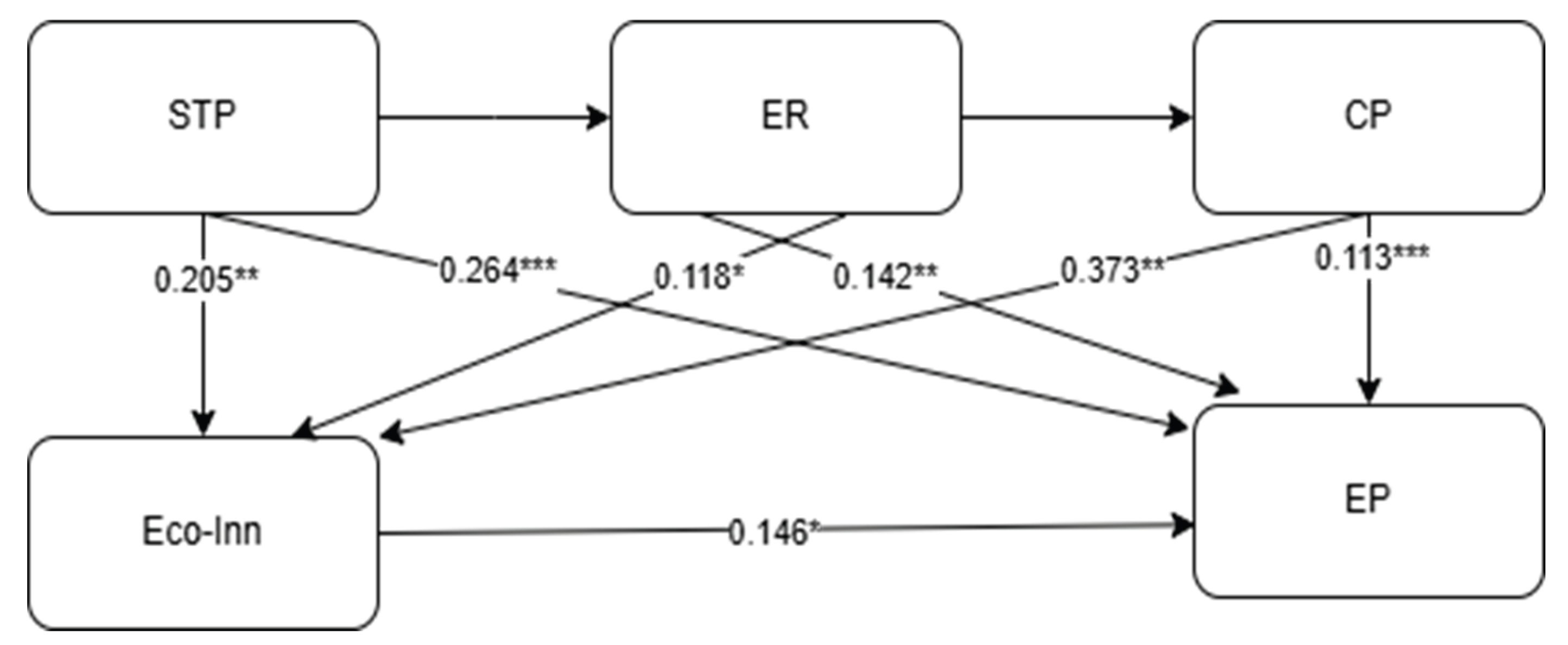
Table 1.
Descriptive Statistics and Correlation Coefficients.
| Variables | Mean | S.D. | VIF | STP | ER | CP | EcoInn | EP |
|---|---|---|---|---|---|---|---|---|
| STP | 3.17 | 0.85 | 1.37 | 0.76 | ||||
| ER | 3.08 | 0.85 | 1.27 | 0.438** | 0.73 | |||
| CP | 3.32 | 0.91 | 1.30 | 0.298** | .222** | 0.76 | ||
| EcoInn | 3.20 | 0.91 | 1.39 | 0.368** | .290** | .460** | 0.77 | |
| EP | 3.26 | 0.83 | 1.31 | 0.420** | .330** | .310** | .345** | 0.71 |
STP = Stakeholders pressure, ER = Environmental regulations, CP = Competitors pressure, Eco-Inn = Eco-Innovation, EP = Environmental performance. **p < 0.01 Note: √AVE is depicted in bold.
Table 3.
Overview of the calibration rules.
| Criteria | STP | ER | CP | Eco-Inn | EP |
|---|---|---|---|---|---|
| Full membership | 3.8 | 4 | 4 | 4 | 4 |
| Crossover point | 3 | 3 | 3.5 | 3.33 | 3.17 |
| Full non-membership | 2.5 | 2.33 | 2.5 | 2.67 | 2.67 |
Table 5.
Configuration for achieving high EP.
| High level of EP | ||
|---|---|---|
| Configuration | 1a | 2a |
| STP_f (Stakeholder pressure) | ● | ● |
| ER_f (Environmental regulations) | ● | |
| CP_f (Competitor’s pressure) | ⊗ | |
| Eco-Inn_f (Eco-innovation) | ● | ● |
| Consistency | 0.873 | 0.862 |
| Raw coverage | 0.388 | 0.224 |
| Unique coverage | 0.220 | 0.056 |
| Overall solution consistency | 0.876 | |
| Overall solution coverage | 0.444 | |
● = core condition present; • = peripheral condition present; ⊗ = absence (negation); blank = condition not in the configuration.
Disclaimer/Publisher’s Note: The statements, opinions and data contained in all publications are solely those of the individual author(s) and contributor(s) and not of MDPI and/or the editor(s). MDPI and/or the editor(s) disclaim responsibility for any injury to people or property resulting from any ideas, methods, instructions or products referred to in the content. |
© 2026 by the authors. Licensee MDPI, Basel, Switzerland. This article is an open access article distributed under the terms and conditions of the Creative Commons Attribution (CC BY) license (http://creativecommons.org/licenses/by/4.0/).
Copyright: This open access article is published under a Creative Commons CC BY 4.0 license, which permit the free download, distribution, and reuse, provided that the author and preprint are cited in any reuse.