

Submitted:
01 April 2026
Posted:
01 April 2026
You are already at the latest version
Abstract
Background/Objectives: To test the accuracy of two sound-based voided volume measurement applications compared to voided volume based on the measurement of pre- and post-void weight using a high-resolution scale. Methods: Seven male and four female volunteers participated. Male and female volunteers used the ProudP and Healthy Bladder-Voiding Diary mobile apps, respectively, to measure sound-based voided volume (SVV). The difference between pre- and post-void weight was calculated and converted to mL to be the true-voided volume (TVV) using a high-resolution scale. A Pearson correlation coefficient and paired t-test were completed. Results: Eighty-two voids were recorded (42M/40F). Median male participant age was 25.9 years. Male SVV ranged from 42-790 mL and TVV ranged from 61-880 mL. Mean difference was 39 mL (95% CI, 18-59 mL). SVV and TVV comparison revealed a strong correlation (r = 0.977, p < 0.0001). Equivalence testing indicated a p-value of 0.022. Median female participant age was 25.0 years. Female SVV ranged from 28-440 mL and TVV ranged from 10-682 mL. Mean difference was 53 mL (95% CI, 22-84 mL). Equivalence testing indicated a p-value of 0.330. SVV and TVV comparison revealed a correlation (r = 0.888, p < 0.0001). Conclusions: The male and female app have a strong correlation to true void volume (male > female app) and can be used by patients to track voided volume at home. The male app accurately measures voided volume within 60 mL from the TVV; however, the female app is less accurate.
Keywords:
urology
; uroflowmetry
; voiding dysfunction
; new technology
; smartphone app
; sound-based technology
; mobile application
1. Introduction
Lower urinary tract symptoms (LUTS) are predicted to affect nearly half the world’s population, with many studies reporting a disproportionate prevalence of greater than 60% in older men and women [1,2,3]. LUTS are divided into three categories -- storage, voiding, and post-micturition symptoms -- and include concerns from urinary urgency and incontinence to incomplete emptying and postmicturition dribble [4]. LUTS have a significant disease burden and commonly impact men with benign prostatic hyperplasia and women with overactive bladder [5,6]. LUTS are associated with anxiety, depressed moods, and quality of life deficits related to vitality and the altered ability to work and carry out daily tasks [7]. Accurate and timely symptomatic management is important for the effective treatment of LUTS.
Uroflowmetry is widely used for the initial non-invasive evaluation of LUTS due to its simplicity and broad availability, and can be helpful in arriving at a diagnosis [8]. However, due to the burden, stress, and inconvenience of conventional uroflowmetry there is growing interest in monitoring urinary flows with voiding acoustics, also known as “sono-uroflowmetry,” as an alternative to uroflowmetry. Sono-uroflowmetry converts acoustic recordings of sound generated by urine hitting the toilet bowl water when a patient voids to standard uroflow parameters including voided volume and there are studies showing good potential of using sound-based uroflowmetry to detect abnormal urinary flow patterns [9]. This technology could allow home-based monitoring of multiple urinary flows, as opposed to a single office-based uroflow that may not accurately depict a patient’s true voiding patterns.
There is a need to investigate the accuracy of these new home-based measurement tools for LUTS across men and women before they are widely adopted and used in clinical practice. This study aimed to test the accuracy of two freely available sound-based smartphone apps from Soundable Health, Inc, Healthy Bladder and ProudP in measuring sound-based voided volume compared to true voided volume based on the measurement of pre- and post-void weight using a high-resolution scale.
2. Materials and Methods
2.1. Study Design and Study Population
This was a prospective, single-center, within subjects, open-label trial to determine the accuracy of the sound-based voided volume measurements from two smartphone applications, ProudP and Healthy Bladder Voiding Diary. The Healthy Bladder Voiding Diary app was rebranded as Bladderly in June 2023. While both the ProudP and Healthy Bladder Voiding Diary were free to use at the time of the study, the company has since made both apps a subscription-based model. This study was approved by the Institutional Review Board at Penn State University before beginning the recruitment and voided volume measurement from participants.
2.2. Inclusion and Exclusion Criteria
Healthy male and female volunteers were recruited. To be eligible for recruitment, participants needed a body weight of less than 150 kg, the ability to stand independently and toilet without assistance, and males needed to be able to urinate while standing. Exclusion criteria included inability to stand or toilet independently, inability to follow verbal instructions independently, and a history of any urologic condition or voiding dysfunction. A total of seven male and four female participants were recruited for the validation pilot study. Each participant provided multiple voids during the study period.
2.3. Study Protocol
Participants’ voided volumes were measured between September 2022 and December 2022. Male participants used the ProudP (Soundable Health, San Francisco, CA, USA) and female participants used the Healthy Bladder Voiding Diary (Soundable Health, San Francisco, CA, USA) to measure sound-based voided volume (SVV). Before measuring the SVV, participants’ pre-void weight was calculated using a HB-150 high-resolution electronic scale. The HB-150 high-resolution scale reported weight in kilograms with 10 grams sensitivity allowing for precise measurements of pre- and post-void weights. Measurement of SVV was done in a quality controlled, single-use, restroom. This allowed for noise control to prevent acoustic background noise which would interfere with the SVV measurement. SVV for male participants was measured as described in Kim et al [10]. To record SVV for female participants, prior to initiating a void the participant rested the smart phone device on their mid-thigh with the bottom of the phone pointed towards the opening of the toilet bowl (Figure 1).
Before beginning to void, the participant pressed the start button on the smartphone application. The Healthy Bladder Voiding Diary recorded the sound of voiding and saved the data. Upon completion of void, male and female participants were weighed on the HB-150 high-resolution scale to record post-void weight. The difference between pre- and post-void weight was calculated. The difference in weight was then converted into the true void volume (TVV). Urine specific gravity generally ranges from 1.005 to 1.030 and within this range, the weight difference in grams will reflect the volume in mL within 0.05% so the weight difference was used as the true voided volume.
SVV measurements interrupted due to an unexpected noise occurrence during the void were excluded. TVV less than 20 ml were also excluded from analysis as 20 grams was the threshold required for a reliable weight measurement. Descriptive statistics of the participants and aggregated SVV and TVV are reported in Table 1 and Table 2, respectively. Statistical analyses were performed with GraphPad Prism 9.
3. Results
A total of eighty-two voids were recorded (42M/40F).
The median male participant age was 25.9 years. Of the 42 voids from male participants, the SVV ranged from 42-790 mL and TVV ranged from 61-880 mL. The mean difference between all voids was 39 mL (95% CI, 18-59 mL). SVV and TVV comparison (Figure 1) revealed a strong correlation (r = 0.977, p < 0.0001). Equivalence testing indicated a p-value of 0.022. At higher voided volumes, the ProudP app appeared to underestimate the TVV.
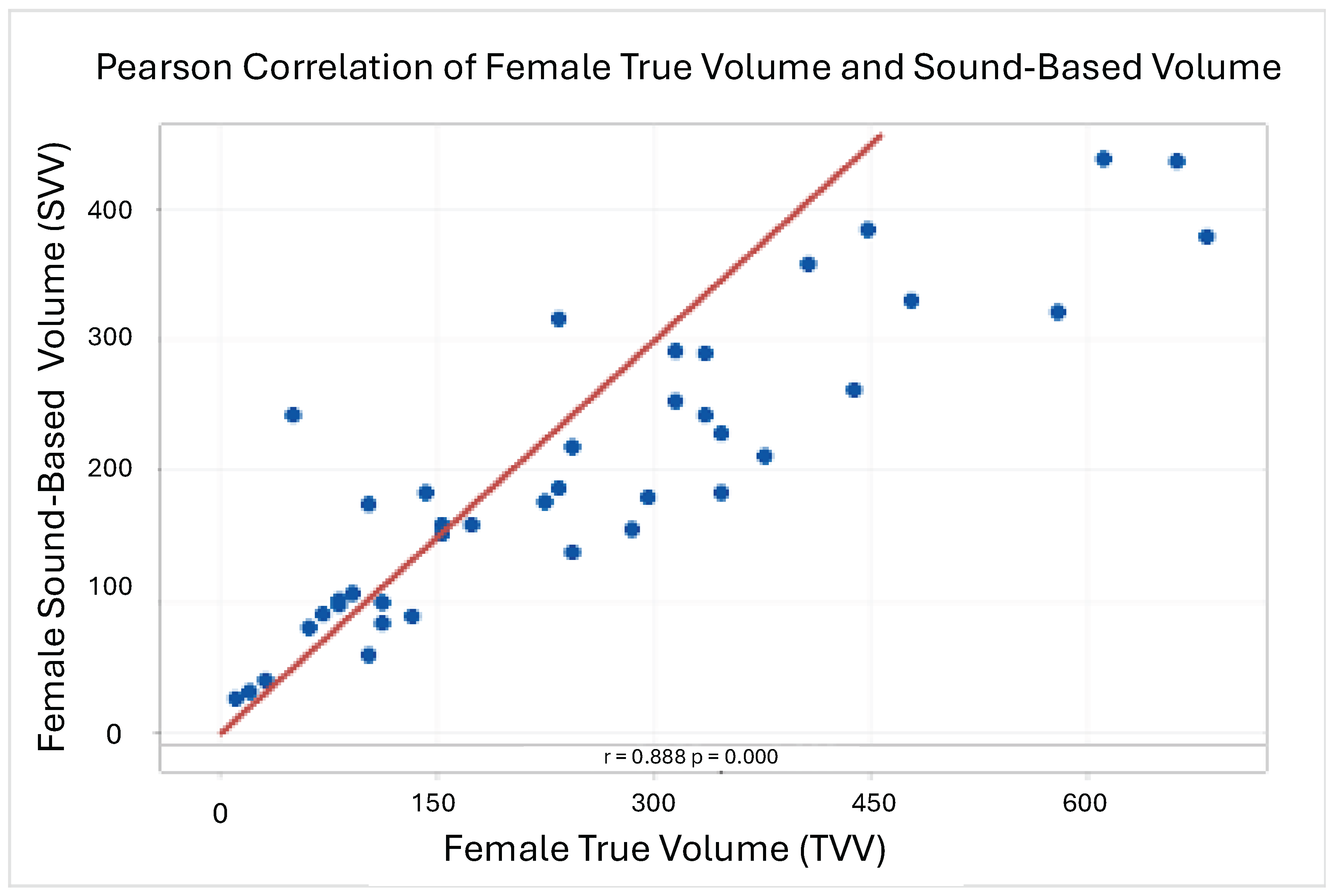
The median female participant age was 25.0 years. Of the 40 voids from female participants, SVV ranged from 28-440 mL and TVV ranged from 10-682 mL. The mean difference was 53 mL (95% CI, 22-84 mL). SVV and TVV comparison (Figure 2) revealed a correlation (r = 0.888, p < 0.0001). Equivalence testing indicated a p-value of 0.330. Similar to the male version of the app, the female version (Healthy Bladder Voiding Diary) at higher volumes appeared to underestimate the TVV.
Figure 3.
Matrix Plot of Female Participant True vs Sound-Based Voided Volume. The red line indicates a perfect correlation.
Figure 3.
Matrix Plot of Female Participant True vs Sound-Based Voided Volume. The red line indicates a perfect correlation.
4. Discussion
This institutional pilot study validates the relative accuracy of two freely available sound-based smartphone apps from Soundable Health, Inc: Healthy Bladder Voiding Diary, and ProudP in healthy volunteers. Both the female app, Healthy Bladder Voiding Diary, and the male app, ProudP showed a significant correlation between SVV and TVV (r = 0.977, p < 0.0001 and r = 0.888, p < 0.0001, respectively).
These results suggest that sound-based smart phone applications are capable of accurately measuring voided volume which is in line with the findings of other validation studies of iOS based uroflow application [10,11]. For patients, these results are significant as this means voided volumes can easily be tracked in the privacy of their home. This study only assessed the accuracy of the voided volume calculated by the app, and no other parameters such as maximum flow rate and average flow rate, which the ProudP app also calculates. A sound-based mobile phone application would also make monitoring symptom progression easier than infrequently at clinic visits. Studies have also shown that tracking voided volumes via the mobile based application are preferred by patients over paper methods [12]. Urologists would also benefit from the use of sound-based mobile phone applications to record voided volumes as they allow an accurate report of specific volumes and number of voids from their patients. This may allow for improved monitoring of symptoms and treatment responses for those with LUTS.
This study is not without limitations. Every effort was made to eliminate or decrease extraneous noise in the restroom during the study; however, ambient noise was inevitably present within the room and could have caused minor variations in the SVV reported. In addition to potential errors due to ambient noise, if the assumption made for converting the weight of urine to volume was inaccurate, minor differences in the TVV may be present. There are also limitations in how the apps generate the SVV. The app makes measurements based on the sound created when urine hits the water of the toilet bowl. However, the sound generated by urine hitting the sides of the toilet is different than that of it hitting the water accounting for some potential inaccuracies despite every effort to control them. Our study enrolled seven healthy volunteers who completed a total of forty-two voids for the male app and forty voids for the female app. A wide range of sample volumes was collected, but consideration should be given to whether a larger number of participants would be needed to report the accuracy between SVV and TVV. That said, studies with a greater number of participants and measured voids had similar results [10,11,12].
Ongoing advancements in algorithm development are expected to further enhance performance. Future research is needed to investigate the accuracy of sound-based mobile applications in patients with LUTS. The ProudP app also calculates the maximum flow rate, average flow rate, and generates uroflow curve, just like the standard uroflow machines in most urology clinics and future research is planned to determine the accuracy of these additional parameters.
5. Conclusions
The male and female apps have a strong correlation to true voided volume (male > female app) and can be used by patients to track the voided volume at home. The male app accurately measures voided volume within 60 mL from the TVV; however, the female app is less accurate. These apps have the potential to allow patients to track urinary void volume using their mobile phones.
Author Contributions
Conceptualization, J.C. and Z.C.; methodology, Z.C., A.R., K.S., B.A. and J.C.; software, J.C. and Z.C.; validation, J.C. and Z.C.; formal analysis, J.C. and Z.C.; investigation, Z.C., A.R., K.S., B.A. and J.C.; resources, J.C. and Z.C.; data curation, J.C. and Z.C.; writing—original draft preparation, Z.C.; writing—review and editing, J.C., A.R. and Z.C.; visualization, J.C. and Z.C.; supervision, J.C.; project administration, Z.C., A.R., K.S., B.A. and J.C; funding acquisition—no external funding. All authors have read and agreed to the published version of the manuscript.
Funding
This research received no external funding.
Institutional Review Board Statement
The study was conducted in accordance with the Declaration of Helsinki and approved by the Institutional Review Board of Penn State University (STUDY00020244 and date of approval: 3 November 2022).
Informed Consent Statement
Implied or verbal consent was obtained from all subjects involved in the study as the IRB felt there was no more than minimal risk of harm to subjects and involved no procedures for which written consent is normally required outside of the research context.
Data Availability Statement
The original contributions presented in this study are included in the article. Further inquiries can be directed to the corresponding author(s).
Acknowledgments
The authors thank Soundable Health, Inc. for permission to reproduce Figure 1.
Conflicts of Interest
The authors declare no conflicts of interest.
Abbreviations
The following abbreviations are used in this manuscript:
| SVV | sound-based voided volume |
| TVV | true-voided volume |
| LUTS | lower urinary tract symptoms |
References
- Zhang, AY; Xu, X. Prevalence, Burden, and Treatment of Lower Urinary Tract Symptoms in Men Aged 50 and Older: A Systematic Review of the Literature. SAGE Open Nurs Published. 2018, 4, 2377960818811773. [Google Scholar] [CrossRef] [PubMed]
- Przydacz, M; Golabek, T; Dudek, P; Lipinski, M; Chlosta, P. Prevalence and bother of lower urinary tract symptoms and overactive bladder in Poland, an Eastern European Study. Sci Rep. Published. 2020, 10(1), 19819. [Google Scholar] [CrossRef] [PubMed]
- Irwin, DE; Milsom, I; Kopp, Z; Abrams, P; Artibani, W; Herschorn, S. Prevalence, severity, and symptom bother of lower urinary tract symptoms among men in the EPIC study: impact of overactive bladder. Eur Urol. 2009, 56(1), 14–20. [Google Scholar] [CrossRef] [PubMed]
- Irwin, DE; Milsom, I; Hunskaar, S; Reilly, K; Kopp, Z; Herschorn, S; Coyne, K; Kelleher, C; Hampel, C; Artibani, W; Abrams, P. Population-based survey of urinary incontinence, overactive bladder, and other lower urinary tract symptoms in five countries: results of the EPIC study. Eur Urol. 2006, 50(6), 1306–1315. [Google Scholar] [CrossRef] [PubMed]
- Egan, KB. The Epidemiology of Benign Prostatic Hyperplasia Associated with Lower Urinary Tract Symptoms: Prevalence and Incident Rates. Urol Clin North Am. 2016, 43(3), 289–297. [Google Scholar] [CrossRef] [PubMed]
- Wennberg, AL; Molander, U; Fall, M; Edlund, C; Peeker, R; Milsom, I. A longitudinal population-based survey of urinary incontinence, overactive bladder, and other lower urinary tract symptoms in women. Eur Urol. 2009, 55(4), 783–791. [Google Scholar] [CrossRef] [PubMed]
- Welch, G; Weinger, K; Barry, MJ. Quality-of-life impact of lower urinary tract symptom severity: results from the Health Professionals Follow-up Study. Urology 2002, 59(2), 245–250. [Google Scholar] [CrossRef] [PubMed]
- Sinha, S. The Use of Uroflowmetry as a Diagnostic Test. Curr Urol Rep. 2024, 25(5), 99–107. [Google Scholar] [CrossRef] [PubMed]
- Rangganata, E; Rahardjo, HE; Rasyid, N; Widia, F; Murwantara, IM; Yugopuspito, P; Gemilang, B; Nasher, FZ; Syadza, YZ; Yonathan, K; Birowo, P. Comparative study of mobile acoustic uroflowmetry and conventional uroflowmetry: A systematic review and meta analysis. Neurourol Urodyn 2024, 43(3), 694–702. [Google Scholar] [CrossRef] [PubMed]
- Kim, H; Ye, C; Jung, G; Ryu, H; Lee, JW; Jeong, SJ; Lee, S. Validation of acoustic voided volume measure: a pilot prospective study. World J Urol 2023, 41(2), 509–514. [Google Scholar] [CrossRef] [PubMed]
- Jung, G; Ryu, H; Lee, JW; Jeong, SJ; Margolis, E; Grover, N; Lee, S. Validation of an algorithm for sound-based voided volume estimation. Sci Rep. 2024, 14(1), 138. [Google Scholar] [CrossRef] [PubMed]
- Kim, JK; Kim, H; Ho, JN; Jeong, SJ; Lee, S. A Novel Acoustic Uroflowmetry-Based Mobile App Voiding Diary: Comparison with Conventional Paper-Based Voiding Diary. Biomed Res Int. Published. 2022, 2022, 3390338. [Google Scholar] [CrossRef] [PubMed]
Figure 1.
Sound-Based Void Volume Collection Method for Female (A) and Male Participants (B). Reproduced with permission from Soundable Heath, Inc.
Figure 1.
Sound-Based Void Volume Collection Method for Female (A) and Male Participants (B). Reproduced with permission from Soundable Heath, Inc.
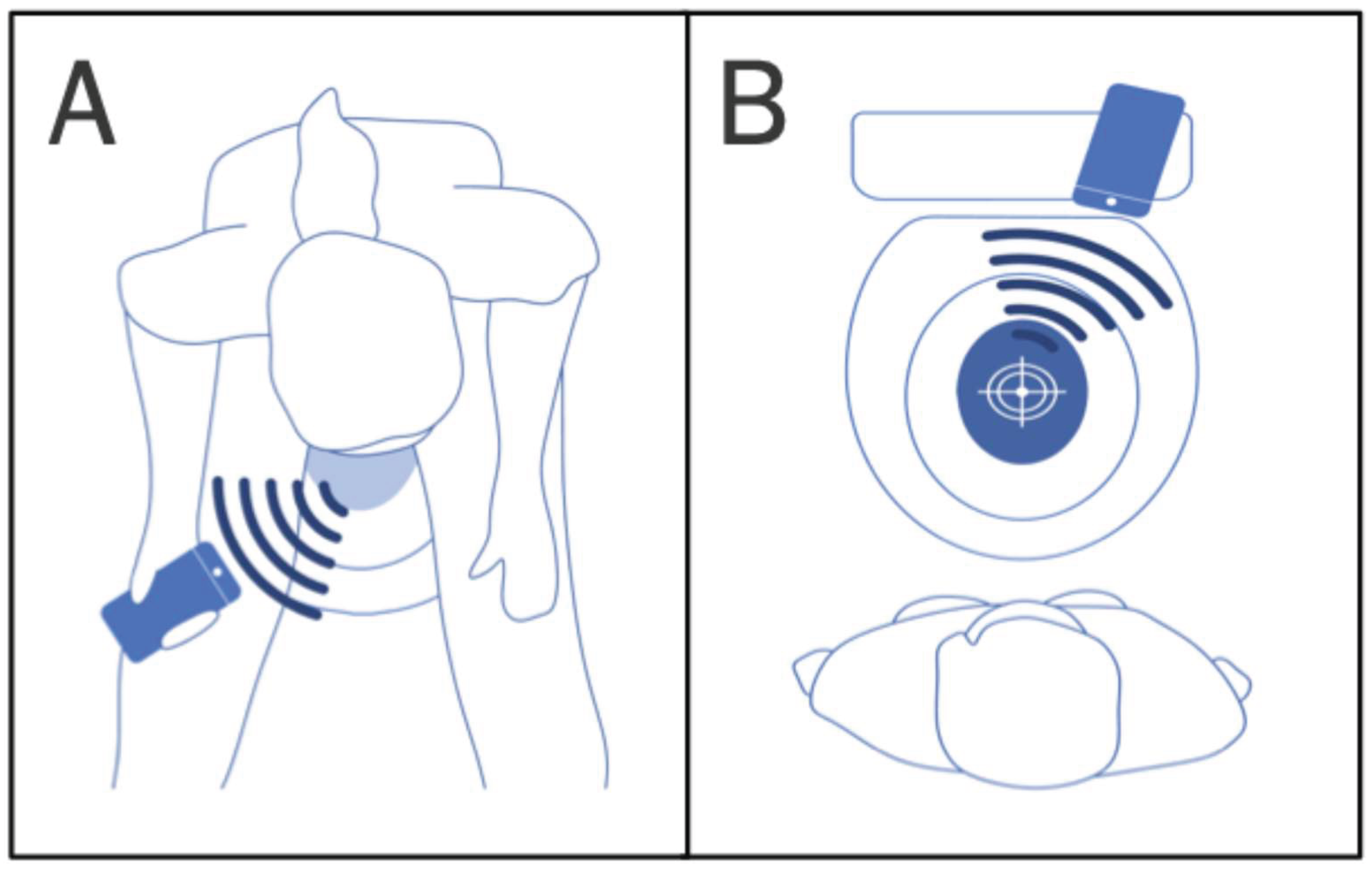
Figure 2.
Matrix Plot of Male Participant True vs Sound-Based Voided Volume. The red line indicates a perfect correlation.
Figure 2.
Matrix Plot of Male Participant True vs Sound-Based Voided Volume. The red line indicates a perfect correlation.
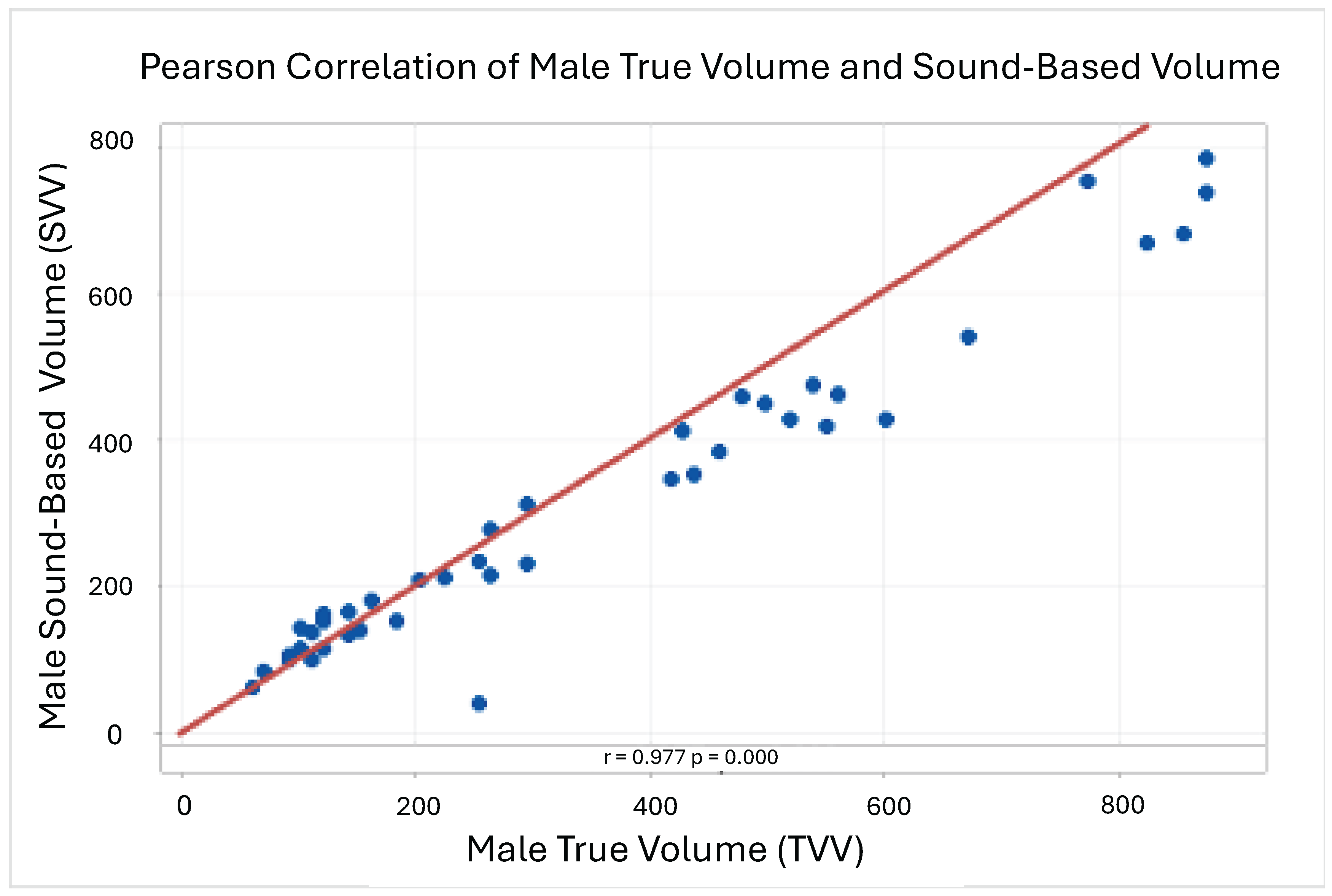

Table 1.
Summary of Participants.
| Clinical Factor | Value |
|---|---|
| Participants (Total) Male Female |
11 |
| 7 | |
| 4 | |
| Age (Years) Male Female |
|
| 25.9 (median) | |
| 25.0 (median) |
Table 2.
Summary of Voided Volume Measurements from 11 Participants.
| Measurements | Values |
|---|---|
| Number of total void measurements Male Female |
82 |
| 42 | |
| 40 | |
| Range of VV measured by mobile application (SVV) (mL) Male Female |
|
| 42-790 28-440 | |
| Range of VV measured by HB-150-high-resolution (TVV) (mL) Male Female |
|
| 61-880 | |
| 10-682 | |
| Mean difference between SVV and TVV measures (mL) Male Female |
39 (95% CI, 18-59) |
| 53 (95% CI, 22-84) |
Disclaimer/Publisher’s Note: The statements, opinions and data contained in all publications are solely those of the individual author(s) and contributor(s) and not of MDPI and/or the editor(s). MDPI and/or the editor(s) disclaim responsibility for any injury to people or property resulting from any ideas, methods, instructions or products referred to in the content. |
© 2026 by the authors. Licensee MDPI, Basel, Switzerland. This article is an open access article distributed under the terms and conditions of the Creative Commons Attribution (CC BY) license (http://creativecommons.org/licenses/by/4.0/).
Copyright: This open access article is published under a Creative Commons CC BY 4.0 license, which permit the free download, distribution, and reuse, provided that the author and preprint are cited in any reuse.


