

Submitted:
30 March 2026
Posted:
31 March 2026
You are already at the latest version
Abstract
Based on a holistic structural model framework, this study examines how Industry 4.0 manufacturing applications impact production system integration, supply chain agility, and operational performance. It has become increasingly important for businesses in recent years to focus on digital transformation and smart manufacturing technologies. In light of this, this study examines the effects of Industry 4.0 applications on the operational capabilities of businesses and their impact on performance. Using Partial Least Squares Structural Equation Modeling (PLS-SEM) as a means of data analysis, the study also evaluated the predictive power of the research model using PLSpredict. A total of 300 manufacturers participated in the research, and the data obtained from 300 of them was analyzed and found to have a strong and significant effect on the integration of production systems. In addition, it was found that production system integration improves supply chain agility, and supply chain agility impacts operational performance positively and significantly. Industry 4.0 applications largely impact operational performance through production system integration and supply chain agility, according to mediation results. Based on the results of PLSpredict, the research model is not only explanatory but also predictive. As a result, the research shows that Industry 4.0 production applications enhance business performance by increasing innovation capacity and supply chain agility, while also serving as a technological transformation tool for businesses. Beyond its operational implications, the study also suggests that Industry 4.0-enabled integration and agility may support more resilient and sustainability-oriented manufacturing sys-tems. As such, the research contributes to both theoretical and managerial literature on digital production technologies and operations management.
Keywords:
Industry 4.0
; production system integration
; supply chain agility
; operational performance
; sustainable manufacturing
; PLS-SEM
; PLSpredict
1. Introduction
One of the most important technological transformation processes that fundamentally changes the structure of production systems is digital transformation. The new production technology, defined as Industry 4.0, supports making production processes more flexible, data-driven, and integrated through the Internet of Things (IoT), smart automation technologies, cyber-physical systems, and big data analytics. By integrating these technologies into production systems, businesses can reshape their operational processes and thus gain a competitive advantage. Current research emphasizes that Industry 4.0 technologies improve the operational performance of businesses by increasing production efficiency [1,2].
The integration of Industry 4.0 technologies into production processes is closely related to both the transformation of the technological infrastructure and the coordination between processes within the business. Real-time data flow between production systems via digital technologies enables both faster decision-making processes and more effective planning of production activities. In this context, production system integration is a key organizational mechanism explaining the impact of Industry 4.0 applications on business performance [3].
As a result of digital manufacturing technologies, businesses are able to organize their supply chain structures more agilely. Generally, supply chain agility refers to businesses’ ability to respond quickly to market changes and develop flexible operational strategies in uncertain environments. In this context, within the framework of data sharing and digital integration capabilities enhanced by Industry 4.0 technologies, businesses can manage their supply chain processes faster and more coordinately, thereby improving their agility levels. Recent research supports the idea that digital manufacturing technologies indirectly affect business performance outcomes by strengthening supply chain agility [4].
However, although there are many studies in the literature examining the effects of Industry 4.0 technologies on business performance, studies that address the organizational mechanisms through which this relationship arises are limited. In particular, the role of organizational competencies such as production system integration and supply chain agility in the relationship between Industry 4.0 applications and operational performance stands out as an important research area in the literature. Recent research highlights that the impact of digitalization on performance is not direct, but often occurs through intermediate mechanisms such as integration and agility [5].
In addition to improving operational processes, Industry 4.0 applications may also contribute to sustainability-oriented industrial development by enabling more integrated, flexible, and adaptive production systems. Therefore, understanding how these technologies shape organizational capabilities is important not only for performance research but also for broader sustainability discussions in manufacturing.
Accordingly, the aim of this study is to examine the impact of Industry 4.0 manufacturing applications on the operational performance of businesses and to analyze the mediating roles of manufacturing system integration and supply chain agility in this relationship. Through the proposed structural model within the scope of the research, the relationships between Industry 4.0 manufacturing applications, manufacturing system integration, supply chain agility, and operational performance are tested within a holistic framework. In this respect, the study aims to fill a significant gap in the literature by addressing the impact of digital manufacturing applications on operational performance from the perspective of organizational integration and agility. In doing so, the study also offers a broader perspective on how digital manufacturing capabilities may support sustainability-oriented operational transformation.
2. Materials and Methods
Industry 4.0 technologies have led to significant structural changes in production systems. In particular, big data analytics, the Internet of Things, intelligent automation technologies, and cyber-physical systems support more integrated, flexible, and data-driven production processes. These technologies not only digitize production processes but also improve the organizational structures and supply chain management approaches of businesses. In this context, evaluating the relationships between Industry 4.0 production applications, production system integration, supply chain agility, and operational performance together will provide significant gains to the literature and application systems.
It is frequently emphasized in the literature that Industry 4.0 production applications strengthen the internal process integration of businesses. Thanks to digital production technologies, real-time data sharing between production machines, information systems, and enterprise software becomes possible, which increases coordination between departments within the business. The acceleration of information flow between functions such as production planning, purchasing, and logistics allows production processes to be carried out in a more synchronized manner. Recent studies show that Industry 4.0 technologies enhance coordination between production systems by strengthening intra-organizational integration [6,7]. Accordingly, Industry 4.0 production applications are expected to increase the integration of production systems.
H1.
Industry 4.0 manufacturing applications (I4PP) positively impact production system integration (PSI).
Industry 4.0 technologies are also creating significant transformations in supply chain processes. Thanks to digital production systems, businesses can analyze data obtained from production and supply processes in real time and respond more quickly to changes in demand. This allows businesses to manage their supply chain processes in a more flexible and adaptable structure. The literature states that Industry 4.0 technologies strengthen supply chain coordination by increasing data visibility and increase the agility capacity of businesses [8,9]. Accordingly, Industry 4.0 production applications are expected to increase supply chain agility.
H2.
Industry 4.0 production applications (I4PP) positively affect supply chain agility (SCA).
Industry 4.0 technologies contribute to the more efficient execution of operational processes by increasing the level of automation in production processes. Thanks to digital production technologies, data obtained from production processes can be analyzed, process optimization can be achieved, and resource utilization can be made more effective. This situation increases production efficiency while having positive effects on operational outputs such as delivery performance and product quality. There are significant findings in the literature indicating that Industry 4.0 applications improve the operational performance of businesses [10,11]. Accordingly, Industry 4.0 production applications are expected to have a positive impact on operational performance.
H3.
Industry 4.0 production applications (I4PP) positively affect operational performance (OP).
Production systems integration is a crucial organizational capability that enables businesses to manage their production processes more effectively. Effective information sharing and process coordination between departments contribute to more harmonious production activities. Increased integration allows for more efficient management of production planning processes and optimization of resource utilization. This facilitates faster and more flexible movement in supply chain processes for businesses. The literature states that intra-business integration is one of the key factors increasing supply chain agility [12]. Accordingly, production systems integration is expected to increase supply chain agility.
H4.
Production systems integration (PSI) positively impacts supply chain agility (SCA).
Production systems integration is also considered a significant factor in improving the operational performance of businesses. Thanks to integrated production systems, businesses can plan their production processes more effectively and strengthen coordination among operational activities. This contributes to increased efficiency in production processes, reduced costs, and improved delivery performance. There is strong evidence in the literature that there is a positive relationship between production system integration and operational performance [12,13].
H5.
Production system integration (PSI) positively affects operational performance (OP).
Agile supply chains let businesses quickly respond to changing market conditions and make adjustments to production plans. Businesses with agile supply chains can respond quickly to demand fluctuations and revise their production plans in a short amount of time. This enables businesses to respond to customer demands faster, thus increasing operational performance. The literature states that supply chain agility has a significant impact on operational performance [14,15].
H6.
Supply chain agility (SCA) positively affects operational performance (OP).
It is stated that the impact of Industry 4.0 production applications on business performance often occurs through organizational mechanisms. Digital manufacturing technologies strengthen process integration within businesses, enabling production systems to operate more efficiently, which indirectly impacts operational performance. Therefore, production system integration is expected to play a mediating role in the relationship between Industry 4.0 manufacturing applications and operational performance.
H7.
Production systems integration (PSI) plays a mediating role in the relationship between Industry 4.0 manufacturing practices (I4PP) and operational performance (OP).
Similarly, Industry 4.0 technologies strengthen the agility capacity of businesses by increasing data visibility in supply chain processes. Agile supply chains improve the operational performance of businesses thanks to their ability to quickly adapt to changes in demand. Therefore, supply chain agility is expected to play a mediating role in the relationship between Industry 4.0 manufacturing practices and operational performance.
H8.
Supply chain agility (SCA) plays a mediating role in the relationship between Industry 4.0 manufacturing practices (I4PP) and operational performance (OP).
Finally, it is thought that the impact of Industry 4.0 manufacturing practices on business performance can emerge through a multi-stage mechanism. Digital manufacturing technologies primarily strengthen in-house production systems integration, and this integration, in turn, increases supply chain agility, thus impacting operational performance. Accordingly, it is considered that production systems integration and supply chain agility can play a series of mediating roles together.
H9.
Manufacturing systems integration (PSI) and supply chain agility (SCA) play a serial mediating role in the relationship between Industry 4.0 manufacturing practices (I4PP) and operational performance (OP).
2.1. Research Model and Methodology
This research is designed using a quantitative research method to examine the impact of Industry 4.0 production applications on the operational performance of businesses. In the context of Industry 4.0, production system integration is considered a crucial component of production system capacity by providing digital coordination and data integration. In this study, the relationships between Industry 4.0 production applications, production system integration, supply chain agility, and operational performance are examined within a structural model framework (Figure 1). Partial Least Squares Structural Equation Modeling (PLS-SEM) method was chosen to test the direct and indirect relationships between the variables within the research model.
Industry 4.0 Production Practices (I4PP), Production Systems Integration (PSI), Supply Chain Agility (SCA), Organizational performance (OP)
The PLS-SEM method is widely used in business and management sciences, particularly for testing complex structural models and providing reliable results with relatively small sample sizes [16]. Furthermore, this method offers a suitable approach for analyzing research models by allowing the testing of multiple mediating relationships. Research data were collected online through a structured questionnaire. In the process of collecting data, participants were informed of the study’s purpose, and their anonymity was maintained. Data collected were used for scientific research only. The results of Harman’s one-factor test, used to assess common method bias in self-reported data, demonstrated less than 50% of the variance could be explained by the first factor. This finding indicates that common method bias did not pose a significant problem in the study [17].
2.2. Universe and Sample
Research participants are middle- and upper-level managers working in manufacturing companies in Turkey, specifically in production management, operations management, supply chain management, and digital transformation. The sample was determined using a convenience sampling method, a non-probability sampling technique. Data was collected from participants using a survey technique and within the translation process using industry-specific communication tools. A minimum sample size was determined to be suitable for structural equation modeling analysis. A total of 300 managers participated in the study.
2.3. Data Collection Tool
A structured questionnaire was used as a data collection tool in the research. The questionnaire consists of two sections. The first section contains questions about the demographic characteristics of the participants, and the second section contains scale items to measure the variables included in the research model. The scales used in the research were adapted from studies whose validity and reliability have been proven in the literature. All scale items were measured with a 5-point Likert type rating (1 = Strongly Disagree, 5 = Strongly Agree).
Industry 4.0 Production Applications Scale: This scale, used to measure the level of use of digital technologies in the production processes of businesses, was adapted from the measurement tool developed by [18]. The scale consists of items that evaluate dimensions such as the use of digital technologies in production processes, data analytics applications, automation level, and digital integration of production systems. Production Systems Integration Scale: This scale, used to measure the level of information sharing and process coordination between departments within the business, is based on the study of [13]. The scale items evaluate coordination and information sharing between production, purchasing, and logistics units [13,19]. Supply Chain Agility Scale: This scale, used to measure businesses’ capacity to adapt to changing market conditions and respond quickly to demand changes, is based on the work of [15] and [15,20,21]. Li et al. (2007) developed a measurement tool for measuring operational outputs such as productivity, quality, delivery performance, and process efficiency[22].

Table 1.
Variables.
| Variable | Source |
|---|---|
| Industry 4.0 Production Practices (I4PP) | |
| Digital technologies are actively used in our production processes. | [18] |
| There is real-time data flow between production machines and information systems. | |
| Production processes are supported by sensor and automation systems. | |
| Production data is collected and analysed digitally. | |
| Production planning and control processes are carried out through digital systems. | |
| Production equipment works in an integrated manner. | |
| Big data analytics is used in production decisions. | |
| Production processes can be monitored and controlled remotely. | |
| The level of automation in production processes is high. | |
| Digital technologies increase production efficiency. | |
| The level of digital integration in production processes is high. | |
| Our production systems are compatible with Industry 4.0 technologies. | |
| Production Systems Integration (PSI) | |
| Effective information sharing is ensured between production-related departments. | [13,19] |
| Production planning, purchasing, and logistics units work in coordination. | |
| Production decisions are made in harmony with other units within the company. | |
| Production processes are carried out synchronously thanks to interdepartmental integration. | |
| Production-related data is used jointly by all relevant units. | |
| Production systems are integrated with other functions within the company. | |
| Supply Chain Agility (SCA) | |
| Our company can respond quickly to changes in customer demand. | [15,21] |
| Our supply chain can easily adapt to unexpected market conditions. | |
| We can quickly revise our production and distribution plans in response to demand fluctuations. | |
| Our coordination with our suppliers is flexible and effective. | |
| Our supply chain operates based on real demand. | |
| We can offer products and services that meet changing customer needs in a short time. | |
| Organizational performance (OP) | |
| Our company’s production processes operate with high efficiency. | [22,23] |
| Our product/service quality is above the industry average. | |
| Our delivery times are shorter compared to our competitors. | |
| Our inventory management is effective and controlled. | |
| Our production processes are flexible to change in demand. | |
| Our operational processes are carried out in a way that will increase customer satisfaction. | |
3. Findings
Table 2 summarizes the demographic characteristics of the participants. Over 80% of the group was male, while 20% was female. Regarding age distribution, most participants were in the 30-39 age range (40.7%), followed by the 25-29 age group (22.7%) and the 40-49 age group (21.3%). In terms of professional experience, the largest group had 10-14 years of experience (26.0%), followed by those with 3-6 years of experience (25.7%). Regarding education level, the majority of participants held a bachelor’s degree (80.7%), while 14.0% held a master’s degree and 5.3% held a doctorate.
3.1. Measurement Model
Factor analyses were performed to evaluate the measurement model. These analyses were conducted using the SmartPLS 4.0 software via the PLS algorithm. Commonly used criteria in the literature were considered in evaluating the measurement model. Accordingly, factor loadings, Cronbach’s Alpha coefficient, rho_A coefficient, composite reliability (CR), average variance extracted (AVE), R² value, t-statistics, and variance inflation factor (VIF) values were examined to assess the validity and reliability of the model [16,24]. The literature recommends that factor loadings should be at least 0.70 and indicator reliability should be above 0.40.
The analyses revealed that the Cronbach’s Alpha values of the scales ranged from 0.806 to 0.885, the rho_A values from 0.817 to 0.889, the composite reliability (CR) values from 0.893 to 0.916, and the AVE values from 0.582 to 0.686. All of these values are above the threshold values recommended in the literature, indicating that the scales have achieved internal consistency reliability and convergent validity. Factor loadings, reliability, and validity results for the measurement model are presented in Table 3. Furthermore, the presence of multicollinearity among the variables in the measurement model was examined using Variance Inflation Factor (VIF) values. In the literature, VIF values below 10 indicate the absence of multicollinearity [25]. According to the analysis results, the VIF values of the observed variables in the model ranged from 1.597 to 2.430. These findings indicate that there is no multicollinearity problem in the model. Overall, it was concluded that the reliability and validity criteria for the measurement model are met and that the model is suitable for structural analysis.
Discriminant validity among the variables in the research model was tested using the Fornell–Larcker criterion and the Heterotrait–Monotrait Ratio (HTMT). According to the Fornell and Larcker criterion, for sufficient discriminant validity to be achieved, the square root of the AVE value of each construct must be greater than the correlation values of that construct with other constructs [26].
Figure 2.
Measurement Model.
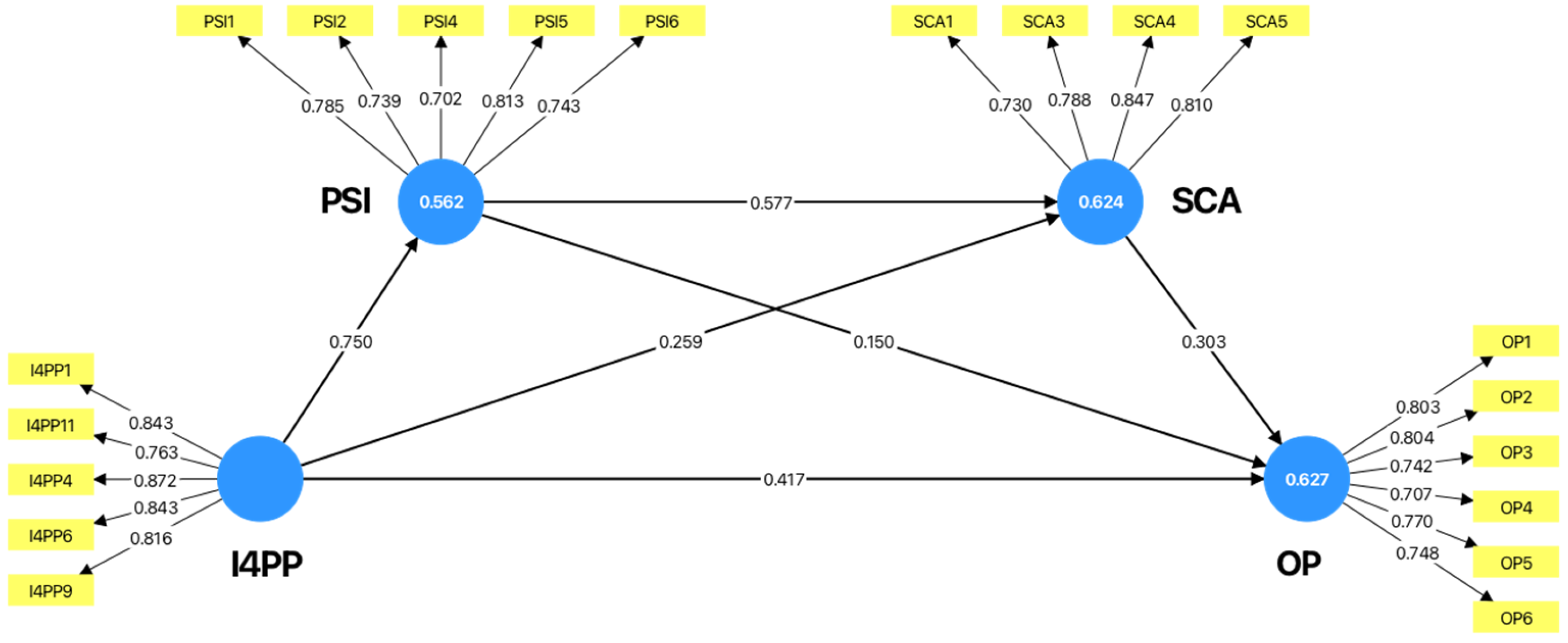
When Table 4 is examined, it is seen that the AVE root mean values for each latent variable are higher than the correlation coefficients with other variables. This indicates that sufficient discriminant validity has been achieved among the structures included in the model. In addition, discriminant validity was further evaluated using the Heterotrait-Monotrait Ratio (HTMT). According to the conservative threshold suggested by [16], HTMT values should ideally be below 0.85, while values below 0.90 are generally considered acceptable in structural equation modeling studies. In this study, HTMT values range from 0.802 to 0.944. Although the highest value slightly exceeds the suggested threshold, the overall pattern of correlations and the Fornell-Larcker results show that discriminant validity is largely acceptable. Therefore, the structures in the model can be considered sufficiently different.
3.2. Structural Model and Hypothesis Testing
Following the evaluation of the measurement model, structural model analysis was performed. In the PLS-SEM approach, the evaluation of the structural model is carried out through various criteria such as model fit, explanatory power, effect size, and predictive power of the model [16,27]. Accordingly, SRMR, R², f², and Q² values were used in the evaluation of the structural model in this study. First, the overall fit of the model was examined through the Standardized Root Mean Square Residual (SRMR) value. According to the SmartPLS analysis results, the SRMR value of the model was calculated as 0.069. According to Henseler et al., an SRMR value less than 0.10 indicates that the model fit is acceptable [28]. Accordingly, the obtained SRMR value shows that the model has an acceptable level of fit (Table 5).
The explanatory power of the structural model was evaluated using R² values. The R² value indicates how much of the variance in the dependent variables is explained by the independent variables. According to Hair et al., R² values of 0.75 represent a strong explanatory power, 0.50 a moderate explanatory power, and 0.25 a weak explanatory power [25]. According to the analysis results, the explanatory power of the endogenous variables in the model is between moderate and strong. Accordingly, the R² value of the operational performance (OP) variable was calculated as 0.627, the R² value of the production systems integration (PSI) variable as 0.562, and the R² value of the supply chain agility (SCA) variable as 0.624. These results show that the independent variables in the model have a moderately strong explanatory power for these structures (Table 6).
In addition, effect size (f²) values were examined to determine the contribution level of the relationships between the variables in the model. According to Cohen (1988), f² values of 0.02 represent a small effect size, 0.15 a medium effect size, and 0.35 a large effect size [29]. The analysis results show that the relationships between the variables have different levels of effect size. The obtained f² values are presented in Table 7.
3.3. Hypothesis Testing
A preloading analysis was performed with 5000 resamples to test the proposed hypotheses. The results show that all structural paths in the model are statistically significant (p < 0.05). The strongest relationship was observed between Industry 4.0 manufacturing applications and manufacturing system integration (β = 0.750, t = 27.893), indicating that digital manufacturing technologies significantly increase the integration of manufacturing systems within firms. Furthermore, Industry 4.0 manufacturing applications positively impact supply chain agility (β = 0.259, t = 3.877) and operational performance (β = 0.417, t = 5.950). The results also reveal that manufacturing system integration significantly improves supply chain agility (β = 0.577, t = 9.676) and operational performance (β = 0.150, t = 2.036). Finally, supply chain agility has a significant positive impact on operational performance (β = 0.303, t = 4.372). Based on these findings, hypotheses H1 through H6 are supported.
Table 8.
Structural Model and Hypothesis Test Results.
| Hypothesis | Structural Path | β | t value | p value | Result |
|---|---|---|---|---|---|
| H1 | I4PP → PSI | 0.750 | 27.893 | 0.000 | Supported |
| H2 | I4PP → SCA | 0.259 | 3.877 | 0.000 | Supported |
| H3 | I4PP → OP | 0.417 | 5.950 | 0.000 | Supported |
| H4 | PSI → SCA | 0.577 | 9.676 | 0.000 | Supported |
| H5 | PSI → OP | 0.150 | 2.036 | 0.042 | Supported |
| H6 | SCA → OP | 0.303 | 4.372 | 0.000 | Supported |
3.4. Mediation Analysis
To examine the indirect effects in the model, mediation analysis was performed using the bootstrapping method. The analysis results show that a significant portion of the indirect relationships in the model are statistically significant. In particular, the I4PP → PSI → SCA (β = 0.433, p < 0.001) path is seen to have a strong indirect effect. This finding indicates that Industry 4.0 production applications significantly increase supply chain agility through production system integration. Furthermore, the significant indirect effect of PSI → SCA → OP (β = 0.175, p < 0.001) reveals that the impact of production system integration on operational performance occurs significantly through supply chain agility. In addition, the significant finding of the I4PP → PSI → SCA → OP path indicates the presence of a serial mediation mechanism among the variables in the model. These results demonstrate that Industry 4.0 production applications affect operational performance not only directly but also indirectly through production system integration and supply chain agility. In mediation analysis, the significance of indirect effects was evaluated using a bootstrapping method with 5000 samples.
Table 9.
Indirect Effects (Mediation) Analysis Results (Bootstrapping).
| Structural Path | β | t value | p value | Result |
|---|---|---|---|---|
| I4PP → PSI → SCA | 0.433 | 9.317 | <0.001 | Significant |
| I4PP → SCA → OP | 0.078 | 2.587 | 0.010 | Significant |
| I4PP → PSI → OP | 0.112 | 2.008 | 0.045 | Significant |
| I4PP → PSI → SCA → OP | 0.131 | 4.157 | <0.001 | Significant |
| PSI → SCA → OP | 0.175 | 4.225 | <0.001 | Significant |
3.5. Model Predictive Power (PLSpredict Results)
To evaluate the predictive power of the model, a PLSpredict analysis was performed. In the PLS-SEM literature, Q²_predict values are used to evaluate the predictive performance of the model. A Q²_predict value greater than zero indicates that the model has predictive power for the relevant indicators (Hair et al., 2017). When the analysis results were examined, it was observed that the Q²_predict values were positive for all indicators included in the model. In particular, it was determined that the Q²_predict values obtained for some indicators of the PSI and OP structures were above the 0.30 level (e.g., PSI2 = 0.346, OP1 = 0.423 and SCA4 = 0.436). This shows that the model has significant predictive power in terms of predicting the dependent variables. In addition, the predictive performance of the model was evaluated by comparing the prediction errors of the PLS-SEM model with the linear regression model (LM). According to the analysis results, the RMSE values of the PLS-SEM model are lower than the RMSE values of the linear regression model for many indicators. This finding reveals that the proposed model has not only explanatory but also predictive power. Summary findings regarding the PLSpredict analysis are presented in Table 10.
According to the data in Table 9, the model has a high level of predictive power, especially for the Production Systems Integration (PSI) variable. For the Supply Chain Agility (SCA) and Operational Performance (OP) variables, the model has a moderate level of predictive power. Based on these results, it has been determined that the research model has both predictive and exploratory validity (Table 10).
4. Discussion
Research conducted in this study examines how Industry 4.0 manufacturing applications affect production systems, supply chain agility, and operational performance through an integrated model framework. The study found that Industry 4.0 manufacturing application impacts business performance both directly and indirectly. Digitalization and smart manufacturing technologies increase innovation capacity, in line with existing literature. The use of smart manufacturing systems, such as sensor technologies, big data analytics, and big data analytics, makes production processes more flexible and innovative [6,30]. Industry 4.0 applications are found to increase innovation performance of businesses by restructuring the process design [30].
The research results also show that production systems have a significant and strong impact on supply chain agility. This finding reveals that production systems are transforming not only production processes but also supply chain processes. Current research shows that digital manufacturing technologies accelerate information flow in the supply chain and enable businesses to respond more quickly to environmental uncertainties [9,31]. In particular, the development of data-driven decision-making mechanisms contributes to businesses achieving higher levels of agility in their supply chain processes [12]. In this context, the findings demonstrate that production systems support operational efficiency by increasing the supply chain agility of businesses.
Another important finding of the research is that supply chain agility has a significant and positive impact on operational performance. This result parallels current studies showing that businesses with agile supply chain structures are more successful in terms of operational performance. Research, particularly in the post-pandemic period, reveals that supply chain agility is a critical factor in increasing the operational resilience and performance of businesses [32,33]. Businesses benefit from agile supply chain structures by being able to adapt more quickly to fluctuations in demand and achieving higher efficiency in operational processes [34].
Research model results indicate that Industry 4.0 production applications have a significant impact on operational performance through production systems and supply chain agility. Technologically driven advanced manufacturing affects the performance of businesses through a multi-stage value creation process as a result of the chain mediation mechanism defined as Industry 4.0 + production systems + supply chain agility + operational performance. Based on one recent study, digital transformation impacts business performance mainly through operational and organizational capabilities rather than directly [8]. The findings also suggest that the contribution of Industry 4.0 extends beyond immediate operational gains. By strengthening integration and agility, digital manufacturing practices may help firms develop more resilient, adaptive, and sustainability-oriented operational systems capable of responding to uncertainty, market volatility, and ongoing technological change.
5. Conclusions
This research, conducted within a holistic structural model framework, evaluates the effects of Industry 4.0 production applications on production systems, supply chain agility, and operational performance. The model developed using the PLS-SEM method was tested. The results show that Industry 4.0 production applications are a significant strategic factor affecting business performance. These results also reveal that Industry 4.0 production applications have a strong and significant impact on production systems. In this context, the research findings are consistent with current research showing that digital production technologies make businesses’ production processes more flexible, data-driven, and innovative [35].
Furthermore, according to the research results, production systems increase supply chain agility, and supply chain agility has a significant impact on operational performance. This result shows that digital transformation processes transform both production systems and the supply chain structures of businesses. In recent years, uncertainties and crises experienced in global supply chains in the business world have necessitated that businesses have agile and flexible supply chain structures [32]. In this context, thanks to Industry 4.0 technologies, information flow in supply chain processes is accelerating, and businesses are able to adapt to environmental changes more quickly. One of the important findings of the research is that the impact of Industry 4.0 production applications on operational performance largely occurs through production systems and supply chain agility. According to the chain mediation findings, digital production technologies do not directly increase business performance, but create an indirect value creation process through organizational and operational capabilities. This result supports the competency-based value creation approach in the digital transformation literature [36].
The PLSpredict analysis used in the research revealed that the proposed model has not only explanatory but also predictive power. The positive Q²_predict values obtained in the research and lower PLS-SEM prediction errors in many indicators show that the model offers a meaningful analytical framework in terms of predicting future performance results. This result supports studies highlighting the importance of the explanatory and predictive modeling approach proposed in recent years [37]. This research demonstrates that Industry 4.0 manufacturing applications are not only a technological transformation tool for businesses, but also a strategic management approach that enhances innovation capacity, supply chain agility, and operational performance. Furthermore, these results indicate that Industry 4.0 manufacturing applications impact operational performance indirectly and directly, via multi-stage value creation through production systems and supply chain agility. In demonstrating that Industry 4.0 applications boost business performance, the research makes a significant contribution to the literature on digital transformation and operations management. In addition, the findings may be evaluated from a sustainability-oriented managerial perspective. The ability of Industry 4.0 manufacturing practices to enhance integration, agility, and operational effectiveness suggests that digital transformation can serve not only as a productivity tool, but also as a strategic mechanism for building more resilient and sustainable manufacturing systems. Accordingly, the study contributes to the growing discussion on how firms can align digital transformation with long-term operational sustainability.
Funding
This research received no external funding.
Institutional Review Board Statement
Ethics Committee Permission, dated 27 February ember 2026 and numbered 050.04-67637, was obtained from the Istanbul Rumeli University Ethics Committee Presidency for the data collection process.
Informed Consent Statement
Informed consent was obtained from all participants involved in the study.
Data Availability Statement
The datasets generated and analyzed during the current study are not publicly available to preserve research participants’ privacy but are available from the corresponding author on reasonable request.
Conflicts of Interest
The author declares no conflicts of interest.
References
- Nazir, S.; Piprani, A.Z.; Mukhuty, S.; Upadhyay, A.; Vilko, J.; Poon, W.C. Industry 4.0 Integration for Sustainability and Value Creation: Moderating Role of Digital and Environmental Strategy. Bus. Strategy Environ. 2026, 35, 2192–2209. [Google Scholar] [CrossRef]
- Szász, L.; Demeter, K.; Rácz, B.-G.; Losonci, D. Industry 4.0: A Review and Analysis of Contingency and Performance Effects. Journal of Manufacturing Technology Management 2020, 32, 667–694. [Google Scholar] [CrossRef]
- Fekrisari, M.; Kantola, J. Integrating Industry 4.0 in Manufacturing: Overcoming Challenges and Optimizing Processes (Case Studies). The TQM Journal 2024, 36, 347–370. [Google Scholar] [CrossRef]
- Alfaqiyah, E.; Alzubi, A.; Aljuhmani, H.Y.; Öz, T. How Industry 4.0 Technologies Enhance Supply Chain Resilience: The Interplay of Agility, Adaptability, and Customer Integration in Manufacturing Firms. Sustainability 2025, 17, 7922. [Google Scholar] [CrossRef]
- Fu, T.; Li, J. An Empirical Analysis of the Impact of ESG on Financial Performance: The Moderating Role of Digital Transformation. Front. Environ. Sci. 2023, 11. [Google Scholar] [CrossRef]
- Frank, A.G.; Dalenogare, L.S.; Ayala, N.F. Industry 4.0 Technologies: Implementation Patterns in Manufacturing Companies. Int. J. Prod. Econ. 2019, 210, 15–26. [Google Scholar] [CrossRef]
- Saad, S.M.; Bhovar, C.; Bahadori, R.; Zhang, H. Industry 4.0 Application in Lean Manufacturing – A Systematic Review. 2021. [Google Scholar]
- Bag, S.; Gupta, S.; Kumar, S.; Sivarajah, U. Role of Technological Dimensions of Green Supply Chain Management Practices on Firm Performance. Journal of Enterprise Information Management 2021, 34, 1–27. [Google Scholar] [CrossRef]
- Dubey, R.; Gunasekaran, A.; Childe, S.J.; Bryde, D.J.; Giannakis, M.; Foropon, C.; Roubaud, D.; Hazen, B.T. Big Data Analytics and Artificial Intelligence Pathway to Operational Performance under the Effects of Entrepreneurial Orientation and Environmental Dynamism: A Study of Manufacturing Organisations. Int. J. Prod. Econ. 2020, 226, 107599. [Google Scholar] [CrossRef]
- Culot, G.; Nassimbeni, G.; Orzes, G.; Sartor, M. Behind the Definition of Industry 4.0: Analysis and Open Questions. Int. J. Prod. Econ. 2020, 226, 107617. [Google Scholar] [CrossRef]
- Kamble, S.S.; Gunasekaran, A.; Sharma, R. Analysis of the Driving and Dependence Power of Barriers to Adopt Industry 4.0 in Indian Manufacturing Industry. Comput. Ind. 2018, 101, 107–119. [Google Scholar] [CrossRef]
- Queiroz, M.M.; Ivanov, D.; Dolgui, A.; Fosso Wamba, S. Impacts of Epidemic Outbreaks on Supply Chains: Mapping a Research Agenda amid the COVID-19 Pandemic through a Structured Literature Review. Ann. Oper. Res. 2022, 319, 1159–1196. [Google Scholar] [CrossRef]
- Flynn, B.B.; Huo, B.; Zhao, X. The Impact of Supply Chain Integration on Performance: A Contingency and Configuration Approach. Journal of Operations Management 2010, 28, 58–71. [Google Scholar] [CrossRef]
- Dubey, R.; Gunasekaran, A.; Papadopoulos, T. Green Supply Chain Management: Theoretical Framework and Further Research Directions. Benchmarking: An International Journal 2017, 24, 184–218. [Google Scholar] [CrossRef]
- Swafford, P.M.; Ghosh, S.; Murthy, N. The Antecedents of Supply Chain Agility of a Firm: Scale Development and Model Testing. Journal of Operations Management 2006, 24, 170–188. [Google Scholar] [CrossRef]
- Sarstedt, M.; Ringle, C.M.; Hair, J.F. Partial Least Squares Structural Equation Modeling. In Handbook of Market Research; Springer International Publishing: Cham, 2021; pp. 1–47. [Google Scholar]
- Podsakoff, P.M.; MacKenzie, S.B.; Lee, J.-Y.; Podsakoff, N.P. Common Method Biases in Behavioral Research: A Critical Review of the Literature and Recommended Remedies. Journal of Applied Psychology 2003, 88, 879–903. [Google Scholar] [CrossRef]
- Çalış Duman, M.; Akdemir, B. İşletmelerin Endüstri 4.0 Teknolojileri Kullanım Düzeyinin Belirlenmesine Yönelik Bir Ölçek Geliştirme Çalışması. Gümüşhane University Journal of Social Sciences 2021, 12, 923–940. [Google Scholar]
- Çetindaş, A.; Çelik, M. İç Entegrasyonun Lojistik Hız Ve Güvenirlik Üzerindeki Etkisi: Müşteri Entegrasyonun Aracı Rolü. Journal of Transportation and Logistics 2023, 8, 62–72. [Google Scholar] [CrossRef]
- Inman, R.A.; Green, K.W. Environmental Uncertainty and Supply Chain Performance: The Effect of Agility. Journal of Manufacturing Technology Management 2022, 33, 239–258. [Google Scholar] [CrossRef]
- Kerse, G.; Tazegül, Ö. Tedarik Zincirinde Çevikliğin Önemi. The Journal of Academic Social Science Studies 2016, 49, 1–12. [Google Scholar]
- Li, S.; Ragu-Nathan, B.; Ragu-Nathan, T.S.; Subba Rao, S. The Impact of Supply Chain Management Practices on Competitive Advantage and Organizational Performance. Omega (Westport). 2006, 34, 107–124. [Google Scholar] [CrossRef]
- Kılıçlı, Y.; Kıpçak, E. Yeşil Tedarik Zinciri Yönetimi Uygulamaları Ile Performans Arasındaki İlişkinin İncelenmesi: Bir Meta-Analiz Çalışması. Journal of Transportation and Logistics 2022, 7, 261–287. [Google Scholar] [CrossRef]
- Hair, J.F.; Hult, G.T.M.; Ringle, C.M.; Sarstedt, M.; Danks, N.P.; Ray, S. Partial Least Squares Structural Equation Modeling (PLS-SEM) Using R; Springer International Publishing: Cham, 2021; ISBN 978-3-030-80518-0. [Google Scholar]
- Hair, J.F.; Risher, J.J.; Sarstedt, M.; Ringle, C.M. When to Use and How to Report the Results of PLS-SEM. European Business Review 2019, 31, 2–24. [Google Scholar] [CrossRef]
- Fornell, C.; Larcker, D.F. Evaluating Structural Equation Models with Unobservable Variables and Measurement Error. Journal of Marketing Research 1981, 18, 39–50. [Google Scholar] [CrossRef]
- Hair, J.F.; Hult, G.T.M.; Ringle, C.M.; Sarstedt, M. A Primer on Partial Least Squares Structural Equation Modeling (PLS-SEM); 2nd Edition; Sage Publications Inc.: Thousand Oaks, CA., 2017. [Google Scholar]
- Henseler, J.; Hubona, G.; Ray, P.A. Using PLS Path Modeling in New Technology Research: Updated Guidelines. Industrial Management & Data Systems 2016, 116, 2–20. [Google Scholar] [CrossRef]
- Cohen, J. Statistical Power Analysis for the Behavioral Sciences, 2nd ed.; Lawrence Erlbaum Associates., 1988. [Google Scholar]
- Dalenogare, L.S.; Benitez, G.B.; Ayala, N.F.; Frank, A.G. The Expected Contribution of Industry 4.0 Technologies for Industrial Performance. Int. J. Prod. Econ. 2018, 204, 383–394. [Google Scholar] [CrossRef]
- Ivanov, D.; Dolgui, A. A Digital Supply Chain Twin for Managing the Disruption Risks and Resilience in the Era of Industry 4.0. Production Planning & Control 2021, 32, 775–788. [Google Scholar] [CrossRef]
- Belhadi, A.; Mani, V.; Kamble, S.S.; Khan, S.A.R.; Verma, S. Artificial Intelligence-Driven Innovation for Enhancing Supply Chain Resilience and Performance under the Effect of Supply Chain Dynamism: An Empirical Investigation. Ann. Oper. Res. 2024, 333, 627–652. [Google Scholar] [CrossRef]
- Chowdhury, M.M.H.; Quaddus, M.; Agarwal, R. Supply Chain Resilience for Performance: Role of Relational Practices and Network Complexities. Supply Chain Management: An International Journal 2019, 24, 659–676. [Google Scholar] [CrossRef]
- Roberta Pereira, C.; Christopher, M.; Lago Da Silva, A. Achieving Supply Chain Resilience: The Role of Procurement. Supply Chain Management: An International Journal 2014, 19, 626–642. [Google Scholar] [CrossRef]
- Frank, B.; Herbas-Torrico, B.; Schvaneveldt, S.J. The AI-Extended Consumer: Technology, Consumer, Country Differences in the Formation of Demand for AI-Empowered Consumer Products. Technol. Forecast. Soc. Change 2021, 172, 121018. [Google Scholar] [CrossRef]
- Dubey, R.; Gunasekaran, A.; Childe, S.J. Big Data Analytics Capability in Supply Chain Agility. Management Decision 2019, 57, 2092–2112. [Google Scholar] [CrossRef]
- Shmueli, G.; Sarstedt, M.; Hair, J.F.; Cheah, J.-H.; Ting, H.; Vaithilingam, S.; Ringle, C.M. Predictive Model Assessment in PLS-SEM: Guidelines for Using PLSpredict. Eur. J. Mark. 2019, 53, 2322–2347. [Google Scholar] [CrossRef]
Figure 1.
Research Model.
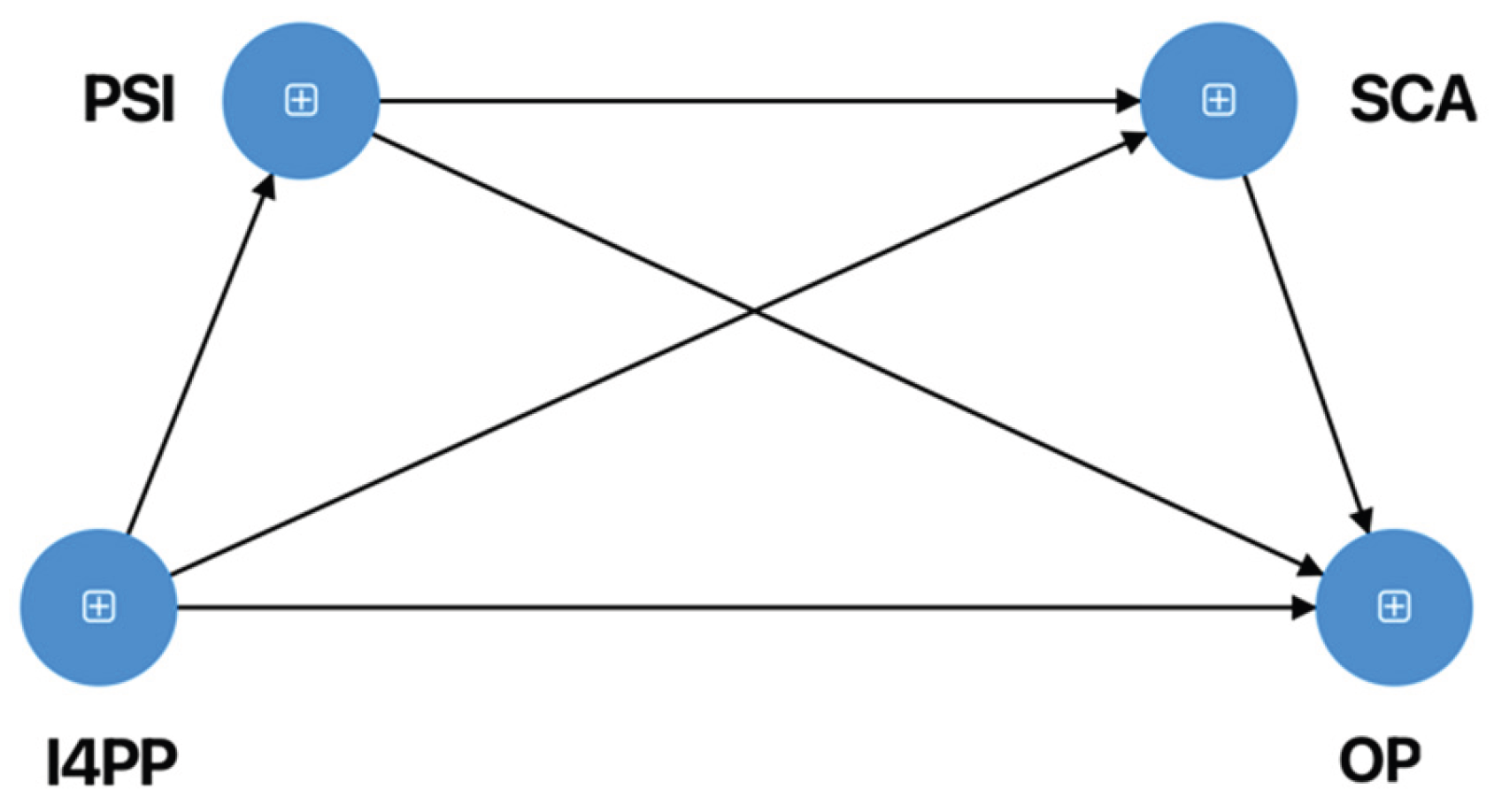
Table 2.
Demographic characteristics of the sample.
| Variable | Levels | n | % |
|---|---|---|---|
| Gender | Male | 240 | 80.0 |
| Female | 60 | 20.0 | |
| Age | 25-29 | 68 | 22.7 |
| 30-39 | 122 | 40.7 | |
| 40-49 | 64 | 21.3 | |
| 50-59 | 42 | 14.0 | |
| 60 and above | 4 | 1.3 | |
| Experience | 1-2 years | 42 | 14.0 |
| 3-6 years | 77 | 25.7 | |
| 7-9 years | 69 | 23.0 | |
| 10-14 years | 78 | 26.0 | |
| 15 and above | 34 | 11.3 | |
| Academic Qualification | Undergraduate | 242 | 80.7 |
| Graduate | 42 | 14.0 | |
| PhD | 16 | 5.3 |
Table 3.
Measurement Model Factor Analysis.
| Scale | Variable | Factor Loads |
Cronbach’s alpha | rho_A | CR | AVE | R2 | T Value |
VIF < 5 |
|---|---|---|---|---|---|---|---|---|---|
| I4PP | I4PP1 | 0.843 | 0.885 | 0.889 | 0.916 | 0.686 | 43.322 | 2.405 | |
| I4PP4 | 0.872 | 26.167 | 1.724 | ||||||
| I4PP6 | 0.843 | 53.849 | 2.635 | ||||||
| I4PP9 | 0.816 | 48.694 | 2.430 | ||||||
| I4PP11 | 0.763 | 42.379 | 1.921 | ||||||
| PSI | PSI1 | 0.785 | 0.813 | 0.817 | 0.870 | 0.573 | 0.562 | 31.284 | 1.777 |
| PSI2 | 0.739 | 25.238 | 1.618 | ||||||
| PSI4 | 0.702 | 19.359 | 1.449 | ||||||
| PSI5 | 0.813 | 43.228 | 2.001 | ||||||
| PSI6 | 0.743 | 22.789 | 1.703 | ||||||
| SCA | SCA1 | 0.730 | 0.806 | 0.817 | 0.873 | 0.632 | 0.624 | 18.949 | 1.468 |
| SCA3 | 0.788 | 28.190 | 1.674 | ||||||
| SCA4 | 0.847 | 44.704 | 1.895 | ||||||
| SCA5 | 0.810 | 35.186 | 1.677 | ||||||
| OP | OP1 | 0.803 | 0.856 | 0.862 | 0.893 | 0.582 | 0.627 |
33.804 | 1.933 |
| OP2 | 0.804 | 31.323 | 1.978 | ||||||
| OP3 | 0.742 | 20.308 | 1.707 | ||||||
| OP4 | 0.707 | 18.551 | 1.597 | ||||||
| OP5 | 0.770 | 23.151 | 1.776 | ||||||
| OP6 | 0.748 | 19.609 | 1.680 |
Table 4.
Findings of interdimensional correlations and dissociation validities.
| Correlations | Fornell-Larcker Criterion | HTMT Rates | |||||||||
|---|---|---|---|---|---|---|---|---|---|---|---|
| Scale | I4PP | PSI | SCA | OP | I4PP | PSI | SCA | OP | I4PP | PSI | |
| I4PP | 1.000 | 0.828 | |||||||||
| PSI | 0.750 | 1.000 | 0.750 | 0.757 | 0.884 | ||||||
| SCA | 0.692 | 0.771 | 1.000 | 0.692 | 0.771 | 0.795 | 0.802 | 0.944 | |||
| OP | 0.739 | 0.696 | 0.707 | 1.000 | 0.739 | 0.696 | 0.707 | 0.763 | 0.840 | 0.827 | |
Table 5.
Findings Regarding Model Fit Indices.
| Criterion | Saturated Model | Estimation Model | Result | |
|---|---|---|---|---|
| SRMR | < 0.100 | 0.069 | 0.069 | Good fit |
Table 6.
Structural Model Explanatory Power (R²).
| Variable | R² | R² Adjusted | Explanatory Power |
|---|---|---|---|
| Organizational performance (OP) | 0.627 | 0.623 | Medium – Strong |
| Production Systems Integration (PSI) | 0.562 | 0.561 | Medium |
| Supply Chain Agility (SCA) | 0.624 | 0.622 | Medium – Strong |
Table 7.
Effect Size (f²) Results.
| Structural Path | f² | Effect Size |
|---|---|---|
| I4PP → OP | 0.189 | Medium |
| I4PP → PSI | 1.285 | Large |
| I4PP → SCA | 0.078 | Small |
| PSI → OP | 0.019 | Very Small |
| PSI → SCA | 0.388 | Large |
| SCA → OP | 0.093 | Small |
Table 10.
Predictive Power of the Model Based on PLSpredict Analysis.
| Construct | Average Q²predict | RMSE Comparison | Predictive Power |
|---|---|---|---|
| Production Systems Integration (PSI) | 0.315 – 0.346 | PLS-SEM RMSE < LM RMSE | High |
| Supply Chain Agility (SCA) | 0.154 – 0.436 | PLS-SEM performs better in most indicators | Medium |
| Operational Performance (OP) | 0.236 – 0.423 | PLS-SEM performs better in most indicators | Medium |
Disclaimer/Publisher’s Note: The statements, opinions and data contained in all publications are solely those of the individual author(s) and contributor(s) and not of MDPI and/or the editor(s). MDPI and/or the editor(s) disclaim responsibility for any injury to people or property resulting from any ideas, methods, instructions or products referred to in the content. |
© 2026 by the authors. Licensee MDPI, Basel, Switzerland. This article is an open access article distributed under the terms and conditions of the Creative Commons Attribution (CC BY) license (http://creativecommons.org/licenses/by/4.0/).
Copyright: This open access article is published under a Creative Commons CC BY 4.0 license, which permit the free download, distribution, and reuse, provided that the author and preprint are cited in any reuse.


