

Submitted:
30 March 2026
Posted:
31 March 2026
You are already at the latest version
Abstract
Mobile network operators are increasingly adopting 5G Fixed Wireless Access (FWA) to meet the growing demand for high performance services in households. This study evaluated the adoption and Quality of Experience (QoE) of 5G FWA through a multi-phase study. First phase, utilized a systematic literature review to develop a structural equation modeling (SEM) framework, identifying Quality of Service (QoS) and User Experience (UX) factors. A questionnaire survey was then conducted with 42 industry experts and 52 end-users. The SEM analysis shows that UX is not transferable between FTTx and 5G FWA, as the correlation (y = - 0.052, t value = -0.100) was statistically insignificant. The technical QoS FTTx does not influence how users perceive the technical QoS 5G FWA (y = - 0.02, t value = -0.122). Bandwidth and Quality are the most critical drivers for 5G FWA success regarding UX, whereas latency, MoS, and throughput are vital for QoS. Exploratory Factor Analysis for the UX and QoS parameters of 5G FWA showed strong internal consistency across all identified factors. The framework with fit indices reflected excellent model QoS (RMSEA = 0.08, CFI = 0.973, TLI = 0.965, CMINDF = 1.254 and GFI = 0.782) and UX (RMSEA = 0.08, CFI = 0.895, TLI = 0.881, CMINDF = 1.377 and GFI = 0.655). The mathematical SEM model provides empirical evidence of the role of the service factor as observed parameters and introduces a validated theoretical framework QoE-SEM. This research contributes to the academic and telecommunications industries, to deliver a fit observe model for upcoming new technology 5G FWA and assist decision makers in formulating strategic QoE models.
Keywords:
5G FWA
; Exploratory Factor Analysis (EFA)
; FTTx
; QoE
; structural equation model (SEM)
1. Introduction
The development of broadband technology Indonesia is striving for a better quality of experience (QoE) [1]. The original targets included 20 Mbps fixed broadband for 71% of homes and 30% urbanites. For rural areas, the goal is to utilize FWA technology to provide 10 Mbps connectivity to nearly half of the households, reaching 6% of the rural demographic [2].
Driven by the growing need for high-performance and reliable household telecommunications, mobile network operators (MNO) are seeking innovative methods to manage surging traffic levels. 5G Fixed Wireless Access (FWA) has emerged as a primary solution, offering a cost-effective alternative to high-speed broadband. By leveraging 5G technology, the FWA provides superior data capacity, faster download rates, and reduced latency, making it an efficient wireless broadband (WBB) delivery method for residential users.
In every country, the average 5G download speeds exceed 4G and FTTx, except in the US, where FTTx is slightly better than 5G owing to limited 5G spectrum availability (in the low band with bandwidth less than 100 MHz). With spectrum and bandwidth usage being the determining factors, the increase in 5G speed compared to 4G ranges from 1.9 times faster (US) to 14.7 times faster (Thailand). With an average spectrum bandwidth usage of over 100 MHz, average 5G download speeds can reach five to six times faster than 4G. South Korea has the fastest download speed, with an average of 351.2 Mbps, which is slightly faster than that of Saudi Arabia at 272.8 Mbps.
The implementation of 5G technology, particularly 5G FWA in Indonesia, can further realize more equitable telecommunications access, bridge the digital divide, and increase the community’s ability and literacy to use technology more adaptively. It also encourages more productive internet use to strengthen the national economic growth. 5G is a highly flexible technology that can be applied to both Mobile Broadband and Fixed Broadband or Fixed Wireless Access (FWA) services. The presence of 5G FWA technology should accelerate household coverage and have a significant impact on users and commercial sectors because 5G FWA quality is perceived to offer significant performance advantages over legacy FTTx.
However, in terms of quality, several factors are believed to determine the success of end users in adopting this service. This is why measuring Quality of Experience, better known as quality of experience (QoE), becomes very important. While ISO 9241-210:2010 established formalized criteria for evaluating the usability of technical systems and features, it remains focused on the technical side of QoE [3,4]. Apart from the technical aspects of QoE represented by Quality of Service (QoS), there is also User Experience (UX), defined as factors referring to the experiences users encounter, shaped by the quality of interaction with various products, applications, systems, or services [5]. In the specific context of 5G FWA broadband, this experience is primarily determined by the level of interactivity, users engagement with the technology, and systems capacity to facilitate the successful achievement of user goals [6]. Regarding the experience felt by users, the most perceived aspect that often serves as a reference in Internet usage is the experience of the download process between FTTx and 5G FWA. The presence of 5G FWA technology will certainly raise questions regarding what determines the QoE of 5G FWA services in an increasingly growing 5G era with rising household penetration. In this regard, this study attempts to answer these questions by focusing on the technical aspects of UX and QoS, as well as the prediction of 5G FWA compared with FTTx. One of the reasons is that Indonesia is the fourth largest market in the world [7,8,9]. In 2022, approximately 89% of Indonesian internet users used mobile devices. Owing to the high number of users in Indonesia, QoE measurements were not conducted on a live network to avoid disruptions to service providers [10]. In this study, a new model was developed to identify the QoE factors of 5G FWA technology using Structural Equation Modeling (SEM). The novelty of these influential UX and QoS factors was used as a reference for 5G FWA implementation in Indonesia. The remainder of this study is structured as follows: Section 2 discusses the research objectives, Section 3 outlines the facts from the related work, Section 4 presents the research methodology, Section 5 outlines the result research model, Section 6 summarizes and discusses, Section 7 presents the implications of the research, and Section 8 presents the conclusion with key insights and future research directions.
2. Research Objective
This study aims to create a conceptual model using SEM. Additionally, this research defines the factors that determine the quality of service (QoS) and user experience (UX) for 5G fixed wireless access (FWA). This research contains the following specific objectives to reach its main goal:
- 1.
- To develop a comprehensive QoE prediction for 5G FWA using specific QoS and UX metrics from the perspectives of technical experts and end-users.
- 2.
- To improve 5G FWA service quality by providing a superior experience guarantee compared with legacy technologies such as FTTx.
- 3.
- To determine QoE factors and prediction models for 5G FWA services in Indonesia, expert-driven QoS and UX dimensions were prioritized to boost user satisfaction over the previous generation.
3. Related Work
3.1. Technology 5G FWA
The commercial rollout of the 5G FWA technology is viewed as a highly economical strategy for network expansion. In addition to its cost efficiency, the technology is anticipated to provide exceptional throughput, and preliminary 5G testing has already demonstrated a peak download speed reaching up to 10-25 Gbps [11,12]. The speeds presented were approximately 30% faster than the normal speeds offered by cable providers (FTTx). The 5G FWA is closely tied to specific use cases and quality of service (QoS) demands. It can comfortably manage high-intensity tasks, such as multiple concurrent 4K video streams, while maintaining a superior data throughput. Furthermore. This technology opens doors for innovative content services and allows wireless providers to scale their subscriber bases more effectively. With an increasing number of households and small businesses using high-speed connections, there is also a rising demand for broadband Internet access. The surge in demand for high-speed broadband is driven by the proliferation of data-intensive services, necessitating advanced solutions, such as fixed wireless access (FWA). 5G FWA is a commercially viable alternative to traditional fiber to the home (FTTH), as it significantly mitigates capital expenditure (CAPEX) related to physical infrastructure [13], such as cabling, poles, and land acquisition. Its advantages include rapid deployment, high scalability, and granular investment models that allow operators to align infrastructure growth with market demand. As a primary 5G use case, FWA transitions residential Internet delivery from traditional wirelines to high-performance wireless broadband. This market shift is supported by Nokia research, which found that 76% of 3000 surveyed consumers across the UK, US, and South Korea identify 5G FWA as the most appealing next-generation technology application [14].
3.2. QOS and User Experience 5G FWA
According to the International Telecommunication Union (ITU), the definition of QoS is the totality of characteristics of a telecommunications service that depends on its ability to satisfy the stated and implied needs of the service user, which essentially means the capability of the telecommunications service to meet user requirements. Furthermore, the ITU definition for QoE is the degree of delight or annoyance of the user of an application or service [15], which is essentially the overall impression a user gains from a technological application or service. However, with nearly 78% of the Indian population accessing the internet via mobile devices, measuring QoS and QoE is critical [16]. To avoid distrupting live networks, these assessments should utilize simulation methods based on a conceptual framework connecting QoS, QoE, and user experience (UX). While 5G FWA is designed to excel in technical reliability and security, traditional QoS Metrics alone are insufficient for gauging true user satisfaction. Therefore, emphasizes the synergy between QoS and QoE, where QoE acts as a comprehensive evaluation that intergrates technical performance with subjective user fulfillment [17,18].
3.3. Review Structural Equation Modeling (SEM)
The modeling concept used in this research is Structural Equation Modeling (SEM). Structural Equation Modeling (SEM) is a powerful multivariate technique increasingly used in scientific investigations to test and evaluate multivariate causal relationships. SEM differs from other modeling approaches because it can test the direct and indirect impacts on assumed causal relationships, which also structural equation modeling (SEM) facilitates the concurrent evaluation of an intricate network of relationship [19,20,21,22]. Furthermore, this methodology allows the delineation of conceptual dimensions while simultaneously quantifying the impact of each variable within the identified factor framework [23]. The use of SEM modeling in this research model by performing measurements and predictions for both 5G FWA UX and 5G FWA QoS as a new wireless broadband (WBB) technology is a form of correlation or influence from FTTx UX and QoS. Additionally, SEM analysis can support a small sample size resulting from surveys in which this technology is not yet commercially available. The main function of this SEM model is to help ensure that the constructed model can be predicted and its correlation values measured, while simultaneously measuring the validity of the model and its constituent variables [24].
3.4. Relevant Literature of Structural Equation Modeling (SEM) in Quality of Experience (QOE)
Much research related to quality measurement, optimization, and efforts to obtain good QoE has been conducted. In [7], measurements related to 5G quality scenarios based on ITU definitions were performed using QoE Technology as the output. Then, in [25], research was conducted regarding video optimization using QoE metrics on applications, whereas in [26], the study delved deeper into the service side regarding 5G FWA on the frequency spectrum. However, research such as [8,21,27,28,29] has not yet utilized SEM modeling to determine the direct correlation within QoE parameters, whether in technology, application, or service. In [21,28,29], QoE measurements for applications and services were performed using SEM modeling with EFA and AHP analysis processes on Wi-Fi technology and 5G video services. These three studies focused on predictive modeling to determine user loyalty metrics. Their research scope encompassed the emotional attachment of Wi-Fi users as a driver of loyalty alongside a comparative analysis of 5G video service strategies against legacy technologies. Research related to 5G FWA and QoE remains limited, with existing studies numbering fewer than 100. Consequently, there is still a significant scope and opportunity to expand the research on 5G FWA. Previous studies have presented thirteen recent studies related to SEM and QoE methods with various research subjects and objects ranging from technology, application, and service perspectives, as well as SEM methods using AHP, EFA, and CFA. Meanwhile, in this study, the SEM construction was built using five UX factors and three QoS factors developed by referring to research by Oproiu et al. regarding the 5G FWA mobile operator perspective, whereas the five UX factors refer to 5G FWA service requirements related to service quality. The novelty of these influential UX and QoS factors is used as a reference for 5G FWA implementation in Indonesia, specifically to identify the priorities that require attention in QoE decision-making regarding the correlation of data service user factors from FTTx wireline data to 5G FWA.
4. Methodology
4.1. The Research Framework
The study methodology begins by determining the type of data used, specifically the primary data obtained through the distribution of a designed questionnaire to a target population to meet the research objectives. This study employs a quantitative research design utilizing structural equation modeling (SEM) to measure and predict the Quality of Experience (QoE) correlations within 5G FWA technology. Data processing was performed using AMOS software version 23. This study aims to develop QoE measurement and prediction for 5G technology, while comprehensively testing hypotheses through Quality of Service (QoS) and User Experience (UX). Hypothesis testing is intended to explain factor correlations as relationships between variables. This model also explores and tests the causal influence among the factors affecting 5G FWA and evaluates how FTTx technology impacts the measurement and prediction of 5G FWA. In this researchs model framework, the novelty of the QoE model framework lies in its ability to not only measure and predict from the user experience perspective, but also to involve experts in measuring and forecasting emerging 5G FWA technology using parameters that expert a critical impact on future technological development.
The strategic model concept on Figure 1 used in the development of the 5G FWA QoE model was created using structural equation modeling (SEM). The use of SEM in this study employs an approach for QoS measurement and UX prediction that is subjective in nature from the perspectives of experts, professionals, and end users; therefore, it accounts for the diversity of responses from end users and practitioners. 5G FWA technology is a new technology that will provide new experience in wireless access technology [30]. As a new wireless technology that is a continuation of mobile broadband access (MBB), it can be assumed that there is an influence from previous similar technologies in this case: wireline broadband access (FTTx) technology, which represents the final stage of the wireline broadband access technology roadmap. 5G FWA technology is simpler, has a lower total cost of ownership (TCO), and possesses a high bandwidth to provide a good experience for end-users and mobile network operators (MNOs). In this QoE measurement, it was necessary to create a construction model as a conceptual framework. This construction model utilizes QoS and UX factors from both FTTx and 5G FWA technologies for broadband services, organized according to SEM qualifications.
4.2. Identification Factor Model UX and QOS
The conceptual model and SEM construction, in order to perform measurements and evaluate the correlations occurring between latent variables, the formative factors of these latent variables are required. In this study related to user experience (UX) for 5G FWA services using 5G technology, five factors were determined to form the latent variables for both FTTx UX and 5G FWA UX. Although both latent variables are formed by the same factors, there are differences. Based on the technology from which the data is derived within these factors the five factors for the FTTx UX latent variable are measured based on the user experience (UX) of data services using FTTx technology. Meanwhile, for the 5G FWA UX, the factors were derived based on predictions using 5G FWA technology. Simultaneously, three factors within QoS depend on the quality of the service aspect, such as latency, MOS, and throughput factors.
- 1.
-
Prediction ModelThe framework connecting QoS and UX factors was established in [31], beginning with the primary influence of service factors. Based on the ITU definition, QoE measures the subjective satisfaction of users while interacting with a service. As various applications have diverse technical requirements to satisfy a user, QoE outcomes are inherently variable. This highlights the necessity of precise QoS parameters, as the key are the building blocks for achieving a high-quality user experience. Within 5G FWA ecosystems, the assessment of QoS and UX service parameters involves key parameters, such as throughput, latency, MOS, usage, location, and time. The 5G FWA landscape is anticipated to support a diverse service suite, including high-speed internet, OTT multimedia, and real-time voice services, all of which rely on the intersection of technical quality, reliability, and bandwidth. Notably, 5G enabled OTT videos services are expected to outperform the traditional FTTx platforms. However, because real-time applications and high-speed access are highly sensitive to latency, maintaining a high reliability and consistent bandwidth remains a critical necessity.
- 2.
-
Feedback Input ProcessThe questionnaires in this study were divided into two models: the SEM EFA (QoS) and (UX) model, followed by a comparative value analysis between 5G FWA and FTTx technologies. To ensure that the survey data reflected high-quality domain expertise, this study employed purposive sampling to recruit qualified participants. The selection criteria for both experts and users were defined as follows:
- Subject matter experts with professional experience in both mobile and fixed telecommunications technologies.
- Direct users with active experience in utilizing both 5G and FTTX data services.
- Mid-to-senior-level professional standing, such as RF managers, RF architects, and senior engineers RF quality.
- Proven track record for enhancing user experience or contributing to broadband strategy development in Indonesia.
Consequently, by engaging expert respondents and employing a rigorous selection process, this approach ensured robust data validation while maintaining random errors within acceptable margins.The Random Error of the measured parameter factors consists of user experience variables, namely, Quality, Availability, Reliability, Transparency, and Bandwidth, which produce correlation values and loading factors. The measurement results to be conducted included calculating the GFI value, loading factor, p-value, and r-value. The r-value is used to obtain an overview of the distribution, whereas the loading factor for each parameter can be interpreted to represent the precision. Based on the samples to be used in the measurement with systematic and random error simulations of the 5G FWA QoE across several parameters, it was found that all loading factors were greater than 0.10 (r-value). Therefore, the SEM processing results for 5G FWA prediction are valid and accurate against the standard loading factor threshold, thus increasing the accuracy. This accuracy improves because the number of respondents meets the standards of the model used; hence, the construction model on Figure must be precise in order to obtain accurate correlation values and loading factors.
4.3. SEM Processing
- 1.
-
Construction ModelWhen constructing a structural equation Modeling (SEM), several key elements must be considered [32,33]:
- (a)
-
Latent Variables There must be at least two latent variables in the model construction. These variables cannot be measured directly except for the underlying factors. There are two types of latent variable:
- Exogenous variables : The independent variables that exert influence.
- Endogenous variables : The dependent variables that are influenced.
- (b)
- Factors, Indicators, or Observed Variables (x and y) These factors are the elements that build the value or measurement of latent variables.
- (c)
-
Correlation ()The relationship paths or links between the latent variables.
- (d)
-
Loading Factor ( and )Relationship paths between latent variable and its corresponding factors. Based on the four elements mentioned above, the simple mathematical representation of the SEM model correlation using equations 1, , and is as follows:SEM analysis requires the validity and reliability of the constructed model on Figure 2. The requirements for validity are as follows:
- i
- p < 0.05, indicating that the model provided a significant relationship or correlation.
- ii
- The relationship between factors and their latent variables was supplemented by a Critical Ratio (C.R.) coefficient for each factor > 1.96.
- iii
- Reliability is met if the coefficient value or Cronbach’s Alpha is > 0.60 (Note: While your text says 0.05, the standard academic threshold for Cronbach’s alpha is usually 0.60 or 0.70).
- iv
- The significance level of the correlation was set at a threshold of 0.5. If the correlation value is lower than 0.5, then the influence of the exogenous variable in this study, FTTx technology, on the endogenous variable, 5G FWA, is not significant. Conversely, if the correlation value is higher than 0.5, the influence of the FTTx technology on 5G FWA is considered significant.
- 2.
-
Systematic Error / GFIIn the SEM analysis, managing systematic errors involves several testing phases. First, the Goodness of Fit Index (GFI) was tested to determine whether systematic errors existed in the constructed model. The Goodness of Fit (GFI) test was conducted to assess the extent to which the data and model satisfied the SEM assumptions. The evaluation is performed on the overall model, followed by separate evaluations of the measurement model and the structural model, with a standard threshold value of > 0.90 or approaching 1. In addition to the GFI, several other indices are used to evaluate the Goodness of Fit of the model, including.
- (a)
- The Root Mean Square Error of Approximation (RMSEA) measures the discrepancy between the observed covariance matrix and the model’s covariance matrix. An RMSEA value ≥ 0.08 is generally considered an indication of an acceptable model fit.
- (b)
- Comparative Fit Index (CFI): The hypothesized model is compared with a baseline or null model. A value > 0.90 or > 0.95 indicates a good fit.
- (c)
- The Tucker-Lewis Index (TLI), also known as the Non-Normed Fit Index (NNFI), is used to evaluate the model’s fit while accounting for model complexity. The standard threshold was typically > 0.90.
- (d)
- Chi-square: A fundamental measure for testing the difference between the sample and fitted covariance matrices. A low chi-square value relative to the degrees of freedom (with a p-value > 0.05) suggested that the model fit the data well.
4.4. Analyze SEM - EFA
Exploratory Factor Analysis (EFA) is a statistical approach aimed at identifying dominant factors while simultaneously grouping the dimensions of factors with closeness or collaboration. The number of dimensions to be formed in the early not yet is unknown. Subsequently, a rotation method was used to obtain the dimensions. The rotation method typically used is varimax rotation. This rotation was used to simplify the columns of the factor matrix such that the factors were clearly associated [34].
In addition to the data collected for analysis, another aspect to consider in EFA is the Kaiser-Meyer-Olkin measure of sampling adequacy value. This value, abbreviated as KMO-MSA, is used to determine whether the factor analysis process can be conducted, in other words, whether the obtained data are appropriate. If the KMO-MSA value is above 0.5, the EFA process can proceed [35]. This KMO-MSA reference is applied to the combination of all factors, as well as to each individual factor.
In EFA, It is also necessary to consider the correlation between the factors (Sig.). If the Sig. is less than 0.05, the EFA process can be performed because there is sufficient proximity between the factors. Through the EFA in this study, the dominant factor weights and the dimensions formed from 5G FWA end-users provide an overview of important factors for prioritizing the development of 5G FWA technology in Indonesia.
4.5. Decision Hypotheses Factors Among Latent and Observed Variables
Based on the literature insight and empirical, a set of hypotheses is mathematical to establish relationships among the latent variables (LV). These hypotheses serve as the construction model for various challenges, as tabulated in Table 1. The correlation values reflect the influence between the observed variable service factors regarding FTTX and 5G FWA, denoted by y, and the influence of the five factors for UX and three factors for QoS. The hypotheses of this study were as follows:
- LV-H0 : FTTx (Fiber to The x) has the perceived performance and limitations of existing FTT-x services that significantly influence the user’s expectation and transition towards 5G FWA solutions for both UX and QoS path-observed variables. There was no influence between the LV of FTT-x and 5G FWA and the related service factors.
- LV-H1 : 5G FWA (Fixed Wireless Access) has the technical dimensions of 5G FWA QoS (e.g., latency, throughput, and MoS) that have a positive and significant correlation with the overall Quality of Experience (QoE) as perceived by experts. There is an influence between the variables of FTT-x and 5G FWA and related service factors.
5. Result
5.1. SEM Processing Result
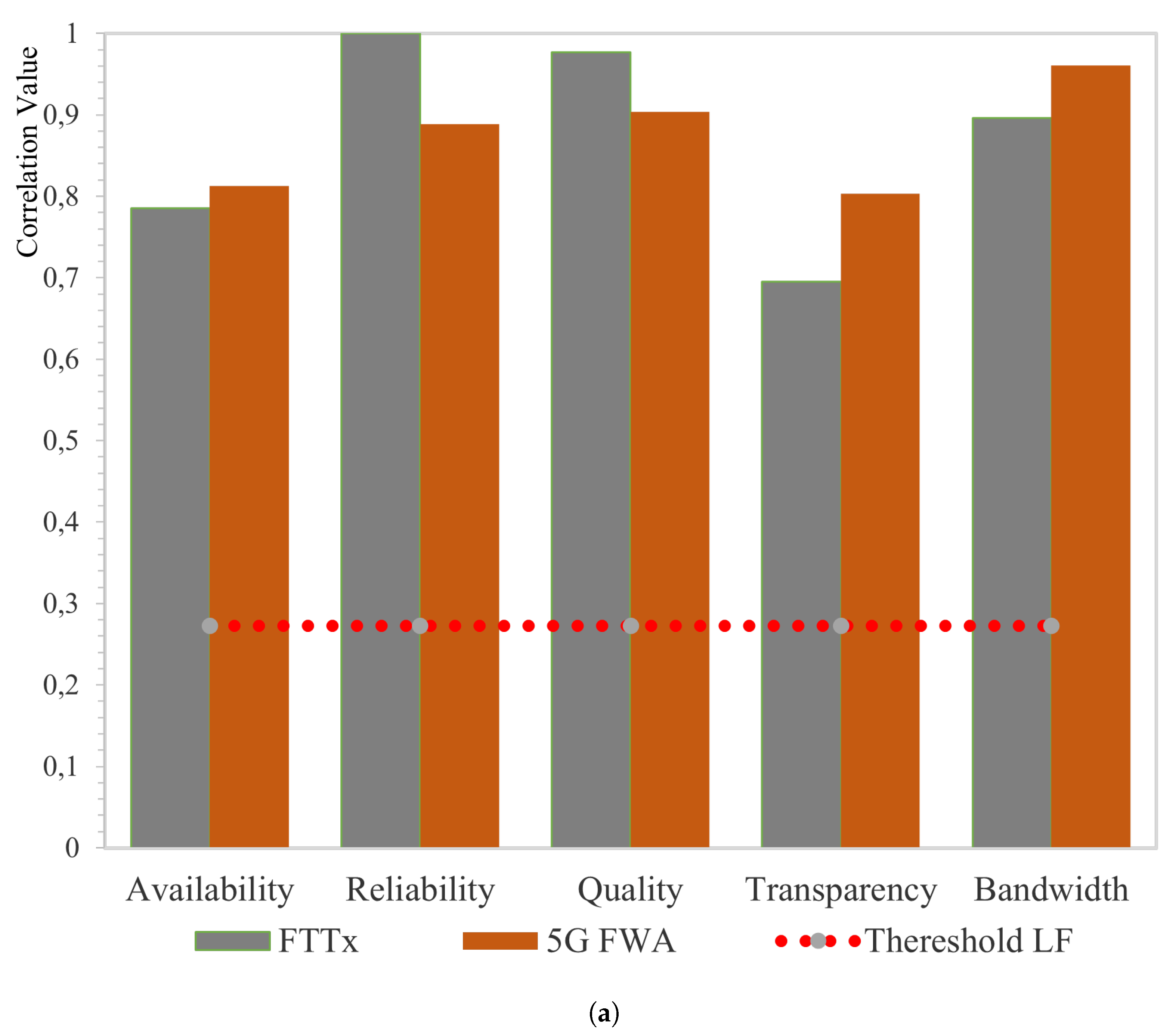
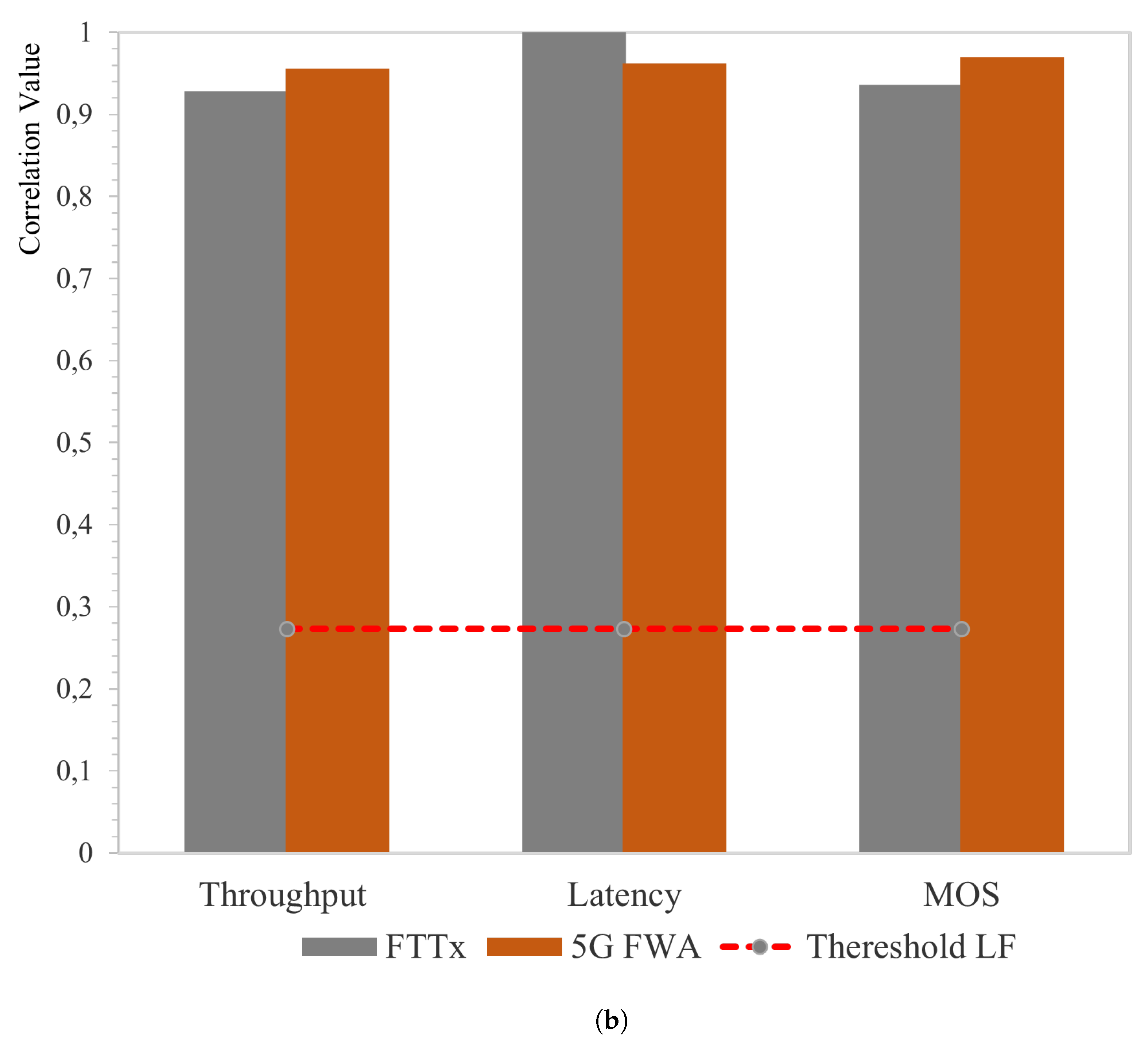
Based on the questionnaire responses, we received complete samples from 42 industry experts on QoS and 52 users on UX. The SEM analysis results in Table 2 and Table 3 illustrate the correlation coefficients , , which define how current FTTx Quality of Experience (QoE) variables influence the predicted QoE for 5G FWA. Figure 2 provides a visual comparison of these technologies, demonstrating that both the FTTx data and 5G FWA projection exhibit well-structured and distinct correlation values.
By identifying the factors with the strongest correlations for each technology, researchers can determine the most significant input for the new 5G FWA framework. Detailed factor-specific analyses of SEM processing are discussed in the subsequent sections.
Referring to Table 2 in this study for user experience, there are five factors for observed variables, whereas in Table 3 for QoS, there are three factors for observed variables. for a detailed analysis of each factor UX and QoS:

Table 4.
Latent Variable (LV) Relationship.
| LV Relationship | Result | Interpretation |
|---|---|---|
| FTTx UX → 5G FWA UX | Insignificant | User experience is not transferable between these two technologies. |
| FTTx QoS → 5G FWA QoS | Insignificant | The technical quality of FTTx does not influence the perceived technical quality of 5G FWA. |
| 5G FWA Indicators Prediction | Strongly Significant | (UX) Bandwidth and Quality are the most critical drivers for 5G FWA success (). (QoS) Latency and MoS are the most critical drivers for 5G FWA, while throughput remains critical to service quality. |
- 1.
-
UX Factor Result For FTTx.Indicators for FTTx demonstrate a very strong correlation with their respective latent variables:
- Reliability of FTTx is the strongest indicator with a correlation value of 0.999 and a t - value of 2.36, suggesting that technical reliability is the primary identity of fiber services for users.
- Quality (0.977) and bandwidth (0.896) also exhibited very high correlations, confirming that FTTx is evaluated based on its quality and bandwidth.
- Validity and Reliability: A validity score of 0.943 and an AVE of 2.14 indicate that these indicators are highly consistent in measuring the FTTx variable.
- 2.
-
UX Factor Result For 5G FWA.Indicators for 5G FWA show more uniform consistency and are statistically significant:
- The bandwidth (0.96) and quality (0.90) were the dominant factors. This is logical because the primary advantage of 5G FWA is the wireless speed that rivals the fiber.
- Statistical Significance: In contrast to FTTx, nearly all t - values for 5G FWA are above the 1.96 threshold (e.g., Reliability at 4.10 and Quality at 4.02). This indicates that these indicators are robust in defining the 5G FWA experience.
- Validity: A validity score of 0.942 demonstrated that the measurement model for 5G FWA was highly accurate.
- 3.
-
Correlation Result UX: FTTx TO 5G FWA.The final row of the result a critical finding regarding the hypothesis on Figure :
- Weak Negative Correlation: The value of -0.052 indicates a negligible negative relationship. In practical terms, this means that a user’s experience with FTTx does not automatically transfer to, or guarantee the same perception of, 5G FWA.
- Statistically Insignificant: The t - value (-0.100) is well below the standard threshold of 1.96, and the relationship between FTTx UX and 5G FWA UX is considered insignificant.
The empirical results for the UX factors indicate a negligible and statistically insignificant correlation between FTTx UX and 5G FWA UX ( = -0.052, t = -0.100).This result suggests that user satisfaction with traditional fiber-based services (FTTx) does not serve as a predictor of user experience with 5G FWA technology. - 4.
-
QoS Factor Result For FTTx.The indicator for FTTx demonstrates a very strong correlation with technical indicators, showing more consistency and significance near perfect:
- Latency on FTTx was the strongest indicator (Correlation: 1.00, t - Value: 6.85), followed closely by the MoS (0.936). This indicates that, for fiber users, the perceived mean opinion score and low latency are the primary technical benchmarks.
- Validity and Reliability: A validity score of 0.969 and AVE of 1.263 indicate that these indicators are highly consistent in measuring the FTTx variable.
- 5.
-
QoS Factor Result For 5G FWAIndicators for 5G FWA show this technology have high statistical significance:
- The MoS was the most critical factor (correlation: 0.97, t - value: 9.42). The extremely high t - value 5G QoS factors (latency and MOS > 9) suggest that latency and MoS are tightly coupled in defining 5G service quality.
- Validity and Reliability: A validity score of 0.974 and AVE of 1.575 indicate that these indicators are highly consistent in measuring the 5G FWA variable.
- 6.
-
Correlation Result QoS: FTTx TO 5G FWA.The relationship between the technical quality of FTTx and 5G FWA is expressed through the path coefficient (y) and critical ratio (t - value) on Figure :
-
Correlation Value ( = -0.02):This value is extremely close to zero, indicating that there is virtually no linear relationship between the Quality of Service (QoS) of FTTx and 5G FWA. The negative sign suggests a negligible inverse trend however, it is too small to be considered a functional impact.Technical statistical result are insignificant (t - value = -0.122), In Structural Equation Modeling (SEM), a relationship is typically considered significant if the t - value is greater than 1.96 (for a 95% confidence level). Referring to the result -0.122 is far below this threshold, the hypothesis 0 (H0) cannot be rejected.
-
Figure 3.
Comparison Chart of Loading Factor to Correlation Values QoE FTTx and 5G FWA (a) QoS Factor; (b) UX Factor.
Figure 3.
Comparison Chart of Loading Factor to Correlation Values QoE FTTx and 5G FWA (a) QoS Factor; (b) UX Factor.
5.2. Systematic Error (GFI) UX: FTTx TO 5G FWA
Through data processing and analysis with SEM, the initial construction model and factors were first checked using AMOS output. Goodness of Fit (GOF) indices assess the fit of the SEM model construction to the observed data value and are guided by the range 0 to 1. The result of GFI in this research for UX and QoS service factors is as follows in Table 5, indicate that all values are within appropiate ranges.
Meanwhile, in Figure 4 compares and contrast fit model indices Qos and Ux factor for EFA, on graphic show the chi square () value for Qos (89.04) and Ux factor (491.7), it falls within an accepatable ranges. The RMSEA, CFI, TLI and CMINDF values also verify a good and excellent model fit, estblashing that the relationship between critical FTTx and 5G FWA factor consructs such as QoS and Ux factors are statistically significant.
5.3. SEM Exploratory Analysis (EFA) Result
The Exploratory Factor Analysis (EFA) for the user experience (UX) parameters of 5G FWA showed strong internal consistency across all the identified factors in Table 4. Loading factors represent the strength of the relationship between each parameter and the underlying UX construct. Higher values indicate that the parameter is the primary driver of user experience in Table 6.
- Factor #5 Bandwidth (0.939): This is the strongest loading factor in the set, identifying bandwidth as the most critical element in defining the 5G FWA user experience.
- Factor #3 Quality (0.915): Overall, perceived quality ranks as the second most influential parameter, closely following bandwidth.
- Factor #4 Throughput (0.91): High throughput was confirmed as a major contributor to UX, reflecting the high-speed nature of 5G technology.
- Factor #2 Reliability (0.87): Although slightly lower than speed-related factors, reliability remains a robust component of the UX construct.
- Factor #1 Availability (0.859): Network availability had the lowest loading in this group, although it remained well above the standard acceptable threshold of 0.4 or 0.5 EFA.
The EFA results demonstrate that the UX of the 5G FWA is predominantly driven by performance-oriented metrics (bandwidth, quality, and throughput) show in Table 7, all of which exceed a loading factor of 0.90. Thus, for Indonesian 5G FWA users, the experience is almost synonymous with the technical speed and data handling capability of the network.
The component matrix EFA for QoS 5G FWA in Table 8 describes the extent to which a specific parameter contributes to the underlying QoS construct. For a 5G FWA, the technical performance is defined by three primary anchors:
- Factor #3 MOS (0.982): Mean opinion score (MOS) was the most dominant factor. This suggests that the overall perceived technical quality is the primary representation of the QoS variable.
- Factor #2 Latency (0.967): Network responsiveness or latency is a critical secondary factor. Its high loading indicates that the low-latency nature of 5G is a core defining characteristic of technical service quality.
- Factor #1 Throughput (0.96): The data transmission speed and throughput also show a very high loading. This confirms that high-speed capability is the foundational pillar of the 5G FWA technical framework.
The EFA results in Table 9 for QoS were extremely robust, with all factors exceeding 0.96. This level of loading indicates high internal consistency for the three parameters (throughput, latency, and MOS) are highly unified in measuring the 5G FWA technical quality. Meanwhile, reliable model construction has high values support the validity of the measurement model (0.974, as seen in Table 2).
The combined analysis of the EFA and measurement model confirmed that the latent variables were robust and reliable. The 5G FWA constructs (both QoS and UX) demonstrate higher and more consistent statistical significance across all indicators compared to legacy FTTx technology. This indicates that the 5G FWA provides a more cohesive and distinct performance profile for users, with validity scores exceeding 0.90, the model is well suited for subsequent structural equation simulations.
Preliminary EFA testing in Table 10 evaluates whether the data are suitable for factor extraction based on sample adequacy and the properties of the correlation matrix. Kaiser-Meyer-Olkin Measure of Sampling Adequacy (KMO-MSA). The KMO index measures the proportion of variance in the variables that might be caused by the underlying factors. the value EFA result for QoS factor construct the KMO value is 0.646. This is considered mediocre but acceptable because it exceeds the minimum recommended threshold of 0.50 or 0.60. Meanwhile, value EFA result for UX factor construct the KMO value is 0.709. This is considered a good level of sampling adequacy, indicating that the UX data are well suited for factor analysis. Bartlett’s test of sphericity on this test checks the hypothesis that the correlation matrix is an identity matrix, which would indicate that variables are unrelated and unsuitable for EFA. Significant (p-value) For both QoS and UX factors, the significance value was 0. As this is less than the threshold of 0.05, the test is statistically significant. Chi-Square result on Bartlett’s values are 153 for QoS and 703 for UX Factor. The final interpretation has a significant result (p < 0.05) indicates that the variables are sufficiently correlated to allow for factor extraction.
6. Discussion
In conducting SEM analysis, this study offers a comprehensive QoE prediction for 5G FWA using specific QoS and UX metrics from technical experts and end-user perspectives. Beside that, This study measures the improvement in 5G FWA service quality by providing a superior experience guarantee compared to legacy technologies such as FTTx. This had the benefit of creating dynamic relationships between latent variables (LV) to determine QoE factors and prediction models for 5G FWA in Indonesia, prioritizing expert-driven QoS and UX dimensions to boost user satisfaction over the previous generation. The SEM results were divided into two observation variables, the five factors for the FTTx UX latent variable are measured based on the user experience (UX) of data services using FTTx technology, and three factors within QoS depend on the QoS aspect, such as latency, MOS, and throughput factors. The results confirmed that the prediction of 5G FWA correlation between QoS and UX to FTTx is insignificant because it is far below this threshold, and hypothesis 0 (H0) cannot be rejected. This means that the user experience is not transferable between these two technologies, and the technical quality of FTTx does not influence the perceived technical quality of 5G FWA.
Several factor analyses for UX FTTx and prediction of 5G FWA. There are three keys, the first is distinct technological expectations, users likely perceive FTTx as a mature, stable utility, whereas 5G FWA is viewed as a high-performance wireless innovation with different mobility and flexibility characteristics. In the second performance disparity, While FTTx shows a near-perfect correlation with reliability (1.00), 5G FWA relies more heavily on bandwidth (0.96) and quality (0.90), indicating that users prioritize different performance metrics for each technology. The third independent ecosystem, the insignificance of the value (t = -0.100, p < 1.96), proves that 5G FWA must be managed as a standalone service category. High satisfaction in the fixed-line domain does not automatically translate into a wireless domain. Factor analysis for QoS FTTx and prediction of 5G FWA. FTTx demonstrated a very strong correlation with technical indicators, showing more consistency and significant near perfect with latency (1.00), and 5G FWA relied more on MoS (0.97), indicating that QoS prioritizes different critical performance metrics. Meanwhile, based on expert data, the QoS is extremely close to zero, indicating that there is virtually no linear relationship between the Quality of Service (QoS) of FTTx and the QoS of 5G FWA. The insignificance of this value (t = -0.122, p < 1.96). These results highlight the need to consider 5G FWA prediction in indonesia that the user experience (UX) parameter bandwidth and quality are the most critical drivers for 5G FWA success (t > 3.0). However, technical experts perceive that latency and MoS are the most critical drivers for 5G FWA, whereas throughput is critical to service quality.
Moreover, the goodness-of-fit indices indicate that the SEM model fits in a good way to the data, with RMSEA (UX 0.08; QoS 0.08 ), CFI (UX 0.895; QoS 0.973), TLI (UX 0.881; QoS 0.965) and CMINDF (UX 1.377; QoS 1.254) indicating a good fit for the model. This enables all the values in the model to be statistically valid and can be used to inform 5G FWA strategies in Indonesia. Further research is needed to investigate domain-specifics in the same technology FWA on different spectrum frequencies positioned to take full advantage of technology fixed wireless capabilities to deliver a fit model quality of experience (QoE).
7. Implication
This study has important implications and is a critical contributor to the academic and telecommunications industries. From a research objective and perspective, the validated SEM construction model offers a framework for exploring and determining QoE factors and prediction models for future technology 5G FWA in Indonesia, prioritizing expert-driven QoS and UX dimensions to boost user satisfaction over the previous generation. In addition, researchers can use this model as a foundation to develop QoE as comprehensive (technical and perceived).
Additionally, this study provides certain keys for practitioners or experts in telecommunication, which are important for improving quality QoE resources from all parameters and drivers related to this study for 5G FWA success in indonesia. QoE can be improved through the objective performance model in QOS (throughput, latency, and MoS) and UX (availability, reliability, quality, transparency, and bandwidth). The findings of this study are expected to deliver a fit observe model for upcoming new technology 5G FWA and to assist decision makers in formulating strategic QoE models and action plans aimed at providers should focus on 5G FWA specific quality standards.
8. Conclusion
In this study, an SEM model development based on an EFA result analysis using the service factor for perceieved loading (UX) and technical loading (QoS) was conducted to build a 5G FWA technology QoE model. We systematically explored the challenges in predicting the adoption of wireless technology or 5G FWA using a multiple-phase research approach. We identified the role service factor for the observed variables, three-factor QoS, and five-factor UX. In short, we conducted an SEM technique to analyze the interpedence of this model technology and to provide a structural framework of empirical literature knowledge with respect to challenges in the telco industry. SEM structural model analysis has shown that from the laten variable FTTx and 5G FWA divided into role QoS and Ux service factors. The SEM analysis shows that UX is not transferable between FTTx and 5G FWA, as the correlation (y = - 0.052, t value = -0.100) was statistically insignificant. The technical QoS FTTx does not influence how users perceive the technical QoS 5G FWA (y = - 0.02, t value = -0.122), its mean user experience is not transferable between these two technologies, and the technical QoS of FTT-x does not influence the perceived technical quality of 5G FWA. However, the 5G FWA indicator service factors have the strongest significance for both Ux and QoS. The Ux service factor parameter showed that bandwidth and quality are the most critical drivers for 5G FWA success (t > 3.0), Latency and MoS are the most critical drivers for 5G FWA, while throughput is critical to service quality on QoS service factors. Exploratory Factor Analysis (EFA) for the User Experience (UX) and QoS parameters of 5G FWA showed strong internal consistency across all identified factors. EFA confirmed the strength of the SEM model construction, and the framework with fit indices reflected excellent model QoS (RMSEA = 0.08, CFI = 0.973, TLI = 0.965, CMINDF = 1.254 and GFI = 0.782) and model UX (RMSEA = 0.08, CFI = 0.895. TLI = 0.881, CMINDF = 1.377 and GFI = 0.655).
This study has important implications for delivering a new QoE model construction on new technology and for the academia and telecommunication industry. The mathematical SEM model provides empirical evidence of the role of the service factor as observed parameters and introduces a validated theoretical framework that can be deployed in future research and to develop a new QoE model technology. These insight strategic models emphasize that technical excellence in 5G FWA directly translates into superior user experience. Providers should focus on 5G FWA specific quality standards rather than relying on legacy FTTx repuation, as the two technologies are statistically decoupled in the minds of users. Future research can focus on expanding and developing new wireless technology that can be used as an example for applications and services in other countries, especially for the implementation of 5G FWA.
Author Contributions
A.O. conducted the experiments and prepared the original draft. M.S. supervised and performed the writing review and editing, while M.A. supervised the research and writing process. All authors have read and agreed to the published version of the manuscript.
Funding
This research is funded by the Indonesian Endowment Fund for Education (LPDP) on behalf of the Indonesian Ministry of Higher Education, Science and Technology and managed under the EQUITY Program (Contract No. 4302/B3/DT.03.08/2025 and 573/PKS/R/UI/2025.
Institutional Review Board Statement
Not applicable.
Informed Consent Statement
Not applicable.
Data Availability Statement
The data that support the findings of this study are available from the corresponding author upon reasonable request.
Acknowledgments
The authors would like to express their gratitude to the Faculty of Engineering, Universitas Indonesia, for providing the facilities and academic support necessary for this doctoral research. Special thanks are extended to Professor Muhamad Asvial and Professor Muhammad Suryanegara for his invaluable guidance and insights throughout the Structural Equation Modeling (SEM) analysis and QoE 5G FWA. We also appreciate the constructive feedback provided our colleagues during the initial stages of this study. Finally, we thank the anonymous reviewers for their comments, which helped to improve the quality of this manuscript.
Conflicts of Interest
The authors declare no conflict of interest.
Abbreviations
The following abbreviations are used in this manuscript:
| FWA | Fixed Wireless Access |
| QoE | Quality of Experience |
| QoS | Quality of Service |
| FTTx | Fiber to The X |
| FTTH | Fiber to The Home |
| UX | User Experience |
| SEM | Structural Equation Model |
| EFA | Exploratory Factor Analysis |
| GFI | Goodness of Fit Index |
| WBB | Wireless Broadand |
| MNO | Mobile Network Operators |
| ITU | International Telecommunication Union |
References
- Jasiyah, R.; Raliby, O.; Hierdawati, T.; Pamungkas, B. D.; Ningtyas, S. Indonesia’s economic growth projections 2023-2025: empirical data analysis. 2024, vol. 13, 345–354. [Google Scholar]
- Chen, X.; Chen, K.; Wang, M.; Li, R. Roles of wireless networks in bridging the rural smart infrastructural divide. Infrastructures 2023, vol. 8(no. 11). Available online: https://www.mdpi.com/2412-3811/8/11/159. [CrossRef]
- D. Iso, 9241–210: 2010: ergonomics of human-system interaction—part 210: human-centred design for interactive systems (formerly known as 13407. Switzerland: International Standards Organization.
- Wu, Y.; Jiang, Q.; Ni, S.; Liang, H. Critical factors for predicting users’ acceptance of digital museums for experience-influenced environments. vol. 12(no. 10), pp. 426. [CrossRef]
- Torjemen, N.; Tabbane, N. Survey on advancing qoe in the 5g/6g era:Challenges, standards, and emerging directions. IEEE Access 2025, vol. 13, 177 874–177 894. [Google Scholar] [CrossRef]
- Agiwal, M.; Roy, A.; Saxena, N. Next generation 5g wireless networks: A comprehensive survey”. IEEE communications surveys & tutorials vol. 18(no. 3), 1617–1655.
- Mardian, R.; Suryanegara, M.; Ramli, K. Measuring quality of service (qos) and quality of experience (qoe) on 5g technology: A review”. 2019 IEEE International Conference on Innovative Research and Development (ICIRD), 2019; IEEE; pp. 1–6. [Google Scholar]
- Suryanegara, M. Managing 5g technology: Using quality of experience (qoe) to identify the innovation enhancement pattern according to the indonesian market”. IEEE Access vol. 8, 165 593–165 611. [CrossRef]
- Suryanegara, M.; Arifin, A.; Asvial, M.; Ramli, K.; Nashiruddin, M.; Hayati, N. “What are the indonesian concerns about the internet of things (iot)? portraying the profile of the prospective market”. IEEE Access vol. 7, 2957–2968. [CrossRef]
- A. Oktarian, M. Suryanegara, and M. Asvial, “5g fwa bandwitdh spectrum analysis for solutions in exclusive areas of indonesia,” in 2025 8th International Conference of Computer and Informatics Engineering (IC2IE), 2025, pp. 1–6.
- Wei, J.; Huang, X.; Qian, B.; Zhang, L.; Zhang, A.; Wei, K.; Chen, X. Throughput modeling and validation of mimo terminals with adaptive mcs and layers. IEEE Transactions on Instrumentation and Measurement 2024, vol. 73, 1–4. [Google Scholar] [CrossRef]
- D. Schoolar, “5g fixed wireless access: Providing fiber speeds over the air while also helping pave the way for full 5g mobility,” in White. Paper: Ovum & Samsung.
- Chatur, “Planning cost-efficient fiwi access network with joint deployment of fwa and ftth,” IEEE Transactions on Communications, vol. 72, no. 9, pp. 5688–5703, 2024. [CrossRef]
- Nokia, “5g report: The value of 5g services and the opportunity for csps,” available:. [Online]. Available: hhttps://www.nokia.com/networks/research/5gconsumer-market-research/.
- Liu, M.; Yang, L.; Barriac, V.; Hu, Y.; Joskowicz, J.; Sotelo, R.; Zhang, S.; Chen, Z.; Armendariz, A.; Wildbaum, M.; Fiorina, G. Quality assessment of audiovisual communication in videotelephony: New itu-t p.940 and suppl.31. IEEE Transactions on Consumer Electronics 2025, vol. 71(no. 4), 10 172–10 184. [Google Scholar] [CrossRef]
- Gatara, M. C.; Mzyece, M. From qos to qoe plus qot in beyond 5g networks. Journal of Mobile Multimedia 2023, vol. 19(no. 1), 135–146. [Google Scholar] [CrossRef]
- Kim, H.; Lee, D.; Lee, J.; Lee, K.; Lyu, W.; Choi, S. The qoe evaluation method through the qos-qoe correlation model. 2008 Fourth International Conference on Networked Computing and Advanced Information Management vol. 2. IEEE, 719–725.
- Rivera, S.; Riveros, H.; Ariza-Porras, C.; Lozano-Garzon, C.; Donoso, Y. Qos-qoe correlation neural network modeling for mobile internet services. in 2013 International Conference on Computing, Management and Telecommunications (ComManTel), 2013; IEEE; pp. 75–80. [Google Scholar]
- Chakraborty, S.; Sengupta, K. Structural equation modelling of determinants of customer satisfaction of mobile network providers: Case of kolkata, india. IIMB Management Review vol. 26(no. 4), 234–248. [CrossRef]
- Laugwitz, B.; Held, T.; Schrepp, M. Construction and evaluation of a user experience questionnaire. Symposium of the Austrian HCI and usability engineering group; Springer; pp. 63–76.
- Reyes-Menendez, A.; Palos-Sanchez, P.; Saura, J.; Martin-Velicia, F. Understanding the influence of wireless communications and wi-fi access on customer loyalty: A behavioral model system. Wireless Communications and Mobile Computing vol. 2018(no. 1), 3487398. [CrossRef]
- Yang, M.; Wang, S.; Calheiros, R.; Yang, F. Survey on qoe assessment approach for network service. Ieee Acces vol. 6, 48 374–48 390. [CrossRef]
- Arbuckle, J. SPSS® User’s Guide AmosTM vol. IBM®, 1–720.
- A. Ahmed Zahrani, “Artificial intelligence for employee growth: A unified model of factors influencing ai-supported staff development through sem analysis,” IEEE Access, vol. 14, pp. 375–397, 2026. [CrossRef]
- Hu, H.; Xu, Z.; Zhang, X.; Guo, Z. Predicting qoe of video streaming with network-context features. in 2019 2nd International Conference on Hot Information-Centric Networking (HotICN), 2019; IEEE; pp. 56–57. [Google Scholar]
- Adityo, M.; Nashiruddin, M.; Nugraha, M. 5g fixed wireless access network for urban residential market: A case of indonesia. in 2021 IEEE International Conference on Internet of Things and Intelligence Systems (IoTaIS), 2021; IEEE; pp. 123–128. [Google Scholar]
- M. F. Abrar, M. Faran Majeed, M. Saqib, A. Alferaidi, and Razauddin, “A data-driven analysis of software testing automation challenges using structural equation modeling (sem) approach,” IEEE Access, vol. 13, pp.96 159–96 181, 2025. [CrossRef]
- Gbongli, K.; Xu, Y.; Amedjonekou, K. Extended technology acceptance model to predict mobile-based money acceptance and sustainability: A multi-analytical structural equation modeling and neural network approach. Sustainability vol. 11(no. 13), pp. 3639. [CrossRef]
- Mardian, R.; Suryanegara, M.; Ramli, K. Userexperience of 5g video services in indonesia: predictions based on a structural equation model. Information vol. 13(no. 3), pp. 155.
- Chiaraviglio, L.; Montenero, M.; Lodovisi, C.; Salsano, S.; Mayer, A.; Lungaroni, P.; Blefari-Melazzi, N.; Basset, L.; Lo Duca, M.; Cicciarelli, T.; Lorenzi, L.; Trucchi, D.; Giuliani, R.; Di Salvatore, G.; Battistini, M.; Michele Musi, A.; Franci, D.; Pavoncello, S.; Coltellacci, S.; Brinciotti, E.; Elzanaty, A.; Alouini, M.-S. Measuring 5g exposure from multiple terminals and base station in standalone fwa networks. IEEE Access 2025, vol. 13, 87 438–87 461. [Google Scholar] [CrossRef]
- Oktarian, A.; Asvial, M. Qoe approach of 5g fwa services in indonesia: A review. in 2024 2nd International Symposium on Information Technology and Digital Innovation (ISITDI), 2024; IEEE; pp. 349–356. [Google Scholar]
- Nejjari, N.; Zkik, K.; Hammouchi, H.; Ghogho, M.; Benbrahim, H. Assessing data breach factors through modern crime theory: A structural equation modeling approach. IEEE Access 2024, vol. 12, 92 198–92 214. [Google Scholar] [CrossRef]
- J.Koorstanje,[Online].Available:. [Online]. Available: hhttps://towardsdatascience.com/structural-equati on-modeling-dca298798f4d.
- M.Watkins, A step-by-step guide to exploratory factor analysis with SPSS. Routledge.
- MSilva, “Exploratory factor analysis,” available:.[Online]. Available: hhttps://opgabriel.github.io/ISMIR2 020/visualizations/efa.html.
Figure 1.
Framework QoE and SEM Model.
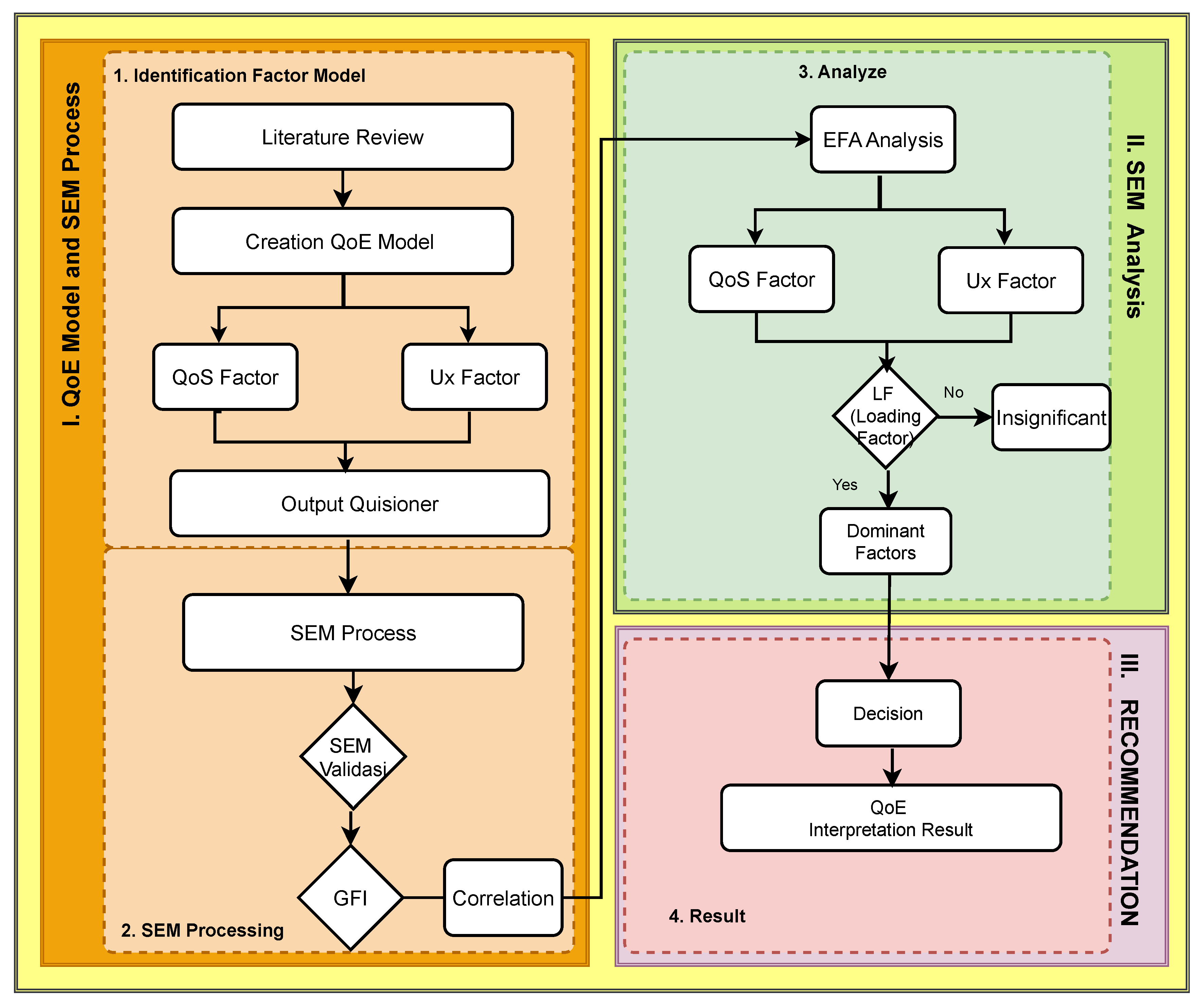
Figure 2.
Construct New SEM Model QoS and UX (a) QoS-SEM; (b) UX-SEM
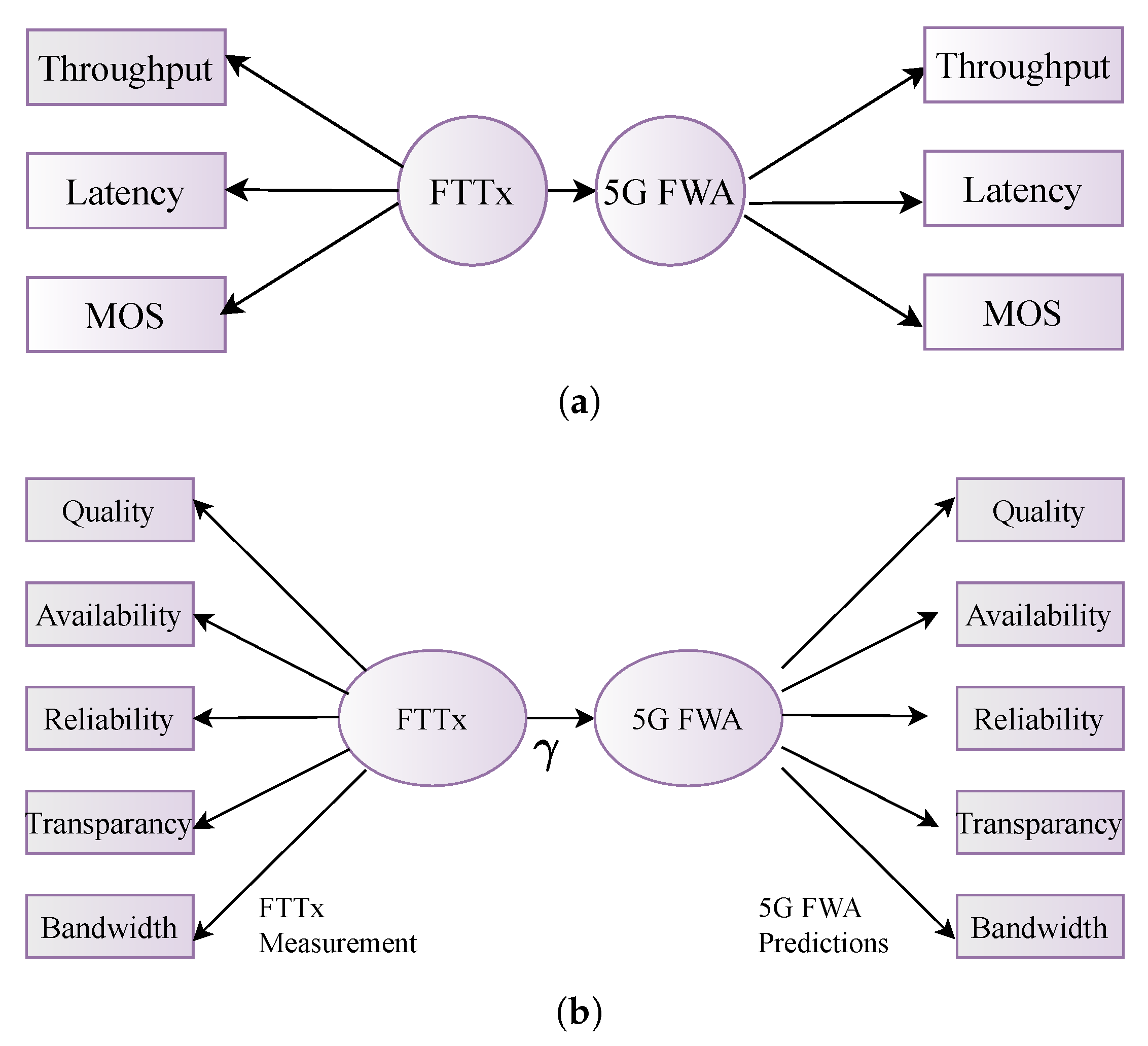
Figure 4.
Model Fit Indices Qos and Ux Factor.
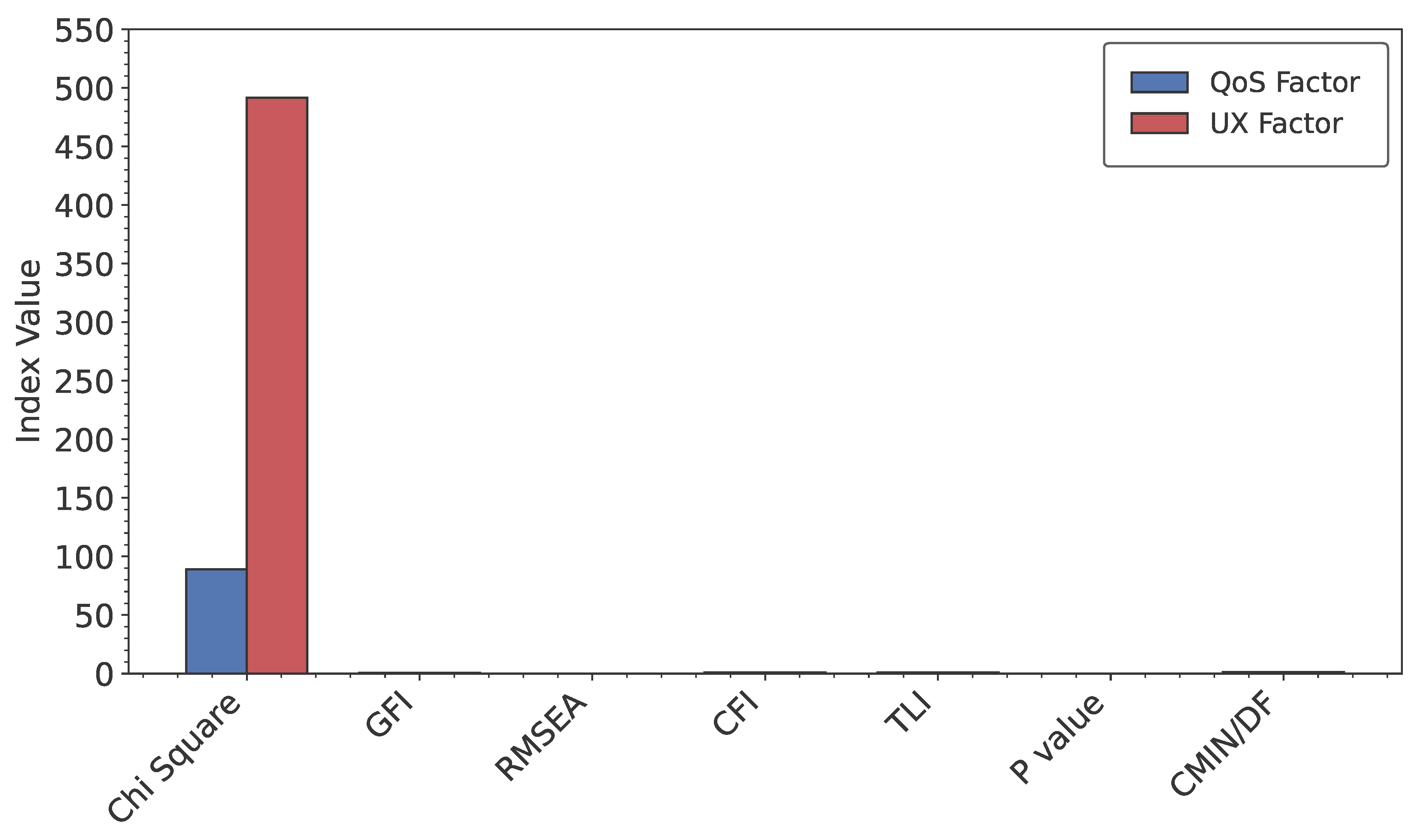
Table 1.
QoE Model and Service Factors
| QoE Model |
Code Variable Laten |
Code | Role Service Factors (Observed Variables) |
|---|---|---|---|
| Role UX | FTTx <> 5G FWA | AV | Availability |
| REA | Reliability | ||
| QUA | Quality | ||
| TR | Transparency | ||
| BW | Bandwidth | ||
| Role QoS | FTTx <> 5G FWA | TH | Throughput |
| LAT | Latency | ||
| MO | MoS |
Table 2.
Correlation Values For QOE Technology FTTX and 5G FWA – UX Factor
| UX Factors | FTTx | 5G FWA | ||
|---|---|---|---|---|
| Correlation | CR (t-value) | Correlation | CR (t-value) | |
| Availability | 0.785 | 0.79 | 0.813 | 0.81 |
| Reliability | 1.000 | 2.36 | 0.889 | 4.10 |
| Quality | 0.977 | 1.88 | 0.904 | 4.02 |
| Transparency | 0.695 | 0.74 | 0.803 | 4.00 |
| Bandwidth | 0.896 | 0.83 | 0.961 | 4.69 |
| Construct Validity | 0.943 | 0.942 | ||
| AVE | 2.14 | 2.16 | ||
| UX FTTx → 5G FWA | ||||
Table 3.
Correlation Values For QOE Technology FTTX and 5G FWA – QOS Factor
| QoS Factors | FTTx | 5G FWA | ||
|---|---|---|---|---|
| Correlation | CR (t-value) | Correlation | CR (t-value) | |
| Throughput | 0.928 | 0.93 | 0.956 | 0.96 |
| Latency | 1.000 | 6.85 | 0.962 | 9.16 |
| MoS | 0.936 | 6.78 | 0.970 | 9.42 |
| Construct Validity | 0.969 | 0.974 | ||
| AVE | 1.263 | 1.575 | ||
| QoS FTTx → 5G FWA | ||||
Table 5.
Fit Indices Systematic Model
| Fit Index | Threshold | QoS Factor | UX Factor | Interpretation |
|---|---|---|---|---|
| Chi Square () | Lower is better | 89.04 | 491.7 | Acceptable |
| GFI | 0.782 | 0.655 | Acceptable Fit | |
| RMSEA | 0.08 | 0.08 | Excellent Fit | |
| CFI | 0.973 | 0.895 | Excellent Fit | |
| TLI | 0.965 | 0.881 | Excellent Fit | |
| P value | 0.07 | 0.00 | Excellent Fit | |
| CMIN/DF | 1.254 | 1.377 | Excellent Fit |
Table 6.
Component Matrix EFA – UX 5G FWA
| Observed Variable UX |
5G FWA Latent Variable | ||||
|---|---|---|---|---|---|
| Availability | Reliability | Quality | Transparency | Bandwidth | |
| AV11 | 0.758 | ||||
| AV21 | 0.688 | ||||
| AV31 | 0.744 | ||||
| AV41 | 0.795 | ||||
| RE11 | 0.696 | ||||
| RE21 | 0.680 | ||||
| RE31 | 0.767 | ||||
| RE41 | 0.743 | ||||
| QU11 | 0.77 | ||||
| QU21 | 0.80 | ||||
| QU31 | 0.85 | ||||
| TR11 | 0.804 | ||||
| TR21 | 0.782 | ||||
| TR31 | 0.661 | ||||
| TR41 | 0.691 | ||||
| BW11 | 0.853 | ||||
| BW21 | 0.825 | ||||
| BW31 | 0.864 | ||||
| BW41 | 0.879 | ||||
Table 7.
Loading Factor EFA – UX 5G FWA.
| Loading Factor UX 5G FWA | Value | Interpretation |
|---|---|---|
| Factor #1 Availability | 0.859 | High |
| Factor #2 Reliability | 0.870 | High |
| Factor #3 Quality | 0.915 | Extremely High |
| Factor #4 Throughput | 0.910 | Extremely High |
| Factor #5 Bandwidth | 0.939 | Extremely High |
Table 8.
Component Matrix EFA – QoS 5G FWA
| Observed Variable QoS |
5G FWA Latent Variable | ||
|---|---|---|---|
| Throughput | Latency | MoS | |
| TH11 | 0.921 | ||
| TH21 | 0.941 | ||
| TH31 | 0.902 | ||
| LAT11 | 0.902 | ||
| LAT21 | 0.936 | ||
| LAT31 | 0.950 | ||
| MOS11 | 0.918 | ||
| MOS21 | 0.905 | ||
| MOS31 | 0.927 | ||
Table 9.
Loading Factor EFA – QoS 5G FWA.
| Loading Factor QoS 5G FWA | Value |
|---|---|
| Factor #1 Throughput | 0.960 |
| Factor #2 Latency | 0.967 |
| Factor #3 MoS | 0.982 |
Table 10.
EFA Simulation Result
| EFA Test | QoS Factor |
UX Factor |
Interpretation |
|---|---|---|---|
| KMO-MSA | 0.646 | 0.709 | Acceptable |
| Significant | 0.000 | 0.000 | Acceptable |
| Bartlett’s Test of Sphericity | 153 | 703 |
Disclaimer/Publisher’s Note: The statements, opinions and data contained in all publications are solely those of the individual author(s) and contributor(s) and not of MDPI and/or the editor(s). MDPI and/or the editor(s) disclaim responsibility for any injury to people or property resulting from any ideas, methods, instructions or products referred to in the content. |
© 2026 by the authors. Licensee MDPI, Basel, Switzerland. This article is an open access article distributed under the terms and conditions of the Creative Commons Attribution (CC BY) license (http://creativecommons.org/licenses/by/4.0/).
Copyright: This open access article is published under a Creative Commons CC BY 4.0 license, which permit the free download, distribution, and reuse, provided that the author and preprint are cited in any reuse.


