

Submitted:
30 March 2026
Posted:
31 March 2026
You are already at the latest version
Abstract
The temporal dynamics and statistical properties of air nanobubbles (NBs) in ultrapure water were investigated using nanoparticle tracking analysis (NTA). Statistical analysis of NB lifetimes reveals a strong correlation between bubble size and persistence. The mean bubble diameter increases rapidly from ~100 nm for short-lived detections to a characteristic size of about 500 nm for bubbles surviving longer than 40 frames, after which the size remains approximately constant. The population of detected NBs decreases monotonically with increasing lifetime, approximately following an exponential decay. Spatial observations show that NBs are separated by micrometer-scale distances, excluding direct bubble–bubble interactions. Temporal analysis of the cumulative population yields a scaling exponent of ~0.6, suggesting correlated activation of localized gas micro-domains rather than independent stochastic events. These findings support a physical picture in which NBs behave as long-lived gas domains embedded in a gas–solution continuum, undergoing continuous molecular exchange with their surrounding environment. The results are consistent with non-extensive thermodynamic descriptions, where NBs are treated as diffuse interfacial entities rather than classical gas phases with sharp boundaries. Within this framework, bubble stability arises from coupling between bubble volume and local dissolved gas concentration, enabling persistence far beyond classical predictions.
Keywords:
nanobubble stability
; nanoparticle tracking statistical analysis
; non-extensive thermodynamics
; fractal scaling
Introduction
Over the past decade there has been increasing interest in nanobubbles (NBs), largely due to their widespread use in numerous industrial and biological processes [1,2,3]. Applications include water treatment [4,5], flotation [6], acceleration of metabolism [7], intracellular drug delivery [8,9], ultrasonography [10,11], and the food industry [12,13], among others.
Nanobubbles are nanometer-scale gas bubbles (typically smaller than 1 μm) that can exist either in bulk liquids or on submerged surfaces [14,15,16]. They exhibit extraordinary longevity compared with larger bubbles. While micro-bubbles typically survive only for seconds, NBs have been observed to persist for days, weeks, or even longer [17]. This longevity contradicts classical theory, which predicts that such small bubbles should dissolve rapidly. According to the Young-Laplace equation [18],
where ΔP is the pressure difference across the interface, γ is the surface tension of the liquid, and R is the bubble radius. Because of their extremely small radius, the internal gas pressure becomes very high, causing NBs to shrink and disappear within μs [19]. However, experiments show that NBs remain stable in solution [20].
First, let us examine the assumptions underlying the classical theory [19]: a) the bubble is at rest, b) the velocity field generated by bubble growth or shrinkage is neglected, c) spherical symmetry is assumed, d) the bubble boundary is considered stationary. However, NBs undergo Brownian motion, and therefore the system cannot remain perfectly spherically symmetric [21,22]. In aqueous solutions, NBs typically carry a negative surface charge, which prevents coalescence. As a result, an electrical double layer (EDL) forms at the gas-water interface, producing a ζ-potential in the range of -20 to -40 mV [23,24]. Furthermore, even extremely small quantities of polar molecules (on the order of pico-moles), present even in ultra-pure water (UPW), may reduce the effective surface tension [25].
Second, we briefly review some theories proposed to explain NB stability, as well as relevant experimental results. In an early paper, Krug and Meakin [26] studied Laplacian growth and interface roughening in diffusion-driven systems. They showed how interfaces can become unstable or develop structured patterns. Shultz et al. [27] demonstrated, using sum-frequency generation spectroscopy that a planar air-water interface contains a hydration layer of finite thickness, with altered molecular orientation and hydrogen bonding compared to bulk water. Molecular dynamics simulations by Dammer and Lohse [28] showed that dissolved gas molecules (such as O2, N2, CO2, or air) preferentially accumulate near liquid-gas interfaces, producing a locally enhanced gas density relative to the bulk liquid.
Duncan and Needham [29] tested the Epstein-Plesset model and examined the effects of surface tension and gas undersaturation in solution. Zhang et al. [30] proposed that NBs contain high-density gas, which reduces the concentration gradient. Ohgaki et al. [31] introduced a physicochemical model emphasizing structured interfaces, suggesting that NBs behave differently from macrobubbles due to interfacial ordering and confinement.
Sun et al. [32] provided a comprehensive review of bulk NBs, including their generation, properties, and applications. They summarized experimental evidence of long-term stability and discussed multiple proposed mechanisms. Meegoda et al. [33] also presented a broad review of NB stability mechanisms by combining experimental observations and theoretical explanations, including electrostatics, contamination, and gas supersaturation. They concluded that no single mechanism fully explains stability, emphasizing the need for integrated models.
Letellier and co-workers [34,36] described NB solutions using non-extensive thermodynamics. They argued that the classical Laplace and Kelvin equations are not generally applicable at nanometric scales and that nanoscale gaseous systems should instead be interpreted using a fuzzy interface description. In this framework, NBs are redefined as non-autonomous interfacial entities rather than conventional gas phases. Hewage and Meegoda [37] used molecular dynamics simulations to study NB structure and concluded that interfaces are not sharp but structured. Onda [38] investigated bubbles composed of CO2 and air mixtures, focusing on stability and dynamics, and showed that gas composition strongly affects behavior. Mass transfer and interfacial effects were also examined.
Koshoridze and Levin [39,40] studied the dynamic equilibrium of NBs in water and performed a thermodynamic analysis of their stability. They suggested that stability requires not only mechanical balance between Laplace and electrostatic pressures but also equality of chemical potentials across the gas–liquid interface. Diffusion equilibrium with the surrounding liquid is rapidly established according to Henry’s law, leading to a state in which the internal bubble pressure approaches atmospheric pressure. Manning [41] also investigated NB stability and concluded that their longevity cannot be explained if surface tension is assumed constant; instead, surface tension must depend on bubble radius.
Tan et al. [42] proposed that NBs can persist via a dynamic equilibrium mechanism, in which gas influx balances diffusive outflux. Their study emphasized the role of local oversaturation near the interface, providing a physically consistent explanation for long-lived bulk NBs. Vehmas and Makkonen [43] demonstrated through thermodynamic analysis that nanoscale bubbles in water may be metastable rather than spontaneously dissolving, as dissolution would require an increase in total Gibbs free energy when the bubble diameter falls below a critical threshold of approximately 180 nm under ambient conditions.
Verma et al. [44] developed a thermodynamic model for air NBs in water and concluded that NBs may exhibit negative Gibbs free-energy minima, indicating spontaneous formation and stable equilibrium at specific combinations of radius and effective surface tension. Chen et al. [45] further demonstrated that nanoscale interfacial thermal (capillary) fluctuations can effectively reduce surface tension in bulk NBs, thereby lowering Laplace pressure and creating a finite size window in which NBs can persist far longer than predicted by classical diffusion theory.
In the present study, nanoparticle tracking measurements were conducted for air NBs in aqueous solution. The population and average size of NBs over different survival times were extracted, and statistical analysis was performed to identify trends in NB behavior. A possible survival mechanism is also discussed.
Experimental Procedure
Nanobubbles were produced using an in-house NB generator based on hydrodynamic cavitation; further details are provided in Ref. [46]. A high-purity synthetic air supply was maintained at a flow rate of 1.2 L/min while the tank contained 4 L of UPW. The air-water mixture was circulated using a pump with a maximum outlet pressure of 3.5 bar for 20 minutes. This generation time was selected as the optimal duration for achieving the maximum NB concentration. Figure 1 shows the concentration and size distribution of the generated NBs, with an average size of 421 ± 138 nm and a concentration of (3.95 ± 0.95) x 107 NB/mL.
The solution was subsequently collected in a sterilized glass container. A volume of 1 mL was withdrawn using a syringe and mounted on the automatic pump of the instrument. Nanoparticle tracking analysis (NTA) was performed using a Malvern NanoSight LM10, equipped with a green laser (538 nm) and a CCD camera for image capture. The installed software was NanoSight NTA 3.4 [47].
The observation window (100x80x7 μm3) was sealed to the optical unit, and a small amount of sample was infused to fill the measurement cell (approximately 0.25 mL with a depth of 0.5 mm). Before the measurement, the temperature was set to 25oC, and the region of interest was defined.
The measurement script was configured to perform 90 runs, each lasting 120 s. The acquisition rate was 30 frames per second, with no flow or sample injection during the runs. In total, 324,000 frames were recorded over three hours. The number of tracked NBs was counted according to their assigned ID; consequently, the number of frames corresponding to each tracked NB was obtained for subsequent statistical analysis.
For a particle undergoing Brownian motion, the mean squared displacement (MSD) grows linearly with time according to:
where D is the diffusion coefficient and t is the elapsed time. By tracking the frame-to-frame positions of each visible particle, the NTA software reconstructs individual trajectories and estimates D from the slope of the MSD curve. The particle size is then obtained through the Stokes-Einstein relation:
where rH is the hydrodynamic radius, kB is the Boltzmann constant, T is the absolute temperature, and η is the dynamic viscosity of the medium. Figure 2 shows the Brownian motion of a NB captured by NTA.
Only trajectories that satisfy certain criteria are retained for quantitative analysis. Each tracked trajectory is classified as either included (true) or excluded (false) in the final size distribution. True trajectories correspond to particles that remain visible for a sufficient number of frames (typically more than five frames) to allow reliable diffusion estimation. False trajectories arise when particles leave the focal volume rapidly, produce insufficient scattering signals, overlap with neighboring tracks, or are affected by optical noise.
Statistical Analysis
The data were organized according to the ID of each tracked particle. A total of 16,417 valid particles were recorded and subsequently distributed across 10 bins according to their lifetime in frames (0-10 up to 91-100 frames). The population and average size of NBs in each bin were then calculated. Individual NBs remain visible across sequential frame windows and frequently reappear throughout the experimental duration. This persistence exceeds the predictions of the classical Epstein-Plesset dissolution theory by several orders of magnitude, confirming the existence of long-lived nanoscale interfacial gas domains. Given the acquisition rate of 30 frames per second and run duration of 120 s, the maximum observable lifetime within a single file is 3,600 frames. However, in practice the tracking algorithm imposes an effective upper cutoff of 100 frames. All row and processed data are included in a supplementary file.
Data processing and binning strategy
For each sub-file, NB trajectories were first condensed so that each NB ID appears only once, associated with its unique size and its total lifetime in frames. The population of each lifetime bin was then defined as the number of distinct NBs whose total lifetime falls within that bin. In parallel, the average NB size per bin was computed for each file. This procedure yielded two core datasets:a) population per lifetime bin per file (90x10 matrix), andb) average NB size per lifetime bin per file (90x10 matrix). After aggregating across all runs, the following quantities were computed for each lifetime bin: a) mean population and standard deviation (SD), b) mean NB size and SD, c) 95% confidence intervals (CI) for both quantities [48].
The population exhibits a strong monotonic decay with increasing lifetime (Figure 3). The 0-10 bin is overwhelmingly dominant, indicating that the majority of detected NBs are short-lived (≤10 frames). The population continues to decrease through intermediate bins (11-20 up to 71-80 frames), after which a statistically significant increase is observed in the 91-100 bin. This late-time population rebound is not accompanied by any corresponding change in size and is therefore attributed to an algorithmic end effect, namely the apparent reassignment or truncation of NB IDs beyond 100 frames by the NTA software. The confidence intervals for the population are sufficiently narrow to confirm that the early dominance of short-lived NBs is a statistically feature rather than noise.
In contrast to population, the mean NB size increases rapidly from the 0-10 bin to the 31-40 bin and then saturates at approximately 500 nm (Figure 4). From 31-40 frames onward, the mean sizes across all bins up to 91-100 overlap strongly within their 95% confidence intervals. This behavior indicates the existence of a characteristic NB size scale that is reached quickly and remains stable, independent of further increases in lifetime.
Pairwise comparisons of population and size
To rigorously assess differences between lifetime bins, pairwise Welch’s t-tests were performed for both population and size [49]. Welch’s test was chosen due to unequal variances and unequal sample sizes across bins. Given the large number of comparisons (36), multiple-testing correction was applied using both Bonferroni and Benjamini-Hochberg (FDR) procedures [50,51].
The pairwise tests reveal that early and intermediate bins are significantly different from one another, reflecting the gradual decay of population with lifetime. The 91-100 bin is significantly different from most intermediate bins, confirming its anomalous nature. At long lifetimes (61-90 frames), several adjacent bins become statistically indistinguishable, indicating a convergence of population behavior in the tail of the distribution.
The size analysis yields a different result. Significant differences are found only among the early bins (0-10 to 31-40). Beyond 31-40 frames, no pairwise size comparison remains statistically significant after correction. Thus, all bins ≥31-40 frames form a single statistical equivalence class in terms of size. Notably, the 91-100 bin does not differ in size from any other long-lifetime bin, further supporting the conclusion that its elevated population is an artifact rather than a physical effect.
Time series analysis
The temporal dynamics of NB population were also investigated using the box-counting method in order to examine whether fluctuations in NB population exhibit scale-invariant behavior. The analysis was applied to the cumulative number of NBs detected per run. The corresponding box-counting results are presented in Figure 5. For fractal or rough signals, the number of boxes N(ε) required to cover the curve follows a scaling relation:
where Df is the fractal dimension and ε is the yardstick. The analysis yields a scaling exponent Df≈0.6. Since Df<1, the fluctuating curve resembles a sparse distribution of temporal events, analogous to a Cantor-dust-like pattern in time [52]. However, because the box-counting analysis is sensitive to the scaling properties of the data, the result should be interpreted more cautiously as an indication of scale-dependent temporal correlations in the NB population dynamics, rather than as an intrinsic fractality of the system.
Results and Discussion
Figure 6 shows representative video snapshots corresponding to various runs. The results indicate that NBs are sparsely distributed within the solution. The video observations reveal several different behaviors. Some NBs appear, disappear, and then reappear at approximately the same location. Others appear at different positions, disappear completely, or move very rapidly. Some appear extremely bright or large. It is possible that the same NB may leave and re-enter the observation window, but the tracking software assigns it a new ID each time. Consequently, the statistical analysis may overestimate the actual population of NBs. The end-effect observed in the 91-100 frame bin represents another source of overestimation.
Bubbles also display halos around them due to optical diffraction effects. Bubbles that move too rapidly or appear too large are classified by the software as false detections, although some of these signals may correspond to diffuse gas micro-domains. A total of 120,543 false IDs were recorded and distributed across the same bins. Their population in the smallest bin exceeds the true population by approximately 20 times, while becoming negligible in the higher bins. Their apparent sizes are also much larger, by factors ranging from 3 to 100.
The statistical analysis of the true NB population reveals several systematic features that provide insight into the physical behavior of the system. The first observation is the strong dependence of bubble lifetime on bubble size. The average diameter increases steadily from ~100 nm in the shortest lifetime bin (0-10 frames) to about 500 nm for bubbles surviving longer than 40 frames, after which the size remains approximately constant. This indicates that short-lived detections correspond predominantly to small bubbles, while long-lived tracks correspond to larger bubbles that have reached a quasi-stationary size. A second important result is the population distribution across lifetime bins. The number of detected bubbles decreases rapidly as lifetime increases, approximately following an exponential decay up to the truncated bin. When population and size are analyzed together, an additional regularity emerges: smaller bubbles are far more numerous than larger ones, indicating a population hierarchy typical of systems where objects exchange mass with a surrounding reservoir.
The temporal evolution of the cumulative population also suggests a possible fractal scaling relation, indicating correlated fluctuations in the population signal. The spatial distribution observed in the NTA images further clarifies the physical context. Bubbles are separated by distances of several micrometers, which are orders of magnitude larger than their diameters. Such dilute conditions effectively eliminate direct bubble-bubble interactions and exclude mechanisms based on gas transfer between neighboring bubbles.
This interpretation is consistent with the non-extensive thermodynamic framework proposed by Letellier and co-workers [34,35,36] for bubble solutions. In that theory, the bubble is not treated as a classical autonomous phase separated by a sharp interface but rather as a gas domain embedded in a liquid environment, continuously exchanging molecules through a diffuse interfacial region. The pressure difference between the bubble phase and the surrounding liquid can then be generalized as:
where PNE is the pressure in the non-extensive gas domain, P is the liquid pressure, V is the bubble volume, Ω describes interfacial interactions, and α characterizes the geometry of the gas domain. The classical Young–Laplace relation appears as a special case with α=2/3. A key consequence of this theory is that bubble volume and dissolved gas concentration become coupled thermodynamic variables. Small variations in dissolved gas concentration may therefore modify bubble volume without requiring complete dissolution or nucleation.
The temporal pattern observed in the cumulative population supports this concept. If NBs were independent objects evolving in a homogeneous medium, one would expect a more regular distribution of events. Instead, the observed clustered structure suggests that each NB interacts primarily with a localized microenvironment of dissolved gas. Within such micro-domains, local fluctuations in concentration or interfacial conditions may allow a bubble to nucleate, grow slightly through gas exchange, and eventually dissolve again. Different micro-domains activate independently over time, producing clusters of bubble events separated by relatively long inactive intervals.
Mechanism of nanobubble surviving
Figure 7 indicates that NBs are not isolated objects, but rather part of a coupled thermodynamic system consisting of the bubble and a surrounding fuzzy interface (micro-domain). Within this framework, each NB acts as an attractor that maintains a localized non-extensive state. The fuzzy interface serves as a buffering gas reservoir, enabling gas exchange between the bubble and the surrounding liquid without immediate dissolution. This coupling suppresses the classical Epstein-Plesset dissolution mechanism and allows the bubble to persist in a quasi-equilibrium state.
A central feature of this coupled system is radial breathing; i.e., small oscillations in bubble size driven by local imbalances between internal pressure and interfacial concentration. These fluctuations are supported by our statistical analysis: NBs within the same run or in adjacent runs exhibit size variations below 10%, indicating that the same physical bubble can appear with slightly different measured radii. Smaller NBs, due to their higher Laplace pressure, exhibit faster gas exchange rates, while larger ones fluctuate more slowly. Because the acquisition rate of NTA (30 frames/s) is orders of magnitude slower than the intrinsic breathing dynamics of NBs, small NBs frequently either fall below the detection threshold and reappear or slightly change size. In both cases, the NTA assigns them a different ID. This produces an apparent overpopulation of short-lived NBs in the early bins (e.g., 0-10 frames). These short-lived detections are therefore measurement artifacts rather than a true physical population. Larger NBs (intermediate to late bins) exhibit slower breathing dynamics and thus appear with lower apparent populations.
When a NB collapses, this attractor is lost and the associated micro-domain becomes unseeded and thermodynamically unstable. In this state, the system expands gradually into the surrounding solution. Over time, multiple such unseeded regions evolve and may overlap, leading to local increases in gas concentration. When favorable conditions are re-established, new NBs can nucleate and grow into the observable size range. Newly formed NBs are initially small and therefore exhibit rapid breathing dynamics; this explains the observed bursts in the time-series population. Some of these bubbles grow or stabilize into larger, longer-lived NBs, while others collapse again, continuing the cycle. Nanobubbles larger than 500 nm have lower internal pressure. As a result, the fuzzy interface becomes less influential, while other forces dominate (e.g., buoyancy).
The system therefore evolves repeating sequence of seeded NBs, unstable micro-domains, transient nucleation fields, and regeneration. The apparent population dynamics are strongly influenced by the interplay between these stages. These stages occur across different temporal and spatial scales and do not produce a continuous signal. This behavior is consistent with the experimentally observed box-counting fractal dimension Df=0.6. A fractal dimension below unity indicates that the NB population signal is temporally sparse and clustered, rather than uniformly distributed. Figure 8 illustrates this mechanism and Table 1 summarizes the findings.
Although the present analysis cannot directly determine the microscopic structure of the bubble interface, the combined statistical and imaging results support a physical picture in which NBs behave as long-lived gas domains embedded in a gas–solution continuum. Their apparent stability and temporal dynamics arise from continuous molecular exchange with the surrounding dissolved gas reservoir, rather than from repeated nucleation–dissolution cycles or direct bubble-bubble interactions.
Conclusions
In this study, nanoparticle tracking analysis (NTA) was used to investigate the statistical behavior and temporal dynamics of air NBs in aqueous solution. A large dataset consisting of 90 experimental runs and 324,000 recorded frames was analyzed, yielding 16,417 valid NB trajectories. The results provide several important insights into the physical behavior and stability of NBs.
First, the statistical analysis reveals a strong correlation between NB size and lifetime. Short-lived detections correspond predominantly to small bubbles with average diameters near 100 nm, whereas bubbles surviving longer than approximately 40 frames rapidly converge to a characteristic size of about 500 nm. Beyond this threshold, the mean bubble size remains essentially constant, indicating the existence of a quasi-stationary size scale for long-lived NBs.
Second, the population of detected NBs decreases monotonically with increasing lifetime following an exponential decay. This behavior suggests that NBs continuously transition between detectable and undetectable states through molecular exchange with the surrounding dissolved gas reservoir.
Third, pairwise statistical comparisons show that significant size differences exist only among the shortest lifetime bins. For lifetimes longer than approximately 40 frames, NBs form a single statistical equivalence class in terms of size.
Spatial analysis confirms that bubbles are widely separated, ruling out direct inter-bubble interactions and emphasizing the dominant role of local gas microenvironments. Temporal fluctuations in the bubble population display scale-dependent correlations, with a box-counting exponent of ~0.6. This behavior suggests that NB dynamics are governed by intermittent activation of localized gas micro-domains, rather than independent stochastic processes. These micro-domains act as transient reservoirs that enable gas exchange and stabilize NBs over extended periods.
The results reveal that a significant fraction of short-lived detections arises from measurement artifacts associated with rapid radial breathing dynamics and tracking limitations. Small NBs fluctuate below and above the detection threshold, leading to repeated ID reassignment and apparent overcounting.
Overall, the experimental evidence supports a non-extensive thermodynamic framework in which NBs are not classical autonomous phases but diffuse, dynamically coupled gas domains embedded within a heterogeneous liquid environment. Their stability emerges from continuous interaction with surrounding gas reservoirs and interfacial structuring effects, which suppress classical dissolution mechanisms.
The system can therefore be understood as a population of coupled NB micro-domain entities exhibiting a well-defined stability window (approximately 50-500 nm), within which non-classical thermodynamic effects dominate. Outside this range, conventional hydrodynamic and thermodynamic behavior is recovered.
Supplementary Materials
The following supporting information can be downloaded at the website of this paper posted on Preprints.org.
References
- Tao, D. Recent advances in fundamentals and applications of nanobubble enhanced froth flotation: A review. Miner. Eng. 2022, vol. 183, no. February, 107554. [Google Scholar] [CrossRef]
- Alheshibri, M.; Al Baroot, A.; Shui, L.; Zhang, M. Nanobubbles and nanoparticles. Curr. Opin. Colloid Interface Sci. 2021, vol. 55, 101470. [Google Scholar] [CrossRef]
- Foudas, A. W.; Kosheleva, R. I.; Favvas, E. P.; Kostoglou, M.; Mitropoulos, A. C.; Kyzas, G. Z. Fundamentals and applications of nanobubbles: A review. Chem. Eng. Res. Des. 2023, vol. 189, 64–86. [Google Scholar] [CrossRef]
- Seridou, P.; Kalogerakis, N. Disinfection applications of ozone micro- And nanobubbles. Environ. Sci. Nano 2021, vol. 8(no. 12), 3493–3510. [Google Scholar] [CrossRef]
- Temesgen, T.; Bui, T. T.; Han, M.; Kim, T. il; Park, H. Micro and nanobubble technologies as a new horizon for water-treatment techniques: A review. Adv. Colloid Interface Sci. 2017, vol. 246, no. June, 40–51. [Google Scholar] [CrossRef]
- Azevedo, A.; Oliveira, H.; Rubio, J. Bulk nanobubbles in the mineral and environmental areas: Updating research and applications. Adv. Colloid Interface Sci. 2019, vol. 271, 101992. [Google Scholar] [CrossRef] [PubMed]
- Xiao, W.; Xu, G.; Li, G. Effect of nanobubble application on performance and structural characteristics of microbial aggregates. Sci. Total Environ. 2021, vol. 765, 142725. [Google Scholar] [CrossRef]
- Su, C. Current advances in ultrasound-combined nanobubbles for cancer-targeted therapy: a review of the current status and future perspectives. RSC Adv. 2021, vol. 11(no. 21), 12915–12928. [Google Scholar] [CrossRef]
- Wu, R.; Yang, X.; Li, X.; Dong, N.; Liu, Y.; Zhang, P. Nanobubbles for tumors: Imaging and drug carriers. J. Drug Deliv. Sci. Technol. 2021, vol. 65, no. April, 102749. [Google Scholar] [CrossRef]
- Zhang, C.; Li, Y.; Ma, X.; He, W.; Liu, C.; Liu, Z. Functional micro/nanobubbles for ultrasound medicine and visualizable guidance. Sci. China Chem. 2021, vol. 64(no. 6), 899–914. [Google Scholar] [CrossRef]
- Kalash, R. S.; Lakshmanan, V. K.; Cho, C.-S.; Park, I.-K. 4.4 - Theranostics; Ebara, M. B. T.-B. N., Ed.; William Andrew Publishing, 2016; pp. 197–215. [Google Scholar] [CrossRef]
- Shiroodi, S.; Schwarz, M. H.; Nitin, N.; Ovissipour, R. Efficacy of Nanobubbles Alone or in Combination with Neutral Electrolyzed Water in Removing Escherichia coli O157:H7, Vibrio parahaemolyticus, and Listeria innocua Biofilms. Food Bioprocess Technol. 2021, vol. 14(no. 2), 287–297. [Google Scholar] [CrossRef]
- Babu, K. S.; Amamcharla, J. K. Generation methods, stability, detection techniques, and applications of bulk nanobubbles in agro-food industries: a review and future perspective. Crit. Rev. Food Sci. Nutr. 2022, vol. 0(no. 0), 1–20. [Google Scholar] [CrossRef]
- Gadea, E. D.; Perez Sirkin, Y. A.; Molinero, V.; Scherlis, D. A. Electrochemically generated nanobubbles: invariance of the current with respect to electrode size and potential. J. Phys. Chem. Lett. 2020, vol. 11(no. 16), 6573–6579. [Google Scholar] [CrossRef]
- Jin, J.; Feng, Z.; Yang, F.; Gu, N. Bulk Nanobubbles Fabricated by Repeated Compression of Microbubbles. Langmuir 2019, vol. 35(no. 12), 4238–4245. [Google Scholar] [CrossRef]
- Bui, T. T.; Nguyen, D. C.; Han, M. Average size and zeta potential of nanobubbles in different reagent solutions. J. Nanoparticle Res. 2019, vol. 21(no. 8), 173. [Google Scholar] [CrossRef]
- Kyzas, G. Z.; Mitropoulos, A. C. From Bubbles to Nanobubbles. Nanomater. (Basel, Switzerland) 2021, vol. 11(no. 10), 2592. [Google Scholar] [CrossRef] [PubMed]
- Adamson, A.W.; Gast, A.P. Physical chemistry of surfaces, 6th Ed. ed; John Wiley & Sons, Inc.: New York, 1997. [Google Scholar]
- Epstein, P. S.; Plesset, M. S. On the stability of gas bubbles in liquid-gas solutions. J. Chem. Phys. vol. 18(no. 11), 1505–1509, 1950. [CrossRef]
- Nirmalkar, N.; Pacek, A. W.; Barigou, M. On the Existence and Stability of Bulk Nanobubbles. Langmuir 2018, vol. 34(no. 37), 10964–10973. [Google Scholar] [CrossRef]
- Bakalis, E.; Efthymiopoulos, P.; Lugli, F.; Kyzas, G. Z.; Zerbetto, F. Bulk nanobubbles’ transient dynamics: Brownian or anomalous? J. Colloid Interface Sci. 2020, vol. 578, 255–263. [Google Scholar]
- Lad, K. N.; Patel, M. K.; Pratap, A. Brownian motion with time-dependent friction and single-particle dynamics in liquids. Phys. Rev. E 2022, vol. 105(no. 6), 64107. [Google Scholar] [CrossRef]
- Takahashi, M. ζ Potential of Microbubbles in Aqueous Solutions: Electrical Properties of the Gas−Water Interface. J. Phys. Chem. B 2005, vol. 109(no. 46), 21858–21864. [Google Scholar] [CrossRef]
- Ushikubo, F. Y. Zeta-potential of Micro- and/or Nano-bubbles in Water Produced by Some Kinds of Gases. IFAC Proc. Vol. 2010, vol. 43(no. 26), 283–288. [Google Scholar] [CrossRef]
- Yasui, K.; Tuziuti, T.; Kanematsu, W. Mysteries of bulk nanobubbles (ultrafine bubbles); stability and radical formation. Ultrason. Sonochem. 2018, vol. 48, no. March, 259–266. [Google Scholar] [CrossRef] [PubMed]
- Krug, J.; Meakin, P. Kinetic roughening of Laplacian fronts. Phys. Rev. Lett. 1991, vol. 66(no. 6), 703–706. [Google Scholar] [CrossRef] [PubMed]
- Schultz, M. J.; Baldelli, S.; Schnitzer, C.; Simonelli, D. Aqueous solution/air interfaces probed with sum frequency generation spectroscopy. J. Phys. Chem. B 2002, vol. 106(no. 21), 5313–5324. [Google Scholar] [CrossRef]
- Dammer, S.M.; Lohse, D. “Gas Enrichment at Liquid-Wall Interfaces”. Phys. ReV. Lett. 2006, 96, 206101. [Google Scholar] [CrossRef]
- Duncan, P. B.; Needham, D. Test of the Epstein–Plesset model for gas microparticle dissolution in aqueous media: Effect of surface tension and gas undersaturation in solution. Langmuir 2004, vol. 20(no. 7), 2567–2578. [Google Scholar] [CrossRef]
- Zhang, L.; Chen, H.; Li, Z.; Fang, H.; Hu, J. Long lifetime of nanobubbles due to high inner density. Sci. China Ser. G Physics, Mech. Astron. 2008, vol. 51(no. 2), 219–224. [Google Scholar] [CrossRef]
- Ohgaki, K.; Khanh, N.; Joden, Y.; Tsuji, A.; Nakagawa, T. Physicochemical approach to nanobubble solutions. Chem. Eng. Sci. - CHEM ENG SCI 2010, vol. 65, 1296–1300. [Google Scholar] [CrossRef]
- Sun, L. , Research progress on bulk nanobubbles. Particuology 2022, vol. 60, 99–106. [Google Scholar] [CrossRef]
- Meegoda, J.; Aluthgun Hewage, S.; Batagoda, J. Stability of Nanobubbles. Environ. Eng. Sci. 2018, vol. 35. [Google Scholar] [CrossRef]
- Letellier, P.; Turmine, M. Bubble solution description by nonextensive thermodynamics: Pressure effect. ChemPhysChem 2019, vol. 20(no. 17), 2230–2235. [Google Scholar] [CrossRef]
- Letellier, P.; Mayaffre, A.; Turmine, M. Thermodynamics of interfaces under nonextensive conditions. Phys. Rev. B 2007, vol. 76, 045428. [Google Scholar] [CrossRef]
- Letellier, P.; Turmine, M. Nonextensive thermodynamics of interfaces. J. Phys. Chem. B 2015, vol. 119, 4143–4154. [Google Scholar] [CrossRef]
- Hewage, S. A.; Meegoda, J. N. Molecular dynamics simulation of bulk nanobubbles. Colloids Surfaces A Physicochem. Eng. Asp. 2022, vol. 650, 129565. [Google Scholar] [CrossRef]
- Onda, T. Stability and dynamics of bubble comprising carbon dioxide and air. Colloids Surfaces A Physicochem. Eng. Asp. 2023, vol. 679, 132535. [Google Scholar] [CrossRef]
- Koshoridze, S. I.; Levin, Yu. K. On the dynamic equilibrium of nanobubbles in water. Nanoscience and Technology: An International Journal 2018, vol. 9(no. 1), 1–8. [Google Scholar] [CrossRef]
- Koshoridze, S. I.; Levin, Yu. K. Thermodynamic analysis of the stability of nanobubbles in water. Nanoscience and Technology: An International Journal 2019, vol. 10(no. 1), 21–27. [Google Scholar] [CrossRef]
- Manning, G. S. On the thermodynamic stability of bubbles, immiscible droplets, and cavities. Phys. Chem. Chem. Phys. 2020, vol. 22, 17523–17531. [Google Scholar] [CrossRef]
- Tan, B. H.; An, H.; Ohl, C.-D. How Bulk Nanobubbles Might Survive. Phys. Rev. Lett. 2020, vol. 124(no. 13), 134503. [Google Scholar] [CrossRef]
- Vehmas, T.; Makkonen, L. Metastable nanobubbles . ACS Omega 2021, 6, 8021–8027. [Google Scholar] [CrossRef] [PubMed]
- Verma, A.; Paliwal, H.; Gopinathan, N. A Classical Thermodynamic Model for Dispersed Nanophase Stability and Its Application for Investigating the Stability of Air Nanobubbles in Water. Ind. Eng. Chem. Res. 2024, vol. 63(no. 42), 18120–18133. [Google Scholar] [CrossRef]
- Chen, B.; Gao, Y.; Zhang, X. The Existence and Stability Mechanism of Bulk Nanobubbles: A Review. Nanomaterials vol. 15(no. 4), 314, 2025. [CrossRef]
- Mitropoulos; Bomis, G. Device for generating and handling nanobubbles" EP2995369A1. 2016. [Google Scholar]
- MAN0514-01-EN-00; NTA 2.3 Analytical Software Operating Manual. Malvern Instruments Ltd., Apr 2014.
- Cumming, G. Understanding the New Statistics: Effect Sizes, Confidence Intervals, and Meta-Analysis; Routledge: New York, 2012. [Google Scholar]
- Welch, B. L. The Generalization of “Student’s” Problem When Several Different Population Variances Are Involved. Biometrika 1947, 34, 28–35. [Google Scholar] [CrossRef]
- Bonferroni, C. Teoria Statistica delle Classi e Calcolo delle Probabilità. Pubbl. R. Ist. Super. Sci. Econ. Commer. Firenze 1936, 8, 3–62. [Google Scholar]
- Benjamini, Y.; Hochberg, Y. Controlling the False Discovery Rate: A Practical and Powerful Approach to Multiple Testing. J. R. Stat. Soc. Ser. B 1995, 57, 289–300. [Google Scholar] [CrossRef]
- Mandelbrot, B.B. The fractal geometry of nature; Freeman Co: New York, 1982. [Google Scholar]
Figure 1.
Size distribution and concentration of the generated NBs.
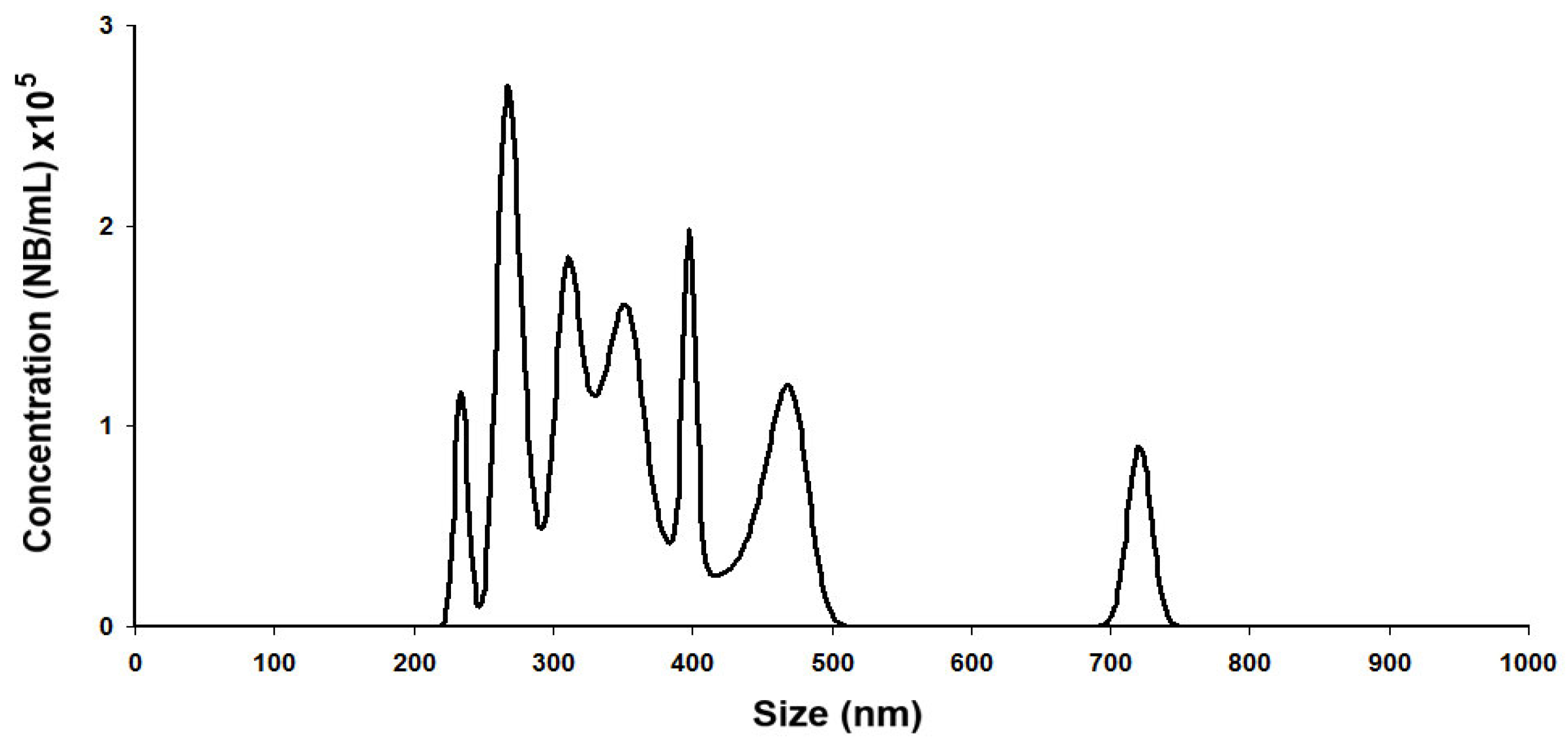
Figure 2.
Brownian motion trajectory of a NB over 100 frames. The starting and ending points are indicated.
Figure 2.
Brownian motion trajectory of a NB over 100 frames. The starting and ending points are indicated.
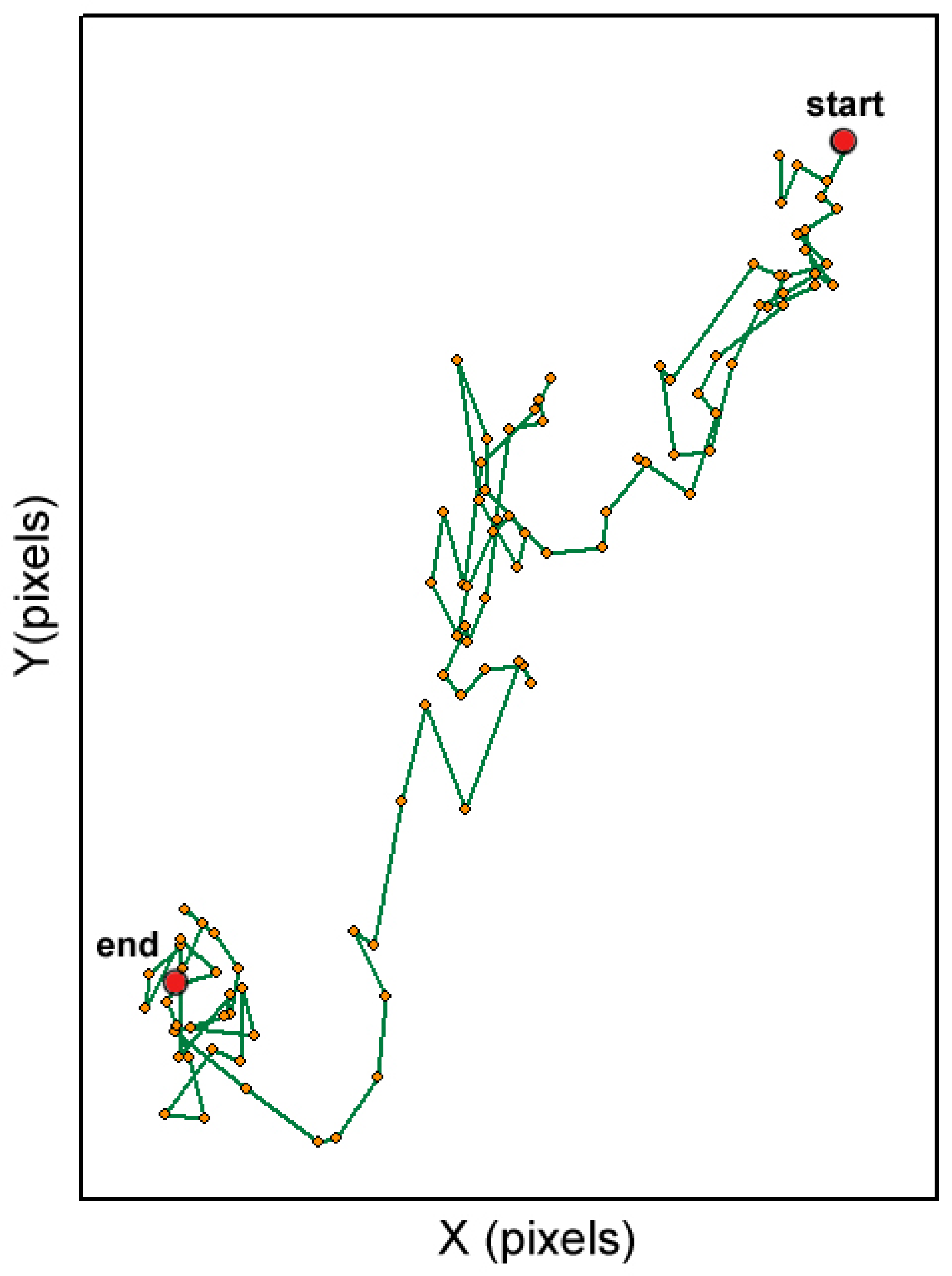
Figure 3.
Decay of NB population as a function of lifetime bin. The high population in the early bins is attributed to overcounting. The increase in the 91-100 bin is attributed to an end-effect of the NTA software.
Figure 3.
Decay of NB population as a function of lifetime bin. The high population in the early bins is attributed to overcounting. The increase in the 91-100 bin is attributed to an end-effect of the NTA software.
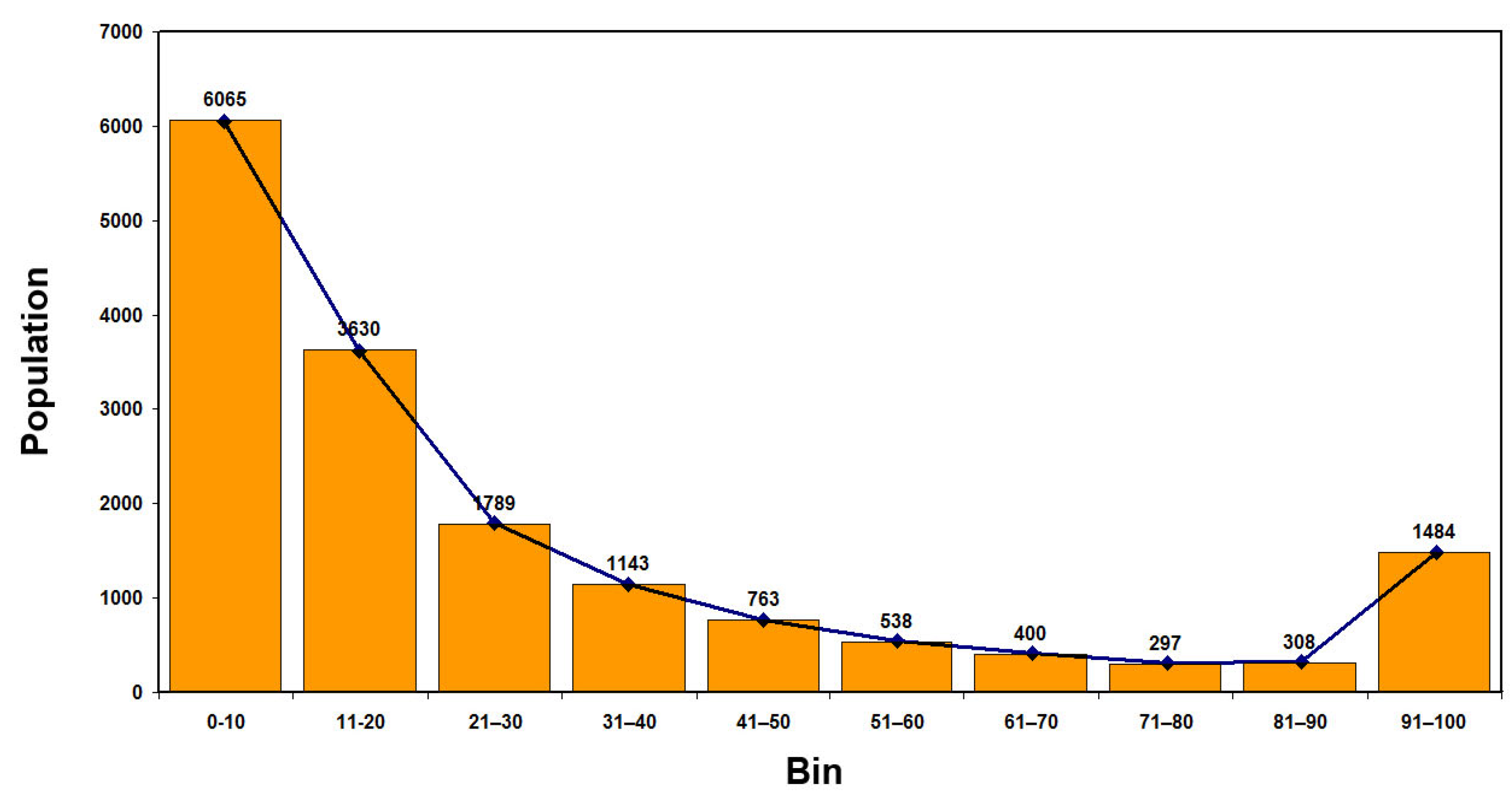
Figure 4.
Average size of NBs as a function of lifetime bin. Beyond the 31-40 bin, the size stabilizes at approximately 500 nm.
Figure 4.
Average size of NBs as a function of lifetime bin. Beyond the 31-40 bin, the size stabilizes at approximately 500 nm.
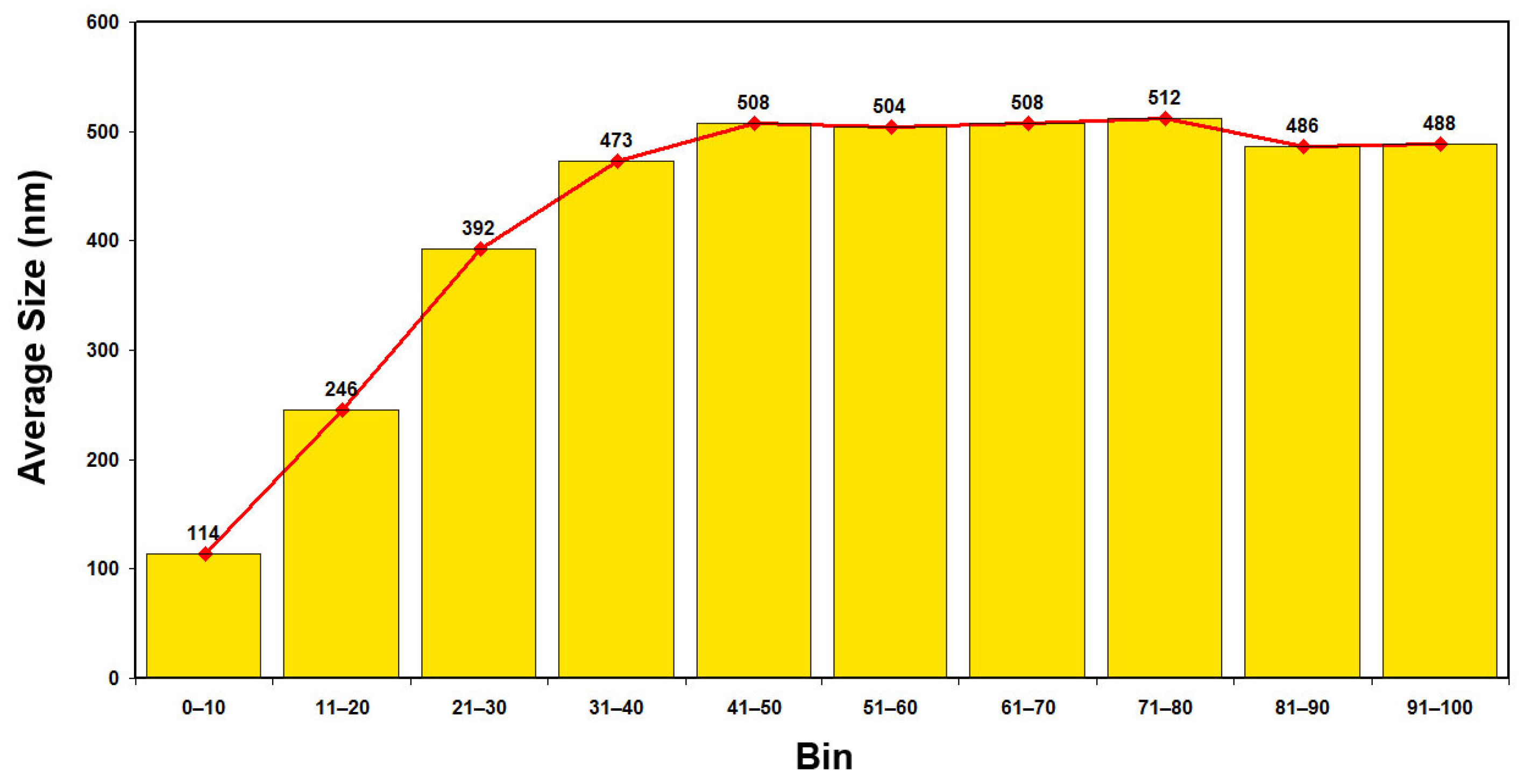
Figure 5.
Temporal dynamics of nanobubble (NB) population. The fractal dimension (Df ≈ 0.6) is estimated using the box-counting method.
Figure 5.
Temporal dynamics of nanobubble (NB) population. The fractal dimension (Df ≈ 0.6) is estimated using the box-counting method.
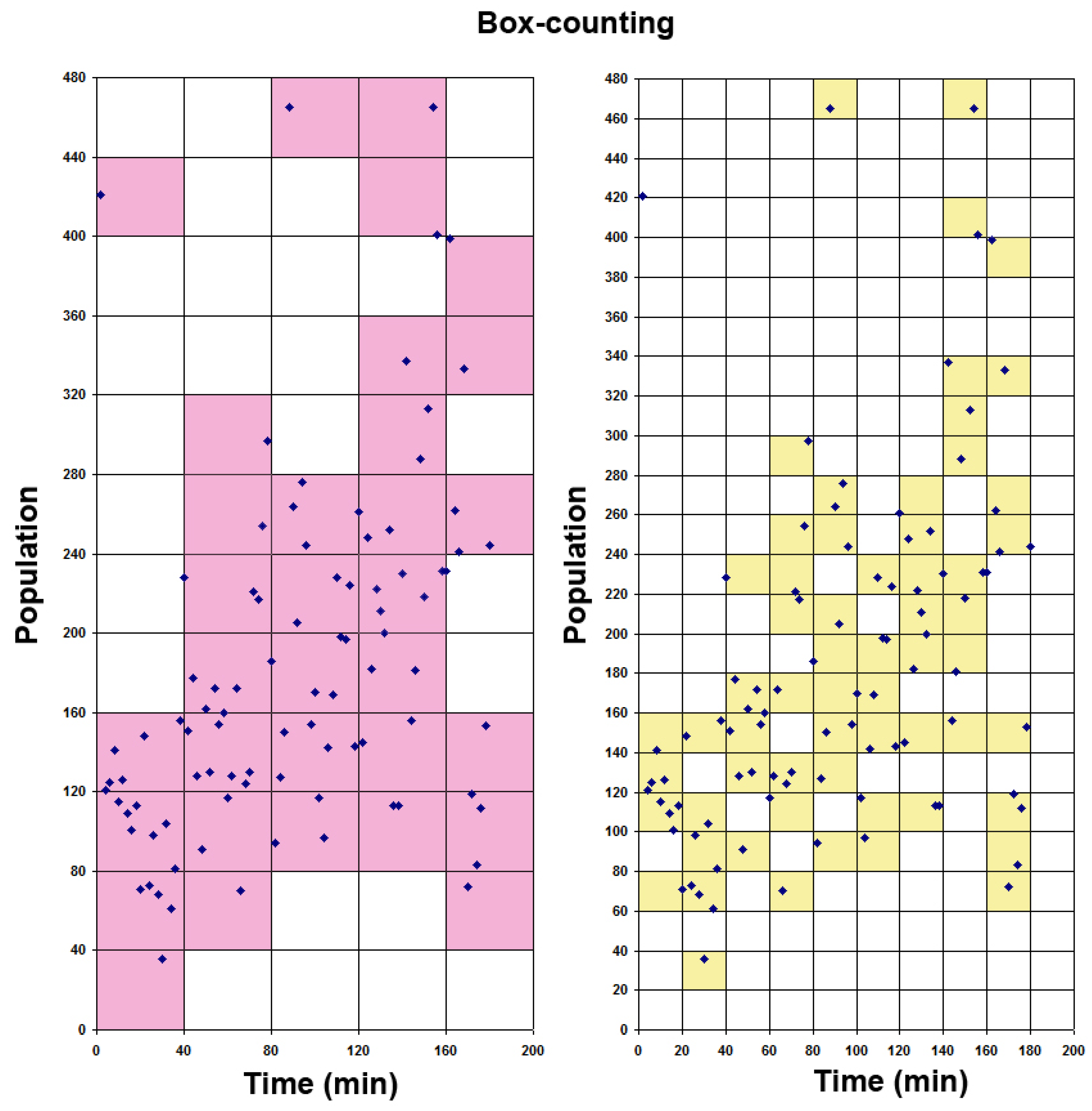
Figure 6.
Representative snapshots from NTA videos. The labels 1, 16, 45, and 50 correspond to different runs (see Supplementary Material). Nanobubbles are highlighted with red circles. The scale bar represents 5 μm within the calibrated 100 μm field of view of the NanoSight LM10.
Figure 6.
Representative snapshots from NTA videos. The labels 1, 16, 45, and 50 correspond to different runs (see Supplementary Material). Nanobubbles are highlighted with red circles. The scale bar represents 5 μm within the calibrated 100 μm field of view of the NanoSight LM10.
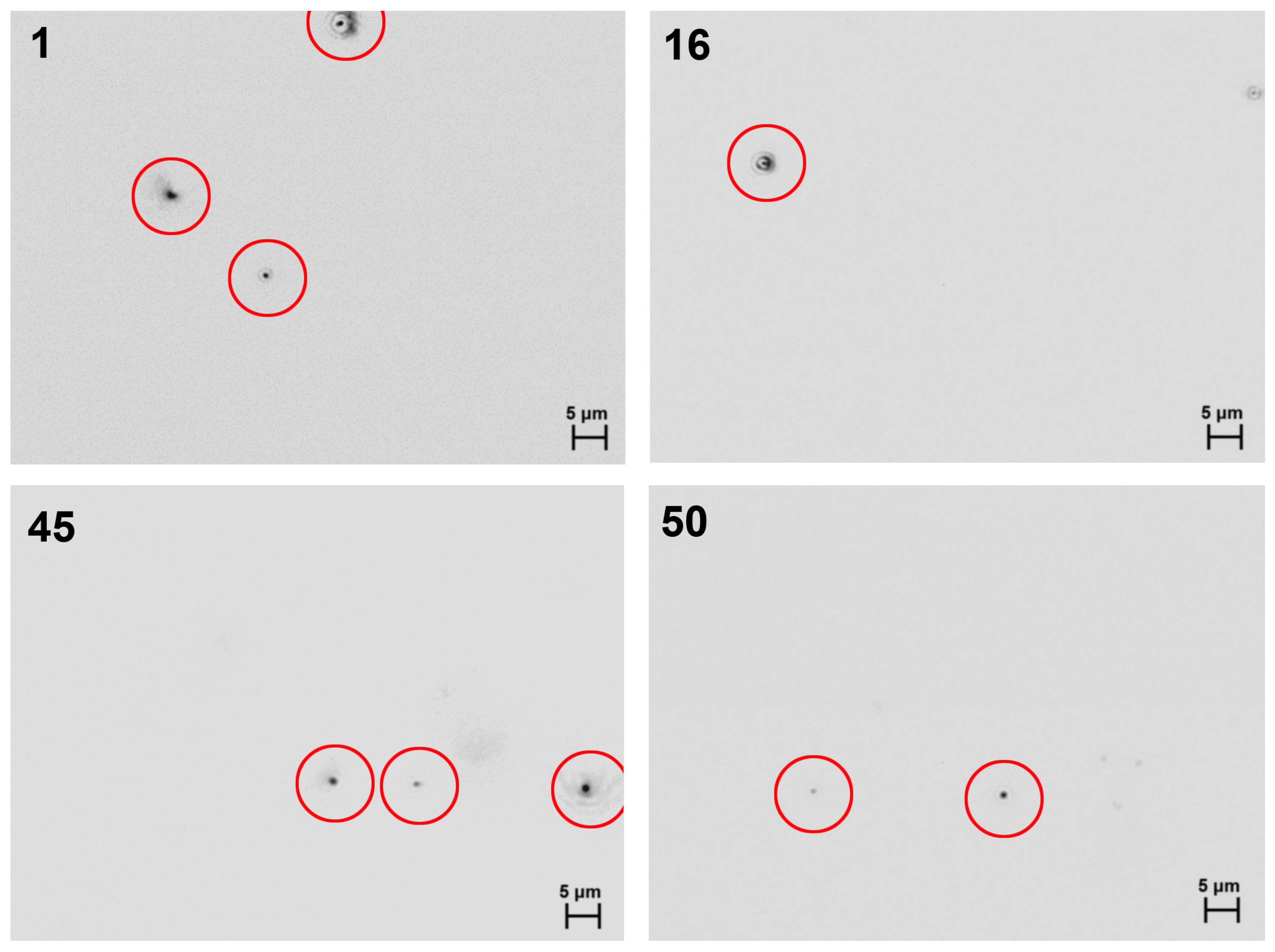
Figure 7.
Temporal fluctuations of NB population. Population bursts occur at intervals of approximately 1 hour, followed by intermittent fluctuations.
Figure 7.
Temporal fluctuations of NB population. Population bursts occur at intervals of approximately 1 hour, followed by intermittent fluctuations.
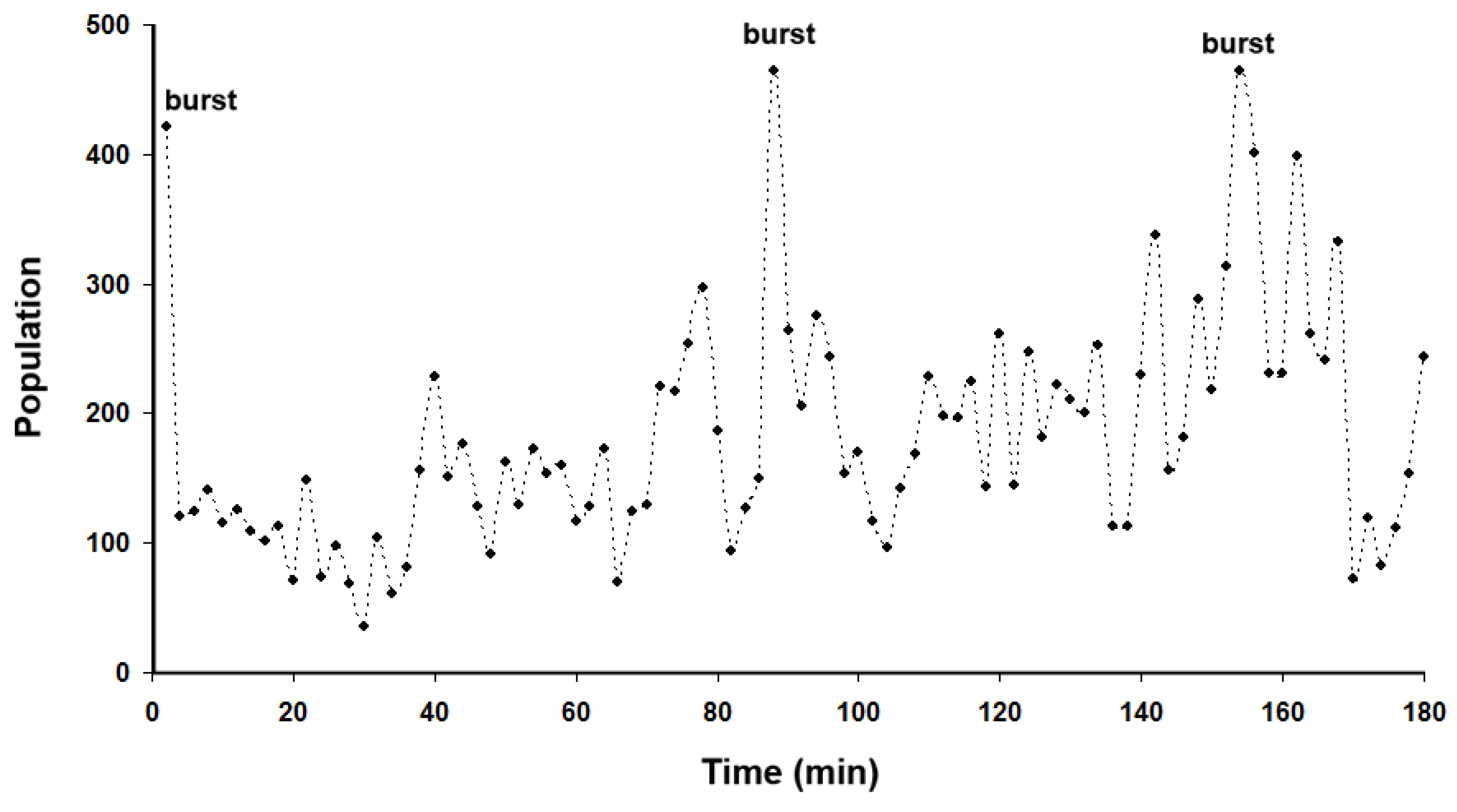
Figure 8.
Proposed mechanism for NB stability. Each NB acts as an attractor of a non-extensive thermodynamic micro-domain. Stability is maintained through radial breathing dynamics. After collapse, the micro-domain becomes extensive and expands. In a metastable state formed by overlapping expanded micro-domains, new NBs can nucleate.
Figure 8.
Proposed mechanism for NB stability. Each NB acts as an attractor of a non-extensive thermodynamic micro-domain. Stability is maintained through radial breathing dynamics. After collapse, the micro-domain becomes extensive and expands. In a metastable state formed by overlapping expanded micro-domains, new NBs can nucleate.
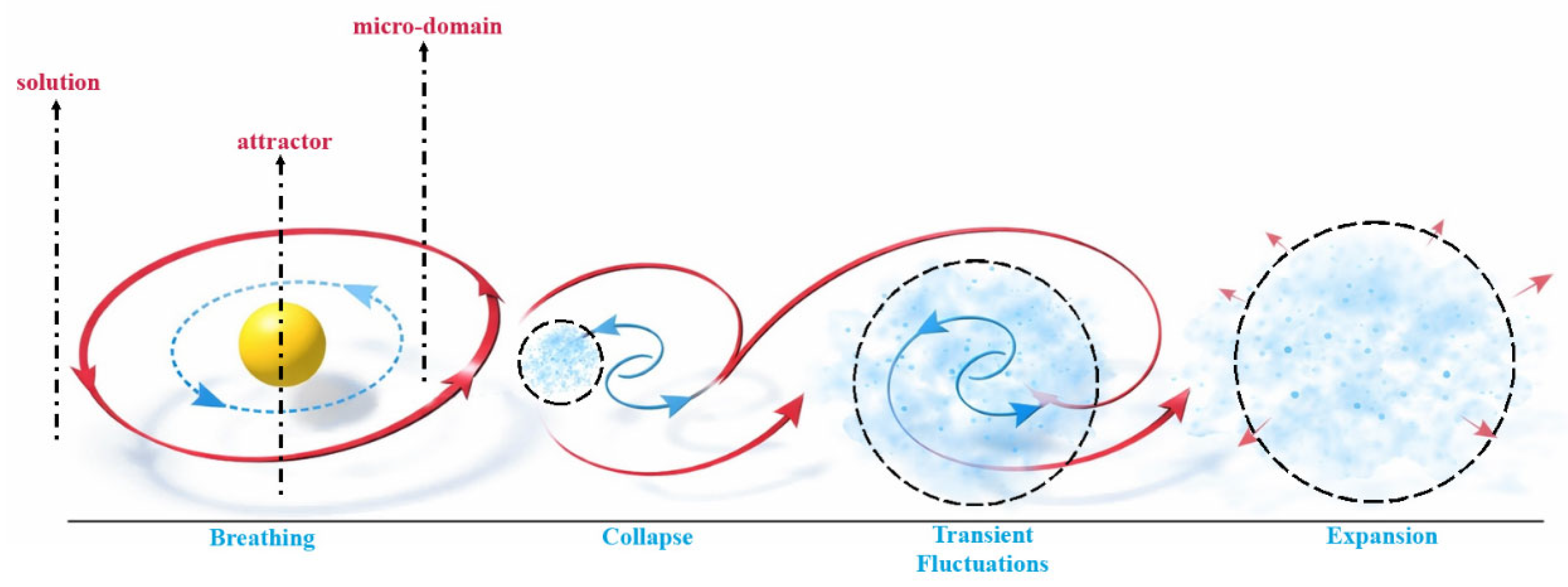

Table 1.
Nanobubble cycling process.
| 1st | 2 | 88 | 154 | ||||
| 2nd | 40 | 78 | 94 | 142 | 162 | 168 | |
| 3rd | 30 | 48 | 66 | 82 | 104 | 137 | 170 |
| 4th | 421 | 465 | 465 | ||||
| 5th | 135 | 203 | 222 | ||||
| 6th | 68 | 56 | 52 | ||||
| 7th | 306 | 210 | 228 | ||||
| 8th | 296 | 286 | 337 | ||||
| 9th | 282 | ||||||
| 10th | 130 | 108 | 116 | ||||
| 11th | 109 | 113 | 131 |
Cases: 1st Time (min) where prime bursts occur; 2nd time where secondary bursts occur; 3rd time where lowest population is recorded; 4th max population per prime burst; 5th average population between bursts; 6th population lost (%); 7th average size (nm) at burst periods; 8th average size at intermittent periods; 9th overall average size; 10th max population at burst for the 0-10 bin; 11th average population between bursts for the 0-10 bin.
Disclaimer/Publisher’s Note: The statements, opinions and data contained in all publications are solely those of the individual author(s) and contributor(s) and not of MDPI and/or the editor(s). MDPI and/or the editor(s) disclaim responsibility for any injury to people or property resulting from any ideas, methods, instructions or products referred to in the content. |
© 2026 by the authors. Licensee MDPI, Basel, Switzerland. This article is an open access article distributed under the terms and conditions of the Creative Commons Attribution (CC BY) license (http://creativecommons.org/licenses/by/4.0/).
Copyright: This open access article is published under a Creative Commons CC BY 4.0 license, which permit the free download, distribution, and reuse, provided that the author and preprint are cited in any reuse.


