

Submitted:
30 March 2026
Posted:
31 March 2026
You are already at the latest version
Abstract
Background: Sustaining measles elimination in the post-elimination era presents increasing challenges due to global resurgence and waning vaccine-induced immunity. We aimed to evaluate epidemiological trends, vaccination strategies, and population immunity associated with achieving and maintaining measles elimination in Taiwan. Methods: We conducted a comprehensive analysis of national surveillance data from 1991 to 2024, including case notifications, viral genotypes, vaccination coverage rates (VCR), and surveillance performance indicators. Three population-based seroprevalence surveys conducted between 2002 and 2020 were reviewed to assess age-specific immunity. Descriptive analyses were performed to characterize long-term epidemiological and immunological trends. Results: Since 1993, annual measles cases have remained below 50, with non-imported incidence consistently <1 per million. Coverage for both MMR1 and MMR2 has exceeded 95% since 1998, with MMR1 coverage >97% since 2009. Genotyping evidence confirms interruption of endemic transmission since 2006. Seroprevalence surveys revealed declining antibody levels among adolescents and young adults, with seropositivity as low as 36.7% in specific cohorts. Despite this, transmission following importations has remained limited, with minimal secondary spread. Conclusions: Taiwan has successfully sustained measles elimination through high vaccination coverage, robust surveillance, and targeted interventions. Although serological evidence indicates waning immunity, epidemiological data suggest preserved population-level protection, likely mediated by immunological memory. Targeted booster strategies for high-risk groups may be more appropriate than universal additional dosing in post-elimination settings.
Keywords:
1. Introduction
2. Materials and Methods
2.1. Surveillance and Immunization Data Collection
2.2. Data analysis
- The first survey (2002–2007): Utilized residual sera from a cohort study titled "Prevalence Survey of Triple-High Status" (participants aged ≥15 years).
- The second survey (2007–2008): Employed a multi-stratified design to sample the general population, ranging from infants (< 1 year) to seniors (≥65 years).
- The third survey (2019–2020): Utilized residual blood samples from the "Taiwan National Immunity Longitudinal Survey" (participants aged 3–59 years).
3. Results
3.1. Long-Term Epidemiological Trends
3.2. Vaccination Policy and Coverage Rates
3.3. Quality of Epidemiological and Laboratory Surveillance Systems [6]
3.4. Seroprevalence Survey
3.5. Genotyping Evidence
4. Discussion
- Birth year prior to 1981 (provided the individual is not immunocompromised);
- Laboratory-confirmed history of measles or rubella infection;
- Serological evidence of positive measles/rubella antibody titers within the previous five years;
- Documented administration of two MMR doses (with a minimum interval of 28 days) after one year of age, provided the final dose was received within the last 15 years.
5. Conclusions
Author Contributions
Funding
Institutional Review Board Statement
Informed Consent Statement
Data Availability Statement
Acknowledgments
Conflicts of Interest
Abbreviations
| VCR | Vaccination Coverage Rates |
| MV | Measles Vaccine |
| CRS | Congenital Rubella Syndrome |
| NT | Neonatal Tetanus |
| WHO | World Health Organization |
| WPRO | Western Pacific Regional Office |
| Taiwan CDC | Taiwan Centers for Disease Control |
| NIIS | National Immunization Information System |
| MMR | Measles-Mumps-Rubella Vaccine |
| MCV | Measles-Containing Vaccine |
| MMR1 | The First Dose of The Measles-Mumps-Rubella Vaccine |
| MMR2 | The Second Dose of The Measles-Mumps-Rubella Vaccine |
| SVF | Secondary vaccine failure |
| Taiwan ACIP | Taiwan Advisory Committee on Immunization Practices |
| ELISA | Enzyme-Linked Immunosorbent Assays |
| PRNT | Plaque Reduction Neutralization Test |
References
- World Health Organization. Measles Fact Sheet, 2025. https://www.who.int/news-room/fact-sheets/detail/measles.
- Centers for Disease Control and Prevention. History of Measles, 2024. https://www.cdc.gov/measles/about/history.html.
- Minta AA, Ferrari M, Antoni S, et al. Progress toward measles elimination - worldwide, 2000–2023. MMWR Morb Mortal Wkly Rep. 2024; 73:1036-1042. [CrossRef]
- World Health Organization, Regional Office for the Western Pacific, 2013. Guidelines on verification of measles elimination in the Western Pacific Region. https://www.who.int/westernpacific/publications/i/item/9789290616290.
- World Health Organization, Regional Office for the Western Pacific, 2013. Measles elimination field guide. https://www.who.int/westernpacific/publications/i/item/9789290616054.
- World Health Organization. Framework for verifying elimination of measles and rubella. Wkly Epidemiol Rec. 2013;88(9):89-99. https://www.who.int/publications/i/item/framework-for-verifying-elimination-of-measles-and-rubella.
- World Health Organization. Monitoring measles surveillance and progress towards measles elimination. Wkly Epidemiol Rec. 2010; 85 (49): 490 – 495. https://www.who.int/publications/i/item/WER8549.
- Chen CJ, Lee PI, Hsieh YC, et al. Waning population immunity to measles in Taiwan. Vaccine. 2012;30(47):6721-6727. vaccine.2012.09.004. [CrossRef]
- Cheng WY, Lee L, Rota PA, Yang DC. Molecular evolution of measles viruses circulated in Taiwan 1992-2008. Virol J. 2009; 6:219. http://www.virologyj.com/content/6/1/219.
- Cheng WY, Wang HC, Wu HS, Liu MT. Measles surveillance in Taiwan, 2012-2014: changing epidemiology, immune response, and circulating genotypes. J Med Virol. 2016;88(5):820-827. [CrossRef]
- Cheng WY, Chen BS, Wang HC, Liu MT. Genetic characteristics of measles viruses isolated in Taiwan between 2015 and 2020. Virol J. 2023; 20:211. [CrossRef]
- Liu DP, Wang ET, Pan YH, Cheng SH. Innovative applications of immunization registration information systems: example of improved measles control in Taiwan. Euro Surveill. 2014;19(50):20994. http://www.eurosurveillance.org/ViewArticle.aspx?ArticleId=20994.
- Castillo-Solórzano C, Reef SE, Morice A, Andrus AM, et al. Guidelines for the documentation and verification of measles, rubella, and congenital rubella syndrome elimination in the region of the Americas. J Infect Dis. 2011;204(Suppl 2): S683-S689. [CrossRef]
- Lee YC, Lee YH, Lu CW, Cheng SY, Yang KC, Huang KC. Measles immunity gaps in an era of high vaccination coverage: A serology study from Taiwan. Travel Medicine and Infectious Disease. 36(2020) 101804. [CrossRef]
- Seagle EE, Bednarczyk RA, Hill T, Fiebelkorn AP, et al. Measles, mumps, and rubella antibody patterns of persistence and rate of decline following the second dose of the MMR vaccine. Vaccine. 2018;36(6):818-826. [CrossRef]
- Gidding HF, Quinn HE, Hueston L, Dwyer DE, McIntyre PB. Declining measles antibodies in the era of elimination: Australia's experience. Vaccine. 2018;36(4):507-513. [CrossRef]
- Ariyarajah A, Crowcroft NS, Brown KA, Wang J, et al. Measles seroprevalence among individuals serologically tested in Ontario, Canada. Vaccine. 2025;62:127446. [CrossRef]
- World Health Organization. Measles vaccines: WHO position paper – April 2017. Wkly Epidemiol Rec. 2017;92(17):213-215. https://www.who.int/publications/i/item/who-wer9217-205-227.
- Williamson KM, Faddy H, Nicholson S, Stambos V, et al. A cross-sectional study of measles-specific antibody levels in Australian blood donors: implications for measles post-elimination countries. Vaccines. 2024;12(7):818. [CrossRef]
- Tischer A, Gassner M, Richard JL, Suter-Riniker F. Mankertz A, Heininger U. Vaccinated students with negative enzyme immunoassay results show positive measles virus-specific antibody levels by immunofluorescence and plaque neutralisation tests. J. Clin. Virol. 2007; 38, 204–209. [CrossRef]
- Lin YC, Hsieh YC, Huang YL, Huang YC, Huang YT, Huang Y C. Seroepidemiology for measles among elementary school children in Northern Taiwan. Journal of Microbiology, Immunology and Infection. 2016;49(4):561-566. [CrossRef]
- Centers for Disease Control and Prevention (CDC); Advisory Committee on Immunization Practices. Immunization of health-care personnel: recommendations of the Advisory Committee on Immunization Practices (ACIP). MMWR Recomm Rep. 2011;60(RR-7):10-14.
- Tranter I, Smoll N, Lau CL, Williams DL, Neucom D, et al. Onward virus transmission after measles secondary vaccination failure. Emerg Infect Dis. 2024;30(9):1769-1777. https://wwwnc.cdc.gov/eid/article/30/9/24-0150_article.
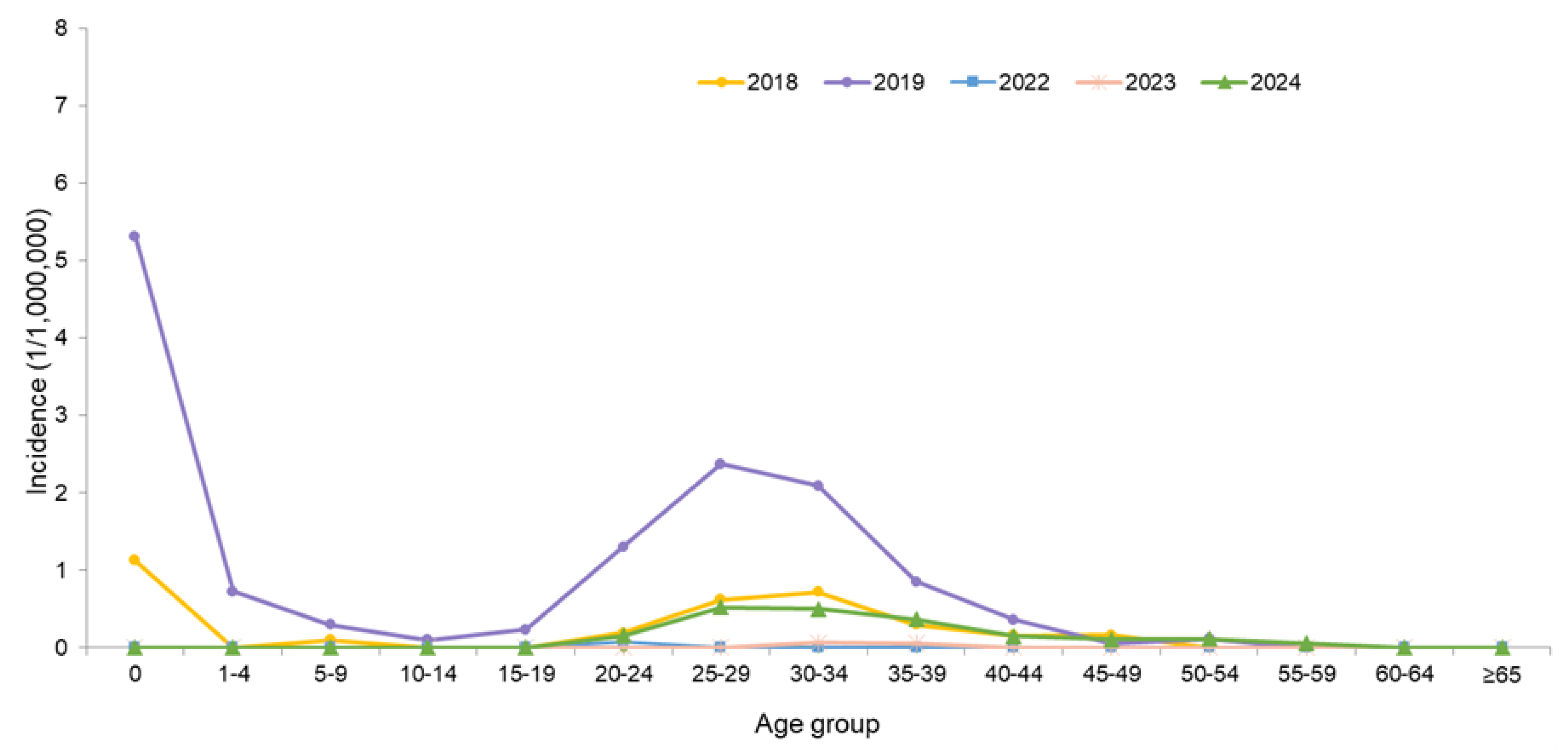

| Indicators | Parameters | |
|---|---|---|
| Target | 2020-2024 | |
| Incidence | ||
| Incidence of all measles cases per million total population (exclude imported cases) | < 1 | 0.00 – 0.85 |
| Population immunity | ||
| National MCV1 coverage | ≥ 95% | 98.6% – 98.8% |
| National MCV2 coverage | ≥95% | 96.2% – 97.6% |
| Quality of the surveillance system | ||
| Epidemiologic surveillance indicators | ||
| % of suspected cases reported within 24 hours | ≥80% | 96.9% –100.0% |
| Annual reporting rate of discarded non-measles cases per 100,000 population at the national level* | ≥2 per 100,000 | 0.39 – 2.35 |
| % of suspected cases with adequate investigation | ≥80% | 100% |
| Laboratory indicators | ||
| % of suspected cases with adequate blood specimen | ≥80% | 96.7% – 100% |
| % of blood specimens received at the TCDC laboratory within five days of collection | ≥80% | 100% |
| % of specimens with results reported within four days of receipt at the designated laboratory | ≥80% | 99.0% – 100% |
| % of outbreaks with specimens collected for virus detection | ≥80% | 100% |
| % of virus detection and genotyping completed within two months of receipt at the lab | ≥80% | 100% |
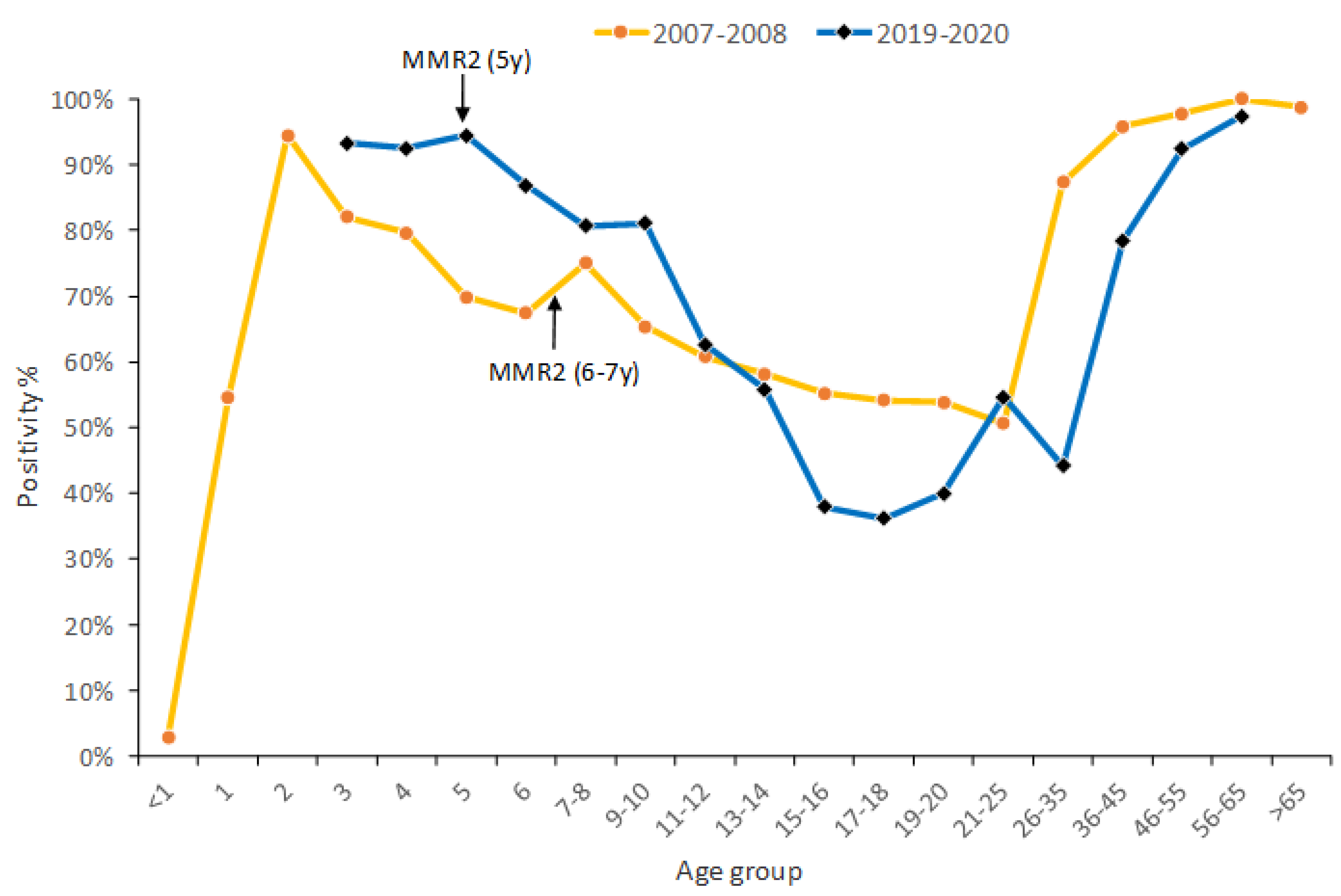
| Year of serum sample obtained | 2002 | 2007 | 2007-2008 | 2019-2020 | |||||||||||
| Source of the study population | Prevalence Survey of Triple-High Status (≥15 years old) |
Population in Taiwan | National Immunity Longitudinal Survey | ||||||||||||
| Sampling method | Stratified random sampling (Cohort study) | Stratified random sampling | Simple random sampling | ||||||||||||
| Antibody test | ELISA (Kit brand: Siemens Enzygnost) | ELISA (Kit brand: Siemens Enzygnost) | ELISA (Kit brand: Euroimmun) | ||||||||||||
| Birth cohort |
Case number | Pa | Eb | Case number | Pa | Eb | Age group | Case number (Birth cohort) |
Pa | Eb | Age group | Case number (Birth cohort) |
Pa | Eb | |
| >65 | 251 (~1942) |
98.8% | 1.2% | ||||||||||||
| 56-65 | 250 (1942-52) |
100% | 0% | ||||||||||||
| 1958-68 | 204 | 98.0% | 1.0% | 204 | 98.5% | 1.0% | 46-55 | 267 (1952-62) |
97.8% | 1.5% | 55-59 | 190 (1959-65) |
97.4% | 1.6% | |
| 1969-75 | 300 | 94.0% | 5.0% | 300 | 93.3% | 4.0% | 36-45 | 263 (1962-72) |
95.8% | 3.0% | 50-54 | 201 (1964-70) |
93.0% | 2.0% | |
| 45-49 | 210 (1969-75) |
89.1% | 1.4% | ||||||||||||
| 1976-86 | 300 | 84.7% | 10.3% | 300 | 81.7% | 10.0% | 26-35 | 245 (1972-82) |
87.3% | 8.2% | 40-44 | 211 (1974-80) |
81.0% | 5.2% | |
| 35-39 | 203 (1979-84) |
66.5% | 9.4% | ||||||||||||
| 21-25 | 255 (1982-87) |
50.6% | 30.6% | 30-34 | 197 (1984-89) |
48.2% | 10.2% | ||||||||
| 17-20 | 408 (1987-91) |
53.9% | 23.3% | 25-29 | 201 (1989-95) |
41.8% | 11.4% | ||||||||
| 13-16 | 302 (1991-95) |
56.6% | 19.2% | 20-24 | 209 (1994-2000) |
54.6% | 6.7% | ||||||||
| 9-12 | 421 (1995-99) |
63.2% | 22.1% | 15-19 | 210 (1999-2005) |
36.7% | 8.1% | ||||||||
| 5-8 | 409 (1999-2002) |
71.9% | 17.1% | 10-14 | 215 (2004-2010) |
64.7% | 8.4% | ||||||||
| 1-4 | 446 (2002-2006) |
78.9% | 7.0% | 5-9 | 213 (2009-2014) |
84.0% | 5.2% | ||||||||
| <1 | 35 (2006~) |
2.9% | 0% | 3-4 | 140 (2014-20017) |
92.9% | 0.7% | ||||||||
| Total | 3,552 | 74.7% | Total | 2,400 | 70.1% | ||||||||||
| Year | Measles Virus Genotypes | ||||||||
| H1 | D3 | D4 | D5 | D8 | D9 | G3 | B3 | All | |
| 2001 | 5(3)a | 0 | 0 | 0 | 0 | 0 | 0 | 0 | 5(3) |
| 2002 | 14(3) | 1(1) | 0 | 1 | 0 | 0 | 0 | 0 | 16(4) |
| 2003 | 1(1) | 2(2) | 0 | 1(1) | 0 | 1(1) | 0 | 0 | 5(5) |
| 2004 | 0 | 0 | 0 | 0 | 0 | 0 | 0 | 0 | 0 |
| 2005 | 3 | 0 | 0 | 1(1) | 0 | 0 | 0 | 0 | 4(1) |
| 2006 | 3(3) | 0 | 0 | 0 | 0 | 0 | 0 | 0 | 3(3) |
| 2007 | 3(3) | 0 | 0 | 3(3) | 0 | 1(1) | 0 | 0 | 7(7) |
| 2008 | 8(7) | 0 | 0 | 1(1) | 0 | 2(2) | 0 | 0 | 11(10) |
| 2009 | 30(30) | 0 | 0 | 0 | 1(1) | 0 | 10 | 0 | 41(31) |
| 2010 | 3(3) | 0 | 0 | 0 | 0 | 7(1) | 0 | 0 | 10(4) |
| 2011 | 0 | 0 | 2(2) | 0 | 0 | 27(1) | 0 | 0 | 29(3) |
| 2012 | 5(2) | 0 | 0 | 0 | 3(2) | 0 | 0 | 0 | 8(4) |
| 2013 | 5(5) | 0 | 0 | 0 | 2 | 0 | 0 | 0 | 7(5) |
| 2014 | 5(5) | 0 | 0 | 0 | 4(4) | 1(1) | 0 | 12(7) | 22(17) |
| 2015 | 27(23) | 0 | 0 | 0 | 0 | 0 | 0 | 0 | 27(23) |
| 2016 | 7(4) | 0 | 0 | 0 | 6(5) | 0 | 0 | 0 | 13(9) |
| 2017 | 1(1) | 0 | 0 | 0 | 4(4) | 0 | 0 | 1 | 6(5) |
| 2018 | 0 | 0 | 0 | 0 | 35(31) | 0 | 0 | 3(2) | 38(33) |
| 2019 | 0 | 0 | 0 | 0 | 102(82) | 0 | 0 | 34(27) | 136(109) |
| 2020 | 0 | 0 | 0 | 0 | 0 | 0 | 0 | 0 | 0 |
| 2021 | 0 | 0 | 0 | 0 | 0 | 0 | 0 | 0 | 0 |
| 2022 | 0 | 0 | 0 | 0 | 0 | 0 | 0 | 0 | 0 |
| 2023 | 0 | 0 | 0 | 0 | 2(2) | 0 | 0 | 0 | 2(2) |
| 2024 | 0 | 0 | 0 | 0 | 12(7) | 0 | 0 | 20(18) | 32(25) |
| Total | 120(93) | 3(3) | 2(2) | 7(6) | 171(138) | 39(7) | 10 | 70(54) | 422(303) |
| Age (years) |
2009 | 2010 | 2011 | 2012 | 2013 | 2014 | 2015 | 2016 | 2017 | 2018 | 2019 | 2020 | 2021 | 2022 | 2023 | 2024 |
|---|---|---|---|---|---|---|---|---|---|---|---|---|---|---|---|---|
| 1 | 7 | 2 | 1 | 1 | 0 | 4 | 1 b | 1c | 1 | 0 | 3 | 0 | 0 | 0 | 0 | 0 |
| 2 | 5 | 0 | 0 | 0 | 0 | 1a | 0 | 0 | 0 | 0 | 0 | 0 | 0 | 0 | 0 | 0 |
| 3 | 1 | 0 | 0 | 0 | 0 | 0 | 0 | 0 | 0 | 0 | 2(1a,1b) | 0 | 0 | 0 | 0 | 0 |
| 4 | 1 | 0 | 0 | 0 | 0 | 0 | 0 | 0 | 0 | 0 | 0 | 0 | 0 | 0 | 0 | 0 |
| 5 | 2 | 0 | 0 | 0 | 0 | 0 | 0 | 0 | 0 | 1 a | 1 a | 0 | 0 | 0 | 0 | 0 |
| 6 | 1 | 0 | 1 | 0 | 0 | 0 | 0 | 0 | 0 | 0 | 1b | 0 | 0 | 0 | 0 | 0 |
| Total cases | 17 | 2 | 2 | 1 | 0 | 5 | 1 | 1 | 1 | 1 | 7 | 0 | 0 | 0 | 0 | 0 |
Disclaimer/Publisher’s Note: The statements, opinions and data contained in all publications are solely those of the individual author(s) and contributor(s) and not of MDPI and/or the editor(s). MDPI and/or the editor(s) disclaim responsibility for any injury to people or property resulting from any ideas, methods, instructions or products referred to in the content. |
© 2026 by the authors. Licensee MDPI, Basel, Switzerland. This article is an open access article distributed under the terms and conditions of the Creative Commons Attribution (CC BY) license (http://creativecommons.org/licenses/by/4.0/).


