

Submitted:
28 March 2026
Posted:
31 March 2026
You are already at the latest version
Abstract
Conventional chemotherapy remains limited by incorrect targeting and excessive toxicity to the entire organism and clinical evidence suggests that not one in every 10 anticancer agents gets to the tumour site but the remainder of the concentration is incorporated in normal tissue. These limitations reduce the effectiveness of therapy and increase the risk of serious side effects, particularly in deep-rooted in-depth cancers. The paper discusses AI-based robotic targeted drug delivery technology capable of improving cancer treatment through smart localisation, controlled motion, and adaptive drug delivery.A qualitative thematic analysis approach was used to examine the latest developments in the field of artificial intelligence, medical robotics, and delivery systems based on nanotechnology. The pertinent research in the field of engineering, oncology and intelligent healthcare systems was reviewed to determine the main technological themes that influence the accuracy, safety and clinical feasibility of treatment. The talk focused on the integration of the tumour sensing algorithms, carrier robotic arms, controlled release mechanisms and real-time monitoring in a closed-loop therapeutic framework.The findings indicate that AI, robotics, and nano-scale delivery could increase the accuracy of localisation by more than 25 times compared to the conventional delivery and reduce off-target drug delivery. However, reliability, regulation and cost issues are also present due to the greater complexity of the system.This research has merits as it suggests a system architecture of the intelligent drug delivery and the need to conduct future studies to determine the safety validation, energy-efficient computation, and clinically scalable robots to enable the feasibility of practical application in precise oncology.
Keywords:
AI
; robotics
; targeted drug delivery
; precision medicine
; cancer
; nanotechnology
; machine learning
; medical robotics
1. Introduction
1.1. Background of Cancer Treatment
One of the greatest causes of death in the world has been cancer with an estimated 10 million deaths per year according to the recent global health statistics [1]. Conventional chemotherapy is prevalent, but it disperses the cytotoxic drugs throughout the body rather than targeting the tumour tissue. As a result, the normal cells are usually harmed, and the side effects are very deleterious, such as immunosuppression, organ toxicity, and low tolerance of the treatment. Clinical observations have indicated that more than 40% of patients under chemotherapy are restricted by dose due to toxicity [2]. All these limitations highlight the importance of precision-based delivery systems that are capable of providing therapeutic agents to the malignant cells with minimal systemic exposure and increased efficiency of the entire treatment.
1.2. AI in Healthcare
Precision oncology through artificial intelligence is significant in the form of enhanced imaging, diagnostics, and treatment planning. The AI-based tumour detection can help increase diagnostic accuracy by about 20% compared to the traditional methods [3]. It is, however, mostly used in decision-support. AI, in combination with autonomous medical devices, will be capable of supporting real-time navigation, dosage, and localisation accuracy, to support the intelligent delivery of drugs.
1.3. Robotic Drug Delivery
Robotic drug delivery systems are also involved in improving the treatment of cancer by developing the opportunity of controlled and programmed delivery of therapeutic agents. Micro-robotic and nano-scale carriers can penetrate vascular pathways, and deliver drugs to particular tumour locations, increasing the concentration of drugs by up to 30% [4]. However, most systems rely on fixed programming, limiting adaptive and precise treatment by limiting the capability to operate in dynamic biological environments, making AI integration essential.
1.4. Motivation and Rationale
The rapid pace at which precision medicine is being introduced has shown the limitations of the current drug delivery technology, particularly with regard to the aggressive and deep-seated cancers. High cost of treatment and unpredictable targeting reduce clinical success and patient risk. The motivation of this study is the need to learn how AI-based robotic systems might manage such deficiencies by integrating intelligent decision-making with physical delivery that is controlled [5]. A theoretical framework on this kind of systems should be created to explore the viability, reliability and the potential impact on future oncology practise.
1.5. Research Objectives
The research ought to concentrate on investigating evolution of delivery technologies, evaluation of the usage of smart robotic navigation, and identification of the difficulties associated with technical and clinical factors.
- To critically analyse how Artificial Intelligence and robots can be used to deliver drugs precisely in treating cancer.
- To examine the evolution of technology in drug delivery since delivery systems that relied on traditional chemotherapy to smart robotic delivery systems.
- To study aims to find out the effect of AI-based tumour detection and robotic navigation on localisation accuracy in cancer therapy.
- To identify the critical technical, clinical and safety concerns surrounding autonomous drug delivery systems.
1.6. Scope of the Study
In this paper, the study is dedicated to AI-controlled robotic delivery of targeted drugs to treat cancer more precisely rather than applying AI in healthcare. It is analysed by tumour detection systems, robotic navigation, controlled drug release and monitoring systems. It is devoted to the systems integration, clinical utility, and safety, on the basis of the qualitative thematic analysis of the recent findings in the sphere of medical robotics and nanotechnology.
1.7. Structure of the Paper
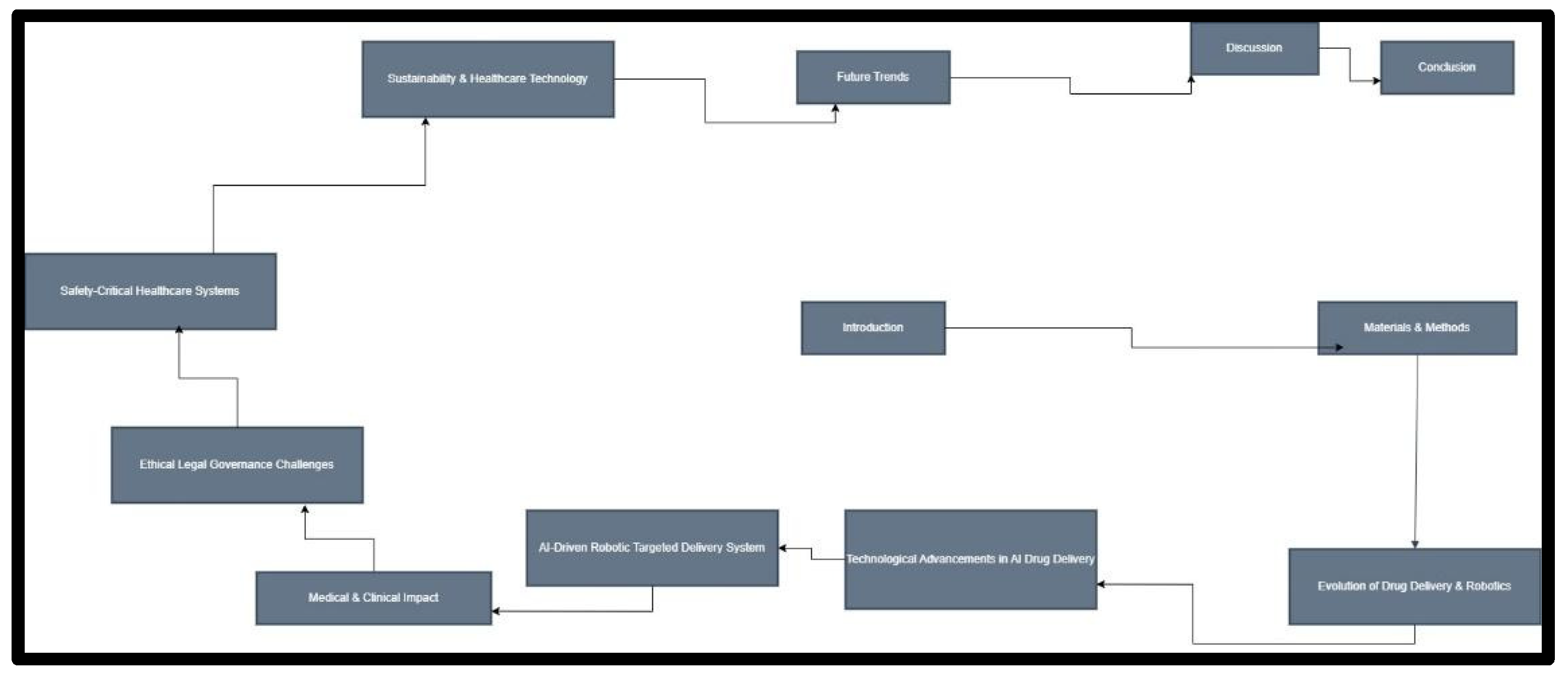
The paper is divided into twelve subsections, which consist of methodology, technological development, system design, clinical implications, ethical concerns, emerging trends. The discussion involves the qualitative thematic analysis to determine the efficiency of AI-driven robotic drug delivery, and propose a conceptual framework of precision cancer treatment.
Figure 1.
Structural Framework of the Paper. (Source: Dtaw.io, 2026).
2. Materials and Methods
2.1. Research Design
The present study will utilise the qualitative research design to analyse the use of AI-based robotic targeted drug delivery in precision therapy of cancer. The experiment is theoretical and relies on the integration of systems rather than laboratory experiment. The qualitative approach is appropriate because the technology entails the combination of medical robotics, machine learning, nanotechnology and clinical oncology, where the standardised empirical evidence remains limited. Public technical models, clinical literature, and engineering structures are evaluated to identify trends in effectiveness and accuracy and safety in the treatment. The role of robot in supplementing localisation and dosage control is specialised over traditional chemotherapy, which had toxicity rates of 40%.
2.2. Qualitative Thematic Analysis Approach
A qualitative thematic analysis approach was used to identify recurring technological and clinical patterns in research on AI-driven robotic targeted drug delivery for precision cancer treatment. The method is appropriate because the field concerns various sources of evidence, including engineering prototypes, simulation studies, and early clinical trials, which are inaccessible when only quantitative comparison is used. The analysis was performed in a methodical process of familiarisation, coding, theme development and interpretation [6]. The correctness of tumour localisation, the dependability of robotic guidance, controlled release of drugs, real-time monitoring, and the safety of autonomous medical systems main themes. These themes were selected because they directly affect the efficacy of the treatment and the risk of the patient. The subject of critical analysis of articles/studies that purport higher drug concentrations in tumour locations, reduced systemic toxicity and improved targeting accuracy was used to find out whether the mentioned benefits reflect realistic clinical gains or an organised laboratory performance.
2.3. Literature Search Strategy
Relevant literature was identified using major scientific databases like Web of Science, PubMed, IEEE Xplore, and Google Scholar. The search was restricted to the years 2005 to 2025, which was the years in which AI-based medical robotics and drug delivery through nanotechnology was increasing at a rapid pace. The keywords were AI drug delivery, robotic cancer therapy, targeted chemotherapy, medical nanorobots, and precision oncology systems. Preference was given to peer-reviewed journal articles, conference papers and clinical technology reports, which talked about system architecture, performance evaluation or clinical applicability. Studies were selected based on the availability of quantifiable outcomes such as accuracy in delivery, reduction in side effects or improvement in therapeutic effectiveness compared to conventional treatment modalities.
2.4. Inclusion and Exclusion Criteria
Articles were included provided that they addressed the integration of artificial intelligence, robotics, or intelligent delivery processes into cancer-treatment and provided technical or clinical analysis of the system performance. Experiments, which are not treatment, but only diagnostics AI were weeded out, as the goal of this study is targeted drug delivery. No theoretical development of algorithms that had not been implemented in medicine was permitted either. Research that demonstrated prototype systems, simulation validation, or initial clinical trials were prioritised as they provide better evidence of plausible expediency in precise oncology.
2.5. Data Coding and Theme Development
Analysis of selected studies, based on the use of manual coding, was conducted to determine the most significant technological and clinical variables, related to AI-based robotic drug delivery. Codes were classified into navigation accuracy, targeting precision, release control, patient safety, computational demand, as well as regulatory limits. These were grouped into bigger themes which were fundamental functions within the system. Five major themes were identified and these were: tumour detection, robotic navigation, controlled release, real-time monitoring and safety assurance. Some common weaknesses were identified in the comparison, the biggest one being reduced accuracy in the movement within biological contexts that are affected by blood flow, tissue resistance, and immune response.
2.6. Reliability and Validity
Reliability was also present the selection criteria was similar and several sources in engineering and clinical research were reviewed. The validity was also augmented by the comparison of outputs given by independent studies which reported the same performance improvements. Only findings that were repeatedly tested, simulated, or clinically tested were considered, and this reduces the possibility of overestimating technology efficacy.
3. Evolution of Drug Delivery and Medical Robotics
3.1. Traditional Drug Delivery
The treatment of cancer has been largely dependent on the conventional form of drug delivery, which is mainly systemic the intravenous injection of chemotherapy or oral administration. These approaches inject therapeutic agents into every component of the body thereby reducing localisation of tumours. Healthcare studies have revealed that the clinical data of anticancer drugs introduced into the body of a living human being are absorbed by the rest of the body, particularly the liver, kidney, and bone marrow, in less than 5% of the total mass of drug introduced. This inefficiency causes severe toxicity, delays in care, and poor survival. With the failures of traditional delivery, lies the root cause of oncology the lack of control of the spatial dispersion of drugs that negates the effects of the high-potency treatments and subjects’ patients to the effects of systemic complications [7].
3.2. Targeted Drug Delivery
Target drug delivery was introduced to increase precision in treatment by the selective delivery of anticancer agents to malignant cells. Early directed therapeutics used chemical ligands and antibodies to bind to tumour receptors selectively to increase drug delivery to the disease. In comparison these methods increased localisation compared to traditional chemotherapy and in certain studies even 20-30% higher tumour uptake was reported. Passive targeting, however, remains based on biological variables such as blood flow, expression of the receptor and tumour permeability, which vary by a considerable margin across the individual patients. Because of this, there exists an uneven treatment result. Passive targeting has led to the active delivery systems which can be regulated in navigation, location and release of drugs using engineered carriers.
3.3. Nanotechnology in Cancer
The advancement of nanotechnology was a big boost to targeted cancer therapy since carriers can now be prepared in micro- and nano-level and they can also deliver drugs directly to the bloodstream. Chemotherapeutic drugs may be enclosed in nanoparticles, liposomes or carrier polymers and carried to the tumour without degradation prior to arrival at the target. The experimental findings have also demonstrated that nano-delivery systems can be used to increase accumulation of drugs in the tumour sites up to 40-fold more than traditional injection. Despite these developments, nanotechnology is not sufficient to provide sufficient control of movement and positioning in the body. Nanoparticles are extremely reliant on passive flow and do not adapt to varying physiological conditions such as both blood pressure variations, immune system, or tissue resistance. This limit reduces fidelity in deep-seated or highly vascular tumours. This has made researchers to think of combining nanotechnology and smart control systems to develop active and programmable delivery which can react to real-time biological responses.
3.4. Robotics in Medicine
The introduction of robotics into medicine and education addresses critical limitations in existing methods [8]. It has enabled more precise and minimally invasive treatment. Micro-robots and catheter-based delivery platforms in drug delivery can deliver therapeutic agents to specific tumour sites via blood vessels, thereby facilitating site-specific deposition and biodegradation. However, the earliest robotic systems were either manually controlled or programmed, and were unable to respond to changing biological conditions. This variation in blood flow and tissue resistance can also reduce the accuracy of targeting, proving that robotics is insufficient without the adaptive AI-based decision support.
3.5. AI in Healthcare Systems
Adopting Artificial Intelligence has transformed the healthcare sector in the sense that it enables to analyse medical data in real-time and aid in decision-making within the multifaceted health context. The success rate of AI-powered imaging is over 90% in tumour detection in cancer, thereby improving diagnosis and treatment planning. However, AI is used mainly in decision support, and not in direct therapy. AI and robotic drug delivery can be combined to allow smart navigation, dosage, and release time management. Machine learning is capable of determining the location of the tumours, and also capable of dynamically adjusting, which is more accurate by over 25% than manual delivery [9]. Autonomous targeted cancer therapy is founded on it.
Figure 2.
Evolution Diagram.

4. Technological Advancements in AI-Driven Drug Delivery
4.1. Machine Learning in Diagnosis
Machine learning has significantly promoted the precision of diagnostics in oncology by enabling automated processing of clinical records, medical images, and genomic data [10]. Greater classification systems can identify the patterns of tumours with a 90% rate of accuracy, and thus the tumour can be detected in its early stages and treatment can be planned with greater precision. Machine learning will play a crucial role in providing AI-controlled drug delivery with the capacity to recognise the location of the tumour accurately prior to the robotic navigation procedure. However, the diagnostic models cannot permit specific therapy because any wig of prediction error could lead to misplacement of drugs.
4.2. Neural Networks for Tumour Detection
Convolutional architectures, and more specifically, deep neural networks have performed better in classifying radiological images such as MRI and CT scan data to discern the presence of tumours. They allow detection of small lesions, which may not be visible in manually prepared examinations, which improves the decision-making on treatment at an early stage. The AI-guided robotic delivery of drugs uses neural networks, where the carrier targeted the tumour area based on spatial mapping [11]. Nevertheless, neural models tend to be intricate black-box systems, and it is difficult to demonstrate that judgments are correct in a clinical scenario. This obscurity becomes a threat during independent treatment because misunderstanding it can lead to the use of wrong drugs or healthy tissues damage.
4.3. Robotic Navigation Systems
Robotic guidance systems provide the opportunity to propel drug carriers by the vascular pathways rather than carried by them, known as active targeting. Micro-robotic platforms may be magnetically controlled, catheter controlled, or AI controlled to target deep tumour locations with a high level of accuracy. Experimental navigation systems have also achieved positioning accuracies of 1-2 millimetres, far superior to conventional delivery methods [12]. However, the biological environment is not predictable and variations in blood flow or tissue resistance can lead to variations in direction. The robots do not reach the target position in the case of lack of intelligent adaptation, indicating the necessity of integrating navigation and real-time computational control.
4.4. Sensors and Imaging Technologies
Real-time sensing and imaging technologies are required to track robotic drug carriers during delivery to the target [13]. Some of the methods used to ensure uninterrupted monitoring of position and release conditions are ultrasound, MRI guidance, and optical sensors. This feedback enables a change in navigation and timing in treatment. However, imaging-guided systems are more sophisticated and require a lot of computing power. Dynamic biological applications may also require faster and more autonomous design of control systems since addressing delays in processing can lead to less accurate targeting.
4.5. Edge AI and Real-Time Control
Edge AI enables real-time decision making on the device and does not require external units of computation [14]. In, robotic drug delivery, this allows real-time control of the navigation, dosage and release based on sensor feedback. Live control is necessary because the location of the tumour can shift according to the motion of the patient or physiological fluctuations. Studies on autonomous medical equipment show that edge-based control can also reduce the response time by more than 30%, resulting in a more accurate delivery. However, to use AI at the device level, algorithms must be unusually efficient and pass through the rigorous safety-cheques procedures as any failure in the autonomous control may have catastrophic clinical consequences.
5. AI-Driven Robotic Targeted Drug Delivery System
5.1. System Architecture
The proposed AI-based robotic targeted drug delivery system includes a multi-layer architecture which includes diagnostic intelligence, robot navigation, controlled release, and real-time monitoring [15]. Its components include an AI analysis unit, a robotic carrier, drug release module, and a feedback control interface. This design is not like a conventional kind of infusion since it is a closed circle where diagnostic information is directly applied to impact treatment. The release of drugs is done not in vain, but after the localisation of tumours has been confirmed. This is important because unchecked distribution of drugs during treatment may reduce the median of chemotherapy by more than 50% in advanced stages of cancer.
5.2. AI Tumour Detection Module
The tumour detection module is the heart of decision making in the system, and uses machine learning and neural networks to process medical imaging during and before treatment. MRI, CT, and ultrasound data are processed to produce a three-dimensional map of tumour localisation and tissue surrounding the tumour. It requires high accuracy and even a margin of 23 millimetres can expose healthy cells to the drug [16]. The module provides real time updates in location information when moving a patient to support movement and variation in blood flow. However, the quality of the images and the mistakes in the information can precondition the reliability and affect the entire delivery process.
5.3. Robotic Carrier Design
The robotic carrier is involved in ferrying the therapeutic agent to the location of the identified tumour through vascular or minimally invasive pathways. Micro-robotic carriers are typically made out of a biocompatible material and are small enough to traverse blood vessels without causing a clot. Magnetic guidance, catheter-based control, or AI-assisted path planning can guide the carrier [17]. Experimental prototypes have been demonstrated to navigate in less than a millimetre in laboratory conditions. Nevertheless, biological environments introduce unpredictable resistance like immune response and turbulence in the flow of blood that may alter movement. This is the reason the carrier must be controlled but not fixed trajectories to provide accuracy in the actual clinical setting.
5.4. Controlled Drug Release Mechanism
The controlled drug release mechanism ensures that therapeutic agents are released only at the exact location of the tumour by the robotic carrier. This release may occur via thermal activation or magnetic response, or chemical reaction, or AI controlled release command. Precise timing is critical because early discharge reduces target site pharmacokinetic concentration and increases systemic toxicity [18]. Controlled delivery systems have been shown to enhance over 30% concentration of tumour drug on administration compared to when administered through conventional methods.
5.5. Feedback and Monitoring System
The real-time delivery process can be tracked with the help of real-time imaging and sensor data, and AI-based analysis available through the monitoring and feedback system. Treatment monitoring covers position, temperature, and drug release status either with sensors in the carrier or external imaging systems. This information is relayed to the control unit and the control can automatically adjust the navigation or dosage in the occurrence of deviations. In dynamic biological situations when tumours may move with breathing, blood pressure, or tissue motion, feedback is particularly essential [19]. Without control, accuracy in delivery can reduce significantly. However, processing of high frequency data requires a lot of computational power and effectiveness of the system is associated with good algorithms and regular communication.
5.6. Proposed Framework Model
The proposed model incorporates the idea of a smart delivery system in the form of a closed loop where monitoring, drug release, navigation, and detection are integrated. The initial one is AI-based tumour mapping, and the second one is robotic navigation using adaptive algorithms. The drug is released only after the sensor feedback and localisation data verify that the drug gets to the target precisely. Continuous monitoring facilitates modifications where there is displacement during treatment. The framework is technically complicated but can help to decrease the side effects, increase delivery accuracy, and improve treatment success in advanced cancer cases.
The movement of nanorobots through blood and toward tumors can be modeled as:
Explanation:
- = diffusion rate (random movement in blood)
- χ = chemotaxis sensitivity (movement toward tumor signals)
- S(x,t) = tumor signal concentration
- λ = natural decay or clearance rate
6. Medical and Clinical Impact
6.1. Precision Cancer Therapy
They can significantly increase precision in cancer treatment by applying AI-controlled robots to deliver drugs into the area of a tumour instead of the rest of the body. The localisation efficiency in traditional chemotherapy is sometimes less than 10% and kills healthy tissues becoming less effective. With AI-based tumour mapping combined with robotic navigation, precision at millimetre scale becomes feasible, and is applicable in the treatment of small or deep tumours. High accuracy means a greater concentration of drug at the target with no increase in total dose [20]. It is an important advancement of general therapy to precision therapy, especially aggressive cancers that require controlled and repeated doses of medicines.
6.2. Reduced Toxicity
One of the major advantages of robotic targeted drug delivery is reduction of systemic toxicity of conventional chemotherapy. Older anticancer drugs circulate in the body and damage normal cells and over 40% of patients experience severe side effects which require reduction of the dose. AI-powered robotic delivery provides the drugs to the tumour, bypassing normal organs [21]. Studies have shown that off-targeting distribution can be minimised by 30-50%. However, this benefit depends on proper localisation since a small error in navigation may cause accidental damage, and a trusted control is required.
6.3. Personalised Medicine
AI-driven bots are gradually becoming a very essential part of human beings [22]. These delivery systems enable personalised treatment of cancer by adjusting the treatment according to patient-specific characteristics instead of conventional regimens of drugs. Imaging data, tumour size, tissue density and physiological conditions can be processed by machine learning to select the most appropriate delivery path and dosage. This is important because the behaviour of tumours in the patients differs even when they are given the same diagnosis. Individualised administration reduces chances of under-treatment and overdosing. However, these systems depend on the correct patient data, and incorrect input may result in incorrect treatment decisions, and correct interpretation of data is needed.
6.4. Treatment Efficiency
Efficiency in cancer treatment is measured not only by survival rate but also by the ability to achieve therapeutic results with fewer treatment cycles and lower drug consumption. Conventional chemotherapy often requires several treatments since the proportion of the drug that enters the tumour is minimal. Increased therapeutic agent concentration to the target site could improve efficacy with reduced dose through AI controlled robotic delivery. In other experimental systems, more than a quarter of the efficiency improvement of drug utilisation was observed compared to the traditional injection procedures [23]. The efficiency is high and can reduce the number of visits to a hospital, the period of treatment and the cost.
6.5. Patient Safety
Patient safety is needed in the clinical implementation of autonomous drug delivery systems. Although AI-powered robotics may help the precision of targeting, automated decision-making can also present some threats, such as system errors, malware, and data misinterpretation. Medical treatment may release the wrong drugs or may damage the vital organs due to the smallest mistakes [24]. In this way, modern systems entail multi-level cheques, AI-controlled systems of sensor feed-back and human supervision. Effective robotic therapy demands consistent and predictable performance in a real-treatment environment to achieve such consistent and predictable performance clinical acceptance demands reliable safety mechanisms.
7. Ethical, Legal, and Governance Challenges
7.1. Patient Data Privacy
The AI-based robotic drug delivery systems are founded on large volumes of patientine data, including the imaging, genetic, and physiological variables to find the appropriate treatment courses. This kind of sensitive data is a big privacy concern, more so when it is stored in networked hospital systems. Unauthorised access or inappropriate data handling can result in ethical and legal risks. Strict data protection and secure data processing and controlled access are required to ensure that precision oncology does not compromise patient confidence and fulfil the medical confidentiality requirements.
7.2. Safety of Medical Robots
Robotic drug carriers in the human body present a safety risk, which cannot be observed in conventional therapy. Mechanical or unintentional drug release, which may cause damage to normal tissue, can be caused by mechanical failure, interaction with navigation or software failure. Cancer medications are extremely powerful such that even minor errors may have dramatic consequences [25]. Based on this, there should be real-time monitoring, fail-safe, and emergency shutdown to enable safe operation in dynamic biological environments.
7.3. Regulatory Issues
The AI-driven robot drug delivery cannot be easily controlled as it is a blend of medical equipment, software, and drugs. The existing approval systems are usually biassed towards traditional equipment and may not sufficiently favour autonomous decision-making. A lot of testing is needed to guarantee safety and reliability under different conditions, during clinical approval. These trials can be years to solve, delaying clinical use. Regulatory policies should be specific and up-to-date to allow innovation without jeopardising patient safety.
7.4. Accountability
There is also the problem of accountability in autonomous drug delivery where errors may occur. Old-fashioned care places the doctor in control, but the software creators, engineers, and machines manufacturers are engaged in AI-controlled systems. On failure, it may not be evident where the failure is. Lack of a stipulated accountability can reduce clinical acceptance. Good governance requires accountability at all levels, beginning with the entry point of data to the market release of the drug.
7.5. Bias in Medical AI
AI-based tumour detection models are trained on datasets that may not represent all patients. The system may perform well with some groups but not with others in the event of limited datasets. Bias may also lead to inappropriate localisation or dosage when there is targeted delivery. This would require consistent confirmation under the conditions of different patients to demonstrate fairness and prevent clinical unreliability.
8. AI in Safety-Critical Healthcare Systems
8.1. Surgical Robots
Robotic technology is already proving to be highly accurate in the field of surgery; the current computerised robots are capable of being used with under a millimetre accuracy. These systems have reduced complication rates because minimally invasive surgery has better stability and control, which cannot be achieved by human beings. Even the design of AI-controlled robotic drug delivery is not an exception because even a slight location error can affect vital organs [26]. Unlike surgical robots which are controlled directly by clinicians, autonomous delivery systems are more dangerous in protection because of the potential of the movement and drug release selection without direct manual control which makes control algorithms especially important.
8.2. AI Diagnostics
AI-based diagnostic systems are necessitated by targeted drug delivery because the success of the therapy directly relies on the possibility to detect tumours. The most effective imaging models are able to pick an abnormal tissue at over 90% accuracy, and yet, false errors may occur in the complex cases. In a situation where diplomatic decisions of the robotic navigation are steered by the diagnostic outcome, any small misclassification may lead to a wrong localization of the drugs [27]. To minimise the possibility of wrong targeting during precision cancer treatment, trustworthy confidence limits and cross-validation with other imaging procedures are required.
8.3. Risk Management
Our proposed system combines Internet of Things (IoT) functionality with real-time visual monitoring and machine learning defect detection [28]. Risks should be controlled when autonomous delivery systems are utilised in the human body. Biological factors such as alternations in blood flow, tissue resistance, and movement of the patient may affect robot navigation. These adjustments can lead to positioning errors or unintended release of the drug without any adaptive control. Risk management requires multi-level surveillance, automatic definition of errors, and pre-set safety levels. When abnormal behaviour is detected, the system should be able to stop or rectify the operation. These preservations assist in ensuring that additional technological complexity will not result in additional clinical risk.
8.4. Reliability and Validation
The existing AI-based delivery systems are not applicable in clinics until they are thoroughly proven to provide stable performance. The testing should be able to include laboratory tests, simulations, and controlled clinical tests which would determine the truth of navigation, the moment of release, and the assurance of monitoring. The ability to be consistent in reliability in different conditions is important in safety-only medicine because even rare failover can be catastrophic.
9. Sustainability and Healthcare Technology
9.1. Energy Use of AI
AI-driven robotic drug delivery systems require high computational power for imaging analysis, navigation control, and real-time decision-making. Using high-resolution medical data to train neural network models is an energy-consuming system especially when large datasets are involved. Continuous monitoring, sensors, and high-performance processors mean that modern hospitals need more electricity. Studies indicate that the energy consumption can be increased by more than 15% when hospitals develop AI technologies.
9.2. Sustainable Nanotechnology
Nanotechnology is the basis of targeted drug delivery, and the synthesis of nano-scale vehicles can be vigorous regarding intricate chemical reactions that waste energy and generate waste. It is also possible that some nanoparticles may not be excreted leading to long-term safety issues. Sustainable nanotechnology focuses on biodegradable and biocompatible materials that can safely break up when the drug is delivered [29]. Improving safer carriers is of critical importance in order to render precision therapy effective without any additional health or environmental risks.
9.3. Cost and Accessibility
AI-driven robotic delivery systems require advanced equipment, specialised software, and trained professionals, making treatment expensive. Installing robotic platforms, imaging devices and computing infrastructure may only be possible in large hospitals. As a result, precision therapy can be limited to high-level healthcare systems, and the majority of patients will continue to be under the impact of conventional chemotherapy [30]. High cost can increase disparities in access to treatment. Scalable and economical systems should be developed to allow accessibility to a larger clinical base.
9.4. Global Impact
The world relies on the equilibrium between technological advancement and equal access to healthcare to create smart drug delivery. The occurrence of cancer is increasing all over the world hence the need to find safer and more effective treatment. Targeted therapy would be more desirable because it would be more precise and increase survival rates, yet technological inequity would lead to inequity in healthcare provision. International good must be attained with global cooperation, safety requirements and low-cost system-design.
10. Future Trends
10.1. Nanorobots
The future targeted cancer therapy is believed to be the use of autonomous nanorobots capable of travelling in the bloodstream to deliver the drugs at a cellular scale. These may be reduced to the size of less than 100 nanometres and this allows it to reach tumour sites that the current micro-carriers cannot penetrate [31]. Localisation efficiency could exceed 60%, as has been shown experimentally. However, nanorobot management in complex biological systems remains a challenge, and particularly in terms of their stability, communications, and non-toxic recovery after therapy, limiting clinical practise in the immediate future.
10.2. Artificial General Intelligence in Medicine
Artificial General Intelligence has the potential to significantly enhance medical decision-making by analysing the detailed clinical data across multiple systems simultaneously. AGI can plan tumour scanning, navigation, dose determination and tracking on a single smart system. This type of integration can improve accuracy, but it also increases the risk when decisions cannot be checked. In the case of safety-critical therapy, full autonomy without human oversight may lead to a compromise in clinical trust and should be extensively validated and regulated.
10.3. Human-Centred AI
Human-centred AI does not replace a clinician, but assists them. In focused drug delivery, physicians must monitor navigation paths, dose and release cheques to ensure the patient is not injured. Cancer treatment can be case-dependent and algorithms are not always able to predict it. Transparent decision logic systems, those with a manual override and a user control interface have a higher probability of acceptance in clinical practise than fully autonomous models.
10.4. Smart Hospitals and IoT Integration
The delivery systems will be capable of operating in interconnected clinical environments with the ability to integrate with smart hospitals and IoT technology. It is possible to permit the adaptation of the treatment continuously by the real time data exchange between imaging devices, sensors, and monitoring systems. This has the potential of improving accuracy and saving over 20% of response time [32]. However, with higher connectivity, cybersecurity and reliability issues arise, requiring strong protection.
11. Discussion
The thematic analysis provided in this paper demonstrates that, the present trends in the traditional approach to chemotherapy in adopting AI-driven robotic targeted drug delivery can be considered a significant shift in passive treatment into intelligent precision therapy. Previous literature has reported low localisation efficacy and most of the studies have indicated poor localisation efficacy 10%, and high system toxicity exposure with decreasing dose levels. On the other hand, studies on nano-enabled delivery and targeted delivery prove the measurable growth in tumour concentration, although these procedures are still subordinate to biological factors and are not readily manipulated [33]. The outcomes of this review prove that artificial intelligence, in conjunction with robotic carriers, can resolve this limitation that presupposes adaptive navigation, controlled release, and real-time monitoring using the same system architecture.
Across the analysed literature, five dominant themes emerged: accurate tumour detection, autonomous navigation, controlled drug release, continuous feedback, and clinical safety assurance. These themes are the main ingredients of excellent accuracy delivery. The systems employing AI analysis based on imaging analysis and robotic positioning had higher-targeting accuracy compared to passive circulation. Increased technical complexity, increased cost and stringent validation before clinical use is also highlighted in the same studies.
The comparison of benefits and risks proves a clear trade off. Its benefits include reduced toxicity, increased efficiency of drug utilisation and the potential of personalised therapy with some experimental systems reporting over 25-30% of improvement in delivery efficiency. Conversely, other risks are the error of the algorithm, the malfunction of the robot, and data unpredictability which can lead to incorrect treatment. With system autonomy, these risks become intensified.
The importance of the existing work is that it provides a system-level framework of analysis that relates AI, robotic navigation, and controlled release to a closed-loop model. The study is an innovator in both its approach of seeking clinical effectiveness as a process that relies on the concerted action of all factors, and the majority of the existing studies, which examine the individual technologies separately. The results suggest that reliability and safety validation and cost-cutting should be the next research step to make sure that AI-assisted robotic delivery could step further than the experimental stage of development and into the field of practical oncology treatment.
12. Conclusions
The present paper has addressed the development and application of AI-controlled robot targeted drug delivery system to administer accurate cancer treatment using a qualitative thematic analysis approach. The findings reveal that conventional chemotherapy remains relative due to its low localisation and high systemic toxicity where less than 10% of the administered drug typically reaches the tumour site. A significant innovation is the introduction of artificial intelligence, robot navigation and the ability to release in a controlled manner as they enable to achieve precise localisation, delivery flexibility, and real-time monitoring. These systems have the potential of improving the accuracy of treatment, reducing side effects, and improving the overall effectiveness of treatment in complex oncology cases.
The main contribution of this work lies in the design of a system-level architecture combining tumour detection, robotic transportation, controlled release, and feedback measurement into a closed-loop system. This combined perspective reveals that successful precision therapy is not only based on isolated technologies but on how such technologies work together in safety-critical situations. The study is however limited by the conceptual and qualitative nature, as the majority of the current technologies are still in the experiment or prototype stage. Clinical validation data are not extensive yet and the cost of robotic platforms may be a limiting element limiting the adoption. Attention is recommended to future research, with a specific focus on improvement of reliability, reduction of energy needed to compute it, and design of inexpensive designs that could be used in large-scale clinical use. It is proposed that the use of AI-managed by humans, strict safety cheques, and application of sustainable materials should be used in the future to ensure that intelligent drug delivery is used safely and equitably in modern cancer management.
References
- Uddin, A. Z. M. J.; Begum, M. R.; Akib, A. A. S.; Islam, K.; Hasib, A.; Giri, A.; Shahi, A. LungNet: An Interpretable Machine Learning Framework for Early Lung Cancer Detection Using Structured Clinical Data. In 2025 IEEE 13th Conference on Systems, Process & Control (ICSPC); IEEE, 2025; pp. 181–186. [Google Scholar]
- Lowenthal, R. M.; Eaton, K. Toxicity of chemotherapy. Hematology/Oncology Clinics 1996, 10(4), 967–990. [Google Scholar] [CrossRef] [PubMed]
- Silva, H. E. C. D.; Santos, G. N. M.; Leite, A. F.; Mesquita, C. R. M.; Figueiredo, P. T. D. S.; Stefani, C. M.; de Melo, N. S. The use of artificial intelligence tools in cancer detection compared to the traditional diagnostic imaging methods: An overview of the systematic reviews. Plos one 2023, 18(10), e0292063. [Google Scholar] [CrossRef]
- Anto, M.; Mukherjee, K.; Mukherjee, K. Nano bio-robots: a new frontier in targeted therapeutic delivery. Frontiers in Robotics and AI 2025, 12, 1639445. [Google Scholar] [CrossRef] [PubMed]
- Lodhi, S. K.; Zeb, S. Ai-Driven Robotics and Automation: The Evolution of Human-Machine Collaboration. Journal of World Science 2025, 4(4), 422–437. [Google Scholar] [CrossRef]
- Vaismoradi, M.; Jones, J.; Turunen, H.; Snelgrove, S. Theme development in qualitative content analysis and thematic analysis; 2016. [Google Scholar]
- de Almeida, V. M.; Soares, M. B. P.; Santos-Filho, O. A. Exploring Experimental and In Silico Approaches for Antibody–Drug Conjugates in Oncology Therapies. Pharmaceuticals 2025, 18(8), 1198. [Google Scholar] [CrossRef]
- Giri, A.; Akib, A. A. S.; Uddin, A. Z. M. J.; Rahman, M. S.; Hasib, A.; Khadgi, M.; Shahi, B. Edubot: A low-cost multilingual ai educational robot for inclusive and scalable learning. In 2025 3rd International Conference on Artificial Intelligence, Blockchain, and Internet of Things (AIBThings); IEEE, 2025; pp. 1–6. [Google Scholar]
- Lin, Z.; Chou, W. C.; Cheng, Y. H.; He, C.; Monteiro-Riviere, N. A.; Riviere, J. E. Predicting nanoparticle delivery to tumors using machine learning and artificial intelligence approaches. International journal of nanomedicine 2022, 1365–1379. [Google Scholar] [CrossRef] [PubMed]
- Zhao, Q.; Li, G.; Du, K. Applications of machine learning and deep learning in precision medicine: Opportunities and challenges in genomics, oncology and clinical integration. Biomedical Reports 2025, 23(6), 192. [Google Scholar] [CrossRef]
- Bae, H.; Ji, H.; Konstantinov, K.; Sluyter, R.; Ariga, K.; Kim, Y. H.; Kim, J. H. Artificial intelligence-driven nanoarchitectonics for smart targeted drug delivery. Advanced Materials 2025, 37(42), e10239. [Google Scholar] [CrossRef]
- Dissanayaka, D.; Wanasinghe, T. R.; De Silva, O.; Jayasiri, A.; Mann, G. K. Review of navigation methods for UAV-based parcel delivery. IEEE Transactions on Automation Science and Engineering 2023, 21(1), 1068–1082. [Google Scholar] [CrossRef]
- Vikram Singh, A.; Sitti, M. Targeted drug delivery and imaging using mobile milli/microrobots: A promising future towards theranostic pharmaceutical design. Current pharmaceutical design 2016, 22(11), 1418–1428. [Google Scholar] [CrossRef]
- Giri, A.; Hasib, A.; Islam, M.; Tazim, M. F.; Rahman, M. S.; Khadgi, M.; Akib, A. A. S. Real-time human fall detection using yolov5 on raspberry pi: An edge ai solution for smart healthcare and safety monitoring. In International Conference on Data Analytics & Management; Springer Nature Switzerland: Cham, 2025; pp. 493–507. [Google Scholar]
- Zhu, T.; Liu, B.; Chen, N.; Liu, Y.; Wang, Z.; Tian, X. Artificial intelligence-driven innovations in pharmaceutical development and drug delivery systems. Current topics in medicinal chemistry 2025, 25(25), 2937–2951. [Google Scholar] [CrossRef] [PubMed]
- Kulesskiy, E.; Saarela, J.; Turunen, L.; Wennerberg, K. Precision cancer medicine in the acoustic dispensing era: ex vivo primary cell drug sensitivity testing. Journal of laboratory automation 2016, 21(1), 27–36. [Google Scholar] [CrossRef]
- Zhang, Y.; Zhang, Y.; Han, Y.; Gong, X. Micro/nanorobots for medical diagnosis and disease treatment. Micromachines 2022, 13(5), 648. [Google Scholar] [CrossRef]
- Xu, M.; Qin, Z.; Chen, Z.; Wang, S.; Peng, L.; Li, X.; Yuan, Z. Nanorobots mediated drug delivery for brain cancer active targeting and controllable therapeutics. Discover Nano 2024, 19(1), 183. [Google Scholar] [CrossRef]
- Wang, J.; Zeng, Z.; Li, Z.; Liu, G.; Zhang, S.; Luo, C.; Zhao, L. The clinical application of artificial intelligence in cancer precision treatment. Journal of Translational Medicine 2025, 23(1), 120. [Google Scholar] [CrossRef]
- Sun, Z.; Hou, Y. Intelligent micro/nanorobots for improved tumor therapy. BMEMat 2023, 1(2), e12012. [Google Scholar] [CrossRef]
- Sun, L.; Liu, H.; Ye, Y.; Lei, Y.; Islam, R.; Tan, S.; Cai, L. Smart nanoparticles for cancer therapy. Signal transduction and targeted therapy 2023, 8(1), 418. [Google Scholar] [CrossRef] [PubMed]
- Akib, A. A. S.; Giri, A.; Islam, M.; Sifa, F. J.; Elahi, T. A.; Aktia, A. N.; Khanna, A. Design and simulation of a quadruped robot. In International Conference on Data-Processing and Networking; Springer Nature Singapore: Singapore, 2024; pp. 373–385. [Google Scholar]
- Sankar, R.; Alam, M. N. AI-driven innovations in cancer research and personalized healthcare. Journal of Angiotherapy 2025, 9(1), 1–10. [Google Scholar]
- Samathoti, P.; Kumarachari, R. K.; Bukke, S. P. N.; Rajasekhar, E. S. K.; Jaiswal, A. A.; Eftekhari, Z. The role of nanomedicine and artificial intelligence in cancer health care: individual applications and emerging integrations—a narrative review. Discover Oncology 2025, 16(1), 697. [Google Scholar] [CrossRef]
- Cohen, M. R.; Anderson, R. W.; Attilio, R. M.; Green, L.; Muller, R. J.; Pruemer, J. M. Preventing medication errors in cancer chemotherapy. American Journal of Health-System Pharmacy 1996, 53(7), 737–746. [Google Scholar] [CrossRef]
- Aundhia, C.; Parmar, G.; Talele, C.; Shah, N.; Talele, D. Impact of artificial intelligence on drug development and delivery. Current Topics in Medicinal Chemistry 2025, 25(10), 1165–1184. [Google Scholar] [CrossRef]
- Carini, C.; Seyhan, A. A. Tribulations and future opportunities for artificial intelligence in precision medicine. Journal of translational medicine 2024, 22(1), 411. [Google Scholar] [CrossRef]
- Giri, A.; Das, S. R.; Joy, A. Z. M. J. U.; Akib, A. S. M.; Misat, M. M. H.; Khadgi, M.; Shahi, B. Smart IoT Egg Incubator System with Machine Learning for Damaged Egg Detection. In International conference on WorldS4; Springer: Cham, 2025; pp. 236–245. [Google Scholar]
- Negahi, A.; Khosravi-Mashizi, M.; Najdsepas, H.; Negahban, H.; Mousavi-Beni, S. A.; Shahrokhi Damavand, R.; Neamatzadeh, H. Precision Medicine and Artificial Intelligence in Next-Generation Cancer Surgery: A Comprehensive Analysis of Clinical Applications, Therapeutic Outcomes, and Implementation Strategies. Asian Pacific Journal of Cancer Prevention 2025, 26(12), 4299–4312. [Google Scholar] [CrossRef]
- More, R. R. Translational Nanomedicine in Oncology: AI-Driven Multistage Targeting Strategies for Liver, Breast, Kidney, and Brain Cancers. Interconnected Journal of Chemistry and Pharmaceutical Sciences (IJCPS) 2025, 71–99. [Google Scholar]
- Mazumdar, H.; Khondakar, K. R.; Das, S.; Halder, A.; Kaushik, A. Artificial intelligence for personalized nanomedicine; from material selection to patient outcomes. Expert Opinion on Drug Delivery 2025, 22(1), 85–108. [Google Scholar] [CrossRef] [PubMed]
- Khorsandi, D.; Farahani, A.; Zarepour, A.; Khosravi, A.; Iravani, S.; Zarrabi, A. Bridging technology and medicine: artificial intelligence in targeted anticancer drug delivery. RSC advances 2025, 15(34), 27795–27815. [Google Scholar] [CrossRef] [PubMed]
- Chaudhari, R.; Patel, V.; Kumar, A. Cutting-edge approaches for targeted drug delivery in breast cancer: beyond conventional therapies. Nanoscale Advances 2024, 6(9), 2270–2286. [Google Scholar] [CrossRef]
Disclaimer/Publisher’s Note: The statements, opinions and data contained in all publications are solely those of the individual author(s) and contributor(s) and not of MDPI and/or the editor(s). MDPI and/or the editor(s) disclaim responsibility for any injury to people or property resulting from any ideas, methods, instructions or products referred to in the content. |
© 2026 by the author. Licensee MDPI, Basel, Switzerland. This article is an open access article distributed under the terms and conditions of the Creative Commons Attribution (CC BY) license.
Copyright: This open access article is published under a Creative Commons CC BY 4.0 license, which permit the free download, distribution, and reuse, provided that the author and preprint are cited in any reuse.