

Submitted:
29 March 2026
Posted:
30 March 2026
You are already at the latest version
Abstract
Descemet stripping automated endothelial keratoplasty (DSAEK) is a well-established surgical technique for the treatment of endothelial dysfunction, in which intracameral gas tamponade plays a critical role in graft adherence. We report a case of a patient with pseudophakic bullous keratopathy who underwent an uncom-plicated DSAEK procedure using a 25% sulfur hexafluoride (SF6) gas–air mixture.
On the first postoperative day, slit-lamp examination suggested an appropriate anterior chamber configuration and satisfactory graft attachment. However, detailed anterior segment optical coherence tomography (AS-OCT) revealed subtle posterior migration of the gas bubble beneath the iris plane. This clinically occult finding raised concern for altered anterior segment anatomy and a potential risk of malignant glaucoma.
Prompt surgical re-intervention was undertaken on postoperative day one, involving decompression of the misdirected gas bubble and reinjection of a centrally positioned tamponade. This resulted in restoration of normal anterior chamber configuration and stable graft adherence.
Best-corrected visual acuity (BCVA) improved from 0.1 Snellen (1.0 logMAR) preope-ratively to 0.7 Snellen (0.15 logMAR) at 2 weeks following surgery.
This case highlights the value of AS-OCT in detecting clinically unapparent postopera-tive complications after DSAEK, enabling timely intervention and prevention of po-tentially sight-threatening conditions.
Keywords:
DSAEK
; anterior segment OCT
; endothelial keratoplasty
; bullous keratopathy
; gas tamponade
; SF6
; malignant glaucoma
; postoperative complications
; slit-lamp examination
Figure 1.
Preoperative anterior segment optical coherence tomography (AS-OCT) demonstrating advanced bullous keratopathy with marked stromal edema and epithelial detachment. Multiple subepithelial bullae are visible, corresponding to recurrent epithelial blistering responsible for significant ocular pain. The patient, a 67-year-old female with a history of cataract surgery, reported progressive visual deterioration and increasing discomfort despite intensive treatment with hyperosmotic eye drops and ointments. Preoperative best-corrected visual acuity (BCVA) was 0.1 Snellen (1.0 logMAR), and intraocular pressure (IOP) measured 18 mmHg. Due to persistent symptoms, lack of therapeutic response, and declining visual function, the patient was qualified for Descemet stripping automated endothelial keratoplasty (DSAEK). Bullous keratopathy remains a common indication for endothelial keratoplasty, particularly in pseudophakic patients, where progressive stromal edema and epithelial bullae significantly impair vision and quality of life [1]. Endothelial keratoplasty techniques such as DSAEK provide effective anatomical and functional restoration in such cases.
Figure 1.
Preoperative anterior segment optical coherence tomography (AS-OCT) demonstrating advanced bullous keratopathy with marked stromal edema and epithelial detachment. Multiple subepithelial bullae are visible, corresponding to recurrent epithelial blistering responsible for significant ocular pain. The patient, a 67-year-old female with a history of cataract surgery, reported progressive visual deterioration and increasing discomfort despite intensive treatment with hyperosmotic eye drops and ointments. Preoperative best-corrected visual acuity (BCVA) was 0.1 Snellen (1.0 logMAR), and intraocular pressure (IOP) measured 18 mmHg. Due to persistent symptoms, lack of therapeutic response, and declining visual function, the patient was qualified for Descemet stripping automated endothelial keratoplasty (DSAEK). Bullous keratopathy remains a common indication for endothelial keratoplasty, particularly in pseudophakic patients, where progressive stromal edema and epithelial bullae significantly impair vision and quality of life [1]. Endothelial keratoplasty techniques such as DSAEK provide effective anatomical and functional restoration in such cases.
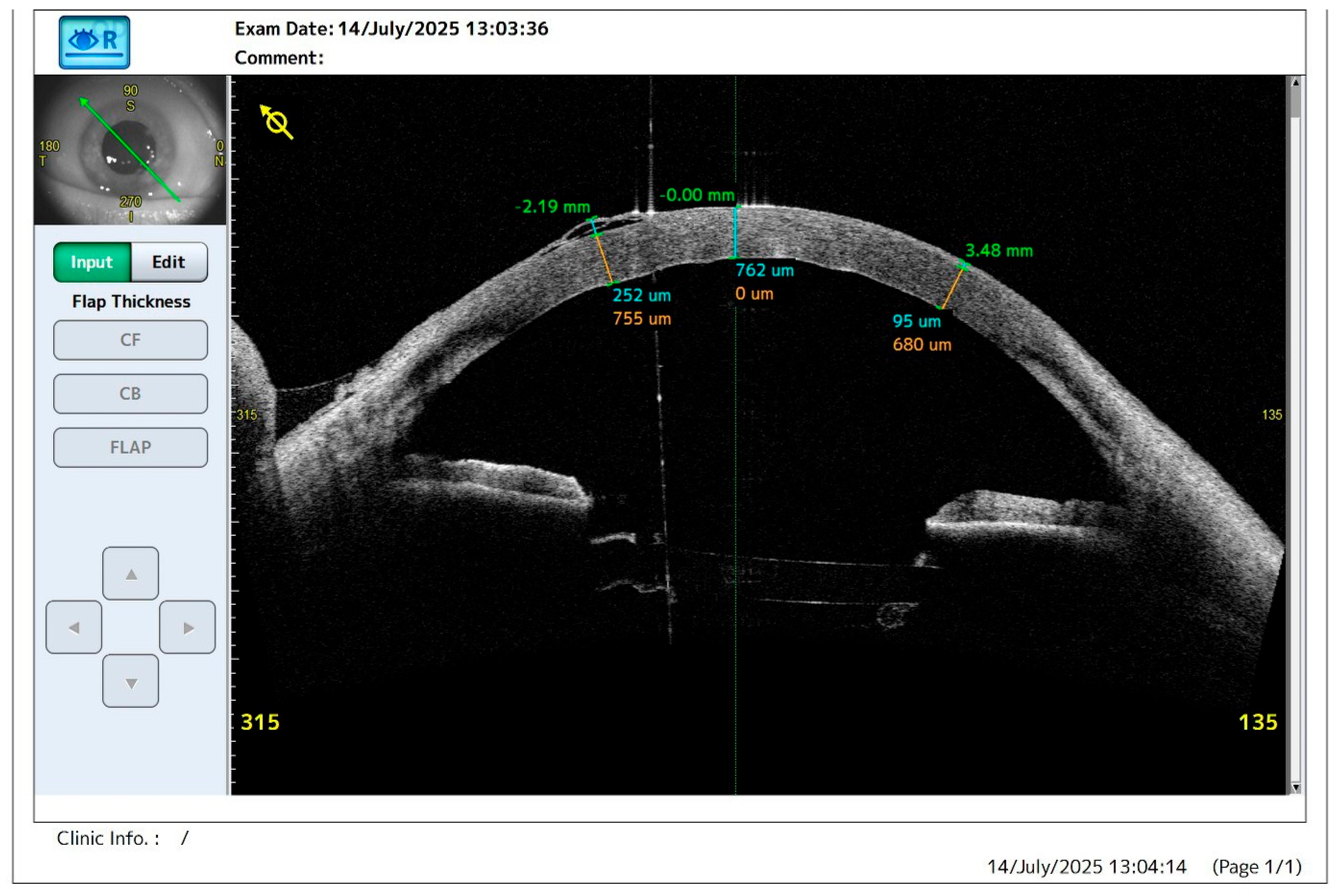
Figure 2.
Early postoperative slit-lamp imaging with clinically unapparent gas misdirection. (A,B) Slit-lamp photographs obtained 6 hours after DSAEK demonstrate a large intracameral gas bubble occupying the anterior chamber, with typical superior positioning due to gravitational forces. The graft appears well apposed, and the anterior chamber configuration seems clinically appropriate at this stage. Importantly, despite the apparently normal postoperative appearance, no signs of posterior gas migration behind the iris are visible on slit-lamp examination. This highlights the limitation of clinical assessment alone, as partial displacement of the gas bubble into the posterior chamber cannot be detected without adjunctive imaging. Intracameral gas tamponade is essential for graft adherence after DSAEK; however, its behavior within the anterior segment is influenced by multiple factors, including patient positioning and anterior chamber anatomy [2]. Slit-lamp examination alone may be insufficient to detect subtle or posteriorly located gas misdirection, which can lead to underestimation of early postoperative complications [3].
Figure 2.
Early postoperative slit-lamp imaging with clinically unapparent gas misdirection. (A,B) Slit-lamp photographs obtained 6 hours after DSAEK demonstrate a large intracameral gas bubble occupying the anterior chamber, with typical superior positioning due to gravitational forces. The graft appears well apposed, and the anterior chamber configuration seems clinically appropriate at this stage. Importantly, despite the apparently normal postoperative appearance, no signs of posterior gas migration behind the iris are visible on slit-lamp examination. This highlights the limitation of clinical assessment alone, as partial displacement of the gas bubble into the posterior chamber cannot be detected without adjunctive imaging. Intracameral gas tamponade is essential for graft adherence after DSAEK; however, its behavior within the anterior segment is influenced by multiple factors, including patient positioning and anterior chamber anatomy [2]. Slit-lamp examination alone may be insufficient to detect subtle or posteriorly located gas misdirection, which can lead to underestimation of early postoperative complications [3].
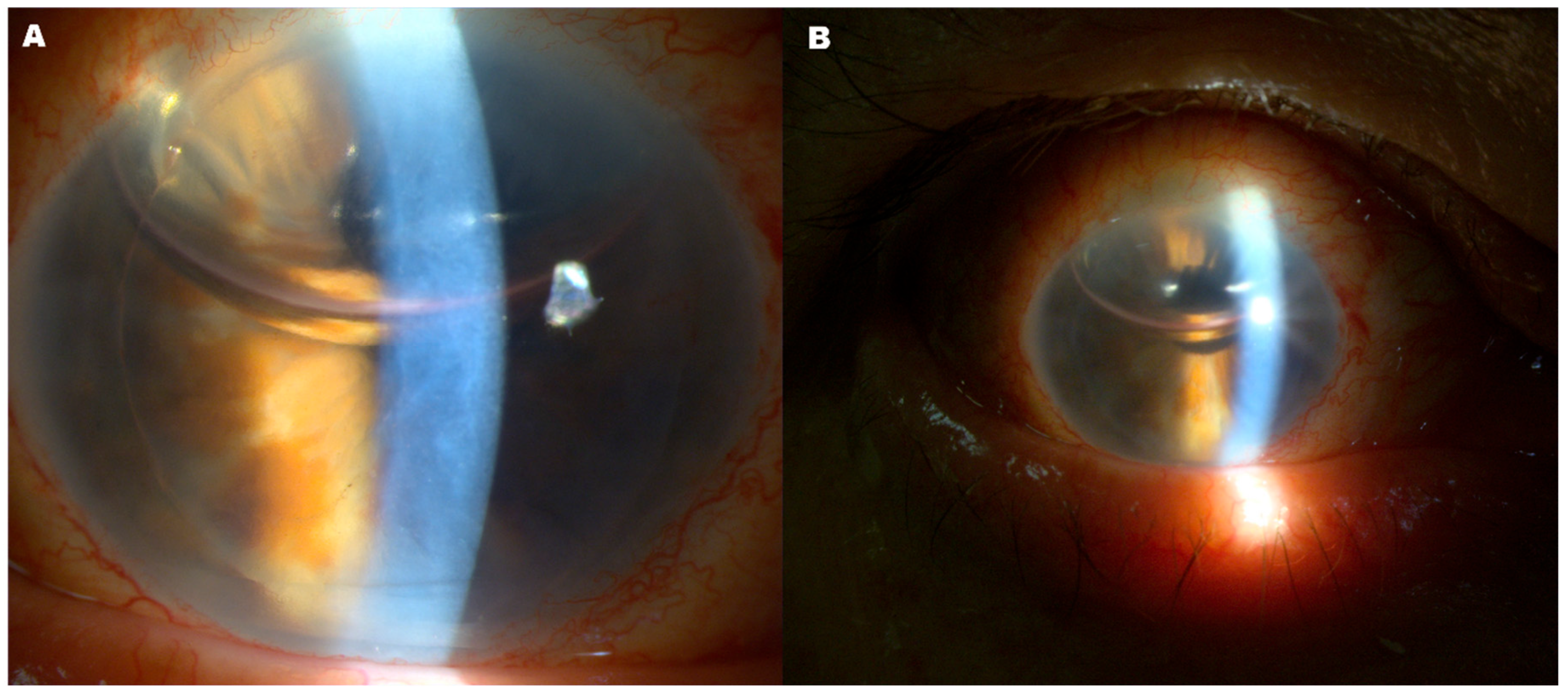
Figure 3.
AS-OCT detection of clinically occult posterior gas migration after DSAEK. (A) Multiplanar AS-OCT assessment on postoperative day one, including vertical, horizontal, and rotational scans. Posterior displacement of the gas bubble beneath the iris is detectable only in the vertical scan (arrow), while horizontal and rotational sections do not clearly demonstrate the abnormality, indicating its localized and orientation-dependent nature. Notably, this finding was not apparent on slit-lamp examination (Figure 2). (B) Magnified vertical AS-OCT image highlighting posterior migration of the gas bubble beneath the iris plane (arrow), associated with anterior displacement of the iris–lens diaphragm and early shallowing of the anterior chamber. The arrows indicate the exact location of gas misdirection. Based on the AS-OCT findings, prompt surgical re-intervention was performed with decompression of the misdirected gas bubble and reinjection of a centrally positioned tamponade, effectively eliminating the risk of malignant glaucoma. These findings illustrate that posterior gas migration after DSAEK may remain clinically occult and dependent on scan orientation, emphasizing the importance of comprehensive, multiplanar AS-OCT imaging to detect subtle abnormalities that may predispose to malignant glaucoma. Posterior migration of air or gas behind the iris has been described as a mechanism leading to secondary angle closure and malignant glaucoma after endothelial keratoplasty [4]. Early detection is critical, as altered aqueous dynamics and anterior displacement of the iris–lens diaphragm may result in rapid intraocular pressure elevation and graft compromise [5,6]. This case highlights the role of AS-OCT as a sensitive diagnostic tool enabling timely intervention and prevention of such complications.
Figure 3.
AS-OCT detection of clinically occult posterior gas migration after DSAEK. (A) Multiplanar AS-OCT assessment on postoperative day one, including vertical, horizontal, and rotational scans. Posterior displacement of the gas bubble beneath the iris is detectable only in the vertical scan (arrow), while horizontal and rotational sections do not clearly demonstrate the abnormality, indicating its localized and orientation-dependent nature. Notably, this finding was not apparent on slit-lamp examination (Figure 2). (B) Magnified vertical AS-OCT image highlighting posterior migration of the gas bubble beneath the iris plane (arrow), associated with anterior displacement of the iris–lens diaphragm and early shallowing of the anterior chamber. The arrows indicate the exact location of gas misdirection. Based on the AS-OCT findings, prompt surgical re-intervention was performed with decompression of the misdirected gas bubble and reinjection of a centrally positioned tamponade, effectively eliminating the risk of malignant glaucoma. These findings illustrate that posterior gas migration after DSAEK may remain clinically occult and dependent on scan orientation, emphasizing the importance of comprehensive, multiplanar AS-OCT imaging to detect subtle abnormalities that may predispose to malignant glaucoma. Posterior migration of air or gas behind the iris has been described as a mechanism leading to secondary angle closure and malignant glaucoma after endothelial keratoplasty [4]. Early detection is critical, as altered aqueous dynamics and anterior displacement of the iris–lens diaphragm may result in rapid intraocular pressure elevation and graft compromise [5,6]. This case highlights the role of AS-OCT as a sensitive diagnostic tool enabling timely intervention and prevention of such complications.
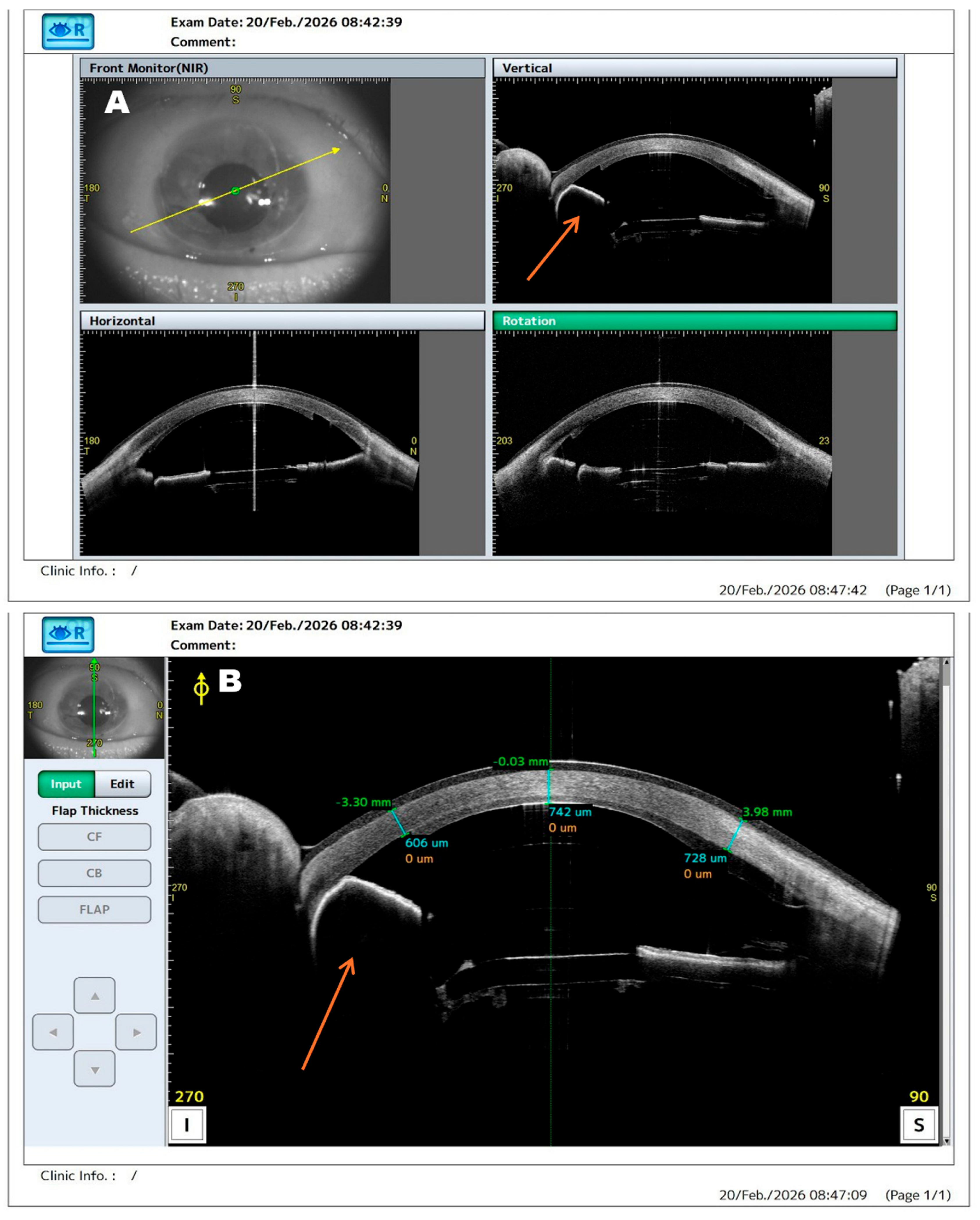
Figure 4.
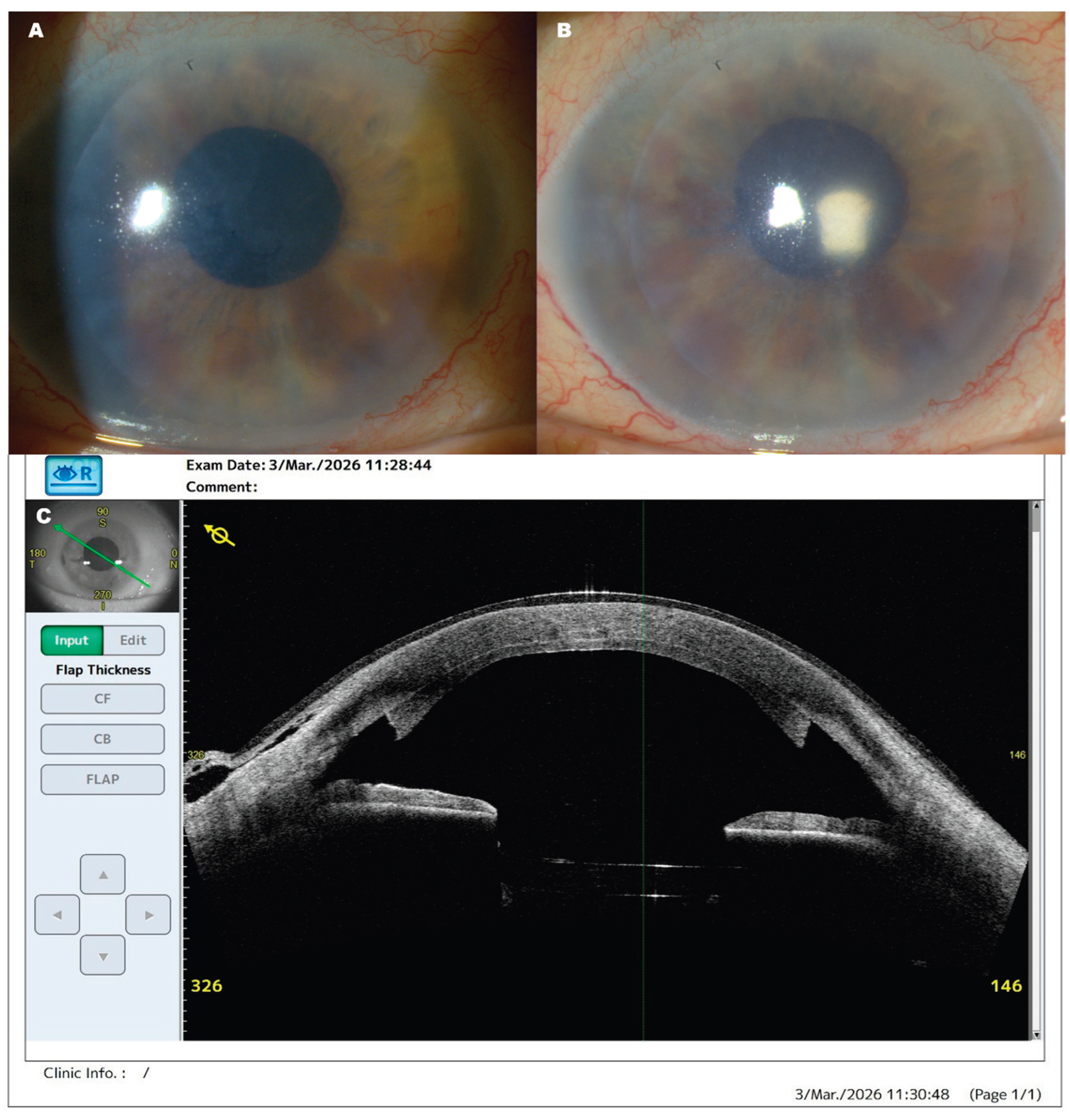
Postoperative outcome at 2 weeks after DSAEK. (A,B) Slit-lamp photographs obtained 14 days after surgery demonstrate a well-centered and fully attached endothelial graft with marked improvement in corneal clarity. The optical zone shows progressive transparency with regression of stromal edema. No signs of graft detachment, interface opacities, or immunologic rejection are observed. The anterior chamber remains well formed, without evidence of shallowing or abnormal iris configuration. Best-corrected visual acuity (BCVA) at this stage was 0.7 Snellen (0.15 logMAR). (C) AS-OCT confirms complete graft adherence with a regular interface and absence of interface fluid. No residual or misdirected gas bubble is present. The anterior chamber depth is normal, and the iris–lens diaphragm is in a physiological position, confirming stable postoperative anatomy and resolution of the previously detected complication. Timely recognition and management of postoperative complications are essential for maintaining graft survival and visual outcomes after endothelial keratoplasty [1,5]. Restoration of normal anterior segment anatomy following appropriate intervention is associated with favorable prognosis and reduced risk of secondary glaucoma [3,6].
Figure 4.
Postoperative outcome at 2 weeks after DSAEK. (A,B) Slit-lamp photographs obtained 14 days after surgery demonstrate a well-centered and fully attached endothelial graft with marked improvement in corneal clarity. The optical zone shows progressive transparency with regression of stromal edema. No signs of graft detachment, interface opacities, or immunologic rejection are observed. The anterior chamber remains well formed, without evidence of shallowing or abnormal iris configuration. Best-corrected visual acuity (BCVA) at this stage was 0.7 Snellen (0.15 logMAR). (C) AS-OCT confirms complete graft adherence with a regular interface and absence of interface fluid. No residual or misdirected gas bubble is present. The anterior chamber depth is normal, and the iris–lens diaphragm is in a physiological position, confirming stable postoperative anatomy and resolution of the previously detected complication. Timely recognition and management of postoperative complications are essential for maintaining graft survival and visual outcomes after endothelial keratoplasty [1,5]. Restoration of normal anterior segment anatomy following appropriate intervention is associated with favorable prognosis and reduced risk of secondary glaucoma [3,6].
Author Contributions
Conceptualization: W.L.; methodology: W.L and M.L.; formal analysis: M.L. and M.D.; investigation: W.L.; resources: W.L.; data curation: M.L.; writing—original draft preparation: W.L.; writing—review and editing: M.L..; visualization: W.L.; supervision: M.D. All authors have read and agreed to the published version of the manuscript.
Funding
This research received no external funding.
Institutional Review Board Statement
Ethical approval was not required for this case report according to institutional guidelines. The study adhered to the principles of the Declaration of Helsinki.
Informed Consent Statement
Written informed consent has been obtained from the patient to publish this paper.
Data Availability Statement
The original contributions presented in this study are included in the article. Further inquiries can be directed to the corresponding author.
Conflicts of Interest
The authors declare no conflicts of interest.
Abbreviations
The following abbreviations are used in this manuscript:
| AS-OCT | Anterior Segment Optical Coherence Tomography |
| BCVA | Best-corrected Visual Acuity |
| DSAEK | Descemet stripping automated endothelial |
| IOP | Intraocular pressure |
References
- Deshmukh, R; Nair, S; Ting, DSJ; Agarwal, T; Beltz, J; Vajpayee, RB. Graft detachments in endothelial keratoplasty. Br J Ophthalmol 2022, 106(1), 1–13. [Google Scholar] [CrossRef] [PubMed]
- Gumus, G; Altan, C; Yildirim, Y; Beşek, NK; Genç, S; Kirgiz, A; Durusoy, GK; Ağca, A. Early intraocular pressure changes following different keratoplasty techniques and association with cornea parameters and anterior chamber depth. Ther Adv Ophthalmol 2022, 14, 25158414221083359. [Google Scholar] [CrossRef] [PubMed] [PubMed Central]
- Shoham, N; Belovay, GW; Ahmed, II. Glaucoma considerations in corneal surgery. Int Ophthalmol Clin. 2010, 50(3), 1–23. [Google Scholar] [CrossRef] [PubMed]
- Lee, JS; Desai, NR; Schmidt, GW; Jun, AS; Schein, OD; Stark, WJ; Eghrari, AO; Gottsch, JD. Secondary angle closure caused by air migrating behind the pupil in descemet stripping endothelial keratoplasty. Cornea 2009, 4 28(6), 652–6. [Google Scholar] [CrossRef] [PubMed]
- Rai, M; Mohamed, A; Chaurasia, S; Senthil, S. Outcomes of Ahmed glaucoma valve implantation and risk factors for graft failure in eyes with Descemet’s stripping endothelial keratoplasty. Int Ophthalmol 2022, 5 42(8), 2335–2345. [Google Scholar] [CrossRef] [PubMed]
- Anders, LM; Gatzioufas, Z; Grieshaber, MC. Challenges in the complex management of post-keratoplasty glaucoma. Ther Adv Ophthalmol 2021, 6 13, 25158414211031397. [Google Scholar] [CrossRef] [PubMed] [PubMed Central]
Disclaimer/Publisher’s Note: The statements, opinions and data contained in all publications are solely those of the individual author(s) and contributor(s) and not of MDPI and/or the editor(s). MDPI and/or the editor(s) disclaim responsibility for any injury to people or property resulting from any ideas, methods, instructions or products referred to in the content. |
© 2026 by the authors. Licensee MDPI, Basel, Switzerland. This article is an open access article distributed under the terms and conditions of the Creative Commons Attribution (CC BY) license (http://creativecommons.org/licenses/by/4.0/).
Copyright: This open access article is published under a Creative Commons CC BY 4.0 license, which permit the free download, distribution, and reuse, provided that the author and preprint are cited in any reuse.


