

Submitted:
27 March 2026
Posted:
27 March 2026
You are already at the latest version
Abstract
Background: The convergence of Evolutionary Game Theory (EGT) and Artificial Intelligence (AI) has established the field of Intelligent Evolutionary Games (IEG). While IEG applications have flourished in general systems and social sciences, their operationalization within healthcare (IEG Health) remains significantly underdeveloped. This study identifies a "knowledge void" in the literature, where the bottleneck is not a lack of clinical data but a scarcity of frameworks that integrate intelligent strategic modeling into clinical practice. Methods: We employ the Synthetic Near-Empty Review (SNER) framework, utilizing Synthetic Knowledge Synthesis (SKS) and bibliometric triangulation via VOSviewer. Three distinct corpora—IEG Health (), EG Health (), and IEG All ()—were harvested from Scopus and mapped to identify thematic clusters and translation pathways. Results: The analysis reveals that IEG Health is a nascent domain currently focused on service regulation in elderly care and chronic disease management. We demonstrate a "Translation Framework" to bridge the research void, mapping concepts like Social Trust and Reputation Management from the broader IEG literature into clinical-specific models, such as Doctor-AI Adoption and Adaptive Coordination Games. Conclusions: By shifting from static replicator dynamics to Adaptive Learning Strategies (e.g., MARL and Bayesian updating), IEG Health can address critical challenges like algorithm aversion and clinical deskilling. This study provides a structured foundation for future research to transition from theoretical modeling to AI-augmented clinical decision-making.
Keywords:
evolutionary game theory
; intelligent evolutionary games
; multi-agent reinforcement learning
; replicator dynamics
; synthetic near-empty review
; algorithm aversion
1. Introduction
The synthesis of Evolutionary Game Theory (EGT) [1] and Artificial Intelligence (AI) [2] has given rise to a potent interdisciplinary framework: Intelligent Evolutionary Games (IEG) [3,4]. While classical EGT focuses on the dynamics of strategy propagation within populations based on fitness and natural selection, the integration of "intelligence"—ranging from reinforcement learning [5], cognitive modelling [6], co-evolutionary algorithms [7] or Multi-Agent Reinforcement Learning [6] introduces a more nuanced dimension to strategic interaction [8].
However, a critical research gap persists within the healthcare sector: the primary bottleneck is not a lack of raw biological or clinical data, but a profound scarcity of peer-reviewed publications that operationalize IEG frameworks in real-world healthcare contexts. This creates a "near-empty" research space that hinders the transition from theoretical modelling to clinical practice. To navigate this, the Synthetic Near Empty Review (SNER) framework [9] offers a transformative solution. By utilizing a triangulation of bibliometric mapping and synthetic thematic analysis, the SNER framework allows researchers to extract knowledge from emerging or sparse literature landscapes. This approach addresses the problem of reviews being "as empty as possible" by generating a structured, evidence-based foundation where traditional systematic reviews fail. By applying the SNER framework, researchers can identify underlying strategic paradigms from fields characterized by the proven efficacy of IEGs and EGT. This approach serves to bridge critical void in the IED employment in healthcare through the generation of systemic, AI-augmented synthesis.
2. Methodology
The SNER framework is based on Synthetic Knowledge Synthesis (SKS) [10,11]. SKS exhibits several advantages over traditional review frameworks. It reduces the time and resources required to synthesize articles, thus enabling the analysis of "whole corpora" of publications (all publications from fields of interest) rather than being limited to small, manually selected samples. In this manner sampling bias is avoided. Additionally, the use of bibliometric landscapes makes it easier to visualize, identify and analyse associations between different author keywords, topics or others units of interest. Furthermore triangulation" (combining bibliometrics and content analysis of publications metadata) supports a holistic understanding of the research presented in corpora being synthetised.
The methodological framework based on for this study is illustrated in Figure 1. Initially, SKS is employed to map the research landscapes of IEG Health (publications presenting the use of IEG in healthcare), EG Health (publications presenting the use of EGT in healthcare), and IEG All (publications presenting the use of IEG in general), facilitating the identification of prominent themes within each respective field. Subsequently, a comparative analysis of IEG Health themes against those of IEG All and EG Health is conducted to distinguish specific knowledge areas and themes suitable for translation into the IEG Health void. Each identified theme is then systematically decomposed into its constituent health domains and AI technologies, thereby delineating potential implementations of IEG within the healthcare sector.
The three corpora presented above were harvested from the Scopus bibliographic database on 16th of February, using the following search strings:
- IEG Health: TITLE-ABS-KEY("evolutionary game*" and ("intelligen*" OR "machine learning" OR "deep learning" OR "intelligent system" OR "support vector machine" OR ("decision tree" AND (induction OR heuristic)) OR "random forest" OR "Markov decision process" OR "hidden Markov model" OR "fuzzy logic" OR "k-nearest neighbours" OR KNN OR "support vector machine*" or SVM OR "naive Bayes" OR "Bayesian learning" OR "artificial neural network" OR "convolutional neural network" OR "recurrent neural network" OR "generative adversarial network" OR "deep belief network" OR "perceptron" OR {natural language processing} OR {natural language understanding} OR {general language model})) AND ( LIMIT-TO ( SUBJAREA,"MEDI" ) OR LIMIT-TO (SUBJAREA,"HEAL"))
- EG Health: TITLE-ABS-KEY("evolutionary game*") AND ( LIMIT-TO ( SUBJAREA,"MEDI" ) OR LIMIT-TO ( SUBJAREA,"HEAL" ))
- IEG All: TITLE-ABS-KEY("evolutionary game*" and ("intelligen*" OR "machine learning" OR "deep learning" OR "intelligent system" OR "support vector machine" OR ("decision tree" AND (induction OR heuristic)) OR "random forest" OR "Markov decision process" OR "hidden Markov model" OR "fuzzy logic" OR "k-nearest neighbours" OR KNN OR "support vector machine*" or SVM OR "naive Bayes" OR "Bayesian learning" OR "artificial neural network" OR "convolutional neural network" OR "recurrent neural network" OR "generative adversarial network" OR "deep belief network" OR "perceptron" OR {natural language processing} OR {natural language understanding} OR {general language model}))
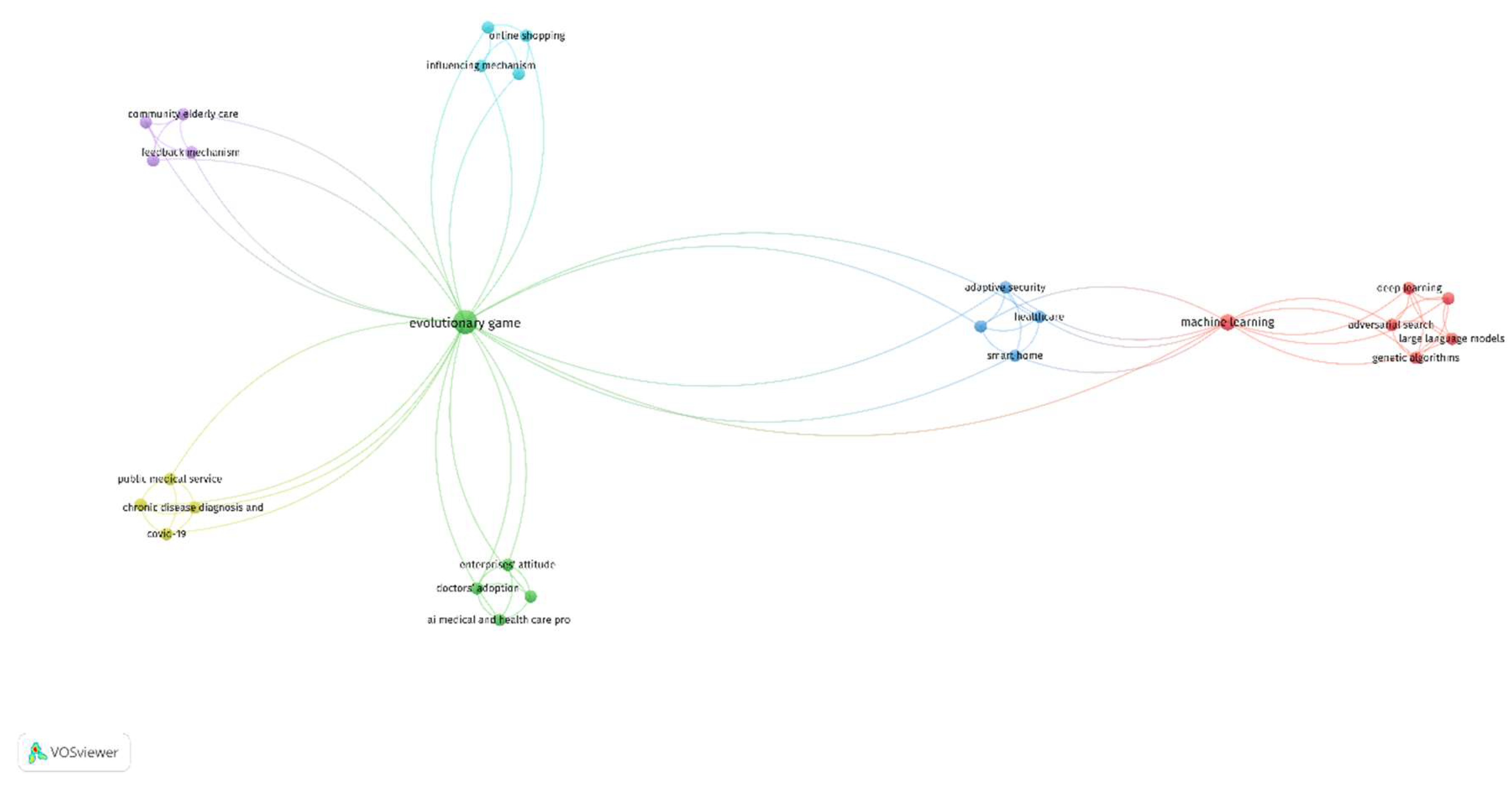
Bibliometric mapping was conducted using VOSviewer version 1.6.20 [12] to visualize the structural and thematic relationships within the identified literature. The resultant research landscapes, which illustrate the conceptual clusters and evolutionary trajectories of the field, are presented in Figure 2 through 4. Complementing this visualization, the findings derived from the systematic content analysis of these landscapes are synthesized in Table 1. This table delineates the corpus across four critical dimensions: (i) Overarching research themes, (ii) Specific healthcare domains, (iii) Evolutionary game strategies, and (iv) Integrated AI algorithms and paradigms.
Figure 3.
The research landscape induced from the EG Health corpora of publications.
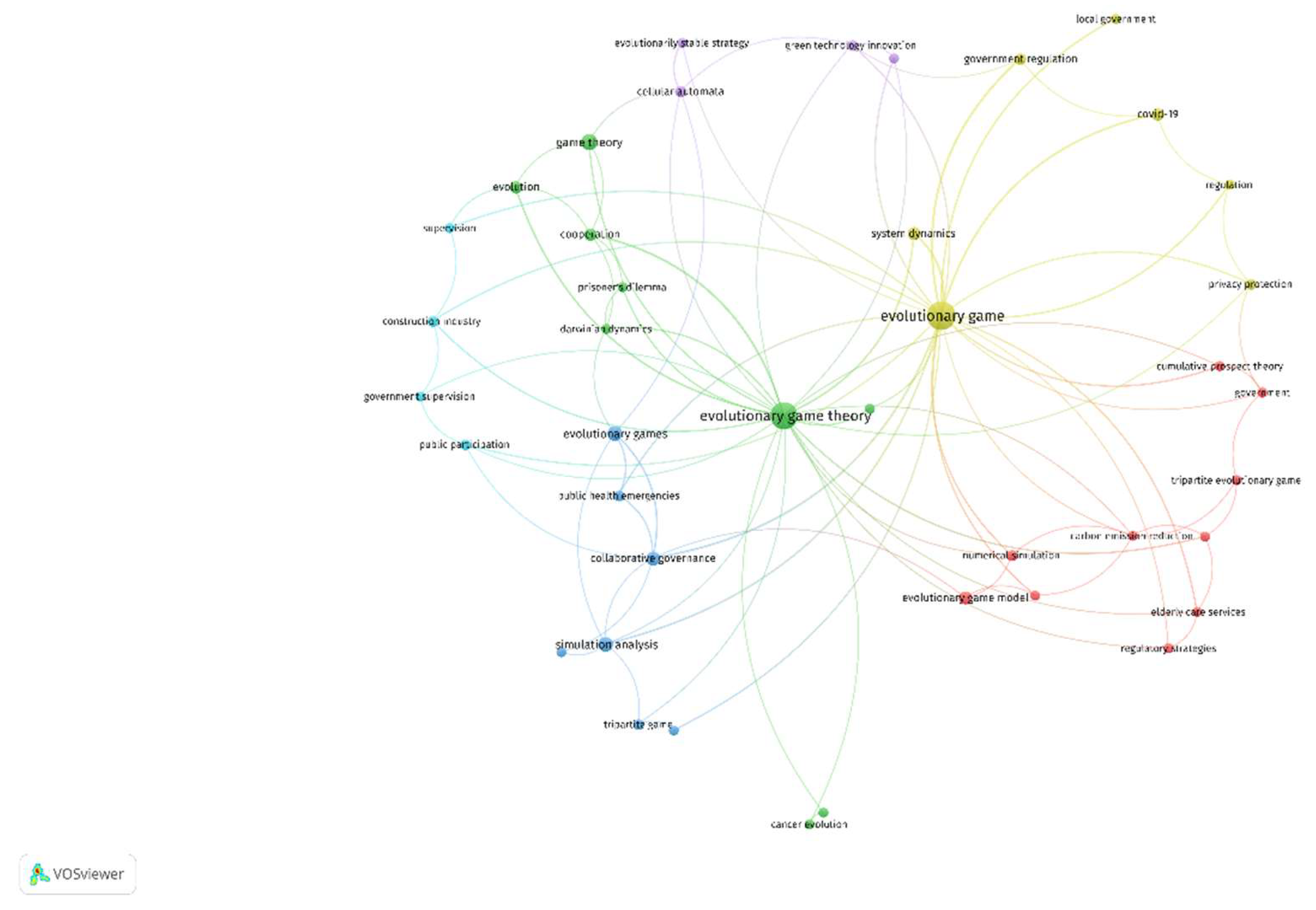
Figure 4.
The research landscape induced from the IEG Health corpora of publications.
3. Results and Discussion
The search result16 publications presenting the use of IEG in health, 335 publications presenting the employment of EG in health and 1124 presenting the use of IEG in general. The research landscapes induced by VOSViewer are shown in Figures 2 to 4, and the result of thematic analysis in Table 1. The themes across the three corpora of publications reflect a transition from broad social management to specialized medical regulation:
The Table 1. highlights where these game-theoretic models are applied within the healthcare field as shown bellow:
The synthesis indicates that while IEG All provides the foundational AI tools and broad social theories, EG Health provides the biological and regulatory context. IEG Health represents the synthesis of these two, applying advanced AI (like LLMs and Deep Learning) to specific healthcare challenges such as elderly care regulation and chronic disease diagnosis.
3.1. The Translation from EG Health and IEG All to IEG Health
The integration of Intelligent Evolutionary Games (IEG) into the healthcare sector necessitates a multidimensional transposition of existing theoretical frameworks. This process involves the systematic recalibration of four core pillars: the themes of social governance, the contextual shift of health domains, the underlying logic of strategic interaction, and the computational engines of Artificial Intelligence. The following analysis explores the transition from static evolutionary dynamics to adaptive learning strategies, ensuring that AI-driven healthcare systems remain resilient, secure, and patient-centric.
The Translation of Social Governance Themes: Foundational IEG constructs, such as Reputation Management and Trust Evaluation, are operationalized within the medical context as "Clinician AI-Adoption" and "Patient Digital-Health Trust." Within the IEG Health framework, the "intelligent" component enables the simulation of trust trajectories as they evolve in response to AI-generated clinical interventions. Furthermore, traditional themes of Public Participation and Governmental Supervision are translated into the "dynamic regulation of community-based elderly care." While traditional models address policy at a macro level, IEG Health introduces an algorithmic layer, utilizing data-driven heuristics to regulate these services in real-time.
The Contextual Shift of Health Domains: The transition across health domains involves an ontological shift from passive biological processes to autonomous agent-based simulations. Traditional biological conflicts—such as oncological evolution, pathogen drug resistance, and disease transmission—are re-contextualized by replacing passive entities with intelligent agents:
- From Drug Resistance to AI-Augmented Chronic Disease Management: Rather than modeling stochastic bacterial evolution, IEG Health models how a patient’s "intelligent" wearable interface adaptively modifies treatment schedules to preemptively mitigate resistance.
- From Privacy Protection to Adaptive Security in Smart Environments: This entails a shift from static regulatory compliance to the implementation of self-evolving, AI-driven security protocols designed to safeguard sensitive health telemetry within smart-home ecosystems.
The Logic of Strategic Interaction: The mathematical foundations of IEG—including the Prisoner’s Dilemma, Nash Equilibrium, and Stackelberg Games—are augmented through the integration of machine intelligence. In conventional health-based evolutionary games, Replicator Dynamics are typically characterized by fixed differential equations. In contrast, IEG Health transposes these into Adaptive Learning Strategies. For example, a "Hawk-Dove" game applied to healthcare resource allocation is reconfigured as a Deep Reinforcement Learning (DRL) problem, wherein agents (such as hospitals or autonomous systems) converge toward equilibrium through iterative trial-and-error and environmental feedback.
Intelligent Computational Engines: The most critical architectural translation involves the deployment of specialized AI paradigms to drive the IEG Health engine:
- Federated Learning: This facilitates the training of robust diagnostic models across heterogeneous hospital networks while maintaining data siloization, thereby addressing the core theme of privacy.
- Multi-Agent Reinforcement Learning: This is utilized to model the high-dimensional interactions between diverse stakeholders within chronic disease or smart-home ecosystems.
- Swarm Intelligence: This paradigm is applied to surgical robotics and decentralized diagnostic networks, where coordinated units collaborate heuristically to execute complex medical tasks.
3.2. Case Study
To demonstrate how Social Trust from IEG All might translate into Doctor Adoption of AI in IEG Health, we look at it as a intelligent evolutionary game where the "players" (the doctor and the AI) must reach a stable equilibrium of cooperation. In the broader IEG All context, trust is a general metric for system stability. In IEG Health, this becomes a high-stakes "Evolutionary Game" with clinical consequences (Table 2).
In this IEG Health scenario, we model the interaction as an Adaptive Coordination Game (Figure 5):
- The Players: The Clinical Specialist (Expertise-driven) and the AI Diagnostic Agent (Data-driven).
-
The Strategy: * Doctor: Choose to Adopt (Follow AI advice) or Override (Use intuition).
- ∘
- AI: Provide High-Confidence or Low-Confidence output.
- The Intelligent Twist: Unlike a static game, this uses MARL. The AI "learns" the doctor’s preferences and risk tolerance, while the doctor "learns" the AI’s strengths.
Why This Translation Matters
- Preventing "Deskilling": If trust is too high (blind adoption), doctors may lose their critical skills.
- Reducing "Algorithm Aversion": If trust is too low (constant override), the benefits of AI in reducing human error are lost.
- Finding the Nash Equilibrium: The goal is to find the point where the doctor uses the AI only when the AI’s "Intelligence" truly exceeds human pattern recognition.
4. Conclusions
This research has systematically mapped the "near-empty" landscape of Intelligent Evolutionary Games in healthcare, revealing a profound disparity between theoretical AI-EGT models and their clinical application. By implementing the SNER framework, we have demonstrated that the "knowledge void" in IEG Health can be bridged through the strategic translation of established paradigms from social governance and general intelligence.
Our findings underscore that the transition to IEG Health necessitates an ontological shift: moving from passive biological modeling—such as stochastic drug resistance—to autonomous, agent-based simulations where AI entities and human practitioners co-evolve. The case study on Doctor-AI Adoption illustrates that trust is not a static prerequisite but a dynamic Nash Equilibrium achieved through Multi-Agent Reinforcement Learning (MARL) and iterative Bayesian updates.
Ultimately, the integration of IEG into healthcare offers a robust mechanism for regulating community-based care, optimizing chronic disease management, and fostering human-AI synergy. Future research should focus on the "Adaptive Oncology" path and the deployment of Federated Learning to resolve the tension between data privacy and the need for high-dimensional strategic modeling. By treating the clinical environment as an adaptive coordination game, the healthcare sector can leverage IEG to ensure that AI adoption is both resilient and patient-centric.
Author Contributions
Writing—review and editing, writing—original draft, P.K., B.Ž. and H.B.V.; supervision, J.Z.; conceptualization, P.K. and B-Ž.; data analysis, methodology development, visualization, P.K; writing—review and editing, All. All authors have read and agreed to the published version of the manuscript.
Funding
This research received no external funding.
Data Availability Statement
No new data were generated.
Acknowledgments
During the preparation of this work, the authors used Gemini 3 for spelling and grammar checking. After using this tool/service, the authors reviewed and edited the content as needed and took full responsibility for the final content of the publication.
Conflicts of Interest
The authors declare no conflicts of interest.
References
- Alexander, J.M. Evolutionary Game Theory. In Elements in Decision Theory and Philosophy; 2023. [Google Scholar] [CrossRef]
- Moor, M.; Banerjee, O.; Abad, Z.S.H.; Krumholz, H.M.; Leskovec, J.; Topol, E.J.; Rajpurkar, P. Foundation Models for Generalist Medical Artificial Intelligence. Nature 2023, 616, 259–265. [Google Scholar] [CrossRef]
- Xie, K.; Szolnoki, A. Reinforcement Learning in Evolutionary Game Theory: A Brief Review of Recent Developments. Applied Mathematics and Computation 2026, 510, 129685. [Google Scholar] [CrossRef]
- Li, X.; Zhang, L.; Wang, P. Artificial Intelligence Techniques Introduced Into Evolutionary Games and Simulation Studies. IEEE Transactions on Computational Social Systems 2025, 12, 1688–1699. [Google Scholar] [CrossRef]
- Zhang, T.; Gupta, H.; Suprabhat, K.; Stella, L. A Multi-Agent Reinforcement Learning Approach to Promote Cooperation in Evolutionary Games on Networks with Environmental Feedback. In Proceedings of the 2023 62nd IEEE Conference on Decision and Control (CDC), December 2023; pp. 2196–2201. [Google Scholar]
- Xiao, Y.; He, W.; Yang, T.; Li, Q. A Dynamic Information Dissemination Model Based on User Awareness and Evolutionary Games. IEEE Transactions on Computational Social Systems 2023, 10, 2837–2846. [Google Scholar] [CrossRef]
- Jiang, F.; Yang, Y. Co-Evolution Mechanism of Peer Effect and Dynamic Networks in Multi-Agent Systems from a Dual-Game Perspective. Chaos, Solitons & Fractals 2026, 203, 117631. [Google Scholar] [CrossRef]
- Vallier, K. The Theory of Strategic Evolution: Games with Endogenous Players and Strategic Replicators 2025.
- Blažun Vošner, H.; Kokol, P.; Završnik, J. Propensity Score Matching: Identifying Opportunities for Future Use in Nursing Studies. Nursing Reports 2025, 15, 142. [Google Scholar] [CrossRef]
- Kokol, P. Synthetic Knowledge Synthesis in Hospital Libraries. Journal of Hospital Librarianship 2024, 24, 10–17. [Google Scholar] [CrossRef]
- Šajnović, U.; Vošner, H.B.; Završnik, J.; Žlahtič, B.; Kokol, P. Internet of Things and Big Data Analytics in Preventive Healthcare: A Synthetic Review. Electronics 2024, 13, 3642. [Google Scholar] [CrossRef]
- Yan, K.; Ma, W.; Yang, Q.; Sun, S.; Wang, W. Info-Chain: Reputation-Based Blockchain for Secure Information Sharing in 6G Intelligent Transportation Systems. IEEE Internet Things J. 2024, 11, 9198–9212. [Google Scholar] [CrossRef]
- Xie, K.; Szolnoki, A. Reputation in Public Goods Cooperation under Double Q-Learning Protocol. Chaos Solitons Fractals 2025, 196. [Google Scholar] [CrossRef]
- Lu, Y.; Aleta, A.; Du, C.; Shi, L.; Moreno, Y. LLMs and Generative Agent-Based Models for Complex Systems Research. Phys. Life Rev. 2024, 51, 283–293. [Google Scholar] [CrossRef] [PubMed]
- Zhao, Y.; Yang, Y.-J.; Luo, B. An Evolutionary Game Approach to Multi-Technology Synergy in Logistics Information Sharing for Smart Supply Chains. IEEE Access 2025, 13, 161320–161343. [Google Scholar] [CrossRef]
- Zhao, J.; Cui, S.; Wang, Z. Tripartite Game Analysis of Online Public Opinion Evolution in Major Epidemics in the Context of Life Sciences. SLAS Tech. 2025, 32. [Google Scholar] [CrossRef]
- Cheng, L.; Li, M.; Tan, C.; Huang, P.; Zhang, M.; Sun, R. Computational Game-Theoretic Models for Adaptive Urban Energy Systems: A Comprehensive Review of Algorithms, Strategies, and Engineering Applications. Arch. Comput. Methods Eng. 2025. [Google Scholar] [CrossRef]
- Cheng, L.; Yu, F.; Huang, P.; Liu, G.; Zhang, M.; Sun, R. Game-Theoretic Evolution in Renewable Energy Systems: Advancing Sustainable Energy Management and Decision Optimization in Decentralized Power Markets. Renewable Sustainable Energy Rev 2025, 217. [Google Scholar] [CrossRef]
- Ma, Y.; Sun, Y.; Guo, Q.; Wang, X. Evolutionary Game Analysis of Building a Sustainable Intelligent Elderly Care Service Platform. Sci. Rep. 2024, 14. [Google Scholar] [CrossRef]
- Cheng, L.; Zhang, M.; Huang, P.; Lu, W. Game-Theoretic Approaches for Power-Generation Companies’ Decision-Making in the Emerging Green Certificate Market. Sustainability 2025, 17. [Google Scholar] [CrossRef]
- Belhaiza, S. Behavioral–Epidemiological Coevolution: An Evolutionary Game-Theoretic Framework for Pandemic Dynamics. Chaos Solitons Fractals 2026, 203. [Google Scholar] [CrossRef]
- Wei, L.; Liu, L. Study on the Coupling Dynamics of the Protective Behavior Game and Disease Transmission. In Proceedings of the Proc. Int. Symp. Artif. Intell. Med. Sci., ISAIMS, 2026; Association for Computing Machinery, Inc; pp. 113–118. [Google Scholar]
- Kokol, P.; Završnik, J.; Blažun Vošner, H.; Žlahtič, B. Evolutionary Game Theory Use in Healthcare: A Synthetic Knowledge Synthesis. Information 2025, 16. [Google Scholar] [CrossRef]
- Karima, D.; Chiheb, R. Integrating Reinforcement Learning and Game Theory for Strategic Decision-Making in Cancer Therapy. In Proceedings of the SITA - Int. Conf. Intell. Syst.: Theories Appl., 2025; Institute of Electrical and Electronics Engineers Inc. [Google Scholar]
- Yu, R.; Liu, F.; Cheng, T.C.E.; Xu, X. AI-Blockchain Synergy for Resilient Agricultural Supply Chains: An Evolutionary Game Analysis. Int J Prod Res 2025. [Google Scholar] [CrossRef]
- Gan, C.; Xiao, X.; Zhang, Y.; Zhu, Q.; Bi, J.; Jain, D.K.; Saini, A. An Asynchronous Federated Learning-Assisted Data Sharing Method for Medical Blockchain. Appl Intell 2025, 55. [Google Scholar] [CrossRef]
- Singh, I.; Agarwal, K.; Ganapathy, S. Advancing Allergy Source Mapping: A Comprehensive Multidisciplinary Framework Integrating Machine Learning, Graph Theory and Game Theory. Appl. Soft Comput. 2024, 166. [Google Scholar] [CrossRef]
- Lee, H.-W.; Weng, Y.-N. Granular Q-Learning Adaptation Boosts Collective Welfare in Multi-Agent Prisoner’s Dilemma. Chaos Solitons Fractals 2025, 199. [Google Scholar] [CrossRef]
- Kastampolidou, K.; Andronikos, T. Microbes and the Games They Play. In Proceedings of the GeNeDis 2020; Vlamos, P., Ed.; Springer International Publishing: Cham, 2021; pp. 265–271. [Google Scholar]
- Morison, C.; Fic, M.; Marcou, T.; Mohamadichamgavi, J.; Redondo Antón, J.; Sayyar, G.; Stein, A.; Bastian, F.; Krakovská, H.; Krishnan, N.; et al. Public Goods Games in Disease Evolution and Spread. Dyn Games Appl 2025, 15, 1733–1749. [Google Scholar] [CrossRef]
- The Role of Cooperation in Epidemic Control: Insights from an SIRS Model with Evolutionary Games | Nonlinear Dynamics | Springer Nature Link. Available online: https://link.springer.com/article/10.1007/s11071-026-12240-1 (accessed on 21 March 2026).
- Narimani, H.; Ansarian, M.; Baharlouei, Z. Strategic Frameworks: A Review of Game Theory Methods for Privacy Preservation in Digital Health. Computers in Biology and Medicine 2025, 197, 111124. [Google Scholar] [CrossRef]
- Zhang, L.; Lv, N.; Chen, N. Evolutionary Game of Medical Knowledge Sharing Among Chinese Hospitals Under Government Regulation. Systems 2025, 13, 454. [Google Scholar] [CrossRef]
- Romano, C.; Domenica Di Benedetto, M.; Borri, A. Stackelberg Evolutionary Games With Modulated Leadership: A Three-Agent Framework for Tumor–Immune Dynamics. IEEE Control Systems Letters 2025, 9, 468–473. [Google Scholar] [CrossRef]
- ZHANG, Z.; JIANG, J.; XU, H.; ZHANG, W.-A. Distributed Dynamic Task Allocation for Unmanned Aerial Vehicle Swarm Systems: A Networked Evolutionary Game-Theoretic Approach. Chin J Aeronaut 2024, 37, 182–204. [Google Scholar] [CrossRef]
- Wang, X.; Yang, Z.; Chen, G.; Liu, Y. Enhancing Cooperative Evolution in Spatial Public Goods Game by Particle Swarm Optimization Based on Exploration and Q-Learning. Appl. Math. Comput. 2024, 469. [Google Scholar] [CrossRef]
- Lin, Y.; Gao, Z.; Du, H.; Niyato, D.; Kang, J.; Liu, X. Incentive and Dynamic Client Selection for Federated Unlearning. In Proceedings of the WWW - Proc. ACM Web Conf., 2024; Association for Computing Machinery, Inc; pp. 2936–2944. [Google Scholar]
- Shen, Y.; Shepherd, C.; Ahmed, C.M.; Shen, S.; Wu, X.; Ke, W.; Yu, S. Game-Theoretic Analytics for Privacy Preservation in Internet of Things Networks: A Survey. Eng Appl Artif Intell 2024, 133. [Google Scholar] [CrossRef]
- Mao, K. Multi-Agent Reinforcement Learning Driven Resource Game Optimization for Network Slicing in MEC-Enabled HetNets. Sci. Rep. 2026, 16. [Google Scholar] [CrossRef] [PubMed]
- Yang, B.; Zhao, H. Wireless Communication System Optimization and Performance Improvement Based on Artificial Intelligence. In Proceedings of the ACM Int. Conf. Proc. Ser.; Association for Computing Machinery, 2024; pp. 161–166. [Google Scholar]
Figure 1.
The framework of the SNER methodology used in the IEG Health study.
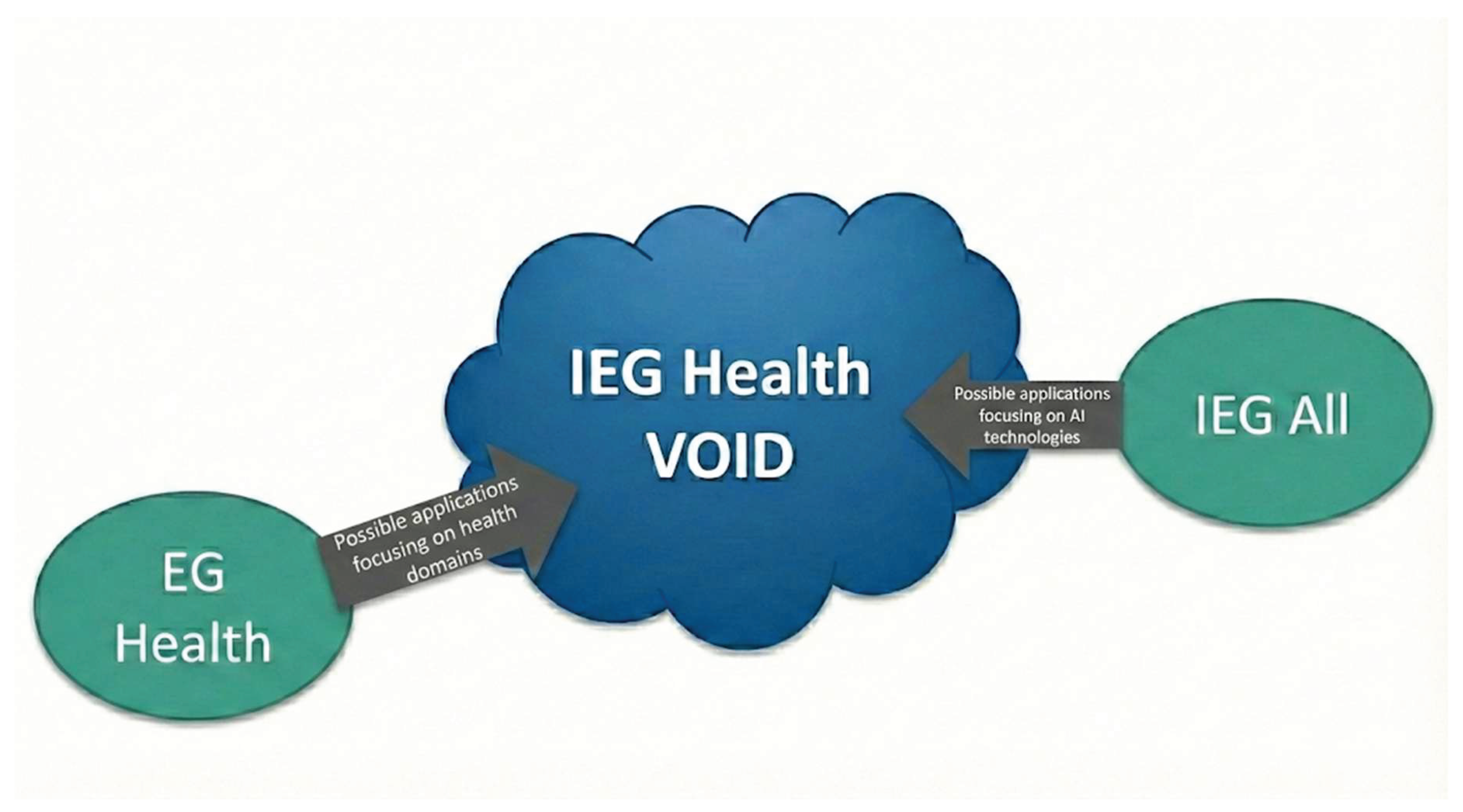
Figure 2.
The research landscape induced from the IEG All corpora of publications.
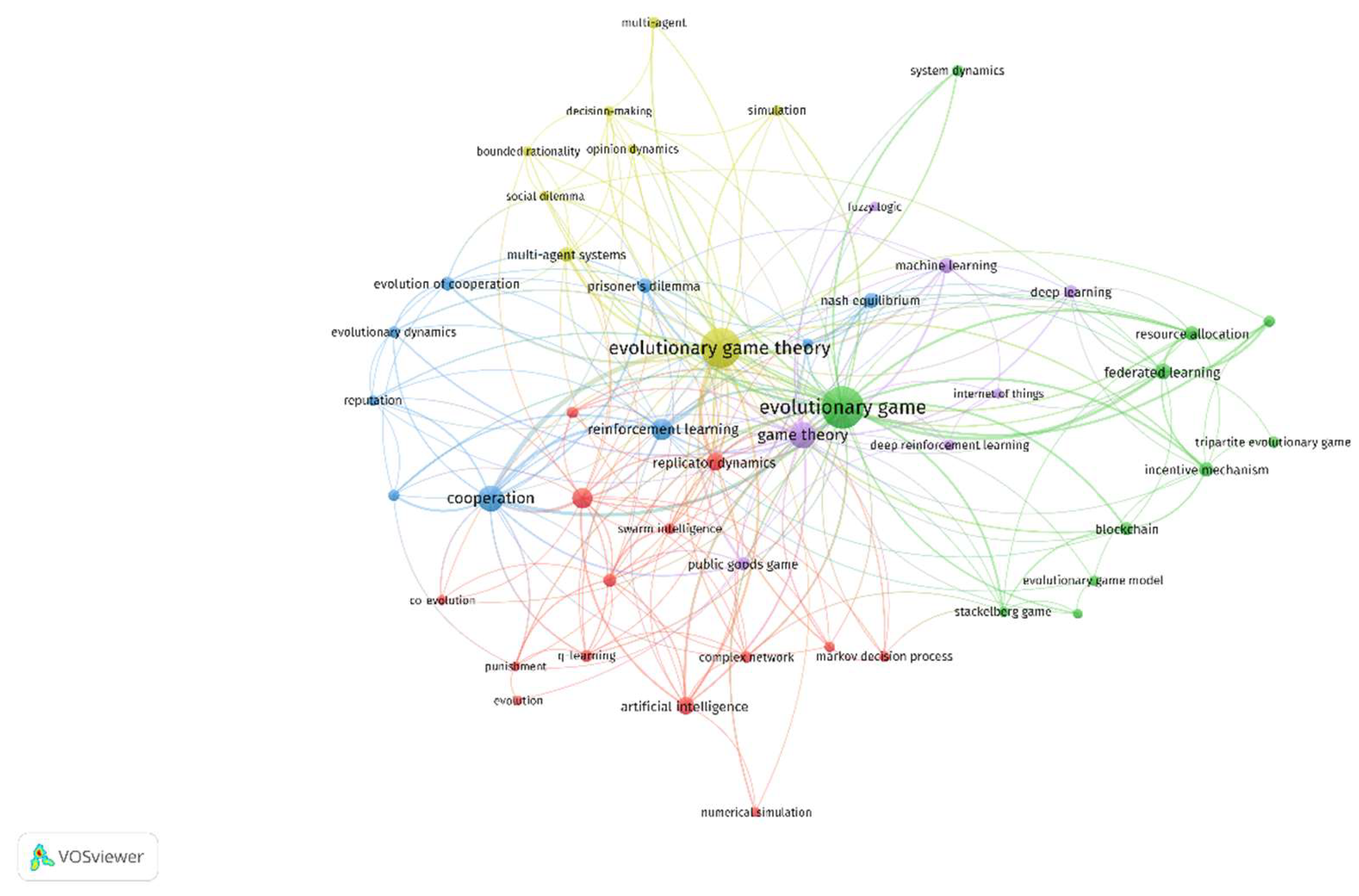
Figure 5.
Translating social trus to Doctor-AI Adoption.
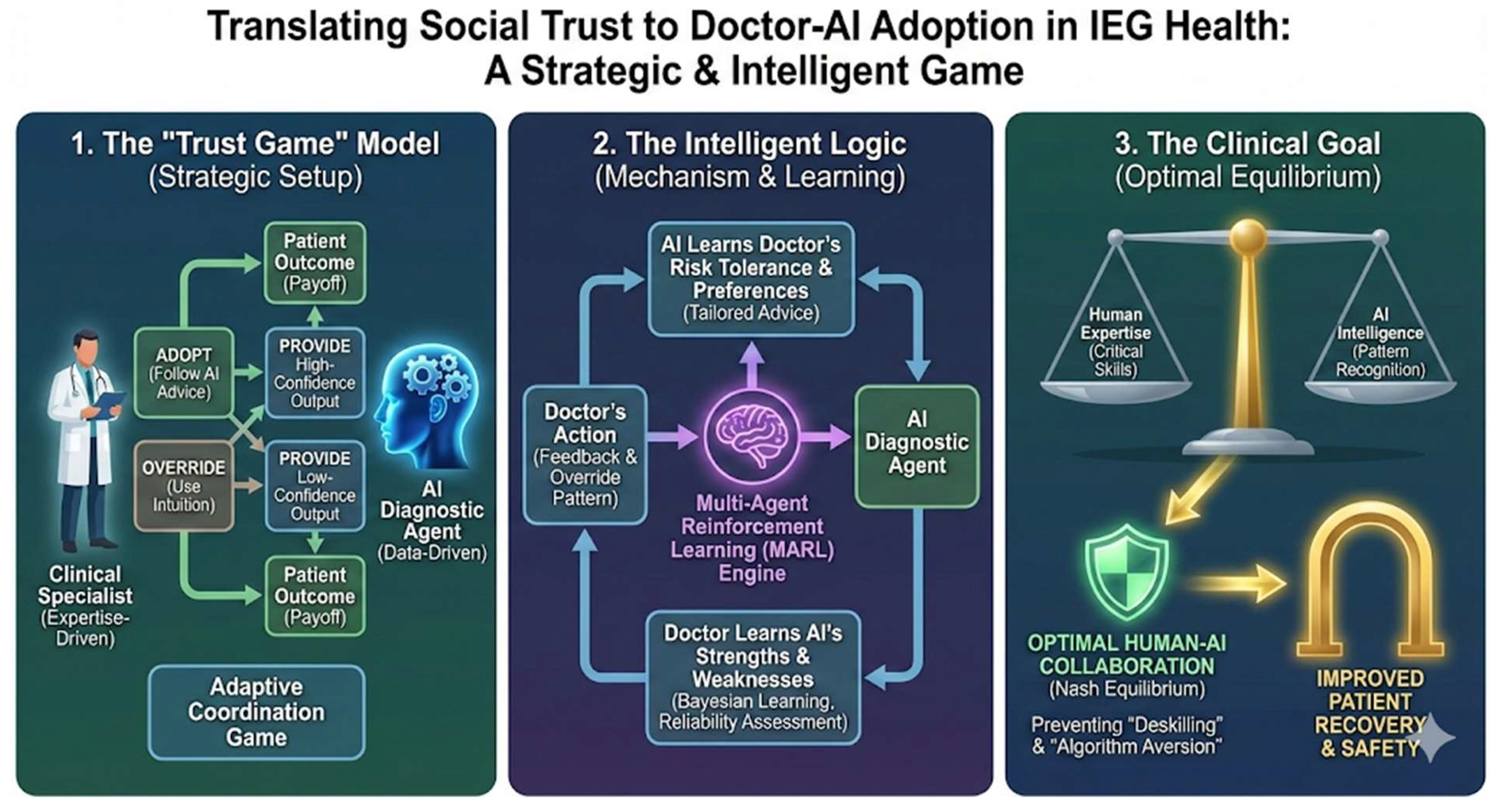

Table 1.
The results of the thematic analysis.
| IEG All | EG Health | IEG Health | |
|---|---|---|---|
| Overreaching research themes | Reputation management | Public participation in governmental supervision | Service regulation in community elderly care |
| Public good management | Collaborative governance in public health emergencies | Public medical services for chronic disease diagnosing and treatment | |
| Solving social dilemmas | Green technology innovation | Privacy protection | |
| Trust evaluation | Government regulation and privacy protection in health crises | Doctors adoption to AI based medicine | |
| Decision making | Regulation strategies in elderly care ser vices | Adaptive security of healthcare in smart homes | |
| Task allocation | Carbon emission reduction | ||
| Smart supply chains | Drug resistance and cancer evolution | ||
| Resource allocation | |||
| Multi-objective optimization | |||
| Value co-creation | |||
| Intelligent construction | |||
| Population dynamics | |||
| Auction | |||
| Social networking | |||
| Specific healthcare domains | Privacy protection | Smart home | |
| Green technologies | AI based medicine | ||
| Cancer evolution | Chronic diseases | ||
| Drug resistance Food and product safety (MAH – Marketing Authorization Holder mechanism) |
|||
| Immunotherapy | |||
| Disease transmission | |||
| Angiogenesis | |||
| Evolutionary game strategies | All from EG Health | Cellular automata | |
| Collective intelligence | Prisoners’ dilemma | ||
| Replicator dynamics | Darwinian dynamics | ||
| Nash equilibrium | Cumulative prospect theory | ||
| Stackelberg game | Hawk-dove game | ||
| Co-operation dynamics | Reciprocal altruism | ||
| Snowdrift game | Agent based technologies | ||
| Integrated AI algorithms and domains | All from IEG Health | Deep learning | |
| Swarm intelligence | Large language models | ||
| Neural network | Genetic algorithms | ||
| Federated learning | Adversarial search | ||
| Edge intelligence | |||
| Deep reinforcement learning | |||
| Multi – agent reinforcement learning | |||
| Q-learning |
Table 2.
The Translation: From Theory to Clinical Reality.
| Concept in IEG All (Social Trust) |
Translation to IEG Health (Doctor Adoption) | The Intelligent Logic (Mechanism) |
|---|---|---|
| Reputation Management | Algorithm Transparency | Doctors assess the AI’s "reputation" based on past diagnostic accuracy and explainability (XAI). |
| Cooperation Dynamics |
Human-AI Collaboration | The game moves from "Human vs. AI" to a "Human + AI" team, where the payoff is the patient’s recovery. |
| Trust Evaluation | Reliability Assessment | Using Bayesian Learning, the doctor updates their trust in the AI after every successful or failed intervention. |
Disclaimer/Publisher’s Note: The statements, opinions and data contained in all publications are solely those of the individual author(s) and contributor(s) and not of MDPI and/or the editor(s). MDPI and/or the editor(s) disclaim responsibility for any injury to people or property resulting from any ideas, methods, instructions or products referred to in the content. |
© 2026 by the authors. Licensee MDPI, Basel, Switzerland. This article is an open access article distributed under the terms and conditions of the Creative Commons Attribution (CC BY) license (http://creativecommons.org/licenses/by/4.0/).
Copyright: This open access article is published under a Creative Commons CC BY 4.0 license, which permit the free download, distribution, and reuse, provided that the author and preprint are cited in any reuse.


