

Submitted:
26 March 2026
Posted:
27 March 2026
Read the latest preprint version here
Abstract
The indispensable research finding of Liu et al. found that PIEZO2 in vagal ganglia contributes to cardiovascular stability by preventing orthostatic hypotension in a time-locked and fine-tuned way to atrial and ventricular systole. As part of this mechanism, a distinct group of vagal neurons with end-net endings in the heart initiate a blood-volume-dependent reflex in response to decreased filling of the heart to compensate upright posture and haemorrhage. After all, this robust feedback control counterbalances the impact of gravity to attain cardiovascular stability. The current commentary is meant to highlight that this mechanism is even more complex, and the finding is only one side of a coin, if we consider an underlying novel body-wide Piezo2 system, a Piezo2-coupled autonomic nervous system (ANS) and proprioceptive system, and the Piezo2-initiated ultradian backbone of the heart-brain axes. Hence, the knockout/ablation of PIEZO2 in vagal ganglia, as Lie et al[M1.1]. showed, critically targets this novel complex body-wide Piezo2 mechanism.
Keywords:
Piezo2
; body-wide Piezo2 system
; autonomic nervous system
; proprioception
; gravity
; orthostatic hypotension
Introduction
The indispensable research finding of Liu et al. found that PIEZO2 in vagal ganglia contributes to cardiovascular stability by preventing orthostatic hypotension in a time-locked and fine-tuned way to atrial and ventricular systole [1]. As part of this mechanism, a distinct group of vagal neurons with end-net endings in the heart initiate a blood-volume-dependent reflex in response to decreased filling of the heart to compensate upright posture and haemorrhage [1]. After all, this robust feedback control counterbalances the impact of gravity to attain cardiovascular stability [1]. The current comment is meant to highlight that this mechanism is even more complex, and the finding is only one side of a coin, if we consider an underlying novel body-wide Piezo2 system, a Piezo2-coupled autonomic nervous system (ANS) and proprioceptive system, and the Piezo2-initiated ultradian backbone of the heart-brain axes. Hence, the knock-out/ablation of PIEZO2 in vagal ganglia, as Lie et al. showed, critically targets this novel complex body-wide Piezo2 mechanism.
Piezo2, Gravity and Orthostasis
It is long known that posture impacts the autonomic nervous system (ANS) and not surprisingly the contribution of proprioception, supported by position sense, has been implicated in this mechanism [2]. In addition, a Piezo2-based crosstalk is suspected between these two systems under homeostatic conditions, namely between the ANS and proprioception [3,4]. The gravity-dependency of ANS regulation by Piezo2 was first put forward in 2023 [2]. Moreover, an orthostasic stress test-based pilot study, also from 2023, showed that delayed-onset muscle soreness (DOMS) impairs orthostasis and this impairment was devoted to acquired Piezo2 channelopathy of proprioceptive terminals that in return suggested to impair the Piezo2-based crosstalk between the ANS and proprioception [4]. Furthermore, this theorized acquired Piezo2 channelopathy induced bi-directional impairment of ANS and proprioception in DOMS was confirmed by nonlinear alteration of heart rate variability (HRV) parameters, reflecting impaired ANS regulation [5] and positive Romberg test-like results by stabilometry measurement, reflecting impaired proprioception [6] respectively. Noteworthily the Piezo2-translated nonlinear alterations of HRV that impacted sample entropy [5] (especially in relation to low-frequency power of HRV [2]) is proposed to be underpinned by the later finding of Liu et al [7] that showed the stochastic entropic spring-like mechanics of Piezo ion channels, not to mention their tunability by low-frequency (~5 HZ in the case of mPIEZO1) [7]. In parallel to the finding of Liu et al. [7], a nonlinear anti-gravity entropic-spring-like function was proposed to Piezo2 channels on glutamatergic proprioceptive terminals [8], based on earlier papers [2,4,5,6].
According to Liu et al. [1], not only baroreceptor deficit can cause neurogenic orthostatic hypotension, but the loss of vagal PIEZO2-containing blood volume receptors as well due to inadequate gravity compensation [1]. The primary damage of a bi-phasic injury mechanism of DOMS is attributed to acquired Piezo2 channelopathy of proprioceptive terminals, and not only DOMS could be considered as neurogenic, but indeed impaired orthostasis [4]. Furthermore, Piezo2 activity involvement in this neurogenic mechanism was suggested to be reflected in low-frequency (LF) power of HRV [2,5]. Important consideration that cardiac ventricular vagal parasympathetic innervation counter modulates ventricular excitability and sympathetic-driven tachycardia. Moreover, Liu et al highlights three different sources of mechanotransduction from the heart to the brain at various phases of cardiac cycle: atrial systole (cardiac mechanoceptors phase I), ventricular systole (cardiac mechanoceptors phase II), and the arterial pressure pulse (baroreceptors) [1]. In addition, vagal nerves were excitable only at higher frequencies between 10 and 50 Hz and this frequency range matches the natural hearth rhythm [1]. Piezo2 was suggested in 2023 to have a low-frequency Schottky diode-like feature with fast switching actions and ultrafast proton signaling capability [3]. In addition, dual Piezo2 connected in series, like in the Merkel cell neurite complex or in regard to innervated enterochromaffin cells [3], may result in higher frequencies [3], like dual Schottky diodes. Correspondingly, the author of this paper suggests that the Piezo2 activity level of baroreceptors is reflected in LF power of HRV, while Piezo2-containg cardiac vagal mechanoceptors in association with Piezo2 containing cardiomyocytes contribute to high-frequency (HF) power. Interestingly, it has been reported earlier that blood volume reduction due to autologous blood donation decreased HF power and increased LF/HF power ratio, hence this 300-400 mL blood volume reduction induced mechanosensory mismatch was reflected in autonomic imbalance and compensatory blood pressure decrease and heart rate (HR) increase in most patients [9]. Hence, the baroreceptors and volume receptors collaborated closely in order to maintain cardiovascular homeostasis, as rightly so highlighted by Liu et al.[1].
The author of this manuscript proposes that the breakthrough research of Liu et al. showed that cardiac Piezo2 containing vagal neurons with end-net endings may exert a Piezo2-initiated ultradian ultrafast/fine reflex control over blood-volume regulation in response to modest decreased filling of the heart due to postural change and/or blood volume change. However, this reflex control could be impaired due to proprioceptive acquired Piezo2 channelopathy, or quasi Piezo2 channelopathy (quasi loss-of-function of Piezo2=loss of ultrafast Piezo2-initiated long-distance synchronous signaling) of volume receptors due to sudden upright posture and/or significant haemorrhage, leading to compensatory blood-volume dependent reflex-like exaggerated reaction (hypersensitivity) with increased blood pressure and HR due to significantly decreased filling of the heart. In this case the close collaboration between baroreceptors and volume receptors was impaired and that is the equivalent of impaired Piezo2 crosstalk between them. As result, the exaggerated compensatory reaction is suggested by this author to be signaled through vagal neurons with flower-spray endings from this on, that are likely ASIC3-containing, based on an analogy to muscle spindles. The intrafusal secondary proprioceptors with flower spray ending are ASIC3 containing, and ASIC3 has been coined as the secondary ion channel responsible for proprioception [5]. In addition, the current author suggests that the third type of vagal neurons with end-net endings that are not containing Piezo2, identified by Liu et al. [1], may contain Cav1.3 in order to support synchrony to HR in the absence of Piezo2 pressure pulse sensing and modulating capability. Consequently, these third type of vagal neurons not only could support autonomic regulation unopposed and in synchrony with the sinoatrial node when Piezo2 is inactivated due to GABAergic inhibition under homeostasis (vagal afferent desynchronization) [2,5,10], but could support the pacemaker activity of the heart in association with vagal neurons with secondary proprioceptive ASIC3-containing flower-spray endings under allostatic stress and even beyond homeostasis.
Earlier it was claimed that Piezo2 is not indispensable in cardiomyocytes, in contrast the author of this manuscript suggests differently. Accordingly, Piezo2 may have a principle role in ultradian sensing and modulation in the heart as well [11], especially on the long-run in favor of remodeling [5]. In support, Kamkin et al. showed that under hypergravity induced pathological changes Piezo2 transcripts were decreased, while Cav1.3 transcripts were increased, amongst other transcriptional alterations of stretch-activated ion channels [12]. Correspondingly, the loss of function of Piezo2 or the acquired channelopathy of Piezo2, e.g., in response to gravity alteration or prolonged mechanotransduction under stress, may present a risk, leading to impaired fine/ultrafast modulation of ultradian events and gravity due to Piezo2’s devoted principle ultradian coupler function [11], leading to accelerated aging on the long run [3].
Reflex Control, Piezo2-Initiated Heart-Brain Axes
Piezo2 was claimed to be the principle mechanosensory ion channel responsible for proprioception by the Nobel laureate Ardem Patapoutian and his team [13]. However, some scientists questioned this claim of principality because later other ion channels were also identified to contribute to proprioception based on genetic knockout models. In support of Piezo2’s principality in proprioception, it was theorized in 2023 that Piezo2 is the only proprioceptive ion channel on top of a hierarchy that could initiate an ultrafast ultradian long-distance synchronous proton signaling through Vglut2 to the hippocampus even from the periphery [3,11]. This feature of Piezo2 in addition to the aforementioned stochastic (nonlinear anti-gravity) entropic-spring-like mechanics may underpins the Piezo2 initiated fine reflex control mechanism.
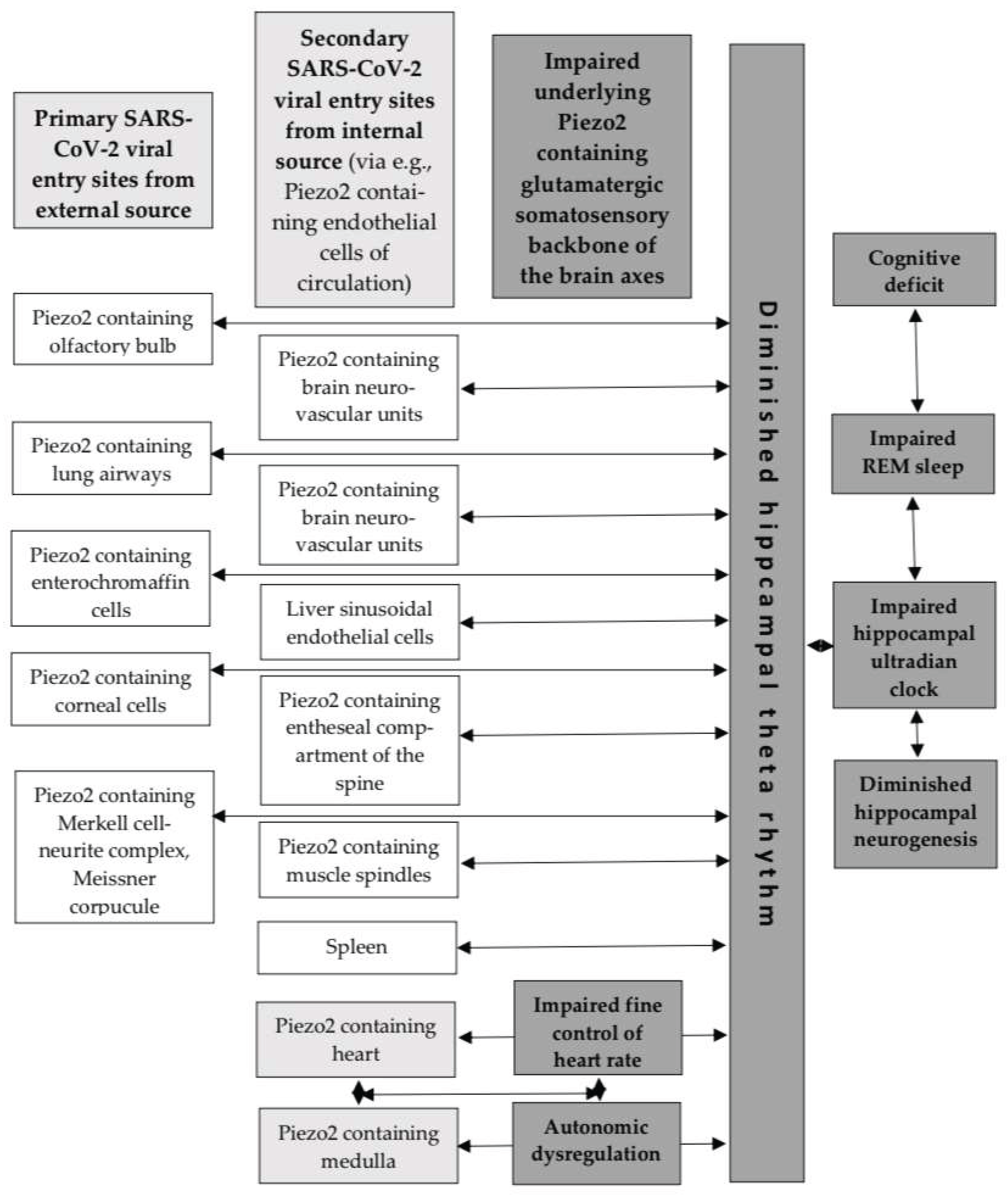
Moreover, this proposed Piezo2-initiated novel long-distance synchronous signaling mechanism also construct the ultradian backbone of brain axes, like in the case of the heart-brain axis (Figure 1) [11]. Important to note that Piezo2 channelopathy impairs this long-distance synchronous reflex mechanism, impairs proprioception, induces autonomic disbalance and invokes the above mentioned reflex-like exaggerated reaction [3].
Hippocampus and the Medulla
An earlier DOMS-related HRV study with Piezo2 interpretation theorized Piezo2’s ultrafast ultradian sensory and ultradian rhythm generation function [5]. Indeed, sensory feedback are organized transiently by ultradian brain rhythms jointly with temporary synchronization of the hippocampal theta rhythm, HR, and medulla firing [14,15]. Based on earlier observation of Pedemonte et al [14,15], it should be contemplated that ultradian backbone axes of heart-brain axes are temporarily synchronized to theta rhythm that may present the fine/ultrafast control over the ANS via ultrafast ultradian long-distance synchronous Piezo2-Piezo2 crosstalk in a HR dependent fashion [5].
Noteworthy that COVID-19 infection often causes autonomic disbalance, and damage to the Piezo2 containing hippocampus and medulla (critical control center of ANS), and these damages are theorized to be the consequence of Piezo2 channelopathy at viral entry sites [11].
The author of this paper highlights that the microdamage to this ultradian Piezo2-initiated ultradian Piezo2 system-wide machinery is why the orthostatic intolerance and postural orthostatic tachycardia syndrome (POTS) are so high among long COVID patients.
Conclusion
The author of this paper proposes that not only Piezo2-modulated baroreceptors and blood volume receptors are in collaboration, but an underlying Piezo2-Piezo2 crosstalk-based Piezo2 system, including the proprioceptive system, in order to adjust to postural change while maintaining cardiovascular stability.
Author Contributions
The author confirms the sole responsibility for the conception of the current paper and manuscript preparation.
Conflicts of Interest
The author declares no competing interests.
References
- Liu, Z.; et al. Vagal blood volume receptors compensate for haemorrhage and posture change. Nature 2026. [Google Scholar] [CrossRef]
- Sonkodi, B. LF Power of HRV Could Be the Piezo2 Activity Level in Baroreceptors with Some Piezo1 Residual Activity Contribution. Int J Mol Sci 2023, 24. [Google Scholar] [CrossRef] [PubMed]
- Sonkodi, B. Acquired Piezo2 Channelopathy is One Principal Gateway to Pathophysiology. Front Biosci (Landmark Ed) 2025, 30, 33389. [Google Scholar] [CrossRef] [PubMed]
- Sonkodi, B.; et al. Orthostasis Is Impaired Due to Fatiguing Intensive Acute Concentric Exercise Succeeded by Isometric Weight-Loaded Wall-Sit in Delayed-Onset Muscle Soreness: A Pilot Study. Sports (Basel) 2023, 11. [Google Scholar] [CrossRef] [PubMed]
- Langmar, G.; et al. Heart Rate Variability Alterations During Delayed-Onset Muscle Soreness-Inducing Exercise-With Piezo2 Interpretation. Sports (Basel) 2025, 13. [Google Scholar] [CrossRef] [PubMed]
- Sümegi, T.; et al. Delayed-Onset Muscle Soreness Mimics a Tendency Towards a Positive Romberg Test. PREPRINT (Version 1) available at Research Square. (2025). [CrossRef]
- Liu, W.; et al. Spring-like mechanics enable rapid inactivation and stochastic single-channel gating of the mechanically activated PIEZO channel. Cell Rep 2025, 44, 116615. [Google Scholar] [CrossRef] [PubMed]
- Sonkodi, B. Big Bang-like, Wormhole-like Mechanism, and Piezo2 Within Humans. Preprints 2025. [Google Scholar] [CrossRef]
- Kamakura, M.; Haga, M.; Nagai, M.; Chiba, H. Effect of blood volume change on circulation and heart rate variability during autologous blood donation. The FASEB Journal 2011, 25, 644.613. [Google Scholar] [CrossRef]
- Nagy, Z. F.; Sonkodi, B.; Pal, M.; Klivenyi, P.; Szell, M. Likely Pathogenic Variants of Ca(v)1.3 and Na(v)1.1 Encoding Genes in Amyotrophic Lateral Sclerosis Could Elucidate the Dysregulated Pain Pathways. Biomedicines 2023, 11. [Google Scholar] [CrossRef] [PubMed]
- Sonkodi, B. Underlying Piezo2 Channelopathy-Induced Neural Switch of COVID-19 Infection. Cells 2025, 14. [Google Scholar] [CrossRef] [PubMed]
- Kamkin, A. G.; et al. Hypergravity Increases the Number of Gene Transcripts of Mechanically Gated and Mechanosensitive Ion Channels in Rat Ventricular Cardiomyocytes. Bull Exp Biol Med 2023, 175, 730–733. [Google Scholar] [CrossRef] [PubMed]
- Woo, S. H.; et al. Piezo2 is the principal mechanotransduction channel for proprioception. Nat Neurosci 2015, 18, 1756–1762. [Google Scholar] [CrossRef] [PubMed]
- Pedemonte, M.; Goldstein-Daruech, N.; Velluti, R. A. Temporal correlations between heart rate, medullary units and hippocampal theta rhythm in anesthetized, sleeping and awake guinea pigs. Auton Neurosci 2003, 107, 99–104. [Google Scholar] [CrossRef] [PubMed]
- Pedemonte, M.; Velluti, R. A. [Sensory processing could be temporally organized by ultradian brain rhythms]. Rev Neurol 2005, 40, 166–172. [Google Scholar] [CrossRef] [PubMed]
Figure 1.
The novel ultrafast proton-based oscillatory synchronization mechanism to hippocampal theta rhythm, constructing the ultradian backbone of the brain axes. The dark gray boxes denote the COVID-19 infection-induced impairments and dysregulations [11].
Figure 1.
The novel ultrafast proton-based oscillatory synchronization mechanism to hippocampal theta rhythm, constructing the ultradian backbone of the brain axes. The dark gray boxes denote the COVID-19 infection-induced impairments and dysregulations [11].
Disclaimer/Publisher’s Note: The statements, opinions and data contained in all publications are solely those of the individual author(s) and contributor(s) and not of MDPI and/or the editor(s). MDPI and/or the editor(s) disclaim responsibility for any injury to people or property resulting from any ideas, methods, instructions or products referred to in the content. |
© 2026 by the author. Licensee MDPI, Basel, Switzerland. This article is an open access article distributed under the terms and conditions of the Creative Commons Attribution (CC BY) license.
Copyright: This open access article is published under a Creative Commons CC BY 4.0 license, which permit the free download, distribution, and reuse, provided that the author and preprint are cited in any reuse.