

Submitted:
26 March 2026
Posted:
27 March 2026
You are already at the latest version
Abstract
Sarcopenia is increasingly recognized as a key extracardiac manifestation of heart failure (HF), contributing to functional impairment, reduced quality of life, and adverse clinical outcomes. Characterized by progressive loss of skeletal muscle mass, strength, and physical performance, it affects more than half of hospitalized HF patients and is independently associated with increased mortality and reduced exercise capacity. The pathophysiology of sarcopenia in HF is multifactorial and closely linked to metabolic and nutritional disturbances. Chronic inflammation, neurohormonal activation, oxidative stress, endothelial dysfunction, and anabolic resistance contribute to muscle catabolism and impaired protein synthesis. These alterations are further exacerbated by inadequate dietary protein intake and micronutrient deficiencies, promoting progressive muscle wasting and functional decline. Sarcopenia may also represent an early and potentially modifiable stage in the continuum toward cardiac cachexia.
This narrative review provides a comprehensive synthesis of current evidence on epidemiology, pathophysiological mechanisms, and management of sarcopenia in HF, with particular emphasis on nutritional and metabolic determinants. Emerging data support a multimodal therapeutic approach integrating exercise training with targeted nutritional strategies, including adequate protein intake, essential amino acid supplementation, and correction of micronutrient deficiencies. However, evidence from large, well-designed trials remains limited. In summary, improved recognition and integrated management of sarcopenia in HF are essential. Future research should focus on the development of effective, nutrition-centered therapeutic strategies.
Keywords:
sarcopenia
; heart failure
; nutrition
; muscle metabolism
; protein intake
; cachexia
; exercise
; amino acids
1. Introduction
Heart failure (HF) is a complex clinical syndrome characterized by hallmark symptoms such as fatigue, reduced exercise tolerance, and exertional dyspnea, and often accompanied by signs like peripheral congestion and elevated jugular venous pressure. These manifestations result from structural or functional cardiac abnormalities leading to reduced cardiac output and/or elevated intracardiac pressures at rest or during stress [1]. HF affects approximately 2% of the population in developed countries, with prevalence increasing markedly with age—doubling nearly every decade in men and every seven years in women beyond 55 years of age [2].
Historically, the conceptualization of HF has transitioned from a “hemodynamic” model, which focused primarily on the heart’s pumping capacity and peripheral vasoconstriction, to a “neurohormonal” model. This model recognizes that HF progression is driven by overactivation of neurohormonal pathways that exert deleterious effects on the heart and peripheral circulation in response to reduced cardiac output [3].
This paradigm shift has enabled the development and widespread use of pharmacological therapies such as angiotensin-converting enzyme (ACEI) inhibitors and beta-blockers, which have substantially improved survival and life expectancy in HF patients [1].
As a result of these therapeutic advances, an increasing number of individuals with HF survive into older age, facing new clinical challenges such as frailty and multi-morbidity, which were historically under-recognized in this population. Notably, HF is frequently accompanied by profound nutritional disorders and alterations in body composition, including sarcopenia—the age-related loss of skeletal muscle mass and strength—and cardiac cachexia, a wasting syndrome characterized by severe body weight, fat, and muscle loss.
These nutritional and muscular abnormalities significantly contribute to the poor prognosis observed in HF patients and highlight the need for comprehensive management approaches that extend beyond pharmacological treatment. Despite the recognition of these complex interrelations, standardized guidelines for the non-pharmacological management of HF, particularly addressing nutritional status and muscle wasting, remain lacking. Understanding the pathophysiology linking HF with sarcopenia and cachexia is therefore critical for improving patient outcomes and developing integrated therapeutic strategies.
2. Sarcopenia and Cachexia in Heart Failure
The main wasting syndromes occurring in the course of chronic diseases, such as chronic heart failure (CHF). include sarcopenia and cachexia [4].
Sarcopenia is a disease of skeletal muscle characterized by reduced muscle strength, low muscle mass, or impaired muscle quality, leading to decreased physical performance [5]. Initially considered exclusively as a geriatric condition, it is now also associated with numerous chronic diseases. It is estimated that sarcopenia affects 10–16% of the elderly population worldwide, while its prevalence is higher among patients with chronic conditions. Depending on the clinical population studied, the prevalence of sarcopenia ranges from 18% in patients with diabetes to as high as 66% in individuals with unresectable esophageal cancer [6]. According to recent studies, signs of sarcopenia can be observed in 36% (10–64%) of patients with chronic heart failure (CHF), with a markedly higher prevalence among hospitalized patients (55%) compared with those treated in the outpatient setting (26%) [7].
Current data indicate a frequent coexistence of both conditions. Importantly, the presence of sarcopenia independently worsens prognosis in patients with CHF [8]. Von Haehling et al. demonstrated increased mortality among patients with CHF and concomitant sarcopenia compared with those without skeletal muscle abnormalities over 100 months of follow-up. At 24 months, mortality was 22.2% in patients with muscle wasting versus 10% in non-sarcopenic patients [9]. These findings are consistent with global statistics concerning patients with sarcopenia. Among individuals with muscle wasting, a significant increase in mortality (31%) was observed compared with non-sarcopenic patients (8%) over 55 months of follow-up. The number of hospitalizations was also higher in sarcopenic patients (68% vs. 48%). Moreover, an increased tendency toward injuries was noted in this population [10].
Muscle loss in the course of heart failure leads to further deterioration of physical capacity beyond the symptoms of CHF itself. In patients with heart failure and sarcopenia, reduced peak oxygen uptake (pVO₂) is frequently observed. Contemporary studies indicate that lower pVO₂ values, as well as the absence of improvement during treatment optimization, are associated with an increased risk of mortality and cardiovascular events [11,12]. Additionally, scores on the Short Physical Performance Battery (SPPB) and EQ-5D, as well as handgrip strength and quadriceps muscle strength, were also lower compared with patients with heart failure without evidence of sarcopenia [13].
According to some authors, during the progression of HF, sarcopenia may represent a prelude to the development of cachexia. Many of the pathophysiological mechanisms underlying sarcopenia overlap with processes favoring the development of cachexia, suggesting the existence of a “wasting continuum” that leads to the progression from sarcopenia to cachexia in patients with heart failure [14]. Cachexia is a condition distinct from sarcopenia, as it is characterized by loss of total body mass and multiple tissues, including muscle, adipose tissue, and bone. Cachexia primarily affects patients with advanced CHF, typically those in higher New York Heart Association (NYHA) functional classes [15]. It is also associated with significantly higher mortality among patients with CHF. Anker et al. demonstrated a 50% mortality rate among patients with CHF and cachexia over an 18-month period, identifying cachexia as a strong negative prognostic factor for mortality in CHF [16].
Comparative studies have demonstrated that the presence of a sarcopenic component is associated with the lowest levels of muscle mass and muscle strength, as reflected by reduced handgrip strength, quadriceps muscle strength, six-minute walk distance (6MWT), peak oxygen uptake (VO₂), and Short Physical Performance Battery (SPPB) scores. Patients with skeletal muscle loss exhibited a lower quality of life (QOL) compared with cohorts with cachexia or without either of these comorbid conditions. Sarcopenia in patients with chronic heart failure may represent a key process increasing hospitalization rates, limiting independence and quality of life, and—through an increased predisposition to the development of cachexia—raising the risk of mortality [13].
3. Pathophysiology of Sarcopenia in Chronic Heart Failure
Cruz-Jentoft et al. identified aging, low physical activity, malnutrition, and the presence of systemic disease as potential factors predisposing individuals to sarcopenia. When factors other than advanced age are present, sarcopenia is referred to as secondary sarcopenia, as it is induced by an underlying pathology [5].
The frequent coexistence of secondary sarcopenia in patients with chronic heart failure can be attributed to multiple and significant disturbances predisposing to its development, resulting from the impact of heart failure on the body and skeletal muscle tissue, as well as from concomitant malnutrition and reduced physical activity.
3.1. Alterations in Skeletal Muscle Tissue
Numerous histopathological alterations characteristic of secondary sarcopenia have been observed in the skeletal muscle of patients with chronic heart failure. These include atrophy of type I (slow-twitch oxidative) and type IIA (fast-twitch oxidative) fibers, accompanied by an increased proportion of type IIB (glycolytic) fibers [17,18]. Alterations in the skeletal muscle capillary network have also been observed, including reduced capillary density and a decreased capillary-to-fiber ratio [19]. In addition, multiple mitochondrial abnormalities have been demonstrated in skeletal muscle myocytes, indicative of impaired oxidative metabolism, such as reduced volumetric and surface density of mitochondrial cristae and decreased cytochrome c oxidase activity [18]. Comparisons between myocytes from patients with chronic heart failure and age-matched healthy individuals revealed a higher number of apoptotic nuclei in patients with heart failure [20].
The morphology of sarcopenic changes in the course of chronic heart failure differs from that observed in primary sarcopenia. In contrast to heart failure–related changes, primary sarcopenia is characterized predominantly by atrophy of type II fibers, preservation of type I fibers, and infiltration of muscle tissue by adipose tissue. These changes are largely dependent on motor unit denervation, as opposed to the alterations caused by reduced cardiac output in chronic heart failure [21].
3.2. Main Factors in the Pathophysiology of Sarcopenia in CHF
Among the most important factors inducing sarcopenia in heart failure are hormonal and neurohormonal disturbances, chronic oxidative stress with subsequent apoptosis, as well as endothelial dysfunction and hemodynamic abnormalities within skeletal muscle tissue.
3.2.1. Hormonal Dysregulation
Cittadini et al. demonstrated the presence of metabolic failure syndrome in 77.5% of patients with chronic heart failure and further identified this syndrome as being associated with increased mortality and more frequent hospitalizations. Deficiency of anabolic hormones, such as growth hormone, insulin-like growth factor 1 (IGF-1), and testosterone, is characteristic of metabolic failure syndrome [22]. Chronic heart failure is associated with reduced local insulin-like growth factor-1 (IGF-1) expression and impaired tissue responsiveness to growth hormone [23]. Dysregulation of the growth hormone/IGF-1 axis disrupts the balance between cellular processes regulating hypertrophy and atrophy [23]. In the context of chronic heart failure, IGF-1 deficiency significantly contributes to reduced skeletal muscle strength and mass, leading to sarcopenia [24].
Testosterone levels decline with age; however, in patients with chronic heart failure, due to the presence of metabolic failure syndrome, testosterone concentrations decrease earlier and are lower than in an age-matched healthy population [25]. Testosterone exerts beneficial effects on skeletal muscle by promoting protein synthesis over degradation and stimulating the formation of new myotubules with an increased number of myonuclei, leading to increased muscle mass, strength, and exercise capacity [26]. Reduced testosterone levels in patients with chronic heart failure may therefore contribute to the development of sarcopenia.
3.2.2. Neurohormonal Dysfunction
In addition to hormonal disturbances, chronic heart failure is characterized by excessive adrenergic stimulation, which represents one of the fundamental neurohormonal abnormalities [3]. Da Fonseca et al. demonstrated dysfunction of the sympathetic–parasympathetic axis in patients with heart failure and sarcopenia by assessing muscle sympathetic nerve activity using peroneal nerve microneurography. In the sarcopenic group, adrenergic activity was higher, reaching 47 (41–52) bursts/min, compared with patients with heart failure without sarcopenia, in whom an average of 40 (34–48) bursts/min was observed [27]. These findings indicate a negative role of excessive sympathetic stimulation in the development of sarcopenia in chronic heart failure.
3.2.3. Increased Myostatin Expression
Elevated levels of myostatin, a hormone that negatively regulates myocyte cellular processes, have also been observed in chronic heart failure [28]. Animal models have demonstrated a detrimental effect of increased myostatin expression by cardiomyocytes on skeletal muscle atrophy [29]. The myostatin pathway is activated only during severe cardiac stress and limits uncontrolled organ growth. By reducing skeletal muscle mass, it decreases the circulatory load imposed on the heart. However, in the long term, chronic myostatin stimulation induces sarcopenia, markedly limiting patients’ exercise capacity [30].
3.2.4. Chronic Inflammation
Both heart failure with preserved ejection fraction and reduced ejection fraction are associated with elevated systemic inflammatory markers, such as tumor necrosis factor alpha (TNF-α), interleukins 1 and 6, and galectin-3. It is currently unclear how pro-inflammatory cytokines influence cardiac remodeling and whether they represent a cause or a consequence of disease progression [31]. Schaap et al. demonstrated a negative impact of elevated pro-inflammatory cytokine levels on muscle strength and mass, identifying chronic inflammation as one of the probable causes of sarcopenia [32].
3.2.5. Oxidative Stress and ROS
Another factor likely to exacerbate sarcopenic processes is oxidative stress and increased production of reactive oxygen species [33]. In addition to an acute increase in oxidative stress mediators, heart failure is also characterized by depletion of endogenous antioxidant defense mechanisms, which may contribute to skeletal muscle loss [34].
3.2.6. Disturbed Hemodynamics and Endothelial Dysfunction
Hemodynamic disturbances resulting from reduced cardiac output also contribute to skeletal muscle wasting in patients with chronic heart failure. Endothelial dysfunction, caused by impairment of the nitric oxide–cGMP signaling pathway, results in reduced vasodilation and consequently altered peripheral blood flow. This pathology is systemic and may persist even after heart transplantation [35]. An abnormal hyperemic response in the vasculature results in reduced blood flow to skeletal muscles, leading to decreased muscle strength and physical performance [36]. In healthy individuals, activation of the skeletal muscle metaboreflex during exercise increases vascular resistance as well as cardiac contractility and stroke volume. In contrast, patients with heart failure exhibit an altered response: reduced cardiac output leads to skeletal muscle ischemia, which in turn increases catabolism and structural changes. This ultimately limits exercise capacity and leads to excessive activation of the metaboreflex [37]. Heart transplantation does not eliminate the excessive activation of the metaboreflex either, which is one of the reasons why exercise capacity in heart transplant recipients remains lower compared with healthy cohorts [38].
3.2.7. Malnutrition and Anorexia
Sze et al., using nutritional status indices such as the Geriatric Nutritional Risk Index (GNRI) and the Controlling Nutritional Status (CONUT) score, demonstrated that malnutrition is a common abnormality among ambulatory patients with heart failure and that it is strongly correlated with increased mortality [39].
Anorexia, a frequent symptom of heart failure, is independently associated with reduced muscle mass and muscle strength. Moreover, patients with sarcopenia have been shown to have decreased intake of several micronutrients, including iron, phosphorus, magnesium, potassium, and vitamin K. The causes of anorexia in patients with chronic heart failure are most commonly attributed to pulmonary and gastrointestinal congestion, increased resting energy catabolism, and certain pharmacological agents used in heart failure therapy, such as digoxin [40,41,42,43,44].
A graphical summary is presented in Figure 1.
4. Nutritional and Pharmacological Interventions Targeting Sarcopenia in Chronic Heart Failure
4.1. Nutritional Interventions
Therapeutic options for sarcopenia in chronic heart failure remain limited. Physical exercise and nutritional interventions, particularly high-protein diets, represent the cornerstone of prevention and treatment. Ongoing research is focused on identifying effective pharmacological strategies aimed at attenuating pathological loss of skeletal muscle mass and function in patients with heart failure.
The primary objective of dietary intervention is to restore the balance between anabolic and catabolic processes within skeletal muscle tissue. Increased daily protein intake has been proposed as a strategy to counteract sarcopenia [45]. Aquilani et al. demonstrated that adequate intake of protein- and amino acid-rich meals, adjusted to individual energy requirements, improved exercise capacity, including peak oxygen uptake and walking performance, in stable patients with chronic heart failure and concomitant sarcopenia; however, no significant improvement in skeletal muscle metabolic abnormalities was observed [46].
Rozentryt et al. reported that high-calorie, energy-dense nutritional supplementation resulted in increased fat and muscle mass and improved quality of life. A concomitant reduction in circulating tumor necrosis factor-α levels was observed, suggesting a potential anti-inflammatory effect [47].
Additionally, supplementation with branched-chain amino acids, particularly leucine, may further stimulate skeletal muscle protein synthesis [48].
It should be emphasized that most studies evaluating dietary interventions for sarcopenia have been conducted in elderly populations without significant comorbidities. High-protein diets should therefore be applied cautiously in patients with chronic heart failure and coexisting conditions, such as chronic kidney disease or diabetes mellitus [49,50].
4.2. Pharmacological INTERVENTIONS
Potential pharmacological approaches to sarcopenia are largely based on the pleiotropic effects of drug classes routinely used in the treatment of chronic heart failure, including angiotensin-converting enzyme inhibitors (ACEIs), β-adrenergic receptor blockers, and mineralocorticoid receptor antagonists (MRAs).
ACEIs, which constitute first-line therapy for heart failure, have been suggested to exert beneficial effects on skeletal muscle [1]. Ata et al. reported a lower prevalence of sarcopenia among hypertensive patients treated with ACEIs compared with those receiving angiotensin II receptor blockers or other antihypertensive agents [51]. In addition, ACEIs may exert anti-inflammatory effects and increase insulin-like growth factor-1 levels in skeletal muscle [52]. However, data regarding their direct impact on muscle function remain inconsistent, warranting further investigation [53,54].
Beyond their central hemodynamic effects, MRAs may exert favorable peripheral actions relevant to sarcopenia. Spironolactone has been shown to improve endothelial function in skeletal muscle vasculature, enhance nitric oxide bioavailability, and inhibit local angiotensin II formation, potentially improving tissue perfusion and exercise capacity [55,56]. MRAs may also reduce the production of pro-inflammatory cytokines implicated in sarcopenia and favorably influence skeletal muscle metabolism and apoptosis [55,57].
β-Adrenergic receptor blockers represent another drug class with potential effects on skeletal muscle. Espindolol has been shown to increase muscle mass and handgrip strength in selected populations [58].
Given the frequent hormonal disturbances observed in sarcopenia and heart failure, several investigational therapies targeting endocrine pathways have been explored. These include testosterone supplementation, selective androgen receptor modulators (SARMs), ghrelin-based therapies, and myostatin inhibitors [59,60].
Testosterone deficiency, commonly observed in heart failure, is associated with reduced physical capacity [14]. Testosterone replacement therapy administered at physiological doses has been shown to improve exercise capacity, peak oxygen uptake, and muscle strength, despite inconsistent effects on muscle mass [61,62]. However, potential adverse effects, including prostate hypertrophy and increased thromboembolic risk, limit its routine clinical use [59] .
SARMs are not currently approved for routine clinical use. These agents stimulate anabolic processes while minimizing androgenic adverse effects [63]. Clinical studies have demonstrated increases in body mass and, in some cases, muscle strength; however, results remain inconsistent, and data in heart failure populations are limited [64,65]. Further investigation is required to establish their safety and efficacy in this setting [60].
Ghrelin levels are often reduced in elderly patients with sarcopenia. In a small clinical study, intravenous administration of synthetic ghrelin improved left ventricular ejection fraction, reduced circulating norepinephrine levels, and enhanced exercise capacity and skeletal muscle mass in patients with heart failure [66]. Larger randomized trials are needed to confirm these findings.
Myostatin inhibition represents another potential therapeutic strategy. Although experimental models have demonstrated anabolic effects, clinical trials have yielded mixed results. While some studies reported increases in body or muscle mass, improvements in functional outcomes have been inconsistent [67,68,69].
Sarcopenic obesity represents a distinct phenotype characterized by the coexistence of skeletal muscle loss and increased adiposity. This phenotype has been reported in approximately 19.4% of patients with chronic heart failure [70]. Emerging combination therapies involving glucagon-like peptide-1 receptor agonists and myostatin inhibitors aim to preserve muscle mass during weight-reducing treatment; however, dedicated studies in heart failure populations are required to evaluate their safety and efficacy [71].
A summary comparing the available treatment methods for sarcopenia in chronic heart failure is presented in Table 1.
5. Physical Training
Physical exercise is currently regarded as the most effective strategy for the prevention and treatment of sarcopenia [60]. It represents a safe, low-cost, and widely accessible intervention that, when appropriately tailored to the patient’s individual capabilities, can significantly improve exercise capacity and quality of life [72,73]. The most commonly applied modalities include aerobic training, resistance training, or combined exercise programs incorporating both forms of activity [72]. Studies evaluating the effects of various training modalities in patients with heart failure have demonstrated numerous beneficial adaptations in both skeletal muscle tissue and circulating biochemical parameters [74].
Aerobic training includes activities such as walking, treadmill exercise, and stationary cycling. Studies assessing the impact of aerobic exercise on health outcomes and quality of life in patients with heart failure have demonstrated increases in pVO₂ and IGF-1 levels. Concomitantly, reductions in NT-proBNP, myostatin, TNF-α, and the expression of TRIM63 mRNA and protein have been observed [72,74].
Skeletal muscle in patients with chronic heart failure is characterized by markedly increased expression of MuRF-1 mRNA and protein, a key regulator of the ubiquitin–proteasome system. Gielen et al. demonstrated a significant reduction in MuRF-1 expression after only four weeks of aerobic training (four sessions per week, 20 minutes per session) in patients with heart failure [75].
Lenk et al. reported a 36% decrease in myostatin mRNA expression and a 23% reduction in circulating myostatin protein levels in peripheral skeletal muscles after 12 weeks of regular exercise training, compared with a sedentary control group [76].
Lelyavina et al. assessed clinical and exercise-related parameters in patients with
(NYHA) class III heart failure before and after 12 weeks of walking performed four to five times per week. Aerobic training resulted in increased pVO₂, left ventricular ejection fraction (LVEF), exercise tolerance (ET), and quality of life in approximately 30% of patients, while 95% of participants exhibited improvement in at least one of the evaluated parameters [77]. Moreover, aerobic exercise has been associated with improved survival and a reduced rate of hospitalization in patients with chronic heart failure [78].
A study conducted by Williams et al. demonstrated that circuit-based resistance training in patients with chronic heart failure led to increased activity of oxidative enzymes, including MAPR and HAD, enhanced citrate synthase (CS) activity, and an elevated lactate threshold—parameters strongly associated with improvements in pVO₂. An increase in the capillary-to-muscle fiber ratio was also observed [79].
Pu et al. investigated the effects of high-intensity resistance training performed three times per week for 10 weeks, including leg press, chest press, knee extension, knee flexion, and triceps exercises. The intervention resulted in increased muscle strength and endurance, as well as a greater six-minute walk distance. Skeletal muscle oxidative capacity improved significantly; however, no significant changes were observed in mean muscle fiber cross-sectional area or total body muscle mass. Peak VO₂ remained unchanged [80].
Additional studies have evaluated the effects of different exercise modalities in older adults with sarcopenia by assessing knee extensor strength, gait speed, chair-stand performance, and the timed up-and-go test as measures of muscle strength and physical function. Comparative analyses indicate that the choice of training modality is associated with selective improvements in specific functional outcomes. Resistance and combined training exerted favorable effects on gait speed and knee extensor strength, whereas whole-body vibration training did not produce significant improvements in these parameters. All three modalities—resistance, combined, and whole-body vibration training—were associated with improved timed up-and-go performance but did not significantly affect chair-stand test results [81].
6. Conclusions and Further Directions
Sarcopenia is a well-established prognostic factor associated with adverse clinical outcomes in patients with heart failure and contributes to increased morbidity and mortality. Since the pathophysiological changes leading to skeletal muscle loss in patients with heart failure involve multiple mechanisms and factors, it is unlikely that a single intervention will be sufficient. Therefore, a multimodal intervention that combines exercise, nutrition and pharmacotherapy will be needed to address the various pathways that contribute to skeletal muscle loss in patients with heart failure [7].
Several pharmacologic agents such as myostatin inhibitors, ghrelin-based therapies and selective androgen receptor modulators are currently being investigated to target skeletal muscle metabolism. Although these agents show promise in preclinical studies, there is limited clinical data available to support their use in the management of skeletal muscle atrophy in heart failure patients [66,67,68,69].
Therefore, several clinical trials are currently underway to evaluate the impact of multimodal lifestyle-based interventions that combine structured physical activity with tailored dietary strategies. These studies will assess whether higher protein intake combined with a structured exercise program can positively affect skeletal muscle mass, strength and functional ability in patients with heart failure [12].
The PROT-HF study (NCT03142399) is designed to evaluate the efficacy of whey protein supplementation combined with a structured exercise program on muscle mass, muscle strength and quality of life in patients with chronic heart failure [82]. An additional mechanistically oriented study (NCT05627440) is evaluating the effectiveness of a skeletal muscle recovery protocol consisting of tailored nutritional supplements and structured physical activity in patients with HFrEF [83]. Most recently, the randomized, double-blind STRIVE trial (NCT06428192) was initiated to evaluate the additive effects of whey protein supplementation and progressive resistance training in patients with HFpEF [84].
Taken together, current data demonstrate that skeletal muscle dysfunction is a crucial extracardiac component of the heart failure syndrome and significantly impacts both the rate of functional decline and long-term survival in patients with HF. Effective management of sarcopenia will likely require integrated strategies combining optimized heart failure therapy with targeted nutritional interventions and structured exercise programs [12]. Future research should focus on well-designed randomized trials to determine whether multimodal approaches aimed at improving skeletal muscle metabolism can translate into meaningful improvements in functional capacity, quality of life, and long-term clinical outcomes in patients with heart failure [85].
Supplementary Materials
The following supporting information can be downloaded at the website of this paper posted on Preprints.org, Figure S1: Pathophysiological pathways of CHF induced sarcopenia in skeletal muscles.; Table S1: Therapeutic strategies targeting sarcopenia and cachexia in patients with chronic heart failure.
Author Contributions
Conceptualization, D.K., A.T. and A.Z.; methodology, D.K., A.Z. and H.K.; validation, D.K., B.P-C. and A.Z.; writing—original draft preparation, D.K., A.Z. and H.K.; writing—review and editing, D.K., A.T., A.Z. and H.K.; supervision, A.T. and B.P-C. All authors have read and agreed to the published version of the manuscript.
Funding
This research received no external funding.
Institutional Review Board Statement
Not applicable.
Informed Consent Statement
Not applicable.
Data Availability Statement
Not applicable.
Conflicts of Interest
The authors declare no conflicts of interest.
Abbreviations
The following abbreviations are used in this manuscript:
| HF | Heart Failure |
| CHF | Chronic Heart Failure |
| NYHA | New York Heart Association |
| 6MWT | Six-Minute Walk Test |
| pVO₂ | Peak Oxygen Uptake |
| SPPB | Short Physical Performance Battery |
| IGF-1 | Insulin-like Growth Factor 1 |
| TNF-α | Tumor Necrosis Factor Alpha |
| ROS | Reactive Oxygen Species |
| GNRI | Geriatric Nutritional Risk Index |
| CONUT | Controlling Nutritional Status Score |
| ACEI | Angiotensin-Converting Enzyme Inhibitor |
| MRA | Mineralocorticoid Receptor Antagonists |
| SARM | Selective Androgen Receptor Modulators |
| TRIM63 | Tripartite Motif-Containing 63 |
| MuRF-1 | Muscle RING Finger 1 |
| NT-proBNP | N-terminal prohormone of brain natriuretic peptide |
| LVEF | Left Ventricular Ejection Fraction |
| ET | Exercise Tolerance |
| QOL | Quality Of Life |
| HFpEF | Heart Failure Preserved Ejection Fraction |
| CS | Citrate Synthase |
References
- McDonagh, T.A.; Metra, M.; Adamo, M.; Gardner, R.S.; Baumbach, A.; Böhm, M.; Burri, H.; Butler, J.; Čelutkienė, J.; Chioncel, O.; Cleland, J.G.F.; Coats, A.J.S.; Crespo-Leiro, M.G.; Farmakis, D.; Gilard, M.; Heymans, S.; Jaarsma, T.; Jankowska, E.A.; Lainscak, M.; Lam, C.S.P.; Lyon, A.R.; McMurray, J.J.V.; Mebazaa, A.; Mindham, R.; Muneretto, C.; Francesco Piepoli, M.; Price, S.; Rosano, G.M.C.; Ruschitzka, F.; Kathrine Skibelund, A. 2021 ESC Guidelines for the Diagnosis and Treatment of Acute and Chronic Heart Failure. European Heart Journal 2021, 42, 3599–3726. [Google Scholar] [CrossRef]
- Hogg, K.; Swedberg, K.; McMurray, J. Heart Failure with Preserved Left Ventricular Systolic Function: Epidemiology, Clinical Characteristics, and Prognosis. Journal of the American College of Cardiology 2004, 43, 317–327. [Google Scholar] [CrossRef]
- Packer, M. The Neurohormonal Hypothesis: A Theory to Explain the Mechanism of Disease Progression in Heart Failure. Journal of the American College of Cardiology 1992, 20, 248–254. [Google Scholar] [CrossRef]
- Lena, A.; Hadzibegović, S.; von Haehling, S.; Springer, J.; Coats, A.J.S.; Anker, M.S. Sarcopenia and Cachexia in Chronic Diseases: From Mechanisms to Treatment. Polish Archives of Internal Medicine 2021, 131. [Google Scholar] [CrossRef]
- Cruz-Jentoft, A.J.; Bahat, G.; Bauer, J.; Boirie, Y.; Bruyère, O.; Cederholm, T.; Cooper, C.; Landi, F.; Rolland, Y.; Sayer, A.A.; Schneider, S.M.; Sieber, C.C.; Topinkova, E.; Vandewoude, M.; Visser, M.; Zamboni, M. Sarcopenia: Revised European Consensus on Definition and Diagnosis. Age and Ageing 2019, 48, 16–31. [Google Scholar] [CrossRef]
- Yuan, S.; Larsson, S.C. Epidemiology of Sarcopenia: Prevalence, Risk Factors, and Consequences. Metabolism 2023, 144, 155533. [Google Scholar] [CrossRef]
- Zhang, Y.; Zhang, J.; Ni, W.; Yuan, X.; Zhang, H.; Zhang, L.; Zhang, M.; Zhang, Y. Sarcopenia in Heart Failure: A Systematic Review and Meta-Analysis. ESC Heart Failure 2021, 8, 1007–1017. [Google Scholar] [CrossRef] [PubMed]
- Lopez, P.D.; Nepal, P.; Akinlonu, A.; Ogunbayo, G.O.; Mishra, T.; Rangaswami, J.; Ahmed, H.M. Low Skeletal Muscle Mass Independently Predicts Mortality in Patients with Chronic Heart Failure after an Acute Hospitalization. Cardiology 2019, 142, 28–36. [Google Scholar] [CrossRef]
- von Haehling, S.; Garfias Macedo, T.; Valentova, M.; Ebner, N.; Bekfani, T.; Sandek, A.; Doehner, W.; Anker, S.D. Muscle Wasting as an Independent Predictor of Survival in Patients with Chronic Heart Failure. Journal of Cachexia, Sarcopenia and Muscle 2020, 11, 1242–1249. [Google Scholar] [CrossRef] [PubMed]
- Bianchi, L.; Ferrucci, L.; Cherubini, A.; Maggio, M.; Bandinelli, S.; Savino, E.; Brombo, G.; Ceda, G.P.; Guralnik, J.M.; Landi, F. The Predictive Value of the EWGSOP Definition of Sarcopenia: Results from the InCHIANTI Study. The Journals of Gerontology: Series A, Biological Sciences and Medical Sciences 2016, 71, 259–264. [Google Scholar] [CrossRef] [PubMed]
- Jensen, M.; Thunestvedt, M.; Lamberts, M.; Hovland, A.; Atar, D.; Omland, T. Heart Failure—Chronic Heart Failure, Pathophysiology and Mechanisms, Heart Failure with Reduced Ejection Fraction (HFrEF). European Heart Journal 2024, 45, ehae666.843. [Google Scholar] [CrossRef]
- de Jorge-Huerta, L.; Marco-Alacid, C.; Grande, C.; Velardo Andrés, C. A Narrative Review of the Diagnosis and Treatment of Sarcopenia and Malnutrition in Patients with Heart Failure. Nutrients 2024, 16, 2717. [Google Scholar] [CrossRef]
- Emami, A.; Saitoh, M.; Valentova, M.; Sandek, A.; Evertz, R.; Ebner, N.; Bekfani, T.; Valentova, M.; Doehner, W.; Anker, S.D.; von Haehling, S. Comparison of Sarcopenia and Cachexia in Men with Chronic Heart Failure: Results from the Studies Investigating Co-Morbidities Aggravating Heart Failure (SICA-HF). European Journal of Heart Failure 2018, 20, 1580–1587. [Google Scholar] [CrossRef] [PubMed]
- von Haehling, S. The Wasting Continuum in Heart Failure: From Sarcopenia to Cachexia. Proceedings of the Nutrition Society 2015, 74, 367–377. [Google Scholar] [CrossRef]
- Valentova, M.; Anker, S.D.; von Haehling, S. Cardiac Cachexia Revisited: The Role of Wasting in Heart Failure. Heart Failure Clinics 2020, 16, 61–69. [Google Scholar] [CrossRef]
- Anker, S.D.; Ponikowski, P.; Varney, S.; Chua, T.P.; Clark, A.L.; Webb-Peploe, K.M.; Harrington, D.; Kox, W.J.; Poole-Wilson, P.A.; Coats, A.J.S. Wasting as an Independent Risk Factor for Mortality in Chronic Heart Failure. The Lancet 1997, 349, 1050–1053. [Google Scholar] [CrossRef]
- Georgiadou, P.; Adamopoulos, S. Skeletal Muscle Abnormalities in Chronic Heart Failure. Current Heart Failure Reports 2012, 9, 128–132. [Google Scholar] [CrossRef]
- Drexler, H.; Riede, U.; Münzel, T.; König, H. Alterations of Skeletal Muscle in Chronic Heart Failure. Circulation 1992, 85, 1751–1759. [Google Scholar] [CrossRef] [PubMed]
- Zamboni, M.; Rossi, A.P.; Corzato, F.; Bambace, C.; Mazzali, G.; Fantin, F. Sarcopenia, Cachexia and Congestive Heart Failure in the Elderly. Current Pharmaceutical Design 2013, 19, 3656–3664. [Google Scholar] [CrossRef]
- Filippatos, G.S.; Kanatselos, C.; Manolatos, D.D.; Kouris, N.T.; Koniavitou, K.; Baltopoulos, P.; Lekakis, J.; Kremastinos, D.T. Studies on Apoptosis and Fibrosis in Skeletal Musculature: A Comparison of Heart Failure Patients with and without Cardiac Cachexia. International Journal of Cardiology 2003, 90, 107–113. [Google Scholar] [CrossRef]
- Lin, J.; Lopez, E.F.; Jin, Y.; Van Remmen, H.; Bauch, T.; Han, H.C.; Lindsey, M.L. Age-Related Cardiac Muscle Sarcopenia: Combining Experimental and Mathematical Modeling to Identify Mechanisms. Biophysical Journal 2008, 95, 5459–5467. [Google Scholar] [CrossRef] [PubMed]
- Cittadini, A.; Salzano, A.; Iacoviello, M.; Sirico, D.; D’Assante, R.; Giallauria, F.; Bossone, E.; Agostoni, P.; Passantino, A.; Perrone-Filardi, P. Multiple Hormonal and Metabolic Deficiency Syndrome Predicts Outcome in Heart Failure: The T.O.S.CA. Registry. European Journal of Preventive Cardiology 2021, 28, 1691–1700. [Google Scholar] [CrossRef]
- Hambrecht, R.; Schulze, P.C.; Gielen, S.; Linke, A.; Möbius-Winkler, S.; Erbs, S.; Kratzsch, J.; Schuler, G. Reduction of Insulin-Like Growth Factor-I Expression in the Skeletal Muscle of Noncachectic Patients with Chronic Heart Failure. Journal of the American College of Cardiology 2002, 39, 1175–1181. [Google Scholar] [CrossRef]
- Niebauer, J.; Pflaum, C.D.; Clark, A.L.; Strasburger, C.J.; Hooper, J.; Poole-Wilson, P.A.; Coats, A.J.S. Deficient Insulin-Like Growth Factor I in Chronic Heart Failure Predicts Altered Body Composition, Anabolic Deficiency, Cytokine and Neurohormonal Activation. Journal of the American College of Cardiology 1998, 32, 393–397. [Google Scholar] [CrossRef]
- Jankowska, E.A.; Biel, B.; Majda, J.; Banasiak, W.; Poole-Wilson, P.A.; Ponikowski, P. Anabolic Deficiency in Men with Chronic Heart Failure: Prevalence and Detrimental Impact on Survival. Circulation 2006, 114, 1829–1837. [Google Scholar] [CrossRef]
- Josiak, K.; Jankowska, E.A.; Piepoli, M.F.; Banasiak, W.; Ponikowski, P. Skeletal Myopathy in Patients with Chronic Heart Failure: Significance of Anabolic-Androgenic Hormones. Journal of Cachexia, Sarcopenia and Muscle 2014, 5, 287–296. [Google Scholar] [CrossRef]
- da Fonseca, G.W.P.; Dos Santos, M.R.; de Souza, F.R.; Takayama, L.; Rodrigues Pereira, R.M.; Alves, M.J.N.N.; Bacal, F.; Brum, P.C. Sympatho-Vagal Imbalance Is Associated with Sarcopenia in Male Patients with Heart Failure. Arquivos Brasileiros de Cardiologia 2019, 112, 739–746. [Google Scholar] [CrossRef]
- Gruson, D.; Ahn, S.A.; Ketelslegers, J.M.; Rousseau, M.F. Increased Plasma Myostatin in Heart Failure. European Journal of Heart Failure 2011, 13, 734–736. [Google Scholar] [CrossRef]
- Heineke, J.; Auger-Messier, M.; Xu, J.; Sargent, M.; York, A.; Welle, S.; Molkentin, J.D. Genetic Deletion of Myostatin from the Heart Prevents Skeletal Muscle Atrophy in Heart Failure. Circulation 2010, 121, 419–425. [Google Scholar] [CrossRef] [PubMed]
- Breitbart, A.; Auger-Messier, M.; Molkentin, J.D.; Heineke, J. Myostatin from the Heart: Local and Systemic Actions in Cardiac Failure and Muscle Wasting. American Journal of Physiology – Heart and Circulatory Physiology 2011, 300, H1973–H1982. [Google Scholar] [CrossRef] [PubMed]
- Dick, S.A.; Epelman, S. Chronic Heart Failure and Inflammation. Circulation Research 2016, 119, 159–176. [Google Scholar] [CrossRef]
- Schaap, L.A.; Pluijm, S.M.F.; Deeg, D.J.H.; Visser, M. Higher Inflammatory Marker Levels in Older Persons: Associations with 5-Year Change in Muscle Mass and Muscle Strength. The Journals of Gerontology Series A: Biological Sciences and Medical Sciences 2009, 64, 1183–1189. [Google Scholar] [CrossRef] [PubMed]
- Fulle, S.; Protasi, F.; Di Tano, G.; Pietrangelo, T.; Beltramin, A.; Boncompagni, S.; Vecchiet, J.; Fanò, G. The Contribution of Reactive Oxygen Species to Sarcopenia and Muscle Ageing. Experimental Gerontology 2004, 39, 17–24. [Google Scholar] [CrossRef]
- van der Pol, A.; van Gilst, W.H.; Voors, A.A.; van der Meer, P. Treating Oxidative Stress in Heart Failure: Past, Present and Future. European Journal of Heart Failure 2019, 21, 425–435. [Google Scholar] [CrossRef]
- Alem, M.M. Endothelial Dysfunction in Chronic Heart Failure: Assessment, Findings, Significance, and Potential Therapeutic Targets. International Journal of Molecular Sciences 2019, 20, 3198. [Google Scholar] [CrossRef] [PubMed]
- Lee, J.F.; Barrett-O’Keefe, Z.; Nelson, A.D.; Garten, R.S.; Ryan, J.J.; Nativi-Nicolau, J.; Richardson, R.S.; Wray, D.W. Impaired Skeletal Muscle Vasodilation during Exercise in Heart Failure with Preserved Ejection Fraction. International Journal of Cardiology 2016, 211, 14–21. [Google Scholar] [CrossRef]
- Piepoli, M.F.; Crisafulli, A. Pathophysiology of Human Heart Failure: Importance of Skeletal Muscle Myopathy and Reflexes. Experimental Physiology 2014, 99, 609–615. [Google Scholar] [CrossRef]
- Houssiere, A.; Gujic, M.; Deboeck, G.; Ciarka, A.; Naeije, R.; Van De Borne, P. Increased Metaboreflex Activity Is Related to Exercise Intolerance in Heart Transplant Patients. American Journal of Physiology – Heart and Circulatory Physiology 2007, 293, H3699–H3706. [Google Scholar] [CrossRef]
- Sze, S.; Pellicori, P.; Kazmi, S.; Rigby, A.; Cleland, J.G.F. Prevalence and Prognostic Significance of Malnutrition Using 3 Scoring Systems among Outpatients with Heart Failure: A Comparison with Body Mass Index. JACC: Heart Failure 2018, 6, 476–486. [Google Scholar] [CrossRef]
- Poehlman, E.T.; Scheffers, J.; Gottlieb, S.S.; Fisher, M.L.; Vaitekevicius, P. Increased Resting Metabolic Rate in Patients with Congestive Heart Failure. Annals of Internal Medicine 1994, 121, 860–862. [Google Scholar] [CrossRef] [PubMed]
- İlhan, B.; Bahat, G.; Erdoğan, T.; Kiliç, C.; Karan, M.A. Anorexia Is Independently Associated with Decreased Muscle Mass and Strength in Community-Dwelling Older Adults. The Journal of Nutrition, Health & Aging 2019, 23, 202–206. [Google Scholar] [CrossRef]
- Sandek, A.; Doehner, W.; Anker, S.D.; von Haehling, S. Nutrition in Heart Failure: An Update. Current Opinion in Clinical Nutrition and Metabolic Care 2009, 12, 384–391. [Google Scholar] [CrossRef]
- Hussain, Z.; Swindle, J.; Hauptman, P.J. Digoxin Use and Digoxin Toxicity in the Post-DIG Trial Era. Journal of Cardiac Failure 2006, 12, 343–346. [Google Scholar] [CrossRef]
- Najm, A.; Niculescu, A.G.; Grumezescu, A.M.; Beuran, M. Emerging Therapeutic Strategies in Sarcopenia: An Updated Review on Pathogenesis and Treatment Advances. International Journal of Molecular Sciences 2024, 25, 4300. [Google Scholar] [CrossRef]
- Naseeb, M.A.; Volpe, S.L. Protein and Exercise in the Prevention of Sarcopenia and Aging. Nutrition Research 2017, 40, 1–20. [Google Scholar] [CrossRef]
- Aquilani, R.; Opasich, C.; Gualco, A.; Verri, M.; Boschi, F.; Febo, O.; Pasini, E. Adequate Energy-Protein Intake Is Not Enough to Improve Nutritional and Metabolic Status in Muscle-Depleted Patients with Chronic Heart Failure. European Journal of Heart Failure 2008, 10, 1127–1135. [Google Scholar] [CrossRef] [PubMed]
- Rozentryt, P.; von Haehling, S.; Lainscak, M.; Springer, J.; Taegtmeyer, H.; Anker, S.D. The Effects of a High-Caloric Protein-Rich Oral Nutritional Supplement in Patients with Chronic Heart Failure and Cachexia on Quality of Life, Body Composition, and Inflammation Markers: A Randomized, Double-Blind Pilot Study. Journal of Cachexia, Sarcopenia and Muscle 2010, 1, 35–42. [Google Scholar] [CrossRef] [PubMed]
- Xu, Z.R.; Tan, Z.J.; Zhang, Q.; Gui, Q.F.; Yang, Y.M. The Effectiveness of Leucine on Muscle Protein Synthesis, Lean Body Mass and Leg Lean Mass Accretion in Older People: A Systematic Review and Meta-Analysis. British Journal of Nutrition 2015, 113, 25–34. [Google Scholar] [CrossRef]
- Chen, L.K.; Arai, H.; Assantachai, P.; Akishita, M.; Chew, S.T.H.; Dumlao, L.C.; Duque, G.; Woo, J.; Won, C.W.; Yamada, M.; Yoshida, H.; Yu, S.C.Y.; Zeng, P.; Zhang, T.; Zeng, Y. Roles of Nutrition in Muscle Health of Community-Dwelling Older Adults: Evidence-Based Expert Consensus from the Asian Working Group for Sarcopenia. Journal of Cachexia, Sarcopenia and Muscle 2022, 13, 1653–1672. [Google Scholar] [CrossRef] [PubMed]
- Johnstone, A.M. Safety and Efficacy of High-Protein Diets for Weight Loss. Proceedings of the Nutrition Society 2012, 71, 339–349. [Google Scholar] [CrossRef]
- Ata, A.M.; Kara, M.; Ekiz, T.; Özçakar, L. Reassessing Sarcopenia in Hypertension: STAR and ACE Inhibitors Excel. International Journal of Clinical Practice 2021, 75, e13800. [Google Scholar] [CrossRef]
- Springer, J.; von Haehling, S. ACE Inhibitors and Sarcopenia: Covering All the BASEs? Drugs & Aging 2013, 30, 321–323. [Google Scholar]
- Júnior, M.; de Oliveira, M.R.; de Almeida, A.A.; de Souza, J.D.; de Oliveira, L.F.; de Oliveira, R.J. Associated Sarcopenia and Use of Diuretics. Clinical Interventions in Aging 2022, 17, 35–44. [Google Scholar]
- Zhou, L.S.; Xu, L.J.; Wang, X.Q.; Huang, Y.H.; Xiao, Q. Effect of Angiotensin-Converting Enzyme Inhibitors on Physical Function in Elderly Subjects: A Systematic Review and Meta-Analysis. Drugs & Aging 2015, 32, 727–735. [Google Scholar] [CrossRef] [PubMed]
- Burton, L.A.; McMurdo, M.E.T.; Struthers, A.D. Mineralocorticoid Antagonism: A Novel Way to Treat Sarcopenia and Physical Impairment in Older People? Clinical Endocrinology 2011, 75, 725–729. [Google Scholar] [CrossRef]
- Farquharson, C.A.J.; Struthers, A.D. Spironolactone Increases Nitric Oxide Bioactivity, Improves Endothelial Vasodilator Dysfunction, and Suppresses Vascular Angiotensin I/Angiotensin II Conversion in Patients with Chronic Heart Failure. Circulation 2000, 101, 594–597. [Google Scholar] [CrossRef]
- Bendtzen, K.; Hansen, P.R.; Rieneck, K.; Nielsen, C.H.; Kharazmi, A.; Diamant, M. Spironolactone Inhibits Production of Proinflammatory Cytokines, Including Tumour Necrosis Factor-α and Interferon-γ, and Has Potential in the Treatment of Arthritis. Clinical and Experimental Immunology 2003, 134, 151–158. [Google Scholar] [CrossRef] [PubMed]
- Morley, J.E. Pharmacologic Options for the Treatment of Sarcopenia. Calcified Tissue International 2016, 98, 319–333. [Google Scholar] [CrossRef] [PubMed]
- Yin, J.; Lu, X.; Qian, Z.; Xu, W.; Zhou, X. New Insights into the Pathogenesis and Treatment of Sarcopenia in Chronic Heart Failure. Theranostics 2019, 9, 4019–4030. [Google Scholar] [CrossRef]
- Saitoh, M.; Ebner, N.; von Haehling, S.; Anker, S.D.; Springer, J. Therapeutic Considerations of Sarcopenia in Heart Failure Patients. Expert Review of Cardiovascular Therapy 2018, 16, 133–142. [Google Scholar] [CrossRef]
- Caminiti, G.; Volterrani, M.; Iellamo, F.; Marazzi, G.; Massaro, R.; Miceli, M.; Mammi, C.; Piepoli, M.; Rosano, G.M.C. Effect of Long-Acting Testosterone Treatment on Functional Exercise Capacity, Skeletal Muscle Performance, Insulin Resistance, and Baroreflex Sensitivity in Elderly Patients with Chronic Heart Failure: A Double-Blind, Placebo-Controlled, Randomized Study. Journal of the American College of Cardiology 2009, 54, 919–927. [Google Scholar] [CrossRef] [PubMed]
- Iellamo, F.; Volterrani, M.; Caminiti, G.; Marazzi, G.; Massaro, R.; Miceli, M.; Mammi, C.; Piepoli, M.; Rosano, G.M.C. Testosterone Therapy in Women with Chronic Heart Failure: A Pilot Double-Blind, Randomized, Placebo-Controlled Study. Journal of the American College of Cardiology 2010, 56, 1310–1316. [Google Scholar] [CrossRef]
- Solomon, Z.J.; Mirabal, J.R.; Mazur, D.J.; Kohn, T.P.; Lipshultz, L.I.; Pastuszak, A.W. Selective Androgen Receptor Modulators: Current Knowledge and Clinical Applications. Sexual Medicine Reviews 2019, 7, 84–94. [Google Scholar] [CrossRef] [PubMed]
- Dobs, A.S.; Boccia, R.V.; Croot, C.C.; Prokocimer, P.; Molnar, I.; Sinha, R.; Hancock, M.L.; Johnston, M.A.; Steiner, M.S. Effects of Enobosarm on Muscle Wasting and Physical Function in Patients with Cancer: A Double-Blind, Randomised Controlled Phase 2 Trial. The Lancet Oncology 2013, 14, 335–345. [Google Scholar] [CrossRef] [PubMed]
- Papanicolaou, D.A.; Ather, S.N.; Zhu, H.; Zhou, Y.; Aroniadis, O.C.; Tsigos, C.; Barkan, A.L.; Bhasin, S. A Phase IIA Randomized, Placebo-Controlled Clinical Trial to Study the Efficacy and Safety of the Selective Androgen Receptor Modulator (SARM) MK-0773 in Female Participants with Sarcopenia. The Journal of Nutrition, Health & Aging 2013, 17, 533–543. [Google Scholar] [CrossRef]
- Nagaya, N.; Moriya, J.; Yasumura, Y.; Uematsu, M.; Ono, F.; Shimizu, W.; Ueno, K.; Kitakaze, M.; Miyatake, K.; Kangawa, K. Effects of Ghrelin Administration on Left Ventricular Function, Exercise Capacity, and Muscle Wasting in Patients with Chronic Heart Failure. Circulation 2004, 110, 3674–3679. [Google Scholar] [CrossRef]
- Becker, C.; Lord, S.R.; Studenski, S.A.; Smith, J.L.; Holcomb, R.; McDermott, M.M.; Gill, T.M.; Fielding, R.A.; Magaziner, J.; Newman, A.B. Myostatin Antibody (LY2495655) in Older Weak Fallers: A Proof-of-Concept, Randomised, Phase 2 Trial. The Lancet Diabetes & Endocrinology 2015, 3, 948–957. [Google Scholar] [CrossRef]
- Rooks, D.; Praestgaard, J.; Hariry, S.; Laurent, D.; Petricoul, O.; Perry, R.; Lach-Trifilieff, E.; Roubenoff, R. Treatment of Sarcopenia with Bimagrumab: Results from a Phase II, Randomized, Controlled, Proof-of-Concept Study. Journal of the American Geriatrics Society 2017, 65, 1988–1995. [Google Scholar] [CrossRef]
- Yamakage, H.; Tanaka, M.; Inoue, T.; Odori, S.; Kusakabe, T.; Satoh-Asahara, N. Effects of Dapagliflozin on the Serum Levels of Fibroblast Growth Factor 21 and Myokines and Muscle Mass in Japanese Patients with Type 2 Diabetes: A Randomized, Controlled Trial. Journal of Diabetes Investigation 2020, 11, 653–661. [Google Scholar] [CrossRef]
- Hu, Y.; Li, Y.; Ma, H.; Zhang, X.; Liu, Y.; Wang, J.; Chen, L. Prevalence and Prognostic Differences between Sarcopenia and Sarcopenic Obesity in Heart Failure. The American Journal of Cardiology 2025, 257, 127–130. [Google Scholar] [CrossRef]
- Baik, J.; Lee, Y.S. Emerging Role of Myostatin Inhibitors in the Management of Glucagon-Like Peptide-1-Associated Sarcopenia and Metabolic Disorders. Journal of Bone Metabolism 2025, 32, 263–275. [Google Scholar] [CrossRef]
- von Haehling, S.; Ebner, N.; Dos Santos, M.R.; Springer, J.; Anker, S.D. Muscle Wasting and Cachexia in Heart Failure: Mechanisms and Therapies. Nature Reviews Cardiology 2017, 14, 323–341. [Google Scholar] [CrossRef] [PubMed]
- Sato, R.; Vatic, M.; da Fonseca, G.W.P.; Anker, S.D.; von Haehling, S. Biological Basis and Treatment of Frailty and Sarcopenia. Cardiovascular Research 2024, 120, 982–998. [Google Scholar] [CrossRef]
- Cho, J.; Choi, Y.; Sajgalik, P.; Kim, D.; Park, J.; Lee, S.; Lee, J.; Park, S. Exercise as a Therapeutic Strategy for Sarcopenia in Heart Failure: Insights into Underlying Mechanisms. Cells 2020, 9, 2284. [Google Scholar] [CrossRef]
- Gielen, S.; Sandri, M.; Kozarez, I.; Kratzsch, J.; Teupser, D.; Thiery, J.; Erbs, S.; Mangner, N.; Lenk, K.; Hambrecht, R.; Schuler, G. Heart Failure Exercise Training Attenuates MuRF-1 Expression in the Skeletal Muscle of Patients with Chronic Heart Failure Independent of Age: The Randomized Leipzig Exercise Intervention in Chronic Heart Failure and Aging Catabolism Study. Circulation 2012, 125, 2716–2727. [Google Scholar] [CrossRef]
- Lenk, K.; Erbs, S.; Höllriegel, R.; Beck, E.; Linke, A.; Gielen, S.; Hambrecht, R.; Schuler, G. Exercise Training Leads to a Reduction of Elevated Myostatin Levels in Patients with Chronic Heart Failure. European Journal of Preventive Cardiology 2012, 19, 404–411. [Google Scholar] [CrossRef] [PubMed]
- Lelyavina, T.A.; Galenko, V.L.; Ivanova, O.A.; Shlyakhto, E.V.; Mareev, V.Y.; Mareev, Y.V.; Malovichko, S.I.; Belenkov, Y.N. Clinical Response to Personalized Exercise Therapy in Heart Failure Patients with Reduced Ejection Fraction Is Accompanied by Skeletal Muscle Histological Alterations. International Journal of Molecular Sciences 2019, 20, 5514. [Google Scholar] [CrossRef]
- O’Connor, C.M.; Whellan, D.J.; Lee, K.L.; Keteyian, S.J.; Cooper, L.S.; Ellis, S.J.; Leifer, E.S.; Kraus, W.E.; Kitzman, D.W.; Blumenthal, J.A.; Rendall, D.S.; Houston-Miller, N.; Fleg, J.L.; Schulman, K.A.; Piña, I.L. Efficacy and Safety of Exercise Training in Patients with Chronic Heart Failure: HF-ACTION Randomized Controlled Trial. JAMA 2009, 301, 1439–1450. [Google Scholar] [CrossRef]
- Williams, A.D.; Carey, M.F.; Selig, S.; Hayes, A.; Krum, H.; Patterson, J.; Geerling, R.H.; Hare, D.L. Circuit Resistance Training in Chronic Heart Failure Improves Skeletal Muscle Mitochondrial ATP Production Rate—A Randomized Controlled Trial. Journal of Cardiac Failure 2007, 13, 79–85. [Google Scholar] [CrossRef] [PubMed]
- Pu, C.T.; Johnson, M.T.; Forman, D.E.; et al. Randomized Trial of Progressive Resistance Training to Counteract the Myopathy of Chronic Heart Failure. J. Appl. Physiol. 2001, 90, 2341–2347. [Google Scholar] [CrossRef]
- Lu, L.; Mao, L.; Feng, Y.; Ainsworth, B.E.; Liu, Y.; Chen, N. Effects of Different Exercise Training Modes on Muscle Strength and Physical Performance in Older People with Sarcopenia: A Systematic Review and Meta-Analysis. BMC Geriatr. 2021, 21, 708. [Google Scholar] [CrossRef] [PubMed]
- ClinicalTrials.gov. Whey Protein Supplementation During Cardiac Rehabilitation in Heart Failure (PROT-HF). Preprint Posted Online. 2017. Available online: https://clinicaltrials.gov/ct2/show/NCT03004833.
- ClinicalTrials.gov. A SkeleTal Muscle Recovery Intervention with Dietary Protein in Heart Failure (ASTRID-HF). Preprint Posted Online. 2022. Available online: https://clinicaltrials.gov/ct2/show/NCT05434976.
- ClinicalTrials.gov. STRIVE Trial: Whey Protein Supplementation and Resistance Training in HFpEF. Preprint Posted Online. 2024. Available online: https://clinicaltrials.gov/ct2/show/NCT06301560.
- Curcio, F.; Testa, G.; Liguori, I.; Papalia, R.; Della-Morte, D.; Gargiulo, G.; Cacciatore, F.; Bonaduce, D.; Abete, P. Sarcopenia and Heart Failure. Nutrients 2020, 12, 211. [Google Scholar] [CrossRef] [PubMed]
Figure 1.
Pathophysiological pathways of CHF induced sarcopenia in skeletal muscles. Heart icon and muscle-fiber icon from Servier Medical Art (https://smart.servier.com/), licensed under CC BY 3.0 (https://creativecommons.org/licenses/by/3.0/).
Figure 1.
Pathophysiological pathways of CHF induced sarcopenia in skeletal muscles. Heart icon and muscle-fiber icon from Servier Medical Art (https://smart.servier.com/), licensed under CC BY 3.0 (https://creativecommons.org/licenses/by/3.0/).
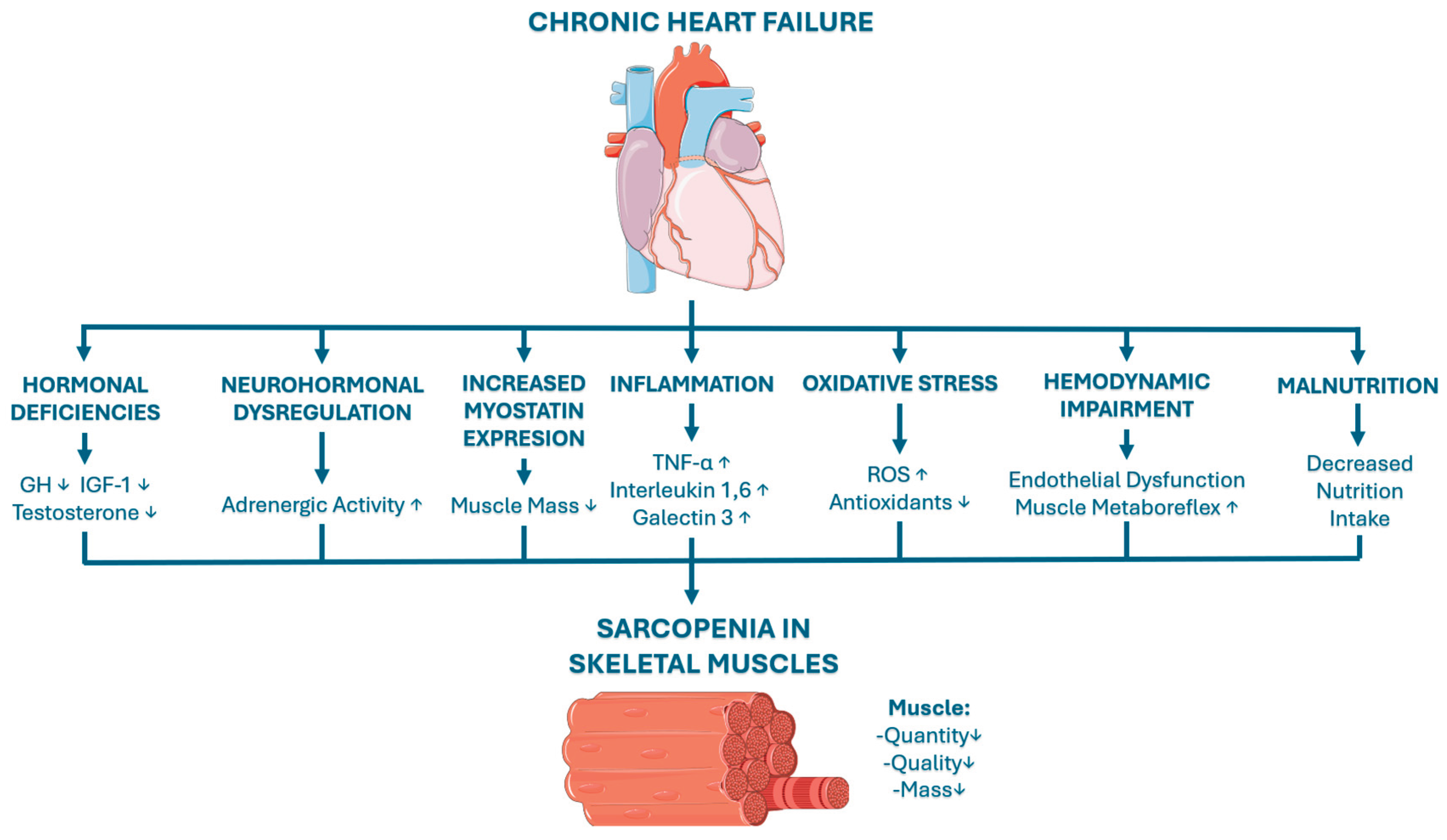

Table 1.
Therapeutic strategies targeting sarcopenia and cachexia in patients with chronic heart failure.
Table 1.
Therapeutic strategies targeting sarcopenia and cachexia in patients with chronic heart failure.
| Therapeutic approach | Targeted mechanism | Evidence and clinical impact |
Limitations and considerations |
|---|---|---|---|
| Resistance and aerobic exercise training | Stimulation of muscle hypertrophy; enhancement of mitochondrial function and skeletal muscle perfusion | Improves muscle strength, peak oxygen uptake (VO₂peak), and quality of life | Limited feasibility in patients with advanced heart failure or severe frailty |
| Nutritional support (adequate protein and caloric intake) | Correction of malnutrition; promotion of muscle protein synthesis | Associated with improvements in muscle mass and functional outcomes | Evidence remains heterogeneous; individualized nutritional assessment is required |
| Micronutrient supplementation (e.g., iron, vitamin D) | Correction of specific deficiencies affecting skeletal muscle metabolism | Iron repletion improves exercise capacity; vitamin D supplementation may support muscle function | Clinical benefit depends on the presence and severity of baseline deficiency |
| Anabolic hormone–based therapies (testosterone, growth hormone, insulin-like growth factor 1) | Restoration of anabolic–catabolic balance; stimulation of muscle protein synthesis | May improve muscle mass, strength, and exercise capacity in carefully selected patients | Safety concerns; limited efficacy in unselected populations; lack of robust outcome data |
| Anti-inflammatory strategies | Reduction of cytokine-mediated catabolic processes | Potential to attenuate muscle wasting | Clinical trials have not demonstrated consistent clinical benefit |
| Myostatin inhibition | Suppression of negative regulation of skeletal muscle growth | Demonstrates favorable effects on muscle mass in experimental models | Limited clinical evidence; long-term safety remains uncertain |
| Appetite stimulation and management of anorexia | Enhancement of caloric intake | May support nutritional status and preservation of muscle mass | Limited heart failure–specific evidence |
| Multidisciplinary rehabilitation programs | Integrated management of physical, nutritional, and psychosocial factors | Improves functional capacity and quality of life | Resource-intensive; availability varies across healthcare settings |
Disclaimer/Publisher’s Note: The statements, opinions and data contained in all publications are solely those of the individual author(s) and contributor(s) and not of MDPI and/or the editor(s). MDPI and/or the editor(s) disclaim responsibility for any injury to people or property resulting from any ideas, methods, instructions or products referred to in the content. |
© 2026 by the authors. Licensee MDPI, Basel, Switzerland. This article is an open access article distributed under the terms and conditions of the Creative Commons Attribution (CC BY) license (http://creativecommons.org/licenses/by/4.0/).
Copyright: This open access article is published under a Creative Commons CC BY 4.0 license, which permit the free download, distribution, and reuse, provided that the author and preprint are cited in any reuse.


