

Submitted:
26 March 2026
Posted:
27 March 2026
You are already at the latest version
Abstract
In this article, we develop a goodness-of-fit test for the Kumaraswamy distribution based on energy statistics. Due to the availability of its quantile (inverse) function, Kumaraswamy distribution has been shown to be the preferred alternative to the beta distribution, since both have bounded support in the (0,1) interval. The proposed test procedure is simple and more powerful against general alternatives. Under different settings, simulations show that the proposed test is capable of being well controlled for any given significance (nominal) levels. In terms of power comparisons, the proposed test outperforms other existing methods in different settings. We then apply the proposed test to real datasets (underground economy index, food expenditure, and Shasta water reservoir) to demonstrate its competitiveness and usefulness.
Keywords:
goodness-of-fit
; Kumaraswamy distribution
; energy statistics
; Monte Carlo simulation
; empirical distribution function (EDF) tests
1. Introduction
There is a growing need to model real-life phenomena that are bounded or constrained within a given range such as proportions, ratios, probabilities, etc. These cases arise naturally and play an important role in applied sciences such as hydrology, engineering, economics, and environmental studies. In recent years, bounded distributions such as Kumaraswamy () and beta distributions have been widely used to model such phenomena with supports within the interval. The Kumaraswamy () distribution is a continuous probability distribution with a bounded support in the (0,1) interval. Introduced by Kumaraswamy [1], it is a flexible alternative to the beta distribution with similar support in the interval. Kumaraswamy [1] applied this distribution to model hydrological events such as daily rainfall and daily stream flow. In such phenomena, Kumaraswamy [1], Kumaraswamy [2] noted that classical probability distribution functions such as Gaussian, log-normal, beta, and empirical distributions (such as polynomial-transformed normal), do not graciously model hydrological random processes.
The probability density function (pdf) of the Kumaraswamy distribution is given as
and its corresponding cumulative distribution function (cdf) is given as
where a and b are both nonnegative shape parameters. The mathematical short-hand notation for the Kumaraswamy distribution is given as Similar to the beta distribution, the Kumaraswamy density function in Eq. (1) is flexible such that is unimodal if and and uniantimodal if and In addition, the density is an increasing function in x if and , a decreasing function in x if and and is constant (uniform) if see for example [3] and [4]. The Figure 1 above shows different densities of for selected values of a and Although the Kumaraswamy and beta distributions agree in many cases, the distribution has some extra advantages over the beta distribution such as its simple explicit formulas for the cumulative distribution function (cdf) and the quantile function, which do not involve any complex or special functions. The quantile function of the Kumaraswamy distribution is defined as
This simplicity of the quantile distribution function in (3) has made it easier to have a simple function for the generation and simulation of random variables. In addition, the closed-form quantile formula in (3) provides the median of the distribution as follows.
In quantile-based modeling, beta regression is based on the closed-form mean of its distribution. In this case, a robust approach to perform similar regression based on the median is impractical. See more details and discussion on regression based on mean and median in [5,6] and [7].
Jones [8] provided the moment of the Kumaraswamy distribution for as follows
where is the complete beta function computed at shape parameters and In addition, Jones [8] extensively studied the basic statistical properties of the Kumaraswamy distribution and provided parameter estimates using the maximum likelihood estimation (MLE) method. Nadarajah [9] noted that the Kumaraswamy distribution is actually a special case of the generalized beta distribution and showed that it is more effective than the beta distribution. Nadar et al. [10] conducted a statistical correlation analysis of the Kumaraswamy distribution for the recorded values.
We thus desire to develop the goodness-of-fit test for the Kumaraswamy distribution with well-established properties to achieve desirable powers for any given sample size based on energy statistics. In the literature, several goodness-of-fit tests have been developed for both simple and composite hypotheses, see for example [3,11,12,13,14,15] and [16]. For instance, Giles [3] came up with a testing procedure for goodness-of-fit for the Kumaraswamy distribution based on the usual classical EDF tests. Moreover, goodness-of-fit tests involving energy statistics have been proposed for some few distributions, see for example, [11,17,18], and [12]. So far, energy-based tests have been shown to be competitive when compared to other EDF-based tests such as Kolmogorov-Smirnov (KS) and Cramer-Von-Mises, see for example, [19].
In this article, we propose a one-sample (univariate) goodness-of-fit test based on energy statistics ([20]). More recently, similar work has been done by Njuki and Hasan [17], Njuki and Avallone [18], Ofosuhene [12], and Opperman and Ning [11] for the goodness-of-fit tests for the Skew-t, Lindley, Inverse gaussian, and Skew-normal, respectively, using energy statistics. In addition, there have been several studies involving energy statistics such as testing for multivariate normality ([20]), testing for equality of distributions ([21,22]), one-sample goodness-of-fit tests ([11,12,23]), change point analysis ([24,25,26,27]), among many others. For a given sequence of independent random variables of size n and with a cdf , the test statistic based on energy statistics will reject the null hypothesis that for large values of the test statistic. If the null distribution, and the given data come from the same underlying distribution, then the values of the test statistic are expected to be very small.
The energy distance is defined as a statistical distance between the distributions of random vectors which characterizes the equality of distributions, see for example [19,28] and [29]. The concept of energy statistics initially described by [30] is based on the notion of Newton’s gravitational potential energy, which is a function of the distance between two bodies; for details, see [31]. The idea of energy statistics therefore is to consider statistical observations as heavenly bodies governed by a statistical potential energy, which is zero if and only if an underlying statistical null hypothesis is true, see for example [19,31]. Sźekely and Rizzo [20], Sźekely and Rizzo [28] thus defined the energy distance between distributions of two independent (univariate) random samples X and Y with finite expectations as
where , and equality holds if and only if X and Y are identically distributed.
Many existing goodness-of-fit tests depend on the distribution function of random variables. Unlike these tests, the energy distance statistic uses the statistical distance between two observations. This gives energy statistic-based tests an invariance property with respect to any distance-preserving transformation of the dataset, see for example [19,26,31]. Energy-type tests have been shown to be typically more powerful against general alternatives than corresponding tests based on non-energy-type statistics (Kolmogorov-Smirnov, Anderson-Darling, Cramers-Von-Mises, etc). Research on goodness-of-fit tests for the Kumaraswamy distribution distribution is limited. Thus, we aim to expand the statistical research on goodness-of-fit tests for the Kumaraswamy distribution through an energy statistic-based testing procedure.
The rest of the article is organized as follows: In Section 2, we propose a one-sample (univariate) goodness-of-fit test for the Kumaraswamy distribution based on energy statistics and establish its theoretical results. We perform a simulation study in Section 3 to compare the results of our testing procedure with other existing methods in terms of Type I error and power. In Section 5, we apply our testing procedure to real-life datasets. The conclusion is provided in Section 6. The proofs of results and supplemental materials are given in the Appendix.
2. Energy Goodness-of-Fit Test for the Kumaraswamy Distribution
We propose a one-sample energy goodness-of-fit test for the Kumaraswamy distribution. The goodness-of-fit problem based on the energy distance in Eq. (5) between distributions is defined so that distributions are compared between the null (hypothesized) distribution, , and the sampled distribution for a given set of observations
Definition 1.
Let be a random sample from a univariate population with distribution F and let be the observed values of the random variables in the sample. Then, a one-sample energy statistic-based goodness-of-fit test for testing the hypotheses versus is given as
where X and are independent and identically distributed random variables with distribution and the expectations are taken with respect to the null distribution .
Large values of the test statistic, , will cause us to reject the null hypothesis, Under the null hypothesis, the limiting distribution of is a quadratic quantity of the form such that are i.i.d. standard normal random variables and are nonnegative constants that depend on the null distribution Thus, the energy statistic-based goodness-of-fit test can be implemented by finding the constants . In practice, this would be difficult and we therefore resort to the use of the Monte Carlo approach to obtain empirical critical values of so that This fact is guaranteed since the test based on is a consistent goodness-of-fit test, see for example, [20]. In order to utilize the goodness-of-fit test statistic defined in (6), we need to derive the expected distances and . The derivations of these expected values are taken with respect to the null distribution and given in the following propositions.
Proposition 1.
Let , then for any fixed
where is the beta function and is the CDF of a Beta() distribution evaluated at .
The proof of Proposition 1 is deferred to the Appendix.
Proposition 2.
Let X and be independent and identically distributed random variables with a distribution. Then,
where is the beta function and is the CDF of a Beta() distribution at
The integral part in Eq. (8) involves complex Gaussian hypergeometric functions and can be evaluated using the numerical integration approach for specified values of a and b in R software with the CDF function pbeta().
Corollary 1.
For a special case in Proposition 2, we consider then . Thus, .
See additional details in Proposition 5. The proofs for Proposition 2 and Corollary 1 can be found in the Appendix. The above expectation can also be approximated using the following proposition suggested by [11].
Proposition 3.
The expectation of in Proposition (2) can be approximated as follows. Let X and be independent and identically distributed random variables with a well-defined cumulative distribution function, . Given that the quantile or inverse CDF function of X exists, we have
where m is the number of equally sized subintervals of , is chosen from the subinterval and is defined in Eq. (3).
Proof.
The proof of Proposition 3 is provided in Proposition 2.4 of Opperman and Ning [11]. □
To illustrate this through simulation, we compared the exact and simulated values of for selected values of nonnegative shape parameters a and b, and increasing values of subintervals, m from 10 to Table A1 (in the Appendix) provides a comparison between formulas in Propositions 2 and 3, and we observe that exact values are in agreement with the simulated values of for a large number of subintervals (when ). Rizzo [32] performed a linearization of the third term of in Eq. (6) to improve the computation speed of the test during intensive simulations and applications as given in Proposition 4.
Proposition 4.
Let be a random sample from the distribution F and be the ordered sample. Then,
We thus define the one-sample energy statistic-based goodness-of-fit test for Kumaraswamy () distribution stated in Eq. (6) combined with Propositions 1, 2 and 4 as follows.
where is a sample of observed values, is the beta function and is the complete beta distribution function (CDF) with shape parameters and b evaluated at , .
Proposition 5.
We consider the following special cases for the Kumaraswamy distribution when the shape parameters are varied.
- 1.
- Let . Then X is a standard uniform random variable, i.e,
- 2.
- Let . Then X follows the Beta() distribution.
- 3.
- Let Then X is a beta random variable with shape parameters and
Proof of Proposition 5.
- 1.
- Let Then Thus,
- 2.
- Let Then Thus,
- 3.
- Let Then Thus,
□
3. Simulation Study
In this section, we perform extensive Monte Carlo simulations to investigate the finite sample performance of the proposed test procedure based on energy statistics. First, we determine the ability of the test to control the Type I error for the Kumaraswamy distribution when different values of the shape parameters a and b are considered. Then we compare the power of our proposed test to other existing well-known EDF tests such as the Kolmogorov-Smirnov and Cramer-von-Mises tests against different alternatives at various chosen parameters and sample sizes. Throughout this paper, we take number of repetitions.
3.1. Empirical Critical Values and Type I Errors
In order to find Type I error rates and powers, we need to obtain empirical critical values by computing a 95% quantile of energy goodness-of-fit test statistics using Eq. (10). To do this, we consider a distribution with nominal levels at and sample sizes . The resulting empirical critical values are reported in Table 1. To investigate the capability of our proposed testing procedure in controlling Type I error under the assumption of distribution, we will consider four (4) different types of Kumaraswamy distribution as follows: and and their estimated density curves are presented in Figure 1.
We narrowed our consideration to sample sizes at the levels of significance Data samples are generated based on each combination of distribution and sample size, and the energy goodness-of-fit test statistic is calculated using the formula in Eq. (10). This process is repeated for B simulations. The empirical Type I error, defined as the probability of rejecting a null hypothesis that is in reality true, can then be found as the proportion of times that the computed energy goodness-of-fit test statistic exceeds the critical value. These values are reported in Table 2 and one can observe that the Type I error rate is controlled at the chosen level of significance for different choices of shape parameters a and b, and sample sizes.
3.2. Power Comparisons
To assess the performance and effectiveness of the proposed energy goodness-of-fit test, we compared our test with other similar existing tests based on empirical distribution functions (EDF). These five well-known EDF test statistics are the Kolmogorov-Smirnov () statistic, the Kuiper (V) statistic ([33]), the Cramér-von Mises () statistic, the Watson () statistic ([34]), and the Anderson-Darling () statistic ([35]). Stephens [36] and D’Agostino and Stephens [37] provided detailed and thorough descriptions of and applications of these different EDF tests. Seven (7) different distributions have been chosen, and samples of five different sizes will be repeatedly run through each test in order to obtain their empirical powers. The procedure for obtaining empirical powers is described below.
- 1.
- Calculate the critical value by computing a 95% quantile of the energy goodness-of-fit test statistic given in Eq. (10) while assuming that the null distribution ( is true.
- 2.
- Generate a set of data from one of the specified alternative distributions.
- 3.
- Using the mlkumar() function of the univariateML package in R, we obtain maximum likelihood estimates and of the shape parameters a and b by treating the simulated data as if they were from a distribution .
- 4.
- Using Eq. (10), compute the energy goodness-of-fit statistic for the simulated data.
- 5.
- Compare the resulting energy goodness-of-fit statistic and the critical value in step 1, and determine whether or not the energy goodness-of-fit statistic exceeds the critical value.
- 6.
- Repeat this process for B times and record the results.
Under the above simulation, the empirical power of the test can then be obtained as the proportion of the number of times the test statistic is greater than the critical value. The empirical powers of the EDF tests considered in this study are calculated in a similar way. The results are reported in Table 3 and Table 4 and nominal levels taken as and . We note that all considered methods are consistent and their powers increase with the increase in sample sizes. For both Table 3 and Table 4, our proposed test has outperformed other existing tests against the entire set of alternative distributions in consideration. The Kuiper (V) test statistic consistently gave the lowest power. The Kolmogorov-Sminorv () test statistic is not much better, even falling behind the Kuiper test statistic occasionally. The Cramér-von-Mises and Watson test statistics show noticeably competitive results. The Anderson-Darling statistic appears to be the most effective of the standard EDF tests, showing higher power than the other four nearly all times. However, we can see that for large samples, the energy goodness-of-fit and Anderson-Darling tests are equally competitive.
4. Discussion
5. Applications
In this section, we demonstrate the effectiveness of the proposed energy goodness-of-fit test using three real-life datasets. The first dataset consists of proportions of income spent on food for a random sample of 38 households in a large US city. This dataset is available in the “betareg" package in R software, see for example Cribari-Neto and Zeileis [38]. The second data set is comprised of proportions of GDPs of different countries that are considered to be part of the “hidden economy" and was analyzed by Medina and Schneider [39]. The last dataset consists of the monthly water capacity from the Shasta reservoir in California, USA. The dataset is recorded for the month of February from 1991 to 2010 and can be found in both Tian et al. [4] and Sultana et al. [40]. Since the underlying distribution of these datasets is not known, we resulted to the use of a bootstrap algorithm to approximate the p-value corresponding to our proposed test and that of other tests considered in the study. The procedure is described below.
- 1.
- Estimate the parameters a and b using the mlkumar() function in the univariateML package in R by fitting the real data to a Kumaraswamy distribution, where n is the size of the dataset.
- 2.
- Compute the energy goodness-of-fit statistic for the data using the formula in Eq. (10) and denote this value as .
- 3.
- Using the parameter estimates and obtained in Step 1, simulate a dataset.
- 4.
- Compute the energy goodness-of-fit statistic for the simulated data using Eq. (10), and denote this value as .
- 5.
- Repeat Steps 3 and 4 for B times, and obtain
- 6.
- The bootstrap p-value can then be approximated aswhere is an indicator function such that it is 1 when and 0 otherwise.
A similar procedure is conducted for the EDF tests. The results are reported in Table A2–Table A4 in the Appendix. For the food expenditure dataset, our test statistic , which results in a p-value of . This leads to not rejecting the null hypothesis that the data can be modeled by a Kumaraswamy distribution. The EDF tests also fail to reject the null hypothesis and thus the data follow a Kumaraswamy distribution. The estimated shape parameters are given as and , see Figure A1a.
For the hidden economy dataset, we randomly sampled 250 data observations from the population of 2529 values using the R function command Sample() and the seed set to 123 for reproducibility purposes. Our test statistic , which results in a p-value of . We thus do not reject the null hypothesis, and the data follow a Kumaraswamy distribution. The EDF tests also fail to reject the null hypothesis that the data can be modeled by a Kumaraswamy distribution. The estimated shape parameters are given as and , see Figure A2a.
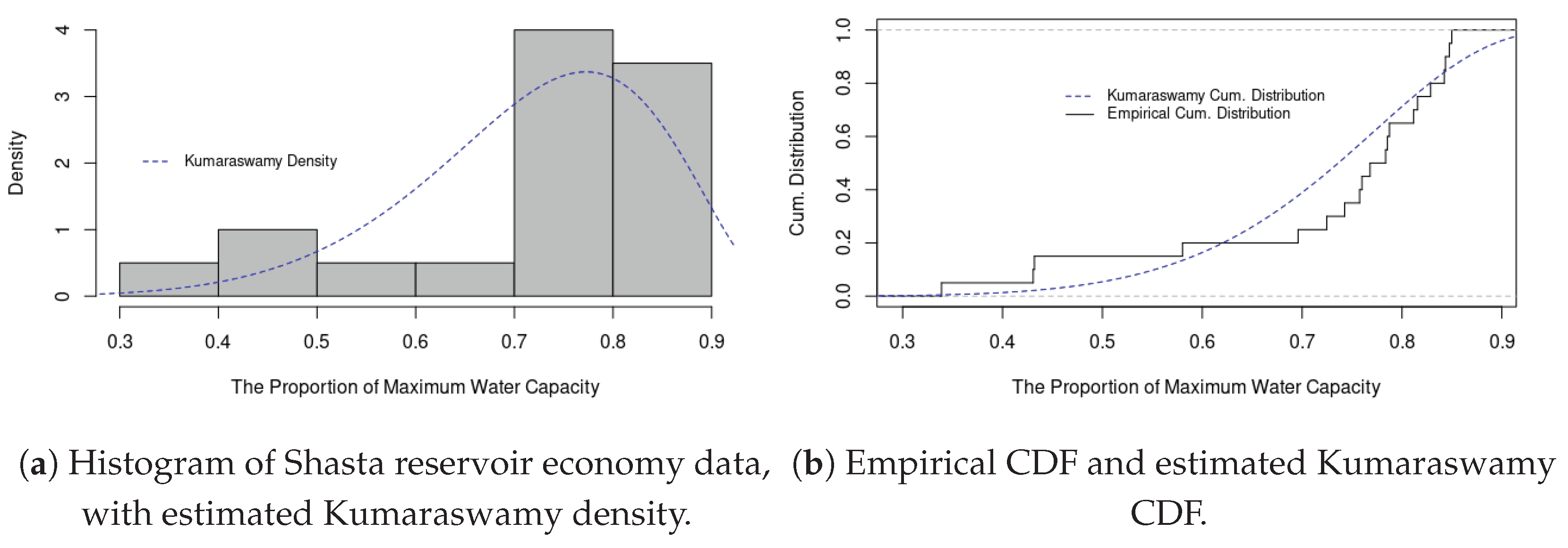
For the Shasta reservoir dataset, our test statistic , which results in a p-value of . We therefore conclude that this dataset can be modeled by a Kumaraswamy distribution. The estimated shape parameters for the Shasta dataset are given as and , see Figure A3a. In a similar manner, EDF tests result in p-values that conclude the Shasta data follow a Kumaraswamy distribution at the level of significance. We can also observe that the Kumaraswamy density estimates and empirical distribution functions for the three real datasets considered in our study fit sufficiently well, see Figure A1, Figure A2 and Figure A3 available in the Appendix.
6. Conclusion
In this paper, we have proposed a new goodness-of-fit test based on energy statistics for the Kumaraswamy distribution. Through rigorous simulations, our proposed test demonstrates clear effectiveness in terms of its ability to control Type I error rate and power. In power comparisons, our proposed test outperforms other similar existing classical tests (non-energy) such as Anderson-Darling and Watson test statistics, especially when sample sizes are considerably small. These properties make it useful for goodness-of-fit testing for the Kumaraswamy distribution against a wide range of possible alternatives.
When dealing with a similar distribution such as the beta distribution as an alternative, it should be noted that results should be taken with caution due to the inherent similarities between the two distributions. The proposed test is then applied to real datasets to show its usefulness and applicability.
Author Contributions
Conceptualization, J.N.; methodology, J.N. and T.G.; software, J.N. and T.G.; validation, J.N. and T.G.; formal analysis, J.N. and T.G.; investigation, J.N. and T.G.; resources, J.N. and T.G.; data curation, J.N. and T.G.; writing—original draft preparation, J.N. and T.G.; writing—review and editing, J.N. and T.G.; visualization, J.N. and T.G.; All authors have read and agreed to the published version of the manuscript.
Funding
This research received no external funding.
Data Availability Statement
The source of each dataset is provided in the article.
Conflicts of Interest
The authors declare no conflicts of interest.
Appendix A
We present proofs of new results stated in the paper and supplementary materials from our simulations and data applications.

Table A1.
Comparisons of results from the Propositions 2 and 3
| m | Exact | Sim | Exact | Sim | Exact | Sim | Exact | Sim |
| 25 | 0.1702 | 0.1434 | 0.3333 | 0.2944 | 0.0866 | 0.0710 | 0.0967 | 0.0799 |
| 50 | 0.1702 | 0.1558 | 0.3333 | 0.3136 | 0.0866 | 0.0779 | 0.0967 | 0.0874 |
| 0.1702 | 0.1626 | 0.3333 | 0.3234 | 0.0866 | 0.0819 | 0.0967 | 0.0917 | |
| 0.1702 | 0.1693 | 0.3333 | 0.3323 | 0.0866 | 0.0860 | 0.0967 | 0.0961 | |
| 0.1702 | 0.1701 | 0.3333 | 0.3332 | 0.0866 | 0.0865 | 0.0967 | 0.0967 | |
| 0.1702 | 0.1702 | 0.3333 | 0.3333 | 0.0866 | 0.0866 | 0.0967 | 0.0967 | |
Table A2.
Computed test statistics and p-values of Food Expenditure data
| Test Statistic | V | |||||
|---|---|---|---|---|---|---|
| Statistic Value | 0.0996 | 0.7781 | 1.3436 | 0.1267 | 0.1129 | 0.8997 |
| p-value | 0.4466 | 0.5536 | 0.3124 | 0.4726 | 0.2192 | 0.4224 |
Table A3.
Computed test statistics and p-values of Gini Index for Hidden Economies data
| Test Statistic | V | |||||
|---|---|---|---|---|---|---|
| Statistic Value | 0.0922 | 0.9782 | 1.4832 | 0.1178 | 0.1161 | 0.6301 |
| p-value | 0.6014 | 0.2996 | 0.1898 | 0.5302 | 0.2124 | 0.6152 |
Table A4.
Computed test statistics and p-values of Shasta Water Reservoir data
| Test Statistic | V | |||||
|---|---|---|---|---|---|---|
| Statistic Value | 0.2147 | 0.2209 | 1.6915 | 0.2568 | 0.1845 | 1.5988 |
| p-value | 0.1576 | 0.2338 | 0.0646 | 0.1758 | 0.0716 | 0.1604 |
Figure A1.
Food Expenditure
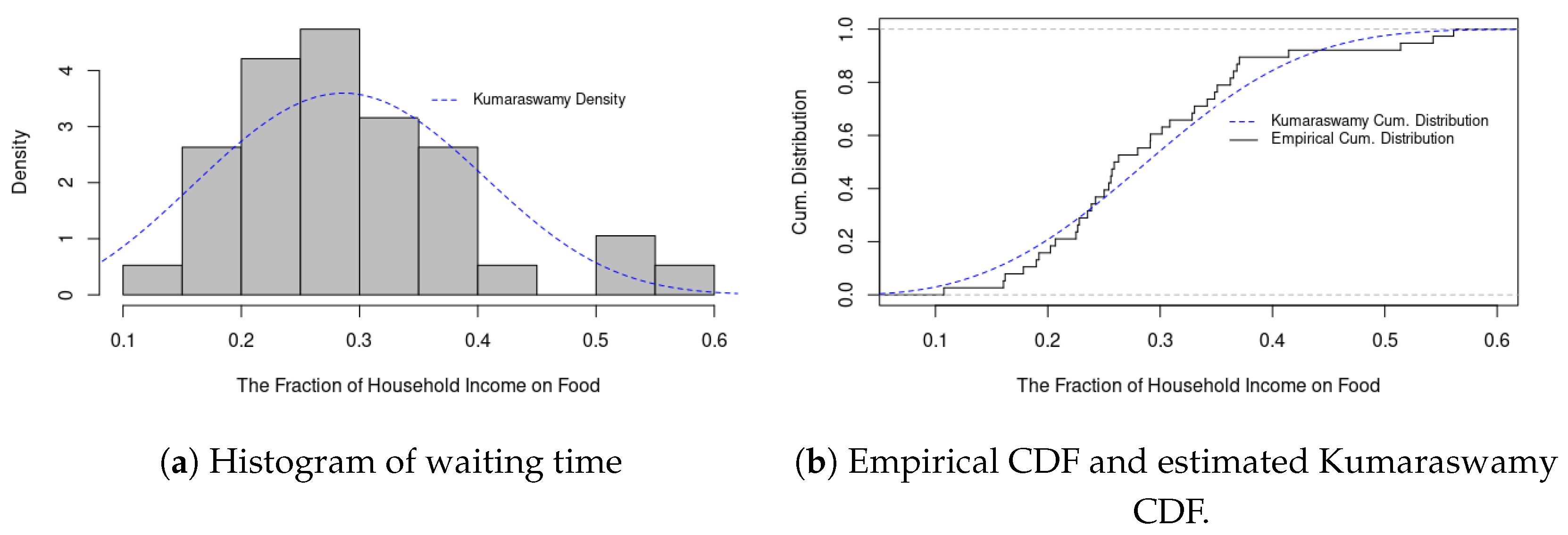
Figure A2.
Hidden Economy
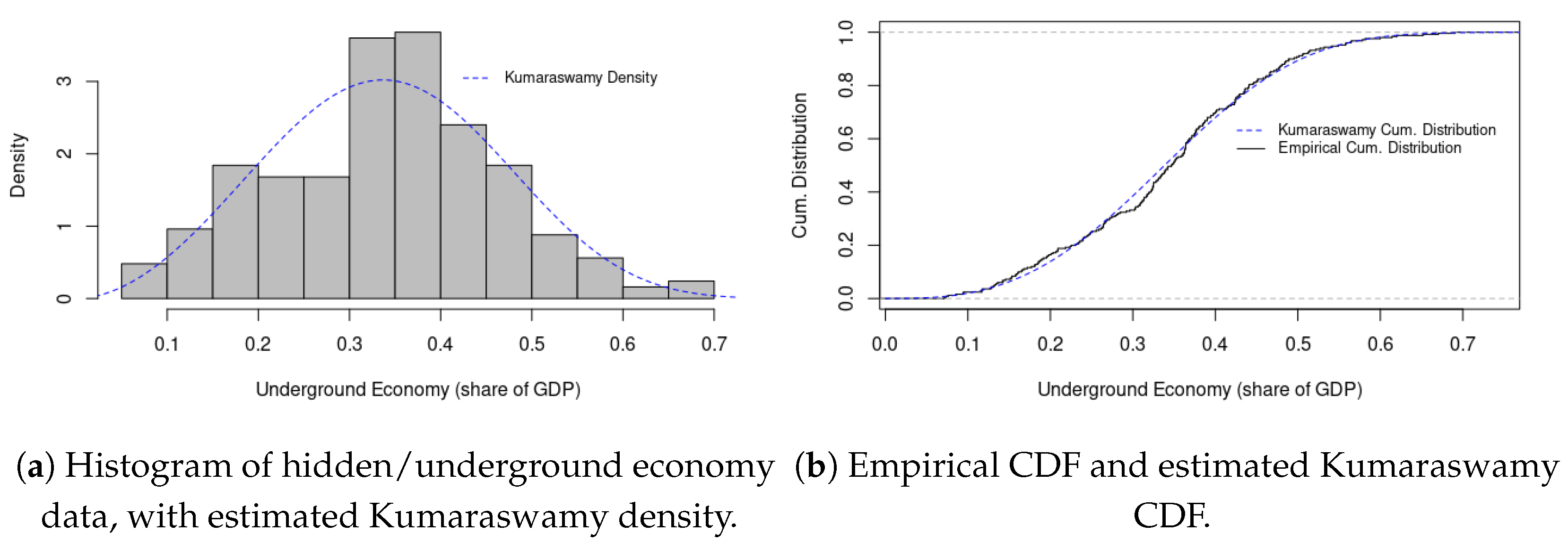
Figure A3.
Shasta Reservoir
Proof of Proposition 1.
Let . Then for any fixed ,
We evaluate the last integral term as follows.
where is the beta function and is the complete beta distribution function with parameters and b at Then, with as given in Eq. 2 and when by the formula in Eq. (4), we get:
where is the beta function and is the CDF of a Beta() distribution evaluated at . □
Proof of Proposition 2.
Let X and be independent and identically distributed random variables from a distribution. Then,
We proceed to evaluate these two integrals ( separately as follows.
We use the U-substitution method to evaluate integrals for C and
Similarly, by letting and apply the above solution. Thus, the integral in A becomes
We proceed to find the integral for B. First, notice that
By letting and substitute this in the last integral, we obtain
where is the CDF of the beta distribution with parameters and The final integral to evaluate for B simplifies to the following expression.
Finally, we plug in the expressions for A and B to obtain
where is the CDF of a at □
Proof of Corollary 1.
Let This follows immediately from the proof of Proposition 2 when and thus
□
References
- Kumaraswamy, P. A generalized probability density function for double-bounded random processes. Journal of Hydrology 1980, 46, 79–88. [Google Scholar] [CrossRef]
- Kumaraswamy, P. Snepower probability density function. Journal of Hydrology 1976, 31, 181–184. [Google Scholar] [CrossRef]
- Giles, D.E. New Goodness-of-Fit Tests for the Kumaraswamy Distribution. Stats 2024, 7, 373–388. [Google Scholar] [CrossRef]
- Tian, W.; Panf, L.; Tian, C.; Ning, W. Change Point Analysis for Kumaraswamy Distribution. Mathematics 2023, 11, 553. [Google Scholar] [CrossRef]
- Hamedi-Shahraki, S.; Rasekhi, A.; Yekaninejad, M.S.; Eshraghian, M.R.; Pakpour, A.H. Kumaraswamy regression modeling for Bounded Outcome Scores. Pakistan Journal of Statistics and Operation Research 2021, 17(1), 79–88. [Google Scholar] [CrossRef]
- Mitnik, P.A.; Baek, S. The Kumaraswamy distribution: Median-dispersion re-parameterizations for regression modeling and simulation-based estimation. Stat Papers 2013, 54, 177–192. [Google Scholar] [CrossRef]
- Ferrari, S.; Cribari-Neto, F. Beta Regression for Modelling Rates and Proportions. Journal of Applied Statistics 2004, 31, 799–815. [Google Scholar] [CrossRef]
- Jones, M. Kumaraswamy’s distribution: A beta-type distribution with some tractability advantages. Statistical Methodology 2009, 6, 70–81. [Google Scholar] [CrossRef]
- Nadarajah, S. On the distribution of Kumaraswamy. Journal of Hydrology 2008, 348, 568–569. [Google Scholar] [CrossRef]
- Nadar, M.; papadopoulos, A.; Kizilaslan, F. Statistical analysis for Kumaraswamy’s distribution based on record data. Stat Papers 2013, 54, 355–369. [Google Scholar] [CrossRef]
- Opperman, L.; Ning, W. Goodness-of-fit test for skew normality based on energy statistics. Random Operators and Stochastic Equations 2020, 28, 227–236. [Google Scholar] [CrossRef]
- Ofosuhene, P. The energy goodness-of-fit Test for the Inverse gaussian distribution. Ph.D Thesis, Bowling Green State University, 2020. [Google Scholar]
- Rizzo, M.L.; Sźekely, G.J. Energy Distance. WIREs Comput Stat 2016, 8, 27–38. [Google Scholar] [CrossRef]
- Maghami, M.; Bahrami, M. Goodness of Fit Test for the Skew-T Distribution. Journal of Mathematics and Computer Science 2015, 14, 274–283. [Google Scholar] [CrossRef]
- Ning, W.; Ngunkeng, G. An empirical likelihood ratio based goodness-of-fit test for skew normality. Stat Methods Appl 2013, 22, 209–226. [Google Scholar] [CrossRef]
- Vexler, A.; Shan, G.G.; Kim, S.G.; Tsai, W.M.; Tian, L.L.; Hutson, A.D. An empirical likelihood ratio based goodness-of-fit test for Inverse gausian distributions. Journal of Statistical Planning and Inference 2011, 141, 2128–2140. [Google Scholar] [CrossRef]
- Njuki, J.; Hasan, A. A New Goodness-of-Fit Test for Azzalini’s Skew-t Distribution Based on the Energy Distance Framework with Applications. Mathematics 2025, 13. [Google Scholar] [CrossRef]
- Njuki, J.; Avallone, R. Energy Statistic-Based Goodness-of-Fit Test for the Lindley Distribution with Application to Lifetime Data. Stats 2025, 8. [Google Scholar] [CrossRef]
- Sźekely, G.J.; Rizzo, M.L. The Energy of Data and Distance Correlation, 1st ed.; Chapman and Hall: London, UK, 2023. [Google Scholar]
- Sźekely, G.J.; Rizzo, M. A new test for multivariate normality. Journal of Multivariate Analysis 2005, 93, 58–80. [Google Scholar] [CrossRef]
- Sźekely, G.J.; Rizzo, M.L. Testing for Equal Distributions in high Dimension. InterStat 2004, 11. [Google Scholar]
- Rizzo, M.L. A test of homogeneity for two multivariate populations, Physical and Engineering Sciences section. In 2002 Proceedings of American Statistical Association; American Statistical Association: Alexandria, VA, 2003. [Google Scholar]
- Rizzo, M.L. New goodness-of-fit tests for Pareto distributions. ASTIN Bulletin: The Journal of the IAA 2009, 39, 691–715. [Google Scholar] [CrossRef]
- Njuki, J.; Ning, W. Energy statistic-based modified information criterion for detecting the change in distribution. Journal of Applied Statistics 2025, 1–23. [Google Scholar] [CrossRef]
- Njuki, J.M. Nonparametric Sequential tests for Change Point Analysis Using Energy Statistics. Ph.D Thesis, Bowling Green State University, 2022. [Google Scholar]
- Matterson, D.S.; James, N.A. A nonparametric Approach for Multiple Change Point Analysis of Multivariate Data. Journal of the American Statistical Association 2014, 109, 334–345. [Google Scholar] [CrossRef]
- Kim, A.Y.; Marzban, C.; Percival, D.B.; Stuetzle, W. Using labeled data to evaluate change detectors in a multivariate streaming environment. Signal Processing 2009, 89(12), 2529–2536. [Google Scholar] [CrossRef]
- Sźekely, G.J.; Rizzo, M. A Class of Statistical Based on Distances. Journal of Statistical Planning and Inference 2013, 143, 1249–1272. [Google Scholar] [CrossRef]
- Rizzo, M.L. Statistical Computing With R, 2nd ed.; CRC Press, Taylor & Francis Group: Boca Raton, FL, 2019. [Google Scholar]
- Sźekely, G.J. E-statistics: Energy of statistical samples. Technical Report 03-05, BGSU, Department of Mathematics and Statistics. 2000. [Google Scholar]
- Sźekely, G.J.; Rizzo, M.L. The Energy of Data. Annual Review of Statistics and Its Application 2017, 4, 447–479. [Google Scholar] [CrossRef]
- Rizzo, M. A new rotation invariant goodness-of-fit test. Ph.D Thesis, Bowling Green State University, 2002. [Google Scholar]
- Kuiper, N.H. Tests concerning random points on a circle. Proceedings of the Nederlandse Akademie Van Wetenschapen, Series A 1960, 63, 38–47. [Google Scholar] [CrossRef]
- Watson, G.S. Goodness-of-fit tests on a circle. Biometrika 1961, 48, 109–114. [Google Scholar] [CrossRef]
- Anderson, T.W.; Darling, D.A. A test of goodness of fit. Journal of the American Statistical Association 1954, 49, 765–769. [Google Scholar] [CrossRef]
- Stephens, M.A. Edf statistics for goodness of fit and some comparisons. Journal of the American Statistical Association 1974, 69, 730–737. [Google Scholar] [CrossRef]
- D’Agostino, R.B.; Stephens, M.A. Tests Based on. In Goodness-of-Fit Techniques; D’Agostino, R.B., Stephens, M.A., Eds.; Marcel Dekker: New York, 1986; pp. 97–193. [Google Scholar]
- Cribari-Neto, F.; Zeileis, A. Beta Regression in R. Journal of Statistical Software 2010, 34, 1–24. [Google Scholar] [CrossRef]
- Medina, L.; Schneider, F.G. Shedding Light on the Shadow Economy: A Global Database and the Interaction with the Official One. CESifo Working Paper No. 7981 2019. [Google Scholar] [CrossRef]
- Sultana, F.; Tripathi, Y.M.; Wu, S.J.; Sen, T. Inference for kumaraswamy distribution based on type I progressive hybrid censoring. Ann. Data. Sci. 2022, 9, 1283–1307. [Google Scholar] [CrossRef]
Figure 1.
Kumaraswamy densities for selected values of a and
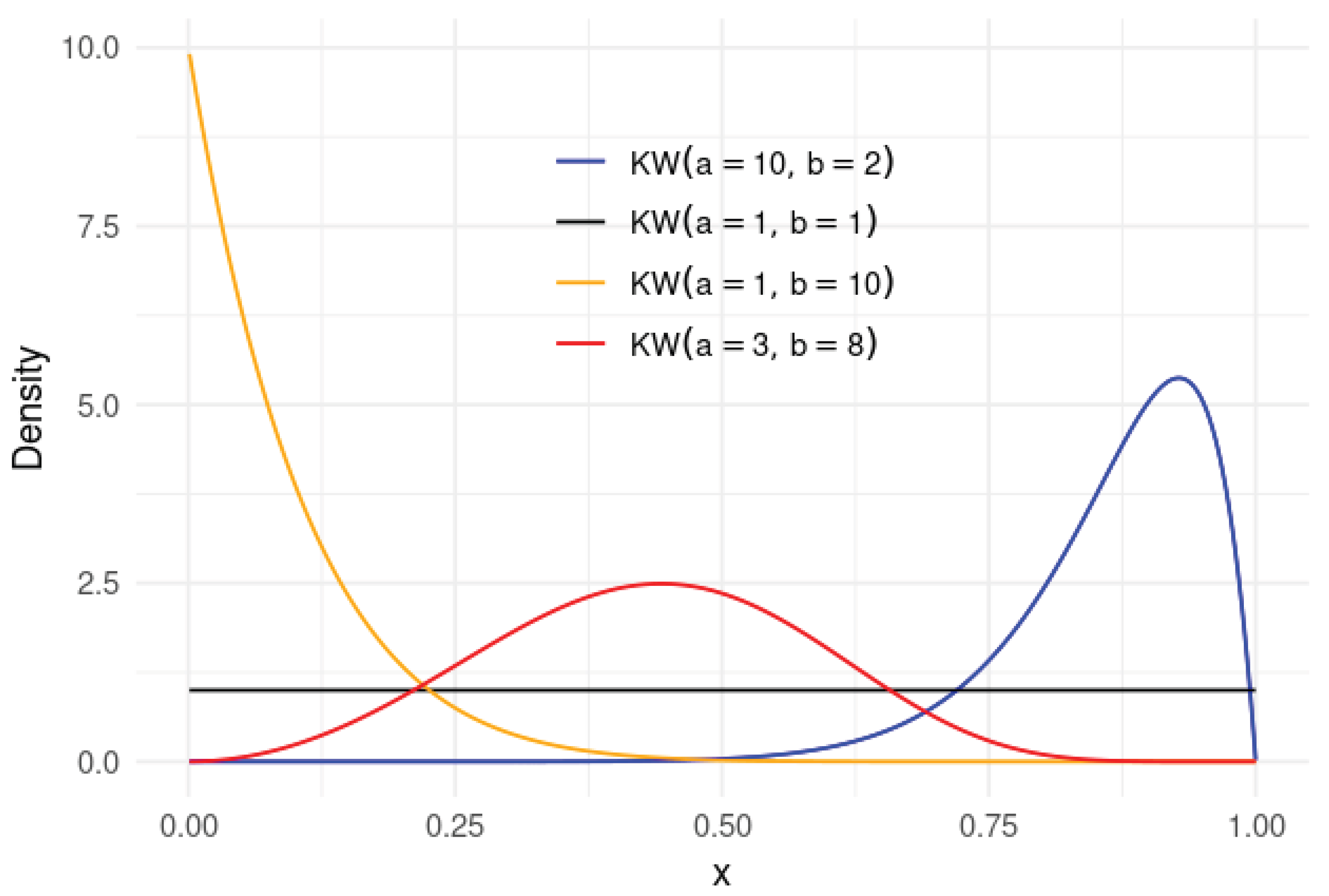
Table 1.
Simulated Critical Values for the Kumaraswamy Distribution
| 10 | 25 | 50 | 75 | 100 | 150 | 200 | 300 | 500 | |
|---|---|---|---|---|---|---|---|---|---|
| 0.7126 | 0.7143 | 0.6741 | 0.6771 | 0.7011 | 0.6874 | 0.7030 | 0.6791 | 0.6927 | |
| 0.4343 | 0.4510 | 0.4448 | 0.4395 | 0.4542 | 0.4531 | 0.4427 | 0.4487 | 0.4430 | |
| 0.3334 | 0.3473 | 0.3367 | 0.3395 | 0.3410 | 0.3424 | 0.3404 | 0.3430 | 0.3394 |
Table 2.
Simulated Type I Errors of the test for the Kumaraswamy Distribution,
| n | ||||||
| 10 | 0.0110 | 0.0541 | 0.1031 | 0.0099 | 0.0476 | 0.0995 |
| 25 | 0.0111 | 0.0529 | 0.1028 | 0.0105 | 0.0505 | 0.0980 |
| 50 | 0.0093 | 0.0502 | 0.1003 | 0.0104 | 0.0467 | 0.0989 |
| 100 | 0.0104 | 0.0483 | 0.0995 | 0.0100 | 0.0519 | 0.1007 |
| 200 | 0.0106 | 0.0507 | 0.1000 | 0.0093 | 0.0473 | 0.1008 |
| n | ||||||
| 10 | 0.0116 | 0.0534 | 0.1019 | 0.0087 | 0.0513 | 0.1001 |
| 25 | 0.0099 | 0.0507 | 0.0971 | 0.0091 | 0.0495 | 0.1047 |
| 50 | 0.0097 | 0.0502 | 0.1004 | 0.0097 | 0.0503 | 0.0967 |
| 100 | 0.0102 | 0.0483 | 0.0998 | 0.0102 | 0.0500 | 0.0917 |
| 200 | 0.0106 | 0.0526 | 0.1017 | 0.0106 | 0.0463 | 0.0978 |
Table 3.
Simulated powers,
| Distribution | Sample size n | V | |||||
|---|---|---|---|---|---|---|---|
| 10 | 0.0646 | 0.0536 | 0.0565 | 0.0557 | 0.0590 | 0.0525 | |
| 25 | 0.0682 | 0.0618 | 0.0645 | 0.0637 | 0.0609 | 0.0633 | |
| Beta (5,5) | 50 | 0.0752 | 0.0676 | 0.0627 | 0.0686 | 0.0646 | 0.0672 |
| 100 | 0.1122 | 0.0872 | 0.0754 | 0.0955 | 0.0878 | 0.1030 | |
| 200 | 0.1792 | 0.1329 | 0.1104 | 0.1631 | 0.1324 | 0.1706 | |
| 10 | 0.2026 | 0.0731 | 0.0614 | 0.0772 | 0.0678 | 0.0715 | |
| Triangular | 25 | 0.2449 | 0.0957 | 0.0801 | 0.1077 | 0.0917 | 0.0998 |
| (a = 0, b = 1) | 50 | 0.3175 | 0.1481 | 0.1161 | 0.1591 | 0.1382 | 0.1489 |
| (Mode = 1/3) | 100 | 0.4731 | 0.2407 | 0.2077 | 0.2767 | 0.2401 | 0.2701 |
| 200 | 0.6942 | 0.4171 | 0.3716 | 0.5026 | 0.4471 | 0.4847 | |
| 10 | 0.3823 | 0.0722 | 0.0522 | 0.0721 | 0.0590 | 0.0587 | |
| Truncated Normal | 25 | 0.3729 | 0.0758 | 0.0528 | 0.0729 | 0.0572 | 0.0613 |
| (a = 0, b = 1) | 50 | 0.3736 | 0.0710 | 0.0488 | 0.0676 | 0.0549 | 0.0587 |
| (Mean = 0.2, SD = 5) | 100 | 0.3910 | 0.0771 | 0.0559 | 0.0713 | 0.0548 | 0.0662 |
| 200 | 0.3926 | 0.0698 | 0.0461 | 0.0647 | 0.0474 | 0.0571 | |
| 10 | 0.1664 | 0.0598 | 0.0640 | 0.0620 | 0.0636 | 0.0569 | |
| Trapezoid | 25 | 0.2067 | 0.0705 | 0.0869 | 0.0790 | 0.0795 | 0.0737 |
| ( = 1/4, = 3/4) | 50 | 0.2767 | 0.0892 | 0.1181 | 0.1189 | 0.1260 | 0.1124 |
| ( = = 3) | 100 | 0.4221 | 0.1416 | 0.1951 | 0.2047 | 0.2223 | 0.2166 |
| 200 | 0.6451 | 0.2895 | 0.3891 | 0.4076 | 0.4278 | 0.4296 | |
| Truncated Log-Normal (meanlog=0.5, sdlog=0.5) |
10 | 0.0890 | 0.0775 | 0.0610 | 0.0775 | 0.0647 | 0.0651 |
| 25 | 0.1023 | 0.0872 | 0.0603 | 0.0910 | 0.0684 | 0.0809 | |
| 50 | 0.1340 | 0.1100 | 0.0764 | 0.1189 | 0.0866 | 0.1093 | |
| 100 | 0.2165 | 0.1640 | 0.1055 | 0.1860 | 0.1271 | 0.1799 | |
| 200 | 0.3684 | 0.2714 | 0.1661 | 0.3274 | 0.2185 | 0.3274 | |
| Truncated Gamma ( = 2, = 6) |
10 | 0.3290 | 0.1612 | 0.1231 | 0.1812 | 0.1480 | 0.1741 |
| 25 | 0.5564 | 0.3312 | 0.2775 | 0.3815 | 0.3184 | 0.3978 | |
| 50 | 0.7652 | 0.5353 | 0.4795 | 0.6145 | 0.5296 | 0.6445 | |
| 100 | 0.9321 | 0.7844 | 0.7556 | 0.8602 | 0.7980 | 0.8799 | |
| 200 | 0.9953 | 0.9731 | 0.9636 | 0.9880 | 0.9771 | 0.9908 | |
| Truncated Weibull ( = 2, k = 1) |
10 | 0.2561 | 0.0756 | 0.0554 | 0.0692 | 0.0576 | 0.0640 |
| 25 | 0.2903 | 0.0854 | 0.0554 | 0.0879 | 0.0647 | 0.0784 | |
| 50 | 0.3090 | 0.0897 | 0.0608 | 0.0924 | 0.0706 | 0.0834 | |
| 100 | 0.3664 | 0.1218 | 0.0816 | 0.1326 | 0.1021 | 0.1212 | |
| 200 | 0.4664 | 0.1757 | 0.1129 | 0.2003 | 0.1362 | 0.1889 |
Table 4.
Simulated powers,
| Distribution | Sample size n | V | |||||
|---|---|---|---|---|---|---|---|
| Beta(5,5) | 10 | 0.1207 | 0.1055 | 0.1113 | 0.1077 | 0.1056 | 0.1043 |
| 25 | 0.1258 | 0.1163 | 0.1113 | 0.1167 | 0.1168 | 0.1184 | |
| 50 | 0.1394 | 0.1254 | 0.1211 | 0.1287 | 0.1225 | 0.1310 | |
| 100 | 0.1816 | 0.1513 | 0.1293 | 0.1642 | 0.1469 | 0.1680 | |
| 200 | 0.2679 | 0.2144 | 0.1925 | 0.2424 | 0.2160 | 0.2548 | |
| 10 | 0.2924 | 0.1311 | 0.1139 | 0.1309 | 0.1230 | 0.1244 | |
| Triangular | 25 | 0.3557 | 0.1692 | 0.1465 | 0.1776 | 0.1637 | 0.1653 |
| (a=0, b=1) | 50 | 0.4383 | 0.2343 | 0.2019 | 0.2487 | 0.2180 | 0.2371 |
| (Mode=1/3) | 100 | 0.5838 | 0.3401 | 0.3021 | 0.3888 | 0.3509 | 0.3686 |
| 200 | 0.7747 | 0.5370 | 0.4926 | 0.6090 | 0.5581 | 0.5921 | |
| 10 | 0.5150 | 0.1309 | 0.1040 | 0.1307 | 0.1105 | 0.1191 | |
| Truncated Normal | 25 | 0.5114 | 0.1352 | 0.0996 | 0.1281 | 0.1104 | 0.1168 |
| (a = 0, b = 1) | 50 | 0.5031 | 0.1246 | 0.0990 | 0.1320 | 0.1094 | 0.1127 |
| (Mean = 0.2, SD = 0.5) | 100 | 0.5194 | 0.1353 | 0.1078 | 0.1365 | 0.1117 | 0.1166 |
| 200 | 0.5152 | 0.1307 | 0.0931 | 0.1258 | 0.1037 | 0.1131 | |
| 10 | 0.2687 | 0.1198 | 0.1216 | 0.1247 | 0.1245 | 0.1128 | |
| Trapezoid | 25 | 0.3233 | 0.1436 | 0.1528 | 0.1494 | 0.1570 | 0.1388 |
| ( = 1/4, = 3/4) | 50 | 0.4020 | 0.1691 | 0.2058 | 0.2069 | 0.2151 | 0.2090 |
| ( = = 3) | 100 | 0.5541 | 0.2550 | 0.3070 | 0.3214 | 0.3341 | 0.3323 |
| 200 | 0.7551 | 0.4364 | 0.5194 | 0.5553 | 0.5650 | 0.5793 | |
| Truncated Log-Normal (meanlog=0.5, sdlog=0.5) |
10 | 0.1490 | 0.1419 | 0.1120 | 0.1319 | 0.1204 | 0.1211 |
| 25 | 0.1740 | 0.1547 | 0.1201 | 0.1567 | 0.1326 | 0.1418 | |
| 50 | 0.2210 | 0.1924 | 0.1355 | 0.2006 | 0.1580 | 0.1909 | |
| 100 | 0.3092 | 0.2524 | 0.1791 | 0.2830 | 0.2143 | 0.2684 | |
| 200 | 0.4804 | 0.3942 | 0.2643 | 0.4494 | 0.3343 | 0.4360 | |
| Truncated Gamma ( = 2, = 6) |
10 | 0.4121 | 0.2367 | 0.1975 | 0.2523 | 0.2157 | 0.2453 |
| 25 | 0.6325 | 0.4262 | 0.3692 | 0.4718 | 0.4144 | 0.4887 | |
| 50 | 0.8140 | 0.6290 | 0.5807 | 0.6968 | 0.6297 | 0.7184 | |
| 100 | 0.9507 | 0.8486 | 0.8240 | 0.9009 | 0.8570 | 0.9142 | |
| 200 | 0.9967 | 0.9860 | 0.9802 | 0.9929 | 0.9855 | 0.9950 | |
| Truncated Weibull ( = 2, k = 1) |
10 | 0.3879 | 0.1347 | 0.1116 | 0.1328 | 0.1168 | 0.1233 |
| 25 | 0.4089 | 0.1474 | 0.1134 | 0.1484 | 0.1225 | 0.1337 | |
| 50 | 0.4297 | 0.1546 | 0.1172 | 0.1580 | 0.1272 | 0.1471 | |
| 100 | 0.4869 | 0.1960 | 0.1414 | 0.2037 | 0.1655 | 0.1988 | |
| 200 | 0.5769 | 0.2746 | 0.1961 | 0.2939 | 0.2249 | 0.2787 |
Disclaimer/Publisher’s Note: The statements, opinions and data contained in all publications are solely those of the individual author(s) and contributor(s) and not of MDPI and/or the editor(s). MDPI and/or the editor(s) disclaim responsibility for any injury to people or property resulting from any ideas, methods, instructions or products referred to in the content. |
© 2026 by the authors. Licensee MDPI, Basel, Switzerland. This article is an open access article distributed under the terms and conditions of the Creative Commons Attribution (CC BY) license (http://creativecommons.org/licenses/by/4.0/).
Copyright: This open access article is published under a Creative Commons CC BY 4.0 license, which permit the free download, distribution, and reuse, provided that the author and preprint are cited in any reuse.


