

Submitted:
25 March 2026
Posted:
27 March 2026
You are already at the latest version
Abstract
Background: Preterm birth, the leading cause of neonatal mortality, is associated with reduced nephron endowment and an increased risk of kidney disease in later life. In preterm infants, the interruption of nephrogenesis leads to a lower nephron number and structural abnormalities. Prenatal factors such as intrauterine growth restriction, and postnatal factors including nephrotoxic medications, patent ductus arteriosus, perinatal asphyxia, and infections, contribute to this deficit. Ultrasound is a key tool for assessing renal volume at birth and can, when indexed to body weight, be used to estimate nephron endowment, which is known to vary widely among individuals. Methods: This study analyzed 52 preterm infants with birth weight <1000 g, assessing combined renal volume (sum of right and left kidney volumes) indexed to body weight. Results: The mean combined kidney volume-to-body weight ratio was 12.12 (SD = 2.03). Values below the 10th percentile (9.46) or more than one standard deviation below the mean (10.11) may indicate nephron deficiency at birth. Conclusions: Standardized ultrasound-based parameters enable early identification of neonates at risk for nephron deficit, supporting targeted preventive strategies. Long-term follow-up is essential to detect early renal functional impairment and reduce the risk of chronic kidney disease.
Keywords:
preterm infants
; extremely‐low‐birthweight
; nephron endowment
; reference ultrasound parameters
1. Introduction
Preterm birth, defined as delivery before 37 weeks of gestational age, remains the leading cause of neonatal mortality. In recent decades, advances in perinatal care have significantly improved the survival of preterm infants; however, many still experience both short- and long-term morbidities, inversely correlated with gestational age and birth weight [1,2]. Among the organs most affected are the kidneys, whose development begins around the fifth week of gestation and continues until approximately the 32nd to 36th week, resulting in a total nephron count ranging from 200,000 to over 2 million. Nephrogenesis may continue for an additional 4 to 6 weeks after birth [3,4]. In premature infants, early birth disrupts normal nephrogenesis, leading to a reduced nephron number and the development of structurally and functionally abnormal nephrons [5]. Prenatal insults, such as intrauterine growth restriction (IUGR) [6], and postnatal factors occurring during admission to the Neonatal Intensive Care Unit (NICU), further contribute to the reduction in nephron endowment. These include the use of nephrotoxic drugs, perinatal asphyxia, hypotensive episodes, severe infections, hypoxia, acute kidney injury (AKI), and hemodynamic instability due to a patent ductus arteriosus (PDA) or its treatment [7,8]. Consequently, preterm infants, who are genetically predisposed to a lower nephron number, are more vulnerable to developing chronic kidney disease compared to those with a greater nephron endowment. Compensatory glomerular hypertrophy and hyperfiltration have been associated with an increased risk of hypertension, cardiovascular disease, and renal failure, particularly during adolescence and adulthood [9,10]. Early identification of preterm infants with reduced nephron endowment is therefore essential to enable appropriate monitoring of short-, medium-, and long-term outcomes. Ultrasound is the imaging modality of choice for assessing renal size, as it is noninvasive, free of ionizing radiation, cost-effective, and easily performed at the bedside [11,12]. In a recent study, we observed that combined renal volume (CRV) — defined as the sum of the right and left kidney volumes measured by ultrasound — correlates strongly with body weight from one week after birth to 24 months of postmenstrual age (PMA) in extremely low birth weight (ELBW) preterm infants. This correlation is stronger with body weight than with neonatal length, likely due to the greater accuracy of electronic scales integrated into modern incubators. These findings suggest that renal volume indexed to body weight may serve as a reliable marker of nephron endowment at birth [13]. Building on this study, the present work suggests a model to define reference ultrasound parameters for the early assessment of nephron endowment in extremely low birth weight preterm infants, with the aim of informing a more targeted and individualized follow-up strategy.
2. Materials and Methods
2.1. Partecipants and Study Design
The initial cohort of 29 ELBW preterm infants born between March 2018 and March 2021 at the Ospedali Riuniti University Hospital (Foggia, Italy) was expanded by including 23 additional infants admitted to the same Neonatal Intensive Care Unit with similar characteristics. Eligible infants were male or female, inborn or outborn, with a birth weight ≤1000 g. Infants with malformative nephrouropathies detected on fetal or neonatal ultrasound, major congenital malformations, or genetic and chromosomal syndromes were excluded. Among the total of 52 infants, 10 were classified as small for gestational age (SGA), 1 as large for gestational age (LGA), and 41 as appropriate for gestational age (AGA), according to the Italian Neonatal Study (INeS) growth percentiles [14]. Seventeen infants were male and thirty-five were female. Gestational age at birth ranged from 23+3 to 32+0 weeks, with a median of 26+4 weeks (interquartile range-IQR, 4). Birth weight ranged from 300 to 1000 g, with a median of 810 g (IQR, 245). Forty-five infants received antenatal betamethasone prophylaxis for the prevention of hyaline membrane disease. Fifteen had birth asphyxia, and forty-three received at least one dose of endotracheal surfactant. During their NICU stay, all neonates received noninvasive ventilation, and 37 also required invasive mechanical ventilation. Four neonates did not require oxygen therapy. All infants were treated with xanthines and aminoglycosides. Fourteen experienced hemodynamic compromise due to patent ductus arteriosus and/or its treatment, while 15 developed serious infections. Hemodynamic support with fluids and, when indicated, inotropes maintained systemic blood pressure within acceptable limits. The Kidney Disease: Improving Global Outcomes (KDIGO) criteria, modified for neonates, were used to define AKI [15,16]. During hospitalization, serum creatinine (SCr), expressed in milligrams per deciliter, was measured in all neonates no earlier than the third day of life to avoid maternal value interference. SCr levels ranged from 0.1 to 2.58 mg/dL, with a median of 0.63 (IQR, 0.67). One neonate had a maximum SCr of 1.53 mg/dL on a single occasion, another reached 1.84 mg/dL once, and a third reached 2.58 mg/dL, all without subsequent elevations. Urine output was quantified by diaper weight or by using a neonatal urine collection bag. Measurements were recorded daily and expressed in milliliters per kilogram per hour (mL/kg/h). During hospitalization, urine output ranged from 2.21 to 6.03 mL/kg/h, with a median of 3.77 mL/kg/h (IQR, 1.30).
2.2. Measurements
The right and left renal volumes, measured ultrasonographically in cubic centimeters (cm³) approximately one week after birth (±1 day) to allow for clinical stabilization, were summed to calculate the combined renal volume of each infant. Body weight was recorded at the time of the ultrasonographic assessment. Ultrasound examinations were performed using a scanner equipped with a convex abdominal probe (5–8 MHz) and ultrasound gel pre-warmed to body temperature. All examinations were conducted by an experienced examiner to minimize interobserver variability. With the neonate in the prone position, renal length was measured in the sagittal plane as the maximum longitudinal cranio-caudal distance. The antero-posterior and transverse diameters of the kidney were measured in an axial plane, where the organ appeared symmetrically round, with all dimensions recorded perpendicularly. Ultrasound images were appropriately magnified to ensure accurate measurements. Renal volume was calculated using the ellipsoid formula: volume = length × width × depth × 0.523 [17,18].
The ultrasound examination was performed at the patient’s bedside as part of a point-of-care ultrasound (POCUS) program in the NICU. This approach requires specific skills but allows for rapid and practical execution [19]. Two-dimensional ultrasonography (2D-US) with the ellipsoid formula was selected instead of three-dimensional ultrasonography (3D-US) because it is widely used in neonatal and pediatric studies and offers greater feasibility in clinical practice. It provides a reasonable approximation of renal volume despite its known limitations compared with 3D-US, which offers a more accurate representation of renal morphology. From a research perspective, the use of 3D-US may serve as a basis for future studies aimed at validating the proposed cutoff values and standardizing reference curves. Body weight was measured using an electronic scale integrated into the incubator. In ELBW infants, ensuring adequate hydration is a fundamental aspect of good clinical practice. To this end, a combined strategy of enteral and, when necessary, parenteral nutrition is used, together with continuous monitoring of hydration status [20,21,22]. This approach enables body weight to be used as a reliable parameter for indexing renal volume.
2.3. Protocol, and Data Analysis
The original study protocol was approved by the Ethics Committee of the Azienda Ospedaliero-Universitaria Ospedali Riuniti di Foggia, Italy (Ref. 106, Opinion No. 54/CE/2018; approved on 6 March 2018). The study was conducted in accordance with the Declaration of Helsinki and its subsequent amendments. Informed consent, including details of the study and authorization to participate and for data publication, was obtained from the participants' parents. Data were analyzed using commercial software (SPSS, version 11.0, 2002; SPSS Inc., Chicago, IL, USA). Combined renal volume was indexed to body weight (in kilograms) for each of the 52 ELBW infants. The normality of the data distribution was assessed using the Shapiro–Wilk test. A p-value < 0.05 was considered statistically significant. Z-scores were calculated for each CRV value indexed to body weight. Values were grouped into the 10th, 25th, 50th, 75th, and 90th percentiles, and categorized according to Z-score ranges: within ±1 SD, ±2 SD, and >2 SD.
The objective of this study is descriptive rather than aimed at developing reference curves (centiles for predictive or clinical purposes), which would require larger, preferably multicenter, cohorts. Given the symmetrical distribution of the data and the satisfactory sample size, the most commonly used centiles (10th, 25th, 50th, 75th, and 90th) were reported, whereas the extreme centiles (e.g., 3rd or 97th) were not included, as their estimation would require several hundred observations to ensure statistical reliability. The standard deviation calculated from 52 observations can be considered appropriate for a clinical research setting, particularly within the context of a single-center, time-limited observational study conducted in a highly selected population, such as preterm infants with a birth weight below 1000 grams. Other data are presented as minimum (Min), maximum (Max), median (Mdn), interquartile range (IQR), mean (M), and standard deviation (SD).
3. Results
Among the 52 ELBW newborns, combined renal volumes indexed to body weight ranged from a minimum of 7.7 to a maximum of 18.07. The mean was 12.12 (SD = 2.03), while the median was 12.06 (IQR = 2.52).
Table 1 shows the data collected for each newborn one week after birth, including gestational age (expressed in weeks and days), combined renal volume, body weight (kilograms), and the ratio of combined renal volume to body weight with the corresponding Z-score.
The Shapiro-Wilk test did not indicate a significant departure from normality, W(52) = 0.98, p = 0.377. This suggests that the data do not significantly deviate from a normal distribution. The test statistic W was 0.9761, which falls within the 95% confidence interval [0.9555, 1]. The p-value of 0.377 provides insufficient evidence to reject the null hypothesis. The observed effect size (KS–D) was small (0.096). Despite the presence of an outlier (18.07), the test does not provide sufficient evidence to reject the assumption of normality. The histogram illustrates the distribution of combined renal volumes indexed to body weight (cm³/kg) one week after birth in 52 ELBW preterm infants. The x-axis represents the combined renal volume - defined as the sum of the right and left renal volumes, indexed to body weight - while the y-axis indicates the number of infants within each range of values (Figure 1).
The Q-Q plot displays the distribution of combined renal volumes indexed to body weight one week after birth in 52 ELBW preterm infants. The x-axis represents the theoretical quantiles of a normal distribution, and the y-axis represents the observed quantiles from the sample. Most data points fall along the reference line, indicating an approximately normal distribution, with minor deviations observed in the tails (Figure 2).
The combined renal volume indexed to body weight was 9.46 at the 10th percentile, 10.87 at the 25th percentile, 12.06 at the 50th percentile, 13.39 at the 75th percentile, and 14.39 at the 90th percentile (Table 2).
Values within one standard deviation below the mean ranged from 10.11 to 12.12. Those between one and two standard deviations below the mean ranged from 8.09 to 10.11, while values more than two standard deviations below the mean were less than 8.09. Similarly, the categories above the mean include values within one standard deviation ranging from 12.12 to 14.14; those between one and two standard deviations above the mean range from 14.14 to 16.16; and values more than two standard deviations above the mean are greater than 16.16 (Table 3).
4. Discussion
Chronic kidney disease often progresses silently, with clinical signs typically emerging only in advanced stages, thus complicating early detection. Given that prematurity is a risk factor per se, preterm infants with reduced nephron numbers are particularly vulnerable and require more rigorous clinical monitoring. However, individual variability in nephron endowment and the absence of standardized methods for its measurement pose significant challenges for early identification and risk stratification.
Numerous studies have documented that preterm birth may impair nephrogenesis, thereby increasing the risk of hypertension and chronic kidney disease in adulthood [23,24,25]. Additional evidence indicates that preterm infants have significantly smaller renal parenchyma and total kidney volume compared to their full-term counterparts at the same corrected gestational age. This reflects a reduced nephron endowment, which is partially compensated by hyperfiltration—an adaptive mechanism that may be associated with glomerular injury and a higher risk of long-term renal dysfunction [11,26].
According to several authors, cystatin C is considered superior to GFR in assessing both renal function and tubular rearrangement, particularly in relation to reduced glomerular number [27,28]. Moreover, Aisa et al. (2016) emphasized that studies investigating renal physiology in preterm neonates and/or those with intrauterine growth restriction rarely include correlation analyses between biochemical parameters and nephron number, although such analyses, according to the authors, could provide additional insights and facilitate early identification of individuals at higher risk of renal insufficiency [29].
Several recent studies have shown a weak correlation between indirect measures of nephron mass and biomarkers such as cystatin C, creatinine, and albuminuria, indicating that these markers are not sufficiently sensitive to detect early reductions in renal function associated with decreased nephron endowment [30,31,32]. For this reason, our study aims to provide only ultrasonographic reference values for estimating nephron endowment at birth.
Recent studies suggest that, for an accurate assessment of kidney growth and health, measuring kidney volume is preferable to relying exclusively on kidney length. Although length is easily accessible—also through freely available applications for calculating z-scores—it may lead to overestimations unrelated to age and may not accurately reflect renal development. This limitation was demonstrated by Torres-Canchala et al., who reported a weak correlation between length z-scores and kidney volume (r = 0.32), along with a significant bias in the Bland–Altman analysis. Moreover, Scholbach et al. proposed using kidney volume indexed to body surface area (BSA) as a reliable and universally applicable parameter, normally distributed across all ages, to monitor renal function over time and to identify pathological deviations without the need for age-specific reference tables. However, the study by Scholbach et al. did not include preterm infants, for whom BSA—calculated based on length—is less accurate than body weight [33,34].
In our previous study, we introduced an innovative approach to estimating nephron endowment at birth in extremely low birth weight preterm infants by indexing renal volume to body weight. The findings suggested that absolute renal volume, which varies considerably even among infants of the same gestational age, does not accurately reflect nephron endowment at birth. In contrast, the renal volume-to-body weight ratio appears to provide a more reliable estimate [13].
The present observational study, while confirming that ultrasound is the most appropriate method for measuring renal volume at birth in ELBW preterm infants, takes a further step by providing useful reference parameters for assessing nephron endowment in this vulnerable population. This may allow for the early identification of infants with reduced nephron endowment and support the planning of more targeted follow-up strategies.
A limitation of this study is the small sample size. Extremely low birth weight preterm infants represent a numerically limited population, making data collection challenging in single-center studies. This research may serve as a model and a stimulus for interinstitutional collaboration, encouraging the development of multicenter studies to establish universal benchmarks.
In addition, collecting data on renal development during the first years of life would allow correlation of neonatal ultrasound parameters with long-term renal outcomes. Renal volume indexed to body weight at birth could also serve as a reference for other groups of preterm and full-term infants. To enhance clinical relevance, future studies should aim to include a larger sample size and incorporate long-term follow-up to assess the actual impact on renal health in adulthood.
5. Conclusions
The present study confirms that renal volume measured by ultrasound and indexed to body weight is a reliable and sensitive parameter for the early estimation of nephron endowment in extremely low birth weight preterm infants. In particular, a combined renal volume-to-body weight ratio below 9.46 (10th percentile) or 10.11 (-1 SD), measured at one week of postnatal life, identifies infants with reduced nephron endowment among the 52 extremely low birth weight infants included in this study. The marked interindividual variability of absolute renal volume limits the reliability of non-indexed measurements, highlighting the need to use values adjusted for body weight. When performed by experienced operators using standardized methods, renal ultrasound remains a non-invasive, repeatable, and clinically valuable tool for the monitoring and follow-up of ELBW newborns. The findings of this work provide useful reference parameters for the studied population, enabling early identification of individuals at risk of developing chronic kidney disease in childhood or adulthood. This approach may support early risk stratification and the design of personalized follow-up strategies, thereby contributing to the secondary prevention of kidney damage in preterm infants. However, it will be necessary to confirm these results in larger, multicenter cohorts in order to validate the proposed threshold values and support their integration into neonatal clinical surveillance protocols.
Author Contributions
Conceptualization, G.V.; methodology, G.V., R.L. and C.G.; validation, R.L., C.G.; formal analysis, C.G.; investigation, G.V.; resources, G.M.; data curation, G.V.; writing—original draft preparation, G.V., R.L. and C.G.; supervision, G.V.; project administration, G.V. All authors have read and agreed to the published version of the manuscript.
Funding
This research received no external funding.
Institutional Review Board Statement
The study was conducted in accordance with the Declaration of Helsinki, and approved by the Ethical Committee at the Azienda Ospedaliero Universitaria Ospedali Riuniti, Foggia, Italy (Ref: 106, Opinion n. 54/CE/2018 approved during the session of 06/03/2018).
Informed Consent Statement
Informed consent was obtained from all subjects involved in the study.
Data Availability Statement
The data presented in this study are available on request from the corresponding author due to ethical reasons.
Conflicts of Interest
The authors declare no conflicts of interest.
Abbreviations
The following abbreviations are used in this manuscript:
| IUGR | Intra Uterine Growth Restriction |
| NICU | Neonatal Intensive Care Unit |
| AKI | Acute Kidney Injury |
| PDA | Patent Ductus Arteriosus |
| CRV | Combined Renal Volume |
| PMA | Post Menstrual Age |
| ELBW | Extremely Low Birth Weight |
| SGA | Small for Gestational Age |
| LGA | Large for Gestational Age |
| AGA | Appropriate for Gestational Age |
| KDIGO | Kidney Disease: Improving Global Outcomes |
| POCUS | Point-Of-Care UltraSound |
References
- Ohuma, E.; Moller, A.-B.; Bradley, E.; Chakwera, S.; Hussain-Alkhateeb, L.; Lewin, A.; Okwaraji, Y.B.; Mahanani, W.R.; Johansson, E.W.; Lavin, T.; et al. National, regional, and global estimates of preterm birth in 2020, with trends from 2010: a systematic analysis. Lancet Erratum in Lancet 2024, 403, 618. https://doi.org/10.1016/s0140-6736(23)00878-4.. 2023, 402, 1261–1271. [Google Scholar] [CrossRef] [PubMed]
- Perin, J.; Mulick, A.; Yeung, D.; Villavicencio, F.; Lopez, G.; Strong, K.L.; Prieto-Merino, D.; Cousens, S.; E Black, R.; Liu, L. Global, regional, and national causes of under-5 mortality in 2000–19: an updated systematic analysis with implications for the Sustainable Development Goals. Lancet Child Adolesc. Heal. 2022, 6, 106–115. [Google Scholar] [CrossRef] [PubMed]
- Oxburgh, L. Kidney Nephron Determination. Annu. Rev. Cell Dev. Biol. 2018, 34, 427–450. [Google Scholar] [CrossRef] [PubMed]
- Allegaert, K.; Iacobelli, S. Editorial: The developing kidney: Perinatal aspects and relevance throughout life. Front. Pediatr. 2022, 10, 990854. [Google Scholar] [CrossRef]
- Sutherland, M.R.; Gubhaju, L.; Moore, L.; Kent, A.L.; Dahlstrom, J.E.; Horne, R.S.C.; Hoy, W.E.; Bertram, J.F.; Black, M.J. Accelerated Maturation and Abnormal Morphology in the Preterm Neonatal Kidney. J. Am. Soc. Nephrol. 2011, 22, 1365–1374. [Google Scholar] [CrossRef]
- Sutherland, M.R.; Black, M.J. The impact of intrauterine growth restriction and prematurity on nephron endowment. Nat. Rev. Nephrol. 2023, 19, 218–228. [Google Scholar] [CrossRef]
- Tain, Y.-L.; Hsu, C.-N. Preterm Birth and Kidney Health: From the Womb to the Rest of Life. Children 2024, 11, 1213. [Google Scholar] [CrossRef]
- Deffrennes, S.; Rayyan, M.; Fidlers, T.; Heuvel, L.v.D.; Levtchenko, E.; Arcolino, F.O. Impact of preterm birth on kidney health and development. Front. Med. 2024, 11, 1363097. [Google Scholar] [CrossRef]
- Stritzke, A.; Thomas, S.; Amin, H.; Fusch, C.; Lodha, A. Renal consequences of preterm birth. Mol. Cell. Pediatr. 2017, 4, 1–9. [Google Scholar] [CrossRef]
- Good, P.I.; Li, L.; Hurst, H.A.; Herrera, I.S.; Xu, K.; Rao, M.; Bateman, D.A.; Al-Awqati, Q.; D’aGati, V.D.; Costantini, F.; et al. Low nephron endowment increases susceptibility to renal stress and chronic kidney disease. J. Clin. Investig. 2023, 8. [Google Scholar] [CrossRef]
- Brennan, S.; Watson, D.L.; Rudd, D.M.; Kandasamy, Y. Kidney growth following preterm birth: evaluation with renal parenchyma ultrasonography. Pediatr. Res. 2022, 93, 1302–1306. [Google Scholar] [CrossRef] [PubMed]
- Al Salmi, I.; Al Hajriy, M.; Hannawi, S. Ultrasound Measurement and Kidney Development: a Mini-Review for Nephrologists. Saudi J. Kidney Dis. Transplant. 2021, 32, 174–182. [Google Scholar] [CrossRef] [PubMed]
- Villani, G.; Zaza, P.; Lamparelli, R.; Maffei, G. Kidney volume-to-birth weight ratio as an estimate of nephron endowment in extremely low birth weight preterm infants. Sci. Rep. 2024, 14, 1–8. [Google Scholar] [CrossRef] [PubMed]
- Bertino, E.; Spada, E.; Occhi, L.; Coscia, A.; Giuliani, F.; Gagliardi, L.; Gilli, G.; Bona, G.; Fabris, C.; De Curtis, M.; et al. Neonatal Anthropometric Charts: The Italian Neonatal Study Compared With Other European Studies. J. Pediatr. Gastroenterol. Nutr. 2010, 51, 353–361. [Google Scholar] [CrossRef]
- Jetton, J.G.; Boohaker, L.J.; Sethi, S.K.; Wazir, S.; Rohatgi, S.; Soranno, D.E.; Chishti, A.S.; Woroniecki, R.; Mammen, C.; Swanson, J.R.; et al. Incidence and outcomes of neonatal acute kidney injury (AWAKEN): a multicentre, multinational, observational cohort study. Lancet Child Adolesc. Heal. 2017, 1, 184–194. [Google Scholar] [CrossRef]
- Zappitelli, M.; Ambalavanan, N.; Askenazi, D.J.; Moxey-Mims, M.M.; Kimmel, P.L.; A Star, R.; Abitbol, C.L.; Brophy, P.D.; Hidalgo, G.; Hanna, M.; et al. Developing a neonatal acute kidney injury research definition: a report from the NIDDK neonatal AKI workshop. Pediatr. Res. 2017, 82, 569–573. [Google Scholar] [CrossRef]
- Dinkel, E.; Ertel, M.; Dittrich, M.; Peters, H.; Berres, M.; Schulte-Wissermann, H. Kidney size in childhood sonographical growth charts for kidney length and volume. Pediatr. Radiol. 1985, 15, 38–43. [Google Scholar] [CrossRef]
- Gupta, A.K.; Anand, N.K.; Lamba, I.M. Ultrasound evaluation of kidney dimensions in neonates. 1993, 30, 319–24. [Google Scholar]
- Fraga, M.V.; Bhombal, S.; Juliano, C.; Kim, M.; Groves, A.M.; Chan, B.; Singh, Y.; Marshall, S.; Mukthapuram, S.; Lawrence, K.G.; et al. Neonatal point-of-care ultrasound—guidelines for training, credentialing and quality assurance. J. Perinatol. 2025, 46, 113–118. [Google Scholar] [CrossRef]
- Braegger, C.; Bronsky, J.; Cai, W.; Campoy, C.; Carnielli, V.; Darmaun, D.; Decsi, T.; Domellöf, M.; Embleton, N.; Fewtrell, M.; et al. ESPGHAN/ESPEN/ESPR/CSPEN guidelines on pediatric parenteral nutrition: Vitamins. Clin. Nutr. 2018, 37, 2366–2378. [Google Scholar] [CrossRef]
- Braegger, C.; Bronsky, J.; Cai, W.; Campoy, C.; Carnielli, V.; Darmaun, D.; Decsi, T.; Domellöf, M.; Embleton, N.; Fewtrell, M.; et al. ESPGHAN/ESPEN/ESPR/CSPEN guidelines on pediatric parenteral nutrition: Fluid and electrolytes. Clin. Nutr. 2018, 37, 2344–2353. [Google Scholar] [CrossRef]
- Mihatsch, W.; Braegger, C.; Bronsky, J.; Cai, W.; Campoy, C.; Carnielli, V.; Darmaun, D.; Decsi, T.; Domellöf, M.; Embleton, N.; et al. ESPGHAN/ESPEN/ESPR/CSPEN guidelines on pediatric parenteral nutrition: Calcium, phosphorus and magnesium. Clin. Nutr. 2018, 37, 2360–2365. [Google Scholar] [CrossRef] [PubMed]
- Abitbol, C.L.; Rodriguez, M.M. The long-term renal and cardiovascular consequences of prematurity. Nat. Rev. Nephrol. 2012, 8, 265–274. [Google Scholar] [CrossRef] [PubMed]
- Grandi, C. Alterations in fetal kidney development and increased risk for adult diseases. Arch. Argent. de Pediatr. 2021, 119, E480–E486. [Google Scholar] [CrossRef]
- Branda, J.I.F.; de Almeida-Pititto, B.; Bensenor, I.; Lotufo, P.A.; Ferreira, S.R.G.; Elsa-Brasil, T. Associations of prematurity and low birth weight with blood pressure and kidney function in middle-aged participants of the Brazilian Longitudinal Study of Adult Health: ELSA-Brasil. J. Nephrol. 2023, 36, 1373–1382. [Google Scholar] [CrossRef]
- Kandasamy, Y.; Rudd, D.; Smith, R.; Lumbers, E.R.; Wright, I.M. Extra uterine development of preterm kidneys. Pediatr. Nephrol. 2018, 33, 1007–1012. [Google Scholar] [CrossRef]
- Abitbol, C.L.; Seeherunvong, W.; Galarza, M.G.; Katsoufis, C.; Francoeur, D.; DeFreitas, M.; Edwards-Richards, A.; Raj, V.M.S.; Chandar, J.; Duara, S.; et al. Neonatal Kidney Size and Function in Preterm Infants: What Is a True Estimate of Glomerular Filtration Rate? J. Pediatr. 2014, 164, 1026–1031.e2. [Google Scholar] [CrossRef]
- Barbati, A.; Aisa, M.C.; Cappuccini, B.; Zamarra, M.; Gerli, S.; Di Renzo, G.C. Urinary Cystatin-C, a marker to assess and monitor neonatal kidney maturation and function: validation in twins. Pediatr. Res. 2020, 89, 932–939. [Google Scholar] [CrossRef]
- Aisa, M.C.; Cappuccini, B.; Barbati, A.; Orlacchio, A.; Baglioni, M.; Di Renzo, G.C. Biochemical parameters of renal impairment/injury and surrogate markers of nephron number in intrauterine growth-restricted and preterm neonates at 30–40 days of postnatal corrected age. Pediatr. Nephrol. 2016, 31, 2277–2287. [Google Scholar] [CrossRef]
- Heo, J.S.; Lee, J.M. The Long-Term Effect of Preterm Birth on Renal Function: A Meta-Analysis. Int. J. Environ. Res. Public Heal. 2021, 18, 2951. [Google Scholar] [CrossRef]
- Liefke, J.; Heijl, C.; Steding-Ehrenborg, K.; Morsing, E.; Arheden, H.; Ley, D.; Hedström, E. Fetal growth restriction followed by very preterm birth is associated with smaller kidneys but preserved kidney function in adolescence. Pediatr. Nephrol. 2022, 38, 1855–1866. [Google Scholar] [CrossRef]
- Kandasamy, Y.; Rudd, D.; Lumbers, E.R.; Smith, R. An evaluation of preterm kidney size and function over the first two years of life. Pediatr. Nephrol. 2020, 35, 1477–1482. [Google Scholar] [CrossRef]
- Torres-Canchala, L.; Rengifo, M.; Filler, G.; Arias, J.C.; Ramirez, O.; Restrepo, J.M. Low agreement between kidney volume and kidney length z-scores. Pediatr. Nephrol. 2021, 36, 1525–1532. [Google Scholar] [CrossRef]
- Scholbach, T.; Weitzel, D. Body-Surface-Area Related Renal Volume: A Common Normal Range from Birth to Adulthood. Scientifica 2012, 2012, 1–4. [Google Scholar] [CrossRef]
Figure 1.
Distribution of combined renal volumes indexed to body weight (cm³/kg) one week after birth in 52 ELBW preterm infants.
Figure 1.
Distribution of combined renal volumes indexed to body weight (cm³/kg) one week after birth in 52 ELBW preterm infants.
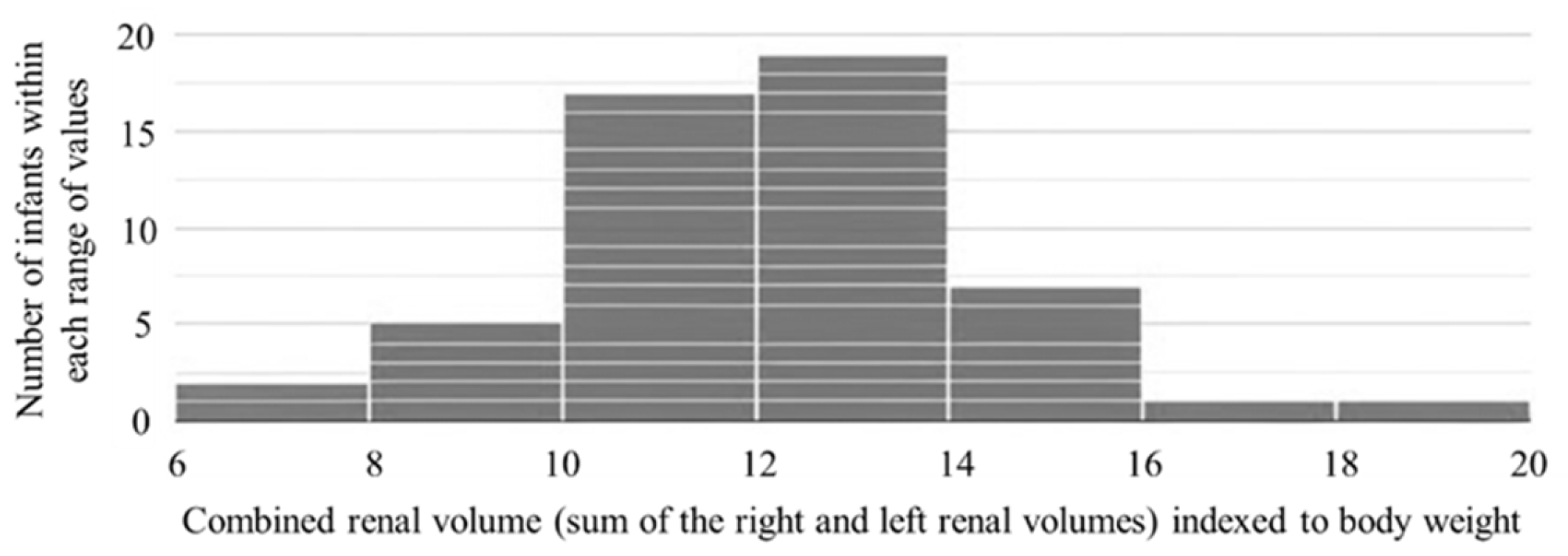
Figure 2.
Distribution of combined renal volumes indexed to body weight (cm³/kg) one week after birth in 52 ELBW preterm infants. Most data points align with the reference line, suggesting an approximately normal distribution, with minor deviations observed in the tails.
Figure 2.
Distribution of combined renal volumes indexed to body weight (cm³/kg) one week after birth in 52 ELBW preterm infants. Most data points align with the reference line, suggesting an approximately normal distribution, with minor deviations observed in the tails.
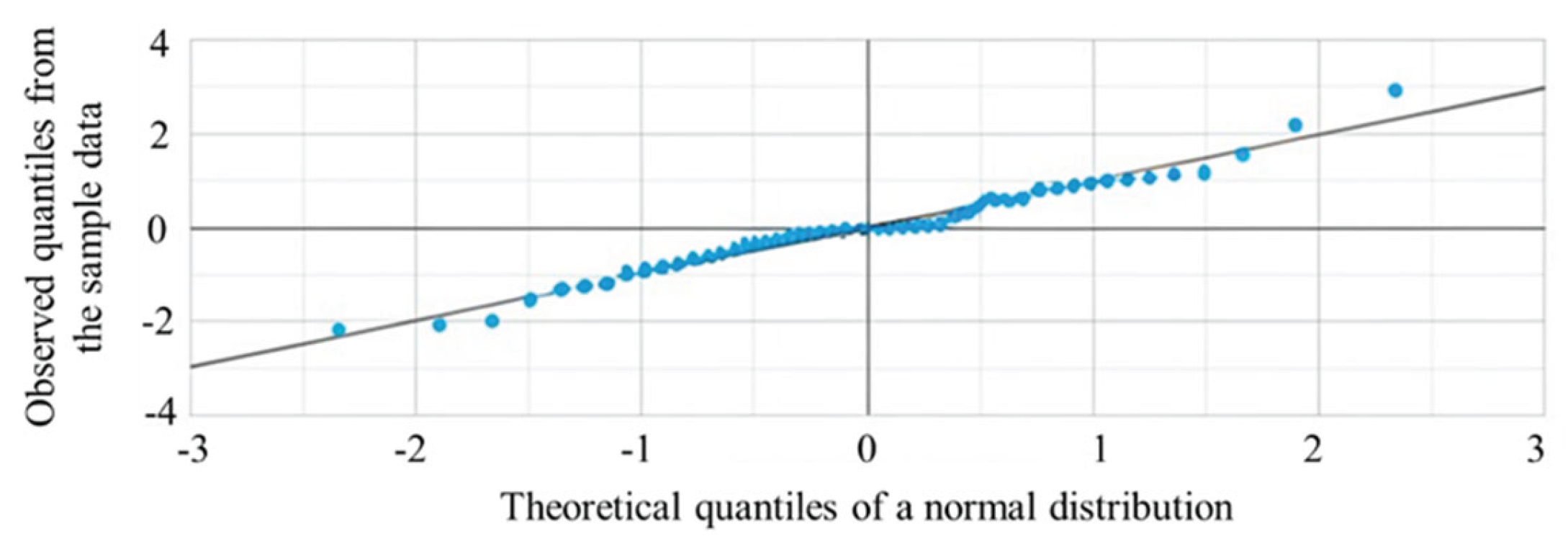

Table 1.
Gestational Age, Combined Kidney Volume, Body Weight, Kidney Volume-to-Body Weight Ratio, and Its Z-Score in 52 ELBW Preterm Infants at One Week of Age.
Table 1.
Gestational Age, Combined Kidney Volume, Body Weight, Kidney Volume-to-Body Weight Ratio, and Its Z-Score in 52 ELBW Preterm Infants at One Week of Age.
| GA (Wk+d) | CRV | BW | CRV/BW | Z-score | GA (Wk+d) | CRV | BW | CRV/BW | Z-score |
| 24+3 | 4.61 | 0.443 | 10.41 | -0.82 | 27+4 | 11.94 | 0.890 | 13.42 | 0.64 |
| 24+3 | 5.11 | 0.570 | 8.96 | -1.53 | 27+5 | 4.97 | 0.630 | 7.89 | -2.05 |
| 24+3 | 6.26 | 0.470 | 13.32 | 0.59 | 27+5 | 8.35 | 0.700 | 11.93 | -0.08 |
| 24+5 | 4.06 | 0.337 | 12.05 | -0.02 | 27+6 | 6.13 | 0.640 | 9.58 | -1.23 |
| 25+2 | 9.38 | 0.670 | 14.00 | 0.93 | 28+0 | 8.97 | 0.703 | 12.76 | 0.32 |
| 25+4 | 6.59 | 0.610 | 10.80 | -0.63 | 28+2 | 8.02 | 0.825 | 9.73 | -1.16 |
| 25+4 | 4.08 | 0.530 | 7.70 | -2.15 | 28+3 | 11.86 | 0.819 | 14.48 | 1.16 |
| 25+6 | 6.72 | 0.555 | 12.11 | 0.00 | 28+3 | 10.47 | 0.850 | 12.32 | 0.11 |
| 25+6 | 7.72 | 0.644 | 11.99 | -0.05 | 28+3 | 12.85 | 0.930 | 13.82 | 0.84 |
| 26+1 | 10.91 | 0.660 | 16.53 | 2.16 | 29+0 | 8.46 | 0.735 | 11.51 | -0.29 |
| 26+2 | 8.73 | 0.690 | 12.65 | 0.27 | 29+6 | 11.58 | 0.960 | 12.06 | -0.02 |
| 26+2 | 7.10 | 0.580 | 12.24 | 0.07 | 29+6 | 10.59 | 1.000 | 10.59 | -0.74 |
| 26+2 | 7.16 | 0.620 | 11.54 | -0.27 | 30+0 | 9.17 | 0.751 | 12.21 | 0.05 |
| 26+2 | 8.92 | 0.630 | 14.16 | 1.00 | 30+2 | 9.82 | 0.835 | 11.76 | -0.17 |
| 26+2 | 12.43 | 0.688 | 18.07 | 2.91 | 30+2 | 9.21 | 0.837 | 11.00 | -0.54 |
| 26+4 | 9.27 | 0.641 | 14.46 | 1.15 | 30+2 | 8.89 | 0.867 | 10.26 | -0.90 |
| 26+4 | 11.67 | 0.763 | 15.29 | 1.56 | 30+2 | 10.91 | 0.950 | 11.49 | -0.30 |
| 26+5 | 10.08 | 0.732 | 13.77 | 0.81 | 30+2 | 7.75 | 0.640 | 12.11 | 0.00 |
| 26+6 | 8.76 | 0.658 | 13.32 | 0.60 | 30+3 | 8.69 | 0.923 | 9.41 | -1.31 |
| 26+6 | 7.86 | 0.670 | 11.73 | -0.18 | 30+4 | 10.59 | 0.885 | 11.97 | -0.06 |
| 26+6 | 9.70 | 0.730 | 13.29 | 0.58 | 30+5 | 12.22 | 0.860 | 14.21 | 1.03 |
| 27+0 | 9.76 | 0.700 | 13.94 | 0.90 | 31+5 | 12.30 | 0.864 | 14.24 | 1.04 |
| 27+0 | 7.80 | 0.720 | 10.83 | -0.62 | 31+6 | 9.84 | 0.815 | 12.07 | 0.01 |
| 27+1 | 6.59 | 0.512 | 12.87 | 0.38 | 32+4 | 10.73 | 1.032 | 10.40 | -0.83 |
| 27+2 | 10.71 | 0.950 | 11.27 | -0.40 | 32+6 | 11.40 | 0.935 | 12.19 | 0.04 |
| 27+3 | 5.13 | 0.440 | 11.66 | -0.21 | 33+0 | 5.78 | 0.721 | 8.02 | -1.99 |
Gestational age (GA) expressed in weeks and days (wk+d), combined renal volume (CRV) calculated as the sum of right and left kidney volumes (in cm³), body weight (BW) in kilograms, combined renal volume-to-body weight (CRV/BW), and its Z-score, all measured at one week of postnatal age.
Table 2.
Percentile Distribution of Combined Renal Volume Indexed to Body Weight (CRV/BW) at One Week of Age in 52 ELBW Preterm Infants.
Table 2.
Percentile Distribution of Combined Renal Volume Indexed to Body Weight (CRV/BW) at One Week of Age in 52 ELBW Preterm Infants.
| Percentiles | CRV/BW |
| Within 1st Standard Deviation | 10.11 to 12.12 |
| Within 2nd Standard Deviation | 8.09 to 10.11 |
| Beyond 2nd Standard Deviation | < 8.09 |
Combined renal volume, defined as the sum of right and left renal volumes and indexed to body weight (CRV/BW), reported at the 10th, 25th, 50th, 75th, and 90th percentiles in 52 ELBW preterm infants evaluated at one week of age.
Table 3.
Distribution of Combined Renal Volume Indexed to Body Weight (CRV/BW) by Stand-ard Deviation Categories in 52 ELBW Preterm Infants at One Week of Age.
Table 3.
Distribution of Combined Renal Volume Indexed to Body Weight (CRV/BW) by Stand-ard Deviation Categories in 52 ELBW Preterm Infants at One Week of Age.
| CRV/BW | Values below the mean | Values above the mean |
| Within 1st Standard Deviation | 10.11 to 12.12 | 12.12 to 14.14 |
| Within 2nd Standard Deviation | 8.09 to 10.11 | 14.14 to 16.16 |
| Beyond 2nd Standard Deviation | < 8.09 | > 16.16 |
Combined renal volume, defined as the sum of right and left renal volumes and indexed to body weight (CRV/BW), stratified by standard deviation ranges from the mean (within 1 SD, between 1 and 2 SD, and beyond 2 SD), in 52 ELBW preterm infants evaluated at one week of age.
Disclaimer/Publisher’s Note: The statements, opinions and data contained in all publications are solely those of the individual author(s) and contributor(s) and not of MDPI and/or the editor(s). MDPI and/or the editor(s) disclaim responsibility for any injury to people or property resulting from any ideas, methods, instructions or products referred to in the content. |
© 2026 by the authors. Licensee MDPI, Basel, Switzerland. This article is an open access article distributed under the terms and conditions of the Creative Commons Attribution (CC BY) license.
Copyright: This open access article is published under a Creative Commons CC BY 4.0 license, which permit the free download, distribution, and reuse, provided that the author and preprint are cited in any reuse.


