

Submitted:
25 March 2026
Posted:
27 March 2026
You are already at the latest version
Abstract
Around the world, banks are not just adopting new technology—they are being reshaped by it. The spread of automation throughout the financial sector is changing what work looks like on the ground: long-familiar roles, everyday routines, and the very skills that employees need are evolving in real time. It is no longer about adding a few digital tools at the edges. Instead, systems such as robotic process automation, Artificial Intelligence (AI), and intelligent decision-support systems are becoming essential components of how banks operate. They actually and significantly influence how banks interact with customers, risk management, and service delivery, signalling a sustainable transformation in how the banking industry functions. A clear outcome of this transformation is the emergence of new job profiles, including AI data scientists, automation analysts, and robotic process automation specialists. These roles illustrate a broader trend in which repetitive, rule-based tasks are being automated, while human work increasingly focuses on analytical judgment, problem-solving, and oversight activities. In the current banking system, a new kind of demand is emerging. It is not just about finding people who know the latest software; it is about finding people who can also interpret complex regulations and navigate intricate banking procedures. Because of this, reskilling and upskilling have moved to the top of the agenda for many institutions as they strive to equip their teams for a techno-logical landscape that is constantly evolving. Hence, where does that leave the nature of work itself? This paper sets out to explore precisely that—to measure how much of the current transformation in banking jobs is being directly driven by automation. To find answers, we developed a framework to tackle the core question: as automation takes hold, what is actually changing about the work that banks’ employees do daily? The study focuses on the five largest banking institutions in South Africa, providing insights into a context where digital transformation is advancing alongside complex organisational challenges. The findings indicate that the implementation of automation technologies is consistently associated with meaningful transformations in job roles, skill composition, and work structures, highlighting automation as a critical factor shaping the future of work in the banking industry.
Keywords:
adoption of bank automation
; smart technology
; banking industry
; changing nature of work
; South African banks
; bank institutions
1. Introduction
Competition in banking has increased significantly. It has completely rewritten the rules. Observations over the last twenty years have shown mounting pressure on the financial sector. New players, agile fintech, and customers who expect everything on their phones have forced traditional banking institutions to adapt or risk falling behind [1]. The local branch—once the undeniable heart of banking—simply is not enough anymore. To survive, banks now lean on a whole ecosystem of digital channels: mobile apps, online platforms, chatbots, and automated kiosks. All of it is driven by technology that gets smarter every day. This is not a surface-level change. It goes much deeper than that. They affect how services are delivered, how quickly decisions are made, and how customers judge the value they receive from their bank [2].
From a customer’s point of view, the change is obvious. Tasks that once required a visit to a branch—opening accounts, transferring funds, applying for loans—can now be done in minutes on a smartphone. Internally, however, the consequences are even more far-reaching. Automation has started to reshape the very nature of work inside banks. Earlier studies already warned that automation systems would not only improve efficiency but also disrupt career paths, workforce size, and skill composition in the banking industry [3]. In the past, a banking career often followed a predictable, almost linear path. Employees would join at an entry level, climb the hierarchy step by step, and often retire from the same institution. That model is fading fast.
A recent business report captures this shift rather bluntly. One participant remarked, “We fully expect people to have four or five ‘careers’ within the same bank” [4]. This statement may sound exaggerated at first, but it reflects what many banking professionals are already experiencing. Roles change. Departments merge. New digital units appear almost overnight. Work has become more fluid, and job boundaries are far less rigid than they used to be. Labour market data reinforces this reality. In the United States, employees aged 25 to 34 had an average job tenure of less than 3 years in 2016, while those aged 55 to 64 had an average tenure of more than 12 years [4]. In Europe, the story is not so different. Surely, tenure varies from one country to the next—sometimes quite a bit. But the overall trend is unmistakable: data shows that, by 2014, millennials were simply not staying in their roles as long as they had at the start of the century.
What does this mean for banks? Simply put, versatility now matters more than longevity. Employees who can move across functions, adapt to new systems, and work comfortably in different corporate settings are becoming far more valuable than those with narrow, role-specific expertise [5]. This reality forces banks to rethink how they approach talent. This shift is not just theoretical—it has real consequences. It forces banks to completely rethink their approach to talent. One industry insider captured the necessary change perfectly–they argued that banks must move beyond a rigid focus on job titles. What matters now are the people themselves and the skills they bring. The roles we think of today might not even exist tomorrow. That sounds sensible, but in practice it is tough. Shifting from position-based structures to skill-based thinking requires new performance systems, new training models, and, perhaps most difficult of all, a cultural shift.
Looking ahead, automation is expected to have an even stronger impact in emerging markets, including South Africa. Advances in intelligent systems mean that machines could soon handle between 20% and 30% of tasks across banking functions, from back-office processing to customer interactions [6]. In theory, automation looks like a guaranteed success. It boosts capacity, cuts delays, and lets employees focus on more valuable work. But reality tends to be messier. The transition is rarely smooth. When banks rush in with a short-term, cost-cutting mindset, they often find themselves struggling to unlock the technology's true potential. To succeed, automation needs a long-term strategy. That may involve redesigning processes so they work better for machines rather than people, as well as partnering with technology vendors who truly understand the banking domain [7,8].
Still, a lingering concern remains. What happens when technology moves faster than people can adapt? This is to say that if employees cannot be upskilled and reskilled fast enough, automation could overtake jobs, including newly created jobs. This scenario, sometimes referred to as the “end of work,” has attracted growing attention in academic and policy debates [9]. Under conditions of structurally lower employment, automation can lead to the permanent removal of certain occupations. Yet this is only one side of the story. Others argue that displaced workers can, and often do, move into new roles that emerge alongside technological change, provided they receive timely support and training [5]. For banks, where knowledge is becoming the norm, one solution stands out: early and continuous reskilling. This might just be the critical factor that decides whether the industry gets disrupted or manages to reinvent itself.
The truth is, the debate is nowhere near settled. On one side, you have experts who are confident that our education and training systems can cushion the impact of automation. On the other, skeptics argue these same systems are already lagging hopelessly behind the pace of tech progress. And let us not forget other variables in the mix—like the push for shorter workweeks and the rise of non-traditional contracts. When you factor all that in, the future of work in the banking industry looks incredibly complex, and frankly, a lot less predictable. Within this context, examining how automation is reshaping the nature of work in the South African banking industry is not just relevant—it is necessary. Understanding these dynamics can help banks, policymakers, and employees make more informed decisions in a sector that shows no sign of slowing down.
1.1. Research Problem
The global banking workplace is not what it used to be. That is due to the steady rise of automation—tools like artificial intelligence, robotic process automation, and fully digital workflows are becoming part of the daily fabric. The promise of greater efficiency and better service is compelling. But it forces a difficult question on us: how much is this wave of automation truly changing the nature of the work itself? The real challenge is figuring out the scale and nuance of that impact. This is especially tricky when you consider the new technical jobs being created alongside very real worries about existing roles being displaced or completely redefined. To tackle this, our research zoomed in on five of South Africa's major banking institutions. to identify the exact, disruptive shifts that these new automation tools bring into the banking workplace. To do that, the investigation took a close look at how these new automation tools are actively changing job roles, which skills are becoming critical, and how entire workforce structures are being re-arranged. The study aimed to provide insights that managers and leaders can genuinely use as a practical guide to navigate the complex human transitions that come with an increasingly automated industry.
1.2. Research Objective
The main research objective of this paper is to determine whether a relationship exists between the adoption of bank automation tools and the changing nature of work.
1.3. Conceptual Framework
Bank automation is not a single idea or a one-size-fits-all solution. It covers a wide range of technologies, tools, and practices that banks use across different parts of their operations. This means that the study does not look forward to investigating every possible dimension or aspect related to the adoption of automation. Instead, it deliberately narrows down its tracks to an established conceptual framework that is specifically linked to the study’s research problem. This is to help the authors shed light on the understanding of how the adoption of automation in banks reshapes everyday work.
Within this framework, automation is treated as a key driver of change. Interestingly, as technology-based practices evolve, banking institutions are rethinking how routine or daily tasks can be rearranged, how decisions can be made, and how the workforce can best carry out their roles. Some changes are subtle. Others are far more visible. In practical terms, the adoption of bank automation is positioned as the independent construct in the model. It is represented by a set of related variables that capture different ways automation shows up in banking operations. On the other hand, the changing nature of work is the dependent construct. This structure demonstrates the practical outcomes this study sought to examine: the transformation of current job roles, the potential new skill set the workforce needs to learn, and the shifts in their daily work routines.
Together, these two pieces—the driver and the outcome—establish the core of the study's hypothesis. Based on the conceptual framework developed, the study could further investigate the primary research question through these avenues: how can automation further influence the workplace? And what specific forms does that influence take within the day-to-day reality of banking?
2. Related Literature Review
2.1. The Strategic Adoption of Automation Within South African Retail Banks
The automation wave is no longer something banks can watch from the sidelines. It is here, and most traditional institutions have already jumped in. Across the sector, leaders are rethinking how technology fits into everyday operations, long-term competitiveness, and even organisational identity. What once sounded futuristic has quickly become standard practice.
Over the past few years, bringing advanced technologies into banking processes has shifted from being an innovation project to a strategic necessity [10]. Executives speak less about whether to automate and more about how fast they can do it, where it will make the biggest difference, and what capabilities they might lose if they fall behind. The pressure is real. Customers want banking to feel effortless, almost invisible, while regulators keep asking tougher questions about accuracy, compliance, and transparency. At the same time, competitors are not standing still—they keep moving the goalposts, rolling out new digital features and faster ways of serving clients. Banks feel this from every angle. You can often see how seriously an institution takes this challenge by paying attention to the language it uses in public. Read the mission statements. Scan the transformation roadmaps. Look at the innovation slogans that appear in annual reports and executive speeches. Again and again, the same themes surface: digital integration, smarter systems, platform thinking, connected services. It is not accidental.
These statements are more than polished marketing lines. They reveal priorities. They hint at where money will be spent, which capabilities will be developed, and how leaders picture the bank of tomorrow. Table 1 illustrates this trend by outlining the core strategic propositions of five major South African banks, each highlighting the rising importance of advanced technologies in shaping both current operations and future ambitions.
Without heavily implementing service delivery automation metrics, which are crucial to operational strategies, it is impossible to penetrate the South African banking landscape. The main strategic drivers that automation and artificial intelligence values can contribute to support the slogan propositions are cost reduction, efficiency, innovation, economies of scale, competitiveness, and simplicity. The FNB holding company, FirstRand Group, for example, takes pride in being creative and strategically disruptive through automated techniques; by 2022, it reported that about 58% of its total sales were processed digitally, which was regarded as a major growth driver [11]. One of the main points is that when a bank digitises its operations, technology deployment becomes a crucial and required step in the banking process [11]. Conversely, Absa places a clear emphasis on incorporating technological innovation into a fresh strategic approach [13].
Shaun Kotwal, Head of Wealth and Investment at Standard Bank South Africa, made a statement that was featured in a banking storybook: “The wealth management and investment sectors are primed for disruption” [14]. Technological intervention has become more feasible due to the burdensome paper trails and overbearing bureaucracy that still exist. An era of totally digital experiences—from initial encounters to client onboarding and processing—is emerging thanks to technological improvements. While moving from advisory services to real implementation still takes time, we expect improvements in speed and efficiency, which will lighten the process.” Additionally, the wealth management sector will undergo a radical transformation in the future due to the introduction of cutting-edge digital offerings and services that are driven by cutting-edge technologies such as process automation, artificial intelligence (AI), robotics, and the Internet of Things (IoT), together with optimised back-end operations [14].
Artificial intelligence (AI) – AI is frequently used in banking to come up with gateways in detecting fraud-related activities, expedite internal procedures, and enhance customer service quality. Its appeal is straightforward. With vast volumes of data, AI systems can sift through transactions, spot patterns, anticipate customer behaviour, and support decisions grounded in evidence rather than intuition [26].
The benefits do not stop there. Banks use AI to take over repetitive tasks that once consumed hours of staff time, tighten their approach to risk management, and craft more personalised experiences for clients. Recommendation engines, automated chat support, and credit assessments—these are now part of everyday operations. AI also opens the door to entirely new financial products and smarter service models that would have been difficult, if not impossible, to deliver before.
Yet the picture is not perfect –in no way. The introduction of AI entails addressing delicate privacy issues, making sure data is safe, and facing the moral dilemmas that occur when robots have an impact on or even make financial decisions for humans. These issues still need to be thoroughly and systematically addressed in any real implementation approach [27]. When the term "robotic assistance" is used in the banking industry, it often refers to the use of robotic process automation (RPA) to manage the significant amount of repetitive, regular labour. Consider data entry; consider updating your account; consider compliance reports that need to be generated repeatedly with minimal change [14]. Although these duties could be necessary, they might take up employees' time and attention. That equation is altered by RPA. Banks may minimise operating expenses, speed up operations, and reduce the risk of human errors contaminating critical tasks by allowing software robots to take over structured processes. Employees who used to spend hours on manual inputs may now focus on more complicated tasks that call for human judgement, experience, and interpretation rather than rote compliance with rules [25]. However, implementing robotic help is not always simple. It can be difficult and costly to integrate modern tools with older systems, both in terms of staff training and technological investment.
Internet of Things (IoT) - The use of Internet of Things (IoT) technologies in banking involves the use of networked devices to improve operational efficiency and the provision of services [28]. Smart ATMs, bank kiosks with the use of the Internet of Things and wearables that can be used for payments are some examples. One of the characteristics of the Internet of Things is to increase consumer satisfaction through the provision of convenient and tailored services. In addition, it makes it easier for banks to collect more accurate customer behaviour and preferences data that can be used for the customisation of services. Managing the security threats posed by a multitude of connected devices and protecting data privacy are among the challenges [29].
Process automation – In the banking environment, process automation is not limited to basic robotic process automation (RPA). It extends further and much further. Rather than focusing only on repetitive, rule-based tasks, it brings together multiple software solutions to manage more complex business processes and layered decision-making activities. That is to recognise that artificial intelligence (AI), machine learning, and advanced data analytics could be integrated into the banking operating systems to stimulate the autonomy of the operations workflow [30]. What is essential is that when the banking institutions are able to deploy the process automation through the robotic process automation with the operational systems, the banks would put themselves in a position of forces to reshape their operations and further improve the banking ecosystem. Thus, this leads to scalability, whereby banks can become capable of expanding their activities without necessarily increasing the input resources. At the same time, the new mechanisms provide leverage in terms of automatically or digitally controlling the entire banking system. It also enhances speed and accuracy across various banking functions, from credit evaluations to back-office operations [31]. Equally important, it gives banks the flexibility to respond more swiftly to regulatory amendments or sudden market shifts. However, these advantages do not come without trade-offs. Comprehensive automation requires substantial upfront investment, both in technology infrastructure and in workforce development. Generally, it is advisable for any organisation on the verge to prepare the environment in such a way that operating models and institutional culture are taken into account to adequately accommodate process automation. Moreover, systems cannot remain static. Therefore, ongoing reviews and systematic continuous improvements should form part of the bank's agility to consistently align operations with the new technological moves.
The banking landscape in South Africa is undergoing a major transformation, largely due to the industry's economic balance. The South African banking industry, which is dominated by the country's five biggest banks—Absa, Capitec, FNB, Nedbank, and Standard Bank—is undergoing significant change in response to stakeholder demands, particularly those of regulators, consumers, investors, and the community. Therefore, in order to meet or exceed the expectations of their customers, many banks have resorted to technological innovation [15].
2.2. The Automation-Based Skill Sets of Staff Will Become the Key Drivers
Growth expectations have significantly pressured the bank to recruit and employ a highly skilled workforce to face advanced technology challenges [16]. Not only must the workforce be ready to stay informed about the most recent technological developments, but to guarantee the bank stays competitive, staff members must look for new and creative ways, in addition to implementing current technologies. As a result, it is anticipated that data analysis will become a crucial competency for executives at all levels [17]. Banking institutions such as Nedbank, for instance, place a great deal of emphasis on the constantly changing skill set that their staff requires in areas like digital innovation, cyber and digital security, robotic process automation, user interface (UI) programming, user experience (UX) design, social media-based customer service, data processing, data protection, predictive risk analytics, and client experience management [18].
Standard Bank understands how critical it is to give employees the tools they need to successfully traverse the rapidly evolving fields of automation and artificial intelligence. They are actively working to improve their human capital through focused training and skill development initiatives in order to respond to these challenges. This involves working with academic institutions to develop IT-related courses and implementing programmes to retrain, upskill, and acquaint employees with cutting-edge tech-related business models and innovative thinking [19]. The bank makes sure that all of its employees have access to the newest tools and technology and is committed to providing them with the necessary training to fulfil the demands of the modern age. This strategy aims to satisfy customer obligations while also adjusting to the changing nature of the labour market [19].
Additionally, for example, when mobile transactions were introduced within Standard Bank’s domestic, business and personal banking units, they saw an increase of 55 percent–approximately 500 million transactions over the first quarter of 2017. The bank subsequently shifted its business operations. As a result, Standard Bank regularly enhances its digital capabilities, reskills staff, and revises its branch formats to meet changing customer desires and improve customer experience [15]. The threat is likely to be generated by cyberattacks, and therefore, professionals with expertise in safeguarding against the ever-evolving digital threats are in more demand. Given that IT, AI data analytics, and risk management are regarded as critical business drivers both now and in the future, South African banking institutions are aware of the intense rivalry for these specialised skills [18]. For instance, Absa has added 843 qualified experts, 91 of whom specialise in data analytics and 71 in cybersecurity, to its workforce, bolstering its skills in technology, digital, data, and cybersecurity [13]. Similarly, the FirstRand Group increased its expenditure on skills development by about 240% in 2020 compared to 2015 [11,20]. In the meantime, Capitec Bank has concentrated on using cutting-edge technology to streamline banking in order to provide retail clients with services that are reasonably priced. They appoint employees who can interact with clients in a constructive way, giving them a sense of empowerment and customising solutions to suit their requirements [21].
Retail bank operations in South Africa are beginning to feel the effects of artificial intelligence (AI) and human-machine synergy. However, the types of business methods these banks decide to deploy have not entirely changed as a result of this deployment. The idea is to reinvest savings from automation back into the workforce in order to spur growth. Beyond just raising profit margins and streamlining bank operations, the objective also entails allocating these savings towards training future employees who will be able to lead creative business models. A pioneer in the high-tech industry has created a workforce that combines human and artificial intelligence (AI) to detect any issues with orders, like the possibility of cancellation or payment conflicts [16]. Employees can now spend more time managing high-risk cases and proactively averting unfavourable outcomes. With a strategy like this, employees must be trained in a wide range of abilities, from data analytics and industry knowledge to soft skills required for novel customer engagement techniques. These changes demonstrate how the nature of work in the banking industry is changing.
From the banking perspective, one must acknowledge that the implementation of automation techniques will significantly disrupt specific jobs and processes [10]. Therefore, banks and other concerned institutions must carefully handle the transition by helping their employees shift from their current skills, competencies, or responsibilities to long-term positions capable of providing the retail banks’ customers with better services. Furthermore, adaptable training and career-development interventions in line with automation practices are necessary to enable employees to reshape their skills for the strain of the long-term vision. Technologies that facilitate automation should be seen as a catalyst to purposefully reskill the banks’ employees, and reskilling provides them with adequate knowledge and competency to use programs and machines for better service delivery. Previous studies reported that, from the employees’ skill developments, typically 10% of a person’s skills are developed within the classroom, approximately 20% are enriched from development interventions and affiliations with mentors and peers, and 70% comes from experience acquired. One learns best when doing [16]! Yet some banks are still focused on the ten percent from the educational institution classrooms and expect their employees to perform at the level of the high penetration of automation. In the South African baking industry, effectively reshaping employees’ skills is vital as the nature of work keeps evolving [20].
3. Materials and Methods
This research examines how automation of service delivery affects operations, processes, as well as the skills of the employees accordingly required in the South African banking industry, with a particular emphasis on the “big five” banking institutions: Absa, Capitec Bank, First National Bank (FNB), Nedbank, and Standard Bank. In order to maximise client service with limited resources, these institutions—which together account for more than 80% of the nation’s banking assets [22]—are transitioning from a traditional operating system to an automated landscape where smart technologies are integrated.
The study followed a quantitative approach in order to answer the research question adequately and reach the set objective. Hence, a questionnaire was administered to bank employees to measure their perceptions of the current trends of automation in their respective banks. A quota sampling was considered, and 223 employees were selected to contribute to the study. The reason for choosing quota sampling for this approach is that it is a non-probability sampling method that relies on the non-random selection of a predetermined proportion of units or several respondents [18,23]. This, therefore, supports the procedure of data collection, whereby the social media platform LinkedIn was used to make contact with respondents/employees of the five prominent banks in South Africa. Also, in the employees’ selection to contribute to the study, top management employees were excluded from the survey because they are in charge of drawing up policies. Therefore, excluding them from the respondent list is to avoid conflict of interest and potential bias.
As the study assesses employees’ perceptions and views on the matter at hand, we opted for a structural equation modeling (SEM) technique, using SPSS, to evaluate the extent of the relationship between the adoption of automation and the changing nature of work. This was done by testing the following hypothesis: ‘The adoption of automation practices in the bank changes the nature of staff work’. Hence, the study’s constructs, adoption of automation and changing nature of work, were made up of five and four items/variables, respectively. Combining the employees’ perceptions (primary data) with bank report data (literature review) would permit a holistic knowledge of the relationship dynamics between adopting automation and the changing nature of work in the South African banking industry.
4. Results
4.1. Primary Findings of the Structural Model Testing
Table 2 below depicts the summary of the primary results of the structural equation modeling (SEM) of the main constructs. It is worth noting that this table only forms part of the extract of the main analysis. Hence, the focus is on the part of the table reflecting the conceptual framework of the research paper. That is to affirm that the adoption of automation is deployed as the central independent model factor with the changing nature of work as the dependent model factor of the study (see Figure 1). The idea was to consider the analysis of the validity and reliability of the model by focusing on the number of items making up each factor/construct, factor loadings or standardised loadings, t-value (t) and the composite reliability coefficient.
The results of the primary analysis of the study suggested that the independent model factor (the adoption of automation and the dependent model factor (changing nature of work) were measured with five and four items, respectively, which were significantly above the minimum required number of items a factor or construct should encompass in order to support the SEM analysis requirements. When specifically focusing on the factor loadings, there is a general scientific rule that stipulates that “factor loading values of 0.67, 0.33, or 0.19 for measurement variables of a model are described as substantial, moderate, or weak, respectively.” [32]. In this study, the values of the loading factor are significantly greater than the thresholding value of 0.3, which is a valid acceptance of the confirmatory factor analysis. This, therefore, reaffirms that the group of items for each construct are indeed measuring the related individual factors that they are intended to measure. In other words, there is a reliability assurance that the items indeed measure the respective factors of the model.
Additionally, looking at the t-value measurement of each factor, it displays 13,7 and 15.51, respectively, for the adoption of bank automation and the changing nature of work. These two t-values are all greater than the threshold value of 1.96 (t>1.96). Also, the composite reliability coefficients are both well above the acceptable standardised cut-off value of 0.70 [33,34].
Based on this explanation, the model is valid and supported since the factor loading values and items are interrelated within the respective constructs without showing signs of cross relationships among the constructs.
4.2. Hypothesis Testing
The path analysis of the SEM output was used to determine the potential relationship between the adoption of bank automation and the changing nature of work, as described in the Figure 2 below.
The relationship model between the adoption of bank automation and the changing nature of work is a significant positive correlation described by the standard estimated regression coefficient of β value equals to 0.51, p= 0.000 (p< 0.05), and the t-value 7.71 (t>1.96). These results are in line with the expectations of the proposed model.
Since the findings are supported, this means the model validates the framework of this study. Therefore, the adoption of bank automation has a direct, strong and positive relationship with the changing nature of work at the five largest banking institutions in South Africa, which are Absa, Capitec Bank, First National Bank (FNB), Nedbank and Standard Bank. These findings are in line with the previous scholars’ findings [7,24,25], who demonstrated that the more conventional or traditional organisations use technology in their daily activities, the more the work environment becomes dynamic, whereby employees with the ability and adaptability to work in various roles across the organisation are a source of privilege, and consequently, value emerges from the sense of such a workforce. As a result, organisations need to re-evaluate and redefine how they view the function and importance of their workforce.
The model hypothesis demonstrates that “the adoption of the automation system in the traditional banking institutions changes the nature of staff work because the working environment tends to evolve as well”. In regard to the Structured Equation Modeling (SEM) for the study, the more banking processes are automated, or service delivery technologies are implemented in five banking institutions, the more changes are observed in the work environment in terms of employees’ roles and responsibilities. It is interesting to highlight that there are two essential facets when it comes to alluding to banking operating approaches, which are traditional or conventional banking and automation-inclined or automation-based banking [10]. As highlighted earlier in this article, the banking operating system is evolving, meaning the changes are real and factual. Hence, the workforce should be able to encompass a certain level of skills and capabilities in order to adapt to the new nature of work practices orchestrated by the adoption of automation. Consequently, the implications of this outcome would shed light on awareness accordingly when it comes to automating bank processes to meet clients’ needs or evolving preferences. The discussion below provides further arguments on the hypothesised relationship.
4.3. Discussion
The results of the path analysis suggest that the banking industry is undergoing rapid transformation, even as it continues to face a range of operational and technological challenges [20]. Change is no longer gradual; it is accelerating. In response, the South African banking industry—particularly the five dominant institutions, namely Absa, Capitec, First National Bank, Nedbank, and Standard Bank—is under increasing pressure to adapt to what has effectively become a new operating reality. Remaining competitive in a constantly shifting financial environment now requires more than incremental improvement; it demands structural and strategic recalibration. As these institutions reconsider the ways in which services are delivered to customers, they are also re-evaluating how to consistently meet—and ideally exceed—rising stakeholder expectations [4]. This shift has elevated technology-driven practices from optional enhancements to strategic necessities. In many respects, digital transformation has become a benchmark of operational excellence, one that banks are actively pursuing in order to secure long-term competitiveness. Such developments inevitably trigger internal change. Banks are increasingly willing to redesign their operational architectures so that emerging smart practices can be embedded into everyday processes. At the centre of this transition lies automation. Processes that were once largely manual are progressively being digitised, streamlined, and in many cases fully automated. This, therefore, demonstrates that the direct implications seem to go beyond the operational efficiency [20]. It is further noticeable that the adoption of automation, as demonstrated in this study, described the direct influence that it has on the changing nature of employee work within the banking industry in South Africa. This is to allude that the adoption of bank automation behaves as a disruptive force, which tends to redefine responsibilities, work processes and dictates to some extent how the banking institutions create value to clients.
Naturally, as operational processes evolve, so too do job roles. The work itself begins to look different. This transformation places new expectations on employees. Skills that were once sufficient are no longer enough. Staff members increasingly need to reskill and upskill in order to align with newly emerging job functions driven by automation adoption [9]. Tasks that defined banking roles in the past have not necessarily disappeared, but they now exist in altered forms, often supported—or partially executed—by intelligent technologies. It is for this reason that working alongside continuous automation or technological progress is viewed as fluid not only by workers but also by clients. The connected nature between the banking ecosystems extends to a dynamic nature, which forces the workforce to upskill and reskill to accommodate the new banking functions.
In addition to work becoming increasingly evolving and dynamic, there is also a considerable level of pressure placed on the workforce from a subjective standpoint. As a result, employees who possess advanced competencies and who are capable of performing multiple job functions are increasingly preferred within these banking institutions. This, therefore, explains that the characteristics related to the changing nature of work are becoming dynamic because of the advancement in technology. From an industry perspective, the integration of technologically driven practices into organisational processes appears to be a practical and sustainable approach that is likely to remain relevant for the foreseeable future. Given the significant pace at which banking automation is being adopted, the practical and policy implications of these findings suggest that banking institutions should invest more deliberately in reskilling and upskilling initiatives for their employees so that they can adapt to the emerging opportunities created by automation and remain competitive in the labour market. Streamlining the training programmes that are based on capability billing is an advisable approach to enhance the analytical and digital skill sets.
Furthermore, addressing this phenomenon should extend beyond the boundaries of the banking industry, as employees increasingly require a solid educational foundation that corresponds with the realities of the evolving automation ecosystem. Consequently, banking institutions, industry leaders, and policymakers are encouraged to establish strategic partnerships with learning and training institutions in order to develop robust curricula that align with the industry’s emerging automation practices. It is also essential to emphasise that banking institutions should foster an innovative organisational culture and implement developmental programmes, such as design thinking workshops, that encourage employees at all organisational levels to strengthen their problem-solving capabilities and gradually move away from routine operational tasks that can be easily automated.
5. Matching the Journal Aspirations and Contribution to the Body of Knowledge
The significance of this article is closely associated with the overarching objective of the journal’s philosophy, which assumes that the purpose and outcomes are significant within the academic and industry dispensation. This paper provides essential insights and elements associated with the deployment of smart technology-based practices, which tend to force traditional or conventional organisations, especially banking institutions, to redefine and reshape the nature of work. As a result, the study foresights awareness for organisations to be prepared because technological advancement is not showing signs of slowing down; therefore, strengthening the integration of automation seems to be a viable option. Such initiatives demonstrate a growing institutional commitment to embracing technologically driven transformation. In this regard, the study contributes meaningfully to the expanding body of knowledge related to automation foresight, particularly in supporting organisations to anticipate, understand, and prepare for potential technological disruptions. Ultimately, the insights generated through this research provide a useful perspective for institutions seeking to navigate the evolving landscape shaped by smart technologies and automation.
6. Concluding Remarks
The adoption of automation within the South African banking institutions is becoming increasingly essential. This seems to be continuing within these financial establishments to ensure that they remain innovative and competitive in the global market arena. Consequently, as South African banks progressively integrate smart technologies, a corresponding transformation is evident in the execution of daily processes and strategic functions. This observation affirms that the adoption of automation exerts a substantial and direct influence on the evolving landscape of the nature of work. Essentially, employees are direct observers of, and participants in, the resultant organisational shifts. Accordingly, it is imperative that these employees are provided with comprehensive training and development initiatives aimed at facilitating upskilling and reskilling, thereby ensuring seamless adaptation to smart technology-augmented work environments. Lastly, it is of crucial essence to acknowledge the necessity for organisations to endorse a gradual approach when it comes to the workforce to transition away from routine roles or tasks that could be automated, towards the functions that require cognitive and high-level of problem-solving capabilities.
8. Suggested Area for Future Research
The present study focuses exclusively on the banking industry in South Africa. Therefore, future research encompassing the broader financial sector would be essential in advancing the insights discussed in this paper. Additionally, it may be of great importance to subsequently collect and analyse secondary or historical data within the financial domain to further strengthen the outcome of this study.
References
- Akilimalissiga, S.; Sukdeo, N.I. Operating Costs and Service Delivery Automation: A Perspective of the South African Banking Industry. In Proceedings of the 2023 IEEE International Conference on Engineering, Technology and Innovation (ICE/ITMC), Edinburgh, United Kingdom, 19–22 June 2023; IEEE; pp. 1–7. [Google Scholar] [CrossRef]
- Raza, S.A.; Umer, A.; Qureshi, M.A.; Dahri, A.S. Internet banking service quality, e-customer satisfaction and loyalty: The modified e-SERVQUAL model. TQM J. 2020, 32, 1443–1466. [Google Scholar] [CrossRef]
- Maroof, M. A Impact of automation on employment (challenges & opportunities). Int. J. Creat. Res. Thoughts 2018, 6. Available online: https://ssrn.com/abstract=4315579.
- Nesindande, A.R.M.; Saurombe, M.D.; Joseph, R.M. Exploring changes in banking workplaces because of digital technology implementation. SA J. Hum. Resour. Manag. 2024, 22, e2542. [Google Scholar] [CrossRef]
- Vermeulen, B.; Kesselhut, J.; Pyka, A.; Saviotti, P. The Impact of Automation on Employment: Just the Usual Structural Change? Sustainability 2018, 10, 1–27. [Google Scholar] [CrossRef]
- Thekkethil, M.S.; Shukla, V.K.; Beena, F.; Chopra, A. Robotic process automation in banking and finance sector for loan processing and fraud detection. In Proceedings of the 9th International Conference on Reliability, Infocom Technologies and Optimization (ICRITO), Noida, India, 03-04 September 2021; pp. 1–6. [Google Scholar] [CrossRef]
- Arangarajan, M.; Gaikwad, K.D.; Dharmani, M.; Nathani, R.; Joshi, R.; Hasan, M.F. Robotics and AI in enhancing banking operations efficiency. In Proceedings of the Second International Conference on Computational and Characterization Techniques in Engineering & Sciences (IC3TES), Lucknow, India, 15-16 November 2024; pp. 1–5. [Google Scholar] [CrossRef]
- Eichhorst, W.; Souza, A.P.; Cahuc, P.; Demazière, D.; Fagan, C. The future of work—good jobs for all. In Rethinking Society for the 21st Century: Report of the International Panel on Social Progress; Cambridge University Press: Cambridge, UK, 2018; pp. 255–312. [Google Scholar] [CrossRef]
- Autor, D.; Salomons, A. Is Automation Labor-Displacing? Productivity Growth, Employment, and the Labor Share. National Bur. of Econ. Res. Work. Paper 2018, 1–76. Available online: http://www.nber.org/papers/w24871.
- Fasnacht, D. Banking 4.0: Digital ecosystems and super-apps. In Theories of Change; Wendt, K., Ed.; Springer: Cham, Switzerland, 2021; pp. pp 235–256. [Google Scholar] [CrossRef]
- Thottoli, M.M.; Islam, M.A.; Yusof, M.F.B.; Hassan, M.S.; Hassan, M.A. Embracing digital transformation in financial services: From past to future. SAGE Open 2023, 13. [Google Scholar] [CrossRef]
- Ramsundra, A.; Mason, R.B. Factors influencing the use of digital personal banking in South Africa. Int. J. Electron. Commer. Stud. 2024, 15, 29–58. [Google Scholar] [CrossRef]
- Atal, M.R.; Mondliwa, P. Afrofuturist ambiguities: Inclusion and consolidation in South African digital finance. Big Data Soc. 2025, 12, 1–18. [Google Scholar] [CrossRef]
- Lotriet, R.; Ditshego, J. An assessment of perceptions concerning digital transformation at a South African commercial bank—A case of Anthropocene denial for the economy? Tydskr. Geesteswet. 2020, 60, 687–707. [Google Scholar] [CrossRef]
- Kariuki, P.; Ofusori, L.O.; Goyayi, M.L.J. Internet of Things on banking processes in South Africa: A systematic reflection on innovations, opportunities and challenges. Digit. Bus. 2025, 5, 1–8. [Google Scholar] [CrossRef]
- Josten, C.; Lordan, G. Automation and the changing nature of work. PLoS One 2022, 17, e0266326. [Google Scholar] [CrossRef] [PubMed]
- Budree, A.; Tew, M. Investigating robotic process automation adoption in South African banking. In Decision Intelligence Solutions; Hasteer, N., McLoone, S., Khari, M., Sharma, P., Eds.; Springer: Lecture Notes in Electrical Engineering, Singapore, 2023; Volume 1080, pp. 81–94. [Google Scholar] [CrossRef]
- Akilimalissiga, S.; Sukdeo, N. Pivotal relationship between service delivery automation and job losses: A case of the South African banking industry. In Proceedings of the International Conference on Industrial Engineering and Operations Management, Michigan, USA, 4-6 April 2023. [Google Scholar] [CrossRef]
- Mlambo, N.; Iyamu, T. Understanding the factors that influence the implementation of robotic process automation from banking sector perspective. In Proceedings of the 3rd European Conference on the Impact of Artificial Intelligence and Robotics (ECIAIR 2021), Lisbon, Portugal, 18-19 November 2021; pp. 98–104. [Google Scholar] [CrossRef]
- Akilimalissiga, S.; Sukdeo, N.; Mukwakungu, S. Adoption of automation as a determinant of the physical footprint in the South African banking institutions. In Proceedings of the International Conference on Industrial Engineering and Operations Management, Michigan, USA, 7-9 March 2023. [Google Scholar] [CrossRef]
- Iyamu, T.; Mlambo, N. Actor-network theory perspective of robotic process automation implementation in the banking sector. Int. J. Inf. Technol. Syst. Approach 2022, 15, 1–17. [Google Scholar] [CrossRef]
- Azinge-Egbiri, N.; Ryder, N.; Esoimeme, E.E. Global Anti-Money Laundering Regulation: Developing Countries Compliance Challenges, 1st ed.; Routledge: London, UK, 2024; pp. 268–301. [Google Scholar] [CrossRef]
- Pallant, J. A Step-by-Step Guide to Data Analysis Using IBM SPSS, 6th ed.; Open University Press: New York, NY, USA, 2016; pp. 10–98. [Google Scholar]
- Aguinaldo, M.A.L.; Montaño, N.; Quito, N.C.; Recel, M.M.; Mañulit, K.A.; Cruz, J. Impact assessment of automation on conditions of employment in the Philippine banking industry. In Proceedings of the 16th International Conference on E-Education, E-Business, E-Management and E-Learning (IC4e), Tokyo, Japan, 26-29 April 2025; pp. 163–166. [Google Scholar] [CrossRef]
- Petersen, B.K.; Chowhan, J.; Cooke, G.B.; Gosine, R.; Warrian, P.J. Automation and the future of work: An intersectional study of the role of human capital, income, gender and visible minority status. Econ. Ind. Democr. 2023, 44, 703–727. [Google Scholar] [CrossRef]
- Rahman, M.; Ming, T.H.; Baigh, T.A.; Sarker, M. Adoption of artificial intelligence in banking services: An empirical analysis. Int. J. Emerg. Mark. 2023, 18, 4270–4300. [Google Scholar] [CrossRef]
- Thowfeek, M.H.; Samsudeen, S.N.; Sanjeetha, M.B.F. Drivers of artificial intelligence in banking service sectors. Solid State Technol. 2020, 63, 6400–6411. Available online: https://solidstatetechnology.us/index.php/JSST/article/view/5969.
- Aripin, Z.; Saepudin, D.; Yulianty, F. Transformation in the Internet of Things (IoT) market in the banking sector: A case study of technology implementation for service improvement and transaction security. J. Jabar Econ. Soc. Netw. Forum 2024, 1, 17–32. Available online: https://jesocin.com/index.php/jesocin/article/view/14.
- Ramalingam, H.; Venkatesan, V.P. Conceptual analysis of Internet of Things use cases in banking domain. In Proceedings of the IEEE Region 10 Conference (TENCON 2019), Kochi, India, 17–20 October 2019; pp. 2034–2039. [Google Scholar] [CrossRef]
- Villar, A.S.; Khan, N. Robotic process automation in the banking industry: A case study on Deutsche Bank. J. Bank. Financ. Technol. 2021, 5, 71–86. [Google Scholar] [CrossRef]
- Nikolaidou, M.; Anagnostopoulos, D.; Tsalgatidou, A.P. Business process modelling and automation in the banking sector: A case study. Int. J. Simul. 2021, 2, 65–76. Available online: https://api.semanticscholar.org/CorpusID:16363727.
- Chin, W.W. The partial least squares approach to structural equation modelling. In Modern Methods for Business Research; Marcoulides, G.A., Ed.; Lawrence Erlbaum Associates: Mahwah, NJ, USA, 1998; pp. 295–336. [Google Scholar]
- Hair, J.F.; Anderson, R.E.; Tatham, R.L.; Black, W.C. Multivariate Data Analysis with Readings; Prentice Hall: New Jersey, NJ, USA, 1995; pp. 157–181. [Google Scholar]
- Akilimalissiga, S.; Sukdeo, N. The effect of service delivery automation (SDA) on the South African banking industry. S. Afr. J. Ind. Eng. 2024, 35, 15–28. Available online: https://hdl.handle.net/10520/ejc-indeng_v35_n2_a2. [CrossRef]
Figure 1.
The conceptual framework.

Figure 2.
Hypothesis testing.
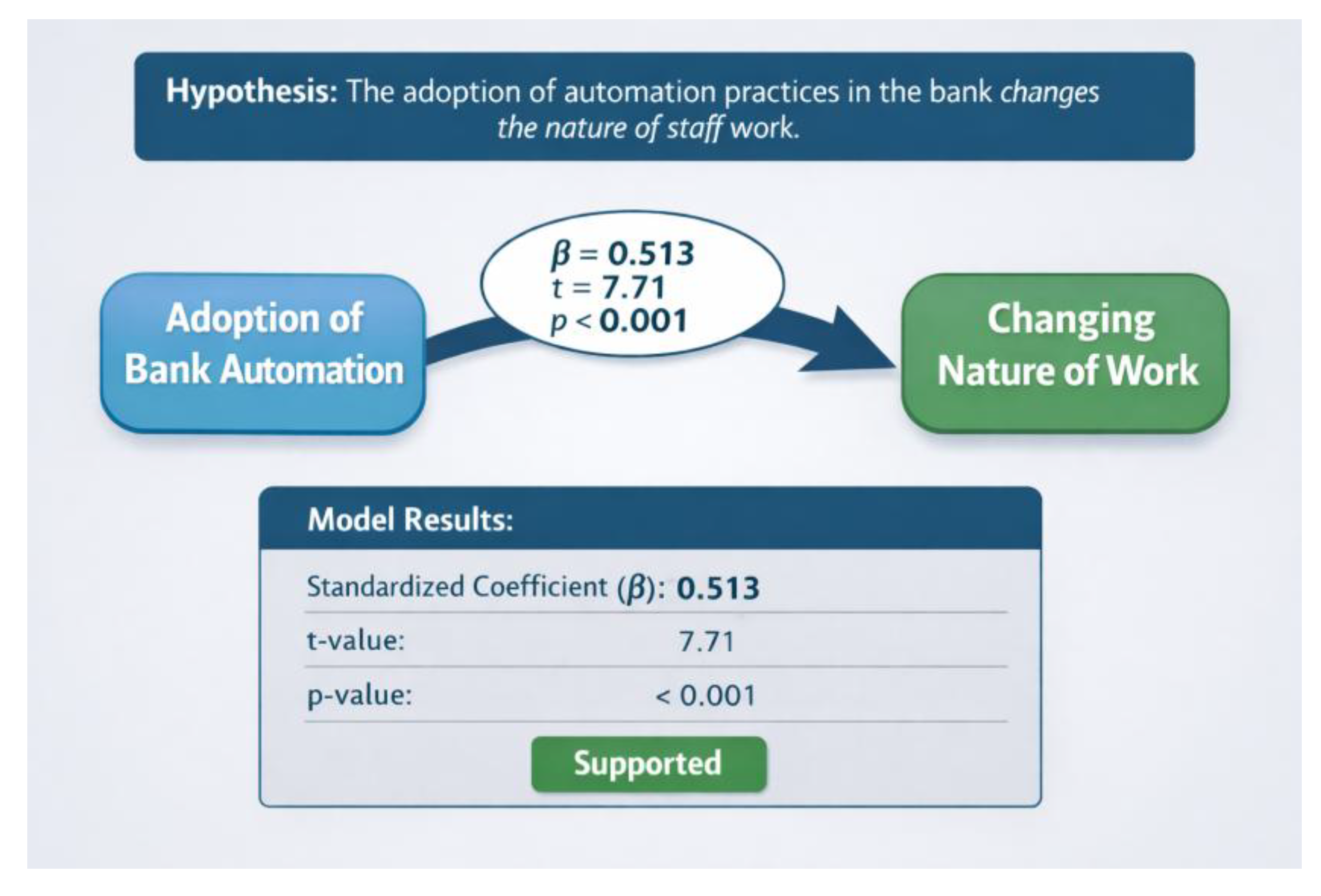

Table 1.
Key strategic value propositions by the selected banking institutions.
| Bank | Key Strategic Value Propositions |
|---|---|
| Absa | We, as Absa, are building a scalable, digitally led business. |
| Capitec Bank | Encourage virtual money management by providing value-adding Internet and mobile banking functionality. |
| First National Bank (FNB) | Provide digital platforms to deliver cost-effective and innovative transactional propositions to its customers. |
| Nedbank | Building a more digital, agile and competitive Bank |
| Standard Bank | We understand the scale of disruption that is currently sweeping through the financial services industry. |
Table 2.
Primary findings of Structural model testing.
| Model Factor | Number of Items per Construct Factor | Factor Loadings | t-Value (t) | Composite Reliability |
|---|---|---|---|---|
| Adoption of bank automation (ABA) | 5 | 0.60 | 13.17 | 0.86 |
| Changing nature of work (CHAN) | 4 | 0.73 | 15.51 | 0.91 |
Disclaimer/Publisher’s Note: The statements, opinions and data contained in all publications are solely those of the individual author(s) and contributor(s) and not of MDPI and/or the editor(s). MDPI and/or the editor(s) disclaim responsibility for any injury to people or property resulting from any ideas, methods, instructions or products referred to in the content. |
© 2026 by the authors. Licensee MDPI, Basel, Switzerland. This article is an open access article distributed under the terms and conditions of the Creative Commons Attribution (CC BY) license.
Copyright: This open access article is published under a Creative Commons CC BY 4.0 license, which permit the free download, distribution, and reuse, provided that the author and preprint are cited in any reuse.