
Submitted:
20 March 2026
Posted:
26 March 2026
You are already at the latest version
Abstract
We provide an intrinsic construction of the central conics in the real hyperbolic
plane H2 whereby each conic C is the composition of a unique pair of Steiner
conics (those generated by collineations). The composition is achieved by el-
liptic curve addition on intersection points of the two components with their
orthogonal trajectories, which have a natural representation as genus 1 curves
in any inversive model of H2. The central Steiner conics that have a focal axis L
are identified with the subgroup G(L) of collineations generated by reections
in the lines perpendicular to L. We define the fiber over g 2 G(L) to be the
set of compositions C such that Pi (C) = g. Here, Pi (C) is the unique Steiner
conic tangent to C at the points on L, and we show that Pi (C) is the product
of the two elements in G(L) that represent the components of C. The central
conics are partitioned into these fibers, which are acted upon transitively by
G(L). The geometry and algebra of the fiber bundle are emphasized, without
topological considerations.
Keywords:
hyperbolic plane
; incidence geometry
; elliptic curve
; fiber bundle
MSC: primary 51M10; secondary 51M15; 51A45
1. Introduction
An intrinsic construction of conics in the real hyperbolic plane would require only the incidence properties of the plane, the action of the collineation group, and a conformal metric. In this article, we provide such a construction by viewing as a linear incidence geometry - two distinct points are on exactly one line and two distinct lines meet in at most one point. A first step toward such a construction was taken in [1] where we classified the Steiner conics in , defining them in the manner of [2] (pp. 134-140).
Definition 1.
Let T be a collineation of a planar incidence geometry. The Steiner conic afforded by T at point P is the locus of intersections for the lines L concurrent at P. The conic is congruent to if, for some collineation , and . If the geometry is oriented, is direct if T preserves orientation, opposite if T reverses orientation. The conic is degenerate if or if for some L.
It is possible for all conics in a planar geometry, defined algebraically or by other means, to be Steiner conics. This is the case in a projective plane over a field, as discussed in [3] (p. 80). From this viewpoint, the “conic sections” - ellipses, parabolas, hyperbolas - are classified by the invariants of affine collineations that afford them. By contrast, the collineation group of consists entirely of isometries if a metric is imposed. This constrains the Steiner conics to the in [1] where we showed them to be proper subsets of seven of the eleven categories of curves described in the classical sources [4,5]. Those categories extended work by Enrico D’Ovidio and others in the 1890s. They were described, non-intrinsically, by intersecting cones with a hyperbolic domain (analogous to the conic sections of Apollonius). The numbering and descriptors for these categories in [5] (p. 119), which correspond to the figures in [4] (p. 229), are reprised in Section 2 for the central conics, characterized by having two perpendicular lines of symmetry.
Since these are our subject, will always denote a central Steiner conic, and C will always designate a central conic in . We write for the set of direct and for the set of opposite . The set consists of the members of with no absolute points (on the boundary of ). Upon choosing a set of congruence representatives we use elliptic curve addition on their orthogonal trajectories to define the composition C of any two members of . This is our main result, which we state in Section 2. Apart from clarifying references to [1], our aim is to keep this presentation as self-contained as possible and of interest to the pedagogical community. The following outline provides context for the proof of our Main Theorem and its consequences in later sections.
In Section 3 we use the hyperboloid model of to construct a family of elliptic space curves and describe the addition on their points. In Section 4 we represent points as complex numbers by projecting them into the conformal disk , where it is easy to visualize these curves and those in as an orthogonal system. That the composition of a member of with itself is a circle is proved in Section 5, followed by a formula in for the elliptic curve addition. In Section 6 we derive some algebraic identities required for the proof, in Section 7, of the Main Theorem. In Section 8 the remaining categories of central conics listed in Section 2 will be produced from the compositions C. In Section 9 we use the Main Theorem and an intrinsic involution on the half-planes of that interchanges and to describe a group structure on . We define the fiber over each member of this group in Section 10 and partition the central conics into fibers.
For brevity throughout, we omit the details of routine calculations unless they are essential to the argument at hand. Several of these calculations are characteristically intricate. They have been performed manually and then thoroughly checked with the algebra program in Scientific Workplace 5.5.
2. Background and Statement of Main Theorem
Before stating our main result we establish some basic terminology by way of a brief summary of the classification of the . It is convenient to describe the translation component of T in terms of distance, whereby the eccentricity of is a function of the distance s between P and . If then . We write for the Steiner conic in this case and will work with a set of congruence representatives parameterized by . These representatives have common axes of symmetry, hence common center O. We reserve the term ellipse for an with , where is the degenerate ellipse O. The ellipses comprise . Each ellipse is a special case of a locus consisting of points the sum of whose distances from two foci is , where is the distance between the foci; for an ellipse, and . The center of is the midpoint of the segment between the foci, its focal axisis the line through the foci, and its transverse axis is the line perpendicular to the focal axis at the center. If we call a hyper-ellipse. The conic is the pair of equidistant curves with angle-of-parallelism relative to the focal axis of the ellipses. The members of are all central; we refer to them as hyperbolas and provide parameters for them in Section 9.
It will suffice to state the Main Theorem in terms of the ellipses because all of the are related to them by the process of split-inversion. Split-inversion is a conformal, incidence-preserving involution on the open half-spaces of a hyperbolic space that interchanges complementary angles-of-parallelism. (The term is not standard but varies with context. See [6], where it is used without an explicit name.) In , we have the following definition.
Definition 2.
For example, if then split-inversion in the focal axis of the ellipse interchanges it with the hyper-ellipse . In any inversive model of (such as the Poincaré disk or upper half-plane) this is implemented by inversion in , which sends each point on the axis to two absolute points. In particular, the split-inversion of is not in the plane, but it will be used in Section 9 to represent reflection in the transverse axis.Let be an open half-plane for a given line L in . For any , let be the perpendicular to L through P. The split-inversion ofPinL is the point such that the angle-of-parallelism to L at is the complement of the angle-of-parallelism to L at P.
The central conics depicted in [4,5] comprise five of the categories in these sources, where they are designated as follows:
C1 Convex hyperbolas
C2 Concave hyperbolas
C4 Ellipses
C9 Equidistant curves
C10 Proper circles.
Since they fit our definition, we will include two other categories, afforded by degenerate cones:
C9A Pairs of intersecting lines
C9B Pairs of ultra-parallel lines.
Except for C9, C9A and C9B, these conics are represented in any inversive model of by irreducible algebraic curves. We will see that the account for C4 and C10. Split-inversion of the in their focal axes will account for C2, and split-inversion of the in their transverse axes for C1. Our construction will also produce the reducible curves C9, C9A and C9B.
The essential fact (see Section 4) is that the are orthogonal in to curves defined by the following locus condition:
Each is symmetric about O. Reflection in reverses the orientation of , interchanging and . Our representatives for the are the for which O is the midpoint on of P and . For any , is considered to be the transverse axis of , and the line L through O perpendicular to is its focal axis. Each meets at two points in , one in each half-plane of the focal axis. The are invariant under split-inversion in L. We will see in Section 3 that the have a natural representation on the Minkowski hyperboloid. Using this model (and later its projection into the disk ) we will derive the elliptic curve addition on the points of the algebraic curve containing . Our main result, the construction of conics in categories C4 and C10, is as follows.Let O be a designated point on a given line in . For , let be the locus of points P such that , where A is the foot of the perpendicular to from P.
Main Theorem.
Given ellipses and with , let and be respective intersections with a given . Let if and are chosen in the same half-plane of the focal axisLand let if they are chosen in opposite half-planes ofL.Then, with and , the set of points for a consistent choice of is the locus where and .
We refer to as the composition of and for the value , denoting it as convenient by . The intersections of with L and are obtained as limiting cases for . Note in particular that if then . Also, if then , that is, the composition of an ellipse with itself is a circle ( if ); we will prove this special case in advance of the general proof of the theorem. Note that , from which it will follow as a corollary to the theorem that is the composition of a unique pair of ellipses.
3. Constant-Angle Curves on the Minkowski Hyperboloid
The intrinsic view of non-Euclidean geometry promoted by Felix Klein was accelerated in the `pre-modern’ era by the introduction of the hyperboloid model of in . Recall that this model is obtained from the quadric ,
whose two sheets are , with , and the Minkowski hyperboloid , with . Let and . The points in this model are those on , and the lines are the intersections with of planes through . Each line, then, is identified with a normal vector , where , that determines its plane. The Minkowski inner product of two lines and is
If and intersect, the angle between them in is defined by
Given , let be the intersection of with the quadric . We will show that this space curve, which includes points on , is the complete form of the locus defined in Section 2 (with ). First, for any point P on , let be the reflection of P in the Z-axis. Then is also on . Reflection in any of the coordinate planes interchanges and , so we work with in this section. For , let
A one-to-one parameterization of is given by
whereby corresponds to N, and to S. Now let P be any point on , so , and let be the line . The line through N and P is and the line through P orthogonal to is , so the cosine of the angle between and is
Thus, the angle between the line through N and P and the line through P orthogonal to is .
A complete is an example of a real elliptic curve obtained from the intersection of two quadrics. As such, it has an addition structure, with identity N, and the inverse of P. We are particularly interested in the sum when and are on . This sum is constructed from the the S-line through these points, the intersection of with a plane through S. Relative to the Minkowski distance formula (see Section 4), the dilation with hyperbolic factor 2 and center N transforms lines into S-lines. Now, the S-line through and (the S-line tangent to if ) intersects at one other point R. Then . We have for any P on because the S-line through P and N is , so in this case. In general, it is not difficult to obtain the addition formula explicitly. From (1), , so it suffices to determine the Z-coordinate of . The vector calculations are straightforward, though characteristically tedious. Later we will derive an alternative formula for addition on from the stereographic projection of into , but we note here that the Z-coordinate of takes a particularly simple form that we will use in Section 5: If P is on with then the Z-coordinate of is
Since is real, it follows from (2) that is on provided . On the other hand, Figure 1 shows an example where R (and therefore ) is on .
Generally, if and are distinct points on we will see (Section 5) that is on provided ; it is sufficient, but not necessary, that and be in the open region where for this condition to hold. In any case, our constructions will take place within . Figure 2 is an illustration on of the Main Theorem. The ellipses and are shown in red, with closer to . Their compositions C for are shown in black. When the conic C intersects in four points.
4. Projection to Plane Curves
Stereographic projection of , from S into , by
conformally maps to the interior of and to the region outside the disk. Thus, N is mapped to , and becomes the line in . From (1), we find that the image of is the polar curve
This is the non-singular cubic , where
which has the single real asymptote . The portion in of an is shown in blue in Figure 3, with constant angle at P.
This representation of as a cubic curve symmetric about O was chosen to make computation as simple as possible. However, our results are not representation dependent because the image of by a Möbius transformation is either a cubic or an irreducible quartic with two ordinary singularities at non-real points. In particular, incidence is preserved and the elliptic curve addition law we derive would hold in either case.
We now show that the and are orthogonal trajectories of each other. Since stereographic projection is conformal, it follows from (3) that the orthogonal trajectories of the are the solutions to the polar equation
These are the algebraic curves
with parameter , which are the complete forms of the non-trivial [1] (pp. 139-140). Figure 4 shows the portions in of (blue) and (red). The curve , shown in bold red, is the projection of the intersections with of the planes , the boundary of the region defined in Section 2. The ellipses are in .
We now identify with the complex number . The image of the transverse axis is the real line in and the image of the focal axis L is the imaginary line. Writing for , the distance between two points and in is given by
which is equivalent to the Minkowski distance formula on given by
Also, the complete curves and are invariant under the transformation . For , this is equivalent to replacing with in (1), whereby is the ideal point for the real asymptote, with projective coordinates . We note that the split-inversion of P in L is
with the signs determined by the half-plane containing P. The split-inversion of P in is
Remark 1.
The Möbius involution maps to the upper half-plane, its boundary to the real line, and the remaining points to the lower half-plane. The are mapped to the one-loop Cassini ovals and the to the two-loop ovals. From the algebraic classification of Cassini ovals it follows that the and represent all genus 1 curves with real coefficients, which are algebraically equivalent precisely when they have the same shape invariant, Klein’s j-invariant. The invariant j can be computed from the cross-ratio of an algebraically equivalent non-singular cubic; the curve is harmonic if , suitably normalized. For we can take which implies ; for we can take which implies . Thus, there is no overlap by algebraic equivalence between the and except for the harmonic cases ( , ).
5. Composition of Ellipsesp
In this section we derive an explicit formula for the elliptic curve addition on with points represented as complex numbers. First, we recall the simple form of (2) in Section 3 and use it to prove a special case of the Main Theorem that motivates the composition of two ellipses in general. Specifically, with , it is easy to find the composition of with itself. We assume since the symmetry of implies .
Proposition 1.
The composition is the circle with center O and radius .
Proof.
Let P be an intersection point of with . Solving (3) and (4) simultaneously, with because , yields
Thus, from (2) and (6), the Z-coordinate of on is
Since , it follows that
the circle in with center O and radius . □
If then the vertices of on its focal axis in are . It follows from Formula (5) that the radius of the circle in Proposition 1 is the length of the segment between these vertices. Consequently, any circle in is the composition of a unique ellipse with itself, but no non-trivial circle is an ellipse. We now proceed under the assumptions that and .
Next, with we obtain a formula for when . This formula applies to the complete . First, the projection into of the S-line through and is a chord of the unit circle whose points P satisfy
Since N projects to the identity 0 we assume . Next, from (3a), consists of all P such that
Solving for in (7) and substituting into (8) produces a cubic polynomial in P with constant term . Since and are on , the roots of this polynomial are obtained from the monic factorization . Then and . It follows after solving for R that
Formula (9) is undefined when , but this happens only when (7) is parallel to the asymptote of , equivalently, when . In this case the sum is the ideal point . Otherwise, from (3), let . Then . Thus , which will be used in the proof of the Main Theorem, is determined by the denominator of the third factor in (9). Noting that , there are two cases to consider depending on whether and have the same or opposite signs. For brevity we omit the straightforward calculation that yields
where in the same-sign case, and otherwise. Therefore, with as in Section 3,
Proposition 2.
If and are on in then is in if and only if .
Proof.
Since is symmetric about 0 it suffices to assume and are in the first polar quadrant of . The claim is obvious if and are in opposite quadrants because in that case and is clearly in . Then in (10). Instead of a tedious manipulation with identities, we show that the condition for is determined by the location of and relative to the portion of in this quadrant. First, if and are related by inversion in , then
whereby
Then , equivalently, . In this case, the S-line through and meets the boundary at , as shown in Figure 5 for on and for . Now, if is replaced by any point on in the first quadrant then the corresponding R is in if and only if , that is, .
In particular, if and are both in then is in , consistent with Proposition 1 and the statement of the Main Theorem.
6. The Computation Field
Typical of analytic geometry in the hyperbolic plane, the proof of the Main Theorem requires several algebraic identities that are straightforward but intricate. We establish these in this section. Although the dilation that transforms lines to S-lines also transforms ellipses to quadratic curves in , it also transforms each to a quartic curve and offers no advantage in the proof. To keep the algebra manageable, we view , , and as formal variables and work within an extension of the base field . For or 2, let and . Adjoining and to the base field produces an extension K with basis , , , . Let . Then each if and are real numbers with . We will avoid explicit reference to the parameter by performing computations in the field , where coefficients of the basis elements reduce to polynomials in and over the base field.
Certain elements in will occur frequently as we manipulate the field relations. These include
For example, the elements and can be written as
Also, the non-zero element can be expressed as , so the element
is zero. To prove the pivotal lemma that concludes this section, we will perform computations , where consists of all multiples of . For example,
because subtracting the RHS from the LHS produces . Similarly,
because subtraction produces .
Lemma 1.
Let and . Then
Proof.
We have , so
with the coefficients of the as follows.
Then and by (11) and (12) respectively, whereas and .
Corollary 1.
Let . Then .
Proof.
From Lemma 1 we have . Then
Now , and
whereby with
Since , these coefficients reduce to , , . It follows that .
7. Proof of the Main Theorem
In this section we assume and begin with an illustration in of for the two cases . Figure 6 shows ellipses and (red) and S-lines through and , for various (blue) when and are in the same half-plane of the focal axis L. The third intersection with each is shown on C (black) in the opposite half-plane, so , the reflection in O of the third intersection, is also on C.
If then C intersects at four points, as shown in Figure 7 for the same two ellipses and a typical when and are in opposite half-planes of L.
Remark 2.
By symmetry, C is produced without reflecting the third intersection with each in O. We have followed the definition of elliptic curve addition to ensure associativity in Section 9 where the ellipses will be viewed as oriented figures with a group structure.
Proof of the MainTheorem.
Let be the foci of in the theorem, and let . A direct calculation using (5) shows that is described by the polar equation
The strategy is as follows. The theorem asserts that
whereby (13) becomes
Now let be the polar angle for and let . Since and are on it follows from (3), with , that
We must show that in (15) is equal to in (14) when . That is, since , we will show that is a root of the quartic polynomial
with and . The roots occur in reciprocal pairs and the polynomial factors as
We will show that is a root of the first factor.
First we write as an element of . Let and be as in Lemma 1. From (10),
and from (6),
Then , so and
Further,
Recall . Then
Thus,
By Corollary 1, is a root of as claimed.
Remark 3.
Corollary 2.
is the composition of a unique pair of ellipses. An ellipse is the composition only of itself with .
Proof.
Let and let . Then the theorem implies . Further, if then , equivalently, ; if then , equivalently, . Thus has the unique solution
which shows, in particular, that and if , that is, if is an ellipse.
8. Split-inversion and Central Conics
In this section, corollaries to the Main Theorem will produce representatives for the central conics in the remaining categories listed in Section 2. We denote the split-inversion of a conic C in its focal axis by , and in its transverse axis by . We will see that the categories are related by these inversions, as summarized in Table 1. Since we reserved the terms ellipse, hyper-ellipse, and hyperbola for Steiner conics, we will add the prefix KC to the descriptions of categories C1, C2, and C4; for example, the conics in C4 are the KC-ellipses , each of which is the composition of a unique pair of ellipses (Corollary 2). For the C in C4, it was shown in [1] (pp. 140-142) that the comprise C2 (KC-concave hyperbolas) and the comprise C1 (KC-convex hyperbolas). It was also shown that each is the locus of points the difference of whose distances from two foci is with the distance between the foci. This locus is related to by
In particular, if then is a hyperbola, distinguished among the by , equivalently, .
Remark 4.
The KC-concave hyperbolas are also the split-inversions of the KC-convex hyperbolas in their focal axes. Specifically, is congruent to by reflection in the asymptotes of the hyperbolas .
Corollary 3.
The locus is a pair of ultra-parallel lines.
Proof.
Let represent the hyperbola, for some . Proposition 1 shows that that is a circle of radius , so category C10 consists of compositions of ellipses with themselves. However, split-inversion of a circle in a diameter line is a pair of lines perpendicular to the diameter since the inversion is conformal. Thus, is a pair of ultra-parallel lines with the focal axis of the hyperbola as the common perpendicular.
Remark 5.
With , the distance between the lines is . This accounts for category C9B.
The remaining categories, C9 and C9A, are obtained from the Main Theorem by continuity, as compositions of ellipses with the equidistant curves , the boundary of . The proof of the following corollary is straightforward.
Corollary 4.
The composition is the reducible curve represented in by
which is contained in if , and outside of if . This is a pair of equidistant curves that meet the focal axis at angle , from which it follows that is the pair of intersecting lines
The constructions that produce each of the central conics are summarized in Table 1.

Table 1.
Construction of Central Conics
| Construction | Category | KC-Description |
| C4 | ellipse | |
| C10 | circle | |
| C2 | concave hyperbola | |
| C1 | convex hyperbola | |
| C9 | equidistant curves | |
| C9A | intersecting lines | |
| C9B | ultra-parallel lines |
9. The Group of Steiner Conics
The lines perpendicular to a given line L in comprise an ultra-parallel pencil. Reflections in the lines of this pencil generate a subgroup of collineations. Denote the identity component of this group by . The identity component consists of translations, which are products of an even number of reflections. In this section we use the Main Theorem to identify with (see Section 1) and with . In light of Remark 4, we restrict our attention to the conics with locus descriptions and .
To obtain this representation we identify each ellipse in with a translation in , and each hyperbola in with a single reflection. First, with the group of translations along L consists of the Möbius transformations
With , we want to represent . Then would represent and the inverse of must be defined to represent . We define it in accordance with by giving an ellipse two orientations, and . With this convention, explicit reference to is no longer needed. Accordingly, will denote the composition C of and , with and taking independent values in . Since , we represent this translation by with . Note that is the unique ellipse containing the vertices of on L. We denote it by . It is implicit from the polar coordinate calculations in the proof of the Main Theorem that is tangent to C at these points. Considering to be tangent to itself, we summarize this paragraph as follows.
Proposition 3.
Let and let be the unique (oriented) ellipse tangent toCat its intersections withL.Then represents
in the commutative group .
The elements of not in the identity component are reflections. For , the involution
is reflection in the line perpendicular to L at . Reflection in the line perpendicular to L at is
Since is reflection in we will denote it by and refer to it as the absolute reflection. For brevity, we now express compositions in in product form without Z in the notation. Thus, . In particular, let . Then , and so .
To extend Proposition 3 we identify each reflection with a hyperbola . With and , let and be represented respectively by the oppositely oriented hyperbolas and . Equivalently, from (16), this determines a correspondence between and with , and between and with . Previously, we did not define because it would consist of the absolute points , but here it represents as the degenerate absolute hyperbola.
With these assignments we complete the representation of , beginning with products of non-absolute reflections. These are straightforward. With in all cases, they are listed in Table 2 along with the ellipses that represent them.
Table 2.
Products of Two Reflections
| Reflections | Product | Representative |
Representing the product of a translation and a non-absolute reflection is more intricate, as indicated by the following proposition. Since split-inversion respects tangency we set for C in category C4. This is the unique (oriented) hyperbola tangent to at its intersections with L.
Proposition 4.
If then the reflection is represented by with and , where
Proof.
First, because . The product with . But this is equal to , so . We need to find so that . Since , we have . Then with and , whereby represents the product reflection.
If then with replaced by . All other products are listed in Table 3. The condition that determines whether the product is or uses the functions and . The formula for uses
Each product is represented by with in all cases and .
Table 3.
Product of Reflection and Translation
| Product | Constraint | ||
A fiber structure over will be defined in the next section. We have avoided Lie notation, such as for orthogonal groups and their indefinite forms, in our description of since there will be no discussion of topology.
10. Central Conics as Fiber Elements
In this section we partition the conics in categories C4 and C1 by the Steiner conics tangent to them. Recall that every C in category C4 is the composition of a unique pair of ellipses (Corollary 2) and that the comprise category C1.
Definition 3.
The fiber over a given ellipse is the collection of C in C4 such that . Equivalently, the set of with , where and (so the fiber over is just ).
Each element of the fiber over is in the closed disk bounded by the circle , where . The fiber over is shown in Figure 8, with the ellipse in red and the circle in blue.
In the fiber over let , where . As with ellipses, we consider and to be oppositely oriented fiber elements and define to be the (oriented) eccentricity of . The fiber elements are parameterized by , with because . Define , where .Then the fiber is a group isomorphic to . The identity element is the bounding circle . The fiber is preserved by with the action defined by , where g is represented by the ellipse . Further, acts transitively on the set of fibers, with g sending the fiber over to the fiber over .
Proposition 5.
The conics in category C4 are partitioned into fibers over the ellipses. The group acts transitively on the fibers, and each fiber is a group isomorphic to .
The conics can also be partitioned by eccentricity. Define the -section by selecting the (unique) element in each fiber with eccentricity . Then is the unique ellipse in the section, as shown in Figure 9 for .
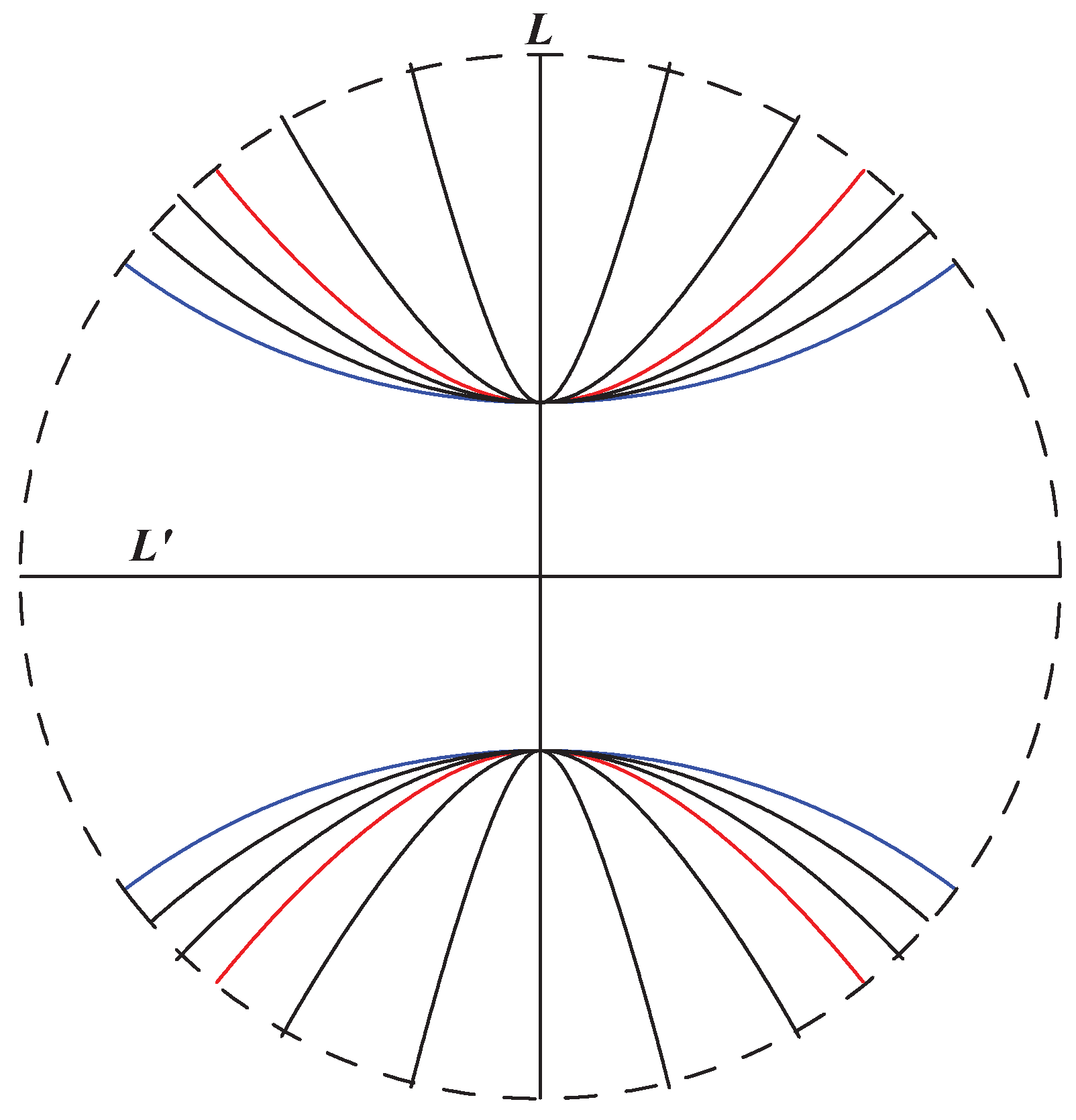
For , the fiber over a hyperbola is the split-inversion of the fiber over . Figure 10 shows the fiber over , with the hyperbola in red. The elements are bounded by , which is in category C9B by Corollary 3. In this example, the distance between these ultra-parallel lines (blue) is (see Remark 5).
The KC-convex hyperbolas in the fiber over can be assigned eccentricities greater than 1 in accordance with (16) and consistent with the fiber over . A section for a given eccentricity would then be the split inversion of an -section of KC-ellipses.
11. Conclusions
In Jakob Steiner’s preface to [2] he states
The source of this quote has been the inspiration for the constructions in this article. These constructions were obtained intrinsically, within conformal models of the hyperbolic plane, from the incidence properties of and the action of its collineation group. This is in the spirit of Steiner’s construction of conics. We used elliptic curve addition on the orthogonal trajectories of the central Steiner conics to generate all central conics, which in turn imposed a group structure on the Steiner conics themselves.Here the main thing is neither the synthetic nor the analytic method, but the discovery of the mutual dependence of the figures and of the way in which their properties are carried over from the simpler to the more complex ones.
The underlying symmetries of the central conics made these constructions possible. Though we previously classified all Steiner conics in we are not aware of analogous results for the categories of non-central conics. Many of these are of so-called parabolic type, but there does not appear to be an inversive representation of the Steiner parabolas for which their orthogonal trajectories have a simple addition structure. Perhaps this work will encourage investigation in that direction.
Conflicts of Interest
The author declares no conflicts of interest.
References
- Sarli J. Conics in the hyperbolic plane intrinsic to the collineation group. J.Geom. 2012;103:131-138. doi: 10.1007/s00022-012-0115-5. [CrossRef]
- Steiner J. Systematische Entwickelung der Abhängigkeit geometrische Gestalten von einander [Systematic development of the dependence of geometric shapes on one another]. Berlin: G. Fincke; 1832. German.
- Coxeter HSM. Projective Geometry. 2nd ed. New York (NY): Springer; 1987.
- Klein F. Vorlesungen über Nicht-Euklidische Geometrie Lectures on non-Euclidean geometry]. Gottingen: 1893. German. Providence (RI), reprint: AMS Chelsea Publishing; 2000. Kapitel VIII, Besondere Untersuchung der beiden nichteuklidischen Geometrien [Special investigation of the two non-Euclidean geometries]; p. 227-232.
- Coolidge JL. The elements of non-Euclidean geometry. Oxford (UK): Clarendon Press; 1909. Chapter XII, Conic sections; p. 119-129.
- Ratcliffe JG. Foundations of hyperbolic manifolds. New York (NY): Springer; 1994.
Figure 1.
S-line tangent to (blue) at P on with R on .
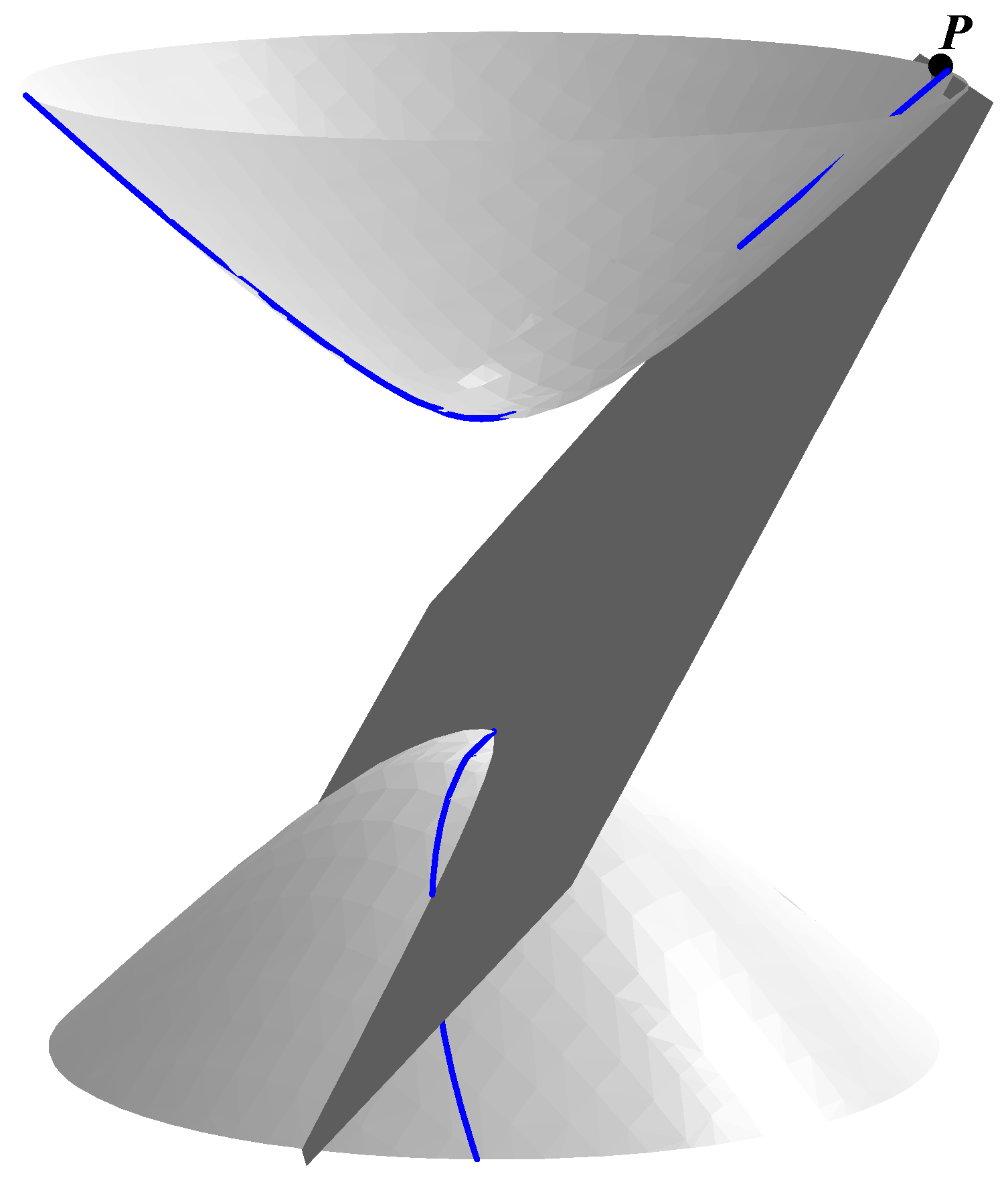
Figure 2.
for .
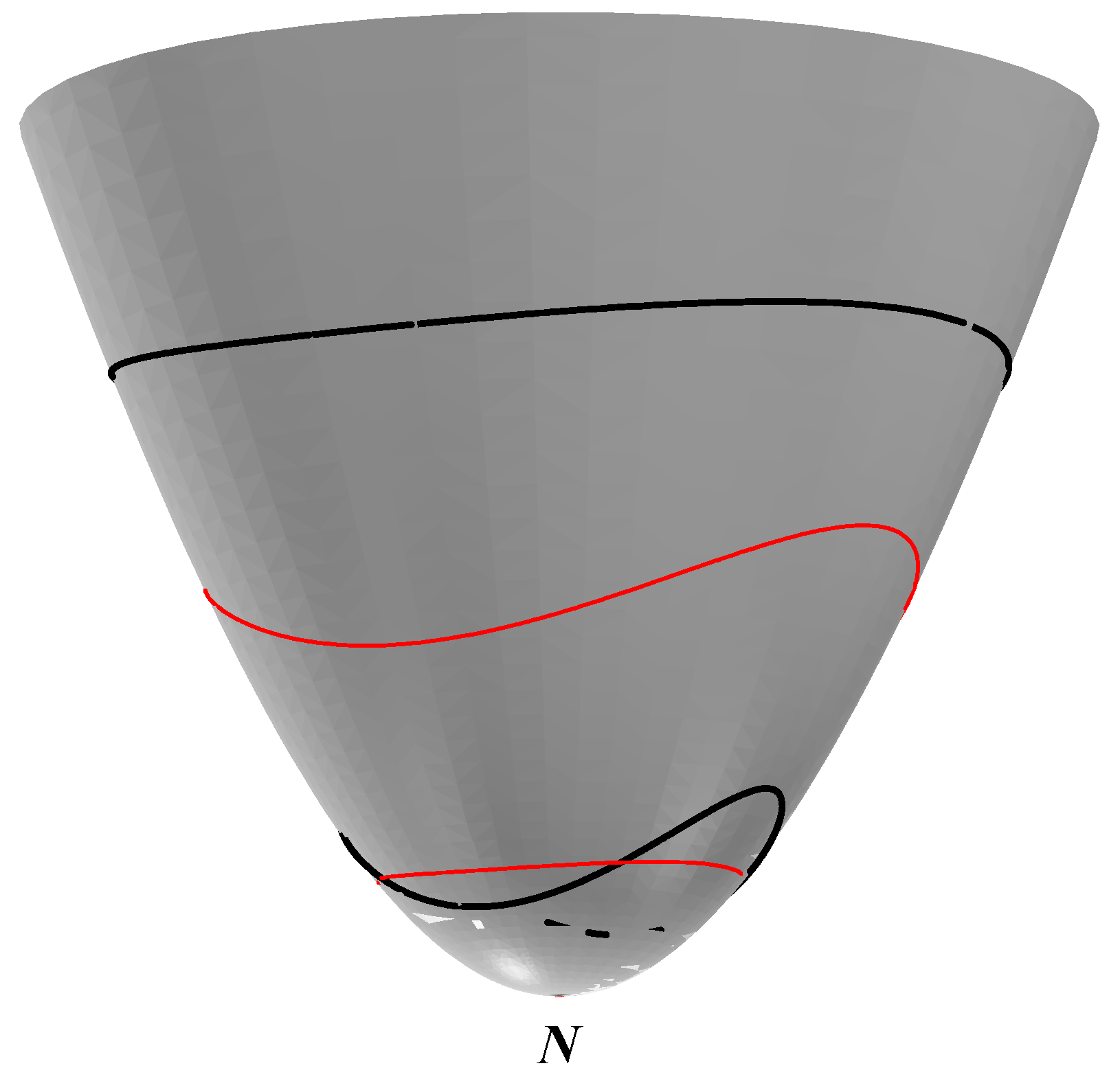
Figure 3.
Angle does not change as P moves on .
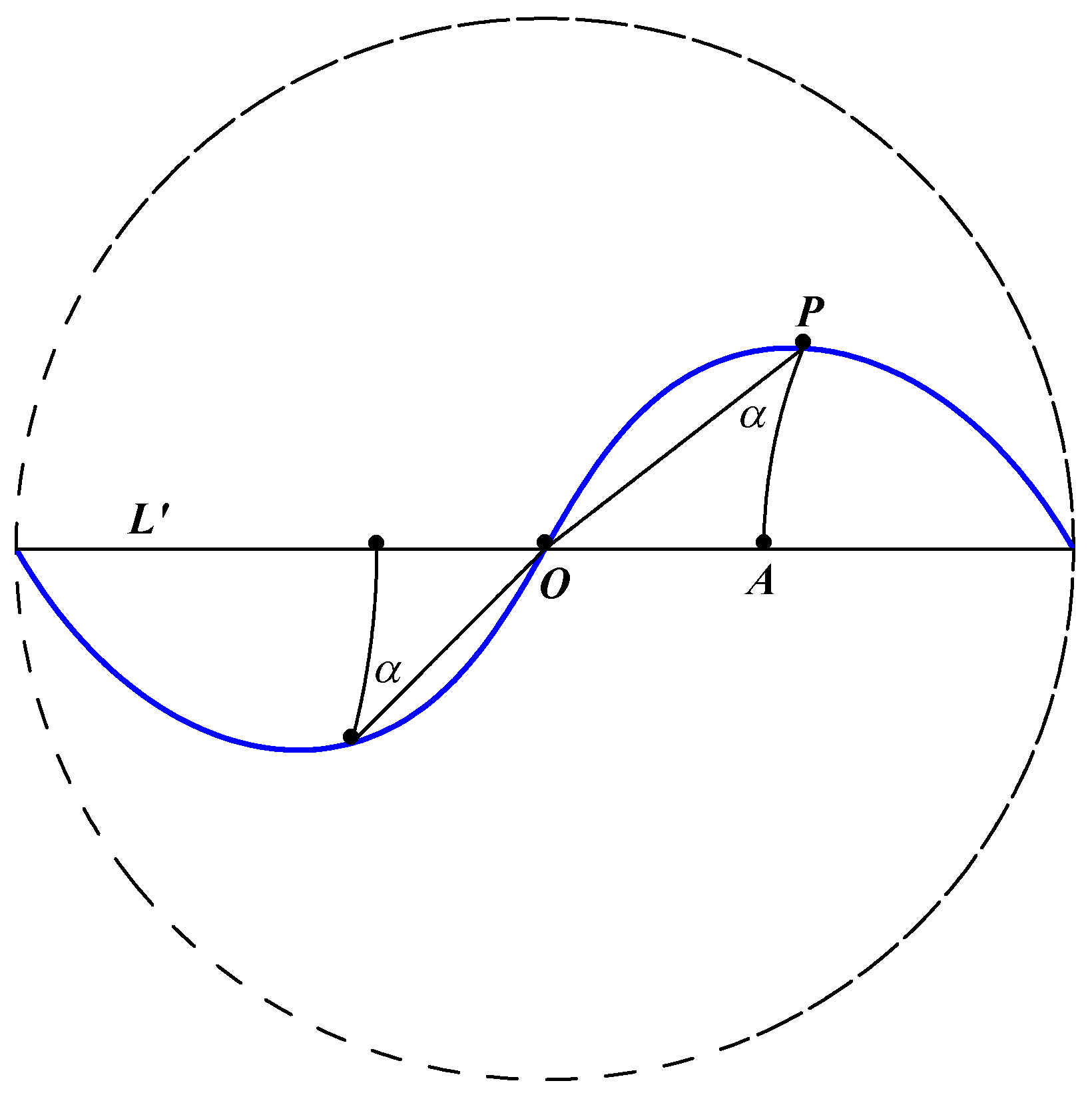
Figure 4.
Orthogonal curves (blue) and (red) in .
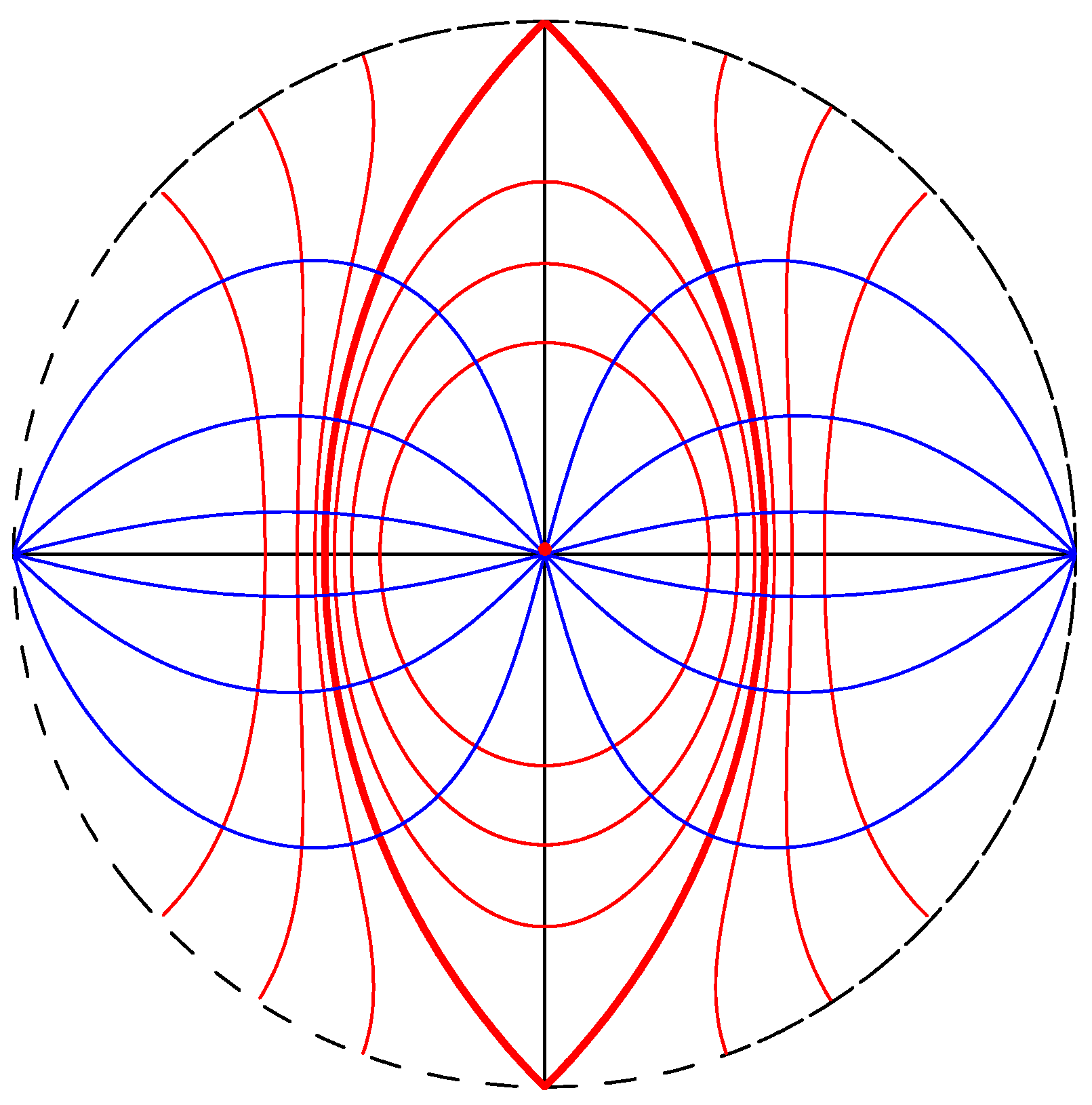
Figure 5.
Pairs of points on related by inversion in .
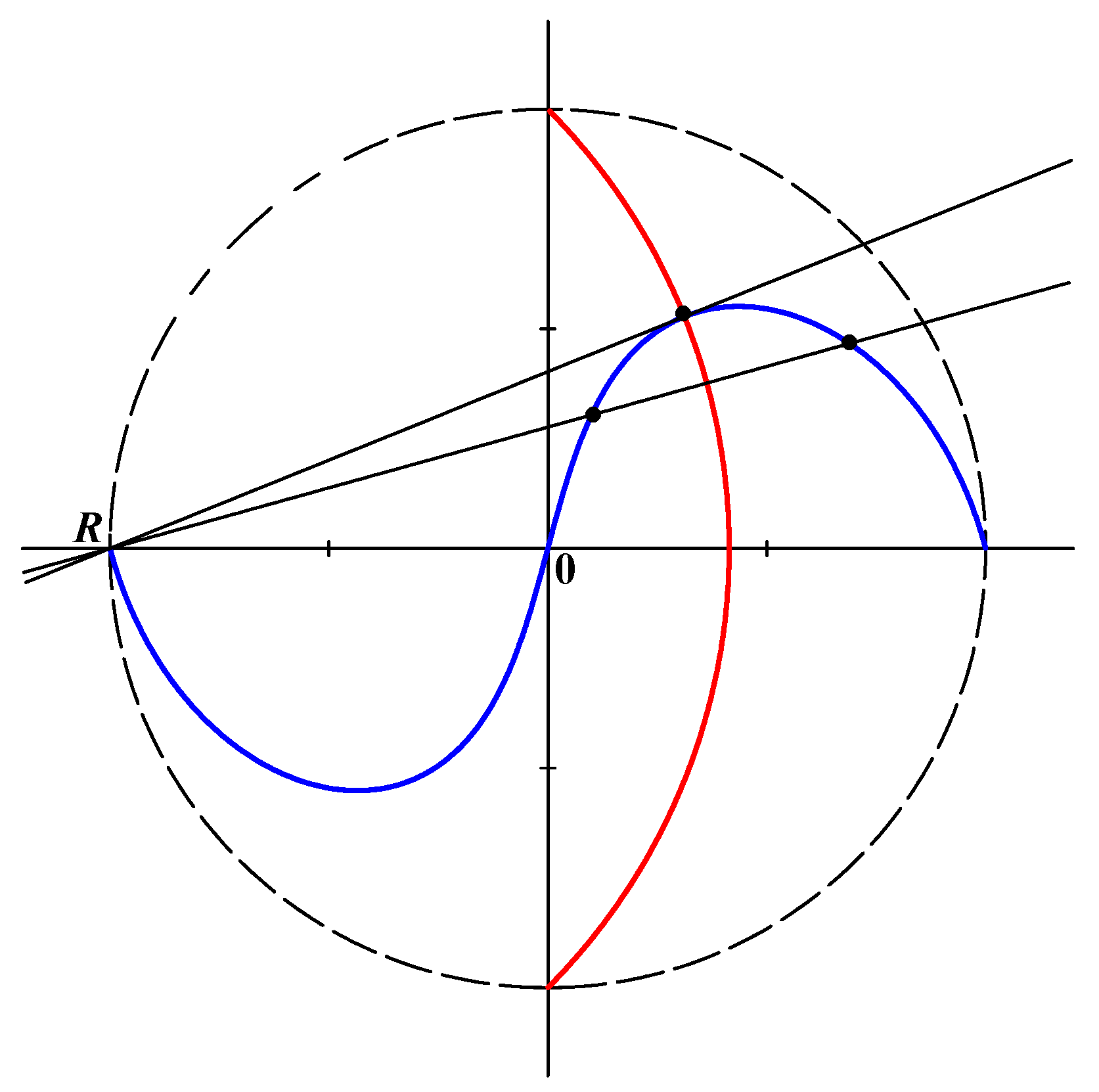
Figure 6.
Composition C (black) of two ellipses (red) for .
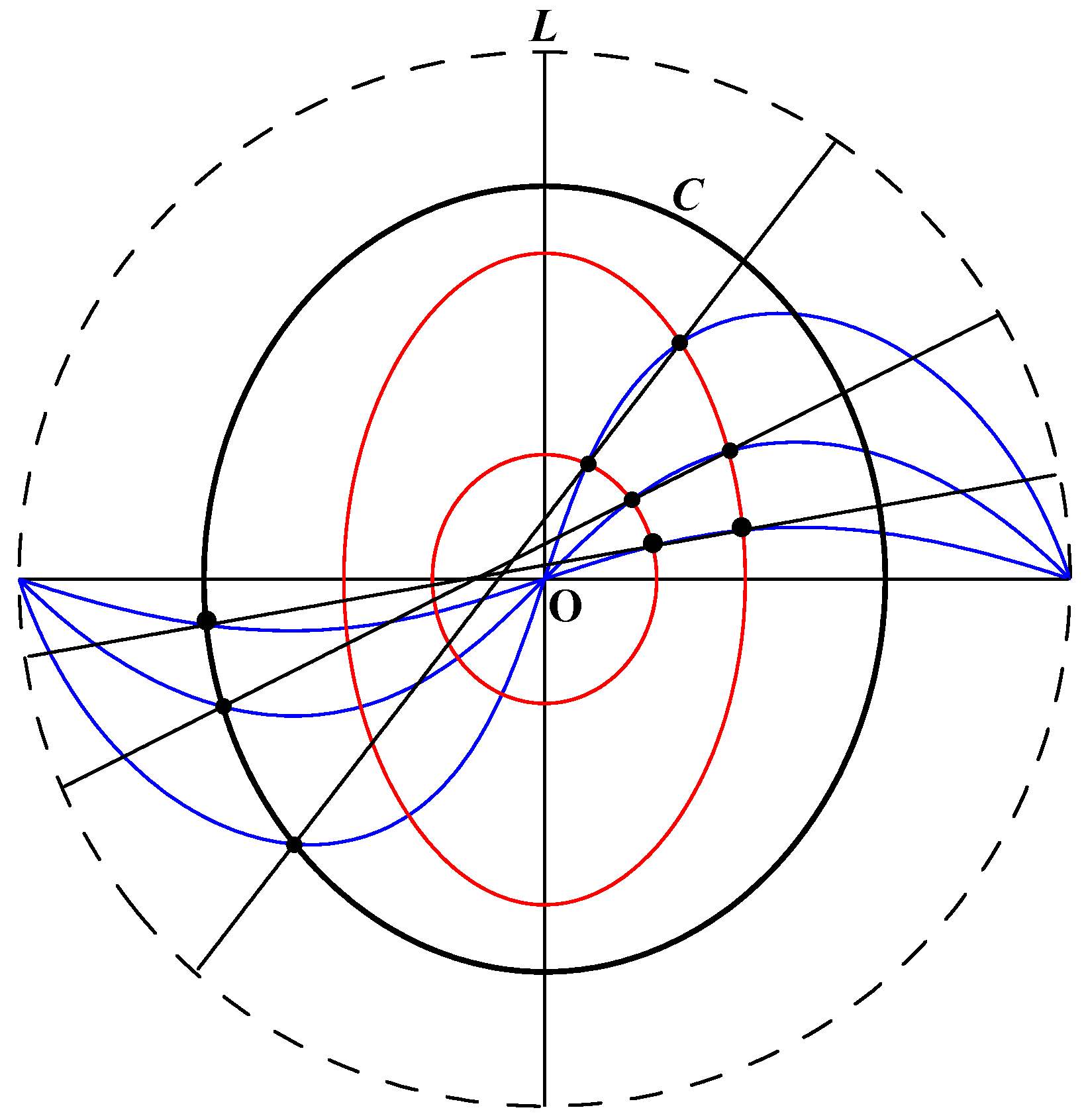
Figure 7.
Composition C (black) for .
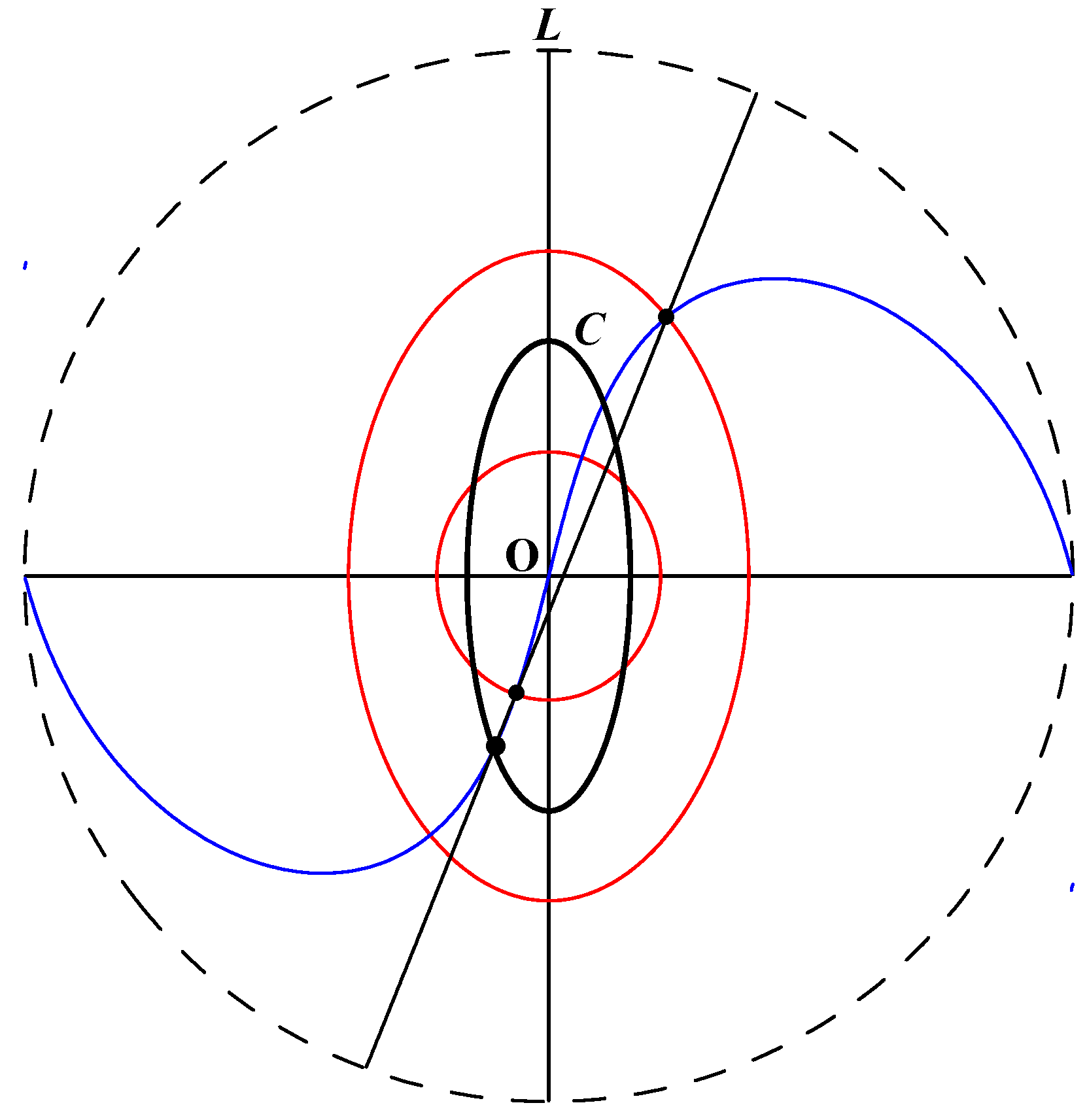
Figure 8.
Ellipse (red) with fiber elements inside C (blue).
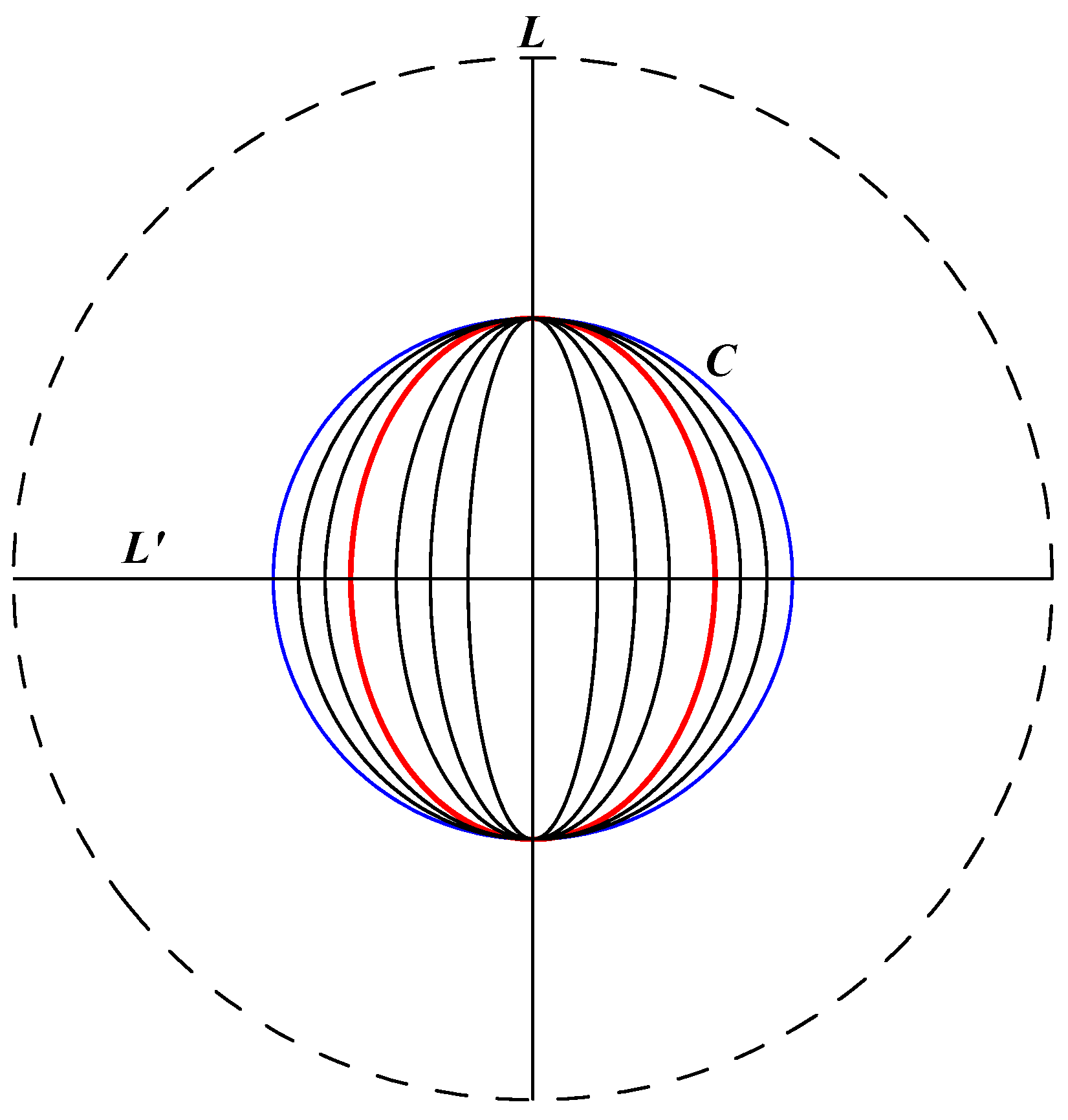
Figure 9.
Section containing the ellipse (red) .
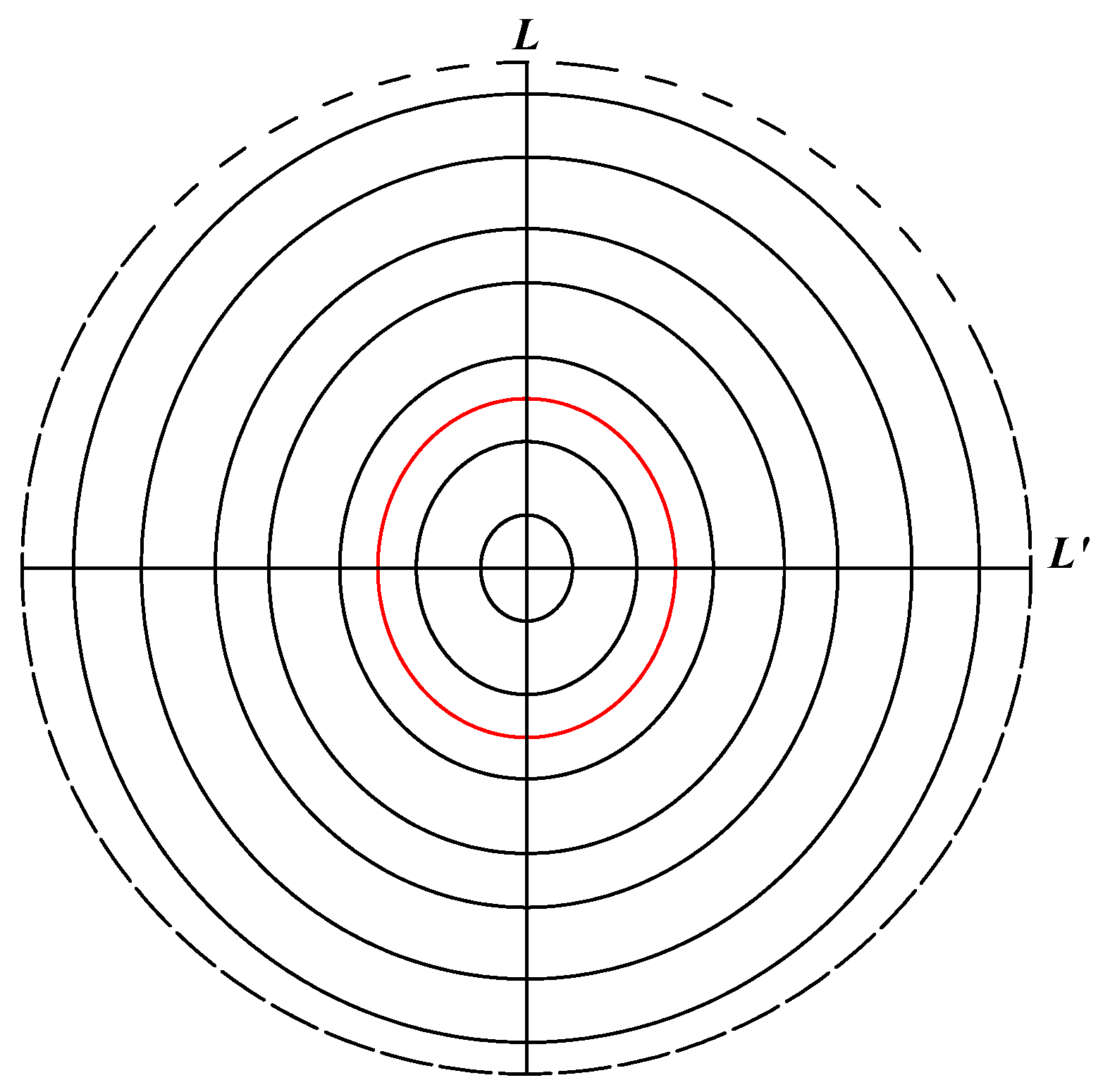
Figure 10.
Fiber over (red) with ultra-parallel lines (blue).
Disclaimer/Publisher’s Note: The statements, opinions and data contained in all publications are solely those of the individual author(s) and contributor(s) and not of MDPI and/or the editor(s). MDPI and/or the editor(s) disclaim responsibility for any injury to people or property resulting from any ideas, methods, instructions or products referred to in the content. |
© 2026 by the authors. Licensee MDPI, Basel, Switzerland. This article is an open access article distributed under the terms and conditions of the Creative Commons Attribution (CC BY) license (http://creativecommons.org/licenses/by/4.0/).
Copyright: This open access article is published under a Creative Commons CC BY 4.0 license, which permit the free download, distribution, and reuse, provided that the author and preprint are cited in any reuse.


