

Submitted:
23 April 2026
Posted:
27 April 2026
You are already at the latest version
Abstract
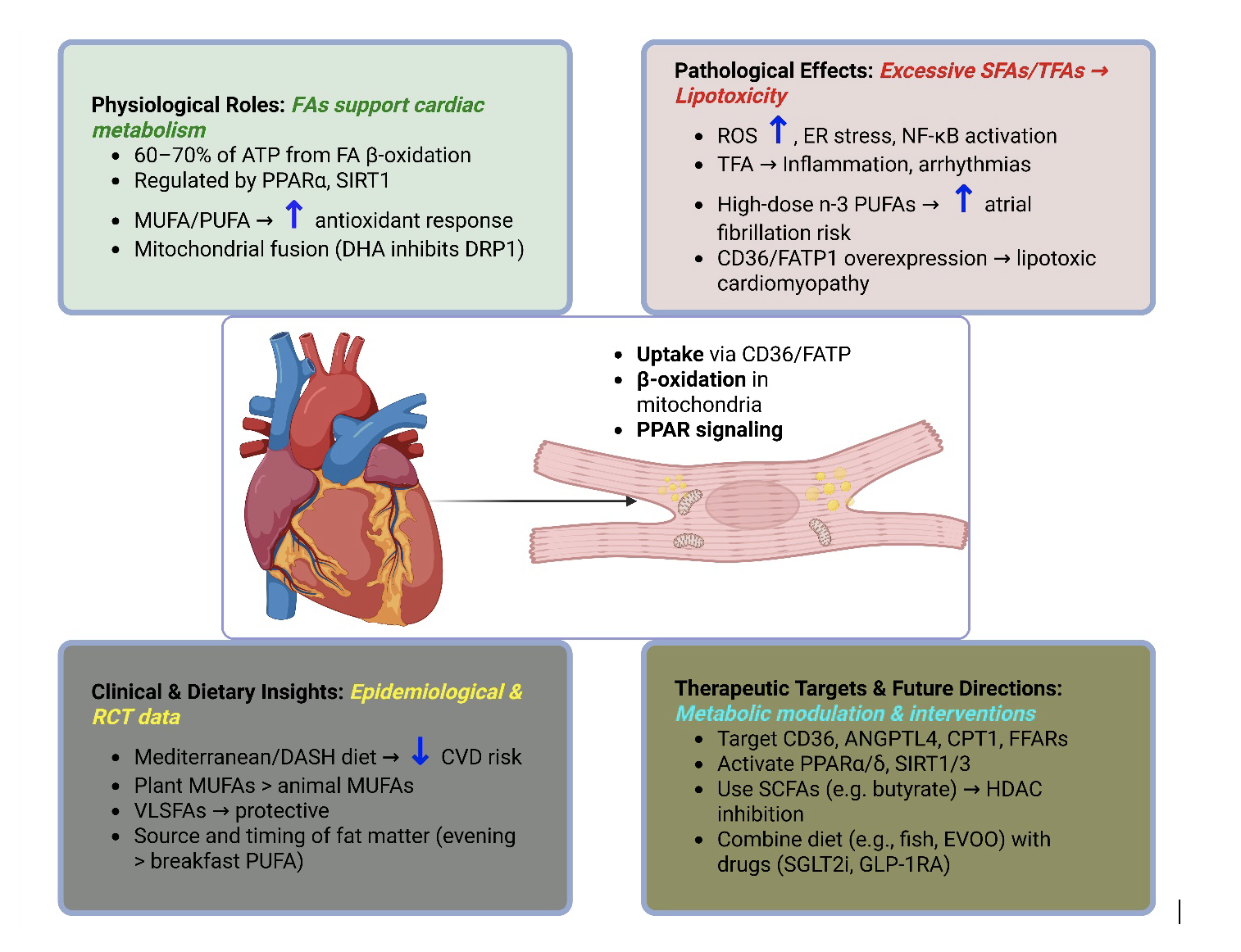
Fatty acids serve dual roles in cardiac physiology: as energy substrates and precursors of bioactive lipid mediators (prostaglandins, leukotrienes, oxylipins) from n-3/n-6 PUFAs that regulate inflammation, thrombosis, and remodeling. Saturated, monounsaturated, and trans fatty acids modulate metabolism and membrane function, shaping these pathways.Clinically, n-3 long-chain PUFAs (EPA and DHA) reduce cardiovascular mortality and aid postischemic remodeling, yet high doses increase the risk of atrial fibrillation. By contrast, trans and saturated fatty acids promote dyslipidemia, dysfunction, and higher rates of coronary artery disease and heart failure. Mechanistically, fatty acid uptake via FABPpm, CD36 (FAT), and FATPs, β-oxidation, and PPAR signaling regulate metabolism, while COX/LOX/CYP pathways generate eicosanoids and resolvins that influence inflammation and repair. This review synthesizes evidence on the roles of fatty acids and oxylipins in lipotoxicity, heart failure, ischemia-reperfusion, and arrhythmias, and evaluates dietary and supplemental interventions to optimize cardiac lipid metabolism—aligning with fatty acid signaling.
Keywords:
fatty acids
; cardiac physiology
; cardiovascular diseases
; lipotoxicity
; N-3 fatty acids
; trans fats
; dietary interventions
; cardiac metabolism
Copyright: This open access article is published under a Creative Commons CC BY 4.0 license, which permit the free download, distribution, and reuse, provided that the author and preprint are cited in any reuse.


