

Submitted:
25 March 2026
Posted:
26 March 2026
You are already at the latest version
Abstract
The therapeutic monoclonal antibody bevacizumab is typically purified using Protein-A affinity chromatography, a highly effective but costly method. As a lower-cost alternative, affinity-based precipitation has been described to purify antibodies. Therefore, in this work, a precipitation protocol was developed for bevacizumab purification using the branched peptide (Ac-PHQGQHIG-Ahx3)2-K-Ahx3-PHQGQHIG-NH2, which contains the epitope PHQGQHIG responsible for interaction with bevacizumab. The peptide was synthesised by microwave-assisted solid-phase peptide synthesis employing LiCl as an additive to prevent aggregation and ensure high purity and yield. Three molecules of 6-aminohexanoic acid were introduced between each epitope branch as spacer arms to promote the formation of cyclic complexes. Bevacizumab purification from the cell-free culture broth was achieved through a fractional precipitation process. First, a negative precipitation step using (NH4)2SO4 1.18 M was performed to remove contaminants. Afterwards, 5 moles of peptide per mol of bevacizumab were added to the supernatant, together with additional (NH4)2SO4 to reach a final concentration of 1.20 M. Under these conditions, bevacizumab was recovered in the precipitate with 98% purity and a yield of 73%. In addition to being recyclable, the peptide´s relative low production cost may enable the development of a single-use purification process, which would be particularly advantageous for biopharmaceutical manufacturing.
Keywords:
peptide
; precipitation
; bevacizumab
; purification
; single-use
; solid-phase peptide synthesis
1. Introduction
Bevacizumab is widely used to treat several cancers, including colorectal, cervical, ovarian, and renal malignancies. It is a recombinant humanised monoclonal antibody (mAb) that targets vascular endothelial growth factor A (VEGF-A), thereby inhibiting tumour angiogenesis [1]. The antibody is commonly produced in Chinese hamster ovary (CHO) cells cultivated in suspension in bioreactors. After cell removal by filtration or centrifugation, the mAb secreted into the culture medium is typically purified by Protein A affinity chromatography (AC), resulting in a highly purified and concentrated product. Afterwards, a polishing step is usually performed by cation-exchange chromatography [2].
However, Protein A AC is very expensive, accounting for up to 50% of the overall cost of mAb production [3,4]. Since Protein A chromatographic supports are nearly 50% more expensive than those bearing non-protein ligands [5], more cost-effective alternatives have been investigated. In this context, Barredo et al. proposed a purification strategy based on the VEGF aminoacidic fragment PHQGQHIG, corresponding to the epitope recognised by bevacizumab. This short peptide ligand, immobilised on agarose, offers higher stability and lower cost than protein A and can be readily obtained by solid-phase peptide synthesis (SPPS) [6,7].
In addition, large-scale AC requires extremely expensive preparative chromatographic systems and large volumes of solvents. Furthermore, it is an intensive and laborious operational process involving column equilibration with approximately 20 column volumes of adsorption buffer, sample loading, washing steps to remove non-binding impurities, and finally mAb elution with an appropriated desorption buffer. Due to the high cost of Protein A-matrices, manufacturers typically reuse them over 50-100 times, which requires extensive chromatographic column cleaning and sanitation steps before each new cycle. The harsh conditions required for the elimination of contaminants progressively reduce matrix binding capacity, product recovery, and overall performance as a result of ligand leaching and degradation, as well as matrix deterioration after repeated use [4,8].
Alternatively, salt-induced precipitation of mAbs using ammonium sulphate represents a simple, rapid, and cost-effective method for antibody purification and, like AC, can yield a highly concentrated product directly from the cell-free culture broth. Typically, an ammonium sulphate concentration of approximately 40–50% saturation (~1.6–2.1 M) induces mAb precipitation. However, the resulting purity is significantly lower than that obtained by AC because other proteins precipitate simultaneously at similar (NH4)2SO4 concentrations [9]. To overcome this limitation, Bilgiçer et al. and Handlogten et al. proposed combining the selectivity of affinity ligands with the simplicity and low cost of salt-induced precipitation, introducing an affinity-based precipitation method for the purification of antibodies [10,11,12].
In this context, the present work proposes a precipitation protocol for bevacizumab purification based on the peptide (Ac-PHQGQHIG-Ahx3)2-K-Ahx3-PHQGQHIG-NH2, which displays three branches of the PHQGQHIG epitope, responsible for VEGF recognition by bevacizumab, in combination with ammonium sulphate-induced precipitation.
2. Materials and Methods
Pure bevacizumab (25 mg/mL) and cell-free culture broth from bevacizumab-producing CHO cells were kindly donated by mAbxience SAU (Munro, Buenos Aires, Argentina). Fluorenylmethyloxycarbonyl (Fmoc)-protected amino acids and 2-(1H-benzotriazole-1-yl)-1,1,3,3-tetramethylaminium tetrafluoroborate (TBTU) were purchased from GL Biochem (Shanghai, China). Piperidine, triisopropylsilane (TIS), trifluoroacetic acid (TFA), N,N-diisopropylethylamine (DIPEA), N,N′-diisopropylcarbodiimide (DIC), 3,6-dioxa-1,8-octanedithiol (DODT), bovine serum albumin (BSA), and Protein A–Sepharose were purchased from Merck Sigma-Aldrich (St. Louis, MO, USA). N,N-dimethylformamide (DMF), dichloromethane (DCM), acetic anhydride (Ac2O), methanol (MeOH), acetonitrile (MeCN), and acetic acid (AcOH) were purchased from Sintorgan SA (Buenos Aires, Argentina), and ammonium sulphate was purchased from Anedra (Buenos Aires, Argentina). Sephadex G-25 PD-10 desalting columns were purchased from Cytiva (Marlborough, MA, USA). Bradford reactive was purchased from Bio-Rad Laboratories (Philadelphia, PA, USA). Bond Elut Empty SPE Cartridges and 20-μm polypropylene filters were acquired from Agilent Technologies. Vacuum manifold to evacuate the fluids from each cartridge by filtration was purchased from Supelco®.
2.1. (Ac-PHQGQHIG-Ahx3)2-K-Ahx3-PHQGQHIG-NH2 Peptide Synthesis
The peptide with three branches of the VEGF-A epitope PHQGQHIG was synthesised manually using SPPS using Fmoc/tBu chemistry and Rink-amide MBHA resin (0.43 meq/g) [13]. The reaction was performed in a polypropylene column fitted with a polyethylene filter. Each coupling was accomplished by adding to 0.1 g of the solid resin a 3-fold excess of each Fmoc-protected amino acid together with TBTU (3 eq.) and DIPEA (4 eq.) in DMF. All couplings were performed by incubation (2 × 2 min) in a microwave reactor BGH Quick Chef at 10% of its potency (nominal potency of the equipment: 1000 W) [14]. After monitoring the coupling completeness of each Fmoc-protected amino acid using the Kaiser or chloranil test [15,16], Fmoc was removed with 20% piperidine in DMF (2 × 5 min) at room temperature. Washings between coupling and Fmoc removal were performed using DMF and DCM (2 × 1 min). Three molecules of 6-aminohexanoic acid (Ahx) were introduced as spacer arm to the peptide epitope through amide linkage between the carboxylic acid of FmocAhx-OH and the amine group of the N-terminal proline, followed by two additional consecutive couplings of Fmoc-Ahx-OH, each preceded by treatment with 20% piperidine to free the amine group of the resin-linked molecule. The resulting Ahx3-PHQGQHIG (first branch) was then coupled to Fmoc-Lys(Fmoc)-OH via amide bond formation between the terminal amine group of the spacer and the carboxylic group of Fmoc-Lys(Fmoc)-OH. Next, Fmoc was removed from the α and ε Lys amino groups of the Fmoc-Lys(Fmoc)-derivate, and peptide elongation continued by duplicating the equivalents of reagents in each coupling to incorporate the other two branches (Figure 1). To overcome aggregation, 0.2 M LiCl in DMF was used as solvent instead of DMF in the coupling and deprotection steps, as previously described by Barredo et al. [17]. N-terminal acetylation was achieved after peptide elongation by adding Ac2O (10 eq.) and DIC (10 eq.) in DCM and incubating for 30 min. Side chain protecting groups and peptide separation from the resin. Finally, side-chain protecting groups removal and peptide release from the solid support were performed simultaneously by treatment with TFA/TIS/H2O/DODT (92.5:2.5:2.5:2.5) for 2 h at room temperature. Subsequently, the peptide was precipitated with cold diethyl ether, the precipitate was washed 2 times with cold diethyl ether, dissolved in MilliQ water, and lyophilised. The yield was determined by gravimetry.
2.2. Peptide Analysis by Electrospray Ionisation Mass Spectrometry (ESI MS)
The synthesised peptide was analysed by direct injection in a Thermo Scientific, Q-Exactive Orbitrap. Peptide ionisation was performed by electrospray. The obtained spectra were evaluated using the FreeStyle program, version 1.5.
2.3. Peptide Analysis by Reverse-Phase High-Performance Liquid Chromatography (RP-HPLC)
The synthesised peptide was analysed by RP-HPLC in a Shimadzu LC-20AT instrument with a photodiode array UV–Visible detector (SPDM20A) using a Phenomenex ULTRACARB 5 μm ODS (20) reverse-phase C18 column (90 Å × 250 mm × 4.6mm) at 50 °C, at a flow rate of 0.5 mL/min. A linear gradient from 15% to 100 % mobile phase B was performed using 0.045% TFA in H2O (solvent A) and 0.036% TFA in acetonitrile (solvent B).
2.4. Bevacizumab Precipitation with (NH4)2SO4
In order to determine the maximun (NH4)2SO4 concentration at which the mAb did not precipitate, 12 μL aliquots of pure bevacizumab 25 mg/mL were mixed with water and increasing volumes of (NH4)2SO4 3.8 M, pH 7.5 to obtain final concentrations of: 0.50, 1.00; 1.16; 1.18; 1.19; 1.20; 1.22; 1.24; 1.26; 1.50 and 2.00 M in a final volume of 0.5 mL. After incubating the samples for 1 h at 25 °C or 5 °C, the resulting precipitates were isolated by centrifugation at 10,000 × g for 5 minutes, and the absorbances of the supernatants were measured at 280 nm to calculate the percentage of bevacizumab precipitated.
2.5. Bevacizumab Precipitation with (Ac-PHQGQHIG-Ahx3)2-K-Ahx3-PHQGQHIG-NH2
In order to evaluate the amount of peptide necessary to precipitate the mAb, 12 μL aliquots of pure bevacizumab 25 mg/mL were mixed with water, increasing volumns of peptide solution 2 mg/mL to obtain final concentrations of 5, 10, 16, 21, 26, 31, 37, 42, and 47 μM and (NH4)2SO4 3.8 M, pH 7.5 to obtain final concentrations of 1.20 or 1.18 M in a final volume of 0.5 mL. After incubating for 1 h at 25 or 5 °C, the resulting precipitates were isolated by centrifugation at 10,000 × g for 5 minutes, and the absorbances of the supernatants were measured at 280 nm to calculate the percentage of bevacizumab in the precipitate as a function of peptide/bevacizumab molar ration (P/B).
2.6. Bevacizumab Purification by Fractional Precipitation from Cell-Free Culture Broth
A sample of 1 mL of cell-free culture broth containing 1.6 mg/mL of bevacizumab was purified through a fractional precipitation process.
2.6.1. 1st Precipitation
A volume of 0.450 mL of (NH4)2SO4 3.8 M, pH 7.5 was added dropwise and under constant stirring to 1 mL of the cell-free culture broth to reach a final (NH4)2SO4 concentration of 1.18 M [18]. After incubating for 1 h at 5 °C, the resulting precipitate was isolated by centrifugation at 10,000 × g for 5 minutes. The supernatant was separated from the pellet, and its absorbance at 280 nm was measured.
2.6.2. 2nd Precipitation
Afterwards, 5 moles of peptide per mol of bevacizumab were added to the supernatant, together with additional (NH4)2SO4 to reach a final concentration of 1.20 M. After incubating the mixture for 1 h at 5 °C, the resulting precipitate was isolated by centrifugation at 10,000 × g for 5 minutes. The supernatant was separated from the pellet, and its absorbance at 280 nm was measured. Next, the 2nd precipitate was dissolved in 0.5 mL of buffer 0.03 M sodium phosphate, 0.12 M NaCl, pH 7.4 for future analysis.
2.7. Bevacizumab Quantification
The amount of bevacizumab was calculated using protein A affinity chromatography, which specifically binds immunoglobulins. A column of Protein A-Sepharose (1 × 0.64 cm) was equilibrated with 0.03 M sodium phosphate, 0.12 M NaCl, pH 7.4 (adsorption buffer). An aliquot of: a) 15 μL of pure bevacizumab (25 mg/mL); b) 250 μL of cell-free culture broth from bevacizumab-producing CHO, and c) 250 μL of the resupeded 2nd precipitate was loaded on the column. Adsorption buffer was used for washing until the absorbance at 280 nm reached its initial value. Next, the elution was performed with 0.5 M of acetic acid, pH 2.5. Bevacizumab concentration in the elution fraction was measured by absorbance at 280 nm using pure bevacizumab as the standard. Puritiy was defined as the amount of bevacizumab as a fraction of the total amount of proteins. Fold purification was calculated by setting the initial purity at a value of one and then giving the purity at the 2nd precipitate relative to the initial purity [20].
2.8. Size Exclusion Chromatography (SEC) with Sephadex G-25
The resuspended 2nd precipitate was desalted using a prepacked PD-10 Desalting Column of Sephadex™ G-25 resin, as indicated in the instruction manual [21]. Briefly, the column was equilibrated with distilled water. After loading the sample, distilled water was added, and the absorbances of the collected fractions were registered at 280 nm. Protein fraction eluted in the void volume, whereas smaller molecules like salts and the peptide were delayed in the gel pores and separated from bevacizumab.
2.9. Total Protein Quantification
The amount of total protein in the samples was measured by Bradford dye-binding assay [19]. Briefly, 100 μL of each sample were mixed with 100 μL of Bradford reactive in a multiwell. Samples were incubated for 15 min at room temperature, and their absorbances at 620 nm were measured.
2.10. Sodium Dodecyl Sulphate Polyacrylamide Gel Electrophoresis (SDS-PAGE)
Pure bevacizumab, cell-free culture broth, and the disolved and desalted 2nd precipitate were analysed using SDS-PAGE (2.5% under reducing and non-reducing conditions) as described by Laemmli [22]. The gels were stained with Coomassie Blue following the standard procedure.
3. Results
3.1. Peptide Design and Synthesis
The peptide (Ac-PHQGQHIG-Ahx3)2-K-Ahx3-PHQGQHIG-NH2, composed of three units of the bevacizumab epitope PHQGQHIG derived from VEGF-A, was designed to purify the mAb by affinity precipitation. The three PHQGQHIG branches, each separated with a spacer arm (Ahx3), ensured the interaction of each epitope with a different molecule of bevacizumab, thereby promoting the formation of cyclic complexes, as previously reported [10]. To increase its stability, the peptide was amidated at the C-terminus and acetylated at both N-termini (Figure 2). SPPS allowed to obtain (Ac-PHQGQHIG-Ahx3)2-K-Ahx3-PHQGQHIG-NH2 with high yield (85 %). A low loading capacity resin (Rink-amide MBHA resin) was selected to minimise steric hindrance during peptide elongation. In addition, the addition of the chaotropic salt LiCl, together with microwave-induced high temperatures, prevented peptide aggregation during its synthesis [17]. Furthermore, microwave-assisted SPPS significantly reduced the reaction time [23]. RP-HPLC analysis demonstrated a high peptide purity(Figure 3).
Furthermore, the ESI-MS mass spectrum of the peptide confirmed its identity. Table 1 indicates the expected peaks in the spectrum. Peaks at m/z 636.6 (100%), 763.6 (85%) and 954.0 (31 %), corresponding to ions [M+6H]6+, [M+5H]5+, and [M+4H]6+, respectively, were found in the spectrum. (Figure 3a). Other peaks observed were also in the blank spectrum (Figure 3b).
3.2. Pure Bevacizumab Precipitation
Previously, Barredo et al. proved that the affinity between bevacizumab and the VEGF-A epitope PHQGQHIG increases at high (NH4)2SO4 concentrations. In addition, stronger adsorption was observed at pH between 7.0 and 8.0 than at pH 5.5, likely because the imidazole side chains of His are not charged at pH over its pKa (approximately 6.0), thereby favouring hydrophobic interactions [6,7]. Therefore, bevacizumab precipitation with the peptide was evaluated at pH 7.5 in the presence of high (NH4)2SO4 concentration. To avoid the coprecipitation of contaminants, a fractional precipitation protocol was designed consisting of a negative precipitation with (NH4)2SO4, followed by a positive precipitation with the peptide in (NH4)2SO4 (Figure 2). Therefore, bevacizumab precipitation with ammonium sulphate at pH 7.5 was evaluated (Figure 4). The maximum (NH4)2SO4 concentration at which the mAb did not precipitate was less than 1.18 M; therefore, this concentration was selected to perform the first negative precipitation step. Between 1.18 and 1.25 M, small variations in (NH4)2SO4 concentration resulted in large variations in the percentage of precipitation, after which almost all mAb precipitated.
Next, the amount of peptide in ammonium sulphate necessary for bevacizumab precipitation was evaluated. Figure 5 shows the percentage of precipitated bevacizumab as a function of peptide/bevacizumab molar ratio (P/B) in (NH4)2SO4, 1.18 or 1.20 M, pH 7.5, at 25 or 5 °C. The amount of precipitated bevacizumab increased with the P/B ratio until it reached a plateau at approximately P/B ≈ 5. Better results were observed at 1.20 M, probably because bevacizumab-peptide binding is largely hydrophobic. Comparing the experiments performed at 25 or 5 °C, refrigeration was found to slightly facilitate bevacizumab precipitation. However, the difference in the percentage of precipitated mAb was moderate, indicating that efficient precipitation can also be achieved at room temperature, which may be advantageous for practical implementation.
3.3. Bevacizumab Purification by Fractional Precipitation
The process designed for bevacizumab purification from the cell-free culture broth consisted of a fractional precipitation protocol. The first step involved a “negative” precipitation using only (NH4)2SO4 1.18 M (concentration in which bevacizumab did not precipitate). Under these conditions, part of the contaminants was removed by precipitation, while bevacizumab remained in the supernatant. The second step involved a “positive” precipitation in which, by adding the peptide to the supernatant obtained after the first step, bevacizumab precipitated selectively (Figure 6).
The composition of the crude sample compared with the 2nd precipitate were evaluated using protein A AC, which specifically binds immunoglobulins. Figure 7 shows the chromatograms obtained when loading a sample of the cell-free culture broth (a), the 2nd precipitate resuspended in adsorption buffer (b), and pure bevacizumab (c). Impurities were collected in the non-binding fraction, whereas bevacizumab was recovered in the elution fraction. As can be seen in Figure 7b, the impurities in the 2nd precipitate represent a small fraction compared to the amount of bevacizumab.
Table 2 shows the purification chart of bevacizumab indicating the good performance of the fractional precipitation developed. In the second precipitate, bevacizumab was obtained with a purity of 98 % and a yield of 73 %.
Figure 8 shows the SDS-PAGE of the crude sample and the 2nd precipitate in reducing conditions, where the mAb light and heavy chains are observed and at non-reducing conditions where the intact mAb can be observed. The SDS-PAGE shows the high purity of the second precipitate.
4. Discussion
The branched peptide (Ac-PHQGQHIG-Ahx3)2-K-Ahx3-PHQGQHIG-NH2 was synthesised using SPPS. Peptide aggregation during its synthesis was avoided by combining a low-loading resin, microwave-induced high temperature, and the use of a chaotropic salt (LiCl).
Bevacizumab purification was efficiently achieved through a novel two-step process, combining salt-based removal of impurities with selective mAb precipitation. In the first step, a “negative” precipitation was performed using (NH4)2SO4 1.18 M, which allows for the elimination of contaminants that precipitate at this salt concentration. This concentration was selected as the highest (NH4)2SO4 level at which bevacizumab does not precipitate, thus maximising impurity removal without compromising the overall yield. In the second step, the addition of the branched peptide promoted the selective precipitation of bevacizumab. To increase the mAb recovery in this step, the final (NH4)2SO4 concentration was increased to 1.20 M without impairing the final purity. The precipitated bevacizumab was recovered by centrifugation and resuspended in 0.03 M sodium phosphate buffer containing 0.12 M NaCl, pH 7.4. The low salt concentration dissociated the peptide from bevacizumab, as the interaction with the peptide epitope is predominantly hydrophobic, as previously demonstrated [6,7]. In contrast with protein A AC, which requires harsh acidic elution conditions, the protocol proposed here enables bevacizumab recovery from the precipitate under mild conditions, thus minimising the risk of antibody damage.
In this small-scale process, the epitope peptide was finally separated from bevacizumab by size-exclusion chromatography using Sephadex G-25, recovering nearly 100 % of the peptide, which can be recycled.
In conclusion, the method herein developed allows obtaining a high purity product under milder conditions and lower cost than current industrial protocols that used Protein A AC. Furthermore, precipitation techniques are easy to scale up using industrial reactors [24,25].
In future work, the scale-up of the process will be assessed. Available automated microwave peptide synthesiser allows quick large-scale peptide synthesis [23]. Although in this low-scale process, the peptide was separated from bevacizumab by size-exclusion chromatography, in a large-scale purification process, ultrafiltration with membranes with appropriate molecular weight cut off (MWCO) would be an alternative good choice. Moreover, instead of recycling the peptide, it would be of great interest to design a single-use (SU) process due to the much lower cost of the peptide compared to AC matrices. SU technology reduces contamination risks and avoids the cumbersome cleaning and validation processes needed with reusable systems; therefore, they are revolutionising therapeutic mAb production [26].
Author Contributions
Conceptualization, J.A.E., J.A.R., G.R.B.V., B.R., M.M. and S.A.C.; methodology, J.A.E., J.A.R., G.R.B.V., M.S.G.C., B.R., M.M. and S.A.C.; investigation, J.A.E., J.A.R., G.R.B.V. and S.A.C.; writing—original draft preparation S.A.C.; writing—review and editing, J.A.E., J.A.R., G.R.B.V., M.S.G.C., B.R., M.M. and S.A.C..; supervision, B.R., M.M. and S.A.C.; project administration, S.A.C.; funding acquisition, B.R., M.M. and S.A.C. All authors have read and agreed to the published version of the manuscript.
Funding
This research was funded by the Agencia Nacional de Promoción de la Investigación, el Desarrollo Tecnológico y la Innovación de la República Argentina (PICT-2021-I-A-00236), the Consejo Nacional de Investigaciones Científicas y Técnicas (CONICET) (PIP 11220210100075CO), the Universidad de Buenos Aires, Argentina (20020220200001BA) and European Union’s Horizon 2020 research and innovation programme under the Marie Skłodowska-Curie grant agreement nº 101008072 (SUPRO-GEN project). S.A.C. is researcher of CONICET. M.M and B.R. also acknowledge financial support provided by the MUR − Dipartimenti di Eccellenza 2023−2027 to the Department of Chemistry “Ugo Schiff” of the University of Florence (DICUS 2.0, CUP: B97G22000740001).
Institutional Review Board Statement
Not applicable.
Informed Consent Statement
Not applicable.
Data Availability Statement
Not applicable.
Acknowledgments
Pure bevacizumab and bevacizumab-producing CHO cell-free culture broth was kindly donated by Lucas Figuera Risso from mAbxience SAU (Munro, Buenos Aires, Argentina).
Conflicts of Interest
The authors declare no conflict of interest.
Abbreviations
| AC | Affinity chromatography |
| Ac2O | Acetic anhydride |
| AcOH | Acetic acid |
| Ahx | 6-Aminohexanoic acid |
| BSA | Bovine serum albumin |
| CHO | Chinese hamster ovary |
| DCM | Dichloromethane |
| DIC | N,N′-Diisopropylcarbodiimide |
| DIPEA | N,N-Diisopropylethylamine |
| DMF | N,N-Dimethylformamide |
| DODT | 3,6-Dioxa-1,8-octanedithiol |
| ESI MS | Electrospray ionization mass spectrometry |
| Fmoc | Fluorenylmethyloxycarbonyl |
| HPLC | High-performance liquid chromatography |
| ID | Isotopic distribution |
| mAb | Monoclonal antibody |
| MBHA | 4-Methylbenzhydrylamine hydrochloride |
| MeCN | Acetonitrile |
| MeOH | Methanol |
| MWCO | Molecular wight cut off |
| P/B | peptide/bevacizumab molar ratio |
| RA | Relative abundance |
| RP-HPLC | Reverse-phase high-performance liquid chromatography |
| SDS-PAGE | Sodium dodecyl sulphate polyacrylamide gel electrophoresis |
| SEC | Size exclusion chromatography |
| SPPS | Solid phase peptide synthesis |
| SU | Single-use |
| TBTU | 2-(1H-benzotriazole-1-yl)-1,1,3,3-tetramethylaminium tetrafluoroborate |
| TFA | Trifluoroacetic acid |
| TIS | Triisopropylsilane |
| VEGF-A | Vascular endothelial growth factor A |
References
- Gerriets, V.; Kasi, A. Bevacizumab; StatPearls Publishing: StatPearls Treasure Island (FL), Jan 2026; Available online: https://www.ncbi.nlm.nih.gov/books/NBK482126/ (accessed on 20 March 2026).
- Waller-Pulido, A.; Jiménez-Pérez, M.I.; Gonzalez-Sanchez, F.A.; Rojo-Gutierrez, R.P.; Torres-Anguiano, E.; Aleman-Aguilar, J.P.; Garcia-Varela, R. Production of monoclonal antibodies for therapeutic purposes: A review. Int Immunopharmacol 2023, 120, 110376. [Google Scholar] [CrossRef]
- Ramos-de-la-Peña, A.M.; González-Valdez, J.; Aguilar, O. Protein A chromatography: Challenges and progress in the purification of monoclonal antibodies. J Sep Sci 2019, 42, 1816–1827. [Google Scholar] [CrossRef] [PubMed]
- Bracewell, D.G.; Pathak, M.; Ma, G.; Rathore, A.S. Re-use of protein A resin: fouling and economics. BioPharm Int 2015, 28, 28–33. Available online: https://www.biopharminternational.com/view/re-use-protein-resin-fouling-and-economics.
- Follman, D.K.; Fahrner, R.L. Factorial screening of antibody purification processes using three chromatography steps without protein A. J Chromatogr A 2004, 1024, 79–85. [Google Scholar] [CrossRef] [PubMed]
- Barredo, G.R.; Giudicessi, S.L.; Martínez Ceron, M.C.; Saavedra, S.L.; Rodriguez, S.; Filgueira Risso, L.; Erra-Balsells, R.; Mahler, G.; Albericio, F.; Cascone, O.; Camperi, S.A. A short peptide fragment of the vascular endothelial growth factor as a novel ligand for bevacizumab purification. Protein Expr Purif 2020, 165, 105500. [Google Scholar] [CrossRef] [PubMed]
- Barredo, G.R.; Giudicessi, S.L.; Martínez Ceron, M.C.; Saavedra, S.L.; Rodriguez, S.; Filgueira Risso, L.; Erra-Balsells, R.; Mahler, G.; Albericio, F.; Cascone, O.; Camperi, S.A. Protocol for bevacizumab purification using Ac-PHQGQHIGVSK-agarose. MethodsX 2019, 7, 100769. [Google Scholar] [CrossRef] [PubMed]
- Norling, L.; Lute, S.; Emery, R.; Khuu, W.; Voisard, M.; Xu, Y.; Chen, Q.; Blank, G.; Brorson, K. Impact of multiple re-use of anion-exchange chromatography media on virus removal. J Chromatogr A 2005, 1069, 79–89. [Google Scholar] [CrossRef] [PubMed]
- Fishman, J.B.; Berg, E.A. Ammonium sulfate fractionation of antibodies. Cold Spring Harb Protoc 2018, 2018(6). [Google Scholar] [CrossRef] [PubMed]
- Bilgiçer, B.; Thomas, S.W., 3rd; Shaw, B.F.; Kaufman, G.K.; Krishnamurthy, V.M; Estroff, L.A.; Yang, J.; Whitesides, G.M. A non-chromatographic method for the purification of a bivalently active monoclonal IgG antibody from biological fluids. J Am Chem Soc 2009, 131, 9361–9367. [Google Scholar] [CrossRef] [PubMed]
- Handlogten, M.W.; Stefanick, J.F.; Alves, N.J.; Bilgicer, B. Nonchromatographic affinity precipitation method for the purification of bivalently active pharmaceutical antibodies from biological fluids. Anal Chem 2013, 85, 5271–5278. [Google Scholar] [CrossRef] [PubMed]
- Handlogten, M.W; Stefanick, J.F.; Deak, P.E.; Bilgicer, B. Affinity-based precipitation via a bivalent peptidic hapten for the purification of monoclonal antibodies. Analyst 2014, 139, 4247–4255. [Google Scholar] [CrossRef]
- Carpino, L.A.; Han, G.Y. 9-Fluorenylmethoxycarbonyl function, a new base-sensitive amino-protecting group. J Am Chem Soc 1970, 92, 5748−5749. [Google Scholar] [CrossRef]
- Manual de instrucciones de microondas, “Quick Chef BGH”. Available online: https://www.manual.ar/bgh/quick-chef-b228db9/manual (accessed on 20 March 2026).
- Kaiser, E.; Colescott, R.L.; Bossinger, C.D.; Cook, P.I. Color test for detection of free terminal amino groups in the solid-phase synthesis of peptides. Anal Biochem 1970, 34, 595–598. [Google Scholar] [CrossRef] [PubMed]
- Smith, R. E.; Davis, W.R. Spectrophotometric determination of amines with p-chloranil. Anal Chem 1984, 56, 2345–2349. [Google Scholar] [CrossRef]
- Barredo-Vacchelli, G.R.; Rodríguez, J.A.; Eloy, J.A.; Camperi, S.A. A novel method for liraglutide synthesis and purification. Pept Sci 2024, 116(5), e24351. [Google Scholar] [CrossRef]
- Wingfield, P. Protein precipitation using ammonium sulfate. Curr Protoc Protein Sci 2001, Appendix 3, Appendix 3F. [Google Scholar] [CrossRef]
- Kielkopf, C.L.; Bauer, W.; Urbatsch, I.L. Bradford assay for determining protein concentration. Cold Spring Harb Protoc 2020, 2020(4), 102269. [Google Scholar] [CrossRef]
- Burgess, R.R. Preparing a purification summary table. In Methods in Enzymology. Guide to Protein Purification, 2nd ed.; Burgess, R.R., Murray, P.D., Eds.; Academic Press: New York, USA, 2009; Volume 463, pp. 29–34. [Google Scholar] [CrossRef]
- PD-10 Desalting Column. Product Booklet. Cytiva.com. 52130800 BD. Available online: https://d3.cytivalifesciences.com/prod/IFU/52130800.pdf (accessed on 13 March 2026).
- Laemmli, U.K. Cleavage of structural proteins during the assembly of the head of bacteriophage T4. Nature 1970, 227, 680–685. [Google Scholar] [CrossRef]
- Singh, S. K.; Collins, J. M. Ultra-efficient solid-phase peptide synthesis. In Peptide Synthesis. Methods in Molecular Biology; Hussein, W.M., Skwarczynski, M., Eds.; Humana: New York, USA, 2025; Volume 2931, pp. 327–342. [Google Scholar] [CrossRef]
- Burgess, R.R. Protein Precipitation Techniques. In Methods in Enzymology. Guide to Protein Purification, 2nd ed.; Burgess, R.R., Murray, P.D., Eds.; Academic Press: New York, USA, 2009; Volume 463, pp. 331–342. [Google Scholar] [CrossRef]
- Martinez, M.; Spitali, M.; Norrant, E.L.; Bracewell, D.G. Precipitation as an enabling technology for the intensification of biopharmaceutical manufacture. Trends Biotechnol 2019, 37, 237–241. [Google Scholar] [CrossRef]
- Samaras, J.J.; Micheletti, M.; Ding, W. Transformation of biopharmaceutical manufacturing through single-use technologies: current state, remaining challenges, and future development. Annu Rev Chem Biomol Eng. 2022, 13, 73–97. [Google Scholar] [CrossRef]
Figure 1.
Chemical structure of peptide (Ac-PHQGQHIG-Ahx3)2-K-Ahx3-PHQGQHIG-NH2.
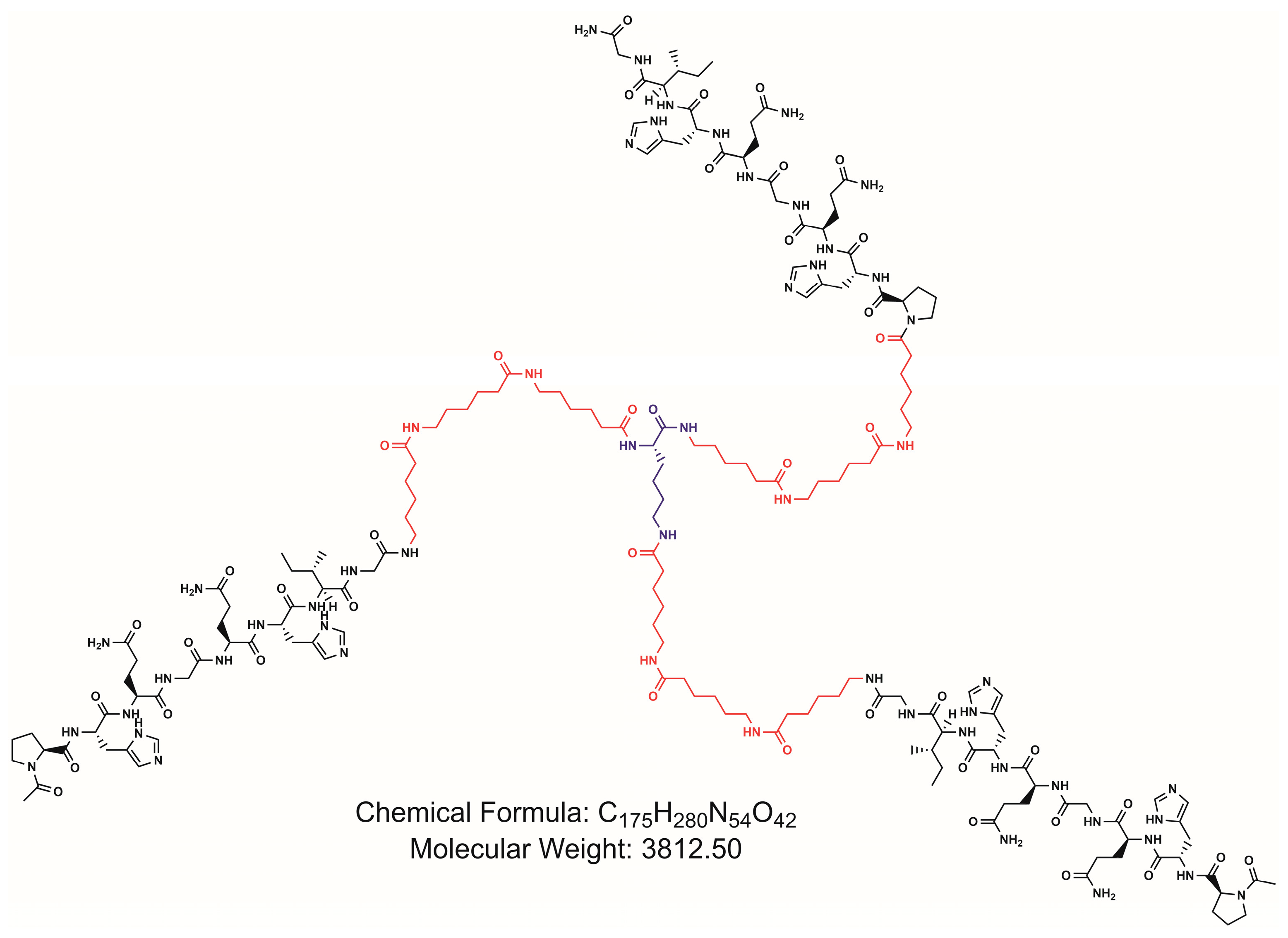
Figure 2.
RP-HPLC analysis of (Ac-PHQGQHIG-Ahx3)2-K-Ahx3-PHQGQHIG-NH2 peptide. Solvent A: 0.045% TFA in H2O. Solvent B: 0.036% TFA in acetonitrile. The right axes indicates % of solution B in solution A (%B) in the gradient program from 15 to 100% B.
Figure 2.
RP-HPLC analysis of (Ac-PHQGQHIG-Ahx3)2-K-Ahx3-PHQGQHIG-NH2 peptide. Solvent A: 0.045% TFA in H2O. Solvent B: 0.036% TFA in acetonitrile. The right axes indicates % of solution B in solution A (%B) in the gradient program from 15 to 100% B.
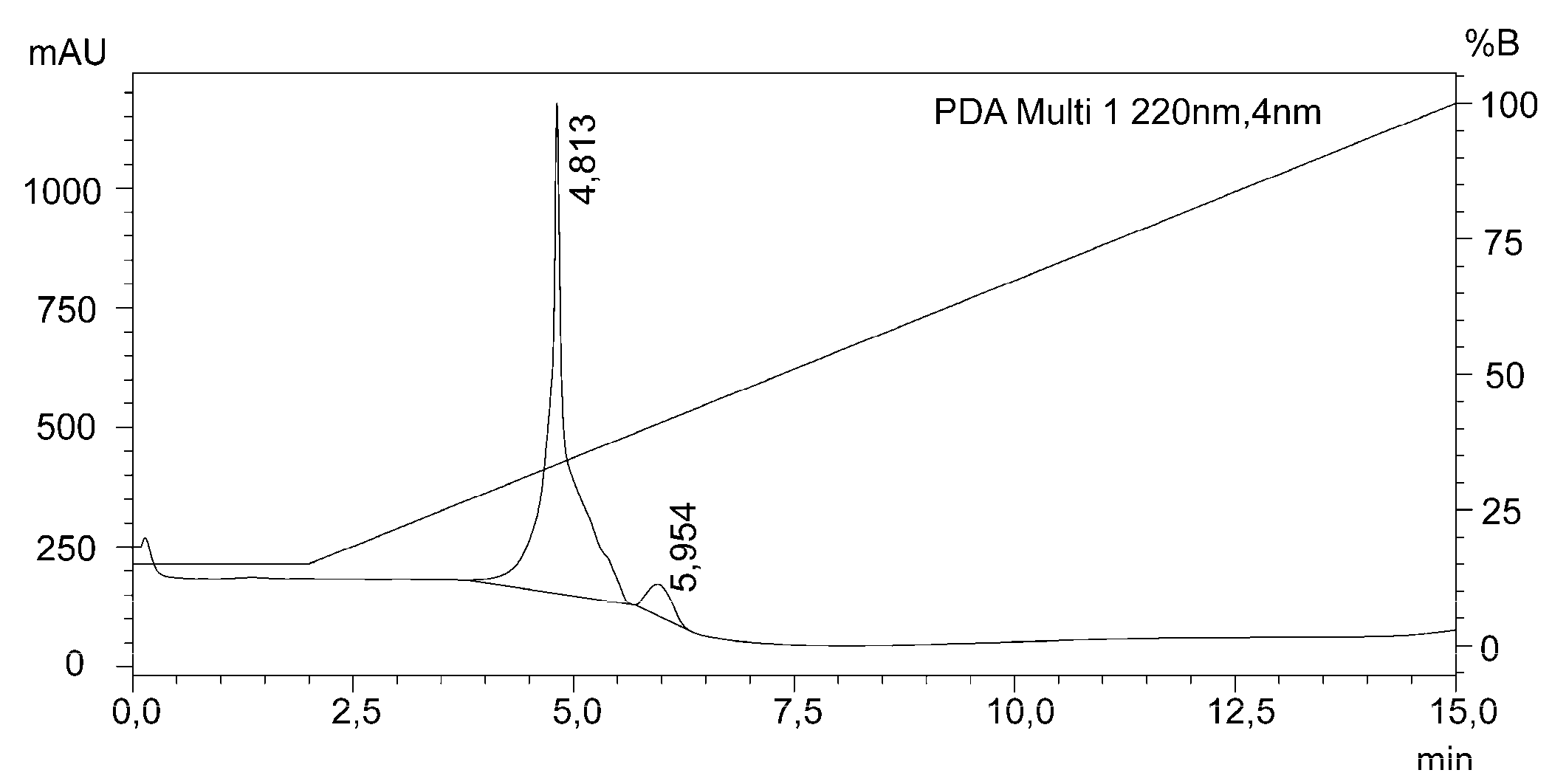
Figure 3.
ESI full mass spectra of a) (Ac-PHQGQHIG-Ahx3)2-K-Ahx3-PHQGQHIG-NH2 peptide and b) solvent blank. Peaks at m/z 636.6, 763.6, and 954.0 in spectrum a) correspond to ions [M+6H]6+, [M+5H]5+ and [M+4H]4+, ´respectively. The other peaks in a) also appear in solvent blank (b).
Figure 3.
ESI full mass spectra of a) (Ac-PHQGQHIG-Ahx3)2-K-Ahx3-PHQGQHIG-NH2 peptide and b) solvent blank. Peaks at m/z 636.6, 763.6, and 954.0 in spectrum a) correspond to ions [M+6H]6+, [M+5H]5+ and [M+4H]4+, ´respectively. The other peaks in a) also appear in solvent blank (b).
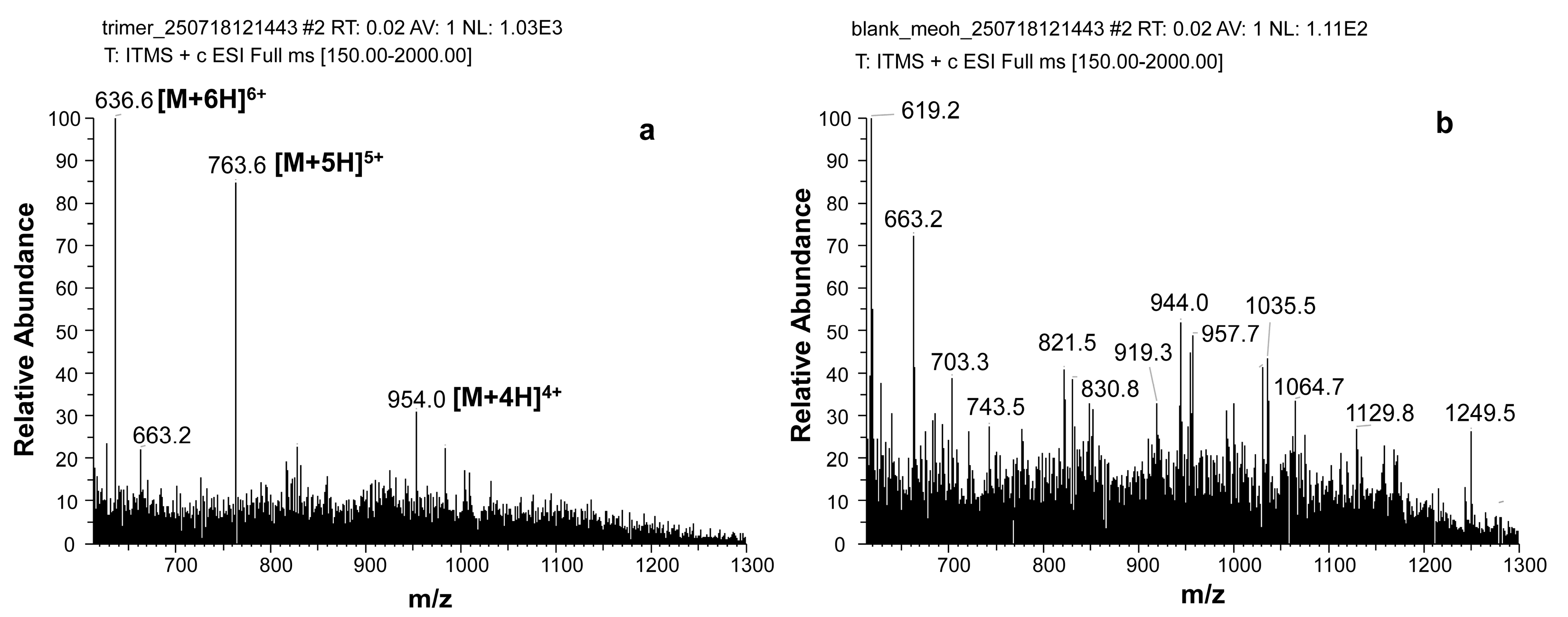
Figure 4.
Percentage of bevacizumab precipitated as a function of (NH4)2SO4 concentration at 25 °C (triangles) or 5 °C (circles).
Figure 4.
Percentage of bevacizumab precipitated as a function of (NH4)2SO4 concentration at 25 °C (triangles) or 5 °C (circles).
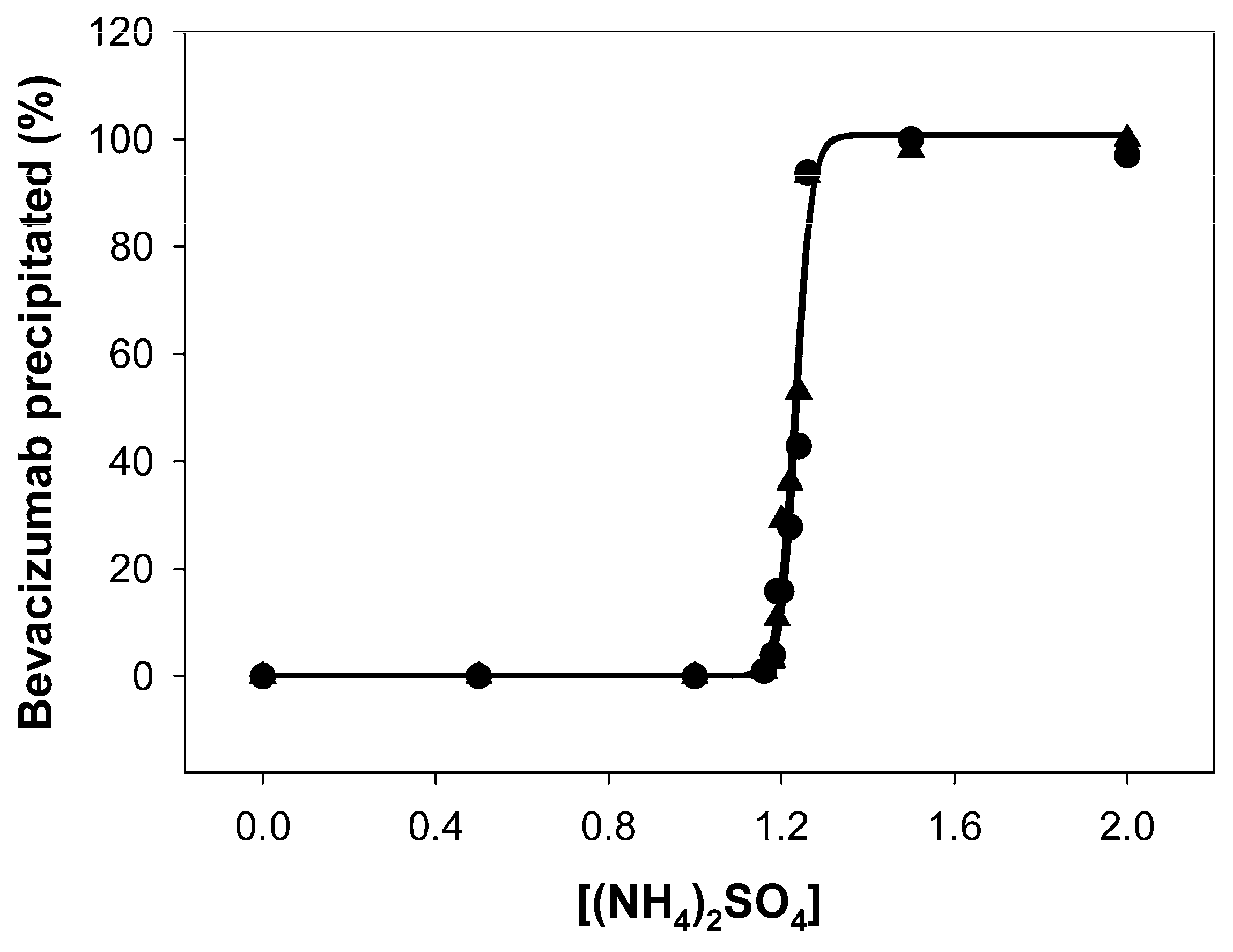
Figure 5.
Percentage of bevacizumab precipitated as a function of peptide/bevacizumab molar ratio. Bevacizumab precipitation in (NH4)2SO4 1.20 M (solid lines) at 25 °C (triangles) or 5 °C (circles) and in (NH4)2SO4 1.18 M (dash lines) at 25 °C (diamonds) or 5 °C (squares).
Figure 5.
Percentage of bevacizumab precipitated as a function of peptide/bevacizumab molar ratio. Bevacizumab precipitation in (NH4)2SO4 1.20 M (solid lines) at 25 °C (triangles) or 5 °C (circles) and in (NH4)2SO4 1.18 M (dash lines) at 25 °C (diamonds) or 5 °C (squares).
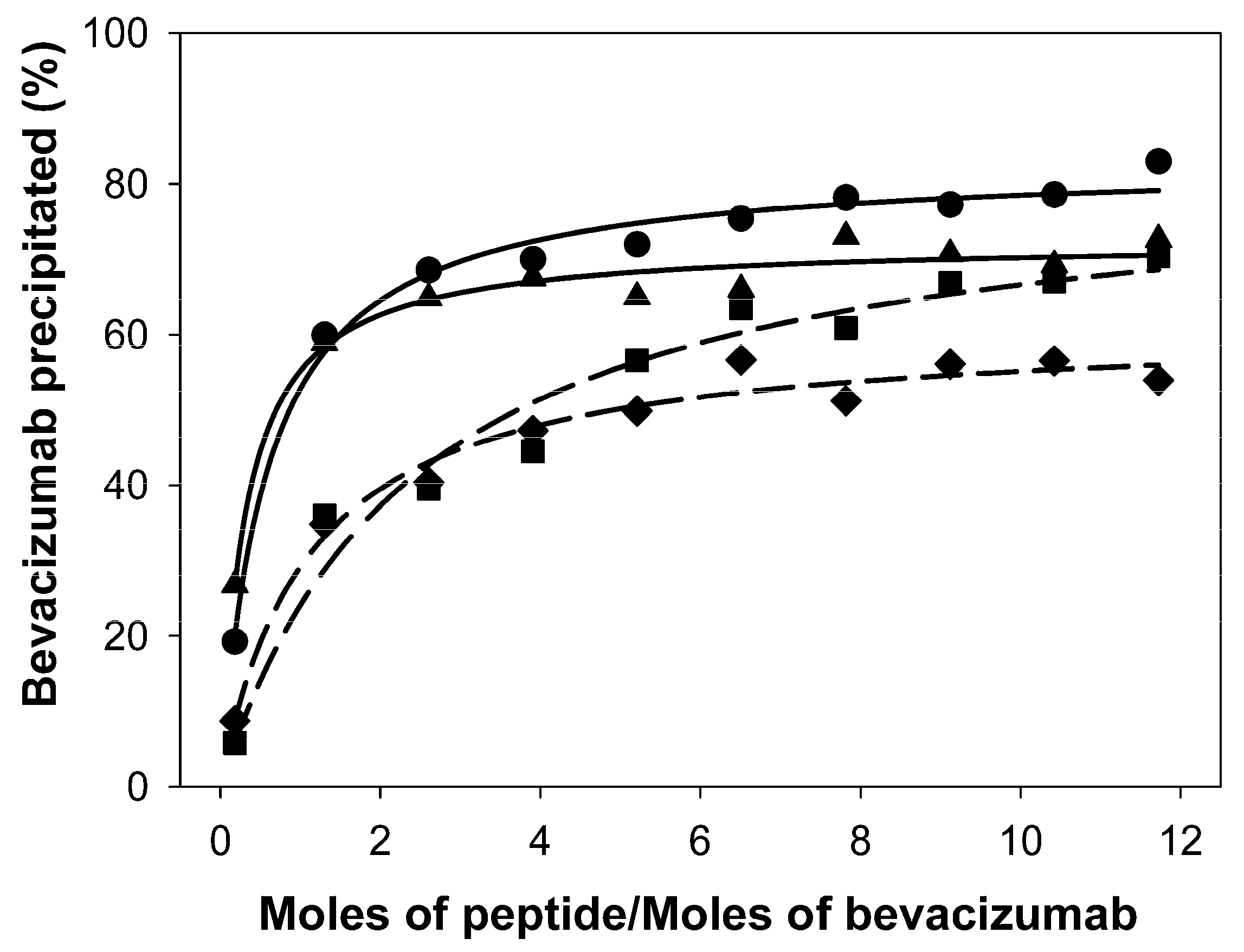
Figure 6.
Scheme of bevacizumab purification by fractional precipitation using (NH4)2SO4 and peptide (Ac-PHQGQHIG-Ahx3)2-K-Ahx3-PHQGQHIG-NH2.
Figure 6.
Scheme of bevacizumab purification by fractional precipitation using (NH4)2SO4 and peptide (Ac-PHQGQHIG-Ahx3)2-K-Ahx3-PHQGQHIG-NH2.
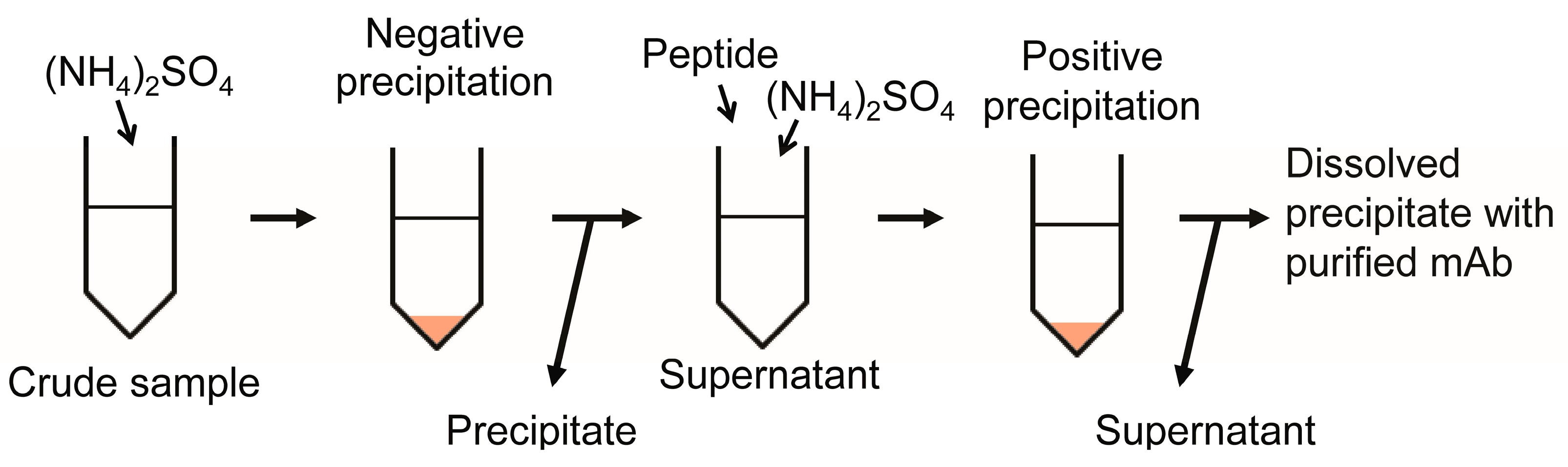
Figure 7.
Protein A affinity chromatography of a) cell-free culture broth, b) resuspended 2nd precipitate set up in this work, and c) pure bevacizumab. The adsorption buffer was 0.03 M sodium phosphate, 0.12 M NaCl, pH 7.4. The elution buffer was 0.5 M of acetic acid, pH 2.5. Fractions of 0.5 mL were collected, and their absorbances at 280 nm were measured. The arrow in each chromatogram indicates the buffer change.
Figure 7.
Protein A affinity chromatography of a) cell-free culture broth, b) resuspended 2nd precipitate set up in this work, and c) pure bevacizumab. The adsorption buffer was 0.03 M sodium phosphate, 0.12 M NaCl, pH 7.4. The elution buffer was 0.5 M of acetic acid, pH 2.5. Fractions of 0.5 mL were collected, and their absorbances at 280 nm were measured. The arrow in each chromatogram indicates the buffer change.
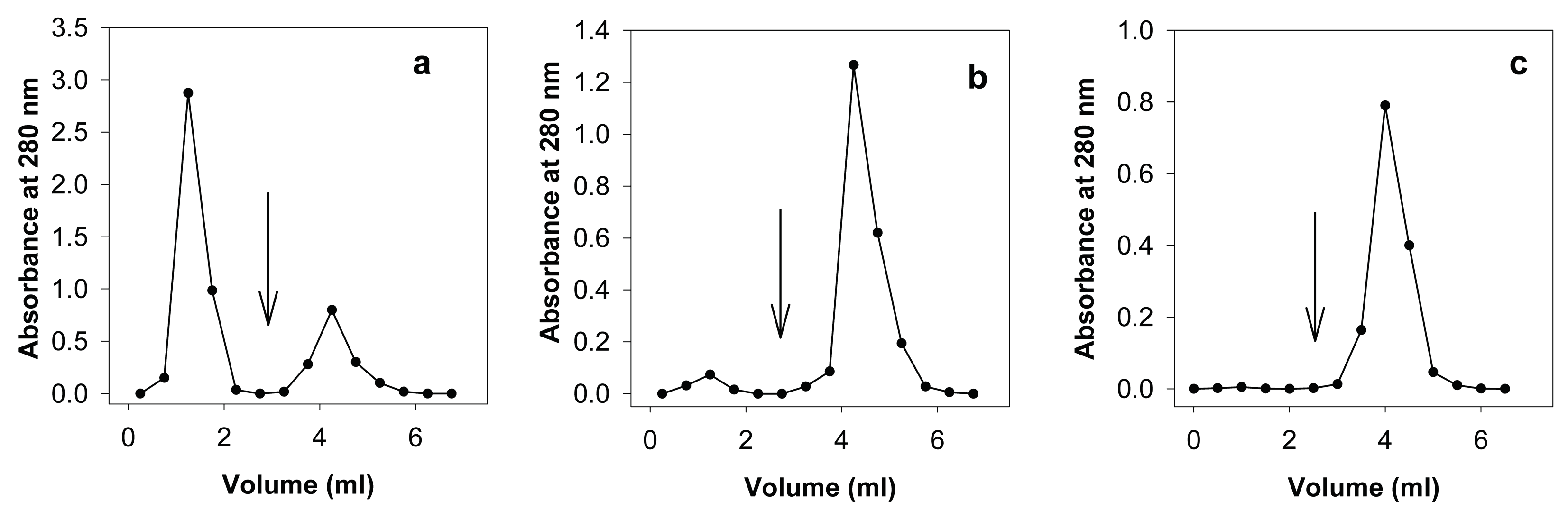
Figure 8.
SDS-PAGE gels under reducing (a) and non-reducing (b) conditions of fractions obtained after bevacizumab purification from cell-free culture broth using sequential precipitation. Lanes: 1) Protein molecular weight marker; 2) bevacizumab-producing CHO cell filtrate; 3) pure bevacizumab standard; 4) 2nd precipitate fraction. Arrows on the right of the gels indicate the bands corresponding to the heavy (H) and light (L) chains and intact bevacizumab, respectively.
Figure 8.
SDS-PAGE gels under reducing (a) and non-reducing (b) conditions of fractions obtained after bevacizumab purification from cell-free culture broth using sequential precipitation. Lanes: 1) Protein molecular weight marker; 2) bevacizumab-producing CHO cell filtrate; 3) pure bevacizumab standard; 4) 2nd precipitate fraction. Arrows on the right of the gels indicate the bands corresponding to the heavy (H) and light (L) chains and intact bevacizumab, respectively.
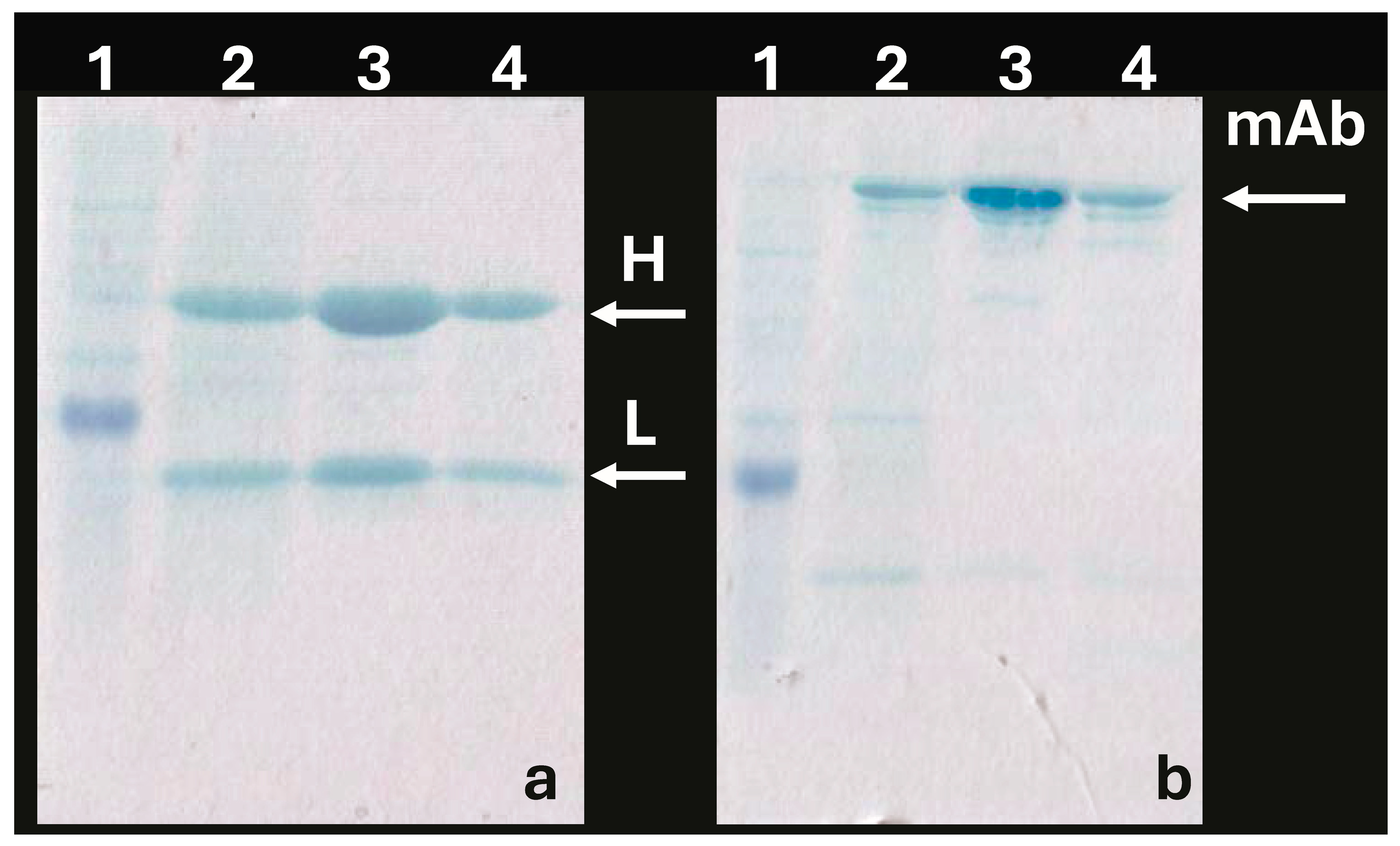

Table 1.
Values of theorical m/z of the monocharged and multicharged ions from the peptide (Ac-PHQGQHIG-Ahx3)2-K-Ahx3-PHQGQHIG-NH2. (Chemical formula: C175H280N54O42; molecular weight: 3812.50; monoisotopic mass (M): 3810.14).
Table 1.
Values of theorical m/z of the monocharged and multicharged ions from the peptide (Ac-PHQGQHIG-Ahx3)2-K-Ahx3-PHQGQHIG-NH2. (Chemical formula: C175H280N54O42; molecular weight: 3812.50; monoisotopic mass (M): 3810.14).
| Ion (ID%)1 | m/z | |||||
|---|---|---|---|---|---|---|
| [M+1H]1+ | [M+2H]2+ | [M+3H]3+ | [M+4H]4+ | [M+5H]5+ | [M+6H]6+ | |
| M (42%) | 3811.1 | 1906.1 | 1271.0 | 953.5 | 763.0 | 636.0 |
| M+1 (91%) | 3812.1 | 1906.6 | 1271.4 | 953.8 | 763.2 | 636.2 |
| M+2 (100%) | 3813.1 | 1907.1 | 1271.7 | 954.0 | 763.4 | 636.4 |
1 ID: Isotopic distribution.
Table 2.
Purification chart of bevacizumab using affinity precipitation with (Ac-PHQGQHIG-Ahx3)2-K-Ahx3-PHQGQHIG-NH2 peptide
Table 2.
Purification chart of bevacizumab using affinity precipitation with (Ac-PHQGQHIG-Ahx3)2-K-Ahx3-PHQGQHIG-NH2 peptide
| Sample |
2 Total protein (mg) |
3 Total bevacizumab (mg) |
4 Purity % |
5 Fold purification |
Yield % |
|---|---|---|---|---|---|
| 1 Crude sample | 2.78 | 1.60 | 58 | 1.0 | 100 |
| 2nd Precipitate | 1.19 | 1.17 | 98 | 1.7 | 73 |
1 Cell-free culture broth from bevacizumab-producing CHO cells from mAbxience SAU. 2 Protein concentration was determined using Bradford reagent. 3 Bevacizumab concentration was determined by protein A affinity chromatography. 4 Purity defined as the amount of bevacizumab as a fraction of the total amount of proteins. 5 Fold purification is defined as the purity of the sample in the 2nd precipitate with respect to the purity of the crude sample.
Disclaimer/Publisher’s Note: The statements, opinions and data contained in all publications are solely those of the individual author(s) and contributor(s) and not of MDPI and/or the editor(s). MDPI and/or the editor(s) disclaim responsibility for any injury to people or property resulting from any ideas, methods, instructions or products referred to in the content. |
© 2026 by the authors. Licensee MDPI, Basel, Switzerland. This article is an open access article distributed under the terms and conditions of the Creative Commons Attribution (CC BY) license (http://creativecommons.org/licenses/by/4.0/).
Copyright: This open access article is published under a Creative Commons CC BY 4.0 license, which permit the free download, distribution, and reuse, provided that the author and preprint are cited in any reuse.