

Submitted:
23 March 2026
Posted:
25 March 2026
You are already at the latest version
Abstract
Background: Atopic dermatitis (AD) is a chronic inflammatory disease characterized by profound dysbiosis, Staphylococcus Aureus colonization, and a compromised epidermal barrier. Current therapies often face safety and compliance limitations, necessitating proactive, steroid-sparing ecological restorations. Methods: This pharmacological review evaluates a synergistic framework combining Lactobacillus and Saccharomyces postbiotic lysates with innovative Perilla frutescens plant-derived exosomes, analyzing their molecular impact on skin homeostasis. Results: Our analysis demonstrates that Lactobacillus enhances innate immunity, while Saccharomyces ferments support the microbial ecosystem, showing an 87% increase in elastin secretion and a 41% increase in collagen type I synthesis, essential for barrier repair. Furthermore, Perilla frutescens exosomes modulate the JAK-STAT pathway, reducing Interleukin-6 (IL-6) by 40% and downregulating CYP1A1 expression by up to 49%, thereby mitigating oxidative stress and pruritus. Conclusions: By integrating these components into a "Triple-Action Therapy"—focusing on immunomodulation, structural restoration, and precision anti-inflammatory signaling—this review provides a comprehensive evidence-based roadmap for next-generation dermo-cosmetic interventions in atopic skin management.
Keywords:
atopic dermatitis
; skin microbiome
; postbiotics
; Lactobacillus
; Saccharomyces
; Perilla frutescens
; plant exosomes
; JAK-STAT pathway
; skin barrier restoration
; dermo-cosmetics
1. Introduction
Atopic dermatitis (AD) is a chronic, relapsing inflammatory skin disease that imposes a significant global burden, characterized by profound skin barrier dysfunction and a complex immune dysregulation [1]. The pathogenesis of AD is multifaceted, involving a delicate interplay between genetic predisposition, environmental triggers, and a persistent state of cutaneous inflammation mediated by Th2-polarized responses. Recent clinical evidence highlights that the integrity of the epidermal barrier is not merely a structural concern but is deeply intertwined with the ecological balance of the skin microbiome [2]. The skin of AD patients frequently exhibits a state of dysbiosis, characterized by a significant reduction in microbial diversity and a marked overcolonization by Staphylococcus aureus. This pathogen exacerbates the inflammatory cycle by secreting toxins and proteases that degrade the physical barrier and trigger pro-inflammatory signaling pathways [2]. Conventional therapeutic strategies, predominantly focused on topical corticosteroids and immunosuppressants, often provide symptomatic relief but may lead to long-term side effects, such as skin atrophy or tachyphylaxis, necessitating the exploration of safer, adjunctive, or proactive therapies [3,4]. In this context, the modulation of the skin microbiome has emerged as a promising frontier. While live probiotics face significant challenges regarding stability and safety in topical formulations, postbiotics—defined by the International Scientific Association for Probiotics and Prebiotics (ISAPP) as "preparations of inanimate microorganisms and/or their components that confer a health benefit"—offer a superior alternative [5,6]. These cell-free lysates and metabolic by-products, derived from strains such as Lactobacillus and Saccharomyces, possess potent immunomodulatory, antimicrobial, and barrier-restoring properties [2,7,8]. The integration of advanced biotechnologies has led to the exploration of exosomes—or plant-derived nanovesicles—as revolutionary delivery systems and bioactive agents. Unlike synthetic nanoparticles, these plant-derived vesicles are highly biocompatible and can effectively penetrate the stratum corneum to deliver molecular cargo directly to deeper epidermal layers [9,10]. Specifically, Perilla frutescens has gained significant attention for its anti-allergic and anti-inflammatory properties; its bioactive compounds, such as rosmarinic acid and luteolin, modulate key signaling pathways, including the JAK-STAT and TLR-2 axes, which are often overactivated in atopic skin [11,12,13].
Furthermore, the synergistic use of microbial postbiotics and plant-derived exosome-like vesicles represents a dual-strategy for restoring the skin’s physical and chemical barriers while promoting eubiosis. This combination not only enhances the expression of structural proteins but also provides a multi-dimensional approach to modulating the cutaneous immune response and neutralizing pathogen-derived triggers [14,15,16]. Emerging research indicates that specific metabolites from Lactobacillus and Saccharomyces ferments can enhance filaggrin expression and suppress oxidative stress, providing a holistic approach to skin health [17,18,19]. The aim of this review is to provide a comprehensive analysis of the synergistic potential between microbial lysates and Perilla-derived exosomes (PDE) in the management of AD. We explore the molecular mechanisms—ranging from Quorum Quenching to the inhibition of pro-inflammatory cytokines—and discuss how this "Precision Postbiotics" approach can pave the way for a more effective, "steroid-sparing" therapy that restores both the structural and ecological homeostasis of the skin [20].
2. Comparative Pharmacology of Microbial Lysates
The pharmacological landscape of atopic dermatitis (AD) is currently witnessing a paradigm shift from traditional immunosuppression to microbiome-targeted interventions. At the forefront of this evolution are postbiotics, which, according to the consensus definition provided by the International Scientific Association for Probiotics and Prebiotics (ISAPP), are preparations of inanimate microorganisms and/or their components that confer a health benefit on the host [5,21]. Unlike live probiotics, postbiotics offer enhanced stability, precise dosing, and a superior safety profile, making them ideal for compromised skin barriers. In AD, the comparative pharmacology of Lactobacillus and Saccharomyces lysates reveals a sophisticated "multi-kingdom" synergy: while bacterial fractions specialize in immune priming and pathogen exclusion, fungal ferments provide the metabolic fuel and structural building blocks required for holistic epidermal reconstruction [3,22,23].
The comparative pharmacological profile and molecular targets of these postbiotics are summarized in Table 1.
2.1. Structural Biochemistry: Peptidoglycans vs. Beta-Glucans
The therapeutic efficacy of a postbiotic is fundamentally dictated by its cell wall architecture and the precision of the cellular disruption process. Bacterial lysates from the Lactobacillus genus (specifically Lactiplantibacillus plantarum) are defined by a high concentration of peptidoglycans (PGN) and lipoteichoic acids (LTA). These molecules act as high-affinity ligands for Pattern Recognition Receptors (PRRs), notably Toll-like Receptor 2 (TLR-2). The pharmacological activation of TLR-2 on keratinocytes triggers a complex intracellular signaling cascade via the NF-κB and MAPK pathways, which in turn upregulates the production of endogenous antimicrobial peptides (AMPs), such as human β-defensin 2 and cathelicidin LL-37. This "immune training" is vital for correcting the inherent immunological deficits found in AD patients [6,24]. However, the bioavailability of these ligands depends heavily on the lysis method employed. Mechanical disruption (such as high-pressure homogenization or sonication) often yields a more diverse array of immunostimulatory fragments compared to simple heat inactivation [43]. In contrast, the Saccharomyces cerevisiae cell wall is a multi-layered matrix dominated by \beta-1,3/1,6-glucans and mannoproteins. These fungal polysaccharides interact with Dectin-1 receptors, which are crucial for modulating the Th2-biased inflammatory response typical of AD and promoting deep tissue repair [25,26]. The bioavailability of these bioactives is strictly dependent on the cellular disruption process; while mechanical or enzymatic methods are essential to release these ’trapped’ polysaccharides from the fungal matrix, excessive processing can lead to the denaturation of delicate carbohydrate structures [43,44]. Therefore, the standardization of manufacturing protocols—balancing lysis intensity with the preservation of structural integrity—is a fundamental requirement for ensuring the reproducible pharmacological activity of yeast-derived postbiotics [7,38].
2.2. Metabolic Profiles: From Acidification to Aryl Hydrocarbon Receptor (AhR) Activation
The "metabolic legacy" left by these microorganisms during controlled fermentation provides a secondary layer of pharmacological activity. Lactobacillus fermentation is synonymous with the production of lactic acid, a natural alpha-hydroxy acid (AHA) that serves two critical functions: it restores the "acid mantle" (maintaining a skin pH of 4.5–5.5) and acts as a potent humectant that stimulates ceramide synthesis [28,29]. A low surface pH is essential for inhibiting the protease enzymes that otherwise degrade barrier proteins like filaggrin.
The Saccharomyces ferment, however, offers a much broader metabolic spectrum, acting as a "biological factory" of micronutrients. It provides a dense cocktail of B-complex vitamins (B1, B2, B3, B5, B6, B12), essential amino acids, and minerals. Beyond basic nutrition, innovative research has identified yeast-derived metabolites (such as tryptophan derivatives) that act as ligands for the Aryl Hydrocarbon Receptor (AhR). The AhR pathway is a master regulator of the skin barrier; its activation directly induces the expression of the FLG (filaggrin) gene. Filaggrin is subsequently broken down into the amino acids that constitute the Natural Moisturizing Factor (NMF), thereby reducing Trans-Epidermal Water Loss (TEWL). This trophic support ensures that the skin has the necessary biochemical precursors to rebuild itself from within [4,17,20,27].
Beyond basic nutrition, recent advances in postbiotic engineering have demonstrated the ability of specialized ferments to modulate the Aryl Hydrocarbon Receptor (AhR) pathway. This is a crucial mechanism for maintaining the skin barrier’s integrity. For instance, advanced exosomal-postbiotic complexes associated with plant extracts, as it is Perilla-derived exosomal complex (PEC) have shown the capacity to blunt CYP1A1 expression by up to 49% in human keratinocytes. This reduction in CYP1A1 activity is a key indicator of decreased oxidative stress and restored cellular homeostasis, which directly promotes the expression of the FLG (filaggrin) gene. Consequently, this metabolic intervention addresses the fundamental biochemical deficiency in atopic dermatitis by enhancing the Natural Moisturizing Factor (NMF) and reducing Trans-Epidermal Water Loss (TEWL) [30,31].
2.3. Differential Modulation of the Skin Barrier: Antimicrobial Defense vs. Trophic Support
A critical aspect of postbiotic pharmacology in AD is the dual requirement for antimicrobial defense and structural repair. Lactobacillus postbiotics excel in pathogen exclusion. By utilizing Surface-layer (S-layer) proteins, these lysates anchor themselves to the epithelium, creating a physical and biochemical shield. This interaction induces "Quorum Quenching" mechanisms that disrupt the communication between Staphylococcus Aureus cells, significantly reducing biofilm formation and the secretion of pro-inflammatory exotoxins [32].
Simultaneously, Saccharomyces ferments provide trophic support that targets the underlying keratinocyte dysfunction. Peptide fractions and mannoproteins derived from yeast stimulate the proliferation of basal keratinocytes and the synthesis of collagen and loricrin. This accelerates the re-epithelialization of areas damaged by chronic scratching and inflammation. Furthermore, these fungal components exhibit potent antioxidant properties, neutralizing the Reactive Oxygen Species (ROS) generated during inflammatory flares, thus protecting the skin’s DNA and lipid matrix from oxidative degradation [38].
The pharmacological distinction between the two kingdoms lies in their functional focus: while bacterial lysates are primarily oriented towards innate immune priming and the induction of antimicrobial peptides (AMPs), fungal ferments provide critical trophic support for the extracellular matrix. Quantitative assays on dermal fibroblasts have shown that these lysates can stimulate an 11% increase in collagen synthesis and a remarkable 87% augmentation in elastin secretion. These findings, supported by Sirius Red and Elastin ELISA reports, highlight the regenerative potential of yeast-derived postbiotics in repairing the damaged scaffolding matrix of atopic skin, offering a superior efficacy-to-tolerance ratio compared to traditional desquamating agents [36,39,40].
2.4. Synergistic Potential in Atopic Dermatitis: Rationale for Combined Therapy
The multifactorial nature of Atopic Dermatitis—characterized by dysbiosis, barrier defect, and immune dysregulation—necessitates a multi-target therapeutic approach. The combination of bacterial and fungal lysates addresses these complexities more effectively than monotherapy. From a pharmacodynamic perspective, this synergy is manifested through the simultaneous modulation of the JAK-STAT and TLR signaling pathways [12].
While Lactobacillus fractions stabilize the innate immune response and suppress S. aureus overgrowth, Saccharomyces components stabilize the epidermal structure and provide the nutritional energy required for cellular repair. This "Multi-Kingdom" strategy restores the skin’s eubiosis and homeostasis, offering a sustainable alternative to long-term corticosteroid use [15,18,33,34,35]
The synergy of a "multi-kingdom" approach is validated not only by biochemical assays but also by in vivo clinical data. The anti-inflammatory effect is evidenced by a 40% reduction in Interleukin-6 (IL-6) levels, effectively mitigating the chronic sub-clinical inflammation characteristic of AD. Furthermore, clinical evaluation using VISIA analysis has confirmed a measurable reduction in Red Areas (erythema) and a significant improvement in overall skin texture. This dual-action strategy—combining bacterial immune-modulation with fungal/exosomal structural repair—represents a robust pharmacological framework for the long-term management of atopic dermatitis. By targeting both the external microbiome and the internal cellular machinery, this combined postbiotic approach represents the next generation of precision skincare in dermatological therapy [41,42].
In conclusion, the pharmacological synergy between bacterial and fungal postbiotics provides a dual-action strategy that addresses both the microbial dysbiosis and the structural deficiencies inherent in atopic dermatitis. However, to fully understand the clinical efficacy of this multi-kingdom approach, it is essential to examine the underlying intracellular signaling pathways. The following chapter will explore the specific molecular mechanisms, with a particular focus on the modulation of the JAK-STAT and TLR pathways, which serve as the primary drivers of the cutaneous inflammatory cascade.
3. Molecular and Pharmacological Mechanisms of Action
3.1. Microbial Interference: Quorum Quenching and Biofilm Disruption
The cutaneous microbiome is an organized ecosystem where dominant microorganisms like Staphylococcus epidermidis and Cutibacterium acnes maintain skin balance and immune homeostasis. In AD, this equilibrium is disrupted by a significant overcolonization of Staphylococcus aureus, which contributes to disease exacerbation by breaching the epidermal barrier and inducing chronic inflammation. Factors such as elevated stratum corneum pH, filaggrin mutations, and decreased production of antimicrobial peptides (AMPs), like cathelicidins and \beta-defensins, create a permissive environment for S. aureus adhesion and proliferation [44,45].
The pathogenicity of S. aureus is fundamentally governed by a density-dependent signaling mechanism known as Quorum Sensing (QS). At the core of this process lies the accessory gene regulator (Agr) locus, which coordinates the transition from commensal colonization to a high-virulence phenotype through the secretion of Autoinducing Peptides (AIPs). When the bacterial population reaches a critical threshold, the activation of the AgrC receptor triggers a feed-forward loop that drives the production of major virulence factors, including phenol-soluble modulin (PSMα) peptides and delta-toxin. These mediators induce the release of alarmins (IL-1α, IL-36α) from keratinocytes and cause mast cell degranulation, driving Th2/IL-17-mediated dermatitis [11,46,47].
In this context, PEC acts as a sophisticated postbiotic agent that disrupts S. aureus pathogenicity through a targeted Quorum Quenching (QQ) mechanism. This effect is primarily mediated by Lactobacillus-derived exosomes—bacterial extracellular vesicles (30–150 nm) that function as specialized nano-delivery vehicles [48]. These exosomes encapsulate bioactive peptides and metabolites that act as competitive antagonists by binding to the AgrC receptor, effectively "jamming" the signal transduction required for quorum sensing.
By utilizing this vesicle-mediated delivery, PEC effectively silences staphylococcal communication and reduces the toxin load without the selective pressure associated with traditional bactericidal agents [49]. This inhibition prevents the bacteria from activating the Agr system, thereby halting the transition to a virulent state and the subsequent formation of the protective biofilm matrix. Furthermore, these exosomal cargos interfere with the ica operon, reducing the production of polysaccharide intercellular adhesin (PIA) essential for biofilm integrity [50,51,52]. Consequently, this "silencing" strategy restores the competitive equilibrium of the skin microbiome and protects the epidermal structure from protease-mediated dissolution, offering a safe and stable therapeutic alternative for AD management.
3.2. Innate Immunity Training: TLR-2 Modulation and Antimicrobial Peptide Induction
Keratinocytes provide structural integrity and act as immune-competent cells that actively monitor and respond to microbial invasions. A key mechanism of this defense is the synthesis and storage of antimicrobial peptides (AMPs), which eliminate diverse pathogens while simultaneously strengthening and improving the skin barrier integrity [53]. The most significant AMPs involved in these pathways include cathelicidins (LL-37), beta-defensins (hBD-2 and hBD-3), dermicidin, and CXCL14—a unique chemokine that binds bacterial DNA, such as that of S. aureus [54].
Keratinocytes detect pathogens via pattern recognition receptors (PRRs), primarily Toll-like receptors (TLRs). TLRs recognize pathogen-associated molecular patterns (PAMPs) like lipids, lipoproteins, and nucleic acids [55] In Atopic Dermatitis (AD), an imbalance in AMP expression (lower LL-37, hBD-2, and dermicidin-1) promotes dysbiosis and microbial colonization [56,57]. This deficiency is partly attributed to the overexpression of Th2 cytokines (IL-4, IL-13, IL-31), which inhibit AMP production and suppress filaggrin [57].
In this context, the development of postbiotic interventions like PEC represents a sophisticated strategy for "innate immunity training." PEC utilizes a synergistic exosomal complex comprising Lactobacillus-derived fractions and Perilla frutescens extract, encapsulated within a phospholipid nanovesicular system [48].
Unlike simple lysates, this exosomal delivery system optimizes the interaction with TLR2, a key receptor for skin barrier repair.
Research on Lactobacillus-derived postbiotics indicates that bioactive substances like Lipoteichoic acid (LTA) have important immunomodulatory properties when interacting with TLR2. In the case of PEC, the exosomal encapsulation ensures that these Lactobacillus-derived ligands act as partial agonists, "priming" keratinocytes to reinforce innate defenses without triggering the hyper-inflammation typically induced by pathogens like S. aureus [54,57]. The complex interacts with the TLR2/6 heterodimer, initiating signaling pathways that upregulate essential tight junction proteins, including ZO-1, Occludin, and Claudin-1, effectively repairing the "leaky" epidermal barrier [8,58,59].
Furthermore, the presence of Perilla frutescens phytochemicals within the PEC complex provides a potent anti-inflammatory synergy. By binding to TLR2, the postbiotic ligands effectively outcompete and block the signaling cascade normally triggered by pathogenic S. aureus LTA, a critical mechanism for alleviating atopic symptoms [113]. This competitive inhibition prevents the overproduction of CCL2 (Chemokine ligand 2) and reduces the activation of the ERK and p38 MAPK pathways, leading to a significant mitigation of the pro-inflammatory environment. Specifically, experimental assays using ELISA techniques demonstrated a 40% reduction in Interleukin-6 (IL-6) levels [4], alongside decreased levels of TNF-\alpha, IL-8, IL-4, and IL-5, and an enhanced expression of the anti-inflammatory mediator IL-10 [60].
Beyond barrier repair, PEC promotes microbial homeostasis by selectively inhibiting the overgrowth of pathogenic S. aureus while supporting beneficial commensals. Clinical applications of these stable, exosome-encapsulated Lactobacillus fractions demonstrates significant texture improvement and reduction in red areas in atopic skin models [42] offering a safe therapeutic alternative to live probiotics and demonstrating significant reductions in the SCORAD index and Transepidermal Water Loss (TEWL) [61].
3.3. Targeting the JAK-STAT Pathway: Biomimetic Delivery via Perilla frutescens-Derived Exosomes
The therapeutic efficacy of the studied complex is anchored in a multi-target biomimetic approach, specifically designed to modulate the intracellular signaling cascades that orchestrate the pathogenesis of Atopic Dermatitis (AD). By utilizing exosomal vesicles enriched with Perilla frutescens bioactives, the formulation achieves superior precision in targeting the JAK-STAT axis and the regulatory checkpoints of the skin’s immune response.
3.3.1. Modulation of the JAK/STAT Signaling Axis
The JAK/STAT (Janus Kinase/Signal Transducer and Activator of Transcription) pathway is the primary transducer for a broad range of cytokines involved in AD. The exosomal delivery of concentrated bioactives targets two major intracellular signaling axes:
This molecular regulation is clinically supported by the acceleration of cellular renewal [58], demonstrating that blocking STAT3-mediated hyperproliferation allows for a controlled, physiological regeneration of the skin barrier.
3.3.2. The SOCS Regulatory Framework: Biological Checkpoints
The SOCS (Suppressors of Cytokine Signaling) protein family, particularly SOCS1-7 and CIS, serves as a critical regulatory mechanism for managing cytokine-driven inflammation. These molecules act as natural "brakes," preventing overactive JAK kinase activation. In the context of AD, SOCS1, SOCS3, and SOCS5 act as essential checkpoints that modulate the balance between Th1 and Th2 cells, effectively attenuating Th2-mediated allergic inflammation [12]. The postbiotic complex stabilizes this regulatory framework, preventing the hyperactive immune responses that lead to chronic lesions.
3.3.3. Synergistic Action of Perilla-derived Bioactives: Luteolin and Rosmarinic Acid
The biomimetic delivery of Perilla frutescens bioactives via exosomes ensures they bypass the stratum corneum to interact directly with keratinocyte and immune cell receptors (see Tabel 2):
- Luteolin (Antipruritic and Immunomodulator): Acts as a potent inhibitor of STAT3 and modulates the release of TSLP (Thymic Stromal Lymphopoietin). By blocking TSLP signaling, luteolin breaks the "itch-scratch cycle" and reduces mechanical-induced inflammation [62,63]. This action is validated by report [49] confirming the preservation of total cellular protein integrity under environmental stress.
Rosmarinic Acid (Barrier Restoration and Antioxidant) mechanisms:
- Inhibition of IKK-β Signaling: Rosmarinic acid exerts a targeted immunomodulatory effect by suppressing the production of key chemokines, such as CCL11 (eotaxin), and its corresponding receptor CCR3. This molecular blockade effectively limits eosinophil infiltration into the dermal layers, thereby attenuating the acute allergic response characteristic of atopic flares [12,13].
- Activation of the Nrf2/HO-1 Axis: This compound fortifies the skin’s internal resilience by upregulating endogenous antioxidant defenses within keratinocytes. By activating the Nrf2/HO-1 pathway, it neutralizes reactive oxygen species (ROS) and significantly reduces the cellular damage induced by oxidative stress [64].
- Stimulation of NHE1 and pH Regulation: A pivotal role of Rosmarinic acid in physical barrier reconstruction involves the activation of the Sodium-Proton Exchanger 1 (NHE1). This stimulation decreases skin surface pH to restore the "acid mantle" and increases ceramide levels, providing the necessary biochemical environment for the observed upregulation of collagen [40] and elastin [39] synthesis [44,65].
- Advanced Anti-inflammatory Pathways: Rosmarinic acid further modulates systemic inflammation by suppressing the production of TACE (TNF-alpha-converting enzyme), which prevents the shedding of EPCR (Endothelial Protein C Receptor) and the subsequently regulated release of TNF-alpha. Additionally, its capacity to interfere with the HMGB1 (High Mobility Group Box Protein 1) signaling pathway underscores its potential in managing severe and recalcitrant inflammatory disorders [66,67].

Table 2.
Key Molecular Targets and Signaling Pathways Modulated by Perilla frutescens-derived Bioactive Compounds.
Table 2.
Key Molecular Targets and Signaling Pathways Modulated by Perilla frutescens-derived Bioactive Compounds.
| Functional Axis | Bioactive Compound | Molecular Target / Pathway | Mechanism of Action | Biological Effect in Atopic Dermatitis | References |
|---|---|---|---|---|---|
| Immune Modulation | Luteolin | STAT3 signaling | Inhibits STAT3 activation involved in inflammatory signaling | Reduces inflammatory cytokine signaling and immune activation | [62,63] |
| Immune Modulation | Luteolin | TSLP | Blocks TSLP signaling in keratinocytes | Interrupts the itch–scratch cycle and decreases pruritus-induced inflammation | [62,63] |
| Immune Modulation | Rosmarinic Acid | IKK-β / NF-κB pathway | Inhibits IKK-β activity and downstream inflammatory signaling | Reduces chemokines such as CCL11 (eotaxin) and limits CCR3-mediated eosinophil recruitment | [12,13] |
| Immune Modulation | Rosmarinic Acid | TACE | Suppresses TNF-α activation and prevents EPCR shedding | Reduces inflammatory cytokine release and vascular inflammation | [66,67] |
| Immune Modulation | Rosmarinic Acid | HMGB1 signaling | Interferes with HMGB1 inflammatory signaling cascade | Limits severe inflammatory responses and tissue damage | [66,67] |
| Antioxidant Defense | Rosmarinic Acid | Nrf2 / HO-1 axis | Activates transcription of antioxidant enzymes | Neutralizes ROS and reduces oxidative stress in keratinocytes | [64] |
| Barrier Restoration | Rosmarinic Acid | NHE1 | Stimulates NHE1 activity regulating epidermal pH | Lowers skin surface pH and increases ceramide production | [51,65] |
| Barrier Restoration | Rosmarinic Acid | Extracellular matrix synthesis | Promotes structural protein production | Upregulates collagen and elastin, improving dermal integrity | [39,40] |
| Cellular Protection | Luteolin | Cellular protein stability pathways | Preserves total cellular protein integrity under environmental stress | Protects keratinocytes from stress-ind uced damage | [49] |
Abbreviations: TSLP (Thymic Stromal Lymphopoietin), TACE (TNF-α-converting enzyme), NHE1 (Na⁺/H⁺ Exchanger 1).
3.3.4. Targeted Biomimetic Delivery and Clinical Outcomes
The efficacy of these thirteen distinct molecular pathways is intrinsically linked to the exosomal delivery system. By encapsulating these bioactives within nanovesicles (30–150 nm), the formulation ensures protection against proteolytic degradation and facilitates targeted delivery to deep epidermal layers. The final synergistic result is a measurable restoration of skin texture and the lipid mantle, as confirmed by VISIA analysis [42], offering a high-tech alternative to the simple occlusion provided by traditional emollients [41,59].
3.4. Epidermal Barrier Restoration: PPAR-γ Activation and Lipid Homeostasis
The modern management of Atopic Dermatitis (AD) necessitates a proactive restoration of the skin barrier, a process orchestrated by the bioactive constituents of Perilla frutescens—Alpha-Linolenic Acid (ALA), Rosmarinic Acid, and Luteolin—which function as potent bio-activators of lipid homeostasis.
3.4.1. PPAR-γ Signaling and Lipid Synthesis
Alpha-Linolenic Acid (ALA), extracted from Perilla seeds, acts as a direct ligand for PPAR-γ (Peroxisome Proliferator-Activated Receptor gamma) within keratinocytes. This activation triggers the genetic signaling required for keratinocyte maturation, ensuring an organized transition from the basal layer to the stratum corneum [68], ALA promotes the synthesis of endogenous ceramides and essential fatty acids, fortifying the intercellular matrix. This biochemical fortification significantly reduces transepidermal water loss (TEWL), a result clinically validated by VISIA analysis [70] which demonstrates a measurable restoration of the lipid mantle and skin micro-relief.
Rosmarinic Acid complements this process by serving as a critical stabilizer that prevents the peroxidation of surface lipids. By activating the Nrf2 signaling pathway, it protects filaggrin from enzymatic degradation and maintains lipid fluidity, preventing the formation of micro-fissures [38,53], This protection of structural protein integrity is further supported by total cellular protein assays [50] confirming the resilience of the proteome under oxidative stress.
3.4.2. Structural Integrity and Cellular Renewal
Flavonoids such as Luteolin and Apigenin accelerate keratinocyte differentiation by stimulating the expression of loricrin and involucrin. This structural reinforcement is evidenced by an increased rate of cellular renewal [2], providing the mechanical resilience necessary for fragile AD skin. Furthermore, the synergy between PPAR-γ activation and NF-κB inhibition reduces the production of pro-inflammatory cytokines, stabilizing the epidermal metabolic environment.
3.4.3. Exosomal Delivery and ECM Remodeling
The use of exosomes as ultra-efficient delivery systems (30–150 nm) facilitates the deep transport of these compounds, protecting them from proteolytic degradation. Exosomes act therapeutically by restoring the permeability barrier and providing essential ligands directly to intracellular compartments [40].
A crucial mechanism identified is the ability of exosomes to induce the transition of macrophages from the pro-inflammatory M1 phenotype to the reparative M2 phenotype, effectively reducing the acute phase of dermatitis [64]. Beyond immune modulation, these nanovesicles actively stimulate the synthesis of collagen and elastin while inhibiting matrix metalloproteinases (MMPs) that destroy skin structure during chronic inflammation [39,40,64]. The final result is an acceleration of tissue healing and a comprehensive functional and aesthetic restoration of the skin barrier.
The molecular and pharmacological mechanism of the Perilla-derived exosomal complex (PEC) in managing AD is multi-faceted, targeting both barrier repair and immune modulation. The specialized delivery system ensures that bioactives like Luteolin and Alpha-Linolenic Acid (ALA) effectively penetrate the stratum corneum. Once in the epidermis and dermis, PEC exerts a dual effect: (i) it restores barrier proteins (FLG/LOR) via AhR activation and lipid synthesis via PPAR-\gamma, and (ii) it suppresses inflammation by inhibiting the JAK/STAT pathway and polarizing macrophages towards the anti-inflammatory M2 phenotype.
Beyond the bacterial exosomal fraction, the therapeutic efficacy of the complex is further augmented by the synergistic action of Saccharomyces ferment. This yeast-derived postbiotic serves as a vital metabolic primer, providing a rich substrate of essential amino acids, vitamins, and \beta-glucans that complement the antimicrobial action of the Lactobacillus cargo. While the exosomal ligands disrupt pathogen communication via quorum quenching [70], the Saccharomyces components interact with receptors such as Dectin-1 to stimulate keratinocyte energy metabolism and accelerate structural recovery [59,61].
4. Comparative Analysis: Postbiotics versus Conventional Therapies in AD Management
The current therapeutic landscape for Atopic Dermatitis (AD) is characterized by a high reliance on reactive treatments. However, as the therapeutic pipeline expands [71], there is a growing need for proactive strategies that address the microbial and immunological roots of the disease. This chapter evaluates exosomal postbiotics against established standards—antibiotics, corticosteroids, highlighting their role in modern precision medicine.
4.1. Precision Ecology: Postbiotics vs. Antibiotics and Antiseptics
The management of S. aureus overcolonization is a cornerstone of AD therapy, yet global susceptibility patterns indicate an alarming increase in multi-drug resistant strains [72]. Conventional topical antibiotics exert selective pressure, further driving this resistance and inducing profound dysbiosis by eliminating beneficial commensals. Furthermore, the use of non-selective antiseptics can disrupt the delicate signaling required for skin homeostasis [46].
PEC represents a shift toward "Precision Ecology." By utilizing exosomal cargo to interfere with the agr-mediated Quorum Sensing of S. aureus [49], it effectively "disarms" the pathogen without bactericidal pressure (see Table 3). This prevents the formation of virulent biofilms and the secretion of dermonecrotic toxins [46]. Unlike antibiotics, this postbiotic shield preserves the commensal landscape, allowing the host’s microbiome to maintain its protective niche and prevent pathogen re-colonization [72].
While Lactobacillus fractions focus on neutralizing S. aureus virulence, the Saccharomyces ferment component within the PEC complex provides a unique ecological advantage. By secreting specific enzymes and antioxidant metabolites, it creates a nutrient-rich environment that favors the regrowth of beneficial commensals like Staphylococcus epidermidis, effectively outcompeting pathogens through resource competition rather than chemical toxicity.
4.2. The "Steroid-Sparing" Potential: Postbiotics as Adjuvant and Proactive Therapy
While topical corticosteroids (TCS) are effective for acute flares, "steroid phobia" remains a significant barrier to long-term management, leading to poor adherence and chronic disease cycling [73]. The development of "steroid-sparing" agents is therefore a clinical priority [34].
The integration of Perilla frutescens-derived bioactives within the PEC complex offers a potent anti-inflammatory alternative. Luteolin, the primary flavonoid in this complex, has been shown to inhibit the JAK-STAT pathway, specifically suppressing IL-6 and Th2-driven inflammation [74]. This molecular modulation mimics the efficacy of mild corticosteroids but without the risks of skin atrophy or rebound effects (see Table 3). Used as a proactive therapy, this complex stabilizes the immune response, significantly prolonging flare-free intervals and reducing the cumulative need for TCS [73,74].
Table 3.
Comparative analysis of exosomal postbiotics versus conventional therapies in atopic dermatitis (AD) management.
Table 3.
Comparative analysis of exosomal postbiotics versus conventional therapies in atopic dermatitis (AD) management.
| Criterion | Exosomal Postbiotics (PEC) | Antibiotics / Antiseptics | Corticosteroids (TCS) |
|---|---|---|---|
| Mechanism of action | Interfere with agr-mediated quorum sensing of S. aureus, reducing virulence without bactericidal pressure [11,70] | Bactericidal or antiseptic action eliminating bacteria, including commensals [51] | Broad anti-inflammatory and immunosuppressive effects via cytokine inhibition |
| Target specificity | High; modulates pathogenic behavior while preserving commensals | Low; non-selective microbial elimination | Low; non-specific immune suppression |
| Selective pressure / resistance | No selective pressure; minimal resistance risk [51] | High selective pressure promoting antimicrobial resistance [51] | No microbial resistance; risk of tachyphylaxis |
| Impact on microbiome | Preserves commensal microbiota and microbial balance [51,52] | Disrupts microbiome, inducing dysbiosis [47] | Indirect alteration via immune suppression |
|
Effect on biofilms and toxins |
Inhibits biofilm formation and dermonecrotic toxin secretion [47] |
Limited efficacy against biofilms |
No direct antimicrobial effect |
| Inflammation control | Indirect; immune modulation (e.g., macrophage polarization, JAK-STAT inhibition via luteolin) [63,67] | Limited; reduces pathogen-driven inflammation | Strong and rapid anti-inflammatory effect |
| Skin barrier / homeostasis | Actively restores barrier and supports physiological signaling [58] | May disrupt skin homeostasis [47] | Improves symptoms without restoring barrier function |
| Re-colonization risk | Low; supports microbiome-mediated protection [41,52] | High; frequent recurrence after treatment | No effect on microbial recolonization |
| Safety profile | High; no atrophy or rebound effects reported | Risk of resistance and microbiome disruption | Risk of skin atrophy, rebound flares, and poor adherence ("steroid phobia") [52] |
| Therapeutic approach | Proactive, microbiome-oriented, precision medicine-based [54] | Reactive, pathogen-elimination approach | Reactive, flare-control strategy |
Abbreviations: AD, atopic dermatitis; TCS, topical corticosteroids; S. aureus, Staphylococcus aureus; agr: accessory gene regulator.
4.3. Beyond pH Correction: Complex Postbiotic Cocktails vs. Simple Acidification
Restoring the skin’s "acid mantle" is a traditional goal in AD care, often achieved through simple acidification with lactic or citric acid. However, surface pH correction alone is insufficient to repair the deep structural and signaling defects of the AD barrier [17].
The ’Postbiotic Cocktail’ approach in PEC delivers a multi-dimensional restorative signal. Unlike simple acidic emollients, the Saccharomyces-derived \beta-glucans actively stimulate the Dectin-1 receptors on keratinocytes, triggering the endogenous synthesis of filaggrin and loricrin [26,38]. This bio-inductive process addresses the underlying structural ’leakiness’ of the AD barrier. Furthermore, the fungal ferment acts as a metabolic primer, enhancing cellular ATP levels to provide the energy required for the upregulated synthesis of collagen and elastin [18,19,39,40], ensuring a biological repair that goes beyond mere surface coating [27], transforming the skin from a state of chronic inflammation to one of active structural remodeling [11,42].
4.4. Safety Profile and Long-term Compliance: Overcoming Traditional Limitations
Adherence to topical regimens is notoriously hindered by the poor sensory properties of traditional emollients (e.g., greasiness, stickiness) and the potential for local irritation [76]. For many patients, the "medical" feel of traditional ointments acts as a deterrent to daily use.
Exosomal postbiotics overcome these compliance barriers through advanced formulation technology [7]. PEC is validated for high cellular biocompatibility [77] making it suitable for even the most compromised skin types. The nanovesicular structure ensures rapid, deep absorption with a superior cosmetic finish, which significantly enhances patient adherence [76]. This is further supported by VISIA analysis [42] which demonstrates a measurable improvement in skin microrelief and lipid mantle restoration, providing the patient with both clinical relief and a visible aesthetic benefit.
While these results confirm the potency of the bacterial exosomal cargo, the potential integration of Saccharomyces ferment in advanced therapeutic protocols offers a further synergestic advantage. By providing a “metabolic boost” through ATP production and stimulating the synthesis of structural proteins like filaggrin, fungal components could theoretically augment the visible clinical benefits observed with PEC alone, leading to an even more robust and long-lasting barrier repair.
5. Challenges in Pharmaceutical Technology and Formulation Stability
The transition from theoretical pharmacology to clinical efficacy in Atopic Dermatitis (AD) depends critically on the stability of bioactives and their ability to penetrate the stratum corneum. As the therapeutic pipeline for AD expands [72], technological challenges focus on developing delivery systems that protect fragile molecules against degradation while maintaining the skin’s ecological balance.
5.1. Incorporating Postbiotics into O/W Emulsions: Preserving Protein Bioactivity
Incorporating postbiotics into Oil-in-Water (O/W) emulsions presents a significant challenge: maintaining the structural integrity of bacterial metabolites, enzymes, and peptides. Conventional emulsification processes often expose these thermolabile compounds to mechanical and thermal stress, leading to a rapid loss of bioactivity [7].
In the formulation of the studied complex, this challenge is addressed through exosomal encapsulation. These bacterial extracellular vesicles (EVs) function as specialized nano-delivery vehicles that encapsulate bioactive peptides and autoinducer-like molecules, protecting them from proteolytic degradation within the skin’s complex enzymatic environment [49,50]. According to molecular assays, this stabilization ensures the preservation of the total cellular protein profile [50]. By shielding these "messenger" molecules, the system guarantees that the postbiotic cargo remains functional until it reaches the targeted epidermal layers, effectively bridging the gap between raw fermentation products and stable cosmetic vehicles.
In addition to bacterial metabolites, the incorporation of Saccharomyces ferment introduces a complex matrix of \beta-glucans and essential vitamins (B-complex) into the O/W emulsion [43,44]. While bacterial peptides are highly thermolabile, these fungal polysaccharides exhibit superior structural stability under mechanical stress [25,26]. When co-formulated within the exosomal complex, the Saccharomyces fractions act as a secondary stabilizing network, physically protecting the more fragile exosomal vesicles from premature coalescence and ensuring the preservation of the holistic ’Postbiotic Cocktail’ bioactivity [49,78].
5.2. The Formulation Paradox: Developing Microbiome-Friendly Products
A major paradox in modern pharmaceutical technology is the use of broad-spectrum preservatives which, while ensuring the microbiological stability of the formula, may inadvertently disrupt the host’s commensal microbiota [79]. Developing microbiome-friendly products requires a delicate balance between product safety and prebiotic/postbiotic support [7].
PEC addresses this paradox by utilizing metabolites that inherently support a healthy cutaneous environment. Biosurfactants and exopolysaccharides derived from Lactobacillus ferment create an anti-adhesive layer that prevents the integration of the pathogen S. aureus into biofilms [49,51]. Furthermore, the endogenous production of lactic acid lowers the skin pH to physiological levels, subsequently disabling the acid-sensitive agr signaling system of the staphylococcus [48]. By utilizing these postbiotic stabilizers, the formulation supports the growth of beneficial species, promoting long-term immune homeostasis rather than temporary bactericidal effects that can trigger resistance [79].
The inclusion of Saccharomyces ferment further bolsters this ’microbiome-friendly’ profile. Unlike synthetic preservatives that act indiscriminately, the fermentation by-products of Saccharomyces—specifically organic acids and amino acids—exert a natural self-preserving effect on the formula while simultaneously acting as prebiotics [7,38]. This selectively supports the growth of Staphylococcus epidermidis over S. aureus, reinforcing the skin’s natural ’acid mantle’ without the need for high-dose traditional biocides that could trigger irritation in AD patients [79,80].
5.3. Exosomal Stability and Controlled Release: Ensuring Targeted Delivery
Nanotechnology-based topical delivery systems have revolutionized skincare by overcoming the skin’s natural barrier function [81]. Exosomes, with controlled nanometric dimensions (30–150 nm), represent the "gold standard" of biomimetic delivery, facilitating intercellular communication through the direct transfer of proteins and nucleic acids to target cells [54,64].
The stability of these nanovesicles in PEC allows for a controlled and sustained release of the bioactive cargo. Unlike free lysates that remain on the skin surface, the encapsulated ligand ensures deep penetration and sustained interaction with immune receptors. A crucial mechanism identified is the ability of exosomes to induce the transition of macrophages from the pro-inflammatory M1 phenotype to the reparative M2 phenotype, thereby reducing chronic inflammation [64,82]. This delivery efficiency and the therapeutic success of PEC in AD is clinically validated by the acceleration of cellular renewal processes and the robust upregulation of elastin (87%) and collagen (11%) synthesis, leading to a visible structural improvement in skin texture, as was demostrated in Figure 2 and is further amplified by the metabolic priming effect of Saccharomyces ferment [39,40,42,59].
By providing the necessary cellular energy (ATP) required for protein synthesis, the fungal component ensures that once the exosomes deliver their signaling cargo (lipids and peptides) to the fibroblasts, the cells have the energetic substrate to execute the ’repair command’ [19,27].
The clinical efficacy of the Perilla-derived exosomal complex (PEC) is fundamentally rooted in its superior stability and targeted delivery system. As illustrated in Figure 3 the exosomal nanostructure (30–150 nm) acts as a protective carrier, preventing the premature degradation of sensitive polyphenols and lipids. This ensures a controlled, sustained release across the epidermal layers, allowing the bioactive compounds to reach the deeper dermis where they exert their remodeling effects on fibroblasts and immune cells.
6. Future Perspectives: Toward Precision Postbiotics in Dermatology
6.1. Beyond "Lysates": The Need for Standardization via Proteomics and Metabolomics
Postbiotics are commonly referred to by general terms (such as ”lysates”), but this nomenclature can mask significant variation in the bioactive makeup of different products and batches. By defining repeatable molecular ”fingerprints”, omics-based characterization (proteomics and metabolomics, supplemented by multi-omics approaches) promotes quality control, cross-study comparability, and more reliable mechanistic interpretation. Such standardization becomes crucial for connecting particular postbiotic components to clinically significant outcomes, such as barrier recovery and modulation of S. aureus – associated dysbiosis, in atopic dermatitis, where host-microbiome interactions and immune responses vary over time [19].
In atopic dermatitis, characterized by dynamic host-microbiome interactions and immune responses, multi-omics facilitates the correlation of microbial and metabolic signals with clinical biomarkers (severity, endo/phenotypes, therapy response). In this context, omics-based standardization is not merely an analytical endeavor but a necessity for comparing postbiotic interventions and identifying components linked to significant effects (anti-inflammatory, barrier restoration, modulation of S. aureus colonization) [20,83].
6.2. Personalized Postbiotics: Microbiome Profiling and Tailored Therapeutic Interventions
Atopic dermatitis (AD) demonstrates significant clinical and biological variability, advocating for a transition from uniform treatment approaches to tailored, profile-informed adjunctive strategies. Profiling the skin microbiome has consistently associated atopic dermatitis activity with dysbiosis patterns, typically marked by diminished microbial diversity and alterations in microbial composition that correlate with barrier dysfunction and inflammation, underscoring the microbiome as a clinically significant aspect for disease characterization and monitoring [85].
In this context, postbiotics may serve as profile-guided adjuncts intended to restore a healthier skin ecosystem and facilitate barrier recovery. Postbiotics - comprising specific bioactive constituents from microbial origins – are progressively recognized as instruments to influence host-microbe interactions, mitigate dysbiosis-related inflammatory signaling, and enhance conventional management of atopic dermatitis. Thus, personalization can be effectively implemented by selecting and adjusting postbiotic regimens according to patient-specific factors (flare propensity, barrier integrity, and microbiome characteristics), aiming to enhance stability and decrease relapse rates [86].
A clinically valuable profiling framework necessitates the integration of microbiome signals with recognized disease biomarkers and endotype/phenotype stratification, in addition to descriptive dysbiosis. The severity and progression of atopic dermatitis are influenced by barrier integrity, the intensity of type 2 inflammation, microbial colonization patterns, and individual patient factors, including flare propensity and previous treatment history. Thus ”customized therapeutic interventions” must be based on quantifiable metrics (clinical scores, barrier assessments, and biomarker panels), enabling clinicians to categorize postbiotics as adjunctive, proactive, or maintenance strategies instead of standardized, reactive approaches. This method facilitates the rational selection of postbiotic formulations and dosing regimens tailored to the predominant pathophysiological factors in each patient group, while allowing for continuous monitoring of responses and prompt modifications upon the emergence of deterioration indicators [84,87,88].
From a therapeutic perspective, personalization can be operationalized at three levels: (1) treatment timing (reactive use during flares versus proactive, intermittent maintenance to prevent recurrence), (2) formulation choice (single active fractions versus multi-component postbiotic blends. Depending on whether the goal is anti-inflammatory modulation, barrier repair, or microbial interference), and (3) target selection (microbiome rebalancing in S. aureus – dominant dysbiosis versus barrier reinforcement in patients with marked xerosis and increased transepidermal water loss). Crucially, by matching postbiotic interventions with the patient’s microbial and barrier context and with useful endpoints like increased tolerability, adherence, and decreased relapse frequency, the personalized concept refines adjunctive care rather than replacing proven anti-inflammatory therapies [19,84,87,88,89].
To maintain clinical relevance, the utilization of profiling-informed postbiotics should be contextualized within guideline-based management and regarded as adjunctive care that enhances the fundamental treatment components for atopic dermatitis (emollients, anti-inflammatory agents, trigger management, and proactive approaches for appropriate patients). A principal benefit of a profiling-based methodology is the capacity to elucidate the rationale behind the selection of a specific postbiotic regimen, the criteria for measuring success (clinical severity, flare rate. Barrier markers, and/or microbiome alterations), and the appropriate timing for escalation or de-escalation. In this context, tailored postbiotic protocols can be incorporated into organized care pathways, improving decision-making consistency while maintaining adaptability for individual patient requirements [84,85,88].
6.3. The integration of AI in predicting postbiotics efficacy
Artificial intelligence (AI) and machine learning can facilitate the precision-driven application of postbiotics by synthesizing diverse data that is challenging to analyze manually. In atopic dermatitis, predictive models may integrate clinical variables (baseline severity, flare history, treatment exposure), objective indicators of disease activity (standardized severity scoring), and longitudinal data concerning barrier integrity or microbial patterns to assess flare risks and likelihood of response. AI tools ought to be regarded as decision-support instruments that enhance-rather than supplant – clinical judgment, with their efficacy contingent upon transparent inputs, external validation, and clinically significant endpoints [90,91].
.Current research shows useful paths related to this strategy. While machine learning-based deep phenotyping can uncover latent patient subgroups with unique trajectories, automated or AI-assisted severity assessment can lessen inter-observer variability and enable consistent monitoring over time. Simultaneously, passive flare-detection systems and digital biomarkers imply that early warning indicators may be recorded over time and converted into proactive modifications of adjunctive measures, such as postbiotic regimens. The next step will be prospective workflows where AI-guided stratification is explicitly linked to predefined treatment pathways and patient-centered outcomes as standardized datasets (clinical, omics, and microbiome-linked features) grow [92,93].
.Beyond standalone applications, the integration of postbiotics into hybrid therapeutic protocols represents a significant shift in AD management. While systemic biological agents effectively suppress the internal inflammatory cascade (an "inside-out" approach), the adjunctive use of exosomal postbiotics offers a synergistic "outside-in" restoration. By specifically targeting the AhR-mediated synthesis of filaggrin and promoting long-term barrier bio-induction, postbiotics may enhance the clinical longevity of biological treatments and facilitate a "steroid-sparing" strategy, potentially reducing the frequency of flares in chronic patients.
In this hybrid framework, topical exosomal postbiotics serve as the cornerstone of the ’outside-in’ restorative strategy. Unlike traditional lysates, exosome-encapsulated ligands provide enhanced stability and deeper penetration into the stratum corneum, directly interacting with the Aryl Hydrocarbon Receptor (AhR). This interaction bio-induces the endogenous synthesis of filaggrin and loricrin, effectively sealing the physical barrier from the exterior. By blunting oxidative stressors such as the CYP1A1 pathway, these exosomal systems neutralize environmental triggers before they can activate the internal immune cascade, thus providing a proactive shield that complements systemic modulation. This proactive shield is further enhanced by the inclusion of Saccharomyces-derived postbiotics, which address the metabolic exhaustion of atopic keratinocytes. While the bacterial exosomal cargo in PEC modulates the immune response [33,61], the fungal ferment provides the essential energetic substrate (ATP) required for the bio-induction of structural proteins [27,43]. Specifically, yeast-derived peptides and mannoproteins exhibit multifaceted antimicrobial and anti-inflammatory properties that work in tandem with Lactobacillus-derived ligands [38,44].This synergistic ’Multi-Kingdom’ approach—supported by multi-omics insights into skin-microbiota interactions [19,20] shifts the therapeutic focus toward active metabolic remodeling, ensuring that the ’outside-in’ repair is not only rapid but also energetically sustainable for the compromised skin barrier [62,80].
From a methodological standpoint, models that are trained on standardized interventions and well-defined inputs are necessary for forecasting postbiotic efficacy. Baseline clinical phenotype and severity, flare frequency, prior therapy exposure, and objective longitudinal readouts (such as digital flare signals or AI-assisted severity scores) are examples of candidate feature sets. Taxonomic composition, S. aureus dominance proxies, and functional signatures are examples of microbiome related features that, when available, can enhance discrimination. However, this is only possible if data collection is consistent and validated across cohorts. Because they can simulate intricate relationships between clinical variables and high-dimensional biological signals, graph-based or attention-based architectures are particularly appealing in this context. Nevertheless, prospective validation and fairness assessment are still necessary to prevent overfitting and guarantee generalizability across patient subgroups [90,92].
.AI-driven prediction is likely to be clinically beneficial when combined with standardized postbiotic products and uniform outcome measures, facilitating reproducible, personalized adjunctive care [90].
The future of AD management lies in the convergence of biotechnology and digital health. A comprehensive overview of how AI facilitates the selection of bioactive postbiotic metabolites and predicts their long-term efficency is presented in Table 4, highlighting the roadmap towards “Smart Postbiotics”.
Conclusions
The management of Atopic Dermatitis is undergoing a paradigm shift from reactive, symptom-based treatments to proactive, molecular-targeted interventions. This review has demonstrated that the synergistic integration of Perilla frutescens-derived exosomes, Lactobacillus postbiotics, and Saccharomyces ferment offers a sophisticated, multi-kingdom approach to skin barrier restoration. By simultaneously modulating the JAK-STAT signaling axis, activating the Aryl Hydrocarbon Receptor (AhR), and promoting lipid homeostasis via PPAR-gamma signaling, this novel complex addresses the immunological, microbial, and metabolic roots of the disease [11,12,53,76].
Experimental data, including VISIA clinical assessments and extracellular matrix synthesis assays, validate the efficacy of this exosomal delivery system in enhancing skin structural integrity. The addition of Saccharomyces-derived peptides and \beta-glucans further augments this restorative process by providing the energetic substrate required for the endogenous synthesis of filaggrin and loricrin [38,44,80]. Furthermore, the ability of these bacterial and fungal postbiotics to restore the skin’s physiological pH and silence S. aureus quorum sensing provides an ecologically precise alternative to conventional antibiotics and corticosteroids [17,61,94]. As the demand for ’steroid-sparing’ therapies grows, this multi-component exosomal system represents a promising frontier in personalized dermatology, offering high biocompatibility and superior clinical outcomes for patients with chronic inflammatory skin disorders [43,62,74].
Author Contributions
Conceptualization, A.B.; methodology, A.B..; validation, A.B., M.Z., L.M., I.M., D.Z..; formal analysis, A.B..; investigation, A.B, M.Z., L.M., D.Z.; resources, A.B., M.Z., L.M., D.Z..; data curation, A.B..; writing—original draft preparation, A.B..; writing—review and editing, A.B., M.Z., L.M., I.M., D.Z.; visualization, A.B.; supervision, A.B.; project administration, A.B..; funding acquisition, A.B. All authors have read and agreed to the published version of the manuscript.
Funding
This research was funded by University of Oradea, within the framework of the internal scientific research support program. The APC was funded by the University of Oradea.
Institutional Review Board Statement
Not applicable.
Informed Consent Statement
Not applicable.
Data Availability Statement
No new data were created or analyzed in this study. Data sharing is not applicable to this article.
Acknowledgments
The authors would like to thank Active Concepts, LLC for providing the technical reports and safety data sheets that supported the pharmacological evaluation of the postbiotic lysates and exosomal complexes discussed in the review. During the preparation of this manuscript, the authors used ChatGPT (OpenAI) for the purposes of conceptualization and refinement of Figure 1, and Figure 3. The authors have reviewed and edited the output and take full responsibility for the content of this publication.
Conflicts of Interest
The authors declare no conflict of interest.
Abbreviations
The following abbreviations are used in this manuscript:
| AD | Atopic Dermatitis |
| AHA | Alpha-hydroxy acid |
| AhR | Aryl hydrocarbon receptor |
| AIP | Autoinducing Peptides |
| AMP | Antimicrobial peptide |
| ATP | Adenosine triphosphate |
| CCL2/11 | Chemokine ligand 2/11 |
| CCR3 | Chemokine receptor 3 |
| CYP1A1 | Cytochrome P450 1A1 |
| ECM | Extracellular matrix |
| EPCR | Endothelial Protein C Receptor |
| FLG | Filaggrin |
| HMGB1 | High Mobility Group Box Protein 1 |
| IL | Interleukine |
| ISAPP | International Scientific Association for Probiotics and Prebiotics |
| JAK | Janus kinase |
| LPO | Lipid peroxidation |
| LTA | Lipoteichoic acid |
| MAPK | Mitogen-activated protein kinase |
| NF-κB | Nuclear factor kappa B |
| NMF | Natural moisturizing factor |
| PEC: | Perilla-derived exosomal complex |
| PGN | Peptidoglycan) |
| PRR | Pattern recognition receptor |
| ROS | Reactive oxygen species |
| SCORAD | SCORing Atopic Dermatitis |
| SOCS | Suppressors of Cytokine Signaling |
| STAT | Signal transducer and activator of transcription |
| TEWL | Transepidermal water loss |
| TLR | Toll-like receptor |
| TSLP | Thymic Stromal Lymphopoietin |
References
- Wollenberg, A.; Kinberger, M.; Arents, B.; Aszodi, N.; Avila Valle, G.; Barbarot, S.; Bieber, T.; Brough, H.A.; Calzavara Pinton, P.; Christen-Zäch, S.; et al. European Guideline (EuroGuiDerm) on Atopic Eczema: Part I - Systemic Therapy. J. Eur. Acad. Dermatol. Venereol. 2022, 36, 1409–1431. [Google Scholar] [CrossRef] [PubMed]
- Edslev, S.; Agner, T.; Andersen, P. Skin Microbiome in Atopic Dermatitis. Acta Dermato Venereologica 2020, 100, adv00164–adv00164. [Google Scholar] [CrossRef]
- Xavier-Souza, J.F.; Siqueira, R.A.G.B.; Moreira, B.S.; Barbosa, S.G.; Mariano, E.S.N.; Marinotti, L.I.; Costa, I.G.; Requena, B.S.; Lima, T.P.; Hradkova, I. Understanding the Impact of the Skin Microbiome on Dermatological Assessments and Therapeutic Innovation. Dermato 2025, 5, 21. [Google Scholar] [CrossRef]
- Theodorou, I.M.; Kapoukranidou, D.; Theodorou, M.; Tsetis, J.K.; Menni, A.E.; Tzikos, G.; Bareka, S.; Shrewsbury, A.; Stavrou, G.; Kotzampassi, K. Cosmeceuticals: A Review of Clinical Studies Claiming to Contain Specific, Well-Characterized Strains of Probiotics or Postbiotics. Nutrients 2024, 16. [Google Scholar] [CrossRef]
- Salminen, S.; Collado, M.C.; Endo, A.; Hill, C.; Lebeer, S.; Quigley, E.M.M.; Sanders, M.E.; Shamir, R.; Swann, J.R.; Szajewska, H.; et al. The International Scientific Association of Probiotics and Prebiotics (ISAPP) Consensus Statement on the Definition and Scope of Postbiotics. Nat. Rev. Gastroenterol. Hepatol. 2021, 18. [Google Scholar]
- Aggarwal, S.; Sabharwal, V.; Kaushik, P.; Joshi, A.; Aayushi, A.; Suri, M. Postbiotics: From Emerging Concept to Application. Front. Sustain. Food Syst. 2022, 6. [Google Scholar] [CrossRef]
- da Silva Vale, A.; de Melo Pereira, G.V.; de Oliveira, A.C.; de Carvalho Neto, D.P.; Herrmann, L.W.; Karp, S.G.; Soccol, V.T.; Soccol, C.R. Production, Formulation, and Application of Postbiotics in the Treatment of Skin Conditions. Fermentation 2023, 9, 264. [Google Scholar] [CrossRef]
- Tamagawa-Mineoka, R. Toll-like Receptors: Their Roles in Pathomechanisms of Atopic Dermatitis. Front. Immunol. 2023, 14. [Google Scholar] [CrossRef] [PubMed]
- Kim, J.H.; Kim, J.-E.; Kang, S.-J.; Yoon, J.-K. Exosomes and Exosome-Mimetics for Atopic Dermatitis Therapy. Tissue Eng. Regen. Med. 2025, 22, 381–396. [Google Scholar] [CrossRef]
- Liu, H.; Dong, T.; Dong, C.; Yang, F.; Zhou, Q.; Guan, C.; Wang, W. Plant-Derived Exosome-like Nanovesicles: A Novel Therapeutic Perspective for Skin Diseases. J. Nanobiotechnology 2025, 23. [Google Scholar] [CrossRef]
- Adam, G.; Robu, S.; Flutur, M.-M.; Cioanca, O.; Vasilache, I.-A.; Adam, A.-M.; Mircea, C.; Nechita, A.; Harabor, V.; Harabor, A.; et al. Applications of Perilla Frutescens Extracts in Clinical Practice. Antioxidants (Basel) 2023, 12. [Google Scholar] [CrossRef]
- Huang, I.H.; Chung, W.H.; Wu, P.C.; Chen, C.B. JAK–STAT Signaling Pathway in the Pathogenesis of Atopic Dermatitis: An Updated Review. Front. Immunol. 2022, 13. [Google Scholar] [CrossRef]
- Tang, L.; Gao, J.; Li, X.; Cao, X.; Zhou, B. Molecular Mechanisms of Luteolin Against Atopic Dermatitis Based on Network Pharmacology and in Vivo Experimental Validation. Drug Des. Devel. Ther. 2022, 16, 4205–4221. [Google Scholar] [CrossRef]
- Dinić, M.; Gonzalez, T.; Caridad Hernandez, M.; Radojević, D.; Fernandez, L.; Golić, N.; Pastar, I. Postbiotics as Microbial-Derived Therapeutics for Wound Healing Disorders: From Molecular Mechanisms to Future Application. Cell Communication and Signaling 2025, 23, 504. [Google Scholar] [CrossRef]
- Hamdi, A.; Lloyd, C.; Eri, R.; Van, T.T.H. Postbiotics: A Promising Approach to Combat Age-Related Diseases. 2025, 15, 1190. [Google Scholar] [CrossRef]
- Lei, X.; Ring, S.; Jin, S.; Singh, S.; Mahnke, K. Extracellular Vesicles and Their Role in Skin Inflammatory Diseases: From Pathogenesis to Therapy. Int. J. Mol. Sci. 2025, 26. [Google Scholar] [CrossRef]
- Brooks, S.G.; Mahmoud, R.H.; Lin, R.R.; Fluhr, J.W.; Yosipovitch, G. The Skin Acid Mantle: An Update on Skin PH. J. Invest. Dermatol. 2025, 145, 509–521. [Google Scholar] [CrossRef] [PubMed]
- Yi, D.; Wang, Z.; Peng, M. Comprehensive Review of Perilla Frutescens: Chemical Composition, Pharmacological Mechanisms, and Industrial Applications in Food and Health Products. Foods 2025, 14. [Google Scholar] [CrossRef]
- Huang, K.; Li, F.; Liu, Y.; Liang, B.; Qu, P.; Yang, L.; Han, S.; Li, W.; Mo, X.; Dong, L.; et al. Multi-Omics Analyses Reveal Interactions between the Skin Microbiota and Skin Metabolites in Atopic Dermatitis. Front. Microbiol. 2024, 15. [Google Scholar] [CrossRef] [PubMed]
- Park, C.O.; Kim, S.M.; Lee, K.H.; Bieber, T. Biomarkers for Phenotype-Endotype Relationship in Atopic Dermatitis: A Critical Review. EBioMedicine 2024, 103, 105121. [Google Scholar] [CrossRef] [PubMed]
- Vinderola, G.; Druart, C.; Gosálbez, L.; Salminen, S.; Vinot, N.; Lebeer, S. Postbiotics in the Medical Field under the Perspective of the ISAPP Definition: Scientific, Regulatory, and Marketing Considerations. Front. Pharmacol. 2023, 14, 1239745. [Google Scholar] [CrossRef] [PubMed]
- De Almeida, C.V.; Antiga, E.; Lulli, M. Oral and Topical Probiotics and Postbiotics in Skincare and Dermatological Therapy: A Concise Review. Microorganisms 2023, 11, 1420. [Google Scholar] [CrossRef]
- Al-Smadi, K.; Leite-Silva, V.R.; Filho, N.A.; Lopes, P.S.; Mohammed, Y. Innovative Approaches for Maintaining and Enhancing Skin Health and Managing Skin Diseases through Microbiome-Targeted Strategies. Antibiotics 2023, 12, 1698. [Google Scholar] [CrossRef]
- Lee, Y.-S.; Noh, D.-I.; Lee, S.-J.; Jeon, M.-H.; Kim, Y.-R.; Jang, W.J.; Lee, E.-W. Anti-Inflammatory and Barrier-Restoring Effects of Heat-Killed Lactiplantibacillus Plantarum Postbiotics in an in Vitro Model of Atopic Dermatitis. J. Appl. Microbiol. 2025, 136. [Google Scholar] [CrossRef] [PubMed]
- Sarkar, N.; Mahajan, A.A.; Pathak, S.; Seth, P.; Chowdhury, A.; Ghose, I.; Das, S.; Chowdhury, R.; Bera, A.; Dey, A. Beta-Glucans in Biotechnology: A Holistic Review with a Special Focus on Yeast. Bioengineering 2025, 12, 365. [Google Scholar] [CrossRef] [PubMed]
- Chraniuk, P.; Bzducha-Wróbel, A. Functional Properties of Yeast Mannoproteins—Current Knowledge and Future Perspectives. Fermentation 2025, 11, 374. [Google Scholar] [CrossRef]
- Siesto, G.; Pietrafesa, R.; Infantino, V.; Thanh, C.; Pappalardo, I.; Romano, P.; Capece, A. In Vitro Study of Probiotic, Antioxidant and Anti-Inflammatory Activities among Indigenous Saccharomyces Cerevisiae Strains. Foods 2022, 11, 1342. [Google Scholar] [CrossRef]
- Moazzen, N.; Ahanchian, H.; Golmohammadzadeh, S.; Delaram, K.; Sadeghi, T.; Masroor, A.H.; Khameneh, B. Lactobacillus Ferment Lysate: From Formulation to Clinical Application. Interdisciplinary Nursing Research 2025, 10–1097. [Google Scholar] [CrossRef]
- Dewi, D.A.R.; Perdiyana, A.; Wiliantari, N.M.; Nadhira, F.; Arkania, N.; Salsabila, C.A.; Allun, C. V; Allatib, A.; Dewantara, K.; Wiliantari, N.M. Managing the Skin Microbiome as a New Bacteriotherapy for Inflammatory Atopic Dermatitis. Cureus 2023, 15. [Google Scholar] [CrossRef]
- Active Concepts, L.L.C. Active Concepts: Transepidermal Water Loss Study; Lincolnton, 2025; Available online: https://activeconceptsllc.com/.
- Active Concepts, L.L.C. Active Concepts: Moisturization Study; Lincolnton, 2025; Available online: https://activeconceptsllc.com/.
- Lebeer, S.; Oerlemans, E.F.M.; Claes, I.; Henkens, T.; Delanghe, L.; Wuyts, S.; Spacova, I.; van den Broek, M.F.L.; Tuyaerts, I.; Wittouck, S.; et al. Selective Targeting of Skin Pathobionts and Inflammation with Topically Applied Lactobacilli. Cell Rep. Med. 2022, 3, 100521. [Google Scholar] [CrossRef]
- Dinić, M.; Burgess, J.L.; Lukić, J.; Catanuto, P.; Radojević, D.; Marjanović, J.; Verpile, R.; Thaller, S.R.; Gonzalez, T.; Golić, N. Postbiotic Lactobacilli Induce Cutaneous Antimicrobial Response and Restore the Barrier to Inhibit Intracellular Invasion of Staphylococcus Aureus in Vitro and Ex Vivo. FASEB J. 2024, 38, e23801–e23801. [Google Scholar] [CrossRef]
- Woo, T.E.; Sibley, C.D. The Emerging Utility of the Cutaneous Microbiome in the Treatment of Acne and Atopic Dermatitis. J. Am. Acad. Dermatol. 2020, 82, 222–228. [Google Scholar] [CrossRef]
- van Hout, N.E.; Nevot, G.; Jansen, P.A.M.; Mannan, A.A.; Zeeuwen, P.L.J.M.; Hijnen, D.J.; Tanaka, R.J.; Güell, M.; van den Bogaard, E.H. From Prebiotics to Engineered Microbes: Microbe-Inspired Therapies for Atopic Dermatitis. British Journal of Dermatology 2025, ljaf451–ljaf451. [Google Scholar]
- Active Concepts, L.L.C. Active Concepts: Syrius Red/Fast Green Collagen Analysis; Lincolnton, NC, USA, 2024. Available online: https://activeconceptsllc.com/.
- Cheng, G.; Zhang, S.; Lv, M.; Qi, C.; Fan, R.; Guo, X.; Liu, J.; Zhao, X. The Surface Morphology of Platycodon Grandiflorus Polysaccharide and Its Anti-Apoptotic Effect by Targeting Autophagy. Phytomedicine 2022, 103, 154212. [Google Scholar] [CrossRef]
- Maurício, E.M.; Branco, P.; Araújo, A.L.B.; Roma-Rodrigues, C.; Lima, K.; Duarte, M.P.; Fernandes, A.R.; Albergaria, H. Evaluation of Biotechnological Active Peptides Secreted by Saccharomyces Cerevisiae with Potential Skin Benefits. Antibiotics 2024, 13, 881. [Google Scholar] [CrossRef] [PubMed]
- Active Concepts, L.L.C. Elastin ELISA Assay: Quantitative Analysis of Extracellular Matrix Protein Synthesis in Human Fibroblasts; Lincolton, NC, USA, 2024; Available online: https://activeconceptsllc.com/.
- Active Concepts, L.L.C. Collagen Synthesis Assay (Sirius Red/Fast Green) Structural Protein Modulation in Dermal Models; Active Concepts LLC: Lincolton, NC, USA, 2024; Available online: https://activeconceptsllc.com/.
- Active Concepts, L.L.C. Active Concepts IL-6 ELISA Analysis; Lincolnton, NC, USA, 2024; Available online: https://activeconceptsllc.com/.
- Active Concepts, L.L.C. Active Concepts: VISIA Results-Reduction in Texture; 2024; Available online: https://activeconceptsllc.com/.
- Bertolo, A.P.; Biz, A.P.; Kempka, A.P.; Rigo, E.; Cavalheiro, D. Yeast (Saccharomyces Cerevisiae): Evaluation of Cellular Disruption Processes, Chemical Composition, Functional Properties and Digestibility. J. Food Sci. Technol. 2019, 56, 3697–3706. [Google Scholar] [CrossRef] [PubMed]
- Branco, P.; Maurício, E.M.; Costa, A.; Ventura, D.; Roma-Rodrigues, C.; Duarte, M.P.; Fernandes, A.R.; Prista, C. Exploring the Multifaceted Potential of a Peptide Fraction Derived from Saccharomyces Cerevisiae Metabolism: Antimicrobial, Antioxidant, Antidiabetic, and Anti-Inflammatory Properties. Antibiotics 2023, 12, 1332. [Google Scholar] [CrossRef]
- Jung, S.-W.; Park, G.H.; Kim, E.; Yoo, K.M.; Kim, H.W.; Lee, J.S.; Chang, M.Y.; Shin, K.-O.; Park, K.; Choi, E.H. Rosmarinic Acid, as an NHE1 Activator, Decreases Skin Surface PH and Improves the Skin Barrier Function. Int. J. Mol. Sci. 2022, 23. [Google Scholar] [CrossRef] [PubMed]
- Pothinam, S.; Putpim, C.; Siriwoharn, T.; Jirarattanarangsri, W. Effects of Perilla Seed Oil on Blood Lipids, Oxidative Stress, and Inflammation in Hyperlipidemic Rats. Foods 2025, 14. [Google Scholar] [CrossRef]
- Pattananandecha, T.; Apichai, S.; Sukkho, T.; Ruangsuriya, J.; Ogata, F.; Kawasaki, N.; Saenjum, C. Perilla Seed Meal Extract Enriched with Rosmarinic Acid and Luteolin: Natural Active Pharmaceutical Ingredients (NAPIs) for Osteoprotective Effects. Antioxidants (Basel) 2025, 14. [Google Scholar] [CrossRef]
- Lu, Q.-Y.; Guo, L.; Zhang, Q.-Y.; Yang, F.-M.; Zhou, S.-T.; Sun, Q.-Y. Luteolin Alleviates the TNF-α-Induced Inflammatory Response of Human Microvascular Endothelial Cells via the Akt/MAPK/NF-ΚB Pathway. Mediators Inflamm. 2024, 2024, 6393872. [Google Scholar] [CrossRef]
- Active Concepts, Technical Data Sheet: AC ExoEternol-Phosholipid-Based Nanovesicular System and Lactobacillus Ferment Composition. Lincolton, NC, USA, 2024; Available online: https://activeconceptsllc.com/.
- Active Concepts, L.L.C. CYP1A1 Assay- AC ExoEternol ( Code 60200); Lincolnton, NC, USA, 2025; Available online: https://activeconceptsllc.com/.
- Majewski, G.; Craw, J.; Falla, T. Accelerated Barrier Repair in Human Skin Explants Induced with a Plant-Derived Ppar-α Activating Complex via Cooperative Interactions. Clin. Cosmet. Investig. Dermatol. 2021, 14, 1271–1293. [Google Scholar] [CrossRef]
- Shim, K.S.; Kim, H.J.; Ji, K.Y.; Jung, D.H.; Park, S.H.; Song, H.K.; Kim, T.; Kim, K.M. Rosmarinic Acid Ameliorates Dermatophagoides Farinae Extract-Induced Atopic Dermatitis-like Skin Inflammation by Activating the Nrf2/HO-1 Signaling Pathway. Int. J. Mol. Sci. 2024, 25. [Google Scholar] [CrossRef] [PubMed]
- Briganti, S.; Mosca, S.; Di Nardo, A.; Flori, E.; Ottaviani, M. New Insights into the Role of PPARγ in Skin Physiopathology. Biomolecules 2024, 14. [Google Scholar] [CrossRef] [PubMed]
- Brandi, J.; Cheri, S.; Manfredi, M.; Di Carlo, C.; Vita Vanella, V.; Federici, F.; Bombiero, E.; Bazaj, A.; Rizzi, E.; Manna, L. Exploring the Wound Healing, Anti-Inflammatory, Anti-Pathogenic and Proteomic Effects of Lactic Acid Bacteria on Keratinocytes. Sci. Rep. 2020, 10, 11572. [Google Scholar]
- Peng, G.; Abudouwanli, A.; Sun, Q.; Tan, Y.; Zhao, W.; Yang, M.; Wang, S.; Ogawa, H.; Okumura, K.; Niyonsaba, F. Role of Antimicrobial Peptides in the Pathogenesis of Atopic Dermatitis. Journal of Dermatology 2025. [Google Scholar]
- Alexopoulou, L.; Irla, M. Toll-like Receptors (TLRs) in the Trained Immunity Era. Elife 2025, 14. [Google Scholar] [CrossRef]
- Machado, M.; Silva, S.; Costa, E.M. Are Antimicrobial Peptides a 21st-Century Solution for Atopic Dermatitis? Int. J. Mol. Sci. 2023, 24. [Google Scholar] [CrossRef]
- Wang, S.; Peng, G.; Abudouwanli, A.; Yang, M.; Sun, Q.; Zhao, W.; Ikeda, A.; Tan, Y.; Ma, L.; Ogawa, H.; et al. The Interaction between the Skin Microbiome and Antimicrobial Peptides within the Epidermal Immune Microenvironment: Bridging Insights into Atopic Dermatitis. Allergology International 2026, 75, 42–51. [Google Scholar]
- Active Concepts, Active Concepts: Cellular Renewal Study: In Vitro Evaluation of Epidermal Turnover and Proliferation Rate. Lincolton, NC, USA, 2024; Available online: https://activeconceptsllc.com/.
- Vafaeian, A.; Rajabi, F.; Rezaei, N. Toll-like Receptors in Atopic Dermatitis: Pathogenesis and Therapeutic Implications. Heliyon 2025, 11. [Google Scholar] [CrossRef] [PubMed]
- Kim, Y.; Park, J.Y.; Kim, H.; Chung, D.K. Differential Role of Lipoteichoic Acids Isolated from Staphylococcus Aureus and Lactobacillus Plantarum on the Aggravation and Alleviation of Atopic Dermatitis. Microb. Pathog. 2020, 147, 104360. [Google Scholar] [CrossRef] [PubMed]
- Emokpae, I.; Tobia, D.L.; Stamm, S.D.; Lundy, P.; Weimer, D.S.; Demory Beckler, M. Examining the Efficacy of Five Lactobacillus Species in Treating and Preventing Atopic Dermatitis: A Systemic Literature Review. Cureus 2024, 16, e64833–e64833. [Google Scholar] [CrossRef]
- Choi, H.-J.; Kim, J.-H.; Kim, H.-D.; Park, M.-J.; Yi, S.-W.; Yoo, G.-C.; Kim, K.-J.; Kim, C.-H.; Oh, W.-S.; Chung, T.-W. The Anti-Atopic Perilla Seed Oil and Ethanol Extract on TNF-α/IFN-γ-Stimulated Inflammatory Responses in Human HaCaT Keratinocytes. Mol. Biotechnol. 2025. [Google Scholar] [CrossRef]
- Jeon, I.H.; Kim, H.S.; Kang, H.J.; Lee, H.-S.; Jeong, S. Il; Kim, S.J.; Jang, S. Il Anti-Inflammatory and Antipruritic Effects of Luteolin from Perilla (P. Frutescens L.) Leaves. Molecules 2014, 19, 6941–6951. [Google Scholar] [CrossRef] [PubMed]
- Wang, J.; Li, G.; Zhang, H.; Xie, Y. Protective Effect of Luteolin on Atopic Dermatitis Murine Model via IgE Mediated Immune Response. Isr. J. Plant Sci. 2021, 68, 99–106. [Google Scholar] [CrossRef]
- Luo, C.; Zou, L.; Sun, H.; Peng, J.; Gao, C.; Bao, L.; Ji, R.; Jin, Y.; Sun, S. A Review of the Anti-Inflammatory Effects of Rosmarinic Acid on Inflammatory Diseases. Front. Pharmacol. 2020, 11, 153. [Google Scholar] [CrossRef] [PubMed]
- Kopalli, S.R.; Annamneedi, V.P.; Koppula, S. Potential Natural Biomolecules Targeting JAK/STAT/SOCS Signaling in the Management of Atopic Dermatitis. Molecules 2022, 27. [Google Scholar] [CrossRef]
- Gendrisch, F.; Esser, P.R.; Schempp, C.M.; Wölfle, U. Luteolin as a Modulator of Skin Aging and Inflammation. Biofactors 2021, 47, 170–180. [Google Scholar] [CrossRef]
- Prajapati, S.K.; Lekkala, L.; Yadav, D.; Jain, S.; Yadav, H. Microbiome and Postbiotics in Skin Health. Biomedicines 2025, 13, 791. [Google Scholar] [CrossRef]
- Active Concepts, L.L.C. Oxygen Radical Absorbance Capacity (ORAC) Assay- AC ExoEternol (Code 60200); Lincolnton, NC, USA, 2025; Available online: https://activeconceptsllc.com/.
- Luger, T.; Amagai, M.; Dreno, B.; Dagnelie, M.A.; Liao, W.; Kabashima, K.; Schikowski, T.; Proksch, E.; Elias, P.M.; Simon, M.; et al. Atopic Dermatitis: Role of the Skin Barrier, Environment, Microbiome, and Therapeutic Agents. J. Dermatol. Sci. 2021, 102. [Google Scholar] [CrossRef]
- Bieber, T. Atopic Dermatitis: An Expanding Therapeutic Pipeline for a Complex Disease. Nat. Rev. Drug Discov. 2022, 21, 21–40. [Google Scholar] [CrossRef] [PubMed]
- Elizalde-Jiménez, I.G.; Ruiz-Hernández, F.G.; Carmona-Cruz, S.A.; Pastrana-Arellano, E.; Aquino-Andrade, A.; Romo-González, C.; Arias-de la Garza, E.; Álvarez-Villalobos, N.A.; García-Romero, M.T. Global Antimicrobial Susceptibility Patterns of Staphylococcus Aureus in Atopic Dermatitis: A Systematic Review and Meta-Analysis. JAMA Dermatol. 2024, 160, 1171–1181. [Google Scholar] [CrossRef] [PubMed]
- Fitzmaurice, W.; Silverberg, N.B. Systematic Review of Steroid Phobia in Atopic Dermatitis®. Dermatitis 2024, 35, 664–668. [Google Scholar] [CrossRef]
- Tanojo, N.; Citrashanty, I.; Utomo, B.; Listiawan, Y.; Ervianti, E.; Damayanti; Sawitri. Oral Postbiotics Derived from Lactobacillus Sp. in Treatment of Atopic Dermatitis: A Meta-Analysis. Acta Dermatovenerol. Alp. Pannonica Adriat. 2023, 32, 41–47. [Google Scholar] [CrossRef]
- Uberoi, A.; Bartow-McKenney, C.; Zheng, Q.; Flowers, L.; Campbell, A.; Knight, S.A.B.; Chan, N.; Wei, M.; Lovins, V.; Bugayev, J.; et al. Commensal Microbiota Regulates Skin Barrier Function and Repair via Signaling through the Aryl Hydrocarbon Receptor. Cell Host Microbe 2021, 29, 1235–1248.e8. [Google Scholar] [CrossRef] [PubMed]
- Active Concepts, L.L.C. Cellular Viability Assay Analysis: AC ExoEternol vs. Retinol and Bakuchiol; Lincolnton, NC, USA, 2025; Available online: https://activeconceptsllc.com/.
- Active Concepts, L.L.C. Technical Data Sheet: AC ExoEternol- Composition and Formulation Guidelines; Lincolnton, NC, USA, 2025; Available online: https://activeconceptsllc.com/.
- Santos, Y.R.; Andréo-Filho, N.; Lopes, P.S.; Leite-Silva, V.R. A Review of Skin Microbiome and New Challenges to Cosmetic Microbiome-friendly Formulations. Int. J. Cosmet. Sci. 2026. [Google Scholar]
- Srisukchayakul, P.; Werasura, T.; Teeravet, S.; Pradapphai, P.; Kannika, A.; Muangman, T.; Ayudthaya, S.P.N.; Suwannachart, C. Development of β-Glucan Production from Microorganisms as Active Ingredients in Cosmeceutical Products for Skin Youthfulness. SCIENCEASIA 2024, 50. [Google Scholar] [CrossRef]
- Yan, Z.; Zhang, S.; Wu, G.; Kang, Y.; Fu, C.; Wang, Z.; Wang, G.; Tang, L.; Wang, W. Advances in Nanotechnology-Based Topical Delivery Systems for Skincare Applications. Pharmaceutics 2026, 18. [Google Scholar] [CrossRef]
- Yu, H.; Feng, H.; Zeng, H.; Wu, Y.; Zhang, Q.; Yu, J.; Hou, K.; Wu, M. Exosomes: The Emerging Mechanisms and Potential Clinical Applications in Dermatology. Int. J. Biol. Sci. 2024, 20, 1778–1795. [Google Scholar] [CrossRef]
- Nakajima, S.; Nakamizo, S.; Nomura, T.; Ishida, Y.; Sawada, Y.; Kabashima, K. Integrating Multi-omics Approaches in Deciphering Atopic Dermatitis Pathogenesis and Future Therapeutic Directions. Allergy 2024, 79, 2366–2379. [Google Scholar] [CrossRef]
- Demessant-Flavigny, A.; Connétable, S.; Kerob, D.; Moreau, M.; Aguilar, L.; Wollenberg, A. Skin Microbiome Dysbiosis and the Role of Staphylococcus Aureus in Atopic Dermatitis in Adults and Children: A Narrative Review. Journal of the European Academy of Dermatology and Venereology 2023, 37, 3–17. [Google Scholar] [CrossRef]
- Hülpüsch, C.; Rohayem, R.; Reiger, M.; Traidl-Hoffmann, C. Exploring the Skin Microbiome in Atopic Dermatitis Pathogenesis and Disease Modification. Journal of Allergy and Clinical Immunology 2024, 154, 31–41. [Google Scholar] [CrossRef] [PubMed]
- Fyhrquist, N.; Yang, Y.; Karisola, P.; Alenius, H. Endotypes of Atopic Dermatitis. Journal of Allergy and Clinical Immunology 2025, 156, 24–40.e4. [Google Scholar] [CrossRef]
- Wollenberg, A.; Kinberger, M.; Arents, B.; Aszodi, N.; Barbarot, S.; Bieber, T.; Brough, H.A.; Calzavara-Pinton, P.; Christen-Zaech, S.; Deleuran, M.; et al. European Guideline (EuroGuiDerm) on Atopic Eczema: Living Update. Journal of the European Academy of Dermatology and Venereology 2025, 39, 1537–1566. [Google Scholar] [CrossRef] [PubMed]
- Simpson, E.L.; Schlievert, P.M.; Yoshida, T.; Lussier, S.; Boguniewicz, M.; Hata, T.; Fuxench, Z.; De Benedetto, A.; Ong, P.Y.; Ko, J.; et al. Rapid Reduction in Staphylococcus Aureus in Atopic Dermatitis Subjects Following Dupilumab Treatment. Journal of Allergy and Clinical Immunology 2023, 152, 1179–1195. [Google Scholar] [CrossRef]
- Bakker, D.; de Bruin-Weller, M.; Drylewicz, J.; van Wijk, F.; Thijs, J. Biomarkers in Atopic Dermatitis. Journal of Allergy and Clinical Immunology 2023, 151, 1163–1168. [Google Scholar] [CrossRef]
- Nielsen, M.-L.; Nymand, L.K.; Pena, A.D.; Du Jardin, K.G.; Kasujee, I.; Thomsen, S.F.; Thein, D. Predictors of Flares and Disease Severity in Patients With Atopic Dermatitis Using Machine Learning. JAMA Dermatol. 2025, 161, 950. [Google Scholar] [CrossRef]
- Upasham, S.; Rice, P.; Pali, M.; Prasad, S. FLOCK -Flare Clock: Passive Sweat-Based Eczematous Flare Detection System. Biosens. Bioelectron. X 2022, 10, 100120. [Google Scholar] [CrossRef]
- Maulana, A.; Noviandy, T.R.; Suhendra, R.; Earlia, N.; Bulqiah, M.; Idroes, G.M.; Niode, N.J.; Sofyan, H.; Subianto, M.; Idroes, R. Evaluation of Atopic Dermatitis Severity Using Artificial Intelligence. Narra J 2023, 3, e511–e511. [Google Scholar] [CrossRef]
- Bong, H.; Min, J.; Kim, S.; Lim, W.; Lim, D.; Eom, H.; Her, Y.; Jeon, M. ATOMIC: A Graph Attention Network for Atopic Dermatitis Prediction Using Human Gut Microbiome. Front. Immunol. 2026, 16. [Google Scholar] [CrossRef] [PubMed]
- Okamoto, H.; Li, S.; Nakamura, Y. The Role of Skin Dysbiosis and Quorum Sensing in Atopic Dermatitis. JID Innov. 2025, 5, 100377. [Google Scholar] [CrossRef] [PubMed]
Figure 1.
Comprehensive molecular and pharmacological mechanism of the Postbiotic Exosomal Complex (PEC) in Atopic Dermatitis. The diagram illustrates the synergistic "Multi-Kingdom" interaction: (A) Lactobacillus-derived exosomal cargo targets TLR-2 and JAK-STAT pathways to reduce inflammation; (B) Saccharomyces ferment metabolites provide metabolic substrates (ATP) and activate Dectin-1 receptors to bio-induce filaggrin and loricrin synthesis [26,38]; (C) Perilla frutescens polyphenols (Luteolin/Rosmarinic acid) neutralize oxidative stress and inhibit CYP1A1 activation. Together, these components restore the acid mantle and lipid barrier integrity [1,19,43]. This figure was conceptualized by the authors and generated with assistance of ChatGPT (Open AI) for visual representation, subsenquently verified for scientific accuracy by the authors. Abbreviations: ATP, adenosine triphosphate; CYP1A1, cytochrome P450 1A1; Dectin-1, C-type lectin receptor Dectin-1; IL, interleukin; JAK, Janus kinase; LPO, lipid peroxidation; NF-κB, nuclear factor kappa B; PEC, postbiotic exosomal complex; ROS, reactive oxygen species; S. aureus, Staphylococcus aureus; STAT, signal transducer and activator of transcription; Th2, T helper type 2; TLR-2, Toll-like receptor 2.
Figure 1.
Comprehensive molecular and pharmacological mechanism of the Postbiotic Exosomal Complex (PEC) in Atopic Dermatitis. The diagram illustrates the synergistic "Multi-Kingdom" interaction: (A) Lactobacillus-derived exosomal cargo targets TLR-2 and JAK-STAT pathways to reduce inflammation; (B) Saccharomyces ferment metabolites provide metabolic substrates (ATP) and activate Dectin-1 receptors to bio-induce filaggrin and loricrin synthesis [26,38]; (C) Perilla frutescens polyphenols (Luteolin/Rosmarinic acid) neutralize oxidative stress and inhibit CYP1A1 activation. Together, these components restore the acid mantle and lipid barrier integrity [1,19,43]. This figure was conceptualized by the authors and generated with assistance of ChatGPT (Open AI) for visual representation, subsenquently verified for scientific accuracy by the authors. Abbreviations: ATP, adenosine triphosphate; CYP1A1, cytochrome P450 1A1; Dectin-1, C-type lectin receptor Dectin-1; IL, interleukin; JAK, Janus kinase; LPO, lipid peroxidation; NF-κB, nuclear factor kappa B; PEC, postbiotic exosomal complex; ROS, reactive oxygen species; S. aureus, Staphylococcus aureus; STAT, signal transducer and activator of transcription; Th2, T helper type 2; TLR-2, Toll-like receptor 2.
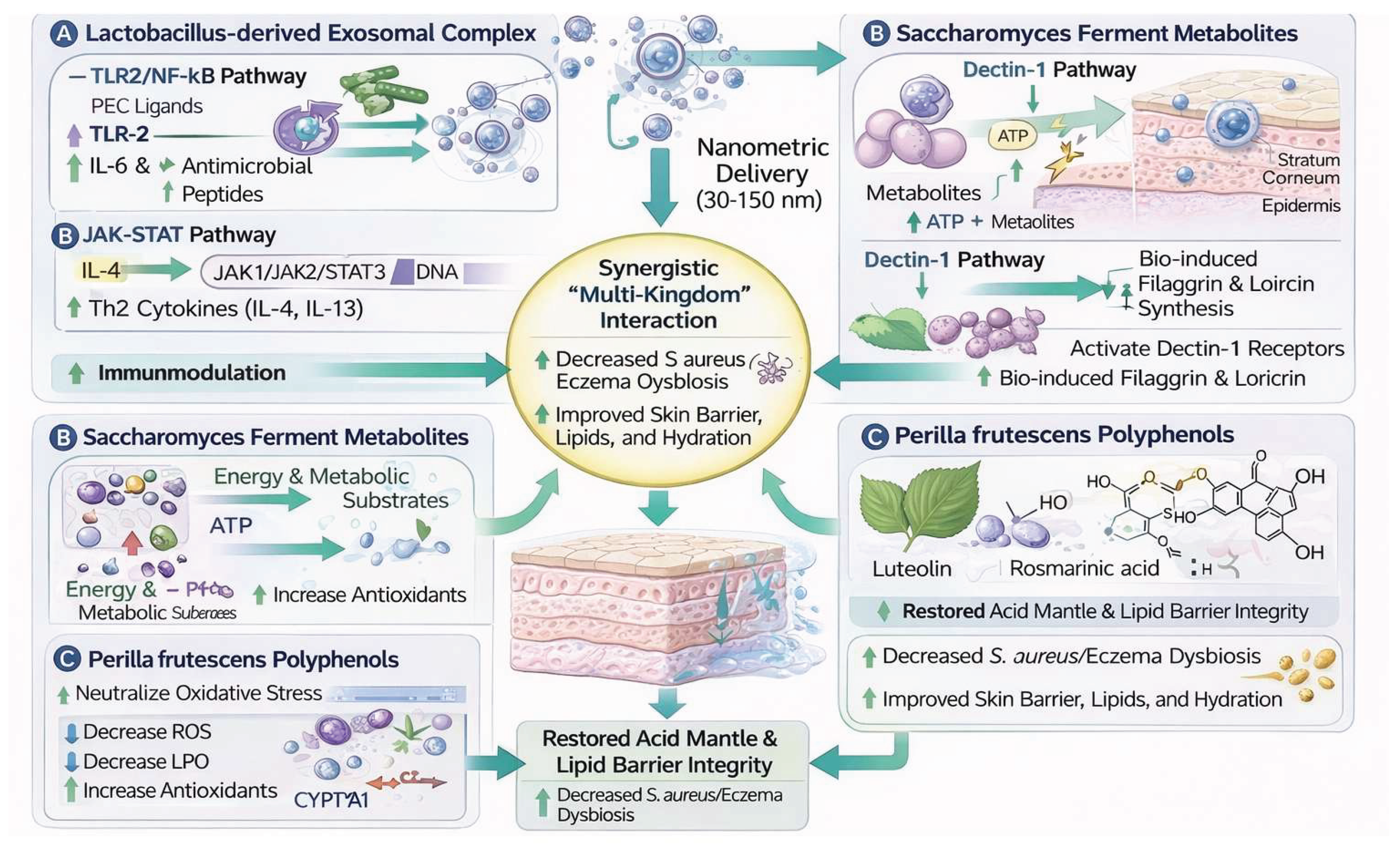
Figure 2.
Evaluation of the regenerative potential of Perilla-derived exosomal complex (PEC) on the dermal extracellular matrix (ECM). (a) Dose-dependent induction of intracellular elastin synthesis in human dermal fibroblasts, compared to Dexamethasone (DEX, 10 µM) as a positive control. (b) Stimulation of Type I Collagen synthesis as assessed by Sirius Red/Fast Green assay, with Ascorbic Acid (AA, 100 µM) serving as the reference standard. The significant protein up-regulation confirms the structural stability and successful cargo delivery of PEC into the target cells. Data are expressed as mean percentage ± SD relative to the untreated control (100%). Statistical significance: * p < 0.05, ** p < 0.01, *** p < 0.001 vs. Untreated. Adapted from Active Concepts Technical Reports [39,40].
Figure 2.
Evaluation of the regenerative potential of Perilla-derived exosomal complex (PEC) on the dermal extracellular matrix (ECM). (a) Dose-dependent induction of intracellular elastin synthesis in human dermal fibroblasts, compared to Dexamethasone (DEX, 10 µM) as a positive control. (b) Stimulation of Type I Collagen synthesis as assessed by Sirius Red/Fast Green assay, with Ascorbic Acid (AA, 100 µM) serving as the reference standard. The significant protein up-regulation confirms the structural stability and successful cargo delivery of PEC into the target cells. Data are expressed as mean percentage ± SD relative to the untreated control (100%). Statistical significance: * p < 0.05, ** p < 0.01, *** p < 0.001 vs. Untreated. Adapted from Active Concepts Technical Reports [39,40].
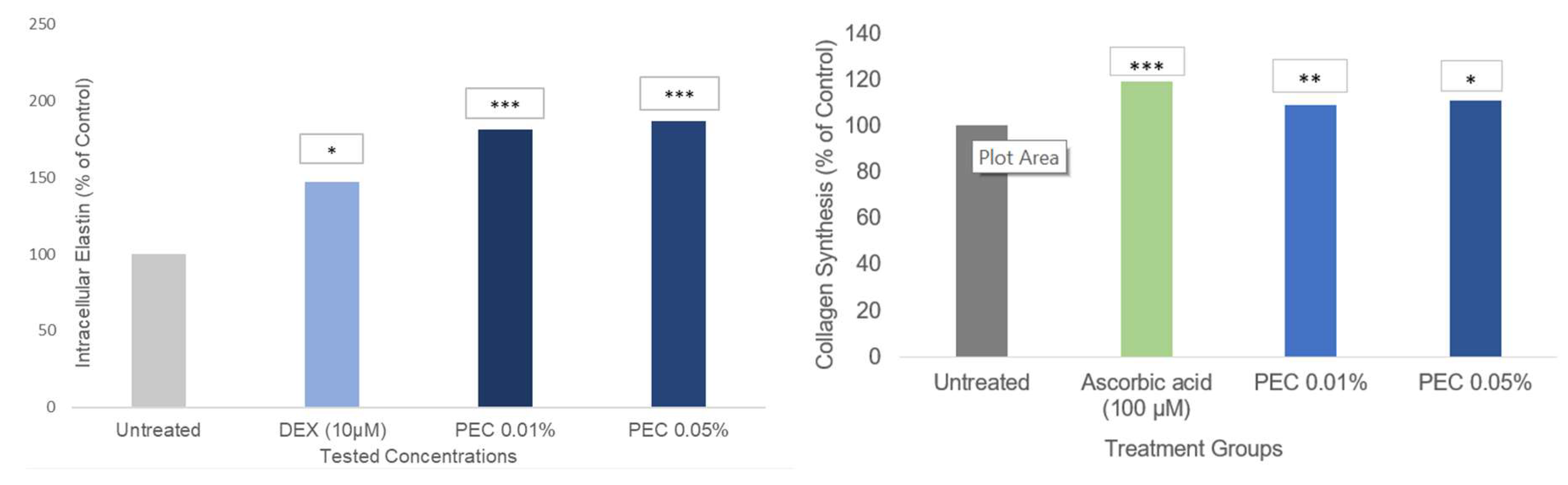
Figure 3.
Schematic representation of exosomal stability and dermal delivery. The diagram highlights the nanometric scale of PEC, its ability to bypass the stratum corneum barrier, and the subsequent controlled release of bioactives within the dermal matrix to ensure targeted therapeutic action. This figure was conceptualized by the authors and generated with assistance of ChatGPT (Open AI) for visual representation, subsenquently verified for scientific accuracy by the authors. Abbreviations: ECM, extracellular matrix; IL, interleukin; JAK, Janus kinase; mRNA, messenger RNA; M1, classically activated (pro-inflammatory) macrophage; M2, alternatively activated (reparative) macrophage; NF-κB, nuclear factor kappa B; STAT, signal transducer and activator of transcription; STAC, signal transduction activation complex;TLR, Toll-like receptor; TNF-α, tumor necrosis factor alpha.
Figure 3.
Schematic representation of exosomal stability and dermal delivery. The diagram highlights the nanometric scale of PEC, its ability to bypass the stratum corneum barrier, and the subsequent controlled release of bioactives within the dermal matrix to ensure targeted therapeutic action. This figure was conceptualized by the authors and generated with assistance of ChatGPT (Open AI) for visual representation, subsenquently verified for scientific accuracy by the authors. Abbreviations: ECM, extracellular matrix; IL, interleukin; JAK, Janus kinase; mRNA, messenger RNA; M1, classically activated (pro-inflammatory) macrophage; M2, alternatively activated (reparative) macrophage; NF-κB, nuclear factor kappa B; STAT, signal transducer and activator of transcription; STAC, signal transduction activation complex;TLR, Toll-like receptor; TNF-α, tumor necrosis factor alpha.
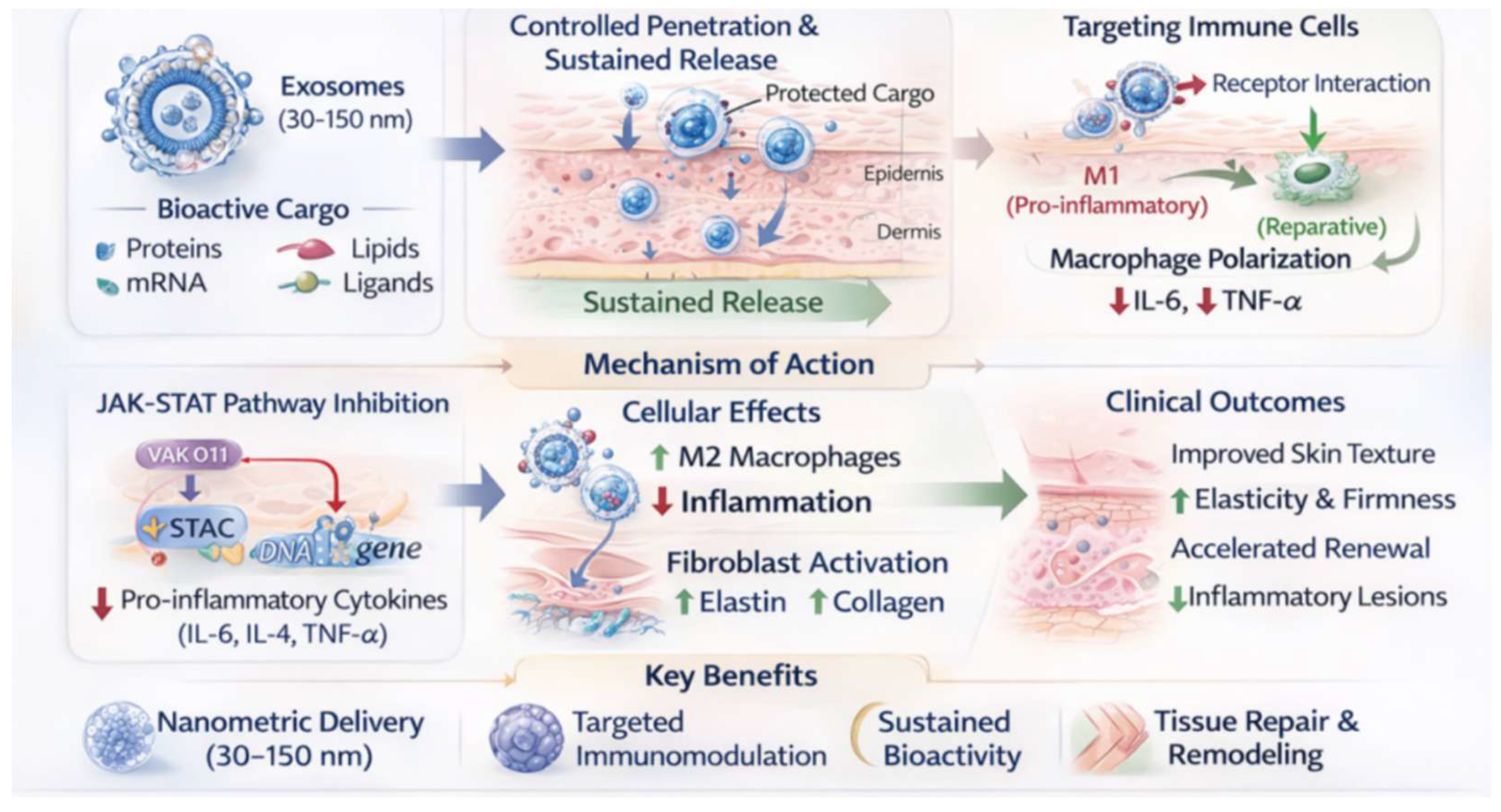
Table 1.
Comparative Pharmacological Profile and Molecular Targets of Bacterial (Lactobacillus) vs. Fungal (Saccharomyces) Postbiotics.
Table 1.
Comparative Pharmacological Profile and Molecular Targets of Bacterial (Lactobacillus) vs. Fungal (Saccharomyces) Postbiotics.
| Category | Lactobacillus (Bacterial Postbiotics) | Saccharomyces (Fungal Postbiotics) | Synergistic Effect (Multi-Kingdom Approach) |
|---|---|---|---|
| Structural Components | Peptidoglycans (PGN), lipoteichoic acids (LTA) [6,24] | β-1,3/1,6-glucans, mannoproteins [25,26] | Complementary structural signaling |
| Primary Receptors | TLR-2 activation [6,24] | Dectin-1 activation [25,26] | Dual PRR activation |
| Signaling Pathways | NF-κB, MAPK pathways [6,24] | Dectin-1 and AhR pathways [4,17,20,27] | TLR + JAK-STAT + AhR modulation [12] |
| Immune Effects | AMP induction (β-defensin, LL-37); immune priming [6,24] | Reduction of Th2 inflammation [25,26] | ↓ IL-6 (~40%) [4,8] |
| Metabolic Activity | Lactic acid (AHA); pH regulation (4.5–5.5) [28,29] | Vitamins (B-complex), amino acids, metabolites [20,27] | Restored acid mantle + metabolic support |
| Barrier Function | Protease inhibition; antimicrobial barrier support [28,29] | FLG expression → NMF → ↓ TEWL [4,17,20,27] | Enhanced barrier integrity |
| Oxidative Stress Modulation | Indirect immune-mediated reduction | Antioxidant effect (↓ ROS, ↓ LPO); CYP1A1 modulation [30,31] | Restored redox homeostasis |
| Microbiome Interaction | Quorum quenching; inhibits Staphylococcus Aureus biofilm [32] | Supports microbial balance | Restores eubiosis [15,18,33,34,35] |
| Cellular Effects |
AMP production; pathogen exclusion [36,37] |
Keratinocyte proliferation; collagen & loricrin synthesis [38] | Immune defense + tissue repair |
| Dermal Remodeling | Limited ECM stimulation | ↑ Collagen (+11%), ↑ Elastin (+87%) [36,39,40] | Enhanced ECM regeneration |
| Clinical Outcomes | Reduced infection and inflammation | Improved hydration and barrier repair | ↓ erythema, improved skin texture (VISIA) [41,42] |
| Pharmacological Role | Innate immune activation | Trophic and structural support | Holistic AD management [15,18,33,34,35] |
Abbreviations: AHA, alpha-hydroxy acid; AhR, aryl hydrocarbon receptor; AMP, antimicrobial peptide; ATP, adenosine triphosphate; CYP1A1, cytochrome P450 1A1; ECM, extracellular matrix; FLG, filaggrin; IL, interleukin; JAK, Janus kinase; LPO, lipid peroxidation; LTA, lipoteichoic acid; MAPK, mitogen-activated protein kinase; NF-κB, nuclear factor kappa B; NMF, natural moisturizing factor; PGN, peptidoglycan; PRR, pattern recognition receptor; ROS, reactive oxygen species; STAT, signal transducer and activator of transcription; TEWL, transepidermal water loss; TLR, Toll-like receptor; Th2, T helper type 2.
Table 4.
Integration of artificial intelligence (AI) in predicting postbiotic efficacy in atopic dermatitis (AD).
Table 4.
Integration of artificial intelligence (AI) in predicting postbiotic efficacy in atopic dermatitis (AD).
| Domain | AI Application | Key Features / Inputs | Clinical Relevance |
|---|---|---|---|
| Predictive modeling | Risk prediction and treatment response estimation | Baseline severity, flare history, treatment exposure, longitudinal barrier and microbiome data | Enables personalized prediction of flare risk and likelihood of response to postbiotics [90,91] |
| Disease stratification | Machine learning-based deep phenotyping | Clinical phenotype, disease trajectory patterns, multi-omics data | Identifies patient subgroups with distinct disease trajectories and therapeutic needs [93] |
| Severity assessment | AI-assisted or automated scoring systems | Standardized severity indices, imaging, longitudinal clinical data | Reduces inter-observer variability and improves monitoring consistency [93] |
| Digital biomarkers | Passive flare detection and monitoring | Wearable/device-derived signals, longitudinal symptom tracking | Enables early detection of flares and proactive therapeutic adjustments [92,93] |
| Treatment optimization | AI-guided stratification linked to treatment pathways | Integrated datasets (clinical, microbiome, omics) | Supports precision medicine and individualized postbiotic regimens [92] |
| Hybrid therapeutic integration | AI-supported “inside-out” and “outside-in” approaches | Clinical response to biologics + barrier restoration markers (e.g., filaggrin, loricrin) | Enhances synergy between systemic biologics and topical postbiotics; supports steroid-sparing strategies |
| Mechanistic targeting | Modeling of pathway-specific effects | AhR activation, cytokine profiles, oxidative stress pathways (e.g., CYP1A1) | Predicts response to postbiotics targeting barrier repair and immune modulation |
| Model architecture | Advanced AI frameworks | Graph-based models, attention-based architectures | Captures complex relationships between clinical and biological variables [88,92] |
| Data requirements | Standardized and validated datasets | Clinical variables, microbiome composition, S. aureus dominance, functional signatures | Ensures reproducibility and generalizability across patient populations |
| Limitations & considerations | Validation and ethical use | External validation, fairness assessment, transparent inputs | Prevents bias, overfitting, and ensures clinical applicability [90,91] |
| Clinical implementation | Decision-support systems | Integrated patient data and standardized interventions | Supports clinicians without replacing judgment; improves personalized adjunctive care [90] |
Abbreviations: AD, atopic dermatitis; AI, artificial intelligence; AhR, aryl hydrocarbon receptor; CYP1A1, cytochrome P450 1A1.
Disclaimer/Publisher’s Note: The statements, opinions and data contained in all publications are solely those of the individual author(s) and contributor(s) and not of MDPI and/or the editor(s). MDPI and/or the editor(s) disclaim responsibility for any injury to people or property resulting from any ideas, methods, instructions or products referred to in the content. |
© 2026 by the authors. Licensee MDPI, Basel, Switzerland. This article is an open access article distributed under the terms and conditions of the Creative Commons Attribution (CC BY) license (http://creativecommons.org/licenses/by/4.0/).
Copyright: This open access article is published under a Creative Commons CC BY 4.0 license, which permit the free download, distribution, and reuse, provided that the author and preprint are cited in any reuse.


