

Submitted:
24 March 2026
Posted:
27 March 2026
You are already at the latest version
Abstract
Background: Although early laparoscopic cholecystectomy represents the standard treatment for acute cholecystitis [AC], reliable preoperative risk stratification remains challenging. This study compared the discriminative performance of five prognostic scores: two disease-specific tools (Chole-Risk and a locally modified variant, Chole-Risk mod) and three general indices (POSSUM Physiological Score, APACHE II, and Charlson Comorbidity Index [CCI]) for predicting postoperative complications [POC] and prolonged hospital stay. Methods: This single-center retrospective study included 211 consecutive patients undergoing cholecystectomy for AC between 2015 and 2024. Primary endpoint: the occurrence of any POC. Secondary endpoint: prolonged length of stay (LOS), defined as postoperative hospitalization exceeding the 75th percentile (>6 days). Discrimination was assessed using the area under the receiver operating characteristic curve (AUC), with pairwise comparisons performed using the DeLong test. Calibration was evaluated graphically, and clinical utility was explored through decision curve analysis. Results: POC occurred in 60 patients (28.4%), and prolonged LOS in 51 (24.2%). Chole-Risk mod showed the best discrimination (AUC 0.786) and the strongest association per one-standard-deviation increase (OR 4.10; 95% CI 2.47–6.79). Other scores showed lower performance: Chole-Risk (AUC 0.755), CCI (0.736), POSSUM Physiological Score (0.707), and APACHE II (0.696). For prolonged LOS, Chole-Risk demonstrated the highest discrimination (AUC 0.713). Decision curve analysis confirmed a net clinical benefit for Chole-Risk–based models across a broad range of decision thresholds. Conclusions: Disease-specific scores incorporating variables related to biliary pathology outperform general physiological and comorbidity indices in predicting adverse outcomes after cholecystectomy for acute cholecystitis. These findings suggest that the severity of the local inflammatory process may influence postoperative risk more strongly than the patient’s overall physiological burden. Prospective multicenter validation is warranted.
Keywords:
acute cholecystitis
; cholecystectomy
; risk-prediction
; prognostic score
; chole-risk
; postoperative complications
; length of stay
1. Introduction
Acute cholecystitis is one of the most common surgical emergencies worldwide, accounting for a substantial proportion of unplanned hospital admissions and operating-room utilization [1,2,3].
In most cases (90–95%), acute cholecystitis results from cystic duct obstruction by gallstones, leading to gallbladder distension, ischemia, and secondary infection. [4].
Early laparoscopic cholecystectomy, performed within 72 hours of symptom onset or during the index admission, is now endorsed as the treatment of choice by the Tokyo Guidelines 2018 [5], the World Society of Emergency Surgery (WSES), and multiple meta-analyses, owing to shorter hospital stays, fewer recurrences, and comparable or lower complication rates relative to delayed surgery [6,7,8,9,10].
Nevertheless, the procedure carries a non-negligible risk of adverse events. Bile duct injury remains the most feared complication, occurring in 0.3–1.8% of cases and carrying mortality rates of up to 20% [11,12]. The principal mechanism is misidentification of ductal anatomy rather than a purely technical error, a risk amplified by inflammation, fibrosis, and the well-documented variability of cystic duct insertion, arterial supply, and gallbladder position [12,13,14]. The systematic adoption of the Critical View of Safety (CVS), introduced by Strasberg in 1995, significantly reduces the risk of bile duct injury without increasing operative time or conversion rates [15,16].
Recent large-scale analyses have further confirmed that male sex and acute cholecystitis itself are independent, non-modifiable risk factors for bile duct injury, underscoring the importance of preoperative risk assessment [17].
Beyond intraoperative biliary injuries, postoperative morbidity encompasses surgical-site infections, intra-abdominal collections, hemorrhage, and systemic complications, all of which prolong hospital stay, increase costs, and impair patient-centered outcomes [18,19]. In this regard, length of stay (LOS) has gained recognition not only as a surrogate marker of clinical complexity but also as a metric of organizational efficiency and resource allocation [20].
Several general prognostic scores, such as the American Society of Anesthesiologists Physical Status (ASA-PS) classification, POSSUM, APACHE II, and the Charlson Comorbidity Index (CCI), have been widely used to stratify perioperative risk across surgical specialties [21,22,23,24]. However, these tools primarily reflect the patient’s systemic physiological reserve and comorbidity burden, while neglecting disease-specific variables related to biliary inflammation and surgical complexity.. More recently, the Chole-Risk score was introduced by Di Martino et al. as a simple, preoperative tool designed expressly to predict complicated postoperative courses after early cholecystectomy for acute calculous cholecystitis [25]. The S.P.Ri.M.A.C.C. multicenter study subsequently provided prospective external validation, comparing Chole-Risk head-to-head with POSSUM PS, CCI, ASA-PS, APACHE II, and TG18 severity grading in 1,253 patients across 79 centers [26].
Despite these advances, important knowledge gaps remain. First, it remains unclear whether the superiority of disease-specific scores over general indices is preserved in unselected, real-world cohorts that include all indications for cholecystectomy in the setting of acute cholecystitis. Second, most validation studies have focused on composite morbidity endpoints; the added ability of these tools to predict prolonged LOS, that is an outcome of considerable organizational relevance, has been less thoroughly investigated. Third, few studies have simultaneously assessed discrimination, calibration, and clinical utility (via decision curve analysis) to provide a comprehensive performance evaluation.
The aim of this study was to compare the predictive performance of five prognostic scores: Chole-Risk, a locally modified Chole-Risk variant (Chole-Risk mod), POSSUM Physiological Score, APACHE II, and CCI, in predicting postoperative complications and prolonged hospital stay after cholecystectomy for acute cholecystitis. Accurate risk prediction may support surgical planning, patient counseling, and hospital resource allocation in emergency biliary surgery.
By integrating measures of discrimination, calibration, and clinical utility (decision curve analysis), we sought to determine whether disease-specific instruments provide a meaningful advantage over general severity indices in perioperative risk stratification.
2. Materials and Methods
2.1. Study Design and Ethical Considerations
This retrospective single-center observational cohort study was conducted at a tertiary referral hospital in Italy.
The study protocol was designed and reported in accordance with the Strengthening the Reporting of Observational Studies in Epidemiology (STROBE) statement [27] and the Transparent Reporting of a multivariable prediction model for Individual Prognosis Or Diagnosis (TRIPOD) checklist [28]. This study was approved by the local institutional review board. The requirement for individual informed consent given its retrospective, anonymized design was waived.
2.2. Population
All consecutive patients who underwent cholecystectomy for acute cholecystitis between January 2015 and December 2024 were identified from a prospectively maintained institutional surgical database. The diagnosis of acute cholecystitis was established on the basis of clinical presentation, laboratory findings, and imaging studies consistent with the previously mentioned Tokyo Guidelines 2018 . Inclusion was unrestricted with respect to the severity of cholecystitis, surgical approach, or patient comorbidity profile, thereby reflecting an unselected, real-world population. Patients with incomplete data precluding the calculation of all five prognostic scores or the ascertainment of outcomes were excluded. The final analytical cohort comprised 211 patients.
2.3. Variables and Definitions
The following variables were extracted for each patient: age, sex, body mass index (BMI), comorbidities (coded as a binary variable), history of prior abdominal surgery, previous percutaneous cholecystostomy, signs of choledocholithiasis, intraoperative findings indicative of difficult cholecystectomy, Mirizzi syndrome, use of inotropes, and need for endoscopic retrograde cholangiopancreatography (ERCP). All dichotomous variables were coded as 1 = present and 0 = absent.
2.4. Prognostic Scores
Five prognostic scores were calculated for each patient:
Chole-Risk (pure): A preoperative score (range 0–4) developed by Di Martino et al. [25] to predict complicated postoperative courses after early cholecystectomy for acute calculous cholecystitis.
Chole-Risk modified (Chole-Risk mod): an exploratory locally adapted version of the original score that incorporated additional clinically relevant variables available in the institutional database, including acute-on-chronic cholecystitis, prior cholecystostomy, and microlithiasis. This modified score was evaluated solely for exploratory comparative purposes and was not intended as a validated clinical prediction model.
POSSUM Physiological Score (PS): The physiological component of the POSSUM system, integrating 12 preoperative physiological parameters [29].
APACHE II: A score originally designed for intensive-care prognostication, based on acute physiological derangements, age, and chronic health status [23].
Charlson Comorbidity Index (CCI): A weighted index quantifying the cumulative burden of chronic comorbidities [24].
2.5. Endpoints
The primary endpoint was the occurrence of any postoperative complication during the index hospitalization. Complications were graded according to the Clavien–Dindo classification and subsequently analyzed as a binary outcome (presence vs absence of complications). Major complications were defined as Clavien–Dindo grade ≥III.
The secondary endpoint was prolonged length of stay (LOS), defined as postoperative hospitalization exceeding the 75th percentile of the cohort distribution (>6 days).
2.6. Statistical Analysis
Continuous variables were described as mean ± standard deviation (SD) and median [interquartile range, IQR]; categorical variables as absolute frequencies and percentages. Between-group comparisons were performed using the Student t-test or Mann–Whitney U test for continuous variables and the chi-squared or Fisher exact test for categorical variables, as appropriate.
The association between each score and the binary endpoints was quantified by logistic regression, with results expressed as odds ratios (OR) per one-standard-deviation (1-SD) increment to allow direct comparison across differently scaled instruments, together with 95% confidence intervals (CI).
Discrimination was evaluated by receiver operating characteristic (ROC) curve analysis with calculation of the area under the curve (AUC), and 95% confidence intervals were estimated using 2,000 bootstrap resamples. Pairwise AUC comparisons were performed using the nonparametric DeLong test [30]. In view of the moderate class imbalance of both endpoints, precision–recall (PR) curves and average precision (AP) were also computed.
For each score, clinically actionable cut-offs were identified using the Youden index, and the corresponding sensitivity, specificity, positive predictive value (PPV), negative predictive value (NPV), and accuracy were reported.
Model calibration was assessed graphically via calibration plots on ten decile bins of predicted risk. Clinical utility was evaluated by decision curve analysis (DCA), estimating the net benefit across a range of clinically relevant threshold probabilities [31].
Analyses were performed using Python 3.12 (scikit-learn 1.4, scipy 1.11). A two-sided P value < 0.05 was considered statistically significant.
3. Results
A total of 211 patients met the inclusion criteria and constituted the analytical cohort. Their baseline characteristics are summarized in Table 1. The mean age was 53.4 ± 17.8 years, with a near-equal sex distribution (50.7% female). The median BMI was 26.0 kg/m² [IQR 23.6–29.4]. Almost all patients (98.1%) presented with acute-on-chronic cholecystitis, and 99.1% had documented cholelithiasis. Relevant surgical history included prior abdominal surgery in 36.5% and previous percutaneous cholecystostomy in 2.4%. Signs of choledocholithiasis were present in 75.8%, intraoperative findings suggestive of difficult cholecystectomy in 29.4%, and ERCP was performed in 18.0% of cases.
The median postoperative stay was 3.0 days [IQR 2.0–6.0]. Postoperative complications occurred in 60 patients (28.4%), while 51 patients (24.2%) experienced prolonged LOS exceeding the 75th percentile threshold (6 days) (Table 2).
3.1. Association Between Scores and Outcomes
All five scores demonstrated a statistically significant association with both endpoints (all P < 0.02; Table 3). For postoperative complications, the Chole-Risk mod exhibited the strongest association per 1-SD increment (OR 4.10; 95% CI 2.47–6.79), followed by Chole-Risk (OR 2.93; 2.04–4.21), CCI (OR 2.62; 1.91–3.60), POSSUM PS (OR 2.33; 1.72–3.16), and APACHE II (OR 1.88; 1.34–2.63). For prolonged LOS, the hierarchy was similar, with Chole-Risk showing the strongest association (OR 2.22; 1.52–3.25) and APACHE II the weakest (OR 1.44; 1.08–1.94).
3.2. Discrimination
The prediction of complications was evaluated at ROC analysis. the Chole-Risk mod achieved the highest AUC of 0.786 (95% CI 0.710–0.851), followed by Chole-Risk (0.755; 0.687–0.821), CCI (0.736; 0.659–0.811), POSSUM PS (0.707; 0.625–0.787), and APACHE II (0.696; 0.618–0.772) (Figure 1a). Pairwise DeLong tests showed that the Chole-Risk mod tended to outperform POSSUM PS (P = 0.085) and APACHE II (P = 0.079), although formal statistical significance at the conventional 0.05 threshold was not reached, likely reflecting the sample size.
For the prediction of prolonged LOS, AUC values evaluated at ROC analysis were globally lower (range 0.647–0.713), indicating that this endpoint is inherently less predictable. The Chole-Risk achieved the best discrimination (AUC 0.713; 0.636–0.791), whereas the Chole-Risk mod ranked second (0.677; 0.579–0.767), followed closely by CCI (0.673), POSSUM PS (0.665), and APACHE II (0.647) (Figure 1b). DeLong comparisons for this endpoint yielded no statistically significant differences between any pair of scores.
Considering the moderate class imbalance (complications: 28.4%; prolonged LOS: 24.2%), precision–recall curves were also generated. For complications, the Chole-Risk mod achieved the highest average precision (AP 0.623), confirming its superiority, followed by CCI (0.600), POSSUM PS (0.561), Chole-Risk (0.513), and APACHE II (0.441). For prolonged LOS, AP values were uniformly lower, with Chole-Risk mod leading (0.441) (Figure 1c,d).
3.3. Cut-Off Identification
Youden-index-derived cut-offs and their corresponding diagnostic performance metrics are presented in Table 4. For complications, the Chole-Risk ≥2 yielded a sensitivity of 78.3% and an NPV of 88.2%, making it well suited as a rule-out threshold. For prolonged LOS, the Chole-Risk mod ≥6 offered high specificity (91.9%) and a PPV of 60.6%, serving as an effective rule-in cut-off.
3.4. Calibration
Calibration plots demonstrated good agreement between predicted probabilities and observed event rates for the Chole-Risk instruments, particularly for the complications endpoint, with data points clustering near the ideal diagonal. General scores exhibited greater dispersion from the calibration line, suggesting suboptimal calibration in this specific surgical context (Figure 2a,b).
3.5. Decision Curve Analysis
The DCA demonstrated that, for the prediction of postoperative complications, the Chole-Risk mod provided the highest net benefit across a broad range of clinically plausible threshold probabilities (approximately 10–50%), consistently outperforming the treat-all and treat-none reference strategies. For prolonged LOS, the Chole-Risk instruments similarly dominated the general scores, although differences were smaller (Figure 3a,b).
4. Discussion
The present study provides a comparative evaluation of five prognostic scores for predicting postoperative complications and prolonged hospital stay after cholecystectomy for acute cholecystitis. The main finding is that disease-specific instruments, in particular the Chole-Risk score and its modified variant, showed better performance than widely used general prognostic indices such as POSSUM PS, APACHE II, and the Charlson Comorbidity Index. These results suggest that, in the setting of acute biliary inflammation, variables directly related to the local disease process may have greater predictive value than measures reflecting the patient’s overall physiological reserve.
From a clinical perspective, these findings support the concept that postoperative morbidity in acute cholecystitis is primarily determined by the complexity of the local biliary pathology rather than by systemic physiological derangement alone. General-purpose prognostic scores capture global physiological status and comorbidity burden, which are undoubtedly important determinants of perioperative risk across surgical disciplines. Other disease-oriented models have also been proposed to predict operative difficulty during laparoscopic cholecystectomy, including the preoperative risk score described by Nassar et al. [31].
However, they do not incorporate variables, specific to gallbladder disease, such as inflammatory severity, anatomical distortion, or indicators of technically demanding dissection. These are directly linked to operative difficulty and the mechanisms leading to intraoperative complications. Anatomical variability of the cystic duct and biliary tree may further increase the risk of misidentification during dissection [32].
In contrast, the Chole-Risk score was specifically designed to integrate such disease-related features, and the improved predictive performance observed in the present analysis appears consistent with this conceptual framework.
The magnitude of this difference is clinically meaningful. In our cohort, the Chole-Risk mod achieved the highest discriminative performance for postoperative complications (AUC 0.786), exceeding that of APACHE II by approximately nine percentage points and demonstrating a substantially stronger association with the outcome when standardized per one standard deviation increment. Although pairwise comparisons did not always reach formal statistical significance, likely due to the moderate sample size, the overall hierarchy of predictive performance consistently favored disease-specific instruments. These observations align with the rationale underlying the development of the original Chole-Risk score [25] and are concordant with the findings of the S.P.Ri.M.A.C.C. prospective multicenter validation study, which also demonstrated the superiority of disease-specific risk stratification compared with general indices [26].
This analysis extends this evidence in several respects. First, our cohort intentionally included an unselected population of patients undergoing cholecystectomy for acute cholecystitis in a real-world emergency surgery setting, thereby enhancing the ecological validity of the findings. Second, beyond conventional measures of discrimination such as the area under the ROC curve, we evaluated model calibration and clinical utility through decision curve analysis.
The observation that Chole-Risk–based instruments consistently provided a higher net benefit across a wide range of clinically relevant threshold probabilities suggests that their predictive advantage may translate into practical decision support for perioperative management [33].
In contrast to the results observed for postoperative complications, the discriminative performance of all scores was lower and more homogeneous for the prediction of prolonged length of stay. This finding likely reflects the inherently multifactorial nature of stay, which is influenced not only by clinical severity but also by organizational and social determinants such as hospital bed availability, discharge policies, and postoperative rehabilitation logistics [20]. Consequently, no purely clinical score can fully capture the complexity of this endpoint.
Beyond global measures of predictive accuracy, the identification of operational cut-offs represents an important step toward practical implementation. In our dataset, a Chole-Risk score below 2 identified patients with a low probability of both postoperative complications and prolonged hospital stay, supporting its potential use as a rule-out threshold in perioperative triage. Conversely, higher thresholds, particularly for the modified Chole-Risk score, were associated with high specificity for prolonged hospitalization, suggesting a potential role in identifying patients who may benefit from enhanced perioperative monitoring, early multidisciplinary involvement, and proactive resource allocation. Such a stratified approach could contribute to improved bed management and more efficient use of hospital resources, particularly in high-volume emergency surgery settings.
The strengths of this study include the use of a consecutive, real-world cohort, the simultaneous comparison of multiple prognostic scores within a uniform analytical framework, and the integration of complementary performance metrics including discrimination, calibration, and decision curve analysis.
The evaluation of two clinically relevant outcomes, such as postoperative complications and prolonged hospital stay, further enhances the practical relevance of the analysis.
Several limitations should nevertheless be acknowledged. The retrospective single-center design introduces potential selection and information biases and may limit the generalizability of the findings to other healthcare systems. The sample size was moderate, which likely reduced the statistical power of pairwise comparisons between models. In addition, postoperative complications were analyzed as a binary outcome without formal severity grading according to a standardized classification system, which precluded the evaluation of score performance for major versus minor complications. The length-of-stay endpoint is also susceptible to non-clinical determinants, as discussed above. Finally, the modified Chole-Risk score represents a local adaptation that requires independent external validation before it can be recommended for widespread adoption.
Future research should therefore focus on prospective multicenter validation of disease-specific risk stratification tools in diverse healthcare environments.
Taken together, these findings indicate that disease-specific risk stratification may represent a more appropriate framework for predicting adverse outcomes after cholecystectomy for acute cholecystitis. Prospective multicenter studies are needed to validate these results and to determine how such tools can be integrated into routine surgical decision-making.
5. Conclusions
In a real-world cohort of patients undergoing cholecystectomy for acute cholecystitis, disease-specific risk scores, particularly the modified Chole-Risk, outperformed general severity and comorbidity indices in predicting postoperative complications and prolonged hospital stay. These findings suggest that, in this surgical setting, the complexity of gallbladder and biliary disease may play a greater role in determining postoperative risk than the patient’s overall physiological condition.
The incorporation of simple disease-specific prognostic tools into the perioperative workflow may support perioperative risk stratification and resource planning in emergency biliary surgery. Prospective multicenter validation is required to confirm these results and to facilitate broader clinical implementation.
Author Contributions
Conceptualization, Marco Marcianò, Giovanni Guercio, Bianca Vicari, Agostara Virginia and Isabella Campo; Methodology, Marco Marcianò, Bianca Vicari, Agostara Virginia, Claudia Militello, Giuseppina Melfa and Giuseppina Orlando; Software, Marco Marcianò and Gianfranco Cocorullo; Validation, Bianca Vicari; Formal analysis, Marco Marcianò, Bianca Vicari, Agostara Virginia and Isabella Campo; Investigation, Marco Marcianò, Giovanni Guercio, Bianca Vicari, Agostara Virginia, Giuseppina Melfa and Giuseppina Orlando; Resources, Marco Marcianò, Giovanni Guercio, Bianca Vicari, Agostara Virginia, Isabella Campo and Claudia Militello; Data curation, Marco Marcianò, Isabella Campo and Claudia Militello; Writing – original draft, Marco Marcianò, Giuseppe Salamone, Giovanni Guercio, Bianca Vicari, Agostara Virginia, Isabella Campo and Gianfranco Cocorullo; Writing – review & editing, Marco Marcianò, Giuseppe Salamone, Giovanni Guercio, Bianca Vicari, Isabella Campo, Giuseppina Melfa, Giuseppina Orlando and Gregorio Scerrino; Visualization, Marco Marcianò, Giuseppe Salamone, Giovanni Guercio, Bianca Vicari, Claudia Militello, Giuseppina Melfa, Giuseppina Orlando, Gianfranco Cocorullo and Gregorio Scerrino; Supervision, Marco Marcianò, Giuseppe Salamone, Bianca Vicari, Giuseppina Melfa, Gianfranco Cocorullo and Gregorio Scerrino; Project administration, Marco Marcianò, Gianfranco Cocorullo and Gregorio Scerrino; Funding acquisition, Gregorio Scerrino. All authors have read and agreed to the published version of the manuscript.
Funding
This research received no external funding.
Institutional Review Board Statement
The study protocol was designed and reported in accordance with the Strengthening the Reporting of Observational Studies in Epidemiology (STROBE) statement and the Transparent Reporting of a multivariable prediction model for Individual Prognosis Or Diagnosis (TRIPOD) checklist. According to the applicable local institutional procedures for retrospective observational non-pharmacological research using anonymized pre-existing data, formal Ethics Committee approval was not required for this study. The study was conducted in accordance with the applicable institutional and national framework governing retrospective observational research.
Informed Consent Statement
Patient consent was waived due to retrospective, anonymized design of the study.
Data Availability Statement
The original contributions presented in this study are included in the article. Further inquiries can be directed to the corresponding author(s).
Acknowledgments
In this section you can acknowledge any support given which is not covered by the author contribution or funding sections. This may include administrative and technical support, or donations in kind (e.g., materials used for experiments).
Conflicts of Interest
The authors declare no conflict of interest.
References
- Pisano, M; Allievi, N; Gurusamy, K; et al. 2020 World Society of Emergency Surgery (WSES) guidelines for the diagnosis and treatment of acute calculous cholecystitis. World J Emerg Surg. 2020, 15, 61. [Google Scholar] [CrossRef] [PubMed]
- Trowbridge, RL; Rutkowski, NK; Shojania, KG. Does this patient have acute cholecystitis? JAMA 2003, 289, 80–86. [Google Scholar] [CrossRef] [PubMed]
- Lahav, L; Goldberg, N; Jiryis, T; Cristo, H; Soback, H; Avital, S; et al. Impact of discordant antibiotics on outcomes after percutaneous cholecystostomy for acute cholecystitis: a retrospective analysis of 184 PCC patients. J Clin Med. 2025, 14, 6589. [Google Scholar] [CrossRef]
- Feldman, M; Friedman, LS; Brandt, LJ. Sleisenger and Fordtran’s Gastrointestinal and Liver Disease, 11th ed.; Elsevier, 2020. [Google Scholar]
- Yokoe, M; Hata, J; Takada, T; Strasberg, SM; Asbun, HJ; Wakabayashi, G; et al. Tokyo Guidelines 2018: diagnostic criteria and severity grading of acute cholecystitis (with videos). J Hepatobiliary Pancreat Sci. 2018, 25, 41–54. [Google Scholar] [CrossRef] [PubMed]
- Gutt, CN; Encke, J; Königer, J; et al. Acute cholecystitis: early versus delayed cholecystectomy (ACDC Study). Ann Surg. 2013, 258, 385–393. [Google Scholar] [CrossRef]
- Gurusamy, KS; Samraj, K. Early versus delayed laparoscopic cholecystectomy for acute cholecystitis. Cochrane Database Syst Rev 2013, CD005440. [Google Scholar] [CrossRef]
- Cao, AM; Eslick, GD; Cox, MR. Early laparoscopic cholecystectomy is superior to delayed: meta-analysis. Surg Endosc. 2015, 29, 1172–1182. [Google Scholar] [CrossRef]
- Roulin, D; Saadi, A; Di Mare, L; Demartines, N; Halkic, N. Early versus delayed cholecystectomy for acute cholecystitis. Surg Endosc. 2016, 30, 1223–1232. [Google Scholar] [CrossRef]
- de Mestral, C; Tamim, H; Dixon, E; et al. Early cholecystectomy offers best outcomes at least cost. J Am Coll Surg. 2014, 219, 185–197. [Google Scholar] [CrossRef]
- Barrett, M; Asbun, HJ; Chien, HL; Brunt, LM; Telem, DA. Bile duct injury and morbidity following cholecystectomy: a need for improvement. Surg Endosc. 2018, 32, 1683–1688. [Google Scholar] [CrossRef]
- Pucher, PH; Brunt, LM; Davies, N; et al. Outcome trends and safety measures after 30 years of laparoscopic cholecystectomy. Surg Endosc. 2018, 32, 2175–2183. [Google Scholar] [CrossRef]
- Strasberg, SM; Hertl, M; Soper, NJ. An analysis of the problem of biliary injury during laparoscopic cholecystectomy. J Am Coll Surg. 1995, 180, 101–125. [Google Scholar] [PubMed]
- Way, LW; Stewart, L; Gantert, W; et al. Causes and prevention of laparoscopic bile duct injuries: analysis of 252 cases from a human factors perspective. Ann Surg. 2003, 237, 460–469. [Google Scholar] [CrossRef] [PubMed]
- Andall, RG; et al. The clinical anatomy of cystic artery variations. Surg Radiol Anat. 2016, 38, 747–754. [Google Scholar] [CrossRef] [PubMed]
- Strasberg, SM; Brunt, LM. Rationale and use of the critical view of safety in laparoscopic cholecystectomy. J Am Coll Surg. 2010, 211, 132–138. [Google Scholar] [CrossRef]
- Aburayya, BI; Al-Hayk, AK; Toubasi, AA; et al. Critical view of safety approach vs infundibular technique in laparoscopic cholecystectomy: which one is safer? A systematic review and meta-analysis. Updates Surg. 2024, 76, 2267–2276. [Google Scholar] [CrossRef]
- Ahmed, R; Akhtar, KH; Shah, S; et al. Risk factors and mitigating measures associated with bile duct injury during cholecystectomy: meta-analysis. BJS Open. 2025, 9(4), zraf076. [Google Scholar] [CrossRef]
- Dindo, D; Demartines, N; Clavien, PA. Classification of surgical complications. Ann Surg. 2004, 240, 205–213. [Google Scholar] [CrossRef]
- Myles, PS; et al. Days at home up to 30 days after surgery (DAH30): a patient-centred outcome. BMJ Open. 2017, 7, e015828. [Google Scholar] [CrossRef]
- Williams, GA; et al. Composite length of stay as a surgical quality metric. J Gastrointest Surg. 2019, 23, 1438–1444. [Google Scholar] [CrossRef]
- American Society of Anesthesiologists. ASA Physical Status Classification System.
- Copeland, GP; Jones, D; Walters, M. POSSUM: a scoring system for surgical audit. Br J Surg. 1991, 78, 355–360. [Google Scholar] [CrossRef] [PubMed]
- Knaus, WA; Draper, EA; Wagner, DP; Zimmerman, JE. APACHE II: a severity of disease classification system. Crit Care Med. 1985, 13, 818–829. [Google Scholar] [CrossRef] [PubMed]
- Charlson, ME; Pompei, P; Ales, KL; MacKenzie, CR. A new method of classifying prognostic comorbidity in longitudinal studies. J Chronic Dis. 1987, 40, 373–383. [Google Scholar] [CrossRef] [PubMed]
- Di Martino, M; Mora-Guzmán, I; Vaello Jodra, V; et al. How to predict postoperative complications after early laparoscopic cholecystectomy for acute cholecystitis: the Chole-Risk Score. J Gastrointest Surg. 2021, 25, 2814–2822. [Google Scholar] [CrossRef]
- Fugazzola, P; et al. Prediction of morbidity and mortality after early cholecystectomy for acute calculous cholecystitis: results of the S.P.Ri.M.A.C.C. study. World J Emerg Surg 2023, 18, 17. [Google Scholar] [CrossRef]
- von Elm, E; Altman, DG; Egger, M; et al. The STROBE statement: guidelines for reporting observational studies. BMJ. 2007, 335, 806–808. [Google Scholar] [CrossRef]
- Collins, GS; Reitsma, JB; Altman, DG; Moons, KGM. Transparent reporting of a multivariable prediction model for individual prognosis or diagnosis (TRIPOD). BMJ 2015, 350, g7594. [Google Scholar] [CrossRef]
- Copeland, GP. The POSSUM system of surgical audit. Arch Surg. 2002, 137, 15–19. [Google Scholar] [CrossRef]
- Nassar, AHM; Hodson, J; Ng, HJ; et al. Predicting the difficult laparoscopic cholecystectomy: development and validation of a pre-operative risk score. Surg Endosc. 2020, 34, 4549–4561. [Google Scholar] [CrossRef]
- Iwashita, Y; Hibi, T; Ohyama, T; et al. Delphi consensus on bile duct injuries during laparoscopic cholecystectomy. J Hepatobiliary Pancreat Sci. 2017, 24, 591–602. [Google Scholar] [CrossRef]
- Vickers, AJ; Elkin, EB. Decision curve analysis: a novel method for evaluating prediction models. Med Decis Making 2006, 26, 565–574. [Google Scholar] [CrossRef]
Figure 1.
Discriminative performance of the evaluated prognostic scores for postoperative complications and prolonged length of stay: ROC and precision–recall analyses. Sub-panels: a) ROC complications; b) ROC LOS; c) PR complications; d) PR LOS.
Figure 1.
Discriminative performance of the evaluated prognostic scores for postoperative complications and prolonged length of stay: ROC and precision–recall analyses. Sub-panels: a) ROC complications; b) ROC LOS; c) PR complications; d) PR LOS.
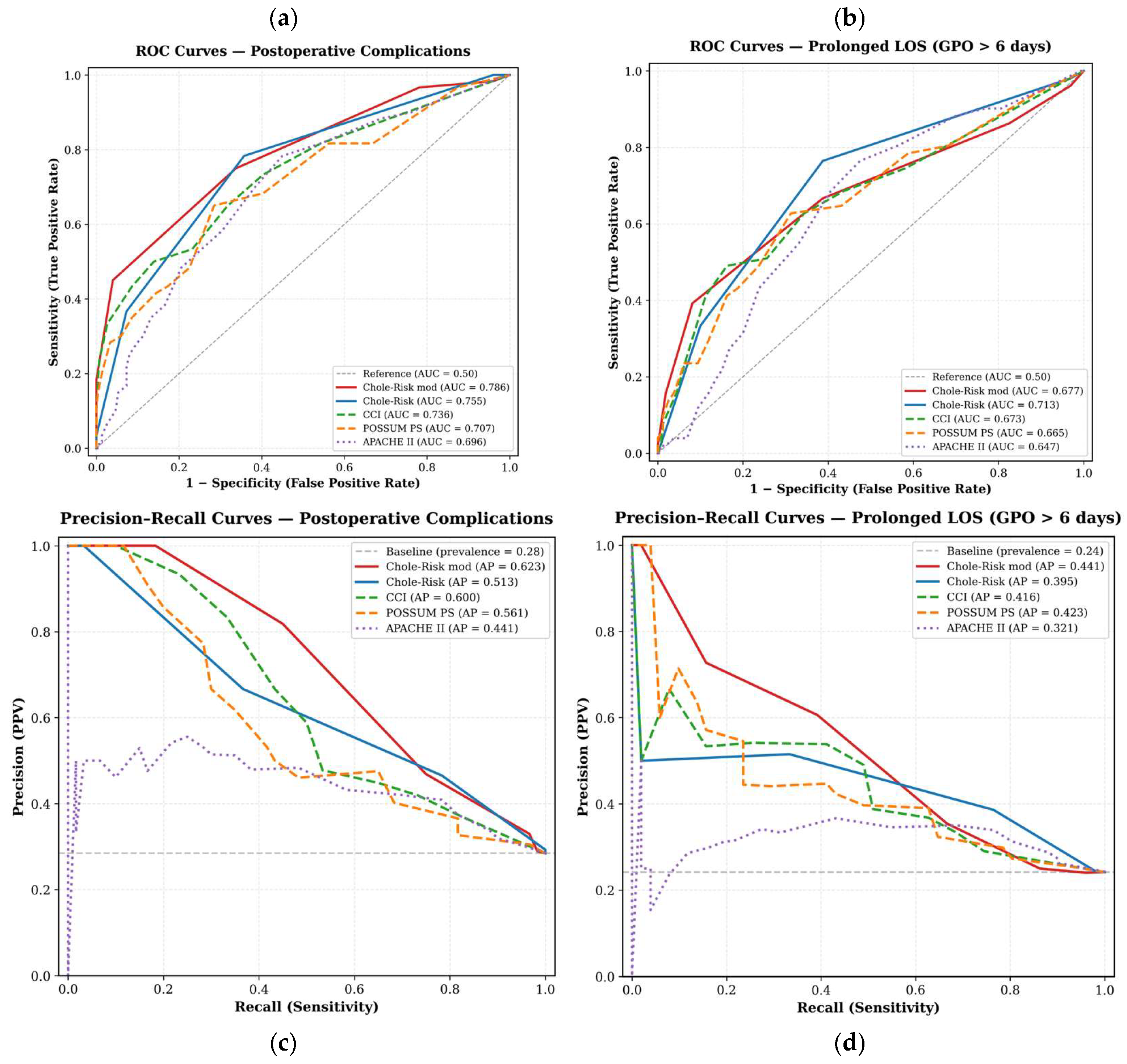
Figure 2.
Calibration plots: a) Postoperative complications. The dashed diagonal represents perfect calibration. b) Prolonged LOS. Each point represents a decile bin of predicted risk.
Figure 2.
Calibration plots: a) Postoperative complications. The dashed diagonal represents perfect calibration. b) Prolonged LOS. Each point represents a decile bin of predicted risk.
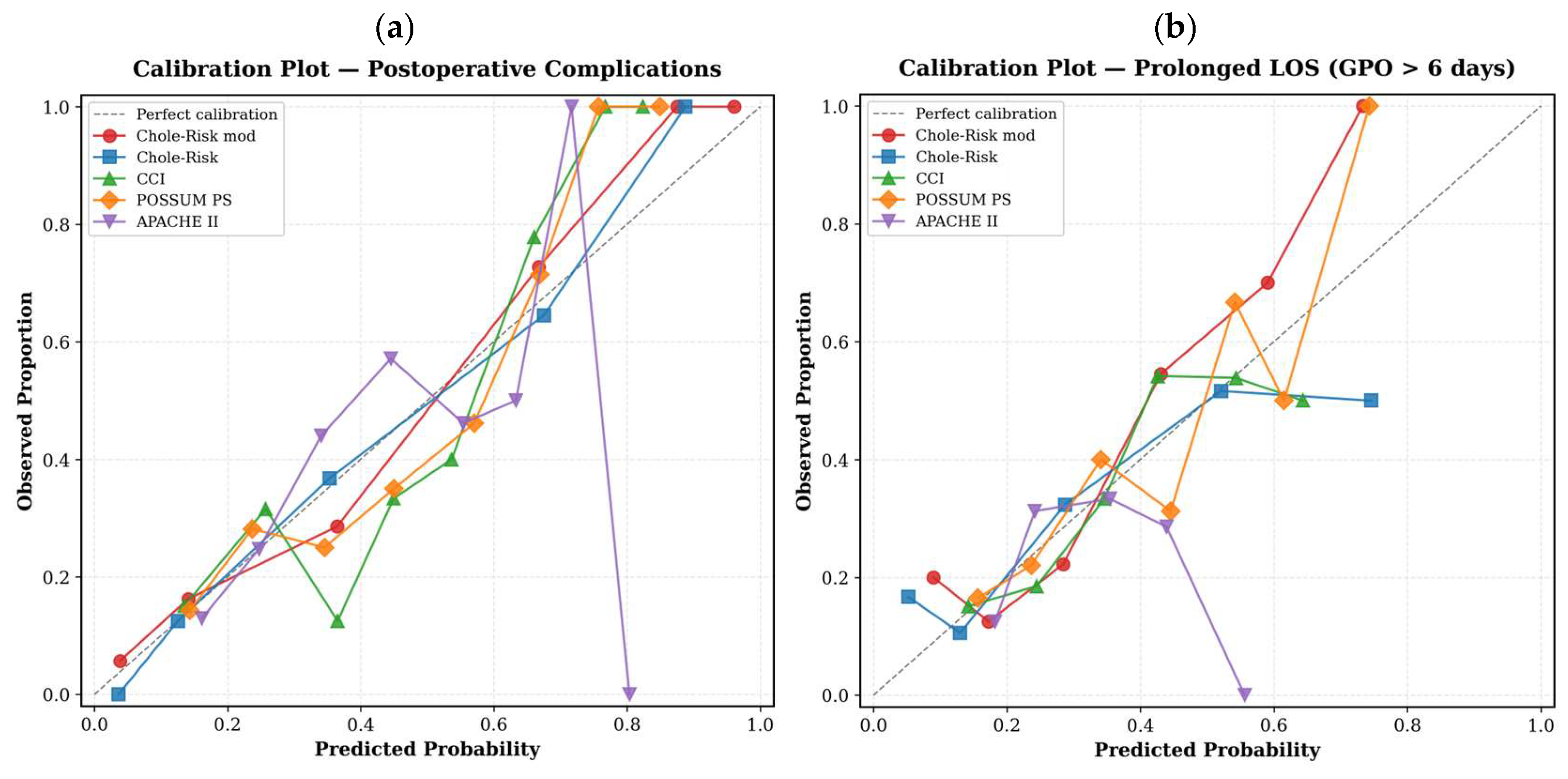
Figure 3.
Decision curve analysis: a) postoperative complications. Significant benefit is plotted against treat-all and treat-none strategies. b) prolonged LOS across a range of threshold probabilities.
Figure 3.
Decision curve analysis: a) postoperative complications. Significant benefit is plotted against treat-all and treat-none strategies. b) prolonged LOS across a range of threshold probabilities.
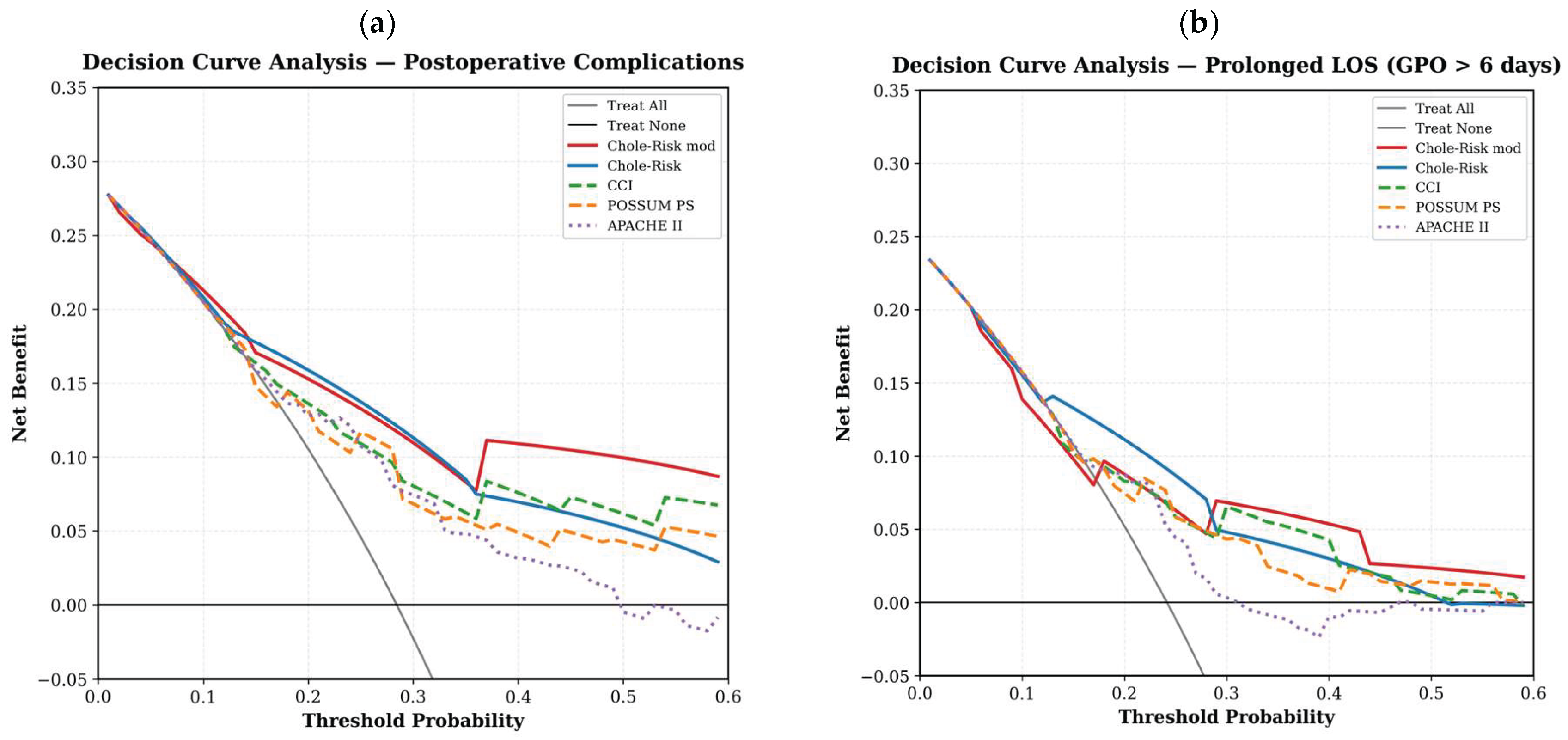

Table 1.
Baseline characteristics of the study cohort (N = 211).
| Variable | Total (N = 211) | Median [IQR] / Note |
| Sex = Female, n (%) | 107 (50.7%) | — |
| Sex = Male, n (%) | 103 (48.8%) | — |
| Age (years), mean ± SD | 53.38 ± 17.83 | 56.0 [40.0–68.0] |
| BMI (kg/m²), mean ± SD | 27.12 ± 5.28 | 25.97 [23.6–29.4] |
| POSSUM PS, mean ± SD | 16.48 ± 3.94 | 15.0 [13.0–18.0] |
| APACHE II, mean ± SD | 8.01 ± 5.25 | 7.0 [4.0–10.0] |
| CCI, mean ± SD | 2.50 ± 2.76 | 1.0 [0.0–4.0] |
| Chole-Risk (0–4), mean ± SD | 1.62 ± 0.80 | 1.0 [1.0–2.0] |
| Chole-Risk mod, mean ± SD | 4.47 ± 1.13 | 4.0 [4.0–5.0] |
| Postoperative days (GPO), mean ± SD | 5.80 ± 8.01 | 3.0 [2.0–6.0] |
| Acute-on-chronic cholecystitis, n (%) | 207 (98.1%) | — |
| Cholelithiasis, n (%) | 209 (99.1%) | — |
| Prior abdominal surgery, n (%) | 77 (36.5%) | — |
| Prior percutaneous cholecystostomy, n (%) | 5 (2.4%) | — |
| Comorbidities, n (%) | 48 (22.7%) | — |
| Signs of choledocholithiasis, n (%) | 160 (75.8%) | — |
| Signs of difficult cholecystectomy, n (%) | 62 (29.4%) | — |
| Mirizzi syndrome, n (%) | 5 (2.4%) | — |
| Inotrope use, n (%) | 11 (5.2%) | — |
| ERCP performed, n (%) | 38 (18.0%) | — |
Table 2.
Endpoint frequency.
| Endpoint | Events (n) | Events (%) |
| Postoperative complications | 60 | 28.4% |
| LOS > p75 (GPO > 6 days) | 51 | 24.2% |
Table 3.
Association (OR per 1-SD) and discrimination (AUC) of each score for the two endpoints. All ORs P < 0.02.
Table 3.
Association (OR per 1-SD) and discrimination (AUC) of each score for the two endpoints. All ORs P < 0.02.
| Score | Outcome | OR (1-SD) | 95% CI | AUC | AUC 95% CI |
| Chole-Risk mod | Complic. | 4.10 | 2.47–6.79 | 0.786 | 0.710–0.851 |
| Chole-Risk | Complic. | 2.93 | 2.04–4.21 | 0.755 | 0.687–0.821 |
| CCI | Complic. | 2.62 | 1.91–3.60 | 0.736 | 0.659–0.811 |
| POSSUM PS | Complic. | 2.33 | 1.72–3.16 | 0.707 | 0.625–0.787 |
| APACHE II | Complic. | 1.88 | 1.34–2.63 | 0.696 | 0.618–0.772 |
| Chole-Risk | LOS > p75 | 2.22 | 1.52–3.25 | 0.713 | 0.636–0.791 |
| Chole-Risk mod | LOS > p75 | 2.07 | 1.34–3.18 | 0.677 | 0.579–0.767 |
| CCI | LOS > p75 | 1.97 | 1.41–2.75 | 0.673 | 0.588–0.761 |
| POSSUM PS | LOS > p75 | 1.86 | 1.34–2.58 | 0.665 | 0.573–0.752 |
| APACHE II | LOS > p75 | 1.44 | 1.08–1.94 | 0.647 | 0.565–0.731 |
Table 4.
Diagnostic performance at the Youden-optimal cut-off for each score and endpoint.
| Outcome | Score | Cut-off | Sensitivity (%) | Specificity (%) | PPV (%) | NPV (%) | Accuracy (%) | AP |
| Complic. | Chole-Risk | ≥2 | 78.3 | 64.2 | 46.5 | 88.2 | 68.2 | 0.513 |
| Complic. | Chole-mod | ≥5 | 75.0 | 66.2 | 46.9 | 87.0 | 68.7 | 0.623 |
| Complic. | POSSUM PS | ≥17 | 65.0 | 71.5 | 47.6 | 83.7 | 69.7 | 0.561 |
| Complic. | APACHE II | ≥7 | 78.3 | 55.0 | 40.9 | 86.5 | 61.6 | 0.441 |
| Complic. | CCI | ≥5 | 50.0 | 86.1 | 58.8 | 81.2 | 75.8 | 0.600 |
| LOS>p75 | Chole-Risk | ≥2 | 76.5 | 61.3 | 38.6 | 89.1 | 64.9 | 0.395 |
| LOS>p75 | Chole-mod | ≥6 | 39.2 | 91.9 | 60.6 | 82.6 | 79.1 | 0.441 |
| LOS>p75 | POSSUM PS | ≥17 | 62.7 | 68.8 | 39.0 | 85.3 | 67.3 | 0.423 |
| LOS>p75 | APACHE II | ≥7 | 76.5 | 52.5 | 33.9 | 87.5 | 58.3 | 0.321 |
| LOS>p75 | CCI | ≥5 | 49.0 | 83.8 | 49.0 | 83.8 | 75.4 | 0.416 |
Disclaimer/Publisher’s Note: The statements, opinions and data contained in all publications are solely those of the individual author(s) and contributor(s) and not of MDPI and/or the editor(s). MDPI and/or the editor(s) disclaim responsibility for any injury to people or property resulting from any ideas, methods, instructions or products referred to in the content. |
© 2026 by the authors. Licensee MDPI, Basel, Switzerland. This article is an open access article distributed under the terms and conditions of the Creative Commons Attribution (CC BY) license (http://creativecommons.org/licenses/by/4.0/).
Copyright: This open access article is published under a Creative Commons CC BY 4.0 license, which permit the free download, distribution, and reuse, provided that the author and preprint are cited in any reuse.


