
Submitted:
24 March 2026
Posted:
26 March 2026
You are already at the latest version
Abstract
This study examined the comparative performance of GARCH family models including GARCH, EGARCH, GJR GARCH, APARCH, and FIGARCH within a horizon and regime aware framework to assess forecasting accuracy. Using daily prices of equity and foreign exchange markets in Kenya covering 1997–2024, volatility was modelled and validated through Value at Risk and Expected Shortfall back tests to establish economic relevance. The results reveal strong horizon and regime dependence: EGARCH performs well in capturing short run volatility in the equity market and turbulent foreign exchange re-gimes, while FIGARCH dominates in calm equity markets and at medium term horizons. Risk validation confirms that FIGARCH delivers reliable tail risk forecasts for equities, whereas EGARCH excels in turbulent foreign exchange markets. Unlike prior comparative studies that focus on efficient markets with stable volatility structures, this study applied GARCH family models to a frontier market, comparing forecasting accuracy across vary-ing horizons and regimes. The study advanced beyond best fit evaluations by linking forecasting performance to horizon length, asset type, and regime shifts, thereby contrib-uting new evidence on modelling volatility in African frontier markets and offering in-sights relevant for regulators, institutional investors, and policymakers concerned with financial stability.
Keywords:
GARCH
; forecasting volatility
; frontier markets
; FIGARCH
; EGARCH
; regime shifts
; horizons
; Value at Risk
; Expected Shortfall
1. Introduction
Modelling Volatility has remained central to financial econometrics since the seminal contributions of Engle (1982) and Bollerslev (1986), which introduced the ARCH and GARCH frameworks. These models became the dominant empirical approach for capturing time-varying volatility and the stylized facts of clustering and persistence (Hansen & Lunde, 2005; Poon & Granger, 2003). Over time, extensions such as EGARCH (Nelson, 1991a), GJR-GARCH (Glosten et al., 1993), APARCH (Ding et al., 1993), and FIGARCH (Baillie et al., 1996) were developed to incorporate leverage effects, power transformations, and long-memory dynamics. Despite these advances, comparative studies show that no single specification dominates across assets, horizons, or regimes (Patton & Sheppard, 2015). This unresolved debate has motivated research into horizon- and regime-specific performance of GARCH-type models.
Forecasting volatility is regime-dependent and horizon-specific. Standard GARCH models produce smooth forecasts that fail to distinguish between calm and turbulent regimes (Hamilton & Susmel, 1994), while regime-switching extensions demonstrate superior performance during crises (Marcucci, 2005). Asymmetric models tend to outperform in high-volatility regimes, whereas long-memory specifications provide gains at longer horizons (Conrad & Haag, 2006). Recent contributions emphasize integrating macroeconomic volatility components and adopting non-parametric approaches to improve robustness against structural breaks (Engle & Rangel, 2008; Kamronnaher et al., 2024; Makatjane & Mmelesi, 2024). These findings highlight ongoing controversies: whether volatility is best explained by structural regimes, asymmetric responses, or long-memory persistence, and whether model rankings remain stable across contexts.
African frontier markets present a challenging environment for modelling volatility. Volatility dynamics are shaped by recurrent structural breaks, thin market depth, and sensitivity to external shocks (Balcilar et al., 2015; Salisu et al., 2020). Evidence from Nigeria, South Africa, and North African economies shows that crises and regime shifts disrupt volatility patterns severely than in developed markets, with asymmetric and long-memory models outperforming standard GARCH specifications during turbulent periods (Salisu et al., 2020). Yet systematic evaluations of horizon- and regime-dependent performance remain scarce in Africa, leaving unresolved questions about how volatility models behave under conditions of thin liquidity, political uncertainty, and recurrent macroeconomic shocks. This gap is critical given the reliance of regulators and institutional investors on volatility forecasts for risk management and financial stability.
Another unresolved debate concerns the economic relevance of volatility forecasts. While many studies rank GARCH models using statistical loss functions, fewer examine their usefulness for risk management through Value-at-Risk (VaR) and Expected Shortfall (ES). Regulatory bodies rely on these tail-risk measures, yet evidence on whether GARCH-family models generate reliable inputs for such applications in frontier markets remains limited (Patton et al., 2019). Addressing this gap requires a horizon- and regime-aware evaluation framework that compares statistical forecasting accuracy and assesses the economic value of volatility forecasts for risk management.
Against this background, this study examined how the performance and ranking of GARCH-family models vary across asset classes, forecast horizons, and market regimes in Kenya. In Kenya thin trading, exchange rate volatility, and exposure to global commodity shocks amplify volatility persistence and asymmetry. Unlike prior studies that focus on statistical loss functions, this study examined the economic relevance of volatility forecasts by assessing their performance in VaR and ES backtests. Therefore, this study contributes to the debate on horizon- and regime-dependent model performance, extends comparative volatility modelling to African frontier markets, and provides insights relevant for regulators, institutional investors, and policymakers concerned with financial stability.
1.1. Theoretical Framework
Modelling volatility is anchored in several theories that explain market behaviour, risk transmission, and investor psychology. The Efficient Market Hypothesis (EMH) (Fama, 1970) posits that asset prices reflect available information, with its weak form aligning to the random walk theory (Kendall & Hill, 1953). While EMH suggests that volatility arises from new information, empirical evidence from frontier markets validates persistent inefficiencies, thin liquidity, and behavioural biases that amplify volatility (Shiller, 2003). The tension between theoretical efficiency and observed inefficiency underscores the need for models that capture clustering, persistence, and asymmetry.
Modern Portfolio Theory (MPT) (Markowitz, 1952)and the Capital Asset Pricing Model (CAPM) (Sharpe, 1964) conceptualize volatility as a measure of risk, emphasizing diversification and systematic exposure. Both frameworks assume normal return distributions and rational investor behaviour which is violated in African markets where recurrent shocks, political instability, and thin trading produce fat-tailed distributions and extreme volatility (Mandelbrot & Hudson, 2010). The Arbitrage Pricing Theory (APT) (Ross, 1976) attempts to incorporate multiple sources of risk, however its empirical application in frontier markets is limited(Faruque, 2011).
Stochastic process theory provides the mathematical foundation for modelling volatility. The random walk hypothesis (Bachelier, 1900)and Brownian motion underpin modern time-series analysis, while mean-reverting processes capture the tendency of volatility to revert to long-run levels. Building on these principles, ARCH and GARCH models (Bollerslev, 1986; Engle, 1982) introduced conditional heteroskedasticity, enabling researchers to capture volatility clustering and persistence.
Behavioural finance challenges rational frameworks by incorporating cognitive biases and emotional influences. Prospect theory (Kahneman & Tversky, 2013) demonstrates that investors exhibit loss aversion, leading to asymmetric responses to gains and losses. Herding behaviour, overconfidence, and anchoring distort price discovery, producing excess volatility and speculative bubbles (Shleifer, 1986). These behavioural tendencies are relevant in markets, where limited information circulation and weak institutional structures amplify the impact of investor sentiment on volatility dynamics (Balcilar et al., 2015; Salisu et al., 2020). Behavioural insights justify the use of asymmetric GARCH variants such as EGARCH and GJR-GARCH, which model leverage effects and asymmetric responses to shocks (Dinga et al., 2023; Watard et al., 2024).
The financialization of commodities has restructured volatility transmission by increasing cross-market linkages. Commodities, once driven by supply and demand fundamentals, are now influenced by institutional investors, hedge funds, and algorithmic trading (Cheng & Xiong, 2014). This integration has increased co-movement between commodity and equity markets, reducing diversification benefits and increasing systemic risk(Domanski & Heath, 2007; Tang & Xiong, 2012). For Kenya’s economy, which is exposed to commodity price shocks and exchange rate volatility, financialization magnifies vulnerability to global shocks and underscores the need for volatility models that incorporate both domestic and international drivers.
1.2. Empirical Literature Review
Empirical research on modelling volatility has evolved since the introduction of ARCH and GARCH frameworks (Bollerslev, 1986; Engle, 1982). While these models captured short-run persistence, they failed to account for the slow hyperbolic decay in volatility autocorrelations (Baillie et al., 1996; Ding et al., 1993). This limitation motivated the development of long-memory models such as FIGARCH and HYGARCH, which outperform standard GARCH specifications in environments characterized by persistent information flows and heterogeneous agents (Andersen & Bollerslev, 1998; Davidson, 2004)(Andersen & Bollerslev, 1998; Davidson, 2004). Parallel advances introduced asymmetric models that incorporate leverage and size effects, improving estimation of volatility during periods of market stress (Orakcioglu, 2015). Evidence suggests that asymmetries and persistence effects are noticeable in emerging and frontier markets, reflecting structural differences in liquidity, market depth, and information circulation (Lim & Sek, 2013; Othman et al., 2019).
Recent studies emphasize the regime-dependent and horizon-specific nature of volatility forecasts. Standard GARCH models produce smooth forecasts that fail to distinguish between calm and turbulent regimes (Hamilton & Susmel, 1994), while regime-switching extensions demonstrate superior performance at short horizons and during crisis periods (Dueker, 1997; Marcucci, 2005). Asymmetric specifications tend to dominate under stress conditions, whereas long-memory models provide gains at longer horizons (Brownlees et al., 2011; Conrad & Haag, 2006). Recent contributions highlight the importance of integrating macroeconomic volatility components and adopting non-parametric approaches to improve robustness against structural breaks (Engle & Rangel, 2008; Kamronnaher et al., 2024; Makatjane & Mmelesi, 2024). These findings underscore the continuing debate: whether volatility is best explained by structural regimes, asymmetric responses, or long-memory persistence, and whether model rankings remain stable across horizons and asset classes.
Studies in Risk management have shifted from variance-based measures to tail-risk metrics such as Value-at-Risk (VaR) and Expected Shortfall (ES). While VaR is widely used, its non-coherent nature has prompted regulators to recommend ES as a reliable measure of extreme losses (Tian et al., 2019). Empirical evidence shows that models incorporating long memory and asymmetry, with skewed Student’s t distributions, provide superior estimates of both VaR and ES (Aloui & Ben Hamida, 2015). However, the superiority of regime-switching models remains horizon-dependent, with single-regime models excelling in short-term forecasts and regime-switching models outperforming over medium and long horizons (Hoang & Luu, 2024). This debate is relevant in frontier markets, where volatility dynamics are shaped by thin liquidity, political uncertainty, and exposure to commodity price shocks.
Despite these advances, comparative studies have focused on developed and emerging markets, leaving frontier markets underexplored. Existing evidence confirms that although volatility persistence, asymmetry, and regime dependence are stronger in less mature markets, there is limited evaluations of horizon-specific and regime-dependent performance. This gap is relevant in Africa, where integrated financial markets are vulnerable to macroeconomic instability and political shocks. Equity and foreign exchange markets in Kenya exhibit stylized facts of volatility clustering and leverage effects, yet remain underrepresented in global volatility forecasting research. By focusing on Kenya, this study provides new insights into the horizon- and regime-dependent performance of GARCH-family models in a frontier market setting, thereby contributing to both academic debates and practical risk management applications.
2. Materials and Methods
2.1. Research Design
This study adopted a quantitative research design to investigate the horizon- and regime-dependent performance of GARCH-family models in a frontier market context. The study used daily equity and foreign exchange return data. Research objectives focused on model estimation, forecast evaluation, and comparative performance analysis. Financial return series are stochastic and exhibit stylized facts. As such, econometric models provide an appropriate framework for capturing these dynamics (Bollerslev, 1986; Engle, 1982). The research design is guided by the theoretical framework of conditional heteroskedasticity (Bollerslev, 1986; Engle, 1982). Extensions of this framework justify the inclusion of asymmetric models to capture leverage effects (Glosten et al., 1993; Nelson, 1991b), as well as long-memory models to account for persistent volatility behaviour (Baillie et al., 1996). The study employed multiple GARCH-type specifications to address the first objective by conducting both in-sample assessment and out-of-sample evaluation. The study incorporated a multi-horizon and regime-dependent framework to address the second objective by evaluating forecast performance across different horizons and regimes in order to capture structural changes in volatility dynamics. The third objective was addressed by integrating an economic evaluation component into the research design. Model performance was assessed based on the ability to capture downside risk using Value-at-Risk (VaR) and Expected Shortfall (ES) measures.
2.2. Data Description
Raw data includes Daily NSE 20 Share index and USD/KES exchange rate from November 1997–December 2024.
Daily returns are derived as continuously compounded logarithmic differences of prices, expressed as
where represents the closing value of the asset exchange rate on day .
2.3. Model Specifications
Five GARCH specifications are estimated using Student- distributed errors.
Let:
GARCH(1,1) Model
The GARCH specification is used because of its ability to capture volatility clustering in financial time series.
The GARCH (1,1) model assumes symmetric response to shocks.
EGARCH(1,1) Model
EGARCH model, introduced by Nelson (1991) addresses limitations of the standard GARCH model.
A negative value of γ signals the presence of a leverage effect.
GJR-GARCH(1,1) Model
The GJR-GARCH model, introduced by Glosten, Jagannathan, and Runkle (1993), extends the standard GARCH framework by incorporating asymmetric responses to positive and negative shocks.
where
Here reflects the extra sensitivity of volatility to negative shocks, creating asymmetry in the conditional variance.
APARCH(1,1) Model
APARCH model, introduced by Ding, Granger, and Engle (1993), accommodates asymmetry, power transformations of volatility, and leverage effects.
where the power parameter allows flexible scaling of volatility magnitude, and captures leverage.
FIGARCH(1,,1) Model
The Fractionally Integrated GARCH (FIGARCH) model, introduced by Baillie, Bollerslev, and Mikkelsen (1996), allows for fractional integration in the conditional variance process.
In compact lag-polynomial notation,
where , denotes the lag operator, while represents the fractional differencing operator, with capturing the degree of fractional integration. When volatility shocks diminish hyperbolically rather than exponentially.
2.4. Estimation Technique
Model estimation is carried out using quasi-maximum likelihood with the Bollerslev–Wooldridge robust covariance approach. The suitability of each specification is assessed using information criteria alongside residual-based diagnostics.
2.5. Forecast Design
Out-of-sample volatility forecasts are obtained through a rolling window framework. Models are initially fitted on a starting sample, then they are re-estimated sequentially to generate conditional variance forecasts at horizons.
Forecast accuracy is assessed from statistical and economic perspectives. Statistical evaluation uses RMSE, MAE, QLIKE, and Diebold–Mariano tests. Economic performance is assessed via VaR and ES with back-testing. Models are ranked across assets, horizons, and regimes.
2.6. Testing Horizon and Regime Dependence
Three-stage analysis evaluates 1-, 5-, and 20-day forecasts using loss metrics and Diebold–Mariano pairwise comparisons.
To evaluate regime dependence, out-of-sample period is divided into calm and crisis segments, identified through historical events or smoothed regime probabilities.
In GARCH-type specifications, volatility persistence is summarized by
Corresponding half-life of shocks is derived as
provided that .
2.7. Model Selection and Interpretation
Model selection is based on a dominance framework using multiple criteria. Preference is given to specifications that pass diagnostic checks, ensuring residuals show no remaining serial correlation or ARCH effects.
3. Results
This section presents the empirical findings from the comparative evaluation of GARCH models applied to Kenyan equity and foreign exchange market.
3.1. Descriptive Statistics
The descriptive statistics in Table 1 confirm the presence of stylized facts. Both series show near-zero mean returns and excess kurtosis. The Augmented Dickey–Fuller (ADF) tests confirm stationarity for both return series (p < .01) in line with evidence that financial return series are stationary processes (Engle, 1982). High kurtosis calls for for long memory specifications while mild skewness favours asymmetric models (Orakcioglu, 2015). Differences in the magnitude of volatility between equity and forex highlight regime dependence consistent with (Marcucci, 2005) and support risk based evaluation using VaR and ES where FIGARCH and APARCH are superior consistent with Aloui and Ben Hamida (2015).
Figure 1 and Figure 2 confirm volatility persistence and regime shifts in equity and forex markets. Volatility persistence is dominant in frontier economies where shocks spread gradually due to limited market depth and slower information circulation (Alberg et al., 2008; Caporale and Zekokh, 2019). Volatility processes are characterized by shifts between high- and low-variance states (Ardia et al., 2018; Conrad and Kleen, 2020). In frontier markets regime transitions are high due to exposure to external shocks and concentrated investor bases (Caporale and Zekokh, 2019; Mensi et al., 2021).
3.2. Model Parameters Estimates
Parameters in Table 2 provide evidence that volatility dynamics in Kenyan financial markets are heterogeneous. For equity, the fractional integration parameter (d = 0.228, p < .01) confirms presence of long-range dependence in conditional volatility. Long-memory behaviour is prevalent in equity markets exposed to structural uncertainty and occasional macroeconomic shocks in frontier contexts (Baillie and Morana, 2009; Conrad and Kleen, 2020; Mensi et al., 2021). The magnitude of the fractional parameter (d < 0.5) indicates covariance stationarity with slow mean reversion, a property observed in markets characterised by thin trading and gradual information circulation (Caporale and Zekokh, 2019). Forex dynamics are dominated by asymmetric responses to market innovations. The asymmetry parameters in EGARCH (γ = 0.084, p < .01) and APARCH (γ = −0.061, p = .016) confirm leverage effects. Exchange rates in emerging economies exhibit asymmetric volatility responses, reflecting risk repricing, capital flow reversals, and policy uncertainty (Ardia et al., 2018; Caporale and Zekokh, 2019; Mensi et al., 2021). The high persistence parameter in the EGARCH specification (β = 0.977) implies that once volatility spikes occur, they disintegrate slowly consistent with findings that FX markets experience prolonged volatility following negative external shocks (Conrad and Kleen, 2020).
3.3. In-Sample Estimation
Table 3 presents in-sample model selection criteria. For equity, FIGARCH achieved the lowest AIC and BIC values consistent with Baillie and Morana (2009) and Conrad and Kleen (2020). For the FX market, EGARCH yields the lowest AIC and BIC values, indicating superior in-sample fit consistent with Ardia et al. (2018) and Caporale and Zekokh ((2019).
3.4. Forecast Performance Across Horizons
Results in Table 4 confirm that model performance is horizon-dependent and regime-sensitive. No single GARCH specification dominates across forecast horizons (Conrad & Kleen, 2020; Hansen & Lunde, 2005; Patton, 2011). For Equity FIGARCH was dominant at the 20-day horizon. Long-memory models outperform short-memory alternatives when forecasting medium- to long-term volatility (Baillie & Morana, 2009; Conrad & Kleen, 2020). This finding supports Caporale and Zekokh (2019) and Mensi et al. (2021). The efficiency of GARCH (1,1) at the 5-day horizon indicates that short-term volatility exhibits localized mean-reversion consistent with weekly trading cycles. Similar horizon-specific reversals were documented by Hansen and Lunde (2005), and Patton (2011).
In the forex market, the shifting dominance across horizons reinforces the asset-specific and regime-dependent nature of modelling volatility. The short-term and crisis-period performance of FIGARCH suggests that during turbulent phases, volatility shocks are persistent consistent with Conrad and Kleen (2020); Mensi et al. (2021) . The superior long-horizon performance of EGARCH indicates that asymmetric leverage effects drive forecast accuracy over long periods. Exchange rates in developing economies respond asymmetrically to depreciation (Ardia et al., 2018; Caporale and Zekokh, 2019)
3.5. Diebold-Mariano (DM) Test for Forecast Significance by Regime
The DM test results in Table 5 confirm that forecast accuracy is regime-dependent. Model dominance is conditional on market states rather than universal across environments (Diebold et al., 2005; Patton, 2011). Ranking GARCH models reverses between calm and turbulent periods in markets characterized by occasional shocks (Conrad and Kleen, 2020; Mensi et al., 2021). During calm regimes, FIGARCH was the best forecasting model for equity market across horizons. DM statistics and QLIKE values indicate that incorporating fractional integration improves forecast performance compared to short-memory GARCH specifications consistent with Billie and Morana (2009) and Caporale and Zekokh (2019). For the FX market under calm conditions, the dominance of EGARCH suggests that asymmetric responses are relevant even when volatility levels are subdued. Exchange rates in emerging economies exhibit persistent leverage effects due to asymmetric reactions to depreciation, policy signals and capital flows (Ardia et al., 2018; Mensi et al., 2021).
3.6. Parameter Estimates and Distributional Diagnostics
The fractional integration parameter of 0.228 for the equity FIGARCH model in Table 6 provides evidence of long-memory dynamics in the Kenyan equity market, confirming that volatility shocks decay slowly over time, consistent with Baillie et al. (1996) and Bollerslev and Mikkelsen (1996). The Student-t shape parameter of 5.187 supports the presence of leptokurtosis, consistent with Brownlees et al. (2011).
In the FX market, APARCH has a significant asymmetry parameter of -0.0607, providing evidence of leverage effects. This finding is consistent with Orakcioglu (2015. The significant power parameter of 2.375 justifies the use of flexible power transformations, consistent with Bali et al. (2012) and Brownlees et al. (2011). EGARCH diagnostics, with a Student-t shape parameter of 2.8, confirm the heavy-tailed nature of currency returns, in line with Liu and Hung (2010) and Gupta (2023).
3.7. Value-at-Risk and Expected Shortfall
Table 7 present the back testing results for Value-at-Risk and Expected Shortfall. For equity, all models are robust at the 1% VaR level, with one violation out of 500 observations, supporting earlier evidence that GARCH models can provide reliable risk estimates in equity markets. The Kupiec LR statistic of 4.81 (p = 0.028) indicates that these models overestimate risk, thereby offering higher capital buffers. This is consistent with Hansen and Lunde (2006) and Patton (2011). The Christoffersen test p-values of 0.949 confirm that violations are independent.
The FX results show systemic failure across all models at the 1% level, with violations exceeding expectations and Kupiec and Christoffersen p-values of 0.000. This outcome reflects the limitations of GARCH models in capturing extreme volatility and clustering of shocks inherent in frontier currency markets, consistent with Ardia et al. (2018) and Othman et al. (2019). The EGARCH model provides conservative Expected Shortfall (-1.2) and the lowest number of violations (24). Liu and Hung (2010) and Gupta (2023) emphasized the ability of EGARCH to capture leverage effects and extreme shocks in currency markets.
4. Discussion
4.1. Horizon Dependence
The Diebold-Mariano (DM) test results reveal sensitivity of model performance to the forecast horizon. At the one-day horizon, the negative and significant DM statistics for pairs involving the FIGARCH model against GARCH and EGARCH specifications suggest that capturing long-memory dynamics is essential for short-term volatility forecasts. This finding is consistent with Maqsood et al. (2017) who argue that the Nairobi Securities Exchange (NSE) lacks weak-form efficiency, causing information shocks to persist rather than dissipate rapidly. As the forecast window extends to five and twenty days, this persistence becomes critical for the equity market during turbulent regimes where the FIGARCH model maintains statistical superiority. Such results corroborate the assertions of Ahmed and Suliman (2011) regarding the explosive nature of conditional variance in African frontier markets, where the structural characteristics of volatility require models that account for fractional integration over longer durations (Ahmed and Suliman, 2011; Maqsood et al., 2017).
While asymmetric models like EGARCH and APARCH demonstrate superior predictive power at shorter horizons their relative advantage shifts during prolonged calm periods. At the twenty-day horizon for USD/KES in a calm regime, the DM statistics turn positive, indicating that parsimonious models may match or exceed the performance of complex long-memory specifications. The marginal utility of modelling long-range dependence diminishes when the currency reaches a state of relative equilibrium or is subject to stabilizing central bank interventions consistent with Lim and Sek (2013).
4.2. Regime Dependence
The Diebold-Mariano (DM) tests highlight regime dependence in the predictive accuracy of the GARCH models, suggesting that the structural dynamics of the Kenyan market undergo shifts between periods of stability and stress. For the Equity market the regime-specific results demonstrate a contrast between market conditions. In calm regimes, the standard GARCH yields positive and significant DM statistics against FIGARCH and EGARCH across horizons. At the five-day horizon in a calm state, the DM statistic for the GARCH versus FIGARCH pair stands at 5.51, indicating that the parsimonious symmetric specification is sufficient and superior when market volatility is low. However, this relationship reverses during turbulent regimes, where the DM statistics for GARCH against FIGARCH and EGARCH become negative (-14.76 for GARCH-FIGARCH at h=5). This reversal emphasises the inadequacy of symmetric models in capturing asymmetric shocks and long-memory persistence that characterize Kenyan equity market crises, necessitating the use of non-linear frameworks during periods of economic instability. In the forex market the optimal model specification is sensitive to the prevailing market environment. During turbulent periods the symmetric GARCH model is outperformed by the EGARCH and APARCH models, which account for the leverage effect and the aggressive market reactions to currency depreciation. This is reflected in the negative DM statistics during crises, which confirm that ignoring asymmetry leads to a significant loss in forecast precision. The USDKES data reveals that while FIGARCH shows short-term gains in calm periods at the one-day horizon, the standard GARCH model regains its statistical dominance as the horizon extends to five and twenty days.
Regime-dependent performance validates the theoretical underpinnings of Markov regime-switching frameworks popularized by Hamilton (1989). The results are consistent with Ardia et al. (2018) and Kambouroudis et al. (2021), who argue that a single-regime GARCH model frequently misprices risk because it averages volatility parameters across distinct market states (Ardia et al., 2018; Kambouroudis and McMillan, 2016). This is consistent with Kirui et al. (2014), who noted that the response of Kenyan markets to news is contingent on the existing macro-economic climate.
4.3. Economic Significance
The back testing results for the equity and forex market reveal divergence in risk model performance. For the FX market all the GARCH models failed the Kupiec and Christoffersen test.
Results for the equity market were conservative. At the 5% level, the models recorded a single violation despite an expected count of twenty-five, indicating that the risk parameters are inflated. By overstating potential losses, these models force institutional investors to hold excessive reserves against equity portfolios, thereby reducing the capital available for active investment and potentially dampening overall market liquidity. While the currency market is exposed to hidden risks, the equity market is hampered by a cautious risk framework that fails to reflect the true distribution of daily returns on the NSE.
The failure of symmetric models in the currency market validates the leverage effect. The performance gains of EGARCH and FIGARCH over the standard GARCH in the USD/KES tests support the necessity of accounting for leptokurtosis and long-memory persistence in emerging market data sets. The conservative bias observed in the NSE 20 Share index results is consistent with Kambouroudis et al. (2021), who argued that traditional GARCH models can over-react to historical shocks in markets with low trading frequency . The rejection of the conditional coverage tests for the USD/KES indicates that the underlying return distribution is non-normal.
5. Conclusions
This study examined the performance of GARCH models in a frontier market , focusing on equity and FX across multiple horizons and regimes. Forecasting volatility depends on the asset class, forecast horizon, and market. FIGARCH is the best for equity while EGARCH is ideal for the FX.
Policy Implications
The Central Bank of Kenya and the Capital Markets Authority should advocate for state-aware risk management practices. Risk management models for the equity market are over-conservative. Regulators can unlock dead capital by recalibrating risk management models to reflect the actual loss distribution of the Nairobi Securities Exchange. The underestimation of tail risk in the FX market is a red flag for financial stability. CBK should allow the use of ES as a primary risk metric for FX exposure. Risk management strategies for portfolio management should be duration-specific.
Author Contributions
Conceptualization, Wawire, Simiyu, Laiboni and Ochenge; methodology, Wawire and Ochenge; software, Wawire,Simiyu, Laiboni and Ochenge; validation, Wawire, Simiyu and Ochenge; formal analysis, Wawire; investigation, Simiyu; resources, Laiboni; data curation, Ochenge; writing—original draft preparation, Wawire; writing—review and editing, Simiyu, Laiboni and Ochenge; visualization, Ochenge; supervision, Simiyu, Laiboni and Ochenge; project administration, Wawire; funding acquisition, Wawire. All authors have read and agreed to the published version of the manuscript.
Funding
This research received no external funding.
Institutional Review Board Statement
Not applicable. The study did not involve humans or animals.
Informed Consent Statement
Not applicable. The study did not involve human participants.
Data Availability Statement
The data supporting the findings of this study are derived from publicly available sources, specifically the daily NSE 20 Share Index and USD/KES exchange rate. Processed datasets are available from the corresponding author upon reasonable request.
Conflicts of Interest
The authors declare no conflict of interest.
Abbreviations
The following abbreviations are used in this manuscript:
| ARCH | Autoregressive Conditional Heteroskedasticity |
| GARCH | Generalized Autoregressive Conditional Heteroskedasticity |
| EGARCH | Exponential Generalized Autoregressive Conditional Heteroskedasticity |
| GJR-GARCH | Glosten–Jagannathan–Runkle Generalized Autoregressive Conditional Heteroskedasticity |
| APARCH | Asymmetric Power Autoregressive Conditional Heteroskedasticity |
| FIGARCH | Fractionally Integrated Generalized Autoregressive Conditional Heteroskedasticity |
| VaR | Value-at-Risk |
| ES | Expected Shortfall |
| MAE | Mean Absolute Error |
| QLIKE | Quasi-Likelihood Loss Function |
| DM Test | Diebold–Mariano Test |
| NSE | Nairobi Securities Exchange |
| USD/KES | United States Dollar / Kenyan Shilling Exchange Rate |
| EMH | Efficient Market Hypothesis |
| MPT | Modern Portfolio Theory |
| CAPM | Capital Asset Pricing Model |
| APT | Arbitrage Pricing Theory |
| MDPI | Multidisciplinary Digital Publishing Institute |
| DOAJ | Directory of open access journals |
| TLA | Three letter acronym |
| LD | Linear dichroism |
References
- Ahmed, A. E. M.; Suliman, S. Z. Modeling stock market volatility using GARCH models evidence from Sudan. International Journal of Business and Social Science 2011, 2(23). [Google Scholar]
- Alberg, D.; Shalit, H.; Yosef, R. Estimating stock market volatility using asymmetric GARCH models. Applied Financial Economics 2008, 18(15), 1201–1208. [Google Scholar] [CrossRef]
- Aloui, C.; Ben Hamida, H. Estimation and Performance Assessment of Value-at-Risk and Expected Shortfall Based on Long-Memory GARCH-Class Models. Finance a Uver: Czech Journal of Economics & Finance 2015, 65(1). [Google Scholar]
- Andersen, T. G.; Bollerslev, T. Answering the skeptics: Yes, standard volatility models do provide accurate forecasts. International Economic Review 1998, 885–905. [Google Scholar] [CrossRef]
- Ardia, D.; Bluteau, K.; Boudt, K.; Catania, L. Forecasting risk with Markov-switching GARCH models: A large-scale performance study. International Journal of Forecasting 2018, 34(4), 733–747. [Google Scholar] [CrossRef]
- Bachelier, L. Théorie de la spéculation 1900, 17, 21–86.
- Baillie, R. T.; Bollerslev, T.; Mikkelsen, H. O. Fractionally integrated generalized autoregressive conditional heteroskedasticity. Journal of Econometrics 1996, 74(1), 3–30. [Google Scholar] [CrossRef]
- Baillie, R. T.; Morana, C. Modelling long memory and structural breaks in conditional variances: An adaptive FIGARCH approach. Journal of Economic Dynamics and Control 2009, 33(8), 1577–1592. [Google Scholar] [CrossRef]
- Balcilar, M.; Cakan, E.; Ozdemir, Z. A. Structural breaks, long memory, or unit roots in stock prices: Evidence from emerging markets. International Econometric Review 2015, 7(1), 13–33. [Google Scholar] [CrossRef]
- Bollerslev, T. Generalized autoregressive conditional heteroskedasticity. Journal of Econometrics 1986, 31(3), 307–327. [Google Scholar] [CrossRef]
- Brownlees, C. T.; Engle, R. F.; Kelly, B. T. SSRN 1502915; A practical guide to volatility forecasting through calm and storm. Available at. 2011.
- Caporale, G. M.; Zekokh, T. Modelling volatility of cryptocurrencies using Markov-Switching GARCH models. Research in International Business and Finance 2019, 48, 143–155. [Google Scholar] [CrossRef]
- Cheng, I.-H.; Xiong, W. Financialization of commodity markets. Annu. Rev. Financ. Econ. 2014, 6(1), 419–441. [Google Scholar] [CrossRef]
- Conrad, C.; Haag, B. R. Inequality constraints in the fractionally integrated GARCH model. Journal of Financial Econometrics 2006, 4(3), 413–449. [Google Scholar] [CrossRef]
- Conrad, C.; Kleen, O. Two are better than one: Volatility forecasting using multiplicative component GARCH-MIDAS models. Journal of Applied Econometrics 2020, 35(1), 19–45. [Google Scholar] [CrossRef]
- Davidson, J. Moment and memory properties of linear conditional heteroscedasticity models, and a new model. Journal of Business & Economic Statistics 2004, 22(1), 16–29. [Google Scholar] [CrossRef]
- Diebold, F. X.; Piazzesi, M.; Rudebusch, G. D. Modeling bond yields in finance and macroeconomics. American Economic Review 2005, 95(2), 415–420. [Google Scholar] [CrossRef]
- Ding, Z.; Granger, C. W.; Engle, R. F. A long memory property of stock market returns and a new model. Journal of Empirical Finance 1993, 1(1), 83–106. [Google Scholar] [CrossRef]
- Dinga, B.; Claver, J. H.; Cletus, K. K.; Che, S. F. Modeling and predicting exchange rate volatility: Application of symmetric GARCH and asymmetric EGARCH and GJR-GARCH models. Journal of the Cameroon Academy of Sciences 2023, 19(2), 155–178. [Google Scholar] [CrossRef]
- Domanski, D.; Heath, A. Financial investors and commodity markets. In BIS Quarterly Review; 2007. [Google Scholar]
- Dueker, M. J. Markov switching in GARCH processes and mean-reverting stock-market volatility. Journal of Business & Economic Statistics 1997, 15(1), 26–34. [Google Scholar]
- Engle, R. F. Autoregressive conditional heteroscedasticity with estimates of the variance of United Kingdom inflation. Econometrica: Journal of the Econometric Society 1982, 987–1007. [Google Scholar] [CrossRef]
- Engle, R. F.; Rangel, J. G. The spline-GARCH model for low-frequency volatility and its global macroeconomic causes. The Review of Financial Studies 2008, 21(3), 1187–1222. [Google Scholar] [CrossRef]
- Fama, E. F. Efficient capital markets. Journal of Finance 1970, 25(2), 383–417. [Google Scholar] [CrossRef]
- Faruque, M. U. An empirical investigation of the arbitrage pricing theory in a frontier stock market: Evidence from Bangladesh; 2011. [Google Scholar]
- Glosten, L. R.; Jagannathan, R.; Runkle, D. E. On the relation between the expected value and the volatility of the nominal excess return on stocks. The Journal of Finance 1993, 48(5), 1779–1801. [Google Scholar] [CrossRef]
- Hamilton, J. D.; Susmel, R. Autoregressive conditional heteroskedasticity and changes in regime. Journal of Econometrics 1994, 64(1–2), 307–333. [Google Scholar] [CrossRef]
- Hansen, P. R.; Lunde, A. A forecast comparison of volatility models: Does anything beat a GARCH (1, 1)? Journal of Applied Econometrics 2005, 20(7), 873–889. [Google Scholar] [CrossRef]
- Hoang, M.; Luu, D. T. Available at SSRN 4867203; Modelling Volatility Dynamics and Identifying Regime Switching in the Stock Market of Vietnam. 2024.
- Kahneman, D.; Tversky, A. Prospect theory: An analysis of decision under risk. In Handbook of the fundamentals of financial decision making: Part I; World Scientific, 2013; pp. 99–127. [Google Scholar]
- Kambouroudis, D. S.; McMillan, D. G. Does VIX or volume improve GARCH volatility forecasts? Applied Economics 2016, 48(13), 1210–1228. [Google Scholar] [CrossRef]
- Kamronnaher, K.; Bellucco, A.; Huang, W. K.; Gallagher, C. M. Estimating Value at Risk and Expected Shortfall: A Brief Review and Some New Developments. arXiv 2024, arXiv:2405.06798. [Google Scholar] [CrossRef]
- Kendall, M. G.; Hill, A. B. The analysis of economic time-series-part i: Prices. Journal of the Royal Statistical Society. Series A (General) 1953, 116(1), 11–34. [Google Scholar] [CrossRef]
- Lim, C. M.; Sek, S. K. Comparing the performances of GARCH-type models in capturing the stock market volatility in Malaysia. Procedia Economics and Finance 2013, 5, 478–487. [Google Scholar] [CrossRef]
- Makatjane, K.; Mmelesi, K. An improved model accuracy for forecasting risk measures: Application of ensemble methods. Journal of Applied Economics 2024, 27(1), 2395775. [Google Scholar] [CrossRef]
- Mandelbrot, B. B.; Hudson, R. L. The (mis) behaviour of markets: A fractal view of risk, ruin and reward. In Profile books; 2010. [Google Scholar]
- Maqsood, A.; Safdar, S.; Shafi, R.; Lelit, N. J. Modeling stock market volatility using GARCH models: A case study of Nairobi Securities Exchange (NSE). Open Journal of Statistics 2017, 7(2), 369–381. [Google Scholar] [CrossRef]
- Marcucci, J. Forecasting stock market volatility with regime-switching GARCH models. Studies in Nonlinear Dynamics & Econometrics 2005, 9(4), 1–53. [Google Scholar] [CrossRef]
- Markowitz, H. The utility of wealth. Journal of Political Economy 1952, 60(2), 151–158. [Google Scholar] [CrossRef]
- Mensi, W.; Al-Yahyaee, K. H.; Vo, X. V.; Kang, S. H. Modeling the frequency dynamics of spillovers and connectedness between crude oil and MENA stock markets with portfolio implications. Economic Analysis and Policy 2021, 71, 397–419. [Google Scholar] [CrossRef]
- Nelson, D. B. Conditional heteroskedasticity in asset returns: A new approach. Econometrica: Journal of the Econometric Society 1991a, 347–370. [Google Scholar] [CrossRef]
- Nelson, D. B. Conditional heteroskedasticity in asset returns: A new approach. Econometrica: Journal of the Econometric Society 1991b, 347–370. [Google Scholar] [CrossRef]
- Orakcioglu, I. Efficiency and volatility on the Istanbul Stock Exchange; 2015. [Google Scholar]
- Othman, A. H. A.; Alhabshi, S. M.; Haron, R. The effect of symmetric and asymmetric information on volatility structure of crypto-currency markets: A case study of bitcoin currency. Journal of Financial Economic Policy 2019, 11(3), 432–450. [Google Scholar] [CrossRef]
- Patton, A. J. Volatility forecast comparison using imperfect volatility proxies. Journal of Econometrics 2011, 160(1), 246–256. [Google Scholar] [CrossRef]
- Patton, A. J.; Sheppard, K. Good volatility, bad volatility: Signed jumps and the persistence of volatility. Review of Economics and Statistics 2015, 97(3), 683–697. [Google Scholar] [CrossRef]
- Patton, A. J.; Ziegel, J. F.; Chen, R. Dynamic semiparametric models for expected shortfall (and value-at-risk). Journal of Econometrics 2019, 211(2), 388–413. [Google Scholar] [CrossRef]
- Poon, S.-H.; Granger, C. W. J. Forecasting volatility in financial markets: A review. Journal of Economic Literature 2003, 41(2), 478–539. [Google Scholar] [CrossRef]
- Ross, S. A. The arbitrage theory of capital asset pricing. In Handbook of the fundamentals of financial decision making: Part I; World Scientific, 1976; pp. 11–30. [Google Scholar]
- Salisu, A. A.; Sikiru, A. A.; Vo, X. V. Pandemics and the emerging stock markets. Borsa Istanbul Review 2020, 20, S40–S48. [Google Scholar] [CrossRef]
- Sharpe, W. F. Capital asset prices: A theory of market equilibrium under conditions of risk. The Journal of Finance 1964, 19(3), 425–442. [Google Scholar] [PubMed]
- Shleifer, A. Do demand curves for stocks slope down? The Journal of Finance 1986, 41(3), 579–590. [Google Scholar] [CrossRef]
- Tang, K.; Xiong, W. Index investment and the financialization of commodities. Financial Analysts Journal 2012, 68(6), 54–74. [Google Scholar] [CrossRef]
- Tian, D.; Cai, Z.; Fang, Y. Econometric modeling of risk measures: A selective review of the recent literature. Applied Mathematics-A Journal of Chinese Universities 2019, 34(2), 205–228. [Google Scholar] [CrossRef]
- Watard, H.; Oumar, S. B.; Felix, N. Volatility spillover effect analysis of African emerging stock exchange markets: 2018–2023. SN Business & Economics 2024, 4(10), 121. [Google Scholar] [CrossRef]
Figure 1.
USD / KES daily returns time series plot, Source: Author’s own creation.
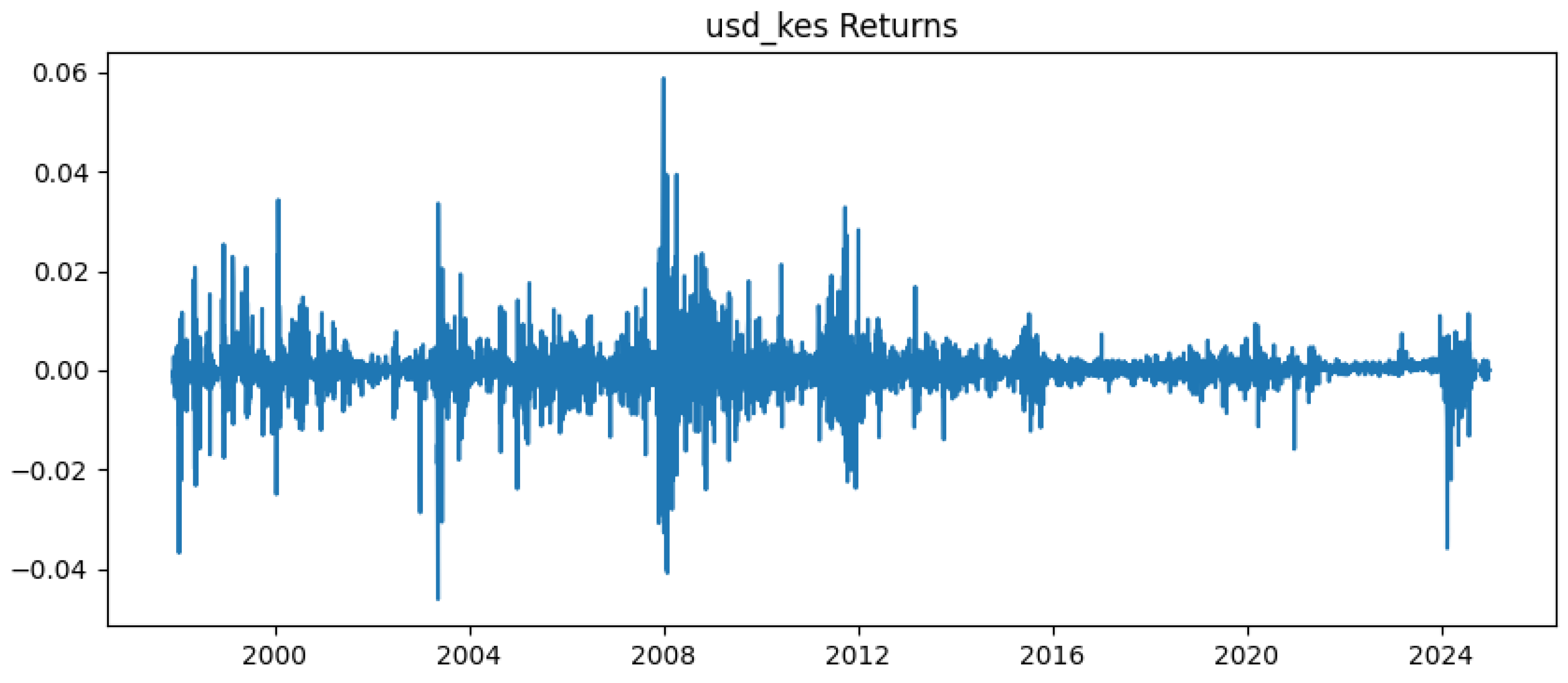
Figure 2.
NSE 20 Share Index Daily Returns time series plot, Source: Author’s own creation.
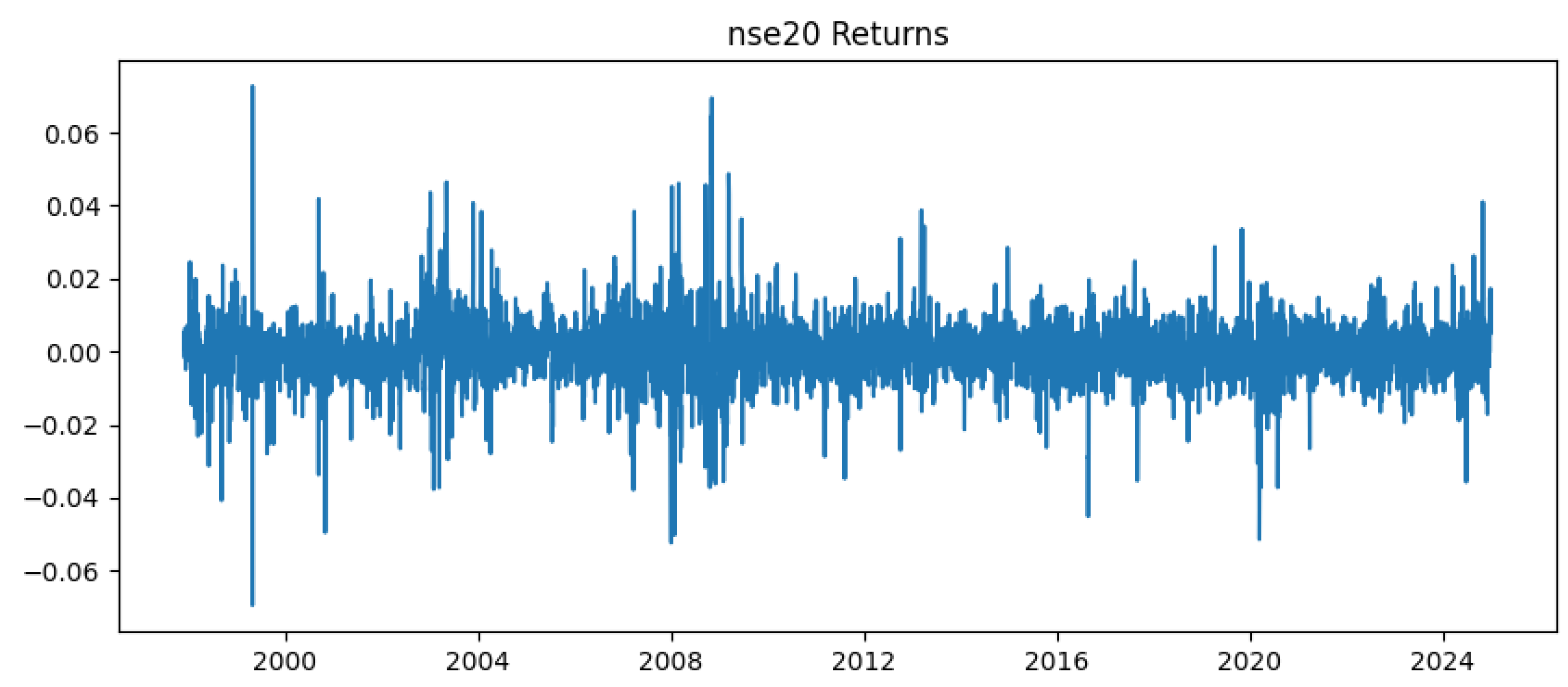

Table 1.
Descriptive Statistics and Diagnostics.
| Asset | count | mean | std | skew | kurtosis | ADF(p-value) | LB_resid (p) | LB_sq (p) | JB (p-value) |
| NSE 20 | 6703 | -0.006 | 0.782 | 0.213 | 9.35 | 0 | 0 | 0.933 | 0 |
| USD/KES | 6703 | 0.011 | 0.432 | 0.061 | 23.99 | 0 | 0 | 1 | 0 |
Source(s): Author’s own work.
Table 2.
Model Parameter Estimates and Preliminary diagnostics.
| Asset | Model | Parameter | Estimate | Std. Error | t-Statistic | p-value |
| NSE 20 | FIGARCH | d | 0.228 | 0.044 | 5.134 | 0.000 |
| NSE 20 | FIGARCH | omega | 0.069 | 0.013 | 5.408 | 0.000 |
| NSE 20 | FIGARCH | beta | 0.444 | 0.096 | 4.618 | 0.000 |
| USD/KES | EGARCH | alpha | 0.450 | 0.034 | 13.330 | 0.000 |
| USD/KES | EGARCH | beta | 0.977 | 0.004 | 256.410 | 0.000 |
| USD/KES | EGARCH | gamma | 0.084 | 0.013 | 6.728 | 0.000 |
| USD/KES | APARCH | delta | 2.375 | 0.507 | 4.683 | 0.000 |
| USD/KES | APARCH | gamma | -0.061 | 0.025 | -2.395 | 0.016 |
Source(s): Author’s own work.
Table 3.
In Sample Model Selection Criteria.
| Asset | Model | Log-Likelihood | AIC | BIC |
| NSE 20 | FIGARCH | -6535.81 | 13083.63 | 13124.49 |
| APARCH | -6547.02 | 13108.04 | 13155.71 | |
| GARCH | -6550.60 | 13111.20 | 13145.30 | |
| EGARCH | -6561.31 | 13133.00 | 13166.70 | |
| USD/KES | EGARCH | 368.60 | -727.31 | -693.26 |
| FIGARCH | 347.83 | -683.66 | -642.80 | |
| APARCH | 331.01 | -648.01 | -600.34 | |
| GARCH | 323.01 | -636.01 | -601.96 |
Source(s): Author’s own work.
Table 4.
Forecast Performance Across Horizons.
| Asset | Model | MSE (1) | MSE (5) | MSE (20) | QLIKE (1) | QLIKE (5) | QLIKE (20) | QLIKE (Calm) | QLIKE (Turb) |
| NSE 20 | FIGARCH | 4.267 | 52.672 | 467.333 | 0.532 | 4.093 | 18.64 | -0.209 | 1.274 |
| APARCH | 4.399 | 52.246 | 468.576 | 0.615 | 3.69 | 20.289 | 0.049 | 1.18 | |
| EGARCH | 4.382 | 52.132 | 468.911 | 0.606 | 3.598 | 20.786 | 0.028 | 1.184 | |
| GARCH | 4.396 | 51.9 | 468.42 | 0.613 | 3.428 | 20.067 | 0.046 | 1.181 | |
| USD/KES | EGARCH | 0.936 | 10.584 | 92.735 | 20.054 | 49.265 | 5.68 | -4.465 | 44.574 |
| FIGARCH | 0.935 | 10.582 | 96.68 | 13.644 | 46.113 | 124.205 | -4.267 | 31.555 | |
| APARCH | 0.936 | 10.595 | 96.676 | 19.168 | 76.162 | 122.202 | -4.443 | 42.78 | |
| GARCH | 0.936 | 10.597 | 96.763 | 19.65 | 86.542 | 203.504 | -4.455 | 43.755 |
Source(s): Author’s own work.
Table 5.
DM Forecast Results by Regime.
| Asset | Horizon | Market State | Loss Metric | Best Model | DM Statistic | p-value |
| NSE 20 | 1-Day | Turbulent | QLIKE | FIGARCH | -6.31 | 0.000 |
| NSE 20 | 1-Day | Calm | QLIKE | FIGARCH | 1223.08 | 0.000 |
| NSE 20 | 20-Day | Calm | QLIKE | FIGARCH | 44.80 | 0.000 |
| NSE 20 | 20-Day | Turbulent | QLIKE | FIGARCH | 12.47 | 0.000 |
| USD/KES | 1-Day | Turbulent | QLIKE | FIGARCH | 15.85 | 0.000 |
| USD/KES | 1-Day | Calm | QLIKE | EGARCH | 69.60 | 0.000 |
| USD/KES | 5-Day | Turbulent | MSE | FIGARCH | 11.99 | 0.000 |
| USD/KES | 20-Day | Calm | QLIKE | EGARCH | 17.10 | 0.000 |
Source(s): Author’s own work.
Table 6.
Parameter Estimates and Distributional Diagnostics.
| Asset | Model | Parameter | Estimate | Std. Error | t-Stat | p-value |
| NSE 20 | FIGARCH | d (Long Memory) | 0.228 | 0.044 | 5.134 | 0.000 |
| NSE 20 | FIGARCH | Shape (ν) | 5.187 | 0.355 | 14.616 | 0.000 |
| USD/KES | EGARCH | ω (Constant) | 0.031 | 0.018 | 1.743 | 0.081 |
| USD/KES | EGARCH | Shape (ν) | 2.800 | 0.115 | 24.288 | 0.000 |
| USD/KES | APARCH | γ (Asymmetry) | -0.061 | 0.025 | -2.395 | 0.016 |
| USD/KES | APARCH | δ (Power) | 2.375 | 0.507 | 4.683 | 0.000 |
Source(s): Author’s own work.
Table 7.
Back testing Results.
| Asset | Model | VaR (1%) | ES (1%) | Violations | Kupiec LR | p-value | Christoffersen LR | Christ. p-value |
| NSE 20 | GARCH | -3.387 | -4.477 | 1 | 4.81 | 0.028 | 0.004 | 0.949 |
| NSE 20 | EGARCH | -3.355 | -4.435 | 1 | 4.81 | 0.028 | 0.004 | 0.949 |
| NSE 20 | APARCH | -3.393 | -4.485 | 1 | 4.81 | 0.028 | 0.004 | 0.949 |
| NSE 20 | FIGARCH | -2.965 | -3.919 | 1 | 4.81 | 0.028 | 0.004 | 0.949 |
| USD/KES | GARCH | -0.378 | -0.593 | 34 | 74.08 | 0.000 | 48.923 | 0.000 |
| USD/KES | EGARCH | -0.585 | -1.200 | 24 | 38.03 | 0.000 | 33.621 | 0.000 |
| USD/KES | APARCH | -0.382 | -0.599 | 31 | 62.51 | 0.000 | 43.529 | 0.000 |
| USD/KES | FIGARCH | -0.440 | -0.689 | 28 | 51.56 | 0.000 | 37.775 | 0.000 |
Source(s): Author’s own work.
Disclaimer/Publisher’s Note: The statements, opinions and data contained in all publications are solely those of the individual author(s) and contributor(s) and not of MDPI and/or the editor(s). MDPI and/or the editor(s) disclaim responsibility for any injury to people or property resulting from any ideas, methods, instructions or products referred to in the content. |
© 2026 by the authors. Licensee MDPI, Basel, Switzerland. This article is an open access article distributed under the terms and conditions of the Creative Commons Attribution (CC BY) license (http://creativecommons.org/licenses/by/4.0/).
Copyright: This open access article is published under a Creative Commons CC BY 4.0 license, which permit the free download, distribution, and reuse, provided that the author and preprint are cited in any reuse.


