

Submitted:
19 March 2026
Posted:
25 March 2026
You are already at the latest version
Abstract
This paper examines the intersection between digital learning environments and multilingual education policies, with a focus on the linguistic integration of mi-grant students in Europe. It explores how technology, particularly mobile-assisted learning, artificial intelligence, and immersive tools, can strengthen language acquisition and promote social inclusion. Drawing on European and Greek policy frameworks, the study shows how digital pedagogies operationalize multilingualism as both an educational objective and a social justice priority. Based on a qualitative review of contemporary research and institutional reports, the findings indicate that digitally enhanced learning environments act as catalysts for equity, intercultural dialogue, and active participation when supported by coherent pedagogical design. The paper concludes by outlining policy recommendations for the development of multilingual digital ecosystems that align technological innovation with democratic, inclusive, and human-centred education. Overall, the analysis highlights that technology-mediated multilingualism can effectively reinforce participation, inclusion, and linguistic integration when embedded within robust policy structures and sound pedagogical practice.
Keywords:
multilingual education
; digital learning environment
; European multilingualism policy
; AI-assisted language learning
; intercultural digital pedagogy
1. Introduction
Multilingualism is a defining feature of contemporary European societies and a cornerstone of European identity. Linguistic diversity is no longer merely a cultural asset but a socio-political pillar that shapes educational, political, and economic realities. In the context of increasing mobility and globalization, education systems must respond to new socio-cultural conditions in which language integration is intrinsically linked to democracy, equality, and social cohesion [1,2]. The integration of migrant and refugee students remains one of the most pressing challenges for European education policy [3,4,5]. Proficiency in the host country’s language is essential for academic achievement and social participation, while the recognition and preservation of students’ mother tongues are equally vital for fostering positive cultural identity and intercultural sensitivity [6,7].
The rapid development of information and communication technologies (ICT) has created new learning ecosystems that support multilingualism and intercultural education. Digital platforms, mobile applications, and artificial intelligence (AI) tools facilitate personalized learning, interactivity, and meaningful participation. When embedded within coherent policy frameworks, such technologies broaden access to knowledge and empower students with a migrant background [8,9].
This analysis draws on contemporary learning theories, official European policies, and relevant research such as [10,11,12,13,14] and Regional policy properties [15]. Through a review of scholarly literature and institutional documents, the study identifies the importance of digital learning environments for augmenting social cohesion, promoting equality, inclusion, and intercultural understanding. It concludes with targeted policy interventions aimed at strengthening multilingual education in Greece and across the European Union. The findings suggest that technology is not simply a pedagogical tool but a lever for social cohesion, provided that its adoption is both pedagogically and politically supported.
The purpose of this study is to investigate the role of digital learning environments in advancing multilingualism and social inclusion. It examines European and national multilingualism policies, the learning theories that underpin technology-mediated education, and examples of effective practice from Greece and other European contexts. Ultimately, the paper highlights how EU and member-state multilingualism policies can be supported through technology by articulating the pedagogical, political, and social dimensions of inclusion. Overall, the findings confirm that technology, when pedagogically integrated, can act as a driver of social change and support multilingualism as a policy of inclusion and democracy. A representation of the research question, main approach, and the expected outcomes is presented below in Figure 1.
Moreover, while substantial research has examined AI-supported language learning, digital inclusion, and multilingual education as distinct areas of inquiry, comparatively limited attention has been given to their structural integration within national education systems facing sustained migration. Existing studies often focus either on technological innovation at the classroom level or on policy discourse at the supranational level, without systematically examining how these dimensions interact within specific institutional contexts. This analytical gap is particularly visible in Southern European settings, such as Greece, where multilingual mandates, digital infrastructure, and migrant integration converge under distinct structural constraints. The present study addresses this gap by proposing a structured analytical framework that interrelates policy, pedagogy, and technology within a context-sensitive model.
In addition, beyond the absence of structural synthesis, the literature reflects ongoing theoretical tensions that warrant further analytical clarification. One such tension concerns the role of AI in language education: while frequently presented as a mechanism for personalization and inclusion, it is also associated with concerns regarding digital inequality and the underrepresentation of less-dominant languages within algorithmic systems. A related tension emerges between the normative aspirations of supranational European multilingual policy and the uneven institutional conditions under which such policies are implemented at the national level. Moreover, classroom-level technological innovation does not necessarily translate into coordinated governance structures. The present study engages these tensions by examining how policy design, pedagogical practice, and technological implementation may be aligned within a context-sensitive institutional framework.
Finally, it is worth noting that this study is guided by the following central research question: How can digital learning environments operationalize European and national multilingualism policies in ways that meaningfully support the linguistic integration and social inclusion of students with migrant backgrounds? As such, this inquiry is grounded in existing scholarship that identifies a persistent gap between multilingualism as a policy objective and its consistent implementation within national education systems [12,20]. While European policy frameworks position multilingualism as a democratic and social priority [3,22], research has documented structural constraints, including uneven digital infrastructure, limited techno-pedagogical training, and fragmented policy coordination [25,28]. By examining the intersection of policy, pedagogy, and technology, the present study evaluates whether digitally mediated educational practices can function as instruments for translating multilingual policy commitments into sustainable educational practice. Figure 1 provides a schematic representation of this analytical structure, linking the research question to the methodological approach and the projected outcomes of the analysis.
2. Conceptual and Policy Frameworks for Multilingualism
The Common European Framework of Reference for Languages (CEFR) [16] and the European Language Portfolio (ELP) [17,18], promote the development of communicative, intercultural, and multilingual competence [19]. These policies reflect the EU’s philosophy of “unity in diversity,” framing linguistic diversity as a source of social wealth [20]. Specifically, the New Action Plan for Multilingualism [3,21] emphasizes the integration of migrants/refugees through language learning, particularly through the use of digital media. Similarly, the studies in [22,23], explicitly link multilingualism with the digital transformation of education. Their objectives include strengthening digital skills, producing multilingual educational content, and promoting innovative pedagogies, encouraging multilingual participation.
Moreover, according to [3,23,24], connecting multilingualism with digital transformation has become a strategic priority for the EU. From a political perspective, multilingual EU policies encourage Member States to recognize immigrant languages and invest in technological solutions that support educational integration [25,26].
Lastly, while European policy frameworks often present digital transformation and multilingual education as mutually reinforcing priorities, the literature suggests that their relationship is more complex in practice. Although official documents emphasize linguistic inclusion as a democratic objective, studies indicate that implementation varies considerably across national systems due to differences in institutional capacity, digital infrastructure, and administrative coordination. This gap between policy ambition and practical realization shows that the integration of technology into multilingual strategies cannot be assumed to occur automatically. Rather, it depends on sustained structural alignment between supranational objectives and national educational realities.
2.1. National Multilingualism Policies: The Greek Case
Although historically monolingual, Greece has increasingly incorporated multilingualism policies, largely in response to rising migration flows. The Greek education system implements intercultural education programmes, Reception Classes, and Intercultural Schools under the supervision of the Ministry of Education [27]. However, as noted in [12], multilingualism within Greek public administration and education often remains an “institutional slogan” that lacks sufficient digital infrastructure. Similarly, research in [10] highlights the importance of technology for teaching Greek as a second or heritage language, emphasizing that digital learning promotes learner autonomy, facilitates access to multilingual content, and enhances intercultural communication.
Nevertheless, several challenges have been identified in the Greek context, such as the insufficient teacher training in digital skills, [25] and the unequal access to equipment and internet connectivity, [28]. Despite these obstacles, promising initiatives have emerged through European programmes such as Erasmus+, eTwinning, and CLIL projects. These efforts indicate a gradual shift toward a more inclusive multilingual pedagogy, as noted in [29,30,31]. However, although these initiatives demonstrate institutional willingness to promote multilingual inclusion, evidence regarding their long-term effectiveness remains mixed. Studies examining Erasmus+ and related transnational programmes suggest positive outcomes in terms of intercultural awareness and linguistic exposure, yet they also indicate uneven participation, limited structural integration into national curricula, and sustainability challenges beyond project cycles, [29,30,31]. In this respect, such initiatives illustrate both the potential and the limitations of digitally supported multilingual policy implementation. Their impact depends less on project visibility and more on systemic alignment with teacher training, infrastructure, and national educational planning. This observation directly relates to the study’s central research question, as it underscores that digital initiatives alone do not guarantee effective multilingual integration unless embedded within coherent institutional frameworks.
In conclusion, the Greek case reflects broader European dynamics: although multilingualism is formally recognized as a policy objective, its effective implementation depends on digital infrastructure, teacher preparation, and institutional coherence. These observations are directly linked to the central research question of the study, as they clarify the structural conditions under which digital learning environments may support or limit the operationalization of multilingual policies. The following section, therefore, examines the role of technology in shaping this policy–practice relationship.
2.2. The Role of Technology in Multilingualism Policies
Technology plays a decisive role in the implementation of multilingualism policies. Specifically, according to [25], digital multilingual pedagogy links linguistic and cultural competence with digital literacy, forming a new educational opportunity. The study in [28] reports that digital media can enhance intercultural understanding and expand access to knowledge, provided that such tools prioritize pedagogical rather than technocratic design principles. Collaborative learning platforms, digital portfolios, and communities of practice allow students to interact, collaborate, and develop awareness.
Nevertheless, as cautioned in [32,33], technology can either reinforce multilingualism or reproduce digital monolingualism if linguistic representation is not balanced. For instance, a digital tool available exclusively in English may inadvertently perpetuate cultural inequality. As such, the study [19] defines multilingualism as an individual’s ability to use more than one language at varying levels of proficiency across diverse social and professional contexts. Multilingualism is therefore understood as a social and political phenomenon connected to active citizenship, employability, and cultural democracy [20,34,35].
Since the Maastricht Treaty [15] and the Education and Training 2020 Agenda, the EU has maintained multilingualism as a strategic objective. The Digital Education Action Plan 2021–2027 [22] affirms that every European citizen should be able to communicate in at least two languages other than their mother tongue. Multilingualism is thus recognized as a fundamental precondition for social integration and European identity. As such, language is a basic means of participation in society. Inadequate proficiency in the host country’s language often results in poor academic performance and social exclusion [6,36].
In Greece, recent studies such as [12] show that multilingualism policies in public administration and education are often implemented in a fragmented way. Digital infrastructures and educational technologies are necessary to support the practical realization of multilingual policies. Similarly, research indicates that teaching Greek as a second or heritage language requires multimodal media, technological tools, and well-trained teachers. The study in [37] advocates for language-education programmes that preserve students’ mother tongues while also enabling mastery of the host-country language, a dual approach that fosters self-esteem and active participation. Similarly, [38] and more recent [39] promote a sociocultural theory, which posits that learning occurs through social interaction and cultural mediation. Technology functions as a mediating tool that facilitates collaborative learning and active construction of knowledge [40,41].
Similarly, the theory of translanguaging [42] expands on this perspective, proposing that learners draw on their linguistic resources dynamically and fluidly, without rigid boundaries. Digital learning environments support such flexibility through multimodal, multimedia, and interactive activities. As such, critical digital pedagogy [43,44] adds a political dimension, emphasizing that technology is not neutral but embodies particular values and power relations.
Another important aspect is the educational technology (EdTech), which encompasses digital tools that support learning in flexible, personalized ways [45]. A key development is mobile-assisted language learning (MALL), which enables individualized practice and feedback through mobile devices [8,46]. Research shows that students using multilingual digital tools develop greater metalinguistic awareness and empathy [47,48]. Artificial-intelligence applications can tailor task difficulty and provide personalized feedback [49,50], while virtual and augmented-reality technologies create authentic communication contexts [51].
In Greece, the study in [10] notes that the use of technology in teaching Greek as a second language remains limited but is expanding through initiatives such as Erasmus+ and eTwinning. These emerging practices require the combined development of language-teaching and techno-pedagogical skills. As such, Digital Learning Environments (DLEs), including Moodle, Canvas, and Google Classroom, support multilingual content and collaborative learning [25]. Additionally, MOOCs and language-learning applications such as Duolingo and Memrise broaden global access to language education. The use of DLEs enhances learner engagement by enabling students to switch between languages, explore diverse resources, and collaborate online. Lastly, [52] highlights that the portability of mobile technologies extends the boundaries of the classroom, enabling learning anytime and anywhere.
In conclusion, the Greek case reflects broader European dynamics: although multilingualism is formally recognized as a policy objective, its effective implementation depends on digital infrastructure, teacher preparation, and institutional coherence. These observations relate directly to the study’s central research question, as they define the conditions under which digital learning environments may facilitate—or constrain—the operationalization of multilingual policies. The following section examines the role of technology in structuring this policy–practice interaction.
2.3. Methodology
This study adopts a qualitative, structured literature review methodology, enabling the systematic examination of existing research, policy documents, and theoretical approaches. The aim is not to generate primary empirical data but to interpret the relationship between multilingualism policies and digital learning environments.
Our literature review analysis provides a comprehensive overview of theoretical foundations, practical implementations, and the challenges associated with technological integration. As such, the data collection involved:
- Academic databases such as Scopus (Elsevier), Web of Science (Clarivate Analytics), ERIC - Education Resources Information Center (U.S. Department of Education), Taylor & Francis Online, SpringerLink (Springer Nature), Cambridge Core (Cambridge University Press), and Google Scholar;
- Official policy documents and institutional reports were examined, including publications from the European Commission, Council of Europe, OECD, and UNESCO, as cited in the reference list of this study;
The review focused on studies published between 2015 and 2025 to capture current developments. Our selection criteria included scientific validity, topical relevance, and policy significance for immigrant education. As a result, this research adheres to ethical principles such as respect for intellectual property rights, accurate citation, and transparency in data selection. Specifically, a total of 60 sources were examined in the course of this qualitative synthesis, including peer-reviewed journal articles, academic book chapters, and official policy reports. Of these, 48 publications dated between 2015 and 2025 formed the principal analytical corpus of the study. The remaining 12 sources, published before 2015, were retained exclusively as foundational theoretical or historical policy references.
Lastly, the selection process was guided by three criteria: relevance to the intersection of digital learning environments and multilingual education; focus on European or comparable policy contexts, with particular attention to settings characterized by significant migration flows; and scholarly or institutional credibility. Studies addressing digital tools solely from a technical perspective, without pedagogical or policy analysis, were excluded. This approach ensured that the review remained aligned with the study’s central research question while maintaining methodological coherence. For clarity and transparency, the structured review and analytical procedure is summarized in Figure 2.
3. Digital Pedagogies and Learning Technologies
The pedagogical effectiveness of AI-supported tools depends on transparent data governance, linguistic diversity in training datasets, and the active mediation of educators. Without these safeguards, personalization systems may inadvertently reinforce existing inequalities or underrepresent minority linguistic profiles. Therefore, AI integration must remain pedagogically supervised and ethically regulated rather than treated as a neutral technical enhancement.
3.1. Research Design and Purpose
The analysis of the theoretical framework can be grouped into three principal areas:
- Access and empowerment: Technology provides access to learning resources regardless of time or place. According to [37], online language-learning programs increase confidence and participation among students with a migrant background. Digital learning platforms can also offer safe environments in which learners express themselves without fear of stigmatization.
- Intercultural communication: Collaborative online learning [48] enhances intercultural understanding. Students exchange experiences and develop communication skills, eliminating linguistic and cultural boundaries.
- Personalization of learning: Digital tools adapt to the level and needs of each learner. Artificial intelligence, through adaptive-learning algorithms, can generate individualized learning paths [49]. Students from migrant backgrounds, whose schooling is often discontinuous, benefit from this approach.
3.2. Digital Pedagogies and Tools
Digital tools supporting multilingual education can be classified into four main categories:
- E-learning platforms (LMS): Moodle, Canvas, Google Classroom support multilingual content, forums, and collaborative learning, [53].
- Mobile applications: Duolingo, Babbel, and Memrise provide flexible, asynchronous learning that promotes lifelong learning, [54].
- Virtual and augmented-reality systems (VR/AR): Programs such as ImmerseMe and Mondly VR simulate authentic communication scenarios that enhance intercultural learning, [51].
At the European level, several initiatives demonstrate the integration of digital technologies:
- Digital Literacy for Inclusion: programs combining language learning with digital empowerment for social participation, [37].
- Language Learning for Refugees and Migrants: online courses and role-playing games for linguistic and social integration, [55].
- Lingua+: micro-courses and multilingual content for learners of diverse backgrounds, [56].
Research by [11] on multimedia tools in teaching Italian confirms that multimodal learning enhances engagement and cultural understanding, particularly in online contexts. As a result, despite these advantages, the application of technology in multilingual education faces significant challenges:
3.3. Data Sources and Selection Criteria
The analysis was categorized into a thematic categorization of sources, grouped into:
- Theories of learning and multilingualism
- Educational technology and digital environments
- EU multilingualism policies & Greek educational practices
- Challenges and policy recommendations
The thematic analysis followed the logic of interpretive synthesis, whereby findings from various studies are integrated to formulate broader theoretical insights, [58]. This methodological choice aims to identify:
- How multilingualism policies are used within digital learning environments,
- Which practices best support students with a migrant background, and
- How technology can function as an instrument for educational policy reform.
This analytical framework underpins the following chapter, which synthesizes results and proposes a model for multilingual digital education.
3.4. Thematic Analysis Method
Although literature identifies significant benefits associated with digital pedagogies in multilingual contexts, several major obstacles persist. Analytically, these include the digital divide between students from different socioeconomic backgrounds [28,57], limited teacher training in the pedagogical use of technology [25], the monolingual orientation of many digital tools that exclude smaller or non-European languages [32,33], and insufficient institutional linkage between education policy and digital strategy [25]. Moreover, institutional discontinuity remains a concern, as multilingual policies are often formulated at a strategic level without consistent evaluation mechanisms [12,28]. Cultural representation within digital tools also remains uneven, frequently privileging dominant languages and generating new forms of linguistic exclusion [32,33].
A recent study [12] emphasizes that without institutional coordination, multilingualism risks remaining a declaratory policy rather than a practical reality. Therefore, integrating digital policies into broader educational strategies is essential for sustainable implementation. The systematic arrangement of themes and the interpretive synthesis were designed to directly correspond with the study’s principal research inquiry. Specifically, the literature was evaluated to determine how digital learning environments assist in operationalizing multilingual frameworks and fostering social cohesion. As such, this approach ensures that the analytical process remains consistent with the foundational research question introduced at the outset and schematically presented in Figure 1.
In addition, the effective implementation of digital multilingual strategies depends significantly on teacher agency. Educators are not passive recipients of technological reform but active mediators of pedagogical change. Research indicates that resistance to digital integration may arise from insufficient training, increased workload, or concerns about professional autonomy. Addressing these issues requires sustained professional development, participatory planning processes, and institutional support structures that position teachers as contributors to policy implementation rather than simple executors of reform.
Lastly, the analysis of the literature indicates that the relationship between multilingualism policy and digital pedagogy is not automatic. Its effectiveness depends on institutional consistency, technological capacity, and pedagogical clarity. These findings inform the model proposed in the following section, which seeks to provide a structured response to the study’s central research question by translating policy principles into an operational educational framework.
3.5. Artificial Intelligence as an Educational System: Capability, Risk, and Governance
AI in multilingual education should not be treated merely as an advanced digital tool, but as an evolving educational system that shapes access to knowledge, linguistic representation, and institutional decision-making. Generative AI and multilingual large language models (LLMs) increasingly influence language production, translation, assessment, and feedback processes. Their capacity to generate adaptive explanations and multilingual content expands the possibilities of differentiated instruction and personalized scaffolding.
However, these systems operate within data architectures that are not linguistically neutral. Training datasets often overrepresent dominant languages, which may result in uneven performance across minority or migrant linguistic profiles. In multilingual educational settings, this imbalance risks reinforcing existing hierarchies rather than reducing them. Furthermore, the limited explainability of generative models presents pedagogical challenges, as automated feedback without transparent reasoning may constrain critical linguistic reflection and teacher oversight.
Beyond pedagogical considerations, AI integration also raises governance and regulatory questions. Educational AI systems that influence assessment, progression, or access to learning opportunities may fall within higher-risk regulatory categories under emerging European frameworks such as the EU Artificial Intelligence Act. In this context, issues of data governance, algorithmic accountability, and institutional responsibility become central. The processing of student data, particularly in vulnerable migrant populations, requires strict adherence to data protection standards and clear institutional protocols.
For these reasons, AI should be conceptualized not only as a technological enhancement but as a regulated and context-sensitive educational infrastructure. Its contribution to multilingual inclusion depends on pedagogical mediation, linguistic diversity in training systems, and alignment with democratic regulatory safeguards.
4. Proposed Model and National Application
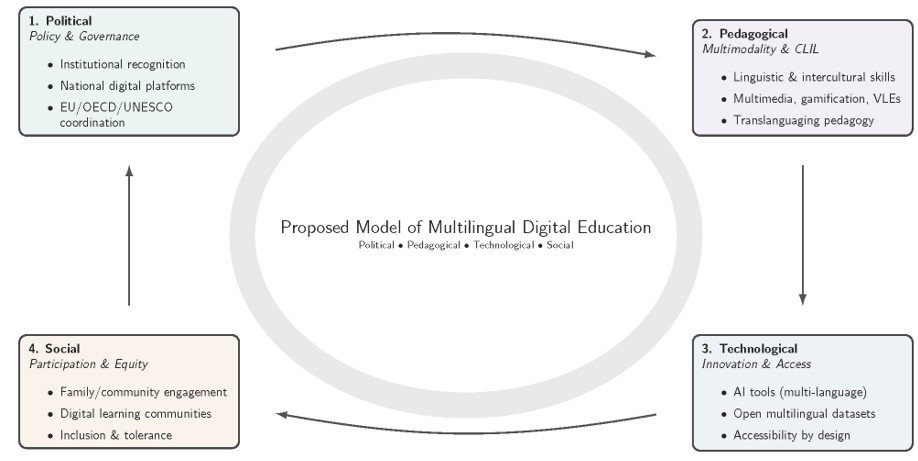
The four-phase model emerged directly from the thematic synthesis conducted in the preceding sections. Across the reviewed literature, four recurring and interdependent dimensions became evident: the political-institutional framing of multilingual policy, the pedagogical mediation of digital environments, the technological capacity of AI-supported systems, and the social implications for inclusion and equity. Rather than introducing a new theoretical claim, the model systematizes these dimensions into a coherent structure that makes their interrelation explicit. In this way, it complements existing research in AI and digital inclusion by moving beyond fragmented discussions of tools or policies and offering an integrated framework that reflects how multilingual digital education functions within national systems.
As such, promoting multilingualism in digital learning requires embedding it across the curriculum with multilingual resources, developing open repositories of digital content in different languages, and training teachers in both digital and intercultural skills. It also demands equitable access to devices for students in vulnerable groups, the creation of culturally sensitive AI through collaboration with universities, NGOs, and tech companies, and the use of clear evaluation indicators to monitor the effectiveness of these policies. Addressing these challenges requires a systematic and holistic approach that combines political commitment, pedagogical innovation, and technological support. Analytically, the proposed model is developed on the basis of the theoretical discussions and policy analyses presented in the previous sections. It reflects recurring themes identified in the literature, including the institutional dimension of multilingual policy implementation [12,20], the pedagogical relevance of multimodality and translanguaging [42,48], and the role of AI-supported learning environments in differentiated instruction [49,50]. At the same time, the framework takes into account structural characteristics of the Greek educational system, such as regional disparities in digital infrastructure and variations in teacher preparation. The model should therefore be understood as a structured synthesis of the reviewed literature, adapted to the specific socio-cultural and institutional context under examination.
4.1. The Proposed Model of Multilingual Digital Education
Based on the literature review, the proposed model is structured around four interrelated phases:
-
Political Phase: Multilingualism as Public Policy
- Institutional recognition of multilingualism across all levels of education.
- Establishment of national digital platforms for language education.
-
Pedagogical Phase: Education through Multimodality
- Integration of linguistic and intercultural competences.
- Utilization of multimedia resources and virtual learning environments.
-
Technological Phase: Innovation and Accessibility
- Design of AI-based tools capable of adapting to multiple languages.
- Development of open, multilingual datasets for educational use.
-
Social Phase: Participation and Empowerment
- Creation of digital learning communities (equality and collaboration).
- Cultivation of social awareness and linguistic tolerance through dialogue.
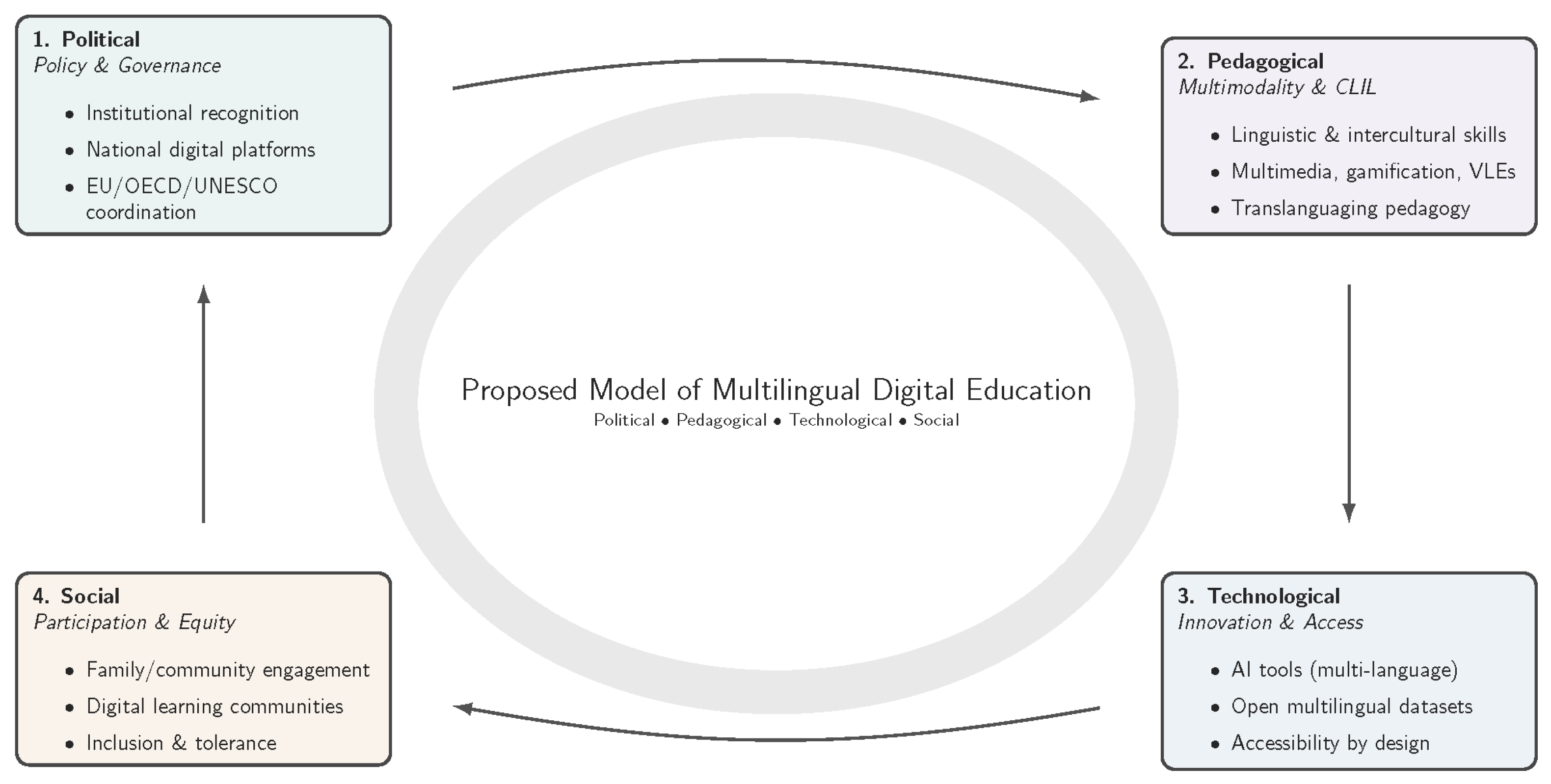
The four phases correspond to recurrent themes identified in the literature review: policy alignment, pedagogical mediation, technological adaptation, and social participation. As such, this model encapsulates the integrated nature of multilingual digital education by combining political, pedagogical, technological, and social dimensions into a cohesive framework. Our proposed model and its phases are presented in Figure 3.
Although the four phases are presented sequentially for analytical clarity, they function as interdependent components rather than isolated stages. The political dimension establishes the institutional framework within which pedagogical strategies are developed. The pedagogical phase operationalizes policy principles through classroom practice, while the technological phase provides the digital infrastructure and tools necessary to support differentiated multilingual learning. Finally, the social dimension reflects the broader impact of these interactions on inclusion, participation, and community cohesion.
These phases therefore operate in a dynamic relationship: policy shapes pedagogy, pedagogy guides technological adaptation, and technological implementation influences social outcomes, which in turn inform future policy adjustments. The model should thus be understood as a cyclical and mutually reinforcing system rather than a linear progression.
Although specific components such as AI-driven instruction, mobile-assisted learning, and digital inclusion are well established in the literature, the contribution of the present framework lies in their structured integration. Rather than treating technological adoption, pedagogical strategy, and policy formulation as parallel domains, the model conceptualizes them as interdependent dimensions of a coordinated institutional process. This perspective shifts the analytical focus from isolated digital interventions to the systemic alignment required across political, pedagogical, technological, and social levels. In this respect, the framework extends existing scholarship by situating AI-enabled multilingual education within a governance-oriented structure rather than approaching it solely at the level of classroom innovation.
4.2. Application of the Model in Greece
Within the Greek socio-cultural context, these dimensions assume particular significance in light of recent migration patterns and the institutional structure of public education. Specifically, although European multilingual and digital education policies establish a coherent strategic framework, their implementation within the Greek educational system requires critical adaptation. Specifically, the Greek context is shaped by specific structural conditions, including uneven digital infrastructure across regions, variations in school resources, and limited institutional coordination in the field of migrant education. In addition, professional development in AI-supported and multilingual pedagogies remains unevenly distributed.
As such, for this reason, European initiatives cannot be transferred as ready-made solutions. Their integration into the Greek framework depends on institutional capacity, administrative coordination, and the linguistic composition of local school communities. The following section, therefore examines how the proposed model may be applied within these parameters, translating broader policy principles into context-sensitive educational practice.
Lastly, as a host country for migrants, Greece occupies a critical position in implementing multilingual digital education. The application of the proposed model involves the following actions:
- Enhancing reception classes: through the use of digital tools (tablets, LMS).
- Training educators: in the use of MALL and AI-based tools.
- Collaborating with universities: to support intercultural education programs.
Finally, it is worth noting that in practical terms, the implementation of the proposed model within the Greek educational system could begin with structured pilot initiatives in Reception Classes and Intercultural Schools, where multilingual support mechanisms are already in place. At the pedagogical level, this would involve embedding AI-assisted language scaffolding and adaptive feedback tools within existing curricula, rather than establishing parallel digital programs. Institutionally, implementation would require coordinated planning between the Ministry of Education, regional authorities, and teacher training bodies to secure infrastructure, professional development, and monitoring mechanisms. A phased rollout with predefined evaluation indicators, such as teacher training participation and digital accessibility metrics, would allow gradual scaling based on institutional readiness.
5. Analytical Synthesis and Discussion
This study contributes to both the theoretical and practical discourse on multilingualism by underscoring the connection between educational technology and social justice. Research by [10,11,12,13,14] demonstrates that technology-supported multilingualism constitutes both a pedagogical and a social reform. As [59,60] note, educational innovation has genuine value only when it leads to social equality.
5.1. Key Findings
According to [50], artificial intelligence can support the development of adaptive learning systems that enhance learner autonomy and enable differentiated instruction. Similarly, [8], emphasizes that mobile-assisted language learning (MALL) applications function as portable multilingual laboratories, allowing students to learn in authentic communicative contexts.
An analysis of European and national policies reveals that:
- Greece has made progress toward digital integration, yet structural weaknesses persist in teacher training and equitable, [12].
- Multilingualism is a fundamental component of European identity and a driver of social cohesion, [20].
- Digital platforms and AI tools can enhance active participation, learner autonomy, and social inclusion, [49].
As such, based on the above and the overall study, we argue that technology-based multilingualism constitutes a form of social innovation that frames linguistic diversity as an instrument for equality. Consequently, the political dimension is as significant as the technical one: technology alone does not ensure inclusion.
5.2. Conceptual Findings and Policy Implications
The literature review demonstrates that the relationship between multilingualism, technology, and education is dynamic and multidimensional rather than linear. European Union policies aim to combine digital innovation with social cohesion, yet their implementation depends largely on national strategies and infrastructure. Specifically, [20,34], note multilingualism as a social right and highlight that it advances democracy and cultural equality. Nevertheless, in practice, multilingual policy often remains at the rhetorical level. Similarly, [12], shows that in Greece, multilingualism in education and public administration is applied inconsistently, lacking sufficient digital infrastructure and teacher training.
5.3. Discussion
The analysis confirms that Digital Learning Environments (DLEs) can support multilingualism policies across three primary dimensions:
- Pedagogical and cognitive dimension: Technology facilitates personalization and self-regulation in learning. Platforms can adapt to individual learner levels, provide immediate feedback, and enable personalized linguistic pathways [50]. AI-driven systems such as ChatGPT, Grammarly, or Replika EDU allow real-time practice of language production and comprehension. For migrant students, such tools compensate for limited access to traditional classrooms.
- Sociocultural dimension: The theory of translanguaging [42] explains how learners draw on their entire linguistic repertoire as a unified system. Digital environments, through multimodal elements such as video, audio, and interactive dialogue, promote this flexibility and strengthen linguistic identity. Collaboration platforms, including eTwinning and Padlet, enable learners from diverse cultural backgrounds to co-create and learn.
- Political dimension: Technology operationalizes multilingualism policies by providing open access to learning resources. MOOCs and Open Educational Resources (OERs) reduce learning costs and advance social equity, [22]. However, sustainable success depends on political will and institutional coordination: without investment in infrastructure and multilingual digital materials, even the most advanced technologies remain ineffective, [10].
Lastly, it is worth noticing that at the same time, the integration of AI-driven tools in multilingual education raises important ethical concerns. Issues related to data privacy, algorithmic bias, and the representation of minority languages require careful regulatory oversight. AI systems trained primarily on dominant linguistic datasets may reproduce structural inequalities or marginalize less-represented languages. Moreover, the collection and processing of student data demand transparent governance mechanisms that safeguard personal information and comply with data-protection standards. These considerations highlight that technological adoption must remain aligned with ethical responsibility and democratic principles.
6. Conclusions
This study sets out to examine how digital educational ecosystems can operationalize multilingual policies in ways that promote the linguistic and social inclusion of students with migrant backgrounds. The analysis indicates that digital learning environments contribute to this objective when supported by institutional coherence, pedagogical mediation, and context-sensitive technological adaptation.
In the Greek context, where recent migration patterns have reshaped the demographic composition of public education, this approach acquires particular relevance. The proposed model responds to structural challenges identified in the national framework, including uneven digital infrastructure, limited teacher preparation in multilingual pedagogies, and fragmented policy coordination. By aligning political commitment, pedagogical practice, and technological design, the framework offers a structured pathway for integrating migrant students not only linguistically but also socially within the Greek educational community.
Rather than functioning as a technical solution, digital multilingual education operates as an institutional mechanism for inclusion when embedded within coherent policy structures and supported by trained educators. In this respect, the model provides a context-sensitive response to the study’s central research question.
Author Contributions
All authors contributed equally.
Funding
This research received no external funding.
Institutional Review Board Statement
Not applicable.
Informed Consent Statement
Not applicable.
Data Availability Statement
No new data were created or analyzed in this study. Data sharing does not apply to this article.
Acknowledgments
During the preparation of this manuscript, the authors used Grammarly to check grammar, punctuation, and spelling. They reviewed and edited the output and take full responsibility for the content of this publication.
Conflicts of Interest
The authors declare no conflicts of interest.
References
- Beacco, J.C.; Fleming, M.; Goullier, F.; Thurmann, E.; Vollmer, H. The Language Dimension in All Subjects: A Handbook for Curriculum Development and Teacher Training; Council of Europe Publishing: Strasbourg, France, 2016; Available online: https://www.coe.int/en/web/language-policy/a-handbook-for-curriculum-development-and-teacher-training.-the-language-dimension-in-all-subjects (accessed on 17/02/2026)ISBN 978-92-871-8456-6.
- European Commission. Education Begins with Language; European Commission: Brussels, Belgium, 2019; Available online: https://edudoc.ch/nanna/record/211326/files/NC0420298ENN.en.pdf (accessed on 17/02/2026).
- European Commission. Action Plan on Multilingualism and Inclusive Education; European Education and Culture Executive Agency: Brussels, Belgium, 2023; Available online: https://eur-lex.europa.eu/legal-content/EN/TXT/HTML/?uri=LEGISSUM:c11068 (accessed on 17/02/2026).
- Ekpe, C. Education without borders: Ramping up support for refugee, migrant, and immigrant learners, PK–12. In Frameworks for Multi-Tiered Systems of Support for Trauma-Informed Educational Settings; IGI Global Scientific Publishing, 2020; pp. 449–472. [Google Scholar] [CrossRef]
- Aleghfeli, Y.K.; McIntyre, J.; Hunt, L.; Stone, C. Safety, belonging and success in education for refugees in Europe: A systematic review. European Journal of Education 2025, 60, e12852. [Google Scholar] [CrossRef]
- Wawire, B.A.; Barnes-Story, A. Translanguaging for multiliteracy development: Pedagogical approaches for classroom practitioners. International Journal of Bilingual Education and Bilingualism 2023, 26, 173–188. [Google Scholar] [CrossRef]
- Halpern, C.; Aydin, H.; Halpern, B.; Franz, M.; Parks, T. Cultural or linguistic competence? Pre-service teachers’ perceptions of their preparation to teach multilingual children. Pedagogy, Culture & Society 2026, 34, 121–13. [Google Scholar] [CrossRef]
- Viberg, O.; Wasson, B.; Kukulska-Hulme, A. Mobile-assisted language learning through learning analytics for self-regulated learning (MALLAS): A conceptual framework. Australasian Journal of Educational Technology 2020, 36, 34–52. [Google Scholar] [CrossRef]
- Guo, P.; Jeyaraj, J.J.; Razali, A.B. A systematic review of collaborative mobile-assisted language learning (C-MALL) practices using bibliometric, content, and scientometric analyses. Humanities and Social Sciences Communications 2024, 11, 1435. [Google Scholar] [CrossRef]
- Mattheoudakis, M.; Maligkoudi, C. Greek as a Second and Heritage Language: Teaching Perspectives and Practices ISBN 9781032333571; Routledge: London, UK, 2024; Available online: https://www.routledge.com/Exploring-Modern-Greek-as-a-Second-Foreign-and-Heritage-Language-In-Greece-and-Beyond/Mattheoudakis-Maligkoudi/p/book/9781032333571 (accessed on 17/02/2026).
- Kouveli, A.; Gazis, A.; Vavouras, T. Integrating multimedia tools in Italian language teaching: Pedagogical and cultural dimensions. Journal of Language and Culture in Education 2024, 12, 55–73. [Google Scholar] [CrossRef]
- Mattheoudakis, M.; Katsavarou, A. Language policy for multilingualism in Greek public administration: Fact or fiction? Current Issues in Language Planning 2025. [Google Scholar] [CrossRef]
- Siddiqi, M.M. Future of digital education: Inclusive, immersive, equitable. MediaSpace: DME Media Journal of Communication 2024, 5, 8–24. [Google Scholar] [CrossRef]
- Selim, H.A.; Popovac, M. Social cohesion in an online era: Opportunities and challenges on social media. Handbook of Social Media in Education Consumer Behavior and Politics 2024, 279–298. [Google Scholar] [CrossRef]
- Fiszer, J.M. The genesis of the Maastricht Treaty and its importance for the European integration and security. Politeja—Pismo Wydziału Studiów Międzynarodowych i Politycznych Uniwersytetu Jagiellońskiego 2023, 20, 5–23. [Google Scholar] [CrossRef]
- Council of Europe. Common European Framework of Reference for Languages: Learning, Teaching, Assessment ISBN 0 521 00531 0; Cambridge University Press: Cambridge, UK, 2001; Available online: https://assets.cambridge.org/052180/3136/sample/0521803136WS.pdf (accessed on 17/02/2026).
- Little, D. The European Language Portfolio: Where pedagogy and assessment meet. In Proceedings of the 8th International Seminar on the European Language Portfolio, Graz, Austria, 2009; p. p. 29. Available online: https://rm.coe.int/1680459fa5 (accessed on 17/02/2026).
- Little, D. The European Language Portfolio: History, key concerns, future prospects. In Perspectives from the European Language Portfolio; Routledge: London, UK, 2012; pp. 7–21. Available online: https://www.taylorfrancis.com/chapters/edit/10.4324/9780203809426-3/european-language-portfolio-david-little (accessed on 17/02/2026).
- Council of Europe. Common European Framework of Reference for Languages: Learning, Teaching, Assessment—Companion Volume; Council of Europe Publishing: Strasbourg, France, 2020; Available online: https://rm.coe.int/common-european-framework-of-reference-for-languages-learning-teaching/16802fc1bf. (accessed on 17/02/2026).
- Beacco, J.C.; Byram, M. From Linguistic Diversity to Plurilingual Education: Guide for the Development of Language Education Policies in Europe; Council of Europe: Strasbourg, France, 2007; Available online: https://www.coe.int/en/web/language-policy/from-linguistic-diversity-to-plurilingual-education-guide-for-the-development-of-language-education-policies-in-europe (accessed on 17/02/2026).
- Mandić, M. Learning the neighbor’s language: Regional and minoritized languages as a resource in the European educational context. In The Routledge Handbook of Endangered and Minority Languages; Routledge: London, UK, 2025; pp. 259–273. Available online: https://www.taylorfrancis.com/chapters/edit/10.4324/9781003439493-20/learning-neighbor-language-marija-mandi%C4%87 (accessed on 17/02/2026).
- European Commission. Digital Education Action Plan 2021–2027 . Publications Office of the European Union: Brussels, Belgium, 2021; Available online: https://education.ec.europa.eu/focus-topics/digital-education/actions (accessed on 17/02/2026).
- Punie, Y. European Framework for the Digital Competence of Educators: DigCompEdu; Publications Office of the European Union, 2017. [Google Scholar] [CrossRef]
- Mattar, J.; Santos, C.C.; Cuque, L.M. Analysis and comparison of international digital competence frameworks for education. Education Sciences 2022, 12, 932. [Google Scholar] [CrossRef]
- Gisbert Cervera, M.; Caena, F. Teachers’ digital competence for global teacher education. European Journal of Teacher Education 2022, 45, 451–455. [Google Scholar] [CrossRef]
- Stadler-Altmann, U. Using the European framework for the digital competence of educators to develop didactic tools on AI for early childhood settings. In Supporting Early Childhood Practice Through Difficult Times; Routledge: London, UK, 2024; pp. 26–38. [Google Scholar] [CrossRef]
- Giavrimis, P.; Dimitriadou, S. Interculturality in Greek education: Practices and challenges of implementation. Journal of Ethnic and Cultural Studies 2023, 10, 72–88. [Google Scholar] [CrossRef] [PubMed]
- OECD. Digital Education Outlook 2021: Pushing the Frontiers with AI, Blockchain and Robots; OECD Publishing: Paris, France, 2021; Available online: https://www.oecd.org/content/dam/oecd/en/publications/reports/2021/06/oecd-digital-education-outlook-2021_0f1487d9/589b283f-en.pdf (accessed on 17/02/2026).
- Habib, M.A.; Rahaman, M.M.; Wahiduzzaman, M. Educational transformation: Refocusing research, innovation, technology integration and social inclusion - An editorial. Teacher’s World: Journal of Education and Research 2023, 49, 9–14. [Google Scholar] [CrossRef]
- Ramirez, A.; Inga, E. Educational innovation in adult learning considering digital transformation for social inclusion. Education Sciences 2022, 12, 882. [Google Scholar] [CrossRef]
- Parveen, A.; Jan, S.; Bashir, F.; Ganie, A.A.; Zimik, P.N. Promoting inclusive learning environments: A study of digital inclusion in education. In Integrating the Biopsychosocial Model in Education; IGI Global Scientific Publishing, 2025; pp. 407–420. [Google Scholar] [CrossRef]
- Helot, C.; Young, A. Imagining multilingual education in France: A language and cultural awareness project at primary level. Language, Culture and Curriculum 2006, 19, 74–86. [Google Scholar] [CrossRef]
- Hamman-Ortiz, L.; Prasad, G. Reimagining bilingual education: A linguistically expansive orientation. Journal of Language, Identity & Education 2025, 24, 413–432. [Google Scholar] [CrossRef]
- Bağ, H.K.; Gürsoy, E. The effect of critical thinking embedded English course design on the improvement of critical thinking skills of secondary school learners. Thinking Skills and Creativity 2021, 41, 100910. [Google Scholar] [CrossRef]
- Wyatt, M. Language teachers’ self-efficacy beliefs. Handbook of Language Teacher Education 2025, 97–129. [Google Scholar] [CrossRef]
- Facciani, C. Parents’ multilingual storytelling in the school setting: Exploring influence on family language practices. EuroAmerican Journal of Applied Linguistics and Languages 2024, 11, 1–17. [Google Scholar] [CrossRef]
- UNESCO. Digital Equity and Inclusion in Education: An Overview of Practice and Policy in OECD Countries . 2022. Available online: https://one.oecd.org/document/EDU/EDPC/RD(2022)4/en/pdf (accessed on 17/02/2026).
- Vygotsky, L.S. Mind in Society: Development of Higher Psychological Processes; Harvard University Press, 1978. [Google Scholar] [CrossRef]
- Garcia, S.A. Closing the Gap with Social-Emotional Learning Programs K–5 . Doctoral Dissertation, Houston Baptist University, 2025. Available online: https://www.proquest.com/openview/fb9ee00999e0f30da3ecc637e7620501/1?pq-origsite=gscholar&cbl=18750&diss=y (accessed on 17/02/2026).
- Warschauer, M. The changing global economy and the future of English teaching. TESOL Quarterly 2000, 34, 511–535. [Google Scholar] [CrossRef]
- Rose, H.; McKinley, J. Global English and TESOL: An editorial introduction to innovating research and practice. TESOL Quarterly 2025, 59, 5–23. [Google Scholar] [CrossRef]
- García, O.; Wei, L. Translanguaging: Language, Bilingualism and Education; Palgrave Macmillan, 2014. [Google Scholar] [CrossRef]
- Freire, P. Pedagogy of the Oppressed; Herder & Herder, 1970. Available online: https://eric.ed.gov/?id=ED045793 (accessed on 17/02/2026).
- Teräs, M. Education and technology: Key issues and debates. International Review of Education 2022, 68, 635–636. [Google Scholar] [CrossRef]
- Laurillard, D. Teaching as a Design Science: Building Pedagogical Patterns for Learning and Technology; Routledge, 2012. [Google Scholar] [CrossRef]
- Morgana, V.; Kukulska-Hulme, A. Language Learning in the Mobile Age; Routledge: London, UK, 2019; Available online: https://www.routledge.com/Mobile-Assisted-Language-Learning-Across-Educational-Contexts/Morgana-Kukulska-Hulme/p/book/9780367714093 (accessed on 17/02/2026).
- Godwin-Jones, R. Using mobile technology to develop language skills and cultural understanding. Language Learning & Technology 2018, 22, 3–20. Available online: https://www.cambridge.org/elt/blog/wp-content/uploads/2018/03/Whitepaper-mobiles-in-class.pdf (accessed on 17/02/2026).
- Reinders, H.; Benson, P. Research agenda for autonomy in language education. Language Teaching 2020, 53, 1–20. [Google Scholar] [CrossRef]
- Seddik, M.E. The impact of AI-powered language learning tools on second language acquisition: A mixed-methods study. International Journal of Linguistics, Literature and Translation 2022, 8, 269–278. [Google Scholar] [CrossRef]
- Holmes, W.; Bialik, M.; Fadel, C. Artificial Intelligence in Education: Promises and Implications for Teaching and Learning . Center for Curriculum Redesign, 2019. Available online: https://oro.open.ac.uk/60255/ (accessed on 17/02/2026).
- Rodriguez, P.A. Immersive Virtual Reality Simulation of Charged Particles: Design Guidelines and User Experience . Doctoral Dissertation, Purdue University, 2025. Available online: https://www.proquest.com/openview/3f8afca4a83f6101f761b15ec55afbf7/1?pq-origsite=gscholar&cbl=18750&diss=y (accessed on 17/02/2026).
- Traxler, J.; Kukulska-Hulme, A. Mobile Learning: The Next Generation ISBN 9780415658362; Routledge: London, UK, 2021; Available online: https://www.routledge.com/Mobile-Learning-The-Next-Generation/Traxler-Kukulska-Hulme/p/book/9780415658362 (accessed on 17/02/2026).
- Rienties, B.; Toetenel, L. The impact of learning design on student behaviour and performance in online and blended environments. Computers in Human Behavior 2016, 60, 333–341. [Google Scholar] [CrossRef]
- Stockwell, G.; Hubbard, P. Some Emerging Principles for Mobile-Assisted Language Learning; The International Research Foundation for English Language Education (TIRF): Monterey, CA, USA, 2013; Available online: https://www.tirfonline.org/wp-content/uploads/2013/11/TIRF_MALL_Papers_StockwellHubbard.pdf (accessed on 17/02/2026).
- European Commission; Directorate-General for Education; Youth; Sport and Culture. Migrants in European Schools: Learning and Maintaining Languages; Publications Office of the European Union: Luxembourg, 2017; Available online: https://publications.europa.eu/resource/cellar/c0683c22-25a8-11e8-ac73-01aa75ed71a1.0001.01/DOC_1 (accessed on 17/02/2026).
- Nogueiro, T.; Saraiva, M.; Jorge, F.; Chaleta, E. The Erasmus+ programme and sustainable development goals—Contribution of mobility actions in higher education. Sustainability 2022, 14, 1628. [Google Scholar] [CrossRef]
- UNESCO. AI and Education: Guidance for Policy Makers; UNESCO: Paris, France, 2023; Available online: https://www.unesco.org/en/articles/ai-and-education-guidance-policy-makers (accessed on 17/02/2026).
- Sandelowski, M.; Barroso, J.; Voils, C.I. Using qualitative metasummary to synthesize qualitative and quantitative descriptive findings. Research in Nursing & Health 2007, 30, 99–111. [Google Scholar] [CrossRef]
- Shadiev, R.; Yang, M. Review of studies on technology-enhanced language learning and teaching. Sustainability 2020, 12, 524. [Google Scholar] [CrossRef]
- Mandala, A.; Gazis, A.; Vavouras, T. Distance learning and multilingual education: A case study of challenges and pedagogical perspectives in the Greek border region. International Journal of Changes in Education 2025, 1, 1–11. [Google Scholar] [CrossRef]
Figure 1.
An overview of our approach and the outcomes of our research question.
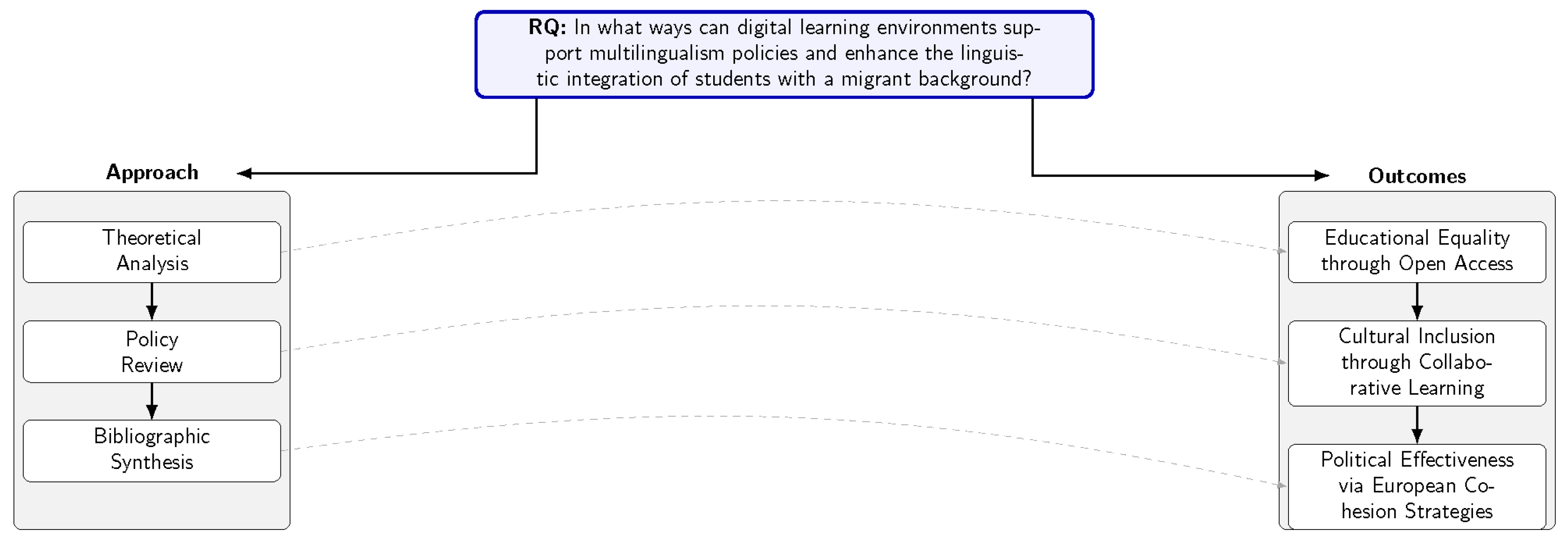
Figure 2.
Structured literature review and analytical synthesis process.
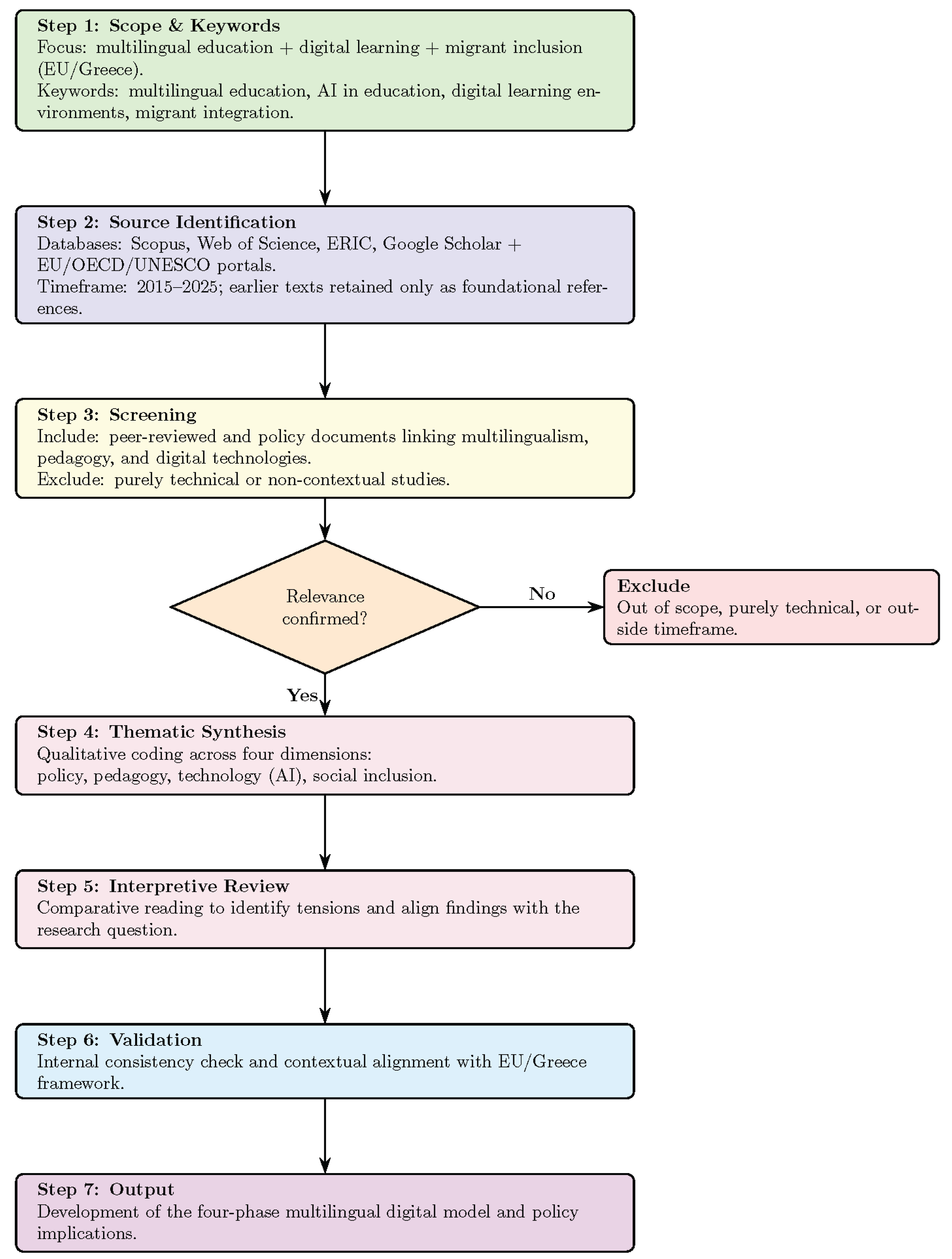
Figure 3.
An overview of our model that illustrates a cyclical framework integrating four interrelated phases: Political, Pedagogical, Technological, and Social.
Figure 3.
An overview of our model that illustrates a cyclical framework integrating four interrelated phases: Political, Pedagogical, Technological, and Social.
Disclaimer/Publisher’s Note: The statements, opinions and data contained in all publications are solely those of the individual author(s) and contributor(s) and not of MDPI and/or the editor(s). MDPI and/or the editor(s) disclaim responsibility for any injury to people or property resulting from any ideas, methods, instructions or products referred to in the content. |
© 2026 by the authors. Licensee MDPI, Basel, Switzerland. This article is an open access article distributed under the terms and conditions of the Creative Commons Attribution (CC BY) license (http://creativecommons.org/licenses/by/4.0/).
Copyright: This open access article is published under a Creative Commons CC BY 4.0 license, which permit the free download, distribution, and reuse, provided that the author and preprint are cited in any reuse.