

Submitted:
24 March 2026
Posted:
25 March 2026
You are already at the latest version
Abstract
Celiac disease (CD) is a chronic immune-mediated enteropathy triggered by the ingestion of gluten in genetically predisposed individuals. While the adaptive immune response to deamidated gliadin peptides represents a central pathogenic mechanism, growing ev-idence suggests that epithelial stress and innate immune activation play a fundamental role in the onset and persistence of the disease. Heat shock proteins (HSPs), central reg-ulators of cellular proteostasis, have emerged as potential mediators at the interface between epithelial distress and immune signaling. This review discusses the involve-ment of major HSP families, including Hsp27, Hsp60, Hsp70, and Hsp90, in the patho-physiology of CD. The altered expression of Hsp27 and Hsp70 in the intestinal mucosa reflects a persistent state of epithelial stress that often persists despite a strict gluten-free diet (GFD). We focus specifically on Hsp60, whose extracellular release under stress conditions may allow it to function as a damage-associated molecular pattern (DAMP), engaging Toll-like receptors and promoting NF-κB- and inflammasome-dependent in-flammatory pathways. Although direct mechanistic evidence linking Hsp60 to CD re-mains limited, the convergence of epithelial stress signs, Toll-like receptor (TLRs) up-regulation, and prolonged innate immune activation supports the hypothesis of a stress-induced inflammatory amplification circuit in the coeliac mucosa. Further studies are essential to clarify the pathogenic relevance and potential therapeutic implications of this proposed axis.
Keywords:
celiac disease
; heat shock protein 60 (Hsp60)
; epithelial stress
; toll-like receptors (TLRs)
; innate immune activation
1. Introduction
1.1. Celiac Disease
Autoimmune diseases (ADs) are complex, multifactorial disorders born from a delicate interplay between genetic susceptibility, epigenetic modifications, and environmental triggers [1]. This alteration leads to the inability of B and T lymphocytes to correctly distinguish autoantigens from non-autoantigens promoting the activation of immune responses directed against the body’s own tissues [2]. The loss of immunological tolerance is a central mechanism in autoimmunity and is associated with an HLA-dependent genetic predisposition, in which specific genetic variants significantly increase individual susceptibility [3]. Current estimates place the global prevalence of autoimmune disease at 3–5%, although the incidence varies between different conditions [3]. The role of genetics factors is evidence by the high concordance observed in twins and first-degree relatives compared to non-biological relatives sharing the same environment, highlighting a strong hereditary component of risk [4]. However, identifying causal variants and understanding their functional effects remains complex [4]. At the same time, diverse environmental factors contribute to the onset of autoimmunity. Bacterial and viral infections are known immunological triggers, while exposures such as cigarette smoking, toxic substances, and dietary factors can modulate the risk through epigenetic mechanisms [5,6]. The spectrum of autoimmunity is vast, with over one hundred distinct autoimmune diseases identified to date [7]. Among these, celiac disease (CD) is one of the most common conditions, with an estimated global prevalence around 1% and a higher incidence in females [8]. CD is a chronic autoimmune disease of the small intestine, triggered by the ingestion of gluten in genetically predisposed individuals [8]. Gluten is a protein complex present in wheat, barley, rye and spelt, consisting of prolamins and glutelins [8]. Prolamins, rich in glutamine residues and characterized by specific amino acid sequences, are partially resistant to gastrointestinal enzymatic digestion. Peptides derived from gliadin are therefore only partially degraded and represent optimal substrates for deamidation by tissue transglutaminase (tTG) [8]. In individuals carrying the HLA-DQ2 and/or HLA-DQ8 haplotypes, deamidated peptides acquire a high affinity for HLA molecules expressed by antigen-presenting cells, promoting the activation of CD4⁺ T lymphocytes and the establishment of an aberrant immune response [8,9,10]. The resulting production of pro-inflammatory cytokines, together with the activation of cytotoxic intraepithelial lymphocytes (IELs), induces progressive damage to the intestinal mucosa. This process manifests itself as crypt hyperplasia and villous atrophy resulting in structural remodeling that compromises the absorptive surface of the small intestine and leads to malabsorption of macro- and micronutrients, with possible systemic complication [8,11]. The dysregulated activation of IELs is a histopathological hallmark of CD. The extent of intraepithelial infiltration, together with the presence of crypt hyperplasia and villous atrophy, forms the basis of the Marsh classification [12]. The classification distinguishes between different degrees of mucosal damage: Marsh 0 (normal mucosa), Marsh I (increased IELs with preserved villous architecture), Marsh II (increased IELs associated with crypt hyperplasia), and Marsh III (villous atrophy of varying degrees). The morphological progression reflects the cytotoxic activity of IELs and the intensity of epithelial damage [8,13]. In addition to the genetic predisposition, a wide array of environmental factors can influence the onset of the disease. These include the manner and amount of gluten introduction in early childhood, viral or bacterial gastrointestinal infections, and alterations in the gut microbiota. Increased intestinal permeability, mediated by zonulin, can further facilitate the passage of immunogenic peptides through the epithelium and amplify immune activation [14]. CD is frequently associated with other autoimmune diseases, such as type 1 diabetes mellitus and autoimmune thyroiditis, suggesting shared pathogenic mechanisms and a common genetic basis [15]. From a clinical point of view, CD presents a broad and heterogeneous phenotypic spectrum. Classic manifestations include chronic diarrhea, abdominal pain, bloating, weight loss, and signs of malabsorption. However, a substantial number of patients manifest extraintestinal symptoms, ranging from iron deficiency anemia and chronic fatigue to dermatitis herpetiformis and vitamin and mineral deficiencies [8]. The diagnosis is based on a combination of serological tests and histological evaluation. The detection of anti-tissue transglutaminase (anti-tTG) and anti-endomysium antibodies (EMA) are the first level of screening thanks to its high sensitivity and specificity [8]. Duodenal biopsy remains the gold standard for diagnosis, revealing an increase in intraepithelial lymphocytes, crypt hyperplasia, and villous atrophy. In doubtful cases, HLA-DQ2/DQ8 typing can provide useful diagnostic support, especially to rule out of the disease in the absence of predisposing haplotypes [8]. There are currently no approved drug therapies. The only effective treatment is strict and permanent adherence to a gluten-free diet (GFD), which can reverse mucosal damage and resolve clinical symptoms. [8]. Early and accurate diagnosis is therefore essential to prevent long-term complications and improve patients’ quality of life [8].
1.2. The Chaperone System
To understand how the intestine copens with such chronic aggression, we must look at the Chaperone system (CS). This sophisticated cellular network, comprising molecular chaperones, co-chaperones, and cofactors, is the primary guardian of protein homeostasis (proteostasis) [13]. It ensures that proteins are correctly folded, transported, and assembled or safely degraded if damaged. When CS fails, proteostasis collapses, paving the way for a broad spectrum of pathologies [16,17].
The most prominent members of this system are the Heat shock proteins (HSPs), an evolutionarily conserved group of proteins expressed both constitutively and in response to stress stimuli [18,19]. Hsps perform fundamental functions in proper protein folding, prevention of protein aggregation, and regulation of intracellular protein trafficking, contributing significantly to the maintenance of cellular homeostasis and proteostasis [20,21]. Hsps expression can be constitutive or inducible [22]. Certain members of the Hsps family exhibit constitutive expression under physiological conditions to maintain routine cellular functions, others are rapidly upregulated in response to different forms of cellular stress. This response arises from a variety of stimuli including heat stress, hypoxia, and exposure to toxic agents or heavy metals, as well as inflammatory processes and metabolic alterations [20]. In the gut, epithelial cells are under constant pressure from environmental stressors that often elicit a massive Hsps response. Increasingly, evidence suggests that HSPs are not just passive markers of stress, but they are active modulators of immune system. Their involvement is well-established across a broad spectrum of immune and chronic inflammatory conditions, including rheumatoid arthritis [23], diabetes mellitus [24], myasthenia gravis [25], and inflammatory bowel disease (IBD) [26]. In such context, Hsps may bridge the gap between cellular distress and chronic immune activation, either by attempting to restore balance or, in certain instances, by acting as endogenous signals that perpetuate the inflammatory cycle.
2. Heat Shock Proteins and Epithelial Stress in Celiac Disease
Current evidence suggests that multiple Hsps follow a convergent pattern of dysregulation in CD. This altered expression is tightly couplet to a state of intestinal epithelial stress that may precede or even persist independently of overt mucosal inflammation. Although individual Hsps differ in their subcellular localization and specific biological roles, their collective imbalance reflects a condition of chronic epithelial distress. This persistence state potentially lowers the threshold for immune-mediated damage, thereby predisposing individuals to both susceptibility and accelerated disease progression.
2.1. Hsp27
Heat shock protein 27 (Hsp27), a member of the small Hsps family, is a key guardian against proteotoxic stress, acting as a molecular chaperone to prevent protein aggregation [25]. Beyond cytoprotective, Hsp27 regulates apoptosis by inhibiting mitochondrial cytochrome c release and the modulating pro-apoptotic signaling [28]. It also stabilizes the cytoskeleton, helping preserve the integrity of the epithelial barrier. In the context of CD, Hsp27 has emerged as an early marker of epithelial stress. Immunohistochemical studies have demonstrated overexpression in enterocytes even before the onset of overt inflammation or villous atrophy [29]. Remarkably, first-degree relatives of celiac patients exhibit increased Hsp27 levels; despite lacking an adaptive immune response to gluten and maintaining a normal mucosal architecture, these individuals display clear signs of subclinical epithelial distress [29]. Since Hsp27 overexpression characterizes active CD and persists in a significant proportion of patients on a GFD, it suggests that epithelial stress may not be merely a secondary effect of gluten, but rather an intrinsic feature of the predisposed epithelium. Take together, these findings place Hsp27 at the center of the interaction between epithelial stress and immune response, where its persistent alteration may lower the threshold for damage in genetically susceptible individuals.
2.2. Hsp60
Hsp60 (chaperonin 60, Cpn60) is a highly conserved mitochondrial chaperone that, in cooperation with Hsp10, ensures the correct folding of newly synthesized proteins while maintaining mitochondrial proteostasis [30]. Under conditions of stress or injury, Hsp60 can accumulate in the cytosol or translocate to the extracellular space. In this extracellular compartment, it acts as a danger-associated molecular pattern (DAMP)), triggering both innate and adaptive immune responses. Dysregulation of Hsp60 is often associated with mitochondrial dysfunction, increased oxidative stress, and the perpetuation of chronic inflammation [30]. In IBD, for instance, Hsp60 expression significantly increases in the inflamed colonic mucosa of patients with Crohn’s disease and ulcerative colitis. Its aberrant cytoplasmic localization suggests an active role in driving mucosal immune activation [31]. While direct evidence linking Hsp60 to the CD pathogenesis is currently limited, the established roles of oxidative stress and mitochondrial distress in gluten-induced damage make Hsp60 a highly plausible player. This hypothesis warrants further targeted experimental investigation to bridge the gap between mitochondrial health and celiac immunity.
2.3. Hsp70
Heat shock protein 70 (Hsp70) belongs to family of ATP-dependent chaperones central to protein quality control. It promotes proper protein folding, prevents aggregation, and facilitates the degradation of damaged proteins [32]. Beyond these roles, Hsp70 interferes with caspase-dependent apoptosis and modulates the immune response when released extracellular during tissue damage [32]. In CD, Hsp70 serves as a marker of intestinal oxidative stress. Research by Piątek-Guziewicz et al. reported significant Hsp70 overexpression in the duodenal mucosa of adult celiac patients, both in untreated subjects and in patients on a GFD [33]. The persistence of elevated Hsp70 levels, despite clinical and serological remission, suggests that a GFD, may not completely normalize the underlying epithelial distress. While Hsp70 acts as an adaptive response to reactive oxygen species, potentially preserving barrier integrity through its anti-apoptotic effects, its chronic elevation correlates with persistent histopathological alterations in adults. [33]. This highlights a clear dissociation between clinical recovery and true mucosal healing. Consequently, Hsp70 may also represent a more sensitive biomarker than conventional serology for detecting residual mucosal activity or intermittent gluten exposure [33].
2.4. Hsp90
Heat shock protein 90 (Hsp90) is a cytosolic chaperone essential for the stability and activity of client proteins, including kinases and pro-inflammatory transcription factors [26]. Through this function, Hsp90 directly regulates inflammatory pathways. In IBD, Hsp90 expression increases significantly in the inflamed mucosa and only partially reduces after therapy [34]. Its levels correlate positively with CD4⁺ T-cell infiltration, suggesting it actively modulates local immunity rather than just responding to damage [34]. Pharmacological inhibition of Hsp90 effectively attenuates colitis in animal models by reducing pro-inflammatory cytokine production and modulating regulatory T-cell activity [26]. As with Hsp60, direct evidence in CD remains scarce. However, since CD features intense CD4+ T cell activation and persistent epithelial stress, the role of Hsp90 in stabilizing immune signaling is an area of great interest. This knowledge gap identifies Hsp90 as a prime candidate for future investigation into the mechanisms of gluten-related pathology.
3. Hsp60–TLR Interplay in Celiac Disease
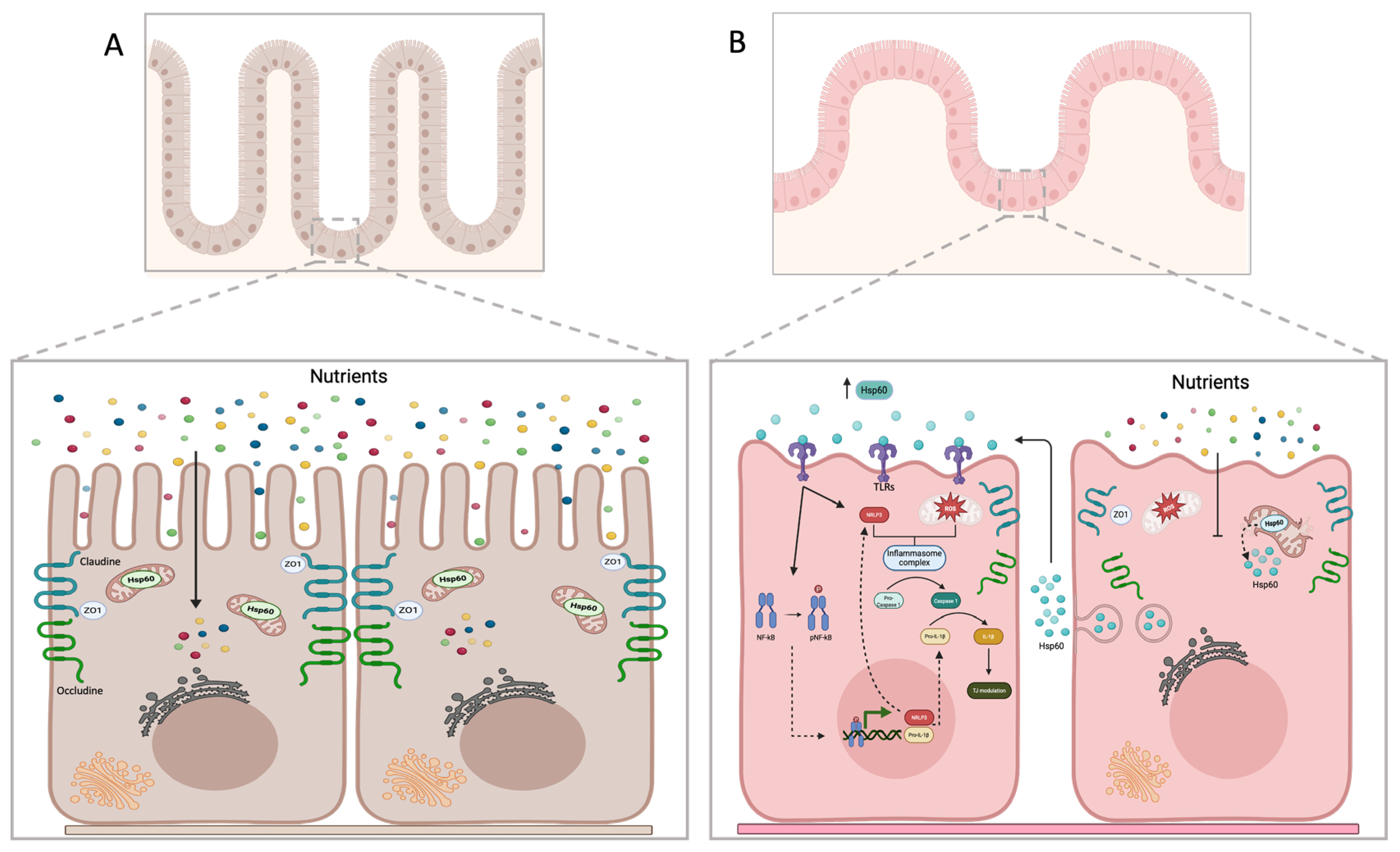
CD features a chronically inflammatory mucosal microenvironment where persistent epithelial stress and the continuous activation of innate and adaptive immunity interplay. In this delicate balance, endogenous molecules released in response to cellular damage can acquire unconventional immunological functions, actively contributing to the perpetuation of inflammation [35,36]. As widely reported in the literature, Hsp60 emerges as a potential mediator capable of linking intracellular distress to the activation of mucosa immune circuit (Figure 1) [37].
Under physiological conditions, Hsp60 primarily resides within the mitochondria, where it ensures proper protein folding and mitochondrial homeostasis [37]. However, under conditions of inflammatory stress or structural damage to the intestinal epithelium, Hsp60 can accumulate in the cytosol or enter the extracellular space [38]. In this context, the protein acts as a DAMP, engaging innate immunity receptors, specifically Toll-like receptors 4 (TLR4) [38]. This interaction triggers pro-inflammatory signaling pathways, such as p38 MAPK and NF-kB, leading to the induction of cytokines like IL-1β, TNF-α and IL-6. Furthermore, TLR4 activation promotes the production of reactive oxygen species (ROS), which serve as key signals for NLRP3 inflammasome activation and subsequent IL-1β release [39,40,41,42]. IL-1β plays a pivotal role in the gut; beyond amplifying the inflammatory response, it directly impacts the epithelial barrier. Through the activation of myosin light chain kinase (MLCK), this cytokine induces alterations in the tight junction architecture, compromising barrier integrity and increasing intestinal permeability. This breakdown facilitates the passage of immunogenic gluten peptides, reinforcing a vicious cycle of mucosal immune activation [43,44,45]. While substantial of this mechanistic evidence stems from general cellular models, the core molecular players, TLR4, NFkB, ROS, NLRP3 and IL-1β, are highly conserved components of the intestinal epithelium. Clinical studies on duodenal biopsies have demonstrated a significant upregulation of TLR2 and TLR4 in patients with active CD; notably, this overexpression often persists even in individuals adhering to a long-term GFD. Such findings suggest that innate immune activation may remain “smoldering” regardless of acute gluten exposure, leading a state of chronic inflammatory priming [46]. Whitin this primed environment, the role of exogenous triggers is well-established: peptides derived from gliadin and other wheat components, such as α-amylase/trypsin inhibitors (ATIs), can directly activate TLR-dependent pathways, particularly through TLR2 and TLR4 [47]. However, in a landscape where these receptors are already upregulated, the presence of endogenous DAMPs like Hsp60 could potently amplify the inflammatory cascade [48]. Taken together, these observations support the hypothesis that the Hsp60-TLR axis represents a crucial intersection between epithelial stress and innate immune activation in CD. In this model, Hsp60 functions as an endogenous “distress signal” born from cellular damage, capable of translating metabolic and epithelial strain into an active inflammatory response. This mechanism may drive to the self-perpetuating mucosal environment characteristic of the disease. Although direct functional evidence of Hsp60-TLR interaction specifically within the celiac context is still emerging, the convergence of persistent epithelial stress, TLR overexpression, and inflammasome activation points toward a powerful inflammatory amplification circuit that warrants urgent further investigation.
4. Conclusions
Although CD is long regarded as an autoimmune disorder driven by the adaptive response to gluten, emerging evidence suggests that epithelial stress and innate immune activation are integral, persistent components of its pathogenesis. In this framework, heat shock proteins take on a significance that extends far beyond their standard role as molecular chaperones. Hsp27 and Hsp70 serve as markers of a chronic condition of epithelial stress, also observable in patients in clinical remission. Strategically, Hsp60 stands at the crossroads of mitochondrial dysfunction and the release of endogenous danger signals. The proposed Hsp60-TLR axis offers a fresh interpretation of CD: one where metabolic and cellular damage to the intestinal epithelium converts into an immunological signal that drives mucosal inflammation. The persistent upregulation of TLRs in the celiac mucosa, even in those adhering to a GFD, supports the hypothesis of a “chronic innate priming” state sustained by DAMPs such as Hsp60. However, directly evidence linking Hsp60 to the CD progression is still emerging; consequently, current insights largely draw upon findings from other inflammatory bowel diseases or in vitro models. Despite these limitations, the convergence of epithelial stress and innate inflammatory pathways points toward a mucosal amplification circuit that demands further investigation. Future research utilizing three-dimensional intestinal models or immune-epithelial co-culture will be essential to confirm if Hsp60 is not just a marker of stress, but a driver of the disease. Redefining CD through this stress-immunity axis could shift our understanding of the condition from a gluten-dependent disease to once characterized by intrinsic epithelial vulnerability.
Author Contributions
Conceptualization: Francesca Rappa, Letizia Paladino, Giuseppe Vergilio, Giusy Vultaggio; writing—original draft preparation: Giuseppe Vergilio, Giusy Vultaggio; writing—review and editing: Francesca Rappa, Letizia Paladino, Rosalia Gagliardo; supervision: Francesca Rappa, Letizia Paladino. All authors have read and agreed to the published version of the manuscript.
Funding
This research received no external funding.
Conflicts of Interest
The authors declare no conflicts of interest.
Abbreviations
| AD | Autoimmune Disease |
| CD | Celiac Disease |
| CS | Chaperone System |
| DAMP | Damage-Associated Molecular Patterns |
| EMA | Anti-Endomysial Antibodies |
| GFD | Gluten-free diet |
| HLA | Human Leukocyte Antigen |
| Hsps | Heat Shock Proteins |
| IBD | Inflammatory Bowel Disease |
| IELs | Intraepithelial Lymphocytes |
| IL-1β | Interleukin-1 beta |
| IL-6 | Interleukin-6 |
| MAPK | Mitogen-Activated Protein Kinases |
| MLCK | Myosin Light Chain Kinase |
| NF-kB | Nuclear Factor kappa B |
| NLRP3 | NLR Family Pyrin Domain Containing 3 (inflammasome NLRP3) |
| ROS | Reactive Oxygen Species |
| TLRs | Toll-Like Receptors |
| TNF-α | Tumor Necrosis Factor |
| tTG | Tissue Transglutaminase |
References
- Ilchmann-Diounou, H.; Menard, S. Psychological stress, intestinal barrier dysfunctions, and autoimmune disorders: An overview. Front. Immunol. 2020, 11, 1823. [CrossRef]
- Pisetsky, D.S. Pathogenesis of autoimmune disease. Nat. Rev. Nephrol. 2023, 19, 509–524. [CrossRef]
- Fugger, L.; Jensen, L.T.; Rossjohn, J. Challenges, progress, and prospects of developing therapies to treat autoimmune diseases. Cell 2020, 181, 63–80. [CrossRef]
- Marson, A.; Housley, W.J.; Hafler, D.A. Genetic basis of autoimmunity. J. Clin. Investig. 2015, 125, 2234–2241. [CrossRef]
- Vojdani, A. A potential link between environmental triggers and autoimmunity. Autoimmune Dis. 2014, 2014, 437231. [CrossRef]
- Tiffon, C. The impact of nutrition and environmental epigenetics on human health and disease. Int. J. Mol. Sci. 2018, 19, 3425. [CrossRef]
- Song, X.; Liang, H.; Nan, F.; Chen, W.; Li, J.; He, L.; Cun, Y.; Li, Z.; Zhang, W.; Zhang, D. Autoimmune diseases: molecular pathogenesis and therapeutic targets. MedComm 2025, 6, e70262. [CrossRef]
- Gujral, N.; Freeman, H.J.; Thomson, A.B.R. Celiac disease: prevalence, diagnosis, pathogenesis and treatment. World J. Gastroenterol. 2012, 18, 6036–6059. [CrossRef]
- Dunne, M.R.; Byrne, G.; Chirdo, F.; Feighery, C. Coeliac disease pathogenesis: The uncertainties of a well-known immune mediated disorder. Front. Immunol. 2020, 11, 1374. [CrossRef]
- Maiuri, L.; Ciacci, C.; Ricciardelli, I.; Vacca, L.; Raia, V.; Auricchio, S.; Picard, J.; Osman, M.; Quaratino, S.; Londei, M. Association between innate response to gliadin and activation of pathogenic T cells in coeliac disease. Lancet 2003, 362, 30–37. [CrossRef]
- Schumann, M.; Siegmund, B.; Schulzke, J.D.; Fromm, M. Celiac disease: Role of the epithelial barrier. Cell. Mol. Gastroenterol. Hepatol. 2017, 3, 150–162. [CrossRef]
- Ensari, A.; Marsh, M.N. Diagnosing celiac disease: A critical overview. Turk. J. Gastroenterol. 2019, 30, 389–397. [CrossRef]
- Macario, A.J.L.; Conway de Macario, E. Chaperone proteins and Chaperonopathies. In Handbook of Stress, Volume 3, Stress Physiology, Biochemistry, and Pathology; Fink, G., Ed.; Elsevier/Academic Press: Cambridge, MA, USA, 2019; Chapter 12, pp. 135–152.
- Caio, G.; Volta, U.; Sapone, A.; Leffler, D.A.; De Giorgio, R.; Catassi, C.; Fasano, A. Celiac disease: A comprehensive current review. BMC Med. 2019, 17, 142. [CrossRef]
- Kahaly, G.J.; Frommer, L.; Schuppan, D. Celiac disease and endocrine autoimmunity – The genetic link. Autoimmun. Rev. 2018, 17, 1169–1175. [CrossRef]
- Cappello, F.; David, S.; Rappa, F.; Bucchieri, F.; Marasà, L.; Bartolotta, T.E.; Farina, F.; Zummo, G. The expression of HSP60 and HSP10 in large bowel carcinomas with lymph node metastase. BMC Cancer 2005, 5, 139. [CrossRef]
- Caruso Bavisotto, C.; Cipolla, C.; Graceffa, G.; Barone, R.; Bucchieri, F.; Bulone, D.; Cabibi, D.; Campanella, C.; Marino Gammazza, A.; Pitruzzella, A.; Porcasi, R.; San Biagio, P.L.; Tomasello, G.; Conway de Macario, E.; Macario, A.J.L.; Cappello, F.; Rappa, F. Immunomorphological pattern of molecular chaperones in normal and pathological thyroid tissues and circulating exosomes: Potential use in clinics. Int. J. Mol. Sci. 2019, 20, 4496. [CrossRef]
- Zhang, M.; Bi, X. Heat shock proteins and breast cancer. Int. J. Mol. Sci. 2024, 25, 876. [CrossRef]
- Basset, C.A.; Conway de Macario, E.; Leone, L.G.; Macario, A.J.L.; Leone, A. The chaperone system in cancer therapies: Hsp90. J. Mol. Histol. 2023, 54, 105–118. [CrossRef]
- Zuo, W.F.; Pang, Q.; Zhu, X.; Yang, Q.Q.; Zhao, Q.; He, G.; Han, B.; Huang, W. Heat shock proteins as hallmarks of cancer: Insights from molecular mechanisms to therapeutic strategies. J. Hematol. Oncol. 2024, 17, 81. [CrossRef]
- Bukau, B.; Weissman, J.; Horwich, A. Molecular chaperones and protein quality control. Cell 2006, 125, 443–451. [CrossRef]
- Samborski, P.; Grzymisławski, M. The role of HSP70 heat shock proteins in the pathogenesis and treatment of inflammatory bowel diseases. Adv. Clin. Exp. Med. 2015, 24, 525–530. [CrossRef]
- Spierings, J.; van Eden, W. Heat shock proteins and their immunomodulatory role in inflammatory arthritis. Rheumatology 2017, 56, 198–208. [CrossRef]
- Zilaee, M.; Shirali, S. Heat shock proteins and diabetes. Can. J. Diabetes 2016, 40, 594–602. [CrossRef]
- Gammazza, A.M.; Bucchieri, F.; Grimaldi, L.M.; Benigno, A.; de Macario, E.C.; Macario, A.J.; Zummo, G.; Cappello, F. The molecular anatomy of human Hsp60 and its similarity with that of bacterial orthologs and acetylcholine receptor reveal a potential pathogenetic role of anti-chaperonin immunity in myasthenia gravis. Cell. Mol. Neurobiol. 2012, 32, 943–947. [CrossRef]
- Hoter, A.; Naim, H.Y. The functions and therapeutic potential of heat shock proteins in inflammatory bowel disease—An update. Int. J. Mol. Sci. 2019, 20, 5331. [CrossRef]
- Kostenko, S.; Moens, U. Heat shock protein 27 phosphorylation: Kinases, phosphatases, functions and pathology. Cell. Mol. Life Sci. 2009, 66, 3289–3307. [CrossRef]
- Paul, C.; Manero, F.; Gonin, S.; Kretz-Remy, C.; Virot, S.; Arrigo, A.P. Hsp27 as a negative regulator of cytochrome C release. Mol. Cell. Biol. 2002, 22, 816–834. [CrossRef]
- Setty, M.; Discepolo, V.; Abadie, V.; Kamhawi, S.; Mayassi, T.; Kent, A.; Ciszewski, C.; Maglio, M.; Kistner, E.; Bhagat, G.; Semrad, C.; Kupfer, S.S.; Green, P.H.; Guandalini, S.; Troncone, R.; Murray, J.A.; Turner, J.R.; Jabri, B. Distinct and synergistic contributions of epithelial stress and adaptive immunity to functions of intraepithelial killer cells and active celiac disease. Gastroenterology 2015, 149, 681–691.e10. [CrossRef]
- Caruso Bavisotto, C.; Alberti, G.; Vitale, A.M.; Paladino, L.; Campanella, C.; Rappa, F.; Gorska, M.; Conway de Macario, E.; Cappello, F.; Macario, A.J.L.; Marino Gammazza, A. Hsp60 post-translational modifications: Functional and pathological consequences. Front. Mol. Biosci. 2020, 7, 95. [CrossRef]
- Rodolico, V.; Tomasello, G.; Zerilli, M.; Martorana, A.; Pitruzzella, A.; Gammazza, A.M.; David, S.; Zummo, G.; Damiani, P.; Accomando, S.; Conway de Macario, E.; Macario, A.J.; Cappello, F. Hsp60 and Hsp10 increase in colon mucosa of Crohn’s disease and ulcerative colitis. Cell Stress Chaperones 2010, 15, 877–884. [CrossRef]
- Hu, C.; Yang, J.; Qi, Z.; Wu, H.; Wang, B.; Zou, F.; Mei, H.; Liu, J.; Wang, W.; Liu, Q. Heat shock proteins: Biological functions, pathological roles, and therapeutic opportunities. MedComm 2022, 3, e161. [CrossRef]
- Piatek-Guziewicz, A.; Ptak-Belowska, A.; Przybylska-Felus, M.; Pasko, P.; Zagrodzki, P.; Brzozowski, T.; Mach, T.; Zwolinska-Wcislo, M. Intestinal parameters of oxidative imbalance in celiac adults with extraintestinal manifestations. World J. Gastroenterol. 2017, 23, 7849–7862. [CrossRef]
- Tomasello, G.; Sciumé, C.; Rappa, F.; Rodolico, V.; Zerilli, M.; Martorana, A.; Cicero, G.; De Luca, R.; Damiani, P.; Accardo, F.M.; Romeo, M.; Farina, F.; Bonaventura, G.; Modica, G.; Zummo, G.; Conway de Macario, E.; Macario, A.J.; Cappello, F. Hsp10, Hsp70, and Hsp90 immunohistochemical levels change in ulcerative colitis after therapy. Eur. J. Histochem. 2011, 55, e38. [CrossRef]
- Barone, M.V.; Zimmer, K.P.; Enders, C.; Tye-Din, J.A.; Troncone, R.; Auricchio, R. Pivotal role of inflammation in celiac disease. Int. J. Mol. Sci. 2022, 23, 7177. [CrossRef]
- Calderwood, S.K.; Gong, J.; Murshid, A. Extracellular HSPs: The complicated roles of extracellular HSPs in immunity. Front. Immunol. 2016, 7, 159. [CrossRef]
- Zininga, T.; Ramatsui, L.; Shonhai, A. Heat shock proteins as immunomodulants. Molecules 2018, 23, 2846. [CrossRef]
- Quintana, F.J.; Cohen, I.R. The HSP60 immune system network. Trends Immunol. 2011, 32, 89–95. [CrossRef]
- Swaroop, S.; Mahadevan, A.; Shankar, S.K.; Yasha, T.C.; Ranga, U. HSP60 plays a regulatory role in IL-1β-induced microglial inflammation via TLR4-p38 MAPK axis. J. Neuroinflamm. 2016, 13, 27. [CrossRef]
- Swaroop, S.; Mahadevan, A.; Shankar, S.K.; Yasha, T.C.; Ranga, U. HSP60 critically regulates endogenous IL-1β production in activated microglia by stimulating NLRP3 inflammasome pathway. J. Neuroinflamm. 2018, 15, 177. [CrossRef]
- Zhen, Y.; Zhang, H. NLRP3 inflammasome and inflammatory bowel disease. Front. Immunol. 2019, 10, 276. [CrossRef]
- Li, Z.; Guo, J.; Bi, L. Role of the NLRP3 inflammasome in autoimmune diseases. Biomed. Pharmacother. 2020, 130, 110542. [CrossRef]
- Al-Sadi, R.; Ye, D.; Dokladny, K.; Ma, T.Y. IL-1beta-induced increase in intestinal epithelial tight junction permeability is mediated by MEKK-1 activation of canonical NF-kappaB pathway. Am. J. Pathol. 2010, 177, 2310–2322. [CrossRef]
- Kaminsky, L.W.; Al-Sadi, R.; Ma, T.Y. IL-1β and the intestinal epithelial tight junction barrier. Front. Immunol. 2021, 12, 767456. [CrossRef]
- Sturgeon, C.; Fasano, A. Zonulin, a regulator of epithelial and endothelial barrier functions, and its involvement in chronic inflammatory diseases. Tissue Barriers 2016, 4, e1251384. [CrossRef]
- Szebeni, B.; Veres, G.; Dezsofi, A.; Rusai, K.; Vannay, A.; Bokodi, G.; Vásárhelyi, B.; Korponay-Szabó, I.R.; Tulassay, T.; Arató, A. Increased mucosal expression of Toll-like receptor (TLR)2 and TLR4 in celiac disease. J. Pediatr. Gastroenterol. Nutr. 2007, 45, 187–193. [CrossRef]
- Talipova, D.; Smagulova, A.; Poddighe, D. Toll-like receptors and celiac disease. Int. J. Mol. Sci. 2022, 24, 265. [CrossRef]
- Vabulas, R.M.; Ahmad-Nejad, P.; da Costa, C.; Miethke, T.; Kirschning, C.J.; Häcker, H.; Wagner, H. Endocytotic HSP60s use the toll-like receptor 2 (TLR2) and TLR4 to activate the toll/interleukin-1 receptor signaling pathway in innate immune cells. J. Biol. Chem. 2001, 276, 31332–31339. [CrossRef]
Figure 1.
Hsp60-TLR4 axis in CD pathogenesis. Healthy mucosa: homeostasis and barrier integrity (A). In a healthy state, the small intestinal mucosa features well-organized villi and preserved epithelial architecture. Enterocytes maintain proper polarization, anchored by intact tight junctions (TJs), composed of claudins, occludin, and ZO-1. These structural proteins ensure selective paracellular permeability and a robust barrier. Under physiological conditions, Hsp60 resides primarily within the mitochondria, where it fulfills its essential chaperone role by assisting protein folding and supporting cellular homeostasis. Celiac mucosa: epithelial stress and inflammatory signaling (B). The celiac mucosa exhibits by villous atrophy, marked by a significant shortening and architectural distortion of the epithelial layer. Environmental triggers induce cellular stress, which drives Hsp60 overexpression and its subsequent release into the extracellular space. Here, extracellular Hsp60 functions as a damage-associated molecular pattern (DAMP), binding to Toll-like receptors (TLRs), particularly TLR4, expressed on enterocytes. This interaction triggers intracellular signaling cascades that promote NF-κB phosphorylation and its nuclear translocation. This process upregulates pro-inflammatory genes, such as NLRP3 and pro-IL-1β. Simultaneously, elevated ROS production fuels the activation of the NLRP3 inflammasome, enabling caspase-1 to cleave pro-IL-1β into its mature, active form. Mature IL-1β then exerts autocrine and paracrine effects on tight junctions, causing structural alterations that increase paracellular permeability. This resulting barrier dysfunction facilitates further antigen translocation, creating a self-perpetuating cycle of mucosal inflammation.
Figure 1.
Hsp60-TLR4 axis in CD pathogenesis. Healthy mucosa: homeostasis and barrier integrity (A). In a healthy state, the small intestinal mucosa features well-organized villi and preserved epithelial architecture. Enterocytes maintain proper polarization, anchored by intact tight junctions (TJs), composed of claudins, occludin, and ZO-1. These structural proteins ensure selective paracellular permeability and a robust barrier. Under physiological conditions, Hsp60 resides primarily within the mitochondria, where it fulfills its essential chaperone role by assisting protein folding and supporting cellular homeostasis. Celiac mucosa: epithelial stress and inflammatory signaling (B). The celiac mucosa exhibits by villous atrophy, marked by a significant shortening and architectural distortion of the epithelial layer. Environmental triggers induce cellular stress, which drives Hsp60 overexpression and its subsequent release into the extracellular space. Here, extracellular Hsp60 functions as a damage-associated molecular pattern (DAMP), binding to Toll-like receptors (TLRs), particularly TLR4, expressed on enterocytes. This interaction triggers intracellular signaling cascades that promote NF-κB phosphorylation and its nuclear translocation. This process upregulates pro-inflammatory genes, such as NLRP3 and pro-IL-1β. Simultaneously, elevated ROS production fuels the activation of the NLRP3 inflammasome, enabling caspase-1 to cleave pro-IL-1β into its mature, active form. Mature IL-1β then exerts autocrine and paracrine effects on tight junctions, causing structural alterations that increase paracellular permeability. This resulting barrier dysfunction facilitates further antigen translocation, creating a self-perpetuating cycle of mucosal inflammation.
Disclaimer/Publisher’s Note: The statements, opinions and data contained in all publications are solely those of the individual author(s) and contributor(s) and not of MDPI and/or the editor(s). MDPI and/or the editor(s) disclaim responsibility for any injury to people or property resulting from any ideas, methods, instructions or products referred to in the content. |
© 2026 by the authors. Licensee MDPI, Basel, Switzerland. This article is an open access article distributed under the terms and conditions of the Creative Commons Attribution (CC BY) license (http://creativecommons.org/licenses/by/4.0/).
Copyright: This open access article is published under a Creative Commons CC BY 4.0 license, which permit the free download, distribution, and reuse, provided that the author and preprint are cited in any reuse.


