
Submitted:
23 March 2026
Posted:
24 March 2026
You are already at the latest version
Abstract
In this paper, we introduce a new set-theoretic operator $(\cdot)^{\sharp}_{\omega}$ in the framework of ideal topological spaces and investigate its fundamental properties, including its connections with the classical $\sharp$-operator and the $\omega$-local function. Using this operator, we define a closure-type operator $\mathrm{Cl}^{\sharp}_{\omega}$ and show that it satisfies the Kuratowski closure axioms. Consequently, a topology $\mathcal{T}^{\sharp}_{\omega}$ is obtained, which is strictly finer than the topology induced by the $\sharp$-operator. Furthermore, the structural relationships among these topologies are examined, and some applications of the $\omega^\sharp$-operator are presented. Finally, we introduce the notions of $\omega^\ast$-continuity and $\omega^\sharp$-continuity, investigate their relationship, and establish a new decomposition of continuity. We also compare these notions with related concepts such as $\ast$-continuity and $\sharp$-continuity.
Keywords:
ideal topological space
; ω-open set
; (·)♯ ω-operator
; Cl♯ ω- operator
; T ♯ ω-topology
; T ∗ ω -topology
; ω∗-continuity
; ω♯-continuity
MSC: 54A05; 54A10; 54C10
1. Introduction and Preliminaries
The interaction between algebraic structures and topology such as ideals [1], filters [2], primals [3], and grills [4] has played an important role in general topology. Among these structures, ideals provide a convenient framework for formalizing notions of smallness.
Let be a topological space. A nonempty family is called an ideal if it is hereditary and closed under finite unions. The triple is called an ideal topological space (briefly, an ideal Top space), with no separation axioms assumed. For an ideal topological space, the associated local function (or ∗–operator) is defined by
where and . This operator, originating in Kuratowski’s work [5], was further developed by Vaidyanathaswamy [6]. Moreover, the operator
defines a Kuratowski closure operator on . Later contributions include the complementary operator introduced by Natkaniec [7] and the systematic study of ideal topological spaces by Janković and Hamlett [8]. Islam and Modak (2018) provided an in-depth study of the * and operators and their properties [9].
Recent developments in the theory of ideal topological spaces have emphasized the interaction between ideals and various generalized topological notions. In particular, investigations have addressed weakened forms of separation axioms as well as extensions of closedness concepts within this framework [10,11]. Moreover, approaches based on nano-topology, especially those employing covering-generated neighborhood systems in the presence of multiple ideals, have further enriched the structure of such spaces [12].
Earlier contributions have also examined decompositions of continuity in the setting of ideal topologies and -Alexandroff spaces, providing a deeper understanding of how classical continuity notions can be refined through the incorporation of ideal-related constraints [13,14].
More recently, attention has shifted toward the formulation of new operators and localized functions in ideal topological spaces, such as sharp-type operators and aura-based local functions. These constructions serve as effective tools for producing finer or alternative topological structures, thereby extending the scope of operator-driven methodologies [15,16,17,18]. Collectively, these advancements reflect a growing interest in operator-oriented frameworks and their role in shaping modern generalizations of ideal topological spaces.
Throughout this paper, a pair , or simply when the topology is clear, denotes a topological space (Top-space) without assuming separation axioms. For any , and represent the closure and interior of H relative to , respectively. Let be a Top-space and . A point is called a condensation point of H if
The set H is said to be ω-closed [19] if it contains all of its condensation points. A subset is ω-open if is -closed. Equivalently, W is -open if and only if
The family of all -open subsets of is denoted by forms a topology on X finer than . The -closure and -interior, which can be defined in the same way as and , respectively, will be denoted by and , respectively.
Motivated by the concept of -open sets, Ahmad Al-Omari and Hanan Al-Saadi [20] introduced the notion of -local functions with respect to a topology and an ideal on a set . For any subset , define where For brevity, we write instead of . Moreover, for an ideal on , the operator defines a Kuratowski closure operator on . The topology generated by the operator is This topology is called the -topology, and it is finer than .
Recently, Issaka, F. Y.; Özköc, M. [21] developed a framework based on extremal ideals and investigated their structural behavior within ideal-induced topologies. Let and let be an ideal. The ideal is said to be maximal if
Dually, assuming , the ideal is called minimal whenever
Let be a topology on . For any , define the operator
This operator is referred to as the sharp transform of H relative to , and is briefly denoted by . Moreover, define the dual operator by Using , one obtains a Kuratowski-type closure operator The family of open sets induced by is given by which defines a topology on satisfying .
In Section 2, we introduce a new operator and investigate its principal properties, emphasizing its connections with the classical sharp operator and the -local function.
In Section 3, using this operator, we define a Kuratowski-type closure and analyze the topology it induces, proving that this topology is strictly finer than . Furthermore, we examine the relationships between and other related topologies, highlighting both implications and independence results among them.
In Section 4, we present some applications of the operator .
Finally, in Section 5, we define the notions of -continuity and -continuity for functions, and examine their relationships with other established forms of continuity, such as -continuity and ♯-continuity.
In this study, , , and denote the sets of integers, rational numbers, and real numbers, respectively.
We first present a number of preliminary results needed in the sequel.
Definition 1.
[21] Let be a nonempty set and with . The ideal generated by H is defined as
Theorem 1.
[22] Let be an ideal Top – space and let . Then the following hold.
- (1)
- (2)
- (3)
- (4)
Lemma 1.
[21] Let be an ideal on , and let . Define
Then is itself an ideal on .
Definition 2.
[21] [Ideal Quotient and Annihilator] Let and let be an ideal on . Suppose .
- (1)
- The quotient of the ideal by is the collection
- (2)
- In the special case where , the quotient is called the annihilator of relative to , denoted by
- (2)
- For a singleton subset , we write for brevity.
Definition 3.
[21] Let and . The ideal is called faithful if
Lemma 2.
[21] Let be an ideal on . Then
Theorem 2.
[21] A proper ideal on a non-empty set is maximal if and only if for every , either or .
Corollary 1.
[21] Let with an ideal . Then the following hold.
- (1)
- For every , one has
- (2)
- If is a minimal ideal, then is a maximal ideal.
2. Basic Properties of the -Operator
Definition 4.
Let be an ideal Top-space. For any subset , define the operator by where The set , also denoted by , is called the -operator of H relative to the ideal and the topology . When the context is clear, we simply write .
Corollary 2.
Let be an ideal Top-space and let . Then
Proof.
Since every -open is also -open, the inclusion follows immediately by definition. □
The next example illustrates that, in general, the containment fails to be valid.
Example 1.
Consider endowed with the trivial (indiscrete) topology Define an ideal on by Let be the set of irrational numbers. Then the sharp operator associated with satisfies Indeed, observe that the set is ω-open. Moreover, for every , we have Consequently, for each , we obtain . Hence,
Remark 1.
From Example 1, we have and hence Next, let be the ideal on generated by the set of integer numbers , and consider the set
For every , we obtain which implies that Consequently,
Finally, consider the ideal Then let It follows that and hence Therefore, in general, there is no inclusion relationship between a set H and its associated set .
Based on Theorem 2, we obtain the following corollary.
Corollary 3.
Let be an ideal Top-space. If the ideal is maximal, then for every subset , we have either or .
Theorem 3.
Let be an ideal Top-space and let . If is a maximal ideal, then H is either -closed or -open.
Proof.
Let be a maximal ideal on , and consider an arbitrary subset . Because is maximal, it follows from the Theorem 2, that
- Case 1. If , then Thus H is -closed, and hence is -open.
- Case 2. If , then Thus is -closed, and hence H is -open. Therefore, □
Theorem 4.
Let be an ideal Top-space. If the ideal is maximal, then the space satisfies the separation axiom.
Proof.
Let with . Define Since the ideal is maximal, we have
Case 1:. By Theorem 3, Hence,
Case 2:. Then Hence,
Thus in all cases, Hence satisfies the separation axiom. □
Remark 2.
Consider a topological space and two ideals and on . Assume that . Then, for any , the following implication holds:
Remark 3.
In general, there is no intrinsic correspondence between the ω-local function and the -operator. This lack of dependence can be demonstrated through the following construction.
Let be the usual topological space where . Let be the ideal on , and consider the set . Then for every .
In this setting, one observes that
Conversely, since , the behavior of the corresponding operators is reversed. Indeed,
This example illustrates that the two operators behave independently..
The following theorem establishes a connection between the -localized function and the -operator.
Theorem 5.
For any ideal Top-space and any , we have
Proof.
Let . Then, for any :
Hence, we conclude, □
Theorem 6.
Consider an ideal Top-space . For any subsets H and G of , the operator satisfies the following properties:
- (1)
- ;
- (2)
- ;
- (3)
- ;
- (4)
- ;
- (5)
- ;
- (6)
- If , then ;
- (7)
- If , then ;
- (8)
- If is faithful, then ;
- (9)
- If , then ;
- (10)
- .
Proof.
We verify the properties of the operator as follows:
(2) Clearly, . To verify the converse inclusion , we proceed as follows:
(3) This follows directly from (1).
(4) From Theorem 1(2) and Theorem 5, we infer that
(5) Since , we have
Combining (1) and (2), we get:
Equivalent Expression via Theorems 1(4) and 5. Using the canonical forms, we also have
This completes the proof.
(6) It follows directly from the definition of .
(7)
Since , by (6) we get
(8) Since is assumed to be faithful, it follows that . From Theorem 5, we deduce that
(9) Let . Then
(10)
Hence, . □
Example 2.
Let be equipped with the usual topology , and let be an ideal on . Consider the operator .
For any with , there exists such that
Hence,
which implies . Therefore, This shows that is not extensive, since .
Lemma 3.
Let be a topological space and let be ideals on . Then, for any subset , .
Proof. (⊆) Let . If and , then there exist such that and . Hence , a contradiction. Thus .
(⊇) If or , then for every , and hence . □
Theorem 7.
In an ideal Top-space , the ω-closure of any subset decomposes as the union of the sets and . Explicitly,
Proof.
□
Corollary 4.
Let be an ideal Top –space and let . Then:
- (1)
- (2)
3. On the -Closure Operator and the Associated Sharp Topology
Definition 5.
Let be an ideal Top –space. The –closure operator
is defined by
Theorem 8.
Let be an ideal Top –space, and . Then satisfies:
- (1)
- (2)
- (3)
- (4)
- (5)
- (6)
- (7)
- If , then .
Proof.
We verify the properties of as follows:
- (1)
- By definition, , so
- (2)
- Since ,
- (3)
- Clearly, .
- (4)
- If , then (Theorem 6 (2)), so
- (5)
- For unions, using Theorem 6 (4),
- (6)
- Using Theorem 6 (10) and items (3) and (4), we obtain that
- (7)
- If , then by Theorem 6 (9),
□
Proposition 1.
Let be an ideal Top –space and . If , then the following properties hold.
- (1)
- ;
- (2)
- .
Proof. (1) By Theorem 6 (2), Since , it follows that Therefore,
(2) From (1), we obtain Hence, the result follows. □
Corollary 5.
If is an ideal Top –space, then for every ,
Remark 4.
By Theorem 8, the operator is a Kuratowski closure. Accordingly,
defines a topology on , called the -topology. When needed, we write .
Theorem 9.
Let be an ideal Top –space. Then the inclusions and hold.
Proof.
To show that . Let . Then, Hence , it follows that
By the definition of the closure operator , Therefore, is -closed, and consequently . Hence,
To show that . Let . Then is -closed, so that
By Corollary 2, Thus,
Therefore, is -closed, and hence . It follows that □
Corollary 6.
Let be an ideal topological space. Then
Remark 5.
The relationships induced by the definitions of the ♯-topology and the -topology are summarized in the diagram below. The example that follows shows that these implications do not admit converses. Moreover, the notions of -open sets and -open sets are independent.
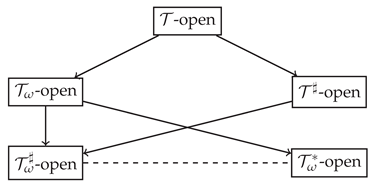
Example 3.
Consider equipped with the topology and let denote the ideal generated by . Since it follows that Moreover, On the other hand, Hence, -open set and -open set are independent concepts. Furthermore, since we obtain Consequently,
Example 4.
Let be an indiscrete topological space, and let denote the ideal generated by the interval . First, consider the set . Then
By Corollary 4 (2), we obtain Therefore, , while . Next, let . Then
Hence, by Corollary 4 (1), Thus, , whereas .
Definition 6.
Let be an ideal topological space and let . The following operators are defined:
- (1)
- The -operator is defined by
- (2)
- The -operator is defined by
Remark 6.
Let be an ideal Top –space and let . According to the definition of the -operator together with the Theorem 5, we have
Theorem 10.
Let be an ideal Top –space and let . Then
Proof.
Let . Then
Hence,
□
Theorem 11.
Let be an ideal Top –space and . Then
Proof.
Consider any subset . By Theorem 7, We have
□
From the Theorem 11, we obtain the following:
Corollary 7.
For an ideal Top –space and a subset . Then:
- (1)
- If , then it follows that
- (2)
- If , then
Theorem 12.
For any ideal Top –space ,
Proof.
Obviously Let . Then
Since , we obtain . Hence,
Therefore,
□
Theorem 13.
Let be an ideal Top –space with a proper minimal ideal. Then, for every ,
Proof.
By the duality between ideals and their annihilators (Corollary 1 (2)) We conclude that
From Theorem 6 (6), we obtain
Therefore
□
Corollary 8.
Let be an ideal Top –space with minimal. Then
Proof.
The proof proceeds analogously to that of Theorem 3. □
Corollary 9.
Let be an ideal Top –space. If is minimal, then the space satisfies the separation axiom.
Theorem 14.
Assume that is an ideal Top –space such that is a maximal ideal on . Then, for any subset ,
Proof.
Let . Since is a maximal ideal on , it follows that
Consequently,
From Theorem 7, we have
Hence,
Using the identity
we deduce
Therefore,
which completes the proof. □
Corollary 10.
Suppose that is an ideal Top –space such that is a proper minimal ideal on . Then, for every subset ,
Proof.
Applying Theorems 7 and 13, the statement is established. □
4. Some Applications of -Operator
Theorem 15.
[21] Let be a topological space and let H be a subset of . Then H is dense in if and only if the ideal topological space is a Hayashi–Samuel space.
Remark 7.
Let be the usual topology on , and let the annihilator ideal of the rationals be
The associated ω-topology is
Since we can write symbolically that the space
fails to be a Hayashi–Samuel space as Furthermore, applying the operator, we have because .
Remark 8.
In [21], Issaka and Özköc established that the set of rational numbers is -dense in the ideal topological space or dense in , where denotes the usual topology on .
Question 1.
Does there exist a Hausdorff topology on such that fails to be dense in with respect to the ideal ?
Example 5.
Let is the usual topology on . Let . Since , then by Corollary 4 (1), we obtain and because is ω-open. Thus . Thus is not -dense or is not dense in . Finally, it is obvious that is Hausdorff since .
Theorem 16.
Let be a topological space. Assume that there is a set . Then the ideal Top –space is -disconnected.
Proof.
Let Then Since it follows that Moreover, and hence, by Theorem 6 (6), By the definition of ,
□
Corollary 11.
Let be a topological space. If , then is .
Example 6.
Consider the real line endowed with its usual topology . Let be the ideal generated by the finite set The set F is ω-closed in the topological space . By Theorem 16, the corresponding ideal topological space is -disconnected.
5. Decomposition Results for Continuity
Definition 8.
Let be an ideal Top –space and a topological space. A function is called -continuous (respectively, -continuous) if and only if
Corollary 12.
Let be a function. Then f is -continuous iff is continuous, and f is -continuous iff is continuous.
Corollary 13.
Let be a function. If f is continuous, then it is also -continuous and -continuous.
The converse of Corollary 12 is not valid in general, as illustrated by the following example.
Example 7.
Let be the standard topology on , and let be the ideal of countable sets. Define the co-countable topology
Consider the identity function
For any , . Since is countable. Then for any ,
so . Therefore, f is -continuous. However, f is not continuous because but Similarly, using the -operator, we have and
so , and . Hence, f is -continuous as well.
Theorem 17.
A function is ω-continuous if and only if it is both -continuous and -continuous.
Proof.
The proof follows directly from Theorem 12. □
Corollary 14.
Let be a function. Then the following hold.
- (1)
- If f is ω-continuous, it is also -continuous.
- (2)
- If f is ♯-continuous, it is also -continuous.
The reverse statement of Corollary 14 is not true in general; this is shown by the following example.
Example 8.
Let be an ideal Top –space, where is the usual topology on and . Define a function by
For any ,
Since , Theorem 6 (6) yields . Hence
which implies by Theorem 10. Similarly, by Theorem 10. Indeed, since and , it follows that Consequently, and therefore . Therefore for every , and thus f is -continuous. However, f is not ω-continuous since .
Remark 9.
Following Issaka and Özköc [21], for any , we have In Example 7, since , it holds that Consequently, , and thus the function is -continuous but not ♯-continuous.
Remark 10.
The example below demonstrates that ω-continuity and ♯-continuity are independent notions.
Example 9.
Let and be ideal Top –spaces, where is the usual topology on , , and . Consider equipped with the topology .
- (1)
- DefineNote that . Since , by Theorem 6 we have which implies . Therefore, for each , Hence, f is ♯-continuous but not ω-continuous.
- (2)
- DefineIn this case, f is ω-continuous but not ♯-continuous.
Remark 11.
The concepts of -continuity and -continuity are independent as illustrated by the following examples. Let be the indiscrete topological space, and consider the ideals on . Define the codomain with topologies Let
- (1)
-
When f is considered as it is -continuous but not -continuous. Observe that Since , Corollary 4 (2) implies Therefore, ,so f is not -continuous.
- (2)
- When f is considered as it is -continuous but not -continuous. Observe that Since , Corollary 4 (1) gives Therefore, , so f is not -continuous.
6. Conclusion
We introduced and analyzed the operator in ideal topological spaces, showing that the associated closure satisfies the Kuratowski axioms and generates a topology strictly finer than the classical ♯-topology. Inclusion relations with related topologies were precisely characterized, clarifying the structural hierarchy. We also defined - and -continuity and demonstrated their independence from existing continuity notions, providing new perspectives on operator-induced continuity. These results highlight the refinement and versatility of the -framework, offering a solid foundation for further exploration in ideal and generalized topological spaces. Future work may investigate applications of these operators in generalized operators, separation axioms, and generalized continuity, as well as other extensions of topological structures.
Conflicts of Interest
The authors declare no conflicts of interest.
Availability of Data and Materialst
No data were used to support this study.
Author Contributions
Abdo Qahis and Mohd Salmi Md Noorani contributed equally to the conception, analysis, and preparation of the manuscript. All authors approved the final version.
Acknowledgments
The authors are thankful to the Deanship of Graduate Studies and Scientific Research at Najran University for funding this work under the Elite Funding Program grant code (NU/EP/3066/14/ID).
References
- Hamlett, T.R.; Jankovic, D. Ideals in topological spaces and the set operator Ψ. Boll. Unione Mat. Ital. 1990, 7, 863–874.
- Kuratowski, K. Topology, Vol. I; Academic Press: New York, NY, USA, 1966.
- Acharyee, S.; Özköc, M.; Issaka, F.Y. Primal topological spaces. Bol. Soc. Parana. Mat. 2025, 43, 1–9. [CrossRef]
- Choquet, G. Sur les notions de filtre et grille. C. R. Acad. Sci. Paris 1947, 224, 171–173.
- Kuratowski, K. Topologie I; Instytut Matematyczny Polskiej Akademii Nauk: Warszawa, Poland, 1933.
- Vaidyanathaswamy, R. The localization theory in set topology. Proc. Indian Acad. Sci. Math. Sci. 1945, 20, 51–61. [CrossRef]
- Natkaniec, T. On I-continuity and I-semicontinuity. Math. Slovaca 1986, 36, 297–312.
- Jankovic, D.; Hamlett, T.R. New topologies from old via ideals. Amer. Math. Mon. 1990, 97, 295–310. [CrossRef]
- Islam, M.M.; Modak, S. Operator associated with the * and Ψ operators. J. Taibah Univ. Sci. 2018, 12, 444–449. [CrossRef]
- Arenas, G.; Dontchev, J.; Puertas, M.L. Idealization of some weak separation axioms. Acta Math. Hungar. 2000, 89, 47–53. [CrossRef]
- Navaneethakrishnan, M.; Joseph, J.P. g-closed sets in ideal topological spaces. Acta Math. Hungar. 2008, 119, 365–371. [CrossRef]
- Kaur, K.; Gupta, A.; Al-shami, T.M.; Hosny, M. A new multi-ideal nano-topological model via neighborhoods for diagnosis and cure of dengue. Comput. Appl. Math. 43 2024, 400. [CrossRef]
- Hatır, E. On decompositions of continuity and complete continuity in ideal topological spaces. Eur. J. Pure Appl. Math. 6 2013, 352–362.
- Ekici, E. On I-Alexandroff and Ig-Alexandroff ideal topological spaces. Filomat 25 2011, 99–108. [CrossRef]
- Acikgoz, A. Ideal-aura topological spaces, new local functions, and generalized open sets. arXiv 2026, arXiv:2602.07692. [CrossRef]
- Matejdes, M. On topologies induced by ideals, primals, filters and grills. Axioms 2024, 13, 698. [CrossRef]
- Roshdey, R.; Nasef, A.; Youns, N.; Badr, M. Some issues on topological operators via ideals. J. Contemp. Technol. Appl. Eng. 2024, 3, 25–31.
- Tunç, A.N.; Yıldırım, S.Ö. Characterization of two specific cases with new operators in ideal topological spaces. J. New Theory 2024, 46, 51–70. [CrossRef]
- Hdeib, H.Z. ω-closed mappings. Rev. Colomb. Mat. 16 1982, 65–78.
- Al-Omari, A.; Al-Saadi, H. A topology via ω-local functions in ideal spaces. Mathematica 60 2018, 2. [CrossRef]
- Issaka, F.Y.; Özköc, M. New topologies derived from the old one via operators. Demonstr. Math. 58 2025, 20240094. [CrossRef]
- Hatir, E.; Al-Omari, A.; Jafari, S. δ-local function and its properties in ideal topological spaces. Fasc. Math. 2014.
- Hdeib, H. ω-continuous functions; Dirasat, 16, 136–142, 1996.
Disclaimer/Publisher’s Note: The statements, opinions and data contained in all publications are solely those of the individual author(s) and contributor(s) and not of MDPI and/or the editor(s). MDPI and/or the editor(s) disclaim responsibility for any injury to people or property resulting from any ideas, methods, instructions or products referred to in the content. |
© 2026 by the authors. Licensee MDPI, Basel, Switzerland. This article is an open access article distributed under the terms and conditions of the Creative Commons Attribution (CC BY) license (http://creativecommons.org/licenses/by/4.0/).
Copyright: This open access article is published under a Creative Commons CC BY 4.0 license, which permit the free download, distribution, and reuse, provided that the author and preprint are cited in any reuse.


