
Submitted:
10 June 2026
Posted:
11 June 2026
You are already at the latest version
Abstract
The developmental basis of retroperitoneal fascial lamination remains unresolved, as classical peritoneal fusion theories cannot fully explain the consistent formation of anterior and posterior renal fasciae or their behavior in congenital renal absence. To clarify the underlying mechanobiology, we conducted a retrospective radiological analysis of unenhanced CT scans, including a rare case of unilateral renal agenesis, and interpreted fascial configurations within a framework incorporating tension‑driven lamination, orthogonal Poisson compression, and subtraction‑based reasoning. Across all cases, a continuous fascial plane was unmistakably preserved at the expected location of the retrorenal fascia despite lifelong absence of the kidney, while the renal‑vacant side consistently exhibited reduced total fascial thickness (mean 1.52 mm vs. 1.85 mm). This asymmetric thinning aligns with selective absence of the organ‑dependent inner lamina and preservation of a system‑derived outer lamina formed through mid‑gestational tension fields. These findings support a mechanobiological model in which retroperitoneal fascial lamination emerges from the interplay of geometric scaling, skeletal stiffening, and Poisson‑driven mesenchymal compression, challenging fusion‑based interpretations and providing a unified framework for understanding multilayered fascia formation.
Keywords:
fascia
; retroperitoneal space
; mechanobiology
; heterochrony
; Poisson effect
; tensegrity
; evolutionary front-loading
; renal agenesis
1. Introduction
The developmental mechanisms underlying the multilaminar architecture of the retroperitoneal fascia have been debated for more than a century. Classical frameworks—including Toldt’s (1879) peritoneal fusion hypothesis and the fixation apparatus models of Zuckerkandl (1883) and Gerota (1895)—provided early morphological descriptions but did not resolve the embryological origin of the bilaminar posterior renal fascia. Integrating early cross-sectional imaging with cadaveric liquid latex injection and macroscopic dissection, Raptopoulos et al. (1986) demonstrated that the posterior renal fascia consists of two distinct laminae, closely matching Gerota’s original illustrations. Yet the fundamental question remains: how and why do these highly organized fascial layers emerge?
Despite extensive historical and contemporary research, a definitive contradiction remains unresolved regarding the ontogeny of the posterior renal fascia. Specifically, the mechanism described by Matsubara et al. (2009)—in which early renal parenchymal expansion compresses the adjacent mesenchyme—does not explicitly invoke the term hoop stress, yet the phenomenon is mechanically equivalent to a localized Poisson compression and elegantly accounts for the formation of the inner lamina. Conversely, the development of the outer lamina has traditionally been attributed to in situ tissue compaction driven by the subsequent expansion of primitive perirenal adipose tissue. However, these localized mechanisms are insufficient to explain the synchronous emergence of highly ordered, multi-layered planar sheets observed across the entire retroperitoneum at gestational week 20.
First, isolated regional fat compaction lacks the systemic mechanical basis required to generate the comprehensive, sharply demarcated macroscopic compartmentalization originally mapped by Zuckerkandl (1883) and Gerota (1895). Second, a macro-mechanical comparison with quadrupedal models further highlights these theoretical limitations. As demonstrated by Jeong et al. (2016), the canine retroperitoneum behaves as a continuous, highly compliant connective tissue mesh; under retroperitoneoscopic conditions, CO2 insufflation at a minimal pressure of 5 mmHg results in rapid, isotropic dissipation across the midline, while increasing the pressure to 10-15 mmHg forces the unbuffered load directly against the peritoneal membrane, causing a high incidence of tearing. This fluid-dynamic behavior stands in stark contrast to the human retroperitoneum, which exhibits pronounced anisotropy that contains and channels pressure along predefined, two-dimensional fascial planes.
Most decisively, our radiological subtraction analysis of congenital renal vacancy directly challenges the fat-compaction paradigm. In all cases (3/3), a distinct, continuous posterior fascial plane positionally corresponding to the outer lamina was unequivocally preserved despite the lifelong absence of renal parenchyma and its associated adipose dynamics. This autonomy indicates that the outer lamina is not a passive consequence of regional crowding as presumed by Matsubara's model, but instead reflects a broader mechanobiological process—specifically, a system-wide multiaxial tension field emerging at gestational week 20 that induces an obligatory, systemic Poisson compression.
Accordingly, this study proposes a unified mechanobiological model that integrates the organ-dependent localized Poisson effect (inner lamina) with the frame-dependent systemic Poisson effect (outer lamina) into a single, overarching physical principle, thereby resolving the historical dichotomy of the retrorenal fascia.
Recent advances in fetal biomechanics provide a crucial conceptual foundation for understanding this transition. Nowlan (2015) demonstrated that the fetal musculoskeletal system undergoes a fundamental shift around week 20—from a compliant, pressure-driven continuum to a mechanically active, tension-bearing frame. However, the precise trigger for this abrupt transition has remained unclear.
Here, we hypothesize that the missing mechanistic link is a genetically timed mechanical convergence. Based on standard fetal growth curves (Hadlock et al., 1991), the internal fetal volume increases nearly sixfold between weeks 12 and 20, whereas the enclosing surface area only triples. This predictable geometric escalation—conceptually expressed as a rapidly increasing V/A ratio (V/A ∝ r)—imposes a rapidly rising internal load on the fetal trunk. As genetically programmed skeletal elements—such as vertebrae, ribs, and the uniquely expanding iliac blades—begin to stiffen, the trunk can no longer dissipate this load isotropically. Instead, it transitions into a tension-bearing architecture, generating a systemic multiaxial tension field.
This tension field acts upon the hydrated retroperitoneal mesenchyme, which is anchored medially by the duodenum and pancreas (weeks 9–12) and laterally by the ascending and descending mesocolon (weeks 17–18). Stretching this anchored mesenchyme inevitably induces orthogonal Poisson compression—a mechanical phenomenon where lateral tension triggers a perpendicular compressive force. This compression drives poroelastic fluid exudation and collapses the collagen framework into discrete laminae. Fibroblast traction and subsequent lysyl-oxidase–mediated crosslinking stabilize these mechanically aligned layers, producing a primitive tensegrity-like load-bearing network wherein the stiffening skeletal elements act as compression-resistant struts and the aligned fascial planes function as continuous tension-bearing cables. Thus, the synchronized lamination observed at week 20 may represent generalized morphological expressions of a single system-wide mechanical transition.
A key unresolved question is whether the outer lamina of the posterior renal fascia depends on the expanding kidney or instead reflects this broader tension field. Congenital renal agenesis provides a natural “subtraction experiment” to distinguish organ-dependent from systemic mechanisms. If the outer lamina forms independently of renal expansion, its presence in renal agenesis would support a systemic, tension-driven origin.
Finally, comparative developmental anatomy suggests that this mid-gestational mechanical transition may be evolutionarily front-loaded in humans (Verbruggen & Nowlan, 2017; Senevirathne et al., 2025). Unlike most mammals, which maintain a compliant trunk until late gestation (“back-loading”), humans possess a uniquely laterally flared ilium essential for bipedalism but structurally vulnerable to isotropic pressure. We hypothesize that human ontogeny has shifted the timing of frame-locking forward to protect this fragile geometry.
To operationalize this structural configuration within our mechanical framework, we collectively define the term “outer fascial laminae” as the anatomical complex comprising the outer lamina of the posterior renal fascia, the retrocolic fascia (of Toldt), and the retropancreatic fascia (of Treitz). It should be noted that this terminology is employed solely for conceptual clarity within the context of our mechanical model, and is not intended to propose a novel formal anatomical classification.
In this study, integrating fetal histology, biomechanics, and radiological subtraction analysis, we propose an exploratory mechanobiological model in which the inner lamina of the renal fascia arises from organ-specific hoop stress, whereas the aforementioned outer fascial laminae emerge from a systemic tension network established at gestational week 20.
2. Materials and Methods
2.1. Study Design and Conceptual Framework
This study employed a hybrid design integrating (1) a retrospective radiological observational analysis of adult patients with unilateral renal agenesis, used as a natural subtraction experiment, and (2) a conceptual synthesis of published fetal histology and developmental biomechanics. The subtraction experiment was essential for distinguishing organ-dependent from system-level mechanisms of fascial lamination. If the outer lamina of the posterior renal fascia forms independently of renal expansion, its preservation in renal agenesis would support a tension-driven, systemic origin rather than a local organ-driven mechanism.
2.2. Case Selection and Retrospective Radiological Review
2.2.1. CT Acquisition A systematic retrospective screening of 5,509 consecutive abdominal CT scans performed at a single institution (Gakkentoshi Hospital, Kyoto, Japan) between April 2018 and March 2024 was conducted to identify cases of unilateral renal agenesis. Renal vacancy was defined as:
- True congenital renal agenesis: complete absence of renal parenchyma and ureter.
- Severe renal involution/dysplasia: non-functional renal remnants < 3 cm.
Patients with prior nephrectomy, retroperitoneal surgery, major trauma, or local malignancy were excluded. Three adult patients met the inclusion criteria.
2.2.2. Measurement Protocol CT
Scans were acquired using standard institutional clinical protocols across multiple multidetector CT (MDCT) systems. Slice thickness ranged from 1.0 mm to 5.0 mm (median 3.0 mm). In-plane pixel spacing ranged from 0.714 mm × 0.714 mm to 1.0 mm × 1.0 mm. Reconstructions used a standard soft-tissue kernel. Unenhanced CT studies were exclusively utilized. Qualitative evaluation of fascial continuity was performed in both axial and coronal planes; however, quantitative measurements of fascial thickness were strictly performed on axial images displayed with an optimized window setting (window width: 250 HU, window level: 150 HU).
Fascial thickness was measured at predefined anatomical landmarks on axial images using 3D Slicer v5.10 (Fedorov et al., 2012). Measurements were performed by a single observer (H.T.). Intra-rater reproducibility was not assessed due to retrospective constraints; inter-rater reproducibility was not assessed.
2.3. Literature Review and Embryological Integration
A structured review of fetal anatomical studies was conducted, focusing on the timing of renal ascent, emergence of the inner lamina of the renal fascia, initial mesocolic adhesion, appearance of multilaminar fascial strata, developmental stiffening of skeletal anchors, and maturation of the fetal skin barrier. These data were integrated to reconstruct the mechanical timeline of retroperitoneal development, evaluating whether the timing and morphology of fascial lamination are better explained by local organ mechanics or by a systemic tension network.
2.4. Ethical Considerations
This study was approved by the Institutional Review Board of Gakkentoshi Hospital (Approval No. GT-R6-07-12-1). Due to its retrospective nature, written informed consent was waived, and an opt-out mechanism was provided through the hospital’s official website.
3. Results
3.1. Radiological Cohort of Renal Agenesis
Because the radiological cohort comprises only three cases, the following comparisons are descriptive and exploratory; statistical inference is not claimed.
Among the 5,509 abdominal CT scans screened, three adults met the strict inclusion criteria for unilateral renal vacancy without prior surgical intervention. Cases 1 and 2 demonstrated true congenital renal agenesis, each accompanied by the characteristic “lying-down” or pancake adrenal morphology (Kenney et al., 1985; Potter, 1972), confirming absence of the kidney from the earliest stages of development. Case 3 exhibited a severely involuted dysplastic renal remnant measuring approximately 2 cm.
3.2. Preservation of the Outer Posterior Fascial Plane
In all three cases, a continuous macroscopic fascial plane, corresponding positionally to the parietal (outer) lamina of the posterior renal fascia was clearly preserved at the predicted anatomical location of the retrorenal fascia (Figure 1). This lamina extended smoothly between the peritoneal sac and the posterior abdominal wall, anchored reliably to the psoas major or quadratus lumborum, and maintained typical anterior continuity with the lateroconal fascia (Congdon & Edson, 1941). Crucially, this fascial plane was identified despite the lifelong absence of an expanding renal parenchyma. This finding is consistent with the hypothesis that the outer lamina can be generated by a system-level tension field.
3.3. Quantitative Assessment of Fascial Thickness
Quantitative measurements are summarized in Table 1. Thickness values are presented per case; group statistical inference was not performed due to the small sample size.
- Affected side (renal vacancy): mean thickness 1.52 mm
- Contralateral healthy side: mean thickness 1.85 mm
The uniform reduction in thickness on the renal-vacant side is consistent with the absence of the organ-dependent inner lamina, while the preserved thickness corresponds to the outer lamina, which appears to form autonomously.
3.4. Chronological Integration of Fetal Fascial Development
Integration of published fetal histology revealed a two-phase developmental pattern (Table 2, Figure 2):
- Phase 1 (Weeks 9–18): Establishment of Mechanical Anchors. (Medial fixation of the duodenum/pancreas and emergence of the inner renal fascia, followed by lateral mesocolic adhesion).
- Phase 2 (~Week 20): System-Level Mechanical Transition. (V/A ratio increases ~3-fold, skeletal anchors stiffen, and multiaxial tension induces Poisson compression, collapsing collagen into discrete laminae) (Table 3).
4. Theoretical Integration and Discussion
4.1. Mechanobiological Interpretation of Retroperitoneal Fascial Lamination
The formation of distinct retroperitoneal fascial layers can be interpreted as a process of continuous, tension-guided tissue remodeling. Soft tissues dynamically reorganize their internal architecture in response to sustained mechanical loading (Humphrey, 2003). Conventional models assume that extrinsic organ pressure merely crushes the underlying mesenchyme. However, such direct, non-directional compression lacks the mechanical capacity to organize collagen fibers into the sharply demarcated, discrete laminae observed in adult anatomy (Figure 3A).
In contrast, during early gestation (weeks 10–12), intrinsic renal expansion generates localized hoop stress, imposing a specific, circumferential tension vector that compacts adjacent mesenchyme into the inner lamina of the renal fascia (Figure 3B). A plausible unifying trigger for the subsequent mid-gestational shift (~week 20) is orthogonal Poisson compression. In the highly hydrated, poroelastic retroperitoneal mesenchyme, longitudinal stretch inevitably produces orthogonal compressive forces (Fung, 1993). This mechanism conceptually acts as a biological “ironing” process: tension applied to smooth the tissue effectively transforms orthogonal pressure into a controlled, planar condensation of the underlying scaffold, accompanied by fluid exudation into the maturing lymphatic system (van der Putte, 1975; Swartz & Fleury, 2007; Mow et al., 1980).
Under this systemic mechanical framework, we must reinterpret the conventional view of adipogenesis. Matsubara et al. (2009) observed that primitive adipose tissue compresses adjacent connective tissue into membranous sheets at mid-gestation. However, our model suggests that adipose tissue expansion is not the primary causal driver of fascial lamination. Rather, the systemic Poisson-driven tension field governs both the structural consolidation of the fascial laminae and the morphological development of the interstitial adipose tissue concurrently. The adipose tissue does not simply push to create the fascia; instead, both the fat and the fascia are parallel manifestations organized within the same multiaxial tension vectors.
This is definitively supported by the presence of distinct fascial lamination in regions such as the retrocolic space, where localized mature adipogenesis is absent at ~20 weeks gestation. As previously demonstrated, fetal retroperitoneal adipose tissue development is highly site-dependent and largely immature at this mid-gestational stage (Kinugasa et al., 2008; Matsubara et al., 2009). In these regions, the Poisson effect alone is sufficient to construct the tensegrity scaffolding prior to the delayed, region-specific deposition of fat. Subsequent fibroblast traction along principal tension vectors (Harris et al., 1981; Weiss, 1929) and lysyl oxidase–mediated cross-linking (Kagan & Li, 2003) likely stabilize these aligned fibers. In contrast to the largely isotropic, disorganized fibrotic consolidation seen in pathological tissue expansion like tumor growth, healthy fascial lamination is an orchestrated morphogenetic process driven by the precise interplay of tension and orthogonal compression. This mechanobiological interpretation is consistent with Thompson’s general principles of morphogenesis, in which tissue form emerges from the interaction between differential growth, mechanical tension, and the geometric constraints imposed by scaling (Thompson 1917).
4.2. The Square-Cube Law and the Emergence of Fetal Tensegrity
This system-wide mechanical transition—from an isotropic, pressure-dominated continuum to an anisotropic, tension-bearing network—can be contextualized within the constraints of the square-cube law. Before week 15, the fetal trunk behaves as a compliant hydrostatic structure. As somatic growth accelerates, the volume-to-surface-area ratio (V/A ∝ r) increases, and internal load per unit area approximately triples between weeks 12 and 20 (Hadlock et al., 1991).
To withstand this escalating load, the epidermis undergoes keratinization by weeks 18–20 (Hardman et al., 1999), while vertebral ossification (Bagnall et al., 1977) and iliac wing expansion (Baumgart et al., 2018) increase internal rigidity. As these anchors stiffen, internal forces can no longer dissipate isotropically and instead generate a systemic tension field spanning the axial skeleton and the rigidifying boundary (Figure 4).
This architecture resembles a whole-body tensegrity system (Ingber, 2003), in which compression-bearing elements interact with a continuous tension network. After week 20, the escalating mechanical force of coordinated fetal movements (Nowlan, 2015) may further amplify this tension field, accelerating poroelastic consolidation. The synchronized timing of perineurial compaction in the sciatic nerve (Pummi et al., 2004) supports the presence of a generalized mechanical transition during this developmental window.
4.3. Resolution of the Historical Controversy: A Natural Subtraction Experiment
The CT cohort of unilateral renal vacancy (n = 3) provides a rare natural subtraction experiment that isolates the contribution of systemic mechanical forces to fascial development. Across all cases, a distinct and continuous posterior fascial plane was unmistakably present at the expected anatomical location of the posterior renal fascia, despite the lifelong absence of renal parenchyma. This establishes that a posterior fascial layer reliably forms and persists independently of renal expansion.
Although CT cannot distinguish the inner and outer laminae as separate structures, the preserved fascial plane on the renal-vacant side was consistently thinner than the composite fascia on the healthy side (mean 1.52 mm vs. 1.85 mm). This uniform thinning aligns with the predicted subtraction of the organ-dependent inner lamina, while the remaining structure is most consistent with the system-derived outer lamina formed through tension-driven Poisson compression near mid-gestation.
By isolating the remaining fascial plane in its naturally subtracted state, the radiological data provide direct anatomical support for a dual-mechanism model:
- The inner lamina arises from localized hoop stress generated by early renal expansion, whereas
- The outer lamina reflects a system-level tension field acting on the retroperitoneal mesenchyme during the week-20 mechanical transition.
This framework resolves the historical discrepancy originating from Tobin’s 1944 specimen, which lacked both kidney and adrenal gland—representing a mesenchymal field defect (Tobin, 1944; Opitz, 1985) rather than evidence against the existence of a system-derived fascial layer (Figure 5).
4.4. A Unified Mechanobiological Model and an Evolutionary Hypothesis
By demonstrating the physical autonomy of the outer posterior renal fascia, this framework supports a unified model that challenges and potentially bridges classical embryological boundaries. Historical anatomy has divided retroperitoneal structures into separate, mutually exclusive categories based on perceived local mechanisms—classifying the outer posterior renal fascia as an in situ mesenchymal condensation, while treating the retropancreatic and retrocolic fasciae as adhesion-derived “fusion fasciae” (Matsubara et al., 2009). We propose that these widely dispersed multilaminar structures share an identical, unified mechanobiological origin. Rather than resulting from disparate local mesothelial fusion events or localized tissue squashing, all these distinct fascial layers may represent generalized morphological expressions of a single, system-wide mechanical transition driven by Poisson compression at gestational week 20.
The root cause of this mid-gestational mechanical convergence lies at the intersection of universal physical laws and hominin evolutionary history. Recent morphogenetic insights by Senevirathne et al. (2025) demonstrate that the human ilium acquires its uniquely broad, laterally flared geometry through a human-specific ectopic reorientation of the iliac growth plate (~90-degree horizontal rotation initiated around embryonic day 59; Senevirathne et al., 2025) coupled with a heterochronic ossification sequence essential for obligate bipedalism. While the vertically oriented pelvis of non-human primates aligns parallel to the posterior body wall and easily dissipates internal expansion pressure cranially, this genetically programmed 90-degree horizontal rotation shifts the human iliac blade away from the body wall plane, driving the pronounced lateral pelvic expansion characteristic of the second trimester (Verbruggen & Nowlan, 2017), and progressively constructing an anisotropic transverse architectural shelf.
As a hypothesis-generating concept, we propose that human ontogeny exhibits an evolutionarily front-loaded pattern of frame-locking (axial rigidification and cutaneous barrier maturation) specifically selected to protect this geometrically vulnerable configuration from isotropic expansion pressure. Because this horizontally reoriented, laterally projected geometry can no longer dissipate internal forces along the ancestral vertical axis, it becomes uniquely susceptible to outward bending deformation under systemic internal pressure, necessitating early truncal frame-locking to prevent structural failure. Consequently, as geometric scaling (V/A ∝ r) accelerates exponentially between weeks 12 and 20, the expanding human truncal volume interacts strongly with this evolutionarily derived transverse boundary. This interaction likely channels the confined scaling energy into a substantial multiaxial tension field that drives generalized retroperitoneal fascial lamination. The classical “fusion fascia” framework can thus be fundamentally re-evaluated: it represents the structural footprint of evolutionary geometry converging with the laws of physical scaling. While this evolutionary interpretation remains speculative, it is presented here as a hypothesis-generating concept intended to stimulate further comparative biomechanical investigations.
4.5. Clinical Relevance and Limitations
A methodological limitation of the present study is that intra-rater and inter-rater reproducibility for the radiological measurements were not formally assessed. Future prospective studies incorporating these reliability metrics will be necessary to further validate the proposed mechanical framework. Although primarily mechanobiological, this framework provides anatomical context for the avascular dissection planes used in modern oncological surgery, including complete mesocolic excision (CME) (Kinugasa et al., 2008; Wedel et al., 2022). High-pressure fluid accumulation can reopen these tension-aligned planes, consistent with patterns observed in acute pancreatitis and retroperitoneal fluid tracking (Feldberg, 1983; Raptopoulos et al., 1986; Molmenti et al., 1996; Ishikawa et al., 2006).
This study is limited by its small retrospective cohort (n = 3). Future work—including fetal MRI elastography and comparative modeling in non-human primates—will be essential to further evaluate the biophysical and evolutionary components of this hypothesis.
5. Conclusion
Congenital renal agenesis provides a natural subtraction experiment to explore the contribution of systemic mechanical forces to retroperitoneal fascial development. Across the three cases examined, a continuous fascial plane positionally corresponding to the outer posterior lamina of the renal fascia was preserved despite the lifelong absence of renal parenchyma, whereas the overall fascial thickness was uniformly reduced. This pattern is consistent with a dual-mechanism model suggesting that the organ-dependent inner lamina fails to form, while the system-derived outer lamina persists autonomously.
We propose that the synchronized lamination of retroperitoneal fasciae at gestational week 20 reflects a fundamental mechanical transition. As geometric scaling (V/A ∝ r) drives an increase in internal load and skeletal anchors stiffen, the trunk shifts to a tension-bearing architecture. This multiaxial tension field induces Poisson-driven mesenchymal compression, poroelastic fluid exudation, and lamellar collapse.
Taken together, these findings suggest that retroperitoneal fascial lamination may represent a biomechanical footprint of human evolution, emerging from the interplay of geometric scaling, skeletal stiffening, and mid-gestational tension fields. These insights provide a theoretical foundation linking fetal mechanobiology to the adult surgical cleavage planes routinely exploited in clinical anatomy.
Finally, our findings suggest that the mechanical synergy between longitudinal tension and orthogonal compression—acting as a biological “ironing” mechanism—may be fundamental to the formation of discrete fascial layers. While our model focuses on the retroperitoneal fascia, the mechanical synergy between longitudinal tension and orthogonal Poisson compression may represent a general physical principle that also influences morphogenesis in other soft-tissue systems. Future comparative and experimental studies will be required to determine the extent to which this principle applies across species.
Author Contributions
H.T. conceived the study, integrated the literature, developed the conceptual mechanobiological model, analyzed the radiological data, and wrote the manuscript.
Funding
The author received no specific funding for this work.
Data Availability
Radiological data supporting the findings of this study are restricted to protect patient privacy but are available from the corresponding author upon reasonable request.
Acknowledgments
The author thanks the colleagues of the Department of Urology at Gakkentoshi Hospital for providing a supportive clinical environment that continually inspires anatomical inquiry. Sincere gratitude is also extended to the radiology staff for their technical assistance.
Ethics Statement
This retrospective study received approval from the Institutional Review Board of Gakkentoshi Hospital (Approval No. GT-R6-07-12-1). Written informed consent was waived, and an opt-out mechanism was provided through the hospital’s official website.
Conflicts of Interest Statement
The author declares no conflicts of interest.
Declaration of generative AI and AI-assisted technologies in the manuscript preparation process
During the preparation of this work, the author used AI to assist with language refinement and structural editing. After using this tool, the author reviewed and edited the content as needed and takes full responsibility for the content of the published article.
References
- Bagnall, K.M.; Harris, P.F.; Jones, P.R. The appearance of ossification centers in the human fetal spine. J. Anat. 1977, 124, 791–802. [Google Scholar] [PubMed]
- Baumann, J.A. Développement et anatomie de la loge rénale chez l’homme. Acta Anat. 1945, 1, 15–65. [Google Scholar] [CrossRef]
- Baumgart, M.; Wisniewski, M.; Grzonkowska, M.; Badura, M.; Biernacki, M.; Siedlecki, Z.; et al. Quantitative anatomy of the ilium’s primary ossification center in the human fetus. Surg. Radiol. Anat. 2018, 40, 1047–1054. [Google Scholar] [CrossRef] [PubMed]
- Cho, B.H.; Kimura, W.; Song, C.H.; Fujimiya, M.; Murakami, G. Investigation into the embryological development of the fasciae used as the basis for pancreatoduodenal mobilization. J. Hepatobiliary Pancreat. Surg. 2009, 16, 824–831. [Google Scholar] [CrossRef] [PubMed]
- Congdon, E.D.; Edson, J.N. The cone of renal fascia in the adult white male. Anat. Rec. 1941, 80, 289–313. [Google Scholar] [CrossRef]
- Fedorov, A.; Beichel, R.; Kalpathy-Cramer, J.; Finet, J.; Fillion-Robin, J.C.; Pujol, S.; et al. 3D Slicer as an image computing platform for the quantitative imaging network. Magn. Reson Imaging 2012, 30, 1323–1341. [Google Scholar] [CrossRef] [PubMed]
- Fung, Y.C. Biomechanics: Mechanical Properties of Living Tissues; Springer: New York, 1993. [Google Scholar]
- Gerota, D. Die Nierenlagerung. Arch. Anat. Physiol. 1895, 1, 1–50. [Google Scholar]
- Hadlock, F.P.; Harrist, R.B.; Martinez-Poyer, J. In utero analysis of fetal growth: a sonographic weight standard. Radiology 1991, 181, 129–133. [Google Scholar] [CrossRef] [PubMed]
- Hardman, M.J.; Sisi, P.; Banbury, D.N.; Byrne, C. Patterned acquisition of skin barrier function during development. Development 1999, 126, 1541–1552. [Google Scholar]
- Harris, A.K.; Stopak, D.; Wild, P. Fibroblast traction as a mechanism for collagen morphogenesis. Nature 1981, 290, 249–251. [Google Scholar] [CrossRef] [PubMed]
- Ingber, D.E. Tensegrity I. Cell structure and hierarchical systems biology. J. Cell Sci. 2003, 116, 1157–1173. [Google Scholar] [CrossRef] [PubMed]
- Ishikawa, O.; Iida, T.; Kaji, T.; et al. Fascial plane anatomy and fluid tracking in acute pancreatitis. Clin. Anat. 2006, 19, 497–505. [Google Scholar]
- Jeong, J.; Ko, J.; Lim, H.; Kweon, O. K.; Kim, W. H. Retroperitoneoscopy in dogs: Access technique, working space, and surgical anatomy. Vet. Surg. 2016, 45 (Suppl 1), O102–O110. [Google Scholar] [CrossRef] [PubMed]
- Kagan, H.M.; Li, W. Lysyl oxidase: properties, specificity, and biological roles inside and outside of the cell. J. Cell Biochem. 2003, 88, 660–672. [Google Scholar] [PubMed]
- Kanagasuntheram, R. The development of the renal fascia in man. J. Anat. 1957, 91, 123–130. [Google Scholar]
- Kenney, P.J.; et al. The “lying-down adrenal” sign in renal agenesis. AJR Am. J. Roentgenol. 1985, 144, 61–65. [Google Scholar]
- Kinugasa, Y.; et al. Development of the retroperitoneal fascia in human fetuses. Clin. Anat. 2008, 21, 512–520. [Google Scholar] [CrossRef] [PubMed]
- Matsubara, A.; et al. Development of the renal fascia and perirenal fat in human fetuses. Surg. Radiol. Anat. 2009, 31, 627–633. [Google Scholar]
- Molmenti, E.P.; et al. Retroperitoneal fluid pathways in pancreatitis. Radiographics 1996, 16, 1211–1221. [Google Scholar]
- Mow, V.C.; Kuei, S.C.; Lai, W.M.; Armstrong, C.G. Biphasic creep and stress relaxation of articular cartilage. J. Biomech. Eng. 1980, 102, 73–84. [Google Scholar] [CrossRef] [PubMed]
- Nowlan, N.C. Biomechanics of fetal movement. Eur. Cell Mater. 2015, 29, 1–21. [Google Scholar] [CrossRef] [PubMed]
- Opitz, J.M. The developmental field concept. Am. J. Med. Genet. 1985, 21, 1–11. [Google Scholar] [CrossRef] [PubMed]
- Potter, E.L. Normal and Abnormal Development of the Kidney; Year Book Medical Publishers: Chicago, 1972. [Google Scholar]
- Pummi, K.; et al. Perineurial development in the human fetal sciatic nerve. J. Anat. 2004, 204, 93–104. [Google Scholar]
- Raptopoulos, V.; et al. The posterior renal fascia: CT and anatomic study. Radiology 1986, 160, 653–658. [Google Scholar]
- Senevirathne, G.; Fernandopulle, S.C.; Richard, D.; Baumgart, S.L.; Christensen, A.L.; Fabbri, M.; et al. The evolution of hominin bipedalism in two steps. Nature 2025, 645, 952–963. [Google Scholar] [CrossRef] [PubMed]
- Stecco, C.; et al. Microanatomy of the abdominal fascia. Clin. Anat. 2017, 30, 848–856. [Google Scholar]
- Swartz, M.A.; Fleury, M.E. Interstitial flow and morphogenesis. J. Biomech. 2007, 40, 2183–2190. [Google Scholar]
- Thompson, D.W. On Growth and Form; Cambridge University Press: Cambridge, 1917. [Google Scholar]
- Tobin, C.E. Absence of the renal fascia in renal agenesis. Anat. Rec. 1944, 88, 1–7. [Google Scholar]
- van der Putte, S.C. The development of the lymphatic system. Adv. Anat. Embryol. Cell Biol. 1975, 51, 1–60. [Google Scholar] [CrossRef]
- Verbruggen, S.W.; Nowlan, N.C. Ontogeny of the human pelvis. J. Anat. 2017, 231, 775–789. [Google Scholar]
- Weiss, P. The problem of specificity in growth and form. Yale J. Biol. Med. 1929, 1, 207–219. [Google Scholar]
- Wedel, T.; et al. Surgical anatomy of the mesocolon. Clin. Anat. 2022, 35, 123–135. [Google Scholar]
Figure 1.
Preservation of the posterior renal fascial plane in congenital renal agenesis. Axial unenhanced CT image from Case 1 (53-year-old female) with true left renal agenesis. Despite the complete and lifelong absence of the kidney and ureter, a distinct, continuous hyperdense fascial plane (arrows) is unequivocally preserved at the anatomical location corresponding to the posterior renal fascia. This plane extends smoothly between the peritoneal sac and the posterior abdominal wall and maintains typical continuity with the lateroconal fascia. On the contralateral healthy side (inset), the composite fascia is thicker, reflecting the presence of both the organ-dependent inner lamina and the system-derived outer lamina. On the renal-vacant side, a thinner but clearly defined solitary fascial plane (~1.5 mm) remains, consistent with selective absence of the inner lamina and preservation of the system-level outer lamina predicted by the tension-driven mechanobiological model.
Figure 1.
Preservation of the posterior renal fascial plane in congenital renal agenesis. Axial unenhanced CT image from Case 1 (53-year-old female) with true left renal agenesis. Despite the complete and lifelong absence of the kidney and ureter, a distinct, continuous hyperdense fascial plane (arrows) is unequivocally preserved at the anatomical location corresponding to the posterior renal fascia. This plane extends smoothly between the peritoneal sac and the posterior abdominal wall and maintains typical continuity with the lateroconal fascia. On the contralateral healthy side (inset), the composite fascia is thicker, reflecting the presence of both the organ-dependent inner lamina and the system-derived outer lamina. On the renal-vacant side, a thinner but clearly defined solitary fascial plane (~1.5 mm) remains, consistent with selective absence of the inner lamina and preservation of the system-level outer lamina predicted by the tension-driven mechanobiological model.
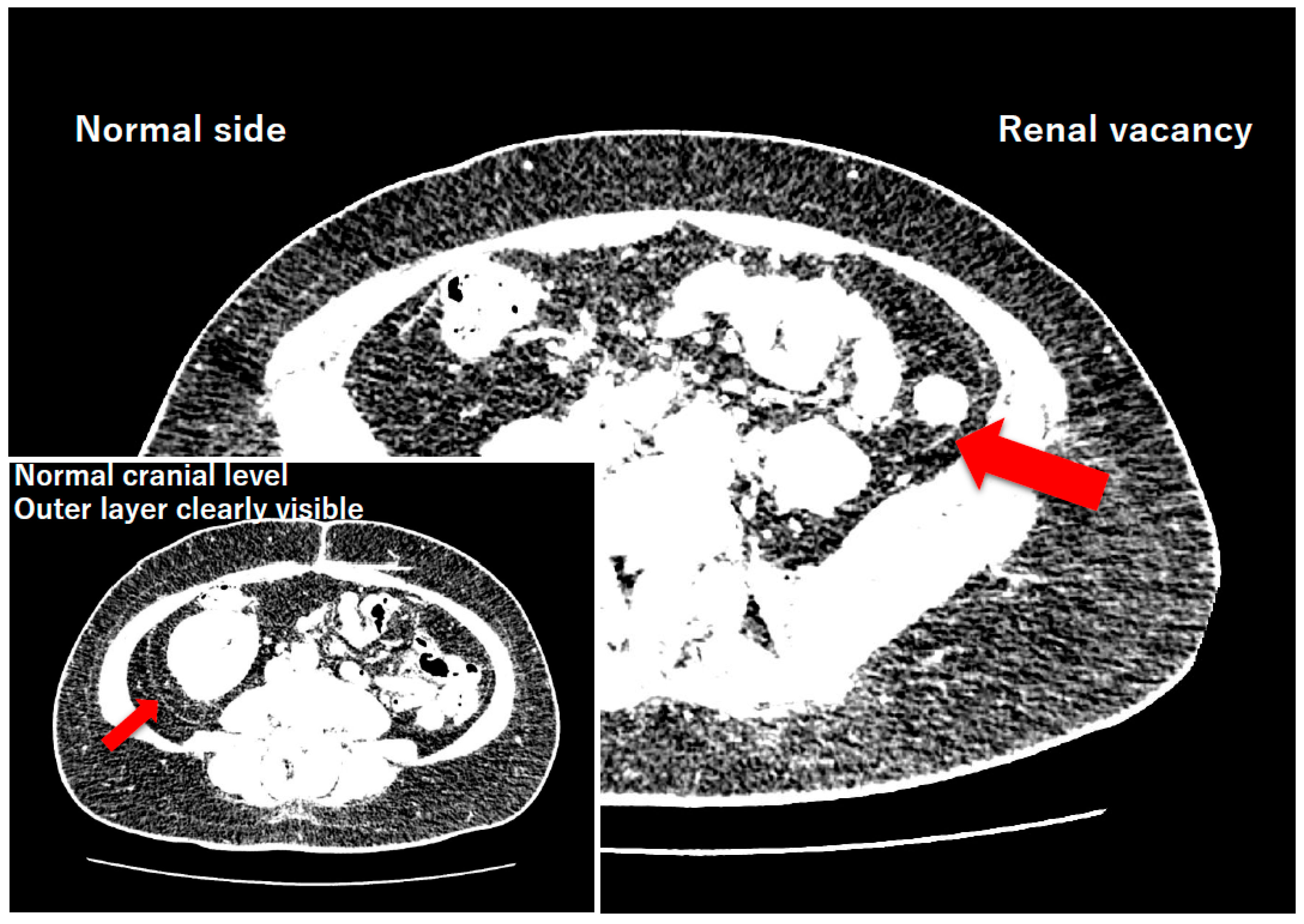
Figure 2.
Spatiotemporal and biomechanical asymmetry in retroperitoneal fascial development. This diagram highlights the chronological discrepancy in fascial emergence. Phase 1 (weeks 9–18) involves the sequential establishment of central and lateral mechanical anchors. During the early part of this phase (weeks 9–12; Panel A), the inner lamina of the renal fascia forms, driven by localized hoop stress from the expanding kidney. In contrast, Phase 2 (around week 20; Panel B) represents the mid-gestational systemic mechanical transition, during which the multilaminated outer layers are synchronously established across the macroscopic tension network completed between these central and lateral visceral anchors.
Figure 2.
Spatiotemporal and biomechanical asymmetry in retroperitoneal fascial development. This diagram highlights the chronological discrepancy in fascial emergence. Phase 1 (weeks 9–18) involves the sequential establishment of central and lateral mechanical anchors. During the early part of this phase (weeks 9–12; Panel A), the inner lamina of the renal fascia forms, driven by localized hoop stress from the expanding kidney. In contrast, Phase 2 (around week 20; Panel B) represents the mid-gestational systemic mechanical transition, during which the multilaminated outer layers are synchronously established across the macroscopic tension network completed between these central and lateral visceral anchors.
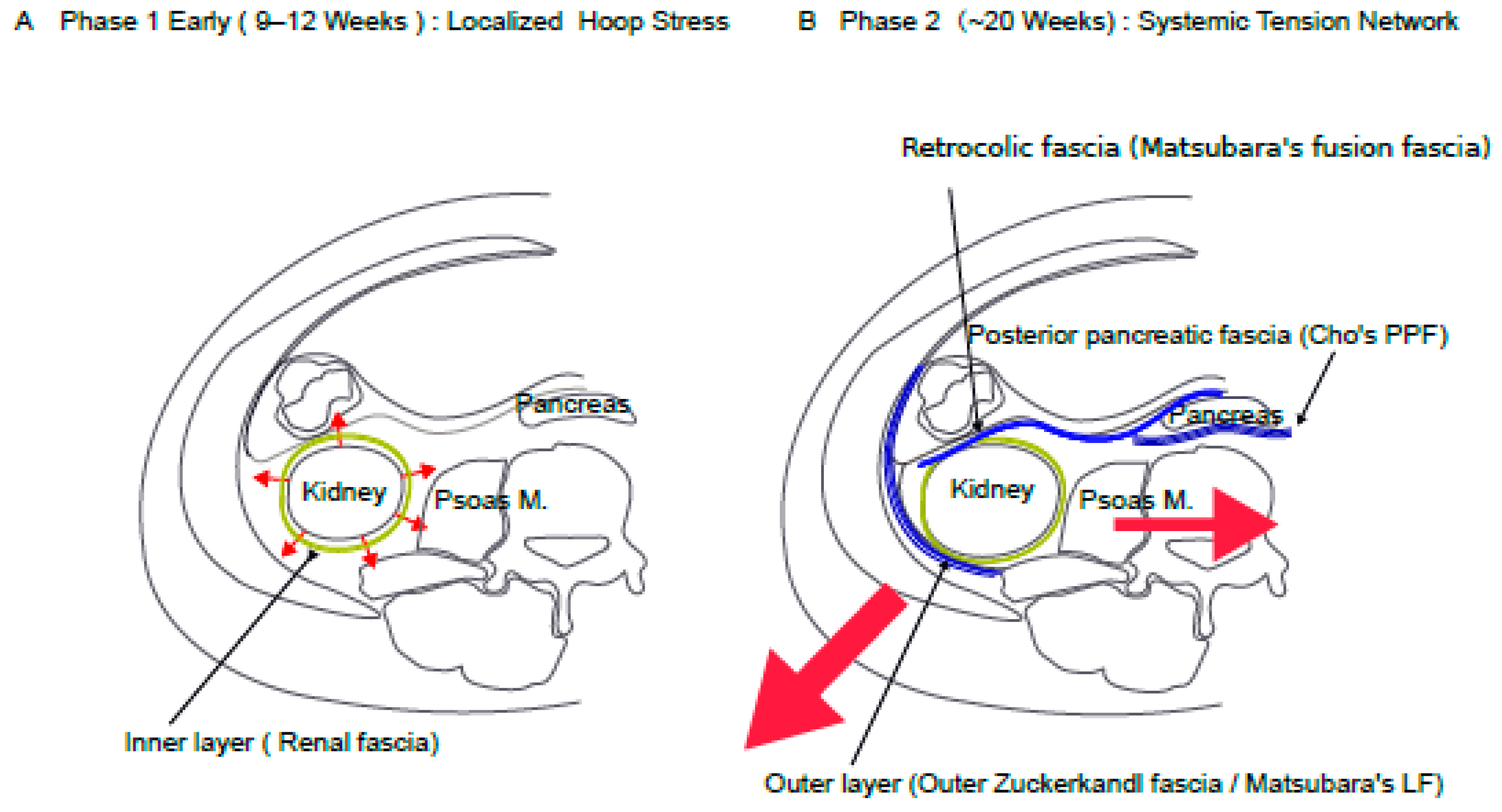
Figure 3.
Theoretical comparison of tissue deformation: Direct Compression vs. Poisson Effect. (A) Simple Direct Compression: A classical assumption where localized compressive forces from expanding organs merely squash the mesenchyme without producing organized lamellar sheets, resulting in disorganized tissue compaction. (B) Hoop Stress-Induced Poisson Effect: Circumferential tension (hoop stress) from the expanding mass induces orthogonal (transverse) compression via the Poisson effect, leading to the orderly condensation of the mesenchyme into the compact lamellar structures characteristic of the investing renal fascia.
Figure 3.
Theoretical comparison of tissue deformation: Direct Compression vs. Poisson Effect. (A) Simple Direct Compression: A classical assumption where localized compressive forces from expanding organs merely squash the mesenchyme without producing organized lamellar sheets, resulting in disorganized tissue compaction. (B) Hoop Stress-Induced Poisson Effect: Circumferential tension (hoop stress) from the expanding mass induces orthogonal (transverse) compression via the Poisson effect, leading to the orderly condensation of the mesenchyme into the compact lamellar structures characteristic of the investing renal fascia.
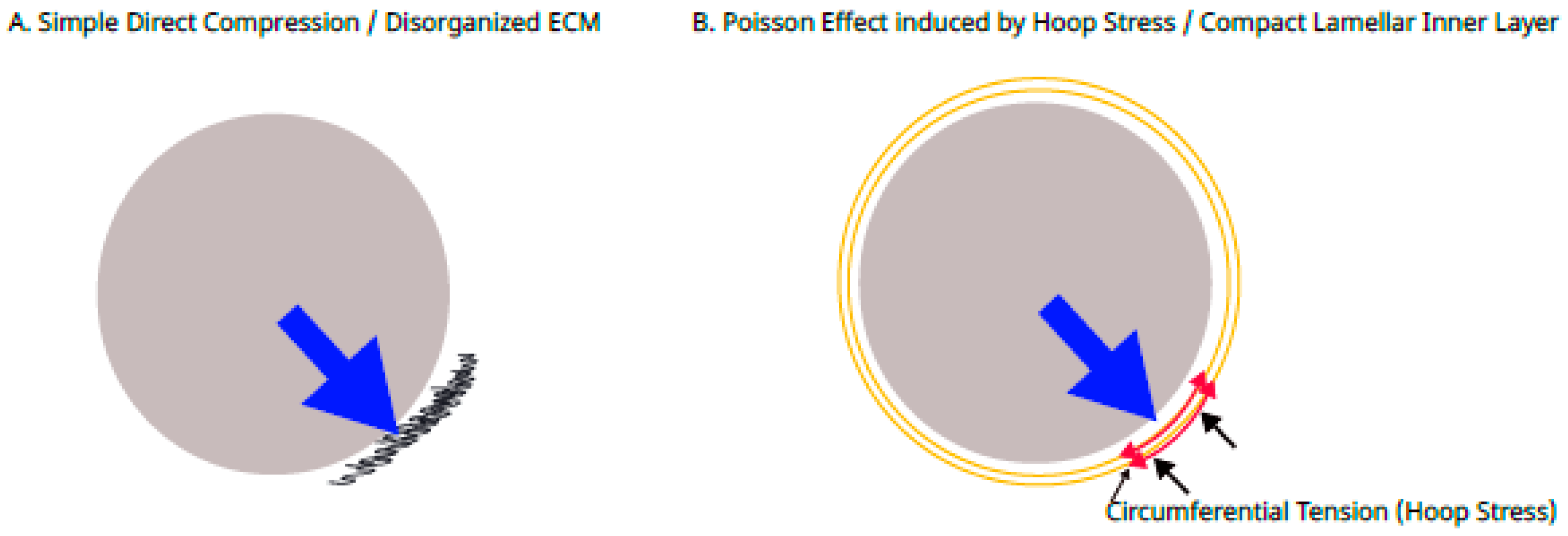
Figure 4.
Square-cube-driven emergence of a fetal tension network and definitive lamination. (A) Volumetric Surge: Rapid somatic growth (V/A ∝ r) dramatically increases internal mechanical load, generating hoop stress and longitudinal/posterolateral traction. (B) Orthogonal Compression: Because isotropic volumetric expansion is strictly restricted by early frame-locking (evolutionary front-loading), the trapped scaling energy is converted into a powerful multiaxial tension field, forcing the hydrated retroperitoneal mesenchyme to undergo obligatory orthogonal compression via the Poisson effect. (C) Consolidation and Fixation: This internal mechanical compression drives poroelastic fluid exudation into the maturing lymphatic system, while LOX-mediated cross-linking permanently stabilizes the collapsed collagen framework into the definitive, highly ordered fascial architecture. LOX, lysyl oxidase.
Figure 4.
Square-cube-driven emergence of a fetal tension network and definitive lamination. (A) Volumetric Surge: Rapid somatic growth (V/A ∝ r) dramatically increases internal mechanical load, generating hoop stress and longitudinal/posterolateral traction. (B) Orthogonal Compression: Because isotropic volumetric expansion is strictly restricted by early frame-locking (evolutionary front-loading), the trapped scaling energy is converted into a powerful multiaxial tension field, forcing the hydrated retroperitoneal mesenchyme to undergo obligatory orthogonal compression via the Poisson effect. (C) Consolidation and Fixation: This internal mechanical compression drives poroelastic fluid exudation into the maturing lymphatic system, while LOX-mediated cross-linking permanently stabilizes the collapsed collagen framework into the definitive, highly ordered fascial architecture. LOX, lysyl oxidase.
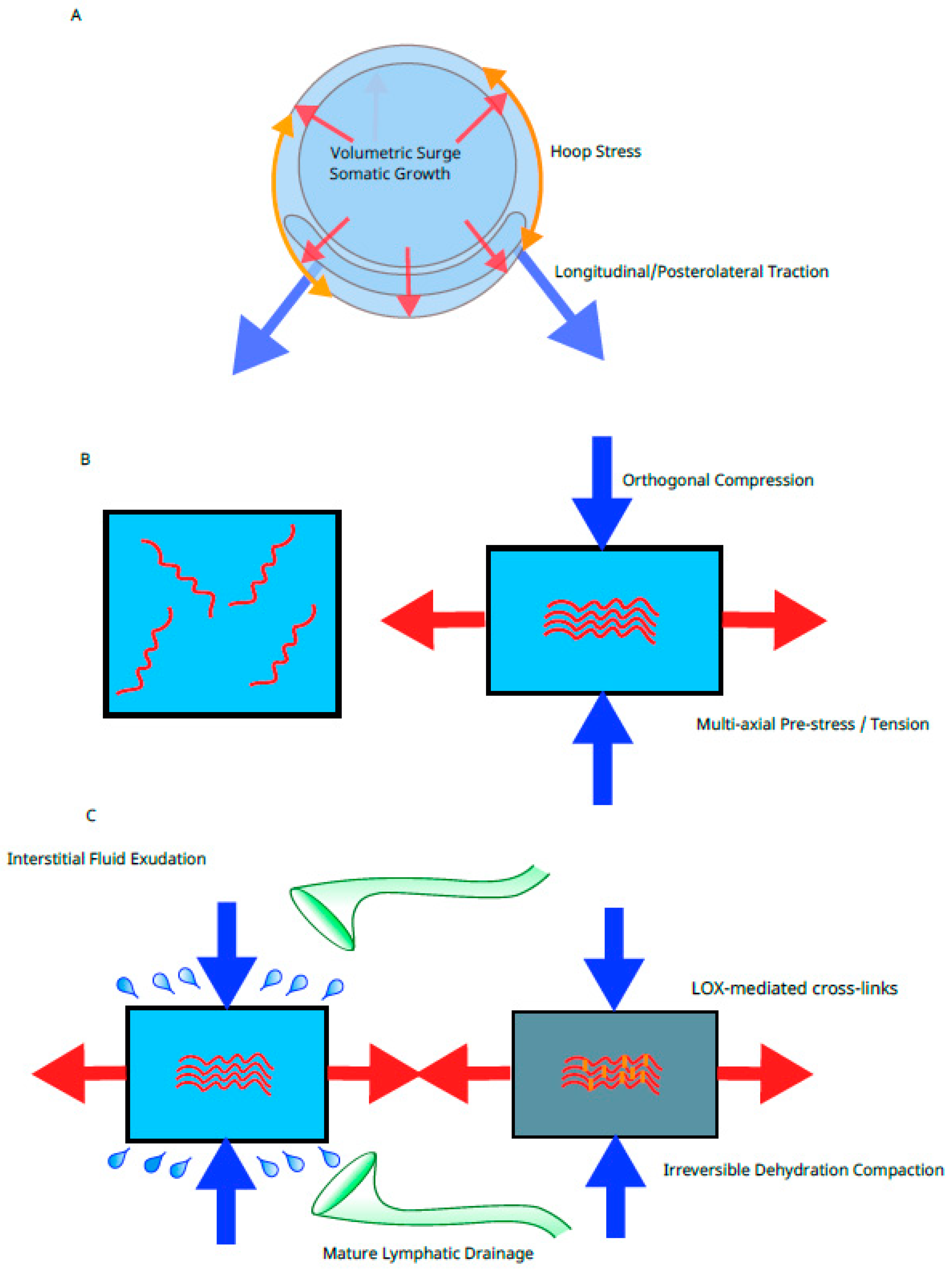
Figure 5.
Dual-mechanism model of retroperitoneal fascial lamination. Left: Early renal expansion (weeks 9–12) generates circumferential hoop stress, compacting adjacent mesenchyme into the organ-dependent inner lamina of the renal fascia. This layer fails to develop in renal agenesis. Right: System-level multiaxial tension emerging near gestational week 20 induces Poisson-driven orthogonal compression, collapsing the retroperitoneal mesenchyme into the outer fascial laminae independently of renal expansion. Notably, Tobin’s 1944 specimen—characterized by concurrent absence of both kidney and adrenal gland—represents a developmental field defect rather than evidence against the existence or formation of the system-derived outer lamina. The preserved solitary fascial plane in the present cohort reflects this system-level mechanism.
Figure 5.
Dual-mechanism model of retroperitoneal fascial lamination. Left: Early renal expansion (weeks 9–12) generates circumferential hoop stress, compacting adjacent mesenchyme into the organ-dependent inner lamina of the renal fascia. This layer fails to develop in renal agenesis. Right: System-level multiaxial tension emerging near gestational week 20 induces Poisson-driven orthogonal compression, collapsing the retroperitoneal mesenchyme into the outer fascial laminae independently of renal expansion. Notably, Tobin’s 1944 specimen—characterized by concurrent absence of both kidney and adrenal gland—represents a developmental field defect rather than evidence against the existence or formation of the system-derived outer lamina. The preserved solitary fascial plane in the present cohort reflects this system-level mechanism.
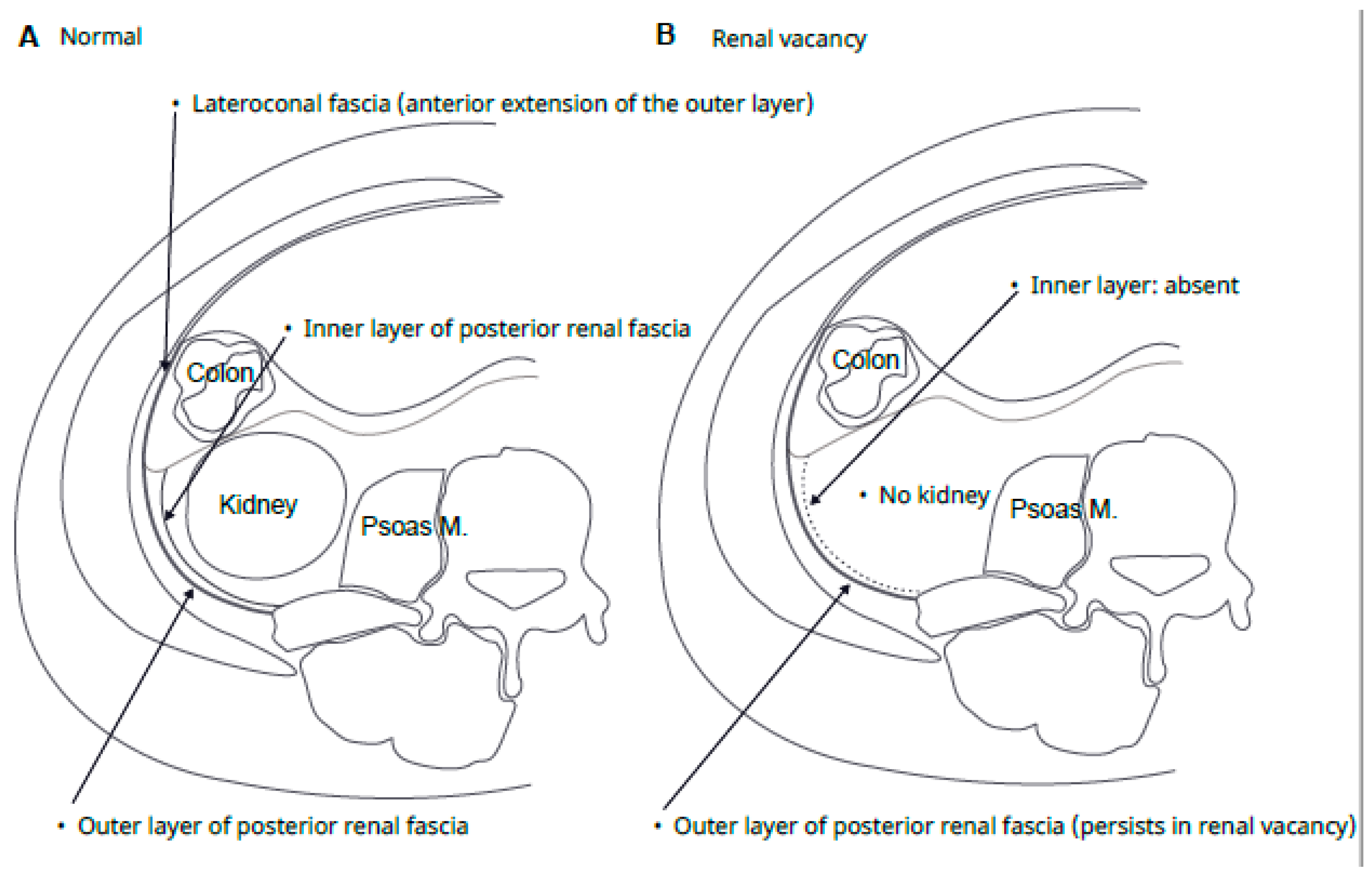

Table 1.
Clinical characteristics and quantitative radiological findings of the renal agenesis cohort (n = 3). Cases were extracted from a primary screen of 5,509 consecutive abdominal CT scans after strict exclusion of patients with a history of renal surgery.
Table 1.
Clinical characteristics and quantitative radiological findings of the renal agenesis cohort (n = 3). Cases were extracted from a primary screen of 5,509 consecutive abdominal CT scans after strict exclusion of patients with a history of renal surgery.
| Case | Age/Sex | Radiological Diagnosis | Adrenal Morphology | Fascial Thickness (Affected Side) | Fascial Thickness (Normal Side) | Difference (Δ) |
|---|---|---|---|---|---|---|
| 1 | 53F | True left renal agenesis | “Lying-down” (pancake) | 1.49 mm | 1.88 mm | −0.39 mm |
| 2 | 47F | True left renal agenesis | “Lying-down” (pancake) | 1.46 mm | 1.82 mm | −0.36 mm |
| 3 | 89M | Severe left renal dysplasia/involution (renal remnant) | Normal | 1.62 mm | Excluded* | N/A |
| Mean | — | — | — | 1.52 mm | 1.85 mm | −0.38 mm |
*Excluded from measurement due to renal fascial thickening secondary to pyelonephritis on the unaffected side. F, female; M, male; CT, computed tomography.
Table 2.
Chronological integration of retroperitoneal fascial development and associated biomechanical events.
Table 2.
Chronological integration of retroperitoneal fascial development and associated biomechanical events.
| Gestational age | Key developmental events | Biomechanical context | References |
|---|---|---|---|
|
Weeks 8.5–12 (Embryonic Day 59 onwards) |
• Heterotopic shift of iliac growth axis (cartilaginous growth plate rotates 90° to expand horizontally). • Early central visceral fixation (pancreas and duodenum). • Appearance of inner renal fascial layer. |
Initiation of the human-specific anatomical constraint. Rotation of the growth axis patterns a transverse (horizontal) boundary; however, the early pelvic cartilage remains too compliant to generate global tension fields. | Kanagasuntheram 1957; Cho et al. 2009; Matsubara et al. 2009; Senevirathne et al. 2025 |
| Weeks 14–16 |
• Asymmetric pelvic stiffening commences. Posterior ilium undergoes perichondral ossification. • Anterior growth zone (AGZ) retains its chondrogenicity, expanding transversely. • Functional maturation of fetal lymphatic system (van der Putte, 1975). |
Formation of the rigid transverse “wall.” While the AGZ drives lateral flaring, posterior ossification progressively limits isotropic pressure dissipation. Lymphatic drainage matures to prepare for poroelastic fluid movement. | van der Putte 1975; Swartz & Fleury 2007; Senevirathne et al. 2025 |
| Weeks 17–18 |
• Initiation of ascending/descending mesocolon adhesion to the posterior abdominal wall. • Continued expansion of the AGZ against the expanding abdominal volume. |
Completion of the macroscopic anchor nodes. Addition of lateral mechanical anchors fixes the retroperitoneal mesenchyme within the gradually tightening horizontal pelvic frame. | Baumann 1945; Senevirathne et al. 2025 |
| Weeks 18–20 |
• Progressive vertebral and rib ossification. • Epidermal keratinization and cutaneous barrier maturation. • Onset of exponential truncal volumetric growth (sixfold volume surge vs. threefold surface area increase). |
The mechanical incubation period reaches its limit. Axial skeletal rigidity increases and the cutaneous envelope becomes inextensible, blocking all vertical and isotropic escape routes for the rapidly rising internal load. | Bagnall et al. 1977; Hardman et al. 1999; Hadlock et al. 1991 |
|
~Week 20 (Temporal Nexus) |
• System-wide mechanical collision. • Pelvic expansion and ossification reach critical threshold. • Fascial lamination becomes histologically distinct. |
The Biomechanical Inflection Point. Trapped scaling energy violently collides with the evolutionarily derived horizontal constraints, generating powerful multiaxial tension fields that drive Poisson-mediated fascial lamination. | Cho et al. 2009; Matsubara et al. 2009; Verbruggen & Nowlan 2017 |
| Weeks 21–24 |
• AGZ finally reaches growth threshold (retention of cartilaginous properties concludes around week 24-25). • Definitive formation of the hominin-derived anterior inferior iliac spine (AIIS). |
Stabilization of the bipedal architectural frame. The permanent anchorage network for bipedal musculature is completed, permanently locking the tension-bearing fascial and skeletal infrastructure. | Senevirathne et al. 2025 |
Table 3.
System-wide developmental changes occurring near gestational week 20.
| System | Developmental change | Mechanical significance | References |
|---|---|---|---|
| Musculoskeletal system | Transition from pressure-driven continuum to tension-bearing architecture | Establishes global tension-responsive network | Nowlan 2015; Verbruggen & Nowlan 2017 |
| Axial skeleton | Vertebral ossification; iliac flare expansion | Increases axial rigidity; converts fetal volumetric expansion into directed strain | Bagnall et al. 1977; Baumgart et al. 2018; Senevirathne et al. 2025 |
| Cutaneous envelope | Epidermal keratinization; barrier maturation | Converts skin into an inextensible boundary resisting internal load | Hardman et al. 1999 |
| Lymphatic system | Functional drainage pathways established | Enables poroelastic fluid exudation during Poisson compression | van der Putte 1975; Swartz & Fleury 2007 |
Disclaimer/Publisher’s Note: The statements, opinions and data contained in all publications are solely those of the individual author(s) and contributor(s) and not of MDPI and/or the editor(s). MDPI and/or the editor(s) disclaim responsibility for any injury to people or property resulting from any ideas, methods, instructions or products referred to in the content. |
© 2026 by the authors. Licensee MDPI, Basel, Switzerland. This article is an open access article distributed under the terms and conditions of the Creative Commons Attribution (CC BY) license (http://creativecommons.org/licenses/by/4.0/).
Copyright: This open access article is published under a Creative Commons CC BY 4.0 license, which permit the free download, distribution, and reuse, provided that the author and preprint are cited in any reuse.


