

Submitted:
21 March 2026
Posted:
24 March 2026
You are already at the latest version
Abstract
Small farms play a vital role in the rural sector of the European Union, contributing to food production, preserving landscape features, protecting biodiversity, providing public goods, and maintaining social cohesion in rural and remote regions. Nevertheless, the sector has undergone rapid structural transformation in recent decades, accompanied by adverse demographic developments that threaten the long-term sustainability of small-scale agriculture. Understanding how farms respond to evolving economic conditions and policy frameworks is therefore essential for designing effective agricultural policies. This study presents the Stochastic Recursive Model for Multiannual impact Assessment in Agriculture (STREMMiAA). This newly developed simulation model endogenously captures structural, and land-use change dynamics in arable farming systems. The model integrates a farm-level recursive linear programming framework with an ARIMA stochastic process, allowing the dynamic representation of farmers’ adaptive behavior under uncertainty. A post-solution module incorporating means-based environmental indicators enables assessment of environmental performance at the farm level. The model is empirically applied to a representative sample of arable farms in Karditsa (NUTS-3 region), Greece, under three alternative scenarios: (i) Business-as-Usual (BAU), (ii) Common Agricultural Policy (CAP) post-2020, and (iii) CAP post-2020 combined with a scenario of Long War of Attrition (LWA). Simulation results reveal a consistent decline in the share of small farms (<30 ha) and a corresponding concentration of land in larger farms (≥50 ha), indicating limited long-term viability for smaller farms. Land-use projections show an expansion of food crop areas and a decline in industrial crops areas. Environmentally, reductions in water, fertilizer and pesticide use under new CAP-related scenarios (ii and iii) suggest potential benefits for nitrate-polluted areas such as Karditsa.
Keywords:
structural change
; land use dynamics
; agricultural policy
; environmental impact assessment
; dynamic simulation
1. Introduction
The European Union’s agricultural landscape is currently defined by a profound paradox. Small-scale family farms remain the backbone of rural territories, providing essential public goods such as food security, biodiversity conservation, landscape preservation, and social cohesion. However, these units face an existential threat from a continuous process of structural transformation. In Greece, and specifically within the highly productive but environmentally sensitive plains of Thessaly, the agricultural sector has undergone a rapid metamorphosis over the last decade. Adverse demographic shifts, such as an aging farming population, coupled with extreme market volatility and evolving policy frameworks, have forced a “grow or go” dilemma (Plogmann et al., 2022) upon many farmers.
To navigate this complexity, it is no longer sufficient to view farmers as purely profit-maximizing machines. Their decisions are embedded in a social fabric where the desire to maintain a certain standard of living—often compared to their peers—influences whether they remain in the sector or exit. Understanding how these farms adapt their behavior under such multi-dimensional uncertainty is not merely a theoretical exercise; it is a prerequisite for designing targeted agricultural policies that balance economic efficiency with the urgent need for environmental sustainability.
Structural change in agriculture has been widely analyzed using a variety of modelling approaches, including farm-level programming models, agent-based simulations, and regional structural change frameworks (e.g., Djanibekov and Finger, 2018; Mendoza Tijerino, 2021; Margarian, 2024). These approaches aim to capture the dynamic interactions between economic incentives, resource allocation, and policy environments shaping agricultural systems over time. Despite these advances, relatively few models simultaneously capture farm-level structural change dynamics, stochastic expectations regarding market conditions, and environmental performance indicators within an integrated simulation framework. This study contributes to literature in three main ways. First, it develops a stochastic recursive programming framework capable of capturing endogenous farm structural change dynamics. Second, it integrates behavioural and social preference mechanisms, such as the “Keeping up with the Joneses” (KUJ) framework, into farm decision-making modelling. Third, it combines economic simulation with environmental performance indicators, allowing the assessment of agricultural policy scenarios in nitrate-vulnerable regions. This article explores these dynamics by synthesizing recent research on the arable systems of Karditsa, utilizing a bottom-up simulation approach to project the future of the sector.
2. Methods and Data
The core of this research is the STREMMiAA model (Stochastic Recursive Model for Multiannual impact Assessment in Agriculture) (Mantziaris et al., 2024). Unlike traditional static models, which often oversimplify the dynamic nature of agricultural systems, STREMMiAA is a farm-level, recursive linear programming framework designed to capture the endogenous nature of structural change. It operates on the premise that structural shifts are not instantaneous but are the result of cumulative, year-to-year decisions made under uncertainty. To represent this uncertainty, the model integrates the Autoregressive Integrated Moving Average (ARIMA) stochastic processes, which simulate “quasi-rational” expectations (Siegle et al., 2024). This allows the model to forecast volatile parameters such as commodity prices and crop yields (Djanibekov and Finger, 2018; Nayak et al., 2025), mirroring the way real-world farmers make decisions based on past trends and anticipated market shifts.
A distinctive methodological innovation of STREMMiAA is the integration of social psychology through the “Keeping up with the Joneses” (KUJ) preference framework (e.g., Barnett et al., 2010; Lombardo, 2021; Paroissien et al., 2021). Farm viability is assessed through a dual-criterion algorithm: first, the farm must maintain non-negative growth in equity; second, the optimal net profit after tax must meet or exceed a Societal Consumption Benchmark derived from neighboring farms. This benchmark reflects the social pressure on farmers to achieve a standard of living comparable to their community. When a farm fails these criteria, it is deemed non-viable and exits the sector.
The model then utilizes an Endogenous Feedback Mechanism (EFM) to reallocate the resources of exiting farms (Robert et al., 2016). Abandoned land and released circulating capital are redistributed among neighboring surviving farms based on their relative optimal growth in equity. This simulates a realistic rental market where more efficient, growing farms absorb the land of those who depart.
A post-solution module incorporating means-based environmental indicators (water, fertilizer and pesticide use) enables assessment of environmental performance at the farm level. The empirical application focused on a representative sample of approximately 6,000 arable farms in the Karditsa region (NUTS-3). The model was calibrated using field survey data and FADN statistics from 2012–2019, serving as the basis for out-of-sample simulations through 2026 across three scenarios (see also Figure 1):
- (i)
- Business-as-Usual (BAU): Projecting current trends forward.
- (ii)
- CAP Post-2020: Implementing the convergence of direct payments and the adoption of “Eco-schemes”.
- (iii)
- CAP Post-2020 + Long War of Attrition (LWA): A high-grain-price scenario reflecting the geopolitical shocks of the Russia-Ukraine conflict, with prices forecasted via ARIMA.
3. Empirical Results
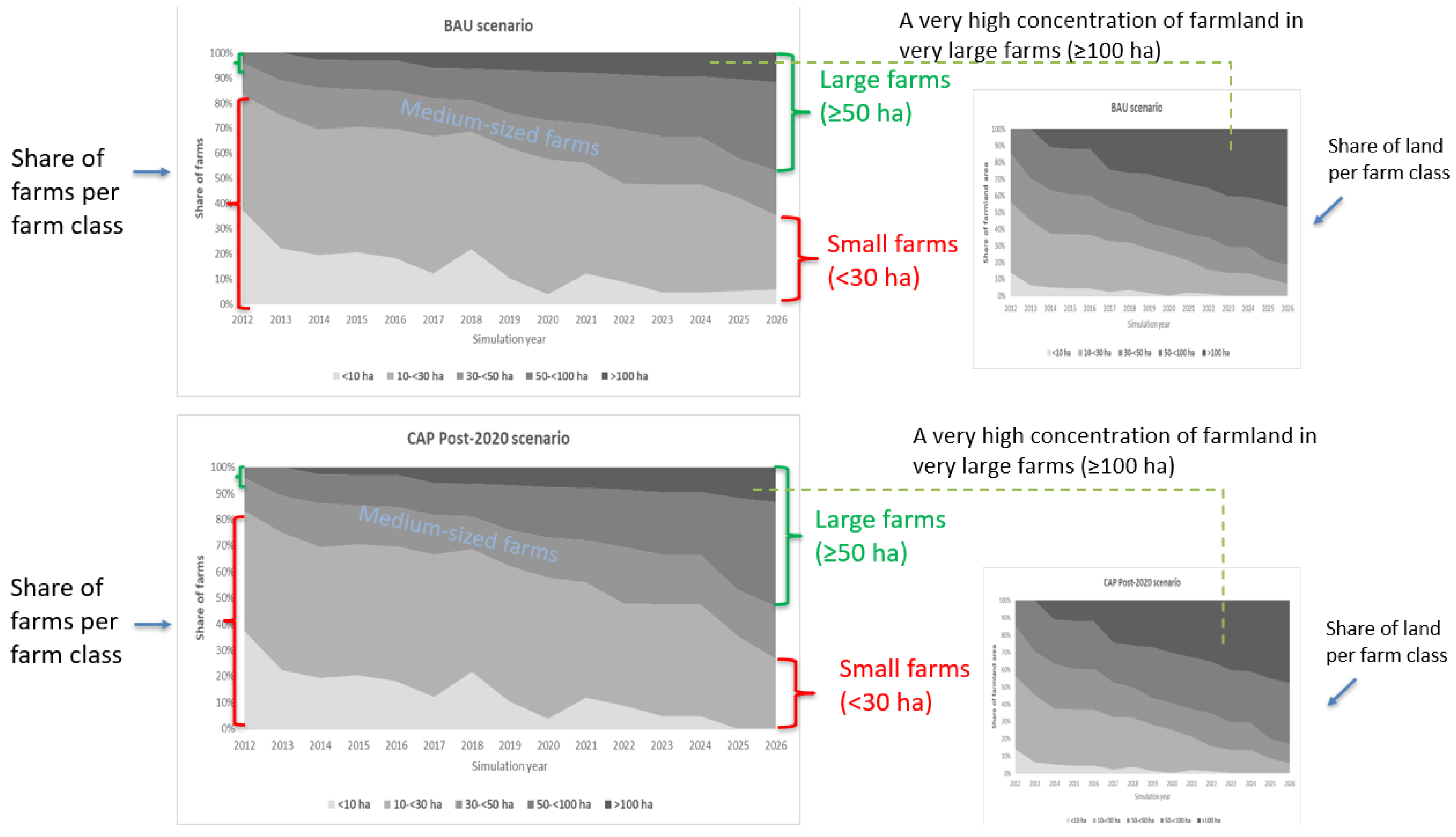
The simulation results reveal a significant acceleration in the rate of structural change across all examined scenarios. The most prominent trend is the consistent decline of small-scale farms (those managing less than 30 hectares). As these smaller units fail to meet the societal consumption benchmark or achieve necessary economies of scale, they exit the system, leading to an intense concentration of farmland in larger farm classes (≥50 ha) (see also Figure 2). By 2026, the model foresees a landscape where only 10% of the farms will manage approximately 50% of the total farmland area. This suggests that the commercialization of the sector is increasingly leaving behind the traditional small-holder model.
This structural transformation is inextricably linked to shifts in land use. Regardless of the policy framework, there is a clear strategic movement toward food crop areas, particularly processing vegetables, which offer higher market stability or better returns compared to traditional industrial crops like tobacco and cotton. Under the LWA scenario, this shift is further modified by the geopolitical landscape; the spike in grain prices drives a resurgence in cereals such as wheat and maize. The model demonstrates that farmers are highly responsive to market signals, but their ability to pivot depends heavily on their farm size and capital stock.
From an environmental perspective, the findings are notably encouraging. When comparing the CAP Post-2020 scenarios against the BAU baseline, the model predicts measurable improvements in resource efficiency. On average, water use is projected to decrease by 8%, fertilizer use by 5%, and pesticide use by 2%. These reductions are driven by the stricter conditionality of the new CAP and the adoption of Eco-schemes by surviving, larger farms. For a nitrate-polluted region like Karditsa, these “environmental gains” are vital. The results suggest that as farms become larger and more commercially managed, they tend to adopt more precise and resource-efficient practices, potentially providing a pathway to meet the EU’s “Farm to Fork” and “Biodiversity” targets.
4. Conclusions
The research conducted through the STREMMiAA framework provides a "realistic diagnosis" of the structural and environmental trajectory of Greek agriculture. It confirms that structural change is an inevitable, cumulative process driven by the pursuit of economic viability and social standing. While the projected disappearance of small farms raises significant concerns regarding the social fabric of rural Greece and the potential loss of "agricultural heritage," the resulting consolidation appears to foster a more resilient and environmentally efficient sector.
The policy implications are twofold. First, the STREMMiAA model proves to be a robust decision-support tool, demonstrating that environmental schemes can successfully decouple production from resource degradation. Second, the rapid exit of small farms suggests an urgent need for targeted support measures. Rather than simply providing income support, policy should focus on enhancing the efficiency and market access of small holders through digitalization, the formation of producer groups, and the promotion of high-value niche products.
Ultimately, the future of the Thessalian plain will be defined by fewer, larger, and more specialized units. The challenge for policymakers is to manage this transition in a way that captures the evident environmental benefits of commercialization without entirely sacrificing the diverse social contributions of the traditional farm structure. Future research should aim to extend this modelling framework to other regions and agricultural sectors, while integrating sustainability assessment (Chopin et al., 2017) and climate change scenarios (Mendoza Tijerino, 2021; Parikoglou and Finger, 2025) in order to assess the long-term resilience of the Greek agricultural system in an increasingly volatile global environment. Moreover, incorporating approaches from regional structural change modelling—such as regression-based counterfactual simulations of industry dynamics (Margarian, 2024)—could further enhance the analysis by capturing interactions between agricultural systems and broader regional economic structures.
References
- Barnett, R. C.; Bhattacharya, J.; Bunzel, H. Choosing to keep up with the Joneses and income inequality. Economic Theory 2010, 45(3), 469–496. [Google Scholar] [CrossRef]
- Chopin, P.; Blazy, J.-M.; Guindé, L.; Tournebize, R.; Doré, T. A novel approach for assessing the contribution of agricultural systems to the sustainable development of regions with multi-scale indicators: Application to Guadeloupe. Land Use Policy 2017, 62, 132–142. [Google Scholar] [CrossRef]
- Djanibekov, U.; Finger, R. Agricultural risks and farm land consolidation process in transition countries: The case of cotton production in Uzbekistan. Agricultural Systems 2018, 164, 223–235. [Google Scholar] [CrossRef]
- Lombardo, V. Social inclusion through social status and the emergence of development traps. Metroeconomica 2021, 72(4), 798–825. [Google Scholar] [CrossRef]
- Mantziaris, S.; Rozakis, S.; Karanikolas, P.; Petsakos, A.; Tsiboukas, K. Simulating farm structural change dynamics in Thessaly (Greece) using a recursive programming model. Bio-Based and Applied Economics 2024, 13(4), 353–386. [Google Scholar] [CrossRef]
- Margarian, A. Analysing evolutionary growth regimes of regional economies and transformative shocks: Proposal for a regression-based counterfactual simulation approach to local inter-industry structural change. Structural Change and Economic Dynamics 2024, 70, 18–32. [Google Scholar] [CrossRef]
- Mendoza Tijerino, F. A. Climate change and agricultural structural change: the relevance for machinery use and acquisition in Germany. 2021. https://hohpublica.uni-hohenheim.de/handle/123456789/6635.
- Nayak, H.S.; Mkondiwa, M.; Patra, K.; Sarkar, A.; Reddy, K.S.; Kumar, P.; Bharadwaj, S.V.; Singh, R.; Parihar, C.M. Risk-return trade-offs in diversified cropping systems under conservation agriculture: Evidence from a 14-year long-term field experiment in north-western India. European Journal of Agronomy 2025. [Google Scholar] [CrossRef]
- Parikoglou, I.; Finger, R. The effect of heat stress on risk and efficiency in dairy farming. European Review of Agricultural Economics 2025, 52(2), 187–215. [Google Scholar] [CrossRef]
- Paroissien, E.; Latruffe, L.; Piet, L. Early exit from business, performance and neighbours’ influence: a study of farmers in France. European Review of Agricultural Economics 2021, 48(5), 1132–1161. [Google Scholar] [CrossRef]
- Plogmann, J.; Mußhoff, O.; Odening, M.; Ritter, M. Farm growth and land concentration. Land Use Policy 2022, 115, 106036. [Google Scholar] [CrossRef]
- Robert, M.; Thomas, A.; Bergez, J. E. Processes of adaptation in farm decision-making models. A review. Agronomy for Sustainable Development 2016, 36(4), 64. [Google Scholar] [CrossRef]
- Siegle, J.; Astill, G.; Plakias, Z.; Tregeagle, D. Estimating perennial crop supply response: A methodology literature review. In Agricultural Economics (United Kingdom); 2024. [Google Scholar] [CrossRef]
Figure 1.
Conceptual framework of the Stochastic Recursive Model for Multiannual impact Assessment in Agriculture (STREMMiAA).
Figure 1.
Conceptual framework of the Stochastic Recursive Model for Multiannual impact Assessment in Agriculture (STREMMiAA).
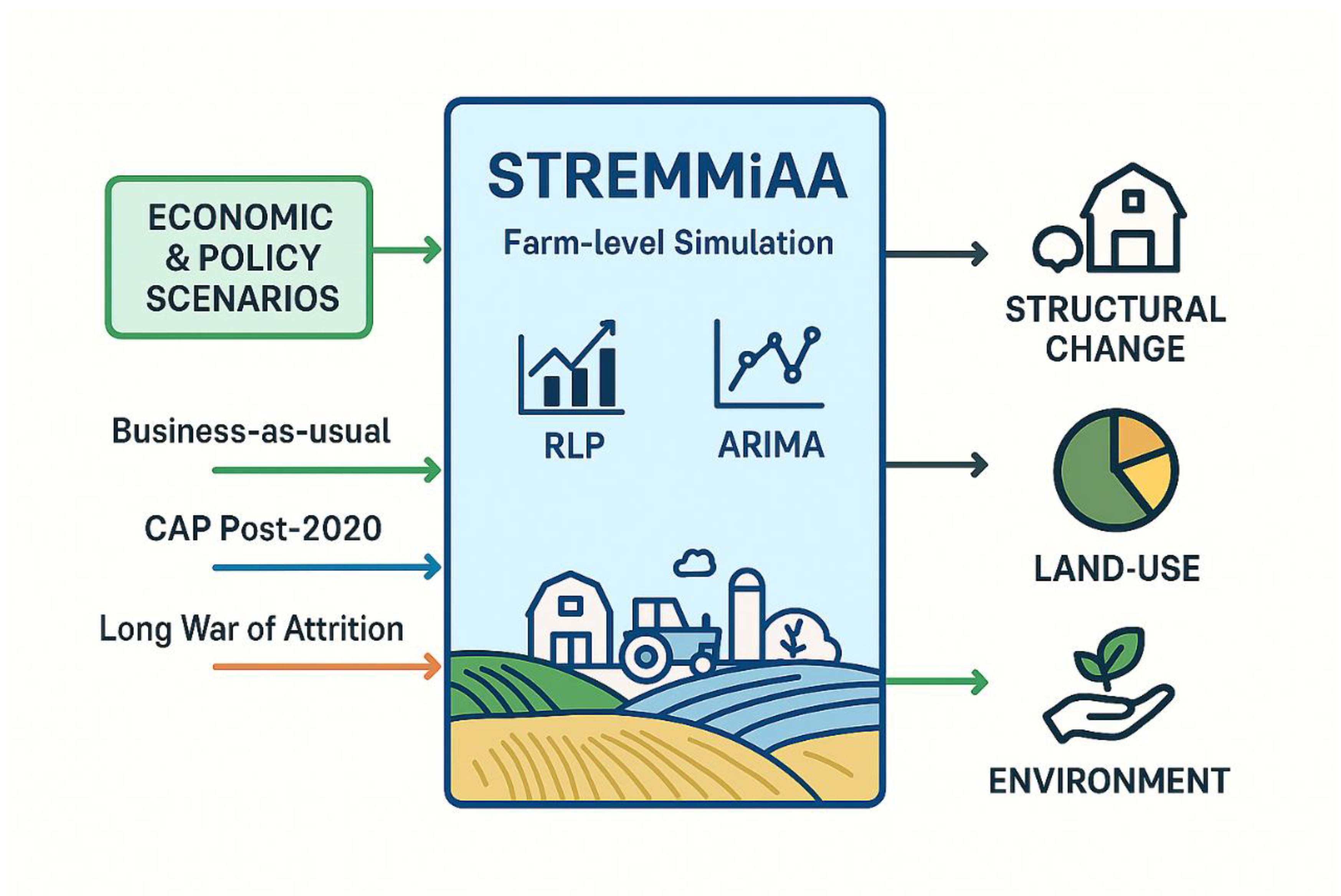
Figure 2.
Evolution of farm size distribution.
Disclaimer/Publisher’s Note: The statements, opinions and data contained in all publications are solely those of the individual author(s) and contributor(s) and not of MDPI and/or the editor(s). MDPI and/or the editor(s) disclaim responsibility for any injury to people or property resulting from any ideas, methods, instructions or products referred to in the content. |
© 2026 by the authors. Licensee MDPI, Basel, Switzerland. This article is an open access article distributed under the terms and conditions of the Creative Commons Attribution (CC BY) license (http://creativecommons.org/licenses/by/4.0/).
Copyright: This open access article is published under a Creative Commons CC BY 4.0 license, which permit the free download, distribution, and reuse, provided that the author and preprint are cited in any reuse.


