

Submitted:
23 March 2026
Posted:
24 March 2026
You are already at the latest version
Abstract
The question of how meaning arises from communication, cognition, and experience remains unresolved across philosophy and cognitive science. Existing theories variously attribute meaning to intention, linguistic structure, interpretation, or subjective valuation, yet fail to integrate these dimensions into a unified framework.The Awareness-Based Meaning System (ABMS) proposes a process-based model in which meaning is not transmitted as an intrinsic property of messages but emerges through a valuation-dependent reconstruction within awareness. In this framework, messaging originates at the source as either Appearance-Based Messaging (ABM), grounded in shared conventions, or Intention-Based Messaging (IBM), which embeds generative depth through intention. At the recipient, messaging undergoes interpretive processing (IP), producing informational intelligence, followed by valuation processing (VP), which assigns relevance and transforms information into emotionally charged intelligence. Meaning arises only when this valuation-integrated content is incorporated into awareness as Recognition-Based Meaning (RBM).ABMS introduces a critical distinction between generative depth and realized meaning, and predicts a fundamental asymmetry between intention-based messaging and experienced meaning, contrasted with relative symmetry in convention-based messaging. This framework unifies and extends existing theories by specifying how intention, interpretation, valuation, and awareness interact to produce meaningful experience.Furthermore, ABMS generates empirically testable predictions, including the necessity of valuation for meaning formation and the dissociation between interpretive depth and meaningful experience. By formalizing the transformation from messaging to meaning, ABMS provides a coherent theoretical and experimental foundation for investigating meaning as an awareness-dependent and valuation-driven process.
Keywords:
meaning in life
; intention
; awareness
; communication
; existentialism
; hermeneutics
; nihilism
; TTC
; QTTC
1. Introduction
Early in my career, I arranged a meeting with a prominent figure in my field, hoping to find guidance and direction. On the day of the meeting, I learned that he had to leave unexpectedly due to a family emergency. Disappointed, I boarded my return flight, replaying the missed opportunity in my mind. By chance, the man seated next to me initiated a conversation that would evolve into a mentorship lasting more than a decade and profoundly shaping the trajectory of my professional life. For some, such a sequence appears imbued with meaning, suggesting a hidden order or unfolding intention, as if the missed meeting had been necessary rather than unfortunate. For others, the same event remains contingent, an intersection of timing and probability without deeper design. The event itself is unchanged, yet its interpretation diverges. This divergence raises a fundamental question: do events carry meaning inherently, or is meaning constructed through the way conscious beings interpret and value them?
The question of meaning has occupied philosophical inquiry since antiquity, yet it remains conceptually unsettled. In classical philosophy, meaning was closely tied to teleology. Aristotle proposed that natural phenomena are intelligible through their telos, or final cause, such that understanding why something exists is inseparable from understanding what it is for (Aristotle, Physics; Nicomachean Ethics). This view was later extended in theological traditions, where meaning was grounded in divine intention, most notably in the work of Thomas Aquinas (Summa Theologica). Within these frameworks, meaning is not constructed or interpreted but discovered as an intrinsic feature of a purposive world.
Modern philosophy introduced a critical shift. Kant argued that meaning is not merely discovered in the world but is partially constituted by the structures of human cognition (Kant, 1785/1993). Subsequent thinkers challenged the very existence of inherent meaning. Nietzsche questioned the validity of objective or divinely grounded values, while existentialist and absurdist traditions further emphasized that meaning is not given but arises through human engagement. Sartre famously asserted that “existence precedes essence,” positioning meaning as a product of human choice (Sartre, 1946/2007), whereas Camus described the human condition as defined by the tension between the search for meaning and an indifferent universe (Camus, 1955/1991).
In parallel, analytic philosophy reframed meaning in terms of language, intention, and communication. Wittgenstein located meaning in use within linguistic practices (Wittgenstein, 1953), while Grice and Searle emphasized the role of speaker intention and its recognition in communication (Grice, 1957; Searle, 1969, 1983). Hermeneutic traditions, particularly in the work of Gadamer, further argued that meaning emerges through interpretation, shaped by historical and cultural context rather than fixed by original intention (Gadamer, 1960/2004).
Despite these diverse perspectives, contemporary discussions of meaning remain fragmented. The term “meaning” is used to denote linguistic intelligibility, intentional content, subjective significance, existential value, and cosmic purpose, often without clear distinction. A statement may be meaningful in a linguistic sense without carrying personal significance. An action may be intentional yet misunderstood. An event may be experienced as deeply meaningful despite lacking any identifiable intention. These observations suggest that meaning is not a unitary property but a layered phenomenon emerging through the interaction of expression, intention, and awareness.
This ambiguity becomes particularly salient when considering life events. Human beings frequently attribute profound meaning to experiences that may, from another perspective, appear entirely contingent. Whether such events are interpreted as fate, coincidence, or narrative reconstruction depends less on the event itself than on the framework through which it is understood. This raises a central problem: is meaning embedded in events, generated by agents, or constructed by recipients?
To address this question, a more precise conceptual framework is required. The present essay introduces the Awareness-Based Meaning System (ABMS), which conceptualizes meaning as a layered relational process rather than a singular property. By distinguishing between appearance-based meaning, intention-based meaning, and recognition-based meaning, ABMS provides a structured account of how meaning is conveyed, generated, and experienced across different contexts.
2. The Awareness-Based Meaning System (ABMS)
Meaning is often treated as an intrinsic property of information or as a direct product of linguistic or symbolic structure. However, such accounts fail to explain a fundamental observation: identical information can produce profoundly different experiences across individuals, or even within the same individual across contexts and time.
The Awareness-Based Meaning System (ABMS) reframes meaning as a messaging-to-meaning process between a source and a recipient. Within this framework, what is transmitted is not meaning itself, but a message. Meaning is not a property of the message itself, but a process that emerges through interpretation and valuation at the recipient.
Accordingly, a message that is not valued does not evoke meaning. Meaning does not arise from transmission alone, but from transformation.
ABMS therefore conceptualizes meaning as the outcome of a structured process that begins with messaging at the source and culminates in valuation-dependent recognition at the recipient. Accordingly, within ABMS, meaning is defined as a valuation-dependent, awareness-integrated reconstruction of messaging.
ABMS therefore distinguishes between embedded (generative) meaning at the source and realized (experiential) meaning at the recipient. Messaging may occur with or without intention, but meaning emerges only when the message undergoes interpretive reconstruction and valuation.
Meaning, therefore, is a valuation-dependent reconstruction of messaging.
2.1. Source-Level Messaging: Appearance-Based Messaging (ABM) and Intention-Based Messaging (IBM)
At the level of the source, no meaning exists; only the potential for meaning is carried by the message. The source generates messages that may later be transformed into meaning through processes at the level of the recipient.
Within the Awareness-Based Meaning System (ABMS), messaging takes two structurally distinct forms depending on the presence or absence of intention: Appearance-Based Messaging (ABM) and Intention-Based Messaging (IBM).
Intention-Based Messaging (IBM) refers to messages generated through a deliberate act of intention. In this case, the source encodes purpose, significance, or desired impact into a message. IBM is therefore internally structured and goal-directed, reflecting the source’s attempt to convey not only what is expressed, but what is meant. As such, IBM introduces layers of content that are not fully contained within the observable structure of the message and may require inferential reconstruction by the recipient.
In contrast, Appearance-Based Messaging (ABM) consists of observable features of an act or expression that arise in the absence of explicit intention. It includes language, symbols, gestures, and behaviors that are interpretable through shared conventions using common linguistic or cultural frameworks. Because ABM is not driven by underlying intention, it primarily conveys what is expressed at face value, without embedding additional layers of intended meaning beyond its surface structure.
In this sense, ABM corresponds to conventional communicative systems in which the source produces a message according to established structures, and the recipient interprets it using the same framework. This level of messaging aligns with established theories of linguistic and communicative structure, including structuralist and intention-based accounts (Grice, 1957; Searle, 1969), while remaining limited to what is expressed rather than what is intended.
The distinction between ABM and IBM is therefore not one of meaning itself, but of structural depth within the message. IBM introduces the possibility of accessing content beyond face value through reconstruction of intention, whereas ABM is confined to surface-level structure. Importantly, this distinction does not determine whether meaning will ultimately arise, but shapes the range and depth of interpretation available to the recipient.
Despite their different origins, both IBM and ABM converge at a critical point: neither constitutes meaning as realized experience. They define only the structure and availability of messages, not their realization as meaningful experience.
ABMS therefore distinguishes between generative structure embedded at the source through intention (IBM) and realized meaning at the recipient, which emerges only through a valuation-dependent, awareness-integrated reconstruction of messaging.
2.2. Recipient-Level Transformation: Interpretive Process (IP), Valuation Process (VP), and Recognition-Based Meaning (RBM)
At the level of the recipient, messages undergo a structured transformation that determines whether they become meaningful. Within ABMS, this transformation is mediated by two sequential and necessary processes: the interpretive process (IP), followed by the valuation process (VP), culminating in Recognition-Based Meaning (RBM), the realized experience of meaning.
The interpretive process (IP) refers to the recipient’s reconstruction of the incoming message. During this stage, the recipient decodes structure, resolves ambiguity, and, when applicable, infers underlying intention. The output of IP is a structured representation of the message, referred to here as informational intelligence.
IP operates across a spectrum of depth. Superficial interpretation corresponds to processing at face value, where meaning is derived directly from observable structure without reconstructing underlying intention. This mode is typical of Appearance-Based Messaging (ABM), where shared linguistic or cultural conventions enable direct decoding. In contrast, deep interpretation involves inferential reconstruction of embedded intention, extending beyond surface structure to access what is meant rather than what is explicitly expressed. This mode is characteristic of Intention-Based Messaging (IBM), where relevant content is not fully specified in the observable signal.
Importantly, depth is a function of interpretation, not of meaning itself. A message may be interpreted deeply or superficially regardless of whether it ultimately becomes meaningful. This distinction reflects a fundamental constraint within ABMS: IP is necessary but not sufficient for meaning formation. A message may be fully reconstructed into informational intelligence without becoming meaningful to the recipient.
The valuation process (VP) operates on the output of IP and assigns relevance, significance, and priority to the informational intelligence generated through interpretation. VP is an affective–motivational process that determines whether the interpreted content matters to the recipient. The output of VP is emotionally charged intelligence, in which informational content is weighted according to its relevance to the recipient’s internal state, goals, and relational orientation.
Within this framework, valuation is independent of interpretive depth. A deeply interpreted message may carry little or no significance if it is not valued, whereas a superficially interpreted message may become highly meaningful if it is strongly valued. Thus, depth reflects how a message is understood, while valuation determines whether that understanding becomes meaningful.
Emotion plays a central role in this process. In alignment with the dynamic love-based valuation framework, emotions can be understood as the experiential manifestations of valuation (Author, 2026a), reflecting the degree and direction of relevance assigned to informational intelligence.
The interaction between IP and VP is strictly sequential. VP cannot operate independently of IP, and RBM cannot emerge without the successful completion of both processes. IP constrains what can be evaluated by determining what the message is understood to represent, while VP determines whether that representation becomes meaningful.
The output of VP constitutes the selected and emotionally weighted intelligence that enters awareness. Within the framework of the Trilogy Theory of Consciousness (TTC) (Author, 2023a), this transition reflects the integration of interpreted and valued content into awareness. Recognition-Based Meaning (RBM) emerges only at this stage as the subjective experience of meaning associated with an expression or event.
RBM is therefore not a property of the message itself, but a valuation-dependent, awareness-integrated experiential state. Informational intelligence that reaches awareness without undergoing valuation results only in awareness of information, not meaning. In the absence of valuation, the process terminates at informational awareness without progressing to meaning formation.
This framework also clarifies the role of intention. While IBM enables deep interpretation by embedding intention within the message, meaning itself does not depend on the presence of intention at the source. Even in the absence of intention, as in ABM, meaning may still arise through recipient-level interpretation and valuation. However, in such cases, meaning is constructed entirely at the level of the recipient rather than derived from embedded purpose.
3. Implications of the Awareness-Based Meaning System (ABMS)
The Awareness-Based Meaning System (ABMS) provides a structured account of how meaning emerges through the interaction of messaging, interpretation, and valuation. Beyond its formal architecture, this framework offers explanatory power across a range of communicative and experiential contexts, particularly in cases where traditional models struggle to distinguish between information, intention, and meaning.
3.1. Meaning as Reconstruction: The Gift–Wrapper Analogy
A useful way to conceptualize ABMS is through the analogy of a gift. In this analogy, the message corresponds to the entire gift as presented, consisting of both an observable wrapper and a potentially hidden content. Appearance-Based Messaging (ABM) corresponds to the wrapper, representing the visible and directly accessible structure of the message, while Intention-Based Messaging (IBM) corresponds to the content of the gift, representing embedded intention that is not directly observable.
From the recipient’s perspective, only the wrapper is immediately available. Through the interpretive process (IP), the recipient can perceive and decode the observable features of the message, but the content of the gift cannot be directly accessed. Instead, it must be mentally reconstructed based on available cues, context, and prior knowledge. The source alone has direct access to the intended content, whereas the recipient can only infer it.
Following this reconstruction, the valuation process (VP) determines whether the interpreted message, either at the level of the wrapper or the inferred content matters to the recipient. Only when the message is both interpreted and valued does it give rise to Recognition-Based Meaning (RBM). Otherwise, it remains informational and is experienced merely as a piece of information without meaningful significance.
Importantly, the presence of a wrapper does not guarantee the presence of meaningful content within. A message may be structurally complete and interpretable while lacking embedded intention, corresponding to messages expressed solely through Appearance-Based Messaging (ABM). Conversely, even when intention is present, it may not be successfully reconstructed or valued by the recipient, resulting in no meaningful experience.
This analogy illustrates a central principle of ABMS: the message itself, whether at the level of observable structure or hidden intention does not inherently contain meaning. Meaning emerges only through the recipient’s reconstruction and valuation of the message.
3.2. Absence of Intention at the Source: Algorithmic and Habitual Outputs
ABMS distinguishes between messaging that contains embedded intention and messaging that does not. In many real-world contexts, messages are generated without deliberate intention, including automated systems, habitual behaviours, and algorithmic outputs. These forms of messaging correspond to Appearance-Based Messaging (ABM), where structure is present but purpose is not embedded.
Despite the absence of intention, such messages can still undergo interpretive processing (IP) and valuation (VP), resulting in the formation of meaning at the recipient level. In these cases, meaning is not derived from intention at the source, but is constructed entirely through recipient-side processes.
Importantly, the absence of intention limits generative depth at the source, but does not preclude interpretive depth at the recipient. A recipient may still infer patterns, assign narratives, or reconstruct implied intention, even when none is present. However, such depth reflects interpretive projection rather than embedded content.
This distinction is particularly relevant in the context of artificial intelligence systems, which generate structurally coherent outputs without awareness or intention. While such systems can produce messages that are interpretable and even persuasive, any meaning attributed to their outputs arises from human interpretation and valuation rather than from intrinsic intentional content.
Accordingly, in the absence of intention, meaning remains possible, but it is entirely recipient-dependent, lacking grounding in source-derived purpose.
3.3. Absence of Awareness at the Recipient: Collapse of Meaning Formation
While intention at the source is not required for meaning to arise, awareness at the recipient is essential for reception of any meaning. Within ABMS, meaning emerges only when the outputs of interpretation and valuation enter awareness as Recognition-Based Meaning (RBM).
In conditions where awareness is diminished or absent, such as automated behavior, habitual responses, or attentional disengagement, the transformation from informational intelligence to meaningful experience is disrupted. Messages may still be processed at a superficial level, and valuation may occur implicitly, but without integration into awareness, meaning fails to fully materialize.
This results in a collapse of meaning into superficial processing, where behavior may be guided by information and valuation without the emergence of a coherent subjective experience of meaning. Such conditions are observed in routine actions, autopilot states, and certain forms of artificial systems that process information without awareness. This distinction is consistent with dual-process models of cognition, in which fast, automatic processing can guide behavior without full conscious awareness or reflective meaning formation (Kahneman, 2011).
3.4. Meaning in the Absence of Agency: Natural Events, Chance, and Loss
ABMS also provides a framework for understanding meaning in contexts where neither intention nor deliberate messaging is present at the source. Natural events such as illness, accidents, and death occur without demonstrable embedded purpose or agency, yet they are often interpreted as deeply meaningful or as having an ultimate purpose. Such interpretations may arise within belief systems that favor fate, destiny, or the presence of a higher organizing principle governing events.
In these cases, meaning does not originate from the source, but arises entirely from recipient-level processes. The interpretive process (IP) constructs narratives, causal attributions, or symbolic representations, while the valuation process (VP) assigns emotional and existential significance. The resulting Recognition-Based Meaning (RBM) can be intense and enduring, despite the absence of intention at the source.
This highlights a fundamental implication of ABMS: meaning does not require intentional origin, but it does require valuation within awareness. Events that are not generated with purpose can nevertheless become central to personal identity, transformation, and existential understanding through the recipient’s interpretive and evaluative engagement with them. This explains why events lacking intrinsic purpose are frequently experienced as meaningful, as individuals construct significance through interpretation and valuation rather than deriving it from the event itself. This observation aligns with logotherapeutic accounts in which meaning is not inherent in events but arises through the individual’s engagement with suffering and circumstance (Frankl, 1959).
4. Comparative Analysis (With Citations)
The Awareness-Based Meaning System (ABMS) conceptualizes meaning as an awareness-dependent, valuation-integrated reconstruction of messaging, arising through the sequential interaction of interpretive processing (IP) and valuation processing (VP), culminating in Recognition-Based Meaning (RBM) at the level of the recipient. Messaging may originate with or without intention at the source through Appearance-Based Messaging (ABM) or Intention-Based Messaging (IBM), but meaning itself emerges only through recipient-level processes within awareness.
This framework enables ABMS to be positioned relative to major philosophical and theoretical traditions by examining how they account for the role of intention at the source, awareness at the recipient, and the status of meaning as inherent, constructed, or absent. Within ABMS, intention introduces generative depth at the source, shaping what may be inferred through interpretation, but it does not constitute meaning by itself. Meaning arises only when interpreted content is evaluated and integrated into awareness.
Accordingly, ABMS distinguishes between structural expression at the level of messaging (ABM and IBM), interpretive depth determined through IP, and valuation assessment through VP prior to experiential meaning realized as RBM. This layered structure allows for a systematic comparison with existing frameworks, many of which emphasize one component of the process while under-specifying others. For example, analytic and speech-act theories emphasize intention and communicative structure (Grice, 1957; Searle, 1969; Austin, 1962), interpretive traditions such as hermeneutics emphasize the role of interpretation (Gadamer, 1960/2004; Ricoeur, 1976), and functional or cognitive models focus on adaptive, computational, or predictive aspects of messaging (Dennett, 1991; Millikan, 1984; Friston, 2010).
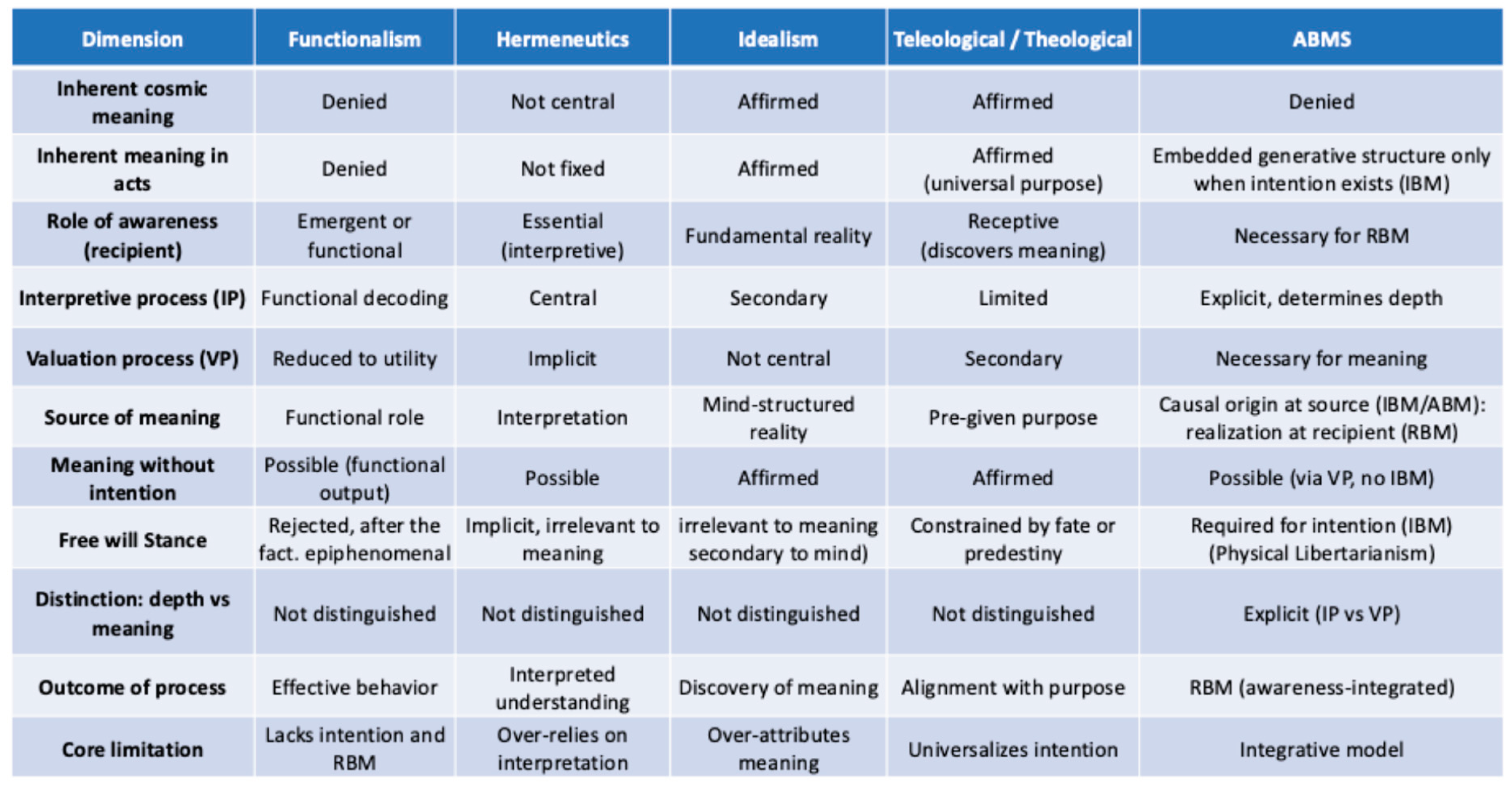
The comparative analysis that follows examines how major philosophical perspectives and theoretical models align with or diverge from ABMS across these dimensions. As summarized in Table 1 and Table 2, existing frameworks tend to capture isolated aspects of meaning formation, whereas ABMS integrates intention, interpretation, and valuation into a unified, process-based account.
4.1. Nihilism: The Absence of Meaning Formation
Nihilism represents a limiting case in which meaning is denied at both the ontological and experiential levels. Classical nihilistic positions reject the existence of inherent meaning in the world and often extend this rejection to the possibility of meaningful human experience (Nietzsche, 1887/1998). Within such a framework, events, actions, and expressions are viewed as devoid of purpose, significance, or value.
From the perspective of ABMS, nihilism can be understood as a condition in which the transformation from messaging to meaning fails to occur. While messages may still be generated and interpreted, the process does not culminate in Recognition-Based Meaning (RBM). In this sense, nihilism does not eliminate messaging or interpretation, but rather negates or suppresses valuation, preventing the emergence of meaningful experience.
This absence of meaning formation may arise through different mechanisms. At the source level, nihilism often assumes the absence of intention or purpose, reducing expressions and events to structurally describable outputs consistent with Appearance-Based Messaging (ABM). A contemporary illustration of this condition can be observed in artificial intelligence systems, where outputs are generated through algorithmic processes without intention.
At the recipient level, nihilism may involve the rejection or attenuation of valuation, such that no content is regarded as significant or worthy of engagement. In such cases, even when interpretive processing (IP) occurs, the absence or suppression of valuation (VP), combined with failure of integration into awareness, prevents the transition to RBM. The system therefore terminates at informational intelligence without progressing to meaningful experience.
Within ABMS, this condition is not interpreted as evidence that meaning does not exist, but rather as a failure of valuation-dependent processing within awareness.
These distinctions differentiate ABMS from nihilistic frameworks by preserving the conditions under which meaning can arise, as summarized in Table 1. While ABMS may align with nihilism in denying generative (source-based) deep meaning in natural or life events lacking agency, it diverges by locating meaning in awareness-based valuation, thereby allowing for meaningful experience even in the absence of inherent purpose. In ABMS terms, nihilism represents a condition in which informational intelligence fails to transition into valuation-integrated awareness.
4.2. Absurdism: Meaning Without Inherent Purpose
Absurdism emerges as a response to nihilism, accepting the absence of inherent or cosmic meaning while rejecting the conclusion that meaningful experience is therefore impossible. As articulated most prominently by Albert Camus, the human condition is defined by a tension between the search for meaning and an indifferent universe that offers none (Camus, 1955/1991). Rather than resolving this tension, absurdism affirms continued engagement with life through awareness, defiance, and valuation.
From the perspective of ABMS, absurdism represents a condition in which intention at the source is absent or irrelevant, but the recipient retains full capacity for interpretive and valuation processes. Messages arising from natural events, chance, or an indifferent world may lack embedded intention (IBM), yet they can still be interpreted and valued, giving rise to Recognition-Based Meaning (RBM).
In this sense, absurdism aligns with ABMS in recognizing that meaning does not require inherent purpose or intention at the source. Meaning arises through the recipient’s engagement with events via interpretive processing (IP) and valuation processing (VP). The resulting meaning is therefore constructed at the level of awareness, rather than discovered as an intrinsic property of the world.
However, a key distinction remains. Within absurdism, meaning is framed primarily as an act of creation or affirmation in response to an indifferent world, and therefore lacks a discoverable component rooted in the source. In contrast, ABMS maintains that when intention is present, messaging may carry generative depth that can be inferred through interpretation. Thus, while absurdism emphasizes meaning as constructed through valuation, ABMS allows for both constructed meaning (via VP) and potentially discoverable depth (via IBM and IP).
Accordingly, absurdism can be understood within ABMS as a framework in which generative depth at the source is absent, but interpretation and valuation remain fully active, allowing meaning to emerge despite the absence of inherent purpose. This distinguishes absurdism from nihilism, where valuation is suppressed, and aligns it with ABMS in affirming that meaning is contingent on awareness-based valuation rather than intrinsic to events themselves.
4.3. Existentialism: Meaning Through Freedom and Intention
Existentialism rejects the existence of inherent or pre-given meaning in the world while affirming that meaning arises through human freedom, intention, and responsibility. As articulated by Jean-Paul Sartre, individuals are “condemned to be free,” and meaning emerges through acts of choice and commitment (Sartre, 1946/2007). Within this framework, meaning is not discovered but created through intentional engagement with the world.
From the perspective of ABMS, existentialism aligns strongly with the recognition that intention plays a central role in meaning formation. The emphasis on agency and deliberate action corresponds to Intention-Based Messaging (IBM), in which intention introduces generative depth at the source. Existentialism also implicitly acknowledges the role of awareness at the recipient level, as meaning is experienced through conscious engagement with one’s actions and their consequences.
However, a key distinction lies in how meaning is conceptualized. Within existentialism, meaning is fundamentally constructed by the agent, with no requirement for it to be embedded within the act itself as a recoverable or discoverable component. Meaning is therefore inseparable from the individual’s interpretive stance and commitment.
In contrast, ABMS introduces a structural distinction between generation and realization. When intention is present, messaging may carry generative depth that is embedded at the source (IBM), even if it is not directly observable. This depth can be reconstructed, misinterpreted, or remain undiscovered, but it exists as a feature of the intentional act. Meaning, however, is not identical to this embedded depth; it arises only when the interpreted content is valued and integrated into awareness as Recognition-Based Meaning (RBM).
Thus, while existentialism emphasizes the creation of meaning through intention, ABMS distinguishes between intention as a generator of depth and valuation as the condition for meaningful experience. This allows ABMS to account for cases in which intention is present but meaning is not realized, as well as cases in which meaning arises without intention through recipient-side processes.
Accordingly, existentialism can be understood within ABMS as a framework that prioritizes intention and agency at the source, while under-specifying the asymmetric structure of the messaging process. In ABMS, a message may be interpreted, misinterpreted, or overinterpreted by the recipient, regardless of whether intention is present at the source. This includes both intentional acts and non-intentional outputs such as habitual behaviors. ABMS extends existentialism by providing a layered and mechanistic account, in which intention shapes what can be inferred, interpretation determines depth of understanding, and valuation determines whether meaning emerges at all. In ABMS terms, existentialism emphasizes the generation of depth through intention but does not fully account for its transformation into meaningful experience.
4.4. Humanism: Meaning Through Shared Values and Human Dignity
Humanism rejects the existence of inherent cosmic meaning while affirming that human life possesses intrinsic worth grounded in shared values, ethical commitments, and dignity. Rather than locating meaning in the structure of the world or in metaphysical foundations, humanism situates meaning within the human domain, emphasizing well-being, moral responsibility, and collective flourishing (Taylor, 1989; Kurtz, 2000).
From the perspective of ABMS, humanism aligns with the recognition that meaning is not an inherent property of external events, but emerges through human-centered processes of evaluation and engagement. The emphasis on values corresponds closely to the valuation process (VP), through which informational intelligence is assigned relevance, significance, and priority. In this sense, humanism highlights the central role of valuation in transforming experience into meaning.
However, a key distinction lies in how meaning is structured. Within humanism, meaning is often grounded in shared or culturally established values that guide interpretation and ethical action. These values provide relatively stable frameworks for determining what matters, but the underlying processes through which messages are interpreted and transformed into meaningful experience are not explicitly articulated.
In contrast, ABMS provides a process-based account of how such value systems operate within meaning formation. While shared values may shape the valuation process (VP), ABMS distinguishes between interpretation (IP) and valuation (VP) as sequential and necessary components. Meaning arises not from values alone, but from the interaction between interpreted content and value assignment within awareness.
Furthermore, ABMS introduces a distinction between source-generated depth and recipient-level meaning. While humanism emphasizes value and dignity at the level of the human subject, it does not explicitly differentiate between messaging that contains embedded intention (IBM) and messaging that does not (ABM). ABMS, by contrast, accounts for how intention may shape the structure of messaging, while maintaining that meaning emerges only through recipient-side valuation.
Accordingly, humanism can be understood within ABMS as a framework that prioritizes valuation and ethical significance, while under-specifying the mechanisms through which meaning is interpreted and realized. ABMS extends this view by providing a layered and mechanistic model, in which intention shapes potential depth, interpretation determines understanding, and valuation determines whether meaning emerges within awareness. In ABMS terms, humanism emphasizes the valuation dimension of meaning while leaving its interpretive and generative structure under-specified.
4.5. Functionalist Interpretation of Meaning
Functionalist and evolutionary approaches to meaning interpret meaning as a biological or cognitive function rather than an intrinsic or intentional property. Within this framework, meaning emerges as an adaptive tool that enhances survival, prediction, coordination, and problem-solving. Language, emotion, intention, and even consciousness are understood as functional outputs of complex systems shaped by natural selection (Millikan, 1984; Dennett, 1991). Meaning is therefore instrumental: something “means” what it does because it plays a role in guiding behavior effectively.
Within this view, awareness is typically treated as an emergent phenomenon arising from neural complexity rather than as a fundamental feature of mind (Churchland, 1986). Intention is often reinterpreted as a post hoc narrative constructed by the brain to rationalize decisions already determined by underlying neurocomputational processes (Wegner, 2002). Free will is generally framed in compatibilist terms, preserving practical responsibility while denying metaphysical independence from causality (Dennett, 2003).
This reductionist physicalism confines meaning largely to Apparent-Based Meaning (ABM), emphasizing linguistic communication, behavioral signaling, and algorithmic interpretations of mental states. While evolutionary functionalism offers strong explanatory power for why meaning is useful as a survival mechanism, it struggles to account for Intention-Based Meaning (IBM) and Recognition-Based Meaning (RBM) without reducing intention and awareness to epiphenomenal byproducts of neural activity or subjective illusions (Searle, 1980). In functionalism, meaning is what works, not what is intended or intrinsically valued. Although this school of thought effectively explains the adaptive utility of meaning, it ultimately approaches meaning in a see-through manner that borders on nihilism, as meaning is never genuinely possessed, only functionally simulated.
ABMS shares the acknowledgment of meaning’s functional value in human life and survival, yet departs from functionalism by recognizing deeper layers of meaning beyond ABM. ABMS insists that awareness is neither a false interpretation of reality nor an illusion, but a fundamental property of mind that enables other mental functions, including intention (Author, 2023a). Intention, within ABMS, is not merely a functional description but a generative source of meaning. While functionalism explains how meaning can be useful, ABMS addresses why meaning exists at all in intentional acts. This distinction becomes especially salient in discussions of artificial intelligence, where purely functional systems can generate convincing ABM while lacking IBM and genuine RBM (Searle, 1980; Floridi, 2014). These distinctions differentiate ABMS from functionalist interpretation as summarized in Table 2.
4.6. Hermeneutics and Interpretive Meaning
Hermeneutics approaches meaning as an interpretive phenomenon, emphasizing context, history, language, and the situatedness of the interpreter. Meaning, in this tradition, is not fixed or intrinsic but emerges through the dynamic interaction between text, action, and recipient (Gadamer, 1960/2004). Early hermeneutic thinkers such as Friedrich Schleiermacher emphasized reconstructing authorial intent, while later figures such as Hans-Georg Gadamer argued that meaning always exceeds original intention and is continually reshaped through historical horizons and lived understanding.
From a hermeneutic perspective, meaning is never final. Interpretation is ongoing, plural, and conditioned by the interpreter’s background, language, and temporal situation. Awareness is therefore essential, but it is awareness understood as interpretive openness rather than as a neutral receiver of fixed meaning. Intention may inform interpretation, but it does not conclusively anchor meaning. Meaning resides in the dialogical process between expression and understanding (Ricoeur, 1976).
ABMS incorporates this hermeneutic insight at the level of the gap between meaning generated by the source (IBM) and meaning recognized by the recipient (RBM), acknowledging that recipients inevitably interpret, contextualize, and value meaning differently. However, by maintaining a principled distinction between generation and interpretation within the messaging system, ABMS diverges from hermeneutics. In ABMS, interpretation is not the primary source of meaning; rather, structure originates in the generator’s intention in the form of messaging and is subsequently recognized or misrecognized by the recipient.
ABMS holds that when intention is present, IBM is structurally embedded in the act itself, even if it is imperfectly or variably understood but remains an inseparable attribute of the message. Not every action or expression is provided with IBM and interpretation may distort, enrich, or fail to access meaning, but it does not create IBM where none exists. In this way, ABMS constrains hermeneutics without rejecting it. Interpretation is acknowledged as unavoidable and epistemically significant, but it is not elevated to the sole source of meaning (Table 2).
4.7. Idealism and Meaning
Idealism begins from the primacy of mind, consciousness, or ideas, holding that reality is fundamentally mental or that what we call reality is inseparable from perception, cognition, or consciousness (Berkeley, 1710/1998; Hegel, 1807/1977). Within idealist traditions, meaning is often treated as intrinsic to reality itself, because reality is already structured by mind, reason, or spirit. Meaning is therefore not primarily generated through discrete acts of intention, but discovered as part of an intelligible, mind-dependent order. Awareness, in idealism, is not merely a condition for receiving meaning; it is the very ground of what exists and what is meaningful.
The Awareness-Based Meaning System (ABMS) departs from idealism at a critical point. While ABMS affirms the indispensability of awareness for meaning, it does not equate awareness with reality itself, nor does it claim that meaning is embedded in all acts by default. Instead, ABMS treats meaning as a relational and communicative process that requires specific conditions: intention on the generating side and awareness on the receiving side. Meaning, in ABMS, is not an ontological given but a structured outcome arising from interaction.
Unlike idealism, ABMS does not assume that events or acts are meaningful merely because they are apprehended by mind. Deep meaning (IBM) exists only when intention is present, and Recognition-Based Meaning (RBM) arises only through awareness in a conscious recipient. Idealism thus risks overgeneralizing meaning by treating it as inherent in reality itself, whereas ABMS discriminates meaning, allowing for meaningful and meaningless phenomena depending on intention and awareness.
In this way, ABMS avoids both the metaphysical inflation of meaning characteristic of idealism and the collapse of meaning into illusion characteristic of nihilism and physicalism. Meaning is preserved where it is structurally justified and withheld where it is not.
4.8. Teleological and Theological Accounts of Meaning
Teleological and theological theories of meaning assert that meaning is inherent in reality itself because existence is oriented toward an end, purpose, or ultimate intention. Classical teleology, most notably articulated by Aristotle, holds that all things possess a telos, or final cause, which explains not only how things occur but why they exist. Within this framework, actions and events are meaningful insofar as they fulfill their natural purpose (Aristotle, Physics II; Nicomachean Ethics).
Theological extensions of teleology, developed most systematically by Thomas Aquinas, ground meaning in divine intention. In this view, meaning is not merely discovered through human interpretation but is bestowed by a transcendent source whose will imbues existence with purpose and order (Aquinas, Summa Theologica). Meaning is therefore objective, universal, and antecedent to human cognition.
Within these traditions, intention exists at a universal or divine level, independent of human agency. Meaning precedes awareness and action rather than emerging from them. Human intention does not generate meaning; it aligns with a pre-existing teleological structure. Awareness functions primarily as a receptive faculty through which meaning is discovered rather than created. Free will, where acknowledged, is typically constrained by divine omnipotence and omniscience, rendering human freedom compatible only insofar as it operates within an already-determined moral and metaphysical order (Aquinas, De libero arbitrio).
The Awareness-Based Meaning System (ABMS) diverges sharply at this point. While ABMS does not deny the internal coherence or historical significance of teleological and theological worldviews, it does not require or assume a universal intention as the source of universal meaning. Meaning, within ABMS, is neither embedded in existence itself nor present in all acts by default. Instead, deep meaning arises only when intention exists at the level of a non-cosmic generator and awareness exists at the level of a recipient.
From the ABMS perspective, actions or events that merely follow the natural laws of cause and effect, whether initiated by nature, the universe, or by humans acting without intention are comparable to a gift wrapper without a gift inside. They may possess apparent meaning (ABM), but they lack Intention-Based Meaning (IBM). Teleological theories therefore risk over-attributing meaning by treating all events as meaningful regardless of intention. ABMS, by contrast, discriminates between meaningful and non-meaningful acts based on structural conditions of intention and awareness without attaching it to a metaphysical assumptions about the nature of reality.
In this way, ABMS avoids both the universalization of meaning characteristic of teleological and theological accounts and the reduction of meaning to illusion characteristic of nihilism and physicalism. Meaning is preserved where it is structurally justified and withheld where it is not (Table 2).
5. Integration of ABMS with TTC, QTTC, and Related Models
The Awareness-Based Meaning System (ABMS) extends the conceptual framework of the Trilogy Theory of Consciousness (TTC) (Author, 2023a) and its quantum formulation (QTTC) (Author, 2025a) by providing a structured account of how meaning emerges within awareness and decision-making processes. In addition, ABMS incorporates its interpretive and valuation architecture from the Dynamic Love-Based Valuation (DLBV) framework of emotional intelligence (Author, 2026a), which is an Identity-relevant valuation and grounded in the Triphasic Model of Love (TML) (Author, 2026b). Together, these models form a coherent theoretical ecosystem that begins with awareness, extends through valuation and emotion, and culminates in meaning.
While TTC characterizes consciousness through the interaction of awareness, intention, and identity, ABMS specifies how messaging is transformed into meaningful experience through sequential interpretive and valuation processes. In this framework, meaning is not an intrinsic property of messaging, but an emergent outcome of its reconstruction and valuation within awareness.
Within this integrated model, Intention-Based Messaging (IBM) corresponds to the generative role of intention described in TTC within decision-making processes (Author, 2025b) and formalized in QTTC as a boundary operator shaping the structure of awareness (Author, 2025a). In this paradigm, neither awareness nor intention is treated as a metaphysical entity, but as an extension of physical processes within a quantum field-theoretic framework, consistent with a model of physical libertarianism (Author, 2023b). IBM therefore introduces generative depth at the source, defining what may be inferred through interpretation without determining how it will ultimately be experienced.
At the recipient level, the interpretive process (IP) reconstructs messaging into informational intelligence, while the valuation process (VP) assigns relevance and significance, transforming informational intelligence into emotionally charged intelligence. This transformation aligns with the preselection stage of awareness described in TTC, in which candidate informational states are evaluated prior to conscious integration. VP also corresponds to affective and motivational modulation within the DLBV framework, where emotion reflects the experiential manifestation of value assignment.
Recognition-Based Meaning (RBM) emerges when interpreted and valued content is integrated into awareness, forming a coherent conscious experience. Within TTC, this corresponds to the transformation of selected content into subjective experience, while within QTTC it may be conceptualized as the stabilization or excitation of noëton states within the Universal Awareness Field.
ABMS therefore provides the operational and phenomenological layer through which TTC and QTTC account for the emergence of meaning within awareness. While TTC and QTTC describe the structural and field-level dynamics of consciousness, ABMS explains how those dynamics give rise to meaningful experience through the transformation of messaging into valuation-integrated awareness.
6. Limitations and Future Directions (Draft)
6.1. Conceptual and Operational Limitations
Despite its integrative structure, ABMS remains a theoretical framework whose core constructs require further empirical refinement and operational clarity. The distinction between Appearance-Based Messaging (ABM), Intention-Based Messaging (IBM), interpretive processing (IP), valuation processing (VP), and Recognition-Based Meaning (RBM), while conceptually well-defined, presents challenges for direct measurement and experimental isolation.
One primary limitation lies in the separation of interpretive and valuation processes. Although ABMS posits that IP generates informational intelligence and VP charges that into emotionally charged intelligence before it transforms it into meaningful experience. These processes may be temporally overlapping and neurally interdependent. Disentangling interpretation from valuation in empirical settings therefore requires carefully controlled paradigms that can independently manipulate structural understanding and affective relevance.
A second challenge concerns the operationalization of generative depth. While IBM is defined as intention-structured messaging at the source, its presence must be inferred indirectly through experimental design. Participants do not have direct access to source intention, and thus the distinction between ABM and IBM depends on controlled manipulations of ambiguity, context, and inferential demand. This introduces variability in interpretation that may complicate measurement of depth-related effects.
Additionally, RBM, as an awareness-integrated and valuation-dependent phenomenon, is inherently subjective. Although it may be approximated through self-report, behavioral proxies, and physiological or neural markers, these measures capture correlates rather than the experience of meaning itself. This limitation is common to all models addressing subjective experience but remains a central challenge for empirical validation.
ABMS also assumes a structural asymmetry between source and recipient, which may be difficult to delineate in internally generated processes such as memory, imagination, or self-directed cognition, where the distinction between messaging and interpretation becomes less clearly defined.
Finally, while ABMS integrates insights from multiple theoretical traditions, including valuation-based emotional models, its explanatory power depends on the extent to which these integrations can be empirically substantiated. The framework therefore requires systematic experimental validation to determine whether its proposed distinctions, particularly between interpretation, valuation, and awareness correspond to measurable and dissociable processes.
6.2. Experimental Design and Falsifiability (ABMS-Aligned)
6.2.1. Operationalizing ABMS Constructs
For ABMS to be empirically testable, its core constructs must be operationalized in experimentally tractable terms. Informational intelligence (II) may be defined as the structured output of the interpretive process (IP), reflecting the recipient’s reconstruction of messaging independent of valuation. Emotionally charged intelligence (ECI) corresponds to the output of the valuation process (VP), in which informational content is weighted by relevance and significance and becomes capable of entering awareness as Recognition-Based Meaning (RBM).
Appearance-Based Messaging (ABM) may be operationalized using stimuli grounded in shared linguistic or symbolic conventions, where interpretation is largely rule-based and minimally dependent on inferential reconstruction. In contrast, Intention-Based Messaging (IBM) may be operationalized using stimuli in which underlying intention is not directly observable and must be inferred from contextual cues, ambiguity, or indirect signaling.
The transition from II to ECI, and subsequently to RBM, may be examined through paradigms that independently manipulate interpretive complexity (IP load) and valuation relevance (VP strength). Behavioral measures (accuracy, response latency), physiological markers (autonomic arousal), and neural correlates (e.g., salience and valuation networks) may be used to dissociate interpretation from valuation.
6.2.2. Asymmetry and Symmetry in Meaning Formation
A central prediction of ABMS concerns the asymmetry between IBM and RBM and the relative symmetry between ABM and RBM.
In ABM-based conditions, where messaging is grounded in shared conventions, the interpretive process is expected to be relatively uniform across individuals. As a result, informational intelligence should be highly consistent, and when valuation is present, RBM should exhibit relative symmetry across recipients.
In contrast, IBM-based conditions require inferential reconstruction of intention, introducing variability in IP. This leads to asymmetry between the generative structure at the source and the realized meaning at the recipient. Even when intention is present and fixed at the source, RBM may vary significantly across individuals depending on differences in interpretation and valuation.
This distinction can be experimentally tested by presenting participants with matched stimuli that differ only in whether they require intention inference (IBM) or rely on surface-level conventions (ABM), and measuring variability in interpretation, valuation, and reported meaning. ABMS predicts greater inter-subject variability and interpretive divergence in IBM conditions compared to ABM conditions.
6.2.3. Testable Predictions
ABMS generates several falsifiable predictions regarding the transformation of messaging into meaning:
1. Interpretation Without Valuation Does Not Produce Meaning
Messages that are fully decoded (high IP) but low in valuation (low VP) should result in informational awareness without subjective meaning. If participants report meaningful experience in the absence of measurable valuation signals, the necessity of VP would be challenged.
2. Valuation Modulates Meaning Independent of Interpretive Accuracy
Identical informational intelligence should produce different levels of reported meaning when valuation is experimentally manipulated. If meaning remains constant despite changes in valuation, the central role of VP would be weakened.
3. IBM–RBM Asymmetry
Messages containing embedded intention (IBM) should produce variable RBM across individuals due to differences in interpretive reconstruction and valuation. If RBM remains consistent across participants despite requiring intention inference, the proposed asymmetry would be invalidated.
4. ABM–RBM Relative Symmetry
Messages based on shared conventions (ABM) should produce relatively consistent interpretation and more stable RBM across participants. If ABM conditions show the same level of variability as IBM conditions, the distinction between surface structure and generative depth would be undermined.
5. Dissociation Between Interpretive Depth and Meaning
High interpretive complexity (deep IP) should not guarantee high meaning if valuation is low. Conversely, low interpretive complexity (surface IP) may still produce strong meaning if valuation is high. Failure to observe this dissociation would challenge the separation between IP and VP.
6.2.4. Falsifiability Criteria
The ABMS framework would be empirically challenged under the following conditions:
- If meaningful experience can be demonstrated to arise independently of valuation processes.
- If interpretive processing alone reliably produces RBM without measurable valuation modulation.
- If no measurable difference exists between ABM and IBM conditions in terms of interpretive variability or meaning formation.
- If valuation does not modulate the intensity or presence of meaning independently of interpretive accuracy.
Because ABMS specifies distinct and sequential processes such as interpretation, valuation, and awareness integration, it allows for direct empirical testing using behavioral, neuroimaging, and psychophysiological methods. The framework is therefore falsifiable without reliance on metaphysical assumptions, as its core claims can be evaluated through observable differences in interpretation, valuation, and experienced meaning.
7. Conclusion
The Awareness-Based Meaning System (ABMS) proposes a unified, process-based account of meaning in which meaning is not transmitted but emerges through a valuation-dependent reconstruction of messaging within awareness. By distinguishing between messaging at the source and meaning at the recipient, ABMS resolves a central ambiguity in existing theories: the conflation of structural expression, intention, interpretation, and experience.
Within this framework, Appearance-Based Messaging (ABM) and Intention-Based Messaging (IBM) define the structure and generative depth of messaging at the source, while interpretive processing (IP) reconstructs this messaging into informational intelligence at the recipient. Meaning, however, arises only when this reconstructed content undergoes valuation (VP) and is integrated into awareness as Recognition-Based Meaning (RBM). This establishes a fundamental principle: interpretation determines depth, but valuation determines whether meaning emerges at all.
A key implication of this model is the asymmetry between generative depth and realized meaning. While intention may embed structured depth within messaging (IBM), this depth is not equivalent to meaning and may not be recovered or valued by the recipient. In contrast, messaging grounded in shared conventions (ABM) tends to produce more consistent interpretive outcomes, resulting in a relative symmetry between messaging and experienced meaning. This asymmetry-symmetry distinction provides a novel and testable signature of meaning formation within ABMS.
Through comparative analysis, ABMS demonstrates that existing philosophical and theoretical frameworks capture important but partial aspects of meaning. Some emphasize intention, others interpretation, valuation, or awareness, yet none integrate these components into a single structured process. ABMS unifies these dimensions by specifying how generative structure, interpretive reconstruction, and valuation-dependent integration interact to produce meaningful experience.
Beyond its theoretical contributions, ABMS offers a framework for empirical investigation. By distinguishing between interpretation, valuation, and awareness, it generates falsifiable predictions regarding the conditions under which meaning emerges. In particular, it predicts that interpretation without valuation will fail to produce meaning, and that variability in meaning arises primarily from differences in valuation rather than differences in informational content alone.
In this way, ABMS positions meaning not as an inherent property of the world nor as a purely subjective construction, but as a relational and structured outcome arising from the interaction between messaging intention and content, interpretation, valuation, and awareness. This perspective provides a foundation for integrating philosophical, cognitive, and affective accounts of meaning, and for advancing a scientifically tractable understanding of how meaning emerges in human experience.
References
- Aristotle. (1984). The complete works of Aristotle (J. Barnes, Ed.). Princeton University Press.
- Austin, J. L. (1962). How to do things with words. Oxford University Press.
- Aquinas, T. (1981). Summa Theologica (Fathers of the English Dominican Province, Trans.). Christian Classics.
- Berkeley, G. (1998). A treatise concerning the principles of human knowledge. Oxford University Press. (Original work published 1710).
- Camus, A. (1991). The myth of Sisyphus (J. O’Brien, Trans.). Vintage. (Original work published 1955). [CrossRef]
- Churchland, P. M. (1986). Neurophilosophy. MIT Press.
- Dennett, D. C. (1991). Consciousness explained. Little, Brown. [CrossRef]
- Dennett, D. C. (2003). Freedom evolves. Viking.
- Author (2023a). Trilogy theory of consciousness: A field-based paradigm. Neuropsychiatry, 13(4), 1–16.
- Author (2023b). Free Will in Physical Libertarianism: A New Paradigm of Decision-Making. J Psych and Neuroche Res 1(3), 01-11.
- Author (2025a). Toward a Field-Based Framework of Awareness: Quantum Trilogy Theory of Consciousness. J. of Mod Phy & Quant Neuroscience 1(3), 1-14.
- Author (2025b). Awareness-based choice selection: improving the decision-making efficiency by using known information. Curr Psychol 44, 13145–13153 (2025). https://doi.org/10.1007/s12144-025-08072-8. [CrossRef]
- Author (2026). Emotion as Love in Disguise: A Dynamic Love-Based Valuation Theory of Emotional Intelligence. Preprints. https://doi.org/10.20944/preprints202603.1145.v1. [CrossRef]
- Author (2026). The Triphasic Model of Love: A Developmental Architecture of Attraction, Immersion, and Union. Qeios. doi:10.32388/9KVQ8T.
- Floridi, L. (2014). The fourth revolution. Oxford University Press.
- Frankl, V. E. (1959). Man’s search for meaning. Beacon Press.
- Friston, K. (2010). The free-energy principle: A unified brain theory? Nature Reviews Neuroscience, 11(2), 127–138. [CrossRef]
- Gadamer, H.-G. (2004). Truth and method (2nd rev. ed.). Continuum. (Original work published 1960).
- Grice, H. P. (1957). Meaning. The Philosophical Review, 66(3), 377–388.
- Hegel, G. W. F. (1977). Phenomenology of spirit. Oxford University Press. (Original work published 1807).
- Kahneman, D. (2011). Thinking, fast and slow. Farrar, Straus and Giroux.
- Kant, I. (1993). Grounding for the metaphysics of morals (3rd ed.). Hackett. (Original work published 1785).
- Kurtz, P. (2000). Humanist manifesto 2000. Prometheus Books.
- Millikan, R. G. (1984). Language, thought, and other biological categories. MIT Press. [CrossRef]
- Nietzsche, F. (1998). On the genealogy of morality. Oxford University Press. (Original work published 1887).
- Ricoeur, P. (1976). Interpretation theory. Texas Christian University Press.
- Sartre, J.-P. (1992). Being and nothingness. Washington Square Press. (Original work published 1956).
- Sartre, J.-P. (2007). Existentialism is a humanism. Yale University Press.
- Searle, J. R. (1969). Speech acts. Cambridge University Press.
- Searle, J. R. (1980). Minds, brains, and programs. Behavioral and Brain Sciences, 3(3), 417–457.
- Searle, J. R. (1983). Intentionality. Cambridge University Press.
- Schleiermacher, F. (1998). Hermeneutics and criticism. Cambridge University Press.
- Taylor, C. (1989). Sources of the self. Harvard University Press.
- Wegner, D. M. (2002). The illusion of conscious will. MIT Press. [CrossRef]
- Wittgenstein, L. (1953). Philosophical investigations. Blackwell.
Figure 1.
The Awareness-Based Meaning System (ABMS) messaging-to-meaning transformation. Messages generated at the source through Intention-Based Messaging (IBM) or Appearance-Based Messaging (ABM) undergo sequential processing at the recipient through the Interpretive Process (IP) and Valuation Process (VP). Meaning (Recognition-Based Meaning, RBM) emerges only after both processes, reflecting valuation-dependent reconstruction rather than direct transmission.
Figure 1.
The Awareness-Based Meaning System (ABMS) messaging-to-meaning transformation. Messages generated at the source through Intention-Based Messaging (IBM) or Appearance-Based Messaging (ABM) undergo sequential processing at the recipient through the Interpretive Process (IP) and Valuation Process (VP). Meaning (Recognition-Based Meaning, RBM) emerges only after both processes, reflecting valuation-dependent reconstruction rather than direct transmission.
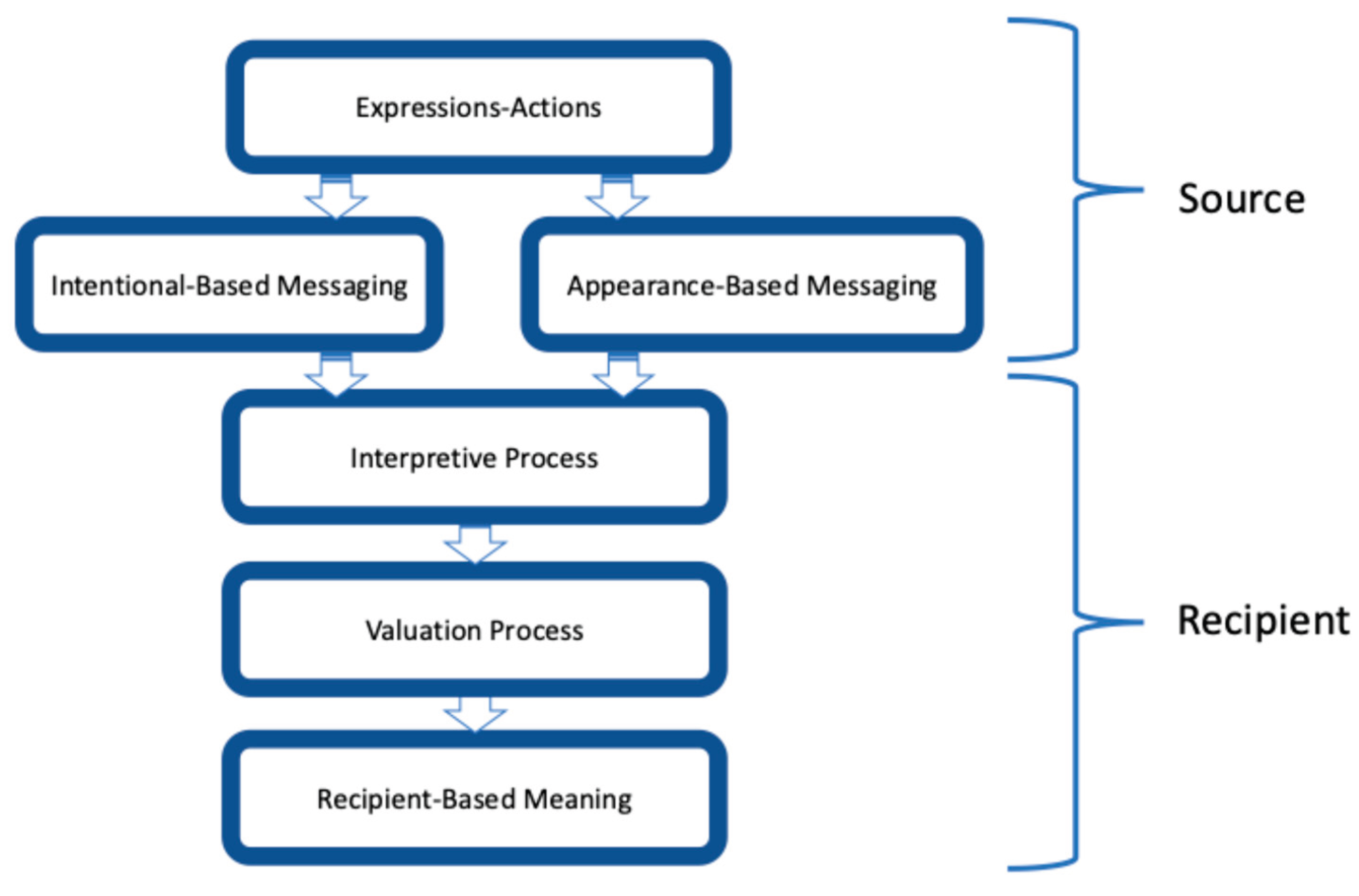
Figure 2.
Recipient-level transformation in ABMS. Received messages undergo interpretive processing through either intention inference or conventional decoding, generating informational intelligence. The valuation process determines whether the content matters. Valued content becomes emotionally charged intelligence and gives rise to Recognition-Based Meaning (RBM), whereas non-valued content remains informational and reaches awareness without forming meaning.
Figure 2.
Recipient-level transformation in ABMS. Received messages undergo interpretive processing through either intention inference or conventional decoding, generating informational intelligence. The valuation process determines whether the content matters. Valued content becomes emotionally charged intelligence and gives rise to Recognition-Based Meaning (RBM), whereas non-valued content remains informational and reaches awareness without forming meaning.
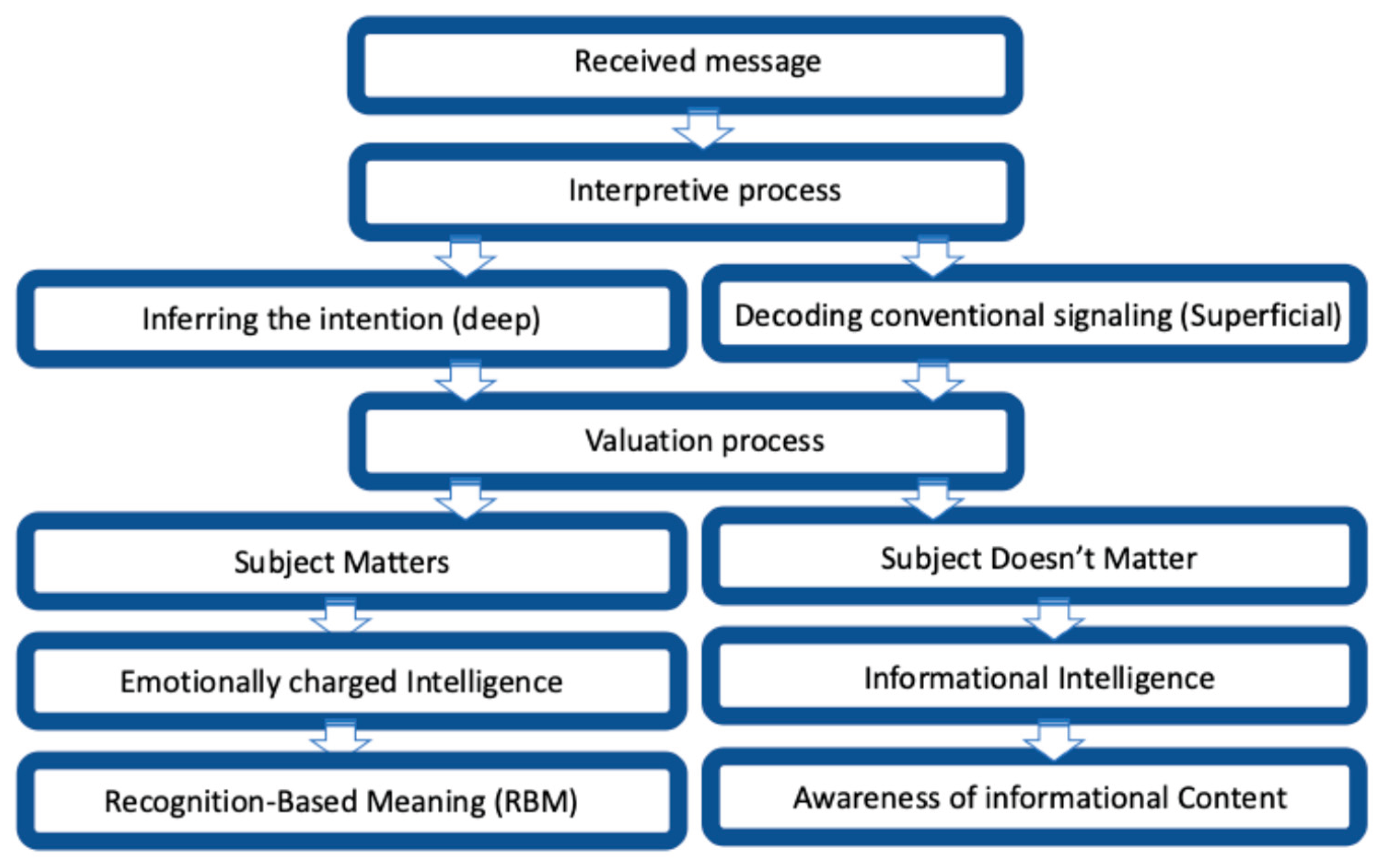

Table 1.
Comparative overview of major philosophical perspectives on meaning in relation to the Awareness-Based Meaning System (ABMS), highlighting differences. The table highlights differences in the role of intention, interpretation, valuation, and awareness in the formation of meaning.
Table 1.
Comparative overview of major philosophical perspectives on meaning in relation to the Awareness-Based Meaning System (ABMS), highlighting differences. The table highlights differences in the role of intention, interpretation, valuation, and awareness in the formation of meaning.
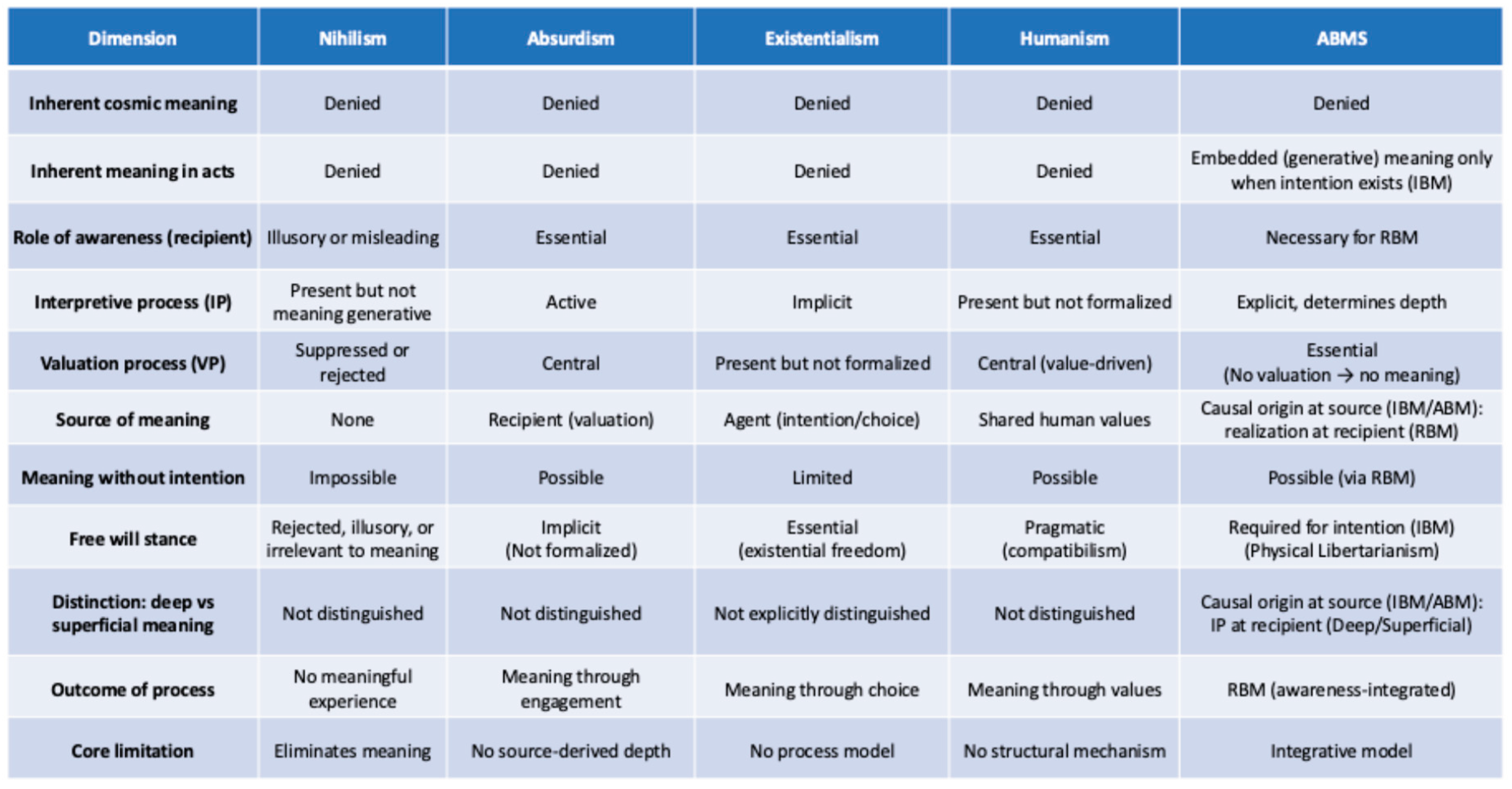 |
Table 2.
Comparative overview of functionalist, hermeneutic, idealist, and teleological frameworks in relation to the Awareness-Based Meaning System (ABMS), highlighting differences in the role of intention, interpretation (IP), valuation (VP), and awareness in the formation of meaning.
Table 2.
Comparative overview of functionalist, hermeneutic, idealist, and teleological frameworks in relation to the Awareness-Based Meaning System (ABMS), highlighting differences in the role of intention, interpretation (IP), valuation (VP), and awareness in the formation of meaning.
 |
Disclaimer/Publisher’s Note: The statements, opinions and data contained in all publications are solely those of the individual author(s) and contributor(s) and not of MDPI and/or the editor(s). MDPI and/or the editor(s) disclaim responsibility for any injury to people or property resulting from any ideas, methods, instructions or products referred to in the content. |
© 2026 by the authors. Licensee MDPI, Basel, Switzerland. This article is an open access article distributed under the terms and conditions of the Creative Commons Attribution (CC BY) license (http://creativecommons.org/licenses/by/4.0/).
Copyright: This open access article is published under a Creative Commons CC BY 4.0 license, which permit the free download, distribution, and reuse, provided that the author and preprint are cited in any reuse.


