

Submitted:
21 March 2026
Posted:
24 March 2026
You are already at the latest version
Abstract
This study investigated the effects of computer-assisted writing on the written language production of secondary school students with Specific Learning Difficulties (SLD), particularly dyslexia. Writing is a complex cognitive process that requires the coordination of spelling, lexical retrieval, syntactic organization, transcription, and revision, areas in which students with SLD often experience persistent difficulties. The study compared handwritten and computer-based texts produced by 40 students with SLD and 20 students without learning difficulties, using a counterbalanced design in which all participants completed both writing conditions on the same topic. In the handwriting condition, students used printed reference materials, whereas in the computer-based condition they had access to general-purpose digital tools, including spell-checkers, electronic dictionaries, online resources, and word-processing software. Written texts were evaluated using the Spelling Accuracy Index and holistic scores assigned by independent raters. The findings revealed statistically significant improvements in favor of computer-based writing for both groups, with particularly strong gains among students with SLD. Computer-written texts demonstrated higher spelling accuracy and received higher evaluation scores, indicating enhanced writing performance. The results suggest that computer-assisted writing can effectively support written language production by reducing transcription-related difficulties and promoting more autonomous revision processes. These findings also highlight the potential of digital writing tools to contribute to sustainable and inclusive educational practices by supporting accessible and long-term learning for students with Specific Learning Difficulties.
Keywords:
specific learning difficulties
; dyslexia
; computer-assisted writing
; assistive technology
; sustainable digital education
1. Introduction
Written language production constitutes a complex cognitive process that requires the coordination of multiple linguistic, cognitive, and motor skills, including spelling, lexical retrieval, syntactic organization, transcription, and revision strategies. Contemporary research has emphasized that writing is not a simple linear act but a multidimensional activity involving lower-order and higher-order processes that interact continuously during text production (Flower & Hayes, 1981; Deane et al., 2008; Hayes, 2012). Subsequent theoretical developments have highlighted the critical role of working memory and transcription skills in shaping writing performance, demonstrating that difficulties in spelling or handwriting can significantly constrain higher-level writing processes (Berninger & Swanson, 1994; Berninger, 2012; Kellogg, 2008).
For students with Specific Learning Difficulties (SLD), particularly those diagnosed with dyslexia, the writing process is often considerably more demanding. Dyslexia is primarily characterized by difficulties in accurate and fluent word recognition and spelling, which can significantly affect written language production (Lyon et al., 2003; Snowling, 2013; Shaywitz, 2020). These difficulties are frequently associated with deficits in phonological processing, orthographic knowledge, and working memory, all of which can disrupt the transcription phase of writing and reduce the cognitive resources available for idea generation and organization (Snowling, 2013; Shaywitz, 2020). As a result, students with dyslexia often produce shorter texts containing more spelling errors, weaker transcription fluency, and lower overall writing quality than typically developing peers (Connelly et al., 2006; Graham et al., 2015; Sumner et al., 2014). Importantly, writing difficulties in students with dyslexia often persist into adolescence and adulthood, particularly in the absence of appropriate instructional and technological support (Graham & Harris, 2018).
Research on writing instruction has consistently emphasized that effective writing development requires explicit support for both transcription and higher-order composing processes (Graham, 2019; Graham & Harris, 2018). In recent decades, the rapid development of digital technologies and assistive tools has introduced new possibilities for supporting the writing process of students with learning difficulties. Educational technologies such as spell-checkers, word prediction systems, text-to-speech applications, and digital dictionaries have been shown to reduce transcription difficulties and facilitate revision processes (Berninger et al., 2015; Dumitru, 2025; Almgren Bäck et al., 2024). These tools can reduce mechanical barriers in writing, enabling students to focus more effectively on idea generation and text organization (MacArthur, 2009; Alves & Limpo, 2015).
Computer-based writing environments may support students with dyslexia by externalizing aspects of the spelling process that would otherwise rely heavily on phonological processing and working memory. Empirical studies indicate that digital tools can improve spelling accuracy and facilitate lexical retrieval during writing, thereby supporting higher-level writing processes such as organization and content development (O’Rourke et al., 2020; Wengelin et al., 2024). In addition, such environments can promote the development of metacognitive writing strategies, including planning, monitoring, and revising texts. Through features such as spell-checkers and speech-based tools, students may be better able to detect and correct errors that might otherwise remain unnoticed (Svendsen, 2016; Svendsen et al., 2026). Assistive technology has also been examined within broader frameworks of digital accessibility and inclusive learning for students with dyslexia, highlighting its role not only as a compensatory tool but also as a means of fostering independent learning strategies and writing autonomy (Drigas & Ioannidou, 2013; Chandra et al., 2026).
Experimental research has further demonstrated that typing and computer-based writing tools may improve spelling accuracy and reduce cognitive load during text production compared with handwriting (Berninger et al., 2015; Cerni et al., 2025). By reducing transcription demands, computer-assisted writing allows students to allocate greater cognitive resources to higher-level writing processes, such as planning, organization, and revision. More broadly, recent evidence suggests that digital writing tools can support literacy development and improve writing-related outcomes when integrated meaningfully into instruction (Dumitru, 2025; Zhang & Quinn, 2024).
Despite these promising developments, empirical research directly comparing handwritten and computer-based writing among students with dyslexia remains relatively limited, particularly at the secondary education level. Although existing studies highlight the potential of assistive technologies, further research is needed to examine how digital writing tools influence spelling accuracy, text quality, and teacher evaluation in authentic educational contexts.
The present study addresses this gap by examining the effects of computer-assisted writing using general-purpose digital tools on the written language production of secondary school students with Specific Learning Difficulties. Specifically, it investigates differences between handwritten and computer-written texts in terms of spelling accuracy and evaluation scores assigned by independent raters.
To provide a clearer theoretical structure for these relationships, a conceptual framework is proposed (Figure 1). This framework illustrates how computer-assisted writing functions as a form of digital support that reduces cognitive and transcription-related demands and enhances key writing processes. It also situates these processes within a broader perspective of inclusive and sustainable digital learning, emphasizing the role of technology in supporting accessible, equitable, and long-term educational practices for students with Specific Learning Difficulties.
2. Context and Literature Review
Contemporary models of writing conceptualize text production as a complex cognitive activity involving recursive processes of planning, translating, and reviewing (Flower & Hayes, 1981; Hayes, 2012). Subsequent models expanded this framework to incorporate working memory and transcription processes, including handwriting and spelling, emphasizing the interaction between lower-level and higher-level writing processes (Berninger & Swanson, 1994; Berninger, 2012; Kellogg, 2008). Within these models, transcription skills are considered critical, as difficulties in spelling or handwriting may consume cognitive resources that would otherwise be allocated to higher-level writing processes (Alves & Limpo, 2015).
Students with dyslexia frequently experience substantial difficulties during the transcription phase of writing, particularly in spelling and orthographic processing. These difficulties are closely associated with deficits in phonological processing and working memory (Snowling, 2013; Shaywitz, 2020). As a result, writing becomes a cognitively demanding process, often leading to shorter texts, reduced lexical diversity, and limited revision. Although dyslexia is primarily characterized by difficulties in word recognition and spelling (Lyon et al., 2003), its impact extends to broader aspects of written expression. Students with dyslexia often struggle to maintain writing fluency, as significant cognitive effort is required for spelling, which can interrupt idea generation and negatively affect text coherence. Empirical research has consistently shown that these students produce texts with more spelling errors and lower overall writing quality compared with typically developing peers (Connelly et al., 2006; Graham et al., 2015; Sumner et al., 2014). In addition, research on writing processes in dyslexia indicates that differences are evident not only in the final written product but also in the underlying processes of text production, including planning, transcription, and revision (Torrance et al., 2016).
Assistive technology has increasingly been recognized as an effective means of supporting students with learning difficulties in literacy tasks. Tools such as spell-checkers, word prediction systems, speech-to-text applications, and digital dictionaries can reduce the cognitive load associated with transcription, enabling students to focus more effectively on idea generation and text organization (Drigas & Ioannidou, 2013; Dumitru, 2025). Studies examining technology-supported writing environments indicate that digital tools can significantly improve spelling accuracy and support proofreading processes in students with dyslexia (O’Rourke et al., 2020; Wengelin et al., 2024). In addition, such technologies may facilitate the development of writing strategies, particularly when combined with explicit instructional support (Svendsen, 2016).
Beyond their compensatory function, digital writing tools can also serve as instructional supports that enhance writing performance through structured interventions. Research has shown that interventions integrating technological tools with explicit teaching of revision strategies can lead to improvements in spelling accuracy, text length, and overall writing quality (Berninger et al., 2015; Graham & Harris, 2018). Furthermore, longitudinal and qualitative evidence highlights that the effectiveness of assistive technology is influenced by contextual and pedagogical factors, including student attitudes, teacher support, and instructional design (Almgren Bäck et al., 2024; Chandra et al., 2026).
Experimental studies further demonstrate that digital writing tools may improve spelling accuracy and lexical diversity compared with handwriting (O’Rourke et al., 2020; Wengelin et al., 2024). In addition, typing reduces some of the motor and transcription demands associated with handwriting, thereby lowering cognitive load. This reduction enables students to allocate more cognitive resources to higher-level writing processes, such as planning, organization, and revision, which may contribute to improved writing quality (Cerni et al., 2025). More broadly, recent meta-analytic evidence suggests that digital writing environments can positively influence literacy development when integrated effectively into educational practice (Zhang & Quinn, 2024).
Taken together, the existing literature suggests that technology-supported writing environments play a significant role in supporting the writing development of students with dyslexia. However, empirical evidence directly comparing handwritten and computer-based writing in authentic educational contexts, particularly at the secondary education level, remains limited. Furthermore, there is a need to better understand how widely available, general-purpose digital tools influence spelling accuracy, text quality, and teacher evaluation of written texts.
The present study addresses this gap by examining the effects of computer-assisted writing on the written language production of secondary school students with Specific Learning Difficulties, focusing on differences between handwritten and computer-based texts in terms of spelling accuracy and evaluation scores.
3. Method
3.1. Research Questions
The present study examined the effects of computer-assisted writing on the written language production of secondary school students with Specific Learning Difficulties (SLD). In particular, the study investigated whether the use of computers and general-purpose digital tools for text improvement and correction could enhance the quality of written texts compared to traditional handwriting supported by printed materials.
Based on these objectives, the study addressed the following research questions:
- Does writing with a computer and general-purpose digital tools improve spelling accuracy compared with handwriting and printed correction tools among students with SLD?
- Does writing with a computer and general-purpose digital tools improve overall text quality compared with handwriting and printed correction tools among students with SLD?
- Does writing with a computer and general-purpose digital tools influence the evaluation scores assigned by independent raters compared with handwritten texts?
To examine these questions, descriptive statistics and non-parametric statistical tests (Mann–Whitney and Wilcoxon tests) were conducted in order to compare the Spelling Accuracy Index and the evaluation scores between handwritten texts and texts produced using a computer for both groups of students (with and without SLD).
3.2. Participants
For the purposes of the present study, students with Specific Learning Difficulties (SLD) were selected from secondary education schools. All participants in this group had previously received an official diagnosis of “Dyslexia—Specific Learning Difficulties” from a recognized public authority. These authorities included the Centers for Educational and Counseling Support and public child and adolescent mental health services officially recognized by the Ministry of Education. The diagnostic reports issued by these institutions are accepted for participation in inclusive education support programs such as integration classes. The researcher reviewed the available diagnostic documentation and conducted an educational screening to verify that participants met the inclusion criteria of the study. The comparison group consisted of students attending secondary education who had never received a diagnosis of dyslexia or other specific learning difficulties. Furthermore, these students had never participated in integration classes or other specialized educational support programs. To ensure the validity of the comparison group, the researcher also conducted an educational screening to ensure that the students did not present indications of learning difficulties relevant to the aims of the study. The research sample consisted of 60 secondary school students, including 40 students diagnosed with Specific Learning Difficulties (SLD) and 20 students without any diagnosis of learning difficulties. For the SLD group, the diagnosis had been issued by a Center for Diagnosis, Differential Diagnosis and Support or by a public child and adolescent mental health center officially recognized by the Ministry of Education. All students were enrolled in secondary education at the time of the study.
3.3. Instrument
Spelling performance in the present study was assessed using the Spelling Accuracy Index, defined as the proportion of correctly spelled words within each written text. This measure reflects a widely used approach in writing research and is consistent with curriculum-based measurement (CBM) frameworks, which evaluate transcription accuracy through the percentage of correct word forms in authentic writing tasks (Deno, 1985).
The Spelling Accuracy Index was calculated using the following formula:
Spelling Accuracy Index = (Number of correctly spelled words/Total number of words) × 100.
The maximum possible score is 100, indicating complete spelling accuracy.
The use of this index aligns with established approaches in the assessment of written language production, where spelling accuracy is considered a key indicator of transcription skills. In addition, the evaluation of overall text quality in the present study follows principles comparable to standardized writing assessments, such as the Test of Written Language (TOWL-4) and the Wechsler Individual Achievement Test (WIAT-III), which assess written expression through holistic scoring of organization, coherence, and linguistic accuracy.
Although standardized instruments were not directly administered, the scoring procedure adopted in this study was designed to reflect similar constructs, ensuring ecological validity while maintaining alignment with established assessment frameworks in writing research.
3.4. Procedure
A total of 40 students with Specific Learning Difficulties (SLD) and 20 students without learning difficulties participated in the study. Students with SLD were randomly divided into two subgroups of 20 students each. The first subgroup initially produced a handwritten text and, after an interval of approximately two weeks, produced a second text using a computer. The second subgroup followed the reverse order, writing first on the computer and then by hand. The same procedure was applied to the students without SLD, who were divided into two subgroups of 10 students each. This counterbalanced design was used in order to control for possible order effects. Students were instructed to write two essays on the topic “a social issue of contemporary relevance,” one handwritten and one computer-written, according to the sequence assigned to their group. Before the handwriting task began, students were provided with access to various printed resources that could assist them in improving and correcting their texts, including dictionaries, encyclopedias, textbooks, and other printed informational materials. Through direct instruction, the researcher briefly demonstrated how these resources could be used to revise and improve written texts. Students then completed short practice activities to ensure that they understood how to use these materials. Following this preparation phase, students wrote their essays by hand. The writing session lasted 90 minutes, reflecting the typical time allocated for essay writing in secondary education. After completing the task, students filled in a recording form indicating the materials they had used and the revision strategies they had applied. Each handwritten text was then processed and anonymized before evaluation. The evaluators identified spelling errors, calculated the Spelling Accuracy Index, and assigned a holistic score on a 20-point scale, following common school essay grading practices. The handwritten texts were evaluated by two independent language teachers using a blind review process. When the difference between the two scores exceeded a predetermined threshold, a third evaluator assessed the text and the final score was calculated as the average of the two closest evaluations. Approximately two weeks later, students completed the second writing task using a computer. During this phase, students were provided with access to digital tools for revising and improving their texts, including electronic dictionaries, the Microsoft Word spell-checker and thesaurus, online encyclopedic sources, digital textbooks, and other internet-based materials. As in the previous phase, the researcher demonstrated how these tools could be used and students completed short practice activities before beginning the writing task. Students then wrote their essays within the same 90-minute time limit. After completing the task, the digital texts were saved using coded identifiers and students again completed a recording form indicating the digital tools and strategies they had used. The computer-written texts were subsequently evaluated by independent language teachers following the same procedure as in the handwriting phase. This design allowed direct comparison between handwritten and computer-based writing conditions.
3.5. Methodological Justification of Measurement Approach
The choice of the Spelling Accuracy Index as the primary measure of transcription performance was guided by its strong alignment with curriculum-based and ecologically valid assessment approaches. Unlike standardized tests administered under highly controlled conditions, the present study aimed to capture students’ writing performance in authentic educational contexts. Therefore, the use of a text-based accuracy index allowed for the direct assessment of spelling within meaningful writing tasks.
This approach is consistent with curriculum-based measurement methodologies, which emphasize the evaluation of student performance in real writing situations rather than isolated subskills (Deno, 1985). Furthermore, by combining a quantitative measure of spelling accuracy with holistic evaluation scores assigned by independent raters, the study integrates both process-oriented and product-oriented dimensions of writing assessment.
Importantly, the evaluation procedure was conceptually aligned with widely used standardized instruments such as the Test of Written Language (TOWL-4) (Hammill & Larsen, 2009) and the Wechsler Individual Achievement Test (WIAT-III) (Wechsler, 2009), which assess writing through multiple components including spelling, organization, and coherence. While these instruments were not directly employed, the adopted methodology reflects their underlying constructs, thereby supporting the validity and interpretability of the findings.
Overall, the measurement design balances ecological validity, methodological rigor, and theoretical alignment, making it appropriate for investigating writing performance among students with Specific Learning Difficulties in naturalistic school settings.
4. Results
Data were analyzed using descriptive statistics and non-parametric tests. The Mann–Whitney U test was employed to examine differences between students with and without Specific Learning Difficulties (SLD), while the Wilcoxon signed-rank test was used to compare handwritten and computer-based writing within groups. Statistical analyses were conducted using SPSS.
4.1. Descriptive Statistics
Descriptive statistics (Table 1) indicate clear differences between handwriting and computer-based writing conditions. Across the total sample, the mean Spelling Accuracy Index increased from 78.96 (SD = 23.06) in the handwriting condition to 95.30 (SD = 5.30) in the computer-based condition. Similarly, the mean evaluation score improved from 12.27 (SD = 2.47) to 13.54 (SD = 2.37).
Improvements were particularly pronounced among students with SLD, whose spelling accuracy increased substantially from 69.97 (SD = 23.52) to 93.73 (SD = 5.81). In contrast, students without SLD demonstrated high performance in both conditions, with smaller gains.
4.2. Between-Group Comparisons
The Mann–Whitney U test results (Table 2) indicated statistically significant differences between students with and without SLD in both writing conditions. In the handwriting condition, students without SLD significantly outperformed students with SLD in spelling accuracy and writing scores (p < 0.01). Similar differences were observed in the computer-based condition, although the magnitude of these differences was reduced.
Importantly, the performance gap between the two groups was smaller in the computer-based writing condition, particularly in relation to spelling accuracy.
4.3. Within-Group Comparisons
Wilcoxon signed-rank test results (Table 2) demonstrated statistically significant improvements in the computer-based writing condition across all measures.
For the total sample, computer-based writing resulted in significantly higher spelling accuracy (Z = -6.533, p < 0.001) and higher evaluation scores. Among students with SLD, improvements were particularly strong (Z = -5.471, p < 0.001), indicating a substantial positive effect of digital tools. Students without SLD also showed significant improvements, although of smaller magnitude.
4.4. Summary of Findings
Overall, the results indicate that computer-assisted writing is associated with significant improvements in both spelling accuracy and overall writing quality. These effects were observed across the entire sample but were especially pronounced among students with Specific Learning Difficulties. Although students without SLD consistently outperformed those with SLD, the performance gap between the two groups was reduced in the computer-based writing condition.
5. Discussion
The present study investigated the effects of computer-assisted writing on the written language production of secondary school students with Specific Learning Difficulties (SLD), with a particular focus on dyslexia. The findings demonstrate that computer-based writing environments significantly improve both spelling accuracy and the overall evaluation of written texts compared to handwriting. These effects were observed across the entire sample but were substantially more pronounced among students with SLD, suggesting that digital writing tools effectively reduce transcription-related constraints and support more efficient written expression.
One of the most salient findings concerns the significant increase in the Spelling Accuracy Index in the computer-based condition. This result is consistent with prior research demonstrating that spell-checkers, word-processing software, and related digital tools can compensate for deficits in phonological processing and orthographic retrieval commonly associated with dyslexia (Berninger et al., 2015; O’Rourke et al., 2020; Wengelin et al., 2024). More recent evidence further corroborates the role of assistive technologies in enhancing language-related skills among students with Specific Learning Disorders, including improvements in spelling accuracy, orthographic processing, and vocabulary development (Dumitru, 2025). From a cognitive perspective, these findings can be interpreted within models of writing that emphasize the limited capacity of working memory: by reducing the cognitive load associated with transcription, digital tools allow students to allocate greater cognitive resources to higher-order writing processes.
In traditional handwriting conditions, students with SLD are required to devote substantial cognitive effort to spelling, which often disrupts idea generation and limits the overall quality of written expression (Snowling, 2013; Shaywitz, 2020). In contrast, computer-assisted environments externalize aspects of the spelling process, enabling students to detect and correct errors more efficiently and to focus on planning, organization, and content development. This redistribution of cognitive resources provides a plausible explanation for the observed improvements in both spelling accuracy and overall text quality.
The findings further revealed that computer-written texts received significantly higher evaluation scores from independent raters. This suggests that improvements in transcription accuracy are closely associated with enhancements in overall writing quality. According to cognitive models of writing (Flower & Hayes, 1981; Berninger & Swanson, 1994), effective writing depends on the dynamic interaction between transcription and higher-level processes such as planning and revision. The reduction of transcriptional demands in the digital condition likely facilitated more effective engagement with these higher-order processes, resulting in more coherent, structured, and linguistically accurate texts.
Importantly, the benefits of computer-assisted writing were substantially greater for students with SLD compared to their peers without learning difficulties. This differential effect aligns with previous research indicating that assistive technologies are most effective when they directly target specific barriers experienced by learners with disabilities (Drigas & Ioannidou, 2013; Graham & Harris, 2018). For students with dyslexia, digital tools such as spell-checkers, electronic dictionaries, and thesauri function as compensatory mechanisms that reduce the cognitive burden associated with spelling and transcription, thereby enabling more efficient writing performance.
Beyond improvements in accuracy and text quality, the findings also highlight the role of digital environments in fostering metacognitive writing processes. The availability of immediate feedback through spelling and grammar checking tools encourages students to engage more actively in reviewing and revising their texts, thereby supporting the development of self-monitoring and self-correction strategies (Svendsen, 2016). Over time, such practices may contribute to increased writing autonomy and improved self-regulation. However, emerging evidence suggests that while digital tools reduce traditional spelling errors, they may also introduce new types of errors related to technology use, such as incorrect word substitutions or morphologically inappropriate forms, which require additional monitoring (Svendsen et al., 2026). These findings indicate that digital tools transform, rather than eliminate, the cognitive demands of writing.
Furthermore, the effectiveness of assistive technology appears to be influenced by contextual and affective factors. Longitudinal and qualitative research highlights the importance of students’ attitudes toward technology, their level of self-acceptance, and the availability of structured instructional support in determining the successful integration of digital tools into writing practices (Almgren Bäck et al., 2024). This suggests that the impact of technology is not solely determined by its functional capabilities but also by the broader pedagogical context in which it is implemented.
From an educational perspective, the findings underscore the importance of integrating digital tools into writing instruction, particularly for students with learning difficulties. Computer-based writing environments offer accessible and scalable solutions that can support inclusive educational practices and enhance student participation in writing tasks. At the same time, recent research emphasizes that effective technology integration depends on factors such as instructional design, teacher training, and technology acceptance within educational settings (Chandra et al., 2026). Therefore, the successful implementation of computer-assisted writing requires not only access to technological tools but also systematic pedagogical support.
From a broader perspective, these findings contribute to the ongoing discourse on sustainable and inclusive digital education. Assistive writing technologies can support more equitable learning environments by reducing barriers to participation and enabling students with SLD to engage more fully in academic tasks. In this sense, computer-assisted writing can be viewed not only as a compensatory tool but also as a mechanism for promoting long-term educational inclusion and equity.
Despite these promising findings, several limitations should be acknowledged. The relatively small sample size and the specific educational context may limit the generalizability of the results. In addition, the study focused on short-term writing tasks, and further research is needed to examine the long-term effects of computer-assisted writing on writing development. Moreover, future studies could incorporate additional measures of writing quality, such as lexical diversity, syntactic complexity, and discourse-level coherence, to provide a more comprehensive assessment of writing performance.
Future research could also explore the impact of structured instructional interventions that integrate assistive technologies, as well as the role of emerging technologies, including adaptive writing systems and artificial intelligence-based tools, in supporting students with learning difficulties.
Overall, the findings of the present study provide strong evidence that computer-assisted writing can significantly enhance written language production among students with Specific Learning Difficulties. By reducing transcription demands and supporting metacognitive processes, digital writing environments contribute to more effective, inclusive, and sustainable writing instruction in secondary education.
6. Conclusions
The present study examined the effects of computer-assisted writing on the written language production of secondary school students with Specific Learning Difficulties (SLD), particularly dyslexia. The findings provide clear evidence that computer-based writing environments significantly enhance both spelling accuracy and overall text quality compared to traditional handwriting. These effects were especially pronounced among students with SLD, indicating that digital writing tools effectively reduce transcription-related constraints and facilitate more efficient written expression.
The results highlight the critical role of widely accessible technological tools—such as word-processing software, electronic dictionaries, and spell-checking systems—in supporting students with learning difficulties. By facilitating error detection and revision processes, these tools enable learners to allocate greater cognitive resources to higher-level writing processes, including organization, coherence, and content development. In this respect, computer-assisted writing not only improves transcription accuracy but also contributes to broader aspects of written language proficiency.
From an educational perspective, the findings underscore the potential of digital writing environments to support inclusive instructional practices. The use of general-purpose and readily available technologies offers a practical and scalable approach to reducing barriers to participation in writing tasks and enhancing academic engagement among students with SLD.
Furthermore, the integration of computer-assisted writing aligns with the broader objectives of sustainable and inclusive digital education. By providing adaptable and accessible support mechanisms, digital tools can contribute to more equitable learning environments and promote long-term educational inclusion for diverse learners.
Future research should extend these findings by examining the long-term impact of computer-assisted writing on writing development and by exploring the potential of emerging technologies, including adaptive and artificial intelligence-based writing support systems, to further enhance writing outcomes.
Overall, computer-assisted writing represents an effective, scalable, and pedagogically meaningful approach to improving written language production and advancing inclusive and sustainable educational practices in secondary education.
References
- Almgren Bäck, G.; Lindeblad, E.; Elmqvist, C.; Svensson, I. Dyslexic students’ experiences in using assistive technology to support written language skills: A five-year follow-up. Disability and Rehabilitation: Assistive Technology 2024, 19(4), 1217–1227. [Google Scholar] [CrossRef]
- Alves, R. A.; Limpo, T. Progress in writing research: The role of transcription skills. Journal of Writing Research 2015, 7(1), 1–25. [Google Scholar]
- Berninger, V. W. Past, present, and future contributions of cognitive writing research to cognitive psychology. Contemporary Educational Psychology 2012, 37(4), 283–299. [Google Scholar] [CrossRef]
- Berninger, V. W.; Abbott, R. D.; Augsburger, A.; Garcia, N. Comparison of pen and keyboard transcription modes in children with and without learning disabilities. Journal of Learning Disabilities 2015, 48(6), 653–670. [Google Scholar] [CrossRef]
- Berninger, V. W.; Swanson, H. L. Modifying Hayes and Flower’s model of writing to explain beginning and developing writing. Educational Psychology Review 1994, 6(1), 57–81. [Google Scholar]
- Cerni, T.; Lonciari, I.; Job, R. Learning by writing: The influence of handwriting and typing on novel word learning in typically developing readers and readers with dyslexia. Learning and Instruction 98 2025, 102119. [Google Scholar] [CrossRef]
- Chandra, S.; Fane, J.; Azizi, N.; McKenzie-Gray, M.; Sager, M.; Dautenhahn, K. Integrating new instructional assistive technology to support academic and behavioural instruction for students with learning disabilities. Journal of Special Education Technology 2026, 41(1), 140–149. [Google Scholar] [CrossRef]
- Connelly, V.; Campbell, S.; MacLean, M.; Barnes, J. Contribution of lower-order skills to the written composition of college students with and without dyslexia. Developmental Neuropsychology 2006, 29(1), 175–196. [Google Scholar] [CrossRef]
- Deane, P.; Odendahl, N.; Quinlan, T.; Fowles, M.; Welsh, C.; Bivens-Tatum, J. Cognitive models of writing: Writing proficiency as a complex integrated skill. Review of Educational Research 2008, 78(3), 470–515. [Google Scholar] [CrossRef]
- Deno, S. L. Curriculum-Based Measurement: The Emerging Alternative. Exceptional Children 1985, 52(3), 219–232. [Google Scholar] [CrossRef]
- Drigas, A.; Ioannidou, R. E. ICTs in dyslexia screening and intervention. In Interdisciplinary approaches to assistive technology and virtual reality for people with disabilities; Stavroulakis, A. G., Ed.; Springer, 2013; pp. 53–63. [Google Scholar] [CrossRef]
- Dumitru, C. Assistive technology and alternative and augmentative communication options in the language skills development of students with specific learning disorders. Education Sciences 2025, 15(2), 170. [Google Scholar] [CrossRef]
- Flower, L.; Hayes, J. R. A cognitive process theory of writing. College Composition and Communication 1981, 32(4), 365–387. [Google Scholar] [CrossRef]
- Graham, S. Changing how writing is taught. Review of Educational Research 2019, 89(2), 277–303. [Google Scholar] [CrossRef]
- Graham, S.; Harris, K. R. An examination of writing instruction for students with learning disabilities. Reading & Writing Quarterly 2018, 34(4), 287–303. [Google Scholar] [CrossRef]
- Graham, S.; Harris, K. R.; Santangelo, T. Research-based writing practices and the common core: Meta-analysis and meta-synthesis. Review of Educational Research 2015, 85(4), 498–542. [Google Scholar] [CrossRef]
- Hammill, D. D.; Larsen, S. C. Test of Written Language, 4th ed.; Pro-Ed, 2009. [Google Scholar]
- Hayes, J. R. Modeling and remodeling writing. Written Communication 2012, 29(3), 369–388. [Google Scholar] [CrossRef]
- Kellogg, R. T. Training writing skills: A cognitive developmental perspective. Journal of Writing Research 2008, 1(1), 1–26. [Google Scholar] [CrossRef]
- Lyon, G. R.; Shaywitz, S. E.; Shaywitz, B. A. A definition of dyslexia. Annals of Dyslexia 2003, 53(1), 1–14. [Google Scholar] [CrossRef]
- MacArthur, C. A. Reflections on research on writing and technology for struggling writers. Learning Disabilities Research & Practice 2009, 24(2), 93–103. [Google Scholar] [CrossRef]
- O’Rourke, L.; Connelly, V.; Barnett, A.; Afonso, O. The use of spellcheckers and writing accuracy among students with dyslexia. Journal of Writing Research 2020, 12(1), 73–95. [Google Scholar] [CrossRef]
- Shaywitz, S. Overcoming dyslexia, 2nd ed.; Oxford University Press, 2020. [Google Scholar] [CrossRef]
- Snowling, M. J. Early identification and interventions for dyslexia. Philosophical Transactions of the Royal Society B 2013, 369(1634), 20120391. [Google Scholar] [CrossRef]
- Sumner, E.; Connelly, V.; Barnett, A. The influence of spelling ability on writing production. Reading and Writing 27 2014, 1601–1620. [Google Scholar] [CrossRef]
- Svendsen, H. B. The use of technology in writing instruction for students with dyslexia. Dyslexia 2016, 22(3), 229–245. [Google Scholar] [CrossRef]
- Svendsen, H. B.; Gøttsche, N. B.; Dolmer, G.; Bäck, G. A.; Svensson, I.; Mossige, M. Technology-based writing—Qualitative study of the writing process when students with dyslexia use speech-to-text. Dyslexia 2026, 32(1), e70024. [Google Scholar] [CrossRef]
- Torrance, M.; Rønneberg, V.; Johansson, C.; Uppstad, P. H. Writing processes in dyslexia. Scientific Studies of Reading 2016, 20(5), 375–390. [Google Scholar] [CrossRef]
- Wechsler, D. Wechsler Individual Achievement Test, 3rd ed.; Pearson, 2009. [Google Scholar]
- Wengelin, Å.; Kraft, S.; Thurfjell, F.; Johansson, V.; Palmqvist, R.; Johansson, R. What can writing-process data add to the assessment of spelling difficulties? Reading and Writing 37 2024, 1635–1658. [Google Scholar] [CrossRef]
- Zhang, Y.; Quinn, J. M. Digital writing tools and literacy development: A meta-analysis. Computers & Education 200 2024, 104789. [Google Scholar] [CrossRef]
Figure 1.
Conceptual framework of computer-assisted writing and sustainable digital learning in students with Specific Learning Difficulties.
Figure 1.
Conceptual framework of computer-assisted writing and sustainable digital learning in students with Specific Learning Difficulties.
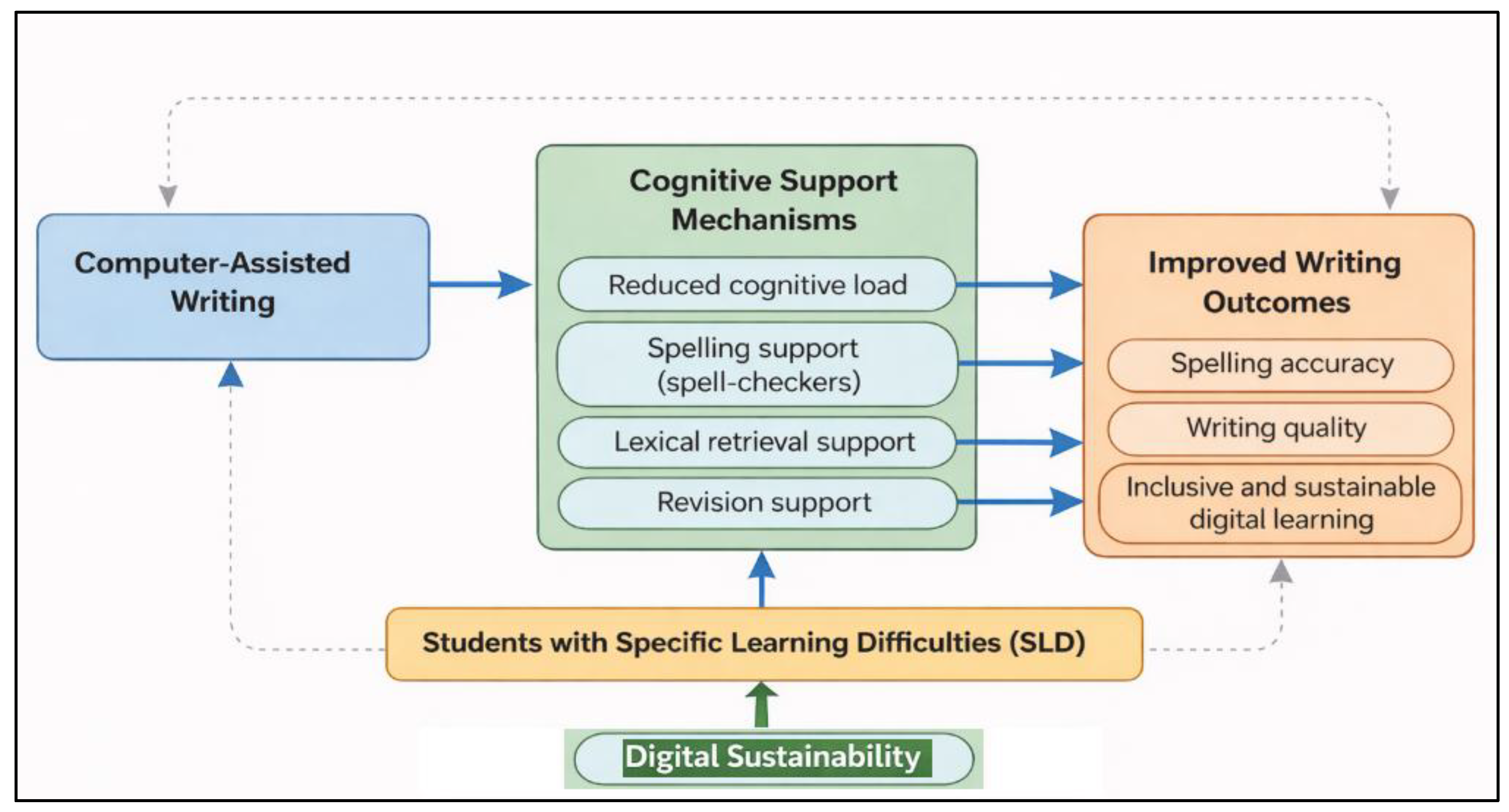

Table 1.
Descriptive statistics for spelling accuracy and writing scores by group and condition.
| Group | Condition | Spelling Accuracy Index M (SD) |
Mean Evaluation Score M (SD) |
|---|---|---|---|
| SLD | Handwriting | 69.97 (23.52) | 11.51 (2.17) |
| SLD | Computer-based writing | 93.73 (5.81) | 13.01 (2.24) |
| Without SLD | Handwriting | 96.93 (2.46) | 13.79 (2.38) |
| Without SLD | Computer-based writing | 98.43 (1.63) | 14.61 (2.31) |
| Total sample | Handwriting | 78.96 (23.06) | 12.27 (2.47) |
| Total sample | Computer-based writing | 95.30 (5.30) | 13.54 (2.37) |
Table 2.
Summary of non-parametric test results for spelling accuracy and writing scores.
| Comparison | Variable | Test | Z | p |
|---|---|---|---|---|
| SLD vs. without SLD (handwriting) | Spelling Accuracy Index | Mann–Whitney U | -5.645 | < 0.001 |
| SLD vs. without SLD (computer) | Spelling Accuracy Index | Mann–Whitney U | -3.768 | < 0.001 |
| Total sample: computer vs. handwriting | Spelling Accuracy Index | Wilcoxon | -6.533 | < 0.001 |
| SLD: computer vs. handwriting | Spelling Accuracy Index | Wilcoxon | -5.471 | < 0.001 |
| Without SLD: computer vs. handwriting | Spelling Accuracy Index | Wilcoxon | -3.566 | < 0.001 |
| SLD vs. without SLD (handwriting) | Mean Score | Mann–Whitney U | -3.397 | 0.001 |
| SLD vs. without SLD (computer) | Mean Score | Mann–Whitney U | -2.363 | 0.018 |
| Total sample: computer vs. handwriting | Mean Score | Wilcoxon | -5.164 | < 0.001 |
| SLD: computer vs. handwriting | Mean Score | Wilcoxon | -4.209 | < 0.001 |
| Without SLD: computer vs. handwriting | Mean Score | Wilcoxon | -3.235 | 0.001 |
Disclaimer/Publisher’s Note: The statements, opinions and data contained in all publications are solely those of the individual author(s) and contributor(s) and not of MDPI and/or the editor(s). MDPI and/or the editor(s) disclaim responsibility for any injury to people or property resulting from any ideas, methods, instructions or products referred to in the content. |
© 2026 by the authors. Licensee MDPI, Basel, Switzerland. This article is an open access article distributed under the terms and conditions of the Creative Commons Attribution (CC BY) license (http://creativecommons.org/licenses/by/4.0/).
Copyright: This open access article is published under a Creative Commons CC BY 4.0 license, which permit the free download, distribution, and reuse, provided that the author and preprint are cited in any reuse.


