

Submitted:
20 March 2026
Posted:
24 March 2026
You are already at the latest version
Abstract
Multiple sclerosis (MS) remains a leading cause of neurological disability, primarily due to the limited efficacy of current disease-modifying therapies in arresting progressive neurodegeneration. While peripheral lymphocyte depletion effectively manages relapsing activity, it fails to address the compartmentalized, smoldering inflammation driven by interactions between adaptive and innate immune systems within the central nervous system (CNS). The CD40–CD40L costimulatory pathway has emerged as a central regulator of these immune interactions, positioning it as a unique therapeutic target capable of addressing the full spectrum of MS pathology. This review examines the multimodal effects of CD40L blockade across peripheral and CNS-resident cell populations. Preclinical and genetic models demonstrate that inhibiting this axis suppresses pathogenic T-cell and B-cell responses while modulating innate immune activation, including macrophages, microglia, and astrocytes, and disrupting pro-inflammatory glial crosstalk. Early clinical data from second-generation, non-thromboembolic CD40L inhibitors, such as frexalimab, demonstrate reductions in markers of neuroaxonal injury and inflammatory disease activity. By simultaneously modulating systemic lymphocyte responses and CNS-resident innate immune processes, CD40L blockade represents a promising strategy to address both relapsing disease activity and progressive disability accumulation, thereby overcoming key therapeutic barriers in multiple sclerosis.
Keywords:
multiple sclerosis
; CD40L
; CD40
; chronic inflammation
; neurodegeneration
1. Introduction
Multiple sclerosis (MS) is a chronic inflammatory and neurodegenerative disorder of the central nervous system (CNS) that affects more than one million individuals in the United States and remains a leading cause of neurological disability in young adults. Current disease-modifying therapies (DMTs) have substantially improved the management of relapsing disease by targeting peripheral lymphocytes and suppressing acute inflammatory activity [1,2]. However, these therapies have had limited success in preventing the gradual accumulation of disability that characterizes progressive forms of MS [3,4]. Progressive disease is thought to be driven by persistent, compartmentalized inflammation within the CNS and by neurodegenerative processes that begin early in the disease course [5]. Increasing evidence suggests that interactions between adaptive immune responses and CNS-resident innate immune cells contribute to this smoldering pathology [6]. Consequently, identifying therapeutic strategies capable of modulating both adaptive and innate immune pathways represents a critical unmet need in MS, particularly approaches that can simultaneously regulate peripheral immune activation and CNS-compartmentalized inflammation to address both relapsing disease activity and progressive disability accumulation.
The CD40–CD40L costimulatory signaling pathway has emerged as a central regulator of immune activation across multiple immune cell populations, and accumulating evidence linking this pathway to the development of autoimmune diseases has established it as an attractive therapeutic target [7]. By coordinating critical interactions between T cells, antigen-presenting cells, and innate immune populations, CD40–CD40L signaling sits at the interface of adaptive and innate immunity. Targeting this pathway offers a promising strategy to modulate both peripheral immune responses and CNS-resident inflammatory mechanisms that contribute to disease progression, potentially addressing key limitations of current therapies. In this review, we examine the effects of CD40L blockade across the major immune and CNS cell populations implicated in MS pathogenesis.
2. The CD40–CD40L Costimulatory Pathway as a Therapeutic Target
CD40L (also known as gp39 or CD154) is a type II transmembrane cytokine within the tumor necrosis factor (TNF) ligand family that is transiently expressed on activated CD4⁺ T cells following T-cell receptor engagement. Its receptor, CD40, is a 44–50 kDa type I transmembrane glycoprotein belonging to the tumor necrosis factor receptor (TNFR) superfamily. CD40 is predominantly expressed on antigen-presenting cells (APCs), including B cells, dendritic cells (DCs), macrophages, and monocytes, but is also present on several non-immune cell types such as endothelial, epithelial, and mesenchymal cells.
The CD40–CD40L costimulatory pathway regulates immune activation and has been implicated in both adaptive and innate immune responses [5,8]. Clinical and pathological evidence support involvement of this pathway in MS and its association with disease progression [9,10,11]. Patients with MS demonstrate elevated levels of soluble CD40L (sCD40L) that correlate with disability as measured by the Expanded Disability Status Scale (EDSS) [10,11]. In patients with MS, CD40L expression is detected on CD4+ T cells [12], and CD40-expressing cells are found in close proximity to CD40L+ cells within the CNS [13]. Notably, CD40L has not been detected in the CNS of healthy individuals or patients with other neurodegenerative disorders [13], suggesting disease-specific relevance of this pathway within MS lesions.
Substantial preclinical evidence supports a pathogenic role for CD40–CD40L signaling in CNS inflammation. In EAE, genetic deletion of CD40L confers protection from disease [14]. Treatment with antagonistic anti-CD40L antibodies during disease induction prevents disease development, while administration after induction significantly reduces disease severity [13]. Blockade during acute disease and remission decreases CNS inflammatory infiltrates and reduces relapse frequency and severity [15,16]. Anti-CD40L therapy is also effective in adoptive transfer models, indicating that blockade of CD40 activation within the CNS contributes to therapeutic benefit during ongoing disease [17]. Encouraged by these findings, early clinical studies evaluated anti-CD40L monoclonal antibodies in MS. Phase I safety and pharmacodynamic profiling confirmed the drug’s immunomodulatory effects [18]; however, the clinical development program was historically halted due to thromboembolic complications attributed to Fc-mediated platelet activation by CD40L-containing immune complexes [18,19]. This safety signal prompted the development of second-generation anti-CD40L therapies engineered to eliminate Fc receptor-mediated platelet binding and reduce thrombotic risk [20]. Frexalimab, a second-generation anti-CD40L monoclonal antibody, is currently in phase III clinical trials for both relapsing-remitting and non-relapsing secondary progressive MS (nrSPMS), reflecting renewed therapeutic interest in this pathway [21]. Importantly, anti-CD40L antibodies have been shown to penetrate the blood-brain barrier (BBB), supporting their potential to modulate inflammatory processes within the CNS [13,17]. Therapeutic antibodies have preferentially targeted CD40L rather than CD40 due to its restricted expression on CD4+ T cells in MS [21].
Figure 1.
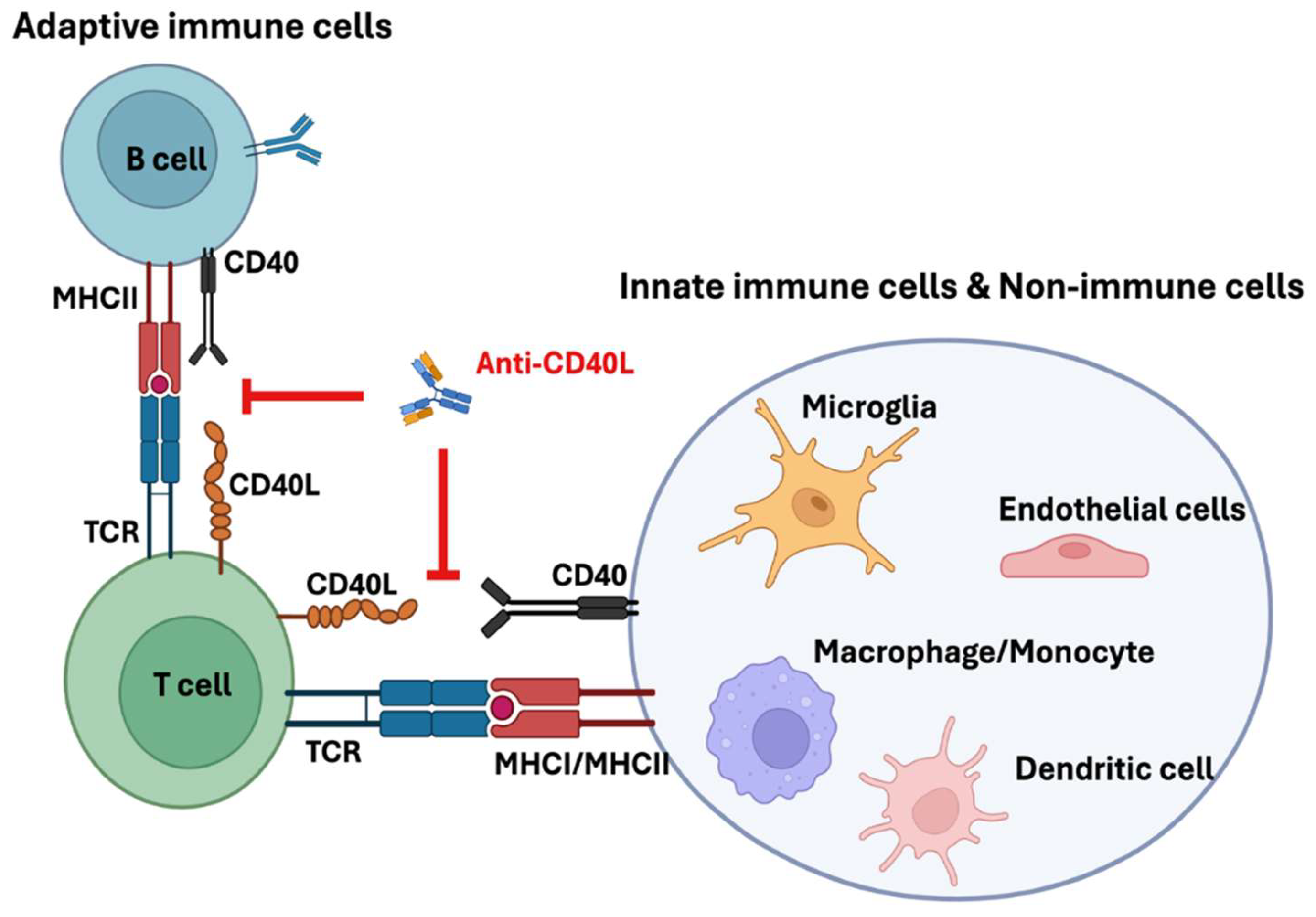
Mechanistic overview of CD40–CD40L signaling and the effects of CD40L blockade in multiple sclerosis. T-cell activation by antigen-presenting cells (APCs), including B cells and dendritic cells, requires both T-cell receptor (TCR) engagement and costimulatory signaling. Recognition of peptide–MHC class II complexes by the TCR induces upregulation of CD40L (CD154) on activated CD4⁺ T cells, which subsequently engages constitutively expressed CD40 on APCs. This interaction amplifies immune activation by promoting APC maturation, cytokine production, and bidirectional signaling that reinforces T-cell differentiation and effector function. Blockade of CD40L with monoclonal antibodies interrupts this costimulatory axis, thereby limiting downstream signaling required for full T- and B-cell activation and potentially promoting antigen-specific immune tolerance. In the periphery, CD40L inhibition modulates multiple immune compartments by reducing T-cell activation and differentiation, suppressing T-cell–dependent B-cell responses, and altering the function of innate immune cells, including macrophages and dendritic cells. This results in diminished generation of pathogenic effector T cells and reduced propagation of inflammatory immune responses.In the context of CNS autoimmunity, CD40L blockade restricts the accumulation and pathogenic function of CD40L⁺ T cells within the central nervous system. By disrupting CD40-dependent crosstalk between infiltrating T cells and CNS-resident myeloid cells, including macrophages and microglia, anti-CD40L therapy attenuates the amplification of local inflammatory responses that drive tissue injury. Collectively, these effects position CD40L blockade as a strategy capable of targeting both peripheral immune activation and CNS-compartmentalized inflammation in multiple sclerosis.
Figure 1.
Mechanistic overview of CD40–CD40L signaling and the effects of CD40L blockade in multiple sclerosis. T-cell activation by antigen-presenting cells (APCs), including B cells and dendritic cells, requires both T-cell receptor (TCR) engagement and costimulatory signaling. Recognition of peptide–MHC class II complexes by the TCR induces upregulation of CD40L (CD154) on activated CD4⁺ T cells, which subsequently engages constitutively expressed CD40 on APCs. This interaction amplifies immune activation by promoting APC maturation, cytokine production, and bidirectional signaling that reinforces T-cell differentiation and effector function. Blockade of CD40L with monoclonal antibodies interrupts this costimulatory axis, thereby limiting downstream signaling required for full T- and B-cell activation and potentially promoting antigen-specific immune tolerance. In the periphery, CD40L inhibition modulates multiple immune compartments by reducing T-cell activation and differentiation, suppressing T-cell–dependent B-cell responses, and altering the function of innate immune cells, including macrophages and dendritic cells. This results in diminished generation of pathogenic effector T cells and reduced propagation of inflammatory immune responses.In the context of CNS autoimmunity, CD40L blockade restricts the accumulation and pathogenic function of CD40L⁺ T cells within the central nervous system. By disrupting CD40-dependent crosstalk between infiltrating T cells and CNS-resident myeloid cells, including macrophages and microglia, anti-CD40L therapy attenuates the amplification of local inflammatory responses that drive tissue injury. Collectively, these effects position CD40L blockade as a strategy capable of targeting both peripheral immune activation and CNS-compartmentalized inflammation in multiple sclerosis.
3. Cell-Specific Effects of CD40L Blockade in Preclinical Models.
3.1. T Cells
In neuroinflammatory settings, anti-CD40L blockade functions as a potent immunomodulatory intervention that disrupts the acquisition of pathogenic T-cell effector programs without inducing generalized lymphocyte depletion. In relapsing EAE (R-EAE), treatment with anti-CD154 antibodies inhibits the differentiation and effector function of myelin-specific Th1 cells while leaving overall T-cell expansion and production of IL-2, IL-4, IL-5, and IL-10 largely intact [17]. Instead, CD40L blockade selectively suppresses interferon-γ (IFN-γ) production, myelin peptide-specific delayed-type hypersensitivity responses, and the generation of encephalitogenic effector T cells, thereby uncoupling T-cell proliferation from pathogenicity [17]. Administration of antagonistic anti-CD154 monoclonal antibodies at the time of EAE induction also prevents clinical disease, likely by limiting the retention or expansion of Th1 cells within the CNS and possibly by shifting immune responses toward less pathogenic Th2 phenotypes [17]. Consistent with this mechanism, anti-CD154 treatment impaired the ability of encephalitogenic T cells to transfer disease to adoptive recipients, indicating that CD40–CD40L signaling provides a critical licensing signal required for full effector function, including the capacity of pathogenic T cells to activate resident CNS macrophages and microglia [17]. In MS, activated CD4⁺ T cells express elevated levels of CD40L and stimulate IL-12 production from antigen-presenting cells, reinforcing IFN-γ-driven Th1 responses; importantly, blockade of CD40L completely inhibited T-cell-induced IL-12 production, thereby interrupting this amplification loop [22]. Beyond monoclonal antibody approaches, the CD40L-sequence-based peptide KGYY6 similarly modulated the CD4⁺ T-cell compartment by altering CD69 expression and enhancing IL-10 production in Th40 and memory T cells, ultimately attenuating disease development in EAE models [23].
3.2. B Cells
The CD40–CD40L interaction is essential for T-cell-dependent B-cell activation. Engagement of CD40 on B cells by CD40L expressed on T follicular helper (Tfh) cells provides a critical costimulatory signal that, together with antigen recognition through the B-cell receptor, drives B-cell proliferation, differentiation, and germinal center formation. Within germinal centers, CD40 signaling supports the survival of antigen-stimulated B cells and promotes their differentiation into antibody-secreting plasma cells or long-lived memory B cells, while also facilitating immunoglobulin class-switch recombination [24]. Memory B cells isolated from treatment-naïve patients with RRMS exhibited increased proliferative responses following stimulation with low-dose CD40L compared with memory B cells from healthy donor controls [25]. By contrast, direct evaluation of anti-CD40L blockade on B cells specifically in MS or EAE has not been clearly dissected, despite the established importance of B cells in MS pathology. Evidence from other autoimmune models nevertheless shows that CD40L blockade strongly restrains B cell responses. In collagen-induced arthritis, anti-Gp39 reduced anti-collagen antibody titers and suppressed joint inflammation [26]. In human lupus nephritis, anti-CD154-depleted activated peripheral CD19+ B cell subsets, including CD38+, CD5+, and CD27+ cells, eliminated CD38 bright Ig secreting cells, and inhibited spontaneous B cell proliferation and immunoglobulin secretion [27]. Similarly, in murine systemic lupus erythematosus, anti-CD154 reduced multiple B cell subsets and prevented ongoing B cell activation during treatment [28].
1.1. Monocytes/Macrophages
Macrophages are major contributors to CNS inflammation and tissue injury in MS and its animal model, EAE. Neuropathological analyses demonstrate that macrophages represent the predominant CD40-expressing population within MS lesions [13,29], and in EAE, a large proportion of infiltrating peripheral macrophages express CD40 [30]. Macrophage accumulation correlates with disease severity [31,32], and these cells dominate inflammatory infiltrates within active demyelinating lesions [31,33], whereas lymphocytes are relatively sparse at sites of active myelin destruction [34]. This cellular distribution implicates resident and recruited myeloid cells as a part of the key mediators of CNS tissue injury [31]. Inhibition of the CD40 signaling pathway using tyrphostin A1, a protein tyrosine kinase inhibitor that disrupts CD40-mediated intracellular signaling, significantly reduced CD40L-stimulated IL-12 production in macrophages. This reduction in macrophage-derived IL-12 was associated with decreased antigen-induced Th1 cell generation and attenuation of EAE in SJL/J mice [35]. Selective inhibition of the CD40–TRAF6 signaling pathway using small-molecule inhibitors similarly altered monocyte function by promoting an anti-inflammatory phenotype and reducing their trans-endothelial migration capacity. In vivo, this intervention decreased the accumulation of monocyte-derived macrophages within the CNS during neuroinflammation, although it produced only minimal improvement in overall EAE disease severity [36]. These findings were further validated in another study using a myeloid-targeted genetic deletion model (CD40^fl/fl LysM^cre). This study confirmed that macrophage-intrinsic CD40 signaling is essential for disease progression; mice lacking myeloid CD40 exhibited a marked reduction in costimulatory molecule expression and impaired myelin phagocytosis. Furthermore, by utilizing chimeric mice that express CD40 specifically on MHCII+ cells but lack the TRAF6 binding site, the authors demonstrated that the CD40–TRAF6 axis is the indispensable driver of macrophage-mediated neuroinflammation [14]. Together, these studies support a role for CD40-CD40L signaling in macrophage-driven inflammatory responses, although direct analysis of macrophages following CD40L blockade in EAE or MS remains limited.
3.3. Microglia
Microglial activation during EAE occurs in two stages, with an initial CD40-independent activation followed by a CD40-dependent phase required for full microglial activation, pathogenic T-cell expansion, and leukocyte infiltration into the CNS [30]. Engagement of microglial CD40 by CD40L induces robust production of proinflammatory cytokines, including TNF-α and IL-12 [37,38]. In models of HIV encephalitis, CD40L, in combination with IFNγ, induced the expression of chemokines, including MCP-1, IP-10, MIP-1α, MIP-1β, and RANTES, in cultured microglia [39]. CD40 ligation has also been shown to induce IL-12 production in primary human microglial cells [40]. Consistent with these findings, an in vitro study using primary adult human microglia isolated from non-MS neurosurgical brain tissue demonstrated that T-cell-induced microglial IL-12 production was dependent on CD40–CD40L signaling and could be inhibited by anti-CD154 monoclonal antibodies [38]. Further studies will be required to determine how CD40L blockade directly influences microglial function in MS.
3.4. Endothelial Cells
Brain endothelial cells constitutively express CD40, and inflammatory stimuli further increase its expression. Engagement of endothelial CD40 by CD40L upregulates adhesion molecules such as E-selectin, VCAM-1, and ICAM-1, thereby enhancing adhesion of both resting and activated CD4⁺ T cells to the endothelium and facilitating leukocyte recruitment across the blood–brain barrier. Blocking CD40–CD40L interactions reduces T-cell adhesion to endothelial cells [41]. To date, no studies have directly examined the effects of CD40L stimulation or blockade on endothelial cells in the context of EAE or MS.
3.5. Dendritic Cells
CD40–CD40L signaling plays a critical role in dendritic cell (DC)-mediated priming of pathogenic T-cell responses. In EAE models, CD40 expression on DCs is required for the expansion and differentiation of encephalitogenic CD4⁺ T helper cells within peripheral draining lymph nodes. Genetic deletion of CD40 in DCs markedly reduces the frequency of Th1 (IFN-γ⁺), Th17 (IL-17⁺), and GM-CSF–producing T cells and limits their subsequent accumulation within the CNS, demonstrating that CD40-dependent DC activation is essential for the generation of pathogenic T-cell responses that drive neuroinflammation [42]. Consistent with these findings, circulating myeloid dendritic cells from patients with MS exhibit a proinflammatory phenotype characterized by increased expression of CD80 and CD40, reduced PD-L1, and enhanced production of IL-12 and TNF-α. Functionally, these DCs promote pathogenic T-cell responses, with DCs from relapsing–remitting MS inducing mixed Th1/Th2 responses, whereas DCs from secondary progressive MS preferentially drive Th1 polarization [43]. Evidence from other autoimmune models further supports the importance of this pathway in regulating DC biology. In a murine model of systemic lupus erythematosus, blockade of CD40L with anti-CD154 monoclonal antibodies altered dendritic cell homeostasis by preventing dendritic cell apoptosis and correcting the abnormal accumulation and activation of dendritic cells observed during lupus nephritis [44].
3.6. CNS Resident Cells
Studies of the effects of CD40L inhibition in CNS resident cells remain limited compared with peripheral immune populations. Astrocytes express CD40 and respond to CD40-mediated signaling, astrocytes activated by the CD40-CD40L interaction in co-culture induce inflammatory cytokine production via small GTPases, and the secreted cytokines re-activate astrocytes via Jak/STAT1701 pathways, and then release more cytokines that contribute to exacerbating the development of EAE [45]. Inhibition of CD40 signaling in astrocytes by anti-CD40 antibody or CD40 siRNA suppresses activation of Rho-family GTPases, NF-κB, and STAT1, leading to reduced production of pro-inflammatory cytokines such as IL-6 and TNF-α [45]. In another study, targeted deletion of CD40 diminished the number of CD40L-positive astrocytes [46]. For neurons, no studies have directly evaluated anti-CD40L antibody blockade; however, genetic deletion of CD40L reduced neuronal death by approximately 64% in a neurodegeneration model [46]. No oligodendrocyte-specific studies examining the effects of CD40L blockade or inhibition have been identified.
Figure 2.
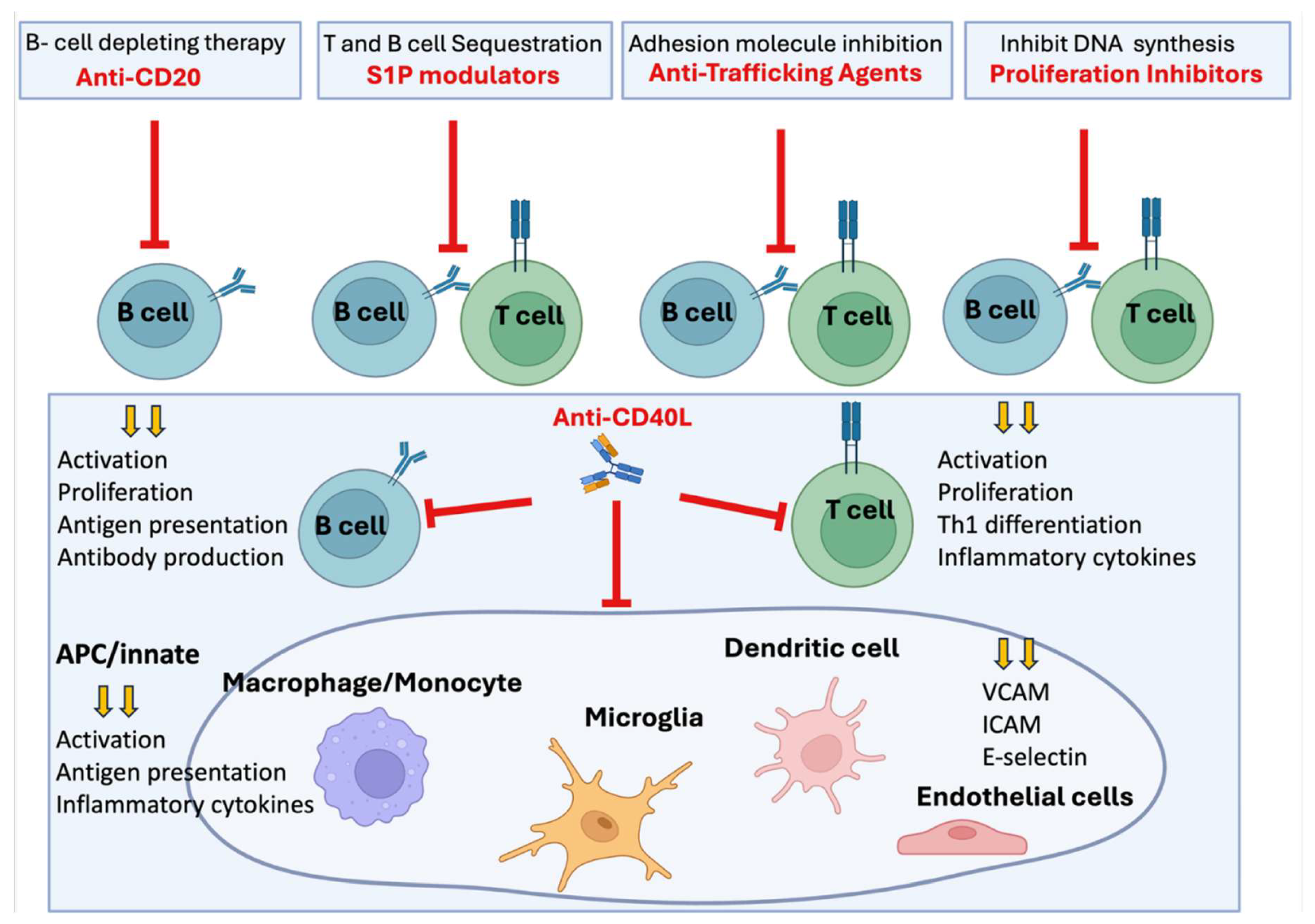
Comparison of CD40L blockade with current disease-modifying therapies (DMTs) in multiple sclerosis.Current DMTs primarily target peripheral adaptive immune mechanisms to reduce relapse-associated inflammation. Agents such as anti-CD20 monoclonal antibodies deplete circulating B cells, S1P receptor modulators restrict lymphocyte egress from lymphoid tissues, and anti-trafficking agents block leukocyte trafficking into the CNS. While effective in reducing relapse rates and new lesion formation, these approaches have limited impact on compartmentalized CNS inflammation and progressive disability accumulation.In contrast, CD40L blockade targets a central costimulatory pathway that regulates both adaptive and innate immune responses. By disrupting CD40–CD40L interactions, anti-CD40L therapies modulate T-cell activation and differentiation, suppress T-cell–dependent B-cell responses, and alter antigen-presenting cell function without inducing broad lymphocyte depletion. Importantly, this approach also impacts CNS-resident and infiltrating myeloid cells by limiting CD40-mediated inflammatory signaling and reducing the ability of pathogenic T cells to activate macrophages and microglia.Through its dual effects on peripheral immune activation and CNS-compartmentalized inflammation, CD40L blockade represents a mechanistically distinct strategy with the potential to address both relapsing disease activity and the progressive neuroinflammatory processes that are inadequately controlled by current therapies.
Figure 2.
Comparison of CD40L blockade with current disease-modifying therapies (DMTs) in multiple sclerosis.Current DMTs primarily target peripheral adaptive immune mechanisms to reduce relapse-associated inflammation. Agents such as anti-CD20 monoclonal antibodies deplete circulating B cells, S1P receptor modulators restrict lymphocyte egress from lymphoid tissues, and anti-trafficking agents block leukocyte trafficking into the CNS. While effective in reducing relapse rates and new lesion formation, these approaches have limited impact on compartmentalized CNS inflammation and progressive disability accumulation.In contrast, CD40L blockade targets a central costimulatory pathway that regulates both adaptive and innate immune responses. By disrupting CD40–CD40L interactions, anti-CD40L therapies modulate T-cell activation and differentiation, suppress T-cell–dependent B-cell responses, and alter antigen-presenting cell function without inducing broad lymphocyte depletion. Importantly, this approach also impacts CNS-resident and infiltrating myeloid cells by limiting CD40-mediated inflammatory signaling and reducing the ability of pathogenic T cells to activate macrophages and microglia.Through its dual effects on peripheral immune activation and CNS-compartmentalized inflammation, CD40L blockade represents a mechanistically distinct strategy with the potential to address both relapsing disease activity and the progressive neuroinflammatory processes that are inadequately controlled by current therapies.
4. Cell-Specific Effects of CD40L Blockade in Clinical Mechanistic Studies
Clinical investigations of CD40L inhibition have demonstrated immunomodulatory effects across several immune cell populations without causing broad leukocyte depletion. In a phase I open-label dose-escalation study of toralizumab, a humanized anti-CD40L monoclonal antibody administered to patients with RRMS, peripheral immune profiling revealed no reductions in total leukocytes, lymphocytes, or major T-cell subsets, including CD3⁺, CD4⁺, and CD8⁺ cells. Instead, treatment was associated with regulatory changes within the T-cell compartment, including increased expression of CD25 on CD3⁺ and CD4⁺ T cells and cytokine shifts toward an anti-inflammatory profile, reflected by increased IL-10:IL-17 and IL-10:MCP-1 ratios, suggesting induction of immune regulatory responses rather than lymphocyte depletion [18]. Comparable findings have been reported in clinical studies of CD40L blockade in other autoimmune diseases. In a phase I dose-escalation study evaluating the anti-CD40L monoclonal antibody IDEC-131 in patients with systemic lupus erythematosus, treatment did not produce depletion of circulating lymphocyte subsets [47]. Consistent with these observations, in an open-label study of the anti-CD40L antibody BG9588 in patients with proliferative lupus nephritis, treatment resulted in reductions in anti–double-stranded DNA antibody titers and increased serum complement C3 levels, reflecting suppression of pathogenic humoral immune responses. Importantly, therapy did not significantly alter circulating lymphocyte counts or total serum immunoglobulin concentrations [48]. Together, these clinical observations indicate that CD40L blockade modulates both T-cell and B-cell–mediated immune responses while preserving overall immune cell numbers, consistent with a mechanism of immune regulation rather than immune cell depletion.
5. Current Biomarkers
Biomarker discovery has become an important focus in MS research to improve early diagnosis, disease stratification, and prediction of disease progression. Cerebrospinal fluid (CSF) IgG oligoclonal bands (OCBs) remain the most widely used laboratory biomarker and are incorporated into the 2017 McDonald criteria as evidence of intrathecal immunoglobulin synthesis and dissemination in time [49,50]. CSF-IgM OCBs are associated with higher relapse rates and earlier conversion to SPMS [51].
Additional CSF biomarkers validated in independent cohorts for identifying patients at risk of converting from clinically isolated syndrome (CIS) to clinically definite MS include IgM OCBs, CXCL13, chitinase-3-like protein 1 (CHI3L1), and neurofilament light chain (NfL) [52]. Elevated CSF CHI3L1 levels correlate with faster disability progression and could help to distinguish PPMS from RRMS [53,54]. B cell related markers, such as κ free light chains (κFLC), have also demonstrated strong diagnostic performance and may help predict CIS conversion to MS [55].
Biomarkers reflecting neuroaxonal injury, particularly NfL, correlate with disease activity and treatment response [56], whereas markers of glial activation and inflammation, including GFAP, CXCL13, osteopontin, and soluble CD163, have been associated with disease progression and CNS immune activation [49,57]. Circulating biomarkers may further aid disease classification. For example, microRNAs such as miR-223 and miR-15 b have been linked to differences between progressive and relapsing MS phenotypes [58,59], while reduced CSF N acetylaspartate (NAA) levels have been reported to be lower in SPMS than in CIS or RRMS [60].
Inflammatory mediators also provide insight into disease severity. sCD40L and IL 31 correlate with MS severity and are lower in treated compared with untreated patients [61,62]. Consistent with these observations, our group identified sCD40L and MCP 1 CCL2 as progression-associated biomarkers elevated in progressive MS and correlated with disability accumulation [11]. Integrative bioinformatic approaches incorporating miRNAs, extracellular vesicles, metabolomics, and microbiome signatures may enable the development of multi-biomarker panels that overcome the limitations of single biomarkers [54].
6. Conclusions
Accumulating evidence from both preclinical and clinical studies supports a central role for CD40–CD40L signaling in the immunopathology of MS. Blockade of this pathway exerts immunomodulatory effects across multiple cell populations that contribute to MS pathology. In experimental models, anti-CD40L therapy disrupts the differentiation and effector function of pathogenic T cells, limits dendritic cell–mediated priming of inflammatory T-cell responses, and alters monocyte and macrophage activation within demyelinating lesions. CD40–CD40L signaling also regulates microglial inflammatory activity and endothelial adhesion molecule expression, highlighting its influence on both CNS-resident and infiltrating immune populations. Evidence from other autoimmune diseases further demonstrates that CD40L blockade can restrain B-cell activation and antibody production, suggesting additional therapeutic benefits in MS. Early clinical studies indicate that CD40L blockade does not cause lymphocyte depletion but instead promotes an immunoregulatory shift in immune responses. Together, these findings suggest that CD40L blockade may simultaneously modulate peripheral immune activation and CNS-compartmentalized inflammation. As second-generation CD40L-targeting therapies with improved safety profiles advance in clinical development, this strategy holds promise for addressing both relapsing disease activity and the progressive disability accumulation that remains a major unmet need in multiple sclerosis.

Table 1A.
Preclinical studies of CD40L blockade (in vivo and in vitro models).
| Study Reference | Disease Context | Method/Antibody Used | Key Effects on Cell Types |
|---|---|---|---|
| Howard et al. (1999) | Multiple Sclerosis (R-EAE) | MR1 (Hamster anti-mouse CD154 mAb) | T cells: Abrogated Th1 differentiation and IFN-γ. Inhibited the effector function of differentiated encephalitogenic T cells. |
| Balashov et al. (1997) | Multiple Sclerosis (in vitro) | Anti-CD40L antibody (in vitro) | T cells: Completely blocked T cell–induced IL-12 production from APCs. |
| Vaitaitis et al. (2019) | Multiple Sclerosis (EAE) | CD40L peptide (KGYY6) | T cells: Increased expression of CD69 and intracellular IL-10 |
| Becher et al. (2000) | Non-tumor-related intractable epilepsy (in vitro) | Anti-CD154 antibody (in vitro) | Microglia: Blocked activation and CD40L-dependent IL-12 production induced by T cells |
| Kalled et al. (2001) | Lupus (SLE) (Murine lupus) |
Anti-CD154 monoclonal antibody | Dendritic cells: Normalized DC accumulation and activation. |
| Durie et al. (1993) | Collagen-induced arthritis (Murine arthritis) | anti-gp39 (anti-CD40L) | B cells: Reduced anti-collagen antibody production; suppressed humoral response |
| Karnell et al. (2019) | Rheumatoid arthritis (in vitro) | anti-CD40L Tn3 protein, VIB4920 | B cells: Inhibition of human B cell activation and plasma cell differentiation. |
| Blazar et al. (1998) | graft-versus-host disease (GVHD) (Murine GVHD) | anti-CD40L mAb–treated | T cells: Blocked initial donor T-cell priming |
| Howard et al. (2003) | Theiler's murine encephalomyelitis virus-induced demyelinating disease | Transient CD154 blockade with anti-CD154 | T cells: Peripheral antiviral and autoimmune T-cell responses remained largely intact. |
| Samoilova et al. (1997) | Multiple Sclerosis (EAE) | Anti-CD40L | T cells: Prevented Th1 differentiation and induced selective activation of Th2 cells |
| Reynolds et al. (2004) | human Goodpasture’s disease (Experimental autoimmune glomerulonephritis (EAG)) | antibody to CD154 (AH.F5) | B cells: Reduction in circulating anti-alpha3(IV)NC1 antibodies and deposits of IgG on the GBM T cells: Reduced numbers of glomerular T cells Macrophages: Reduced numbers of glomerular macrophages. |
| Liu et al. (2000) | human inflammatory bowel disease (IBD) (experimental colitis in SCID mice) | anti-CD40L neutralizing mAb | Colonic tissue: Marked reduction in IFN-γ, TNF, and IL-12 |
| Carayanniotis et al. (1997) | Thyroiditis (experimental autoimmune thyroiditis (EAT) | Anti-gp39 mAb | T cells: Suppression of antigen specific Th1-cell activation Lymph node cells: Secreted significantly less amounts of IL-2 and IFN-γ |
| Peterson et al. (1999) | Thyroiditis (granulomatous experimental autoimmune thyroiditis (G-EAT) | Anti-CD40L | T cells: Increased IL-4 mRNA expression by CD4(+) T cells. |
| Resetkova et al. (1996) | Graves' disease (Graves' thyroid tissues xenografted into SCID mice) | anti-gp39 mAb | B cells: Anti-gp39 mAb completely blocked or significantly decreased the humoral response. |
| Wu et al. (2017) |
Renal transplantation (Murine) | anti-CD154 mAb | T cells: CD154 blockade-induced tolerance associated with Foxp3Treg cells. Foxp3Treg cells were activated and had more potent regulatory function in vivo than naive Treg cells. |
| Anwar et al. (2025) | Renal transplantation (nonhuman primate) | anti-CD154 mAb (5C8) | B cells: Decreased donor-specific antibodies (DSAs). T cells: Improved induction of T regulatory cells |
Table 1B.
Clinical mechanistic studies of CD40L blockade (human studies).
| Study Reference | Disease Context | Method/Antibody Used | Key Effects on Cell Types |
|---|---|---|---|
| Fudal, Mao-Draayer et al. (2021) | Relapsing-Remitting MS | Toralizumab (IDEC-131; Humanized mAb) | T cells: Increased CD25+ expression; shifted cytokine profile toward IL-10. General: No lymphocyte depletion. |
| Kivitz et al. (2023) | Rheumatoid arthritis | Dazodalibep (DAZ), a non-antibody biological antagonist of CD40L | B cells: Reduction of anti-citrullinated protein antibody (ACPA) titers, reflecting a potent suppression of the B-cell effector compartment. |
| Boumpas et al. (2003) | Lupus nephritis | BG9588 (Humanized anti-CD154 mAb) | B cells: Reduced anti-dsDNA antibodies. Platelets: First report of Fc-mediated thromboembolic risks. |
| Kuwana et al. (2004) | Immune thrombocytopenic purpura (ITP), human phase I trial | anti-CD154 | B cells: Suppressed B cells producing anti-GPIIb/IIIa antibodies T cells: Suppressed GPIIb/IIIa-induced T-cell proliferation |
Table 1. Cell-specific effects of CD40L blockade across preclinical and human studies. This table summarizes studies that directly evaluated cell-specific immune effects of CD40L blockade across experimental and clinical settings. Table 1A includes preclinical studies (in vivo and in vitro) that provide mechanistic insight into the effects of CD40L inhibition on defined immune cell populations. Table 1B includes human in vivo studies, including clinical trials and patient-based investigations, that assess immune modulation following CD40L-targeting therapies. Only studies reporting cell-specific outcomes were included.
References
- Manjunatha, R.T.; Habib, S.; Sangaraju, S.L.; Yepez, D.; A Grandes, X. Multiple Sclerosis: Therapeutic Strategies on the Horizon. Cureus 2022, 14, e24895. [Google Scholar] [CrossRef]
- Faissner, S.; Plemel, J.R.; Gold, R.; Yong, V.W. Progressive multiple sclerosis: from pathophysiology to therapeutic strategies. Nat. Rev. Drug Discov. 2019, 18, 905–922. [Google Scholar] [CrossRef]
- Dobson, R.; Giovannoni, G. Multiple sclerosis - a review. Eur J Neurol 2019, 26, 27–40. [Google Scholar] [CrossRef]
- Friese, M.A.; Schattling, B.; Fugger, L. Mechanisms of neurodegeneration and axonal dysfunction in multiple sclerosis. Nat. Rev. Neurol. 2014, 10, 225–238. [Google Scholar] [CrossRef]
- Lassmann, H. Pathogenic Mechanisms Associated With Different Clinical Courses of Multiple Sclerosis. Front. Immunol. 2019, 9, 3116. [Google Scholar] [CrossRef] [PubMed]
- Dendrou, C.A.; Fugger, L.; Friese, M.A. Immunopathology of multiple sclerosis. Nat Rev Immunol 2015, 15, 545–58. [Google Scholar] [CrossRef] [PubMed]
- Fatima, T.M.; Mirza, A.M.; Fatima, F.M.; Karamat, R.I.M.; Ahmad, B.M.; Naeem, S.M.; Shahid, I.M.; Akilimali, A. Frexalimab (SAR441344) as a potential multiautoimmune disorder tackling mAB targeting the CD40-CD40L pathway undergoing clinical trials: a review. Ann. Med. Surg. 2024, 86, 7305–7313. [Google Scholar] [CrossRef]
- Karnell, J.L.; Rieder, S.A.; Ettinger, R.; Kolbeck, R. Targeting the CD40-CD40L pathway in autoimmune diseases: Humoral immunity and beyond. Adv. Drug Deliv. Rev. 2019, 141, 92–103. [Google Scholar] [CrossRef]
- Aarts, S.A.B.M.; Seijkens, T.T.P.; van Dorst, K.J.F.; Dijkstra, C.D.; Kooij, G.; Lutgens, E. The CD40–CD40L Dyad in Experimental Autoimmune Encephalomyelitis and Multiple Sclerosis. Front. Immunol. 2017, 8, 1791. [Google Scholar] [CrossRef]
- Masuda, H.; Mori, M.; Uchida, T.; Uzawa, A.; Ohtani, R.; Kuwabara, S. Soluble CD40 ligand contributes to blood–brain barrier breakdown and central nervous system inflammation in multiple sclerosis and neuromyelitis optica spectrum disorder. J. Neuroimmunol. 2017, 305, 102–107. [Google Scholar] [CrossRef] [PubMed]
- Wu, Q.; Wang, Q.; Yang, J.; Martens, J.W.; A Mills, E.; Saad, A.; Chilukuri, P.; A Dowling, C.; Mao-Draayer, Y. Elevated sCD40L in Secondary Progressive Multiple Sclerosis in Comparison to Non-progressive Benign and Relapsing Remitting Multiple Sclerosis. J. Central Nerv. Syst. Dis. 2021, 13. [Google Scholar] [CrossRef]
- Mackey, M.F.; Barth, R.J., Jr.; Noelle, R.J. The role of CD40/CD154 interactions in the priming, differentiation, and effector function of helper and cytotoxic T cells. J Leukoc Biol 1998, 63, 418–28. [Google Scholar] [CrossRef]
- Gerritse, K.; Laman, J.D.; Noelle, R.J.; Aruffo, A.; A Ledbetter, J.; Boersma, W.J.; Claassen, E. CD40-CD40 ligand interactions in experimental allergic encephalomyelitis and multiple sclerosis. Proc. Natl. Acad. Sci. USA 1996, 93, 2499–2504. [Google Scholar] [CrossRef]
- Aarts, S.A.; Seijkens, T.T.; Kusters, P.J.; van Tiel, C.M.; E Reiche, M.; Toom, M.D.; Beckers, L.; van Roomen, C.P.; de Winther, M.P.; Kooij, G.; et al. Macrophage CD40 signaling drives experimental autoimmune encephalomyelitis. J. Pathol. 2018, 247, 471–480. [Google Scholar] [CrossRef]
- Laman, J.D. Therapy with antibodies against CD40L (CD154) and CD44-variant isoforms reduces experimental autoimmune encephalomyelitis induced by a proteolipid protein peptide. Mult Scler 1998, 4, 147–53. [Google Scholar] [CrossRef] [PubMed]
- Howard, L.M.; Canto, M.C.D.; Miller, S.D. Transient anti-CD154-mediated immunotherapy of ongoing relapsing experimental autoimmune encephalomyelitis induces long-term inhibition of disease relapses. J. Neuroimmunol. 2002, 129, 58–65. [Google Scholar] [CrossRef] [PubMed]
- Howard, L.M.; Miga, A.J.; Vanderlugt, C.L.; Canto, M.C.D.; Laman, J.D.; Noelle, R.J.; Miller, S.D. Mechanisms of immunotherapeutic intervention by anti-CD40L (CD154) antibody in an animal model of multiple sclerosis. J. Clin. Investig. 1999, 103, 281–290. [Google Scholar] [CrossRef] [PubMed]
- Fadul, C.E.; Mao-Draayer, Y.; Ryan, K.A.; Noelle, R.J.; Wishart, H.A.; Channon, J.Y.; Kasper, I.R.; Oliver, B.; Mielcarz, D.W.; Kasper, L.H. Safety and Immune Effects of Blocking CD40 Ligand in Multiple Sclerosis. Neurol. - Neuroimmunol. Neuroinflammation 2021, 8. [Google Scholar] [CrossRef]
- Couzin, J. Magnificent Obsession. Science 2005, 307, 1712–1715. [Google Scholar] [CrossRef]
- Vermersch, P.; Granziera, C.; Mao-Draayer, Y.; Cutter, G.; Kalbus, O.; Staikov, I.; Dufek, M.; Saubadu, S.; Bejuit, R.; Truffinet, P.; et al. Inhibition of CD40L with Frexalimab in Multiple Sclerosis. New Engl. J. Med. 2024, 390, 589–600. [Google Scholar] [CrossRef]
- Reidy, M.; Khan, M.; Mills, E.A.; Wu, Q.; Garton, J.; Draayer, D.E.; Zahoor, I.; Giri, S.; Axtell, R.C.; Mao-Draayer, Y. New Frontiers in Multiple Sclerosis Treatment: From Targeting Costimulatory Molecules to Bispecific Antibodies. Int. J. Mol. Sci. 2025, 26, 3880. [Google Scholar] [CrossRef]
- Balashov, K.E.; Smith, D.R.; Khoury, S.J.; Hafler, D.A.; Weiner, H.L. Increased interleukin 12 production in progressive multiple sclerosis: Induction by activated CD4+T cells via CD40 ligand. Proc. Natl. Acad. Sci. 1997, 94, 599–603. [Google Scholar] [CrossRef]
- Vaitaitis, G.M.; Yussman, M.G.; Wagner, D.H. A CD40 targeting peptide prevents severe symptoms in experimental autoimmune encephalomyelitis. J. Neuroimmunol. 2019, 332, 8–15. [Google Scholar] [CrossRef]
- Vermersch, P.; Wagner, D.; Mars, L.T.; Noelle, R.; Giovannoni, G. Inhibiting CD40 Ligand in Multiple Sclerosis: A Review of Emerging Therapeutic Potential. Curr. Treat. Options Neurol. 2024, 27, 7. [Google Scholar] [CrossRef]
- Ireland, S.J.; Blazek, M.; Harp, C.T.; Greenberg, B.; Frohman, E.M.; Davis, L.S.; Monson, N.L. Antibody-independent B cell effector functions in relapsing remitting Multiple Sclerosis: Clues to increased inflammatory and reduced regulatory B cell capacity. Autoimmunity 2012, 45, 400–414. [Google Scholar] [CrossRef] [PubMed]
- Durie, F.H.; Fava, R.A.; Foy, T.M.; Aruffo, A.; Ledbetter, J.A.; Noelle, R.J. Prevention of Collagen-Induced Arthritis with an Antibody to gp39, the Ligand for CD40. Science 1993, 261, 1328–1330. [Google Scholar] [CrossRef]
- Grammer, A.C. Abnormal germinal center reactions in systemic lupus erythematosus demonstrated by blockade of CD154-CD40 interactions. J Clin Invest 2003, 112, 1506–20. [Google Scholar] [CrossRef] [PubMed]
- Wang, X.; Huang, W.; Schiffer, L.E.; Mihara, M.; Akkerman, A.; Hiromatsu, K.; Davidson, A. Effects of anti-CD154 treatment on B cells in murine systemic lupus erythematosus. Arthritis Rheum. 2003, 48, 495–506. [Google Scholar] [CrossRef]
- Peters, A.L.; Stunz, L.L.; Bishop, G.A. CD40 and autoimmunity: The dark side of a great activator. Semin. Immunol. 2009, 21, 293–300. [Google Scholar] [CrossRef] [PubMed]
- Ponomarev, E.D.; Shriver, L.P.; Dittel, B.N. CD40 Expression by Microglial Cells Is Required for Their Completion of a Two-Step Activation Process during Central Nervous System Autoimmune Inflammation. J. Immunol. 2006, 176, 1402–1410. [Google Scholar] [CrossRef]
- Leuti, A.; Talamonti, E.; Gentile, A.; Tiberi, M.; Matteocci, A.; Fresegna, D.; Centonze, D.; Chiurchiù, V. Macrophage Plasticity and Polarization Are Altered in the Experimental Model of Multiple Sclerosis. Biomolecules 2021, 11, 837. [Google Scholar] [CrossRef]
- Yamasaki, R.; Lu, H.; Butovsky, O.; Ohno, N.; Rietsch, A.M.; Cialic, R.; Wu, P.M.; Doykan, C.E.; Lin, J.; Cotleur, A.C.; et al. Differential roles of microglia and monocytes in the inflamed central nervous system. J. Exp. Med. 2014, 211, 1533–1549. [Google Scholar] [CrossRef]
- Rawji, K.S.; Yong, V.W. The Benefits and Detriments of Macrophages/Microglia in Models of Multiple Sclerosis. J. Immunol. Res. 2013, 2013, 948976. [Google Scholar] [CrossRef]
- Lassmann, H. Multiple Sclerosis Pathology. Cold Spring Harb. Perspect. Med. 2018, 8, a028936. [Google Scholar] [CrossRef]
- Du, C.; Bright, J.J.; Sriram, S. Inhibition of CD40 signaling pathway by tyrphostin A1 reduces secretion of IL-12 in macrophage, Th1 cell development and experimental allergic encephalomyelitis in SJL/J mice. J. Neuroimmunol. 2001, 114, 69–79. [Google Scholar] [CrossRef]
- Aarts, S.A.B.M.; Seijkens, T.T.P.; Kusters, P.J.H.; van der Pol, S.M.A.; Zarzycka, B.; Heijnen, P.D.A.M.; Beckers, L.; Toom, M.D.; Gijbels, M.J.J.; Boon, L.; et al. Inhibition of CD40-TRAF6 interactions by the small molecule inhibitor 6877002 reduces neuroinflammation. J. Neuroinflammation 2017, 14, 105. [Google Scholar] [CrossRef] [PubMed]
- Tan, J.; Town, T.; Paris, D.; Placzek, A.; Parker, T.; Crawford, F.; Yu, H.; Humphrey, J.; Mullan, M. Activation of microglial cells by the CD40 pathway: relevance to multiple sclerosis. J. Neuroimmunol. 1999, 97, 77–85. [Google Scholar] [CrossRef] [PubMed]
- Becher, B.; Blain, M.; Antel, J.P. CD40 engagement stimulates IL-12 p70 production by human microglial cells: basis for Th1 polarization in the CNS. J. Neuroimmunol. 2000, 102, 44–50. [Google Scholar] [CrossRef]
- D'Aversa, T.G.; Weidenheim, K.M.; Berman, J.W. CD40-CD40L interactions induce chemokine expression by human microglia: implications for human immunodeficiency virus encephalitis and multiple sclerosis. Am J Pathol 2002, 160, 559–67. [Google Scholar] [CrossRef]
- Herve, M.d.G.d.; Delfraissy, J.; Taoufik, Y. Following direct CD40 activation, human primary microglial cells produce IL-12 p40 but not bioactive IL-12 p70. Cytokine 2001, 14, 88–96. [Google Scholar] [CrossRef] [PubMed]
- Omari, K.M.; Dorovini-Zis, K. CD40 expressed by human brain endothelial cells regulates CD4+ T cell adhesion to endothelium. J. Neuroimmunol. 2003, 134, 166–178. [Google Scholar] [CrossRef] [PubMed]
- Lu, Y.; Xu, M.; E Dorrier, C.; Zhang, R.; Mayer, C.T.; Wagner, D.; McGavern, D.B.; Hodes, R.J. CD40 Drives Central Nervous System Autoimmune Disease by Inducing Complementary Effector Programs via B Cells and Dendritic Cells. J. Immunol. 2022, 209, 2083–2092. [Google Scholar] [CrossRef]
- Karni, A.; Abraham, M.; Monsonego, A.; Cai, G.; Freeman, G.J.; Hafler, D.; Khoury, S.J.; Weiner, H.L. Innate Immunity in Multiple Sclerosis: Myeloid Dendritic Cells in Secondary Progressive Multiple Sclerosis Are Activated and Drive a Proinflammatory Immune Response. J. Immunol. 2006, 177, 4196–4202. [Google Scholar] [CrossRef] [PubMed]
- Kalled, S.L.; Cutler, A.H.; Burkly, L.C. Apoptosis and Altered Dendritic Cell Homeostasis in Lupus Nephritis Are Limited by Anti-CD154 Treatment. J. Immunol. 2001, 167, 1740–1747. [Google Scholar] [CrossRef] [PubMed]
- Kim, D.Y.; Hong, G.U.; Ro, J.Y. Signal pathways in astrocytes activated by cross-talk between of astrocytes and mast cells through CD40-CD40L. J. Neuroinflammation 2011, 8, 25. [Google Scholar] [CrossRef]
- Ke, Z.; Calingasan, N.; Degiorgio, L.; Volpe, B.; Gibson, G. CD40–CD40L interactions promote neuronal death in a model of neurodegeneration due to mild impairment of oxidative metabolism. Neurochem. Int. 2005, 47, 204–215. [Google Scholar] [CrossRef]
- Davis, J.C.; Totoritis, M.C.; Rosenberg, J.; A Sklenar, T.; Wofsy, D. Phase I clinical trial of a monoclonal antibody against CD40-ligand (IDEC-131) in patients with systemic lupus erythematosus. J Rheumatol. 2001, 28, 95–101. [Google Scholar] [PubMed]
- Boumpas, D.T.; Furie, R.; Manzi, S.; Illei, G.G.; Wallace, D.J.; Balow, J.E.; Vaishnaw, A. on behalf of the BG9588 Lupus Nephritis Trial Group A short course of BG9588 (anti–CD40 ligand antibody) improves serologic activity and decreases hematuria in patients with proliferative lupus glomerulonephritis. Arthritis Rheum. 2003, 48, 719–727. [Google Scholar] [CrossRef]
- Maroto-García, J.; Martínez-Escribano, A.; Delgado-Gil, V.; Mañez, M.; Mugueta, C.; Varo, N.; de la Torre, Á.G.; Ruiz-Galdón, M. Biochemical biomarkers for multiple sclerosis. Clin. Chim. Acta 2023, 548, 117471–117471. [Google Scholar] [CrossRef]
- Thompson, A.J.; Banwell, B.L.; Barkhof, F.; Carroll, W.M.; Coetzee, T.; Comi, G.; Correale, J.; Fazekas, F.; Filippi, M.; Freedman, M.S.; et al. Diagnosis of multiple sclerosis: 2017 revisions of the McDonald criteria. Lancet Neurol. 2018, 17, 162–173. [Google Scholar] [CrossRef]
- Fonderico, M.; Portaccio, E.; Razzolini, L.; Pastò, L.; Bellinvia, A.; Addazio, I.; Betti, M.; Aprea, M.G.; Ballerini, C.; Biagioli, T.; et al. Cerebrospinal Fluid IgM and Oligoclonal IgG Bands in Multiple Sclerosis: A Meta-Analysis of Prevalence and Prognosis. Brain Sci. 2021, 11, 1444. [Google Scholar] [CrossRef] [PubMed]
- Msheik, A.; Al Mokdad, Z.; Hmede, R.; Atat, R. Advances in the understanding and management of multiple sclerosis phenotypes. Heal. Sci. Rev. 2025, 16. [Google Scholar] [CrossRef]
- Floro, S. Role of Chitinase 3-like 1 as a Biomarker in Multiple Sclerosis: A Systematic Review and Meta-analysis. Neurol Neuroimmunol Neuroinflamm 2022, 9. [Google Scholar] [CrossRef]
- Yang, J.; Hamade, M.; Wu, Q.; Wang, Q.; Axtell, R.; Giri, S.; Mao-Draayer, Y. Current and Future Biomarkers in Multiple Sclerosis. Int. J. Mol. Sci. 2022, 23, 5877. [Google Scholar] [CrossRef] [PubMed]
- Vecchio, D.; Crespi, I.; Virgilio, E.; Naldi, P.; Campisi, M.; Serino, R.; Dianzani, U.; Bellomo, G.; Cantello, R.; Comi, C. Kappa free light chains could predict early disease course in multiple sclerosis. Mult. Scler. Relat. Disord. 2019, 30, 81–84. [Google Scholar] [CrossRef] [PubMed]
- Varhaug, K.N.; Torkildsen, Ø.; Myhr, K.-M.; Vedeler, C.A. Neurofilament Light Chain as a Biomarker in Multiple Sclerosis. Front. Neurol. 2019, 10, 338. [Google Scholar] [CrossRef]
- Housley, W.J.; Pitt, D.; Hafler, D.A. Biomarkers in multiple sclerosis. Clin Immunol 2015, 161, 51–8. [Google Scholar] [CrossRef] [PubMed]
- Pietrasik, S.; Dziedzic, A.; Miller, E.; Starosta, M.; Saluk-Bijak, J. Circulating miRNAs as Potential Biomarkers Distinguishing Relapsing–Remitting from Secondary Progressive Multiple Sclerosis. A Review. Int. J. Mol. Sci. 2021, 22, 11887. [Google Scholar] [CrossRef]
- Ebrahimkhani, S.; Vafaee, F.; Young, P.E.; Hur, S.S.J.; Hawke, S.; Devenney, E.; Beadnall, H.; Barnett, M.H.; Suter, C.M.; Buckland, M.E. Exosomal microRNA signatures in multiple sclerosis reflect disease status. Sci. Rep. 2017, 7, 14293. [Google Scholar] [CrossRef]
- Teunissen, C.E.; Iacobaeus, E.; Khademi, M.; Brundin, L.; Norgren, N.; Koel-Simmelink, M.; Schepens, M.; Bouwman, F.; Twaalfhoven, H.A.; Blom, H.J.; et al. Combination of CSF N -acetylaspartate and neurofilaments in multiple sclerosis. Neurology 2009, 72, 1322–1329. [Google Scholar] [CrossRef]
- Laura Iulia, B. Clinical and Serological Biomarkers of Treatment’s Response in Multiple Sclerosis Patients Treated Continuously with Interferonβ-1b for More than a Decade. CNS & Neurological Disorders - Drug Targets 2018, 17, 780–792. [Google Scholar]
- Rodica Ioana, B. Natalizumab Changes the Peripheral Profile of the Th17 Panel in MS Patients: New Mechanisms of Action. CNS & Neurological Disorders - Drug Targets 2017, 16, 1018–1026. [Google Scholar]
Disclaimer/Publisher’s Note: The statements, opinions and data contained in all publications are solely those of the individual author(s) and contributor(s) and not of MDPI and/or the editor(s). MDPI and/or the editor(s) disclaim responsibility for any injury to people or property resulting from any ideas, methods, instructions or products referred to in the content. |
© 2026 by the authors. Licensee MDPI, Basel, Switzerland. This article is an open access article distributed under the terms and conditions of the Creative Commons Attribution (CC BY) license (http://creativecommons.org/licenses/by/4.0/).
Copyright: This open access article is published under a Creative Commons CC BY 4.0 license, which permit the free download, distribution, and reuse, provided that the author and preprint are cited in any reuse.


