
Submitted:
20 March 2026
Posted:
23 March 2026
You are already at the latest version
Abstract
Access to safe drinking water affects 2.2 billion people globally, yet conventional laboratory-based water quality testing is slow and often fails to detect swift contamination. Internet of Things (IoT) technology, which is a network of smart sensors, cloud platforms, and advanced analytics, offers real-time monitoring at household and community scales. This systematic review examines IoT water quality monitoring technologies, architectures, and practical deployment challenges, with emphasis on domestic applications in resource-constrained environments. Three significant trends emerge: machine learning for predictive contamination detection, edge computing for low-connectivity resilience, and affordable sensor assemblies for community implementation. However, there are critical barriers like sensor drift, cybersecurity vulnerabilities, infrastructure gaps, and affordability constraints, to its general adoption. Using Nigeria (where 68-70% of water is contaminated) as a case study, this review synthesizes evidence on IoT effectiveness and provides evidence-based recommendations for designing systems that improve water safety and public health in developing regions.
Keywords:
IoT
; water quality monitoring
; domestic water contamination
; smart sensors
; real-time monitoring
; machine learning
; edge computing
; LoRaWAN
; developing countries
; Nigeria
1. Introduction
1.1. Background and Motivation
Access to clean and safe water is a fundamental requirement for human health, hygiene, and sustainable development. However, rapid urbanisation, population growth, industrial expansion, and climate change are placing unprecedented pressure on global water resources, making domestic water supplies increasingly vulnerable to contamination and exacerbating water scarcity (United Nations, 2023; World Health Organization, 2023). Globally, water pollution represents a severe public health challenge, with millions of people exposed to unsafe water daily, and the burden disproportionately affecting developing countries where wastewater treatment and sanitation infrastructure are often inadequate (World Health Organization, 2019; Galadima et al., 2011). Contaminated water is a key driver of waterborne illnesses, including cholera, typhoid, dysentery, diarrhoea, and polio, contributing to thousands of deaths annually (Shayo et al., 2023; World Health Organization, 2023).
Traditional laboratory-based approaches for assessing water quality are often labor-intensive, costly, and time-consuming, relying on periodic sampling that may fail to detect sudden contamination events caused by microbial intrusion, chemical spills, or infrastructure failures (Jan et al., 2021; Dharmarathne et al., 2025). These limitations highlight the urgent need for continuous, real-time water quality monitoring solutions that can provide timely and actionable information at the household and community levels. Advances in Internet of Things (IoT) technologies and low-cost smart sensors have created opportunities to address these challenges, enabling automated data collection, rapid contamination detection, and predictive analytics for improved water management (Abu Bakar et al., 2025; Hemdan et al., 2023; Murti et al., 2024).
By integrating IoT-enabled monitoring systems with machine learning and cloud-based analytics, it is now possible to deliver scalable, real-time insights into water quality while reducing dependency on traditional laboratory infrastructure (Essamlali et al., 2024; Forhad et al., 2024). Such systems can improve public health outcomes, support regulatory compliance, and facilitate sustainable water management strategies, particularly in regions where conventional monitoring approaches are insufficient (Okoli & Kabaso, 2024, Ramos et al., 2020). Consequently, the development and deployment of smart water quality monitoring technologies represent a critical response to the dual pressures of growing demand and rising contamination risks worldwide.
Figure 1 illustrates the global burden of waterborne diseases in developing countries, highlighting key statistics reported by the World Health Organization. The map shows that over 500,000 deaths occur annually due to unsafe water, sanitation, and hygiene, while 1.7 billion children experience diarrhea disease each year, predominantly in Sub-Saharan Africa and South Asia. Additionally, approximately 1.7 billion people rely on faecal contaminated water sources, and 2.2 billion lack safely managed drinking water, highlighting widespread exposure to unsafe water. The figure also captures the ongoing cholera burden in Africa, with over 2.7 million reported cases and more than 63,000 deaths from 2000 to 2023. These highlight the critical public health risks posed by inadequate water, sanitation, and hygiene infrastructure in low- and middle-income countries and highlight the urgent need for improved water management and monitoring strategies (World Health Organization, 2022, 2023).
In addition to water quality monitoring, recent research in smart agriculture and aquaculture further demonstrates the potential of intelligent and IoT based systems in managing environmental conditions and improving productivity. For instance, Adetunji et al. (2022) applied fuzzy logic techniques to enhance salt water shrimp production by enabling adaptive decision making under uncertain and dynamic water conditions. Similarly, Anani et al. (2022) developed an IoT based monitoring system for freshwater fish farming, emphasising the importance of continuous sensing and real time data transmission in maintaining optimal aquatic environments. Beyond water-based systems, Olayinka et al. (2025) utilised a data driven machine learning approach to improve maize crop production, illustrating how predictive analytics can support better resource management and yield optimisation. Although these studies are applied in different domains, they collectively highlight the effectiveness of integrating sensing technologies, intelligent data processing, and automated decision support. These same principles form the foundation of smart water quality monitoring systems, reinforcing the relevance of IoT and machine learning approaches in addressing current challenges in domestic water safety and management.
1.2. The Promise of IoT-Enabled Monitoring
The development of Internet of Things (IoT) technology has revolutionised environmental monitoring by enabling remote, continuous, and real-time observation of water quality. Networks of sensors that measure key parameters such as pH, temperature, turbidity, dissolved oxygen, and electrical conductivity are integrated into IoT-based smart water quality monitoring systems. Through wireless communication modules, these sensors transmit data to cloud platforms or local gateways, where analytics and visualisation tools provide near-instantaneous insights into water conditions. These systems are increasingly recognised as scalable, low-cost solutions that enable individuals, water utilities, and policymakers to make data-driven decisions, automate alerts, and detect contamination early (Jan et al., 2021).
1.3. Scope and Objectives of the Review
This review examines IoT-based smart water quality monitoring systems, with a particular emphasis on domestic water applications. Its objectives are multifaceted. First, it seeks to identify and analyse the core sensor technologies and system architectures that underpin IoT-based water quality monitoring. Second, it surveys recent techniques and emerging trends, including the integration of machine learning, the use of edge computing, and the deployment of low-cost sensor assemblies. Third, it evaluates the principal technical, economic, and socio-infrastructural challenges that impede widespread adoption, especially in developing regions. Fourth, the review contextualizes its findings within the Nigerian water quality landscape. Lastly, it derives evidence-based recommendations for future research, system design, and policy support.
2. Theoretical Framework
2.1. The Internet of Things: Paradigm and Evolution
The Internet of Things (IoT) is broadly defined as a paradigm in which objects equipped with sensors, actuators, and processors communicate with each other to serve meaningful purposes, essentially representing the interaction between the physical and digital world (Lynn et al., 2020). IoT has introduced a transformative approach to field-based research by enabling real-time access to data and analytical insights regardless of geographical location. Through IoT-enabled systems, physical and chemical parameters can be measured either in situ or within laboratory environments with significantly reduced effort compared to traditional manual data collection methods. The capability to deploy interconnected sensor networks over large geographical areas and facilitate continuous inter-device communication is particularly critical in water quality monitoring, where sudden parameter variations can cause severe downstream impacts on ecosystems and human health (Bandara et al., 2025).
In recent years, IoT has gained widespread adoption across numerous application domains. By integrating platforms such as Raspberry Pi with sensors capable of measuring temperature, dissolved oxygen, and pH, water quality can be monitored continuously and in real time. Collected data can be processed using programming languages such as Python and Julia, enabling stakeholders to derive actionable insights and make informed decisions regarding water resource management. For instance, systems incorporating temperature and dissolved oxygen sensors can assess the ecological health of rivers and lakes; variations in these parameters may signal disturbances such as algal blooms or shifts in aquatic biodiversity. Similarly, pH and biochemical oxygen demand (BOD) sensors provide valuable information on water acidity and pollution levels, respectively (Abu Bakar et al., 2025).
2.2. IoT Applications in Water Quality Monitoring
Water quality monitoring is a major application domain of the Internet of Things (IoT), offering continuous, real-time data acquisition that supports rapid decision-making in water treatment, distribution, and conservation. Unlike traditional laboratory-based sampling, IoT-enabled systems integrate multi-parameter sensors with embedded controllers and wireless communication modules to provide automated and remote surveillance of key indicators such as pH, temperature, turbidity, dissolved oxygen, and electrical conductivity (Jan et al., 2021; Zainurin et al., 2022). These systems are particularly valuable in regions facing water scarcity, aging infrastructure, or limited regulatory oversight. Recent implementations demonstrate the evolution from threshold-based alert systems to predictive and decision-support platforms. For example, An IoT real-time potable water quality monitoring and prediction model based on cloud computing architecture developed an NB-IoT-enabled architecture integrating Arduino-based sensing nodes with cloud dashboards (Grafana) for real-time visualization and SMS alerts. The study further applied decision-tree classifiers to predict drinkability status, illustrating the integration of machine learning into operational monitoring frameworks (Wiryasaputra et al., 2024). Also, ensemble and explainable AI approaches have been employed to improve anomaly detection accuracy and transparency in urban water systems (Sharanya et al., 2024).
Emerging research emphasizes hybrid edge–cloud architectures to enhance scalability and reduce latency. Edge preprocessing combined with cloud analytics enables faster anomaly detection while minimizing transmission overhead (El-shafeiy et al., 2023). Industrial-scale IoT systems increasingly incorporate intelligent sensing-to-feedback loops for improved responsiveness and reliability (Chen, 2025). Federated and distributed learning strategies have also been proposed to support privacy-preserving model updates across geographically dispersed monitoring nodes, thereby strengthening predictive performance without centralizing raw data (Chen, 2025). Low-cost sensor integration remains a central theme in domestic deployments, particularly in resource-constrained environments. Systematic reviews highlight the growing feasibility of affordable microcontrollers (e.g., ESP32, Arduino) and low-cost sensing assemblies for household water safety applications (De Camargo et al., 2023; Miller et al., 2023). Communication technologies such as Wi-Fi, LoRa, NB-IoT, and GSM/GPRS are selected according to coverage, energy efficiency, and infrastructure availability (Pires et al., 2024; Murti et al., 2024).
Modern IoT-based water quality monitoring systems are transitioning toward intelligent, scalable, and privacy-aware cyber-physical infrastructures capable of real-time anomaly detection, predictive analytics, and automated alerts. These advancements position IoT as a transformative technology for domestic water governance and public health protection (Hemdan et al., 2023).
2.3. Key Water Quality Parameters for Domestic Monitoring
Figure 2 presents the key water quality parameters most amenable to Internet of Things based remote monitoring and most directly relevant to domestic water safety. These parameters include pH, temperature, turbidity, dissolved oxygen, electrical conductivity, and total dissolved solids. Each indicator captures a distinct but complementary dimension of water quality. pH reflects the acid base status of water and influences chemical solubility, contaminant toxicity, and the corrosion behaviour of plumbing materials, with the World Health Organization (2022) recommending a guideline range of 6.5 to 8.5 for drinking water. Temperature affects both physicochemical processes and biological activity, with elevated values promoting microbial proliferation and reducing dissolved oxygen concentrations. Turbidity measures suspended particulate matter and is closely associated with contamination risk and reduced disinfection efficacy. Dissolved oxygen provides insight into the oxidative condition of stored water and can signal stagnation or organic pollution when concentrations decline. Electrical conductivity indicates ionic strength and is widely applied in assessing salinity and potential chemical contamination. Total dissolved solids quantify the overall concentration of dissolved substances and are directly linked to palatability, safety, and regulatory compliance. Collectively, these parameters provide a scientifically grounded and operationally practical framework for comprehensive domestic water quality surveillance using real time sensing technologies.
3. System Architecture of IOT-Based Water Quality Monitoring
3.1. Layered Architecture Overview
The architecture of an IoT based smart water quality monitoring system is commonly organised into four key layers, each contributing to accurate real time monitoring and informed decision making (Jan et al., 2021). These layers, namely the Perception, Network, Processing, and Application layers, function together as a continuous pipeline that transforms raw sensor measurements into meaningful information for end users. Figure 3 presents a conceptual architecture developed in this study, which builds upon this four-layer model while providing a more practical and system-oriented perspective. The figure clearly illustrates how sensing, communication, data processing, and user interaction are interconnected. It also shows the complete flow of data from real time measurement of water parameters through transmission and analysis to final visualization and decision support. This representation helps bridge the gap between theoretical models and real-world implementation.
3.2. Perception Layer: Sensors and Actuators
The Perception Layer forms the physical interface between the monitoring system and the water environment. At this stage, sensors continuously measure key water quality parameters such as pH, turbidity, temperature, dissolved oxygen, and total dissolved solids. These measurements serve as the foundation for all subsequent processing and analysis. In addition to sensing, some systems incorporate actuators that allow automatic responses when abnormal conditions are detected. For instance, the system may shut off the water supply or activate a treatment process if contamination is identified. This capability enhances the system by enabling not only monitoring but also immediate intervention. Designing this layer requires careful consideration of several practical factors. Sensor accuracy must be balanced with power consumption, cost, and response time. In real water environments, sensor performance can degrade due to biofouling, where biological material accumulates on sensor surfaces and affects readings. To improve long term reliability, current research focuses on solutions such as self-cleaning mechanisms and protective surface coatings. These improvements are particularly important for domestic systems that operate with minimal maintenance.
3.3. Network Layer: Communication Protocols and Connectivity
The Network Layer is responsible for transmitting data collected by sensors to processing units or cloud platforms. Reliable communication at this stage is essential for maintaining real time monitoring and ensuring that alerts are delivered without delay. The choice of communication technology depends on several factors, including coverage area, energy efficiency, data rate, and overall cost. Commonly used technologies include:
- Wi Fi is widely used in domestic environments where existing internet infrastructure is available, offering high data rates over short distances.
- LoRaWAN supports long range communication with low power consumption, making it suitable for rural or widely distributed monitoring systems.
- NB IoT provides wide area coverage through cellular networks while maintaining relatively low energy usage.
- Zigbee and Bluetooth are typically used for short range communication and are well suited for compact or indoor monitoring setups.
As shown in Figure 3, this layer may also include gateways that collect data from multiple sensor nodes and forward it to higher level systems. This improves scalability and simplifies data management in larger deployments.
3.4. Processing Layer: Edge and Cloud Computing
The Processing Layer is responsible for storing, analysing, and interpreting the data collected from sensors. Cloud platforms such as ThingSpeak, Ubidots, Blynk, and Google Firebase are commonly used in IoT applications. These platforms provide tools for real time data visualization, historical data storage, and alert generation, making them attractive for rapid system development. However, complete reliance on cloud services can introduce challenges. These include concerns related to data security, long term operational costs, and dependence on stable internet connectivity. To address these issues, edge computing has become an important addition to IoT architectures. In this approach, data is processed locally at the sensor node or gateway before being transmitted to the cloud. This reduces latency, lowers bandwidth requirements, and allows the system to continue operating even when internet access is unavailable. Such capabilities are especially valuable in regions where connectivity is unreliable. Figure 3 reflects this combined approach by showing both local processing for immediate insights and cloud-based analytics for deeper evaluation. It also highlights the role of advanced data analysis techniques, including machine learning, in identifying patterns and supporting predictive decision making.
3.5. Application Layer: User Interfaces and Alert Systems
The Application Layer presents processed data to users in a clear and accessible form. This is typically achieved through mobile applications, web dashboards, or desktop interfaces that display real time readings, historical trends, and system status. Beyond simple data display, modern systems include alert mechanisms that notify users when water quality parameters fall outside acceptable limits. These alerts can be delivered through multiple channels such as SMS, email, and mobile notifications, which can help in quick intervention to potential issues.
As shown in Figure 3, this layer may also incorporate reporting tools and decision support features. These functions help users interpret the data more effectively and take appropriate action when needed. By focusing on usability and clarity, the application layer ensures that the technical capabilities of the system translate into practical benefits for everyday water management.
4. Core Components and Embedded System Design
4.1. Sensor Technologies
Smart sensors constitute the foundational layer of Internet of Things based water quality monitoring systems. Their analytical accuracy, stability, and compatibility with embedded electronics determine the reliability of real time domestic water assessment. Among the most frequently monitored parameters are pH, temperature, turbidity, dissolved oxygen, electrical conductivity, and total dissolved solids, reflecting global water quality guideline priorities.
pH Sensors: pH measurement is central to water quality monitoring because it influences chemical solubility, contaminant toxicity, corrosion potential, and treatment efficiency. Conventional glass electrode pH sensors remain widely used due to their high sensitivity and well-established electrochemical stability. However, ion sensitive field effect transistor sensors have gained increasing attention for miniaturised and embedded monitoring applications. ISFET sensors offer advantages including mechanical robustness, rapid response time, low output impedance, and compatibility with microelectronic fabrication processes, making them suitable for integration into portable and distributed monitoring systems (Zou et al., 2024). Field evaluations have demonstrated that properly calibrated ISFET sensors can achieve high accuracy and stability in environmental monitoring contexts, supporting their use in continuous pH surveillance systems (McLaughlin et al., 2017). These characteristics align well with the design requirements of IoT enabled domestic water monitoring platforms.
Turbidity Sensors: Turbidity is commonly measured using optical nephelometric techniques in which scattered light intensity correlates with suspended particle concentration. Optical sensors are particularly suited for real time monitoring because they enable rapid, non-destructive measurement. Turbidity is frequently incorporated in IoT water quality systems due to its strong association with microbial contamination and disinfection inefficiency. Systematic reviews of IoT based monitoring platforms confirm turbidity as one of the most widely implemented parameters in water quality sensing architectures (Flores-Iwasaki et al., 2025).
Temperature Sensors: Temperature directly affects chemical reaction kinetics, microbial growth rates, and dissolved oxygen solubility. In IoT deployments, digital temperature sensors such as the DS18B20 are frequently used due to their low power requirements, digital output compatibility, and ease of integration with microcontrollers. Reviews of IoT water monitoring systems consistently report temperature sensing as a fundamental parameter in embedded water quality platforms (Flores-Iwasaki et al., 2025).
Dissolved Oxygen Sensors: Dissolved oxygen (DO) measurement provides insight into aerobic conditions, organic pollution levels, and water stagnation. Traditional electrochemical probes based on Clark type electrodes remain widely used; however, optical dissolved oxygen sensors based on luminescence quenching mechanisms are increasingly preferred for long term deployments. Optical sensors offer improved stability, reduced maintenance requirements, and resistance to membrane fouling and chemical interference. Experimental studies have demonstrated the effectiveness of phosphorescence quenching based dissolved oxygen sensors for intelligent real time environmental monitoring (Wang et al., 2021). These advantages make optical DO sensors particularly suitable for continuous IoT based water quality assessment.
Electrical Conductivity and Total Dissolved Solids: Electrical conductivity sensors measure the ability of water to conduct electrical current, serving as a rapid proxy for ionic strength and dissolved mineral content. Total dissolved solids are typically derived from conductivity measurements using empirical correlations. Reviews of IoT water monitoring architectures consistently report EC and TDS as core parameters in real time multi sensor deployments, reflecting their importance in detecting salinity variations and potential chemical contamination (Flores-Iwasaki et al., 2025).
The integration of these sensors enables multi parameter assessment aligned with international drinking water quality standards and supports comprehensive domestic water safety evaluation.
4.2. Microcontroller and Embedded Processing Platforms
Embedded processing units constitute the computational core of Internet of Things water quality monitoring systems. These platforms manage sensor interfacing, signal conditioning, analogue to digital conversion, local data processing, and wireless communication. The choice of microcontroller or single board computer directly affects system reliability, scalability, energy efficiency, communication architecture, and overall deployment cost. Reviews of IoT enabled water monitoring consistently emphasise that hardware architecture is a decisive design component in achieving real time, low cost, and scalable domestic water surveillance systems (Flores-Iwasaki et al., 2025; de Camargo et al., 2023).
Arduino based platforms remain extensively adopted in laboratory prototypes and pilot scale implementations. Their open-source ecosystem, modular hardware design, large developer community, and extensive software libraries facilitate rapid sensor integration and experimental validation. Systematic reviews confirm that Arduino Uno and related variants are among the most frequently reported platforms in academic IoT water quality studies, particularly in low cost and proof of concept deployments (Flores-Iwasaki et al., 2025; de Camargo et al., 2023). Broader analyses of smart water monitoring architectures similarly document the dominance of Arduino boards in early-stage research and community scale systems (Zulkifli et al., 2022; Pasika & Gandla, 2020).
Wi Fi enabled microcontrollers such as ESP8266 and ESP32 have gained significant prominence because wireless communication capability is integrated directly into the chip architecture. This reduces external hardware requirements, simplifies system design, and lowers energy consumption compared to multi board configurations. Recent IoT based drinking water monitoring implementations demonstrate effective integration of multiparameter sensor arrays with ESP32 microcontrollers for real time transmission of pH, turbidity, temperature, and conductivity data to cloud platforms for remote visualization and analytics (SaiPavan et al., 2024; de Camargo et al., 2023). Reviews further highlight ESP32 platforms as particularly suitable for household and distributed monitoring applications where cost, compactness, and connectivity are critical constraints (Flores-Iwasaki et al., 2025; Zulkifli et al., 2022).
For applications demanding higher computational capability, single board computers such as Raspberry Pi provide operating system level functionality and support for advanced edge analytics. These systems enable local database management, preprocessing of sensor signals, and implementation of machine learning inference models prior to cloud transmission. Comparative studies note that Raspberry Pi platforms are advantageous when data fusion, image processing, or predictive analytics are required at the edge, although they typically consume more power than microcontroller-based alternatives (Zulkifli et al., 2022; Pasika & Gandla, 2020). In practical domestic monitoring contexts, ESP32 based architectures frequently represent a balanced design solution because they combine integrated wireless connectivity, moderate processing capacity, low energy consumption, and cost effectiveness. Across reviewed studies, key criteria guiding platform selection include power requirements, number of analogue input channels, memory capacity, communication protocol compatibility, environmental robustness, and availability of sensor interfacing libraries (Sethi & Sarangi, 2017; Flores-Iwasaki et al., 2025; de Camargo et al., 2023).
5. Water Quality Context: Global and Nigerian Perspectives
5.1. Global Water Quality Challenges
Water quality is a cornerstone of public health, economic stability, and environmental sustainability. Although water covers 71% of the Earth’s surface, approximately 97% is contained in oceans and is not directly usable by humans, plants, or agriculture due to high salt content. Freshwater constitutes only 3% of total water on Earth; however, approximately 69% of this is locked in polar icecaps and glaciers, and a further 30% constitutes groundwater. Consequently, only approximately 1% of global freshwater is readily accessible to humans (Carrion-Mero et al., 2024). Water is a fundamental resource for life, yet it is under extreme stress due to high urban consumption, intensive industrial and agricultural use, and climate change–driven alterations in the water cycle. A substantial portion of the global population lacks access to safe drinking water due to unequal distribution. Water pollution, defined as the presence of hazardous concentrations of contaminants that render water unsafe for drinking, cooking, bathing, or other uses, is a principal contributor to this public health burden (World Health Organization, 2023). Agricultural practices, industrial and commercial activities, and improper waste disposal all significantly worsen water pollution. According to the World Health Organization (2023), unsafe water, sanitation, and hygiene are responsible for approximately 1 million deaths each year from diarrhoeal disease, particularly affecting children under five in developing countries.
Table 1 shows verified global data on water quality and implication on human health with over two (2) billion people worldwide, approximately a quarter of the global population, consume water contaminated with fecal matter, which make them susceptible to diseases such as cholera, typhoid, dysentery, diarrhoea, and polio (World Health Organization, 2023). Unsafe water and sanitation contribute significantly to mortality, with approximately 395,000 child deaths under five years of age annually (WHO, 2019). These statistics highlight the urgency for enhanced water management strategies, sanitation infrastructure expansion, and comprehensive pollution control initiatives worldwide.
5.2. Water Quality in Nigeria: Status, Challenges, and Implications
Domestic water pollution remains a persistent public health and environmental challenge across Nigerian communities (Galadima et al., 2011). Although Nigeria is endowed with substantial surface and groundwater resources, the availability of safe and reliably managed drinking water remains critically inadequate. Recent national estimates indicate that approximately 67 percent of the population has access to basic drinking water services, yet only about 13 percent benefit from safely managed drinking water services that meet quality, accessibility, and reliability standards (UNICEF, 2024; UNICEF-WHO, 2024). Access to safe drinking water in Nigeria therefore remains uneven and insufficient, particularly when comparing urban and rural communities. Current estimates indicate that about 48 percent of the urban population has access to potable water, while access in rural areas declines to approximately 39 percent. In many rural settings, households depend largely on boreholes and hand dug wells, sources that are often poorly regulated and inconsistently monitored. Of greater concern is the widespread microbiological contamination observed across water sources and household storage systems. Evidence suggests that approximately 68 percent of water sources are contaminated, and contamination levels increase to nearly 70 percent at the point of use. The frequent detection of Escherichia coli and faecal coliform bacteria indicates ongoing faecal pollution, often associated with inadequate sanitation infrastructure, unsafe water handling practices, and poor storage conditions within households. Table 2 presents a summary of the current status of water supply and quality indicators in Nigeria.
The Nigerian situation underscores the urgency of deploying low-cost, real-time water quality monitoring solutions. With the majority of the population relying on unregulated private sources like boreholes, rainwater harvesting, and surface water. IoT-based systems represent a practical pathway toward improving domestic water safety without dependence on costly centralised infrastructure.
6. Emerging Trends in IOT-Based Domestic Water Quality Monitoring
6.1. Real-Time Remote Monitoring and Cloud Accessibility
A defining strength of IoT based domestic water quality monitoring systems is their ability to provide continuous, real-time access to water quality information through web dashboards and mobile applications. Unlike conventional laboratory testing that depends on periodic sampling, these systems enable uninterrupted acquisition and transmission of key physicochemical parameters. Users are therefore able to visualise both current readings and historical trends, receive automated alerts when measured values exceed predefined safety thresholds, and implement preventive actions before contamination poses significant health risks (Forhad et al., 2024).
Real time accessibility is particularly valuable in household settings, where water quality directly affects daily consumption, food preparation, and hygiene practices. IoT architectures typically integrate multiparameter sensor arrays with embedded microcontrollers and wireless communication modules to transmit data to cloud servers for storage and visualization. Such systems enhance transparency and empower users with actionable information, thereby strengthening community level water safety management (Forhad et al., 2024; de Camargo et al., 2023). Cloud platforms such as ThingSpeak, Ubidots, Blynk, and Google Firebase are commonly leveraged to support these functionalities. They provide real time dashboards, time series data logging, remote device management, and threshold based alert systems. Their application significantly lowers deployment barriers by eliminating the need for dedicated on premise infrastructure and enabling scalable monitoring solutions (Zulkifli et al., 2022; Flores-Iwasaki et al., 2025).
However, dependence on third party cloud services introduces technical and governance concerns. Issues relating to cybersecurity, data privacy, service reliability, vendor lock in, and long-term operational costs remain critical considerations, particularly in resource constrained environments (Pasika & Gandla, 2020; de Camargo et al., 2023). Consequently, emerging system designs increasingly incorporate hybrid architectures that combine edge processing with selective cloud synchronisation to enhance resilience, reduce latency, and strengthen data control in domestic water quality monitoring applications (Forhad et al., 2024).
6.2. Machine Learning Integration for Predictive Analytics
To move beyond traditional threshold-based alerts, recent IoT water quality systems are increasingly incorporating machine learning techniques to provide more intelligent and predictive insights. Since it is often impractical to measure every water quality parameter due to cost, maintenance, and sensor availability, machine learning models can infer additional parameters from a limited set of measurements. For example, real time readings of turbidity and pH can be used to estimate correlated indicators such as total dissolved solids or water quality indices, enhancing the interpretability of IoT systems without requiring extensive additional hardware (Dharmarathne et al., 2025; Flores-Iwasaki et al., 2025). Supervised learning approaches, including Random Forest, Support Vector Machines, and neural network architectures such as Long Short-Term Memory networks, have demonstrated promising performance for contamination prediction and anomaly detection. These models can be trained on historical sensor datasets and deployed either on cloud platforms or directly at edge nodes, enabling continuous real time inference and early warning of potential hazards (de Camargo et al., 2023).
6.3. Edge Computing for Offline Resilience
Edge computing, which processes data locally at or near the sensor node, is emerging as a critical complement to cloud based analytics. By performing preliminary data processing, anomaly detection, and alert generation locally, IoT water monitoring systems can continue operating reliably even in regions with intermittent or absent internet connectivity. Only summarised or exception data are transmitted to the cloud, reducing bandwidth usage, lowering operational costs, and improving system responsiveness (Flores-Iwasaki et al., 2025; Pasika & Gandla, 2020). This approach is particularly relevant in rural or off grid domestic settings, where network infrastructure is often limited.
6.4. Low Cost and Community Deployable Solutions
Affordability and ease of deployment remain major drivers of innovation in domestic IoT water quality monitoring. Low-cost sensor assemblies and open-source microcontroller kits, such as ESP32 boards combined with multiparameter sensors, allow communities to implement practical monitoring systems without excessive financial investment (de Camargo et al., 2023; Flores-Iwasaki et al., 2025). These solutions are well suited for rural households, communal water storage tanks, and small off grid installations. Integration with renewable energy sources, particularly solar photovoltaic panels, further enhances the viability of these systems in regions with unreliable electricity supply. Solar powered IoT nodes can operate autonomously, supporting long term monitoring without the need for grid connectivity and reducing maintenance requirements (Zulkifli et al., 2022).
6.5. Multi Parameter Sensor Arrays and System Integration
Recent IoT deployments are increasingly supporting multi-parameter sensor arrays that simultaneously monitor several key water quality indicators. This approach provides a more holistic and reliable assessment of water safety compared with single parameter systems (Flores-Iwasaki et al., 2025; de Camargo et al., 2023). Integration of these arrays with smart home platforms, mobile applications, and building management systems is also gaining traction, positioning domestic water quality monitoring as a component of broader smart home and smart city ecosystems. Such integration not only improves user engagement but also enables predictive maintenance, automated reporting, and data driven decision making at the household and community levels (Dharmarathne et al., 2025).
7. Challenges and Barriers to Adoption
7.1. Sensor Accuracy, Calibration, and Long-Term Reliability
The accuracy and long-term reliability of water quality sensors remain a central challenge for domestic IoT monitoring systems. Low-cost or poorly calibrated sensors may produce inconsistent or erroneous readings, which can either trigger false alarms or fail to detect actual contamination, undermining user trust and public health outcomes (Miller et al., 2023; Singh & Walingo, 2024, Khile, et al., 2025). Biofouling, the accumulation of biological matter on sensor surfaces, further contributes to measurement drift over time, reducing data reliability. Regular calibration is essential to maintain sensor accuracy. However, in domestic or community contexts where technical expertise may be limited, manual calibration can be burdensome and reduce long-term system adoption. To address this, research is focusing on automated calibration mechanisms and self-cleaning or anti-fouling sensor surfaces that minimise maintenance requirements while preserving data quality (Singh & Walingo, 2024; Hemdan et al., 2023).
7.2. Data Management, Quality, and Volume
IoT water monitoring networks generate large volumes of data from distributed sensors, which can strain storage, processing, and analytical infrastructure. Ensuring that this data remains reliable, free from noise, drift, or sensor degradation, is essential for accurate analysis and timely decision making (Miller et al., 2023). Effective data management strategies include filtering, anomaly detection, and compression algorithms, which help maintain data quality and reduce network load. Despite these measures, standardised frameworks for assessing and maintaining IoT water quality data quality remain underdeveloped. Further research is needed to define best practices for data validation, cleaning, and harmonisation across heterogeneous sensor networks (Dharmarathne et al., 2025).
7.3. Cybersecurity and Data Privacy
The networked nature of IoT water monitoring introduces significant cybersecurity and privacy concerns. Water quality data may be sensitive and, if accessed or altered without authorisation, could compromise public health interventions (Hemdan et al., 2023). Risks include unauthorised data access, sensor tampering, and data injection attacks. Robust security measures are therefore essential. These include end-to-end data encryption, secure authentication protocols such as TLS/SSL and OAuth 2.0, regular firmware updates, and adherence to security-by-design principles during system development (Hemdan et al., 2023; Singh & Walingo, 2024). Prioritising cybersecurity from the outset helps protect both the integrity of the monitoring system and the privacy of households and communities.
7.4. Infrastructure and Connectivity Constraints
Many domestic environments, particularly in rural or remote areas, lack reliable internet and electrical power, presenting a major barrier to real time IoT water monitoring. Intermittent electricity and low broadband penetration limit the deployment of continuous monitoring systems in Nigeria and across sub-Saharan Africa (Jan et al., 2021). Alternative communication technologies, such as LoRaWAN, offer long-range, low-power connectivity suitable for off-grid or poorly connected regions. However, these solutions require compatible gateway infrastructure and careful network design, adding complexity to system deployment (Srishti Verman et al., 2025).
7.5. Standardisation, Interoperability, and Scalability
A lack of unified standards for devices, communication protocols, and data formats in IoT ecosystems complicates integration and scaling. Heterogeneous devices and fragmented platforms make it difficult to aggregate water quality data into unified situational awareness or public health dashboards (de Camargo et al., 2023). Developing harmonised international standards for IoT water monitoring, similar to standards used in smart grid and industrial IoT systems, is essential for achieving interoperability, facilitating large scale adoption, and enabling long term system integration. Standardisation will also support cross platform analytics, data sharing, and decision support for policymakers and community managers.
7.6. Cost, Affordability, and Socioeconomic Barriers
Financial constraints remain a significant barrier to adoption of domestic IoT water monitoring systems. The combined cost of sensors, microcontrollers, communication modules, cloud services, and ongoing maintenance can be prohibitive, especially in low-income or rural households in developing countries (de Camargo et al., 2023). Demonstrating tangible benefits, such as improved household health outcomes, reduced dependence on bottled water, and early detection of contamination, is crucial to motivate investment and adoption at the household and community levels. Low-cost, open-source hardware and energy autonomous solutions, including solar powered nodes, are increasingly being explored to lower financial and technical barriers (Dharmarathne et al., 2025; Flores-Iwasaki et al., 2025).
8. Synthesis of Related Works
A growing body of research highlights the development and deployment of IoT based water quality monitoring systems, emphasising their potential to improve domestic water safety. Jan et al. (2021) provided a comprehensive overview of smart water quality monitoring technologies, establishing a widely adopted four-layer architectural framework consisting of Perception, Network, Processing, and Application layers. This framework underpins much of the subsequent research in IoT water monitoring and provides guidance for system design to ensure that domestic water meets safety standards. Forhad et al. (2024) developed and evaluated a real time IoT system for water treatment plants, demonstrating that continuous monitoring of key parameters including pH, dissolved oxygen, total dissolved solids, and temperature is critical for effective water quality management and early detection of contamination events. Similarly, Keshipeddi et al. (2021) reviewed IoT devices capable of continuous water monitoring and visualization via web interfaces, highlighting the role of user-friendly interfaces in facilitating household and community level water safety interventions.
De Camargo et al. (2023) examined the deployment of low-cost sensors for IoT water quality monitoring across multiple countries, identifying global data trends and projecting the future trajectory of smart monitoring systems. Their findings confirmed that affordable sensor assemblies can be successfully deployed in resource constrained environments, underscoring the growing relevance of IoT monitoring for underserved communities. Miller et al. (2023) further emphasised the importance of these systems in addressing water contamination and protecting populations most vulnerable to unsafe water.
Collectively, these studies establish a strong foundation for IoT based domestic water quality monitoring. They converge on several critical needs: enhanced sensor accuracy and longevity, robust data security frameworks, cost effective and scalable solutions, and careful consideration of deployment in resource limited settings. Emerging research directions include the integration of machine learning for predictive analytics, edge computing for resilience in low connectivity contexts, and the development of standardised methodologies for system evaluation and interoperability.
9. Implications for Domestic Water Quality Governance and Policy
The deployment of IoT-based smart water quality systems can profoundly transform how households and communities manage water safety. Real-time alerts through automated notifications enable swift responses to contamination events, significantly reducing the lag between contamination occurrence and corrective action. Empowered households gain access to actionable data, facilitating informed decisions regarding water consumption, treatment, and storage. Shared data platforms can foster collective awareness and accountability among local governments, utilities, and residents.
However, technological adoption must be accompanied by robust policy support, education, and infrastructure investment to ensure equitable access and sustained impact. Regulatory frameworks aligned with international standards such as those published by the World Health Organization (WHO, 2022) are essential to defining minimum acceptable sensor accuracy thresholds, data security requirements, and system certification pathways. Governments in developing countries should consider IoT water monitoring as a public health investment by providing subsidies, tax incentives, or community-managed deployment models to accelerate uptake in underserved areas.
Public awareness campaigns and user training are equally important for encouraging acceptance and sustained use. Without adequate digital literacy and understanding of system outputs, even well-designed IoT monitoring systems may fail to produce the behavioural changes necessary to improve health outcomes.
10. Conclusion and Recommendations
10.1. Conclusion
This review demonstrates that IoT based smart water quality monitoring systems offer a promising and practical approach to enhancing domestic water safety. By integrating multi parameter sensor arrays, affordable microcontrollers, wireless communication protocols, cloud analytics, and increasingly, machine learning algorithms, these systems provide households and communities with the ability to detect contamination events promptly and make informed water management decisions. In the Nigerian context, and more broadly across developing regions, where water contamination is widespread and infrastructure is often weak, IoT monitoring systems represent a transformative and scalable solution. Nonetheless, significant challenges remain, including sensor calibration and maintenance, power supply limitations, data security vulnerabilities, intermittent internet connectivity, and limited technical expertise among users. High upfront costs and inadequate supporting infrastructure further constrain widespread adoption, particularly at the household level.
10.2. Recommendations
To enhance the adoption and effectiveness of IoT based domestic water quality monitoring systems, several measures are recommended. First, researchers and developers should focus on designing robust, low cost, and low maintenance sensor assemblies tailored to the needs of households and communities in resource constrained environments. Integrating automated or semi-automated calibration routines within these systems can reduce the technical burden on non-expert users and improve long term reliability. Incorporating renewable energy sources, such as solar panels, into sensor node designs can further enable autonomous operation in off grid settings, overcoming challenges of intermittent electricity supply.
Data security and system integrity must also be prioritized. Implementing end to end encryption, secure authentication, and tamper detection mechanisms from the outset of system design will safeguard sensitive water quality information and protect users against cyber threats. Additionally, investing in edge computing capabilities allows IoT monitoring systems to function effectively during network interruptions, reducing dependence on continuous cloud connectivity while enabling real time decision making at the household level.
Machine learning should be leveraged to maximize insights from limited sensor arrays. Predictive models capable of estimating water quality indices from minimal inputs can enhance system interpretability, reduce hardware requirements, and support early warning of contamination events. Harmonized international standards for IoT water monitoring are also needed to ensure interoperability, facilitate cross platform data integration, and guide system certification.
Finally, policy support and community engagement are essential for widespread adoption. Governments and organisations should consider subsidies, tax incentives, or community managed deployment models to lower economic barriers, particularly in low-income regions. Public education and user training programmes will build digital literacy, encourage informed use of monitoring outputs, and promote behavioural changes necessary to translate IoT insights into improved water safety and health outcomes.
Acknowledgments
TCO acknowledges support from the African-German Network of Excellence in Science (AGNES) through the 2025 AGNES Junior Researcher Grant, funded by the German Federal Ministry for Economic Cooperation and Development (BMZ) and supported by the Alexander von Humboldt Foundation (AvH).
Conflicts of Interest
The authors declare no conflicts of interest.
References
- Abu Bakar, A. A., Abu Bakar, Z., Mohd Yusoff, Z., Mohamed Ibrahim, M. J., Mokhtar, N. A., & Zaiton, S. N. (2025). IoT-based real-time water quality monitoring and sensor calibration for enhanced accuracy and reliability. International Journal of Interactive Mobile Technologies (iJIM), 19(01), 155–170. [CrossRef]
- Adetunji, C. O., Anani, O. A., Olugbemi, O. T., Hefft, D. I., Wilson, N., & Olayinka, A. S. (2022). Toward the design of an intelligent system for enhancing salt water shrimp production using fuzzy logic. In AI, edge and IoT based smart agriculture (pp. 533–541). Elsevier. [CrossRef]
- Anani, O. A., Adetunji, C. O., Olugbemi, O. T., Hefft, D. I., Wilson, N., & Olayinka, A. S. (2022). IoT based monitoring system for freshwater fish farming: Analysis and design. In AI, edge and IoT based smart agriculture (pp. 505–515). Elsevier. [CrossRef]
- Bandara, R. M. P. N. S., Jayasinghe, A. B., & Retscher, G. (2025). The integration of IoT (Internet of Things) sensors and location-based services for water quality monitoring: A systematic literature review. Sensors, 25(6), 1918. [CrossRef]
- Carrion-Mero, P., Morante-Carballo, F., Briones-Bitar, J., Jaya-Montalvo, M., Sanchez-Zambrano, E., Solorzano, J., Malave-Hernandez, J., Montalvan Toala, F. J., Proano, J., Flor-Pineda, A., & Espinel, R. (2024). Water quality from natural sources for sustainable agricultural development strategies: Galapagos, Ecuador. Water, 16(11), 1516. [CrossRef]
- Chen, J. (2025). Design and realization of industrial water quality pollution monitoring system based on Internet of Things technology. In Proceedings of SPIE. [CrossRef]
- De Camargo, E. T., Spanhol, F. A., Slongo, J. S., Da Silva, M. V. R., Pazinato, J., De Lima Lobo, A. V., Coutinho, F. R., Pfrimer, F. W. D., Lindino, C. A., Oyamada, M. S., & Martins, L. D. (2023). Low-cost water quality sensors for IoT: A systematic review. Sensors, 23(9), 4424. [CrossRef]
- Dharmarathne, G., Abekoon, A. M. S. R., Bogahawaththa, M., Alawatugoda, J., & Meddage, D. P. P. (2025). A review of machine learning and internet-of-things on the water quality assessment: Methods, applications and future trends. Results in Engineering, 26, 105182. [CrossRef]
- El-shafeiy, E., Alsabaan, M., Ibrahem, M. I., & Elwahsh, H. (2023). Real-time anomaly detection for water quality sensor monitoring based on multivariate deep learning technique. Sensors, 23(20), 8613. [CrossRef]
- Essamlali, I., Nhaila, H., & El Khaili, M. (2024). Advances in machine learning and IoT for water quality monitoring: A comprehensive review. Heliyon, 10(6), e27920. [CrossRef]
- Flores-Iwasaki, M., Guadalupe, G. A., Pachas Caycho, M., Chapa Gonza, S., Mori Zabarburú, R. C., & Guerrero Abad, J. C. (2025). Internet of Things sensors for water quality monitoring in aquaculture systems: A systematic review and bibliometric analysis. AgriEngineering, 7(3), 78. [CrossRef]
- Forhad, H. M., Uddin, Md. R., Chakrovorty, R. S., Ruhul, A. M., Faruk, H. M., Kamruzzaman, S., Sharmin, N., Jamal, A. S. I. M., Haque, Md. M.-U., & Morshed, A. M. (2024). IoT based real-time water quality monitoring system in water treatment plants (WTPs). Heliyon, 10(23), e40746. [CrossRef]
- Galadima, A., Garba, Z.N., Leke, L., Almustapha, M.N. and Adam, I.K. (2011) Domestic Water Pollution among Local Communities in Nigeria - Causes and Consequences. European Journal of Scientific Research, 4, 592-603.
- Hemdan, E.-E., Essa, Y. M., Shouman, M., El-Sayed, A., & Moustafa, A. N. (2023). An efficient IoT-based smart water quality monitoring system. Multimedia Tools and Applications, 82(19), 28827–28851. [CrossRef]
- Jan, F., Min-Allah, N., & Dustegor, D. (2021). IoT-based smart water quality monitoring: Recent techniques, trends and challenges for domestic applications. Water, 13(13), 1729. [CrossRef]
- Keshipeddi, S. B. (2021). IoT Based Smart Water Quality Monitoring System. SSRN Electronic Journal. [CrossRef]
- Khile, R., Karvande, S., Katbane, P., & Shaikh, S. (2025). IoT-based smart water quality monitoring system architectures, challenges, and future trends. *Iconic Research and Engineering Journals, 9 (5), 596–607. [CrossRef]
- Lynn, T., Endo, P.T., Ribeiro, A.M.N.C., Barbosa, G.B.N., & Rosati, P. (2020). The Internet of Things: Definitions, Key Concepts, and Reference Architectures. In: The Cloud-to-Thing Continuum. Palgrave Studies in Digital Business & Enabling Technologies (pp. 1-22). Palgrave Macmillan, Cham. [CrossRef]
- McLaughlin, K., Dickson, A., Weisberg, S. B., Coale, K., Elrod, V., Hunter, C., Johnson, K. S., Kram, S., Kudela, R., Martz, T. R., Negrey, K., Passow, U., Shaughnessy, F., Smith, J. E., Tadesse, D., Washburn, L., & Weis, K. R. (2017). An evaluation of ISFET sensors for coastal pH monitoring applications. Regional Studies in Marine Science, 12, 11–18. [CrossRef]
- Miller, M., Kisiel, A., Cembrowska-Lech, D., Durlik, I., & Miller, T. (2023). IoT in water quality monitoring - Are we really here? Sensors, 23(2), 960. [CrossRef]
- Murti, M. A., Saputra, A. R. A., Alinursafa, I., Ahmed, A. N., Yafouz, A., & El-Shafie, A. (2024). Smart system for water quality monitoring utilizing long-range-based Internet of Things. Applied Water Science, 14(4), 69. [CrossRef]
- Okoli, N. J., & Kabaso, B. (2024). Building a smart water city: IoT smart water technologies, applications, and future directions. Water, 16(4), 557. [CrossRef]
- Olayinka, T. C., Adetunmbi, A. O., Obe, O. O., Ibam, E. O., & Olayinka, A. S. (2025). A data driven machine learning approach toward an improved maize crop production. Franklin Open, 12, 100334. [CrossRef]
- Pasika, S., & Gandla, S. T. (2020). Smart water quality monitoring system with cost-effective using IoT. Heliyon, 6(7), e04096 . [CrossRef]
- Pires, L. M., & Gomes, J. (2024). River Water Quality Monitoring Using LoRa-Based IoT. Designs, 8(6), 127. [CrossRef]
- Ramos, H. M., McNabola, A., López-Jiménez, P. A., & Pérez-Sánchez, M. (2020). Smart Water Management towards Future Water Sustainable Networks. Water, 12(1), 58. [CrossRef]
- SaiPavan, K., et al. (2024). IoT based drinking water quality monitoring with ESP32. International Journal for Research in Applied Science and Engineering Technology. [CrossRef]
- Sethi, P., & Sarangi, S. R. (2017). Internet of Things: Architectures, protocols, and applications. Journal of Electrical and Computer Engineering, 2017, 1–25. [CrossRef]
- Sharanya, U. G., Birabbi, K. M., Sahana, B., Kumar, D. M., Sharmila, N., & Mallikarjunaswamy, S. (2024). Design and implementation of IoT-based water quality and leakage monitoring system for urban water systems using machine learning algorithms. In Proceedings of the IEEE Conference. [CrossRef]
- Shayo, G. M., Elimbinzi, E., Shao, G. N., & Fabian, C. (2023). Severity of waterborne diseases in developing countries and the effectiveness of ceramic filters for improving water quality. Bulletin of the National Research Centre, 47(1), 113. [CrossRef]
- Singh, Y., & Walingo, T. (2024). Smart water quality monitoring with IoT wireless sensor networks. Sensors, 24(9), 2871. [CrossRef]
- Srishti Verman. (2025). IoT in water quality management market. Tech Sci Research.
- UNICEF - United Nations Children’s Fund (2024). Water supply data for Nigeria [Data set]. UNICEF Data. https://data.unicef.org.
- UNICEF-WHO - United Nations Children’s Fund & World Health Organization. (2024). Joint Monitoring Programme for water supply, sanitation and hygiene (JMP) data [Data set]. https://washdata.org.
- United Nations, Department of Economic and Social Affairs, Population Division. (2023). World population prospects 2023: Key findings and advance tables. https://population.un.org/wpp/.
- Wang, F., Chen, L., Zhu, J., Hu, X., & Yang, Y. (2021). A Phosphorescence Quenching-Based Intelligent Dissolved Oxygen Sensor on an Optofluidic Platform. Micromachines, 12(3), 281. [CrossRef]
- Wiryasaputra, R., Huang, C.-Y., Lin, Y.-J., & Yang, C.-T. (2024). An IoT real-time potable water quality monitoring and prediction model based on cloud computing architecture. Sensors, 24(4), 1180. [CrossRef]
- World Health Organization. (2019). Burden of disease from unsafe water, sanitation and hygiene. WHO Global Health Observatory. https://www.who.int/data/gho/data/themes/topics/water-sanitation-and-hygiene-burden-of-disease.
- World Health Organization. (2022). Guidelines for drinking-water quality: Fourth edition incorporating the first and second addenda. WHO Press.
- World Health Organization. (2023). Drinking-water Fact Sheet. https://www.who.int/news-room/fact-sheets/detail/drinking-water.
- Zainurin, S. N., Wan Ismail, W. Z., Mahamud, S. N. I., Ismail, I., Jamaludin, J., Ariffin, K. N. Z., & Wan Ahmad Kamil, W. M. (2022). Advancements in monitoring water quality based on various sensing methods: A systematic review. International Journal of Environmental Research and Public Health, 19(21), 14080. [CrossRef]
- Zou, J., et al. (2024). Ion sensitive field effect transistor biosensors for biomarker detection: Current progress and challenges. Journal of Materials Chemistry B, 12, 8523–8542. [CrossRef]
- Zulkifli, C. Z., Garfan, S., Talal, M., Alamoodi, A. H., Alamleh, A., Ahmaro, I. Y. Y., Sulaiman, S., Ibrahim, A. B., Zaidan, B. B., Ismail, A. R., Albahri, O. S., Albahri, A. S., Soon, C. F., Harun, N. H., & Chiang, H. H. (2022). IoT-Based Water Monitoring Systems: A Systematic Review. Water, 14(22), 3621. [CrossRef]
Figure 1.
Global Burden of Waterborne Diseases and Unsafe Drinking Water in Developing Countries (WHO, 2022, 2023).
Figure 1.
Global Burden of Waterborne Diseases and Unsafe Drinking Water in Developing Countries (WHO, 2022, 2023).
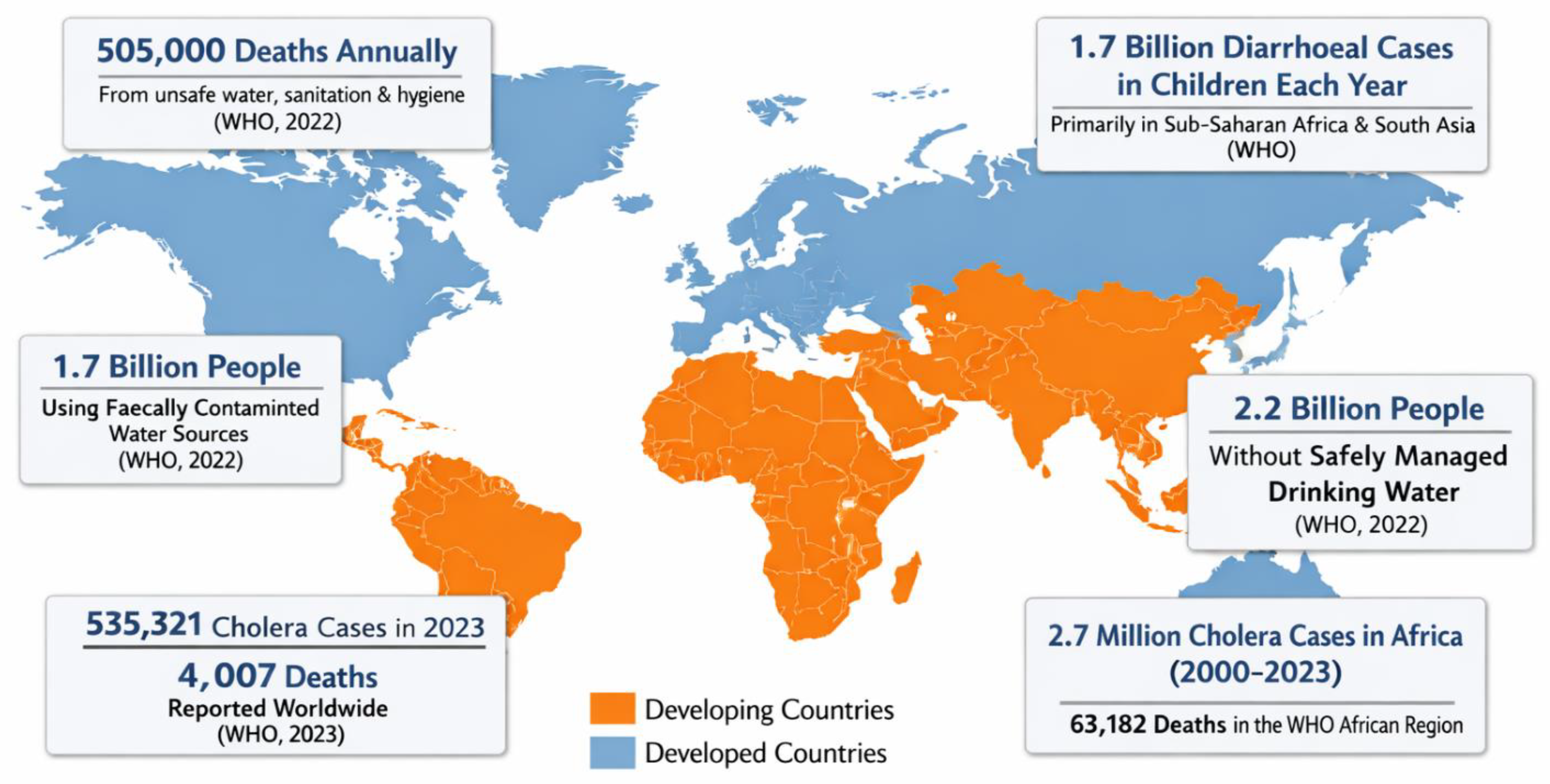
Figure 2.
Key Water Quality Parameters for Domestic Monitoring Using IoT-Enabled Sensors.
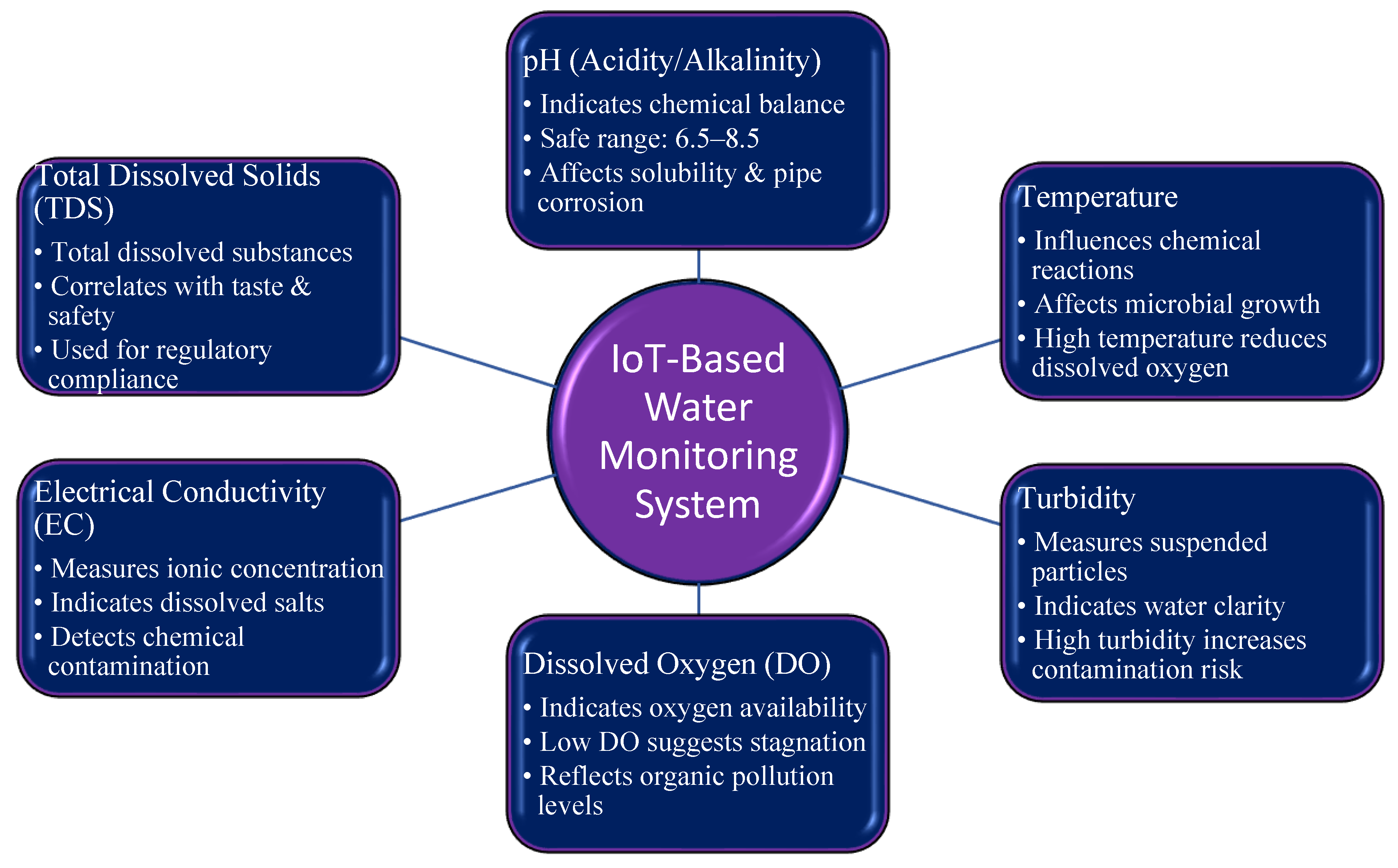
Figure 3.
Conceptual IoT architecture for smart water quality monitoring showing sensing, connectivity, data processing, and user interaction layers with integrated edge and cloud analytics.
Figure 3.
Conceptual IoT architecture for smart water quality monitoring showing sensing, connectivity, data processing, and user interaction layers with integrated edge and cloud analytics.
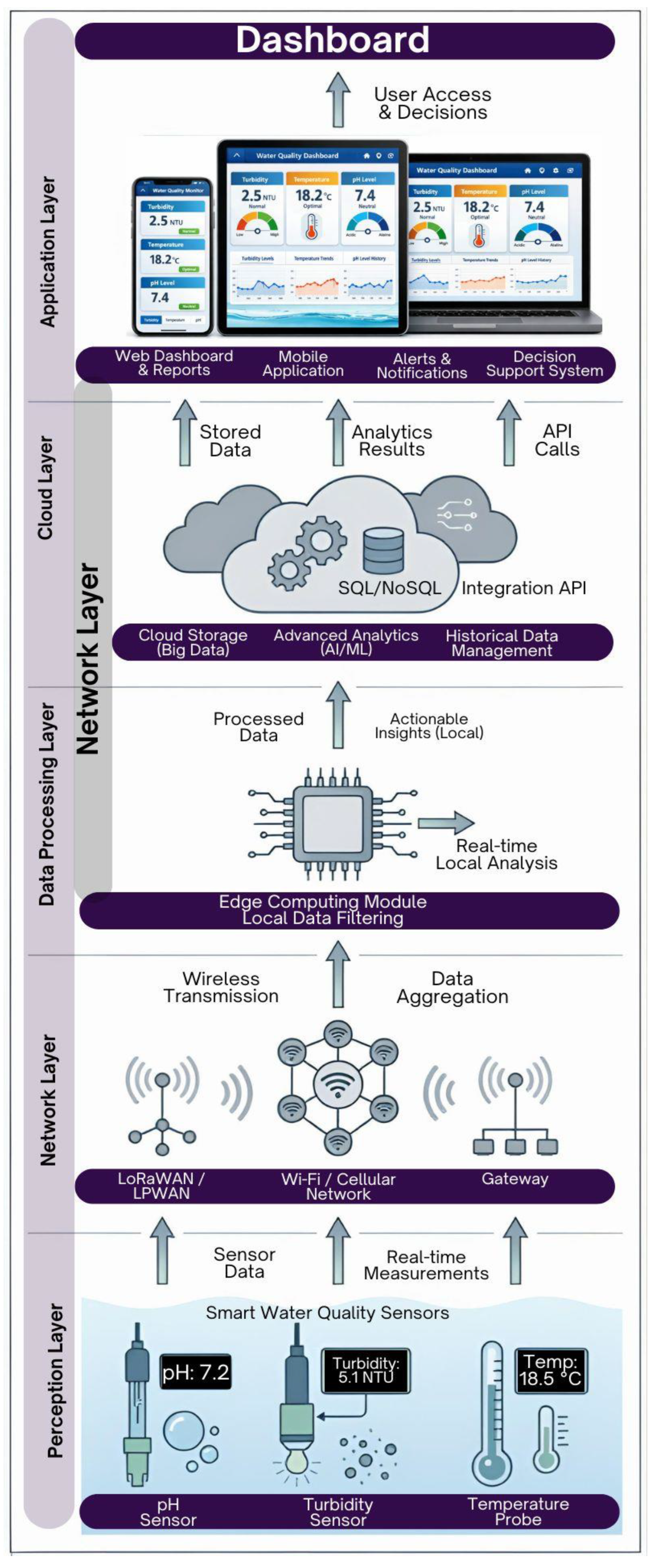

Table 1.
Global Burden of Disease Attributable to Unsafe Water, Sanitation, and Hygiene.
| Indicator | Value / Estimate | Source |
|---|---|---|
| People using drinking-water sources contaminated with feces | > 2 billion |
World Health Organization, 2023 |
| Common waterborne diseases from contaminated water | Cholera, diarrhoea, dysentery, typhoid, polio | |
| Diarrhoeal deaths attributable to unsafe water, sanitation, and hygiene (2019) | > 1 million annually |
WHO WASH Burden of Disease, 2019 |
| Deaths preventable with safe water and sanitation services (2019) | ~ 1.4 million annually | |
| Under-5 deaths due to unsafe WASH (2019) | ~ 395,000 |
Table 2.
Current State of Water Supply in Nigeria (UNICEF, 2024; UNICEF-WHO, 2024).
| Category | Indicator | Status | Remarks |
|---|---|---|---|
| Access | Population with safely managed drinking water | 13% | Very low by global standards |
| Urban access to potable water | 48% | Higher than rural but still inadequate | |
| Rural access to potable water | 39% | Heavy reliance on boreholes and wells | |
| Water Source | Boreholes / Tube wells | 37% | Most common source nationwide |
| Pipe-borne water | 11% | Limited and unreliable | |
| Unimproved sources (streams, ponds) | 25% | High health risk | |
| Water Quality (Microbiological) | Water contaminated at source | 68% | Presence of E. coli and faecal coliform |
| Water contaminated at point of use | 70% | Due to storage and handling practices |
Disclaimer/Publisher’s Note: The statements, opinions and data contained in all publications are solely those of the individual author(s) and contributor(s) and not of MDPI and/or the editor(s). MDPI and/or the editor(s) disclaim responsibility for any injury to people or property resulting from any ideas, methods, instructions or products referred to in the content. |
© 2026 by the authors. Licensee MDPI, Basel, Switzerland. This article is an open access article distributed under the terms and conditions of the Creative Commons Attribution (CC BY) license.
Copyright: This open access article is published under a Creative Commons CC BY 4.0 license, which permit the free download, distribution, and reuse, provided that the author and preprint are cited in any reuse.


