

Submitted:
21 March 2026
Posted:
23 March 2026
You are already at the latest version
Abstract
Solar energy is emerging as a cornerstone of the global renewable energy transition, with projections indicating that photovoltaics (PV) could contribute up to 90% of electricity generation by 2050. However, environmental factors, particularly dust deposition, pose a significant challenge to the long-term performance and efficiency of PV systems. Dust accumulation varies widely across different geographic regions, influenced by climate, land use, humidity, and pollution. Arid and semi-arid areas experience the highest deposition rates, while tropical and temperate regions are affected by seasonal rainfall and urban pollutants. This review comprehensively examines the impact off dust on PV performance, highlighting factors such as surface roughness of PV module, panel tilt angle, seasonal variations, wind dynamics, and dust composition. Furthermore, the review assesses various dust mitigation strategies, including manual and water-based cleaning, robotic systems, hydrophobic coatings, and electrostatic methods. By synthesizing global studies and presenting a holistic view of dust effects, this paper provides critical insights for optimizing PV design, maintenance, and operational strategies to ensure sustained energy yield and reliability in solar energy systems worldwide.
Keywords:
solar energy
; photovoltaic efficiency
; regional diversity
; dust accumulation
; soiling effect
; environmental impact
; mitigation strategies
; sustainable energy
1. Introduction
1.1. Background & Importance of Solar PV Systems
The global energy landscape is undergoing a transformative shift towards renewable energy, with solar energy at the forefront. Projections indicate that by 2050, solar photovoltaics (PV) could account for up to 90% of global electricity generation[1], driven by technological advancements and supportive policies. Solar energy is among the most promising renewable energy sources for mitigating global warming and the energy crisis [2], offering a practical means of generating power from sustainable sources rather than relying on fossil fuels. Due to the rapid and sustained growth from 2010 to 2050 of global electricity generation from solar photovoltaic (PV) systems, in 2010, solar PV contributed only 30 TWh, reflecting its early-stage deployment[3]. Figure 1 illustrates a sharp increase to 250 TWh by 2015, followed by accelerated growth to 850 TWh in 2020, due to declining module costs, supportive policies, and large-scale installations. The estimated value for 2025 shows a significant jump to 2,260 TWh, indicating solar PV’s transition into a mainstream energy source [4]. Future forecasts project an exponential rise, with generation expected to reach 6,000 TWh by 2030 and 10,500 TWh by 2035. By 2040 and 2045, solar PV output is projected to grow to 15,000 TWh and 20,000 TWh, respectively. By 2050, global solar PV generation is projected to reach approximately 25,000 TWh, underscoring its critical role in meeting future global energy demand and decarbonization targets. However, the performance and efficiency of PV systems are significantly influenced by environmental factors, particularly dust accumulation [5]. Dust deposition on solar panels can lead to substantial losses in energy yield, particularly in arid regions or areas with high industrial activity. The impact of dust is not uniform; it varies across different geographical locations due to variations in climate, land use, and atmospheric pollution[6].
At the same time, urban air pollution increases the deposition of carbon-based particles, contributing to efficiency losses. In contrast, the arid climates of the Middle East and North Africa experience frequent dust storms, leading to heavy dust deposition, and the coarse nature of desert dust often causes rapid degradation of PV modules [7]. Similarly, regions near the Sahel in Africa experience severe dust accumulation due to dry, windy conditions, with limited rainfall exacerbating dust-related performance losses [8]. In Europe, while dust accumulation is generally lower in temperate regions, industrial pollution and agricultural activities contribute to the deposition of fine particulates. For instance, a single dust storm can lower power production by 20% [9], while dust can lower PV performance by 25% to 35% in a month [10]. To visualize the global distribution of dust concentrations, the following map in Figure 2 illustrates areas with varying levels of dust deposition [11].
According to research, the tilt angle of the panels, the local environment, and the actual composition of dust are the primary determinants of dust accumulation on PV surfaces [13]. These are the main factors influencing dust aggregation [14]. Several important factors, such as dust particle size, shape, and composition, significantly affect the amount of light reaching solar panels [15,16]. The accumulation of dust on the grid solar panel modules is seen in Figure 3. The map highlights the impact of dust, showing that dust accumulation poses significant challenges to PV performance across different regions, emphasizing the need for tailored dust mitigation strategies. Understanding the spatial variability of dust deposition is essential for optimizing the design, maintenance, and operation of solar energy systems worldwide.
Recent initiatives to reduce dust accumulation and enhance PV cleaning have focused on both passive and active strategies [10]. These procedures encompass design, installation, and operation. Furthermore, numerous techniques and experimental tools have been developed for power plant dust monitoring, revealing difficulties in measurement outcomes. Innovation and the development of novel methods to address dust-related issues and improve PV system efficiency under challenging conditions have been highlighted in recent PV cleaning research [17]. In the subsequent sections, this review paper examines the various factors that influence dust accumulation on PV panels, the methodologies used to assess its impact, and the strategies implemented to mitigate its effects, thereby ensuring the sustained efficiency and reliability of solar energy systems worldwide.
1.2. Objectives of the Review Work
This review aims to provide a comprehensive analysis of the impact of dust deposition on rooftop solar PV systems by synthesizing findings from existing research across different geographic regions and climatic conditions. The specific objectives of this review are as follows:
- To summarize global research on dust-induced PV degradation: By reviewing previous studies, this paper will analyze the extent of performance losses due to dust accumulation and highlight the key findings from different regions.
- To identify variations in dust accumulation across different climates: The review will compare studies conducted in diverse environmental settings to understand how dust accumulation patterns vary and influence PV performance.
- To discuss dust characterization, mitigation strategies of dust accumulation, and future research directions to enhance PV system efficiency in dusty environments.
2. Methodology
A systematic framework for the review paper on rooftop solar PV performance deterioration caused by dust accumulation is shown in Figure 4. The review begins with defining the scope and objectives, establishing the relevance of rooftop PV systems in modern energy systems, and setting the context for the study. It then introduces the background and importance of PV systems, highlighting their role in sustainable energy generation and urban deployment. Subsequently, the framework classifies dust and soiling materials, categorizing the different types of dust affecting rooftop PV modules by origin and composition. This is followed by an analysis of the factors affecting dust deposition, encompassing environmental, dust-related, system-level, and regional influences.
The next stage examines the impact of dust on PV performance, focusing on power loss mechanisms, efficiency reduction, and reliability concerns. The framework further emphasizes geographic and climatic variations in dust accumulation, recognizing that soiling behavior and degradation rates vary significantly across regions due to differences in climate, land use, and pollution levels. Finally, the framework culminates in the evaluation of dust mitigation strategies for rooftop PV systems, covering both preventive and corrective measures. The review concludes with results and recommendations, synthesizing findings from the literature to provide practical insights and to identify future research directions and challenges that will guide further advances in improving the long-term performance and sustainability of rooftop solar PV installations.
2.1. Classification of Accumulated Dust Material on PV
Accumulated dust on photovoltaic (PV) modules can be broadly classified based on its origin, composition, and physical characteristics, as reported in previous studies. The most common category is mineral dust, originating from soil, sand, and desert environments, and mainly composed of silica, quartz, and aluminosilicates [18]. This type of dust is dominant in arid and semi-arid regions and causes significant optical losses due to light scattering and absorption [19,20]. Anthropogenic or urban dust consists mainly of fine particles generated from vehicle emissions, industrial activities, and combustion processes [21]. These particles are rich in carbonaceous matter and metal oxides, exhibiting high absorptivity and strong adhesion to PV glass surfaces. Several studies report that, despite lower mass deposition, anthropogenic dust can cause disproportionate power losses due to its optical and thermal properties. Organic and biological dust includes pollen, plant debris, microorganisms, and biofilm-forming materials commonly observed in agricultural, tropical, and vegetated regions. Although often less dense than mineral dust, this category forms sticky layers that enhance further dust accumulation and complicate cleaning processes, thereby indirectly accelerating performance degradation[22]. In coastal and humid environments, marine or saline dust becomes significant. This dust type is primarily composed of sodium and magnesium salts transported by sea spray and aerosols [19]. Saline particles promote wet adhesion, crystallization, and surface abrasion, leading to persistent soiling and potential material degradation of PV modules [21].
Additionally, several studies highlight the presence of mixed or composite dust, especially in urban–agricultural transition zones, where mineral, organic, and anthropogenic particles coexist[23]. The performance impact of such dust is highly variable and strongly dependent on local climate, particle size distribution, and humidity [24]. Table 1 presents a comprehensive classification of dust and soiling materials commonly affecting the performance of solar photovoltaic (PV) modules, highlighting their sources, composition, and performance impacts as reported in reputable journal literature.
The category of different types of dust, such as mineral Dust, organic/biological particles, bird & animal droppings, agricultural emissions / mixed Soil, coastal/saline particles, anthropogenic/industrial particulates made of different raw materials of dust components. Figure 5 shows the raw materials of different categories of dust components. Sand is made up of particles that are either sandy, metallic, or have a diameter between 0.02 and 2 mm (0.0008 and 0.08 in). They originate from dust in desert regions and occur in large quantities in rocks. The authors [29] are also highly difficult, have almost no cleavage, are nearly insoluble in water, and do not break down.
Cement is a mineral powder that has been finely ground and is typically gray in color [30]. The three most crucial raw materials used to make cement are marl, clay, and limestone. Cement, when combined with water, acts as an adhesive to hold hard rock, gravel, and sand together as concrete [31]. Both underwater and in the air, the cement solidifies, and once it reaches this stage, it stays that way. Typically, cement is offered as a uniform bulk dry product. To guarantee the necessary stability, dependability, and processability in the application, its features are standardized[32]. Limestone is a sedimentary rock composed of calcium carbonate that is utilized in the cement and building materials industries. It can be white or gray in color [33,34]. Silica Gel (SiO2) is an amorphous type of silica that comes in tiny packets[29]. It has the capacity to both evaporate and absorb vast volumes of water. Small silica gel packets are present in anything that is eventually affected by excessive moisture or accumulation. They are thus mostly used as dehumidifiers and drying specialists [35]. The eighth group of the periodic table contains the chemical element iron. It's a delicate solid. High temperatures and damp air cause pure iron metal to rust quickly. Tiny iron metal particles that are generated as trash in industrial regions spread throughout the atmosphere and build up on PV [36].
Sulphur precipitated is used in products like topical creams that treat psoriasis, eczema, and acne in the personal care and pharmaceutical sectors. Based on several tests, sulfur was selected as an antibacterial and keratolytic ingredient in both products [38]. Brown soil dust is the second greatest major particle source after sea salt, and it has a significant impact on air quality. The dust in the atmosphere is made up of dust microparticles, which originate from a variety of sources, including soil dust that has been raised by wind, volcanic eruptions, and air pollution[29]. Dust in homes, workplaces, and other human environments contains trace amounts of plant pollen, as well as skin, animal fur, textile fibers, and paper fibers. Along with several other materials that could be present in the surrounding environment, they also include burning meteorite fragments[39]. Many shells, including chalk, plant ash, limestone, marble, and bones, contain calcium carbonate (CaCO3), a white precipitate that is produced by transferring carbon dioxide to a Ca (OH)2 suspension in water. It is also utilized in medicinal formulations. Common sand, calcium carbonate, was primarily formed by different living forms, including coral and shellfish, over the last half-billion years. Numerous investigations have looked into calcium carbonate[40]. Among the most durable and efficient materials in the synthetic mineral spectrum, black silicon carbide finds use in a wide range of applications, such as non-aero parts surface finishing and general blasting, anti-slip flooring, vibratory finishing devices, secure processing, coated and bonded abrasives, and polishing compounds [41]. Sawdust, also known as wood shavings, is a waste product or by-product of woodworking processes like sawing. It is made up of tiny wood particles. These tasks can be completed using hand tools, portable power tools, or woodworking equipment. Additionally, several forest-dwelling animals, birds, and insects produce wood dust as a byproduct [32]. The particulate particles released from exhausts and chimneys during the burning of fossil fuels is referred to as fly ash. Significant amounts of particulate matter are produced when fossil fuels are burnt, and these concentrations vary depending on the fuel type, combustion quality, and other factors. Depending on the geography, local weather, combustion system conditions, and other factors, incinerator stacks release particulate matter in a variety of sizes and forms [42]. These released particles vary in size from one to several tens of microns [43]. Other names for fly ash include coal and soot, all of which refer to particulate particles. The circumstances of combustion and the particles generated affect these particles' physical and chemical characteristics, including how well they absorb light [44]. Overall, this classification demonstrates that dust composition is as critical as dust quantity in determining PV performance degradation. Understanding these categories provides a foundation for region-specific mitigation strategies and optimized maintenance planning for rooftop PV systems.
2.1.1. Factors Affecting Dust Deposition
Several factors contribute to the retention of dust on PV panels, influencing their long-term performance[45]. The site's characteristics and the extent of local human and natural activities, such as traffic, industry, and sandstorms, all of which are thought to be sources of dust generation, shape the rate at which dust accumulates [46]. The farther away from the source of the dust creation, the lower the deposition rate[47]. Figure 6 illustrates the key factors influencing dust accumulation on photovoltaic (PV) modules, grouped into four major categories: environmental factors, dust-related factors, PV module factors, and regional factors. It is important not to underestimate how much rainfall affects dust deposition [48]. According to research by the researcher[49] on the natural settling process of PV panels in Krakow under varied weather conditions, the intensity of rainfall has a significant impact on the dust-settling process. Another study [50] claims that dust particles may be removed from the panels by rainfall with an intensity of at least 38 mm/h. It should be mentioned, too, that when the dust density hits 40 mg/m3, the purifying effects of heavy rain become saturated[51]. Furthermore, raindrops have a propensity to collect airborne particles and promote dust formation on PV modules when there is light rainfall. Shorter periods of light rain actually encourage the accumulation of dust on the PV panel surface, turning the dust into a muddy material[52]. Wind may have a big impact on PV modules that are exposed to the outside. Dust deposition on PV panels is caused by an increase in wind velocity at low wind speeds, which encourages the transmission and dispersion of particles in the atmosphere [53].
The typical wind speeds at the location are insufficient to fully resuspend fine particle dust sticking to the surface of PV modules when wind speeds are low [54]. Rather, the deposition of tiny particle dust is encouraged by these modest wind speeds [55]. The deposition of particulate matter is also influenced by wind direction, which is even more significant than wind speed[56]. In another study [48], a test rig was constructed with four standard orientations and seven inclinations to examine the effect of wind direction on dust deposition on PV panel surfaces. When the inclination angle was less than 45 degrees, it was discovered that at the same inclination angle, the density of dust deposition was greater on the PV panels' south-facing surface. An important factor in the buildup of dust on PV modules is relative humidity. Water capillary bridges develop between the particles and the panel surface in conditions with high humidity and dew. This promotes the dust particles' condensation and coalescence, which results in the creation of gel-like materials [57]. Additionally, the cemented dust particles' adherence to the PV module is strengthened by the presence of relative humidity [49,58,59]. Relative humidity between 40% and 80% can boost particle adhesion by up to 80%, which encourages deposition on the component's surface, claim Said et al. In order to promote deposition on the component's surface, a relative humidity between 40% and 80% can boost particle adhesion by up to 80% [56].
According to studies done in southern Spain by [60], dust deposition during the rainy season causes a daily decrease in solar radiation of less than 4% when PV modules are washed by rainwater. On the other hand, dust accumulation during the summer might result in daily irradiation losses of more than 20%. The significance of taking into account the seasonal impacts of dust deposition on PV performance is shown by this. However, dust particles can also escape from PV modules due to the thermophoretic effect. The impact of the temperature differential between the PV module and the surrounding air on dust collection was examined [61]. The size of the particles affects the rate of dust deposition. CFD was used [62]to simulate the deposition of 11 distinct dust particle sizes close to PV panels at varied wind speeds. Interestingly, at a wind speed of 1.3 m/s, dust particles of a moderate size (100μm) have the highest tendency for deposition. On the other hand, the deposition trajectory is similar to lower wind speeds at 2.6 m/s, with a maximum deposition rate of 150μm diameter dust particles. The greatest deposition rate is 0.28 percent at a dust diameter of 10μm, while the minimum deposition rate is 0.13 percent for particles with a diameter of 50μm [63], [64,65,66,67]. Soluble salts, carbon quasi-molecules, and other substances make up natural dust[66].
The rate of dust deposition on PV modules is affected differently by different kinds of dust particles. Atomic force microscopy was used by Kazmerski et al.[53] to evaluate dust adherence on PV panels. Their experiment's findings showed that dust particles with organic and dissolved mineral components tended to stick together more firmly than those without. The amount of dust that deposits on the surface of PV modules is significantly influenced by the quantity of dust in the air. More dust is deposited on the PV modules when there is a higher concentration of dust in the air [68]. An electrostatic field is created while PV modules are operating, polarizing and charging the dust particles. Dust deposition is significantly influenced by this process, which is called the electrostatic effect[69,70]. PV modules can be installed in a number of ways, including building photovoltaic integration, pole mounting, roof mounting, ground mounting, and solar awning mounting[71]. Every mounting technique has a unique effect. PV arrays are the usual configuration for both ground-mounted and roof-mounted PV modules, although other approaches mostly include isolated installations [72]. The orientation and tilt angle of PV module installations are important variables that affect the pace at which particles settle on the panel surface. There is often less dust collection on the PV panels at greater tilt degrees because dust particles are more likely to slide off the surface owing to gravity[73]. In order to study dust deposition on slanted PV panels under various circumstances, Heydarabadi et al.[74] performed numerical simulations. They decided to use 0°, 15°, 30°, 45°, 60°, 75°90°, tilt angles. The results show that the maximum amount of dust deposition for particles larger than 10 um happens at a tilt angle of 45 °. When the particle size is smaller, the highest value happens at a 90-degree tilt angle. The surface characteristics of PV panels, which may vary with the material used, significantly affect the rate of dust deposition[75]. When compared to uncoated surfaces, coated surfaces typically have less of an effect on dust deposition [76]. Jiang et al. investigated the accumulation of dust on the surfaces of epoxy resin, polycrystalline silicon, amorphous silicon glass, and monocrystalline silicon glass. The findings showed that, in contrast to the other two kinds of surfaces with clear glass coverings, epoxy-covered polysilicon surfaces were more likely to accumulate dust[77]. Overall, the dust-accumulation factor emphasizes that dust-induced PV performance loss is a complex, multi-parameter phenomenon. The interaction of environmental conditions, dust properties, module design, and regional characteristics determines the extent of optical losses, power degradation, and maintenance requirements. Understanding these factors is essential for developing region-specific mitigation strategies, optimizing PV system design, and ensuring long-term energy yield and reliability.
3. Analysis of PV Performance Degradation
3.1. Impact of Dust Accumulation on Solar Photovoltaic Performance
A significant factor in the performance deterioration of solar photovoltaic (PV) modules is dust deposition, which primarily reduces the amount of incident solar irradiance reaching the active cell surface. Through light scattering and absorption, deposited dust layers reduce optical transmittance, thereby lowering short-circuit current and total power output. In this section, the study analyzed the impact of dust on solar PV systems during the period, PV system type, climate conditions, and seasonal variations.
3.1.1. Impact of Dust on PV Performance Considering Deposition Duration
PV panels may experience a decrease in optical characteristics like transmittance and reflectance as a result of dust and other air pollutants depositing on them. The impact of dust on PV panel performance at the UAE's power plants was investigated by Dhaouadi et al. [78] The transmittance of PV panels at a tilt angle of 25° After 15 weeks of dust collection, it dropped by 30%. This suggests that improper cleaning practices may reduce the transmittance of nearby PV modules by up to 33%, resulting in a substantial loss of PV power output. According to Gholami et al. [9] the relative transmittance of PV modules rapidly decreased in Isfahan, Iran, due to the presence of natural dust deposition. The relative transmittance dropped by 20% after just eight days, and then by 25% after seventy days. Crucially, dust collection raises panel temperatures, which in turn affects PV panels' output power, in addition to reducing the transmittance of PV glass panels. Lakshmi et al.'s study [79] in tropical India assessed how four distinct dust kinds affected photovoltaic modules. From 61.42% to 73.51%, the data showed that coal, sand, brick dust, and chalk dust all contributed to large power losses. Dust degrades the PV module's electrical, optical, and thermal properties, reducing its performance. The power and efficiency reductions due to dust accumulation over the PV module's lifetime are shown in Table 2.
3.1.2. Dust Impact on PV Performance for Various Climates and System Types
Dust accumulation varies considerably across geographical regions, with arid and semi-arid climates experiencing the highest deposition. The experiment was conducted by [100] to investigate the impact of the physical properties of the dust particles deposited on the PV module's surface. They employed three different types of limestone elements—limestone, carbon, and cement with an average diameter of 10, 5, 50, 60, and 80 µm. The differences between dust deposition densities and the four parameters of short circuit current, output power, solar radiation, and fill factor. The findings indicate that the short circuit current is more reduced for carbon particle deposition at 28 g/m2 than for cement at 73 g/m2 for 10 micro and limestone at 125 g/m2 for 50 µm, 168 g/m2 for 60 µm, and 250 g/m2 for 80 µm. They discovered that, in contrast to cement and limestone particles, carbon particles absorb more solar light. Asl-Soleimani et al.[96] conducted the study in Tahan, Iraq, and [101]in Egypt. They found that a PV module's output power may decrease by more than 60% in six months and by more than 66% in a year. Another investigation [102] tested a PV module up to 4g with randomly dispersed ground clay (bentonite) to ascertain the impact of dust deposition. They found that the PV module's conversion efficiency decreased by 10%, 16%, and 20% for 0.1g, 0.2g, and 0.3g, respectively. Another study[103] using talcum powder and mud revealed that the power losses of PV modules can reach 18.2% and 16.2%, respectively. They also discovered that dirt deposition on the PV module's front sheet can reduce its efficiency by 50%. The experiment examined how dust settling affected the PV module. Three forms of dust, often found in urban and other environments, were employed in this investigation: ash particles (less than 10 µm in diameter), limestone particles (less than 60 µm), and red soil particles (less than 150 µm). For a dust deposition of 10g/m2, Jiang et al. (2011) found that the short circuit current decreased by 10% for monocrystalline silicon, 14% for polycrystalline, and 16% for amorphous PV modules with white glass and epoxy front sheets [104].
According to [118], the average daily energy decrease caused by dust settling on PV modules over the course of a year is around 4.4%; if there is no rainfall for an extended period of time, this reduction might reach 20%. According to [92], there was a 50% decrease in output power following six months of exposure in Dhahran, KSA. The effects of dust in Mexico City were examined by [119]. On level surfaces, he noticed that the dust settling rate varied between 24 and 102 gm−2d−1. After 60 days, the dust settles When there is no precipitation on the PV modules, the performance ratio drops by around 15%. However, there is little annual generation reduction as a result of dust deposition. The influence of dust settlement was assessed by[120] using both indoor and outdoor trials. The power loss resulting from the 1.4g/m2 dust thickness in the outside test was 5–6% of the maximum influence yield; whereas, the power loss resulting from the indoor recreation setup, where the dust thickness was 7.155g/m2, was 45–55% of the highest possible influence yield. During a 108-day waterless period in the late spring, [121]found that the effects of dust caused changes in the efficiency of a large PV commercial site (86.4 kWdc) from 7.2% to 5.6%. The significant impact of dust deposition on PV performance under different climate variations is highlighted in Table 3. The decrease in yield energy for the amorphous silicon PV module was 3.50% with 260 mg of dust and 7.28% with 425 mg of dust accumulation, according to [91]. Energy losses for monocrystalline silicon were 2.96% with 260 mg of dust and 5.79% with 425 mg of dust, while energy losses for multicrystalline silicon were 2.83% with 260 mg of dust and 6.03% with 427 mg of dust. Additionally, they provided the mathematical relationship between the PV module's output power and dust deposition.
3.1.3. Impact Analysis Based on Seasonal and Climatic Conditions
Photovoltaic solar energy technologies and their uses have received international academic attention and are currently grabbing the attention of investors [122]. A number of environmental factors, such as wind speed, rainfall, air temperature, and dust accumulation on the surfaces that shield the systems, affect the power output of solar energy systems[123,124]. Therefore, it is vital to address the kind of dust deposition and how it impacts PV module performance. Dust accumulation on protective surfaces has a significant impact on energy output, according to a review of the literature [56,75,125]. Without natural removal or cleaning, the seasonal distribution of solar energy losses from dust accumulations on panels indicates notable effects of more than 0.5% near South and Central Australia, peaking around 3% around the Lake Eyre Basin in all seasons[126]. In tropical regions, dust accumulation on photovoltaic (PV) panels tends to peak during dry seasons when rainfall is minimal. NASA data has been used in a multi-criteria decision-making framework to evaluate the operating capabilities of solar systems in Iran [127]. This framework examines cleaning techniques utilizing multi-criteria decision-making and discusses the dust deposition process, its seasonal influence on radiation, and its effects on solar systems. Dust deposition-induced energy loss in solar panels has also been predicted using the Markov model [128]. Three distinct power rates have been used to examine three cleaning scenarios: weekly, monthly, and seasonal.
The performance of PV modules may be significantly impacted by the effect of ambient temperature on dust deposition[60]. Seasonal differences in temperature have been linked to variations in dust formation, which in turn can affect solar radiation, according to studies. When PV modules are cleaned by rainwater during the rainy season, dust deposition causes a daily decrease in solar radiation of less than 4%, according to studies done in southern Spain by Zorrilla-Casanova et al[60].[135]Nonetheless, the accumulation of dust throughout the summer might result in irradiation losses of more than 20% every day. This emphasizes how crucial it is to take into account how dust deposition affects PV performance throughout the year. In outdoor studies carried out in Brighton, UK, Ghazi and Ip [135] examined the effect of dust on PV modules. They discovered that, in comparison to dust deposition alone, weather had a greater detrimental effect on PV module performance. This implies that while evaluating the performance of PV modules, the combined impact of temperature variations and meteorological conditions should be taken into account. In Ulaanbaatar, Mongolia, Eredavaa et al. [136] investigated how dust deposition affected the transmittance of solar collector glass tubes. Their results showed that the glass tubes had significant dust contamination throughout the cold season, especially in modules slanted at a 60 degree angle. The relative transmittance of these modules dropped by as much as 50% during the course of 20 weeks. Another study investigated the impact of dust buildup on PV in Kathmandu, which is known for its summertime dust deposition and wintertime heavy rains. The practical measurements revealed that, in comparison to cells cleaned every day, the density of dust deposition over a 5-month period reduced the efficiency of dusty and naturally contaminated PV by up to 29.76%. Over the course of the investigation, the highest dust density—6711 g/m2—accumulated near the bottom of the PV[137]. Overall, incorporating seasonal data into dust mitigation planning—through automated cleaning systems and self-cleaning technologies—can enhance the long-term efficiency and reliability of PV systems. Table 4 summarizes the findings on the seasonal Impact of dust on solar PV performance, considering dust deposition, efficiency, and effects.
4. Mitigation Strategies
4.1. Dust Mitigation Strategies for Solar PV Systems
Dust accumulation on solar PV panels significantly reduces their efficiency, making effective dust mitigation strategies crucial for maintaining optimal power output. These strategies can be categorized into traditional cleaning methods and advanced dust prevention techniques. This section provides a comprehensive analysis of different approaches, highlighting their benefits, limitations, and suitability for rooftop solar PV installations, which has been summarized in Table 5. Moreover, the various dust mitigation strategies for solar power systems are illustrated in Figure 7.
Dust buildup on PV module surfaces not only lowers the module's performance but also shortens its lifespan. PV module cleaning has become crucial. Based on three climatic zones—low latitude, mid-latitude, and high latitude—Mani and Pillai [19]suggested mitigation and cleaning techniques. Depending on the dust deposition densities, there are several cleaning techniques to lessen the effect of dust settlement on the PV module's surface.
4.1.1. Natural Cleaning of Solar Photovoltaic Panels
Natural cleaning eliminates dust without the need for human involvement by using environmental elements including wind, rain, and gravity. Since it doesn't require any energy or equipment, this method is the most economical. Its effectiveness, however, is very erratic and differs depending on the region and the time of year. In arid or high-dust settings, it is frequently insufficient to maintain optimal efficiency, even if it can greatly reduce soiling in some areas. The most popular substance for washing PV panels is pure water. Because water is not very conductive, there is little chance of corrosion during the cleaning process, making water cleaning quite safe. However, because of the naturally moist atmosphere (high rate of dew formation and rainfall), dust deposition is a minor problem [159]. Rainfall and dew increase the power output of dusty solar panels, but they are insufficient and infrequent in arid areas, thus they cannot be relied upon to remove dust. Furthermore, no correlation has been found between variations in efficiency and rainfall[160]. A number of strategies have been put out to stop the creation of dew, such as cleaning the PV surfaces every night, flipping the PV modules over to face the ground, or covering the top surface with plastic sheets until the early hours of the morning [107]. In many places, such as Spain, rainfall serves as the main natural cleaning agent during wet seasons [161]. However, inverted modules are used to improve the cleaning process; field tests showed that this technique reduced the soiling rate by 50%[162]. Furthermore, the ratio of effective irradiance for both cleansed and soiled surfaces is known as the Soiling Ratio (SR)[52]. Through a "sliding" action, where the snow layer collects dust and transports it away as it melts and slides off the surface, melting snow cleans PV panels. Because of the heavy weight and friction of the sliding snow, this procedure can be very successful. But snow accumulation itself can be a significant barrier, occasionally cutting power production completely until it goes away. Research on special coatings to make snow slide off more quickly and effectively is ongoing[163,164]. Additionally, wind is essential for the natural removal of dust from the surface. Smaller particles (less than 50 μm) cannot be adequately removed because of the adhesive force between the dust particles and the PV module surface, whereas larger particles can be removed with ease[165]. Because the wind speed rises with elevation, it is important to put the system at a higher height rather than a lower one in order to effectively remove dust by the wind. Another crucial factor that balances dust particle deposition and removal is wind speed[166]. Two methods of natural dust cleaning are shown in Figure 8.
The idea of resuspension was used to analyze the wind cleaning process on solar PV surfaces using a model that included the various impacts of torque, adhesion force, and hydrodynamic force. The purpose of the study was to ascertain the effects of particle size and the necessary velocity for dust removal. The findings demonstrated that the surface was covered in dust particles ranging in diameter from 0.1 to 100 μm. The dust particles were removed using wind and shear velocities ranging from 0.8 m/s to 220 m/s and 0.2 m/s to 57.5 m/s, respectively. The findings showed that while dust particles with a diameter of less than 1 μm were difficult to remove because higher shear velocities were required, larger particle sizes with a diameter of more than 1 μm could be readily removed from the PV surface by wind [167].
Dust accumulation on the PV module's cover is influenced by the inclination angle. Although it can reduce the quantity of solar energy captured, tilting the module's surface toward the ground can decrease dust collection caused by gravity[168,169]. Compared to a stationary solar system, the solar tracker has been shown to reduce dust accumulation on PV panels by 50%, potentially improving PV performance[81]. Thus, it is crucial to determine the ideal tilt angle that maximizes the collection of solar radiation while minimizing the formation of dust. Furthermore, the impact of inclination is contingent upon the current meteorological circumstances. In Singapore, for example, there was no appreciable change in dust deposition when solar modules' inclination angle was changed[170].
However, because of the fluctuation in the amount of solar radiation received at the module surface, the tilt angle of the module has an impact on PV efficiency. Determining the ideal tilt angle is therefore crucial to maximizing the performance of the PV modules. The type of application and the environmental conditions of the year will largely determine this angle [96,171]. Dust deposition on the PV module glass cover was prevented by a high temperature differential between the PV module's surface and the surrounding air, despite the fact that high module temperatures reduce energy conversion [172]. Furthermore, an inclined dust screen is positioned over the PV panel in place of tilting the PV surface, which reduces the rate of dust deposition by over 40% [173].
4.1.2. Manual Cleaning of Solar Photovoltaic Panels
In manual cleaning, dust is physically removed off PV surfaces by human operators using brushes, towels, or sponges[174]. Although it is an inexpensive and straightforward method, it is time-consuming, labor-intensive, and subject to surface scratches and module breakage concerns [175]. Despite these limitations, proper manual cleaning can increase efficiency by more than 90% [176]. It is still frequently used for small-scale projects or in areas with cheap labor costs [164,177].
Brushing: To remove accumulated dust and debris from PV panels, the manual cleaning method uses cleaning instruments such nylon, cloth, and silicone rubber foam brushes [24]. This method usually uses a straight brushing technique, which successfully gets rid of adhesives and tough dirt[81]. To avoid any possible harm to the solar modules, it is recommended to use high-quality brushes[75,178]. A revolutionary silicone rubber foam automated brush that efficiently boosts output power by clearing the collected dust. Because of its low cost and ability to effectively clean solar panels without causing harm to their surface at high frequencies, this new brushing technique is seen as promising for dust reduction in solar energy applications[147].
Manual Water Jet: High-pressure water streams are used in the manual water jet approach to remove impurities [10,175]. Bird droppings and extensive soiling that dry treatments miss can be effectively removed with it[10,177]. Results show that although water jets are quite effective at cleaning, they use a lot of water, which makes them less sustainable in arid areas[163,175]. Furthermore, applying cold water to hot panels during periods of high sunshine can result in thermal shock[117,174].
Surfactant: To reduce surface tension and enhance the removal of greasy or sticky residues, chemical solutions and surfactants are added to water[179]. Certain surfactants can boost cleaning effectiveness by up to 20% when compared to pure water, according to research[10,179]. Additionally, certain specialized solutions produce a short-term protective layer that postpones further dust accumulation[179]. To avoid contaminating soil and groundwater, the environmental effects of chemical runoff must be carefully controlled [174,180]. The most popular manual cleaning systems are illustrated in Figure 9.
4.1.3. Self-Cleaning Methods of Solar Photovoltaic Panels
Self-cleaning surfaces reduce particle adhesion by using the "Lotus effect" with super-hydrophobic or super-hydrophilic coatings. Whereas hydrophilic surfaces produce a thin water coating that removes particles, hydrophobic surfaces encourage water to bead and roll off, taking dust away. These coatings can minimize dust collection by as much as 50%, according to studies. Their effectiveness is mostly reliant on the humidity of the surrounding air and the occurrence of precipitation to initiate the cleaning process.
Anti-soiling: By reducing the frequency of cleaning, anti-soiling coatings provide an additional layer of protection that may extend the life of panels. However, certain coatings require reapplication every three to five years because they deteriorate after prolonged exposure to UV light[180,181]. Hybrid systems that combine automatic cleaning with anti-soiling coatings are more beneficial in areas with moderate amounts of factory dust and pollution. Robotic brush systems with nanostructured coatings are used in rooftop PV installations in Germany to reliably restore efficiency (95–98%) in a variety of weather conditions[72]. Water use is only one aspect of environmental concerns. Volatile organic compounds and other hazardous chemicals may be released during the production and application of anti-soiling coatings [182].
Solvent-based Method: This active cleaning method dissolves tough dirt and bird droppings by using robotic equipment or sprayers to apply chemical solutions or surfactants[179]. When it comes to eliminating "cementation" layers that water cannot remove, the solvent technique works very well[159,179]. In comparison to conventional dry brushing, experimental studies employing 3D-printed robots and chemical solutions prepared in the lab showed notable efficiency recovery in panels with heavy, sticky buildup [10,179].
Sol-Gel: It is a wet chemical process used to create nanostructures, particularly metal oxide nanoparticles. This technique involves dissolving a metal alkoxide in either water or alcohol, followed by heating and stirring to produce a gel by hydrolysis or alcohololysis. Using a straightforward sol–gel method, Deepanjana et al. [183] produced a transparent self-cleaning film. Sol-coated surfaces exhibit 2◦ hysteresis and 150◦ static contact angles. The coating decreased reflection from 8.7% to 3.2% and enhanced transmission from 91.8% to 95.5% [12]. Using the dip coating process, functionalized nano-sized silica particles are applied to glass surfaces to provide a hydrophobic surface. The liquid droplet infusion (cloaking) on the dust particle surfaces is tracked and monitored using high-speed recording equipment [184]. Using the electrospinning technique, hydrophilic, optically transparent, hydrophilic Silica (SiO2) modified Titania (TiO2) nanofibrous thin films have been created on glass substrates for use in solar cells that require self-cleaning. After soiling, the coating's optical transmittance was more than 16% higher than that of the glass substrate. In comparison to the uncoated substrate, which displayed 9.08% and 22.2%, the soiling density dropped by up to 38.9% and 64.9%, respectively, and the photovoltaic (PV) efficiency increased by 0.8% and 1% for tilt angles of 33.4° and 60°, respectively[185].
Ultra-thin, consistent protective layers are applied on PV glass using vapor-assisted techniques, such as Chemical Vapour Deposition (CVD)[174]. In order to preserve the coating's anti-reflective qualities and offer anti-soiling advantages, this method guarantees excellent durability and exact control over the coating's nanostructure [12,176]. Although vacuum-based equipment is very successful in protecting surfaces at the molecular level, its use is often restricted to large-scale industrial manufacture due to its high cost[174,177]. A dry etching method that uses plasma instead of strong acids as an etchant. Thin films of the necessary chemicals are deposited on the substrate[175].
A thin layer of film is deposited through a gaseous medium encircled by a substrate through chemical reactions carried out at a high temperature. Compressed air from electrostatically charged dry powders is applied to the earthed coated film using a spray cannon. This technique resulted in a 30% increase in visible light transmission[186]. Applying dry fluoropolymer or silicone-based powders that are thermally bonded to the substrate is commonly referred to as powder coating in solar applications[12]. Compared to liquid-based sprays, this technique produces a strong, weather-resistant barrier that is thicker and more resilient[174,176]. Although they must be applied carefully to prevent substantial shadowing or reduction in light transmittance, findings indicate that powder-coated surfaces display greater mechanical stability and resistance to sand abrasion in harsh Saharan settings[12,187]. The thermodynamic performance of a particle-driven Brayton cycle for CO2 recompression, simulating a fluidised bed heat exchanger (FBHX) and a solar particle receiver. They reported that the power cycle and the FBHX's thermal efficiency were 50.5% and 99.1%, respectively[188].
The electrostatic fluidized bed powder coating technique uses a remote charging medium to ionize dry air that has previously been delivered via a fluidization column and driven to flow from a plenum chamber through a porous plate into a powder reservoir. A cloud of ionized powder is created as the charged powder particles oppose one another and rise from the fluidizing bed chamber's base. Before the curing procedure, the charged particles are drawn to the substrate and briefly stick to it when a grounded workpiece is dipped in the cloud[189]. The idea is based on the burning of atomized and gaseous raw materials in an atmospheric oxy-fuel flame. The mass feed rate is the primary determinant of the nanoparticles' ultimate size. This method's drawback is that it requires a specialized burner to create micron-sized liquid droplets[175,186].
To produce a low-energy, non-stick finish, polymerization entails directly applying thin-film polymers, like PTFE or PMMA, to the panel surface[174,190]. The utilization of reusable biomass digestate polymers as a sustainable coating option is highlighted by recent study[190]. A compromise between protection and light absorption can be achieved by engineering these polymeric layers to be both super-hydrophobic and anti-reflective [176]. By avoiding the "baked-on" dust effect, efficiency studies show that these films can preserve 95–98% of the initial power output[163,164]. For these coatings, TiO2 sol contains a block copolymer that serves as a structure-directing agent. This structure encourages the creation of regular pores in the TiO2 thin film, which significantly lowers the coatings' refractive index values (~ 1.31) and increases their transparency (4% antireflection gain) [191].
The electrostatic charge interactions between the heterogeneous layer, such as those between polyanion and poly-cation, are the basis for this approach. creating a film on the substrates layer by layer. Large-area AR coating deposition on non-flat surfaces is made possible by this technique, which also makes it simple to manage the film thickness and offers a wide variety of materials for AR coating fabrication [192,193]. The potential for developing low-cost, lightweight, and flexible systems has made the use of polymeric and other organic materials as active components in electroactive devices more and more appealing. Only a small number of layers can alter the interface between the donor and acceptor blocks in this approach, which, when properly tailored, increases device efficiency thrice[194]. By decreasing reflectivity and keeping solar panels cleaner, laser-treated glass shows promise for improving solar panel efficiency. With anti-reflective coatings, power production might rise by as much as 8%. However, major obstacles to its broader acceptance include expensive production costs, environmental concerns, and some loss of transparency. Approximately 16% of the identified issues impact transparency, which subsequently affects performance. To enhance the practicality of this technology, there is a critical need to focus on improving durability, cost-effectiveness, and sustainability[195]. This chapter describes the synthesis of conducting polymer films, which are utilized as transducers in sensors and electrocatalysis, by chemically and electrochemically polymerizing monomers on solid electronic conductor materials with high work function. The drawback of chemical polymerization is that additional purification and characterization are needed for confirmation. Low yield and poor product solubility are drawbacks of electrochemical polymerization; the former makes the process unsuitable for large-scale polymer manufacturing. Nonetheless, doping, redox scan mode, polymerization cycle, and electrode material type can all influence the type of product that is produced in electrochemical polymerization[196].
4.1.4. Mechanical Cleaning of Solar Photovoltaic Panels
The main method of mechanical cleaning is to physically remove dust from PV surfaces using brushes, scrapers, or robotic devices. Soft materials like nylon can be used for brushes to prevent scratches on glass. Because they can manage large-scale installations and function independently, robotic mechanical systems are becoming more and more common. Even while it works well, too much brush pressure can result in micro-scratches that lower transmittance over time. Robotic brushing systems frequently remove dust with efficiencies of over 90%. Water bases Cleaning: One popular mechanical cleaning method is water-based cleaning[197,198,199]. It entails utilising a pump and tubing to link a reservoir to a nozzle that is placed on the PV panels. To properly remove dust, a large amount of high-pressure water is subsequently sprayed onto the panel surface through the nozzle[10]. To increase the effectiveness of dust removal, high-pressure water is occasionally combined with specific cleaning agents[10,155,200,201]. Water also aids in cooling the photovoltaic panels [10,202]. Nevertheless, this approach is unsuitable for dry and semi-arid areas with acute water scarcity[75]. A portion of the PV power generated is also consumed by the use of high-pressure water pumps, and the wet panel surface may draw more dust particles, which would reduce panel efficiency. Additionally, using low-temperature water to clean panels with high surface temperatures can cause thermal shock, which could harm the panels[10,81].
One popular mechanical cleaning technique is forced airflow cleaning [203]. This technique uses compressed air equipment that consists of a compressor, a nozzle, an air storage tank, and an airflow management valve. The PV panels power the compressor, and the airflow management valve directs compressed air from the storage tank to the PV panels. Dust accumulation on the PV modules' surfaces is successfully removed by this procedure[204,205,206]. The mechanical cleaning systens are shown in Figure 10.
The forced airflow cleaning method has the advantage of not relying on water resources, making it particularly suitable for arid and semi-arid regions with high ambient temperatures and limited water supply. Additionally, through better cooling, the compressed air helps to improve the PV modules' performance as it cools down[207]. It is crucial to remember that the compressor requires some of the electricity produced by the PV panels in order to function, which could reduce the PV modules' efficiency.
Piezoelectric technology is used in vibratory cleaning techniques to produce vibrations that efficiently clean solar module surfaces [89,208,209]. In order to reduce dust particle adhesion to the panel surface, these techniques use mechanical vibrators that are affixed to the panel and generate harmonic excitation forces[204]. The vibrator, which is usually located on the panel's back, makes sure that only the dust is removed without harming the glass's surface. [199]and others presented a vibrational self-cleaning process in which the fundamental frequency of the solar panel is stimulated by an external vibration source. The PV module's power-generating efficiency may be restored to roughly 95% with this vibrating cleaning method, which also removes the requirement for water and manual labor [112]. In order to remove impurities like dirt and grease that are immersed in aqueous media, ultrasonic cleaning technology uses the phenomena of ultrasonic cavitation in liquids[210]. This method is frequently used to clean a variety of materials, such as ceramics, metal, glass, and even PV panel surfaces[206]. Even the smallest dust particles can be efficiently removed by ultrasonic cleaning technology, which can penetrate deep crevices. Its cleaning effectiveness is demonstrated by the frequency range of 20 to 80 kHz that is commonly employed for dust cleaning [211]. It is important to note, though, that this approach typically calls for a specific power source[10].
4.1.5. Intelligent Cleaning of Solar Photovoltaic Panels
AI and sensors are combined in intelligent cleaning to optimize schedules based on soiling levels in real time. IoT and machine learning algorithms are basic methods for forecasting efficiency declines. According to unique research, these solutions can cut down on wasteful water and cleaning expenses. Making sure panels are only cleaned when the cost of power outages outweighs cleaning costs maximizes efficiency. New approaches concentrate on passive, water-free technologies such as self-cleaning nano-coatings and Electrostatic Dynamic Shields (EDS)[12,176]. EDS repels dust particles without making mechanical contact by using high-voltage travelling waves[212,213]. The "lotus effect" is used by super-hydrophobic and photocatalytic coatings to let wind or rain naturally remove debris[163,174]. With the capacity to maintain up to 90% panel cleanliness, these techniques are very effective in arid regions where water is limited [176,212]. Four different Intelligent cleaning systems are shown in Figure 11.
The application of robotic cleaning methods demonstrates how intelligent technology may be incorporated into mechanical cleaning procedures. In order to efficiently clean PV panels, this technique usually uses robotic arms, locomotive carriages, and robotic devices [178,179] that follow a preset course on their surface. These robotic systems can carry out genuinely intelligent cleaning chores because they are outfitted with cutting-edge characteristics like wireless charging, night operation, and panel spanning[72].
As a state-of-the-art automated cleaning method, robotic cleaning greatly increases overall cleaning efficiency by simulating human actions and cleaning PV panels quickly and continuously. However, it is crucial to recognize that the deployment of automated cleaning systems requires complex mechanical and control designs due to the relatively high initial and ongoing expenditures[214]. With its convenient control, effective data logging, and remote monitoring capabilities, drone cleaning has become a key intelligent cleaning technology. PV panels are currently being monitored, inspected, and cleaned using it [215,216]. Excellent autonomy and mobility are provided by drone cleaning, enabling the creation of personalized cleaning schedules according to particular needs. It uses cutting-edge technologies like real-time analysis, data mining, machine learning, and image synthesis, and it can function in any weather. These developments greatly improve PV panels' cleaning and operating efficiency. It's crucial to be aware of drone cleaning's limitations, though. Stains on PV panels may be difficult to remove since cleaning solutions have a limited carrying capacity. Additionally, due to the rapid depletion of their batteries, drones have limited endurance and short flight times. As a result, research and development is still ongoing for the use of UAVs to clean PV panels[81].
4.1.6. Self-Cleaning Coating of Solar Photovoltaic Panels
Nanomaterials are used in self-cleaning coatings to form a protective layer that reduces dust adhesion and makes removal from the environment easier. To lower the surface energy of PV glass, these coatings mostly use passive or photocatalytic (titanium dioxide) processes. In arid areas, they can greatly increase energy yield by increasing light transmission by up to 6%. However, environmental deterioration and expensive initial application costs frequently pose a threat to their long-term efficacy. A solar energy system's cleaning capabilities can be improved by altering its surface to have a superhydrophobic quality. A SiO2-based porous surface with poor wettability and high water droplet mobility is called a superhydrophobic surface[186,189]. The idea behind this technique is to put a small layer of hydrophobic coating to the PV's surface, which serves as a barrier to keep water and dust from sticking to it[217,218]. Rainwater or water cleaning methods make it simple to eliminate dust buildup from extremely hydrophobic surfaces. Although this method is effective in areas with a lot of rainfall, it might not be appropriate in arid climates. Water or precipitation is needed to remove the dust particles since this layer stops them from sticking to the PV surface[219].
Strong water attraction and a contact angle that is almost zero (contact angle ≈ 0°) are characteristics of super-hydrophilic surfaces[220]. On certain surfaces, water droplets can dislodge dirt particles from the surface by spreading out rapidly [221]. This can be accomplished by applying a thin layer of titanium dioxide (TiO2) nanofilm on the nanostructured glass's surface [222]. Super-hydrophilic surfaces are inappropriate for solar PV modules in arid regions with minimal rainfall, even if they are reasonably effective in wet conditions and can have cleaning effects with rainwater [223]. However, because they don't need polymer-based coatings, they are more durable and resilient than hydrophobic surfaces[224]. Other benefits of TiO2 coating over hydrophobic coatings are stability, non-toxicity, cost-effectiveness, and transparency to visible light[225]. Nevertheless, the solar energy system's performance cannot be fully restored.
In recent years, numerous researchers have looked into the usage of electrodynamic screens (EDS), which are mostly employed to accomplish automatic dust removal by electrostatic force[226,227]. It is made up of a row of transparent parallel electrodes implanted in a transparent dielectric film and positioned on a glass substrate. The dust falling on the surface of the EDS films will experience electrostatic charge exchange between the surface atoms that are in contact with the upper surface of the dielectric layer when the EDS is activated with a phased voltage pulse. This will result in the donor atoms being positively charged and the recipient atoms being negatively charged. The moving electric field will then sweep the charged particles away, creating a cleaning effect[228]. This technique is now commonly utilized in dry, arid, and desert regions[210,212] because it can remove 90% of the dust that has accumulated on PV panels in less than two minutes without the need for water or labor[76,229,230]. Improvements have been suggested[212,231], although this approach is less successful at removing moist or small dust particles [210,214]. Furthermore, the electric field produced by EDS requires a high-voltage power supply, which reduces power generation efficiency by 15% [76,141,214].
4.1.7. Electrostatic Cleaning of Solar Photovoltaic Panels
By coupling a high voltage to gravity, this waterless technique uses electrostatic forces to keep dust away from solar panels. Particles fall away with negligible power usage when they move reciprocally between parallel screen or wire electrodes. Steeper panel tilt and low-frequency high voltage enhance efficiency. However, heavy humidity or extremely fine particles may reduce its efficiency. A schematic diagram of the electrosurgical cleaning method is illustrated in Figure 12.
The standing-wave method generates a pulsing electric field by applying a single-phase alternating voltage to parallel electrodes[12,163]. Dust particles vibrate in this field and rise to the surface before being carried away by wind or gravity[12,176]. In desert settings, it works especially well to remove coarse particles like sand [163,177]. In comparison to multi-phase traveling-wave systems, it usually exhibits inferior transport efficiency, despite providing a low-energy option for large-scale plants [12,117].
This sophisticated technique creates a moving electric field across the panel surface using multi-phase (often three-phase) AC power [12,117,176]. Dust particles are actively carried in a particular direction toward the panel edges by this "traveling wave"[12,163]. According to research, it achieves clearance rates close to 90%, making it noticeably more effective than standing-wave systems, particularly for fine lunar or desert dust[163,212]. It is a reliable option for automated, waterless maintenance since it successfully stops dust re-deposition[117,176].
4.1.8. Advantages and limitations of the common PV cleaning methods
The various dust cleaning and mitigation strategies for PV systems, highlighting their advantages and limitations, are shown in Table 6. Manual cleaning is low-cost and simple but labor-intensive and may damage PV surfaces. Water-based methods effectively remove dust but are less sustainable in water-scarce regions. Robotic systems reduce labor and ensure consistent cleaning, though they require high initial investment and maintenance. Hydrophobic coatings and self-cleaning glass lower maintenance needs but may lose effectiveness over time. Electrostatic and air blower systems are eco-friendly and water-free, yet they often consume significant energy. The choice of method depends on environmental conditions, resource availability, and cost.
4.2. Performance Evaluation of the Dust Cleaning Method
4.2.1. Advantages and Limitations of the Common PV Cleaning Methods
The efficiency of different PV cleaning methods varies depending on environmental conditions, dust characteristics, resource availability, and system design, with each approach offering distinct trade-offs between effectiveness, cost, sustainability, and maintenance requirements, as illustrated in Figure 13.
4.2.2. Operational and Labor Costs and Human Safety Levels of Different Cleaning Methods
The comparison of common mitigation strategies of PV modules based on operating cost, labor expenses, water waste, and human safety in this section. A basic impression of the many characteristics of PV cleaning techniques, technologies, and approaches is given in Figure 14. However, further research is needed to identify metrics that truly characterize these technologies and to evaluate them economically. In this section, M1, M2, M3, M4, and M5 represent washing and brushing (Manual), Water Spray Machine, Self-coating method, Static Robotic Cleaning, and Portable Robotic Cleaning, respectively. The numerical value represents the intensity of cost and human safety.
5. Discussion
The findings of this review indicate that dust accumulation is a dominant and region-dependent factor driving performance degradation in photovoltaic (PV) systems. Consistent with earlier studies, the literature confirms that dust-induced optical losses are the primary mechanism responsible for power reduction, mainly through decreased transmittance, increased light scattering, and absorption. However, this review extends previous work by emphasizing that PV systems experience more complex and soiling behavior compared to ground-mounted systems due to their proximity to localized pollution sources and urban activities. When interpreted in the context of prior studies, the results demonstrate strong agreement regarding the influence of dust type and environmental conditions on degradation severity. Studies conducted in arid and semi-arid regions consistently report mineral dust as the primary soiling agent. These findings validate earlier hypotheses that dust composition—not merely dust quantity—plays a critical role in determining PV performance loss.
The reviewed mitigation strategies also align with existing literature, which identifies cleaning as the most effective short-term solution for restoring PV performance. Manual and robotic cleaning methods consistently achieve high recovery efficiencies, confirming conclusions drawn by previous experimental and field-based studies. However, this review places these findings in a broader operational and sustainability context, showing that water consumption, labor intensity, and safety risks limit the long-term viability of frequent cleaning. Preventive approaches such as anti-soiling coatings and design optimization are shown to reduce cleaning frequency but exhibit variable long-term effectiveness, reinforcing conclusions from earlier studies regarding coating durability and environmental sensitivity. In a broader context, the findings underscore that PV performance degradation cannot be addressed through isolated mitigation techniques. Instead, the reviewed evidence supports a systems-level interpretation, where degradation mechanisms, regional climate, system design, and maintenance practices interact dynamically. This perspective advances prior research by highlighting the need for integrated mitigation frameworks that combine preventive measures, intelligent monitoring, and adaptive cleaning strategies.
Several future research directions emerge from this review. Standardized methodologies for quantifying soiling rates and performance losses are needed to enable meaningful cross-study comparisons. Additionally, further research should integrate techno-economic analysis with performance data to identify cost-optimal mitigation strategies for different regions. Finally, the growing potential of AI-based monitoring and condition-based maintenance warrants deeper investigation to improve operational efficiency and reduce lifecycle costs. Overall, by synthesizing results from previous studies and interpreting them within a unified framework, this review provides a broader understanding of dust-induced degradation in rooftop PV systems and establishes a foundation for future research aimed at enhancing the reliability and sustainability of distributed solar energy systems.
6. Conclusions
This review comprehensively examined dust-induced performance degradation in rooftop photovoltaic (PV) systems, emphasizing degradation mechanisms, regional variability, and mitigation strategies. The findings confirm that dust accumulation is a dominant environmental factor limiting the long-term energy yield and reliability of PV installations. Even moderate soiling levels can significantly reduce optical transmittance, leading to measurable power losses, mismatch effects, and, in severe cases, hotspot formation that may compromise module lifespan. The review highlights that dust characteristics and environmental conditions vary substantially across regions, resulting in highly location-dependent soiling behavior. Arid and semi-arid regions are primarily affected by mineral dust, urban and industrial areas by fine anthropogenic particulates, and coastal regions by saline aerosols that promote strong adhesion and surface degradation. These regional differences underscore the inadequacy of uniform mitigation solutions and the necessity for climate- and site-specific performance assessment and maintenance strategies. Mitigation approaches were critically analyzed, revealing that cleaning-based methods remain the most effective for immediate performance recovery, while preventive measures such as anti-soiling coatings and optimized system design can reduce dust accumulation rates and maintenance frequency. However, each technique presents trade-offs in terms of cost, durability, and long-term effectiveness. Emerging technologies, including automated robotic cleaning, electrostatic dust removal, and intelligent monitoring using imaging and data-driven techniques, show strong potential for improving operational efficiency, particularly in water-scarce and highly polluted environments. Despite advances in understanding and mitigation, the review identifies key research gaps, including the lack of long-term rooftop-specific datasets, limited standardization in soiling measurement, and insufficient integration of techno-economic analysis with performance degradation studies. Addressing these gaps is essential for developing optimized, scalable, and cost-effective solutions for PV systems. In conclusion, ensuring the sustainable and reliable operation of rooftop PV installations requires a holistic, region-specific approach that integrates dust characterization, system design optimization, smart monitoring, and adaptive mitigation strategies. The insights presented in this review provide valuable guidance for researchers, system designers, and policymakers seeking to maximize the long-term performance and contribution of rooftop solar PV systems to global energy sustainability.
Author Contributions
Conceptualization, A.A.M.; methodology, M.S.A., S.A.H., K.I.U.A. and M.F.K.; software, M.S.A., and S.A.H.; formal analysis, M.S.A., and S.A.H.; investigation, A.A.M., K.I.U.A., and M.F.K.; resources, A.A.M., M.S.A., S.A.H., K.I.U.A. and M.F.K.; data curation, M.S.A., and S.A.H.; writing—original draft preparation, A.A.M., M.S.A., S.A.H., K.I.U.A and M.F.K.; writing—review and editing, A.A.M., K.I.U.A., and M.F.K.; supervision, A.A.M., K.I.U.A., and M.F.K.; project administration, K.I.U.A., and M.F.K.; funding acquisition, A.A.M., K.I.U.A., and M.F.K.; All authors have read and agreed to the published version of the manuscript.
Acknowledgments
The authors gratefully acknowledge the support received under the collaborative research project (Project Code: UIU-IAR-02-2024-SE-29) between the Institute for Advanced Research (IAR), United International University (UIU), and the Center for Research, Innovation and Transformation for Sustainability (CRITS) at Green University of Bangladesh (GUB). The authors also sincerely appreciate the academic support provided by the Department of Electrical and Electronic Engineering (EEE), Bangladesh University of Business and Technology (BUBT).
Conflicts of Interest
The authors declare no conflict of interest.
References
- S. Reporter, “Over 90% of global electricity to be powered by renewables by 2050 | Asian Power.” Accessed: Feb. 25, 2026. [Online]. Available: https://asian-power.com/news/over-90-global-electricity-be-powered-renewables-2050.
- T. Ma, H. Yang, and L. Lu, “A feasibility study of a stand-alone hybrid solar–wind–battery system for a remote island,” Applied Energy, vol. 121, pp. 149–158, 2014.
- “Global Electricity Review 2025 | Ember.” Accessed: Feb. 25, 2026. [Online]. Available: https://ember-energy.org/latest-insights/global-electricity-review-2025/the-big-picture/.
- “Global solar generation up 31% year-on-year - PV Tech.” Accessed: Feb. 25, 2026. [Online]. Available: https://www.pv-tech.org/global-solar-generation-up-31-year-on-year-first-nine-months-2025/.
- M. Thebault and L. Gaillard, “Optimization of the integration of photovoltaic systems on buildings for self-consumption–Case study in France,” City and Environment Interactions, vol. 10, p. 100057, 2021.
- H. A. Kazem and M. T. Chaichan, “Effect of humidity on photovoltaic performance based on experimental study,” International Journal of Applied Engineering Research (IJAER), vol. 10, no. 23, pp. 43572–43577, 2015.
- “7. D. McGee, P.B. deMenocal, G. Winckler, J.-B.-W.... - Google Scholar.” Accessed: Feb. 25, 2026. [Online]. Available: https://scholar.google.com/scholar?hl=en&as_sdt=0%2C5&q=7.%09D.+McGee%2C+P.B.+deMenocal%2C+G.+Winckler%2C+J.-B.-W.+Stuut%2C+L.I.+Bradtmiller%2C+The+magnitude%2C+timing+and+abruptness+of+changes+in+North+African+dust+deposition+over+the+last+20%2C000+yr%2C+Earth+Planet+Sci+Lett.+371+%282013%29+163%E2%80%93176.+&btnG=.
- P. Ozer, “Dust variability and land degradation in the Sahel,” Belgeo. Revue belge de géographie, no. 2, pp. 195–210, 2002.
- A. Gholami, A. Saboonchi, and A. A. Alemrajabi, “Experimental study of factors affecting dust accumulation and their effects on the transmission coefficient of glass for solar applications,” Renewable energy, vol. 112, pp. 466–473, 2017.
- H. A. Kazem, M. T. Chaichan, A. H. Al-Waeli, and K. Sopian, “A review of dust accumulation and cleaning methods for solar photovoltaic systems,” Journal of Cleaner Production, vol. 276, p. 123187, 2020.
- B. J. Solutions, “Clean Air For All: Towards A Global Community Of Action - Health Policy Watch.” Accessed: Feb. 25, 2026. [Online]. Available: https://healthpolicy-watch.news/clean-air-for-all-towards-a-global-community-of-action/.
- G. Hassan, B. S. Yilbas, A. Al-Sharafi, F. Al-Sulaiman, and A. A. Abubakar, “Dust mitigation strategies concerning solar energy applications: A comprehensive review,” Solar Energy, vol. 277, p. 112728, 2024.
- G. Al-Shabaan, W. A. Shehab, A. Abu-Al-Aish, W. Al-Sawalmeh, and M. Al-Shaweesh, “Effects of dust grain size and density on the monocrystalline PV output power,” Int J Appl, vol. 6, no. 1, 2016, Accessed: Feb. 25, 2026. [Online]. Available: https://www.researchgate.net/profile/Wael-Abu-Shehab/publication/313764371_Effects_of_Dust_Grain_Size_and_Density_on_the_Monocrystalline_PV_Output_Power/links/59ed1a8fa6fdccef8b0dc57b/Effects-of-Dust-Grain-Size-and-Density-on-the-Monocrystalline-PV-Output-Power.pdf.
- K. Fatima, A. F. Minai, H. Malik, and F. P. G. Márquez, “Experimental analysis of dust composition impact on Photovoltaic panel Performance: A case study,” Solar Energy, vol. 267, p. 112206, 2024.
- Y. N. Chanchangi, A. Ghosh, S. Sundaram, and T. K. Mallick, “An analytical indoor experimental study on the effect of soiling on PV, focusing on dust properties and PV surface material,” Solar Energy, vol. 203, pp. 46–68, 2020.
- E. B. Oyom, E. B. Ettah, and N. A. Akonjom, “Impact of dust particles on the output power of photovoltaic modules in Calabar, Cross River State,” Science World Journal, vol. 18, no. 3, pp. 380–385, 2023.
- W. Yao, X. Kong, A. Xu, P. Xu, Y. Wang, and W. Gao, “New models for the influence of rainwater on the performance of photovoltaic modules under different rainfall conditions,” Renewable and Sustainable Energy Reviews, vol. 173, p. 113119, 2023.
- D. Goossens and E. Van Kerschaever, “Aeolian dust deposition on photovoltaic solar cells: the effects of wind velocity and airborne dust concentration on cell performance,” Solar energy, vol. 66, no. 4, pp. 277–289, 1999.
- M. Mani and R. Pillai, “Impact of dust on solar photovoltaic (PV) performance: Research status, challenges and recommendations,” Renewable and sustainable energy reviews, vol. 14, no. 9, pp. 3124–3131, 2010.
- G. García-Medina, H. T. Özkan-Haller, and P. Ruggiero, “Wave resource assessment in Oregon and southwest Washington, USA,” Renewable Energy, vol. 64, pp. 203–214, 2014.
- H. K. Elminir, A. E. Ghitas, R. H. Hamid, F. El-Hussainy, M. M. Beheary, and K. M. Abdel-Moneim, “Effect of dust on the transparent cover of solar collectors,” Energy conversion and management, vol. 47, no. 18–19, pp. 3192–3203, 2006.
- R. E. Cabanillas and H. Munguía, “Dust accumulation effect on efficiency of Si photovoltaic modules,” Journal of Renewable and Sustainable Energy, vol. 3, no. 4, 2011, Accessed: Feb. 25, 2026. [Online]. Available: https://pubs.aip.org/aip/jrse/article/3/4/043114/284828.
- J. Kong, Y. Wei, J. Li, J. Huang, and T. Wang, “Microwave-assisted combustion synthesis of Fe3Al bulk nanocrystalline intermetallic matrix composites,” Advanced Powder Technology, vol. 26, no. 3, pp. 778–782, 2015.
- V. Rious and Y. Perez, “Review of supporting scheme for island powersystem storage,” Renewable and Sustainable Energy Reviews, vol. 29, pp. 754–765, 2014.
- K. K. Ilse, B. W. Figgis, V. Naumann, C. Hagendorf, and J. Bagdahn, “Fundamentals of soiling processes on photovoltaic modules,” Renewable and Sustainable Energy Reviews, vol. 98, pp. 239–254, 2018.
- A. Sayyah, M. N. Horenstein, and M. K. Mazumder, “Energy yield loss caused by dust deposition on photovoltaic panels,” Solar Energy, vol. 107, pp. 576–604, 2014.
- R. Conceicao, J. Gonzalez-Aguilar, A. A. Merrouni, and M. Romero, “Soiling effect in solar energy conversion systems: A review,” Renewable and Sustainable Energy Reviews, vol. 162, p. 112434, 2022.
- M. R. Maghami, “Impact of dust deposition on photovoltaic systems and mitigation strategies,” Technologies, vol. 14, no. 1, p. 15, 2025.
- M. R. Chitlange and P. S. Pajgade, “Strength appraisal of artificial sand as fine aggregate in SFRC,” ARPN Journal of Engineering and Applied Sciences, vol. 5, no. 10, pp. 34–38, 2010.
- M. S. El-Shobokshy and F. M. Hussein, “Effect of dust with different physical properties on the performance of photovoltaic cells,” Solar energy, vol. 51, no. 6, pp. 505–511, 1993.
- T. Hosseini, I. Flores-Vivian, K. Sobolev, and N. Kouklin, “Concrete embedded dye-synthesized photovoltaic solar cell,” Scientific reports, vol. 3, no. 1, p. 2727, 2013.
- H. Rajput, S. Patil, V. Lavhale, and J. Pindoriya, “Removal of Hardened Cement Deposited on PV Panels and Its Effect on Power Generation,” International Journal of Engineering Research & Technology (IJERT), vol. 7, no. 4, pp. 547–550, 2020.
- J. K. Kaldellis and M. Kapsali, “Simulating the dust effect on the energy performance of photovoltaic generators based on experimental measurements,” Energy, vol. 36, no. 8, pp. 5154–5161, 2011.
- T. Ogawa, “How Can Be Realized High Piezoelectricity from Measuring Acoustic Wave Velocities?,” Advances in Science and Technology, vol. 90, pp. 33–42, 2014.
- Z. Darwish, Z. A. Darwish, and K. Sopian, “Effect of dust on photovoltaic performance: Review and research status,” 2013, Accessed: Feb. 26, 2026. [Online]. Available: https://www.academia.edu/download/31635207/RESEN-32.pdf.
- H. Zitouni et al., “Experimental investigation of the soiling effect on the performance of monocrystalline photovoltaic systems,” Energy Procedia, vol. 157, pp. 1011–1021, 2019.
- H. A. Kazem, M. T. Chaichan, A. H. Al-Waeli, and K. Sopian, “Effect of dust and cleaning methods on mono and polycrystalline solar photovoltaic performance: An indoor experimental study,” Solar Energy, vol. 236, pp. 626–643, 2022.
- H. Seo, S.-H. Nam, N. Itagaki, K. Koga, M. Shiratani, and J.-H. Boo, “Effect of sulfur doped TiO2 on photovoltaic properties of dye-sensitized solar cells,” Electronic Materials Letters, vol. 12, no. 4, pp. 530–536, 2016.
- J. K. Kaldellis, A. Kokala, and M. Kapsali, “Natural air pollution deposition impact on the efficiency of PV panels in urban environment,” Fresenius Environmental Bulletin, vol. 19, no. 12, pp. 2864–2872, 2010.
- T. Khatib, H. Kazem, K. Sopian, F. Buttinger, W. Elmenreich, and A. S. Albusaidi, “Effect of dust deposition on the performance of multi-crystalline photovoltaic modules based on experimental measurements,” International Journal of Renewable Energy Research, vol. 3, no. 4, pp. 850–853, 2013.
- Z. Chen et al., “Research on Performance Improvement of Photovoltaic Cells and Modules Based on Black Silicon,” Crystals, vol. 10, no. 9, p. 753, 2020.
- J. Vukić, J. Fott, A. Petrusek, and R. Šanda, “What can size distribution of spheroidal carbonaceous particles reveal about their source?,” Atmospheric Environment, vol. 40, no. 19, pp. 3527–3535, 2006.
- J. Inoue, A. Momose, T. Okudaira, A. Murakami-Kitase, H. Yamazaki, and S. Yoshikawa, “Chemical characteristics of Northeast Asian fly ash particles: Implications for their long-range transportation,” Atmospheric environment, vol. 95, pp. 375–382, 2014.
- I. Radonjić, T. Pavlović, D. Mirjanić, and L. Pantić, “Investigation of fly ash soiling effects on solar modules performances,” Solar Energy, vol. 220, pp. 144–151, 2021.
- Z. A. Darwish, H. A. Kazem, K. Sopian, M. A. Al-Goul, and H. Alawadhi, “Effect of dust pollutant type on photovoltaic performance,” Renewable and Sustainable Energy Reviews, vol. 41, pp. 735–744, 2015.
- J. Cano, J. J. John, S. Tatapudi, and G. TamizhMani, “Effect of tilt angle on soiling of photovoltaic modules,” in 2014 IEEE 40th photovoltaic specialist conference (PVSC), IEEE, 2014, pp. 3174–3176. Accessed: Feb. 26, 2026. [Online]. Available: https://ieeexplore.ieee.org/abstract/document/6925610/.
- N. J. Middleton, “Desert dust hazards: A global review,” Aeolian research, vol. 24, pp. 53–63, 2017.
- W. Yao, X. Han, Y. Huang, Z. Zheng, Y. Wang, and X. Wang, “Analysis of the influencing factors of the dust on the surface of photovoltaic panels and its weakening law to solar radiation—A case study of Tianjin,” Energy, vol. 256, p. 124669, 2022.
- K. Styszko et al., “An analysis of the dust deposition on solar photovoltaic modules,” Environ Sci Pollut Res, vol. 26, no. 9, pp. 8393–8401, Mar. 2019. [CrossRef]
- M. Jaszczur, A. Koshti, W. Nawrot, and P. Sędor, “An investigation of the dust accumulation on photovoltaic panels,” Environmental Science and Pollution Research, vol. 27, no. 2, pp. 2001–2014, 2020.
- H. Pedersen, J. Strauss, and J. Selj, “Effect of soiling on photovoltaic modules in Norway,” Energy Procedia, vol. 92, pp. 585–589, 2016.
- R. Conceicao, I. Vazquez, L. Fialho, and D. Garcia, “Soiling and rainfall effect on PV technology in rural Southern Europe,” Renewable Energy, vol. 156, pp. 743–747, 2020.
- L. L. Kazmerski et al., “Fundamental studies of adhesion of dust to PV module surfaces: Chemical and physical relationships at the microscale,” IEEE Journal of Photovoltaics, vol. 6, no. 3, pp. 719–729, 2016.
- M. P. Ndeto, D. W. Wekesa, F. Njoka, and R. Kinyua, “Correlating dust deposits with wind speeds and relative humidity to overall performance of crystalline silicon solar cells: An experimental study of Machakos County, Kenya,” Solar Energy, vol. 246, pp. 203–215, 2022.
- M. M. Dagher and H. A. Kandil, “Computational prediction of dust deposition on solar panels,” Environ Sci Pollut Res, vol. 30, no. 5, pp. 12545–12557, Sep. 2022. [CrossRef]
- S. A. Said, G. Hassan, H. M. Walwil, and N. Al-Aqeeli, “The effect of environmental factors and dust accumulation on photovoltaic modules and dust-accumulation mitigation strategies,” Renewable and Sustainable Energy Reviews, vol. 82, pp. 743–760, 2018.
- K. K. Ilse et al., “Comprehensive analysis of soiling and cementation processes on PV modules in Qatar,” Solar Energy Materials and Solar Cells, vol. 186, pp. 309–323, 2018.
- P. Huang, G. Hu, X. Zhao, L. Lu, H. Ding, and J. Li, “Effect of organics on the adhesion of dust to PV panel surfaces under condensation,” Energy, vol. 261, p. 125255, 2022.
- H. Lu and S. Liang, “Reduction of Dust Deposition on Solar Photovoltaic Cells by Self-Cleaning Coating: Experimental Study of Influencing Factors,” Energy Tech, vol. 9, no. 2, p. 2000795, Feb. 2021. [CrossRef]
- J. Zorrilla-Casanova et al., “Losses produced by soiling in the incoming radiation to photovoltaic modules,” Progress in Photovoltaics, vol. 21, no. 4, pp. 790–796, Jun. 2013. [CrossRef]
- S. Oh, B. W. Figgis, and S. Rashkeev, “Effects of thermophoresis on dust accumulation on solar panels,” Solar Energy, vol. 211, pp. 412–417, 2020.
- H. Lu and W. Zhao, “CFD prediction of dust pollution and impact on an isolated ground-mounted solar photovoltaic system,” Renewable Energy, vol. 131, pp. 829–840, Feb. 2019. [CrossRef]
- H. Lu, L. Lu, and Y. Wang, “Numerical investigation of dust pollution on a solar photovoltaic (PV) system mounted on an isolated building,” Applied Energy, vol. 180, pp. 27–36, 2016.
- H. Lu and L.-Z. Zhang, “Influences of dust deposition on ground-mounted solar photovoltaic arrays: A CFD simulation study,” Renewable Energy, vol. 135, pp. 21–31, 2019.
- H. Lu and W. Zhao, “Effects of particle sizes and tilt angles on dust deposition characteristics of a ground-mounted solar photovoltaic system,” Applied Energy, vol. 220, pp. 514–526, 2018.
- H. Lu and L. Zhang, “Numerical study of dry deposition of monodisperse and polydisperse dust on building-mounted solar photovoltaic panels with different roof inclinations,” Solar Energy, vol. 176, pp. 535–544, 2018.
- H. Peng, H. Lu, X. Chang, C. Zheng, and Y. Wang, “3D CFD modelling of dust deposition characteristics and influences on building-mounted photovoltaic system,” Case Studies in Thermal Engineering, vol. 35, p. 102138, 2022.
- F. Liu et al., “A method of calculating the daily output power reduction of PV modules due to dust deposition on its surface,” IEEE Journal of Photovoltaics, vol. 9, no. 3, pp. 881–887, 2019.
- J. K. Kaldellis and P. Fragos, “Ash deposition impact on the energy performance of photovoltaic generators,” Journal of cleaner production, vol. 19, no. 4, pp. 311–317, 2011.
- F. Lisco et al., “Degradation of hydrophobic, anti-soiling coatings for solar module cover glass,” Energies, vol. 13, no. 15, p. 3811, 2020.
- A. A. Babatunde, S. Abbasoglu, and M. Senol, “Analysis of the impact of dust, tilt angle and orientation on performance of PV Plants,” Renewable and Sustainable Energy Reviews, vol. 90, pp. 1017–1026, 2018.
- B. He, H. Lu, C. Zheng, and Y. Wang, “Characteristics and cleaning methods of dust deposition on solar photovoltaic modules-A review,” Energy, vol. 263, p. 126083, 2023.
- L. Zhang, A. Pan, R. Cai, and H. Lu, “Indoor experiments of dust deposition reduction on solar cell covering glass by transparent super-hydrophobic coating with different tilt angles,” Solar energy, vol. 188, pp. 1146–1155, 2019.
- H. Heydarabadi, M. Abdolzadeh, and K. Lari, “Simulation of airflow and particle deposition settled over a tilted Photovoltaic module,” Energy, vol. 139, pp. 1016–1029, 2017.
- Y. N. Chanchangi, A. Ghosh, S. Sundaram, and T. K. Mallick, “Dust and PV Performance in Nigeria: A review,” Renewable and Sustainable Energy Reviews, vol. 121, p. 109704, 2020.
- W. J. Jamil, H. A. Rahman, S. Shaari, and Z. Salam, “Performance degradation of photovoltaic power system: Review on mitigation methods,” Renewable and Sustainable Energy Reviews, vol. 67, pp. 876–891, 2017.
- H. Jiang, L. Lu, and K. Sun, “Experimental investigation of the impact of airborne dust deposition on the performance of solar photovoltaic (PV) modules,” Atmospheric environment, vol. 45, no. 25, pp. 4299–4304, 2011.
- R. Dhaouadi, A. Al-Othman, A. A. Aidan, M. Tawalbeh, and R. Zannerni, “A characterization study for the properties of dust particles collected on photovoltaic (PV) panels in Sharjah, United Arab Emirates,” Renewable Energy, vol. 171, pp. 133–140, 2021.
- G. Ramadas, “Dust deposition’s effect on solar photovoltaic module performance: an experimental study in India’s tropical region,” Journal of Renewable materials, vol. 10, no. 8, p. 2133, 2022.
- N. Amran, S. L. M. Hassan, I. S. A. Halim, N. Sulaiman, N. E. Abdullah, and A. A. A. Rahim, “Effect of water cooling and dust removal on solar photovoltaic module efficiency,” Journal of Advanced Research in Fluid Mechanics and Thermal Sciences, vol. 105, no. 1, pp. 184–193, 2023.
- H. Z. Al Garni, “The impact of soiling on PV module performance in Saudi Arabia,” Energies, vol. 15, no. 21, p. 8033, 2022.
- H. Yazdani and M. Yaghoubi, “Dust deposition effect on photovoltaic modules performance and optimization of cleaning period: A combined experimental–numerical study,” Sustainable Energy Technologies and Assessments, vol. 51, p. 101946, 2022.
- E. Z. Ahmad, H. Jarimi, and T. R. Razak, “Artificial neural network prediction model of dust effect on photovoltaic performance for residential applications: Malaysia case study,” International Journal of Renewable Energy Development, vol. 11, no. 2, pp. 365–373, 2022.
- A. M. Mahdy, S. I. Ibrahim, D. S. Al-Zubidi, A. J. Ali, M. T. Chaichan, and H. A. Kazem, “The influence of dust physical specifications photovoltaic modules performance,” in IOP Conference Series: Materials Science and Engineering, IOP Publishing, 2020, p. 022123. Accessed: Feb. 26, 2026. [Online]. Available: https://iopscience.iop.org/article/10.1088/1757-899X/928/2/022123/meta.
- D. Diop, M. S. Drame, M. Diallo, D. Malec, D. Mary, and P. Guillot, “Modelling of photovoltaic modules optical losses due to Saharan dust deposition in Dakar, Senegal, West Africa,” Smart Grid and Renewable Energy, vol. 11, no. 7, pp. 89–102, 2020.
- A. Gholami, I. Khazaee, S. Eslami, M. Zandi, and E. Akrami, “Experimental investigation of dust deposition effects on photo-voltaic output performance,” Solar Energy, vol. 159, pp. 346–352, 2018.
- Y. Guan, H. Zhang, B. Xiao, Z. Zhou, and X. Yan, “In-situ investigation of the effect of dust deposition on the performance of polycrystalline silicon photovoltaic modules,” Renewable energy, vol. 101, pp. 1273–1284, 2017.
- E. Abdeen, E.-S. Hasaneen, and M. Orabi, “Real study for Photovoltaic system performance in desert environment-Upper Egypt-case study,” in 2016 Eighteenth International Middle East Power Systems Conference (MEPCON), IEEE, 2016, pp. 843–847. Accessed: Feb. 26, 2026. [Online]. Available: https://ieeexplore.ieee.org/abstract/document/7836993/.
- J. Tanesab, D. Parlevliet, J. Whale, T. Urmee, and T. Pryor, “The contribution of dust to performance degradation of PV modules in a temperate climate zone,” Solar Energy, vol. 120, pp. 147–157, 2015.
- S. A. Said, N. Al-Aqeeli, and H. M. Walwil, “The potential of using textured and anti-reflective coated glasses in minimizing dust fouling,” Solar Energy, vol. 113, pp. 295–302, 2015.
- N. Ketjoy and M. Konyu, “Study of dust effect on photovoltaic module for photovoltaic power plant,” Energy Procedia, vol. 52, pp. 431–437, 2014.
- M. J. Adinoyi and S. A. Said, “Effect of dust accumulation on the power outputs of solar photovoltaic modules,” Renewable energy, vol. 60, pp. 633–636, 2013.
- S. A. Kalogirou, R. Agathokleous, and G. Panayiotou, “On-site PV characterization and the effect of soiling on their performance,” Energy, vol. 51, pp. 439–446, 2013.
- L. Liqun, L. Zhiqi, and S. Z. L. Chunxia, “Degraded output characteristic at atmospheric air pollution and economy analysis of PV power system: a case study,” Przeglad Elektrotechniczny, vol. 88, pp. 281–284, 2012.
- A. M. Pavan, A. Mellit, and D. De Pieri, “The effect of soiling on energy production for large-scale photovoltaic plants,” Solar energy, vol. 85, no. 5, pp. 1128–1136, 2011.
- E. Asl-Soleimani, S. Farhangi, and M. S. Zabihi, “The effect of tilt angle, air pollution on performance of photovoltaic systems in Tehran,” Renewable Energy, vol. 24, no. 3–4, pp. 459–468, 2001.
- H. Becker, “Reduced output of solar generators due to pollution,” in 14 European Photovoltaic Solar Conference, 1997. Accessed: Feb. 26, 2026. [Online]. Available: https://cir.nii.ac.jp/crid/1572261549628799744.
- S. C. Bajpai and R. C. Gupta, “Performance of Silicon solar-cells under Hot and dusty environmental-conditions,” Indian Journal of Pure & Applied Physics, vol. 26, no. 5, pp. 364–369, 1988.
- H. Al-Busairi and A. Al-Kandari, “Performance evaluation of photovoltaic modules in Kuwait,” in 3rd International Photovoltaic Science and Engineering Conference. Tokyo, Japan, 1987, pp. 323–326.
- M. S. El-Shobokshy and F. M. Hussein, “Degradation of photovoltaic cell performance due to dust deposition on to its surface,” Renewable energy, vol. 3, no. 6–7, pp. 585–590, 1993.
- A. H. Hassan, U. A. Rahoma, H. K. Elminir, and A. M. Fathy, “Effect of airborne dust concentration on the performance of PV modules,” J. Astron. Soc. Egypt, vol. 13, no. 1, pp. 24–38, 2005.
- A. Molki, “Dust Affects Solar-Cell Efficiency.,” Physics Education, vol. 45, no. 5, pp. 456–458, 2010.
- S. A. Sulaiman, H. H. Hussain, N. Leh, and M. S. Razali, “Effects of dust on the performance of PV panels,” World Academy of Science, Engineering and Technology, vol. 58, no. 2011, pp. 588–593, 2011.
- J. K. Kaldellis and A. Kokala, “Quantifying the decrease of the photovoltaic panels’ energy yield due to phenomena of natural air pollution disposal,” Energy, vol. 35, no. 12, pp. 4862–4869, 2010.
- A. A. Hachicha, I. Al-Sawafta, and Z. Said, “Impact of dust on the performance of solar photovoltaic (PV) systems under United Arab Emirates weather conditions,” Renewable energy, vol. 141, pp. 287–297, 2019.
- A. A. Hegazy, “Effect of dust accumulation on solar transmittance through glass covers of plate-type collectors,” Renewable energy, vol. 22, no. 4, pp. 525–540, 2001.
- T. M. Alnasser, A. M. Mahdy, K. I. Abass, M. T. Chaichan, and H. A. Kazem, “Impact of dust ingredient on photovoltaic performance: An experimental study,” Solar Energy, vol. 195, pp. 651–659, 2020.
- D. Goossens and E. Van Kerschaever, “Aeolian dust deposition on photovoltaic solar cells: the effects of wind velocity and airborne dust concentration on cell performance,” Solar energy, vol. 66, no. 4, pp. 277–289, 1999.
- S. A. Sulaiman, A. K. Singh, M. M. M. Mokhtar, and M. A. Bou-Rabee, “Influence of dirt accumulation on performance of PV panels,” Energy Procedia, vol. 50, pp. 50–56, 2014.
- A. Azouzoute et al., “Developing a cleaning strategy for hybrid solar plants PV/CSP: Case study for semi-arid climate,” Energy, vol. 228, p. 120565, 2021.
- A. K. Yadav, H. Malik, S. S. Chandel, and I. A. Khan, “(Senior Member IEEE), Sattam Al Otaibi5, Hend I. Alkhammash5”, Accessed: Feb. 26, 2026. [Online]. Available: https://www.researchgate.net/profile/Irfan-Khan-60/publication/353692953_Novel_approach_to_investigate_the_influence_of_optimum_tilt_angle_on_minimum_cost_of_energy_based_maximum_power_generation_and_sizing_of_PV_systems_A_case_study_of_diverse_climatic_zones_in_India/links/610b272d169a1a0103ddcd84/Novel-approach-to-investigate-the-influence-of-optimum-tilt-angle-on-minimum-cost-of-energy-based-maximum-power-generation-and-sizing-of-PV-systems-A-case-study-of-diverse-climatic-zones-in-India.pdf.
- T. Sarver, A. Al-Qaraghuli, and L. L. Kazmerski, “A comprehensive review of the impact of dust on the use of solar energy: History, investigations, results, literature, and mitigation approaches,” Renewable and sustainable energy Reviews, vol. 22, pp. 698–733, 2013.
- S. O. Jekayinfa, J. I. Orisaleye, and R. Pecenka, “An assessment of potential resources for biomass energy in Nigeria,” Resources, vol. 9, no. 8, p. 92, 2020.
- M. T. Chaichan et al., “Sand and dust storms’ impact on the efficiency of the photovoltaic modules installed in Baghdad: a review study with an empirical investigation,” Energies, vol. 16, no. 9, p. 3938, 2023.
- H. Khonkar et al., “Importance of cleaning concentrated photovoltaic arrays in a desert environment,” Solar Energy, vol. 110, pp. 268–275, 2014.
- A. A. Kazem, M. T. Chaichan, and H. A. Kazem, “Dust effect on photovoltaic utilization in Iraq,” Renewable and Sustainable energy reviews, vol. 37, pp. 734–749, 2014.
- S. Z. Said, S. Z. Islam, N. H. Radzi, C. W. Wekesa, M. Altimania, and J. Uddin, “Dust impact on solar PV performance: A critical review of optimal cleaning techniques for yield enhancement across varied environmental conditions,” Energy Reports, vol. 12, pp. 1121–1141, 2024.
- J. Zorrilla-Casanova et al., “Analysis of dust losses in photovoltaic modules,” in World renewable energy congress, Linköping University Electronic Press Linköping, Sweden, 2011, p. May-2985. Accessed: Feb. 26, 2026. [Online]. Available: https://www.researchgate.net/profile/Hassan-Nasser-9/post/Are_there_any_studies_in_which_statistical_analysis_was_used_to_quantify_the_effect_of_dust_on_photovoltaic_cells/attachment/6276a5e21d03190b320b66a4/AS%3A1153146181173249%401651942882511/download/Analysis-of-dust-losses-in-photovoltaic-modules_2011.pdf.
- B. Weber, A. Quiñones, R. Almanza, and M. D. Duran, “Performance reduction of PV systems by dust deposition,” Energy Procedia, vol. 57, pp. 99–108, 2014.
- A. Rao, R. Pillai, M. Mani, and P. Ramamurthy, “Influence of dust deposition on photovoltaic panel performance,” Energy Procedia, vol. 54, pp. 690–700, 2014.
- F. Mejia, J. Kleissl, and J. L. Bosch, “The effect of dust on solar photovoltaic systems,” Energy Procedia, vol. 49, pp. 2370–2376, 2014.
- A. Assi, “Effect of wind blown sand and dust on photovoltaic arrays-model and solution,” 2008, Accessed: Feb. 26, 2026. [Online]. Available: https://www.osti.gov/etdeweb/biblio/21084052.
- A. A. Katkar, N. N. Shinde, P. S. Patil, and M. Tech, “Performance & evaluation of industrial solar cell wrt temperature and humidity,” Int. J. Res. Mech. Eng. Technol, vol. 1, no. 1, pp. 69–73, 2011.
- X. Costoya, M. DeCastro, D. Carvalho, B. Arguilé-Pérez, and M. Gómez-Gesteira, “Combining offshore wind and solar photovoltaic energy to stabilize energy supply under climate change scenarios: A case study on the western Iberian Peninsula,” Renewable and Sustainable Energy Reviews, vol. 157, p. 112037, 2022.
- R. Appels et al., “Effect of soiling on photovoltaic modules,” Solar energy, vol. 96, pp. 283–291, 2013.
- A. A. Prasad, N. Nishant, and M. Kay, “Dust cycle and soiling issues affecting solar energy reductions in Australia using multiple datasets,” Applied Energy, vol. 310, p. 118626, 2022.
- S. S. H. Dehshiri and B. Firoozabadi, “Dust cycle, soiling effect and optimum cleaning schedule for PV modules in Iran: A long-term multi-criteria analysis,” Energy Conversion and Management, vol. 286, p. 117084, 2023.
- G. Sánchez-Barroso, J. González-Domínguez, J. García-Sanz-Calcedo, and J. G. Sanz, “Markov chains estimation of the optimal periodicity for cleaning photovoltaic panels installed in the dehesa,” Renewable Energy, vol. 179, pp. 537–549, 2021.
- K. Zhang, J. Tian, B. Liu, H. Zhang, Z. Wang, and T. Wang, “Numerical simulation analysis of dust deposition characteristics and effects on parabolic trough solar collector,” Journal of Wind Engineering and Industrial Aerodynamics, vol. 261, p. 106086, 2025.
- X. Gao, Z. Yang, and S. James, “Effects of wind barrier height and porosity on dust deposition and power generation efficiency of photovoltaic arrays,” Solar Energy, vol. 298, p. 113642, 2025.
- S. deve Venkatachalam, A. Al Nadabi, A. A. Al Shukaili, A. S. Al Hinai, A. S. Al Shuaili, and I. said Al Shukaili, “Performance and suitability analysis of rooftop solar PV in Oman: A case study of university branches,” Heliyon, vol. 11, no. 4, 2025, Accessed: Feb. 26, 2026. [Online]. Available: https://www.cell.com/heliyon/fulltext/S2405-8440(25)00958-2.
- İ. Kayri and M. T. Bayar, “A new approach to determine the long-term effect of efficiency losses due to different dust types accumulation on PV modules with artificial neural networks,” Journal of Cleaner Production, vol. 434, p. 140282, 2024.
- J. Qi, Q. Dong, Y. Song, X. Zhao, and L. Shi, “Combining dust scaling behaviors of PV panels and water cleaning methods,” Renewable and Sustainable Energy Reviews, vol. 212, p. 115394, 2025.
- L. Micheli, F. Almonacid, J. G. Bessa, Á. Fernández-Solas, and E. F. Fernández, “The impact of extreme dust storms on the national photovoltaic energy supply,” Sustainable Energy Technologies and Assessments, vol. 62, p. 103607, 2024.
- S. Ghazi and K. Ip, “The effect of weather conditions on the efficiency of PV panels in the southeast of UK,” Renewable energy, vol. 69, pp. 50–59, 2014.
- P. Erdenedavaa, A. Akisawa, A. Adiyabat, and E. Otgonjanchiv, “Observation and modeling of dust deposition on glass tube of evacuated solar thermal collectors in Mongolia,” Renewable energy, vol. 130, pp. 613–621, 2019.
- B. R. Paudyal and S. R. Shakya, “Dust accumulation effects on efficiency of solar PV modules for off grid purpose: A case study of Kathmandu,” Solar Energy, vol. 135, pp. 103–110, 2016.
- M. Al-Housani, Y. Bicer, and M. Koç, “Experimental investigations on PV cleaning of large-scale solar power plants in desert climates: Comparison of cleaning techniques for drone retrofitting,” Energy Conversion and Management, vol. 185, pp. 800–815, 2019.
- D. Adak, R. Bhattacharyya, and H. C. Barshilia, “A state-of-the-art review on the multifunctional self-cleaning nanostructured coatings for PV panels, CSP mirrors and related solar devices,” Renewable and Sustainable Energy Reviews, vol. 159, p. 112145, May 2022. [CrossRef]
- S. Şevik and A. Aktaş, “Performance enhancing and improvement studies in a 600 kW solar photovoltaic (PV) power plant; manual and natural cleaning, rainwater harvesting and the snow load removal on the PV arrays,” Renewable Energy, vol. 181, pp. 490–503, 2022.
- D. Deb and N. L. Brahmbhatt, “Review of yield increase of solar panels through soiling prevention, and a proposed water-free automated cleaning solution,” Renewable and Sustainable Energy Reviews, vol. 82, pp. 3306–3313, 2018.
- P. A. Patil, J. S. Bagi, and M. M. Wagh, “A review on cleaning mechanism of solar photovoltaic panel,” in 2017 International Conference on Energy, Communication, Data Analytics and Soft Computing (ICECDS), IEEE, 2017, pp. 250–256. Accessed: Feb. 26, 2026. [Online]. Available: https://ieeexplore.ieee.org/abstract/document/8389895/.
- R. Tejwani and C. S. Solanki, “360 sun tracking with automated cleaning system for solar PV modules,” in 2010 35th IEEE Photovoltaic Specialists Conference, IEEE, 2010, pp. 002895–002898. Accessed: Feb. 26, 2026. [Online]. Available: https://ieeexplore.ieee.org/abstract/document/5614475/.
- K. Jaiganesh, K. B. S. Reddy, B. K. D. Shobhitha, and B. D. Goud, “Enhancing the efficiency of rooftop solar photovoltaic panel with simple cleaning mechanism,” Materials Today: Proceedings, vol. 51, pp. 411–415, 2022.
- S. Fan, W. Liang, G. Wang, Y. Zhang, and S. Cao, “A novel water-free cleaning robot for dust removal from distributed photovoltaic (PV) in water-scarce areas,” Solar Energy, vol. 241, pp. 553–563, 2022.
- M. K. Smith, C. C. Wamser, K. E. James, S. Moody, D. J. Sailor, and T. N. Rosenstiel, “Effects of natural and manual cleaning on photovoltaic output,” Journal of solar energy engineering, vol. 135, no. 3, p. 034505, 2013.
- B. Parrott, P. C. Zanini, A. Shehri, K. Kotsovos, and I. Gereige, “Automated, robotic dry-cleaning of solar panels in Thuwal, Saudi Arabia using a silicone rubber brush,” Solar energy, vol. 171, pp. 526–533, 2018.
- A. Ullah, A. Amin, T. Haider, M. Saleem, and N. Z. Butt, “Investigation of soiling effects, dust chemistry and optimum cleaning schedule for PV modules in Lahore, Pakistan,” Renewable Energy, vol. 150, pp. 456–468, 2020.
- M. Z. Al-Badra, M. S. Abd-Elhady, and H. A. Kandil, “A novel technique for cleaning PV panels using antistatic coating with a mechanical vibrator,” Energy Reports, vol. 6, pp. 1633–1637, 2020.
- M. U. Khan et al., “Modeling and design of low-cost automatic self cleaning mechanism for standalone micro PV systems,” Sustainable Energy Technologies and Assessments, vol. 43, p. 100922, 2021.
- N. W. Alnaser et al., “Comparison between performance of man-made and naturally cleaned PV panels in a middle of a desert,” Renewable and Sustainable Energy Reviews, vol. 82, pp. 1048–1055, 2018.
- K. I. Abass, A. A. Radhi, and A. M. J. Mahdy, “Using water and surfactants in cleaning PV modules effect on its yield,” Int J Trend Res Dev, vol. 7, pp. 2394–9333, 2020.
- M. A. Jaradat et al., “A fully portable robot system for cleaning solar panels,” in 2015 10th International Symposium on Mechatronics and its Applications (ISMA), IEEE, 2015, pp. 1–6. Accessed: Mar. 03, 2026. [Online]. Available: https://ieeexplore.ieee.org/abstract/document/7373479/.
- B. Guo, W. Javed, Y. S. Khoo, and B. Figgis, “Solar PV soiling mitigation by electrodynamic dust shield in field conditions,” Solar Energy, vol. 188, pp. 271–277, 2019.
- K. A. Moharram, M. S. Abd-Elhady, H. A. Kandil, and H. El-Sherif, “Influence of cleaning using water and surfactants on the performance of photovoltaic panels,” Energy Conversion and Management, vol. 68, pp. 266–272, 2013.
- E. J. Schneller et al., “Evaluating solar cell fracture as a function of module mechanical loading conditions,” in 2017 IEEE 44th Photovoltaic Specialist Conference (PVSC), IEEE, 2017, pp. 2897–2901. Accessed: Mar. 03, 2026. [Online]. Available: https://ieeexplore.ieee.org/abstract/document/8366463/.
- J. K. Chesnutt, H. Ashkanani, B. Guo, and C.-Y. Wu, “Simulation of microscale particle interactions for optimization of an electrodynamic dust shield to clean desert dust from solar panels,” Solar Energy, vol. 155, pp. 1197–1207, 2017.
- J. P. Bock, J. R. Robison, R. Sharma, J. Zhang, and M. K. Mazumder, “An efficient power management approach for self-cleaning solar panels with integrated electrodynamic screens,” in Proc. ESA Annual Meeting on Electrostatics, 2008, p. O2.
- B. S. Yilbas, G. Hassan, A. Al-Sharafi, H. Ali, N. Al-Aqeeli, and A. Al-Sarkhi, “Water droplet dynamics on a hydrophobic surface in relation to the self-cleaning of environmental dust,” Scientific reports, vol. 8, no. 1, p. 2984, 2018.
- A. Kimber, L. Mitchell, S. Nogradi, and H. Wenger, “The effect of soiling on large grid-connected photovoltaic systems in California and the southwest region of the United States,” in 2006 IEEE 4th World Conference on Photovoltaic Energy Conference, IEEE, 2006, pp. 2391–2395. Accessed: Mar. 03, 2026. [Online]. Available: https://ieeexplore.ieee.org/abstract/document/4060159/.
- Y. Callot, B. Marticorena, and G. Bergametti, “Geomorphologic approach for modelling the surface features of arid environments in a model of dust emissions: application to the Sahara desert,” Geodinamica Acta, vol. 13, no. 5, pp. 245–270, Oct. 2000. [CrossRef]
- S. Bhaduri, S. Chattopadhyay, S. Zachariah, C. S. Solanki, and A. Kottantharayil, “Evaluation of increase in the energy yield of PV modules by inverting the panels during the non-sunshine hours,” in 26th int. photovolt. sci. eng. conf, 2016. Accessed: Mar. 03, 2026. [Online]. Available: https://www.eqmagpro.com/wp-content/uploads/2019/04/Sonali_Evaluation-of-increase-in-the-Energy-yield-of-PV-modules.pdf.
- L. Wan, L. Zhao, W. Xu, F. Guo, and X. Jiang, “Dust deposition on the photovoltaic panel: A comprehensive survey on mechanisms, effects, mathematical modeling, cleaning methods, and monitoring systems,” Solar Energy, vol. 268, p. 112300, 2024.
- V. Gupta, M. Sharma, R. K. Pachauri, and K. D. Babu, “Comprehensive review on effect of dust on solar photovoltaic system and mitigation techniques,” Solar Energy, vol. 191, pp. 596–622, 2019.
- E. F. Cuddihy, “Theoretical considerations of soil retention,” Solar energy materials, vol. 3, no. 1–2, pp. 21–33, 1980.
- B. Figgis, B. Guo, W. Javed, S. Ahzi, and Y. Rémond, “Dominant environmental parameters for dust deposition and resuspension in desert climates,” Aerosol Science and Technology, vol. 52, no. 7, pp. 788–798, Jul. 2018. [CrossRef]
- Y. Jiang, L. Lu, A. R. Ferro, and G. Ahmadi, “Analyzing wind cleaning process on the accumulated dust on solar photovoltaic (PV) modules on flat surfaces,” Solar Energy, vol. 159, pp. 1031–1036, 2018.
- M. Ahmad, A. Khader, K. Ali, K. Daraghmeh, and A. Mansour, “An experimental investigation of the impact of the dust deposition on the performance of the PV systems at different tilt angles in Palestine conditions. _,” 2023, Accessed: Mar. 03, 2026. [Online]. Available: https://repository.najah.edu/items/de3e1b11-500e-48a3-8d30-320ea4e367d8.
- R. Xu, K. Ni, Y. Hu, J. Si, H. Wen, and D. Yu, “Analysis of the optimum tilt angle for a soiled PV panel,” Energy Conversion and Management, vol. 148, pp. 100–109, 2017.
- J. Y. Hee, L. V. Kumar, A. J. Danner, H. Yang, and C. S. Bhatia, “The effect of dust on transmission and self-cleaning property of solar panels,” Energy Procedia, vol. 15, pp. 421–427, 2012.
- T. Pavlović, Z. Pavlović, L. Pantić, and L. Kostić, “Determining optimum tilt angles and orientations of photovoltaic panels in niš, Serbia,” Contemporary Materials I, vol. 2, 2010, Accessed: Mar. 03, 2026. [Online]. Available: https://www.researchgate.net/profile/Lana-Pantic/publication/267958610_Determining_optimum_tilt_angles_and_orientations_of_photovoltaic_panels_in_Nis_Serbia/links/571ca69f08aee3ddc56aa6a4/Determining-optimum-tilt-angles-and-orientations-of-photovoltaic-panels-in-Nis-Serbia.pdf?_sg%5B0%5D=started_experiment_milestone&origin=journalDetail.
- Y. Jiang and L. Lu, “Experimentally investigating the effect of temperature differences in the particle deposition process on solar photovoltaic (PV) modules,” Sustainability, vol. 8, no. 11, p. 1091, 2016.
- R. Shenouda, M. S. Abd-Elhady, H. A. Kandil, and M. M. Dagher, “Numerical investigation of the effect of dust shields on accumulation of dust over PV panels,” Environ Sci Pollut Res, vol. 30, no. 22, pp. 62905–62923, Mar. 2023. [CrossRef]
- M. Nezamisavojbolaghi, E. Davodian, A. Bouich, M. Tlemçani, O. Mesbahi, and F. M. Janeiro, “The impact of dust deposition on PV panels’ efficiency and mitigation solutions,” Energies, vol. 16, no. 24, p. 8022, 2023.
- T. Salamah et al., “Effect of dust and methods of cleaning on the performance of solar PV module for different climate regions: Comprehensive review,” Science of The Total Environment, vol. 827, p. 154050, 2022.
- M. Gandomzadeh et al., “Dust mitigation methods and multi-criteria decision-making cleaning strategies for photovoltaic systems: Advances, challenges, and future directions,” Energy Strategy Reviews, vol. 57, p. 101629, 2025.
- A. B. Ahmadullah, A. Al-Sharafi, G. Hassan, H. Al-Qahtani, A. A. Abubakar, and B. S. Yilbas, “A techno-economic review of dust accumulation and cleaning techniques for solar energy harvesting devices,” Arabian Journal for Science and Engineering, vol. 49, no. 2, pp. 1343–1365, 2024.
- A. Al Shehri, B. Parrott, P. Carrasco, H. Al Saiari, and I. Taie, “Impact of dust deposition and brush-based dry cleaning on glass transmittance for PV modules applications,” Solar Energy, vol. 135, pp. 317–324, 2016.
- F. Ekinci, A. Yavuzdeğer, H. Nazlıgül, B. Esenboğa, B. D. Mert, and T. Demirdelen, “Experimental investigation on solar PV panel dust cleaning with solution method,” Solar Energy, vol. 237, pp. 1–10, 2022.
- M. I. Hossain, A. Ali, V. Bermudez Benito, B. Figgis, and B. Aïssa, “Anti-soiling coatings for enhancement of PV panel performance in desert environment: a critical review and market overview,” Materials, vol. 15, no. 20, p. 7139, 2022.
- A. Pouladian-Kari, S. Eslami, A. Tadjik, L. Kirchner, R. Pouladian-Kari, and A. Golshanfard, “A novel solution for addressing the problem of soiling and improving performance of PV solar systems,” Solar Energy, vol. 241, pp. 315–326, 2022.
- M. Mirzaee, T. Mohebbi, M. Hamadanian Khozani, and M. Golmohammad, “A Review of Anti-Soiling Coatings for Improving the Performance of Photovoltaic Panels,” Advanced Materials and New Coatings, vol. 12, no. 47, pp. 224–244, 2024.
- D. Adak, R. Bhattacharyya, H. Saha, and P. S. Maiti, “Sol–gel processed silica based highly transparent self-cleaning coatings for solar glass covers,” Materials Today: Proceedings, vol. 33, pp. 2429–2433, 2020.
- B. S. Yilbas, G. Hassan, H. Al-Qahtani, A. Al-Sharafi, and A. Z. Sahin, “Dust mitigation by rolling water droplets from hydrophobic surfaces,” Surfaces and Interfaces, vol. 22, p. 100825, 2021.
- I. Batool et al., “Self-cleaning study of SiO2 modified TiO2 nanofibrous thin films prepared via electrospinning for application in solar cells,” Solar Energy, vol. 268, p. 112271, 2024.
- M. S. Mozumder, A.-H. I. Mourad, H. Pervez, and R. Surkatti, “Recent developments in multifunctional coatings for solar panel applications: A review,” Solar Energy Materials and Solar Cells, vol. 189, pp. 75–102, 2019.
- M. Dida, S. Boughali, D. Bechki, and H. Bouguettaia, “Output power loss of crystalline silicon photovoltaic modules due to dust accumulation in Saharan environment,” Renewable and Sustainable Energy Reviews, vol. 124, p. 109787, 2020.
- P. Domínguez-Coy, J. I. Córcoles, and J. A. Almendros-Ibáñez, “Experimental study of erosion in a high-temperature fluidized bed with granular materials for concentrated solar power applications,” Solar Energy Materials and Solar Cells, vol. 295, p. 113947, 2026.
- M. Barletta and V. Tagliaferri, “Influence of process parameters in electrostatic fluidized bed coating,” Surface and Coatings Technology, vol. 200, no. 14–15, pp. 4619–4629, 2006.
- M. Mashuk et al., “Progress and prospects on performance analysis of solar cleaning system–A comprehensive review,” Solar Compass, p. 100146, 2025.
- S. Mullasseri et al., “Self-cleaning Transparent Coating For solar energy devices.” INDIAN ACAD SCIENCES CV RAMAN AVENUE, SADASHIVANAGAR, PB# 8005, BANGALORE …, 2018.
- A. Syafiq, A. K. Pandey, N. N. Adzman, and N. Abd Rahim, “Advances in approaches and methods for self-cleaning of solar photovoltaic panels,” Solar Energy, vol. 162, pp. 597–619, 2018.
- L. Zhang, Y. Li, J. Sun, and J. Shen, “Mechanically Stable Antireflection and Antifogging Coatings Fabricated by the Layer-by-Layer Deposition Process and Postcalcination,” Langmuir, vol. 24, no. 19, pp. 10851–10857, Oct. 2008. [CrossRef]
- M. F. Durstock, R. J. Spry, J. W. Baur, B. E. Taylor, and L. Y. Chiang, “Investigation of electrostatic self-assembly as a means to fabricate and interfacially modify polymer-based photovoltaic devices,” Journal of applied physics, vol. 94, no. 5, pp. 3253–3259, 2003.
- R. Rai, M. Ishak, S. Kumarasamy, A. Bin Mohd Halil, and M. M. Quazi, “Laser treated super hydrophobic glass for solar PV self cleaning application: a SWOT-TWOS-based analysis,” Materials Research Express, vol. 12, no. 1, p. 012003, 2025.
- G. Fomo, T. Waryo, U. Feleni, P. Baker, and E. Iwuoha, “Electrochemical polymerization,” Functional polymers, pp. 105–131, 2019.
- H. A. Kazem and M. T. Chaichan, “The effect of dust accumulation and cleaning methods on PV panels’ outcomes based on an experimental study of six locations in Northern Oman,” Solar Energy, vol. 187, pp. 30–38, 2019.
- H. A. Kazem and M. T. Chaichan, “Experimental analysis of the effect of dust’s physical properties on photovoltaic modules in Northern Oman,” Solar Energy, vol. 139, pp. 68–80, 2016.
- A. S. Alghamdi, A. S. Bahaj, L. S. Blunden, and Y. Wu, “Dust removal from solar PV modules by automated cleaning systems,” Energies, vol. 12, no. 15, p. 2923, 2019.
- H. A. Kazem, M. T. Chaichan, and A. H. Al-Waeli, “A comparison of dust impacts on polycrystalline and monocrystalline solar photovoltaic performance: an outdoor experimental study,” Environmental Science and Pollution Research, vol. 29, no. 59, pp. 88788–88802, 2022.
- F. Ekinci, A. Yavuzdeğer, H. Nazlıgül, B. Esenboğa, B. D. Mert, and T. Demirdelen, “Experimental investigation on solar PV panel dust cleaning with solution method,” Solar Energy, vol. 237, pp. 1–10, 2022.
- A. Elnozahy, A. K. A. Rahman, A. H. H. Ali, M. Abdel-Salam, and S. Ookawara, “Performance of a PV module integrated with standalone building in hot arid areas as enhanced by surface cooling and cleaning,” Energy and Buildings, vol. 88, pp. 100–109, 2015.
- X. Du, F. Jiang, E. Liu, C. Wu, and F. H. Ghorbel, “Turbulent airflow dust particle removal from solar panel surface: Analysis and experiment,” Journal of Aerosol Science, vol. 130, pp. 32–44, 2019.
- B. O. Olorunfemi, O. A. Ogbolumani, and N. Nwulu, “Solar panels dirt monitoring and cleaning for performance improvement: a systematic review on smart systems,” Sustainability, vol. 14, no. 17, p. 10920, 2022.
- D. Li, M. King, M. Dooner, S. Guo, and J. Wang, “Study on the cleaning and cooling of solar photovoltaic panels using compressed airflow,” Solar Energy, vol. 221, pp. 433–444, 2021.
- H. Kawamoto, “Improved detachable electrodynamic cleaning system for dust removal from soiled photovoltaic panels,” Journal of Electrostatics, vol. 107, p. 103481, 2020.
- A. Assi, A. Hassan, M. Al-Shamisi, and H. Hejase, “Removal of air blown dust from photovoltaic arrays using forced air flow of return air from air conditioning systems,” in 2012 International Conference on Renewable Energies for Developing Countries (REDEC), IEEE, 2012, pp. 1–5. Accessed: Mar. 03, 2026. [Online]. Available: https://ieeexplore.ieee.org/abstract/document/6416699/.
- E. Babu, S. Yesudasan, and S. Chacko, “Cymatics inspired self-cleaning mechanism for solar panels,” Microsystem Technologies, vol. 27, no. 3, pp. 853–861, 2021.
- K. Eisa, R. Shenouda, M. S. Abd-Elhady, H. A. Kandil, and T. Khalil, “Mitigation of dust on PV panels that operate light posts using a wind shield, mechanical vibrations and AN antistatic coating,” Ain Shams Engineering Journal, vol. 14, no. 5, p. 101993, 2023.
- W. Zhao, Y. Lv, Z. Wei, W. Yan, and Q. Zhou, “Review on dust deposition and cleaning methods for solar PV modules,” Journal of Renewable and Sustainable Energy, vol. 13, no. 3, 2021, Accessed: Mar. 03, 2026. [Online]. Available: https://pubs.aip.org/aip/jrse/article/13/3/032701/285068.
- P. Vasiljev, S. Borodinas, R. Bareikis, and A. Struckas, “Ultrasonic system for solar panel cleaning,” Sensors and Actuators A: Physical, vol. 200, pp. 74–78, 2013.
- H. Kawamoto and T. Shibata, “Electrostatic cleaning system for removal of sand from solar panels,” Journal of Electrostatics, vol. 73, pp. 65–70, 2015.
- H. Kawamoto, “Electrostatic cleaning equipment for dust removal from soiled solar panels,” Journal of Electrostatics, vol. 98, pp. 11–16, 2019.
- Z. Quan et al., “A review of dust deposition mechanism and self-cleaning methods for solar photovoltaic modules,” Coatings, vol. 13, no. 1, p. 49, 2022.
- S. Gallardo-Saavedra, L. Hernández-Callejo, and O. Duque-Perez, “Technological review of the instrumentation used in aerial thermographic inspection of photovoltaic plants,” Renewable and Sustainable Energy Reviews, vol. 93, pp. 566–579, 2018.
- N. M. Kumar, K. Sudhakar, M. Samykano, and V. Jayaseelan, “On the technologies empowering drones for intelligent monitoring of solar photovoltaic power plants,” Procedia computer science, vol. 133, pp. 585–593, 2018.
- N. Ahmed et al., “Silsesquioxanes-based nanolubricant additives with high thermal stability, superhydrophobicity, and self-cleaning properties,” Arabian Journal for Science and Engineering, vol. 46, no. 7, pp. 6207–6217, 2021.
- B. S. Yilbas et al., “Retracted Article: Environmental dust removal from inclined hydrophobic glass surface: avalanche influence on dynamics of dust particles,” RSC advances, vol. 8, no. 59, pp. 33775–33785, 2018.
- G. Hassan, B. S. Yilbas, A. Al-Sharafi, and H. Al-Qahtani, “Self-cleaning of a hydrophobic surface by a rolling water droplet,” Scientific reports, vol. 9, no. 1, p. 5744, 2019.
- A. K. Kota, G. Kwon, and A. Tuteja, “The design and applications of superomniphobic surfaces,” NPG Asia Materials, vol. 6, no. 7, pp. e109–e109, 2014.
- S. Nishimoto and B. Bhushan, “Bioinspired self-cleaning surfaces with superhydrophobicity, superoleophobicity, and superhydrophilicity,” Rsc Advances, vol. 3, no. 3, pp. 671–690, 2013.
- J. Drelich and E. Chibowski, “Superhydrophilic and Superwetting Surfaces: Definition and Mechanisms of Control,” Langmuir, vol. 26, no. 24, pp. 18621–18623, Dec. 2010. [CrossRef]
- G. He, C. Zhou, and Z. Li, “Review of self-cleaning method for solar cell array,” Procedia Engineering, vol. 16, pp. 640–645, 2011.
- L. K. Verma et al., “Self-cleaning and antireflective packaging glass for solar modules,” Renewable Energy, vol. 36, no. 9, pp. 2489–2493, 2011.
- L. Graziani, E. Quagliarini, F. Bondioli, and M. D’Orazio, “Durability of self-cleaning TiO2 coatings on fired clay brick façades: Effects of UV exposure and wet & dry cycles,” Building and Environment, vol. 71, pp. 193–203, 2014.
- S. Panat and K. K. Varanasi, “Electrostatic dust removal using adsorbed moisture–assisted charge induction for sustainable operation of solar panels,” Sci. Adv., vol. 8, no. 10, p. eabm0078, Mar. 2022. [CrossRef]
- M. K. Mazumder, R. Sharma, A. S. Biris, J. Zhang, C. Calle, and M. Zahn, “Self-Cleaning Transparent Dust Shields for Protecting Solar Panels and Other Devices,” Particulate Science and Technology, vol. 25, no. 1, pp. 5–20, Jan. 2007. [CrossRef]
- M. Mazumder et al., “Characterization of electrodynamic screen performance for dust removal from solar panels and solar hydrogen generators,” IEEE Transactions on industry applications, vol. 49, no. 4, pp. 1793–1800, 2013.
- M. K. Mazumder et al., “Mitigation of dust impact on solar collectors by water-free cleaning with transparent electrodynamic films: progress and challenges,” IEEE Journal of Photovoltaics, vol. 7, no. 5, pp. 1342–1353, 2017.
- M. Al-Housani, Y. Bicer, and M. Koç, “Assessment of various dry photovoltaic cleaning techniques and frequencies on the power output of CdTe-type modules in dusty environments,” Sustainability, vol. 11, no. 10, p. 2850, 2019.
- A. Sayyah, M. N. Horenstein, M. K. Mazumder, and G. Ahmadi, “Electrostatic force distribution on an electrodynamic screen,” Journal of Electrostatics, vol. 81, pp. 24–36, 2016.
- N. Sakarapunthip, D. Chenvidhya, S. Chuangchote, K. Kirtikara, T. Chenvidhya, and W. Onreabroy, “Effects of dust accumulation and module cleaning on performance ratio of solar rooftop system and solar power plants,” Japanese Journal of Applied Physics, vol. 56, no. 8S2, p. 08ME02, 2017.
- A. Elamim et al., “Performance analysis of innovative cleaning and soiling mitigation solutions in the semi-arid climate of Benguerir Morocco,” Heliyon, vol. 9, no. 5, 2023, Accessed: Mar. 03, 2026. [Online]. Available: https://www.cell.com/heliyon/fulltext/S2405-8440(23)03370-4.
- B. Zhao et al., “Design of a vacuum-type PV module cleaning robot based on an auxiliary mobile frame,” Solar Energy, vol. 275, p. 112634, 2024.
- H. Lu and C. Zheng, “Comparison of dust deposition reduction performance by super-hydrophobic and super-hydrophilic coatings for solar PV cells,” Coatings, vol. 12, no. 4, p. 502, 2022.
- Y. Wu et al., “A review of self-cleaning technology to reduce dust and ice accumulation in photovoltaic power generation using superhydrophobic coating,” Renewable Energy, vol. 185, pp. 1034–1061, 2022.
- M. K. Mazumder et al., “Electrostatic removal of particles and its applications to self-cleaning solar panels and solar concentrators,” in Developments in surface contamination and cleaning, Elsevier, 2011, pp. 149–199. Accessed: Mar. 03, 2026. [Online]. Available: https://www.sciencedirect.com/science/article/pii/B9781437778854100053.
- A. S. Sarkın, N. Ekren, and Ş. Sağlam, “A review of anti-reflection and self-cleaning coatings on photovoltaic panels,” Solar energy, vol. 199, pp. 63–73, 2020.
- A. K. Mondal and K. Bansal, “A brief history and future aspects in automatic cleaning systems for solar photovoltaic panels,” Advanced Robotics, vol. 29, no. 8, pp. 515–524, Apr. 2015. [CrossRef]
- R. B. Williams, R. Tanimoto, A. Simonyan, and S. Fuerstenau, “Vibration Characterization of Self-Cleaning Solar Panels with Piezoceramic Actuation,” in 48th AIAA/ASME/ASCE/AHS/ASC Structures, Structural Dynamics, and Materials Conference, Honolulu, Hawaii: American Institute of Aeronautics and Astronautics, Apr. 2007. [CrossRef]
- L. A. Lamont and L. El Chaar, “Enhancement of a stand-alone photovoltaic system’s performance: Reduction of soft and hard shading,” Renewable energy, vol. 36, no. 4, pp. 1306–1310, 2011.
- S. Masuda and Y. Matsumoto, “Contact-type electric curtain for electrodynamical control of charged dust particles,” in Proc. 2nd Int. Conf. on Static Electricity, Frankfurt, 1973, pp. 1370–09.
- S. Mondal et al., “An overview of cleaning and prevention processes for enhancing efficiency of solar photovoltaic panels,” Current Science, vol. 115, no. 6, pp. 1065–1077, 2018.
- M. U. Hassan, M. I. Nawaz, and J. Iqbal, “Towards autonomous cleaning of photovoltaic modules: Design and realization of a robotic cleaner,” in 2017 First International Conference on Latest trends in Electrical Engineering and Computing Technologies (IN℡LECT), IEEE, 2017, pp. 1–6. Accessed: Mar. 03, 2026. [Online]. Available: https://ieeexplore.ieee.org/abstract/document/8277631/.
- A. K. Mondal and K. Bansal, “Structural analysis of solar panel cleaning robotic arm,” Current Science, vol. 108, no. 6, pp. 1047–1052, 2015.
- F. Mustafa, A. Abd Sahb, A. S. Al-Ammri, and A. Ghazi, “Self cleaning control system for PV solar panel street light,” in IREC2015 The Sixth International Renewable Energy Congress, IEEE, 2015, pp. 1–6. Accessed: Mar. 03, 2026. [Online]. Available: https://ieeexplore.ieee.org/abstract/document/7110890/.
- M. Anderson et al., “ROBOTIC DEVICE FOR CLEANING PHOTOVOLTAIC PANEL ARRAYS,” in Mobile Robotics, Istanbul, Turkey: WORLD SCIENTIFIC, Aug. 2009, pp. 367–377. [CrossRef]
Figure 1.
Global solar photovoltaic energy generation forecast by 2050.
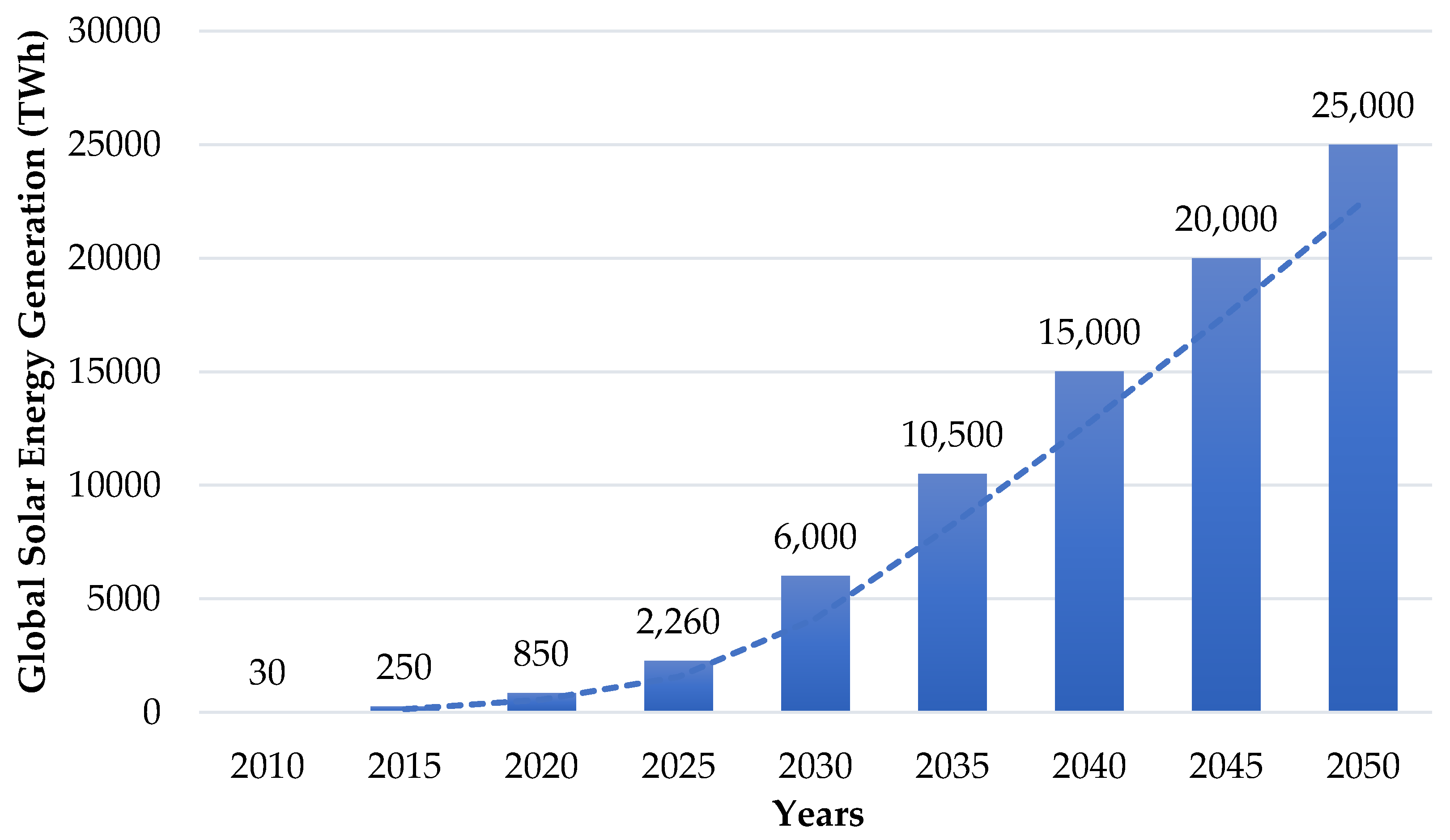
Figure 2.
The geographic distribution of dust density worldwide, measured in micrograms per cubic meter (μg/m3) [12].
Figure 2.
The geographic distribution of dust density worldwide, measured in micrograms per cubic meter (μg/m3) [12].
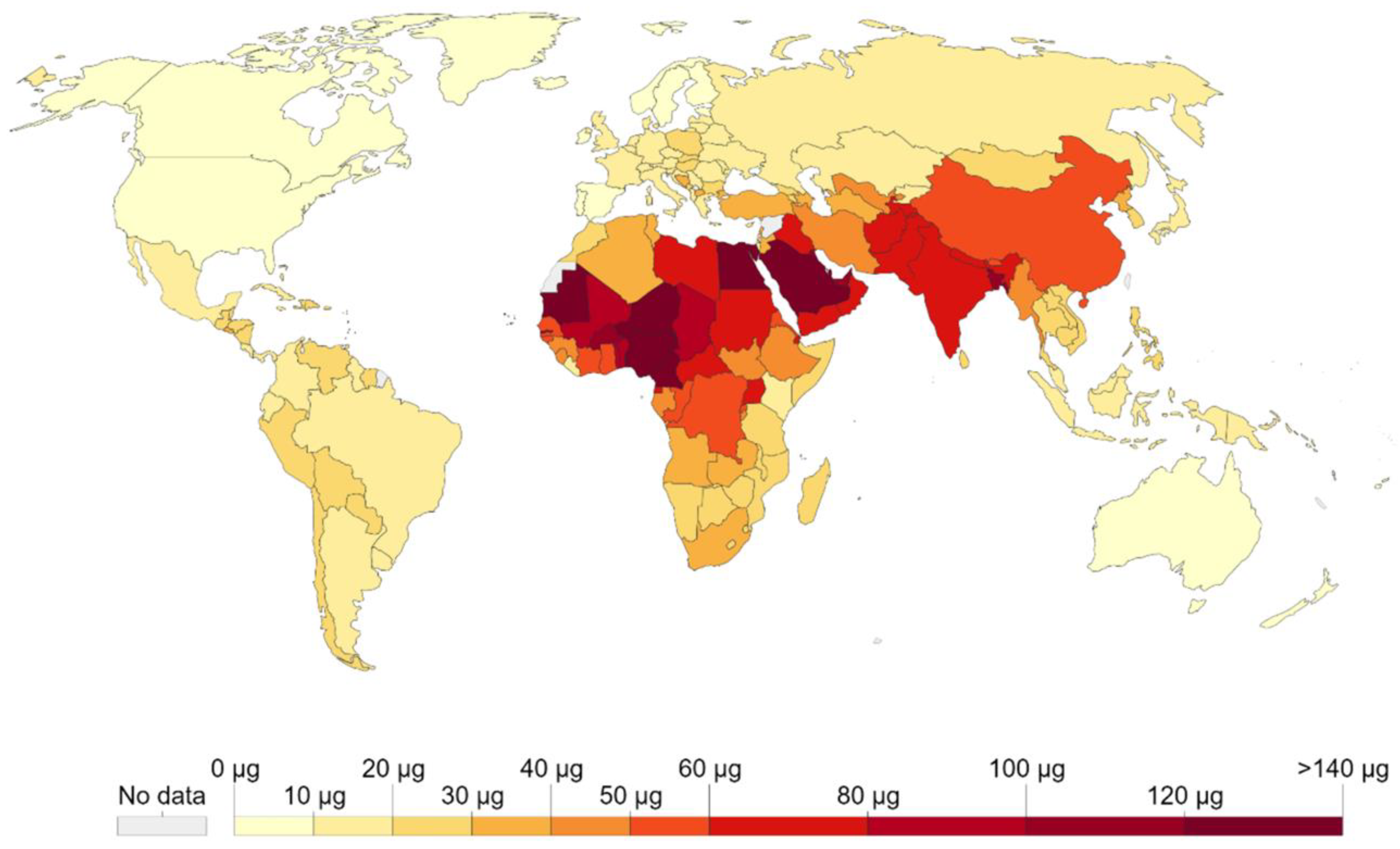
Figure 3.
Scenario of natural dust accumulation on solar photovoltaic panels in different locations.
Figure 3.
Scenario of natural dust accumulation on solar photovoltaic panels in different locations.
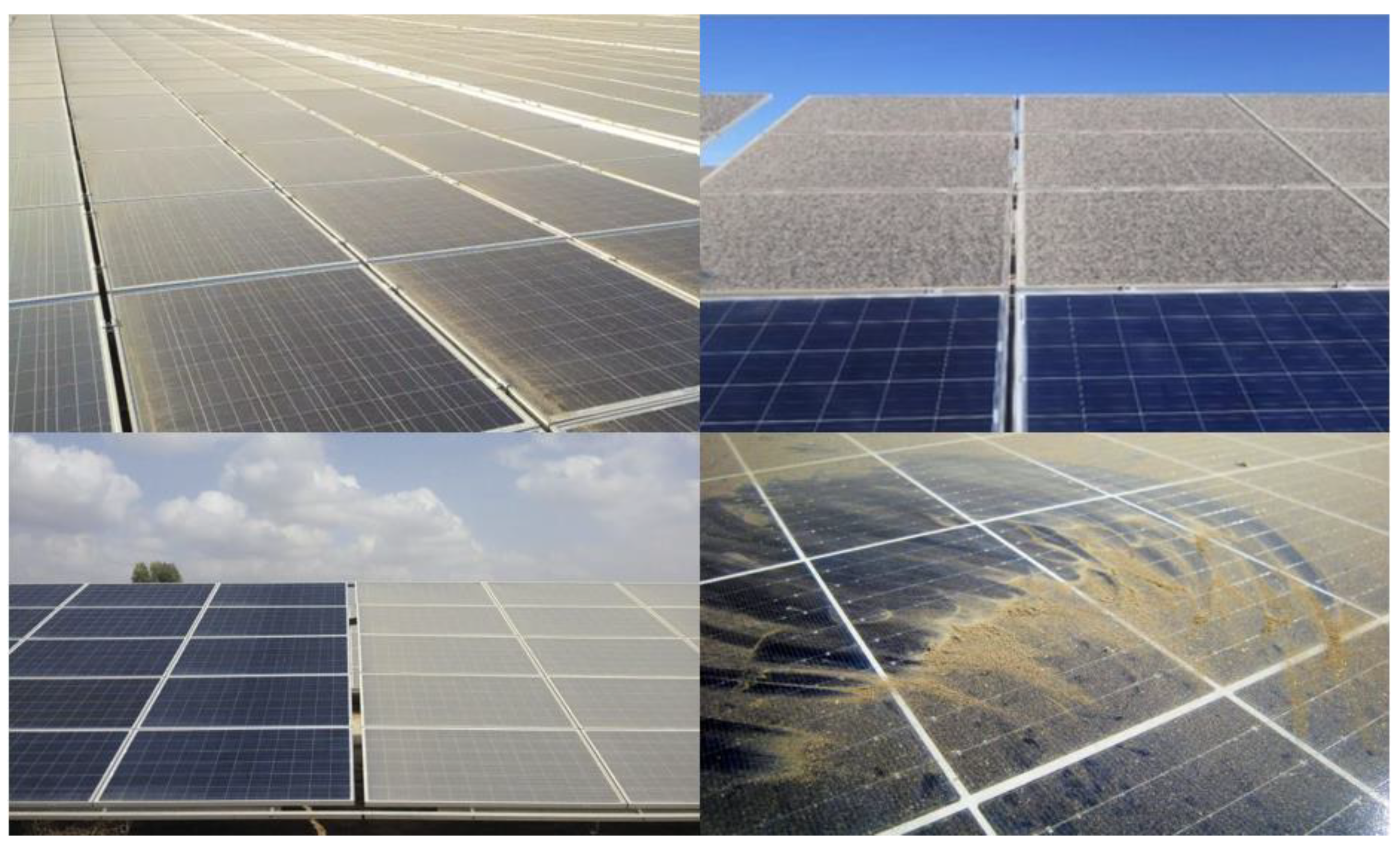
Figure 4.
Step-by-step process of the proposed work.
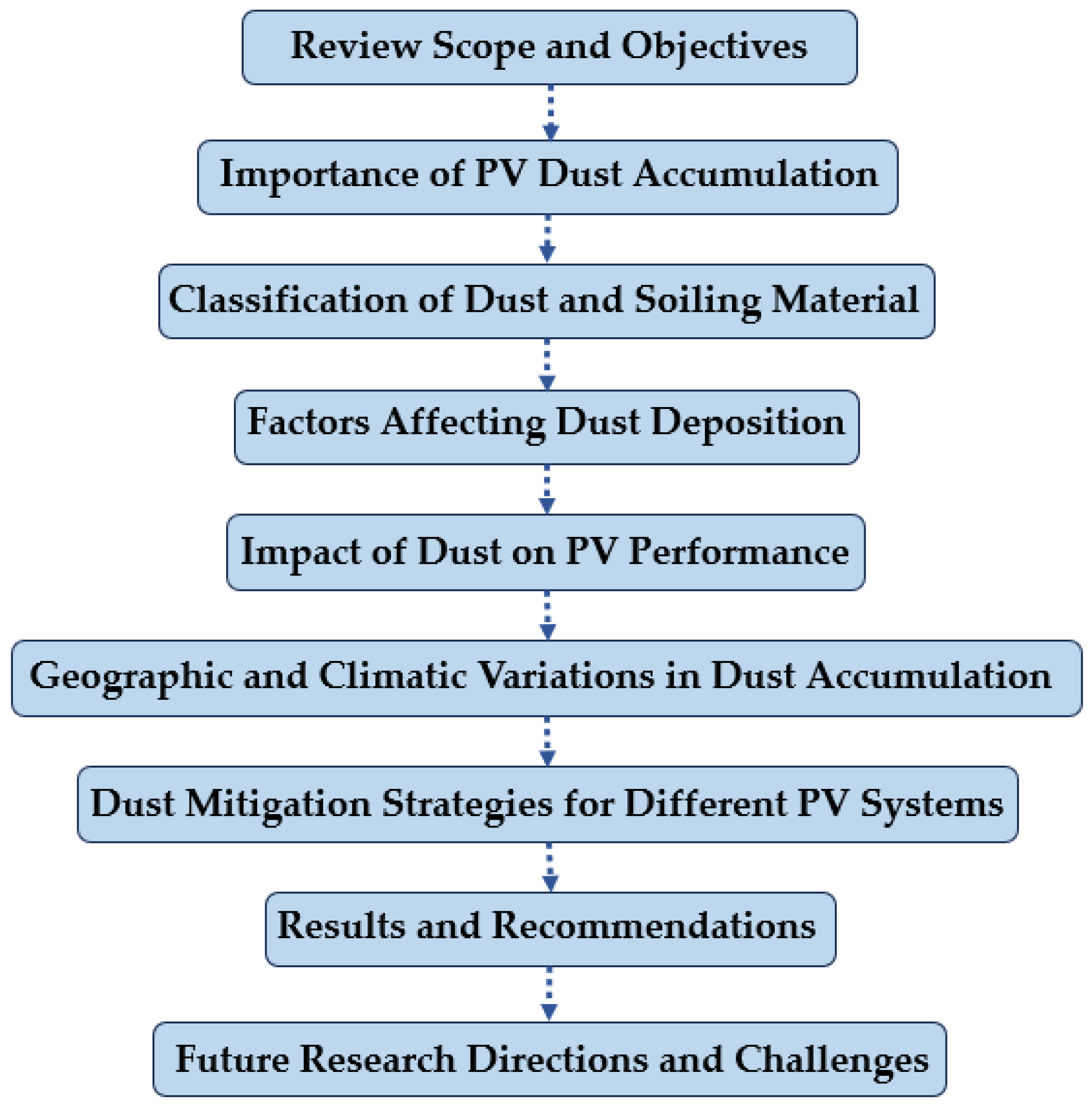
Figure 5.
Raw Materials of different categories of dust components [37].
Figure 5.
Raw Materials of different categories of dust components [37].
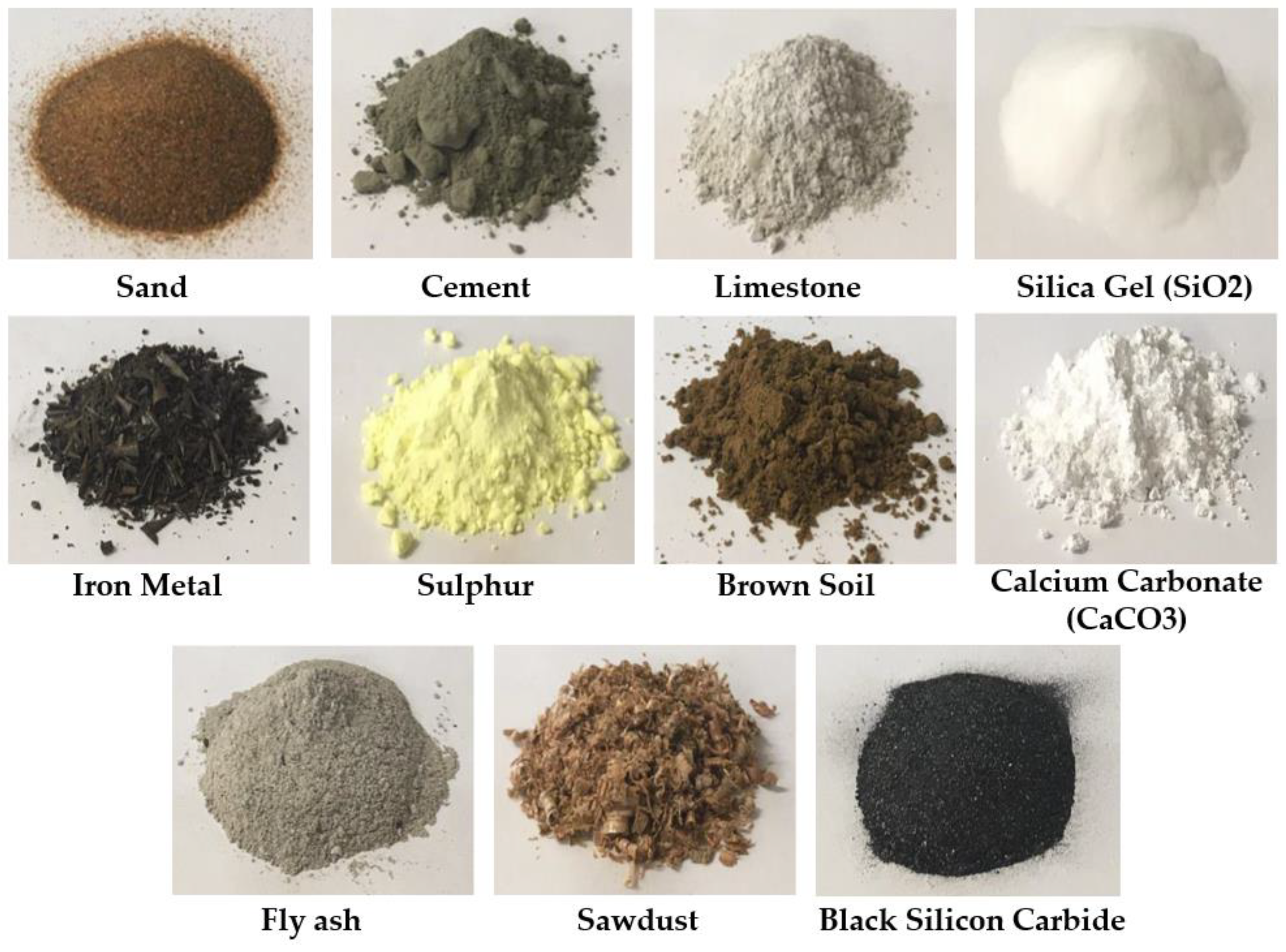
Figure 6.
Different types of factors of dust accumulation on the PV module.
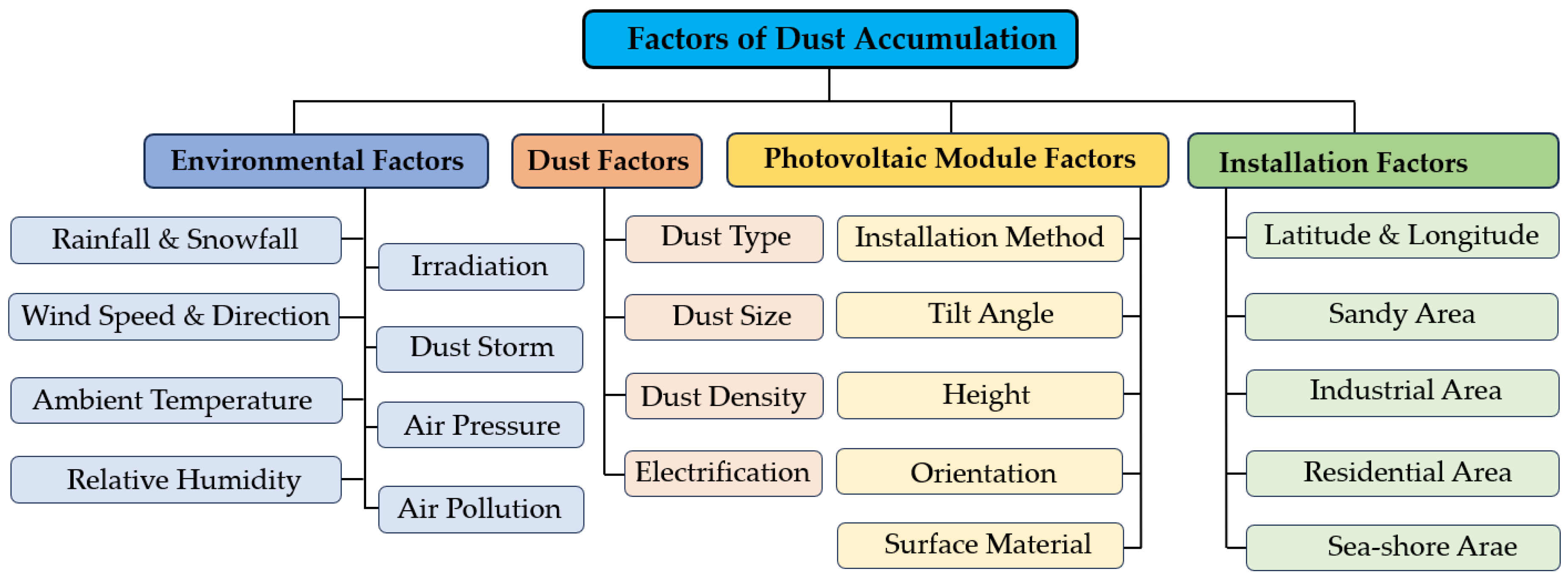
Figure 7.
Various dust mitigation strategies for solar power systems.
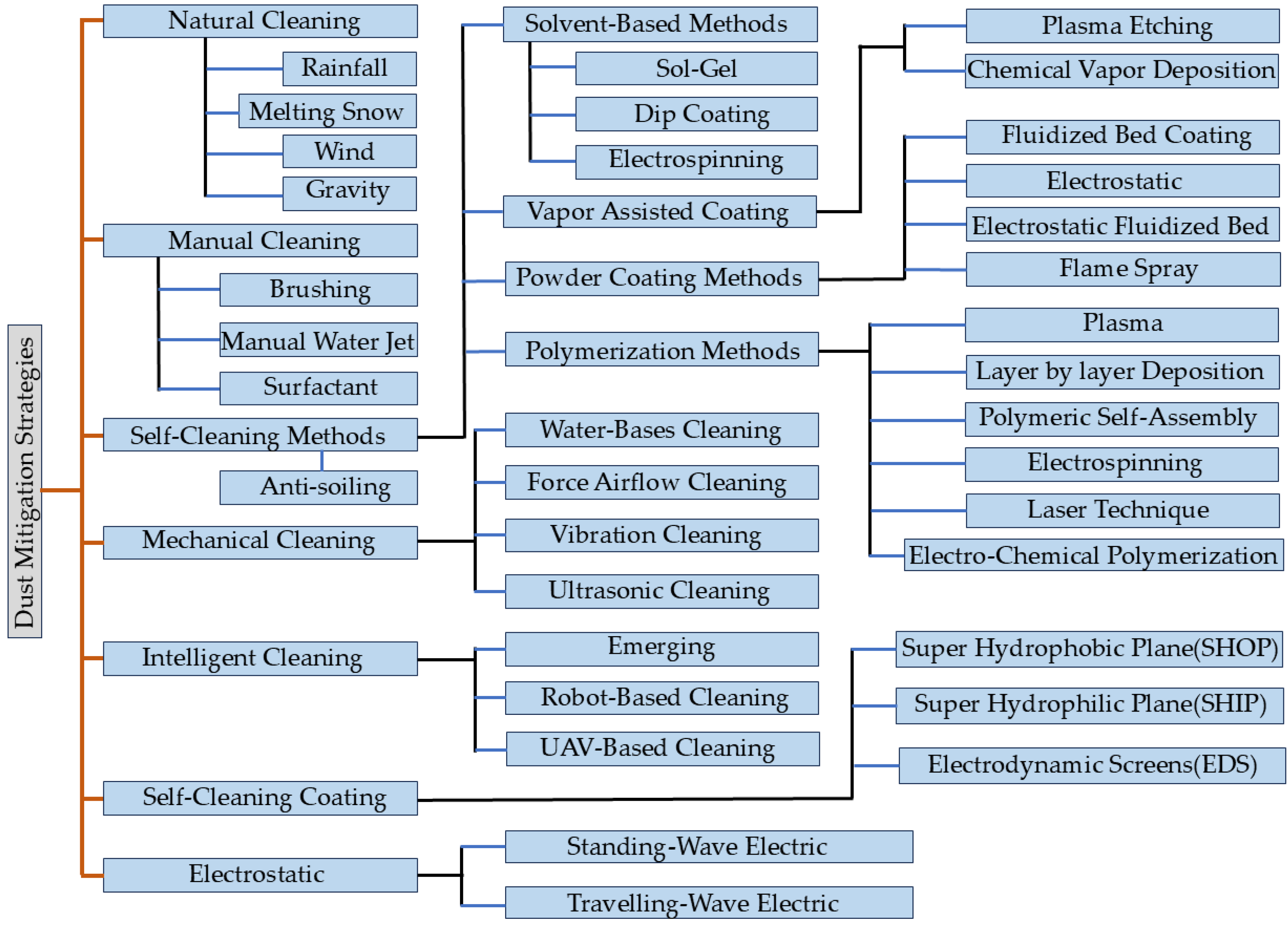
Figure 8.
Natural dust cleaning methods of PV module.
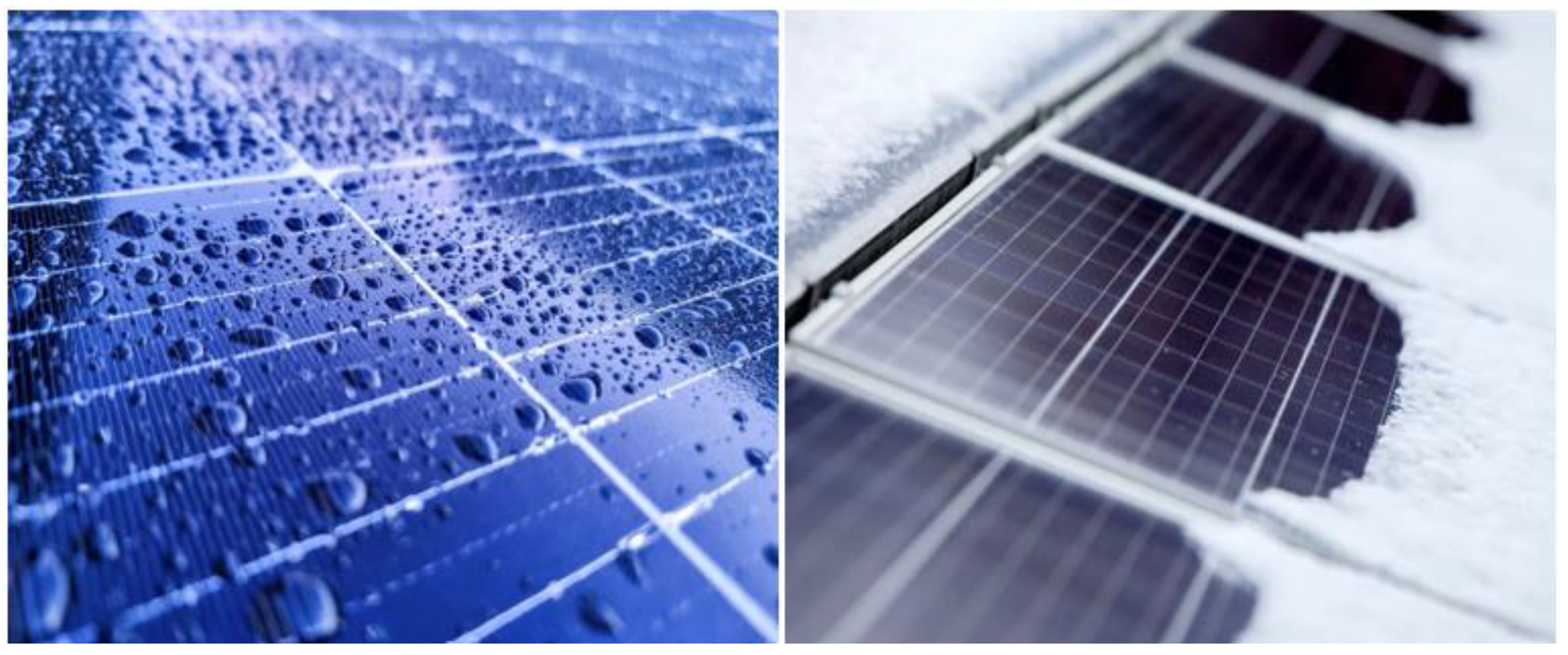
Figure 9.
Manual cleaning methods
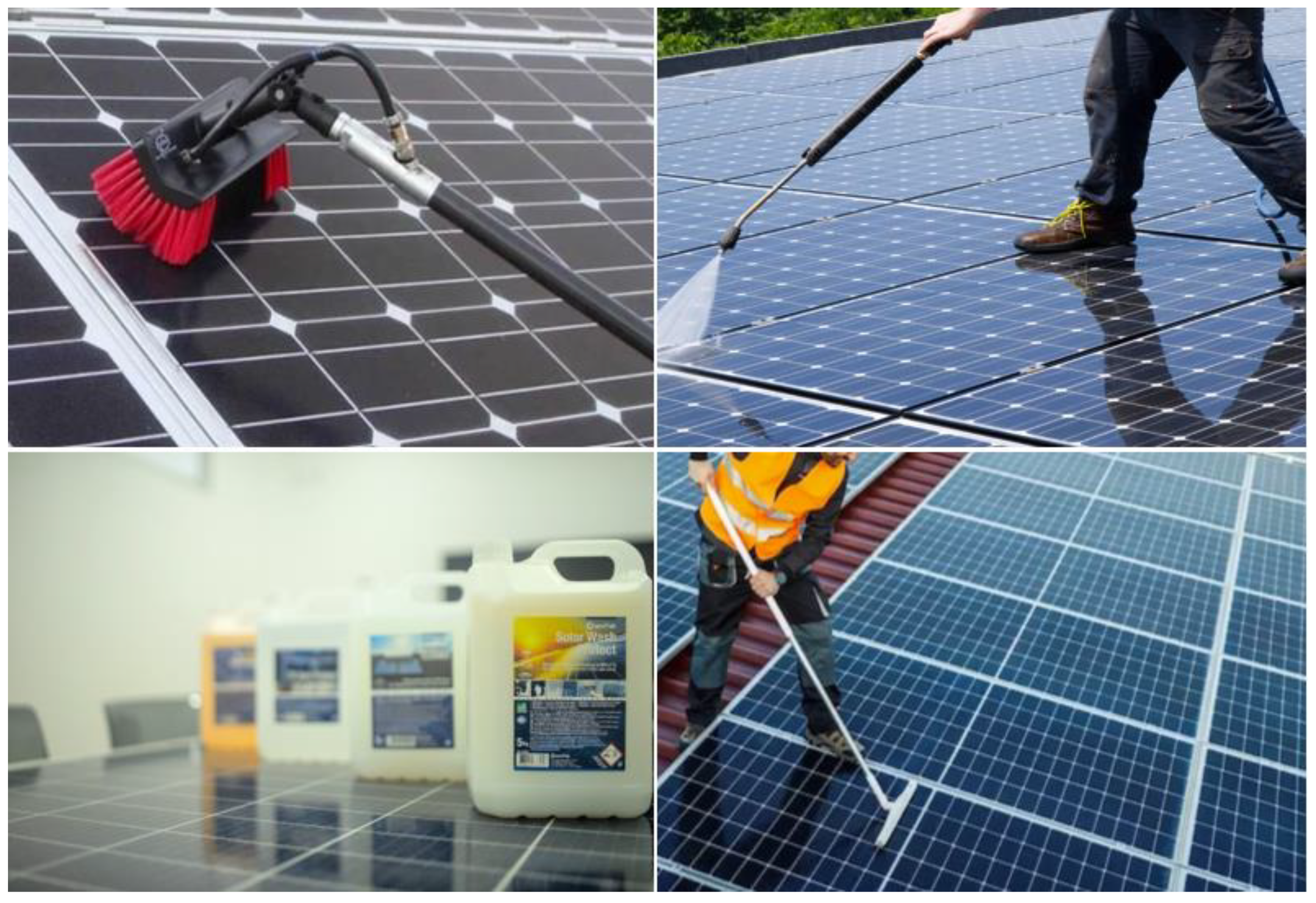
Figure 10.
Conventional Mechanical Cleaning Methods
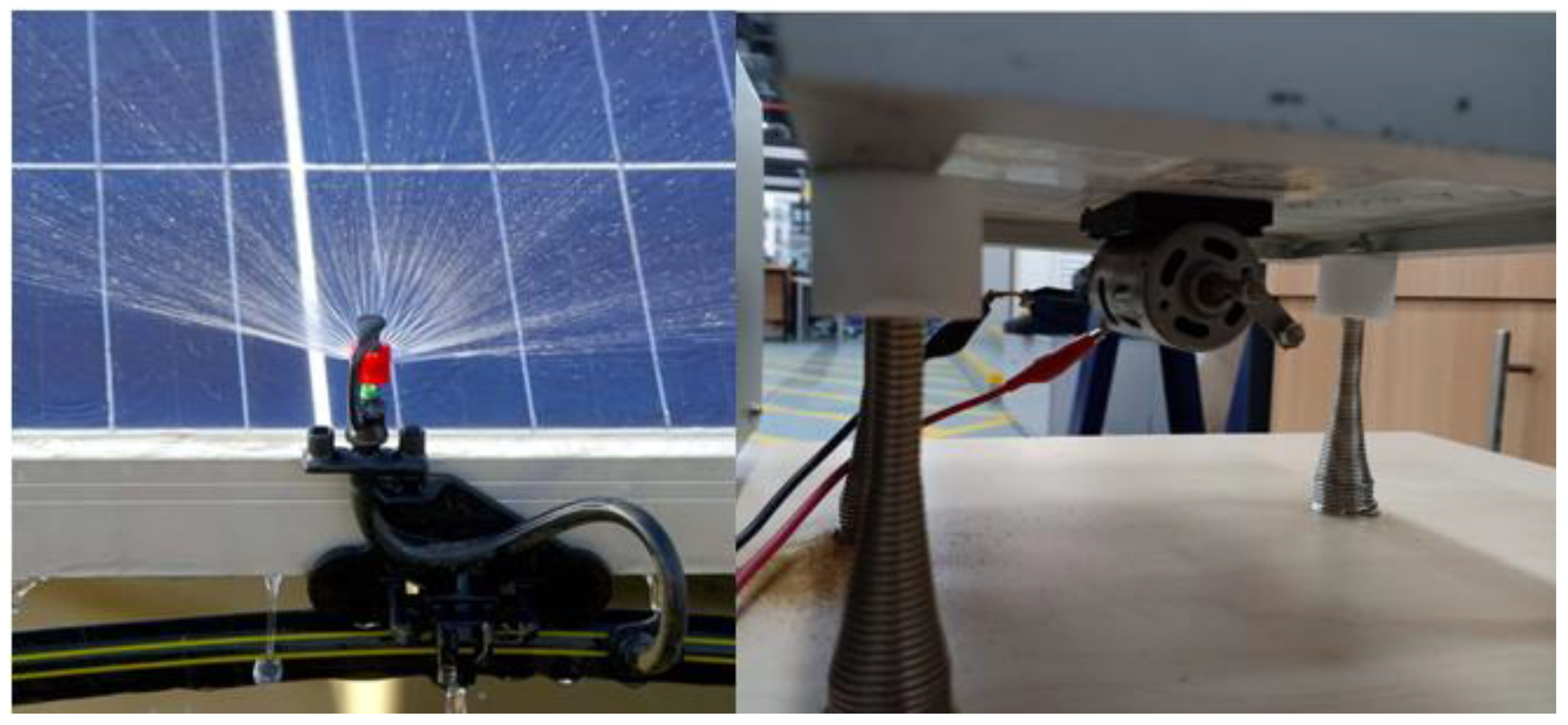
Figure 11.
Intelligent Cleaning Methods
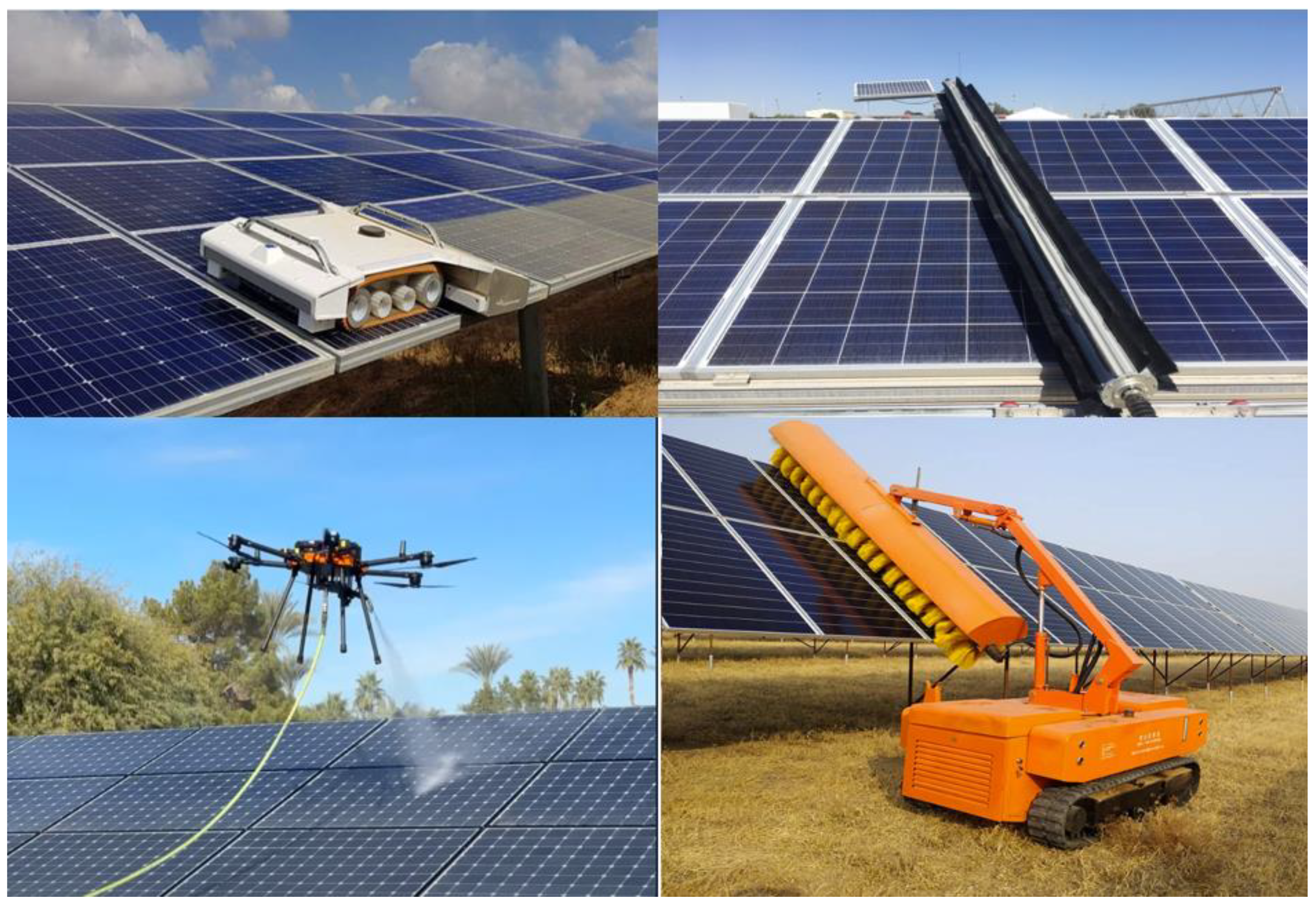
Figure 12.
Electrostatic Cleaning Methods
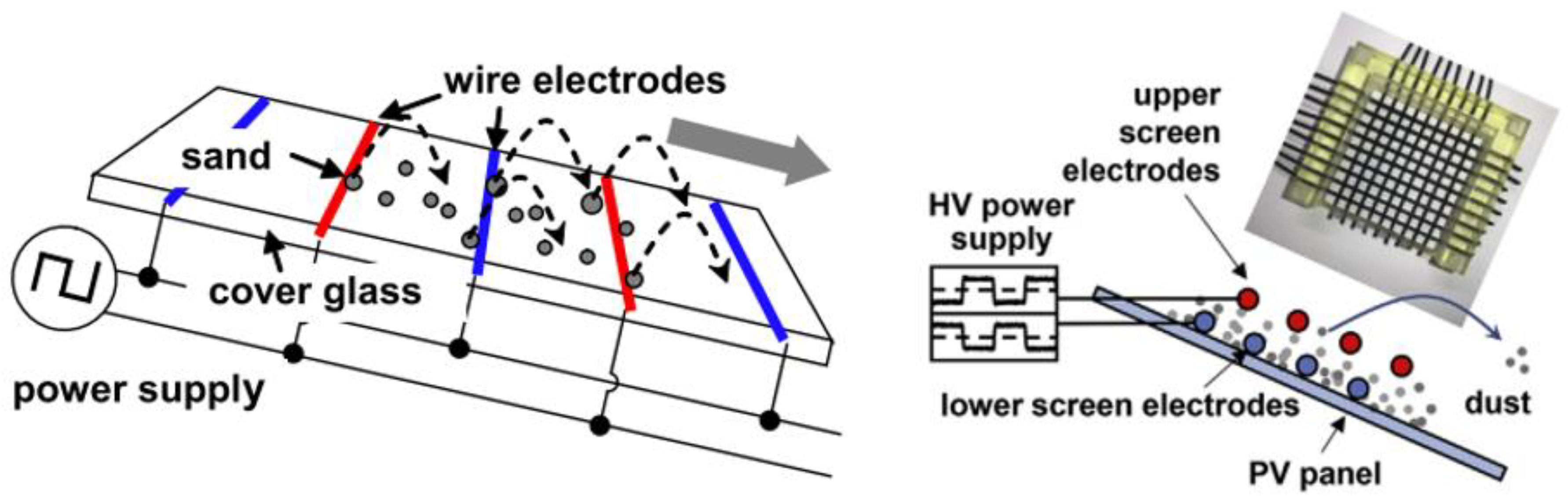
Figure 13.
The maximum efficiency of the various solar photovoltaic panel cleaning methods[143,228,240,241,242,243].
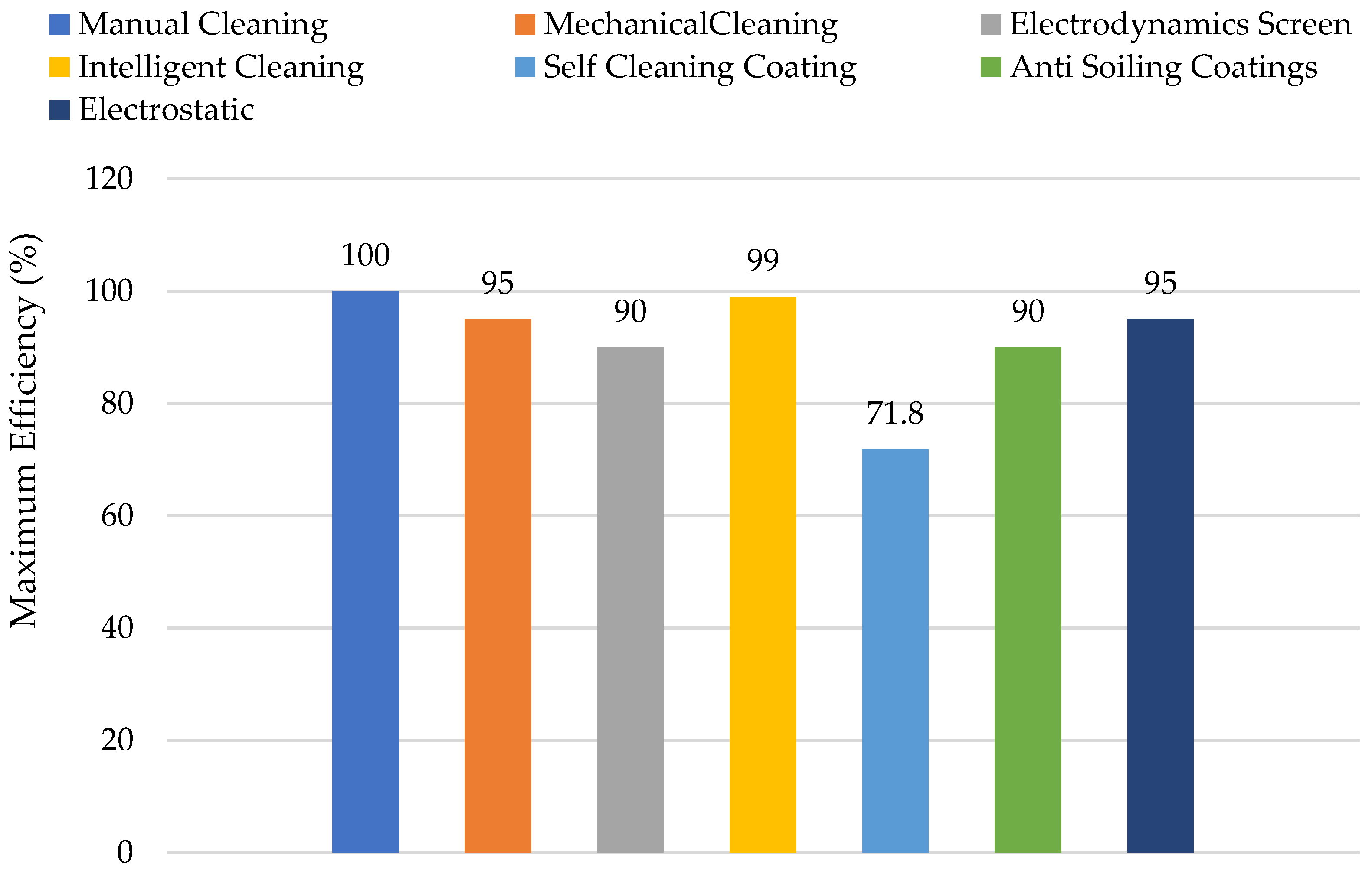
Figure 14.
Comparison of operational cost, labor cost, and human safety between various cleaning methods[153], [244,245,246,247].
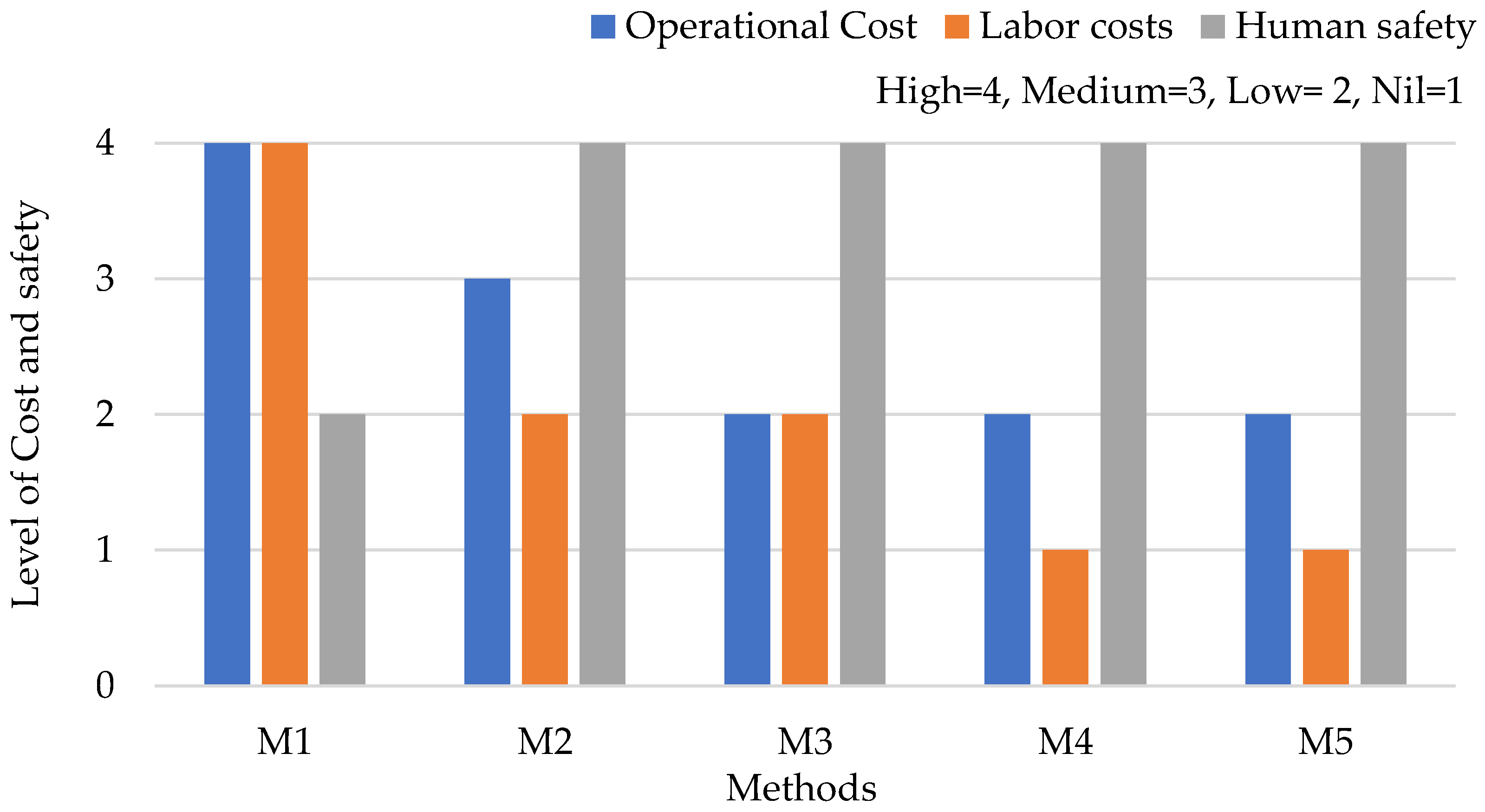

Table 1.
Accumulated Dust Material Classification for Solar Photovoltaic Panels
| Category | Types | Typical Composition / Origin | Impact on PV Performance | Ref. |
|---|---|---|---|---|
| Mineral Dust | Desert dust, soil, sand, and clay particles | Quartz, feldspar, clay minerals (silica, aluminosilicates) | Significant optical attenuation due to scattering and absorption is typical in arid regions | [25,26] |
| Anthropogenic/Industrial Particulates | Engine exhaust, urban soot, industrial emissions | Carbonaceous particles, metal oxides | Fine absorptive particles that increase light loss; higher adhesion in polluted areas | [25,26] |
| Organic/Biological Particles | Pollen, biofilms, plant debris, microorganisms | Organic matter, cellulose, biological residues | Creates sticky layers, potential biofilm formation; can trap more dust | [27] |
| Bird & Animal Droppings | Bird excreta, insect deposits | Mixed organic/inorganic components | Causes localized shading and hot spots; strong adhesion, high optical blockage. | [25] |
| Agricultural Emissions / Mixed Soil | Crop dust, fertilizer dust | Mineral + organic components | Variable effects depending on composition and weather | [27] |
| Coastal/Saline Particles | Sea salt, saline dust | NaCl, MgCl₂ from coastal environments | Salt crystals promote micro-scratching and wet adhesion, relevant for coastal PV installations. | [28] |
Table 2.
Power loss of the PV module due to dust for multiple durations.
| Ref. | Location | Duration | Soiling Loss of PV System |
|---|---|---|---|
| [80] 2023 |
Slangor, Malaysia | 5 weeks | The Solar photovoltaic module experienced a 20% efficiency loss due to overheating and dust accumulation. |
| [81] 2022 |
Dhahran, Saudi Arabia | 6 months | The power of the PV module dropped more than 50% |
| [82] 2022 |
Shiraz, Iran | 6 months | approximately 9% soiling power loss of PV modules with increasing dust density |
| [83] 2022 |
Melaka, Malaysia | 1 month | The PV module's power output performance declined by 7.29%, although the dust effect was mitigated. |
| [44] 2021 |
Niˇs, Serbia | 168 days | Maximum fly ash-induced power decrease of the solar modules, up to 87.2% |
| [84] 2020 |
Baghdad, Iraq | 2 months | The PV system's production drops by 35–40%. |
| [85] 2020 |
Dakar, Senegal | 30 days | Reduce the total power of the transmittance by more than 50% at a dust density of 3.3 g/m2. |
| [86] 2018 |
Tehran, Iran | 70 days | PV power production was reduced by 21.47% due to dust accumulation on the surface (6.0986g/m2). |
| [87] 2017 |
Shaanxi, China | 8 days | According to relative transmittance, the PV module's power production decreased by 20%. |
| [51] 2016 |
Norway and South Africa | 7 days | For every 10 mg/m2 of dust, there is a 2.8% reduction in PV transmission power. |
| [88] 2016 |
Aswan, Egypt | 21 days | At a 15° tilt angle, accumulated soiling causes a 5% drop in output power. |
| [89] 2015 |
Perth, Australia | 18 years | Dust deposition causes a 16–29% loss in PV output, whereas delamination causes a 71–84% decrease. |
| [90] 2015 |
Dhahran, Saudi Arabia | 6 weeks | Significant reduction in PV power generation of up to 10%–17% of global efficiency |
| [91] 2014 |
Thailand | 60 Days | 7.28% maximum power reduction due to the soiling of the PV module |
| [92] 2013 |
Dhahran, Saudi Arabia | 8 months | PV module 49% maximum power reduction due to dust effect |
| [93] 2013 |
Limassol, Cyprus | 10 weeks | For 10 weeks 8% maximum power reduction by dust effect |
| [94] 2012 |
Taiyuan. China | 2 weeks | 32.6% maximum power reduction |
| [95] 2011 |
Puglia, Italy | 8 weeks | 6.9% maximum power reduction |
| [96] 2001 |
Tehran, Iran | 8 days | Short time duration, 43 % maximum power reduction of the PV module |
| [97] 1997 |
Cologne, Germany | 5 years | 24 % maximum power reduction |
| [98] 1988 |
Sokoto, Nigeria | 4 months | 60% maximum power reduction |
| [99] 1987 |
Kuwait | 14 months | 55% maximum power reduction |
Table 3.
Dust impact on PV performance under climatic variations.
| Ref. | Location | Climate | System Type | Dust Deposition (g/m²) | Efficiency Reduction (%) | Key Findings |
|---|---|---|---|---|---|---|
| [19] | India | Tropical | Rooftop | 4.4 | 16–50 | Found significant seasonal variations, with the monsoon reducing dust accumulation. |
| [105] | UAE | Arid | Ground-Mounted | 5.44 | 12.7 | Reported that wind-blown sand in desert environments severely affects PV performance. |
| [106] | Egypt | Arid | Rooftop | 5.0 | 30 | Highlighted that high dust deposition rates in urban areas result in rapid degradation. |
| [107] | Iraq | Arid | Ground-Mounted | 1.75 | 5–13 | Observed that humidity enhances dust adhesion, worsening performance losses. |
| [108] | Saudi Arabia | Arid | Ground-Mounted | 8.0 | 30 | Found that frequent dust storms lead to high PV degradation in desert regions. |
| [109] | Malaysia | Tropical | Rooftop | 3.2 | 10–18 | Concluded that rainfall partially cleans PV panels, but dust buildup still affects efficiency. |
| [45] | Global | Mix | ---- | 0.35–0.63 | 0.1–1.4 | Showed that industrial pollutants mixed with dust increase deposition rates. |
| [110] | Morocco | Semi-Arid | Ground-Mounted | 6.5 | 5-10 | Reported that PV efficiency drops rapidly in the absence of regular cleaning. |
| [111] | Egypt | Arid | Rooftop | 7.5 | 20 | Stated that the tilt angle influences dust accumulation, with flat panels experiencing higher losses. |
| [112] | USA | Temperate | Rooftop | 2.5 | 5–12 | Demonstrated that dust particle size impacts efficiency loss, with finer particles being more problematic. |
| [113] | Pakistan | Arid | Ground-Mounted | 5.8 | 28 | Observed that solar irradiance loss due to dust leads to underestimated energy yield predictions. |
| [114] | Oman | Arid | Rooftop | 6.0 | 32 | Found that high humidity in coastal areas leads to sticky dust, making removal harder. |
| [115] | Saudi Arabia | Arid | Rooftop | ---- | 2-21 | Stressed the importance of frequent cleaning schedules in desert conditions. |
| [116] | Iraq | Arid | Rooftop | ---- | 23.1–31.4 | Showed that biological dust (pollen, algae growth) is a major factor in PV efficiency losses. |
| [117] | Global | Mix | ---- | 6.086–21.47 | 2.8–50 | Found that rural and urban dust sources influence deposition rates differently. |
Table 4.
Seasonal Impact of Dust on PV Performance.
| Study | Location | Season | Average Dust Deposition (g/m²) | Efficiency Drop (%) | Observed Seasonal Effects |
| [19] | India | Dry | 5.2 | 20–50 | Higher dust accumulation in summer due to lack of rainfall; efficiency drops significantly. |
| [100] | Egypt | Dry | 7.5 | 30 | Dust adhesion increases with high temperatures, requiring frequent cleaning. |
| [109] | Malaysia | Wet | 2.8 | 5–12 | Frequent rainfall reduces dust accumulation, maintaining PV efficiency. |
| [129] | China | Desert | 1.5 | 63 | Desert environments significantly increase dust deposition, resulting in severe performance losses. |
| [106] | Egypt | Wet | 3.1 | 15 | Humidity increases dust adhesion, affecting PV efficiency even in wet seasons. |
| [18] | Saudi Arabia | Dry | 10.5 | 35 | Wind-driven sandstorms lead to higher dust accumulation in the summer. |
| [127] | Iran | Hot season |
0.8 | 30 | Dust intensity is notably higher in the southwest, center, and southeast of Iran during spring and summer. |
| [130] | China | Dry | 0.524 | 38.25 | seasonal effects on dust deposition or efficiency drop |
| [131] | Oman | Dry | ** | 5 | Dust accumulation is lower during the non-summer period compared to the summer period. |
| [114] | Oman | Wet | 3.8 | 12 | Coastal humidity increases sticky dust accumulation, requiring additional cleaning. |
| [132] | Turkey | ** | ** | ** | observed seasonal effects on dust deposition or efficiency loss |
| [133] | Asia | Dry | ** | 7.84 | weekly decrease in PV efficiency due to dust |
| [132] | Middle East | Dry | 0.045 to 100 | 4–35 | Summer/dry season: High deposition and efficiency loss |
| [134] | Spain | Dry | ** | 80 | Dust storms in dry seasons cause rapid degradation of PV efficiency. |
| [134] | Portugal | Wet | ** | 3-7 | Tropical rainfall helps remove natural dust, thereby maintaining PV performance. |
Table 5.
Different research papers address PV cleaning techniques in different locations.
| Locations | Year | PV Cleaning technique | Key findings | Ref. |
| Qatar | 2019 | Clothwipers, vacuum cleaners, brushes, and some combinations | For weekly cleaning frequency, the microfiber-based cloth wiper improved its performance by an average of 3.1% and 7.7% in the summer and winter | [138] |
| India | 2022 | Self-cleaning coatings | Analyzed the performance evaluation, cost-effective deposition techniques, and the lifetime of self-cleaning coatings | [139] |
| Turkey | 2022 | Natural cleaning technique | 0.94% of the dust removal effect was obtained due to rainfall | [140] |
| India | 2018 | The automated water-free cleaning device | A 9.05% improvement was obtained in energy output in one month | [141] |
| India | 2017 | Automated cleaning system | 15 to 20% improvement in conversion efficiency | [142] |
| India | 2010 | Automated cleaning system | Compared to the solar PV module, the tracking-cum-cleaning device improved the output energy by 30% in terms of Daily energy generation |
[143] |
| Morocco | 2021 | Manual cleaning technique | Cleaning with a robot once a week is more profitable than doing it manually twice a week (gain of $15 per month); in the case of CSP, the cost can be further decreased by 13% | [110] |
| India | 2022 | Automatic cleaning by the wiper | The solar system efficiency was improved by15–20% | [144] |
| China | 2022 | Water-free cleaning robot | The efficiency improvement ranged from 11.06% to 49.53%, with an average dust cleaning rate of 92.46%. | [145] |
| USA | 2016 | Natural cleaning technique | Natural rainfall is enough to clean the surface of solar PV modules | [146] |
| Saudi Arabia | 2018 | Automated, robotic dry cleaning technique | Robots that use silicone rubber foam brushes can effectively clean the dust from the PV surface at a low Cost and without damaging the surface of the PV | [147] |
| Pakistan | 2020 | Manual and washing tractor cleaning techniques | Manual cleaning and washing, tractor-assisted cleaning techniques were compared to techno economically |
[148] |
| Egypt | 2020 | Mechanical vibrator cleaning technique | Vibration system applications improve performance more than self-cleaning coatings | [149] |
| Pakistan | 2021 | Automatic self-cleaning mechanism | 35% improvement was obtained in the efficiency of the PV module | [150] |
| Bahrain | 2018 | Manual and natural cleaning techniques | 7% loss in the energy output of the PV cleaned once a year, compared to 17% loss cleaned naturally | [151] |
| Spain | 2020 | Natural cleaning techniques | Probability of a 50% reduction in a soiling ratio by 2.2 mm rainfall | [52] |
| Iraq | 2020 | Water-based cleaning technique | Tide Surfactant No.(3) with water improves the generating power by upto 7.4%, and surfactant No.(4) improves energy produced by about 5.9% | [152] |
| Jordan | 2015 | Portable robot system | The portable robot system device was developed and could clean 80% surface of the solar PV module | [153] |
| Qatar | 2019 | Electrodynamic dust shield cleaning technique | Electro dynamic screen could reduce soiling loss by 16–33% | [154] |
| China | 2018 | Wind cleaning technique | The wind successfully removed particles with a diameter bigger than 1µm | [140] |
| Egypt | 2013 | Water mixed with surfactants | The efficiency remained constant with the cleaning of the surface with a mixture of cationic and anionic surfactants mixed with water, and the efficiency was decreased by 50% after 45 days by cleaning with only water | [155] |
| USA | 2017 | Electrodynamic dust shield cleaning technique | 95% power output of CSP can be restored by electrodynamic screen-film laminated cleaning technique |
[156] |
| Qatar | 2017 | Electrodynamic dust shield cleaning technique | The parameters of the electrodynamic screen for the optimal cleaning efficiency of the PV module were analyzed | [157] |
| USA | 2008 | Electrodynamic dust shield cleaning technique | The electrodynamic dust screen cleaning model was made for the solar PV module, effectively removing the dust from the surface |
[158] |
Table 6.
Comparison of Dust Cleaning and Prevention Techniques.
| Technique | Description | Advantages | Limitations | Ref. |
| Manual Cleaning | Hand-held tools or mechanical brushes are used to remove dust from PV surfaces. | Simple, low-cost, effective in localized areas, and easy to implement. | Labor-intensive, it can be abrasive, and risks damage to the PV surface if not done correctly. | [146,232] |
| Water-Based Cleaning | Using water jets or hoses to wash away dust from PV panels. | Effective in removing large quantities of dust quickly and thoroughly. | Water usage may be excessive, especially in arid regions, which can lead to concerns about water runoff. | [138,233] |
| Robotic Cleaning Systems | Automated robotic devices that move along PV modules and clean using brushes or sponges. | Reduces human labor, provides precise cleaning, and minimizes surface abrasion. | High initial cost, requires maintenance, and may struggle with complex panel layouts. | [234] |
| Hydrophobic Anti-Dust Coatings | Coatings applied to PV surfaces that repel dust particles due to their water-resistant properties. | Long-term protection reduces the need for frequent cleaning and improves cleaning efficiency. | Coating degradation over time can be expensive and may not be effective in high-density dust environments. | [235,236] |
| Electrostatic Cleaning | Uses electrostatic fields to attract and remove dust particles from PV panels. | Requires minimal water usage, is effective for small particles, and is environmentally friendly. | Environmental conditions can influence the high installation cost and effectiveness. | [213,237] |
| Self-Cleaning Glass | Glass coatings with self-cleaning properties often use a combination of hydrophobic and photocatalytic effects to break down dust particles. | Minimal maintenance required, self-cleaning under sunlight, and efficient in moderate dust conditions. | Expensive, may not be fully effective in high-dust accumulation areas, and it can degrade over time. | [176,238] |
| Brush-Based Mechanical Systems | Automated mechanical brushes that sweep over the surface to remove dust. | Energy-efficient, low water consumption, and adaptable for large installations. | Risk of abrasion on PV surfaces, potential for damage to delicate components, and high operational costs in remote areas. | [178,239] |
| Air Blowers and Compressed Air | Utilizes compressed air to dislodge dust particles from PV panels. | Quick, water-free solution that is effective in dry regions with moderate dust accumulation. | High energy consumption is inadequate for heavily adhered dust, which can lead to dust redeposition. | [203,205] |
Disclaimer/Publisher’s Note: The statements, opinions and data contained in all publications are solely those of the individual author(s) and contributor(s) and not of MDPI and/or the editor(s). MDPI and/or the editor(s) disclaim responsibility for any injury to people or property resulting from any ideas, methods, instructions or products referred to in the content. |
© 2026 by the authors. Licensee MDPI, Basel, Switzerland. This article is an open access article distributed under the terms and conditions of the Creative Commons Attribution (CC BY) license (http://creativecommons.org/licenses/by/4.0/).
Copyright: This open access article is published under a Creative Commons CC BY 4.0 license, which permit the free download, distribution, and reuse, provided that the author and preprint are cited in any reuse.