

Submitted:
20 March 2026
Posted:
23 March 2026
You are already at the latest version
Abstract
Chromosomal rearrangements involving the Lysine Methyl Transferase 2 A (KMT2A) define a genetically distinct subset of acute myeloid leukemia (AML) in about 10% of cases in adult patients; the frequency of KMT2A-r is higher in pediatric AML. Translocations involving the KMT2A-locus at chromosome 11q23 result in the formation of a chimeric oncogene partner, where the N-terminal part of KMT2A is fused to a variety of translocation partners. The leukemogenic activity of KMT2A-fusion partners is related to their capacity to hyperactivate the expression of HOX-A and MEIS1 target genes which stimulate the proliferation and expansion of hematopoietic stem cells. The oncogenic activity of KMT2A fusion proteins requires the interaction with Menin and this interaction can be targeted pharmacologically by small molecules acting as potent and selective Menin inhibitors. The presence of KMT2A-r is associated with adverse outcomes in AML patients. In the present review article, we summarize our current understanding about the biology of KMT2A-r in AML development and the recent consistent progresses made in the treatment of KMT2A-r AML through new chemotherapy regimens and targeted therapy using Menin inhibitors. These studies have led to consistent improvements in the outcomes of KMT2A-r AML patients. However, the prognosis of older KMT2A-r AML patients remains poor and could be improved by drug combination studies including Menin inhibitors. Many encouraging observations derived from ongoing clinical trials with Menin inhibitors need to be confirmed through randomized clinical trials.
Keywords:
acute myeloid leukemia
; KMT2A rearrangements
; menin inhibitors
; targeted therapy
; intensive chemotherapy
; HOX genes
1. Introduction
Acute Myeloid Leukemia (AML) is a heterogeneous hematologic malignancy characterized by clonal expansion, uncontrolled proliferation, and differentiation arrest of myeloid progenitor cells. AMLs are highly heterogeneous at molecular level and are characterized by multiple somatic genetic events, some of them acting as driver genetic events.
Lysine Methylase 2 A gene (KMT2A), a histone 3 lysine 4 methyltransferase, previously known as mixed-lineage leukemia (MLL) plays a key role in the control of normal hematopoiesis and its alterations are frequently observed in several hematologic malignancies.
KMT2A gene displays frequent alterations in AML. Three types of KMT2A gene alterations may be observed in AML: (i) rearrangements of KMT2A gene involving events of balanced translocations between the KMT2A gene and a partner gene with formation of a fusion gene and a corresponding fusion protein composed by the N terminus of the KMT2A gene fused in frame to one of many different partners; (ii) KMT2A-PTD, involving the duplication of KMT2A gene segment comprised between exons 2 to 9; (iii) point mutations of the KMT2A gene [1]. A recent study carried out at the Cleveland Clinic Foundation, Ohio, USA explored KMT2A gene alterations in 730 adult AML patients, showing 88% of patients with KMT2A-WT and 12% with KMT2A alterations: 5.7% with KMT2A-r, 3.2% with KMT2A point mutation and 2.3% KMT2-PTD [1].
AML with KMT2A-r is recognized as a clinically and biologically distinct entity in the current classification of AML. Rearrangement of KMT2A gene in AML results in the generation of fusion proteins that cause epigenetic dysregulation of hematopoietic cells and upregulation of HOXA, HOXB and MEIS1 genes leading to leukemia. AML with KMT2A-PTD is increasingly recognized as a distinct molecular entity in AML, associated with distinct gene signatures (high HOX gene expression) and adverse prognosis.
The aim of the present study is to provide an overview of the recent progresses made in the understanding of the molecular pathogenesis, in the biologic and clinical characterization and response to therapy of AMLs with KMT2A abnormalities, including recent developments in newer targeted therapies.
2. KMT2A Gene and Protein Structure
The histone methyltransferase 2 family comprises a highly conserved group of histone methyltransferase enzymes that are involved in mono-, di-, and tri-methylation at histone three lysine 4 through the enzymatic activity of their conserved SET domain [2]. Six mammalian KMT2 proteins of three subgroups, KMT2A/B (MLL 1-2), KMT2 C/D (MLL 3-4) and KMT2 F/G (SETD1 A/B) have shared and distinct protein domains, catalytic substrates, genomic locations, and associated complex subunits [2]. The C-terminal SET catalytic domain of KMT2A confers mono, di- and tri-methylation on histone H3K4.
The KMT2A gene, initially identified as the MLL gene is located at chromosomal position 11q23. Due to its homology to the Drosophila Trithorax protein, it was designated as the Trithorax-like gene, ALL-1 and the human homolog of Drosophila Trithorax “HRX”.
The KMT2A gene comprises 38 exons, including the 5′ and 3′-untranslated regions (UTR), distributed across a 90,375 bp region at 11q23.3. The major breakpoint cluster region (BRC1) is located at the level of a DNA sequence comprised between KMT2A exons 9 and 12 (>90% of KMT2A rearrangements), while a minor breakpoint cluster region (BCR2) is mostly located between exons 21 and 25 [3].
Figure 1.
Structure of the WT KMT2A protein (top) and KMT2A fusion protein formed through gene rearrangement events. The main structural elements of KMT2A protein are reported and their function is analyzed in the text.
Figure 1.
Structure of the WT KMT2A protein (top) and KMT2A fusion protein formed through gene rearrangement events. The main structural elements of KMT2A protein are reported and their function is analyzed in the text.
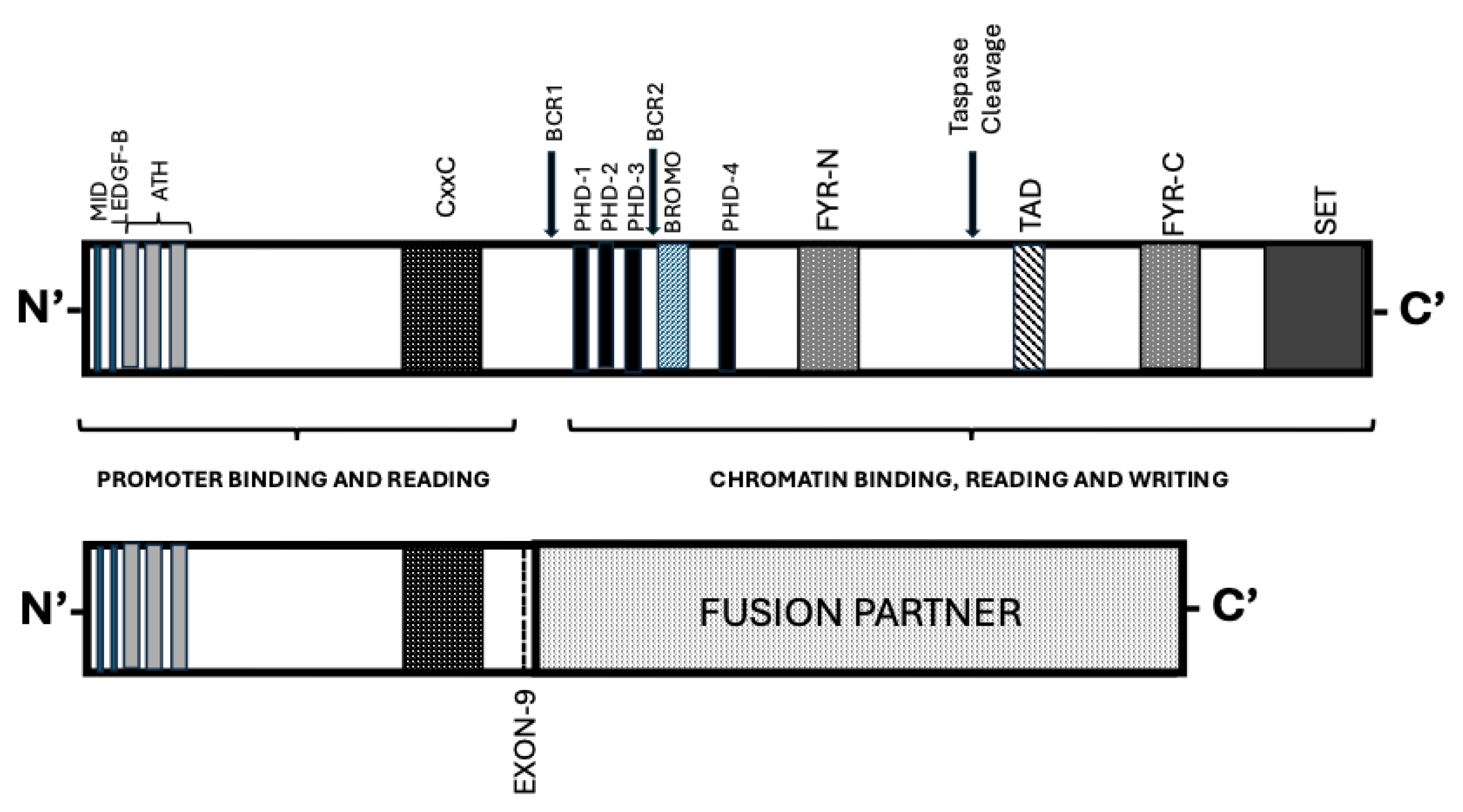
KMT2A is a 500 kDa protein and acts as a key epigenetic regulator that exerts its biological activity as a “writer” of histone markers, to control gene expression during hematopoiesis. The KMT2A protein is organized at structural level with a modular design with molecule regions involved in mediating DNA binding, protein-protein interactions and enzymatic activity. The full-length KMT2A protein is cleaved by the endopeptidase Taspase 1 into two different subunits: KMT2A N-terminal (KMT2AN) and KMT2A-C-terminal (KMT2AC); these two subunits are non-covalently linked at the level of FYRNR and FYRC domains and exert their function together as a heterodimer [4]. The N-terminal subunit of KMT2A protein contains several functional domains mainly represented by: binding DNA sequences for Menin (MID) and LEDGF (Lens Epithelium Derived Growth Factor), required for guiding the complex between KMT2A and Menin, LEDGF proteins to target genes; three AT-hooks required for DNA binding; a CxxC domain, known also as MBD, required to promote binding of unmethylated CpG islands located in gene promoters [3,4]. The C-terminal domain contains two functional domains: the catalytic SET domain which possesses methyltransferase activity; the TAD domain which interacts with the histone acetyltransferase CBP/p300, MD2 and MOF to unable appropriate histone acetylation [3,4]. The N-terminal domain contains also two sets of regulatory domains: Plant Homeodomain (PHD) and Bromodomain (BRD). PHDs are zinc-finger structures that function as chromatin readers, guiding KMT2A methyltransferase enzyme to specific active genomic regions. BRD functions as an epigenetic reader that recognizes acetylated lysine residues on histones, enhancing the interaction of adjacent PHD domain with the H3K4me3 mark.
The main biological function of KMT2A consists in acting as an epigenetic writer that catalyzes the mono-, di-, and tri-methylation of histone 3 on lysine 4 (H3K4 me 1/2/3). Through this activity, KMT2A acts as a transcriptional regulator of gene activity: H3K4 methylation is associated with an open chromatin conformation and active gene transcription. KMT2A exerts a number of important functions in the control of normal hematopoiesis, particularly at the level of the HSC compartment. Thus, KMT2A is required for HSC maintenance and self-renewal, as shown by experiments of KMT2A gene deletion showing a severe impairment of HSC proliferation and long-term repopulating capacity [5]. At molecular level, KMT2A acts as a transcriptional coactivator, maintaining the expression of a set of genes, such as HOXA9, HOXA7, MEIS1 and PRDM16, which are crucial for the development and homeostatic regulation of hematopoietic stem and progenitor cells [5]. KMT2A exerts also an important role in the regulation of hematopoietic differentiation through a control of the Rac/Rho/integrin signaling pathway. Finally, KMT2A exerts an important role in the cell cycle control and in the control of genomic stability, a function fundamental for the HSC compartment [5].
In acute leukemias, chromosomal translocations generate KMT2A fusion genes and the corresponding proteins in which the N-terminus of the KMT2A gene is fused in-frame to one of many different partners. There are over 90 unique oncogenic fusion partners that have been documented [3,4]. Frequent KMT2A rearrangements are represented by t(9;11)/KMT2A-MLLT3, t(6;11)/KMT2A-AFDN, t(11;19)(q23;p13.1)/KMT2A-ELL, t/ins(10;11)(p13;q23)/KMT2A-MLLT10, t(11;19)(q23;p13.3)/KMT2A-MLLT1 and t(11;17)(q23;q25)/KMT2A-SEPTIN; KMT2A-PTD, most commonly involving exons 2 to 9, with duplication of CxxC and ATH domains, is transforming despite the absence of a fusion partner [6].
The formation of KMT2A fusion proteins determines a condition of loss of function and gain of function: in fact, the fusion KMT2A protein loses its C-terminal SET domain and then loses its original H3K4 methyltransferase activity but it gains a new potent C-terminal partner. Thus, the chimeric protein uses the retained N-terminal Menin-binding domain to bind to target promoters and uses the partner component, such as the Super Elongation Complex (SEC) to activate high level, deregulated transcription of HOX-A genes.
A consistent number of studies have investigated the mechanisms through which KMT2A fusion genes promote leukemia development. According to these studies, KMT2A fusions can be categorized in 5 functional groups: direct AEP recruiter type (the fusion protein recruits an AEP complex on AF4 protein family), an EN family protein and p-TEFb (positive Transcription Elongation Factor b, a protein complex formed by CDK9 and cyclin T1 or T2); acetyl marker provider type; ENL provider type; multimerization type; partial tandem duplication type [7]. In most of these different categories, there is evidence that the KMT2A fusion proteins act as conditionally active transcriptional regulators, involving HOX-A9 upregulation and constitutive recruitment of AEP [7].
KMT2A-PTD is an intragenic, in frame mutation where N-terminal exons, usually ranging from 2 to 10, are duplicated and inserted in tandem; break points frequently occur in intronic regions flanking exons 2 to 10, causing a direct repeat; The duplication typically encompasses the Menin binding domain and the CxxC domain. The PTD determines a full-length protein followed by an extra est of N-terminal domains, subject to Taspase 1 cleavage, resulting in a unique, stable N-terminal fragment that keeps the SET domain and disrupts normal chromatin regulation. It is important to note that KMT2A-PTDs are complex gene rearrangements whose detection requires multiple genomic platforms, including NGS, OGM (Optical Genome Mapping) and MLPM (Multiplex-ligation Probe Amplification) [8].
The mechanism through which KMT2A-PTD promotes AML development seems to be different from that mediated by KMT2A fusion proteins: in fact, KMT2A-PTD oncoprotein drives AML expression through a molecular mechanism involving ENL but not Menin [9]. This finding had important implications at therapeutic level, in that KMT2A-PTD is characterized by a relative intrinsic resistance to Menin inhibitor monotherapy, which is mediated by a duplication of the CxxC domain and AT hooks of KMT2A. A concomitant inhibition of ENL and AF9YEATS domain, together with a Menin inhibitor seems an strategy in KMT2A-PTD AMLs [9].
The key pathogenetic event operating in AMLs with KMT2A alterations is represented by uncontrolled, deregulated HOX-A gene expression. In normal hematopoiesis, the expression of HOX-A genes is finely tuned by a regulatory network implying activation by the KMT2A complex and repression by PRC2 complex [10]. The deregulated HOX-A expression promotes a leukemic condition by activating a set of target genes which stimulate proliferation, inhibit differentiation and promote survival through inhibition of apoptosis [10]. This dysregulation may be related to different genetic events represented by KMT2A-r, NPM1 mutations, NUP98-r [10].
KMT2A fusion oncoprotein lacks the catalytic SET domain and the KMT2A SET domain from the wild-type allele is dispensable in KMT2A-r; higher H3K4me3 levels are observed in leukemic stem cells and are required for the maintenance of these cells in an undifferentiated condition [11]. A recent study showed that SETD1B (KMT2G) is required for mediating H3K4me3 methylating activity in KMT2A-r AML cells and for the oncogenic activity of KMT2A fusion proteins [12]. Inactivation of SETD1B in KMT2A-r cells inhibits the amplitude of histone methylation and MYC gene expression [12]. SETD1B may represent a therapeutic target in KMT2A-r AML [12].
3. AMLs with KMT2A Rearrangements
KMT2A-r in AML displays an inverse relationship with age appearing most frequently in infants (being observed up to 50-60% of cases in children <2 years) and decreasing to 5-15% in older children and 2.7% in adults [13].
The frequency of the different KMT2A translocations varied with age of AML patients: KMT2A-MLLT10 and KMT2A-MLLT11 fusions are more frequent in pediatric than in adult patients; KMT2A-AFDN is less frequent in pediatric than in adult patients; KMT2A-MLLT3 and KMT2A-ELL fusions are similarly frequent in pediatric and adult patients; KMT2A-PTD is markedly less frequent in pediatric than in adult patients [6] (Figure 2).
Several recent studies have provided a characterization of pediatric KMT2A-r AMLs. Bolouri et al. (Children Oncology Group) reported the characterization of almost 1000 pediatric AML patients; in infants (<3 years) KMT2A-r was the most frequent abnormality [13]. The analysis of the mutational profile showed that KMT2A-r AMLs are characterized by a lower number of mutations compared to the rest of AMLs without this abnormality; RAS-pathway mutations are frequently associated with KMT2A-r AMLs [13].
Yuen et al. reported the characterization of 493 pediatric AML patients, including 105 KMT2A-r AMLs [13]. KMT2A-r AMLs were characterized by a younger age (median age 3.1 years) and by the presence of a higher rate of NRAS, KRAS, PTPN11, SETD2 mutations and a lower rate of KIT, WT1, and FLT3-ITD mutations [14]. KRAS and SETD2 mutations were associated with KMT2A-MLLT10 translocation [14]. SETD2 mutations cooperate with KMT2A-r to promote leukemia development and confer chemoresistance through altered cell cycle control [15].
The prognostic implications of different KMT2A translocations observed in pediatric AML patients is variable: KMT2A translocations associated with KMT2A-AFF1, KMT2A-AFDN, KMT2A-MTTLT10, KMT2A-ABI1 and KMT2a-MLLT1 exhibited a poor prognosis than the rest of KMT2A translocations [16]. The high-risk group of childhood KMT2A-r AML had inferior EFS and OS and a higher cumulative incidence of relapse (CIR) than the non-high-risk group [16]. Allo-HSCT in high risk KMT2A-r pediatric AML with flow cytometry MRD negativity at end of induction 2, but not of induction 1, was associated with improved OS and EFS compared to MRD positivity [17].
A recent study on a large set of Japanese pediatric AML patients explored the mutational profiles in 59 KMT2A-r AML infants (<1 year) and 180 KMT2A-R children (>1 year to 10 years) [18]. EFS and OS were significantly better in infants than in children KMT2A-r patients, while the opposite was observed for non-KMT2A-r pediatric AMLs [18]. KMT2A-MLLT3 fusions were more frequent in children than infant patients, with KMT2A-ELL fusions and other fusions were more frequent in infant than in children patients [18]. Signaling pathway mutations (mainly represented by RAS pathway mutations) are similarly frequent in infant and children patients; in contrast, non-signaling pathway mutations and, particularly, mutations of genes involved in epigenetic regulation are more frequent in children than in infant patients [18]. The presence of KMT2A-MLLT4 fusions was associated with particularly poor prognosis among children patients; both in infant and children, patients with KRAS mutations have reduced EFS and OS; non-signaling mutations had not significant impact on the prognosis in both infants and children [18]. The study of 225 pediatric AML patients with KMT2A-r identified KRAS mutations as poor prognostic factors; particularly, KRAS codon G12 mutations were associated with a poorer prognosis when compared with other KRAS mutations [19].
Hernandez-Sanchez reported the genomic characterization of 205 adult KMT2A-r AML patients. In these patients the most frequent translocations were t(9;11) (49%), t(11;19) (16%), t(6;11) (12%), t(10;11) (5%) and t(11;17) (5%) [18]. Additional cytogenetic abnormalities were present in 40% of these patients: complex karyotype (19%), trisomy 8 (18%) and trisomy 21 (5%) [20]. The most frequent gene mutations co-occurring with a KMT2A-r were: NRAS (21%), KRAS (19.5%), FLT3-TKD (13.3%), TP53 (8.6%), TET2 (8.1%), ASXL1 /7%), WT1 (7%), DNMT3A (6.5%) and FLT3-ITD (5.8%) [20]. RAS pathway signaling mutations (NRAS, KRAS, PTPN11, BRAF) were present in 42.1% of patients [20]. The mutational spectrum was similar for different KMT2A rearrangements [20].
Batayneh and workers reported the analysis of the mutational profile of 521 adult AML patients with KMT2A-r compared to 3863 KMT2A-WT patients [21]. KMT2A-r cases displayed a significantly increase in the frequency of FLT3, KRAS and IDH2 mutations compared to KMT2A-WT cases [19]. KMT2A-WT AMLs had significantly increased frequency of mutations in RUNX1, ASXL1 and TET2 [21].
Wu et al. reported the molecular characterization and outcomes of 180 adult KMT2A-r AML patients. KRAS-mutated patients had significantly worse 2-year OS and higher 2-year cumulative incidence of relapse (CIR) than WT patients (24.6% vs 50.9% and 56.3% vs 34.3%, respectively). KRAS-mutated patients had significantly lower 2-year OS and 2-year higher CIR than WT patients after transplantations (32.3% vs 72.9% and 73.6% vs 23.1%) [22].
4. Standard Treatment of AML Patients with KMT2A Rearrangements
Bill and coworkers reported the molecular characterization and the outcomes of 172 adult AML patients with KMT2A-r [18]. 44% of patients had KMT2A/MLLT3 fusions, 17% KMT2A/AFDN6, 12% KMT2A/ELL, 6% KMT2A/MLLT1, 8% KMT2A/MLLT10, 3% KMT2A/SEPIN9 and 10% other KMT2A-r [23]. Patients with KMT2A-r displayed a low number of additional gene mutations, mainly involving RAS pathway (NRAS. KRAS and PTPN11) [18]. RAS pathway mutations were significantly more frequent in patients with KMT2A/AFDN rearrangements [23]. Younger patients with KMT2A/MLLT3 fusion genes had better outcomes than patients with other KMT2A-r; however, outcomes of older AML patients with KMT2A/MLLT3 rearrangements were poor [23]. These observations suggested that the fusion partner of KMT2A-r influenced outcomes.
However, another study failed to show an improved OS of KMT2A-r AMLs with KMT2A/MLLT3 fusion compared to other KMT2A-r. Thus, Hernadez-Sanchez et al. explored the outcomes of 205 adult AML patients with KMT2A-r, characterized by their mutational profile by NGS [18]. Overall survival of these patients was similar across the different KMT2A translocations, including those generating KMT2A/MLLT3 fusion; however, t(9;11)(p21.3;q23.3)/KMT2A/MLLT3 AMLs had an almost significant improvement of EFS compared to other KMT2A translocations [18]. Independent prognostic factors for OS were age >60 years, secondary AML and KRAS and DNMT3A mutations; in the subset of patients with de novo AML <60 years, KRAS and TP53 were the most prognostically relevant mutated genes, since patients with mutations of any of these genes had lower CR rate (50% vs 86%) and shorter mOS (7 vs 30 months) [18]. Allo-HSCT in first CR improved OS [18].
Othman and coworkers reported the results of the analysis of 217 AML patients with KMT2A-r reported in the AML176 and AML19 studies, prospective randomized clinical trials of intensive chemotherapy for younger adults with ND AML, which incorporated several randomizations. In the whole treated population, CRc was 82%, mOS 2.1 years and 3-year OS 423%; relapse rate at 3-years was 47% in patients achieving a CRc [24]. In the AML19 study, AML patients were randomized to receive FLAG-IDA or DA (Daunorubucin/Cytarabine): relapse rate (RR) was significantly lower with FLAG-IDA than with DA (3-year RR 26% or 68%, respectively); there was a clear trend to improved OS for patients with FLAG-IDA compared to DA (3-year OS 66% vs 37%, respectively) [24]. In the AML17 study, AML patients were randomized to receive DA or ADE (DA+Etoposide): the addition of Etoposide to DA did not improve relapse rate or survival over DA [24]. Patients who achieved a MRD negative status after FLAG-IDA had particularly promising outcomes, with a 3-year OS of 92% [24].
In line with these findings, Di Nardo and coworkers in the context of a single center study aiming to evaluate the safety and the efficacy of a FLAG+IDA+Venetoclax regimen in ND and R/R AML patients, reported the results observed in 9 AML patients with KMT2A-r AML: all patients achieved a CR, with undetectable MRD, with a mOS and mEFS not reached, a 3-year OS of 71% and with 7 patients transitioning to allo-HSCT [25]. However, for R/R KMT2A-r AML patients the responses were poor, with a CRc rate of 33% [25].
Zheng and coworkers have retrospectively evaluated the outcomes of 875 pediatric AML patients who received frontline therapy with FLAG+IDA (681 patients) or DAE (194 patients); in the whole population of patients FLAG+IDA treatment significantly improved 5-year OS over DAE treatment (79.6% vs 69.3%, respectively) [26]. The benefit deriving from FLAG+IDA treatment compared to DAE treatment was well evident in the group of patients with KMT2A-r AML (80.8% vs 61.3%, respectively) [26].
In KMT2A-r AML patients the MRD status post-induction chemotherapy is a major predictor of outcomes of allo-HSCT. Thus, Loo et al. showed in a cohort of 54 KMT2A-r patients who underwent allo-HSCT after that have achieved a CRc post-induction therapy, that the presence of a measurable MRD pre-transplant was associated with inferior post-transplant outcome [27]. Wang et al. confirmed that residual KMT2A-r before allo-HSCT predicts the risk of survival and relapse and suggested that donor lymphocyte infusion or post-transplantation maintenance therapies must be considered for patients with detectable MRD [28]. Zhang et al. reported the analysis of 292 KMT2A-r AML patients, of whom 87% achieved a CR and 75.6% of responding patients underwent allo-HSCT [28]. These patients did benefit from allo-HSCT in first CR and in transplanted patients MRD evaluation predicted transplantation outcomes [29]. Molecular-based quantification of KMT2A-r MRD prior allo-HSCT is a better surrogate for transplant prognosis that multiparameter flow cytometry-based MRD assessment [29].
McMahon et al. reported a real-world retrospective study in 325 AML patients with KMT2A-r AML treated at both academic and community sites: 71% received intensive chemotherapy (IC) 17% Venetoclax (VEN) + a hypomethylating agent (HMA) and 11% HMA monotherapy; 42% underwent allo-HSCT [30]. Patients receiving treatment with IC had superior outcomes compared to patients receiving VEN+HMA: CRc rate (75% vs 37%, respectively), 3-year DFS (34% vs 18%, respectively). 3-year OS (36% vs 19%, respectively) [30]. In a retrospective analysis on 34 KMT2A-r AML patients, a significantly lower response rate was observed in patients treated with VEN+Azacitidine compared to those treated with IC [31].
Khaire et al. reported the results of a retrospective study carried out on 22 KMT2A-r newly diagnosed AML patients treated either with CLIA (Cladribine, Idarubicin and Cytarabine) or CLIA+VEN; 35% of patients received CLIA (median age 51 years) and 65% of patients CLIA+VEN (m3dian age 41 years); 16% of the patients of CLIA arm had t-AML and 25% of patients of the CLIA+VEN arm had t-AML [32]. In the CLIA arm CRc rate was 83%, while in the CLIA+VEN arm was 100%; in the CLIA arm, 60% of responders underwent allo-HSCT and in the CLIA+VEN arm 96%; the 2-year EFS was 81% and 50% for CLIA and CLIA+VEN, respectively [32].
A recent retrospective analysis by Bataller et al. in a group of 1611 patients with ND AML showed KMT2A-r in 4.3% of cases. Patients treated with IC achieved a CRc rate of 81% and, when combined with VEN, the CRc rate was 100% [33]. Patients with low-intensity treatment (LIT) achieved a CRc rate of 33% and, when combined with VEN, the CRc rate the CRc rate increased to 61%. For patients treated with IC, the 5-year OS and EFS were 66% and 64%, compared with 7% in those treated with LIT [33]. 37% of patients underwent allo-HSCT; patients who underwent an allo-HSCT in CR1 had an improved survival compared to those who did not undergo HSCT (2-year OS 67% vs 39%, respectively); after 5 years, the OS of patients who received HSCT was 64% [33]. For patients treated with LIT, the presence of NRAS or KRAS was a negative prognostic factor [33]. For patients treated with IC only, the bone marrow blast percentage was the only variable predicting for OS and EFS [33]. For patients treated with IC, there was no significant difference between patients with KMT2A-MLLT3 rearrangement and other rearrangements [33].
Older KMT2A-r AML patients treated with conventional therapy have a poor prognosis, with a mOS of <5 months [34].
Allo-HSCT is of fundamental importance to ensure a potential long-term survival of KMT2A-r AML patients. Chen and coworkers reported the study of 125 AML patients median age 51 years) with KMT2A alterations, including 45 with KMT2A-r, 64 with KMT2A-PTD and 14 with both KMT2A-r and KMT2A-PTD [30]. As expected, the mutational profile of KMT2A-r and KMT2A-PTD AMLs mas different; patients with both KMT2A-r and KMT2A-PTD had genetic profiles more closely resembling those of the KMT2A-r group [35]. The majority (77%) of patients were treated with IC and a minority (23%) with reduced-intensity therapy and their OS and EFS were similar [35]. Patients were stratified into three risk groups intermediate risk (KMT2A-MLLT3 and KMT2A-ELL), high risk (KMT2A-PTD) and very high risk (KMT2A-AFDN and other KMT2A-rs), with different 3-year OS (78%, 51% and 35%, respectively) [35]. 68 patients proceeded to allo-HSCT, markedly improving their survival: 3-year OS 78% with HSCT and 23% without HSCT and 3-year EFS 66% with HSCT and 12% without HSCT [35].
Alzarkali and coworkers explored a group of 81 KMT2A-r AML patients treated at the Moffitt Cancer Center (Tampa, USA) who underwent either first-line IC (69 patients) or low-intensity therapy (12 patients) [36]. The CRc rate was 86.6% for IC and 36.4% fot LIT [36]. 34 patients received allo-HSCT and their median OS and PFS were 93.8 82.1 months, compared to 11.5 months and 5.3 months for those, respectively for those who did not receive HSCT [36].
Shen et al. have evaluated the outcomes of 181 KMT2A-r AML who received IC treatment; 74% of patients underwent allo-HSCT in CR1 [37]. The patients who received allo-HSCT had a clearly better OS and EFS compared to those not receiving transplantation [37]. The benefit deriving from allo-HSCT was markedly more evident for patients with age >20 years compared to those with age <20 years [37]. All the most recurrent KMT2A-r had a benefit from allo-HSCT, but the OS post-transplantation was different for different KMT2A-r [37].
Liu et al. monitored KMT2A-r gene expression at various times after chemotherapy: post-induction (MRD1), post first consolidation (MRD2), post second consolidation (MRD3); the incidence of MRD negativity peaked at MRD2 [38]. The study of 52 KMT2A-r patients who underwent allo-HSC showed that KMT2A-r status after chemotherapy and its kinetics are significant HSCT prognostic indicators [38].
The studies of allo-HSCT in KMT2A-r AML patients have shown that HSCT determines a substantial improvement in the long-term survival and that the presence of a remission status prior to HSCT is a crucial factor influencing the outcomes. Patients who did not achieve remission before HSCT faced significantly poorer outcomes, highlighting the need for effective pre-transplant therapies to induce remission.
As above discussed, KMT2A-PTD displays immunophenotypic and molecular features different with respect to KMT2A-r AMLs. A recent study showed that morphological and immunophenotypical features typically described in myelodysplasia are observed in about 40% of KMT2A-PTD AMLs; IDH2, FLT3, RUNX1 and DNMT3A mutations were frequent in these leukemias [39].
5. Target Therapy of KMT2A-r AMLs
Molecular studies on the mechanisms of action of KMT2A fusion proteins and preclinical studies have strongly supported the clinical use of Menin inhibitors.
High throughput screening studies have led to the identification of of several compounds that act as small molecule inhibitors of the interaction between KMT2A-r and Menin or NPM1m and Menin. Menin inhibitors disrupt this protein-protein binding and, consequently, block the expression of genes, such as HOXA9 and MEIS1, forcing the differentiation and apoptosis of leukemic cells [42]. Physiologically, Menin acts as a scaffold protein that supports the binding of KMT2A fusion proteins or NPM1m protein to DNA; menin inhibitors occupy the pocket binding of Menin, thus blocking their capacity to interact with KMT2A-r or NPM1m [42]. By disrupting the binding of the complex KMT2A-rearranged protein-Menin to chromatin, Menin inhibitors induce a rapid downregulation of HOXA9 and MEIS1 gene expression, with consequent induction of leukemic cell differentiation and apoptosis (Figure 3).
Four Menin inhibitors, Ravumenib, Bleximenib, Enzomenib and Ziftomenib have been selected for their potent inhibitory activity and have been evaluated in AML patients with KMT2A-r, MPM1m and NUP-98-r. Two of these compounds have been approved for clinical use.
5.1. Monotherapy Studies with Menin Inhibitors
Several clinical trials have explored the safety and the efficacy of monotherapy studies with Menin inhibitors in KMT2A-r AML patients (Table 1).
5.1.1. Monotherapy Studies with Revumenib
In a phase I clinical study, treatment with Revumenib showed an acceptable profile of safety and provided preliminary evidence about the efficacy of Revumenib in patients with KMt2A-r. The pivotal phase II, registration-enabling portion of the clinical study AUGMENT-101 involving 94 patients with KMT2A-r acute leukemia (including 78 patients with AML, 14 with ALL, 2 with acute leukemia of ambiguous lineage), with a mean age of 37 years [43]. At the level of safety, grade ≥3 adverse events included febrile neutropenia (37%), differentiation syndrome (16%) and QTc prolongation (13.8%) [43]. The CRc rate was 22.8%; 70% of patients who achieved a CRc condition were MRD-negative by flow cytometry; the ORR was 63%; the median duration of CR was 6.4 months; the median OS was 8 months [43]. Analysis of the transcription profile of bone marrow cells of treated patients showed a significant downregulation of target genes MEIS1, HOXA9, PBX3 and an upregulation of the genes associated with cell differentiation, such as CD11b and CD14 [43]. The analysis of the outcomes of the 78 KMT2A-r AML patients enrolled in the AUGMENT-101 study showed an ORR of 67%, CRc rate of 23%, a median DOR of 7.7 months, a MRD-negativity of 64% among patients achieving a CR; 19 patients proceeded to allo-HSCT [44]. According to the results of this study, in November 2024, FDA approved the clinical use of Revumenib as monotherapy in R/R KMT2A-r AML patients.
A recent study reported the immunophenotype of leukemia cells by flow cytometry in 48 KMT2A-r AML patients treated with Revumenib; dynamic changes in the immunophenotype after treatment were observed in 52% of patients, characterized by a switch from a myeloid/stem-like to a monocytic or myelo-monocytic immunophenotype, or by substantial changes in the intensity of antigen expression or patterns of leukemia-associated immunophenotypes [45]. Morphologic remission with MRD-negativity by flow cytometry following Revumenib was associated with improved OS [45].
In spite the consistent efficacy of Revumenib in the treatment of R/R KMT2A-r AML patients, 40% of patients treated with Revumenib monotherapy developed Menin inhibitor resistance through mechanisms involving or not Menin1 (MEN1) mutations. Thus, it was shown that leukemic cells with KMT2A-r may acquire somatic changes in MEN1 structure reducing the effectiveness of Menin inhibitors; in fact, mutations at the level of the residues H327, G331, T349 and S160 reduce the ability of Revumenib to interact with Menin, without affecting the capacity of Menin to interact with KMT2A [46]. Consequently, the Menin-KMT2A fusion proteins continue to activate their target genes and to drive leukemogenic expression, despite exposure to the Menin inhibitor [46]. In KMT2A patient-derived xenograft model (PDX), the continuous exposure to Menin inhibitors generated MEN1 mutations in 80% of mice treated with lower dose Menin inhibitor therapy; with higher doses of Menin inhibitor, only 20% of mice developed a MEN1 mutation and in the remaining mice MEN1-WT cells persisted and slowly expanded over 6 months of therapy, despite the on-target gene expression changes [47].
Studies on KMT2A-r AML patients treated with Revumenib, as well as in murine models of KMT2A-r leukemia, showed that TP53 inactivation is associated with resistance to this Menin inhibitor, through a mechanism seemingly related to upmodulation of the antiapoptotic MCL1 protein [48].
Soto-Feliciano and coworkers showed the existence of a resistance mechanism to Revumenib not dependent upon MEN1 mutations [48]. In fact, these authors showed that Menin-KMT2A interaction promotes leukemia survival inhibiting the binding of the KMT2B/C-UTX complex to target gene promoters; Revumenib, disrupting the MEN-KMT2A interaction triggers UTX-dependent transcriptional activation of a tumor suppressive program required to confer therapeutic response in KMT2A-r leukemic cells [40]. In a part of Revumenib-resistant KMT2A-r AML patients there is the loss of the activation of this pathway, and this activity can be rescued using CDK4/6 inhibitors [49].
These cases of non-genetic Menin inhibitor resistance showed a marked reprogramming of gene expression and, at variance with resistant leukemic cells with MEN1 mutations, displayed a maintained capacity of the Menin inhibitor to displace Menin from chromatin [50]. Using a genome-wide CRISPR-Cas9 screen, it was shown that inactivation of the histone acetyl transferase KATA6 was able to reverse the resistance phenotype and restore sensitivity to the Menin inhibitor [50]. A recent study provided clear evidence that KATA6 and KATA7 interact with Menin and the KMT2A complex and are colocalized at the level of chromatin regions where they coregulate oncogenic transcriptional programs [51]. The functional significance of these observations is supported by experiments of double KAT6A and KAT7 inhibition using PF-9363 inhibitor, eliciting eviction of the KMT2A fusion protein from chromatin, potent repression of oncogenic transcription and overcoming of primary resistance to Menin inhibitors [51].
5.1.2. Monotherapy Studies with Enzomenib
Enzomenib (ENZO) is an oral small molecule inhibitor of the Menin and KMT2A interaction with a short half-life of 2-5 hours, low lipophilicity and high clearance. A phase I-II dose-escalation/optimization study evaluated ENZO in monotherapy in 116 R/R AML patients (108 AML, 61 KMT2A-r and 34 with NPM1m AML). 31% of these patients had prior HSCT and 74% had prior VEN [52]. Treatment was well tolerated, with grade ≥3 in 7.7% of patients; grade 1-2 QTc prolongation was observed in 4.3% of cases [52]. For KMT2A-r patients treated with ENZO+azoles the ORR rates and CRc rates at doses of 200, 300 and 400 mg were 50%, 16.7% and 72.7% and 45.5, 75 and 25%, respectively [52]. The duration of CRc at 300 mg was not reached; median OS for all patients with KMT2A-r AML treated at ≥200 mg ENZO was 11.4 months [52].
5.1.3. Monotherapy Studies with Ziftomenib
Ziftomenib, an oral selective Menin inhibitor was evaluated in the multicentre phase I-II KOMET-001 clinical trial in adult patients with R/R KMT2A-r or NPM1m AML [44]. The phase I of this study was designed to evaluate the safety profile of Ziftomenib and to determine the optimal dose for phase II studies [53]. In the phase I, 83 patients were enrolled and no clinical responses were observed at the dose of 200 mg of Ziftomenib; at the 600 mg dose of Ziftomenib, 25% of KMT2A-r or NPM1m AML (12.5% in KMT2A-r and 35% in NPM1m AML) patients had CRc [53]. For the rate and severity of differentiation syndrome, the enrollment of patients with KMT2A-r was halted and only NPM1m patients were evaluated in the phase II of the study [53].
5.1.4. Monotherapy Studies with Bleximenib
The phase I-II CAMELOT-1 study evaluated the safety and the optimal dose for phase II of the oral Menin inhibitor Bleximenib. 121 patients with R/R acute leukemia (108 AML) were enrolled in this study [54,55]. The optimal dose for phase II studies was estimated to correspond to 100 mg of Bleximenib. The most serious adverse event observed in these patients was differentiation syndrome (DS), with a frequency of 13% and with two cases of fatal differentiation syndrome; cardiac toxicity was very limited [54,55]. At the optimal dose tested (90 mg) the rate of CRc of 33.3% was observed both for KMT2A-r and NPM1m AML patients [55].
5.2. Menin Inhibitors in Combination with Chemotherapy
5.2.1. Revumenib in Combination with Chemotherapy
Several clinical trials are evaluating Revumenib in association with intensive chemotherapy (IC) both in R/R and ND patients. The AUGMENT-102 clinical trial is a phase I dose-escalation study evaluating the safety, tolerability and efficacy of Revumenib in combination with chemotherapy (Fludarabine and Cytarabine) in children and adults with R/R KMT2A-r and NPM1-m AMLs [56]. The evaluation of the first 27 patients (mostly pediatric) showed a CRc rate of 50-55% [56]. 71.4% of patients who achieved CRc were MRD-negative and many of them proceeded to allo-HSCT [56]. The adverse event profile was compatible with the background chemotherapy, and no cases of differentiation syndrome were reported [56].
A phase I clinical study is evaluating the safety and the efficacy of Revumenib in combination IC (7+3 standard regimen) in patients with ND KMT2A-r and NPM1-m and NUP98-r [57]. Preliminary data in the first 7 patients treated at the low Revumenib dose (DL1) showed a safety profile compatible with known safety profiles of IC and Revumenib; CRc rate was 100% with 100% of MRD negativity [57].
5.2.2. Ziftomenib in Association with Chemotherapy
The KOMET-007 study is an ongoing dose-escalation/expansion clinical study evaluating Ziftomenib with standard chemotherapy in KMT2A-r and NPM1-m AML. The patients were treated with Ziftomenib (600 mg) plus 7+3 IC (Cytarabine/daunorubicin) induction, then consolidation with Cytarabine and/or allo-HSCT [58]. At January 2025, 51 ND AML patients with KMT2A-r (16 patients) and NPM1-m (35 patients) AML were treated [58]. Adverse events were those expected for this type of treatment. CRc rates were 94% for NPM1-m and 83% for KMT2A-r patients; with a median follow-up of 19.7 weeks, OS rates were 97% for NPM1-m and 83% for KTM2A AMLs [58]. No cases of differentiation syndrome were observed.
5.2.3. Bleximenib in Association with Chemotherapy
The ALE 1002 phase Ib study explored the safety and the efficacy of the combination of Bleximenib with IC 7+3 in 44 ND AML patients with KMT2A-r (43%) or NPM1-m (57%) [59]. The safety profile was that expected for the type of treatment; no differentiation syndrome was observed; only three cases of QT prolongation of grade 1-2 were observed [59]. The ORR was 95.8% and CRc rate 87.5%; responses were similar for both KMT2A-r and NPM1-m patients [59].
A randomized phase III HOVON 181 AML/AML SG 37-25 clinical trial is evaluating the combination of Bleximenib plus IC 7+3 vs IC 7+3 in KMT2A-r and NPM1-m AMLs, with EFS selected as the primary endpoint [60].
5.3. Menin Inhibitors in Combination with Venetoclax
Several recent studies have explored the safety and the efficacy of menin inhibitors in combination with VEN (Table 2).
5.3.1. Revumenib in Association with Venetoclax
Revumenib was evaluated in association with VEN both in R/R and ND KMT2A-r and NPM1-m AML patients. The SAVE study evaluated the safety and the efficacy of the triplet combination of Revumenib, Decitabine/Cedazuridine and VEN in R/R and ND KMT2A-r and NPM1-m patients. The study in R/R AML patients involved 26 patients (KMT2A-r, NPM1-m and NUP98-r), sharing an ORR of 88%, with a CRc rate of 58% and with 93% of MRD negativity among patients with CRc; with a median follow-up of 6-months, RFS was 59% and OS 74% [61].
The study carried out in 17 ND AML patients with either KMT2A-r (35%) or NPM1-m (65%) AML; the median age of patients was 68 years and 24% had s-AML or t-AML [62]. CR rate was 88% and 100% of patients who achieved CR were MRD-negative; all KMT2A-r patients were also negative by FISH analysis after treatment [62]. At 6-months of follow-up, the median EFS and OS were not reached [62]. 50% of KMT2A-r patients proceeded to allo-HSCT [62].
A recent phase I dose-escalation and expansion study evaluated Azacitidine (AZA), Ven and Revumenib (at two dose levels, 113 mg or 163 mg) in 43 patients aged 60 years or older ND AML patients with KMT2A-r or NPM1m [63]. The safety profile was acceptable, with differentiation syndrome observed in 19% patients and QTc prolongation in 44% of patients and neither required permanent discontinuation of Revumenib [63]. For NPM1m and KMT2A-r patients, ORR was 85.3% vs 100%, CRc rate was 79.4% vs 88.9%, CR rate 65% vs 78%, MRD-negativity by flow cytometry 100% in 37 evaluable patients, patients proceeding to allo-HSCT 20.6% vs 23.2%, respectively [63]. With a median follow-up of 6.9 months, median EFS, median OS, and 1-year OS were 13.3 months, 15.5 months and 62.9%, respectively; median OS was 15.5 months versus 18.0 months in NPM1m versus KMT2A-r and 17.0 months versus not reached at the lower and at the higher Revumenib dose [63]. On the basis of these findings, a randomized phase III study is in development comparing azacitidine, venetoclax, and Revumenib with azacitidine, venetoclax and placebo in older/unfit patients newly diagnosed NPM1m AML to determine whether the addition of Revumenib improves OS in this patient population.
5.3.2. Zeftomenib in Association with Venetoclax
The study KOMET-007 explored the triplet combination of VEN, AZA and Ziftomenib in both R/R and ND KMT2A-r and NPM1m AML patients. The study on R/R patients involved 80 patients (51 NPM1m and 29 KMT2A-r) [64]. Ziftomenib-related adverse events were limited and 6% of patients discontinued treatment due to adverse events [64]. ORR was 65% for NPM1m and 33% for KMT2A-r patients; CRc rates were 49% for NPM1m and 22% for KMT2A-r AMLs, associated with 50% and 60% of MRD-negativity, respectively [64]. In VEN-naïve patients, CRc rates were 71% for NPM1m and 33% for KMT2A-r patients [64]. For ND AML patients results of KOMET-0097 study are available only for NPM1m AML patients [65].
5.3.3. Bleximenib in Association with Venetoclax
The ALE 1002 clinical study explored the safety and the efficacy of Bleximenib in association with VEN in R/R KMT2A-r and NPM1m AML patients [66]. 15 patients received the combination of Bleximenib with VEN; the treatment was well tolerated and one patient required dose adjustments [66]. ORR was 69%, with a CRc rate of 23%; responses were maintained also in patients who received prior VEN exposure; 30% of patients proceeded to allo-HSCT [66].
A phase Ib study evaluated VEN+AZA+Bleximenib at 15 to 150 mg (R/R) or 30 to 100 mg (ND) in 120 AML patients with KMT2A-r (52 patients) or NPM1m (68 patients) [67]. Safety profile was acceptable with 4% of differentiation syndrome events and no QT prolongation events [67]. In the R/R group, ORR and CRc rate were lower with 50 mg (76% and 32%) versus 100 mg (79% and 54%); in the ND group, ORR and CRc rate were lower with 50 mg (77% and 62%) versus 100 mg (92% and 85%) [67]. This triplet combination therapy showed an acceptable safety profile and promising efficiency, supporting additional exploration in the context of the phase III cAMELot-2 study.
5.3.4. Enzomenib in Association with Venetoclax
A phase I clinical study evaluated Enzomenib in combination with VEN and AZA in 18 patients with R/R KMT2A-r and NPM1m AML; Enzomenib was evaluated at three different doses [68]. Enzomenib up to 300 mg was well tolerated in combination with VEN+AZA, with no dose-limiting toxicities; no QT prolongation was reported and only 1 patient with grade 1-2 developed differentiation syndrome [68]. In the whole population of patients, ORR was 83% and CRc rate was 56%, with 86% of MRD negativity among responders [68]. In patients without VEN or MI exposure, ORR was 100%, with a CRc rate of 67% [68].
5.4. Menin Inhibitors in Combination with FLT3 Inhibitors
Preclinical studies have clearly shown the synergistic anti-leukemic effects of Menin inhibitors when added in combination with FLT3 inhibitors in FLT3m KMT2A-r or NPM1m AMLs. A significant proportion of NPM1m and KMT2A-r AMLs exhibit FLT3 co-mutations and thus there is a rationale in these patients to explore the therapeutic impact deriving from the combination of a Menin inhibitor with a FLT3 inhibitor. Thus, Borate and coworkers recently reported the preliminary results of a phase I study exploring the safety, tolerability and efficacy of the combination of Revumenib with Gilteritinib (a FLT3 inhibitor) [69]. The preliminary results observed in 7 R/R AML patients (5 NPM1m, 1 KMT2A-r and 1 NUP98-r ) showed that Revumenib can be combined with Gilteritinib with encouraging preliminary efficacy [69].
5.5. Menin Inhibitors as Post-Transplant Maintenance Therapy in KMT2A-r AML
In the AUGMENT-101 trial, 39% of patients who achieved a response underwent allo-HSCT. Nine patients resumed Revumenib administration 59 to 180 days after HSCT; Revumenib dose was reduced for 4 of these 9 patients to mitigate adverse events [61]. Revumenib duration of treatment in the maintaining setting ranged from 23 to 588 days, with treatment ongoing for 5 of the 9 patients; CRc was maintained in 6 of 9 patients after HSCT and maintenance Revumenib [70]. Notably, one patient MRD-positive after allo-HSCT converted to a MRD-negative condition during maintenance therapy [61]. and coworkers reported the retrospective analysis of 10 KMT2A-r and 2 NUP98-r (2 patients) pediatric AML patients who have received in first-line Revumenib monotherapy as maintenance therapy [71]. The patients received a median number of 11 cycles of maintenance therapy and remained all alive with no relapses with a 1-year EFS of 100% [71].
6. Conclusions
KMT2A-r AMLs are generally considered and classified as adverse risk leukemias, characterized by reduced response to chemotherapy and high likehood of relapse. It was also assumed that the prognosis of KMT2A-r AMLs varies based in the KMT2A fusion partner. Progresses in chemotherapy induction treatments in fit patients and in target treatments using Menin inhibitors have improved the outcomes of KMT2A-r AML patients.
A retrospective analysis by Bataller and coworkers showed the consistent improvements in OS observed in KMT2A-r AML patients from 1990 to 2022: 2-year OS rates of 21% in 1990-1999 decade, 19% in the 2000-2009 decade, 38.4% in the 2010-2019 decade and 55% in the 2020-2022 [33]. The introduction of more effective induction treatments, such as FLAG-IDA and the association of VEN to IC regimens was in part responsible for this improvement, particularly in the last years. The important contribution of this more efficacious induction IC regimens was related to an improvement in the rate and in the quality of remission achieved, offering an increased opportunity to more patients to proceed to allo-HSCT [33]. Furthermore, for patients treated with IC, there was no significant difference between patients with KMT2A-MLLT3 rearrangement, historically considered more favorable and with other rearrangements, considered more adverse [33]. The better efficacy of this induction IC regimens, and their combinations with VEN or Menin inhibitors, if confirmed through randomized clinical trials, will modify the induction for first line treatment of KMT2A-r AML patients [72].
Menin inhibitors have transitioned from an emerging targeted therapy to a keystone of treatment for AML patients with KMT2A-r, NPM1m and NUP-98-r. Following the initial FDA approvals of Revumenib in late 2024 (R/R KMT2A-r) and 2025 (R/R NPM1m) and Ziftomenib in late 2025 (R/R NPM1m), the landscape of treatments based on Menin inhibitors is now shifting toward exploring these agents in combination with standard care treatments for adult and older patients, in earlier lines of therapy, as maintenance therapy post-HSCT and overcoming resistance.
While Menin inhibitors are effective in KMT2A-r AMLs, KMT2A-PTD AMLs often demonstrate resistance because the duplication (mostly of the CxxC/AT hooks) retains chromatin binding even after treatment. Due to potential resistance to single agent Menin inhibitors, combining these inhibitors with other agents mus be evaluated in future studies at experimental and clinical levels.
Author Contributions
G.C. and E.P. were involved in researching, writing, and editing the manuscript. U.T. was involved in conceptualization, organization, research, and editing the manuscript. All authors have read and agreed to the published version of the manuscript.
Funding
This research received no external funding.
Institutional Review Board Statement
Not applicable.
Informed Consent Statement
Not applicable.
Acknowledgments
The authors have reviewed and edited the output and take full responsibility for the content of this publication.
Conflicts of Interest
The authors declare no conflicts of interest.
References
- Bawwab, A.; Nurse, D.P.; El-Asmar, J.; Abu-Farshak, Y.; Albliwi, M.; Hanna, J.; Rauf, A.; Batah, H.; Abuamsha, H.; Zabor, E.C.; et al. Comprehensive analysis of KMT2A alterations in acute myeloid leukemia and their impact on survival response rates: A single center experience. Blood (suppl.1), 4249–4250. [CrossRef]
- Van, H.T.; Xie, G.; Dong, P.; Liu, Z.; Ge, K. KMT2 family of H3K4 methyltransferases: Enzymatic activity-pendent and -independent functions. J Mol Biol 2024, 146, 168453. [Google Scholar] [CrossRef]
- Ogino, J.; Dou, Y. Histone methyltransferase KMT2A: Developmental regulation to oncogenic transformation. J Biol Chem 2024, 300, 107791. [Google Scholar] [CrossRef]
- Meyer, C.; Larghero, P.; Lopes, B.A.; Marschalek, R. The KMT2A/MLL consensus gene: A comprehensive update for research and diagnostic implications. Leukemia 2024, 38, 1403–1406. [Google Scholar] [CrossRef]
- Zehtabchech, S.; Samarkhazan, H.S.; Asan, M.; Zabihi, M.; Parkhiden, S.; Mohammadi, M.H. Insights into KMT2A rearrangements in acute myeloid leukemia: From molecular characteristics to targeted therapies. 2025, 13, 73. [Google Scholar]
- Guarnera, L.; D’Addona, M.; Bravo-Perez, C.; Visconte, V. KMT2A rearrangements in leukemias: Molecular aspects and therapeutic perspectives. Int J Mol Sci 2024, 25, 9023. [Google Scholar] [CrossRef] [PubMed]
- Ernst, P.; Kyel, P.; Yokoyama, A. KMT2a-rearrangement leukemia: From mechanism to drug development. Exp Hematol 2025, 151, 105247. [Google Scholar] [CrossRef] [PubMed]
- Seto, A.; Downs, G.; King, O.; Salehi-Rad, S.; Baptista, A.; Chin, K.; Grenier, S.; Nwachukuwu, B.; Tierens, A.; Minden, M.D.; et al. Genomic characterization of partial tandem duplication involving the KMT2A gene in adult acute myeloid leukemia. Cancers 2024, 26, 1693. [Google Scholar] [CrossRef]
- Wenge, D.; Wessels, M.; Schweber, S.; Boileau, M.; Marinaccio, C.; Bourgeois, W.; Hatton, C.; Godfrey, L.; Shan, Y.; Akele, T.; et al. The KMT2A-PTD oncoprotein depends on ENL but not menin to drive AML gene expression. Blood 2025, 146, 321–322. [Google Scholar] [CrossRef]
- Huang, W.; Zhang, F.; Zhang, Z.; Wang, Q.; Chen, S. Dysregulation of HOXA genes in acute myeloid leukemia and targeted therapy. Npj Precision Oncol 2025, 9, 396. [Google Scholar] [CrossRef]
- Wong, S.; Goode, D.L.; Ieasaki, M.; Wei, M.; Kuo, H.P.; Zhu, L.; Schneidawind, D.; Duque-Afonso, J.; Weng, Z.; Cleary, M. The H3K4-methyl epigenome regulates leukemia stem cell oncogenic potential. Cancer Cell 2015, 28, 198–209. [Google Scholar] [CrossRef] [PubMed]
- Izumi, S.; Ohtani, K.; Matsumoto, M.; Shibata, S.; Rahmutulla, B.; Fukuyo, M.; Nishimoto, M.; Miyagama, H.; Sakaida, E.; Yokote, K.; et al. Regulation of H3K4me3 breadth and MYC expression by the SETD1B catalytic domain in MLL-rearranged leukemia. Leukemia 2025, 39, 1627–1639. [Google Scholar] [CrossRef] [PubMed]
- Bolouri, H.; Farrar, J.E.; Triche, T.; Ries, R.; Lim, E.; Alonzo, T.A.; Ma, Y.; Moore, R.; Mungall, A.J.; Marra, M.; et al. The molecular landscape of pediatric acute myeloid leukemia reveals recurrent structural alterations and age-specific mutational interactions. Nat Med 2018, 24, 103–112. [Google Scholar] [CrossRef]
- Yuen, K.Y.; Liu, Y.; Zhou, Y.Z.; Wang, Y.; Zhou, D.H.; Fang, J.P.; Xu, L.H. Mutational landscape and clinical outcome of pediatric acute myeloid leukemia with 11q23/KMT2A rearrangements. Cancer Medicine 2023, 12, 1418–1430. [Google Scholar] [CrossRef]
- Dong, Y.; Zhao, X.; Feng, X.; Zhou, Y.; Yan, X.; Zhang, Y.; Bu, J.; Zhan, D.; Hayashi, Y.; Zhang, Y.; et al. SETD2 mutations confer chemoresistance in acute myeloid leukemia partly through altered cell cycle checkpoints. Leukemia 2019, 33, 2585–2589. [Google Scholar] [CrossRef]
- Van Weelderen, R.; Harrison, C.; Klein, K.; Jiang, Y.; Abrahmsson, J.; Alonzo, T.; Apleno, R.; Arad-Cohen, N.; Bert-Delabesse, E.; Buldini, B.; et al. Optimized cytogenetic risk group stratification of KMT2A-rearranged pediatric acute myeloid leukemia. Blood Adv 2024, 8, 3200–3213. [Google Scholar] [CrossRef]
- Van Weldeeren, R; Klein, K.; Harrison, C.J.; Jiang, Y.; Abrahamsson, J.; Arad-Cohen, N.; Bart-Delabesse, E.; Buldini, B.; De Moerloose, B.; Dworzak, M.N.; et al. Measurable residual disease and fusion partner independently predict survival and relapse risk in childhood KMT2A-rearranged acute myeloid leukemia: A study by the international Berlin Frankfurt-Munster study group. J Clin Oncol 2023, 41, 2963–2974. [Google Scholar] [CrossRef] [PubMed]
- Shoji, K.; Yoshida, K.; Iyoda, S.; Ishikawa, M.; Tanaka, M.; Nobe, M.; Saito, N.; Shino, Y.; Nannva, Y.; Yamato, G.; et al. Age-specific mutation profiles and their prognostic implications in pediatric KMT2A-rearranged acute myeloid leukemia. Haematologica 2026. [Google Scholar] [CrossRef]
- Iyoda, S.; Yoshida, K.; Shoji, K.; Ito, N.; Tanaka, M.; Nannya, Y.; Yamato, G.; Tsujimoto, S.; Shiba, N.; Hayashi, Y.; et al. KRAS G12 mutations as adverse prognostic factors in KMT2A-rearranged acute myeloid leukemia. Leukemia 2024, 38, 1609–1612. [Google Scholar] [CrossRef]
- Hernandez-Sancho, A.; Gonzalez, T.; Sobas, M.; Starng, E.; Castellani, G.; Abadigar, M.; Valk, P.; Vivvavertde Ramiro, A.; Benner, A.; Metzler, K.; et al. Rearrangements involving 11q23.3/KMT2A in adult AML: Mutational landscape and prognostic implications—A HARMONY study. Leukemia 2024, 38, 1929–1937. [Google Scholar] [CrossRef]
- Batayneh, O.; Moein, M.; Naji, N.S.; Patel, A.; Mandawa, A.; Goodman, A.; Ross, J.; Ho, C.; Marcus, C.; Zhou, Z.; et al. Characterizing KMT2A rearrangement in acute myeloid leukemia: A comprehensive genomic study. Cancers 2026, 18, 161. [Google Scholar] [CrossRef] [PubMed]
- Wu, Y.; Yuan, X.; Lai, X.; Liu, L.; Shi, J.; Zhang, W.; Yu, J.; Zhao, Y.; Sun, J.; Ye, X.; et al. The mutated of KRAS gene determine the fate of KMT2A-rearranged AML patients. Blood 2024, 144, 843–844. [Google Scholar] [CrossRef]
- Bill, M.; Mrozek, K.; Kohlschmidt, J.; Eisfeld, A.K.; Walker, C.J.; Nicolet, D.; Papaioannu, D.; Bachly, J.S.; Orwick, S.; Carroll, A.J.; et al. Mutational landscape and clinical outcome of patients with de novo acute myeloid leukemia and rearrangements involving 11q23/KMT2A. Proc Natl Acad Sci USA 2020, 117, 26340–26346. [Google Scholar] [CrossRef]
- Othman, J.; Potter, N.; Freeman, S.D.; McCarthy, N.; Jovanovic, J.; Runglall, M.; Cunham, J.; Thomas, I.; Johnson, S.; Gilkes, A.; et al. Induction chemotherapy and molecular MRD influence outcomes in KMT2A-rearranged AML. Blood 2025, 146, 1862–1867. [Google Scholar] [CrossRef]
- DiNardo, C.D.; Jen, W.Y.; Takahashi, K.; Kadia, T.; Loghavi, S.; Daver, N.G.; Xiao, L.; Reville, P.K.; Issa, G.C.; Short, N.J.; et al. Long term results of venetoclax combined with FLAG+IDA induction and consolidation for newly diagnosed and relapsed or refractory acute myeloid leukemia. Leukemia 2025, 39, 854–863. [Google Scholar] [CrossRef]
- Zheng, Y.; Li, J.; Li, H.; Xheng, M.; Zhang, B.; Mai, H.; Liu, S.; Li, C.; Yang, L.; Yu, L.; et al. FLAG-IDA as frontline induction improves outcomes in pediatric patients with core-binding factor or KMT2A-rearranged acute myeloid leukemia: A multicenter cohort study in southern China. Blood 2025, 146, 5152. [Google Scholar] [CrossRef]
- Loo, S.; Potter, N.; Ivey, A.; O’Nions, J.; Moon, R.; Fong, C.Y.; Anstee, N.; Tiong, I.S.; Chua, C.C.; Othman, J.; et al. Pre-transplant measurable residual disease (MRD) detection of KMT2A-rearranged acute myeloid leukemia is strongly associated with inferior post-transplant outcome. Blood 2023, 142, 1577–1579. [Google Scholar] [CrossRef]
- Wang, L.; Chen, Y.; Zang, M.; Zhou, J.; Xiao, M.; Fu, H.; Mo, X.; Wang, F.; Han, W.; Zhang, Y.; et al. Molecular measurable residual disease before transplantation independently predicts survival and relapse risk in adult lysine methyltransferase 2a-rearranged acute myeloid leukemia. Cancer 2025, e35717. [Google Scholar] [CrossRef] [PubMed]
- Zhang, R.; Huang, H.; Zhang, Y.; Xia, Y.; Huang, J.; Jiang, C.; Wang, L.; Lu, H.; Pan, Z.; Wang, G.; et al. Oucomes of acute myeloid leukemia with kMT2A (MLL) rearrangement: A multicenter study of TROPHY group. Blood Cancer J 2025, 15, 84. [Google Scholar] [CrossRef]
- McMahon, C.; Nicolet, D.; Mims, A.; Foucar, C.; Madanat, Y.; Ragon, B.; Sahasrabudhe, K.; Chan, O.; Zeidner, J.; Hochman, M.; et al. Defining the clinical characteristics and outcomes of adult patients (pts) with 11q23/KMT2A-rearranged acute myeloid leukemia (AML): And analysis from the MARROW consortium. Blood 146, 292–293. [CrossRef]
- Singh, A.; Bosma, G.; Zhang, J.; Abbott, D.; Amaya, M.; Kent, A.; Angelos, M.; Schwartz, M.; Gutman, J.A.; Pollyea, D.A.; et al. Outcomes for adults with KMTA-r acute myeloid leukemia treated with venetoclax plus azacitidine (Ven/Aza) or intensive chemotherapy (IC): A single-center retrospective study. J Clin Oncol 2025, 43, e18537. [Google Scholar] [CrossRef]
- Khaire, N.; Bouligny, I.; Issa, G.; Daver, N.; DiNardo, C.D.; Jabbour, E.; Short, N.; Jen, W.Y.; Tang, G.; Loghavi, S.; et al. Oucomes in patients with newly diagnosed acute myeloid leukemia with KMT2A rearrangement treated with cladribine, idarubicin, cytarabine (CLIA) with or without venetoclax. Blood 2025, 146, 3459–3460. [Google Scholar] [CrossRef]
- Bataller, A.; Goulart, H.; Issa, G.C.; DiNardo, C.D.; Daver, N.; Kadia, T.; Bazinet, A.; Bouligny, I.M.; Senapati, J.; Haddad, F.G.; et al. Characteristics and outcomes of newly diagnosed acute myeloid leukemia with KMT2A rearrangements. Leukemia 2025, 39, 1640–1649. [Google Scholar] [CrossRef]
- Zeidner, J.F.; Jain, J.; Welkie, R.L.; Huang, Y.; Swords, R.T.; Traer, E.; Stein, E.M.; Lin, T.L.; Madanat, Y.F.; Collins, R.H.; et al. Clinical outcomes of older patients with NPM1-mutated or KMT2A-rearranged AML before menin inhbitors: A Beat AML report. Blood Adv 2026. [Google Scholar] [CrossRef]
- Chen, L.; Zhu, Y.; Zhao, L.; Li, J.; An, R.; Liu, Z.; Xu, X.; Zhang, S. prognostic implications of KMT2A rearrangements and partial tandem duplications in AML: Outcomes and the role of allogeneic hematopoietic cell transplantation. Blood 2024, 144, 4291–4292. [Google Scholar] [CrossRef]
- Alrakali, O.; Zomrokji, Z.; Al Ali, N.; Xie, Z.; Chan, O.; Kuykendall, A.; Yun, S.; Shalis, R.; Reynolds, S.; Walker, A.; et al. Setting the stage in KMT2A rearranged acute myelogenous leukemia in the era of menin inhibitors. Blood 2025, 146, 3393–3394. [Google Scholar] [CrossRef]
- Shen, H.; Chen, J.; Gong, X.; Zhou, C.; Lin, D.; Liu, K.; Gong, B.; Zhang, G.; Li, Y.; Liu, Y.; et al. Impact of fusion partners and transplantation benefit in intensively treated KMT2A-rearranged acute myeloid leukemia. Cancers 2026, 18, 401. [Google Scholar] [CrossRef]
- Liu, J.; Zhao, X.S.; Chang, Y.J.; Qin, Y.Z.; Jiang, Q.; Jiang, H.; Zhang, Y.H.; Xu, L.P.; Wang, Y.; Lv, M.; et al. Monitoring the KMT2A gene post-chemotherapy independently predicts the relapse and survival risk after allogeneic hematopoietic stem cell transplantation. Br J Haematol 2025, 206, 1418–1429. [Google Scholar] [CrossRef] [PubMed]
- Kannan, N.; Achrekar, A.; Terse, V.; Gawde, V.; Joshi, S.; Bhanshe, P.; Chaudhary, S.; Salunke, P.; Ghogale, S.; Deshpande, N.; et al. Acute myeloid leukemia (AML) harbouring KMT2A-PTD should be considered as myelodysplasia-related abnormality?
- Kunadt, D.; Zukunft, S.; Metzeler, K.H.; Rollig, C.; Schliemann, C.; Braess, J.; Muller-Tidow, C.; Kraemer, A.; Scholl, S.; Hilgendorf, I.; et al. Impact of KMT2A-PTD mutational subgroups on outcome of AML patients after therapy and allogeneic hematopoietic stem cell transplantation. Blood 2023, 142, 2236–2238. [Google Scholar] [CrossRef]
- Abdelmessieh, P.; Shah, B.; Shestovska, Y.; Stack, A.; Khanak, R.; Styler, M.; Slamm, S.; Stapor, D.C.; Vartanov, A.; Yanovsky, A.; et al. Efficacy of allogeneic stem cell transplant in KMT2A partial tandem duplication (KMT”A-PTD) myeloid neoplasms. Transplant Cell Therapy 2026, 32 suppl) S110. [Google Scholar]
- Candoni, A.; Coppola, G. A 2024 update on menin inhibitors. A new class of target agents against KMT2A-rearranged and NPM1-mutatted acute myeloid leukemia. Hematol Rep 2024, 16, 244–254. [Google Scholar] [CrossRef] [PubMed]
- Issa, G.C.; Aldoss, I.; Thirman, M.J.; DiPersio, J.; Arellano, M.; Blachy, J.S.; Mannis, G.N.; Perl, A.; Dickens, D.S.; McMahon, C.; et al. Menin inhibition with revumenib for KMT2A-rearranged relapsed or refractory acute leukemia (AUGMENT-101). J Clin Oncol 2025, 43, 75–84. [Google Scholar] [CrossRef] [PubMed]
- Aldoss, I.; Issa, G.C.; Blachy, J.S.; Thirman, M.; Mannis, G.; Arellano, M.; DiPersio, J.; Traer, E.; Zwaan, C.; Shukla, N.; et al. Revumenib for patients with relapsed or refractory (R/R) KMT2Ar acute leukemia: Outcomes by leukemia type in the phase 2 AUGMENT-101 study. Blood 2025, 146, 1001–1002. [Google Scholar] [CrossRef]
- Loghavi, S.; Farhat, A.; Jamison, T.J.; El Hajjar, G.; Bataller, A.; Wang, S.A.; Tang, G.; Quesada, A.E.; Bazinet, A.; Cuglievan, B.; et al. Immunophenotypic changes following menin inhibition in acute myeloid leukemia. Leukemia 2026. [Google Scholar] [CrossRef] [PubMed]
- Perner, F.; Stein, E.M.; Wenge, D.V.; Singh, S.; Kim, J.; Apazidis, A.; Rahnamoun, H.; Anand, D.; Marinaccio, C.; Hatton, C.; et al. MEN1 mutations mediate clinical resistance to menin inhibition. Nature 2023, 615, 913–919. [Google Scholar] [CrossRef]
- Bourgeois, W.; Cutler, J.; Rice, H.; Regalado, B.; Wenge, D.; Perner, F.; Doench, J.; McGeehan, J.; Armstrong, S. Discerning the landscape of menin inhibitor resistance. Blood 2024, 144, 724–725. [Google Scholar] [CrossRef]
- D’Souza, J.; Leung, C.J.; Ballapuram, A.C.; Lin, A.S.; Batingana, A.R.; Lamble, A.J.; Ries, R.E.; Morales, C.E.; Cottonham, C.; Gona, P.; et al. TP53 Inactivation Confers Resistance to the Menin Inhibitor Revumenib in Acute Myeloid Leukemia. Blood 2025, 146, 3470. [Google Scholar] [CrossRef]
- Soto-Feliciano, Y.; Sanchez-Rivera, F.; Perner, F.; Barrows, D.; Kastenhuber, E.; Ho, Y.J.; Carroll, T.; Xiong, Y.; Anand, D.; Soshnev, A.; et al. A molecular switch between mammalian MLL complexes dictates response in menin-MLL inhibition. Cancer Discov 202313, 146–169. [CrossRef]
- Perner, F.; Rahnamoun, H.; Wenge, D.V.; Xiong, Y.; Apazidis, A.; Anand, D.; Hatton, C.; Wen, Y.; Gu, S.; Liu, X.S.; et al. S125: Non-Genetic Resistance to Menin Inhibition in AML Is Reversible by Perturbation of KAT6A. Hemasphere 2023, 7, e6233123. [Google Scholar] [CrossRef]
- Gordon, S.; Perner, F.; MacPherson, L.; Fennell, K.; Wenge, D.; Bourgeois, W.; Klaus, T.; Plenge, T.; Murat, A.; Petrovic, J.; et al. Catalytic inhibition of KAT6/KAT7 enhances the efficacy and overcomes primary and acquired resistance to menin inhibitors in MLL leukemia. Cancer Discov 2025, 15, 2117–2138. [Google Scholar] [CrossRef]
- Daver, N.; Zeidner, J.; Watts, J.; Yuda, J.; Levis, M.; Montesinos, P.; Papayannidis, C.; Fukushima, K.; Shima, T.; Raffoux, E.; et al. Monotherapy update from Phase 1 portion in Phase1/2 trial of the menin-MLL inhibitor enzomenib (DSP-5336) in patients with relapsed or refractory acute leukemia. Blood 2025, 146, 763. [Google Scholar] [CrossRef]
- Wang, E.S.; Issa, G.C.; Erba, H.P.; Altman, J.K.; Montesinos, P.; DeBotton, S.; Walter, R.B.; Pettit, K.; Savona, M.R.; Shah, M.V.; et al. Ziftomenib in relapsed or refractory acute myeloid leukaemia (KOMET-001): A multicentre, open-label, multi-cohort, phase 1 trial. Lancet Oncol 2024, 25, 1310–1324. [Google Scholar] [CrossRef]
- Jabbour, E.; Searle, E.; Abdul-Hay, M.; Abedin, S.; Aldoss, I.; Alfonso Piérola, A.; Alonso-Dominguez, J.M.; Chevallier, P.; Cost, C.; Daskalakis, N.; et al. A First-in-Human Phase 1 Study of the Menin-KMT2A (MLL1) Inhibitor JNJ-75276617 in Adult Patients with Relapsed/Refractory Acute Leukemia Harboring KMT2A or NPM1 Alterations. Blood 2023, 142, 57. [Google Scholar] [CrossRef]
- Searle, E.; Recher, C.; Abdul-Hay, M.; Abedin, S.; Aldoss, I.; Pierole, A.; Aolnso-Dominguiez, J.; Chevallier, P.; Cost, C.; Daskalakis, N.; et al. Bleximenib dose optimization and determination of RP2D from a phase 1 stud in relapsed/refractor acute leukemia patients with KMt2A and NPM1 alterations. Blood 2024, 144 (Suppl. S1), 212. [Google Scholar] [CrossRef]
- Shukla, N.; Guest, E.; Tasian, S.K.; Breese, E.; Schafer, J.; DiPersio, G.; Issa, G.C.; Silverman, B.; Stieglitz, B.; Pollard, J. Safety and activity of revumenib in combination with fludarabine/cytarabine (FLA) in patients with relapsed/refractory acute leukemias. HemaSphere 2024, 8, e104. [Google Scholar]
- Aldoss, I.; Shultz, C.; Hunter, B.; Swoboda, D.; Montesinos, P.; Assouline, S.; Fleming, S.; Grove, C.; Schuh, A.; Taussig, D. Phase 1 study of revumenib in combination with intensive chemotherapy (IC) in patients (Pts) with newly diagnosed (ND) Acute Myeloid Leukemia (AML) harboring genetic alterations in KMT2A, NPM1, or NUP98: SNDX-5613-0708. Blood 2025, 146, 3425. [Google Scholar] [CrossRef]
- Zeidan, A.M.; Wang, E.; Fathi, A.; Roboz, G.; Madanat, Y.; Strickland, S.; Balasubramianan, S.; Mangan, J.; Pratz, K.; Advani, A.; et al. Ziftomenib combined with intensive induction chemotherapy (7+3) in newly diagnosed NPM1-m or KMT2A-r acute myeloid leukemia (AML): Updated phase 1°/b results from KOMET-007. Clin Lymphoma Myeloma Leukemia 2025, 25, S452–S453. [Google Scholar] [CrossRef]
- Döhner, H.; Schuh, A.; Recher, C.; O’Nions, J.; Aldoss, I.; Alfonso-Pierola, A.; Allred, A.; Alonso-Dominguez, J.M.; Barreyro, L.; Bories, P.; et al. Bleximenib in combination with intensive chemotherapy: A phase 1b study in newly diagnosed Acute Myeloid Leukemia with KMT2A or NPM1 alterations. Blood 2025, 146, 5199. [Google Scholar] [CrossRef]
- Raaijmakers, M.; Döhner, H.; Breems, D.; Byrd, J.; Döhner, K.; Esteve, J.; Gjertsen, B.; Gradowska, P.; Huls, G.A.; Kaare, A.; et al. Bleximenib or placebo in combination with standard induction and consolidation therapy followed by maintenance for the treatment of patients with newly diagnosed KMT2A-rearranged or NPM1-mutant Acute Myeloid Leukemia eligible for intensive chemotherapy: A double-blind Phase 3 study (HOVON 181 AML / AMLSG 37-25). Blood 2025, 146, 1654. [Google Scholar]
- Issa, G.C.; Cuglievan, B.; Daver, N.; DiNardo, C.D.; Farhat, A.; Short, N.J.; McCall, D.; Pike, A.; Tan, S.; Kammerer, B.; et al. PhaseI/II Study of the All-Oral Combination of Revumenib (SNDX-5613) with Decitabine/Cedazuridine (ASTX727) and Venetoclax (SAVE) in R/R AML. Blood 2024, 144, 216. [Google Scholar] [CrossRef]
- Jen, W.-Y.; DiNardo, C.; Short, N.; Farhat, A.; El Hajjar, G.; Zhang, B.; Duose, D.; Daver, N.; Kadia, T.; Cuglievan, B.; et al. Phase II study of the all-oral combination of revumenib (SNDX-5613) with decitabine/cedazuridine (ASTX727) and venetoclax (SAVE) in newly diagnosed AML. Blood 2025, 146, 47. [Google Scholar] [CrossRef]
- Zeidner, J.F.; Lin, T.L.; Welkie, R.L.; Curran, E.; Koenig, K.; Stock, W.; Madanat, Y.F.; Swords, R.; Baer, M.R.; Blum, W.; et al. Azacitidine, Venetoclax, and Revumenib for Newly Diagnosed NPM1 -Mutated or KMT2A -Rearranged AML. J. Clin. Oncol. 2025, 43, 2606–2615. [Google Scholar] [CrossRef]
- Issa, G.; Fathi, A.; Zeidan, A.; Erba, H.; Roboz, G.; Altman, J.; Pratz, K.; Juckett, M.; Lin, T.; Balasubramanian, S.K.; et al. Ziftomenib in combination with venetoclax and azacitidine in relapsed/refractory NPM1-m or KMT2A-r acute myeloid leukemia: Updated phase 1a/b safety and clinical activity results from KOMET-007. Blood 2025, 146, 764. [Google Scholar] [CrossRef]
- Roboz, G.; Wang, E.; Fathi, A.; Erba, H.; Pratz, K.; Guru Murthy, G.S.; Alsfeld, L.; Blachly, J.; Naqvi, K.; Issa, G.; et al. Ziftomenib in combination with venetoclax and azacitidine in newly diagnosed NPM1-m acute myeloid leukemia: Phase 1b results from KOMET-007. Blood 2025, 146, 766. [Google Scholar] [CrossRef]
- O’Nions, J.; Wei, A.; Esteve, J.; Aldoss, I.; Alfonso-Pierola, A.; Allred, A.; Alonso-Dominguez, J.M.; Barreyro, L.; Bories, P.; Daskalakis, N.; et al. Phase 1b study of bleximenib in combination with venetoclax in Acute Myeloid Leukemia with KMT2A or NPM1 alterations. Blood 2025, 146, 5200. [Google Scholar] [CrossRef]
- Wei, A.H.; Reyner, J.E.; Garciaz, S.; Aldoss, I.; Piérola, A.A.; Allred, A.; Alonso Dominguez, J.M.; Barreyro, L.; Bories, P.; Daskalakis, N.; et al. Recommended phase 2 dose (RP2D) determination of bleximenib in combination with venetoclax (VEN+AZA): Phase Ib study in newly diagnosed (ND) and relapsed/refractory (R/R) acute myeloid leukemia (AML) with KMT2A or NPM1 alterations. Clin Lymphoma Myeloma Leukemia 2025(25), S423–S424. [CrossRef]
- Watts, J.; Borate, U.; Levis, M; Abaza, Y.; Wang, E.; Zeidner, J.; Cai, H.; Xu, B.; Robson, P.; Watanabe, A.; et al. Preliminary data from the ongoing phase 1 study of the menin-MLL inhibitor enzomenib (DSP-5336) in combination with venetoclax and azacitidine in patients with relapsed or refractory acute myeloid leukemia. Blood 2025, 146, 765. [Google Scholar] [CrossRef]
- Borate, U.; Jain, J.; Huang, Y.; Dvorak-Kornaus, K.; Perl, A.; Zeidner, J.; Mims, A. Preliminary results of a phase 1 study of the safety and tolerability of the combination of revumenib (REV) with gilteritinib (GILT) in relapsed/refractory (R/R) acute myeloid leukemia. Blood 2025, 146, 3427–3428. [Google Scholar] [CrossRef]
- Zucenka, A.; Issa, G.C.; Arellano, M.; Khazal, S.; Khera, N.; Stock, W.; Cuglievan, B.; Gu, Y.; Nguyen, H.V.; Smith, A.R.; et al. Revumenib maintenance therapy following revumenib-induced remission and transplant. Blood 2023, 142, 4950–4952. [Google Scholar] [CrossRef]
- Cuglievan, B.; Okeleji, O.; Catueno, S.; McCall, D.; Garcia, M.; Gibson, A.; Nunez, C.; Roth, M.; Farhat, A.; El Hajjar, G.; et al. Post-transplant maintenance with revumenib in children in children with HOX-driven AML. Blood 2025, 146, 3461–3462. [Google Scholar] [CrossRef]
- Okoniewski, M.; Lugo, J.G.; Lin, T.L. Moving away from standard induction in newly diagnosed acute myeloid leukemia. Am Soc Clin Oncol Educ Book 2025, 45, e473646. [Google Scholar] [CrossRef] [PubMed]
- Author 1, A.B.; Author 2, C. Title of Unpublished Work. Abbreviated Journal Name year, phrase indicating stage of publication. submitted; accepted. in press. [Google Scholar]
- Author 1, A.B.; Author 2, C. Personal communication, 2012.
- Author 1, A.B.; Author 2, C.D.; Author 3, E.F. Title of Presentation. In Proceedings of the Name of the Conference, Location of Conference, Country, Date of Conference (Day Month Year).
- Author 1, A.B. Title of Thesis. Level of Thesis, Degree-Granting University, Location of University, Date of Completion.
- Title of Site. Available online: URL (accessed on Day Month Year).
Figure 2.
Frequency of the most recurrent KMT2A rearrangements observed in adult and pediatric AML patients with KMT2A-r.
Figure 2.
Frequency of the most recurrent KMT2A rearrangements observed in adult and pediatric AML patients with KMT2A-r.
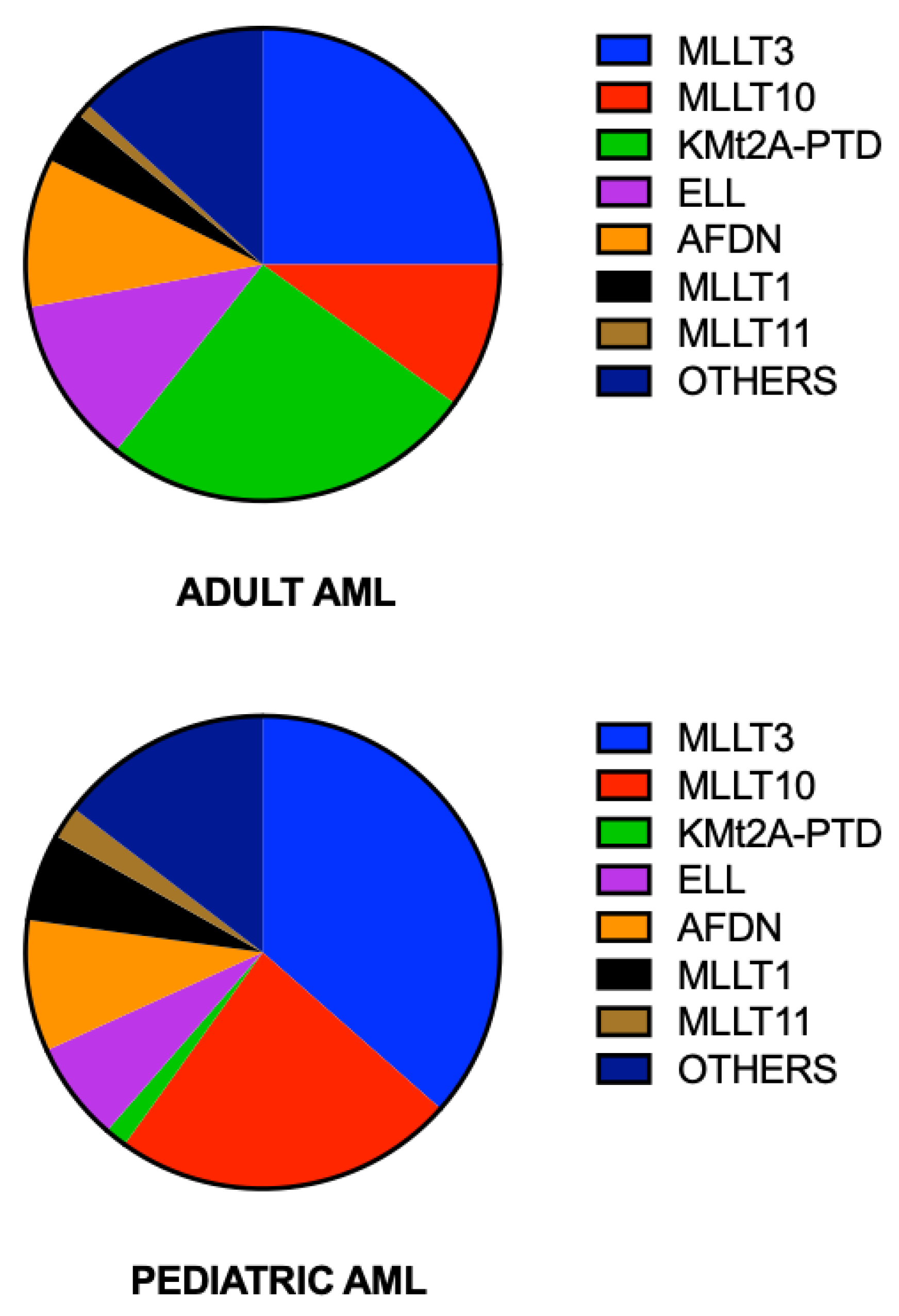
Figure 3.
Mechanism of action of Menin inhibitors. (Top Panel) In KMT2A-r leukemic cells the molecular complex of KMT2A fusion protein with Menin binds to chromatin and stimulates the overexpression of HOX-A9 and MEIS genes, driving leukemic development. (Bottom Panel) The addition of a Menin inhibitor binds to Menin, impeding its interaction with KMT2A fusion protein and, consequently, downregulates HOX-A9 and MEIS expression and induces differentiation and apoptosis of leukemic cells.
Figure 3.
Mechanism of action of Menin inhibitors. (Top Panel) In KMT2A-r leukemic cells the molecular complex of KMT2A fusion protein with Menin binds to chromatin and stimulates the overexpression of HOX-A9 and MEIS genes, driving leukemic development. (Bottom Panel) The addition of a Menin inhibitor binds to Menin, impeding its interaction with KMT2A fusion protein and, consequently, downregulates HOX-A9 and MEIS expression and induces differentiation and apoptosis of leukemic cells.
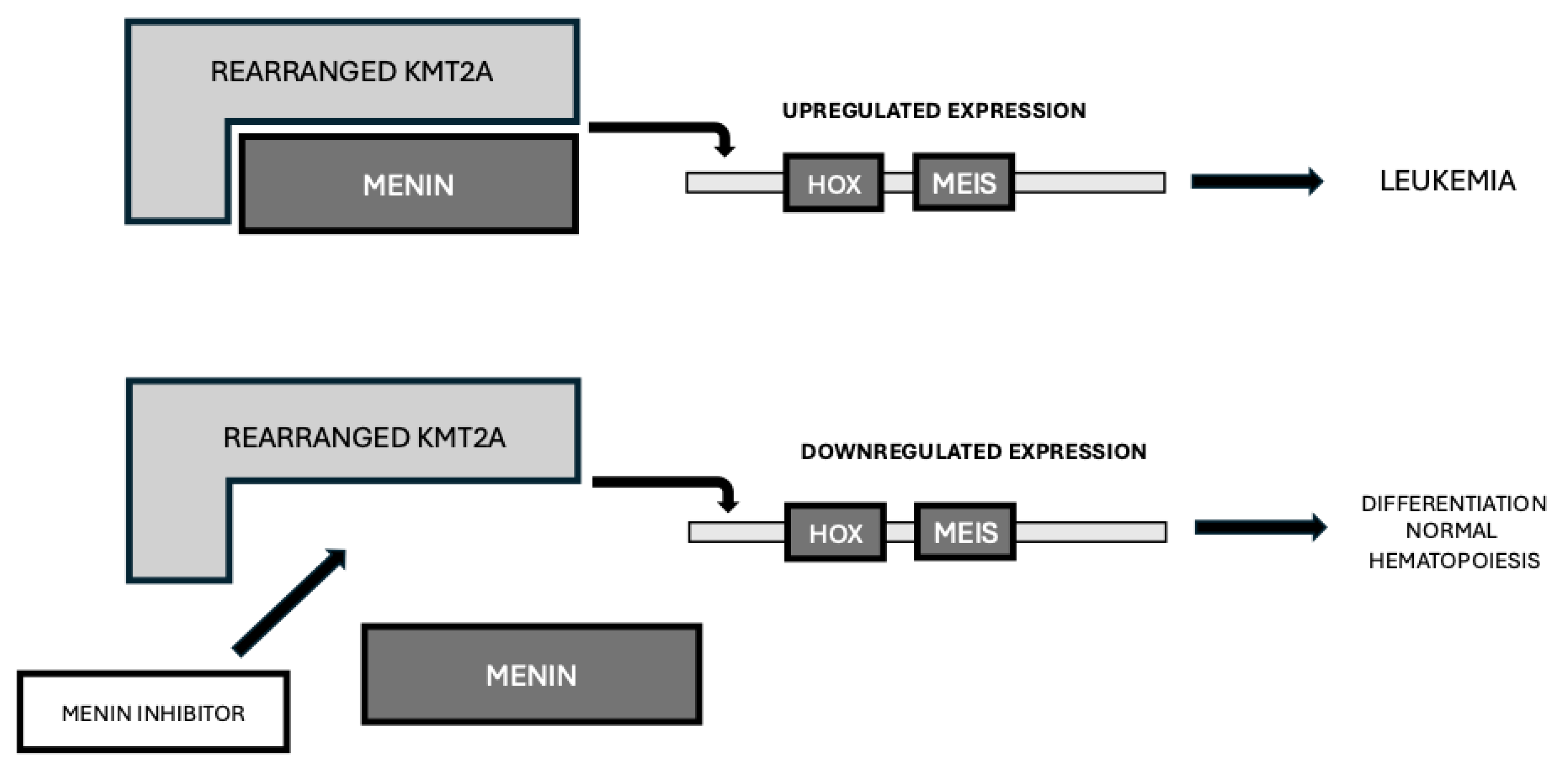

Table 1.
Major clinical trials involving the use of Menin Inhibitors in monotherapy in R/R KMT2A-r and NPM1m AML patients.
Table 1.
Major clinical trials involving the use of Menin Inhibitors in monotherapy in R/R KMT2A-r and NPM1m AML patients.
| Trial Name NCT Identifier Phase |
Patient Number and Disease Status |
Therapeutic Regimen | Efficacy | Toxicity |
|---|---|---|---|---|
| AUGMENT-101 NCT04065399 Phase I/II |
Adult and pediatric patients with R/R NPM1m (116) and KMT2A-r (84) AML | Revumenib (single arm) | KMT2A-r ORR 63.2% CRc 22.8% DOR 4.3 mo OS 8.0 mo NPM1m ORR 46.9% CRc 23.4% DOR 4.4 mo OS 4.0 mo |
KMT2A-r DS 27% QTc prol 29% NPM1m DS 19% QTc prol 43% |
| KOMET-001 NCT04067336 Phase I/II |
Phase Ib: patients with R/R NPM1m or KMT2A-r AML Phase II: patients with R/R NPM1m 200 mg 20 pts 600 mg 130 pts |
Ziftomenib (single arm) | KMT2A-r (18 pts) ORR 17% CRc 11% DOR 2.1 mo NPM1m (112 pts) ORR 33% CRc 25% DOR 3.7 mo OS 6.1 mo |
All patients DS 14% QTc prol NR |
| DSP-5336-101 NCT04988555 Phase I/II |
Phase I: patients with R/R Acute Leukemia Phase II: patients with R/R NPM1m or KMT2A-r |
Enzomenib (single arm) | KMT2A-r (300mg 11 pts) ORR 72.7% CRc 45.5% DOR 4.3 NR OS 11.4 mo NPM1m (200-300 mg 17 pts) ORR 58.8% CRc 47% DOR 5.9-6.7 mo OS 8.5 mo |
All patients (116) DS 12.9% QTc prol 4.3% |
| cAMELot-1 NCT04811560 Phase I/II |
Phase Ib: patients with R/R NPM1m or KMT2A-r or NUP-98-r AML Phase II: patients with R/R NPM1m or R/R KMT2A-r AML |
Bleximenib (single arm) | KMT2A-r (90-100 mg 9 pts) CRc 33.3% NPM1m (90-100 mg 12 pts) CRc 33.3% All patients (146) DOR 6 mo |
All patients DS 19.4% QTc prol NR |
Table 2.
Major clinical trials involving the use of Menin Inhibitors in combination with Venetoclax in R/R and ND KMT2A-r and NPM1m AML patients.
Table 2.
Major clinical trials involving the use of Menin Inhibitors in combination with Venetoclax in R/R and ND KMT2A-r and NPM1m AML patients.
| Trial Name NCT Identifier Phase |
Patient Number and Disease Status |
Therapeutic Regimen | Efficacy | Toxicity |
|---|---|---|---|---|
| SAVE NCT005360160 Phase I |
Adult patients with R/R NPM1m, KMT2A-r, NUP-98-r AML (26) | Revumenib Venetoclax Decitabine/ Cedazuridine |
ORR 88% CRc 43.9% |
DS 4% QTc prol 8% |
| SAVE NCT005360160 Phase II |
Adult patients with ND NPM1m, KMT2A-r, NUP-98-r AML (17) | Revumenib Venetoclax Decitabine/ Cedazuridine |
ORR 94% CR 88% 6-mo EFS 59% Median OS NR |
DS 12% QTc prol 18% |
| BEAT AML Master Trial | Adult patients with ND NPM1m (34 patients) or KMT2A-r (9 patients) | Revumenib Venetoclax Azacitidine |
KMT2A-r (9 pts) ORR 100% CRc 88.9% CR 78% OS 18 mo NPM1m (34 pts) ORR 85.3% CRc 79.4% CR 65% OS 15 mo |
All patients DS 19% QTc prol 44% |
| KOMET-007 NCT05735184 Phase Ia/Ib |
Patients with R/R NPM1m or KMT2A-r | Ziftomenib Azacitidine Venetoclax |
KMT2A-r (29 pts) ORR 33% CRc 22% OS 21 wks NPM1m (51 pts) ORR 65% CRc 49% OS NR |
All patients DS 12% QTc prol 0% |
| ALE1002 NCT05453903 Phase Ib |
Patients with R/R NPM1m (10) or KMT2A-r (3) | Bleximenib Venetoclax |
ORR 69.2% CRc 38.5% |
All patients DS 0/13 QTc prol 1/13 |
| ALE1002 NCT05453903 Phase Ib |
Patients with NPM1m (68) or KMT2A-r (52) R/R (86) or ND (34) |
Bleximenib Venetoclax Azacitidine |
R/R (50/100mg) ORR 76/79% CRc 32/54% ND (50/100ng) ORR 72/92% CRc 62/85% |
All patients DS 4% QTc prol 0% |
| Phase I | Patients with R/R NPM1m or KMT2A-r (18) |
Enzomenib Venetoclax Azacitidine |
ORR 83% CRc 56% |
All patients DS 0% QTc prol 1/18 |
Disclaimer/Publisher’s Note: The statements, opinions and data contained in all publications are solely those of the individual author(s) and contributor(s) and not of MDPI and/or the editor(s). MDPI and/or the editor(s) disclaim responsibility for any injury to people or property resulting from any ideas, methods, instructions or products referred to in the content. |
© 2026 by the authors. Licensee MDPI, Basel, Switzerland. This article is an open access article distributed under the terms and conditions of the Creative Commons Attribution (CC BY) license (http://creativecommons.org/licenses/by/4.0/).
Copyright: This open access article is published under a Creative Commons CC BY 4.0 license, which permit the free download, distribution, and reuse, provided that the author and preprint are cited in any reuse.


