
Submitted:
22 March 2026
Posted:
23 March 2026
You are already at the latest version
Abstract
Climate change poses existential threats to rural agrarian communities across the Global South, necessitating deeper understanding of how climate communication correlates with adaptive capacity. This study explores associations between perceptions of radio message framing and cognitive-affective pathways among rural Ghanaian farmers. Using a cross-sectional survey design, the study collected data from 384 smallholder farmers in coastal Ghana's Ada East District who reported their exposure to different types of radio messaging, threat appraisal, self-efficacy, collective efficacy, and adaptation intentions. The data was analysed using PLS-SEM to examine correlational patterns among these variables. The findings reveal patterns that differ from predictions of the Extended Parallel Process Model (EPPM) in high-vulnerability contexts. Perceived exposure to threat-focused frames showed strong positive associations with adaptation intentions through both direct relationships and positive correlations with self-efficacy patterns; this study termed it the "productive fear association." This finding contradicts EPPM's prediction that threat messages without explicit efficacy-building content reduce self-efficacy. The study hypothesise this correlational pattern may reflect experiential validation processes, whereby messages acknowledging farmers' lived climate realities may resonate differently than messages introducing novel threats. Perceived exposure to culturally narrated frames showed no significant associations with any outcomes, and collective efficacy did not moderate intention formation pathways. This study proposes the "Authenticity Primacy hypothesis", a tentative framework suggesting that perceived message resonance with lived experience may be more strongly associated with adaptation intentions than abstract framing taxonomies.
Keywords:
climate communication
; threat framing
; extended parallel process model
; self-efficacy
; rural adaptation
; productive fear
; message authenticity
; Global South
; community radio
1. Introduction
Climate change poses an existential threat to rural agrarian communities across the Global South, where livelihoods remain vulnerable to environmental shifts (Ayal et al., 2021; Derbile et al., 2022). Environmental hazards, which are increasing in magnitude, persistently plague many coastal communities in Ghana. These hazards predominantly recur through floods and erosion and affect the livelihoods of many smallholder farmers (Avornyo et al., 2023). The urgency of this challenge extends beyond economic vulnerability to include fundamental questions about the adaptive capacity and resilience of smallholder farmers in resource-constrained environments.
Understanding how climate risk communication correlates with adaptive responses is critical for building resilience among vulnerable populations. Radio, particularly community radio, functions as a vital conduit for information dissemination in these contexts owing to its accessibility, affordability, and cultural relevance (Chavinda, 2025). Community radio is the most democratic medium for climate communication in Ghana, enabling marginalised voices to share local knowledge and experience (Samaddar et al., 2021). In countries like Ghana, community radio has fostered participatory development by integrating audience input into programming focused on enhancing livelihoods of the vulnerable (Alare et al., 2022; Chavinda, 2025).
However, research suggests that information exposure alone does not consistently correlate with adaptive action. Cognitive and affective mediators, which encompass threat appraisal and self-efficacy, are theorised to be pivotal in translating risk awareness into behavioural intentions (van Valkengoed et al., 2024). The Extended Parallel Process Model (EPPM) proposes that threat messages motivate action only when paired with efficacy-building content, positing that high-risk perception without corresponding efficacy may induce fatalism (Witte, 1994). Communities prone to flooding in Nigeria have observed this phenomenon, where awareness rarely translates into preparedness (Ben-Enukora et al., 2025; Oladele & Ngidi, 2025).
Gain-framed messages that highlight benefits of actions paired with anthropomorphic cues show promise in boosting pro-environmental intentions (Surira et al., 2025). However, overtly scientific or catastrophic framing often disengages audiences (McLoughlin et al., 2023). In rural contexts where cultural narratives and collective decision-making predominate, our understanding of the associations between framing perceptions, psychological mediators, and behavioural intentions remains inadequate.
Despite the growing recognition of radio’s potential, critical gaps persist in understanding the patterns of association between climate messages and adaptive behaviours. Radio’s reach is well-established. However, how farmers’ perceptions of specific message frames (threat-focused, culturally narrated) correlate with psychological mechanisms and shape adaptation intentions remains underexplored. Framing research frequently exhibits a deficiency in conceptual coherence among message production, content, and audience effects, thereby constraining the advancement of evidence-based communication strategies (Guenther et al., 2023).
Furthermore, rural adaptation is inherently collective, involving community-based decision-making and resource-sharing arrangements. However, whether collective efficacy moderates individual-level psychological pathways remains inconsistently examined in the literature. Studies on collective efficacy remain limited in high-vulnerability African contexts, despite the high prevalence of cultural collectivism and communal behaviours among these populations (Mzimela & Moyo, 2023).
This study utilises a cross-sectional survey design to analyse correlational relationships among farmers’ perceptions of radio messaging, psychological factors, and adaptation intentions. Rather than experimentally manipulating message exposure, the study measured farmers’ self-reported exposure to different message types encountered through regular radio listening, along with their current psychological states and behavioural intentions, at a single time point. This perceptual approach offers ecological validity by capturing associations as they exist in real-world contexts where farmers encounter diverse messages through community radio over time.
To address these gaps, this cross-sectional study examines correlational patterns within an integrated model exploring:
- How farmers’ perceptions of radio message framing are associated with adaptation intentions, and whether threat appraisal and self-efficacy statistically mediate these relationships
- Whether collective efficacy moderates the observed associations among threat appraisal, self-efficacy, and adaptation intentions
- Which perceived frame exposures (threat-focused, culturally narrativized) show the strongest correlations with adaptive intentions when accounting for psychological factors?
By addressing these objectives, this study advances climate communication theory by identifying patterns that warrant experimental investigation while offering preliminary insights for community resilience programming and policy directions. The research aligns with multiple Sustainable Development Goals, specifically SDG 13 (Climate Action), SDG 2 (Zero Hunger) and SDG 10 (Reduced Inequalities), by exploring factors associated with adaptive capacity among smallholder farmers and examining the role of inclusive communication approaches.
2. Literature Review and Theoretical Framework
2.1. Conceptualising Climate Communication Variables
2.1.1. Radio Message Framing: Strategic Information Architecture
The effectiveness of climate change communication hinges on precise conceptualisation of its constituent elements. Radio message framing constitutes a strategic emphasis on specific aspects of climate information to shape audience interpretation and behavioural response. Based on theoretical foundations and empirical evidence, this study focuses on two primary framing approaches:
Threat-focused frames amplify climate dangers through vivid descriptions of potential losses, emphasising vulnerability and consequences such as crop failure projections and flood damage scenarios. Culturally narrativized frames embed messages within local epistemologies through storytelling, proverbs, and traditional wisdom, emphasising cultural resonance and community identity (Surira et al., 2025; Thier & Wu, 2025).
Community radio has demonstrated exceptional capacity for cultural narration in contexts like Malawi and Ghana using local languages and storytelling traditions (Attuh & Kankam, 2022; Chavinda, 2025). However, quantitative evidence of differential behavioural impacts remains underexplored. This gap is particularly concerning given that threat-dominant frames may inadvertently induce fatalism without efficacy reinforcement (McLoughlin et al., 2023), as high-risk awareness rarely translates into preparedness behaviour in emerging economies (Ben-Enukora et al., 2025).
2.1.2. Threat Appraisal: The Cognitive Gateway
Threat appraisal encompasses perceived susceptibility (personal vulnerability) and severity (impact magnitude), functioning as a critical cognitive gateway in risk processing models. Rural farmers often demonstrate accurate perception of climate severity at regional levels but systematically underestimate personal susceptibility due to optimism bias and temporal discounting (Derbile et al., 2022). This appraisal gap may be compounded by messaging that neglects localised relevance or fails to connect regional phenomena to individual farm-level impacts.
2.1.3. Self-Efficacy: The Affective Bridge
This study conceptualises self-efficacy as belief in personal capacity to execute specific adaptations successfully, representing the affective bridge between awareness and action in climate adaptation contexts. Resource-constrained farmers pursue costly adaptations when confidence exceeds perceived barriers, suggesting that efficacy beliefs can overcome structural constraints under certain conditions (Tran & Chen, 2022; Zobeidi et al., 2021). However, in Ghana’s Northern Region, farmers failed to implement irrigation-related activities despite having technical knowledge and understanding irrigation benefits. This failure is attributed to eroded self-efficacy stemming from financial constraints and previous failure experiences (Owusu et al., 2021), highlighting the dynamic nature of efficacy beliefs and their susceptibility to contextual influences.
2.1.4. Collective Efficacy: The Moderating Factor
The study positions collective efficacy as a moderator, conceptualised as shared belief in community capacity to achieve collective goals. This remains underutilised in message framing despite its theoretical centrality in collectivist societies and empirical importance in community-based adaptation. Communality in rural farming communities buffers individual helplessness by distributing risks, pooling resources, and providing social support during climate stresses (Ayal et al., 2021; Ntim-Amo et al., 2022).
2.1.5. Adaptation Intentions: Proximal Behavioural Precursors
The study positions adaptation intentions as the dependent variable, serving as a proximal behavioural precursor to implementation. It includes both technical responses (agroforestry, soil conservation, crop diversification) and non-technical strategies (livelihood diversification, collective risk-sharing, migration planning) (van Valkengoed et al., 2024).
2.2. Theoretical Integration: Beyond Fragmented Models
2.2.1. Protection Motivation Theory: Foundational Mechanisms
The study’s conceptual architecture integrates three complementary theories to address persistent fragmentation in climate communication scholarship. Protection Motivation Theory (PMT) provides the foundational mechanism, positing that adaptive behaviour requires both threat appraisal (vulnerability assessment) and coping appraisal (efficacy beliefs plus response effectiveness). PMT illuminates why Ghanaian farmers facing identical flood risks exhibit divergent responses (Ntim-Amo et al., 2022).
2.2.2. Extended Parallel Process Model: Cognitive Contingencies
The Extended Parallel Process Model (EPPM) introduces a critical contingency: threat messages only motivate action when self-efficacy exceeds threat appraisal. When threat dominates efficacy, audiences engage in fear control (denial, fatalism, defensive avoidance) rather than danger control (problem-focused action) (Ben-Enukora et al., 2025). However, its continued inattention to communal resilience represents a significant theoretical omission in collectivist contexts.
2.2.3. Social Cognitive Theory: Communal Dimensions
Social Cognitive Theory (SCT) addresses this omission by focussing on collective efficacy as a distinct construct—the shared belief in group capabilities to organise and execute the courses of action required to produce given attainments (Bandura, 2001). SCT contextualises why farmers participating in radio listening clubs demonstrate higher adaptation rates than isolated listeners through communal discourse that transforms individual anxiety into collective agency (Chavinda, 2025).
2.3. Hypothesis Development and Conceptual Framework
2.3.1. Serial Mediation Pathways
The Figure 1 presents the conceptual model of the study. Based on EPPM’s predictions but considering the unique context of high vulnerability, the study hypothesises:
H1a:Threat-focused frames will positively correlate with adaptation intentions through enhanced threat appraisal.
H1b: In high-vulnerability contexts, perceived exposure to threat-focused frames willpositively correlate with self-efficacy, contrary to EPPM predictions of an inverse relationship between threat and efficacy.
H1c: Perceived exposure to culturally narrativised frames will show positiveassociations with both threat appraisal and self-efficacy, correlating positively with adaptation intentions through these mediating pathways.
2.3.2. Moderating Role of Collective Efficacy
H2a:Collective efficacy will moderate the association between threat appraisal and self-efficacy, such that the positive relationship between these constructs is stronger at higher levels of collective efficacy.
H2b:Collective efficacy will moderate the association between self-efficacy and adaptation intentions, such that the positive relationship between these constructs is stronger at higher levels of collective efficacy.
2.3.3. Direct Effects as Primary Pathways
H3:
Perceived threat message exposure will show substantial direct associations with adaptation intentions beyond pathways mediated by threat appraisal and self-efficacy, potentially reflecting message authenticity and experiential validation processes in high-vulnerability contexts.
3. Methods
3.1. Research Design and Rationale
This study employed a cross-sectional survey design to examine associations among farmers’ perceptions of radio message framing, psychological factors (threat appraisal, self-efficacy, collective efficacy), and adaptation intentions. The design measures all variables at a single time point through self-report questionnaires, capturing patterns of covariation as they naturally occur rather than manipulating variables to establish causation.
A perceptual, correlational approach was selected to: (1) capture associations in an ecologically valid field setting where farmers encounter diverse messages through authentic community radio programming, (2) document baseline patterns worthy of future experimental investigation, and (3) explore whether associations in high-vulnerability contexts align with or deviate from theoretical predictions developed in different contexts. The cross-sectional design precludes causal inference about temporal sequences or directional effects. Observed associations could reflect message influences on farmers, farmer characteristics influencing message attention and recall, reverse causation, or unmeasured third variables. Statistical mediation analyses identify patterns consistent with theoretical predictions but cannot establish causal pathways.
3.2. Sampling
The target population was smallholder farmers within major settlements in Ada East District in the Greater Accra Region whose livelihoods have been affected by climate-related factors. The 2021 population and housing census recorded a total population of 76,411, of which 53% are females, and over 40% of the labour force are farmers(Ghana Statistical Service, 2021). Data was collected from smallholder farmers in Pute, Totope, Elavanyo, Otrokpe, Ocanseykope, and Anyakpor whose farming activities have been affected by either sea advancement or tidal waves.
The sample size of the study was determined using the Yamane (1967) cross-sectional design for unknown populations. The estimated minimum sample size of the study was 384. To ensure sample representativeness, the study purposively selected farmers who meet the inclusion criteria of direct exposure to climate-related impacts including flooding, coastal erosion and saltwater intrusion. The respondents were required to have regular radio access.
3.3. Data Collection and Measurement Tools
All constructs were measured using validated scales adapted for the Ghanaian context through systematic cultural adaptation procedures. The final instrument comprised 23 items across four constructs, with all items rated on 5-point Likert scales (1 = Strongly Disagree/Very Unlikely to 5 = Strongly Agree/Very Likely).
Threat appraisal was adapted from protection motivation theory (Floyd et al., 2000). Sample items: “The changing weather patterns can seriously damage my crops” and “Climate problems threaten my family’s well-being.”
Self-efficacy items were adapted from Schwarzer and Jerusalem (2010) General Self-Efficacy Scale and climate adaptation efficacy measures from van Valkengoed et al. (2024). Sample items: “I can successfully change my farming methods to deal with climate change” and “I feel confident making farming decisions when weather is unpredictable.”
Collective efficacy measures were adapted from Bandura (2006) Collective Efficacy Scale and community resilience measures from Mzimela and Moyo (2023). Sample items: “Our community can work together to reduce climate risks” and “We can overcome climate challenges if we work together as a community.”
Adaptation intentions were adapted from the Theory of Planned Behaviour (Ajzen, 1991) and climate adaptation behaviour scales (van Valkengoed et al., 2024). Sample item: “How likely are you to plant crops that can survive dry seasons better?” and “How likely are you to join community-based adaptation groups?”
Message frame items were adapted from (Chavinda, 2025; McLoughlin et al., 2023; Samaddar et al., 2021; Surira et al., 2025).
Data collection was carried out over a 3-month period from March to May 2024, during the pre-planting season when climate adaptation decisions are most salient. Data collection was handled by the researcher and administered primarily in the local Dangme language. Community entry followed traditional protocols, with free, prior, and informed consent obtained from all participants.
3.4. Analytical Approach
The study assessed data quality through Little’s Missing Completely at Random (MCAR) test (Little, 1988). Multicollinearity concerns were evaluated using variance inflation factors (Schroeder et al., 1990). Given the single-source, cross-sectional design, the study implemented various approaches to assess and minimize common method bias (Jarvis et al., 2003). Questionnaire items were counterbalanced and randomised while including reverse code items. The researcher also ensured anonymity in the data collection process. The study adopted the Harman single-factor analysis to test for common method bias. The study reports that no single factor explained >40% of variance. The common latent factor (CLF) analysis showed minimal variance attributed to method effects (15%) while variance inflation factors remained below 3.5. Despite these controls, common method bias cannot be entirely eliminated in a single-source design and effect sizes may be inflated.
Measurement models were established through confirmatory factor analysis, evaluating reliability (Cronbach’s α > 0.70), convergent validity (AVE > 0.50), discriminant validity (HTMT < 0.85), and model fit indices (CFI > 0.90, RMSEA < 0.08). The study tested the hypothesised structural model through path coefficients, R² values, and effect sizes. Bootstrapping with 5,000 subsamples was adopted to generate bias-corrected confidence intervals.
4. Results
4.1. Sample Demographics and Descriptive Statistics
The final sample of 384 smallholder farmers reflected the target demographic profile with participants averaging 47.3 years of age with 20.1 years of farming experience. The sample included 62% male and 38% female respondents. The educational attainment of the respondents was predominantly at the primary level. 41% have completed primary school, 28% completed junior high school and 18% with no formal education. Farm sizes averaged 3.2 acres with 68% operating between 1-5 acres. Majority of the respondents have access to radio with 74% reporting daily or weekly listening habits. 87% of respondents reported direct farming impacts from climate-related events, mostly flooding (71%) and saltwater intrusion (58%).
The data quality assessment indicates that Little’s MCAR test yielded (χ² = 162.4, df = 156, p = 0.347) this indicates missing data was missing completely at random (Little, 1988). Missing data rates were low across all variables (range = 0.8%-4.2%). Variance inflation factors were well below the 3.5 threshold indicating acceptable levels of multicollinearity.
4.2. Measurement Model Assessment
The measurement model was refined through confirmatory factor analysis following established psychometric protocols. All constructs demonstrated satisfactory psychometric properties. Composite reliability values ranged from 0.899 to 0.958, exceeding the recommended threshold of 0.70. Average variance extracted (AVE) values were all above the 0.50 threshold, confirming convergent validity and internal consistency (Table 1). The Heterotrait-Monotrait (HTMT) ratio values were within acceptable thresholds to achieve discriminant validity (Dijkstra & Henseler, 2015). The Fornell-Larcker criterion further supported discriminant validity (Fornell & Larcker, 1981) (Table 2). The saturated model demonstrated satisfactory fit indices (SRMR = 0.04), indicating appropriate model specification (Hu & Bentler, 1999) (Table 3).
4.3. Structural Model Evaluation and Hypothesis Testing
The structural model demonstrated substantial explanatory power, accounting for 56.5% of the variance in adaptation intention (R² = 0.565), representing significant predictive accuracy. The model explained significant variance in threat appraisal (R² = 0.502) and a modest but meaningful portion of variance in self-efficacy (R² = 0.262). (Table 4)
4.4. Hypothesis Testing Results
Table 5 and Figure 2 presents the hypothesised associations of the study. The study found a significant positive association between threat frames and self-efficacy (β = 0.512, p < 0.001), which differs from EPPM predictions (H1b supported). The substantial association of threat frames on adaptation intentions (β = 0.612) demonstrates that these messages correlate strongly with motivation in high-vulnerability contexts (H3 supported). The positive relationship between threat appraisal and adaptation intentions provides support for H1 associations. Cultural frames showed no significant relationships across all pathways (H1c not supported), and collective efficacy failed to moderate the hypothesised relationships (H2a and H2b not supported).
The Table 6 presents the predictive relevance of the study. Stone-Geisser Q² test evaluates the ability of the model to predict omitted data points through cross-validation procedures. Values above zero indicate the structural model can predict better than the mean value of the construct (Leguina, 2015). The findings demonstrate strong predictive relevance for adaptation intentions (Q² = 0.653, Q²predict = 0.833). This indicates the model can accurately predict farmer adaptation behaviour in new contexts. The high predictive relevance of the model supports the practical utility of the threat-focused communication approaches. The model correctly predicts over 65% of the variation in adaptation intentions when validated against omitted observations. The moderate predictive relevance for threat appraisal (Q² = 0.390) and self-efficacy (Q² = 0.174) suggests these psychological constructs are also adequately predicted by the model, though with varying degrees of accuracy.
5. Discussion
5.1. Theoretical Implications: Reconsidering Fear Appeals in High-Vulnerability Contexts
The findings from this study suggest important boundary conditions for how fear appeal theories may apply in contexts characterised by immediate climate vulnerability and lived experience of environmental threats. The Extended Parallel Process Model predicts that high-threat messages without corresponding efficacy enhancement trigger maladaptive fear control responses. This maladaptive fear control responses leads audiences to engage in denial, fatalism, or defensive avoidance rather than constructive action (Witte, 1994). However, this study observed correlational patterns where threat-focused frames were positively associated with both threat appraisal and self-efficacy, correlating with substantial increases in adaptation intentions. The finding suggests potential modifications to established fear appeal theories within this specific context.
This study hypothesize that this apparent theoretical contradiction may be explained through the lens of experiential validation. For farmers in coastal Ghana who regularly experience flooding, saltwater intrusion, and crop failures (Avornyo et al., 2023), high-threat climate messages may not introduce new fears but rather validate existing lived realities. This validation could serve a dual psychological function that might reduce cognitive dissonance between personal experience and external messaging while potentially enhancing source credibility through perceived accuracy.
The positive association between threat frames on self-efficacy represents the most theoretically significant finding of this study. The study proposes the hypothesis that “productive fear association” may explain this phenomenon—a potential psychological state where threat recognition, when grounded in authentic experience and delivered through trusted channels, might clarify the nature of the challenge and mobilise agency rather than inducing paralysis.
This mechanism operates through several pathways. First, an accurate threat description validates farmers’ existing concerns, reducing uncertainty and providing clarity about the nature of the challenge they face. Second, this validation implicitly acknowledges farmers’ resilience and capacity to recognise and respond to environmental threats. Third, clear threat articulation makes the necessary adaptive responses seem more concrete and manageable rather than overwhelming.
This finding aligns with emerging research from other vulnerable populations suggesting that fear can be empowering when it accurately reflects genuine risks that individuals can meaningfully address (McLoughlin et al., 2023). However, it is crucial to note that this mechanism appears to depend on the authenticity gap between message content and recipient experience. When this gap is minimal, as in the high-vulnerability context of this study, threat messages validate rather than alarm, clarify rather than confuse, and empower rather than paralyse.
The implications for fear appeal theory are profound. The EPPM’s assumption that threat messages invariably reduce self-efficacy when not paired with explicit efficacy-building content appears to hold primarily in contexts where threats are probabilistic, distant, or unfamiliar to audiences. In contexts where audiences have extensive lived experience with the communicated threats, different psychological mechanisms may operate. This suggests that fear appeal theories require substantial modification to account for the experiential context of message recipients.
5.2. The Cultural Frame Paradox: Embedded Authenticity Versus Performative Culture
The complete non-significance of culturally narrativised frames across all pathways presents a substantial paradox given the extensive qualitative literature emphasising the critical importance of local cultural elements in climate communication (Attuh & Kankam, 2022; Chavinda, 2023). This finding demands careful consideration of how we conceptualise and operationalise cultural communication elements in research and practice.
This study posits that this paradox reflects a fundamental misunderstanding about how culture functions in authentic communication contexts. Cultural elements such as local language, storytelling conventions, and community voices may be so fundamentally embedded in all effective local radio communication that attempting to create a discrete “cultural” frame category was methodologically artificial. The most potent threat frames in this study were delivered by trusted local broadcasters in the Dangme language, incorporating local knowledge and addressing community-specific concerns. These messages were already maximally “cultural” in the most authentic sense of the term.
This suggests that culture may function as a foundational enabling layer rather than a specific framing technique to be applied or omitted at will. Effective cultural communication may require seamless integration of cultural elements with substantive content rather than their deployment as standalone narrative devices. When cultural references—such as proverbs, traditional stories, or cultural metaphors—are deployed in isolation from directly relevant adaptation content, they may feel performative rather than authentic to rural audiences who are dealing with immediate, existential threats.
Furthermore, the failure of culturally narrativised frames to achieve significance may reflect the limitations of academic attempts to operationalise and commodify cultural elements. Culture, in its authentic form, is not a technique to be applied but rather the medium through which all meaningful communication occurs. The attempt to create a discrete “cultural frame” may have inadvertently stripped cultural elements of their organic context and authentic relevance.
This finding has important implications for climate communication practice. Rather than adding cultural elements as supplementary features to predetermined messages, effective communication may require starting with cultural context and community knowledge as the foundation from which all messaging emerges. This represents a fundamental shift from cultural adaptation of external messages to culturally grounded message development.
5.3. The Collective Efficacy Conundrum: Measurement Challenges in Collectivist Contexts
The failure of collective efficacy to moderate the hypothesised relationships represents a significant deviation from theoretical predictions based on social cognitive theory and previous research in collectivist contexts. This finding is particularly puzzling given Ghana’s collectivist social structure and the extensive qualitative evidence for community-based climate adaptation in the region (Gideon et al., 2022). The high correlation between individual self-efficacy and collective efficacy provides important insights into this unexpected result.
This finding reflects fundamental limitations in how Western-derived psychological theories conceptualise and measure collective constructs in non-Western contexts. The high correlation between self-efficacy and collective efficacy suggests that these constructs may be more psychologically intertwined in this cultural context than established theories typically assume. Rather than representing distinct psychological phenomena, individual and collective efficacy may be experienced as interconnected or even inseparable aspects of a unified concept of capability and agency.
This interconnectedness may reflect cultural worldviews in which individual capacity is inherently understood as embedded within and inseparable from community capacity. In such contexts, asking farmers to distinguish between their personal capabilities and their community’s collective capabilities may be requesting a conceptual separation that does not align with their lived experience or cognitive frameworks. The moderate correlation may indicate that while farmers can make some distinction between these concepts when prompted by survey instruments, the distinction may not be psychologically meaningful in the way that Western theories assume.
Additionally, the non-significant moderation effects of collective efficacy may reflect measurement challenges rather than theoretical inadequacies. Our measures, adapted from Western instruments, may have failed to capture the specific mechanisms through which collective capability influences individual decision-making in this context. Effective collective action may require concrete institutional structures, established leadership mechanisms, and proven resource mobilisation frameworks that were not adequately captured by our abstract measures of communal beliefs and general community capability.
The finding may also suggest important distinctions between abstract communal beliefs and actionable collective capacity. Farmers may maintain strong beliefs in their community’s general capability to overcome challenges while simultaneously recognising that translating these beliefs into specific adaptive actions requires institutional and organisational elements that may not currently exist or function effectively in their context.
6. Conclusion
6.1. Study Summary and Achievement of Research Objectives
This study set out to investigate the mechanisms through which radio-based climate message frames influence the adaptation intentions of rural Ghanaian farmers, exploring an integrated theoretical model that incorporated cognitive-affective mediators and socio-cultural moderators. The research was guided by three primary objectives: determining how message frames operate through psychological pathways, examining how collective efficacy moderates these pathways, and identifying which frame types most effectively activate adaptive intentions when mediated and moderated by psychological factors.
The study achieved its fundamental research objectives, although the findings revealed patterns that were largely contrary to initial hypotheses derived from Western-centric models such as the Extended Parallel Process Model. The study successfully mapped the psychological pathways through which climate messages influence adaptation intentions but discovered that these pathways functioned in directions opposite to theoretical predictions. Threat-focused frames emerged as the most significant driver of adaptation intentions, not through the fear control mechanisms predicted by established theories, but through substantial positive direct effects and by paradoxically enhancing self-efficacy beliefs. This finding directly contradicts core EPPM assumptions and suggests that for farmers facing validated existential threats, stark warnings serve to validate lived experience and clarify adaptive stakes, thereby boosting agency through what we have termed “productive fear”.
The investigation of collective efficacy as a moderating factor revealed that abstract communal beliefs may not translate into individual behavioural intentions in the ways that Social Cognitive Theory suggests. While communal spirit and collective identity remain strong in this context, their influence on intention-formation pathways was not significant, indicating that the translation from communal beliefs to individual motivational processes may require pre-existing tangible structures for collective action that were not activated by message framing alone.
The study achieved its objective of identifying the most effective frame types, although with counterintuitive findings that challenge established wisdom about cultural communication. Culturally narrativised frames showed no significant effects across all measured pathways, suggesting that the attempt to operationalise cultural communication elements may have been artificially imposed rather than organically embedded. This implies that authentic cultural integration may already be present in effective local communication rather than existing as a discrete framing category that can be applied or omitted at will.
Most fundamentally, the study achieved its core aim of advancing climate communication theory by demonstrating that message authenticity may hold primacy over abstract framing techniques in determining communication effectiveness. The introduction of the Authenticity Primacy Principle represents a crucial theoretical refinement for climate communication, arguing that context, validation, and truth-telling through trusted channels constitute the foundational elements for empowering adaptive action among frontline communities.
6.2. Theoretical Integration: Toward the Authenticity Primacy Principle
The pattern of findings from this study—the empowering effect of authentic threat messages, the irrelevance of artificially constructed cultural frames, and the complex relationship between individual and collective efficacy—points toward a more fundamental theoretical insight about effective climate communication in high-vulnerability contexts. This study proposes the Authenticity Primacy Principle as a unifying theoretical framework to explain these seemingly disparate findings and to guide future climate communication research and practice.
The Authenticity Primacy Principle posits that the effectiveness of climate messages is not primarily determined by their structural characteristics, such as frame type, message organisation, or communication technique, but rather by their perceived authenticity. Authenticity, in this context, refers to the degree of resonance between message content and the audience’s lived experience, delivered through channels and sources that the audience recognises as credible and trustworthy. This authenticity functions as the foundational filter through which all other message characteristics are evaluated and processed.
The principle rests on three interconnected propositions that emerged from the data. First, contextual relevance precedes technical sophistication. The failure of theoretically predicted effects such as cultural frame effectiveness underscores that communication strategies developed in one context cannot be mechanically applied as universal templates in different contexts. The Extended Parallel Process Model, developed largely in individualistic, high-capacity contexts where climate threats are often probabilistic and psychologically distant, makes assumptions that may not hold in contexts where audiences have extensive direct experience with environmental threats. For the farmers in Ada East District, climate change is not a future scenario requiring cognitive processing of abstract probabilities, but rather a present, visceral reality of eroded farmlands, saline water sources, and failed harvests. In such contexts, a message’s power derives not from its technical construction or theoretical sophistication but from its fidelity to observed truth and lived experience.
Second, validation overpowers persuasion as a communication mechanism. Traditional communication models, including most fear appeal theories, operate on what might be termed a deficit model, assuming that audiences lack knowledge, hold misperceptions, or fail to appreciate the seriousness of risks. These models position effective communication as a process of knowledge transfer from expert sources to lay audiences. The Authenticity Primacy Principle suggests that in communities with deep, experiential knowledge of environmental change, the most powerful communicative act is not persuasion but affirmation. The potent effect of threat-focused frames in our study did not lie in their ability to persuade farmers of risks they had not previously recognised, but rather in their capacity to validate experiences, concerns, and observations that farmers had developed through direct environmental engagement.
This validation process serves multiple psychological functions that extend beyond simple information processing. It builds crucial trust and credibility by positioning message sources not as external experts imparting superior knowledge, but as allies who accurately understand and articulate shared realities. It reduces cognitive dissonance by aligning external messages with internal experience, eliminating the psychological tension that can arise when official communications contradict lived experience. Perhaps most importantly, it provides a form of recognition and respect for local knowledge and observation, countering the marginalisation and dismissal that vulnerable communities often experience in formal climate discourse.
Third, authentic threat articulation functions as empowerment rather than intimidation. The most counterintuitive finding from our study—that threat appeals enhanced self-efficacy—directly challenges core assumptions of the Extended Parallel Process Model and fear appeal theories more generally. The study theorise that in high-vulnerability contexts characterised by extensive threat experience, an authentic and stark portrayal of environmental risks does not induce paralysing fear but can instead be productively agentic. This mechanism operates through several pathways that reflect the unique psychological dynamics of communities living with immediate environmental threats.
By accurately naming and describing threats that farmers already recognise and experience, authentic threat messages validate struggles and concerns that might otherwise be dismissed or minimised by external authorities. This validation carries an implicit acknowledgement of farmers’ resilience, observational skills, and capacity to recognise and respond to environmental challenges. Rather than positioning farmers as passive victims requiring external salvation, authentic threat communication implicitly recognises their agency and competence as environmental observers and adaptive actors.
Furthermore, clear and honest threat articulation can make necessary adaptive responses seem more concrete and manageable rather than overwhelming. When threats remain unnamed, unacknowledged, or euphemistically described, they can feel chaotic, unpredictable, and impossible to address. Authentic threat communication provides clarity about the nature of challenges, enabling more targeted and effective adaptive responses. When this clear-eyed assessment is delivered through trusted, local channels such as community radio, it does not diminish agency but rather grounds and enables it by providing a shared foundation for mobilising collective action.
6.3. Implications for Climate Communication Theory and Practice
The findings of this study have significant implications for both theoretical understanding and practical application of climate communication in vulnerable contexts. From a theoretical perspective, the study demonstrates that established communication theories developed primarily in Western, individualistic, high-capacity contexts may require substantial modification when applied to Global South contexts characterised by high vulnerability, collectivist orientations, and extensive direct experience with climate impacts.
The productive fear mechanism we identified suggests that fear appeal theories need to incorporate experiential context as a crucial moderating variable. The effectiveness of threat-based communication may depend critically on what we term the “authenticity gap”—the distance between message content and recipient experience. When this gap is minimal, as in high-vulnerability contexts where audiences have extensive direct experience with communicated threats, threat messages may validate and empower rather than alarm and paralyse. When the gap is substantial, as in contexts where threats are distant or unfamiliar, traditional fear appeal mechanisms may operate as predicted by established theories.
This insight points toward the development of contingency theories of climate communication that specify when different approaches are likely to be effective based on contextual factors such as vulnerability level, threat experience, cultural orientation, and institutional capacity. Such theories would move beyond universal prescriptions toward more nuanced, context-sensitive frameworks that can guide communication strategy selection based on audience and situational characteristics.
From a practical perspective, the study suggests several important shifts in the climate communication approach. Rather than relying on complex framing techniques or sophisticated message construction, communication efforts may be more effective when they prioritise authentic engagement with local realities through trusted, community-embedded channels. This implies a fundamental reorientation from top-down, expert-driven communication toward more participatory, community-grounded approaches that begin with deep listening and local knowledge recognition.
The findings also suggest that attempts to artificially inject cultural elements into predetermined messages may be less effective than developing communication approaches that are fundamentally grounded in cultural context from their inception. This requires moving beyond cultural adaptation of external messages toward culturally rooted communication processes that emerge from and remain accountable to community knowledge and priorities.
6.4. Contributions to Sustainable Development Goals
This research directly advances multiple Sustainable Development Goals through its focus on enhancing adaptive capacity among vulnerable populations and its emphasis on inclusive, participatory communication approaches. The study’s primary contribution to SDG 13 (Climate Action) lies in providing evidence-based guidance for more effective climate communication strategies that can enhance adaptation planning and implementation among smallholder farmers and other vulnerable groups. By demonstrating the effectiveness of authentic, locally grounded communication approaches, the research offers pathways for improving climate action that are both more effective and more respectful of local knowledge and agency.
The focus on smallholder farmer resilience and adaptive capacity directly supports SDG 2 (Zero Hunger) through the promotion of agricultural adaptation strategies that can protect food security in the face of increasing climate variability and change. The study’s insights about the empowering potential of honest threat communication may help agricultural extension and food security programmes develop more effective approaches to supporting farmer adaptation and resilience building.
The emphasis on inclusive communication approaches that reach and empower marginalised rural communities advances SDG 10 (Reduced Inequalities) by ensuring more equitable access to climate information and support. The study’s challenge to top-down, expert-driven communication models and its advocacy for community-grounded approaches align with broader goals of reducing inequalities in access to information, resources, and decision-making power related to climate adaptation.
More broadly, the study’s advocacy for authentic, participatory communication approaches supports the cross-cutting principles of community ownership, cultural respect, and local empowerment that underlie effective sustainable development programming across multiple goal areas.
6.5. Methodological Concerns and the Question of Common Method Bias
The single-source, cross-sectional survey design creates significant potential for common method bias, whereby correlations between constructs may be artificially inflated due to measurement occurring through the same method at the same time. Despite the assessment indicating acceptable variance inflation factor values below 3.5 for all constructs, this does not eliminate concerns about same-source variance effects. The magnitude of key relationships, particularly the direct effect of threat frames on adaptation intentions, may be partially attributable to common method bias rather than representing true causal relationships.
Additionally, the cross-sectional design fundamentally limits the ability to make causal claims about the relationships observed. While the study has demonstrated strong associations between threat-focused messaging and adaptation intentions, this study cannot definitively establish that exposure to threat messages caused the observed increases in self-efficacy and adaptation intentions. It is equally plausible that farmers with higher baseline self-efficacy and stronger adaptation intentions were more receptive to or more likely to recall threat-focused messages, creating reverse causation that the design of this study may not detect.
The geographic specificity of the sample, limited to coastal farming communities in a single district in Ghana, also constrains the generalisability of the findings. The specific environmental, cultural, and economic conditions of Ada East District may have created a unique context in which threat messages operate through the productive fear mechanism identified. Whether similar effects would be observed in inland farming communities, pastoralist populations, or other vulnerable groups remains an open empirical question.
6.6. Future Research Directions and Methodological Improvements
The limitations identified in this study, combined with its novel findings, open several critical avenues for future research that could advance both theoretical understanding and practical application of climate communication in vulnerable contexts. These research directions address both methodological improvements needed to strengthen causal inference and theoretical extensions needed to understand the boundary conditions and broader applicability of the mechanisms identified.
The counterintuitive finding that threat appeals enhanced self-efficacy demands systematic exploration across diverse contexts to establish the boundary conditions under which the productive fear mechanism operates. A multi-site comparative study examining inland subsistence farmers, pastoralist communities, and coastal agriculturalists across different countries and ecological zones could help establish whether the authenticity gap concept explains communication effectiveness across diverse high-vulnerability contexts. Such research could contribute to the development of a contingency theory of climate communication that specifies which approaches work most effectively for different populations under different conditions.
Cross-cultural validation research could test the generalisability of the Authenticity Primacy Principle across different Global South contexts, examining whether the emphasis on experiential validation over technical sophistication holds across diverse cultural, ecological, and institutional settings. Such research could contribute to broader efforts to decolonise communication theory and develop more inclusive, context-sensitive frameworks for understanding effective risk communication.
6.7. Final Reflections on Decolonising Climate Communication
This study’s findings point toward broader questions about the need to decolonise climate communication theory and practice, moving beyond the application of Western-derived models toward the development of more inclusive, participatory, and contextually grounded approaches to understanding and facilitating effective environmental communication. The failure of established theories to predict communication effectiveness in high-vulnerability context reflects broader patterns in which Global North theoretical frameworks struggle to account for the realities, worldviews, and communication patterns of Global South populations.
The productive fear mechanism we identified may represent just one example of how communication processes operate differently in contexts characterised by immediate vulnerability, extensive direct experience with environmental threats, and cultural orientations that prioritise community solidarity and collective response. The irrelevance of artificially constructed cultural frames and the complex relationship between individual and collective efficacy similarly point toward the limitations of academic attempts to operationalise and manipulate cultural and social processes that may be fundamentally different from Western theoretical assumptions.
The Authenticity Primacy Principle, while emerging from this specific research context, may have broader implications for understanding effective communication in contexts characterised by marginalisation, vulnerability, and extensive experiential knowledge. The principle’s emphasis on validation over persuasion, context over technique, and truth-telling over strategic messaging may have relevance beyond climate communication to other domains where external authorities attempt to communicate with populations that have extensive direct experience with communicated topics.
Most fundamentally, this research champions a communication paradigm that begins with deep listening, respects existing knowledge, and treats shared experience as the foundation for meaningful dialogue and collective action. This approach represents a significant departure from deficit models that position communication as a process of knowledge transfer from experts to lay audiences, instead embracing approaches that recognise and build upon the expertise that vulnerable communities have developed through direct environmental engagement.
The study’s findings suggest that effective climate communication in vulnerable contexts may require not just different techniques or messages, but fundamentally different relationships between communicators and communities. Rather than external experts delivering information to passive recipients, effective communication may require authentic partnerships between local knowledge holders and supportive allies who can help amplify and extend community voices and priorities.
This vision of climate communication aligns with broader movements toward environmental justice, participatory development, and community-controlled adaptation that recognise vulnerable populations not as victims requiring salvation but as capable agents requiring support, resources, and respectful partnership. The communication approaches suggested by this research—honest, locally grounded, and authentically collaborative—may contribute not only to more effective climate adaptation but also to more just and empowering relationships between climate science, policy, and the communities most affected by environmental change.
Funding Declaration: This manuscript received no funding.
Competing Interests: The authors have no relevant financial or non-financial interests to disclose.
References
- Ajzen, I. The theory of planned behavior. Organizational Behavior and Human Decision Processes 1991, 50(2), 179–211. [Google Scholar] [CrossRef]
- Alare, R. S.; Lawson, E. T.; Mensah, A.; Yevide, A.; Adiku, P. Assessing nuanced social networks and its implication for climate change adaptation in northwestern Ghana. World Development Perspectives 2022, 25, 100390. [Google Scholar] [CrossRef]
- Attuh, S.; Kankam, P. K. Community radio as Information Dissemination Tool for Sustainable Rural Development in Ghana. Journal of Radio & Audio Media 2022, 1–23. [Google Scholar] [CrossRef]
- Avornyo, S. Y.; Appeaning Addo, K.; Teatini, P.; Minderhoud, P.; Woillez, M.-N.; Jayson-Quashigah, P.-N.; Mahu, E. A scoping review of coastal vulnerability, subsidence and sea level rise in Ghana: Assessments, knowledge gaps and management implications. Quaternary Science Advances 2023, 12, 100108. [Google Scholar] [CrossRef]
- Ayal, D. Y.; Tilahun, K.; Ture, K.; Terefe Zeleke, T. Psychological dimensions of climate change: perceptions, collective efficacy, and responses in Berehet District, north Shoa, Ethiopia. Climatic Change 2021, 165(1), 32. [Google Scholar] [CrossRef]
- Bandura, A. Social Cognitive Theory: An Agentic Perspective. Annual Review of Psychology 2001, 52((Volume 52), 1–26. [Google Scholar] [CrossRef]
- Bandura, A. Guide for constructing self-efficacy scales. Self-Efficacy Beliefs of Adolescents 2006, 5(1), 307–337. [Google Scholar]
- Ben-Enukora, C. A.; Okorie, N.; Ejem, A. A.; Eze, I. Flood Risk Communication, Perception and Precautionary Behaviours among residents in Flood-prone state in North-Central, Nigeria. International Journal of Disaster Risk Reduction 2025, 105719. [Google Scholar] [CrossRef]
- Chavinda, C. R. Community Voice and Participation in Climate Change Communication Through Community Radio in Malawi. Journal of Radio & Audio Media 2025, 32(1), 48–65. [Google Scholar] [CrossRef]
- Derbile, E. K.; Bonye, S. Z.; Yiridomoh, G. Y. Mapping vulnerability of smallholder agriculture in Africa: Vulnerability assessment of food crop farming and climate change adaptation in Ghana. Environmental Challenges 2022, 8, 100537. [Google Scholar] [CrossRef]
- Dijkstra, T. K.; Henseler, J. Consistent partial least squares path modeling. MIS Quarterly 2015, 39(2), 297–316. [Google Scholar] [CrossRef]
- Floyd, D. L.; Prentice-Dunn, S.; Rogers, R. W. A meta-analysis of research on protection motivation theory. Journal of Applied Social Psychology 2000, 30(2), 407–429. [Google Scholar] [CrossRef]
- Fornell, C.; Larcker, D. F. Evaluating Structural Equation Models with Unobservable Variables and Measurement Error. Journal of Marketing Research 1981, 18(1), 39. [Google Scholar] [CrossRef]
- Ghana Statistical Service. 2021 population census 2021, 1–17.
- Guenther, Lars; Jörges, Susan; Mahl, Daniela; Brüggemann, Michael. Framing as a Bridging Concept for Climate Change Communication: A Systematic Review Based on 25 Years of Literature. Communication Research 2023, 51(4), 367–391. [Google Scholar] [CrossRef]
- Hu, L. T.; Bentler, P. M. Cutoff criteria for fit indexes in covariance structure analysis: Conventional criteria versus new alternatives. Structural Equation Modeling 1999, 6(1), 1–55. [Google Scholar] [CrossRef]
- Jarvis, C. B.; Mackenzie, S. B.; Podsakoff, P. M.; Giliatt, N.; Mee, J. F. A Critical Review of Construct Indicators and Measurement Model Misspecification in Marketing and Consumer Research. Journal of Consumer Research 2003, 30(2), 199–218. [Google Scholar] [CrossRef]
- Leguina, A. A primer on partial least squares structural equation modeling (PLS-SEM). In International Journal of Research & Method in Education; Sage Publications, 2015; Vol. 38, Issue 2. [Google Scholar] [CrossRef]
- Little, R. J. A. A test of missing completely at random for multivariate data with missing values. Journal of the American Statistical Association 1988, 83(404), 1198–1202. [Google Scholar] [CrossRef]
- McLoughlin, N.; Howarth, C.; Shreedhar, G. Changing behavioral responses to heat risk in a warming world: How can communication approaches be improved? WIREs Climate Change 2023, 14(2), e819. [Google Scholar] [CrossRef]
- Mzimela, J. H.; Moyo, I. A Systematic Review of Collective Efficacy for Supporting Adaptation-Related Responses to Climate Hazards. Sustainability 2023, Vol. 15(Issue 12). [Google Scholar] [CrossRef]
- Ntim-Amo, G.; Yin, Q.; Ankrah, E. K.; Liu, Y.; Ankrah Twumasi, M.; Agbenyo, W.; Xu, D.; Ansah, S.; Mazhar, R.; Gamboc, V. K. Farm households’ flood risk perception and adoption of flood disaster adaptation strategies in northern Ghana. International Journal of Disaster Risk Reduction 2022, 80, 103223. [Google Scholar] [CrossRef]
- Oladele, O. I.; Ngidi, M. S. C. A content analysis of actionable guidelines for Climate-Smart agriculture implementation in South Africa- communication for behavioral changes. Climate Services 2025, 38, 100541. [Google Scholar] [CrossRef] [PubMed]
- Owusu, V.; Ma, W.; Renwick, A.; Emuah, D. Does the use of climate information contribute to climate change adaptation? Evidence from Ghana. Climate and Development 2021, 13(7), 616–629. [Google Scholar] [CrossRef]
- Samaddar, S.; Oteng-Ababio, M.; Dayour, F.; Ayaribila, A.; Obeng, F. K.; Ziem, R.; Yokomatsu, M. Successful Community Participation in Climate Change Adaptation Programs: on Whose Terms? Environmental Management 2021, 67(4), 747–762. [Google Scholar] [CrossRef]
- Schroeder, M. A.; Lander, J.; Levine-Silverman, S. Diagnosing and dealing with multicollinearity. Western Journal of Nursing Research 1990, 12(2), 175–187. [Google Scholar] [CrossRef]
- Schwarzer, R.; Jerusalem, M. The general self-efficacy scale (GSE). Anxiety, Stress, and Coping 2010, 12(1), 329–345. [Google Scholar]
- Surira, M. D.; Zakkariya, K. A.; Sajid, M. Shaping pro-environmental behavior through CSR messaging: Insights from the norm activation model. Journal of Retailing and Consumer Services 2025, 82, 104123. [Google Scholar] [CrossRef]
- Thier, K.; Wu, X. Framing Climate Solutions: An Exploratory Quantitative Content Analysis. Environmental Communication 2025, 19(3), 359–375. [Google Scholar] [CrossRef]
- Tran, T. T.; Chen, H. Climate change risk perception and adaptive behavior of coffee farmers: the mediating role of climate-related attitudinal factors and moderating role of self-efficacy. Journal of Environmental Studies and Sciences 2022, 12(2), 354–368. [Google Scholar] [CrossRef]
- van Valkengoed, A. M.; Perlaviciute, G.; Steg, L. From believing in climate change to adapting to climate change: The role of risk perception and efficacy beliefs. Risk Analysis 2024, 44(3), 553–565. [Google Scholar] [CrossRef]
- Witte, K. Fear control and danger control: A test of the extended parallel process model (EPPM). Communications Monographs 1994, 61(2), 113–134. [Google Scholar] [CrossRef]
- Yamane, T. Sampling Formula. 1967.
- Zobeidi, T.; Yazdanpanah, M.; Komendantova, N.; Sieber, S.; Löhr, K. Factors affecting smallholder farmers’ technical and non-technical adaptation responses to drought in Iran. Journal of Environmental Management 2021, 298, 113552. [Google Scholar] [CrossRef]
Figure 1.
Conceptual Framework.
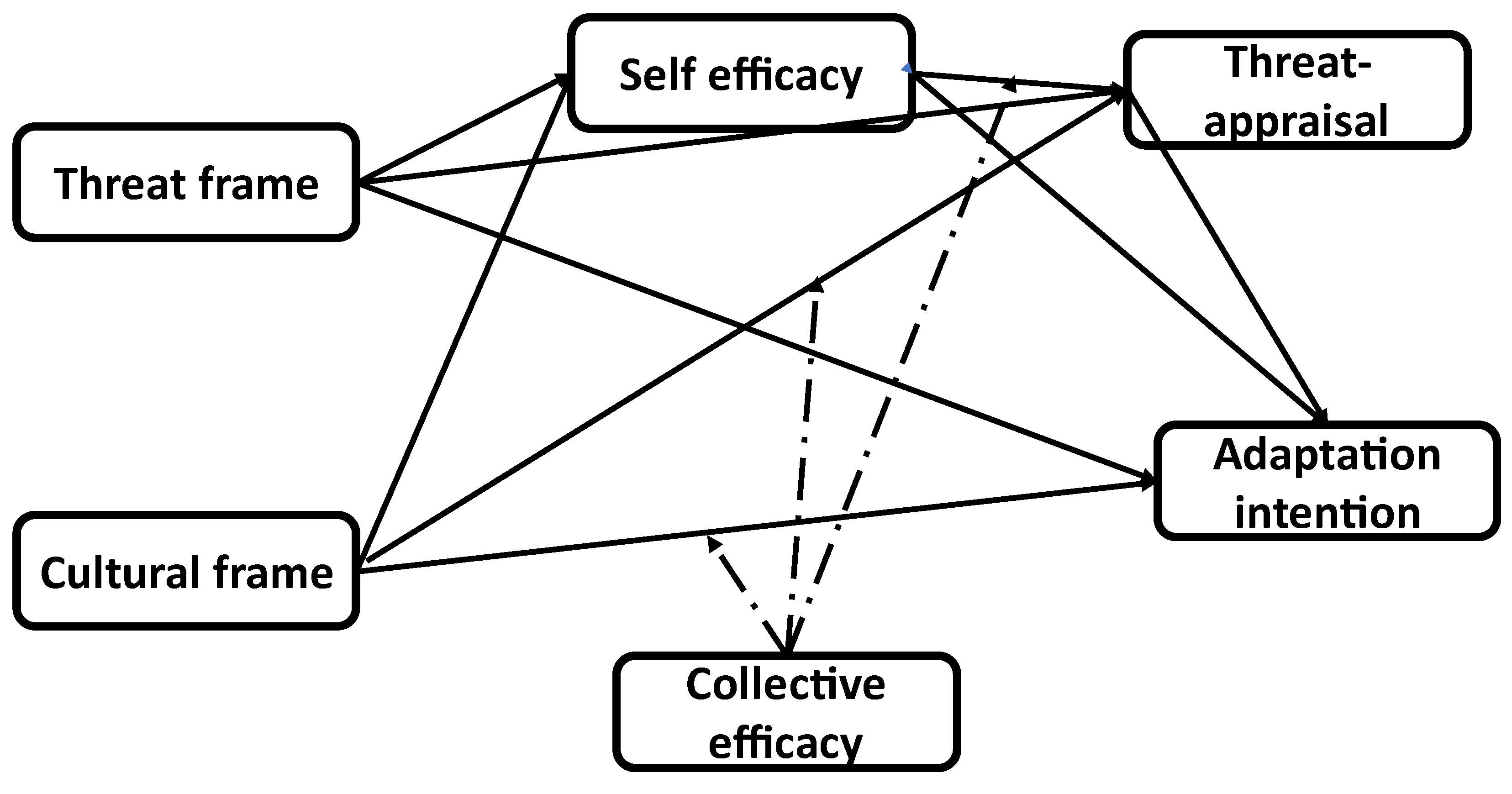
Figure 2.
.
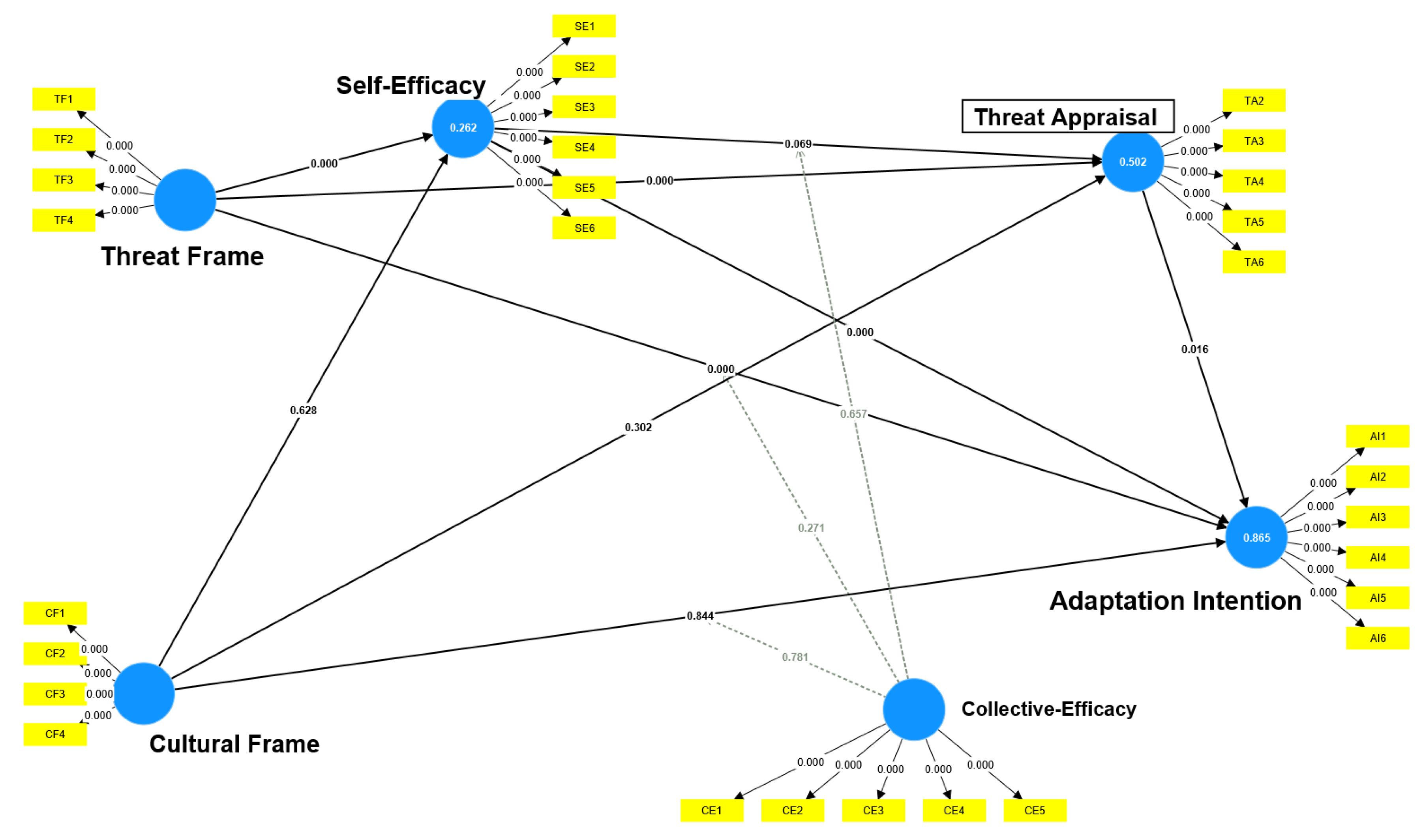

Table 1.
Measurement Model Assessment.
| Construct | Code | Factor Loadings | CA | rho_a | rho_c | AVE |
|---|---|---|---|---|---|---|
| Adaptation Intention | 0.938 | 0.941 | 0.951 | 0.764 | ||
| AI1 | 0.889 | |||||
| AI2 | 0.832 | |||||
| AI3 | 0.886 | |||||
| AI4 | 0.889 | |||||
| AI5 | 0.906 | |||||
| AI6 | 0.841 | |||||
| Collective Efficacy | 0.92 | 0.921 | 0.94 | 0.759 | ||
| CE1 | 0.828 | |||||
| CE2 | 0.856 | |||||
| CE3 | 0.895 | |||||
| CE4 | 0.876 | |||||
| CE5 | 0.898 | |||||
| Cultural Frame | 0.873 | 0.875 | 0.899 | 0.692 | ||
| CF1 | 0.781 | |||||
| CF2 | 0.968 | |||||
| CF3 | 0.776 | |||||
| CF4 | 0.788 | |||||
| Self-Efficacy | 0.905 | 0.91 | 0.927 | 0.678 | ||
| SE1 | 0.801 | |||||
| SE2 | 0.859 | |||||
| SE3 | 0.733 | |||||
| SE4 | 0.859 | |||||
| SE5 | 0.827 | |||||
| SE6 | 0.856 | |||||
| Threat Appraisal | 0.933 | 0.934 | 0.949 | 0.789 | ||
| TA2 | 0.874 | |||||
| TA3 | 0.919 | |||||
| TA4 | 0.904 | |||||
| TA5 | 0.898 | |||||
| TA6 | 0.844 | |||||
| Threat Frame | 0.941 | 0.941 | 0.958 | 0.85 | ||
| TF1 | 0.92 | |||||
| TF2 | 0.919 | |||||
| TF3 | 0.926 | |||||
| TF4 | 0.923 |
Table 2.
Discriminant Validity (HTMT and Fornell-Larcker).
| Panel A: HTMT | ||||||
|---|---|---|---|---|---|---|
| Variable | AI | CE | CF | SE | TA | TF |
| AI | ||||||
| CE | 0.485 | |||||
| CF | 0.035 | 0.044 | ||||
| SE | 0.417 | 0.592 | 0.041 | |||
| TA | 0.594 | 0.422 | 0.063 | 0.437 | ||
| TF | 0.576 | 0.487 | 0.034 | 0.45 | 0.649 | |
| Panel B: Fornell-Larcker | ||||||
| Variable | AI | CE | CF | SE | TA | TF |
| AI | 0.874 | |||||
| CE | 0.421 | 0.871 | ||||
| CF | -0.021 | 0.002 | 0.832 | |||
| SE | 0.369 | 0.523 | 0.014 | 0.824 | ||
| TA | 0.534 | 0.393 | -0.067 | 0.404 | 0.888 | |
| TF | 0.518 | 0.446 | -0.027 | 0.411 | 0.602 | 0.922 |
Table 3.
Model fit analysis.
| Fit Measure | Saturated Model | Estimated Model | Threshold |
|---|---|---|---|
| SRMR | 0.000 | 0.065 | < 0.080 |
| d_ULS | 0.734 | 1.245 | Lower is better |
| d_G | 0.648 | 0.712 | Lower is better |
| Chi-square | 1268.634 | 1298.425 | Lower is better |
| NFI | 1.000 | 0.954 | > 0.900 |
Table 4.
R-square values.
| Variable | R-square | R-square adjusted |
|---|---|---|
| AI | 0.565 | 0.563 |
| SE | 0.262 | 0.258 |
| TA | 0.502 | 0.494 |
Table 5.
Path Coefficients and Statistical Significance.
| Panel A: Direct Path Coefficients | |||||||
|---|---|---|---|---|---|---|---|
| Hypothesized Path | β | M | SD | t-value | p-value | Hypothesis | Decision |
| CE → AI | -0.058 | -0.057 | 0.044 | 1.309 | 0.191 | - | - |
| CE → TA | -0.105 | -0.105 | 0.075 | 1.401 | 0.161 | - | - |
| CF → AI | 0.004 | 0.004 | 0.022 | 0.197 | 0.844 | H1c | Not supported |
| CF → SE | 0.028 | 0.037 | 0.058 | 0.484 | 0.628 | H1c | Not supported |
| CF → TA | -0.05 | -0.039 | 0.049 | 1.033 | 0.302 | H1c | Not supported |
| SE → AI | 0.172 | 0.172 | 0.046 | 3.762 | <0.001*** | - | - |
| SE → TA | 0.141 | 0.141 | 0.078 | 1.816 | 0.069 | - | - |
| TA → AI | 0.081 | 0.081 | 0.034 | 2.411 | 0.016* | H1a | Supported |
| TF → AI | 0.612 | 0.61 | 0.036 | 22.264 | <0.001*** | H3 | Supported |
| TF → SE | 0.512 | 0.512 | 0.047 | 10.885 | <0.001*** | H1b | Supported |
| TF → TA | 0.685 | 0.685 | 0.045 | 15.221 | <0.001*** | - | - |
| CE × SE → TA | -0.018 | -0.017 | 0.04 | 0.444 | 0.657 | H2a | Not supported |
| CE × CF → AI | 0.006 | 0.004 | 0.02 | 0.278 | 0.781 | - | - |
| CE × TF → AI | 0.02 | 0.02 | 0.018 | 1.1 | 0.271 | - | - |
| Panel B: Total Indirect Effects | |||||||
| Hypothesized Path | β | M | SD | t-value | p-value | Hypothesis | Decision |
| CE → AI | -0.009 | -0.009 | 0.008 | 1.119 | 0.263 | H2b | Not supported |
| CF → AI | 0.001 | 0.004 | 0.013 | 0.082 | 0.934 | - | - |
| CF → TA | 0.004 | 0.005 | 0.01 | 0.409 | 0.683 | - | - |
| SE → AI | 0.011 | 0.011 | 0.008 | 1.37 | 0.171 | - | - |
| TF → AI | 0.149 | 0.15 | 0.039 | 3.869 | <0.001*** | - | - |
| TF → TA | 0.072 | 0.072 | 0.041 | 1.769 | 0.077 | - | - |
| CE × SE → AI | -0.001 | -0.002 | 0.004 | 0.398 | 0.691 | H2b | Not supported |
| Panel C: Specific Indirect Effects | |||||||
| Hypothesized Path | β | M | SD | t-value | p-value | Hypothesis | Decision |
| CF → SE → TA → AI | 0 | 0 | 0.001 | 0.366 | 0.714 | - | - |
| TF → SE → TA | 0.072 | 0.072 | 0.041 | 1.769 | 0.077 | - | - |
| CE → TA → AI | -0.009 | -0.009 | 0.008 | 1.119 | 0.263 | - | - |
| CF → SE → AI | 0.005 | 0.006 | 0.011 | 0.455 | 0.649 | - | - |
| SE → TA → AI | 0.011 | 0.011 | 0.008 | 1.37 | 0.171 | - | - |
| TF → SE → TA → AI | 0.006 | 0.006 | 0.004 | 1.353 | 0.176 | - | - |
| TF → SE → AI | 0.088 | 0.088 | 0.025 | 3.482 | 0.001*** | ||
| CF → TA → AI | -0.004 | -0.003 | 0.004 | 0.923 | 0.356 | - | - |
| CE × SE → TA → AI | -0.001 | -0.002 | 0.004 | 0.398 | 0.691 | - | - |
| CF → SE → TA | 0.004 | 0.005 | 0.01 | 0.409 | 0.683 | - | - |
| TF → TA → AI | 0.056 | 0.056 | 0.024 | 2.297 | 0.022* | - | - |
| Panel D: Total Effects | |||||||
| Hypothesized Path | β | M | SD | t-value | p-value | ||
| CE → AI | -0.066 | -0.066 | 0.045 | 1.48 | 0.139 | ||
| CE → TA | -0.105 | -0.105 | 0.075 | 1.401 | 0.161 | ||
| CF → AI | 0.005 | 0.008 | 0.027 | 0.198 | 0.843 | ||
| CF → SE | 0.028 | 0.037 | 0.058 | 0.484 | 0.628 | ||
| CF → TA | -0.046 | -0.034 | 0.051 | 0.905 | 0.366 | ||
| SE → AI | 0.183 | 0.183 | 0.047 | 3.913 | <0.001*** | ||
| SE → TA | 0.141 | 0.141 | 0.078 | 1.816 | 0.069 | ||
| TA → AI | 0.081 | 0.081 | 0.034 | 2.411 | 0.016* | ||
| TF → AI | 0.562 | 0.56 | 0.026 | 37.109 | <0.001*** | ||
| TF → SE | 0.512 | 0.512 | 0.047 | 10.885 | <0.001*** | ||
| TF → TA | 0.757 | 0.757 | 0.052 | 14.592 | <0.001*** | ||
| CE × SE → AI | -0.001 | -0.002 | 0.004 | 0.398 | 0.691 | ||
| CE × SE → TA | -0.018 | -0.017 | 0.04 | 0.444 | 0.657 | ||
| CE × CF → AI | 0.006 | 0.004 | 0.02 | 0.278 | 0.781 | ||
| CE × TF → AI | 0.02 | 0.02 | 0.018 | 1.1 | 0.271 | ||
Note: β = path coefficient; M = bootstrap sample mean; SD = standard deviation; t-value = bootstrap t-statistics; * p < 0.05, ** p < 0.01, *** p < 0.001 AI = Adaptation Intentions CE = Collective Efficacy CF = Cultural Frame SE = Self-Efficacy TA = Threat Appraisal TF = Threat Frame × = interaction term.
Table 6.
predictive validity.
| Panel A: construct cross validated redundancy | |||
|---|---|---|---|
| SSO | SSE | Q² (=1-SSE/SSO) | |
| Adaptation Intention | 2088 | 724.562 | 0.653 |
| Collective-Efficacy | 1740 | 1740 | 0.000 |
| Cultural Frame | 1392 | 1392 | 0.000 |
| Self-Efficacy | 2088 | 1724.329 | 0.174 |
| Threat Appraisal | 1740 | 1061.572 | 0.390 |
| Threat Frame | 1392 | 1392 | 0.000 |
| Panel B: q2 predict | |||
| Q²predict | RMSE | MAE | |
| Adaptation Intention | 0.833 | 0.412 | 0.298 |
| Self-Efficacy | 0.247 | 0.872 | 0.670 |
| Threat Appraisal | 0.473 | 0.731 | 0.557 |
Note: SSO = Sum of Squared Observations; SSE = Sum of Squared Prediction Errors; Q² = Stone-Geisser criterion for predictive relevance; RMSE = Root Mean Square Error; MAE = Mean Absolute Error. Q² values > 0 indicate predictive relevance. Exogenous constructs (CE, CF, TF) show Q² = 0.
Disclaimer/Publisher’s Note: The statements, opinions and data contained in all publications are solely those of the individual author(s) and contributor(s) and not of MDPI and/or the editor(s). MDPI and/or the editor(s) disclaim responsibility for any injury to people or property resulting from any ideas, methods, instructions or products referred to in the content. |
© 2026 by the authors. Licensee MDPI, Basel, Switzerland. This article is an open access article distributed under the terms and conditions of the Creative Commons Attribution (CC BY) license (http://creativecommons.org/licenses/by/4.0/).
Copyright: This open access article is published under a Creative Commons CC BY 4.0 license, which permit the free download, distribution, and reuse, provided that the author and preprint are cited in any reuse.