

Submitted:
20 March 2026
Posted:
23 March 2026
You are already at the latest version
Abstract
Background: Outdoor time in early childhood education and care (ECEC) settings provides important opportunities for children’s physical activity; Evidence is limited on whether different organizational outdoor conditions influence not only activity intensity but also the contextual characteristics of children’s movement. Methods: An observational study was conducted using the Observational System for Recording Physical Activity in Children – Preschool Version (OSRAC-P). A total of 7,440 observation intervals were collected from preschool children across three outdoor conditions: structured educator-led physical activity, outdoor free play, and outdoor free play with additional portable equipment. Physical activity intensity, activity type, equipment use, and social context were coded. Contextual differences were analyzed using chi-square tests with standardized residuals, and activity intensity using linear mixed-effects models. Results: No significant differences were found between outdoor conditions in physical activity intensity, sedentary behavior and moderate-to-vigorous physical activity (all p > 0.05). About one third of the variance in activity intensity was attributable to individual differences between children (ICC ≈ 33%). Differences appeared in contextual characteristics. Structured activity involved more locomotor activities and greater adult involvement, with 49.4% of intervals occurring in groups with an educator present. Free play with portable equipment showed more manipulative activities, greater equipment use, and mostly peer interactions without adult presence (55.5%), while free play without additional equipment involved more stationary behavior and activities without equipment (46.9%). Conclusions: Although physical activity intensity did not differ across conditions, the structure, material context, and social organization of children’s activity varied, highlighting the importance of considering contextual dimensions when planning outdoor physical activity in ECEC settings.
Keywords:
preschool children
; outdoor physical activity
; early childhood education and care (ECEC)
; physical activity intensity
; activity context
; OSRAC-P
1. Introduction
Physical activity in early childhood plays a crucial role in children’s motor, cognitive, and socio-emotional development and provides a foundation for the adoption of long-term health-promoting behaviors. Given that preschool-aged children spend a substantial part of their day in early childhood education and care (ECEC) settings, the preschool environment is recognized as one of the key contexts shaping children’s everyday movement patterns [27]. Empirical evidence indicates that children’s physical activity levels vary considerably between preschools, reflecting the influence of organizational arrangements, the quality of the physical and material environment, and pedagogical approaches [12,16,34].
In efforts to increase children’s physical activity levels in ECEC settings, numerous interventions have been developed, primarily targeting changes in activity organization and adaptations of the educational environment. However, systematic reviews and meta-analyses suggest that the effects of such interventions are generally modest and inconsistent and largely dependent on contextual factors, as well as on the duration and design of the interventions [6,14]. An umbrella review by Lum et al. further emphasizes that, although many strategies show potential for increasing children’s physical activity, robust and consistent empirical evidence is still lacking for many of them, particularly under naturalistic, everyday preschool conditions [19].
Particular attention in the literature has been devoted to outdoor time, which is often viewed as an important opportunity for spontaneous movement and free play. Nevertheless, a systematic review and meta-analysis of studies conducted in preschool settings indicate that, despite greater opportunities for movement, children still spend a substantial proportion of outdoor time engaged in sedentary and low-intensity activities, while the proportion of moderate-to-vigorous physical activity (MVPA) is highly variable and often relatively low [32]. Consistent with these findings, available evidence suggests that even during outdoor time, children spend most of their time in light-intensity activities, whereas activities of moderate-to-vigorous intensity are comparatively infrequent [8,29]. At the same time, characteristics of the outdoor preschool environment may be associated with differences in overall physical activity levels, with equipment availability and spatial features shaping children’s behavioral patterns but not necessarily leading to substantial changes in activity intensity [24].
Within this context, some studies have focused on comparing different organizational formats of outdoor activities, most notably structured, educator-led physical activity and unstructured free play. Findings to date remain inconclusive, with some studies showing that overall physical activity intensity does not differ significantly between structured and unstructured conditions, at least during shorter play periods [7]. Such results point to the need for a more in-depth understanding of the contextual characteristics of children’s behavior during outdoor activities, rather than an exclusive focus on quantitative assessments of activity intensity. Despite this, relatively few empirical studies have simultaneously examined both the intensity and the context of children’s physical activity when comparing different organizational forms of outdoor time.
There is increasing recognition that exclusively quantitative measures of physical activity, such as total duration or average intensity, cannot fully capture the complexity of children’s behavior during play. During outdoor time, children engage in a variety of activity types, use diverse equipment, and participate in different forms of social interaction within the same physical space. Accordingly, there is a growing need for methodological approaches that allow for the simultaneous examination of physical activity intensity and the contextual dimensions of behavior.
Research based on direct observation provides precisely such insight, as it enables the assessment of physical activity levels alongside the recording of activity type, equipment use and the social context in which activity occurs. This approach allows children’s physical activity to be examined in relation to its immediate social and environmental context and represents one of the key advantages of direct observation systems compared with exclusively quantitative measures of physical activity [2,22].
In line with the above, the aim of this study was to examine whether the intensity and context of preschool children’s physical activity differ across three outdoor conditions: structured, educator-led physical activity; outdoor free play; and outdoor free play with additional portable equipment. A further aim was to provide detailed contextual insight into patterns of children’s physical activity under naturalistic conditions using the OSRAC-P observational system, thereby complementing findings based solely on quantitative measures of physical activity intensity.
2. Materials and Methods
2.1. Participants and Setting
The study initially observed 120 preschool-aged children from two public early childhood education and care (ECEC) centers located in an urban area. The centers were selected based on the criterion of having broadly comparable spatial and material characteristics of their outdoor environments. Children were observed under three organizational physical activity conditions: structured, educator-led physical activity; outdoor free play; and outdoor free play with additional portable equipment. Due to the field-based design of the study, data were not available for all children across all conditions. Children with observations in only one condition (N = 36) were excluded from the analyses. The final analytical sample comprised 84 children with observations in at least two conditions, of whom 77 had complete data across all three conditions and were therefore included in the repeated-measures analyses of variance. Analyses of the distributions of activity types, equipment use, and social context were based on all available observations of children included in the analytical sample. The sample consisted of 42 boys and 42 girls, aged 4 to 7 years (M = 5.14; SD = 0.85). Observations were conducted during the morning hours in the children’s usual preschool environment. In total, 7,440 valid observation intervals were analyzed.
2.2. Description of Activity Conditions
All observed activities were conducted within the same spatial and temporal framework of the preschool outdoor playground as part of the regular daily routine. Each of the three observed physical activity conditions lasted 30 minutes, ensuring temporal and contextual comparability, while differing in the degree of activity structure and the role of the educator.
Structured physical activity was implemented outdoors as a pre-planned, educator-led session under the direct guidance of the educator. The activity followed a clearly defined structure and sequence, consistent with typical practices of organized physical activity in early childhood education. It included introductory dynamic games aimed at activating the children, general preparatory exercises, an obstacle course, and rope-skipping tasks, followed by additional dynamic games. The session concluded with calming activities designed to gradually reduce movement intensity. Throughout the session, the educator played an active role in organizing, demonstrating, and regulating the flow of activities.
Outdoor free play took place without a predetermined structure or guided instructions, with children independently selecting activities, duration, and modes of engagement in play, using fixed playground equipment and materials regularly available in the preschool environment. The educator’s role was consistent with routine daily practice and was limited to supervising safety and occasionally joining play at the children’s request, without initiating or directing activities.
Outdoor free play with additional portable equipment was conducted under the same spatial and organizational conditions as free play without additional equipment. Children were provided with a range of portable equipment (e.g. frisbees, rackets, balls of various sizes, obstacles, balance elements, and skipping ropes) without prior explanation or demonstration of their use. Children independently and spontaneously chose whether and how to use the available equipment. The educator’s role was identical to that in the free play condition without additional equipment and was limited to safety supervision and reactive involvement in play only at the children’s request, without initiating or structuring activities. All provided equipment was simultaneously available to all children within the shared outdoor space, ensuring equal access throughout the activity period.
2.3. Instrument and Observation Procedure
All observed activities were conducted within the same spatial and temporal framework of the preschool outdoor playground as part of the regular daily routine. Each of the three observed physical activity conditions lasted 30 minutes, ensuring temporal and contextual comparability, while differing in the degree of activity structure and the role of the educator.
Structured physical activity was implemented outdoors as a pre-planned, educator-led session under the direct guidance of the educator. The activity followed a clearly defined structure and sequence, consistent with typical practices of organized physical activity in early childhood education. It included introductory dynamic games aimed at activating the children, general preparatory exercises, an obstacle course, and rope-skipping tasks, followed by additional dynamic games. The session concluded with calming activities designed to gradually reduce movement intensity. Throughout the session, the educator played an active role in organizing, demonstrating, and regulating the flow of activities.
Outdoor free play took place without a predetermined structure or guided instructions, with children independently selecting activities, duration and modes of engagement in play, using fixed playground equipment and materials regularly available in the preschool environment. The educator’s role was consistent with routine daily practice and was limited to supervising safety and occasionally joining play at the children’s request, without initiating or directing activities.
Outdoor free play with additional portable equipment was conducted under the same spatial and organizational conditions as free play without additional equipment. Children were provided with a range of portable equipment (e.g. frisbees, rackets, balls of various sizes, obstacles, balance elements, and skipping ropes) without prior explanation or demonstration of their use. Children independently and spontaneously chose whether and how to use the available equipment. The educator’s role was identical to that in the free play condition without additional equipment and was limited to safety supervision and reactive involvement in play only at the children’s request, without initiating or structuring activities. All provided equipment was simultaneously available to all children within the shared outdoor space, ensuring equal access throughout the activity period.
2.4. Observer Training and Interobserver Reliability
Observers were trained in the use of the OSRAC-P observational system [2] prior to data collection. Inter-observer agreement (IOA) was assessed during a pilot phase using point-by-point agreement based on 25 observation intervals of a single child coded concurrently and independently by five observers. Agreement values were 92.0% for physical activity intensity, 91.2% for activity type, 92.8% for equipment use, and 95.2% for social context, exceeding the recommended 90% criterion for all categories.
Following the establishment of satisfactory inter-observer reliability, each child was observed by a single observer during the main data collection.
2.5. Statistical Analysis
Primary analyses of differences between activity conditions were conducted using repeated-measures analysis of variance (ANOVA). These analyses were performed on participants’ mean observed physical activity intensity and on the mean proportions of time spent in each physical activity intensity category (sedentary, low, and moderate-to-high), calculated per child and per condition. The assumption of sphericity was tested using Mauchly’s test, which indicated no significant violation.
Differences in the distributions of activity types, equipment use, and the social context of activity (group composition) were examined using chi-square (χ²) tests of independence, with Cramer’s V calculated as a measure of effect size. For more detailed interpretation of significant χ² results, standardized residuals were examined, with a threshold of |z| ≥ 2.0 considered indicative of meaningful deviations from expected frequencies. These analyses were used to describe patterns of contextual activity characteristics across conditions and were interpreted at the level of observation intervals rather than as independent effects at the individual child level.
To account for the hierarchical structure of the data and to examine the robustness of the findings, linear mixed-effects models with a random intercept for participants were additionally applied to analyze average physical activity intensity and the proportions of moderate-to-vigorous physical activity (MVPA) and sedentary behavior. The inclusion of a random intercept was justified through comparisons with a null model, with the intraclass correlation coefficient (ICC) indicating the proportion of variance attributable to between-child differences. Activity condition, child age, and sex were included as fixed effects, with activity condition specified as a within-subject factor. Model parameters were estimated using restricted maximum likelihood (REML).
An a priori power analysis was conducted using G*Power (version 3.1.9.7) [5] for a design with three repeated measurements (F tests; repeated-measures ANOVA, within-subjects factors), assuming a significance level of α = 0.05 and statistical power of 1 − β = 0.80. A small effect size was assumed (f = 0.15), with a correlation among repeated measures of r = 0.50, resulting in a minimum required sample size of N = 73 participants. All analyses were performed using IBM SPSS Statistics (version 29.0).
3. Results
Descriptive data presented in Table 1 indicated very similar mean levels of physical activity intensity across all three conditions. Mauchly’s test confirmed that the assumption of sphericity was met (W = 0.985, p = 0.573); therefore, results from the sphericity-assumed model were interpreted. The repeated-measures analysis of variance revealed no statistically significant effect of activity condition on physical activity intensity, F(2, 152) = 0.519, p = 0.596, partial η² = 0.007. Additional analyses indicated that neither linear nor quadratic trends were statistically significant.3.1. Subsection
Descriptive data presented in Table 2 indicated comparable proportions of time spent in moderate-to-vigorous physical activity across conditions, accompanied by pronounced individual variability. Mauchly’s test confirmed that the assumption of sphericity was met (W = 0.999, p = 0.957). The results of the repeated-measures ANOVA showed no statistically significant effect of activity condition on MVPA, F(2, 152) = 0.412, p = 0.663, partial η² = 0.005.
Descriptive data presented in Table 3 showed very similar mean values for the proportion of low-intensity physical activity across all three conditions. Lower variability was observed in the structured activity condition, suggesting more uniform patterns of children’s behavior. Mauchly’s test indicated that the assumption of sphericity was met (W = 0.983, p = 0.532). The repeated-measures analysis of variance revealed no statistically significant effect of activity condition on low-intensity physical activity, F(2, 152) = 0.033, p = 0.967, partial η² < 0.001.
Descriptive values indicated a slightly higher mean proportion of sedentary behavior during free play compared with the other conditions, accompanied by substantial variability in the results (Table 4). The assumption of sphericity was not significantly violated (W = 0.978, p = 0.436). The repeated-measures analysis of variance showed no statistically significant effect of activity condition on sedentary behavior, F(2, 152) = 0.489, p = 0.614, partial η² ≈ 0.006.
Values for different physical activity intensity levels were comparable across all observed conditions (structured activity, free play, and free play with portable equipment). Repeated-measures ANOVA revealed no statistically significant effects of activity condition on mean physical activity intensity or on the proportions of moderate-to-vigorous physical activity (MVPA), low-intensity activity, or sedentary behavior (all p > 0.59), with negligible effect sizes.
Results from the linear mixed-effects models indicated substantial variability in physical activity intensity between children, with approximately one third of the total variance attributable to differences at the participant level (ICC ≈ 0.33). Activity condition did not emerge as a significant predictor of mean physical activity intensity after accounting for individual variability among children, F(2, 240) = 1.24, p = 0.292, while neither sex (p = 0.175) nor age (p = 0.622) was significantly associated with physical activity intensity. Fixed effects explained a small proportion of the variance in activity intensity (marginal R² = 0.012), whereas the total explained variance was 34.2% (conditional R² = 0.342).
Analyses of the proportion of MVPA likewise showed no significant effects of activity condition, sex, or age (all p > 0.05). In contrast, a significant association with age was observed for the proportion of sedentary behavior (B = 4.07, p = 0.016), indicating that older children spent a greater proportion of time engaged in sedentary activities, independent of activity condition and sex.
As shown in Table 5 and Figure 1, the distribution of observed activity types differed significantly across the three conditions. Examination of standardized residuals (|z| ≥ 2.0) indicated that free play with portable equipment was associated with higher-than-expected proportions of manipulative activities (throwing/catching), walking, and obstacle play, as well as a lower-than-expected proportion of stationary behavior. In contrast, free play without additional equipment was characterized by a higher-than-expected proportion of stationary behavior and lower-than-expected proportions of jumping and manipulative activities. Structured outdoor activity was associated with higher-than-expected proportions of jumping and activities classified as “other”, whereas manipulative activities and walking occurred less frequently than expected.
The distribution of equipment use differed significantly across the observed activity conditions (χ²(18, N = 4,416) = 1,572.98, p < .001, Cramer’s V = .422) (Table 6). Examination of standardized residuals (|z| ≥ 2.0) indicated that free play without additional equipment was characterized by a higher proportion of observation intervals with no equipment use and more frequent use of sand play tools, whereas other types of equipment occurred less frequently than expected. In contrast, free play with additional portable equipment was associated with higher proportions of ball use, sports equipment, climbing equipment, and wheeled toys, alongside a lower proportion of intervals without equipment. Structured physical activity was characterized by the predominant use of pre-specified equipment, particularly hoops, while balls, climbing equipment, sports equipment, and wheeled toys were used less frequently than expected.
The distribution of the social context of activity differed significantly across the observed conditions (χ²(10, N = 7.440) = 1,522.54, p < .001, Cramer’s V = .29) (Table 7). Examination of standardized residuals (|z| ≥ 2.0) indicated that free play was associated with higher proportions of solitary activities and activities conducted in groups without an adult, whereas one-to-one activities with an adult and group activities with an adult occurred less frequently than expected.
Free play with additional portable equipment was characterized by higher proportions of activities in groups without an adult and one-to-one activities with a peer. Structured physical activity was associated with higher proportions of activities in groups with an adult and one-to-one activities with an adult, while solitary activities and activities in groups without an adult occurred less frequently than expected.
4. Discussion
The aim of this study was to examine whether the intensity and context of preschool children’s physical activity differed across three outdoor activity conditions: structured, educator-led physical activity; outdoor free play; and outdoor free play with additional portable equipment. The main findings indicate that children’s physical activity intensity did not differ significantly between the observed conditions, while clear differences were simultaneously identified in the contextual characteristics of activity, particularly in activity types, equipment use and social context. Although physical activity intensity did not vary across conditions, the differing activity forms and social frameworks point to qualitatively distinct motor and social experiences for children during outdoor time.
4.1. Absence of Differences in Physical Activity Intensity
The absence of differences in physical activity intensity between structured activity, free play and free play with additional portable equipment is consistent with a substantial body of previous empirical research conducted in ECEC settings. Using accelerometry to examine different forms of recess in a preschool context, Frank et al. found no significant differences in physical activity levels between structured and free-play conditions when analyses were conducted at the whole-sample level, despite pronounced individual variability among children [7]. Similarly, Tortella et al. reported no clear differences in physical activity levels between partially structured activity and outdoor free play, suggesting that changes in organizational format alone do not necessarily lead to changes in movement intensity [31].
Findings from the present study, derived from linear mixed-effects models, further corroborate this pattern. The analyses indicated that approximately one third of the total variability in physical activity intensity (ICC ≈ 0.33) could be attributed to stable child-level differences, whereas the organizational condition of outdoor activity did not emerge as a significant predictor of physical activity intensity. These results suggest that differences in physical activity levels are more strongly related to children’s individual behavioral patterns than to differences in the organization of outdoor activities. This finding is consistent with previous research indicating that characteristics of the physical environment account for only a limited proportion of variability in preschool children’s physical activity [20].
Notably, the present study identified a positive association between child age and the proportion of sedentary behavior during outdoor time, with older children spending a greater proportion of time in sedentary activities irrespective of activity condition. This finding should be interpreted in light of previous research showing that age-related differences in sedentary behavior among preschool children are not unequivocal. A systematic review reported that child-level variables, including age, show no consistent or strong associations with sedentary behavior in ECEC settings [30], while empirical studies conducted in preschools have not identified significant differences in overall sedentary time between age groups during time spent in the institution [1,15]. Discrepancies between these findings and the results of the present study may suggest that age-related patterns of sedentary behavior manifest selectively within specific activity contexts, such as outdoor time, and may depend on activity organization, measurement method, and the level at which behavior is analyzed.
The present findings may also be considered in the context of observational studies demonstrating that preschool children in ECEC settings spend the majority of their time engaged in very low- and light-intensity activities, with moderate-to-vigorous physical activity occurring relatively infrequently. Kyhälä et al. showed that the largest proportion of MVPA occurs during specific activity types, such as physical education activities and rule-based games, whereas routines and material-based play occupy a substantial portion of the day but contribute little to MVPA [17]. Similarly, research indicates that even during unstructured play, children spend much of their time in low-intensity activities, with marked individual variability, even under favorable spatial and organizational conditions [35].
In this context, observational studies suggest that characteristics of the preschool environment and activity organization explain only a small proportion of the variability in children’s physical activity during time spent in ECEC settings [13], while systematic reviews confirm that MVPA levels in preschools are often low and highly variable, regardless of how activities are organized [26]. Nobre et al. demonstrated that the quality of the physical environment, operationalized through the availability and diversity of physical environmental opportunities for physical activity, explains only a moderate proportion of variability in MVPA among preschool children (approximately 16–20%), with the environment acting as an enabling rather than a determining factor of physical activity intensity [25]. Within this broader context, the results of the present study align with a growing body of evidence pointing to the limited impact of organizational changes on increasing the intensity of children’s physical activity.
The absence of higher levels of moderate-to-vigorous physical activity during structured physical activity may be further explained by organizational and pedagogical characteristics of this activity format. Although structured activities often include motorically demanding tasks, a substantial proportion of time may be devoted to task explanations, demonstrations, group organization, and waiting for turns, thereby reducing opportunities for sustained high-intensity movement. In contrast, during free play, children have greater autonomy in selecting activities and regulating movement pace, which may result in shorter but more intense bouts of activity that, when averaged over time, approximate the intensity levels observed under structured conditions. Such compensatory behavioral patterns may help explain why, despite differing organizational characteristics, no differences in overall physical activity intensity were observed between the outdoor activity conditions examined.
4.2. Context of Physical Activity in Outdoor Conditions
Although no differences in physical activity intensity were observed between the activity conditions, the results of this study indicate clear differences in the contextual characteristics of physical activity during outdoor time. Free play with additional portable equipment was characterized by a higher proportion of manipulative activities and more frequent equipment use, whereas structured physical activity involved a higher proportion of locomotor activities and more pronounced educator involvement in the activity itself. Free play without additional equipment more often included stationary activities and peer interactions, with minimal direct involvement of adults. These findings support previous research showing that environmental characteristics and equipment availability can shape patterns of children’s behavior, even when overall physical activity levels do not change. For example, Ng et al. demonstrated that modifications to preschool outdoor spaces may lead to changes in the types of activities children engage in, but not necessarily to increases in moderate-to-vigorous physical activity [24]. Similarly, Clevenger et al. emphasized that classifying physical activity by activity type provides different insights into children’s behavior than assessments based solely on location [4].
Observational studies further suggest that the availability of specific types of portable equipment may be associated with the nature and motor demands of activities, whereas other environmental elements, such as sand play, are more frequently linked to patterns of lower motor engagement [10]. In line with theoretical approaches emphasizing the concept of affordances, outdoor spaces in ECEC settings do not function as direct drivers of physical activity intensity, but rather as contexts that enable diverse forms of play and interaction with varying motor demands [28].
In addition to differences in activity type and equipment use, clear differences were also observed in the social context of physical activity. During free play, both with and without additional equipment, activities predominantly occurred without direct adult presence, most often in groups without an adult or in one-to-one interactions with peers. The provision of portable equipment increased the frequency of peer interactions but did not result in greater adult involvement. In contrast, structured physical activity was characterized by substantially greater educator presence and group-based activities, with the adult assuming the role of organizer and regulator of the activity. Such social organization, however, does not necessarily lead to higher levels of physical activity, as structured frameworks may standardize movement pace and reduce individual variability in children’s behavior. These findings are consistent with theoretical perspectives that conceptualize the social dimension of the environment as an integral component of affordances shaping children’s play patterns, but not as a factor exerting a linear influence on physical activity intensity [23].
5. Strengths and Limitations
5.1. Methodological Implications
An important contribution of this study relates to the use of the OSRAC-P direct observation system, which enables the simultaneous examination of physical activity intensity and the contextual dimensions of children’s behavior under naturalistic, everyday preschool conditions. In contrast to studies that rely exclusively on accelerometry, an observational approach provides insight into the types of activities children engage in, the equipment they use, and the social contexts in which movement occurs [2,22]. This approach proved particularly valuable for interpreting findings in which overall physical activity intensity remained similar across conditions, while behavioral patterns and activity structures differed substantially.
The present findings further support the value of employing combined methodological approaches in research on physical activity in ECEC settings, especially when the aim is to understand not only the quantity but also the quality of children’s movement in naturalistic, everyday educational contexts.
5.2. Practical Implications
The results of this study indicate that decisions regarding the organization of outdoor time in preschools should not be guided solely by the goal of increasing physical activity intensity, but also by considerations of the context in which activity takes place. As different organizational conditions promote different activity types, patterns of equipment use, and forms of social interaction, the practical value of outdoor activities lies in their capacity to provide diverse movement experiences. The findings suggest that thoughtful variation and combination of different outdoor activity formats within daily or weekly routines may represent a simple and feasible strategy in preschool practice. Such an approach does not require extending outdoor time or introducing additional structural changes, but instead allows children to be exposed to a range of motor and social demands within existing organizational frameworks.
Moreover, the findings indicate that the role of the educator during outdoor time can be flexibly adapted to the goals of a given activity condition, with levels of guidance and child autonomy adjusted according to the type of activity. Such flexibility enables a balanced integration of structured and unstructured play elements, thereby enriching the context of children’s movement in everyday early childhood education and care practice.
5.3. Limitations and Future Research
Several limitations of this study should be considered when interpreting the findings. Observations were conducted over a limited data collection period and in a relatively small number of preschools, which may restrict the generalizability of the results. Although analyses of physical activity intensity were performed on mean values per child and activity condition, these averages were derived from observation intervals that were hierarchically structured within children and centers. Future research could apply multilevel models directly at the level of observation intervals to more fully capture the temporal dynamics and variability of physical activity within specific conditions.
Furthermore, the use of extended observation intervals allowed for the simultaneous recording of physical activity intensity and contextual characteristics of behavior; however, this approach may have reduced sensitivity to detect very brief fluctuations in movement intensity. Future studies should therefore consider combining observational methods with objective measurement tools, such as accelerometry, as well as examining the longer-term effects of different organizational outdoor activity conditions on children’s physical activity patterns. In addition, the possibility of a Hawthorne effect cannot be excluded, as both children and educators were aware that observations were being conducted, which may have influenced children’s behavior and the organization of activities during outdoor time.
5. Conclusions
The findings of this study indicate that the overall intensity of preschool children’s physical activity does not differ significantly across different organizational forms of outdoor time, whereas the patterns and contexts in which this activity occurs differ markedly. Differences between conditions are primarily reflected in activity types, equipment use, and the social organization of movement, suggesting that structured activity, free play, and free play with additional portable equipment provide children with qualitatively distinct motor and social experiences. These findings underscore the importance of considering the contextual characteristics of physical activity, alongside intensity levels, when planning and interpreting outdoor activities in early childhood education and care settings.
Author Contributions
Conceptualization, I.N., S.M. and M.H.; methodology, I.N.; formal analysis, I.N.; investigation, I.N., S.M. and M.H.; data curation, I.N., S.M. and M.H..; writing—original draft preparation, I.N.; writing—review and editing, M.H.; visualization, S.M.; supervision, I.N.; All authors have read and agreed to the published version of the manuscript.
Funding
This research did not receive any external funding.
Institutional Review Board Statement
The study was conducted in accordance with the Ethical Code of the University of Zagreb and the Ethical Code for Research Involving Children. Ethical approval was obtained from the Ethics Committee of the Faculty of Teacher Education, University of Zagreb, Croatia (protocol code 641-03/25-01/12; Ref. No. 251-378-01-25-2). Written informed consent was obtained from the parents or legal guardians of all participating children prior to participation, and verbal assent procedures were conducted in accordance with ethical guidelines for research involving young children.
Informed Consent Statement
Informed consent was obtained from the parents or legal guardians of all children involved in the study prior to data collection.
Data Availability Statement
The data presented in this study are not publicly available due to privacy and ethical restrictions.
Acknowledgments
The authors confirm that no generative AI tools were used for the writing, analysis, or preparation of this manuscript. The authors thank the participating preschools, educators, children, and their parents or legal guardians for their cooperation and support during the data collection process.
Conflicts of Interest
The authors declare no conflicts of interest.
Abbreviations
The following abbreviations are used in this manuscript:
| MDPI | Multidisciplinary Digital Publishing Institute |
| DOAJ | Directory of open access journals |
| TLA | Three letter acronym |
| LD | Linear dichroism |
References
- Barbosa, S.C.; Coledam, D.H.; Stabelini Neto, A.; Elias, R.G.; Oliveira, A.R. School environment, sedentary behavior and physical activity in preschool children. Rev. Paul. Pediatr. 2016, 34, 301–308. [Google Scholar] [CrossRef]
- Brown, W.H.; Pfeiffer, K.A.; McIver, K.L.; Dowda, M.; Almeida, J.M.C.A.; Pate, R.R. Assessing preschool children’s physical activity: The Observational System for Recording Physical Activity in Children—Preschool Version. Res. Q. Exerc. Sport 2006, 77, 167–176. [Google Scholar] [CrossRef] [PubMed]
- Cakan, A.; Acer, D. Analysis of preschool children’s outdoor play behaviours. J. Outdoor Environ. Educ. 2024, 27, 1–16. [Google Scholar] [CrossRef]
- Clevenger, K.A.; Erickson, K.; Grady, S.C.; Pfeiffer, K.A. Characterizing preschoolers' outdoor physical activity: The comparability of schoolyard location- and activity type-based approaches. Early Child. Res. Q. 2021, 56, 139–148. [Google Scholar] [CrossRef]
- Faul, F.; Erdfelder, E.; Lang, A.-G.; Buchner, A. G*Power 3: A flexible statistical power analysis program for the social, behavioral, and biomedical sciences. Behav. Res. Methods 2007, 39, 175–191. [Google Scholar] [CrossRef]
- Finch, M.; Jones, J.; Yoong, S.; Wiggers, J.; Wolfenden, L. Effectiveness of centre-based childcare interventions in increasing child physical activity: A systematic review and meta-analysis for policymakers and practitioners. Obes. Rev. 2016, 17, 412–428. [Google Scholar] [CrossRef]
- Frank, M.L.; Flynn, A.; Farnell, G.S.; Barkley, J.E. Differences in physical activity levels in preschool children during free play recess and structured play recess. J. Exerc. Sci. Fit. 2018, 16, 37–42. [Google Scholar] [CrossRef] [PubMed]
- Fröberg, A.; Eskilsson, T.; Manni, A.; Markström, J. Outdoor physical activity in traditional and newly designed preschools: A cross-sectional study. BMC Public Health 2025, 25, 2173. [Google Scholar] [CrossRef]
- Gabriel, K.K.P.; Morrow, J.R.; Woolsey, A.T. Framework for physical activity as a complex and multidimensional behavior. J. Phys. Act. Health 2012, 9, S11–S18. [Google Scholar] [CrossRef]
- Gubbels, J.S.; Van Kann, D.H.; Jansen, M.W. Play equipment, physical activity opportunities, and children's activity levels at childcare. J. Environ. Public Health 2012, 326520. [Google Scholar] [CrossRef] [PubMed]
- Hesketh, K.R.; Lakshman, R.; van Sluijs, E.M.F. Barriers and facilitators to young children's physical activity and sedentary behaviour: A systematic review and synthesis of qualitative literature. Obes. Rev. 2017, 18, 987–1017. [Google Scholar] [CrossRef] [PubMed]
- Henderson, K.E.; Grode, G.M.; O'Connell, M.L.; Schwartz, M.B. Environmental factors associated with physical activity in childcare centers. Int. J. Behav. Nutr. Phys. Act. 2015, 12, 43. [Google Scholar] [CrossRef]
- Hinkley, T.; Salmon, J.; Crawford, D.; Okely, A.D.; Hesketh, K.D. Preschool and childcare center characteristics associated with children’s physical activity during care hours: An observational study. Int. J. Behav. Nutr. Phys. Act. 2016, 13, 117. [Google Scholar] [CrossRef]
- Hnatiuk, J.A.; Brown, H.E.; Downing, K.L.; Hinkley, T.; Salmon, J.; Hesketh, K.D. Interventions to increase physical activity in children 0–5 years old: A systematic review, meta-analysis and realist synthesis. Obes. Rev. 2019, 20, 75–87. [Google Scholar] [CrossRef]
- Júdice, P.B.; Teno, S.C. How do 4–6-year-old children spend their time in preschool? J. Public Health 2025. [Google Scholar] [CrossRef]
- Kippe, K.; Lagestad, P. The effect of activity videos on preschool children and preschool employees’ physical activity level during preschool time. Phys. Act. Health 2024, 8, 167–181. [Google Scholar] [CrossRef]
- Kyhälä, A.-L.; Reunamo, J.; Valtonen, J.O. Children’s time use and moderate-to-vigorous physical activity in early childhood education and care in Finland. S. Afr. J. Child. Educ. 2021, 11, a933. [Google Scholar] [CrossRef]
- Lehto, S.; Reunamo, J.; Ruismäki, H. Children’s peer relations and children’s physical activity. Procedia Soc. Behav. Sci. 2012, 45, 277–283. [Google Scholar] [CrossRef]
- Lum, M.; Wolfenden, L.; Jones, J.; Grady, A.; Christian, H.; Reilly, K.; Yoong, S.L. Interventions to improve child physical activity in the early childhood education and care setting: An umbrella review. Int. J. Environ. Res. Public Health 2022, 19, 1963. [Google Scholar] [CrossRef] [PubMed]
- Määttä, S.; Gubbels, J.; Ray, C.; Koivusilta, L.; Nislin, M.; Sajaniemi, N.; Erkkola, M.; Roos, E. Children’s physical activity and the preschool physical environment: The moderating role of gender. Early Child. Res. Q. 2019, 47, 39–48. [Google Scholar] [CrossRef]
- Martín-García, A.; Rico-González, M. The effect of free play on preschoolers’ physical activity level and motor, cognitive, and socioemotional competences: A systematic review of randomized controlled trials. Eur. Early Child. Educ. Res. J. 2024, 32, 429–447. [Google Scholar] [CrossRef]
- McIver, K.L.; Brown, W.H.; Pfeiffer, K.A.; Dowda, M.; Pate, R.R. Assessing children's physical activity in their homes: The observational system for recording physical activity in children-home. J. Appl. Behav. Anal. 2009, 42, 1–16. [Google Scholar] [CrossRef] [PubMed]
- Moreira, M.; Veiga, G.; Lopes, F.; Hales, D.; Luz, C.; Cordovil, R. Preschool affordances for physical activity and preschoolers’ motor and social-emotional competence. Children 2023, 10, 214. [Google Scholar] [CrossRef] [PubMed]
- Ng, M.; Rosenberg, M.; Thornton, A.; Lester, L.; Trost, S.G.; Bai, P.; Christian, H. The effect of upgrades to childcare outdoor spaces on preschoolers' physical activity: Findings from a natural experiment. Int. J. Environ. Res. Public Health 2020, 17, 468. [Google Scholar] [CrossRef] [PubMed]
- Nobre, J.N.P.; Morais, R.L.S.; Prat, B.V.; Fernandes, A.C.; Viegas, Â.A.; Figueiredo, P.H.S.; Costa, H.S.; Camargos, A.C.R.; de Alcantara, M.A.; Mendonça, V.A.; Lacerda, A.C.R. Physical environmental opportunities for active play and physical activity level in preschoolers: A multicriteria analysis. BMC Public Health 2022, 22, 340. [Google Scholar] [CrossRef]
- O'Brien, K.T.; Vanderloo, L.M.; Bruijns, B.A.; Truelove, S.; Tucker, P. Physical activity and sedentary time among preschoolers in centre-based childcare: A systematic review. Int. J. Behav. Nutr. Phys. Act. 2018, 15, 117. [Google Scholar] [CrossRef]
- Pate, R.R.; Brown, W.H.; Pfeiffer, K.A.; Howie, E.K.; Saunders, R.P.; Addy, C.L.; Dowda, M. An intervention to increase physical activity in children: A randomized controlled trial with 4-year-olds in preschools. Am. J. Prev. Med. 2016, 51, 12–22. [Google Scholar] [CrossRef]
- Sando, O.J.; Sandseter, E.B. Affordances for physical activity and well-being in the ECEC outdoor environment. J. Environ. Psychol. 2020, 69, 101430. [Google Scholar] [CrossRef]
- Taylor, N.; Pringle, A.; Roscoe, C.M.P. Characteristics of the outdoor environment affording physical activity, motor competence, and social interactions in children aged 3–7 years: A systematic review. Children 2024, 11, 1491. [Google Scholar] [CrossRef]
- Tonge, K.L.; Mavilidi, M.; Jones, R.A. An updated systematic review of correlates of children's physical activity and sedentary time in early childhood education services. Child Care Health Dev. 2024, 50, e13265. [Google Scholar] [CrossRef]
- Tortella, P.; Haga, M.; Ingebrigtsen, J.E.; Fumagalli, G.F.; Sigmundsson, H. Comparing free play and partly structured play in 4–5-year-old children in an outdoor playground. Front. Public Health 2019, 7, 197. [Google Scholar] [CrossRef] [PubMed]
- Truelove, S.; Bruijns, B.A.; Vanderloo, L.M.; O'Brien, K.T.; Johnson, A.M.; Tucker, P. Physical activity and sedentary time during childcare outdoor play sessions: A systematic review and meta-analysis. Prev. Med. 2018, 108, 74–85. [Google Scholar] [CrossRef] [PubMed]
- Tucker, P.; Vanderloo, L.M.; Johnson, A.M.; Burke, S.M.; Irwin, J.D.; Gaston, A.; Driediger, M.; Timmons, B.W. Impact of the Supporting Physical Activity in the Childcare Environment (SPACE) intervention on preschoolers' physical activity levels and sedentary time: A cluster randomized controlled trial. Int. J. Behav. Nutr. Phys. Act. 2017, 14, 120. [Google Scholar] [CrossRef] [PubMed]
- Vanderloo, L.M.; Tucker, P.; Johnson, A.M.; Van Zandvoort, M.M.; Burke, S.M.; Irwin, J.D. The influence of centre-based childcare on preschoolers’ physical activity levels: A cross-sectional study. Int. J. Environ. Res. Public Health 2014, 11, 1794–1802. [Google Scholar] [CrossRef]
- Vega-Perona, H.; Estevan, I.; Bernabé-Villodre, M.M.; Segura-Martínez, P.; Martínez-Bello, D.A.; Martínez-Bello, V.E. Correlates of toddlers’ physical activity levels and sedentary behavior during unstructured outdoor play in early childhood education and daycare settings. Percept. Mot. Skills 2024, 131, 39–58. [Google Scholar] [CrossRef]
Figure 1.
Percentage distribution of observed activity types during free play, free play with portable equipment and structured outdoor activity.
Figure 1.
Percentage distribution of observed activity types during free play, free play with portable equipment and structured outdoor activity.
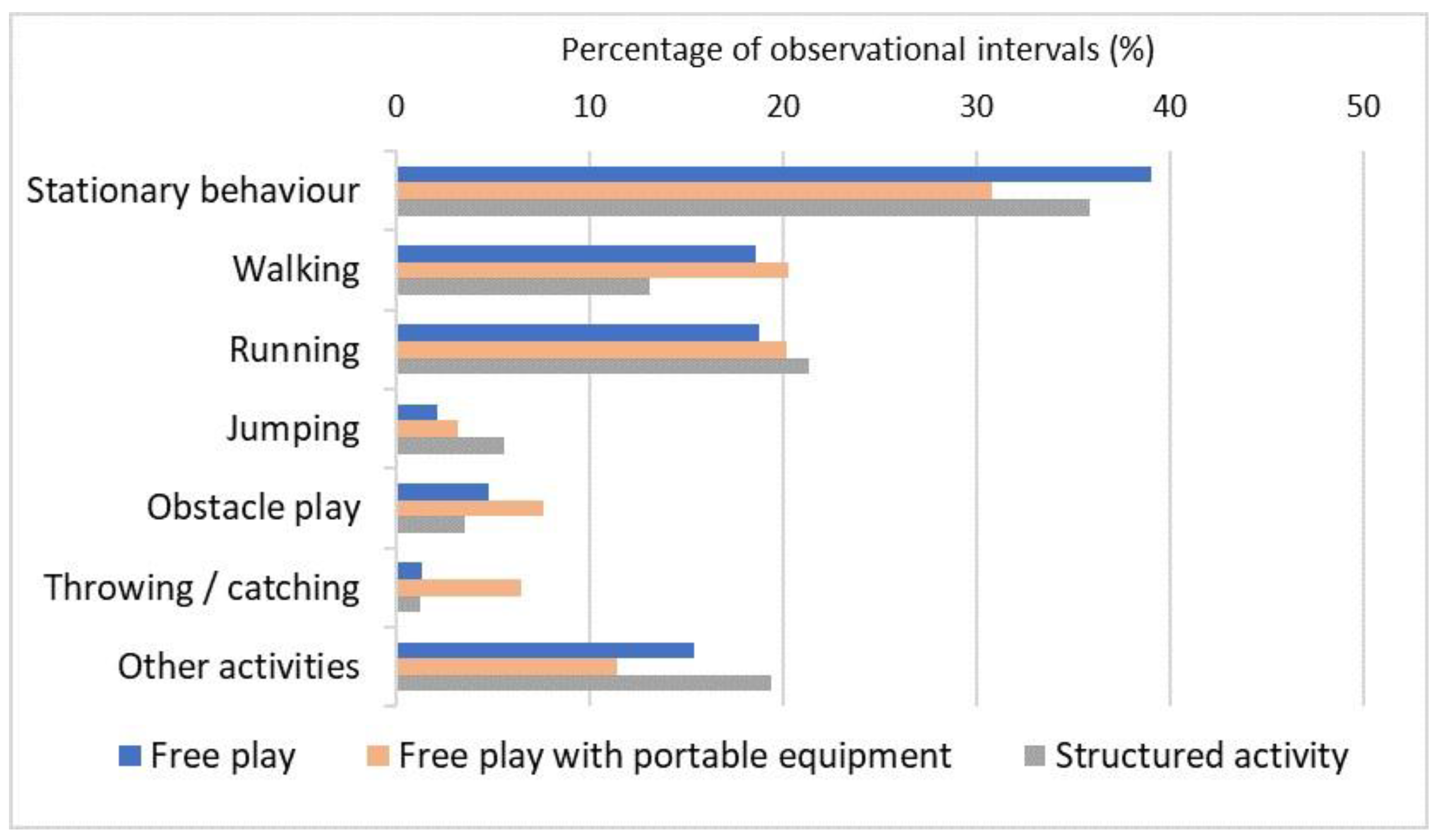

Table 1.
Results of the repeated-measures ANOVA for mean physical activity intensity across three activity conditions.
Table 1.
Results of the repeated-measures ANOVA for mean physical activity intensity across three activity conditions.
| Analysis | Value (M ± SD) |
|---|---|
| Structured activity | 2.886 ± 0.652 |
| Free play | 2.818 ± 0.838 |
| Free play with portable equipment | 2.945 ± 0.819 |
| Mauchly’s test of sphericity | W = .985, p = .573 |
| Repeated-measures ANOVA (sphericity assumed) | F(2,152) = 0.519, p = .596, partial η² = .007 |
| Linear trend | F(1,76) = 0.267, p = .607 |
| Quadratic trend | F(1,76) = 0.823, p = .367 |
Table 2.
Results of the repeated-measures ANOVA for MVPA (%).
| Analysis | Value (M ± SD) |
|---|---|
| Structured activity | 35.40 ± 18.35 |
| Free play | 31.59 ± 24.10 |
| Free play with portable equipment | 34.78 ± 24.85 |
| Mauchly’s test of sphericity | W = .999, p = .957 |
| Repeated-measures ANOVA (sphericity assumed) | F(2,152) = 0.412, p = .663, partial η² = .005 |
Table 3.
Results of the repeated-measures ANOVA (RM-ANOVA) for low-intensity physical activity (LIGHT, %).
Table 3.
Results of the repeated-measures ANOVA (RM-ANOVA) for low-intensity physical activity (LIGHT, %).
| Analysis | Value (M ± SD) |
|---|---|
| Free play | 37.14 ± 24.36 |
| Free play with portable equipment | 38.05 ± 25.26 |
| Structured activity | 37.58 ± 19.43 |
| Mauchly’s test of sphericity | W = 0.983; p = 0.532 |
| Repeated-measures ANOVA (sphericity assumed) | F(2, 152) = 0,033; p = 0.967; partial η² < 0.001 |
Table 4.
Repeated-measures ANOVA results for sedentary behavior (SED, %) across the three conditions.
Table 4.
Repeated-measures ANOVA results for sedentary behavior (SED, %) across the three conditions.
| Analysis | Value (M ± SD) |
|---|---|
| Structured activity | 27.53 ± 20.32 |
| Free play | 31.08 ± 23.96 |
| Free play with portable equipment | 28.66 ± 24.06 |
| Mauchly’s test of sphericity | W = 0.978; p = 0.436 |
| Repeated-measures ANOVA (sphericity assumed) | F(2,152) = 0.489; p = 0,614; partial η² ≈ 0.006 |
Table 5.
Distribution of observation intervals by activity type and outdoor activity condition (OSRAC-P).
Table 5.
Distribution of observation intervals by activity type and outdoor activity condition (OSRAC-P).
| Activity type | Free play (n = 2460) | Free play with portable equipment (n = 2610) | Structured activity (n = 2370) |
|---|---|---|---|
| Stationary | 960 (39.0%) | 804 (30.8%) | 852 (35.9%) |
| Walking | 458 (18.6%) | 531 (20.3%) | 311 (13.1%) |
| Running | 462 (18.8%) | 526 (20.2%) | 504 (21.3%) |
| Jumping | 51 (2.1%) | 84 (3.2%) | 133 (5.6%) |
| Obstacle course | 118 (4.8%) | 198 (7.6%) | 82 (3.5%) |
| Throwing / catching | 33 (1.3%) | 170 (6.5%) | 29 (1.2%) |
| Riding | 39 (1.6%) | 92 (3.5%) | 0 (0.0%) |
| Other | 339 (13.8%) | 205 (7.9%) | 459 (19.4%) |
Note. The chi-square test of independence indicated a statistically significant association between activity condition and activity type, χ²(14, N = 7.440) = 513.09, p < .001, Cramer’s V = .186.
Table 6.
Distribution of observation intervals by equipment use and outdoor activity condition (OSRAC-P).
Table 6.
Distribution of observation intervals by equipment use and outdoor activity condition (OSRAC-P).
| Equipment | Free play (n = 1348) | Free play with portable equipment (n = 1826) | Structured activity (n = 1242) |
|---|---|---|---|
| No equipment | 580 (43.0%) | 319 (17.5%) | 446 (35.9%) |
| Balls | 334 (24.8%) | 629 (34.4%) | 152 (12.2%) |
| Hoops | 25 (1.9%) | 55 (3.0%) | 378 (30.4%) |
| Climbing equipment | 94 (7.0%) | 195 (10.7%) | 28 (2.3%) |
| Sports equipment | 6 (0.4%) | 226 (12.4%) | 7 (0.6%) |
| Wheeled toys | 39 (2.9%) | 106 (5.8%) | 0 (0.0%) |
| Sand play tools | 98 (7.3%) | 16 (0.9%) | 26 (2.1%) |
| Other | 96 (7.1%) | 199 (10.9%) | 167 (13.4%) |
| Swing | 44 (3.3%) | 44 (2.4%) | 28 (2.3%) |
| Slide | 32 (2.4%) | 37 (2.0%) | 10 (0.8%) |
Note. The chi-square test of independence indicated a statistically significant association between activity condition and type of equipment used, χ²(18, N = 4,416) = 1,572.98, p < .001, Cramer’s V = .422. The analysis was conducted on a subset of observation intervals for which equipment use was coded.
Table 7.
Distribution of observation intervals by group composition (social context) across outdoor activity conditions (OSRAC-P).
Table 7.
Distribution of observation intervals by group composition (social context) across outdoor activity conditions (OSRAC-P).
| Group composition | Free play (n=2460) | Free play with portable equipment (n=2610) | Structured activity (n=2370) |
|---|---|---|---|
| Solitary | 194 (7.9%) | 60 (2.3%) | 89 (3.8%) |
| One-to-one with educator | 9 (0.4%) | 11 (0.4%) | 88 (3.7%) |
| One-to-one with peer | 662 (26.9%) | 823 (31.5%) | 392 (16.5%) |
| Group with educator | 411 (16.7%) | 237 (9.1%) | 1171 (49.4%) |
| Group without adult | 1154 (46.9%) | 1449 (55.5%) | 630 (26.6%) |
| Can’t tell | 30 (1.2%) | 30 (1.1%) | 0 (0.0%) |
Note. The chi-square test of independence indicated a statistically significant association between activity condition and group composition, χ²(10, N = 7.440) = 1,522.54, p < .001, Cramer’s V = .29.
Disclaimer/Publisher’s Note: The statements, opinions and data contained in all publications are solely those of the individual author(s) and contributor(s) and not of MDPI and/or the editor(s). MDPI and/or the editor(s) disclaim responsibility for any injury to people or property resulting from any ideas, methods, instructions or products referred to in the content. |
© 2026 by the authors. Licensee MDPI, Basel, Switzerland. This article is an open access article distributed under the terms and conditions of the Creative Commons Attribution (CC BY) license (http://creativecommons.org/licenses/by/4.0/).
Copyright: This open access article is published under a Creative Commons CC BY 4.0 license, which permit the free download, distribution, and reuse, provided that the author and preprint are cited in any reuse.


