

Submitted:
22 March 2026
Posted:
23 March 2026
You are already at the latest version
Abstract
Background: Echinococcosis is an infection caused by the Echinococcus Granulosus parasite, mainly affecting the liver and, less commonly, the lungs. Surgical intervention is the main treatment for Echinococcus Granulosus, with various approaches available depending on the cyst characteristics. This study provided a comprehensive assessment of age characteristics, hospitalization length, and regional differences in the surgical treatment of echinococcosis in Kazakhstan. Objectives: To conduct a comparative analysis of regional disparities in surgical management of pulmonary echinococcosis in Kazakhstan and identify organizational factors contributing to the burden of emergency surgeries. Methods: A brief description of the main methods or treatments applied. This can include any relevant preregistration or specimen information. Results: A short summary of the article’s main findings. Conclusions: A final summarizing comment of the main conclusions or interpretations. The abstract should be an objective representation of the article; it must not contain results which are not presented and substantiated in the main text and should not exaggerate the main conclusions. Clinical trial abstracts should include items that the CONSORT group has identified as essential.
Keywords:
echinococcosis
; echinococcal granulosa infection
; surgery
1. Introduction
According to the 2025 World Health Statistics and health monitoring to achieve the SDGs, neglected tropical diseases (NTDs) are a diverse group of diseases with complex epidemiology that require innovative solutions, especially amid uncertainty and variability in the health sector and across political and financial domains. In 2023, 1.495 billion people worldwide needed measures to combat neglected tropical diseases (MTD), an indicator reflecting progress toward Sustainable Development Goal (SDG) 3.3.5. This is about 122 million fewer people than in 2022 [1]. There is a decrease in the number of people needing interventions due to global health improvement efforts [2]. The epidemiological significance of echinococcosis is determined by its severe clinical course, leading to disability and death, a wide range of carriers, and the formation of synanthropic and mixed lesions. The choice of rational surgical tactics for combined echinococcosis should be based on an individual approach, taking into account the patient’s general condition, risk analysis, and the likelihood of complications [3]. Worldwide, more than 1 million people develop echinococcosis and the annual cost of treatment is 3 billion US dollars [4].
The main species of medical importance are Echinococcus granulosus and Echinococcus multilocularis, with two main types of infections: cystic echinococcosis (CE) and alveolar echinococcosis (EE) [5]. Human echinococcosis is caused by larval infection and most often manifests as echinococcal liver cysts in adults. Although cyst formation can occur in other organs, such as the lungs, extrahepatic disease usually develops as a secondary infection after hematogenous infection. We present an unusual case of primary pulmonary echinococcosis without signs of liver involvement [6]. Chest injury in liver echinococcosis is a rare evolutionary complication of liver echinococcosis associated with significant postoperative morbidity, consistent with the results observed in patients with uncomplicated liver echinococcosis [7]. Numerous systematic reviews and meta-analyses confirm the significant impact of echinococcosis on public health. The study covers several continents and includes detailed epidemiological studies from Iran [8] and Canada, which provide comprehensive information on transmission, clinical manifestations, and economic consequences [9]. Efforts to control and prevent echinococcosis include innovative tools and traditional measures with an emphasis on a unified approach to health [10].
This is the first nationwide comparative analysis of regional disparities in surgical management of pulmonary echinococcosis in Kazakhstan, identifying organizational determinants of emergency surgery burden.
2. Materials and Methods
This study is a retrospective, population-based analysis of temporal trends and regional differences in the number of treated cases of echinococcosis in the Republic of Kazakhstan from 2017 to 2024. The analysis was based on secondary data obtained from official national health reporting systems, including regional records of treated cases and surgical interventions (elective and emergency). Data on the population of Kazakhstan is taken from the statistical collection “Health of the population of the Republic of Kazakhstan and the activities of healthcare organizations,” Committee on Statistics: Astana, Kazakhstan, 2017–2024. Descriptive statistics, including means (M) and standard deviations (SD), were used to summarize the data. Time trends were assessed using percentage changes and growth rates. For all analyses, 95% confidence intervals (95% CI) were calculated where applicable. Statistical analysis of the results was carried out using SPSS ver. 25.0 (IBM, Armonk, NY, USA). A p-value <0.05 was considered statistically significant. The forecast for treated echinococcosis cases in 2034 is calculated in the Excel 2016 Forecast sheet.
3. Results
A comparative analysis of echinococcosis treatment cases in Kazakhstan (Figure 1) revealed a substantial decline in prevalence between 2017 and 2024. Nationally, the rate decreased from 2.29 per 100,000 population in 2017 to 0.37 per 100,000 in 2024, representing a 6.2-fold reduction in treated cases. In 2017, the highest prevalence rates occurred in the southern and western regions, with Turkestan leading at 6.35 per 100,000 population and accounting for 126 treated cases, the largest regional disease burden. Elevated rates were also observed in Western Kazakhstan (4.35 per 100,000), Almaty (3.60 per 100,000), and the Zhambyl region (3.58 per 100,000). Moderate prevalence was noted in Aktobe (2.70), Mangystau (2.61), and Astana (2.59). Lower rates were recorded in Karaganda (0.58), Kostanay (0.57), East Kazakhstan (0.50), and the Abai region (0.31). By 2024, most regions experienced a marked reduction in treated cases. The highest rates were reported in Astana (0.81 per 100,000) and Almaty (0.75 per 100,000), followed by Western Kazakhstan (0.72) and Kyzylorda (0.59). The incidence rate in Turkestan, previously the highest, declined significantly from 6.35 to 0.56 per 100,000 population, reflecting a substantial decrease in disease burden. Several regions, including Kostanay, reported very few or no treated cases in 2024.
National data indicate a substantial reduction in the prevalence of treated cases of echinococcosis. The average prevalence per 100,000 population declined from 2.29 in 2017 to 0.37 in 2024, representing an 83-84% decrease. This trend suggests that preventive and curative interventions have been effective in reducing morbidity. In 2017, the most endemic regions were Turkestan (6.35 per 100,000), Zhambyl (3.58), West Kazakhstan (4.35), and Almaty city (3.60). By 2024, Turkestan experienced a marked reduction from 6.35 to 0.56 per 100,000 (-91%), while still reporting the highest absolute number of treated cases. Zhambyl decreased from 3.58 to 0.25 per 100,000 (-93%), indicating a consistent decline in morbidity. West Kazakhstan also achieved a significant reduction from 4.35 to 0.72 per 100,000 (-83.4%), although intermittent fluctuations suggest periodic local outbreaks. Almaty city reported a decrease from 3.60 to 0.75 per 100,000 (-79%), a less pronounced decline than in southern endemic regions, potentially due to high urbanization and challenges with comprehensive preventive coverage. These findings underscore the continued priority of monitoring southern regions, despite notable reductions in morbidity. Regions with intermediate morbidity rates (1-3 per 100,000) include Aktobe, Mangystau, Astana city, Almaty, Zhetisu, Kyzylorda, and Karaganda. Mangystau’s rate declined from 2.61 to 0.25 per 100,000 (-90%), indicating near elimination of reported cases. Aktobe reduced its rate from 2.70 to 0.53 per 100,000 (-80.4%), with minor fluctuations suggesting possible local outbreaks. Astana city decreased from 2.59 to 0.81 per 100,000 (-68.7%), reflecting a slower reduction in urban settings. Zhetisu exhibited variability, with an increase to 2.95 in 2020 followed by a decrease to 0.29 in 2024, likely due to episodic outbreaks. Overall, these regions demonstrate a gradual downward trend with periodic fluctuations, necessitating ongoing surveillance. Regions with low morbidity rates (<1 per 100,000 in 2017) include Abay, Akmola, Kostanay, East Kazakhstan, and Shymkent city. By 2024, Abay, Akmola, and Kostanay had nearly ceased registering cases, indicating the success of preventive measures in the northern areas. East Kazakhstan experienced a moderate decline from 0.50 to 0.28 per 100,000 (-44%). Shymkent city was an exception, with an increase from 0.03 to 0.08 per 100,000 (+166%), likely attributable to improved case detection and registration rather than a true rise in incidence. Some regions, such as Zhetisu and West Kazakhstan, experienced spikes between 2018 and 2020. The slower decline in major cities (Almaty and Astana) may reflect urban and social factors that affect transmission dynamics. These patterns highlight the necessity for sustained monitoring and targeted prevention campaigns, particularly in urban and border regions. Between 2017 and 2023, substantial variability was observed, primarily due to exceptionally high values in Turkestan and Almaty City. The mean number of surgeries declined from 24.3 in 2017 to 5.3 in 2024, demonstrating a marked reduction in surgical activity. Additionally, the standard deviation decreased from 31.2 to 4.9, indicating a reduction in interregional variability. In 2024, the distribution of values became more uniform, which was accompanied by a pronounced decrease in surgical procedures across nearly all regions (Table 1).
From 2017 to 2024, there is a clear downward trend in the number of patients treated nationwide (Table 2). In 2017, 413 treated cases were registered, which corresponds to 1,000 units per indicator of visibility. By 2024, the number of cases had declined sharply to 74, representing an almost 82% reduction from baseline. The decline did not occur evenly; it fluctuated, as reflected in the intervening years. The absolute increase shows changes in the number of treated patients compared to the previous year: The largest drop occurred in 2024: 210 cases. In 2018 and 2019, there was a moderate decrease: -41 and -30, respectively. In 2022, a slight increase was recorded: 6 additional cases, indicating a temporary increase in detected or treated cases. The growth rate (%) reflects the ratio of the number of patients to the previous year. The decrease is greatest in 2024 (26.1%), highlighting a sharp decline in treatment or detection activity. The smallest decrease in pace was noted in 2020 (99.4%), with almost no changes. The growth rate (%) shows the rate of change: Negative values indicate a decrease: in 2018 -9.93%, in 2023 -13.9%, and in 2024 -73.9%. The positive rate in 2022 (+1.85%) reflects temporary growth. The absolute size of the 1% increase shows how many cases correspond to a 1% change. The value has decreased from 4.13 in 2018 to 2.84 in 2024, reflecting a decline in the incidence rate. The visibility indicator visually represents the data and reflects the relative weight of the number of treated patients. The decrease from 1,000 units in 2017 to 179.2 units in 2024 visually highlights the dramatic reduction in the number of treated cases. The sharp decline in 2024 (from 284 to 74) requires attention — possible causes include reduced detection of cases, changes in registration or reporting, or reduced morbidity due to preventive measures. Fluctuations in the intervening years (moderate falls and an increase in 2022) indicate episodic outbreaks and differences in diagnosis and treatment availability. Long-term trend: from 2017 to 2024, the number of treated patients in the country has steadily decreased, which aligns with the regional analysis.
The analysis indicates a gradual decline in treated cases of echinococcosis in Kazakhstan from 2017 (413 cases) to 2023 (284 cases), with fluctuations, including a minor increase in 2022 (330 cases). A significant drop to 74 cases was noted in 2024, attributed to potential reporting issues. Forecasts predict a continued decrease, with estimates of 141 cases in 2025 and 107 in 2026, both accompanied by wide confidence intervals reflecting high uncertainty. Long-term projections evoke negative case estimates, signaling limitations in the forecasting model. Overall, while a downward trend exists, projections should be interpreted cautiously due to considerable forecast uncertainty.
Analysis of data for 2017-2024 shows that the number of elective operations for echinococcosis in Kazakhstan varied significantly by year and region. In 2017, the largest number of operations was recorded in large cities: Almaty city – 61 operations (24 per 100,000 population), Astana city – 25 (9.84 per 100,000), and in southern endemic regions such as Turkestan – 47 operations (18.5 per 100,000), Zhambyl – 30 (11.8 per 100,000 100,000). By 2024, the number of operations has decreased in many regions, especially in cities and southern endemic regions: Almaty city has reduced the number from 61 to 16 operations (from 24 to 34.8 per 100,000). Despite the drop in the number, the Rate has increased, due to a decrease in population or recalculation per 100,000. Turkestan has reduced the number of operations from 47 to 4 (from 18.5 to 8.7 per 100,000). Zhambyl reduced the rate from 30 to 2 operations (from 11.8 to 4.35 per 100,000). The overall decrease in the number of operations reflects fewer detected cases and, possibly, the influence of systemic factors, including the availability of surgical care. A high surgical workload was observed in 2017-2019 in large cities and southern regions, including Almaty and Astana cities, with the largest absolute number of operations. Turkestan, Zhambyl, and West Kazakhstan are the leading regions for surgical interventions, reflecting endemicity and high incidence. Low load is typical in northern and sparsely populated regions, such as Abay, Akmola, Kostanay, and Shymkent, with fewer than 5 operations per year. In some cases, for example, in Shymkent, the number of operations ranged from 0 to 6, indicating irregular scheduling and limited resources. 2017-2019: The number of operations remains relatively stable, with a slight decrease in some regions. 2020-2021: decrease in the number of operations in most regions (for example, Turkestan: from 30 to 47 in 2020-2021; Almaty: from 10 to 7), which may be related to the COVID-19 pandemic and the restriction of elective surgery. 2022-2023: moderate recovery in the number of operations in some regions, for example, Akmola increased the number from 3 to 6 operations in 2023. 2024: a sharp reduction in operations in almost all regions, except for some cities, for example, Almaty city (16 operations) and Kyzylorda (4 operations), which indicates a further decrease in the availability of elective surgery or a reduction in cases.
Figure 2.
Trends in treated echinococcosis cases in Kazakhstan with a forecast to 2034.
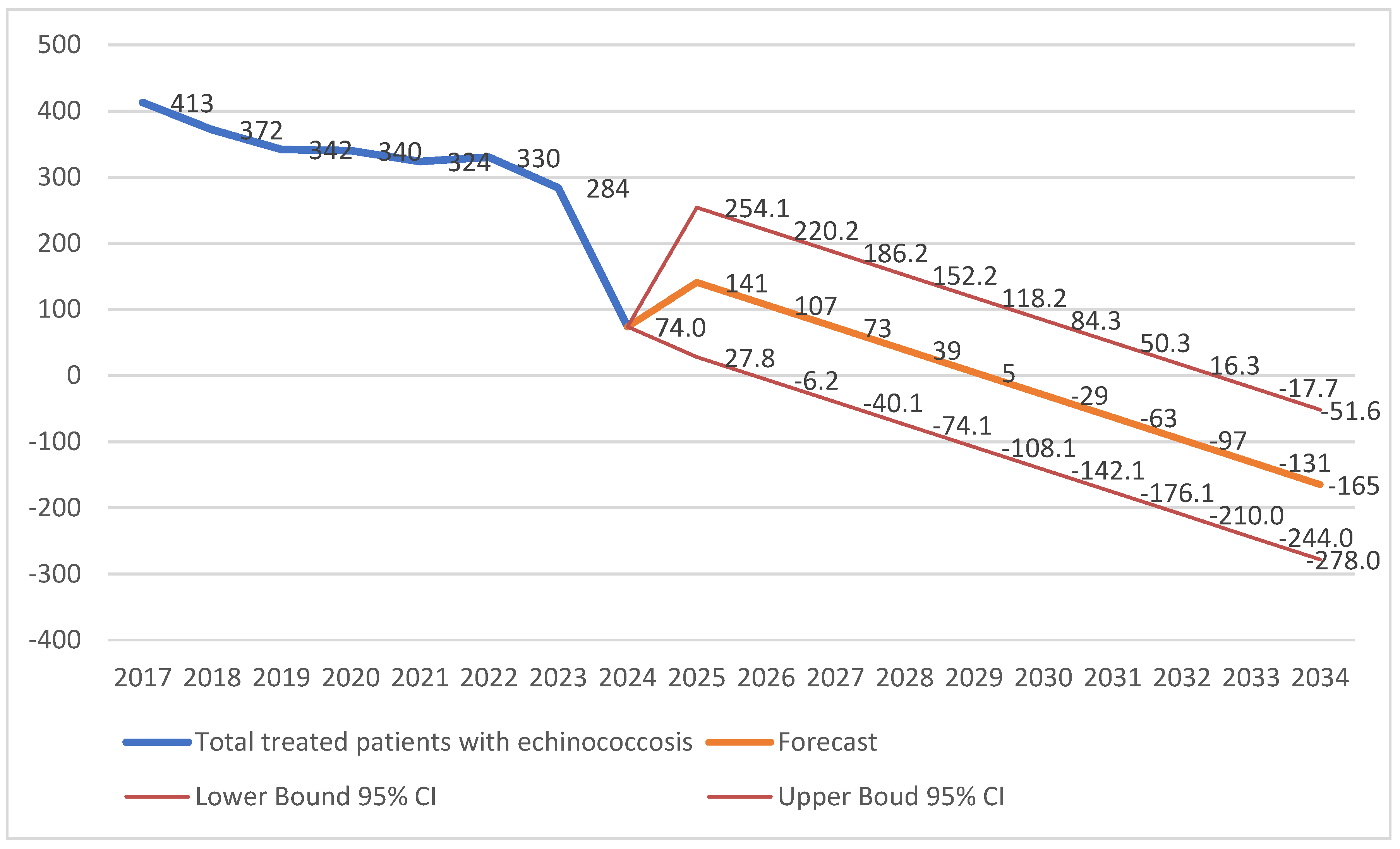

Table 3.
Elective operations for echinococcosis.
| Regions | 2017 | 2018 | 2019 | 2020 | 2021 | 2022 | 2023 | 2024 |
|---|---|---|---|---|---|---|---|---|
| Abay | 2 (0.79) | 1 (0.43) | 3 (1.50) | 1 (0.47) | 2 (1.00) | 2 (0.98) | 2 (1.18) | - |
| Akmola | 2 (0.79) | 5 (2.16) | 2 (1.00) | 2 (0.94) | 3 (1.50) | 3 (1.46) | 6 (3.55) | - |
| Aktobe | 18 (7.09) | 10 (4.31) | 12 (6.00) | 8 (3.76) | 4 (2.00) | 4 (1.95) | 4 (2.37) | 3 (6.52) |
| Almaty | 17 (6.69) | 14 (6.03) | 10 (5.00) | 8 (3.76) | 7 (3.50) | 8 (3.90) | 6 (3.55) | 1 (2.17) |
| Atyrau | 2 (0.79) | 4 (1.72) | 4 (2.00) | 1 (0.47) | 1 (0.49) | |||
| East Kazakhstan | 5 (1.97) | 2 (0.86) | 1 (0.50) | 5 (2.35) | 4 (2.00) | 2 (0.98) | 1 (0.59) | 1 (2.17) |
| Zhambyl | 30 (11.8) | 29 (12.5) | 18 (9.00) | 8 (3.76) | 20 (10.0) | 20 (9.76) | 13 (7.69) | 2 (4.35) |
| Zhetisu | 4 (1.57) | 6 (2.59) | 9 (4.50) | 11 (5.16) | 4 (2.00) | 6 (2.93) | 8 (4.73) | |
| West Kazakhstan | 17 (6.69) | 4 (1.72) | 13 (6.50) | 7 (3.29) | 8 (4.00) | 15 (7.32) | 8 (4.73) | 3 (6.52) |
| Karaganda | 5 (1.97) | 9 (3.88) | 11 (5.50) | 8 (3.76) | 14 (7.00) | 16 (7.80) | 9 (5.33) | 1 (2.17) |
| Kostanay | 3 (1.18) | 1 (0.43) | 1 (0.50) | 1 (0.47) | 2 (1.00) | 1 (0.49) | 1 (0.59) | |
| Kyzylorda | 8 (3.15) | 12 (5.17) | 11 (5.50) | 7 (3.29) | 5 (2.50) | 7 (3.41) | 2 (1.18) | 4 (8.70) |
| Mangystau | 7 (2.76) | 7 (3.02) | 7 (3.50) | 10 (4.69) | 4 (2.00) | 2 (0.98) | 5 (2.96) | |
| Turkestan | 47 (18.5) | 51 (22.0) | 30 (15.0) | 47 (22.1) | 44 (22.0) | 34 (16.6) | 29 (17.2) | 4 (8.70) |
| Shymkent | 1 (0.39) | 0 | 1 (0.50) | 1 (0.47) | 1 (0.50) | 6 (2.93) | 3 (1.78) | 1 (2.17) |
| Almaty city | 61 (24.0) | 53 (22.8) | 58 (29.0) | 63 (29.6) | 45 (22.5) | 51 (24.9) | 48 (28.4) | 16 (34.8) |
| Astana city | 25 (9.84) | 24 (10.3) | 9 (4.50) | 25 (11.7) | 33 (16.5) | 27 (13.2) | 24 (14.2) | 10 (21.7) |
| Mean±SD | 14.94±17.25 | 13.65±16.45 | 11.76±13.99 | 12.53±17.22 | 11.76±14.82 | 12.06±13.96 | 9.94±12.63 | 2.71±4.25 |
Analysis of the data indicates significant interregional variability in the number of emergency operations for echinococcosis (Table 4). The highest mean number of procedures was observed in Turkestan (Mean = 56.5) and Almaty (Mean = 13), whereas the lowest counts were recorded in Kostanay, Astana city, East Kazakhstan, and Atyrau (1–2 operations). These findings suggest an uneven distribution of emergency surgical services across regions, reflecting potential disparities in healthcare accessibility and resource allocation. Standard deviation (SD) analysis reveals substantial fluctuations in regions with varying yearly case numbers. High SD values were noted for Turkestan (SD = 6.36), Zhetisu (SD = 2.97), and Almaty (SD = 4.24), indicating considerable interannual variability. In contrast, regions with consistently low numbers of operations, such as Atyrau and East Kazakhstan, exhibited SD = 0, reflecting stable but minimal surgical activity. No data were available for the period 2019–2021 in most regions. This gap may be attributable to incomplete registration of emergency operations or the impact of the COVID-19 pandemic, which could have disrupted routine healthcare services. The absence of these data must be taken into account when interpreting temporal trends. In city-specific settings (Almaty, Astana, Shymkent), the number of emergency operations was notably lower than in larger regional centers (e.g., Turkestan, Almaty oblast), suggesting that emergency surgical care is centralized in regional hospitals rather than in local urban facilities. Zhetisu displayed marked fluctuations in annual operation numbers (4, 6, and 2 operations in recent years), with an SD = of 2.97. This variability may reflect irregular demand for surgical interventions, potentially driven by localized epidemiological surges or sporadic outbreaks.
The age distribution of patients with echinococcosis for the period 2017–2024 is presented in Table 5. Overall, most cases occurred in adults aged 18–59 years, accounting for 54–63% of patients annually. Children aged 1–14 years constituted the second-largest group (27–37%), while adolescents aged 15–17 years and the elderly (60–69 years and>70 years) accounted for a smaller proportion. The mean patient age gradually increased over the study period. Calculated as a weighted average based on the number of patients per year, the mean age ranged from 27.8 years in 2017 to 34.4 years in 2024, reflecting a slight increase in the patient population’s age. Over the entire period, the mean age was 29.0 ± 1.2 years, indicating a relatively young patient cohort. Most surgically treated cases occurred in adults aged 18–59 years, highlighting the significant impact of echinococcosis on the working-age population. Children consistently accounted for approximately one-third of cases, suggesting ongoing transmission among younger populations. Patients aged 60 years and older represented a small proportion, although a slight increase in the median age by 2024 may indicate changing epidemiological trends. The weighted median age remained relatively stable from 2017 to 2023 (28–30 years), with a notable increase in 2024 (34.4 years), possibly due to the small total number of cases that year or changing demographic characteristics among affected patients. These results highlight the importance of including both adults and children in preventive and diagnostic strategies to combat echinococcosis, as well as the need to monitor emerging trends in older age groups.
4. Discussion
Echinococcosis remains a significant medical and social problem in Kazakhstan. The country’s territory is divided into three zones according to the incidence rate: high (6-11 cases per 100 thousand, Turkestan, Zhambyl, Almaty regions), medium (2-6 cases, Mangystau, Atyrau, Aktobe, Karaganda, Kyzylorda) and low (up to 2 cases, West Kazakhstan, Pavlodar, Akmola, East Kazakhstan regions) [2].
In some regions Abai and Aktobe, emergency classical surgeries predominate, reflecting a high surgical workload and limited use of minimally invasive technologies. In other regions (Almaty, Zhambyl, Almaty city, Astana city), elective surgeries and the introduction of thoracoscopic and endovascular technologies indicate advanced specialised profiles and well-equipped clinics. Regions with a high proportion of elective surgeries (e.g., Almaty city) reflect developed, specialized surgical care and intervention planning capabilities. Regions with a high proportion of emergency surgeries (Shymkent, Turkestan) demonstrate an acute burden and lower capacity for elective surgery. In Western Europe, human echinococcosis occurs in three forms, each requiring different treatment. For example, Echinococcus multilocularis, the fox tapeworm, causes alveolar disease [3]. Similarly, the study showed that Pakistan, Turkey, and Iran the three most populous countries in the region are endemic for echinococcosis. The three neighboring countries have close cultural and socioeconomic ties. None of the countries in the region has a sophisticated echinococcosis control program. Effective control programs require multisectoral coordination within a One Health approach, along with long-term political and administrative commitment, and enhanced international cooperation among the three countries [4].
From 1996 to 2013, the average annual incidence of cystic echinococcosis in Bulgaria was 6.7 per 100,000 people, but with significant differences in incidence between different age groups. Hydatid cysts in children aged 0 to 9 years are most often found in the lungs, compared to patients in other age groups. Nearly 90% of affected children had prolonged contact with dogs. Currently, Bulgaria ranks first among European Union countries in the incidence and prevalence of cystic echinococcosis. Childhood echinococcosis remains a serious public health problem for the country[5].
Potential high-risk factors for echinococcosis included women, herding populations aged 20 to 60 years, the presence of stray dogs in homes, handling dogs and livestock, low health literacy, low educational qualifications, and the lack of tap water as a source of drinking water. The incidence of cerebral echinococcosis in patients with hepatic echinococcosis was high (2.05%) [6].
In our study, children aged 1–14 years accounted for about one-third of cases, suggesting ongoing transmission among younger populations.
A study conducted on the treatment of cystic echinococcosis in children and adolescents aged 2–15 years (39 subjects) in south-eastern Romania highlights the complexity of treating this disease in this age group and the need for a multidisciplinary approach combining early diagnosis, individually tailored drug therapy, and meticulous surgical intervention when necessary [7].
The study retrospectively analyzed cases of cystic echinococcosis in western Romania from 2007 to 2022, covering 426 individuals (14.1% children, 85.9% adults), and found a decreasing trend in the incidence of cases with significant differences in organ involvement between age groups. The liver was the most affected organ in both children and adults, but children were more susceptible to lung involvement. Compared to adults, children had a higher prevalence of multiple organ involvement [8].
The introduction of modern technologies into the surgical practice of pulmonary echinococcosis and the elimination of the residual cavity using a modified method have improved the quality of care provided and improved patient treatment outcomes by reducing the incidence of immediate postoperative complications from 13.5% to 2.4% (p=0.027 according to the χ2 criterion) and disease recurrence from 9.3% to 1.4% [9]. In the context of hydatid infection, frozen section, when performed correctly, is an invaluable tool for making the correct diagnosis and determining the appropriate surgical approach to lesions, particularly in anatomically complex areas such as the pelvis or neck, where hydatid infection can be fatal [10]. Timely diagnosis combined with appropriate surgical intervention is a key factor in the effective treatment of echinococcosis. In some cases, it is advisable to supplement the surgical stage with antiparasitic therapy under the supervision of an infectious disease specialist [11]. However, the risks of intraoperative infection spread and patient safety remain, necessitating prospective multicenter studies [12]. The development and implementation of practice-oriented approaches to the diagnosis and treatment of echinococcosis in endemic regions requires improved training of healthcare professionals and greater public access to specialized diagnostic facilities [13]. According to published clinical studies, surgical treatment remains the primary treatment for echinococcosis and is a determining factor in the long-term prognosis of the disease.
The most effective strategy combines radical surgical resection with benzimidazole-based therapy, which results in a low recurrence rate [14,15,16]. Additionally, laparoscopic techniques can reduce hospital stay [17,18]. Additionally, laparoscopic techniques can reduce hospital stay [17,18]. There is no consensus on the treatment of echinococcosis; less invasive methods are associated with fewer complications and shorter hospital stays [19].
The choice of treatment method should be based on the characteristics of the cyst and the patient’s clinical condition, and minimally invasive approaches, when properly selected, can be a safe and effective alternative to traditional surgery [20].
Echinococcosis ranks first among research priorities, with chemotherapy and immunological diagnostics for echinococcosis, as well as treatment of definitive and intermediate hosts, included among the list of advanced research areas. Although numerous intervention programs have been implemented, and transmission of E. granulosus and E. multilocularis has been effectively controlled, prevention and control of global echinococcosis remains challenging, especially when human treatment fails to interrupt transmission. Because humans cannot transmit echinococcosis (or alveolar echinococcosis), human treatment does not play a critical role in control programs for these two zoonotic diseases [21]. Our study confirms that echinococcosis remains a significant medical and social problem in Kazakhstan, demonstrating significant interregional differences in surgical tactics. The analysis revealed heterogeneity in the provision of surgical care. In regions with a high caseload (Shymkent, Turkestan), emergency classical surgeries predominate, indicating limited capacity for elective surgery. Meanwhile, in large centers (Almaty, Astana), thoracoscopic and endovascular technologies are actively being introduced. Despite the obtained results, this study has several limitations that must be considered when interpreting the data. Despite the obtained results, this study has several limitations that must be considered when interpreting the data. This study did not analyze organ damage types, the number and location of cysts, treatment methods, recovery rates, diagnostic methods, or clinical symptoms due to insufficient data on exposure to dogs, consumption of raw vegetables, and the types of affected organs. We also did not analyze social and environmental factors that contribute to disease transmission. Future studies should expand the database, extend the time period, or combine data from multiple centers. To develop unified national clinical guidelines in Kazakhstan, it is necessary to integrate epidemiological data with patients’ clinical characteristics and healthcare facilities’ resources.
5. Conclusions
Thus, studying and analysing the prevalence of echinococcosis across different age groups and surgical treatments has allowed significant regional differences to be identified and the accessibility of medical care to be determined, thereby informing the development of standardized care standards for these patients.
Author Contributions
Conceptualization, B.A. and T.Y.; methodology, A.S., G.Y.; software, T.M.; validation, N.A., A.D. and S.K.; formal analysis, A.I.; investigation, N.A.; resources, B.A.; data curation, A.T.; writing—original draft preparation, B.A.; writing—review and editing, A.T.; visualization, A.S.; supervision, B.A.; project administration, A.T. All authors have read and agreed to the published version of the manuscript.
Funding
This research received no external funding.
Institutional Review Board Statement
The Local Ethical Committee of the Kazakhstan Medical University “KSPH” approved this study on 22 October 2024 (protocol number #IRB-265-2024).
Informed Consent Statement
Due to the retrospective nature of the study and the complete anonymization of the data, the need for informed consent from patients was waived.
Data Availability Statement
All data generated or analyzed during this study are included in this article. Further inquiries can be directed to the corresponding author. The data utilized in this study originate from publicly accessible sources. Population statistics for Kazakhstan were obtained from the statistical collection “Health of the population of the Republic of Kazakhstan and the activities of healthcare organizations,” Committee on Statistics, Astana, Kazakhstan, 2017–2024, available at https://prg.kz/document/?doc_id=34505302&pos=3;156. All data sources are publicly available and may be accessed for verification and further analysis.
Conflicts of Interest
The authors declare no conflicts of interest.
Abbreviations
The following abbreviations are used in this manuscript:
| AE | alveolar echinococcosis |
| CE | Cystic echinococcosis |
| MTD | Measures to combat neglected tropical diseases |
| NTDs | Neglected tropical diseases |
References
- Ahmed, R. The Burden of Neglected Tropical Diseases: A Global Review of Control Programs and Research Gaps. PJPH 2025. [Google Scholar] [CrossRef]
- Abdybekova, A.; Sultanov, A.; Karatayev, B.; Zhumabayeva, A.; Shapiyeva, Z.; Yeshmuratov, T.; Toksanbayev, D.; Shalkeev, R.; Torgerson, P.R. Epidemiology of Echinococcosis in Kazakhstan: An Update. J. Helminthol. 2015, 89, 647–650. [Google Scholar] [CrossRef] [PubMed]
- Deplazes, P.; Gottstein, B.; Junghanss, T. Alveolar and Cystic Echinococcosis in Europe: Old Burdens and New Challenges. Veterinary Parasitology 2015, 213, 73–75. [Google Scholar] [CrossRef] [PubMed]
- Borhani, M.; Fathi, S.; Darabi, E.; Jalousian, F.; Simsek, S.; Ahmed, H.; Kesik, H.K.; Hosseini, S.H.; Romig, T.; Harandi, M.F.; et al. Echinococcoses in Iran, Turkey, and Pakistan: Old Diseases in the New Millennium. Clin Microbiol Rev 2021, 34, e00290-20. [Google Scholar] [CrossRef] [PubMed]
- Jordanova, D.P.; Harizanov, R.N.; Kaftandjiev, I.T.; Rainova, I.G.; Kantardjiev, T.V. Cystic Echinococcosis in Bulgaria 1996–2013, with Emphasis on Childhood Infections. Eur J Clin Microbiol Infect Dis 2015, 34, 1423–1428. [Google Scholar] [CrossRef] [PubMed]
- Ma, L.; Chen, D.-C.; Zou, S.-Y.; Liu, Y.-Y.; Zhou, L.-Y.; Xiu, Z.-G. Epidemiological Characteristics of Hepatic Echinococcosis, Concurrent Cerebral Echinococcosis, and Pulmonary Echinococcosis in Ganzi County, Sichuan Province, China. Medicine 2020, 99, e19753. [Google Scholar] [CrossRef] [PubMed]
- Mihai, C.M.; Lupu, A.; Chisnoiu, T.; Balasa, A.L.; Baciu, G.; Lupu, V.V.; Popovici, V.; Suciu, F.; Enache, F.-D.; Cambrea, S.C.; et al. A Comprehensive Analysis of Echinococcus Granulosus Infections in Children and Adolescents: Results of a 7-Year Retrospective Study and Literature Review. Pathogens 2025, 14, 53. [Google Scholar] [CrossRef] [PubMed]
- Ardelean, A.A.; Lupu, M.A.; Sima, L.V.; Cozma, G.V.; Nesiu, A.; Mihu, A.G.; Cretu, O.M.; Olariu, T.R. Cystic Echinococcosis in Hospitalized Children and Adults from Western Romania: 2007–2022. Microorganisms 2025, 13, 1035. [Google Scholar] [CrossRef] [PubMed]
- Vakhidov, V. Improving the Method of Surgical Treatment of Complicated Echinococcosis of the Lungs. 2023.
- Maggioni, G.; Bonis, A.; Schiavon, M.; Giraudo, C.; Lunardi, F.; Pezzuto, F.; Calabrese, F. An Unexpected Guest: Pulmonary Echinococcosis Diagnosed by Intraoperative Frozen Section Examination. A Case Report and Literature Review. Pathology - Research and Practice 2023, 248, 154615. [Google Scholar] [CrossRef] [PubMed]
- Taraz; Sheyshenov, Zh.O.; Kenbayev, A.B.; Taraz; Joshibaev, S.; Taraz; Narbaev, D.A.; Taraz; Azimzhanova, A.U.; et al.; Scientific and Clinical Center for Cardiac Surgery and Transplantology; Scientific and Clinical Center for Cardiac Surgery and Transplantology; Scientific and Clinical Center for Cardiac Surgery and Transplantology; Scientific and Clinical Center for Cardiac Surgery and Transplantology Clinical case of cardiac echinococcosis. Clinical and Experimental Surgery. Petrovsky journal 2024, 12, 113–117. [Google Scholar] [CrossRef]
- Bakhytzhan, S.; Mukhtar, S.; Ruslan, K.; Denis, V.; Gulziya, I. Single-Center Experience in the Surgical Treatment of Combined Lung Echinococcosis. SMJ 2018, 39, 31–37. [Google Scholar] [CrossRef] [PubMed]
- Qian, M.-B.; Abela-Ridder, B.; Wu, W.-P.; Zhou, X.-N. Combating Echinococcosis in China: Strengthening the Research and Development. Infect Dis Poverty 2017, 6, 161. [Google Scholar] [CrossRef] [PubMed]
- Bartosik, K.; Turczak, J.; Wyroślak-Najs, J. Management of Hepatic Echinococcosis: Should Surgical Intervention Be the First-Line Therapeutic Option? Pol J Public Health 2025, 135, 14–18. [Google Scholar] [CrossRef]
- Bakinowska, E.; Kostopanagiotou, K.; Wojtyś, M.E.; Kiełbowski, K.; Ptaszyński, K.; Gajić, D.; Ruszel, N.; Wójcik, J.; Grodzki, T.; Tomos, P. Basic Operative Tactics for Pulmonary Echinococcosis in the Era of Endostaplers and Energy Devices. Medicina 2023, 59, 543. [Google Scholar] [CrossRef] [PubMed]
- Zubritskiy, V.F.; Pakhomova, R.A.; Tishchenko, I.A. CURRENT PROBLEMS IN THE TREATMENT OF HUMAN ECHINOCOCCOSIS. MINO Bulletin 2023, 3, 39–45. [Google Scholar] [CrossRef]
- Shaprinskiy, V.; Verba, A.; Formanchuk, T.; Formanchuk, A.; Chernychenko, O. SURGICAL TREATMENT OF ECHINOCOCCOSIS OF THE LIVER AND ITS COMPLICATIONS. Wiad Lek 2022, 75, 244–258. [Google Scholar] [CrossRef] [PubMed]
- Tuxun, T.; Zhang, J.; Zhao, J.; Tai, Q.; Abudurexti, M.; Ma, H.-Z.; Wen, H. World Review of Laparoscopic Treatment of Liver Cystic Echinococcosis—914 Patients. International Journal of Infectious Diseases 2014, 24, 43–50. [Google Scholar] [CrossRef] [PubMed]
- Mönnink, G.L.E.; Stijnis, C.; Van Delden, O.M.; Spijker, R.; Grobusch, M.P. Percutaneous Versus Surgical Interventions for Hepatic Cystic Echinococcosis: A Systematic Review and Meta-Analysis. Cardiovasc Intervent Radiol 2021, 44, 1689–1696. [Google Scholar] [CrossRef] [PubMed]
- Yagci, G.; Ustunsoz, B.; Kaymakcioglu, N.; Bozlar, U.; Gorgulu, S.; Simsek, A.; Akdeniz, A.; Cetiner, S.; Tufan, T. Results of Surgical, Laparoscopic, and Percutaneous Treatment for Hydatid Disease of the Liver: 10 Years Experience with 355 Patients. World j. surg. 2005, 29, 1670–1679. [Google Scholar] [CrossRef] [PubMed]
- Ma, X.; Zhang, L.; Wang, J.; Luo, Y. Knowledge Domain and Emerging Trends on Echinococcosis Research: A Scientometric Analysis. IJERPH 2019, 16, 842. [Google Scholar] [CrossRef] [PubMed]
Figure 1.
Comparative analysis of treated echinococcosis prevalence per 100.000 population in Kazakhstan in 2017 and 2024.
Figure 1.
Comparative analysis of treated echinococcosis prevalence per 100.000 population in Kazakhstan in 2017 and 2024.
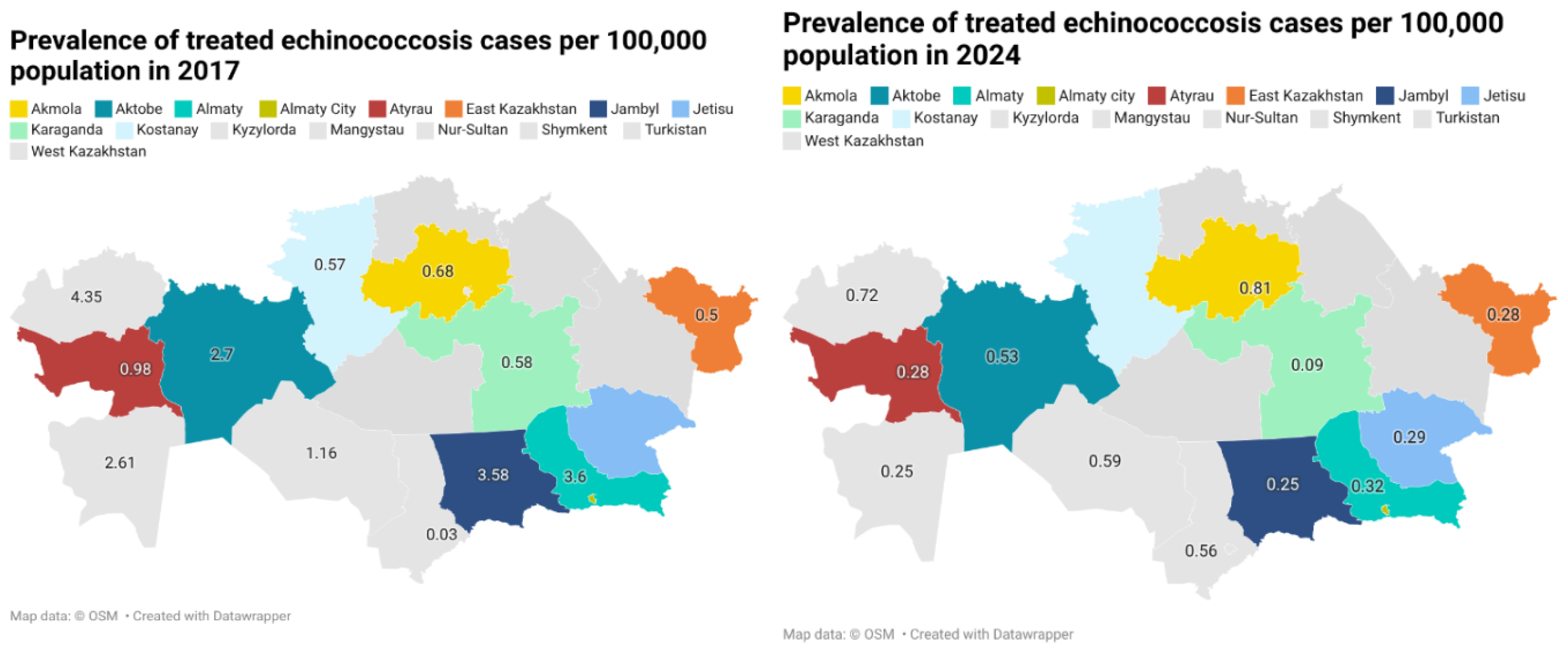
Table 1.
Total treated patients with echinococcosis per 100,000 population by region in Kazakhstan.
| Regions | 2017 | 2018 | 2019 | 2020 | 2021 | 2022 | 2023 | 2024 |
|---|---|---|---|---|---|---|---|---|
| Abay | 2 (0.31) | 1 (0.16) | 4 (0.62) | 3 (0.47) | 2 (0.31) | 4 (0.65) | 2 (0.33) | - |
| Akmola | 5 (0.68) | 6 (0.81) | 4 (0.54) | 3 (0.41) | 6 (0.82) | 5 (0.64) | 7 (0.89) | - |
| Aktobe | 23 (2.70) | 18 (2.08) | 18 (2.06) | 17 (1.91) | 9 (1.01) | 16 (1.73) | 15 (1.61) | 5 (0.53) |
| Almaty | 37 (1.84) | 24 (1.18) | 22 (1.07) | 20 (0.97) | 21 (1.01) | 19 (1.27) | 18 (1.19) | 5 (0.32) |
| Atyrau | 6 (0.98) | 6 (0.96) | 4 (0.63) | 5 (0.77) | 1 (0.15) | 1 (0.15) | 2 (0.29) | 2 (0.28) |
| East Kazakhstan | 7 (0.50) | 5 (0.36) | 5 (0.36) | 8 (0.59) | 10 (0.73) | 6 (0.82) | 3 (0.41) | 2 (0.28) |
| Zhambyl | 40 (3.58) | 40 (3.57) | 27 (2.39) | 19 (1.67) | 30 (2.63) | 23 (1.89) | 17 (1.39) | 3 (0.25) |
| Zhetisu | 9 (1.32) | 18 (2.65) | 14 (2.06) | 20 (2.95) | 8 (1.18) | 10 (1.43) | 14 (2.00) | 2 (0.29) |
| West Kazakhstan |
28 (4.35) | 9 (1.39) | 18 (2.75) | 11 (1.67) | 15 (2.27) | 21 (3.06) | 12 (1.74) | 5 (0.72) |
| Karaganda | 8 (0.58) | 14 (1.01) | 14 (1.02) | 10 (0.73) | 17 (1.24) | 17 (1.50) | 12 (1.06) | 1 (0.09) |
| Kostanay | 5 (0.57) | 3 (0.34) | 4 (0.46) | 3 (0.35) | 4 (0.46) | 3 (0.36) | 1 (0.12) | - |
| Kyzylorda | 9 (1.16) | 15 (1.90) | 13 (1.63) | 7 (0.87) | 13 (1.60) | 9 (1.09) | 2 (0.24) | 5 (0.59) |
| Mangystau | 17 (2.61) | 14 (2.09) | 11 (1.60) | 14 (1.97) | 6 (0.83) | 9 (1.19) | 7 (0.90) | 2 (0.25) |
| Turkestan | 126 (6.35) | 111 (5.60) | 102 (5.10) | 100 (4.93) | 94 (4.60) | 88 (4.18) | 86 (4.04) | 12 (0.56) |
| Shymkent | 1 (0.03) | 3 (0.31) | 3 (0.29) | 5 (0.47) | 3 (0.28) | 15 (1.27) | 5 (0.41) | 1 (0.08) |
| Almaty city | 64 (3.60) | 60 (3.28) | 68 (3.61) | 68 (3.49) | 51 (2.58) | 55 (2.26) | 55 (2.51) | 17 (0.75) |
| Astana city | 26 (2.59) | 25 (2.37) | 11 (0.99) | 27 (2.33) | 34 (2.87) | 29 (2.19) | 26 (1.87) | 12 (0.81) |
| Mean±SD | 24.29±31.18 | 21.88±27.44 | 20.12±26.11 | 20.00±25.75 | 19.06±23.44 | 19.41±21.87 | 16.71±22.11 | 5.29±4.91 |
Table 2.
Dynamics of treated patients with echinococcosis cases in 2017-2024.
| Year | Total treated patients with echinococcosis | Absolute increase | Growth rate (%) | Rate of change (%) | Absolute number corresponding to 1% growth | Visualization index |
|---|---|---|---|---|---|---|
| 2017 | 413 | 1000 | ||||
| 2018 | 372 | -41 | 90,1 | -9,93 | 4,13 | 900,7 |
| 2019 | 342 | -30 | 91,9 | -8,06 | 3,72 | 828,1 |
| 2020 | 340 | -2 | 99,4 | -0,58 | 3,42 | 823,2 |
| 2021 | 324 | -16 | 95,3 | -4,71 | 3,40 | 784,5 |
| 2022 | 330 | 6 | 101,9 | 1,85 | 3,24 | 799,0 |
| 2023 | 284 | -46 | 86,1 | -13,9 | 3,30 | 687,7 |
| 2024 | 74 | -210 | 26,1 | -73,9 | 2,84 | 179,2 |
Table 4.
Emergency operations for echinococcosis.
| Regions | 2017 | 2018 | 2019 | 2020 | 2021 | 2022 | 2023 | 2024 | Mean±SD |
|---|---|---|---|---|---|---|---|---|---|
| Abay | - | - | - | - | - | - | - | ||
| Akmola | 3 (2.36) | 1 (0.81) | - | - | - | - | - | - | 2.0±1.41 |
| Aktobe | 5 (3.94) | 7 (5.69) | - | - | - | - | - | - | 6.0±1.41 |
| Almaty | 16 (12.6) | 10 (8.13) | - | - | - | - | - | - | 13±4.24 |
| Atyrau | 2 (1.57) | 2 (1.63) | - | - | - | - | - | - | 2.0±0.00 |
| East Kazakhstan | 2 (1.57) | 2 (1.63) | - | - | - | - | - | - | 2.0±0.00 |
| Zhambyl | 8 (6.30) | 10 (8.13) | - | - | - | - | - | - | 9.0±1.41 |
| Zhetisu | 5 (3.94) | 10 (8.13) | - | - | - | 4 (100.0) | 6 (100.0) | 2 (7.14) | 5.4±2.97 |
| West Kazakhstan | 10 (7.87) | 5 (4.07) | - | - | - | - | - | - | 7.5±3.54 |
| Karaganda | 2 (1.57) | 5 (4.07) | - | - | - | - | - | - | 3.5±2.12 |
| Kostanay | 1 (0.79) | 2 (1.63) | - | - | - | - | - | - | 1.5±0.71 |
| Kyzylorda | 1 (0.79) | 3 (2.44) | - | - | - | - | - | - | 2.0±1.41 |
| Mangystau | 7 (5.51) | 5 (4.07) | - | - | - | - | - | - | 6±1.41 |
| Turkestan | 61 (48.0) | 52 (42.3) | - | - | - | - | - | - | 56.5±6.36 |
| Shymkent | 2 (1.63) | - | - | - | - | - | - | - | |
| Almaty city | 3 (2.36) | 6 (4.88) | - | - | - | - | - | 1 (3.57) | 3.33±2.52 |
| Astana city | 1 (0.79) | 1 (0.81) | - | - | - | - | - | 2 (7,14) | 1.33±0.57 |
Table 5.
Age distribution of patients with echinococcosis for 2017–2024.
| Year | 1-14 years | 15-17 year | 18-59 years | 60-69 years | 70 years | Total | Mean age (years) |
|---|---|---|---|---|---|---|---|
| 2017 | 142 (34.3) | 24 (5.8) | 229 (55.4) | 12 (2.9) | 6 (1.45) | 413 (100.0) | 27.8 |
| 2018 | 115 (36.8) | 184 (58.9) | 13 (4.16) | 312 (100.0) | 28.2 | ||
| 2019 | 113 (36.1) | 186 (59.4) | 14 (4.47) | 313 (100.0) | 28.5 | ||
| 2020 | 94 (31.9) | 2 (0.68) | 186 (63.2) | 12 (4.08) | 294 (100.0) | 29.5 | |
| 2021 | 92 (32.3) | 4 (1.40) | 174 (61.2) | 14 (4.92) | 284 (100.0) | 29.4 | |
| 2022 | 99 (33.6) | 1 (0.34) | 176 (59.8) | 18 (6.12) | 294 (100.0) | 29.6 | |
| 2023 | 88 (35.0) | 1 (0.39) | 148 (58.9) | 14 (5.57) | 251 (100.0) | 29.0 | |
| 2024 | 19 (27.1) | 1 (1.42) | 38 (54.2) | 11 (15.7) | 1 (1.42) | 70 (100.0) | 34.4 |
| 2017-2024 | - | - | - | - | - | 2.231 | 29.0±1.2 |
Disclaimer/Publisher’s Note: The statements, opinions and data contained in all publications are solely those of the individual author(s) and contributor(s) and not of MDPI and/or the editor(s). MDPI and/or the editor(s) disclaim responsibility for any injury to people or property resulting from any ideas, methods, instructions or products referred to in the content. |
© 2026 by the authors. Licensee MDPI, Basel, Switzerland. This article is an open access article distributed under the terms and conditions of the Creative Commons Attribution (CC BY) license (http://creativecommons.org/licenses/by/4.0/).
Copyright: This open access article is published under a Creative Commons CC BY 4.0 license, which permit the free download, distribution, and reuse, provided that the author and preprint are cited in any reuse.


