

Submitted:
20 March 2026
Posted:
23 March 2026
You are already at the latest version
Abstract
The study assesses the effectiveness of various stature estimation methods that utilise biases such as sex and race. Based on the literature gathered, the plausibility that stature estimation methods that use regression equations in their computation may just be a result of mathematical coincidence. In order to evaluate the need for group-biased methods, the research devised its own set of regression equations for the sampled population and compared it against region-biased, sex-biased, and height-categorisation approaches. The sample population was taken entirely from Delhi, India and the English dataset used by Mays (2016). The sampling included all long bone measurements of the humerus, radius, ulna, femur, tibia, and fibula, along with the sex and ancestry of the participants. The findings revealed that the general regression model provided the lowest mean standard error estimate (SEE), initially suggesting that a non-biased approach to stature estimation may be more effective. However, upon analysis, it was found that the general model resulted in a fairly consistent overestimation of stature, although no particular trend of how this was occurring was noticeable. Along with this, the height-categorisation method, though mathematically very interesting, produced the highest mean SEE, indicating that the trends seen in stature estimation methods are not a result of mathematical coincidences. Looking at the group-specific models, a consistent performance was noticed in the statistical assessment and in the literature review. With a few caveats of certain bone measurements outperforming others, the group-specific models provide confirmation that the stature of any population has clear trends and can be quantified for estimation purposes. In the field of forensic anthropology, the complexity of accuracy, efficiency, and inclusivity is in constant discussion. Traditional race and sex biases being applied to modern contexts is challenging, especially with the rise of violence towards marginalised groups. Additionally, given the increase in cultural and genetic diversity of populations now, there needs to be immediate reconsideration of the terminology and sampling utilised in these long-standing methodologies. Future research should focus on developing more inclusive and adaptable stature estimation models.
Keywords:
forensic anthropology
; stature estimation
; osteology
; race
; sex
Introduction
In the forensic identification process of the deceased, one of the more tedious aspects can be stature estimation. According to the Scientific Working Group for Forensic Anthropology (SWGANTH), this practice primarily relies on and is possible due to the relations between the bone measurements and the complete living height (National Institute of Standard and Technology, 2012).
There are two distinct approaches to stature estimation: the anatomical method and the mathematical or regression method. The anatomical one, although providing a lot of accuracy due to the minimal corrections needing to be applied, they generally do not take fragmented or burnt bones into consideration (Maijanen, 2009). They are best in cases where the whole skeleton is available for analysis (Lundy, 1985; Brits, Manger and Bidmos, 2018; Verma et al., 2020). This, for a variety of reasons, is quite inconvenient in the current day and age. When considering the training process for forensic specialists, most are familiarised with archaeological remains, which are almost always fragmented or incomplete. Therefore, the obtained knowledge through the anatomical methods leaves a gap in the efficacy of the forensic identification process.
Thus, a preference for the mathematical method through the use of regression formulae and tables is simply a means to compensate for those unpredictable aspects of stature estimation. However, if the bone ratio methods are to be taken, then their accuracy is heavily dependent upon the specific biases used in their formulation. Which is why when applying these tables or formulae, it is encouraged to use only the populations used in the study (Brits, Manger and Bidmos, 2018).
From an academic perspective, the mathematical approach tells two stories with similar endings. One side caters to the specific biases utilised in these studies. For instance, sex and race are the most common distinguishing variables in stature related research. This is likely due to the fact that they, along with age at the time of death, are the main parameters for the identification of a deceased body (Spradley, 2016; Garg et al., 2021). The combinations of sex and race alone cover several communities of people, allowing for wide scale application, so long as correct populations are being used for their specific methods. As this branch of forensics is reliant on anthropology, the need for inclusivity is also being met. All forms of representation further the field and favour precision in identifying deceased individuals, regardless of their demographic factors.
On the other side of the story, the basic mathematics seems to dislike the all-accommodating approach that scholars would ideally like to take in their work. Looking solely at regression equations, the concluding formula takes the average of all the values inputted. This is not to say that there are no trends or correlations in the values, it simply raises the question of whether certain trends are more reliable than others or whether those trends are just numerical coincidences. The following thought experiment shall demonstrate the particular dilemma being discussed:
Let there be a random population where all the heights are recorded but a researcher is unaware of that fact. The researcher decides to apply their knowledge of stature estimation on the population to create a database of the living heights. They decide to take two approaches, both of which are of the mathematical method. First, the height-based system presented by Duyar, Pelin and Zagyapan (2006), where there is an assumption that the short group has an average height of 5’4”, the medium group of 5’8”, and the tall group of 6’. Second, a general sex-biased stature estimation method, where there is an assumption that the average height of the females is 5’4” and for the males it is 5’8”. If the population had a 5’4” male, which approach would have the least margin of error for it? Similarly, for a 6’ female?
Stature is an aspect of the human population that is dictated by a variety of factors (Mamidi, Kulkarni and Singh, 2011; Alacevich and Tarozzi, 2017; Jelenkovic et al., 2020). Many of these factors are not quantifiable and even those that are, are not always capable of experimentation. This is why the resulting methodologies are not very accommodating on a global scale. This allows for the mathematical approach to be favoured quite a bit by academics, as it allows for repetitive analysis where only one variable or population is altered, and the finalised work is still a great contribution.
The intent of this study is to focus on the primary concern in the usage of either methods, which comes down to a prioritization struggle, whether to be accurate or to be efficient. Whether a bias is necessary or whether general formulas, irrespective of the population being used, is the approach to take. The work outcome here aims to conclude on biased methods and their fruitfulness, it does not intend on singling out one method to be the best.
Background
Stature Through the Years
In 1831, Mathieu Orfila (1787-1853) and Octave Lesueur (1802-1860), both professors at the Faculté de Médecine de Paris, designed a table for the dimensions of 51 autopsied bodies in their handbook titled ‘Traité des exhumation juridique’ (Orfila and Lesueur, 1831). In this, they measured the lengths of individual body segments, and the individual lengths of the long bones, humerus, ulna, radius, femur, tibia, and fibula. For quite some time following the publication of the handbook, many specialists in osteology related fields began using the tables by correlating the individual bone measurements with the complete height of the bodies. Although, Orfila and Lesueur themselves had informed the public that they do not encourage their handbook be used for such estimation as, given the structure of the tables, it would imply that one bone measurement can determine the entire stature of a deceased individual.
Following this, Paul Topinard (1830-1911), in quite a public manner, expressed his contempt for the Orfila and Lesueur chart. He criticized the lack of explanation in how the bone measurements were taken, disallowing for repetition of the finalised research. Additionally, Topinard identified a marginal difference between the complete skeletal height and the complete living body height, which was about 3.5cm. He made note of this and outlined his own chart for stature estimation (Topinard, 1885), whilst highlighting that it is far more reliable to use the maximum lengths of the long bones using Broca’s osteometric board (Zeman, Kralik and Beňuš, 2014). The inculcation of the 3.5cm in his research and the resulting mathematical adjustments was a phenomenon called ‘regression towards the mean’ (Galton, 1886; Beddoe, 1888). This gave needed insight into the regulations and format with which measurements are to be used in the statistical analysis. Moreover, such methods led to inaccurate estimation of outliers from the dataset. Typically, those that had long limb measurements that were shorter than the mean population, would end up having their estimated stature being underestimated relative to their true heights. A similar trend was seen where those that were longer than the mean population, would have their estimated stature be overestimated relative to their true heights.
Around the same time, French forensic anthropologist Étienne Rollet (1862-1973) presented his ratio method which had a very large sample size. The approach was quite simple, he looked at the average length for each long bone of those who had the same stature (Rollet, 1888). Using the same set of cadavers, Karl Pearson (1856-1936) made significant headway with his implementation of linear regression to the bone-stature correlation tables. The English eugenicist and mathematician was quite critical of the ratio method and accommodated for fluctuations and other factors that may disrupt perfect calculation of living stature (Pearson, 1899).
As discussed earlier, there were two methods that specialists primarily utilised while estimating stature. When we view the anatomical method, Georges Fully (1926-73) is quite an early pioneer of it (Ubelaker, 2018). Fully attempted using the chart created by Rollet (1888) but found that it did not provide a clear identification for each individual. He opted to create a method that tackled the individual measurements of each cadaver, setting a precedent that the living stature was the sum of select bones, determined to be stature-impacting. The method looked at the measurements of the skull (basion to bregma), every vertebral body, the sacrum, femur, tibia, talus and calcaneus (Fully, 1956; Raxter, Auerbach and Ruff, 2006). Even in current times, this method is still being employed as it provides high accuracy for all sorts of populations. So long as the bones are available and decently intact, the living height can be calculated without any complications.
Both approaches were being tackled along roughly the same timeline, allowing for interdisciplinary contributions as well. Despite the distinct approaches, there were two independent schools of thought. One side viewed stature as an individual aspect, while another viewed it to be a population specific matter. This later brought about a third approach which inculcated both ideologies. This led to, arguably, the most well-known stature estimation method. The one proposed by Trotter and Gleser (1952, 1958) established regression tables which displayed high accuracy primarily for their Caucasian samples, even in recent studies (Steptoe and Wood, 2002). Moreover, they were not nearly as tedious as other methods which required the presence of all the bones in the skeleton in near perfect state. They observed population specific trends and accommodated for those differences. However, George Olivier (1912-1996), a professor of anthropology in Paris and a professor of anatomy in Lile, challenged the Trotter and Gleser (1952, 1958) approach, arguing for a more holistic understanding of stature estimation that accounted for regional and ethnic variations in skeletal morphology. This observation arose as result of the 4cm (about) difference between his French population (Olivier, 1963) and the U.S. population examined by Trotter and Gleser (1952).
The cumulative issues arising as a result of the plethora of stature estimation methods posed over the last few centuries have brought about several questions in regard to the ethics behind everything. Whether the methods should be population-specific, how to account for regional and ethnic variations, and the importance of an interdisciplinary approach have all been topics of active discussion (Matthay et al., 2019; Mauro et al., no date).
Factors Affecting Stature
This study aims to look at the specific influence of demographic factors race and sex on the stature estimation of an individual. However, as it will be discussed later on, race is a factor which encompasses an array of other factors rather than being a sole influencer. Through the literature analysis process, the incredible depth of each factor was astounding. If a particular factor which was closely associated with race affected adult stature development, it was later found that the same factor was influenced by another broader trait. To reduce the confusion, all the factors being discussed are in reduced quantities and strictly in relation to race, so as to maintain relevancy.
Genetics and Ethnicity
In a general sense, stature is influenced by many aspects. When it comes to living height, anything from genetic factors to environmental factors can impact a person’s height. It is vital to understand their impact as they may inadvertently affect the forensic identification process of the deceased. Whilst browsing through the literature that assess and evaluate the influence of various factors on stature, it is important to note that many of them primarily look at growth restriction.
One angle which is not usually considered during stature estimation due to the difficulty in its quantification is the genetic or biological contributions. Many consider stature to be a highly heritable trait, almost 50-80% of it being genetically controlled (Palmert and Hirschhorn, 2003). Even within these complex topics of genetics there are an array of systems that add and contradict to pre-existing inherited traits. For instance, the endocrine system possesses the growth hormone (GH), with an insulin-like growth factor (IGF-1) being the main contributor to childhood growth and height disorders. However, there have been findings that indicate that gene mutations in all kinds of intracellular, paracrine, and extracellular factors can significantly affect the growth of children (Baron et al., 2015), consequently affecting their adult heights. Further evidence of this can be seen in a study which primarily observed the etiological profile of children having growth restrictions. It was found that the most common cause of the short stature was regular variant short stature1 (36.1%), followed closely by endocrine factors (30.9%) (Bhadada et al., 2003).
In the same direction, ethnicity comes into the discussion. Certain communities are on average shorter than the global mean stature, making them the subject of many studies. As it will be discussed later on, ethnicity is a concept that carries much contention with it. From a scientific perspective it is impossible to not factor in region specific contributors, whilst also avoiding generalisations. Case in point, the analysis of a specific ‘short gene’. The pygmy2 populations across a variety of regions, primarily in Africa, Asia, and Melanesia, have been extensively analysed for the possibility of a unique phenotype that may be present across these communities, despite being significant distances apart. Through genome-wide analyses and comparison with non-pygmy neighbours, it was found that each of these pygmy populations were genetically distinguished from one another. Additionally, the genetically contributing factors to stature in the non-pygmy neighbour populations were inconclusively unimpactful to the height of the pygmy populations (Migliano et al., 2013). The study barely found any correlation between the thyroid thermoregulation functioning and the preference for short stature. These findings indicate that short stature, at least in the case of pygmy populations, did not come about as a result of a single common genetic component that favoured stunted height. Rather, it was a byproduct of the combined selection of traits such as early reproduction and fast lives in high-mortality nations. This then gives more credence to external influences on stature rather than uncontrollable internalised ones.
Some, however, argue that genetics plays a very small role in height estimation, crediting nutrition and other related environmental factors for the heights of their following generations (Rodriguez-Martinez et al., 2020).
Socioeconomic Status and Diet
It is fairly common knowledge that human body size and shape are regulated by social, economic, political, and emotional components (Bogin, Hermanussen and Scheffler, 2022). The influence of diet on the living stature of an individual is an unsurprising correlation. An individual may be genetically predisposed to be 180cm (~5’11”) but due to poor nutrition, may end up being shorter than that. Whilst protein rich diets are strongly associated with impressive height gains, they also affect how the muscles in the body form, which can also impact the complete adult stature. It is safe to assume that the genetics of an individual acts like a threshold point. If an individual consumes large quantities of produce like proteins, it does not guarantee that they will be able to have muscle development or height gains that are beyond their genetic build up. GH and IGF-1 are considered the primary drivers of height development across most of the literature but endocrine secretions from the thyroid, oestrogen, and androgen seem to be playing a clear role as well. The age at which a certain diet is being consumed also greatly influences the growth of the individual, especially in context with puberty. IGF-1 production has been observed to be less than the peak height velocity during puberty, ensuring the involvement of other biological mechanisms (Millward, 2021).
When it comes to diet, most of it is under the control of the consumer, with the availability of produce being the only component that is an unmanageable aspect. A variety of socioeconomic factors such as income, education level, responsibilities, community safety, etc. interfere with an individual’s nutritional makeup which then impacts their stature (Johnston, Fanzo and Cogill, 2014). The overall financial worth and stability of a household can impact the steady growth of its next generations. This is primarily because the income of a household directly correlates to the education level of its members, distribution of chores, food insecurity, and miscellaneous activities, all of which are stature impacting in some form (Caswell et al., 2013).
A trend can be observed between the socioeconomic status of a household and the height of its children. Higher parental income correlated to taller children. Typically, such households have parents with higher education levels, which encourages healthier eating habits, various physical activities, access to healthcare, and the reduced likelihood of a culture of smoking cigarettes, drinking alcohol, and/or abusing stimulants (Caswell et al., 2013; Nieczuja-Dwojacka et al., 2023). Additionally, the availability of foods containing growth-improving attributes such as proteins, vitamins A and D, especially in the post-natal stage than the pre-natal stage (Silventoinen, 2003), can impact the height of the children in a household. A study done on tall and short Korean children in a growth clinic found that children belonging to the short stature group had a significantly lower consumption of protein, fat, calcium, and iron (Lee et al., 2012).
Undernutrition and limited access to a sustainable diet have been seen to greatly deter the natural stature development of young people (Johnston, Fanzo and Cogill, 2014). Individuals that grew up with diets having lower nutritional value showed reduced cortisol and IGF-1 amounts, resulting in stunting. The average height and weight for a particular age was observed to be less for those receiving insufficient nutrients of that same age. However, nutritional rehabilitation conducted in São Paulo found that 92.5% of the children recovered in at least one of the anthropometric measurements, and 67.9% recovering both height and weight (Martins et al., 2011). Thus far, several factors affected others, resulting in studies being unreliable or easily countered. However, a study done on Swedish primary schools from 1959 to 1969 minimised the influencing factors. The long-term effects of school lunch programs and how adjustments to them can alter the growth and educational development of students were observed (Lundborg, Rooth and Alex-Petersen, 2022). To ensure that there are no parallel trends running that may impact the outcomes of the study, the correlation between income and the year of adoption of the program was tested and concluded to be non-existent. Additionally, the study also evaluated the impact of school lunch consumption by the children against predetermined characteristics such as birthplace of parents, parental age at birth, and education levels of parents, and found little influence. This isolated the impact of the lunch programs and their outcomes in the healthy parameters of the children. Students from lower-income households and those of younger age were more affected by the program3. Conclusively, the meal plan outlined resulted in improved educational performance and increased height. The influenced children later would have income gains in their adult lives, creating a cycle of height increase for the following generations. Typically, in such household conditions, and in ones later highlighted, the likelihood of childhood neglect is also quite high. Child-to-adult height trajectories have been observed to be reduced by about 1.4cm in childhood and about 0.7cm in adulthood, for those having various indicators of neglect (Denholm, Power and Li, 2013).
Whilst there is a clear correlation between income and food security and consequently stature, there is no concrete connection between income, diet, and stature. During the 18th century, a gradual decline in stature was observed, especially in several European countries (Komlos and Cinnirella, 2007; Jaadla, Shaw-Taylor and Davenport, 2020). Several historical records indicated that there were food shortages, an increase in the citizens below the poverty line, and limited food security. Similar to many other European countries around the 18th and 19th century, the Swedish town of Linköping saw long term economic stagnation, increased infant mortality, and financial ruin. Through stable isotope analysis of carbon and nitrogen, the decline in stature was observed with reference to the dietary changes. Although isotope analysis does not account for minute dietary adjustments that may have contributed to the stature decline, it is fairly reliable given that centuries old skeletons were being analysed4. It was observed that there was an increase in consumption of marine resources (shown by the carbon isotope ratios) since the medieval period, however the decline in stature still occurred. Additionally, no significant variation in the nitrogen isotope ratios were seen. The caries found in the dentition of the skeletons studied may point to an increase in consumption of sugars, possibly carbohydrates as well (Arcini, Ahlström and Tagesson, 2014). Based upon this, the influence of diet on stature is tossed on its own head, where the increased protein intake would encourage improved or regular stature progression, but no such phenomenon was observed. The next assertion could be that the increased consumption of carbohydrates and sugars and other non-growth improving produce led to the stature decline. Unfortunately, no literature shows evidence of the occurrence.
Following the 19th century, the average stature for several countries saw an increase, irrespective of their progression in industrialisation. The United States, England, and Netherlands were exceptions to this as they saw a decline in average stature during this period of time (Komlos and Baur, 2004). Although there was no correlation between height and per capita GDP (Gross Domestic Product) until the end of the 19th century, there was a significant correlation in the early 20th century, specifically from 1900-1920 (Baten, 2000; Peracchi, 2008). With the inequality index peaking at the time of World War I, various health related consumer activities arose which coincided with stature development for the proceeding generations. In Spain, during the 1918 flu epidemic and Civil War, the mortality rate rose exponentially, which led to the fall in stature for the following generations (María-Dolores and Martínez-Carrión, 2011), further proving the connection between mortality rates and average stature. Although height is impacted by income which is impacted by GDP per capita, the first and last aspects do not evolve parallel to each other despite being influenced by one another. Thus far, height is influenced by mortality rates, diet/food security, parental education, community safety, and access to healthcare, all of which are directly affected by the GDP per capita of a nation. In the past century however, the correlation between per capita GDP and average stature has become inconclusive at best (Grasgruber et al., 2016; Bogin, Scheffler and Hermanussen, 2017).
When looking towards modern economies and contrasting with the given information, nations having egalitarian systems in place would logically harbour taller citizens in comparison to those that have a more top-down decision-making approach. The Netherlands have some of the tallest citizens on average, with the average height of men being 183cm (~6’) and for women, 170cm (~5’7”). They have a more secure and consensual healthcare plan in place in comparison to the United States, which is seen in the average heights of both nations5. However, Japan has better facilities and arguably a better GDP per capita than the Netherlands but their citizens are not nearly as tall6 (Beauchamp, 2014). Whilst a multitude of factors may impact the average stature development of a nation, it is unclear what the priority list is and how each trait is valued.
Activities
Intuitively, the influence of physical activity and various lifestyle choices, be it intentional or unintentional, plays a key role in the stature of an individual. Stature development has been observed to be strongly dictated by the body’s neuroendocrine system. Certain movements can encourage the production of anabolic hormones like GH, which is vital for encouraging reparative growth. The principal is that GH secretion, is reliant on acute oxygen and metabolic fuels shortage, and increase in body temperature, all of which occur during exercise (Borer, 1995). Particularly in men, the change in testosterone levels before and after physical exercise was proportional to stature attainment. Taller men displayed larger differences between their pre and post physical activity testosterone levels (Kowal et al., 2021). It has also been observed that adult muscle toning and height attainment can be improved through physical activity during the pre-natal stage (Alves and Alves, 2019). It is uncertain if the increased movement enhances the rate of the hormone secretion or if there is only a momentary increase in production which then results in the reduction of its secretion at other times, averaging out to normal secretion levels.
Contrarily, some studies found that regular physical activity and competitive training does not necessarily guarantee impressive height attainment in later years (Beunen et al., 1992; Malina, 1994). It is clear that most sports have a group of people that have a specific physical build which can be observed to perform better than those that have an opposing build. This, however, does not imply that playing the sport more will encourage that ideal physique if it is not genetically possible. Case in point, most basketball players are quite tall but playing basketball is unlikely to make a person tall. This trend can be seen in most studies of young children that were active in a sport of their choice (Theintz et al., 1993; Borer, 1995).
Similar to most hormone deficiencies, some children born with a GH deficiency undergo some form of hormone therapy to try and undo the effects of their condition. This is typically applicable for children having Turner’s Syndrome7, pituitary dwarfism, or Down Syndrome. Once successful diagnosis of the child is done, depending upon regional laws, they will undergo treatment. The diagnostic procedure for adults lacks specificity (Reed, Merriam and Kargi, 2013). However, the main hurdle and significant problem with the treatment is the unreliable diagnostic process. The auxological approach of isolating the IGF-1 and IGF binding protein 3 (IGFBP-3) is not useful and needs to be measured alongside bone measurements, genetic testing, and magnetic resonance imaging (MRI) in order to have a confident diagnosis of any possible GH deficiency disorders (Guyda, 1999; Stanley, 2012). GH having a dependency on the metabolic functioning of the body is proven by the reduced fat mass of patients (about 9%) specifically around the trunk. Unfortunately, due to lack of literature and precautions, the hormone therapy has several concerning side effects which give the patient more issues than they had previously. Many specialists document risks across all bodily systems, from nervous, to excretory, and everything in between, some confidently reporting the occurrence of diabetes mellitus in both adult and child patients (Reed, Merriam and Kargi, 2013). These risks and concerns are not limited to those having a pre-existing condition as children with natural short stature who are also being treated with GH therapy are showing side effects that do not outweigh the psychosocial stresses that led to the treatment in the first place (Sandberg, 2000). Such therapies, although they do not affect the stature estimation process at the time of death, they do alter the understanding of the different contributing factors for stature and consequently altering the different biases used in various stature estimation methods.
Latitudes and Altitudes
Whilst analysing the contributions of race to one’s stature, the region is a key determining factor. Typically, the stature influencing environmental factors of a region are more attributed to the vegetation and food resources found there, it is possible that the distance of that region from the equator and from sea-level also play a role. A trend has been observed with those that are closer to the arctic and with those that are closer to the equator having higher and lower sexual stature dimorphism (SSD), respectively. Carl Bergmann (1814-1865) analysed the specific patterns followed by groups of people across the globe. He devised a rule which stated that in colder climates, the body aims to have a larger body mass8 in order to retain more metabolic heat, and the converse trend is seen in warmer regions (those closer to the equator). In colder conditions, bodies that are short-limbed and have a lot of mass, retain more heat, and in warmer conditions, bodies that are long-limbed and have little mass, expend more heat. (Wolfe and Gray, 1982). Whilst the underlying science behind this rule did provide a starting point for future research, the Bergmann rule has been discredited as a viable point in the correlation between latitude and SSD (Bogin, Hermanussen and Scheffler, 2022).
A study done by Gustafsson and Lindenfors (2009) showcased an opposing correlation to the previously mentioned studies. They attributed the connections between SSD and distance from the equator to the varied living conditions. Instead, their research found that male and female stature and SSD increases with distance from the equator. It is, however, uncertain if this connection is an evolutionary adaptation to climate or truly distance from the equator. Interestingly, children raised in colder conditions at higher altitude regions had larger frames, and vice versa for the inverse conditions (Cowgill et al., 2012).
Dated Concepts
A core part of this study is to evaluate the terminology used in studies looking at demographic factors. In order to fully grasp the purpose of assessing a race or sex bias in stature estimation methods, the purpose of these concepts needs to be understood.
Race
The use of the word ‘race’ has quite an ambiguous history. This is due to the fact that it requires the acknowledgement of a false idea. Müller-Wille (2014) characterised it the best, by stating that in order to “tell the history of a concept, however, one also needs to tell the history of the object or phenomenon that the concept encompasses”, otherwise there is no actual substance to the concept itself. Thoughts like these created perpetual dilemmas that have since taken centre stage for quite an extended period of time. Despite many communities and organisations rebuking the usage of ‘race’ not only in day-to-day lingo but also in an academic context, its existence still persists (Braveman and Parker Dominguez, 2021).
Sauer (1992) posed an interesting question in regard to the existence of race estimation within the field of forensic anthropology. The question was, if race as a concept did not exist or was not legally credible, then why was it that forensic anthropologists were very proficient in estimating it? Moreover, if there was more of a need in the revision of such social categorisation, irrespective of the scientific value to it, or if it was more pressing to devalue the concept as a whole. With the different descriptions and outlines for different races, a very unique problem is created for forensic anthropologists. The lack of clear segregation makes ethnicity estimation quite difficult which in-turn impacts the efficiency of stature estimation. And if a certain ethnic group is not recognised in the country, the specialist is left to draw conclusions that may deter the identification process (Lundy, 1998).
When it came to the science of ethnicity, there was definite fixation upon estimating and segregating it rather than acknowledging it as just an aspect of an individual (Mersha and Beck, 2020). While it can be said that during investigations and identifying unknowns, the appearance and skin colour of an individual is quite helpful (Cunha and Ubelaker, 2019), in order to get to that point, several misguided and baseless methodologies are used to estimate those details. Although, the accuracy rates for ethnicity estimation are quite high (Thomas, Parks and Richard, 2017), that does not negate the fact that it is still wholly unreliable.
Many are promoting for the continued use of ‘racism’ and ‘racialisation’ (Braveman and Parker Dominguez, 2021; Lu et al., 2022) as they are societal issues further perpetuated through the continued usage of the word ‘race’ that need to be dealt with. The replacement of the word ‘race’ is seen almost as a remedy for the societal issue of racism. Although in many instances, ‘ethnicity’ and ‘race’ are used fairly interchangeably, they stand for very different things with very different histories. Where ‘race’ refers to traits such as facial bone structure, hair texture, skin colour, etc., ‘ethnicity’ refers to language, dietary practices, and sometimes may even indicate the geographical location of that person (Lu et al., 2022). Some even include religion, alliances/allegiances, and specific traits that align with an ethnic group (Pereira, 2020). Alongside the usage of ‘race’ and ‘ethnicity’, there came ‘ancestry’. This was less to do with the individual alone and more so to do with their background. Ancestry was related to one’s lineage and who their predecessors were. That said, the definition for ancestry is far more modern and also quite vague. In several articles and books, the definition for ‘ancestry’ tends to be restructured and modified according to the metrics relevant to the paper being written (Mathieson and Scally, 2020; Birney et al., 2021).
Hirschman (2004) pointed out a very pertinent issue in relation to the fact that ‘race’ is still considered a noteworthy social categorisation. He questioned the inconsistencies of determining which groups of people were considered a race. Why are certain religious groups, subsects of communities, or people of mixed ethnic backgrounds considered races, while some are not? It implied that there was a certain metric that countries would apply to segregate their inhabitants, one that did not globally translate.
Sex and Gender
Similar with the usage of the term ‘race’ and its adjacent terms, sex and gender are constantly used interchangeably. Sex is often defined as the biological variable characterised by the presence of male or female reproductive organs. And gender is often described as the social construct which covers the roles, mannerisms, lifestyles, opportunities, etc. based on their biological sex (Torgrimson and Minson, 2005; Lips, 2020).
The binary approach to sex estimation in forensic anthropology and adjacent subjects has led to the lack of inclusion of intersex and transgender individuals. According to the United Nations Human Rights Office of the High Commission, about 1.7% of the general population possesses organs and/or genitalia that does not conform to the typical binary male or female categorisation. This is especially noticeable in the sex estimation methods employed in forensic anthropology (Payne, 2018). The morphological approach of observing the cranium and mandible, and the pelvis, is the most commonly applied method for sex estimation of skeletons. Alongside that, context clues from grave goods and epitaphs were cross-referenced with historical data, leading to sex estimation. Unfortunately, that is not reliable when it comes to intersex and transgender individuals due to possible variations in their bone structures. Typically, the pelvic bone is the go-to approach for specialists when identifying the sex of the deceased (Phenice, 1969; Walker, 2005). There are precise features that are observed for, none of which are distinctly accounted for whenever dealing with intersex remains. The next approach would be to use the skull to primarily do the estimating, but even when the sex is already known, skull based morphological analysis for sex identification has been quite unreliable (Payne, 2018). The issue does not lie in the fact that their bones are different, but due to possible hormonal discrepancies, as discussed prior, can result in bone structuring that affects sex and stature estimation. Fortunately, there has been an increase in studies for transgender individuals, however the same cannot be said for intersex individuals (Wolff, Rubin and Swarr, 2022). This is likely due to the limited number of intersex skeletal collections and the increase in violence towards transgender individuals in recent years.
In the case of transgender bodies, most of the identification process is reliant upon surgical alterations. For instance, there are indicators of facial feminization for male-to-female transitioned individuals through injection marks in the skull (Schall, Rogers and Deschamps-Braly, 2020), which makes sex identification easier. However, not all transgender individuals transition.
Materials and Methodology
Data Collection
Population Selection
All measurements were done anthropometrically with a measuring tape and set guidelines for how they were to be taken. Due to the nature in which the measurements were being taken, consent forms (Appendix A) were given to all participants after a detailed debriefing of what is to be collected, how their information will be used, and if their questions were answered.
Given that one of the biases being assessed was race9, samples needed to be from multiple locations in order to investigate the impact of region-based stature estimation methods. The selected locations were Gurugram, Haryana, India and the English sample set utilised in the study done by Simon Mays (2016). Both these locations were chosen since the difference between the average heights of both locations were far apart enough, almost exactly 10cm across males and females, with those of the UK being taller (Mamidi, Kulkarni and Singh, 2011; Stewart, 2024). This gave the study a fairly large range to work with when applying the formulae. Additionally, all participants must be above the age of 18 to ensure that maximum height has been attained (Carter, 2024), and that they can also provide consent. The sex of the participants was recorded in a binary male and female context in order to minimise complications in analysis, also since the percentage of physiologically non-binary individuals in India is quite low.
Individuals with known bone deformities or bodily complications that may impact bone growth were excluded from the study. This typically meant individuals above the age of 60 (Huang et al., 2013) were excluded from the participant pool.
Participant Demographic Information and Measurements
For measuring the complete stature, the subjects were asked to first remove their footwear and then stand straight against a completely flat wall. The shoulders must be rolled back, where the shoulder blades are pressed against the wall, along with the buttocks. The spine must be straight, and feet as together as possible. The subjects had to look straight ahead with their chin levelled. A flat board was rested on top of their head to be an end marker for the complete height to be recorded. Using the measuring tape, starting from the toes all the way to the flat board, the height was recorded to the nearest 0.1cm.
The rest of the bone measurements were taken with the subjects seated down on a chair that allowed the knees to be as close to a right angle as possible. These measurements were taken in millimetres, till 1 decimal point. The measurements for each bone were taken accordingly (only one side of the body, typically left side):
- -
- Humerus: the participants were asked to position their arms in an L shape with their palm facing upwards, with their forearm parallel to the ground. Using the lateral side of the upper arm, the starting point was the topmost part of the greater tuberosity, and the ending point was the lateral protruding part of the lateral epicondyle.
- -
- Radius: the same position was utilised. Using the lateral side of the forearm, the starting point was the elbow, specifically where the skin crease is visible. The end point was the radial styloid process that juts out on the lateral side of the forearm, at the wrist.
- -
- Ulna: the participants were asked to fold their forearm onto their upper arm, hinging at the elbow from that same L-shape position. Using the inferior side from the L-position of the forearm, the starting point was the outermost tip of the olecranon process. The end point was the part of the ulnar head that’s juts out at the posterior side of the wrist.
- -
- Femur: the participants were asked to sit as straight as possible, back pressed completely to the spine of the chair with their feet flat on the ground and knees at a right angle. Viewing laterally, following the curve of the spine, a very rough estimate of the starting point was taken10. The end point was the protruding part of the lateral epicondyle. Occasionally participants were required to flex their knees or even stand up in order for better pinpointing of the lateral epicondyle. With male participants, no difficulties were faced whilst taking this measurement. However, some female participants had to find their hip dip, as the lower protrusion of the dip is the greater trochanter.
- -
- Tibia: whilst seated down with their feet flat on the ground and knees at a right angle, the participants were asked to pivot their leg outwardly at the knee to allow for visibility of the inner ankle. Viewing the lower leg medially, the starting point was the obtruding part of the medial part of the tibial plateau. The end part was the medial malleolus, which is the inner ankle.
- -
- Fibula: in the same seated position, participants were required to pivot their lower leg inwardly at the knee to access the outer ankle. Viewing the lower leg laterally, the starting point is the protruding part of the fibular head. The end part is the outer ankle, which is the lateral malleolus.
The other information collected from participants was their self-reported sex and their regional information. For the second aspect, since most people are likely to have a different place of birth from the location they were primarily raised in (as this would dictate the environmental factors that may affect their stature), participants were asked to provide the location within which they had lived for a majority of their lives. If no such place exists, they were asked to provide their place of birth instead. These were inputted as locality and ancestry, respectively.
Statistical Analyses
All statistical analyses will be performed using SPSS version 29, with a significance level set at p < 0.05. This threshold will be used to determine the statistical significance of the regression coefficients and the overall model fit.
All demographic factors were given values:
- -
-
Sex
- = Female
- = Male
- -
-
Location
- = Delhi
- = Uttar Pradesh
- = Haryana
- = Punjab
- = West Bengal
- = Karnataka
- = Uttarakhand
- = Bihar
- = Maharashtra
- = Jharkhand
- = Tamil Nadu
- -
-
Type of location
- = Ancestry
- = Locality
Descriptive statistics were computed for all measurements, including means, standard deviations, and ranges, to provide an overview of the sample characteristics. This helped in understanding the distribution of the data and confirmed the lack of any notable outliers. The demographic information of the participants was analysed using frequency statistics, which included mean, median, mode, and percentage. Scatter plots of each individual demographic with respect to stature were also computed.
Multiple linear regression analyses were conducted to assess the relationship between stature (the dependent variable) and various skeletal measurements (the independent variables). The regression methods for the sampled population were created without the utilisation of any grouping methods, as a baseline comparison against each of the other methodologies. This is because one of the major questions of this research is to determine whether stature estimation methods that have a bias, are more accurate than general formulae applied to very specific populations. For analysing the accuracy of sex-biased stature estimation, the method utilised is the one by Trotter and Gleser (1952, 1958). The data collected by the participants from India will be inserted into the regression tables created for black males or females. For assessing the race-biased stature estimation approach the numbers of the sampled population were observed and based on them the stature estimation methodology created using the Kori population in India (Kamal and Yadav, 2016) were used and evaluated parallel to the English Wharram Percy population (Mays, 2016). The equations utilise the measurements of the arm length (acromion to dactylion), foot length, hand length, head breadth, and knee length. Adjusting to this, for the arm length (AL), the radial and humeral lengths will be summed with the mean hand lengths of females (mean=17.33cm) and males (mean=19.36) in Uttar Pradesh (Tandon et al., 2016), and the tibial length will take the place of the knee length in the final regression equations. Since the research done on the Kori population was divided for males and females, those findings will also be referenced to in the sex-bias stature estimation approach analysis. Alongside this, the English population will have the mean SEE of the Trotter and Gleser (1952) males and females populations (Appendix B) compared with that of the Indian population. Lastly, the application of a height-categorisation system will be assessed to evaluate the mathematical aspect of stature estimation. The height-categorisation system utilised in the method devised by Duyar, Pelin and Zagyapan (2006) has a cut-off length for each bone measurement valid to the study. New variables were made to assign a category to each measurement, the values were labelled using the ulna and tibia lengths for each category, which were:
- = Short: below 254mm (UL), below 357mm (TL), and below 615mm (UL+TL)
- = Medium: 255-294mm (UL), 358-422mm (TL), and 616-712mm (UL+TL)
- = Tall: above 295mm (UL), above 423mm (TL), and above 713mm (UL+TL)
Based upon this system, the descriptive statistics of the new grouping system was computed. As some participants’ measurements placed them in more than one height category, the best of three was preferred and through that the regression equations were inputted. In order to compare the different stature estimation methods, two different apporaches were taken to evalute their reliability and accuracy. The first method looked at the formulae that gave out the least SEE, while the second method looked at all the formulae that utilise the same bone measurement, which in this case is the tibial length.
Expectations
Based upon the literature reviewed, the general regression model is anticipated to perform the best out of all the other methods, followed by the region-biased method, then the height-categorisaiton method, and lastly the sex-biased method. The region-biased method for the English population will likely have a lower error estimate than the Indian population one due to poor execution of the latter method. With reference to the height-categorisation method, the medium category is predicted to demonstrate the least error amongst the other two categories as it favors the mean measurments of the population. And the sex-biased approach, although typically yielding a low error estimate, is expected to perform relativley poorly due to the lack of correlation between sex-deteremining bones and stature.
The general model performing well would likely raise questions on the purpose of population-specific methodologies all across the board. Although it would invalidate the use of societal constructs like ‘gender’ and ‘race’ in stature-related research, it would also minimise our understanding of which physically measurable attributes contribute to stature.
If, however, the group-specific methods perform better then the current condition of stature estimation remains the same and would imply the need for the calculation of more group-specific methods in order to accommodate for a wide array of people.
Results
The descriptive statistics for the independent variables, that are the skeletal measurements and stature, were conducted. As seen in Table 1, it was found that the whole population (N=49) had a mean stature of 164.4cm. The mean of the humerus length was 307.1mm, of the radius length was 253.7mm, of the ulna length was 283.9mm, of the femur length was 447.9mm, of the tibia length was 381.5mm, and of the fibula length was 396.4mm. The range is highest for the ulna length (205mm), and least for the stature (43mm). Table 2 showcases the descriptive statistics for females (N=28) is shown, where the mean stature is 158.5cm. The mean of the humerus length was 299mm, of the radius length was 241.5mm, of the ulna length was 269.8mm, of the femur length was 441.4mm, of the tibia length was 381.5mm, and of the fibula length was 366.4mm. The range is also highest for the ulna length (205mm), and least for the stature (29.1mm). Table 3 showcases the descriptive statistics for males (N=21) is shown, where the mean stature is 172.4cm. The mean of the humerus length was 317.8mm, of the radius length was 269.9mm, of the ulna length was 302.8mm, of the femur length was 456.6mm, of the tibia length was 401.5mm, and of the fibula length was 416.6mm. The range is highest for the radius length (141mm), and least for the stature (34.2mm).
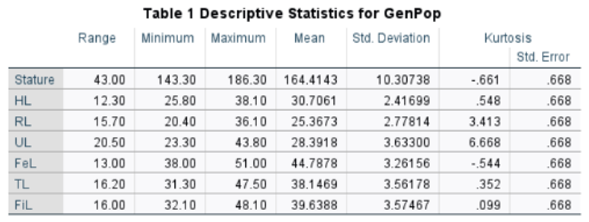
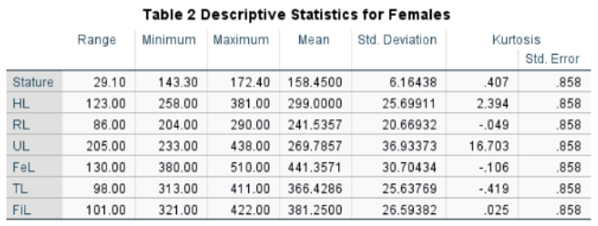
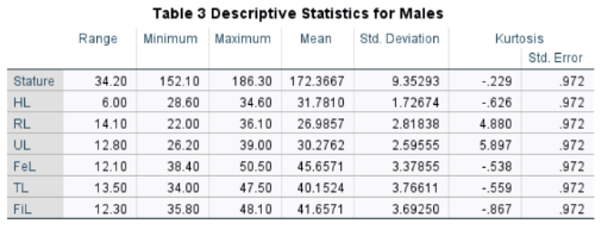
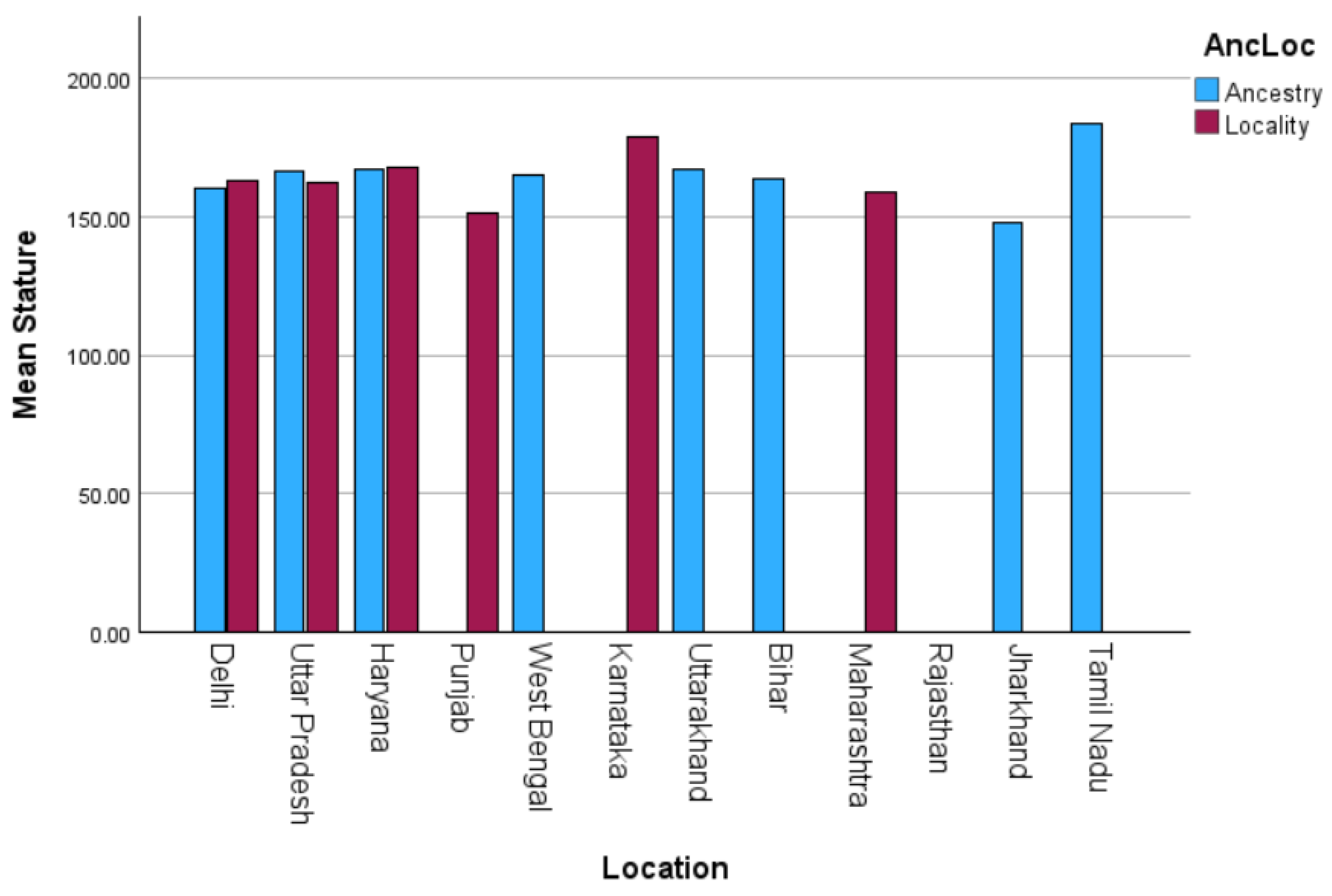
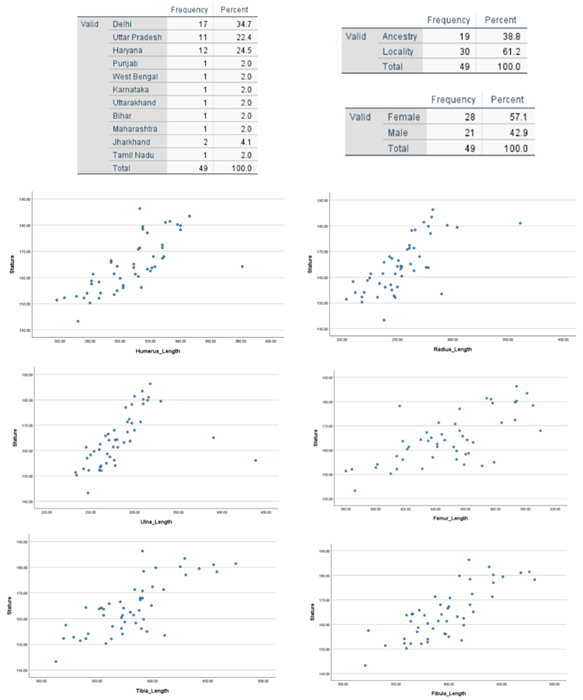
The frequency statistics for the demographic information of sex, location, and whether the location was ancestry or locality. Table 4 shows through the mode that the most frequently occurring location was Delhi, and most of the provided locations were more based on locality. Graph 1 shows the mean statures of the general population across each location, filtered by whether the location is ancestral or local (AncLoc).
Figure 1.
Cluster Graph of Mean Stature of GenPop by Location by AncLoc.
Conducting multiple linear regression across the dataset found that stature estimation using the humerus and fibula lengths yielded a 68.6% dependability rate and using the humerus and tibia lengths yielded 66.5%11. Table 5 showcases the regression equations for the general population, with the and values for each equation and the standard error estimate (SEE)12. The standard of error was observed to be highest when using the length of the ulna (SEE=8.877) and lowest when using the lengths of the humerus and tibia (SEE=5.781). The p-value or degree of significance was below 0.001 for each equation.
For assessing the sex-bias, Table 6 showcases the SEE for the application of the Trotter and Gleser (1952) regression equations for females and males. The equation that utilises the length of the humerus has the least error in females (SEE=5.803) and the fibula for males (SEE=6.352). Interestingly, the ulna has a very high error estimate in both sexes (SEE=13.549 for females, SEE=11.239 for males).
For the race-bias evaluation, the following adjustments were made:
- - AL for females = HL + RL + 17.33
- - AL for males = HL + RL + 19.36
The new AL values were inputted into the equations. Table 7a shows the standard error for females using the arm length is the least (SEE=4.820) and the most for females using the tibial length (SEE=12.301). Table 7b shows the comparison of mean SEE of females and males methods for both English and Indian populations.
The descriptive statistics of the height-categorisation system method is shown in Table 8. Most participants fell into the medium height group (mode for each category was 2). According to the grouping based on ulnar length, 9 participants fell into the short category, 24 into the medium category, and 16 into the tall category. Based on tibial length, 12 participants belonged to the short category, 30 to the medium category, and 7 to the tall category. Lastly, based on the sum of tibial and ulnar length, 9 were in the short category, 29 in the medium category, and 11 in the tall category, showing similarities with ulnar length categorisation. Based upon the overlap, it was found that 2 cases had to be removed due to them being present in each category, 9 were inputted into the short-height equation, 27 into the medium-height equation, and 11 into the tall-height equation.
After inputting the values into the equation, the findings in Table 9 were noted. The short category group, although having the smallest sample size has the lowest standard error relative to the other height categories. The equation using the ulnar and tibial lengths in the short categoy has the lowest standard error (SEE=5.736), whilst the estimation of the tall category using the ulnar length had the highest standard error (SEE=20.984).
Shown in Table 10, the cross-method comparison yielded that the Kamal and Yadav (2016) equation that uses the arm length measurment has the least standard error (SEE=4.820). The general regression equation for the general population using the fibula and humerus lengths has the second lowest standard error (SEE=5.593). Most of the low SEE equations utilise multiple bones, with only the Trotter and Gleser (1952) female (SEE=5.803) and male (SEE=6.352) equations using single bone measurments.
The equations from each method using tibial length are shown in Table 11. The height-categorisation method for the short group yields the lowest standard error (SEE=5.977) and from the same method but for the tall group has the highest standard error from the bunch (SEE=13.742).
Table 12 showcases the mean SEE for each methodology relevant to the study. The general regression equations created for the population has the lowest mean SEE (=6.877) and the height-categorisation method has the highest mean SEE (=11.834). Both Trotter and Gleser (1952) set of equations for males and females yield a high mean SEE (8.224 for females, 8.237 for males).
Discussion
The study aimed to evaluate the different biases taken in various stature estimation methods and whether taking a method which prefers such an approach is beneficial. The biases observed in this study were based on demographic factors such as sex and race, and additionally a height-categorisation system. It was found that having a general regression formula for a population yields the lowest mean error estimate (mean SEE=6.877), followed by a region-biased approach, then a sex-biased approach (mean SEE for females=8.224, mean SEE for males=8.237), all relative to other methodologies. A height-categorisation system approach showed the most inconsistent results across most of the parameters, having the highest mean error estimate (mean SEE=11.834). To compare a common attribute for each method, it was found that all the methods have at least one equation that utilises the tibial length. The height-categorisation short group equation has the lowest error estimate (SEE=5.977), followed by the general regression equation (SEE=6.668), and the sex-biased method, yet again, yields fairly low error estimates for both females (SEE=7.223) and males (SEE=6.352). When isolating and evaluating the difference in regional estimation methods, the English population outperformed the Indian population across the general (SEE=3.875), females (SEE=3.438), and males (SEE=4.312) categories.
General Regression Model
The general regression model was created for the purpose of seeing whether a non-biased stature estimation approach that is catered to the sampled population would yield a lower standard error estimate. By eliminating the need for relying on factors such as sex and race, the time consumption in the estimation process is also reduced. This approach allows for broad applicability, minimization of complexity, and can be utilised for a large population without the need for grouping. This was shown in its low mean SEE (=6.877) in comparison to the other methods that utilised a grouping system. The mean of all the values was 0.537, implying a reliability of about 53.7%. This type of dependability provided by an entire set of regression equations may not instill much confidence into the results calculated but given the few stature-affecting factors taken into consideration while conducting the statistical analysis and model evaluation.
However, the main disadvantage of having a general regression model is the high likelihood of bias, which may lead to inaccurately low standard error estimates. As the regression model would use the original population mean values, the results will primarily prefer those values, disallowing for new measurements that do not follow the specific patterns that the original population values had.
Due to the dispersed nature of the sample set, the model also assisted in disavowing the impact of lifestyle and diet choices on stature development. As the regions are displaced across India in a scattered and inconsistent manner, the influence of multiple environmental factors was accounted for and mostly subsidized. Additionally, as the exclusion criteria was confined to just age, the array of internal biological factors was also minimised quite a bit, allowing for a fairly unbiased generalised approach to estimation of living stature.
Region-Biased Method
Majority of the literature reviewed in this study primarily assessed the environmental influences on stature, which are mostly dictated by the region within which a person has been raised in. Based on the analysis done in this study, a region-biased method did procure results that gives it some confidence. The equations created for the Kori population (Kamal and Yadav, 2016) in India yielded low error estimates for the arm length equations in both males (mean SEE=4.820) and females (mean SEE=7.853). Moreover, those specific formulae in comparison to the English Wharram Percy population (Mays, 2016) results for females (mean SEE=3.438) and males (mean SEE=4.312) indicates a strong regional influence on the stature of a given population.
Given that majority of the dataset was centralised near the capital city of Delhi and the state of Uttar Pradesh, the Kori population study was the best middle ground for a regional analysis. This allows for a specific focus on the type of regional influences there are on stature. The diet and lifestyle variations are quite low throughout the two states and the sample population, and similarly can be said for the height variations.
Sex-Biased Method
Most stature estimation methods utilise a sex-bias in their estimation, typically for males and females, occasionally for individuals of an unknown sex. For several decades, the Trotter and Gleser (1952, 1958) equations have been in usage on a very global scale due to the low error rates it presents for each population that was studied. Whilst region specific changes can be made sense of as there are many external factors that can influence the stature of an entire local population, the correlation between sex and stature is uncertain. Despite the findings from this study indicating that the sex-biased approach through the Trotter and Gleser (1952) equations shows fairly high reliability (mean SEE for females=8.224, mean SEE for males=8.237), it still does not explain the lack of theoretical explanation for the occurrence. Many stature estimation methodologies that deploy a sex-bias in their research, never specify how sex-determining bones contribute to the stature of an individual. Whilst it has been discussed prior that certain hormones (example: testosterone) that are primarily produced by the reproductive organs may contribute to the overall living stature of an individual, there is no rational explanation for how those hormones affect both sex-determining bones and stature simultaneously. For instance, if a male body obtains complete sexual maturity very early on, would they also attain their maximum stature?
Another aspect for the assessment of sex-biased stature estimation methods that is rarely discussed, is the mathematics behind it. Globally, the average height of a female is less than a male, regardless of which country is being reviewed. Thus, whilst creating the regression formulae for each individual sex, the means for the measurements would likely cater to similar measurements later on. There is a preferential bias that occurs in regression equations regardless of the bias being taken, however, due to the fact that sex is such a largely segregated area in research, such methods are highly prone to inaccuracies for those at the extreme heights.
Height-Categorisation Method
The idea to use a height-categorisation method in this study was to only assess the mathematical aspect of creating regression equations for stature estimation. The principle is that regression equations favour the mean measurements of an entire population, which results in the faulty computation of values and measurements that are at the extremes, i.e., very tall and very short people. The solution to this was to create three groups for the bone measurements which correspond to a height category, either short, medium, or tall. The mean preference of regression equations would be reduced to smaller groups allowing for higher accuracy for those present in those bone measurement groups and height groups. This approach also evaluated stature for what it is, an aspect of an individual. It was not connected to any external or internal attributes; it was entirely individualised. The primary issue with this method is that it was limited to two bones, the tibia and ulna (Duyar, Pelin and Zagyapan, 2006).
However, contrary to the expected results, the statistical analysis found that this method yielded the highest mean error estimate (mean SEE=11.834) out of all the methods. Whilst using only the tibial length, it performed quite well (SEE=5.977). Within the method itself, the short category performed the best which is fascinating given that it had the lowest number of participants (N=9), in contrast to the medium (N=27) and the tall (N=11) groups. The poor performance of this method indicates that the regression approach to stature estimation is not heavily dictated by mathematics. This is further supported by the inconsistencies found across each equation. The other methods displayed a fair amount of consistency in results through their categories (male vs. female, English vs. Indian), where the error estimates would fluctuate for each bone measurement in the same manner in both categories. This was not seen in this method. Regardless of the bone measurements being used, it cannot be confidently stated whether the ulnar lengths, the tibial lengths, or the tibial and ulnar length sums performed the best.
Implications
Looking at the various factors that affect stature development, it is difficult to evaluate which ones deserve more credence over the others. As discussed previously, each contributing factor, be it diet, income, mortality rates, and so on, can be sub-grouped under a demographic factor that is commonly associated with stature estimation regression methods (sex and race). These factors can be evenly broken down into internal and external factors. The internal factors are primarily genetics and adjacent supporting systems that are mostly biological functions. Although in many ways hormone therapy treatments can adjust the internal mechanisms originally in place, that still is a component that can be assessed during forensic examination of the deceased. Looking to external contributors such as the living conditions a person is either born into or raised in, several convoluted and complicated concepts come into play.
Beyond the reliability of sex-biased stature estimation methods, the quality of the literation and foundation upon which the study is built on must be evaluated. Sex and gender are a very common topic of discussion in the current world as several rights and mediums of self-expression are at risk if there is not an ethical conclusion. With respect to the field of forensic anthropology, understanding the distinction between the two terms is something that is not being done. The result of which is the misidentification of the sex of a skeleton, which will result in unreliable results. There is an increasing need to discuss why there is a lack of inclusion of intersex skeletons despite them making up 1.7% percent of the population (Payne, 2018). Due to an increase in transgender community violence in recent years, forensic departments have had several such bodies for analysis and investigation.
The concept of ‘race’ is a notion created societally to segregate groups of people based upon income, lifestyle, social status, and so on. Beyond that, however, all those attributes impact the stature of an individual as it interferes with the diet and medical care that they will likely receive. The parental education levels impact the stature of the children in that household as their access to healthcare, healthy meals, funding for sports/exercise, etc. and limited access to stature-hindering factors such as smoking and drinking. A great example of a factor that unknowingly impacts the stature development of an entire nation, is GDP. During great economic struggle and distress, the stature of a country has been noted to decline as quality of life was greatly impacted, hindering the availability of stature-improving facilities. In the modern age, similar problems are still visible within certain communities. Simply looking at systemic racism faced by black communities in the United States of America, a dark question arises: if tall stature is a beneficial trait, then why are predominantly young black men that have larger and taller builds, being unjustly targeted by the police? Several surveys have shown that there is a positive correlation between stature and higher incomes and salary bonuses (Case and Paxson, 2008), yet there is an unfortunate occurrence of this specific demographic of black people being subjected to unjustified stop-and-frisk checks by the police (Hester and Gray, 2018).
The terminology in place is also a crucial part of this research, although not the main focus. When using outdated and undefined terms in the field of forensic anthropology, the understanding of future researchers is likely to be skewed based upon their understanding of those terms. In recent years there has been a preferential movement towards more accommodative and proactive terminology that evades offending communities whilst having them involved in their study. As mentioned previously, ethnicity as a whole concept can be a significant contributor to an individual’s stature. However, such a statement can only hold water so long as definitions are made clear. If race is characterized as a collective result of environmental, cultural, and lifestyle factors that are prominent in a specific region, then those factors are the variables worth analysing. And if race is outlined to be anything besides that, then it has no place in stature estimation. For these collective reasons, the purposes of stature estimation methods that had a crude race bias, one which did not outline the exact demographic it is catering to, become quite unclear. Evidently, using genetics as an argument to support the production of more race-biased stature estimation methods is quite ineffectual.
In order for such methods to have credence, a certain degree of reliability needs to be promoted. Thus, if even on a genetic level large populations that supposedly belong to the same race or ethnic group cannot, for instance, have their own regression tables created, then on what bases are race-biased stature estimation methods being formed?
If race is seen as an aspect of the region from which a person was raised in, then physical factors such as the latitudinal position or distance from the equator and height above sea-level could impact the stature development. Due to the adaptive nature of bodies to their environment, it is unsurprising that various locations need specific regression equations for estimating the stature.
The primary alteration this study would like to urge is the discontinuance of methodologies that utilise the term race and the various racial groups. Although Trotter and Gleser’s (1952) highly reliable stature estimation method has been used for a very long time across various populations, fields, and software (Jeong et al., 2023), that does not negate the fact that the race-based separation for the formulae is diminutive, especially to modern populations. Given ease of global travel and interculture and interfaith relationships becoming a common occurrence, the application of race in scientific research lacks present day relevance.
Limitations
The English population outperforming the Indian population is likely due to faulty application for the Kamal and Yadav (2016) methodology, especially given that arm lengths were not taken but instead calculated. The preference of working primarily with standard error estimates (SEE) is due to the difficulty in isolating and comparing the methods across other attributes like values, mean absolute error, and so on. SEE provides a simplistic consistent analysis of each method. Even though this one aspect did allow for fair evaluation of the statistical output, it underscores the multifaceted nature of the study. SEE alone does not capture all aspects of each model performance.
Conclusions
This study aimed to assess and compare the effectiveness of various stature estimation methods that have a group-bias model. These biases primarily looked at race and sex, and to evaluate the influence of mathematics on the regression equations, a height-categorisation system was put into place as well. The main objective was to compute which method demonstrated the most accuracy and lowest error estimate for a given sample population. The findings of this paper positively contribute to the current state of forensic anthropology with respect to stature estimation.
Through the use of standard error estimates (SEE) and mean SEE, it was found that the general regression equation performed the best. When applied across the population as a whole, a consistent overestimation was noticeable, although no particular trend was noticeable. This observation suggested that although the general model did have the lowest mean SEE amongst all the methods, it is still not adequate for a group it is catering towards. This is primarily a positive outcome as the overwhelming success of the general model would have implied that the mathematics behind regression are creating preferential trends that benefit the model rather than actual trends present within the dataset. The fairly unimpressive performance of the general model confirms that there are trends within the dataset which are some factors that impact stature.
Conversely, the group-biased models, performed about as well as they do in most other studies. This further confirms that there are underlying patterns within the measurements of a specific population. When analysing the outcome of the region-biased model, the consistency in the output was a strong indicator of region being a relevant contributor to stature. The English population which used the Trotter and Gleser (1952) method had a fairly low error estimate (Mays, 2016) as the sampled population matched accurately with the calculation criteria (white males and females having most long bone measurements). Similarly, was seen with the Indian population (Kamal and Yadav, 2016) but only in the equations that used arm length. Intuitively, this information tracks with the given literature that has a lot of emphasis on regional-affected factors that influence stature. The sex-biased approach which utilised the Trotter and Gleser (1952) black population equations has low error estimates despite a re-application of the equations to a primarily Indian population. In smaller manner that was more population specific was the Kamal and Yadav (2016) equations, which yielded fairly good estimates for the equations that utilised the arm lengths for calculation. The height-categorisation model did not stand strong against the other methodologies, with only one equation performing well. The conclusion drawn from this finding is that the principle behind preferential computation due to how regression equations work, is not an aspect of concern in stature estimation processes. There is a clear trend in the values that is influencing the end outcome.
The future influence of these findings, especially in regard to potential research within the field of forensic anthropology, is quite prevalent. During the identification process, the increasing need for efficiency and reliability is difficult to accommodate for. The demonstrated superiority of group-specific models for stature estimation, especially those that are region specific, suggests that the demographic background of individuals is important in the selection and research of new stature estimation models.
With that in mind, there are clear limitations present in these methods. Whilst the height-categorisation model may not have performed quite well, there is still an issue in estimating the stature for those that are at the extreme ends of the population, i.e., very tall people and very short people. Many methodologies, since the beginning of stature estimation history provide a caveat to their findings by imploring researchers and investigators to apply their method to the specific population that they used. Varying too far from those methods can result in obscure and fault results. The dissemination of incomplete information is a very real concern as many methodologies do not characterise how they measured their bones.
Due to the multifaceted nature of this study, there is much scope and elaboration possible for future researchers. There is a definitive need for the exploration and validation of regression models that account for additional factors like age, socioeconomic status, diet types, etc. in a quantifiable manner. The outcome of such models would provide much needed answers to the type of factors that impact stature and stature development as well. In the pursual of these answers, there could one day be a concise and inclusive vocabulary with which research can be done. As time progresses forward, the adaptation of research methodologies alongside it is quite vital.
Appendix A: Consent Form Used

Appendix B: Mays (2016) Findings13
| S.NO. | BONES USED | N | SEE | %ERROR |
| WHITE FEMALES | ||||
| 1 | Humerus | 17 | 3.24 | 1.46 |
| 2 | Radius | 16 | 4.62 | 2.02 |
| 3 | Ulna | 17 | 5.07 | 2.19 |
| 4 | Femur | 18 | 1.87 | - 0.23 |
| 5 | Tibia | 18 | 2.39 | 0.65 |
| WHITE MALES | ||||
| 1 | Humerus | 22 | 5.84 | 2.44 |
| 2 | Radius | 22 | 4.99 | 2.03 |
| 3 | Ulna | 21 | 5.56 | 2.35 |
| 4 | Femur | 22 | 2.31 | 0.69 |
| 5 | Tibia | 22 | 2.86 | 0.40 |
| S.NO. | EQUATIONS | MEAN SEE |
| 1 | White Females | 3.438 |
| 2 | White Males | 4.312 |
Appendix B.1. Figures
| 1 | No underlying cause. Simply a result of variation. |
| 2 | An ethnic group; recognized for their diminutive stature. The men are typically short than 150cm. |
| 3 | It is important to consider that this program lasted for 6-9 years. Children who did not sustain the plan for that duration, did not share the incremental improvements in both adult income and stature. |
| 4 | Specifically from the 12-13th century and 18-19th century. |
| 5 | Average height of US men is 175.26cm (~5’9”) and for women, 162.56cm (~5’4”). |
| 6 | Average height of Japanese men is 172cm (~5’7.7”) and for women, 158cm (~5’2”). |
| 7 | A genetic condition characterized by the complete or partial absence of one of the X chromosomes in females. |
| 8 | It is important to understand that ‘body mass’ refers to the ratio of volume-to-surface area. |
| 9 | The term ‘race’ being used here is done primarily since most of the methods
that are ancestry/region based, use the term ‘race’. |
| 10 | Errors for this will be accounted for later on. |
| 11 | These are all the adjusted R2 values. |
| 12 | Both SEE and %ERROR were calculated without the upper and lower range of the final outputs of the equation as those are incremental changes and do not significantly affect the error calculations. |
| 13 | Excluding the AltTibia results. |
References
- Alacevich, C. and Tarozzi, A. (2017) ‘Child height and intergenerational transmission of health: Evidence from ethnic Indians in England’, Economics & Human Biology, 25, pp. 65–84. [CrossRef]
- Alves, J.G.B. and Alves, G.V. (2019) ‘Effects of physical activity on children’s growth’, Jornal de Pediatria, 95, pp. 72–78. [CrossRef]
- Arcini, C., Ahlström, T. and Tagesson, G. (2014) ‘Variations in Diet and Stature: Are They Linked? Bioarchaeology and Paleodietary Bayesian Mixing Models from Linköping, Sweden’, International Journal of Osteoarchaeology, 24(4), pp. 543–556. [CrossRef]
- Baron, J. et al. (2015) ‘Short and tall stature: A new paradigm emerges’, Nature reviews. Endocrinology, 11. [CrossRef]
- Baten, J. (2000) ‘Heights and Real Wages in the 18th and 19th Centuries: An International Overview’, Jahrbuch für Wirtschaftsgeschichte / Economic History Yearbook, 41(1), pp. 61–76. [CrossRef]
- Beauchamp, Z. (2014) Is economic inequality making people shorter?, Vox. Available at: https://www.vox.com/2014/6/30/5857354/what-are-the-tallest-countries-in-the-world (Accessed: 16 August 2024).
- Beddoe, J. (1888) ‘On the Stature of the Older Races of England, as Estimated from the Long Bones’, The Journal of the Anthropological Institute of Great Britain and Ireland, 17, pp. 201–209. [CrossRef]
- Beunen, G.P. et al. (1992) ‘Physical activity and growth, maturation and performance: a longitudinal study’, Medicine & Science in Sports & Exercise, 24(5), p. 576.
- Bhadada, S.K. et al. (2003) ‘Etiological profile of short stature’, The Indian Journal of Pediatrics, 70(7), pp. 545–547. [CrossRef]
- Birney, E. et al. (2021) ‘The Language of Race, Ethnicity, and Ancestry in Human Genetic Research’.
- Bogin, B., Hermanussen, M. and Scheffler, C. (2022) ‘Bergmann’s rule is a “just-so” story of human body size’, Journal of Physiological Anthropology, 41(1), p. 15. [CrossRef]
- Bogin, B., Scheffler, C. and Hermanussen, M. (2017) ‘Global effects of income and income inequality on adult height and sexual dimorphism in height’, American Journal of Human Biology, 29(2), p. e22980. [CrossRef]
- Borer, K.T. (1995) ‘The effects of exercise on growth’, Sports Medicine (Auckland, N.Z.), 20(6), pp. 375–397. [CrossRef]
- Braveman, P. and Parker Dominguez, T. (2021) ‘Abandon “Race.” Focus on Racism’, Frontiers in Public Health, 9. Available at: https://www.frontiersin.org/articles/10.3389/fpubh.2021.689462 (Accessed: 13 December 2023).
- Brits, D., Manger, P.R. and Bidmos, M.A. (2018) ‘Assessing the use of the anatomical method for the estimation of sub-adult stature in Black South Africans’, Forensic Science International, 283, p. 221.e1-221.e9. [CrossRef]
- Carter, M. (2024) When Do Boys Stop Growing?, Parents. Available at: https://www.parents.com/kids/development/physical/when-do-boys-stop-growing/ (Accessed: 23 August 2024).
- Case, A. and Paxson, C. (2008) ‘Stature and status: Height, ability, and labor market outcomes’, The journal of political economy, 116(3), pp. 499–532. [CrossRef]
- Caswell, J.A. et al. (2013) ‘Individual, Household, and Environmental Factors Affecting Food Choices and Access’, in Supplemental Nutrition Assistance Program: Examining the Evidence to Define Benefit Adequacy. National Academies Press (US). Available at: https://www.ncbi.nlm.nih.gov/books/NBK206912/ (Accessed: 16 August 2024).
- Cowgill, L.W. et al. (2012) ‘Developmental variation in ecogeographic body proportions’, American Journal of Physical Anthropology, 148(4), pp. 557–570. [CrossRef]
- Cunha, E. and Ubelaker, D.H. (2019) ‘Evaluation of ancestry from human skeletal remains: a concise review’, Forensic Sciences Research, 5(2), pp. 89–97. [CrossRef]
- Denholm, R., Power, C. and Li, L. (2013) ‘Adverse childhood experiences and child-to-adult height trajectories in the 1958 British birth cohort’, International Journal of Epidemiology, 42(5), pp. 1399–1409. [CrossRef]
- Duyar, I., Pelin, C. and Zagyapan, R. (2006) ‘A new method of stature estimation for forensic anthropological application’, Anthropological Science, 114(1), pp. 23–27. [CrossRef]
- Fully, G. (1956) ‘Une nouvelle methode de determination de la taille’, Annales de Medicine Legale et de Criminologie, 36, pp. 266–273.
- Galton, F. (1886) ‘Regression Towards Mediocrity in Hereditary Stature.’, The Journal of the Anthropological Institute of Great Britain and Ireland, 15, p. 246. [CrossRef]
- Garg, A. et al. (2021) ‘Forensic Osteology and Identification’, in Forensic Analysis - Scientific and Medical Techniques and Evidence under the Microscope. IntechOpen. [CrossRef]
- Grasgruber, P. et al. (2016) ‘Major correlates of male height: A study of 105 countries’, Economics & Human Biology, 21, pp. 172–195. [CrossRef]
- Gustafsson, A. and Lindenfors, P. (2009) ‘Latitudinal patterns in human stature and sexual stature dimorphism’, Annals of Human Biology, 36(1), pp. 74–87. [CrossRef]
- Guyda, H.J. (1999) ‘Four Decades of Growth Hormone Therapy for Short Children: What Have We Achieved?’, The Journal of Clinical Endocrinology & Metabolism, 84(12), pp. 4307–4316. [CrossRef]
- Hester, N. and Gray, K. (2018) ‘For Black men, being tall increases threat stereotyping and police stops’, Proceedings of the National Academy of Sciences, 115(11), pp. 2711–2715. [CrossRef]
- Hirschman, C. (2004) ‘The Origins and Demise of the Concept of Race’, Population and Development Review, 30(3), pp. 385–415.
- Huang, W. et al. (2013) ‘Health, Height, Height Shrinkage, and SES at Older Ages: Evidence from China’, American economic journal. Applied economics, 5(2), pp. 86–121. [CrossRef]
- Jaadla, H., Shaw-Taylor, L. and Davenport, R. (2020) ‘Height and health in late eighteenth-century England’, Population Studies, 75(3), pp. 381–401. [CrossRef]
- Jelenkovic, A. et al. (2020) ‘Genetic and environmental influences on human height from infancy through adulthood at different levels of parental education’, Scientific Reports, 10(1), p. 7974. [CrossRef]
- Jeong, Y. et al. (2023) ‘Trotter and Gleser’s (1958) equations outperform Trotter and Gleser’s (1952) equations in stature estimation of the US White males’, Forensic Sciences Research, 8(1), pp. 16–23. [CrossRef]
- Johnston, J.L., Fanzo, J.C. and Cogill, B. (2014) ‘Understanding Sustainable Diets: A Descriptive Analysis of the Determinants and Processes That Influence Diets and Their Impact on Health, Food Security, and Environmental Sustainability’, Advances in Nutrition, 5(4), pp. 418–429. [CrossRef]
- Kamal, R. and Yadav, P.K. (2016) ‘Estimation of stature from different anthropometric measurements in Kori population of North India’, Egyptian Journal of Forensic Sciences, 6(4), pp. 468–477. [CrossRef]
- Komlos, J. and Baur, M. (2004) ‘From the tallest to (one of) the fattest: the enigmatic fate of the American population in the 20th century’, Economics & Human Biology, 2(1), pp. 57–74. [CrossRef]
- Komlos, J. and Cinnirella, F. (2007) ‘European Heights in the Early 18 th Century’, Vierteljahrschrift für Sozial- und Wirtschaftsgeschichte, 94(3), pp. 271–284. [CrossRef]
- Kowal, M. et al. (2021) ‘A positive relationship between body height and the testosterone response to physical exercise’, Evolution and Human Behavior, 42(3), pp. 179–185. [CrossRef]
- Lee, E.M. et al. (2012) ‘Differences in Dietary Intakes between Normal and Short Stature Korean Children Visiting a Growth Clinic’, Clinical Nutrition Research, 1(1), pp. 23–29. [CrossRef]
- Lips, H.M. (2020) Sex and Gender: An Introduction, Seventh Edition. Waveland Press.
- Lu, C. et al. (2022) ‘Use of race, ethnicity, and ancestry data in health research’, PLOS Global Public Health, 2(9), p. e0001060. [CrossRef]
- Lundborg, P., Rooth, D.-O. and Alex-Petersen, J. (2022) ‘Long-Term Effects of Childhood Nutrition: Evidence from a School Lunch Reform’, The Review of Economic Studies, 89(2), pp. 876–908. [CrossRef]
- Lundy, J.K. (1985) ‘The mathematical versus anatomical methods of stature estimate from long bones’, The American Journal of Forensic Medicine and Pathology, 6(1), p. 73.
- Lundy, J.K. (1998) ‘Forensic Anthropology: What Bones Can Tell Us’, Laboratory Medicine, 29(7), pp. 423–427. [CrossRef]
- Maijanen, H. (2009) ‘Testing Anatomical Methods for Stature Estimation on Individuals from the W. M. Bass Donated Skeletal Collection’, Journal of Forensic Sciences, 54(4), pp. 746–752. [CrossRef]
- Malina, R.M. (1994) ‘Physical activity and training: effects on stature and the adolescent growth spurt’, Medicine and Science in Sports and Exercise, 26(6), pp. 759–766. [CrossRef]
- Mamidi, R.S., Kulkarni, B. and Singh, A. (2011) ‘Secular Trends in Height in Different States of India in Relation to Socioeconomic Characteristics and Dietary Intakes’, Food and Nutrition Bulletin, 32(1), pp. 23–34. [CrossRef]
- María-Dolores, R. and Martínez-Carrión, J.M. (2011) ‘The relationship between height and economic development in Spain, 1850–1958’, Economics & Human Biology, 9(1), pp. 30–44. [CrossRef]
- Martins, V.J.B. et al. (2011) ‘Long-Lasting Effects of Undernutrition’, International Journal of Environmental Research and Public Health, 8(6), pp. 1817–1846. [CrossRef]
- Mathieson, I. and Scally, A. (2020) ‘What is ancestry?’, PLoS Genetics, 16(3), p. e1008624. [CrossRef]
- Matthay, E.C. et al. (2019) ‘Alternative causal inference methods in population health research: Evaluating tradeoffs and triangulating evidence’, SSM - Population Health, 10, p. 100526. [CrossRef]
- Mauro, M. et al. (no date) ‘A systematic review of guidelines for the use of race, ethnicity, and ancestry reveals widespread consensus but also points of ongoing disagreement’.
- Mays, S. (2016) ‘Estimation of stature in archaeological human skeletal remains from Britain’, American Journal of Physical Anthropology, 161(4), pp. 646–655. [CrossRef]
- Mersha, T.B. and Beck, A.F. (2020) ‘The social, economic, political, and genetic value of race and ethnicity in 2020’, Human Genomics, 14(1), p. 37. [CrossRef]
- Migliano, A.B. et al. (2013) ‘Evolution of the Pygmy Phenotype: Evidence of Positive Selection from Genome-wide Scans in African, Asian, and Melanesian Pygmies’, Human Biology, 85(1–3), pp. 251–284. [CrossRef]
- Millward, D.J. (2021) ‘Interactions between Growth of Muscle and Stature: Mechanisms Involved and Their Nutritional Sensitivity to Dietary Protein: The Protein-Stat Revisited’, Nutrients, 13(3), p. 729. [CrossRef]
- Müller-Wille, S. (2014) ‘Race and History: Comments from an Epistemological Point of View’, Science, technology & human values, 39(4), pp. 597–606. [CrossRef]
- National Institute of Standard and Technology (2012) ‘Stature Estimation’.
- Nieczuja-Dwojacka, J. et al. (2023) ‘The Influence of Socioeconomic Factors on the Body Characteristics, Proportion, and Health Behavior of Children Aged 6–12 Years’, International Journal of Environmental Research and Public Health, 20(4), p. 3303. [CrossRef]
- Olivier, G. (1963) ‘L’estimation de la stature par les os longs des membres.’ Available at: . [CrossRef]
- Orfila, M.-J.-B. (1787-1853) A. du texte and Lesueur, O. (1802-1860) A. du texte (1831) Traité des exhumations juridiques et considérations sur les changemens physiques que les cadavres éprouvent en se pourrissant dans la terre, dans l’eau,.... T. 1 / par M. Orfila,... et par M. O. Lesueur,... Available at: https://gallica.bnf.fr/ark:/12148/bpt6k206620k (Accessed: 9 July 2024).
- Palmert, M.R. and Hirschhorn, J.N. (2003) ‘Genetic approaches to stature, pubertal timing, and other complex traits’, Molecular Genetics and Metabolism, 80(1), pp. 1–10. [CrossRef]
- Payne, A. (2018) ‘Determination of Intersex Humans in Human Remains’.
- Pearson, K. (1899) ‘IV. Mathematical contributions to the theory of evolution.—V. On the reconstruction of the stature of prehistoric races’, Philosophical Transactions of the Royal Society of London. Series A, Containing Papers of a Mathematical or Physical Character, 192, pp. 169–244. [CrossRef]
- Peracchi, F. (2008) ‘Height and Economic Development in Italy, 1730-1980’, American Economic Review, 98(2), pp. 475–481. [CrossRef]
- Pereira, A. (2020) ‘”Race” vs. “Ethnicity”: Why These Terms Are So Complex’, Dictionary.com, 31 July. Available at: https://www.dictionary.com/e/race-vs-ethnicity/ (Accessed: 14 December 2023).
- Phenice, T.W. (1969) ‘A newly developed visual method of sexing the os pubis’, American Journal of Physical Anthropology, 30(2), pp. 297–301. [CrossRef]
- Raxter, M.H., Auerbach, B.M. and Ruff, C.B. (2006) ‘Revision of the Fully technique for estimating statures’, American Journal of Physical Anthropology, 130(3), pp. 374–384. [CrossRef]
- Reed, M.L., Merriam, G.R. and Kargi, A.Y. (2013) ‘Adult Growth Hormone Deficiency – Benefits, Side Effects, and Risks of Growth Hormone Replacement’, Frontiers in Endocrinology, 4. [CrossRef]
- Rodriguez-Martinez, A. et al. (2020) ‘Height and body-mass index trajectories of school-aged children and adolescents from 1985 to 2019 in 200 countries and territories: a pooled analysis of 2181 population-based studies with 65 million participants’, The Lancet, 396(10261), pp. 1511–1524. [CrossRef]
- Rollet, É. (1888) De la mensuration des os longs des membres dans ses rapports avec l’anthropologie, la clinique et la médecine judiciaire : thèse présentée à la Faculté de médecine... / par Étienne Rollet,... Available at: https://gallica.bnf.fr/ark:/12148/bpt6k97653475 (Accessed: 23 July 2024).
- Sandberg, D.E. (2000) ‘Should short children who are not deficient in growth hormone be treated?’, Western Journal of Medicine, 172(3), pp. 186–189.
- Sauer, N.J. (1992) ‘Forensic anthropology and the concept of race: If races don’t exist, why are forensic anthropologists so good at identifying them?’, Social Science & Medicine, 34(2), pp. 107–111. [CrossRef]
- Schall, J.L., Rogers, T.L. and Deschamps-Braly, J.C. (2020) ‘Breaking the binary: The identification of trans-women in forensic anthropology’, Forensic Science International, 309, p. 110220. [CrossRef]
- Silventoinen, K. (2003) ‘DETERMINANTS OF VARIATION IN ADULT BODY HEIGHT’, Journal of Biosocial Science, 35(2), pp. 263–285. [CrossRef]
- Spradley, M.K. (2016) ‘Metric Methods for the Biological Profile in Forensic Anthropology: Sex, Ancestry, and Stature’, Academic Forensic Pathology, 6(3), pp. 391–399. [CrossRef]
- Stanley, T. (2012) ‘Diagnosis of Growth Hormone Deficiency in Childhood’, Current Opinion in Endocrinology, Diabetes, and Obesity, 19(1), pp. 47–52. [CrossRef]
- Steptoe, D.P. and Wood, W.B. (2002) ‘The Human Remains from HMS Pandora’, Internet Archaeology [Preprint]. [CrossRef]
- Stewart, C. (2024) Height of individuals by gender in England 1998-2021, Statista. Available at: https://www.statista.com/statistics/332542/height-of-individuals-by-gender-in-england-uk/ (Accessed: 7 July 2024).
- Tandon, R. et al. (2016) IJARS - Foot morphometrics, Hand morphometrics, Height, Thumb length. Available at: https://www.ijars.net/article_fulltext.asp?issn=0973-709x&year=2016&month=January&volume=5&issue=1&page=12%20-%2015&id=2092 (Accessed: 26 August 2024).
- Theintz, G. et al. (1993) ‘Effects of Physical Exercise on Growth and Pubertal Development’, in E.E. Müller, D. Cocchi, and V. Locatelli (eds) Growth Hormone and Somatomedins during Lifespan. Berlin, Heidelberg: Springer, pp. 218–228. [CrossRef]
- Thomas, R.M., Parks, C.L. and Richard, A.H. (2017) ‘Accuracy Rates of Ancestry Estimation by Forensic Anthropologists Using Identified Forensic Cases’, Journal of Forensic Sciences, 62(4), pp. 971–974. [CrossRef]
- Topinard, P. (1885) Éléments d’anthropologie générale / par Paul Topinard., Wellcome Collection. Available at: https://wellcomecollection.org/works/tqr2ngg5 (Accessed: 9 July 2024).
- Torgrimson, B.N. and Minson, C.T. (2005) ‘Sex and gender: what is the difference?’, Journal of Applied Physiology, 99(3), pp. 785–787. [CrossRef]
- Trotter, M. and Gleser, G.C. (1952) ‘Estimation of stature from long bones of American Whites and Negroes’, American Journal of Physical Anthropology, 10(4), pp. 463–514. [CrossRef]
- Trotter, M. and Gleser, G.C. (1958) ‘A re-evaluation of estimation of stature based on measurements of stature taken during life and of long bones after death’, American Journal of Physical Anthropology, 16(1), pp. 79–123. [CrossRef]
- Ubelaker, D.H. (2018) ‘A history of forensic anthropology’, American Journal of Physical Anthropology, 165(4), pp. 915–923. [CrossRef]
- Verma, R. et al. (2020) ‘Stature estimation in forensic examinations using regression analysis: A likelihood ratio perspective’, Forensic Science International: Reports, 2, p. 100069. [CrossRef]
- Walker, P.L. (2005) ‘Greater sciatic notch morphology: sex, age, and population differences’, American Journal of Physical Anthropology, 127(4), pp. 385–391. [CrossRef]
- Wolfe, L.D. and Gray, J.P. (1982) ‘Latitude and Intersocietal Variation of Human Sexual Dimorphism of Stature’, Human Ecology, 10(3), pp. 409–416.
- Wolff, M., Rubin, D.A. and Swarr, A.L. (2022) ‘The Intersex Issue: An Introduction’, TSQ: Transgender Studies Quarterly, 9(2), pp. 143–159. [CrossRef]
- Zeman, T., Kralik, M. and Beňuš, R. (2014) History of Human Stature Estimation Based on Skeletal Remains.:.

Table 4.
Frequency Statistics.
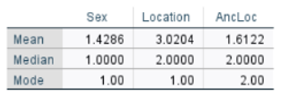
Table 5.
Regression Equations for GenPop.
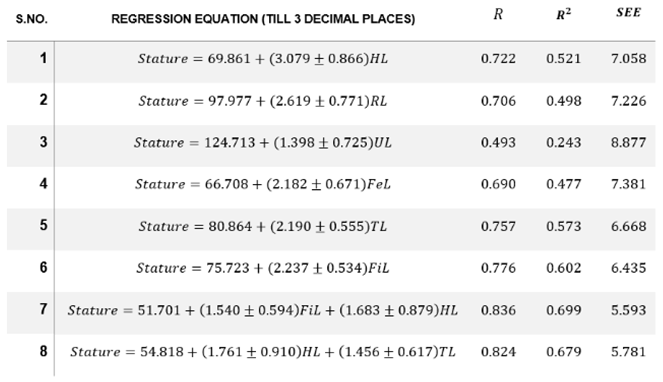
Table 6.
Results of Application of Trotter & Gleser (1952) Method to the Female Population.
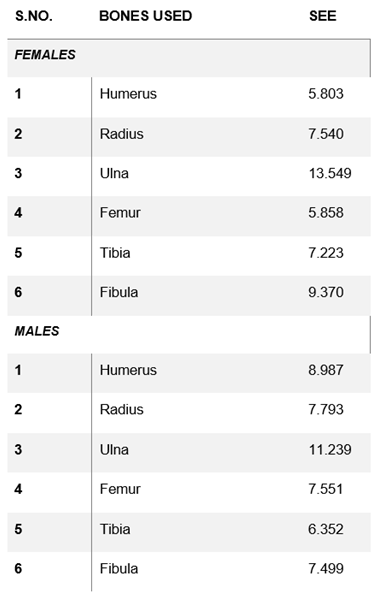
Table 7.
(a) Results of Application of Kamal & Yadav (2016) Method to the Female Population. b Comparing the Mean SEE of the English and Indian Populations.
Table 7.
(a) Results of Application of Kamal & Yadav (2016) Method to the Female Population. b Comparing the Mean SEE of the English and Indian Populations.
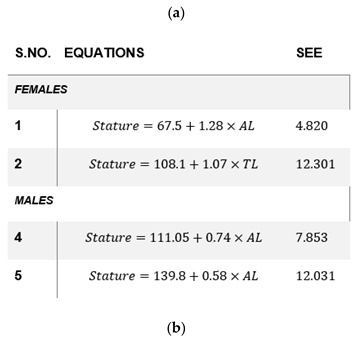
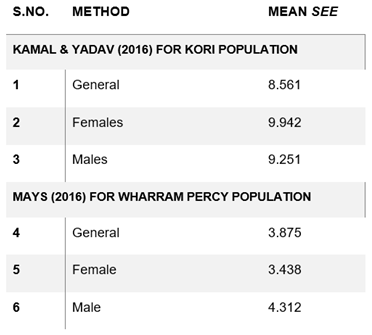
Table 8.
Frequency Statistics of Height-Categorization System Method to GenPop.
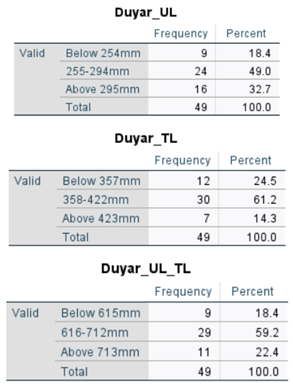
Table 9.
Frequency Statistics of Height-Categorization System Method to GenPop.
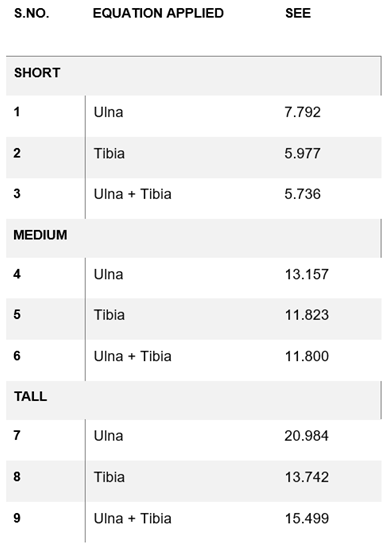
Table 10.
Comparing SEE of Different Equations Across Methods.
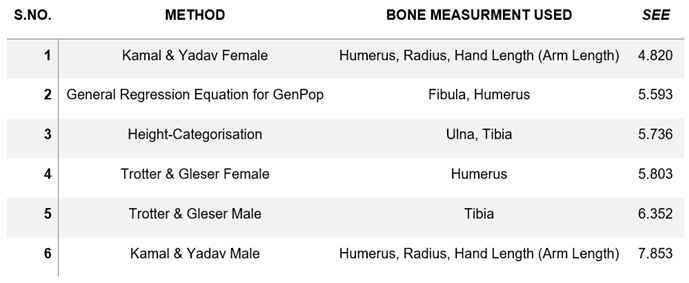
Table 11.
Comparing SEE of Different Equations Across Methods Using Tibial Length.
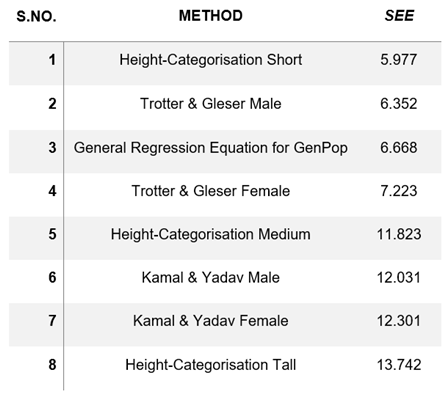
Table 12.
Comparing Mean SEE of Different Equations Across Methods.
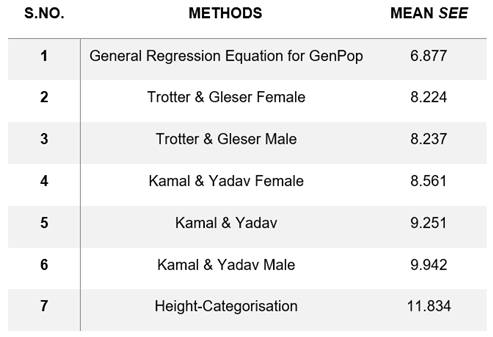
Disclaimer/Publisher’s Note: The statements, opinions and data contained in all publications are solely those of the individual author(s) and contributor(s) and not of MDPI and/or the editor(s). MDPI and/or the editor(s) disclaim responsibility for any injury to people or property resulting from any ideas, methods, instructions or products referred to in the content. |
© 2026 by the authors. Licensee MDPI, Basel, Switzerland. This article is an open access article distributed under the terms and conditions of the Creative Commons Attribution (CC BY) license (http://creativecommons.org/licenses/by/4.0/).
Copyright: This open access article is published under a Creative Commons CC BY 4.0 license, which permit the free download, distribution, and reuse, provided that the author and preprint are cited in any reuse.