

Submitted:
20 March 2026
Posted:
23 March 2026
You are already at the latest version
Abstract
Background/Objectives: In the recent years there has been a consistent development of clinical studies surrounding the incorporation of the B-cell lymphoma 2 (BCL-2) inhibitor Venetoclax (VEN) into the treatment of acute myeloid leukemia (AML). Methods: A search of literature showed a tremendous development of experimental and clinical studies evaluating the impact of VEN-based regimens in the treatment of AML patients. Results: Recent studies have evaluated VEN-based regimens in newly diagnosed (ND) and refractory/relapsed (R/R) AML patients, showing the efficacy of these treatments. VEN with hypomethylating agents (HMAs) became the standard-of-care for elderly/unfit AML patients. Recent studies strongly support the effectiveness of VEN-based regimens in frontline treatment of adult AML patients eligible for intensive treatments. VEN-based therapies were also used in combination with targeted therapies, thus generating triplet therapeutic regimens that are under evaluation for the treatment of some AML subtypes. However, the response to VEN+HMAs is highly variable and in part depend on tumor genetics; some patients are resistant or relapse following VEN-based treatments and future studies will be required to develop therapeutic strategies able to circumvent resistance and to identify patients at high risk of relapse. Prospective randomized trials are required to establish the real efficacy of VEN in various clinical settings and to refine maintenance and discontinuation strategies, aiming to improve long-term outcomes and to make more safe treatments based on VEN.
Keywords:
venetoclax
; acute myeloid leukemia
; hypomethylating agents
; targeted therapy
; genomic profiling
; clinical studies
1. Introduction
Acute myeloid leukemia (AML) is a heterogeneous group of myeloid malignancies characterized by an abnormal proliferation and differentiation of myeloid leukemic blasts in the bone marrow. AML cells display a consistent number of acquired genetic abnormalities allowing the identification of molecular subgroups. AML is typically a disease of older adults, with a median age at diagnosis of >65 years.
Standard treatment for younger patients and fit patients with AML consists of intensive chemotherapy induction, followed by consolidation treatment in patients achieving a remission and allogeneic hematopoietic stem cell transplantation (allo-HSCT) in eligible patients. The treatment of older AML patients is challenging in that only a part of these patients can tolerate high-intensity treatments. The earlier treatment of older AML patients was particularly challenging because these patients have a poor response due to : disease biology (frequent presence of an adverse cytogenetics and an higher frequency of secondary and therapy-related AML, less responsive to antileukemic drugs); high treatment-related mortality and toxicity, rendering these patients unfit for intensive chemotherapy, leaving them very limited options with low-dose chemotherapy or hypomethylating agents.
The treatment of older AML patients was completely revolutionized by the introduction in therapy of B-cell lymphoma-2 (BCL-2) inhibitors. Venetoclax (VEN) is a BH3-mimetic agent that specifically interacts with the antiapoptotic BCL-2 protein, causing cytochrome c release from mitochondria, consequent caspase activation and apoptosis. Venetoclax (VEN) displayed remarkable antileukemic activity, particularly when administered in association with hypomethylating agents (HMA), either azacitidine or decitabine. VEN received approval on November 21, 2018 by Food and Drug Admnistration for use in older AML patients who are unfit, or are age >75 years or older combined with either HMAs or low-dose cytarabine [1,2]. The introduction of VEN in the treatment of older AML patients was a game-changer in AML for older or “unfit” patients with newly diagnosed AML, the combination of VEN with a HMA has significantly improved survival and, in some patients, serves as a bridge to curative transplant [1,2]. Combinations of lower intensity therapy with VEN have become the standard of care for patients with AML who are age 65 years or older or deemed unfit for intensive therapy [1,2]. The success obtained in these studies has stimulated the study of VEN in combination with other lower-intensity regimens and its introduction into higher-intensity regimens [1,2]. More recent studies have supported the efficacy of VEN-based combinations for the treatment of fit adult AML patients. (Figure 1)
The present review provides an updated and detailed analysis of recent studies involving the use of different VEN-based regimens in the treatment of AML patients. Particularly, this review aims to analyze the current direction and research area involving the clinical use of VEN-based therapies, with particular emphasis to: (i) to optimize the use of VEN in patients who have relapsed after frontline treatment; (ii) to assess the safety and the efficacy of the incorporation of VEN into more intensive chemotherapy regimens for younger “fit” patients; (iii) to evaluate the efficacy of VEN-based combinations with IDH1-IDH2 and Menin inhibitors to increase the efficacy in subgroups of AML patients; (iv) to define the role of VEN-based in NPM1-mutated AMLs; (v) to develop and to assess the safety and the efficacy of combining VEN+HMA with a third agent to target resistance mechanisms, such as TP53, FLT3-ITD, and RAS mutations; (vi) to investigate whether patients with sustained remission after NEN-based treatments, can safety stop VEN after >12 months of therapy, to avoid long-term toxicity.
2. Effects of Venetoclax on Newly Diagnosed and Relapsed/Refractory AML Patients Alone or in Association with a Hypomethylating Agent
A phase Ib study (M15-38 study) showed that treatment with Venetoclax (VEN) and a hypomethylating agent (HMA), either Azacitidine (AZA) or Decitabine (DEC) in a group of 145 treatment-naïve AML patients with age ≥65 years (median age 74 years) [3]. 67% of all treated patients achieved a composite complete remission rate (CRc defined by complete remission (CR) plus CR with incomplete count recovery) [3]. CRc rates in patients with poor- and intermediate-risk cytogenetics were 60% and 74%, respectively; in TP53-mutant AML, CRc rates were 47%, with a median duration of response of 5.6 months; in FLT3-mutant AML 72% with a median duration of response of 11 months; in IDH1/IDH2.mutant AML 71% with a median duration of response not reached; in NPM1-mutant AML, 91.5% with a median duration of response not reached [3]. The safety profile was acceptable and included gastrointestinal symptoms, febrile neutropenia, fatigue, hyperkalemia and decreased WBC [3].
In the VIALE-A study, 431 ND AML patients were randomized to receive either VEN+AZA or AZA+Placebo; at a median follow-up of 20.5 months, the median OS was 14.7 months in VEN+AZA group versus 9.6 months in the control group; the CRc rate was higher in the VEN+AZA group than in the control group (66.4% vs 28.3%) [2]. The analysis of the rate of CRc in different molecular subgroups, comparing VEN+AZA arm to the control arm, showed the following results: IDH1/IDH2 mutations 75.4% vs 10.7%; FLT3 mutations 72.4% vs 36.4%; NPM1 mutations 66.7% vs 23.5%; TP53 mutations 55.3% vs 0% [4]. At the level of OS, the most significant improvement compared to AZA alone was observed for IDH1/IDH2-mutant patients treated with VEN+AZA [2].
Long-term follow-up analysis of the patients enrolled in the VIALE-A study reported a 2-year, 3-year and 4-year OS of 58%, 29% and 18%, respectively in the VEN+AZA arm and 41%, 12% and 0% in the AZA+Placebo arm [5]. The most benefit for VEN+AZA-treated patients over AZA+Placebo-treated patients was observed for IDH1/IDH2-mutant patients [5].
33 patients from VIALE-A and M14-358 trials received allo-HSCT after VEN+HMA therapy [6]. At the time of HSCT, 85% of these patients were in CRc [6]. With a median follow-up of 31.6 months after HSCT, the median OS was 29.9 months and median duration of remission was not reached; the 12-month and 24-month survival rates were 69% and 61%, respectively; among patients in CRc at the time of HSCT, mOS after HSCT was 29.9 months; mOS was not reached among the patients who had MRD-negative response before HSCT and 28.2 months among patients with MRD-positive responses before HSCT [6]. These observations support VEN+HMA as an alternative induction therapy before HSCT for patients with newly diagnosed AML ineligible for IC [6].
A post-hoc analysis of VIALE-A and M15-358 trials assessed the outcomes of patients with therapy-related AML (t-AML) or antecedent myelodysplatic syndromes (s-AML) [4]. This analysis showed that: CRc was achieved among patients treated with VEN+HMA in 61% of t-AML, with a duration of response of 25.5 months, compared to 11% with a duration of 8.5 months in the group of patients treated with AZA alone; CR was achieved among patients treated with VEN+HMA in 66% of s-AML with a duration of response of 21.0 months, compared to 31% , with a duration of response of 5.8 months in the group treated with HMA alone [7]. The OS was significantly improved in both s-AML and t-AML by VEN+HMA treatment in comparison with HMA alone [7].
A sub-analysis of the VIALE-A study showed that patient benefits from VEN+AZA treatment occurred regardless of age of patients or of degree of patient frailty [8].
However, some a clinical trial and real-world studies suggest that very elderly AML patients with an age >75 years and particularly vulnerable to treatment-related toxicities, a less intensive regimen, such as HMA alone, aiming at controlling disease while minimizing adverse effects, may be more appropriate than remission-targeted therapy, such as VEN+HMA [9,10].
2.1. Responses in AML Molecular Subtypes
A pooled sub-analysis of the results observed for FLT3-mutant patients in the VIALE-A and M15-38 studies showed: a CRc rate for VEN+AZA versus AZA alone for FLT3-mutant patients of 67% vs 36%, with a median duration of remission of 17.3 vs 5.4 months and a median OS of 12.5 vs 8.6 months [11]. The CRc among FLT3-WT patients was 67% vs 26%, median duration of response 18.4 vs 13.4 months, and median OS of 14.7 vs 10.1 months [6]. In patients treated with VEN+AZA, CRc in AML patients with FLT3-ITD and FLT3-TKD mutations was 63% and 77% and median OS was 9.9 and 19.2 months [11]. The retrospective analysis of 127 ND AML patients treated with VEN-based regimens (mostly VEN+AZA) showed a similar rate of responses among FLT3-mutant and FLT3-WT patients (CRc rate of 79% vs 61%, respectively; OS of 14.0 vs 19.9 months, respectively) [12].
Patients with isolated NPM1 mutations represent one of the groups of patients with most favorable responses to VEN-based therapy. As above mentioned, the VEN+AZA combination improved CRc in NPM1-mutant AMLs from 24% to 67% [2]. Molecular measurable residual disease (MRD) by mutation-specific reverse transcription quantitative polymerase chain reaction (RT-qPCR) is strongly predictive of outcomes in patients with NPM1-mutant AMLs treated with IC [13]. Othman et al. explored the prognostic impact of molecular MRD in a cohort of 76 NPM1-mutant AML patients who achieved CR following treatment with VEN+HMA or VEN+low-dose cytarabine (VEN+LDAC) [14].58% of these patients achieved molecular MRD negativity and 18% achieved a reduction of ≥4 log10 from baseline, with no difference between the two groups of patients (VEN+HMA or VEN+LDAC) [8]. Patients achieving a MRD negativity by the end of cycle 4 of treatment, displayed a 2-year survival of 84% compared to 46% for patients with MRD positivity [14]. On multivariate analyses, molecular MRD negativity was the strongest prognostic factor [14]. 22 patients who electively discontinued VEN-based therapy while in sustained MRD-negative remission, achieved a 2-year treatment-free remission of 88% [14]. This last finding raises the problem of the maintenance therapy in NPM1-mutant AML patients who achieved a durable complete molecular response. A subset of NPM1- and/or IDH1/IDH2-mutant AMLs receiving ≥12 months of VEN-based therapy can experience durable treatment-free remission after cessation of therapy [15]. A similar observation was made by Garciaz et al. showing that discontinuation VEN and/or AZA in AML patients (including NPM1-mutant) was associated with sustained responses and long-term survival rates [16]. In the absence of established criteria for selection of NPM1-mutant AML in remission for maintenance or for discontinuation of therapy and simple observation, it can be proposed according to Molica et al. [17] that: patients with isolated NPM1 mutations, sustained MRD negativity for >6-12 months, and stable recovery of hematological parameters may represent appropriate candidates for observation and potential treatment discontinuation; patients with co-mutations increasing relapse risk, such a FLT3-ITD with high allelic ration, TP53 and ASXL1 and with incomplete or unstable MRD responses are candidates for maintenance therapy.
NRAS/KRAS and FLT3 mutations can affect the response of AMLs to VEN+HMAs. A recent study evaluated the impact of NPM1, NRAS/KRAS and FLT3-ITD mutations in a real-world cohort of 803 ND AML patients with a median age of 76 years treated with VEN+AZA; 80% patients were favorable and 20% intermediate-risk per ELN 2024 [18]. The presence of NPM1mut was associated with significantly longer OS compared to NPM1WT; RASmut was associated with shorter OS compared to RASWT, irrespective of NRAS or KRAS; the presence of FLT3-ITD did not affect outcome [18]. The stratification of NPM1mut patients according to the presence of RAS or FLT3-ITD co-mutations showed that 2-year OS of NPM1mut/RASmut was inferior to NPM1mut/RASWT (27% vs 51%, respectively), while the presence of FLT3-ITD co-mutations did not impact outcome [18].
Several studies have explored the efficacy of VEN-based regimens in TP53-mutant AML patients. Kim et al evaluated the outcomes of TP53-mutant AMLs (31% of total) in a group of 121 AML patients (median age 72b years) receiving frontline treatment based on VEN+DEC [19]. TP53-mutant patients were more likely to have t-AML compared to those TP53-WT (43% vs 11%, respectively) and adverse ELN cytogenetic risk (92% vs 27%, respectively) [19]. The CRc rate in the whole cohort of patients was 69% with MRD-negativity (as assessed by flow cytometry) in 42% of cases. Patients with TP53 mutations had a CRc rate of 54% with MRD negativity in 19% of cases, compared to a CRc rate of 76% with a MRD negativity in 52% of cases in TP53-WT patients [19]. 60-day mortality was much higher among TP53-mutant that TP53-WT patients (26% vs 4%); patients with TP53 mutations had shorter OS than TP53-WT patients (5.2 vs 19.4 months, respectively), as well as shorter EFS (3.4 vs 18.9 months, respectively) [20].
Di Nardo and coworkers explored the molecular patterns of response and treatment failure after frontline VEN+HMA or VEN+LDAC combinations and observed that TP53 mutations are absent among patients displaying a durable remission but are enriched among patients unresponsive with primary resistance or those with acquired resistance after an initial response [21]. Pollyea and coworkers have analyzed the outcomes in patients with poor-risk cytogenetics with or without TP53 mutations treated with VEN+AZA or AZA alone in the context of the VIALE-A clinical trial [22]. The results of this analysis showed that: VEN+AZA improved remission rates but not duration of response or OS compared with Azacitidine alone; in poor-risks cytogenetics and TP53-WT patients, VEN+AZA resulted in higher remission rates and longer OS and duration of response than AZA alone, with outcomes comparable to those observed in similarly treated patients with intermediate-risk cytogenetics [22]. Toxicities were comparable in TP53-WT and TP53-mutant patients [22].
Bader and coworkers have reported the retrospective analysis of a large set of TP53-mutant AML patients treated either with HMAs alone (50 patients) or VEN+HMAs (104 patients) [23]. These two groups of patients were comparable for age, cytogenetic profile and frequency of biallelic TP53 alterations [23]. The median EFS and the median OS were not significantly different between the HMA and VEN+HMA groups (5.07 vs 3.67 months, respectively and 9.23 vs 7.3 months, respectively); the median duration of response was higher in the VEN+HMA group compared to the HMA group (15.6 vs 7.9 months, respectively) [23].
A retrospective study on the analysis of the outcomes of 91 TP53-mutant AMLs with a median age of 72 years treated with either IC or VEN+HMA and subdivided according to hit status (single-hit at diagnosis or double-hit) [24]. There was no significant difference in OS by treatment regimen (5.8 months in IC group and 6.9 months in VEN+HMA group) [24]. However, within the population that received IC, the patients with single-hit status had significantly longer mOS compared to double-hit (18.2 vs 3.0 months, respectively), while no difference by hit status was observed in patients treated with VEN+HMA (7.4 months vs 6.9 months) [24].
Other studies have evaluated in TP53-mutated and in high-risk AMLs a therapeutic approach based on a metronomic weekly dosing of a low-dose of Decitabine and VEN [25]. Mechanistically, metronomic dosing relies in terminal differentiation, rather than cytotoxicity making it an attractive therapeutic regimen for TP53-mutant AML and other high-risk AMLs. Goldfinger explored the safety and the efficacy of this treatment in 21 high-risk AML patients with an age ≥75 years not candidate for any intensive chemotherapy treatment (5 of these patients are TP53-mutant) [25]. Rockwell et al. reported the outcomes of 40 patients with TP53-mutated myeloid malignancies (14 AML and 26 MDS), 82% with biallelic TP53 mutations and all ELN-poor risk [26]. Among AML patients, 70% achieved a CR and among MDS patients, 49% achieved a CR [26]. For the entire cohort, OS was 11.3 months, 11.6 months for AML and 9.9 months foe MDS patients [26]. 6 patients underwent allo-HSCT, with an OS of 16 months [26]. The median OS observed in this study compares favorably with currently approved cytotoxic dosing of VEN+HMA [26].
A recent, single-arm retrospective study including 33 high-risk AML/MDS patients in CR with a MRD negativity who underwent allo-HSCT and received VEN combined with metronomic dose of DEC and interferon for prevention of post-transplant relapse: 24-month OS and EFS were 92.4% and 83%, respectively; 24-month cumulative incidence of relapse and non-relapse mortality were 13.9% and 3.6%, respectively [27]. These observations support the utility of this treatment as an optimized maintenance strategy for relapse prevention post-allo HSCT [27].
The mechanisms responsible for the poor response of TP53mut AMLs to VEN-based regimens were poorly explored. Vanttinen et al. have explored the mechanisms of resistance of TP53mut AMLs to VEN. Particularly, these authors explored a group of 16 AML patients, 8 with TP53mut and 8 with TP53WT AMLs [28]. TP53mut blasts displayed a tendency to lower expression of BCL-2 compared to TP53WT AMLs [28]. Importantly, VEN+AZA refractory AMLs exhibited significantly higher BCL-XL expression compared to VEN+AZA responsive TP53mut patients [28].
As above discussed, AMLs IDH mutations represent one of the groups associated with best responses to VEN+HMA therapy. Pollyea et al performed a cumulative analysis of the IDH1/IDH2-mutant AML patients enrolled in the phase III VIALE-A and phase Ib M15-358 clinical studies [29]. The comparison of the outcomes of patients treated with VEN+AZA vs those treated with AZA alone (VEN+AZA/AZA) showed that: among patients with IDH1/IDH2 mutations CRc rate was 79%/11%, median duration of remission was 29.5/9.5 months, mOS was 24.5/6.2 months; among patients without IDH1/IDH2 mutations CRc rate was 63%/31%, median duration of remission 17.5/10.3 months and mOS 12.3/10.1 months; among patients with IDH1 mutant patients CRc was 66.7%/9.1% and mOS 15.2/2.2 months; among IDH2 mutant patients NR(not reached)/13.0 months [29]. In a second study, the same authors in a study englobing both ND and R/R AML patients showed that the combination of VEN+AZA resulted in high rates of responses, with durable remission and remarkable OS in both ND and R/R patients (42.2 vs 15.8 months, respectively); 90% of responding patients were MRD-negative by flow cytometry, but the IDH mutations remained detectable in the majority of patients; MRD negativity by flow cytometry was associated with a clear survival benefit compared to patients who remained MRD positive after therapy [30].
2.2. Responses in a Real-World Setting
The use of novel therapeutics in routine clinical practice may differ from that tested in the registration clinical trials that have led to their approval. Therefore, several clinical studies have evaluated the safety and the efficacy of VEN+HMA in a real-world setting.
The REVIVAL trial is a prospective clinical study aiming to demonstrate the effectiveness of VEN-containing therapy in the real world [31].This study reported the outcomes of 209 ND IC-ineligible AML patients with a median age 75 years; the large majority (94.7%) of these patients was treated with VEN+AZA, while only 2.9% of patients received VEN+DEC [31]. At a median follow-up of 22.5 months, mOS was 11.7 months and CRc rate was 65.2% [31]. When these patients were stratified according to VIALE-A original eligibility criteria, mOS was 17.8 months for patients meeting eligibility criteria and 10.7 months for patients who did not [31]. The results of this prospective observational study support the effectiveness of VEN-containing therapy in a real-world [31].
Ohtman and coworkers reported real-world outcomes of 654 patients treated in 53 UK hospitals with either VEN+AZA (587 patients) or LDAC (67 patients); the median age was 73 years [31]. Patients receiving VEN+AZA had a CRc rate of 67%, day 30 and day 60 mortality of 5% and 8%, respectively and a mOS of 13.6 months [32]. Mutations in NPM1, RUNX1, STAG2 and IDH2 were associated with improved survival, while age, s-AML and t-AML, trisomy 8, MECOM rearrangements, complex karyotype, ASXL1 and KIT mutations were associated with poorer survival [32].
Brandwein and coworkers explored all AML patients (105) treated with VEN+AZA at a single institution in a real-world setting [33]. The ORR was 66% (highest for NPM1 (78%), IDH1/2 (82%) and lowest with TP53 mutations (40%)), the mOS was 9.6 months and 16.3 months for patients with CRc. On multivariate analysis FLT3-ITD/RAS/TP53 mutations were associated with inferior OS [33]. The mOS of FLT-ITD patients was significantly lower than that observed for FLT3-WT patients (8.1 months vs 16.0 months, respectively) [33].
Solana-Altabella and coworkers performed a systematic review and meta-analysis of unfit AML patients who have received VEN-based treatment, including 73 studies and more than 7,000 treated patients [33]. The weighted mOS was 10.3 months, significantly lower than the mOS of 14.7 months observed in the VIALE-A trial; mean CRc rate was 58.2% and was comparable to the CRc rate of 66.4% observed in the VIALE-A trial; early death rates at 30 and 60 days were 5% and 13%, respectively; 15.4% of patients proceeded to allo-HSCT [34]. These observations suggest that an optimization of patient selection, dosing regimens, and supportive care are required to improve outcomes for VEN-treated patients in the context of real-world studies [34].
2.3. Genetic Risk Stratification in AML Patients Treated with Venetoclax and Hypomethylating Agents
The results of these studies have led to revise the risk classification system for AML patients undergoing treatment with VEN+AZA or other hypomethylating agents. In fact, the European Leukemia Network risk classification system was designed to predict outcomes of AML patients undergoing intensive chemotherapy treatment but was unable to offer an accurate prediction for AML patients undergoing treatment with VEN+HMAs [35]. To bypass this limitation, using clinical and biological data on patients treated with VEN+AZA in the context of the VIALE-A trial, Dohner and coworkers, have proposed a 4-gene prognostic gene signature (mPRS) predicting more accurately the outcomes of AML patients undergoing treatment with VEN+AZA [36]. This molecular prognostic risk signature uses NRAS/KRAS, FLT3-ITD and TP53 mutations to stratify AML patients undergoing treatment with VEN+AZA [36]. This molecular prognostic risk signature uses NRAS/KRAS, FLT3-ITD and TP53 mutations to stratify AML patients into three groups: lower benefit (mOS 5.5 months), characterized by the presence of TP53 mutations; intermediate benefit mOS 12.1 months) characterized by the presence on NRAS/KRAS or FLT3-ITD mutations; higher benefit (mOS 26.5 months) characterized by the absence of the above-mentioned mutations [36].
The retrospective analysis of 159 AML patients who were treated with VEN+HMA showed that patients with intermediate-benefit profile, enriched in FLT3-ITD and NRAS/KRAS mutations display a mOS of 12 months, significantly shorter that the survival of 30 months observed for the higher-benefit group; patients in the lower benefit group had lower incidence of NPM1, ASXL1, RUNX1 and IDH2 mutations [37].
Given the limitations of the ELN 2017 and ELN 2022 in predicting the risk of older AML patients treated with non-intensive chemotherapy treatments, a group of experts proposed a new risk classification (ELN 2024) for these patients [38]. According to this classification, the adverse risk group includes TP53-mutated AMLs; the intermediate risk group includes FLT3-ITD,and/or KRAS, and/or NRAS-mutated, TP53-WT; the favorable group includes different subtypes, including NPM1-mutant AMLs without FLT3-ITD, NRAS, KRAS and TP53 mutations, IDH2-mutated without FLT3-ITD, NRAS, KRAS and TP53 mutations, IDH1-mutated without TP53 mutations, DDX41-mutated and other molecular abnormalities without FLt3-ITD, NRAS, KRAS and TP53 mutations [38].
Data from a real-world setting confirm the goodness of the mPRS risk stratification system in terms of prediction of OS and EFS in the setting of newly diagnosed AML and suggest its potential role also for refractory/relapsed patients [39]. Interestingly, the analysis of minimal residual disease (MRD) showed that among patients achieving CRc only a part (46%) of those in the higher benefit group achieved a MRD negative condition [39]. Furthermore, a recent real-world study from UK patients treated with VEN+AZA showed that the new ELN 2024 performed better than the ELN 2022 [32].
The BEAT AML Program proposed a BEAT-AML ELN-refined risk stratification for older adult AML patients undergoing lower intensity therapy [40]. This classification model incorporates IDH2, KRAS, MLL2 and TP53 into the ELN 2022 classification to refine risk stratification among patients aged ≥60 years who received low intensity treatments [40]. The BEAT AML 2024 classification performed better than the ELN 2022, particularly allowing a better stratification of the group of patients classified as adverse-risk in ELN 2022.
The evaluation of new older AML patients allowed to incorporate new additional criteria for the development of an improved ELN 2024 risk stratification classification (ELN 2024 refined) [31]. The ELN 2024 refined allowed the classification of three groups of patients: a favorable group (mutated NPM1, IDH1, IDH2, DDX41 and wild-type NRAS, KRAS, PTPN11, FLT3-ITD and TP53), an intermediate group (mutated FLT3-ITD, NRAS and other mutations not classified, and wild-type KRAS, PTPN11 and TP53) or an adverse risk group (mutated KRAS, PTPN11 or TP53) [31]. Favorable-risk patients with mutations in DDX41, NPM1 or IDH1/2 display a particularly favorable survival (mOS 34.3 months), while patients with other mutations that are currently considered as favorable risk but without mutations in DDX41, NPM1 or IDH1/2 have survival comparable to that observed for ELN 2024 intermediate-risk [40]. Compared to ELN 2024, ELN 2024 refined improved the classification of favorable and intermediate-risk AMLs.
Hoff et al. comparatively evaluated the three risk stratification models mPRS, ELN 2024 refined and BEAT AML and reached the conclusion that all improved the risk classification of AML patients compared to ELN 2022 but all were equally unable to predict outcomes for all patients [42].
Gongat and coworkers developed a prognostic scoring system based on genetic signatures for response and survival of AML patients treated with VEN+HMAs, considering the mutational status of favorable mutations (NPM1, IDH2 and DDX41) and unfavorable mutations (FLT3-ITD, TP53 and RUNX1); in multivariate analysis, risk factors for inferior survival included failure to achieve CR, adverse karyotype, TP53 mutations and the absence of IDH2 mutations; this risk stratification model performed better than the ELN genetic risk model [43]. Based on these observations, Mayo genetic risk models were developed for ND AML patients treated with VEN+AZA, offering pre-treatment and response-based prognostic tools [44]. Particularly, for patients achieving a CRc response, adverse karyotype, KRAS mutations, KMT2A rearrangements and IDH2-WT predict inferior survival [44].
Recently, a new risk stratification model, called PRISM, was proposed to better predict overall survival in AML patients undergoing VEN-based treatments [45]. The PRISM model integrates multiple variables, including age, sex, s-AML, ELN 2022 complex karyotype and other adverse-risk cytogenetic abnormalities, adverse mutations (KRAS, PTPN11, FLT3-ITD, JAK2, ASXL1 and TP53) and favorable mutations (IDH2, RUNX1, CEBPA, BCOR, IDH1, SF3B1) [45]. The PRISM model scores defined four risk groups: low (L), moderate (M), high (H) and very high (VH). The application of this model to a large cohort of AML patients who have received VEN-based treatment (VEN+HMA) showed that median OS by PRISM risk groups L/M/H/VH was 29.6, 17.6, 11.3 and 5.6 months [44]. PRISM risk groups improved OS versus mPRS [45].
A recent study carried out in 128 ND AML patients who received treatment with VEN+DEC in a real-world setting showed that, according to a multivariate analysis, neither ELN 2022 and ELN 2024 significantly predicted RFS and OS [45]. However, a modified ELN 2024 risk model adding comple karyotype (CK) to TP53 in the daverse risk group [46]. This mELN 2024 risk model was associated with the best predictive ability for both EFS and OS [46].
2.4. The Sensitivity of Leukemic Blasts to VEN+HMAs Is Correlated with Cell Differentiation
Several studies have shown that not only the genotypic features of AML blasts but also their differentiation status influences sensitivity to VEN+HMA. An initial study on 100 AML patients characterized according to the morphologic FAB classification showed that AMLs with a more mature monocytic phenotype (classified as M5) are less sensitive to treatment with VEN+AZA; particularly, 62% of FAB M5 AMLs and 8% of non-FAB M5 AMLs are refractory to VEN+AZA [47]. According to these findings it was suggested that VEN+AZA response seems to correlate with differentiation stage, with phenotypically primitive AML blasts being more sensitive and monocytic differentiation more resistant to VEN+AZA [47].
Ex vivo drug assay confirmed that AMLs displaying high proportion of monocytic cells (FAB M4/M5) are more resistant to VEN compared to those with phenotypically immature leukemic blasts (FAB M0/M1) [48]. Furthermore, AMLs with erythroid/megakaryocytic differentiation display resistance to VEN [49].
In spite these observations, Waclawiczek and coworkers retrospectively analyzed 54 ND AML patients who received VEN+AZA; 26% of these patients did not achieve remission following VEN+AZA treatment and were considered clinically resistant [50]. Although cultured monocytic AML cells displayed upfront resistance, monocytic differentiation of AML blasts was not clinically predictive of resistance in this cohort of patients [50].
However, other studies supported the clinical relevance of AML monocytic differentiation as a phenotypic property associated with reduced clinical response to VEN+AZA treatment. Thus, Zhao and coworkers explored a group of 86 ND AML patients treated with VEN+AZA [51]. In these patients monocytic properties were defined using multiparametric flow cytometry; using this approach, monoblasts were defined as AML blasts coexpression of ≥2 monocytic markers (CD14, CD36 and CD64) [49]. Patients with higher monoblast/CD45+ proportions had lower CRR and OS compared to those with lower monoblast/CD45+ frequencies [51]. Multivariable analysis supported monoblasthigh status as an independent adverse prognostic factor for OS, with a particularly strong impact in ELN 2024 favorable-risk patients [51]. In fact, the presence of monoblasthigh status identified a subgroup of AML patients classified as favorable-risk in ELN 2024 classification as a subgroup of patients with shorter OS [51].
Lachowiez et al. reported the analysis of two large cohorts of AML patients, including a total of 451 patients, treated with VEN+HMA; patients with monocytic AML had lower CRc rates (59% vs 71%) and higher rates of 30-day mortality (11% vs 5.5%) compared with patients with non-monocytic AML [50]. In the whole cohort of patients, monocytic differentiation was associated with shorter OS (7.8 months vs 13.6 months) [52]. The negative impact of monocytic differentiation was observed also in subgroups of AMLs, characterized either by NPM1 mutations or by KRAS, PTPN11, FLT3-ITD mutations [52]. Signaling pathway mutations (NRAS, KRAS, PTPN11) are enriched in patients with monocytic AML and have a clear prognostic implication for survival; these mutations can alter the level of antiapoptotic proteins, such as MCL1, promoting resistance to VEN+HMA and leukemic clone expansion [52].
The results of these studies highlight the importance of characterizing monocytic differentiation status and mutations in prognostic genes when choosing treatment for AML patients not eligible for IC.
Other studies have explored new strategies to improve the response of monocytic AMLs to VEN+HMA. The study of leukemia hierarchy composition in AML led to the identification of various developmental hierarchies, including also a hierarchy characterized by sensitivity to histone deacetylase inhibitors (HDACi) [53]. This observation provided a rationale for the clinical evaluation of the triplet drug based on VEN+AZA+Chidamide (a HDACi) (VAC regimen) in ND AML patients. Thus, Tan et al. evaluated 48 ND AML patients with mature monocytic phenotype, 28 receiving VA regimen and 20 patients receiving VAC regimen; at the end of the first cycle of treatment, ORR in VAC was 75% compared to 46.4% in VA; the MRD-negative status in patients achieving CR was 86.7% in VAC group and 84% in VA group; mOS was not reached in both groups of patients [54].
2.5. Ventoclax and Hypomethylating Agents in Relapsed/Refractory AML Patients
There is no standard salvage therapy in relapsed/refractory (R/R) AML patients, particularly in older patients. Feasible options involve various types of treatment, including VEN+HMAs. Response to VEN+HMA salvage treatment is reported in 20-40% of R/R AML patients, with a median OS ranging from 3.3 to 11.2 months [55].
Although the majority of R/R AML patients are unresponsive to VEN+HMA treatment, some molecular subgroups, including AMLs with NPM1, IDH1 and STAG2 mutations, are associated with high response rates and significant survival, while AML patients with high-risk molecular features such as adverse cytogenetics and mutations in TP53, KRAS/NRAS, EZH2 and SF3B1 are poorly responsive [56]. Other more recent studies have shown a particularly favorable response of R/R NPM1-mutant patients. Jimenez-Chillon reported 84% of responses in a group of 79 NPM1-mutant AML patients with NPM1 molecular failure treated with VEN-based combinations [57]. 71% of patients achieved MRD negativity after treatment [57]. 41 patients were bridged to allo-HSCT with no further therapy [57]. OS for the whole cohort at 2 years was 67% and EFS was 45% [57]. Presence of FLT3-ITD was associated with a lower response rate and shorter OS [57]. These observations have supported the VEN-based therapies as a potentially effective treatment for molecular relapse in NPM1-mutated AML [57]. Another study carried out in 70 NPM1-mutant patients in molecular relapse after intensive chemotherapy showed a high rate of response, with a 2-year OS of 86% [58]. The majority of responding patients proceeded to allo-HSCT [58].
VEN-based salvage therapy may represent a bridge to transplant effective and feasible in AML R/R patients [59]. Propensity scoring matching comparing the results of this study on VEN+AZA-treated patients with a cohort of R/R AML patients treated with non-VEN-containing salvage therapy according to their treating physician’s choice (TPC), suggested a trend toward improved OS for VEN-treated patients: mOS 15.8 months for VEN and 10.5 months for TPC; mEFS was significantly longer in the VEN cohort (8.0 months) than in the TPC cohort (3.7 months) (p=0.06) [59]. 73% of VEN-treated patients vs 63% of TPC patients were bridged to allo-HSCT [59].
A risk stratification model to predict the outcomes of R/R AML patients undergoing treatment with low-intensity VEN-based regimens was proposed. Kruger et al through the analysis of 163 R/R AML patients with a mean age of 70 years treated with VEN in combination either with HMA or LDAC, identified predictors of response and outcome. In these patients, ORR was 44%, CRc was 38%; mOS and mEFS were 8.4 months and 4.8 months, respectively [60]. Clinical predictors of survival included age, HMA pretreatment, extramedullary disease manifestations and genomic profile. The mutational status of nine genes was associated with survival. AML patients were stratified into three risk groups based on the mutational profile of 8 genes, generating three different categories, favorable (STAG2, BCOR or SF3B1-mutant), adverse (TP53, FLT3, CBL, PTPN11 or NF1-mutant) and intermediate (none of the above) [60]. In a second study, the same authors evaluated 240 R/R AML patients who have received treatment with VEN+HMA for the identification of prognostic risk factors at genetic level; mutations in NF1, PTPN11, FLT3 and TP53 were identified as adverse risk factors for inferior survival, whereas SF3B1 mutations were identified as a favorable risk factor [61]. These risk factors, including also extramedullary disease and prior HMA pretreatment were used to generate a risk model that allocated patients into three groups, favorable (mOS 21.4 months), intermediate (mOS 7.5 months) and adverse (mOS 4.5 months) [61]. This risk factor model was predictive also for newly diagnosed AML patients who received VEN+HMA treatment [61].
A multicenter, randomized controlled trial compared the efficacy of MEC regimen (Mitoxantrone, Etoposide, Cytarabine) versus CAV regimen (Cladribine, VEN, low-dose cytarabine) in 55 R/R AML patients, 30 assigned to CAV regimen and 25 to MEC regimen [62]. ORR was 53% in the CAV group and 32% in the MEC group; 1-year mOS was not reached in the CAV group and 67% in the MEC group; in the VEN-naïve patients, CAV achieved a significantly superior ORR of 66% vs 32% with MEC [62].
Some studies have attempted to potentiate the response of R/R AML to VEN+HMA through the inclusion of an additional agent to this drug combination. Several studies focused on the addition of Homoharringtonine (HOMO= to VEN+AZA. HOMO is an alkaloid extracted from the herb Cephalotaxus mannii found in Southern China, inducing apoptosis of leukemic cells through reduction of MCL1 expression; in vitro and in vivo experimental studies showed a synergistic anti-leukemic effect of HOMO together with VEN. Thus, these observations have supported a clinical study based on the treatment regimen VAH, consisting of 14-day courses of VEN and 7-day courses of AZA and HOMO; VEN began at 100 mg on day 1 and increased stepwise over 3 days to reach the target dose of 400 mg per day from day 4 though day 14, AZA (75 mg/m2) and HOMO (1 mg/m2) were administered from day 1 to day 7 [63]. A retrospective analysis was performed on a group of 321 AML patients, 172 treated with VAH and 149 with VA treatment regimens. In comparison with VA, VAH enhanced the rates of CRc (44% vs 66.3%, respectively), MRD negativity (34.8% vs 59.3%, respectively), prolonged mOS (15.1 months vs not reached) and EFS (3.8 months vs 13.0 months) [61]. Furthermore, VAH mitigated the negative impact on VA efficacy of FLT3-ITD and NRAS/KRAS mutations [64]. A sub-analysis of this study explored the response of AMLs with monocytic features (FAB M4 and M5) in comparison with non-monocytic AMLs (FAB M0, M1, M2 and M6) to VA and VAH [62]. In the cohort of patients treated with VS, the patients with monocytic-like AMLs displayed a lower response than those with non-monocytic features (ORR 47.4% vs 65%; CRc 36.8%vvs 48.9%); however, in the cohort treated with VAH monocytic-like AMLs had similar response compared to those with non-monocytic features (ORR 74.4% vs 73.3%; CRc 63.4% vs 68.9%) [65].
However, no responses were observed by DiNardo and coworkers in a group of 22 heavily pretreated AML patients with RUNX1-mutant AMLs, treated with a VAH regimen similar to that reported in the previous study [66].
Other studies evaluated the combination of Pevonedistat (a small-molecule inhibitor of NEDD8) with VEN+AZA in the treatment of R/R AML patients showed an ORR of 46.7%; 80% of patients who achieved a CR were MRD-negative; four patients were bridged to allo-HSCT [67].
Several studies have evaluated VEN-based therapy in AML patients relapsing after allo-HSCT. A meta-analysis of studies carried out before 2025 included 337 AML patients relapsing after HSCT and treated with VEN+HMA (VEN+AZA 62% of cases; VEN+DEC 38% of cases) [68]. 1-year OS was 29%; the pooled mortality was 29); CRc rate was 39% [68].
Moukalled et al. reported a retrospective analysis on 224 AML patients relapsed after allo-HSCT present in the EBMT registry: 83 patients received VEN+AZA and 128 patients AZA alone [69]. The 1-year CR post-treatment was higher in the VEN+AZA group compared to the AZA group (44% vs 26%), but the 2-year CR was similar (24% vs 16%) [69]. In the group of patients with late relapse and without adverse cytogenetics, the rate of responses was better among patients treated with VEN+AZA compared to AZA alone [66]. It was estimated that around 20% of these patients treated with VEN+AZA may experience a long-term survival [69].
Peters et al reported the results observed in 26 AML patients relapsing after allo-HSCT and treated with VEN+AZA [70]. The ORR, CRc and CR rates were 69%, 57% and 38%, respectively; mEFS and mOS were 4.8 months and 15.0 months, respectively [70]. A part of these patients received donor lymphocyte infusions and those receiving these infusions before the start of VEN+AZA administration had a better mOS [70].
Chiusolo performed a retrospective observational analysis on AML patients relapsing after allo-HSCT and treated with VEN+HMA, involving nine Italian centers [71]. An ORR of 36%, with 33% of CR was reported [71]. Cytogenetic and molecular features influenced response rate and survival: TP53 mutations and complex karyotype correlated with absent response to VEN+HMA, while NPM1 mutations were associated with a better response; patients displaying a CRc response had better survival, while the survival of patients with TP53 mutations and/or complex karyotype had low OS [71].
2.6. Venetoclax Plus HMAs in Adult AML Patients Versus Induction Chemotherapy
Xie and coworkers have retrospectively evaluated the safety and the efficacy of VEN with DEC in 42 adult adverse-risk AML patients (median age 39 years); 93% of these patients achieved a CRc and 7% of patients did not achieve CRc after two cycles of therapy; 79% of patients with CRc achieved a MRD negativity, as assessed by multiparametric flow cytometry (MFC) (<10-3) [72]. At 12 months, OS and EFS were 82% and 61%, respectively; 86% of patients received allo-HSCT [72]. Patients with RUNX1 mutations were particularly sensitive to this treatment [72].
Cherry et al. reported the retrospective analysis of the outcomes of 143 ND AML patients who received VEN+AZA compared to 179 patients who received intensive chemotherapy (IC) [73]. The median OS was 884 days for IC and 483 days for VEN+AZA; however, when a propensity-matched cohort with equivalent baseline features was used to compare outcomes, OS was 705 days for IC and not reached for VEN+AZA [73]. Variables that favored response to VEN+AZA over IC were RUNX1 mutations, older age and adverse risk; the presence of intermediate risk AML favored IC over VEN+AZA [73].
Another study based on the use of VEN plus DEC versus intensive chemotherapy compared in two groups of patients, each composed by 85 patients of comparable age (median age 72 years for VEN+DEC group and 73 years for IC group) [74]. Propensity scores were used to match patients to minimize bias. The VEN+DEC group was associated with higher CRc rate than the IC group (81% vs 52%, respectively), lower rate of relapse (34% vs 56%, respectively), longer OS (12 vs 4.5 months) and lower day 30 mortality (1% vs 24%) [74]. In conclusion, for older AML patients, particularly those at high risk of treatment-related mortality, VEN+DEC offers better outcomes than IC.
A retrospective analysis in AML patients aged ≥65 years treated with VEN-based regimens or with IC showed comparable OS in the two groups but a higher response rate and a more favorable safety profile in the VEN-treated group [75].
Two randomized clinical trials compared VEN+AZA to conventional induction chemotherapy for newly diagnosed fit adults with AML. In a first study, Lu and coworkers enrolled 188 patients with ND AML with an age comprised between 18 and 59 years who were eligible for IC and were randomized in a 1:1 ratio to receive either VEN+DEC or IC (idarubicin and Cytarabine) [76]. CRc rate after induction therapy was 89% in the VEN+DEC arm and 79% in the IC arm; VEN-DEC displayed superior CRc in patients aged ≥40 years (91% vs 75%) and those with adverse risk (91% vs 42%) or epigenetic mutations (IDH1/IDH2, DNMT3A, ASXL1 and TET2 91% vs 67%) but lower in CRc in RUNX1-RUNXT1 fusion cases (44% vs 88%) [76]. Patients in the VEN+DEC arm experienced fewer grade ≥3 infections and shorter severe thrombocytopenia duration than patients in the IC arm [76]. In conclusion, this study showed that VEN-DEC displayed non-inferior response rates with superior safety profile over IC in young patients with AML [76]. The second study was an open-label, multicenter phase II randomized clinical trial comparing the therapeutic activity of VEN+AZA to IC among IC-eligible patients aged ≥18 [77]. Patients with core binding fusions, FLT3 mutations or NPM1 mutations (unless aged ≥ 60) were excluded. Patients were allowed to proceed to transplant on both arms following response to treatment. 172 patients were randomized to the two treatments in a 1:1 ratio and their median age was 64 for VEN+AZA arm and 65 for IC arm. The rate of CRc was higher in the VEN+AZA group than in the IC group (81% vs 55%); procession to allo-HSCT was higher for VEN+AZA group than for IC arm (61% vs 40%); EFS was higher in the VEN+AZA arm than in the IC arm (53% vs 39%); MEFS was 14.6 months in VEN+AZA arm compared to 6.2 months in IC arm [77]. mOS showed comparable levels in VEN+AZA (21.5 months) compared to IC group (18.6 months); however, the interpretation of mOS values is made complex by the frequent cross-over events (67% shift from IC to VEN+AZA and 47% from VEN+AZA to IC) in patients refractory or relapsing [77]. (Figure 2) AZA+VEN treatment led to numerically fewer serious infectious complications [77].
Fang et al. reported the results of a randomized phase II trial comparing in elderly AML patients, aged 60-75 years, three different therapeutic regimens: standard IC (arm A), VEN+AZA (arm B) and VEN+Chemotherapy (arm C) [78]. A total of 102 AML patients were enrolled. The following results were observed in arms A, B and C, respectively: CR rates of 37.5, 47.2, and 61.8%; CRc rates of 40.6%, 60.9% and 61.8%; mortality rates within 30 days of 12.5%, 2.8% and 11.7%; EFS of 7.1, 5.7 and 4.5 months; mOS of 10.4, not reached and 14.1 months. Importantly, within the ELN 2022 adverse-risk subgroup EFS and OS were improved in patients treated with VEN+AZA compared to those receiving IC [78].
Wan and coworkers have retrospectively analyzed the outcomes of 188 AML patients with an age comprised between 18 and 64 years and with myelodysplasia-related changes who received treatment with VEN+AZA or 7+3 IC [70]. Patients were classified into MR-G group (only MR mutations, including SRFSF2, SF3B1, U2AF1, ZRSR2, EZH2, BCOR, STAG2 and RUNX1 mutations), MR-C group (only MR cytogenetic abnormalities) and MR-G/C group (both MR gene mutations and cytogenetic abnormalities) [79]. After induction therapy, both the ORR and CRc rates of the VEN+HMA cohort were significantly higher than that of the IC cohort (75% vs 46% for ORR and 61% and 32% for CRc) [79]. Furthermore, MRD-negative CR rate was higher in VEN+HMA group than in the IC group (46% vs 19%, respectively) [79]. The EFS was longer in the VEN+HMA group than in the Ic group (not reached vs 1.2 months, respectively) [79]. 56% of patients in the VEN+HMA cohort and 59% of patients in the IC cohort received allo-HSCT [79].
Other studies have compared the response to VEN+HMA treatment and IC in molecular subgroups of AML patients. A multicenter retrospective cohort study of ND 221 NPM1-mutant AML patients evaluated the outcomes following treatment with IC (147 patients) or VEN+AZA (74 patients) [80]. CRc was similar for IC and VEN+HMA (55% vs 74%, respectively); in unselected patients 24-month OS was 59% with IC and 38% with VEN+HMA and in patients aged 60-75 years, 24-month OS was 60% with IC and 44% with VEN+HMA [80]. In subgroup analysis, patients with normal cytogenetics and without FLT3-ITD might benefit from IC compared to VEN+HMA [80]. In multivariate analysis, OS was not statistically different between IC and VEN+HMA [80].
Dunn and coworkers retrospectively analyzed the outcomes observed in 141 NPM1-mutant AML patients (median age, 51 years) who received treatment with IC or VEN+AZA (patients not eligible for IC). In the IC and VEN+AZA groups the CRc rate (97% vs 95%, respectively) and 2-year OS (88% vs 71%, respectively) were similar [81].
Another study confirmed the findings of these studies showing that outcomes of patients aged 60 to 75 years with NPM1-mutated AMLs are similar between IC and VEN+HMA [82]. Furthermore, patients who underwent allo-HSCT had excellent outcomes, regardless of their first line treatment regimen based on IC or VEN+HMA [82].
VINCENT, a randomized-controlled clinical trial will evaluate VEN+AZA versus IC in patients aged 18-70 years with ND, NPM1-mutated AML [83].
Other studies have compared the outcomes of AML patients who received CPX-351 as induction treatment compared to those treated with VEN+HMA. A retrospective meta-analysis carried out on 1852 older ND AML patients treated with CPX-351 (a liposomal, dual-drug formulation of Cytarabine and Daunorubicin in a 5:1 molar ratio) or VEN+HMA as frontline therapy. The mean age of patients was 63.5 years in the CPX-351 group and 73 years in the VEN+HMA group [84]. mOS and CRc rate were similar in the two groups of patients; day-30 and day-60 mortality was also similar in these patients [84]. A similar conclusion was reached by Fathima and coworkers through the retrospective analysis of 600 ND AML patients treated either with CPX-351 (19%) or VEN+HMA (81) [85]. The outcomes of these patients were similar in CPX-351 and VEN+HMA-treated patients: ORR 55% vs 60%; mOS 10 vs 13 months; CRc rate 45% vs 60% [85]. An analysis of subsets of AML patients showed: similar rates of response in AMLs with adverse karyotype, NPM1mut, TP53mut, IDH1mut, IDH2mut; mOS in patients with post-MDS AML was higher in VEN+HMA group than in the CPX-351 group (12 vs 7 months); mOS in patients with SF3B1 mutations was lower in the VEN+HMA group compared to the CPX-351 group (14 months vs not reached) [85].
Several recent studies have explored whether VEN+HMA treatment may improve the outcome of various subsets of high-risk AML patients compared to IC. Boussi et al. performed a retrospective analysis of a large cohort of AML patients with deletion of chromosome 7 (-7) and del 5 or 5q (-5/del5q) comparing the outcomes between IC and VEN+HMA-treated patients [86]. mEFS and mOS were similar in the two groups of patients, treated with VEN+HMA or IC [86]. OS improved only in patients who received allo-HSCT, irrespective of frontline therapy [86]. Aguirre et al. have recently reported the retrospective analysis of 358 ND AML patients with very-high-risk cytogenetics (vHRC), defined by complex karyotype (CK), monosomal karyotype (MK) and inv3/t(3;3) who received either IC (40%) or VEN+HMA as frontline therapy [87]. TP53 mutations occurred in 51% of these patients. mOS for these patients was 8 months and was similar in the two groups of patients treated with IC or VEN+HMA [87]. On multivariate analysis, older age, inv(3)/t(3;3) and TP53mut independently predicted OS [87]. Given the equivalent efficacy and similar early mortality, VEN+HMA represents a valuable frontline option for patients with high-risk AML, including patients intended for allo-HSCT.
Bouligny et al. retrospectively analyzed 50 older AML patients with IDH mutations: 48% received IC, 36% VEN+HMA and 16% with HMA monotherapy [88]. The mOS in the IC and VEN+HMA cohorts was comparable (14.1 months vs 12.2 months, respectively) and was significantly higher than that observed in the group treated with HMA monotherapy (6 months) [88]. Bewersdorf et al. have retrospectively analyzed the outcomes of 151 IDH-mutant AML >60 years who received a treatment based on IC (81 patients) or VERN+AZA (70 patients) [89]. CRc and 24-month OS were similar for patients treated with IC or VEN+AZA, including subgroups of patients, such as age 60-75 years, type of IDH mutation, ELN risk category and allo-HSCT receipt [89]. Multivariate analysis showed that treatment type did not impact OS [89]. These findings provide evidence supporting a comparable efficacy of VEN+HMA and IC in older adults with IDHmut AML.
Real-world studies based on a comparison of VEN+HMAs and intensive chemotherapy have provided variable results. Thus, some studies have evidenced a better OS and more favorable safety profile in patients treated with VEN+HMAs [90,91], while other studies have shown a better OS in patients treated with IC [92,93]; furthermore, other studies indicate similar outcomes in patients treated with VEN+HMA and IC [88]. These discrepancies may be related to the heterogeneity of patients and to the difficulty to compare homogeneous groups of patients for baseline characteristics. Interestingly, Chen and coworkers have performed a genotype-guided comparison of VEN+HMA versus IC in a real-world context, showing that patients aged ≥60 years or harboring FLT3-ITD, DNMT3A and TET2 mutations exhibit superior responses to VEN+HMA [91].
2.7. Venetoclax and Low-Dose Citarabine (VEN+LDAC)
Venetoclax and low dose cytarabine (VEN+LDAC) represent an effective and well-tolerated treatment option for older AML patients who are ineligible for intensive chemotherapy. Response rates to LDAC as frontline therapy in older AML patients are poor and thus there is a strong rationale to potentiate the effects of LDAC though its association with VEN. Thus, a phase II clinical trial of VEN combined with LDAC in AML patients showed a CRc rate of 54%, with median OS of about 10 months, that compare favorably with historical response rates and survival observed in studies of LDAC monotherapy in AML patients [94]. A phase III randomized trial (VIALE-C) compared the outcomes in 215 elderly AML patients randomized in a 2:1 ratio to receive VEN+LDAC or Placebo+LDAC [88]. The CRc rate of 48% observed in VEN+LDAC was markedly higher than the CRc rate of 13% observed in patients treated with LDAC monotherapy; the mOS for patients on VEN+LDAC was 8.4 months compared to 4.1 months for LDAC alone [95]. Longer-term follow-up confirmed that patients receiving VEN+LDAC had longer OS than those receiving Placebo+LDAC; CRc repsonses in the VEN+LDAC arm were durable, with 11% remaining in remission for >2 years; for patients with NPM1 mutations treated with VEN+LDAC, OS at 24 months was about 50%; outcomes of patients with TP53 mutations were poor [96].
A meta-analysis including 5 studies and a total of 493 patients confirmed that patients receiving VEN+LDAC have a significantly higher OS and CR compared to LDAC alone [97].
A recent study provided criteria for risk stratification of AML patients who received VEN+LDAC treatment [91]. Analyzing a cohort of 139 patients treated with VEN+LDAC, Wei et al. reported that neither the ELN 2022 nor the mPRS classifier models adequately stratified prognosis of these patients [98]. The reason of the failure of the mPRS model to predict prognosis of VEN+LDAC-treated patients is that in these patients FLT3-ITD and NRAS/KRAS mutations are equally distributed in the intermediate and in the high benefit groups [91]. Particularly, in these patients NPM1 mutant AMLs display a significantly better OS than NPM1-WT AMLs (mOS 29.6 vs 11.5 months) and the presence of FLT3-ITD or RAS mutations does not affect outcomes [98]. AMLs with TP53 mutations and AMLs with complex karyotype alterations, either with or without concomitant TP53 mutations, are poorly responsive and have low mOS [98].
Other studies have evaluated a triplet combination involving VEN+AZA+LDAC (defined as VAA). A first study evaluated this drug combination in 12 AML (4 with R/R disease and 5 with s-AML) patients with a median age of 65 years. The ORR was 91.7% including 83.5% CR and 8.3% CRi; mOS and mPFS were 15.3 months and 10.8 months, respectively [99].
Han and coworkers reported the results of a randomized controlled clinical trial involving the enrollment of 78 adult AML patients (age >60 years) randomized 1:1 to receive treatment with VEN+AZA (VA) or VEN+AZA+LDAC (VAA) [100]. The estimated mOS for VAA group was 17.6 months compared to 14.6 months in the VA group; in the VAA group, 61.5% of patients achieved CR with MRD negativity and 20.5% CR with MRD positivity, while in the VA group only 37.5% of patients achieved CR with MRD negativity; 8 patients in the VAA group and 1 patient in the VA group underwent allo-HSCT [93]. Interestingly, AMLs with monocytic features, including FAB M4 and M5, reached a CR more frequently in the VAA group than in the VA group (69% vs 28%, respectively). In another recent study VEN+AZA was combined with low-dose Cytarabine and Idarubicin (VAIA regimen) and retrospectively compared with standard Cytarabine and Idarubicin (IA) induction [101]. Particularly, 26 patients treated with VAIA were compared to 52 patients treated with IA, with matched clinical and molecular features [101]. The VAIA cohort displayed a significantly higher CR rates and MRD-negativity compared to IA cohort (84% vs 61% for CR; 81% vs 54% for MRD negativity); furthermore, 1-year OS and 1-year LFS were improved in VAIA cohort compared to IA cohort (77% vs 58% for OS and 65% vs 46% for LFS) [101].
2.8. Venetoclax in Association with Intensive Chemotherapy
VEN in association with intensive chemotherapy (such as 7+3 or FLAG-IDA or CLIA) has shown promising results in treating AML, particularly in high-risk or R/R cases.
The 7+3 regimen is the standard, induction chemotherapy for ND AML combining 7 days of continuous intravenous Cytarabine (Ara-C) with 3 days of an anthracycline (Daunorubicin or Idarubucin). Wang et al. evaluated the safety and the activity of VEN+7+3 Cytarabine and Daunorubicin chemotherapy (DAV regimen) in adults with AML in the context of a phase II, single-arm, trial; 33 patients aged 18-60 years with ND AML were enrolled [102]. The CRc rate was 97%, with 97% of patients reaching CR with MRD-negativity in 97% of cases [102]. Grade 3 adverse events mostly involved hematological parameters, with 55% of cases of febrile neutropenia, 24% of pneumonia and 12% of sepsis [102]. No treatment-related deaths occurred [102]. In a second study, the same authors performed a propensity score-matched analysis comparing the outcomes of the patients treated with DAV to a historical group treated with DA [103]. The group displayed a higher rate of CR than the DA group (90% vs 55%, respectively) and a higher rate of MRD-negative CRs (96% vs 62%, respectively) [103]. DAV treatment improved OS and EFS but not DFS [103].
A more recent study confirmed the findings of this study [104]. Thus, Mantzaris et al. have performed a phase Ib study exploring the combination of VEN (investigated with three different schedules of administration of either 7, 11 or 14 days) and 7+3 IC (Arac and Daunorubicin) [104]. A total of 34 patients was enrolled with a CRc rate of 85.3% with 86.2 MRD negativity among patients who achieved CR [104]. With a median follow-up of 9.6 months, EFS, OS and duration of regimen were reached [104]. The rate of response was similar for all the three different schedules of VEN administration [104].
Liu et al. reported a retrospective analysis on 63 ND AML patients with FLT3-ITD patients who received DAV treatment [105]. The ORR was 97.7% with CR rate of 91.8%; 92.5% of patients achieved CR with undetectable MRD [105]. 1-year OS, EFS and RFS were 73%, 59% and 59%, respectively [105]. 19% of patients proceeded to allo-HSCT [98]. Adverse events were similar to those reported in the study of Wang et al [103].
Chua and coworkers in the context of the CAVEAT phase Ib study enrolled 85 patients aged ≥65 years with ND AML considered suitable for IC and treated with a modified 7+3 regimen limiting the administration of Cytarabine to 5 days and Idarubicin to 2 days; this 5+2 chemotherapy regimen was associated with VEN evaluated at various doses [106]. CAVEAT induction regimen was well tolerated, with 4% of mortality [99]. The ORR was 88%, with a mOS of 33.1 months [106]. Almost one third of patients did not relapse with a treatment-free remission of 17.9 months [106].
A phase Ib/II clinical study evaluated the safety and the efficacy of Fludarabine, Cytarabine, Granulocyte Colony stimulating Factor, and Idarubicin (FLAG-IDA) combined with VEN in ND and R/R AML patients. The phase IB enrolled patients into two arms to evaluate response and time-to-event in ND AML (phase IIA) and R/R AML (phase IIB) [100]. The ORR for PIB, PIIA and PIIB were 75%, 97% and 70%, respectively, with 75%, 90% and 61%, respectively achieving CRc; MRD-negativity in patients who achieved a CR was 96% in ND AML and 69% in R/R AML [107]. 69% of ND AML and 46% of R/R AML proceeded to allo-HSCT [107]. Recently, a long term analysis of 138 patients (77 ND and 61 R/R) enrolled in this study showed that: in the ND cohort, the ORR was 97%, CRc rate 95%, MRD negativity by flow cytometry 90%, the 3-year OS and EFS rates 66% and 64%, respectively; in the R/R cohort, the ORR was 67%, CRc rate 41%, MRD-negativity 74% and 3-year OS 51% [108]. 71% of ND AML patients proceeded to allo-HSCT, compared to 51% of R/R patients [108]. Importantly, in ND AML patients, the rates of response to FLAG+IDA+VEN were similar in the three groups of risk-stratified patients according to ELN 2022: in the favorable, intermediate and adverse ELN groups CRc rates and MRD-negativity were 100%, 91%, 97% and 92%, 90%, 88%, respectively [109].
Al-Shaibani et al. et al. retrospectively evaluated 44 AML patients (17 ND high-risk AMLs and 21 R/R AMLs) treated with FLAG-IDA+VEN [110]. Among ND AML patients, ORR was 71% with 75% achieving MRD-negativity; OS and RFS were 9 months and 8 months, respectively; 6 patients proceeded to allo-HSCT [110]. Among R/R AML patients, ORR was 67%, with 67% achieving MRD negativity; mOS and RFS were 26 months and 15 months, respectively; 12 patients proceeded to allo HSCT [110]. 10 patients experienced disease relapse after achieving remission with FLAG+IDA+VEN treatment [110].
A retrospective analysis on 53 R/R AML patients performing salvage therapy with FLAG-IDA (35 patients) or FLAG-IDA+VEN (18 patients) showed a better EFS in patients treated with FLAG-IDA+VEN compared to those treated with FLAG-IDA [111].
Shahswar et al. in a retrospective study have compared safety and efficacy of FLAG-IDA without or with 7-day VEN in patients with R/R AML [112]. 37 patients received one course of FLAG-IDA+VEN and 81 patients FLAG-IDA. The ORR was significantly higher in FLAG-IDA+VEN compared to FLAG-IDA (78% vs 47%), while MRD negativity was comparable at a similar proportion in responding patients (50% vs 57%, respectively); 81% and 79% of patients proceeded to allo-HSCT after FLAG-IDA+VEN and FLAG-IDA, respectively [112]. EFS and OS were similar in the two groups of patients [112].
Raj et al. reported a retrospective analysis on 12 adolescents/young adults who received FLAG-IDA+VEN (11 with ND AML and 1 with t-AML); the median age of these patients was 20 years (from 2 to 25 years) [113]. All 12 patients experienced CR, 9/12 with MRD negativity; 7 patients with CR proceeded to allo-HSCT; the 6-month EFS was 80.2% and 6-month OS rate was 88.8% [113]. These preliminary observations support prospective studies evaluating FLAG-IDA+VEN in pediatric/young AML patients [113].
A real-world study carried out by Federov et al. on 32 ND and R/R AML patients treated with FLAG-IDA with 7-day or 14-day VEN showed high response rates in both frontline and R/R settings; remission rates were high even in high-risk AML subtypes including ELN adverse risk [114]. Response rates were comparable in patients treated with day-7 VEN and day-14 VEN [114]. Analysis of the safety profile supports a close monitoring of patients and favors the 7-day VEN regimen over the 14-day VEN regimen [114].
Bashey and coworkers comparatively evaluated 200 consecutive ND AML patients who underwent treatment with FLAG-IDA (154 patients) or FLAG+IDA+VEN (46 patients) [108]. The two groups of patients well matched for their clinical characteristics, with 52% and 51% of patients pertaining to the NCCN adverse risk among FLAG-IDA and FLAG-IDA+VEN-treated patients [115]. CR and CRc rates following a single cycle of treatment of FLAG-IDA or FLAG-IDA+VEN were 93% and 83% and 98% and 88%, respectively [115]. In NCCN poor/intermediate risk AML, CR rates and CRc rates were 91% vs 75% and 97% vs 83% [115]. For intermediate/poor risk patients 55% of patients induced with FLAG-IDA+VEN and 59% of those treated with FLAG-IDA proceeded to allo-HSCT [115]. The estimated 1-year LFS in the two groups of patients was similar (75% in FLAG-IDA+VEN group and 79% in FLAG-IDA group) [115]. These observations show that FLAG-IDA+VEN treatment resulted in a higher rate of CRc compared to FLAG-IDA in the poor/intermediate risk AML patients; the evaluation of the effects on OS requires a longer follow-up [115].
Schonrock and coworkers have developed a reduced-intensity regimen of FLAG-IDA and was evaluated without or with VEN in R/R AMLs showing a better safety profile and an efficacy comparable to that observed for standard FLAG-IDA regimen [116].
A multicenter study phase I/II, GIMEMA 1718, investigated the safety and efficacy of VEN combined with Fludarabine, Cytarabine, Idarubicin (V-FLAI regimen) as induction therapy for patient s with non-low risk AML aged <65 years and at intermediate or High ELN risk [117]. In the phase I the patients were randomly allocated to VEN 400 mg or VEN 600 mg cohorts [117]. A preliminary analysis after 57 patients showed that: safety and effectiveness were similar for VEN 400 mg or VEN 600 mg cohorts; CRc was achieved in 84% of patients; day-60 mortality rate was 58%; with a median follow-up of 20.6 months, 1-year OS, DFS and cumulative incidence of relapse were 71%, 66.2% and 24%, respectively [117]. 55 more patients will be enrolled in the part 2 of the study and will receive 400 mg VEN [117].
Recently, Ruhnke and coworkers reported the results of the phase I/II RELAX study evaluating HAM (high-dose Cytarabine and Mitoxantrone) in combination with VEN as a salvage therapy for 55 medically fit patients with R/R AML [118]. 45% of the enrolled patients had adverse-risk AML and 35% had previous allo-HASCT [118]. The CRc rate was 75%. The most common adverse events (sepsis and pneumonia); potential treatment-related deaths were reported in four patients [118]. 24-month OS was 56% and 24-month EFS was 58%; among patients who achieved a CRc condition, 24% were MRD-negative by flow cytometry and 41% by RT-PCR; 88% of patients achieving CRc proceeded to allo-HSCT [118]. Importantly, compared with historical salvage treatment with HAM alone, HAM+VEN improved outcomes, allowing a high rate of patients to proceed to allo-HSCT.
Other studies have explored the intensive chemotherapy regimen CLIA (Cladiribine, high-dose Cytarabine and Idarubicin) in association with VEN [119]. A phase II clinical trial evaluated in 50 ND AML patients (median age 48 years) the CLIA+VEN regimen with an ORR of 94%, with 82% of MRD negativity; at a median follow-up of 13.5 months, the median duration of response, EFS and OS were not reached; at 12-months, DOR was 74%, EFS 68% and OS 85% [119]. The most common adverse events were related to hematological complications; 2 patients died of infectious complications [119].
A single-institution study confirmed the efficacy of the CLIA+VEN regimen in 15 ND AML patients with 1-year PFS and OS both of 93.3% [120]. Lee and coworkers in a retrospective analysis compared the outcomes observed in 20 ND AML patients who received CLIA+VEN to a historical cohort of AML patients who received 7+3 induction chemotherapy [121]. CLIA+VEN was associated with a higher rate of CRc (90% vs 54.8%) and MRD negativity (93.8% vs 60.9%) compared to 7+3 regimen [121]. Furthermore, OS was significantly improved in the CLIA+VEN cohort compared to 7+3 cohort [121].
CPX-351, a nanoscale liposome that includes a fixed 5:1 molar ratio of Cytarabine and Daunorubicin, is approved as frontline therapy in patients with ND t-AML and AML with myelodysplasia-related changes (AML-MRC). A phase II clinical study reported the results observed in 17 ND AML patients (59% with AML-MRC, 47% with CK and 29% with TP53mut) treated with CPX-351+VEN [122]. ORR was 82%, with a CRc rate of 71%; in AML-MRC patients, ORR was 100%, with CRc of 90%; patients with prior HMA exposure had a CRc rate of 65%; in all patients, mOS was 12.8 months and in those with AML-MRC mOS was 17.9 months [122]. 86% of responding patients proceeded to allo-HSCT [122].
Croden and coworkers reported the outcomes of IDH-mutant AML patients treated either with FLAG-IDA+VEN or CLIA+VEN [123]. In this retrospective analysis, a total of 124 AML patients were treated with frontline VEN+IC: 99 were IDH-WT, 10 IDH1mut and 15 IDH2mut. The ORR was 96% in IDH-WT, 80% in IDH1mut and 100% in IDH2mut; 38% of IDH1mut and 27% of IDH2mut AML patients proceeded to allo-HSCT; OS at 3 years for IDH-WT, IDH1mut and IDH2mut AMLs was 76%, 60% and 61%, respectively [123].
In conclusion, these studies support IC+VEN as an effective regimen in both ND and R/R AML patients. Particularly, the FLAG-IDA+VEN regimen appears to be risk agnostic, with similar effects in ELN favorable, intermediate and adverse risk groups. However, future randomized studies will be required to assess both in ND and R/R AML patients whether the association of VEN with IC regimens improves OS compared to IC alone and to define AML subtypes which may benefit from this treatment.
2.10. Venetoclax-Based Treatments as Maintenance Therapy in AML
VEN-based regimens have been investigated as maintenance therapy post-chemotherapy and post-HSCT. The rationale of a maintenance therapy in AML patients who have reached a remission condition is that the majority of patients relapse and will die from leukemia if not bridged to allo-HSCT.
The main clinical objective of maintenance therapy consists in administering low, well-tolerated doses to sustain remission and eventually to eliminate the small fraction of residual disease.
In this context, some studies have supported the efficacy of HMAs and VEN as maintenance therapy. The phase III clinical trial QUAZAR AML-001 evaluated oral AZA as a treatment suitable to prolong OS in patients in patients >55 years with AML in first CR/CRi after IC who were not candidates for allo-HSCT [123]. After a median follow-up of 41.2 months, AZA was shown to improve OS over placebo from 14.8 to 24.7 months, as well as EFS from 4.8 to 10.2 months [124]. Molecular subgroup analyses showed a pronounced benefit for NPM1-mutant AML patients with an improvement of OS from 15.9 months in the placebo group to 47.2 months in the AZA group [125]. Long-term follow-up analysis showed that the survival curves of the AZA and Placebo arms remained separate in favor of AZA up to 80 months, but after this time the curves appeared to narrow [126]. Oral AZA was approved as maintenance therapy in patients who achieve CR after IC but are unable to complete intensive consolidation therapy.
However, a phase III randomized study of AZA maintenance vs observation in high-risk AML and MDS patients failed to show any significant improvement of RFS and OS by AZA treatment [127].
Several studies have explored the safety and the efficacy of VEN+HMA post-chemotherapy or post-allo-HSCT. In a phase II clinical trial on 35 AML patients in remission after IC or low-intensity induction chemotherapy, Bazinet and coworkers explored the role of low-dose AZA in association with VEN as maintenance therapy. After a median follow-up of 23.3 months, the median RFS was not reached in the whole cohort and 30 months in the cohort of patients who received prior low-intensity therapy [128]. Two-year RFS was 65% in the whole cohort: 71% in the patients who received prior IC and 52% in those who received low-intensity chemotherapy [128]. 8 patients proceeded to allo-HSCT. Patients with NPM1 and IDH1/IDH2 mutations had favorable outcomes, while those in adverse risk by ELN relapsed during maintenance therapy [128]. Although the comparison with the QUAZAR AML-001 trial is difficult for some remarkable differences in the baseline characteristics of the patients enrolled in these two trials, the RFS rate observed in this trial compares favorably to the RFS observed in the QUAZAR AML-001 trial [128].
Recently, Medawar and coworkers retrospectively reported the outcomes of 29 patients with ND-AML who received VEN+HMA maintenance therapy after IC and CR/CRi; median age at diagnosis was 62 years; 58% of patients had ELN 2022 adverse risk [128]. Most common reasons for switching to VEN+HMA were post-induction MRD-positivity and decline in performance post-induction therapy [129]. mOS was 37.7 months for the whole cohort, NR for patients who proceeded to allo-HSCT and 19.3 months for patients not proceeding to HSCT [129]. RFS was not reached for the whole cohort and for patients who proceeded to HSCT and 11.2 months for patients not proceeding to HSCT [129]. Of the 5 MDR+ patients, all converted to MRD negativity after 1 cycle of maintenance therapy [129].
VEN-based treatments were evaluated also in high-risk AML patients who underwent allo-HSCT as maintenance therapy aiming to prevent or to delay the risk of relapse post-transplant. Kent evaluated the safety and the efficacy of VEN administered to 49 AML patients at high-risk of relapse; at 1-year post-HSCT, OS and RFS were 70% and 67%, respectively [130]. VEN administration was well tolerated and 88% of patients completed the full year of planned therapy [130]. Oran et al. reported the results of phase II trial evaluating the safety and the efficacy of VEN+AZA as maintenance therapy post allo-HSCT in 58 high-risk AML patients [131]. At 1-year and 2-years, RFS was 63.3% and 54.1%, respectively; at 1-year and 2-years, OS was 82.5% and 56%, respectively [131]. Despite frequent hematological toxicity, the treatment was usually well tolerated, with two cases of non-relapse mortality [1301.
Garcia et al. have conducted a phase I trial assessing safety and efficacy of prophylactic maintenance with VEN+AZA after reduced intensity conditioning allo-HSCT for high-risk MDS and AML patients [132]. This maintenance treatment was safe, with low rates of infections and chronic GVHD, and minimal impact on T-cell immune reconstitution [131]. The 2-year OS, PFS, non-relapse mortality and cumulative incidence of relapse rates were 67%, 59%, 0% and 41%, respectively [132].
Diebold et al compared outcomes of adult patients with AML and MDS undergoing reduced-intensity conditioning and receiving post-HSCT low-dose VEN+HMA maintenance to a matched cohort of RIC allo-HSCT recipients that did not receive maintenance therapy [133]. The median RFS and OS for the maintenance group vs no maintenance group was not reached vs 21.9 months and not reached vs 31.3 months, respectively [133].
In conclusion, VEN+HMA is a safe and effective regimen for maintenance therapy after IC or allo-HSCT; however, randomized clinical trials are required to assess its superiority with respect to oral AZA, an approved maintenance treatment.
2.11. Treatment of FLT3-Mutant AMLs with Combinations of Venetoclax and FLT3 Inhibitors
As above discussed, older AML patients with FLT3-ITD mutations treated with VEN+AZA do not have a significant advantage with a median OS around 10 months [11]. The combination of Gilteritinib (GIL), a FLT3i with AZA failed to improve mOS compared to AZA alone (9.8 months vs 8.8 months, respectively) [134].
Preclinical studies showed that VEN combines synergistically with FLT3 inhibitors to effectively target FLT3-ITD+ AML cells, resulting in a strong anti-tumor activity and providing mechanistic rationale for clinical studies [135]. Interestingly, high-throughput drug screening identified GIL and VEN as a highly synergistic drug combination acting also in FLT3-WT AML [136]. GIL-VEN combination inhibited the expression of the MCL-1 anti-apoptotic protein and decreased the viability of VEN-AZA-resistant cells In vitro and in vivo [135].
A phase Ib clinical study evaluated the combination of VEN+GIL in R/R FLT3+ AML, reporting a high rate of FLT3 molecular response (60%) in patients who achieved CRc; mOS was 10 months [137]. The treatment resulted in consistent myelosuppression, requiring dose interruptions to mitigate cytopenias [137].
According to these initial studies it was hypothesized that triplet therapy containing a FLT3i, VEN+HMA or a FLT3i+VEN+LDAC may potentiate the anti-leukemic activity, further improving outcomes [136]. In an initial clinical study, a small cohort of older/unfit patients with ND FLT3+ AML were treated with a triplet drug combination including a FLT3i, VEN and DEC; of the 12 patients who received the triplet drug combination, 92% of patients achieved CRc, with MRD negativity in 91% of patients who achieved CRc [138]. In a second study, Yilmaz and coworkers retrospectively analyzed 87 FLT3mut patients who received either a doublet treatment based on low-intensity chemotherapy (LDAC or LDAC-Cladribine) in association with a FLT3i (60 patients) or a triplet treatment based on LIC, FLT3i and VEN (27 patients) [139]. Triplet therapy was associated with a greater rate of CR (67% vs 32%), CRc (95% vs 70%), FLT3-nagativity (96% vs 54%) than doublets [138]. With a median follow-up of 24 months, mOS was longer in triplet than doublet regimens (not reached versus 9.5 months) [139].
These initial studies have strongly supported the development of triplet regimens for the treatment of older/unfit FLT3mut AML patients [140].
A phase I/II study evaluated AZA/GIL and VEN in two cohorts of AML patients: patients with ND FLT3mut AML who are unfit for IC and R/R AML patients [141]. In the frontline therapy, the CRc rate was 96% and 60% of patients achieved a MRD positivity at <5x10⁻⁵; with a median follow-up of 19.3 months, the 18-months RFS and OS were 71% and 72%, respectively [141]. In the R/R cohort, CRc rate was 27% [141].
Recently, a long-term follow-up of ND AML patients enrolled in this study was reported. With a median follow-up of 41.5 months, the mRFS and MOS were 23.4 months and 29.7 months, with a 3-year RFS and OS of 63% and 46%, respectively [142]. MRD negativity was achieved in 93% of patients [142]. Among patients with FLT3-ITD mutations, mRFS and mOS were 17 and 21.8 months, while in those with FLT3-TKD mutations were 38.5 months and not reached [142]. Among 11 patients who relapsed, 8 had FLT3-ITD and 3 had FLT3-TKD mutations at baseline; at relapse, 6 of 9 patients no longer had detectable FLT3 mutations [142].
The ongoing phase I/II VICEROY study is a multicenter, randomized, phase I/II study evaluating the VEN-AZA-GIL triplet using two different VEN dosages, 200 or 400 mg VEN [143]. CRc rate was 90% at VEN 200 and 91% at VEN 400; 12-month OS was 64% at VEN 200 and 77% at VEN 400 [143]. Based on the safety response profile, VEN 400 was the recommended phase II dose [143].
Arora et al have recently reported the initial results of a phase II clinical trial involving the treatment of adult AML patients with adverse risk FLT3-WT AML [144]. The analysis of the first 15 patients showed: CRc rates in TP53-mut and TP53-WT of 44% and 67%, respectively; in 7 responders, MRD negativity by flow cytometry was 71%; 4 patients underwent allo-HSCT; with a follow-up of 7.6 months, none of patients in CRc relapsed [144].
In a retrospective cohort study, Jiang et al. have evaluated the safety and the efficacy of the triplet regimen VEN, AZA, GIL in 48 FLT3-ITD-mutated AML patients with R/R disease or persistent MRD, as a bridge to allo-HSCT [145]. After one cycle of therapy, 81.3% of patients achieved CRc, with 70% of MRD negativity; no TRM was observed; 1-year OS and RFS were 83.3% and 75%, respectively; 1-year relapse and non-relapse mortality were 14.6% and 10.4%, respectively [145].
Short and coworkers reported a retrospective analysis on 73 ND AML patients who received a frontline FLT3 inhibitor containing triplet regimen [146]. The CRc rate was 93%, with 60% MRD negativity (48% in FLT3-ITD+ AML) after 2 cycles and 90% (in FLT3-ITD+ 70%) after 4 cycles; the 3-year RFS and OS for FLT3-ITD AMLs were 38% and 45% and for FLT3-TKD AMLs 76% and 76%, respectively [146]. Baseline RAS mutations were associated with poor long-term survival: mOS of 24.5 months in AMLs with RAS pathway mutations compared to a mOS of 51.8 months in AMLs without RAS mutations [146] (Figure 3).
FLT3-WT relapses were observed in 65% of relapsing patients without FLT3 mutations and new RAS mutations were detected in 24% of relapses and new GATA-2 mutations in 18% of relapses, both exclusively in patients with FLT3-WT relapses [145] (Figure 4)
In an analysis of the molecular profile of 80 AML patients who relapsed after front-line therapy with IC+FLT3i, HMA+VEN+FLT3i or low intensity therapy+FLT3i, Arera et al. showed that: relapses with FLT3-mutant loss were more frequent in patients who received IC+FLT3i or triplet therapy than in those who received LIT+FLT3i; at relapse, patients who received HMA+VEN+FLT3i had higher rates of emergent RAS pathway and DNA methylation mutations compared to those who received IC+FLT3i or LIT+FLT3i [147]. Relapses after allo-HSCT had lower rates of emergent non-FLT3 mutations [147].
The combination of VEN, DEC and Quizartinib (QUIZ) was evaluated in a phase II clinical study specific to patients with FLT3-ITD mutation, 30 ND and 46 R/R AMLs [147]. Among ND AML patients, 94% achieved a CRc and 75% of responders were MRD-negative by flow cytometry and 61% by RT-PCR; day 30 mortality was 3%; 30% of patients underwent allo-HSCT; with a median follow-up of 17 months, mOS was not reached [148]. Among R/R AML patients, 61% achieved CRc and 30% of responders were MRD-negative by flow cytometry and 33% by RT-PCR; mOS was 6.1 months and 1-year OS was 20% [149].
A triplet regimen using a LDAC+VEN backbone in combination or not with midostaurin was evaluated in a randomized phase II trial of patients with AML with intermediate risk cytogenetics; patients were randomized to receive LDAC+VEN+MID or LDAC+VEN [149]. MID was administered sequentially to LDAC to reduce the risk of myelosuppression. The trial enrolled a total of 120 patients in a 2:1 randomization between LDAC+VEN+MID vs LDAC+VEN; 22% of patients were FLT3-ITD-positive in the LDAC+VEN+MID group [150]. In the subgroup of FLT3-ITD-positive patients, CRc was observed in 82% of patients in the LDAC+VEN+MID group, compared to 57% in the LDAC+VEN group; FLT3-ITD MRD clearance was observed in 60% of patients in the LDAC+VEN+MID arm and 50% in the LDAC+VEN arm; mOS was 16.8 months, with 1-year OS of 57% [150].
2.12. Treatment of IDH-Mutant AML with Venetoclax-Based Regimens and IDH Inhibitors
IDH-mutant AMLs represent a heterogeneous group of AMLs whose incidence increases with age and whose prognosis is dependent on the presence of frequent co-mutations, mainly represented by NPM1, DNMT3A and FLT3-ITD.
The mutant IDH1 inhibitors Ivosidenib (IVO) and Olutasidenib (OLU) and mutant IDH2 inhibitor Enasidenib (ENA) promote the differentiation of IDH-mutant AMLs and are approved for the treatment of IDH1 and IDH2-mutant AMLs. Furthermore, IVO in combination with AZA (IVO+AZA) is approved for patients with ND IDH1mut AMLs who are ineligible for IC, based on the results of the phase III AGILE study showing a mOS of 29.3 months in the group treated with IVO+AZA compared to 7.9 months in the group treated with AZA+Placebo [151].
Preclinical studies have shown a synergism between VEN and IDH inhibitors, thus providing the rationale for IDH-based drug doublets (VEN+IDHi) or triplets (VEN+HMA+IDHi).
The pooled analysis of two prospective phase II trials of VEN+AZA+IVO for ND IDH1mut AML, and DEC-C (DEC-Cedazuridine)+VEN+IVO or +ENA was recently reported [152]. The two studies enrolled a total of 60 IC-ineligible patients. The CRc rate was 92%, with an ORR of 95%; 87% of responding patients achieved MRD negativity by flow cytometry after 2 cycles of treatment [142]. With a median follow-up of 27.4 months, mOS has not been reached. The 2-year OS was 69% with a 2-year cumulative incidence of relapse of 24% [152]. Molecular analysis of patients who relapsed after IDH triplet therapy showed that 50% of IDH2mut and 83% of IDH1mut AML relapses were IDH-WT, thus suggesting that triplet therapy was able to eradicate the IDHmut clone and that most relapses are due to evolution or progression of a separate leukemic clone [152]. Although the safety profile of this triplet regimen was favorable, dose adjustments and supportive care were required in many patients, particularly after 6 cycles of treatments [152]. Given the good outcomes observed in this study, a phase III randomized trial (EVOLVE-1) comparing the triplet to a doublet regimen is now enrolling.
The phase Ib/II AML-150 clinical enrolled 105 AML IDHmut patients (62 ND, 43 R/R) undergoing treatment with a triplet regimen based on DEC-C, Ven and ENA or IVO [143]. Median age of patients was 71 years. The CRc rate was 87% in the ND cohort, with 91% of MRD negativity in responders; among ND patients, CRc rate was 91% in treatment-naïve patients and 73% in those with therapy or secondary AMLs. For patients with R/R disease, CRc rate was 60% with an MRD-negativity of 58%. For the ND patients mOS was not reached, with a 2-year OS of 63% and 79% if patients with therapy or secondary AML are excluded [144]. For R/R patients, mOS was 1.3 months and 2-year OS was 34% [153]. 20% of patients proceeded to allo-HSCT. Early mortality was low, with two deaths within 30 days.
Longitudinal genomic analyses of IDH-mutant AML patients undergoing treatment with IDH inhibitors in various combinations have contributed to understand the molecular mechanisms underlying resistance to this treatment. The analysis of resistance mechanisms in 60 AML patients who received treatment with IDH1 and IDH2 inhibitors showed that leukemia stemness is a major driver of primary resistance to IDH inhibitors, while selection of mutations in RUNX1/CEBPA or RAS/RTK pathway genes is the main driver of acquired resistance to IDH inhibitors [154].
Lachowiez et al. reported the longitudinal molecular analysis of 31 patients with IDH1-mutant myeloid malignancies (14 ND AML, 8 R/R AML and 9 MDS/MPN) treated with either VEN+IVO (12 patients) or VEN+IVO+AZA (19 patients) [146]. CRc rate and 24-month OS with VEN+IVO+AZA vs VEN+IVO was 90% vs 83% and 75% vs 58%, respectively; in ND AML patients 12-month OS was 90% vs 50% with VEN+IVO+AZA or VEN+IVO, respectively [146]. IDH1 mutation clearance in patients receiving >5 cycles of therapy was 86% in VEN+IVO+AZA group and 43% in the VEN+IVO group [155]. Patients with methylation gene mutations (DNMT3A, TET2, IDH2) other than IDH1, displayed improved survival compared to those with WT status [155]. Patients with mutations in signaling pathway genes (FLT3, NRAS, KRAS, NF1, PTPN11, JAK/STAT, KIT, CSF3R) showed a trend to shorter survival, particularly evident for those with RAS/RTK pathway signaling [155]. Patients with signaling pathway mutations appeared to benefit from treatment with VEN+IVO+AZA compared to VEN+IVO [155]. Longitudinal single-cell DNA sequencing studies showed the elimination of large leukemic clones containing IDH1/NPM1/NRAS mutations with VEN+IVO+AZA; at relapse, outgrowth of minor IDH1+NPM1+NRAS+KRAS mutation-containing clones was observed [155]. In other patients, the elimination of a TP53/SF3B1 and TP53 cones without co-occurring IDH1 mutations [155]. These observations suggest that clonal composition is a major determinant of the response to VEN+IVO+AZA treatment [155]. At variance with patients treated with IDH-inhibitor monotherapy, in patients treated with VEN+IVO combinations, emergent mutations in transcription factor genes rather than RAS/RTK signaling pathways were common at relapse [155].
Sirenko and coworkers have explored the clonal architecture of IDH-mutant AMLs at baseline and after treatment with IDH inhibitors alone or in association with chemotherapy or HMAs. Gene expression studies showed that IDH-mutant AMLs are characterized by expanded progenitor-like populations and an extended inflammatory phenotype: in samples with NPM1 co-mutations are associated with a GMP phenotype, while SRSF2 mutations with a MEP phenotype [156]. Each IDH-mutant AML was characterized by a consistent level of clonal heterogeneity; typical examples are given by the presence of an ancestral clone IDH1 and DNMT3A-mutated and a NRAS-mutated subclone or an ancestral clone with IDH2 and DNMT3A mutations and a subclone with SRFS2 mutations [156]. Initiating mutations in epigenetic genes (IDH and DNMT3A) confer stem-like, non-proliferative and inflammatory phenotype, while later mutations in signaling or splicing genes (NRAS and SRFSF2) are associate with proliferation, lineage skewing and impaired differentiation [156]. In responding patients, parental clones defined by IDH and DNMT3A mutations or copy number alterations respond to therapy by differentiation and reconstitution of hematopoiesis [156]. Relapse after therapy with IDH inhibitors is associated with selection of pre-existing minute subclones [156].
Turkilji and coworkers used high-sensitivity single-cell genotyping and RNA-sequencing techniques for the characterization of the clonal evolution and transcriptional changes in bone marrow cells in 8 IDH1-mutant AML patients who received treatment with VEN+AZA+IVO [157]. All the patients achieved a CR after triplet therapy; however, late outcomes of these patients were different, with 2 patients remaining in CR and 6 patients who relapsed 4 to 50 months from the initial therapy [157]. The clonal analysis of the mutational profile of the 6 patients who relapsed provided evidence that 3 patients developed novel driver mutations (FLT3-ITD or SF3B1 or RUNX1 mutations), while the remaining 3 patients developed outgrowth of pre-existing small clones with a stem cell phenotype and impaired differentiation, expanding after therapy [157] (Figure 5). These results indicate that the multiclonality of IDH-mutant AMLs represents a major determinant of the response to current treatments including IDH inhibitors and strategies must be developed to target these subclones responsible for disease progression.
2.13. Targeting CD123 with Anti-CD123 Agents in Combination with Venetoclax
CD123 (the alpha chain subunit of the inteleukin-3 receptor) is highly expressed in approximately 80% of AML cases, particularly on leukemic stem cells, making it a key therapeutic target [158,159]. CD123 overexpression on leukemic blasts is associated with increased proliferative activity, resistance to apoptosis and with poor prognosis following chemotherapy induction treatment [160]. CD123 overexpression in AML is frequently associated with FLT3-ITD mutations [161,162]. CD123 is consistently expressed in NPM1mut AMLs and its overexpression is particularly evident in double mutant NPM1/FLTR3-ITD AMLs; In these AMLs, CD123 expression if clearly higher on CD34+/CD38- cells than on bulk leukemic cells [163].
CD123 is overexpressed on the surface of AML blasts compared to healthy HSCs, allowing for a therapeutic targeting; thus, various antibodies targeting CD123 have been developed and their potential use in the treatment of AML is under evaluation [159]. Preclinical studies have shown that VEN synergizes with antibodies targeting CD123 by potentiating apoptosis of leukemic cells [164]. On the other hand, a retrospective analysis on AML patients treated with VEN+HMA showed a significant anti-leukemic effect in AMLs overexpressing CD123 [165].
Pivekimab sunirine (PVEK) is a first-in-class antibody-drug conjugate comprised of a high-affinity anti-CD123 antibody, a cleavable linker, and an indolinobenzodiazepine pseudodimer payload. In patients with CD123-positive AMLs, PVEK combined with VEN+AZA showed robust response rates with a manageable safety profile [166]. Using this triplet drug regimen, Daver et al recently reported the outcomes observed in 49 ND CD123+ AML patients, with a a mean age of 77 years, 51% with adverse-risk and 35% with TP53 mutations [166]. With a median follow-up of 10 months, 79% of patients achieved a CRc, with 90% of MRD negativity among patients achieving CRc; 16% of patients were bridged to allo-HSCT [167]. Response rates were consistent across various mutational profiles tested [167]. This triplet regimen showed a consistent efficacy also in a group of patients with blastic plasmocytoid dendritic cell neoplasms (BPCDN), a rare and aggressive hematologic malignancy [168].
Another triplet drug regimen, based on Tagroxofusp (composed by recombinant IL3 coupled to diphteria toxin payload), AZA and VEN showed a consistent efficacy in BPCDN patients, including R/R patients, with a high rate of patients bridged to allo-HSCT [169].
Finally, a recent study showed a significant efficacy of a triplet regimen based on Mipletimig, a CD123 x CD3 bispecific antibody, AZA and VEN in 9 AML patients, including 4 patients with TP53mut; 78% of patients achieved a CR, all associated with MRD negativity [170].
3. Conclusions
The treatment of ND-AML patients considered unfit to receive IC has evolved, moving to treatments, less toxic than chemotherapy, such as VEN and a HMA that is the current standard-of-care for these patients. The VEN+HMA represents a basic backbone with flexible options regarding VEN dose and duration of cycles of treatment.
Recent studies support the extension of this treatment also to the therapy of adult AML patients fit for IC. However, additional randomization studies on larger number of patients, comparing the VEN+HMA regimen to IC regimen. Furthermore, additional studies are required to determine the molecular subtypes that more clearly have survival benefits compared to standard IC. In fact, studies carried out in the last years have shown the high heterogeneity in treatment response and survival outcomes of patients with ND AM receiving VEN+HMA, associated with their profile of genetic alterations.
Other studies suggest the possible benefit deriving from various IC regimens combined with VEN, particularly in high-risk AML patients. As frontline therapy, IC plus VEN regimens may improve the number of high-risk patients who can be bridged to allo-HSCT. In R/R AML patients, IC+VEN regimens may improve OS and the number of patients bridged to allo-HSCT. However, randomized clinical studies, supported by concomitant genome analyses, are required to assess the superiority of IC+VEN with respect to IC in some subsets of AML patients.
Some studies have suggested a possible effectiveness of VEN-based regimens as maintenance therapy in AML patients who underwent HSCT. Although several studies showed encouraging results, randomized clinical studies are required to demonstrate a better benefit from VEN-based regimens compared to AZA or to other approved drugs for maintenance therapy.
A last area of considerable interest is represented by the investigation of the combination of VEN+HMA with targeted therapies (FLT3, IDH1, IDH2 and Menin inhibitors) in patients with actionable mutations. The studies so far carried out have supported a consistent efficacy with tolerable toxicity (often requiring dosing adjustments) of these triplet drug regimens. Ongoing randomized clinical trials are required to confirm the capacity of these triplet regimens to generate a therapeutic benefit in terms of improvements of response rates and overall survival for these various genomic subgroups of AML. Concomitantly, the development of new therapeutic strategies will be necessary to limit disease relapse and progression observed in a significant proportion of patients treated with triplet regimens through targeting of resistant subclones.
Current strategies involving VEN face significant limitations primarily revolving around safety and primary and secondary resistance. The safety concerns raised by VEN are mainly related to the high rate of hematological toxicity: the 28-day standard cycle of VEN administration is difficult due to frequent neutropenia and thrombocytopenia; thus, many patients cannot tolerate the full 28-day cycle and must receive only 14 or 7 days of treatment. Resistance mechanisms represent another important limitation of VEN-based regimens. Thus, despite their consistent efficacy, 20-30% of AML patients show primary resistance. Furthermore, despite high initial response rates, many AML patients develop resistance, leading to relapse. For refractory or relapsed patients there are very possible effective options. Finally, VEN causes rapid leukemic cell death, which can lead to tumor lysis syndrome, a potentially life-threating metabolic complication.
The future of studies turning around VEN will first consist in the achievement of randomized clinical trials to assess the benefit deriving from VEN combination with intensive chemotherapy in newly diagnosed and R/R patients, the inclusion of VEN in triplet regimens, in the post-transplant maintenance setting and in combination with targeted agents in some AML subsets. Furthermore, future therapeutic strategies have to attempt to overcome the limitations above discussed: Particularly, it will be of crucial importance to develop adequate strategies to overcome resistance mechanism to VEN evaluating the combination of VEN with other anti-apoptotic inhibitors, such as MCL-1 inhibitors.
Author Contributions
G.C. and E.P. were involved in researching, writing, and editing the manuscript. U.T. was involved in conceptualization, organization, research, and editing the manuscript. All authors have read and agreed to the published version of the manuscript.
Funding
This research received no external funding.
Institutional Review Board Statement
Not applicable.
Informed Consent Statement
Not applicable.
Data Availability Statement
No new data are created.
Acknowledgments
The authors have reviewed and edited the output and take full responsibility for the content of this publication.
Conflicts of Interest
The authors declare no conflicts of interest.
References
- Goulart, H.; Kantarjian, H.; Pemmaraju, N.; Daver, N.; DiNardo, C.D.; Rausch, C.R.; Ravandi, F.; Kadia, T.M. Ventoclax-based combination regimens in acute myeloid leukemia. Blood Cancer Discovery 2025, 6, 23–37. [Google Scholar] [CrossRef] [PubMed]
- Wei, A.H.; Loo, S.; Daver, N. How I treat patients with AML using azacitidine and venetoclax. Blood 2025, 145, 1237–1250. [Google Scholar] [CrossRef] [PubMed]
- Dinardo, C.D.; Pratz, K.; Pullarkat, V.; Jonas, B.A.; Arellano, M.; Becker, P.S.; Frankfurt, O.; Konopleva, M.; Wei, A.H.; Kantarjian, H.M.; et al. Venetoclax combined with decitabine or azacitidine in treatment-naive, elderly patients with acute myeloid leukemia. Blood 2019, 133, 7–17. [Google Scholar] [CrossRef] [PubMed]
- DiNardo, C.D.; Jonas, B.A.; Pullarkat, V.; Thirman, M.J.; Garcia, J.S.; Wei, A.H.; Konopleva, M.; Döhner, H.; Letai, A.; Fenaux, P.; et al. Azacitidine and Venetoclax in Previously Untreated Acute Myeloid Leukemia. N Engl J Med 2020, 383, 617–629. [Google Scholar] [CrossRef]
- Pratz, K.W.; Jonas, B.A.; Pullarkat, V.; Thirman, M.J.; Garcia, J.S.; Dohner, H.; Récher, C.; Fiedler, W.; Yamamoto, K.; Wang, J.; et al. Long-term follow-up of VIALE-A: venetoclax and azacitidine in chemotherapy-ineligible untreated acute myeloid leukemia. Am J Hematol 2024, 99, 615–624. [Google Scholar] [CrossRef]
- Pratz, K.W.; DiNardo, C.D.; Arellano, M.; Thirman, M.J.; Pullarkat, V.; Becker, P.S.; Smith, B.D.; Zhang, M.; Miu, K.; Potluri, J.; et al. Long-term outcomes of stem cell transplant in older patients with acute myeloid leukemia treated with venetoclax-based therapies. Am J Hematol 2026, 0, 1–4. [Google Scholar] [CrossRef]
- Pullarkat, V.; Pratz, K.W.; Dohner, H.; Recher, C.; Thirman, M.J.; DiNardo, C.D.; Fenaux, P.; Schuh, A.; Wei, A.H.; Pigneux, A.; et al. Venetoclax and azacitidine in untreated patients with therapy-related acute myeloid leukemia, antecedent myelodysplastic syndromes in chronic myelomonocytic leukemia. Blood Cancer J 2025, 15, 49. [Google Scholar] [CrossRef]
- Venditti, A.; Hou, J.Z.; Fenaux, P.; Jonas, B.A.; Vhrovac, R.; Montesinos, P.; Garcia, J.S.; Rizzieri, D.; Thirman, M.J.; Zhang, M.; et al. Outcomes of patients treated with venetoclax plus azacitidine alone stratified by advanced age and acute myeloid leukemia composite model. Leukemia 2026, in press. [Google Scholar] [CrossRef]
- Efficace, F.; Kicinski, M.; Coens, C.; Suciu, S.; van der Velden, W.; Noppeney, R.; Chantepie, S.; Griskevicius, L.; Neubauer, A.; Audisio, E.; et al. Decitabine il older patients with AML: quality of life results of the EORTC-GIMEMA-GMDS-SG randomized phase 3 trial. Blood 2024, 144, 541–548. [Google Scholar] [CrossRef]
- Tarantini, F.; Contento, C.; Vigna, E.; Carluccio, V.; Greco, G.; Pisciolla, C.; Ciuffreda, L.; Rossi, G.; Urbano, M.A.; D’Ambrosio, A.; et al. Hypomethylating agents alone or in combination with venetoclax in very elderly acute myeloid leukemia patients: less treatment, better care? Ann Hematol 2026, 105, 1. [Google Scholar] [CrossRef]
- Konopleva, M.; Thirman, M.J.; Pratz, K.W.; Garcia, J.S.; Recher, C.; Pullarkat, V.; Kantarjian, H.M.; DiNardo, C.D.; Dail, M.; Duan, Y.; et al. Impact of FLT3 Mutation on Outcomes after Venetoclax and Azacitidine for Patients with Treatment-Naïve Acute Myeloid Leukemia. Clin Cancer Res 2022, 28, 2744–2752. [Google Scholar] [CrossRef]
- Weng, G.; Huang, J.; An, N.; Zhang, Y.; Yu, G.; Sun, Z.; Lin, D.; Deng, L.; Liang, X.; Xiao, J.; et al. Clinical and genetic characteristics predict outcomes of acute myeloid leukemia patients with FLT3 mutations receiving venetoclax-based therapy. Cancer Medicine 2024, 13, e6885. [Google Scholar] [CrossRef]
- Ivey, A.; Hills, R.K.; Simpson, M. A, Assessment of minimal residual disease in standard-risk AML. N Engl J Med 2016, 374, 422–433. [Google Scholar] [CrossRef]
- Othman, J.; Tiong, I.S.; O’Nions, J.; Dennis, M.; Mokretar, K.; Ivey, A.; Austin, M.J.; Latif, A.-L.; Amer, M.; Chan, W.Y.; et al. Molecular MRD is strongly prognostic in patients with NPM1-mutated AML receiving venetoclax-based nonintensive therapy. Blood 2024, 143, 336–341. [Google Scholar] [CrossRef] [PubMed]
- Chua, C.C.; Hammond, D.; Kent, A.; Tiong, I.S.; Konopleva, M.Y.; Pollyea, D.A.; DiNardo, C.D.; Wei, A.H. Treatment-free remission after ceasing venetoclax-based therapy in patients with acute myeloid leukemia. Blood Adv 2022, 6, 3879–3883. [Google Scholar] [CrossRef]
- Garciaz, S.; Bertoli, S.; A Sallman, D.; Decroocq, J.; Dumas, P.-Y.; Belhabri, A.; Orvain, C.; Requena, G.A.; Simand, C.; Laribi, K.; et al. Acute Myeloid Leukemia Patients Who Stopped Venetoclax or/and Azacytidine for Other Reasons Than Progression Have a Prolonged Treatment Free Remission and Overall Survival. a Filo Study. Blood 2023, 142, 161–163. [Google Scholar] [CrossRef]
- Molica, M.; Simio, C.; De Fazio, L.; Alati, C.; Martino, M.; Rossi, M. Harnessing venetoclax in NPM1-mutatted AML: a path to sustained remission and beyond. Cancers 2025, 17, 3733. [Google Scholar] [CrossRef]
- Hoff, F.; Li, A.; Huang, Y.; Wellde, R.; Swords, R.; Traer, E.; Stein, E.; Lin, T.; Baer, M.; Duong, V.; et al. RAS mutations negate the favorable impact of NPM1 in older patients with newly diagnosed acute myeloid leukemia treated with Ven/HMA. Blood 2025 146, 995. [CrossRef]
- Kim, K.; Maiti, A.; Kadia, T.; Ravandi, F.; Daver, N.; Pemmaraju, N.; Borthakur, G.; Bose, P.; Issa, G.C.; Short, N.J.; et al. Outcome s of TP53-mutant acute myeloid leuekmia with venetoclax and decitabine. Blood 2020, 136, 33–36. [Google Scholar] [CrossRef]
- Kim, K.; Maiti, A.; Loghavi, S.; Pourebrahim, R.; Kadia, T.M.; Rausch, C.; Furudate, K.; Daver, N.; Alvarado, Y.; Ohanina, M; et al. Outcomes of tP53-mutant acute myeloid leukemia with decitabine and venetoclax. Cancer 2020, 135, 791–803. [Google Scholar]
- DiNardo, C.D.; Tiong, I.S.; Quaglieri, A.; MacRaild, S.; Loghavi, S.; Brown, F.C.; Thijssen, R.; Pomilio, G.; Ivey, A.; Salmon, J.M.; et al. Molecular patterns of response and treatment failure after frontline venetoclax combinations in ilder patients with AML. Blood 2020, 135, 791–803. [Google Scholar] [CrossRef] [PubMed]
- Pollyea, D.A.; Pratz, K.W.; Wie, A.H.; Pullarkat, V.; Jonas, B.A.; Recher, C.; Babu, S.; Schuh, A.C.; Dail, M.; Sun, Y.; et al. Outcomes in patients with poor-risk cytogenetics with or without TP53 mutations treated with venetoclax and azacitidine. Clin Cancer Res 2022, 28, 5272–5279. [Google Scholar] [CrossRef] [PubMed]
- Badar, T.; Nanaa, A.; Atallah, E.; Shallis, R.; Guillherme, S.; Goldberg, A.D.; Saliba, A.N.; Patel, A.; Bewersdorf, J.; Duvall, A.; et al. Comparing venetoclax in combination with hypomethylating agent-based therapies for treatment naïve TP53-mutated acute myeloid leukemia: results from the Consortium on myeloid malignancies and neoplastic diseases (COMMAND). Blood Cancer J 2024, 14, 32. [Google Scholar] [CrossRef]
- Mueller, D.; Santhosh, S.; Singhal, A.; Chitty, D.W.; Gladstone, D.; Goldberg, B.; Jou, E.; Kolitz, J.; Boisclair, S. TP53-mutated AML and treatment outcomes in the era of hypomethylating agent/venetoclax therapy. Blood 2025, 146, 1705. [Google Scholar] [CrossRef]
- Goldfinger, M.; Mantzaris, I.; Shastri, A.; Saunthararajah, Y.; Sica, R.A.; Klombum, N.; Shah, N.; Levitz, D.; Rockwell, B.; Shapiro, L.C.; et al. A weekly low-dose regimen of decitabine and venetoclax is efficacious and less myelotoxic in a racially diverse cohort. Blood 2024, 144, 2360–2363. [Google Scholar] [CrossRef]
- Rockwell, B.; Mantzaris, I.; Shastri, A.; Jonas, B.A.; Saunthararajah, Y.; Levitz, D.; Verceles, J.; Cooper, D.; Munioz, A.; Dhaeman, A.; Pradhan, K.; et al. Dosing decitabine and venetoclax for terminal differentiation to improve outcomes in TP53 mutant MDS and AML. Blood 2025, 146, 6514. [Google Scholar] [CrossRef]
- Yang, X.; Li, C.; Zheng, H.; Huang, X. The venetoclax combined with metronomic low-dose decitabine and interferon for preventing post-transplant relapse in high-risk MDS and AML patients. Blood 2025, 146, 7793–7794. [Google Scholar] [CrossRef]
- Vanttinen, I.; Ruokoranta, T.; Saad, J.; Kytola, S.; Hellesoy, M.; Gullaksen, S.E.; Ettala, P.S.; Pyorala, M.; Rimpilainen, J.; Siitonen, T.; et al. Targeting venetoclax resistance in TP53-mutated acute myeloid leukemia. Blood 2023, 142, 2927–2928. [Google Scholar] [CrossRef]
- Pollyea, D.A.; DiNardo, C.D.; Arellano, M.L.; Pigneux, A.; Fiedler, W.; Konopleva, M.; Rizzieri, D.A.; Smith, D.; Shinagawa, A.; Lemoli, R.M.; et al. Impact of venetoclax and azacitidine in treatment-naïve patients with acute myeloid leukemia and iDH1/2 mutations. Clin Cancer Res 2022, 28, 2753–2761. [Google Scholar] [CrossRef]
- Hammond, D.; Loghavi, S.; Wang, S.; Konopleva, M.; Kadia, T.; Daver, N.; Ohanian, M.; Issa, G.; Alvarado, Y.; Short, N.J.; et al. Response patterns and impact of MRD in patients with IDH1/2-mutated AML treated with venetoclax and hypomethylating agents. Blood Cancer J 2023, 13, 148. [Google Scholar] [CrossRef]
- Wolach, O.; Levi, I.; Nacmias, B.; Tavor, S.; Amitai, I.; Ofran, Y.; Ganzel, C.; Zuckerman, T.; Okasha, D.; Helmann, I.; et al. Trial eligibility, treatment patterns, and outcome for venetoclax-based therapy in AML: a prospective cohort study. Blood Adv 2025, 9, 1544–1554. [Google Scholar] [CrossRef]
- Othman, J.; Lam, H.P.; Leong, S.; Basheer, F.; Abdallah, I.; Fleming, K.; Mehta, P.; Yassin, H.; Laurie, J.; Austin, M.; et al. Real-world outcomes of newly diagnosed AML treated with venetoclax and azacitidine or low-dose cytarabine in the UK NHS. Blood Adv 2024, 1, 100017. [Google Scholar] [CrossRef]
- Brandwein, J.; Page, D.; Liew, E.; Hnatiuk, M.; Bolster, L.; Hamilton, M.; Sawler, D.; Wang, P. A real-world evaluation of frontline treatment for acute myeloid leukemia with azacitidine plus venetoclax. Clin Lymphoma Myeloma Leukemia 2025, 7, e435–e442. [Google Scholar] [CrossRef]
- Solana-Altabella, A.; Rodrigiuez-Veiga, R.; Martinez-Cuadròn, D.; Montesinos, P. A systematic review of venetoclax for the treatment of unfit AML patients in real-world: is all that glitters gold? Ann Hematol 2025, 104, 913–935. [Google Scholar] [CrossRef] [PubMed]
- Dohner, H; Pratz, KW; DiNardo, CD; Jonas, BA; Lullarkat, VA; Thirman, MJ; Recher, C; Schuh, AC; Babu, S; Dail, M; et al. ELN risk is not predictive of outcomes for treatment-naïve patients with acute myeloid leukemia treated with venetoclax and azacitidine. Blood 2022, 140, 1441–1444. [Google Scholar] [CrossRef]
- Dohner, H; Pratz, KW; DiNardo, CD; Wei, AH; Jonas, BA; Pullkart, VA; Thiman, MJ; Recher, C; Schuh, A; Babu, S. Genetic risk stratification and outcomes among treatment-naïve patients with AML treated with venetoclax and azacitidine. Blood 2024, 144, 2211–2222. [Google Scholar] [CrossRef]
- Bataller, A; Bazinet, A; DiNardo, CD; Maiti, A; Borthakur, G; Daver, NG; Short, NJ; Jabbour, EJ; Issa, GC; Pemmaraju, N; et al. Prognostic risk signature in patients with acute myeloid leukemia treated with hypomethylating agents and venetoclax. Blood Adv 2024, 8, 927–936. [Google Scholar] [CrossRef]
- Dohner, H; DiNardo, CD; Appelbaum, F; Craddock, C; Dombret, H; Ebert, B; Fenaux, P; Godley, LA; Hanerjian, RP; Larson, RA; et al. Genetic risk classification for adults with AML receiving less-intensive therapies: the 2024 ELN recommendations. Blood 2024, 144, 2169–2173. [Google Scholar] [CrossRef] [PubMed]
- Ciolli, G.; Piccinni, M.; Mannelli, F.; Gianfaldoni, G.; Scappini, B.; Fasano, L.; Crupi, F.; Quinti, E.; Pasquini, A.; Caroprese, J.; et al. Prognostic stratification in venetoclax-based acute myeloid leukemia treatments: the molecular prognostic signature tested in a real-world setting. Haematologica 2025, 110, 239–243. [Google Scholar] [CrossRef]
- Hoff, FW; Blum, WG; Huang, Y; Walkie, R; Swords, R; Fraer, E; Stein, E; Lin, T; Archer, KJ; Patel, P; et al. Beat-AML 2024 ELN-refined risk stratification for adults with newly diagnosed AML given lower-intensity therapy. Blood Adv 2024, 8, 5297–5303. [Google Scholar] [CrossRef] [PubMed]
- Lachowiez, C.A.; Ravikumar, V.I.; Othman, J.; O’Nions, J.; Peters, D.T.; McMahon, C.; Swords, R.; Cook, R.; Saultz, J.N.; Tyner, J.W.; et al. Refined ELN 2024 risk stratification improves survival prognostication following venetoclax-based therapy in AML. Blood 2024, 144, 2788–2792. [Google Scholar] [CrossRef]
- Hoff, F.W.; Yocum, A.O.; Borate, U.; Mims, A.S.; Byrd, J.C.; Madanat, Y.F. Beat AML genetic risk stratification model in an older VEN/HMA-treated AML patient cohort. Blood Neoplasia 2025, in press. [Google Scholar] [CrossRef] [PubMed]
- Gangat, N.; Karrar, O.; Iftikkar, M.; Macullough, K.; Johnson, M.; Abdelmagid, M.; Abdallah, M.; Al-Kali, A.; Alkateeb, H.B.; Begna, K.H.; et al. Venetoclax and hypomethylating agent combination therapy in newly diagnosed acute myeloid leukemia: genotype signatures for response and survival among 301 consecutive patients. Am J Hematol 2024, 99, 193–202. [Google Scholar] [CrossRef] [PubMed]
- Gangat, N.; Elbeih, A.; Ghosoun, N.; McCullough, K.; Aperne, F.; Johnson, I.M.; Abdelmagid, M.; Al-Kali, A.; Alkhateeb, H.B.; Begna, K.H.; et al. Mayo genetic risk models for newly diagnosed acute myeloid leukemia treated with venetoclax + hypomethylating agent. Am J Hematol 2025, 100, 260–271. [Google Scholar] [CrossRef]
- Lachowiez, C.; Kaempf, A.; Ohtman, J.; Yun, S.; Heiblig, M.; Heuser, M.; Shahswar, R.; Patel, A.; Madero-Marroquin, R.; Cannova, J.; et al. Prognostic risk integration for survival modeling (PRISM) in newly diagnosed acute myeloid leukemia treated with venetoclax: a multinational retrospective cohort study. Blood 2025, 146, 453. [Google Scholar] [CrossRef]
- Mothy, R.; Diebold, K.; Mudd, T.; Hardee, M.; Jarodiya, J.; Parks, K.; Bachiashvili, K.; Espinoza-Gutarra, M.; Rangaraju, S.; Vachhani, P.; et al. Refined genetic risk model with complex karyotype predicts outcomes of nearly diagnosed acuite myeloid leukemia treated with decitabine plus venetoclax. Blood 2025, 146, 5272–5273. [Google Scholar]
- Pei, S.; Pollyea, D.A.; Gustafson, A.; Stevens, B.M.; Minhajuddin, M.; Fu, R.; Riemondy, K.A.; Gillen, A.E.; Sheridan, R.M.; Kim, J.; Costello, J.C.; et al. Monocytic subclones confer resistance to venetoclax-based therapy in patients with acute myeloid leukemia. Cancer Discov 2020, 10, 536–551. [Google Scholar] [CrossRef]
- Kuusanmald, H.; Leppa, A.M.; Polonen, P.; Kontro, M.; Dufva, O.; Deb, D.; Yadav, B.; Bruck, O.; Kumar, A.; Everaus, E.; et al. Phenotype-based drug screening reveals association between venetoclax response and differentiation stage in acute myeloid leukemia. Haematologica 2020, 105, 708–720. [Google Scholar] [CrossRef]
- Kuusanmald, H.; Dufva, O.; Vaha-Koskela, M.; Leppa, A.M.; Huuhtanen, J.; Vanttinen, I.; Nygren, P.; Klievink, J.; Bouhlal, J.; Polonen, P.; et al. Erythroid/megakaryocytic differentiation confers BCL-XL dependency and venetoclax resistance in acute myeloid leukemia. Blood 2023, 141, 1610–1616. [Google Scholar] [CrossRef]
- Waclawiczek, A.; Leppa, A.M.; Renders, S.; Stumpf, K.; Reyneri, C.; Betz, B.; Janssen, M.; Sahswar, R.; Donato, E.; Karpova, D.; et al. Combinatorial BCL2 family expression in acute myeloid leukemia stem cells predicts clinical response to azacitidine/venetoclax. Cancer Discov 2023, 13, 1408–1427. [Google Scholar] [CrossRef]
- Zhao, L.P.; Dumas-Rivero, T.; Barette, L.; Aguinaga, L.; Cheffai, A.; Chauvel, C.; Dal Bello, R.; Raffoux, E.; Clappier, E.; Duchmann, M.; et al. Prognostic significance of monocytic-like phenotype in patients with AML treated with venetoclax and azacytidine. Blood Adv 2025, 9, 3556–3565. [Google Scholar] [CrossRef]
- Lachowiez, C.A.; Heiblig, M.; Requena, G.A.; Tavernier- Tardy, E.; Dai, F.; Ashango, A.B.; Peters, D.T.; Fang, J.; Kaempf, A.; Long, N.; et al. Genetic and phenotypic correlates of clinical outcomes with venetoclax in acute myeloid leukemia: the GEN-PHEN-VEN study. Blood Cancer Discover 2025, 6, 437–449. [Google Scholar] [CrossRef]
- Zeng, A.; Bansalk, S.; Jin, L.; Mitchell, A.; Chen, W.C.; Abbas, H.A.; Chan-Seng-Yue, M.; Voisin, V.; van Galen, P.; Tierens, A.; et al. A cellular hierarchy framework for understanding heterogeneity and predicting drug response in acute myeloid leukemia. Nat Med 2022, 28, 1212–1223. [Google Scholar] [CrossRef]
- Tan, K.W.; Pei, S.; Wang, M.; Dai, L.; Zhang, H.; Chen, C.Y.; Huang, Z.Q.; Dai, H.P.; Wang, Y.; Miao, M.; et al. Comparing the efficacy and safety of VAC (Venetoclax, Azacitidine, Chidamide) and VA regimens as induction therapy for newly diagnosed patients with immunophenotypically mature monocytic AML. Blood 2024, 144, 1507–1508. [Google Scholar] [CrossRef]
- Cai, Q.; Xiao, J.; Weng, C.; Chen, H. Efficacy and safety of venetoclax plus azacitidine based regimens in the treatment of relapsed or refractory acute myeloid leukemia: a systematic review and meta-analysis. Ann Hematol 2025, 104, 4931–4948. [Google Scholar] [CrossRef]
- Stahl, M.; Menghrajani, K.; Derkach, A.; Chan, A.; Xiao, W.; Glass, J.L.; King, A.C.; Daniyan, A.; Famulare, C.; Cuello, B.M.; et al. Venetoclax therapy for relapsed and treatment refractory AML: clinical outcomes and molecular predictors. Blood 2020, 136, 47–48. [Google Scholar] [CrossRef]
- Jimenez-Chillon, C.; Ohtman, J.; Taussig, D.; Jimenez-Vicente, C.; Martinez-Toca, A.; Tiong, I.S.; Jain, M.; Aries, J.; Cakmak, S.; Knapper, S.; et al. Ventoclax-based low intensity therapy in molecular failure of NPM1-mutated AML. Blood Adv 2024, 8, 343–352. [Google Scholar] [CrossRef]
- Higué, J.; Orvain, C.; Dumas, P.Y.; Peterlin, P.; Hospital, M.A.; Barrière, S.; Couturier, A.; Carre, M.; Chantzi, A.; Tavernier, E.; et al. Venetoclax and azacitidine for molecular relapse after intensive chemotherapy in NPM1 or CBF AML: a FILO study. Blood Cancer J 2025, 15, 141. [Google Scholar] [CrossRef]
- Unglaub, J.M.; Schlenk, R.F.; Middeke, J.M.; Krause, S.W.; Kraus, S.; Einsele, H.; Kramer, M.; Zukunft, S.; Kauer, J.; Renders, S.; et al. Venetoclax-based salvage therapy as a bridge to transplant is feasible and effective in patients with relapsed/refractory AML. Blood Adv 2025, 9, 375–384. [Google Scholar] [CrossRef]
- Kruger, K.; Wichmann, M.; Gabdoulline, R.; Braitsch, K.; Modermann, F.; Fiedler, W.; Trummer, A.; Krauter, J.; Kaun, S.; Roterman, S.; Vob, A.; et al. Predictors of response and outcome in patients with refractory/relapsed acute myeloid leukemia receiving venetoclax with non-intensive chemotherapy. Hemasphere 2023, 7(S3), 873–874. [Google Scholar] [CrossRef]
- Shahswar, R.; Gabdoulline, R.; Krueger, K.; Wichmann, M.; Gotze, K.S.; Braitsch, K.; Meggendorfer, M.; Schmalbrock, L.; Bullinger, L.; Modelmann, F.; et al. A novel prognostic risk model for patients with refractory/relapsed acute myeloid leukemia receiving venetoclax plus hypomethylating agents. Leukemia 2025, 39, 614–622. [Google Scholar] [CrossRef]
- Cao, H.Y.; Liu, F.; Tan, K.W.; Wang, Z.H.; Huang, S.M.; Wan, C.L.; Huang, Y.H.; Liu, M.J.; Yao, Z.; Li, Z.; et al. Venetoclax, cladribine plus low-dose cytarabine for relapsed/refractory acute myeloid leukemia: a multicenter, randomized phase II study. Blood 2015, 146, 5202. [Google Scholar] [CrossRef]
- Jin, H.; Zhang, Y.; Yu, S.; Du, X.; Xu, N.; Shao, R.; Lin, D.; Chen, Y.; Xiao, J.; Sun, Z.; et al. Venetoclax combined with azacitidine and homoarringtonine in relapsed/refractory AML: a multicenter, phase 2 trial. J Hematol Oncol 2023, 16, 42. [Google Scholar] [CrossRef]
- Yu, G.; Zhang, Y.; Yu, S.; Yin, Z.; Weng, G.; Xu, N.; Du, X.; Lin, D.; Xiao, J.; Sun, Z.; et al. Homoharringtonine added to venetoclax and azacitidine improves outcome and mitigates genetic impact in relapsed/refractory AML: a multicenter cohort study. Clin Cancer Res 2025, 31, 87–97. [Google Scholar] [CrossRef]
- Yu, G.; Chen, Y.; Yin, Z.; Zhang, Y.; Zhao, W.; Weng, G.; Du, X.; Nie, D.; Guo, Z.; Sun, Z.; et al. Poor response of venetoclax/azacitidine in monocytic-like acute myeloid leukemia might be associated with genetic patterns and could be improved by addition of Homoharringtonine. Blood 2024, 144, 1516. [Google Scholar] [CrossRef]
- DiNardo, C.; Jen, W.Y.; Montalban-Bravo, G.; Wang, X.; Loghavi, S.; Lavu, S.; Short, N.J.; Chien, K.; Issa, G.C.; Pemmaraju, N.; et al. Omecetaxine and venetoclax in relapsed/refractory acute myeloid leukemia or myelodysplastic syndrome with mutant RUNX1. Blood Neoplasia 2025, 2, 100145. [Google Scholar] [CrossRef]
- Murthy, G.S.; Saliba, A.N.; Szabo, A.; Harrington, A.; Abedin, S.; Carlson, K.; Michaelis, L.; Runaas, L.; Baim, A.; Hinman, A.; et al. A phase I study of pevonedistat, azacitidine, and venetoclax in patients with relapsed/refractory acute myeloid leukemia. Haematologica 2024, 109, 2864–2872. [Google Scholar] [CrossRef]
- Shahzad, M.; Mumtaz, A.; Basharat, A.; Irfan, S.; Saquid, M. H.; Altaf, F.; Faisal, S.; Zhara, F.T.; Zeeshan, M.; Akram, N.; et al. OPutcomes with venetoclax and hypomethylating agents in relapsed acute myeloid leukemia after allogeneic hematopoietic cell transplantation: a systematic review and meta-analysis. Transplant Cellular Therapy 2025, 31, S128–S129. [Google Scholar] [CrossRef]
- Moukalled, N.; Gallimard, J.E.; Bazarbachi, A.; Houhou, M.; Blaise, D.; Franke, G.N.; Salmenniemi, U.; Holderried, T.; Versluis, J.; et al. Venetoclax in combination with hypomethylating agents shows promising activity in acute myeloid leukemia with late relapse post allogeneic stem cell transplant: from the EBMT acute leukemia working party. Blood 2025, 146, 6079–6080. [Google Scholar] [CrossRef]
- Peters, D.T.; Chang, C.; Snow, A.; Buhlinger, K.M.; Patel, B.; Dennison, T.; Dawson, S.; Gallagher, S.; Tolley, R.; et al. Azacitidine and venetoclax with or without lymphocyte infusion in relapsed AML post-HSCT: a single-institution retrospective study. Blood 2024, 144, 1481. [Google Scholar] [CrossRef]
- Chiusolo, P.; Malagola, M.; Giglio, F.; Frioni, F.; Secreto, C.; Lessi, F.; D’Amore, F.; Monella, I.M.; Abbenante, M.; Marconi, G.; et al. Venetoclax plus hypomethylating agents as first salvage therapy for myeloid malignancies relapsing after allogeneic HSCT. Bone Marrow Transplant 2026, 61, 101–103. [Google Scholar] [CrossRef]
- Xie, J.; Bao, X.; Xue, S.L.; Shen, M.; Cen, J.; Yao, L.; Pan, J.; Zhu, M.; Liu, D.; Hu, X.; et al. Venetoclax with decitabine as frontline treatment in younger adults with newly diagnosed ELN adverse-risk AML. Blood 2023, 142, 1323–1327. [Google Scholar] [CrossRef]
- Cherry, E.M.; Abbott, D.; Amaya, M.; McMahon, C.; Schwartz, M.; Rosser, J.; Sato, A.; Schowinsky, J.; Inguva, A.; Minhajuddin, M.; et al. Venetoclax and azacitidine compared with induction chemotherapy for newly diagnosed patients with acute myeloid leukemia. Blood Adv 2021, 5, 5565–5573. [Google Scholar] [CrossRef]
- Maiti, A.; Qiao, W.; Sasaki, K.; Ravandi, F.; Kadia, T.M.; Jabbour, E.J.; Daver, N.G.; Borthakur, G.; Garia-Manero, G.; Pierce, S.A.; et al. Venetocalx with decitabine vs intensive chemotherapy in acute myeloid leukemia: a propensity score matched analysis stratified by risk of treatment-related mortality. Am J Hematol 2021, 96, 282–291. [Google Scholar] [CrossRef]
- Shimada, T.; Takahata, A.; Tanaka, K.; Toyota, S. Efficacy and safety of venetoclax-based regimens versus intensive chemotherapy in older adults with newly diagnosed acute myeloid leukemia: a single-center retrospective study. Int J Hematol 2025, in press. [Google Scholar] [CrossRef]
- Lu, J.; Xue, S.; Wang, Y.; He, X.; Hu, X.; Miao, M.; Zhang, Y.; Tanf, Z.; Xie, J.; Yang, X.; et al. Venetoclax and decitabine vs intensive chemotherapy as induction for young patients with newly diagnosed AML. Blood 145, 2645–2655. [CrossRef]
- Fathi, A.; Perl, A.; Fell, G.; Jonas, B.; Ragon, B.; Mims, A.; Borate, U.; Mannis, G.; Quillen, K.; Stahl, M.; et al. Results from paradigm – a phase 2 randomized multi-center study comparing azacitidine and venetoclax to conventional induction chemotherapy for newly diagnosed fit adults with acute myeloid leukemia. Blood 2025, 146, 6–7. [Google Scholar] [CrossRef]
- Fang, Q.; Li, F.; Liao, A.; Yin, O.; Yang, L.; Xu, L.; Ma, J.; Xu, J.; Zhang, H.; Wang, J.; et al. This is a title in sentence case: venetoclax-based regimens versus intensive chemotherapy in fit older adults with newly diagnosed acute myeloid leukemia (AML): a multicenter, perspective, randomized phase II trial. Blood 2025, 146, 650–651. [Google Scholar] [CrossRef]
- Wan, C.L.; Liu, Y.C.; Liu, F.T.; Huang, Y.H.; Cao, H.Y.; Huang, S.M.; Tan, K.W.; Ge, S.S.; Wang, M.; Liu, M.J.; et al. Venetoclax with hypomethylating agents versus intensive chemotherapy in newly diagnosed acute myeloid leukemia with myelodysplasia related changes: a propensity score-matched analysis based on International Consensus Classification. Blood Cancer J 2014, 14, 144. [Google Scholar] [CrossRef]
- Bewersdorf, J.P.; Shimonoy, S.; Shallie, R.M.; Liu, Y.; Berton, G.; Shaefer, E.J.; Zeidan, A.M.; Goldberg, A.D.; Stein, E.M.; Marcucci, G.; et al. Intensive induction chemotherapy vs hypomethylating agents in combination with venetoclax in NPM1-mutant AML. Blood Adv 2024, 8, 4845–4856. [Google Scholar] [CrossRef]
- Duan, W.; Chen, Q.; Yu, W.; Jia, J.; Wang, J.; Zhu, X.; Zhao, T.; Jiang, Q.; Ruan, G.; Zhao, X.; et al. The well tolerated VA-based regimen bringing to high-quality of life did not absolutely inferior to intensive chemotherapy in AML patients with NPM1 mutation. Blood 2024, 144, 5952–5953. [Google Scholar] [CrossRef]
- Zale, A.D.; Kaduluri, V.P.S.; Webster, J.A.; Levis, M.J.; Gojo, I.; DeZern, A.E.; Ghiaur, G.; Gondek, L.P.; Dalton, W.B.; Karantanos, T.; et al. Intensive chemotherapy vs venetoclax/hypomethylating agents for patients aged 60 to 75 years with favorable, NPM1-mutated AML. Blood Neoplasia 2025, 2, 100133. [Google Scholar] [CrossRef]
- Kretschmer, L.; Ruhnke, L; Schliemann, C.; Francesky, L.; Steffen, B.; Kaufmann, M.; Burchert, A.; Schmid, C.; Hanoun, M.; Sauer, T.; et al. VINCENT: a randomized-controlled trial evaluating venetoclax plus azacitidine versus intensive chemotherapy in patients with newly diagnosed, NPM1-mutated AML. Ann Hematol 2025, 104, 3647–3654. [Google Scholar] [CrossRef]
- Miyashita, A.; Basendwah, A.M.; Fero, H.; Alabass, F. CPX-351 versus venetoclax plus hypomethylating agents for newly diagnosed acute myeloid leukemia: a systematic review and meta-analysis. Leuk Res 2026, 162, 108179. [Google Scholar] [CrossRef]
- Fathima, S.; Rokach, L.; Ghosoun, N.; Razasoltani, M.; Alsugair, A.; McCullough, K.; Abdelmagid, M.; Al-Kali, A.; Alkhateeb, H.; Begna, K.; et al. CPX-351 versus venetoclax plus hypomethylating agents in newly diagnosed acute myeloid leukemia: a comparative analysis of outcomes in 600 patients. Blood 2025, 146, 1602–1603. [Google Scholar] [CrossRef]
- Boussi, L.; Bewersdorf, J.P.; Liu, Y.; Shallis, R.M.; Agulme, L.; Bystrom, R.; Zucenka, A.; Garciaz, S.; DeAngelo, D.; Stone, R.M.; et al. Hypomethylating agents plus venetoclax versus intensive chemotherapy in acute myelogenous leukemia with chromosome 5 and 7 abnormalities. Haematologica 2026, in press. [Google Scholar] [CrossRef]
- Aguirre, L.E.; Bewersdorf, J.P.; Liu, Y.; Shallis, R.M.; Boussi, L.; Zucenka, A.; Garciaz, S.; Bystrom, R.P.; DeAngelo, D.J.; Stone, R.M.; et al. Comparative effectiveness of HMA plus venetoclax versus intensive chemotherapy in AML with very-high-risk cytogenetics. Blood Neoplasia 2026, in press. [Google Scholar] [CrossRef]
- Bouligny, I.; Murray, G.; Ho, T.; Gor, J.; Zacholski, K.; Wages, N.; Grant, S.; Maher, K. First line venetoclax and a hypomethylating agent or conventional chemotherapy in older adults with IDH-mutated AML. Blood 2023, 142, 1488–1489. [Google Scholar] [CrossRef]
- Bewersdorf, J.P.; Shimony, S.; Shallis, R.; Liu, Y.; Berton, G.; Schaefer, E.; Zeidan, A.; Goldberg, A.; Stein, E.; Marcucci, G.; et al. Combination therapy with hypomethylating agents and venetoclax versus intensive induction chemotherapy in IDH1- or IDH2-mutant newly diagnosed acute myeloid leukemia- A multicenter cohort study. Am J Hematol 2024, 99, 1640–1643. [Google Scholar] [CrossRef]
- Khan, F.; Ajenaghughrure, G.; Qadri, H.; Zamani, T.; Alsidawi, S. AML 851: real-world comparison of hypomethylating agent-venetoclax and intensive chemotherapy in elderly acute myeloid leukemia: survival and safety insights from a global matched cohort. Clin Lymphoma Myeloma Leukemia 2025(25), S464.
- Chen, X.; Yan, Y.; Cheng, Q.; Tang, Y.; Xiao, H.; Li, Y.; Wang, E.; Zhang, J.; Wang, U.; Zhang, Q.; et al. Genotype-guided comparison of VEN/HMA versus intensive chemotherapy in newly diagnosed intermediate-risk AML: a multicenter real-world study. Blood Cancer J 2025, 15, 153. [Google Scholar] [CrossRef] [PubMed]
- Matthews, A.; Perl, A.; Luger, S.; Gill, S.; Lai, C.; Porter, D.L.; Skull, S.; Bruno, X.; Carroll, M.; Freier, C.; et al. Real-world effectiveness of intensive chemotherapy with 7&3 versus venetoclax and hypomethylating agent in acute myeloid leukemia. Am J Hematol 2023, 98, 1254–1264. [Google Scholar]
- Moghaddam, A.S.; Ruby, H.; Syed, A.; Fanizza, J.; Nasrollahi, E.; Papp, S.R.; Rajagopalan, V.; Atrash, A. Real-world outcomes of venetoclax-based therapy vs intensive chemotherapy in older adults with newly diagnosed acute myeloid leukemia. Blood 2025(146), 6996.
- Wei, A.H.; Strickland, S.A.; Hou, J.Z.; Fiedler, W.; Lin, T.L.; Walter, R.B.; Enjeti, A.; Tiong, I.S.; Savona, M.; Lee, S.; et al. Venetoclax combined with low-dose cytarabine for previously untreated patients with acute myeloid leukemia: results from a phase Ib/II study. J Clin Oncol 2019, 37, 1277–1284. [Google Scholar] [CrossRef]
- Wei, A.H.; Montesinos, P.; Ivanov, V.; DiNardo, C.D.; Novak, J.; Laribi, K.; Kim, I.; Stevens, D.A.; Fiedler, W.; Pagoni, M.; et al. Venetoclax plus LDAC for newly diagnosed AML ineligible for intensive chemotherapy: A phase 3 randomized placebo-controlled trial. Blood 2020, 135, 2137–2145. [Google Scholar] [CrossRef]
- Wei, A.H.; Panayotidis, P.; Montesinos, P.; Laribi, K.; Ivanov, V.; Kim, I.; Novak, I.; Champion, R.; Fiedler, W.; Pagoni, M.; et al. Long-term follow-up of VIALE-C in patients with untreated AML ineligible for intensive chemotherapy. Blood 2022, 140, 2754–2756. [Google Scholar] [CrossRef]
- Wang, K.; Pokima, N.; Keesari, P.R.; El-Gharib, K.; Widjaja, M; El-Sayegh. The efficacy of LDAC+Venetoclax and CPX-351 over traditional regimen in older patients with AML not eligible for intensive therapy: a meta-analysis and systematic review. Blood 2024, 144, 6073–6074. [Google Scholar] [CrossRef]
- Wei, A.H.; Panayotidis, P.; Montesinos, P.; Ivanov, V.; DiNardo, C.D.; Novak, J.; Laribi, K.; Kim, I.; Stevens, D.A.; Fiedler, W.; Pagoni, M.; et al. Risk stratification at low-dose cytarabine and venetoclax in patients with AML ineligible for intensive chemotherapy. Blood Adv 2026. [Google Scholar] [CrossRef]
- Liu, Y.; Zhu, L.; Lv, Z.; Mao, L.; Hu, C.; Wang, J.; Zhou, Y.; Jin, J.; Meng, H.; You, L. Venetoclax plus azacitidine and LDAC induced high response rates in acute myelkoid leukemia in routine clinical practice. Br J Haematol 2023, 201, 995–999. [Google Scholar] [CrossRef]
- Han, X.; Yi, H.; Yan, H.; Zhang, Y.; Luo, Y.; Xiao, Y.; Zhang, M.; Fang, L.; Chen, G.; Peng, Z.; et al. Venetoclax, Azacitidine, combined with low-dose cytarabine in older newly diagnosed acute myeloid leukemia: the result of a prospective, multicenter, open, randomized controlled trials. Blood 2024, 144, 2902–2903. [Google Scholar] [CrossRef]
- Chen, X.T.; Li, Q.; Zhao, Y.Q.; Fan, S.J. Safety and efficacy of venetoclax-azacitidine combined with low-dose idarubicin and cytarabine regimens for the treatment of newly diagnosed acute myeloid leukemia patients compared to the standard chemotherapy: a propensity score-matched real-world single-center experience. Ann Hematol 2025, 104, 6197–6204. [Google Scholar]
- Wang, H.; Mao, L.; Yang, M.; Qian, P.; Lu, H.; Tong, H.; Xie, W.; Zhou, D.; Huang, X.; Wang, Y.; et al. Venetoclax plus 3+7 daunorubicin and cytarabine chemotherapy as first-line treatment for adults with acute myeloid leukemia: a multicentre, single-arm, phase 2 trial. Lancet Hematol 2022, 9, e415–e424. [Google Scholar] [CrossRef]
- Wang, R.; Zhang, Y.; Chang, J.; Wang, H.; Lou, Y.; Yang, M.; Xu, G.; Tong, H.; Xie, W.; Zhou, D.; et al. Venetoclax plus daunorubicin and cytarabine in newly diagnosed acute myeloid leukemia patients: a propensity score-matched analysis. Hematol Oncol 2024, 42, e3260. [Google Scholar] [CrossRef] [PubMed]
- Mantzaris, I.; Goldfinger, M.; Uniel, M.; Shastri, A.; Gritsman, K.; Komblum, N.; Shapiro, L.; Sica, R.A.; Munoz, A.; Chambers, N.; et al. Venetoclax plus daunorubicin and cytarabine for newly diagnosed acute myeloid leukemia: results of a phase 1b study. Blood 2025, 145, 1870–1875. [Google Scholar] [CrossRef]
- Liu, Y.; Bai, G.; Zhao, X.; Suo, X.; Bai, Y.; Zhao, W.; Peng, H.; Zhang, F.; Wang, D.; Zhao, L.; et al. Venetoclax combined with intensive chemotherapy as an induction chemotherapy in newly diagnosed FLT3-ITD-positive AML. Blood 2024, 144, 1485–1486. [Google Scholar] [CrossRef]
- Chua, C.C.; Loo, S.; Fong, V.Y.; Ting, S.B.; Tiong, I.S.; Fleming, S.; Anatee, N.; Ivey, A.; Ashby, M.; The, T.C.; et al. Final analysis of the phase 1b chemotherapy and venetoclax in elderly acute myeloid leukemia trial (CAVEAT). Blood Adv 2025, 9, 1827–1835. [Google Scholar] [CrossRef]
- DiNardo, C.D.; Lachowiez, C.A.; Takahashi, K.; Loghavi, S.; Xiao, L.; Kadia, T.; Daver, N.; Adeoti, M.; Short, N.J.; Sasaki, K.; et al. Venetoclax Combined with FLAG-IDA Induction and Consolidation in Newly Diagnosed and Relapsed or Refractory Acute Myeloid Leukemia. J Clin Oncol 2021, 39, 2768–2778. [Google Scholar] [CrossRef] [PubMed]
- DiNardo, C.D.; Wen, W. Y.; Takahashi, K.; Kadia, T.; Loghavi, S.; Daver, N.; Xiao, L.; Reville, P.K.; Issa, G.C.; Short, N.J.; et al. Long term results of venetoclax combined with FLAG-IDA induction and consolidation for newly diagnosed and relapsed or refractory acute myeloid leukemia. Leukemia 2025, 39, 854–863. [Google Scholar] [CrossRef]
- Al-Shaibani, E.; Davidson, M.B.; Bankar, A.; Chan, S.M.; Sibai, H.; Maze, D.C.; Schimmer, A.D.; Minden, M.D.; Yee, K.; Gupta, V.; et al. FLAG-IDA in high-risk newly diagnosed and relapsed or refractory acute myeloid leukemia: the Pricess Margaret Cancer Center experience. Blood 2024, 144, 4273–4274. [Google Scholar] [CrossRef]
- Jen, W.Y.; Takahashi, K.; Loghavi, S.; Kadia, T.M.; Daver, N.G.; Xiao, L.; Short, N.J.; Borthakur, G.; Issa, G.; Pemmaraju, N.; et al. FLAG-IDA + venetoclax in newly diagnosed (ND) or relapsed/refractory (RR) AML. J Clin Oncol 2024. [Google Scholar] [CrossRef]
- Wille, K.; Dumke, M.; Wilsdorf, N.; Sadjadian, P.; Schnedider, A.; Jender-Bartling, S.; Kolatzki, V.; Horstmann, A.; Meixner, R.; Jimenez-Munoz, M.; et al. Venetoclax combined with FLAG-IDA in refractory or relapsed acute myeloid leukemia. Eur J Haematol 2025, 114, 17–25. [Google Scholar] [CrossRef]
- Shahswar, R.; Beutel, G.; Gabdoulline, R.; Schwarzer, A.; Kloos, A.; Koenecke, C.; Stadler, M.; Gohring, G.; Behrens, Y.L.; Li, Z.; et al. Fludarabine, cytarabine, and idarubicin with or without venetoclax in patients with relapsed/refractory acute myeloid leukemia. Haematologica 2024, 109, 72–80. [Google Scholar] [CrossRef]
- Raj, R.; Catueno, S.; Gibson, A.; McCall, D.; Garcia, M.B.; Nunez, C.; Roth, M.; Sasaki, K.; Tewari, P.; Issa, G.C.; et al. FLAG-IDA plus venetoclax for children, adolescents, and young adults with newly diagnosed AML. Blood 2025, 146, 2608–2611. [Google Scholar] [CrossRef]
- Fedorov, K.; Kennedy, K.; Mittlebeeler, E.; Profitt, S.; Yalvington, B.; Brooks, C.; Kishtagari, A.; Mohan, S.; Savona, M.; Ball, S. High remission rates with FLAG-IDA-venetoclax in acute myeloid leukemia: “Less is more” on days of venetoclax in the intensive regimen. Blood 2025, 146, 1666–1667. [Google Scholar] [CrossRef]
- Bashey, A.; Zhang, X.; Morris, L.E.; Holland, E.K.; Brachier-Rodriguez, L.; Solomon, S.R.; Solh, M.M. Comparison of FLAG-idarubicin to FLAG-idarubicin plus venetoclax for treatment of newly diagnosed AML in patients eligible for intensive induction. Analysis of 200 consecutive patients treated as a single center. Blood 2024, 144, 1522–1523. [Google Scholar] [CrossRef]
- Schonrock, M.; Sonnemann, P.; Michalowski, P.; Heuser, M.; Thol, F.; Ayuk, F.A.; Wolschke, C.; Klyucnikov, E.; Bokemeyer, C.; Fiedler, W.; et al. Dose-reduced FLA-IDA in combination with venetoclax is an effective and safe salvage therapy in relapsed and refractory acute myeloid leukemia (R/R AML). Cancers 2024, 16, 3872. [Google Scholar] [CrossRef]
- Marconi, G.; Piciocchi, A.; Audisio, E.; Papayannidis, C.; Cerrano, M.; Minotti, C.; Paoloni, F.; Guolo, F.; Bocchia, M.; Rondoni, M.; et al. Safety run-in and part 1 of GIMEMA AML1718: venetoclax combined with FLAI as induction treatment in non-low-risk AML. Blood Adv 2025, 9, 2542–2550. [Google Scholar] [CrossRef] [PubMed]
- Ruhnke, L.; Schlieman, C.; Mikesch, J.H.; Stelljes, M.; Fransecky, L.; Steffen, B.; Kaufmann, M.; Burchert, A.; Rank, A.; Hanoun, M.; et al. Venetoclax plus high-dose cytarabine and mitoxantrone as salvage treatment for relapsed or refractory acute myeloid leukemia (RELAX): a multicentre, single-arm, phase 1-2 trial. Lancet Hemtol 2026, 13, e157–e168. [Google Scholar] [CrossRef] [PubMed]
- Kadia, T.M.; Reville, P.K.; Borthakur, G.; Yilmaz, M.; Komblau, S.; Alvarado, Y.; Dinardo, C.D.; Daver, N.; Jain, N.; Pemmaraju, N.; et al. Venetoclax plus intensive chemotherapy with cladribine, idarubicin, and cytarabine in patients with newly diagnosed acute myeloid leukemia or high-risk myelodysplastic syndrome: a cohort from a single-centre, single-arm, phase 1 trial. Lancet Hematol 2021, 8, e552–e561. [Google Scholar] [CrossRef] [PubMed]
- Bambace, N.; Eilo, E.; Al Sagheer, T.; Andersen, A.; El Chaer, F.; Feinstein, L.; Corrales, E.G.; Perez, A.P.; Morales, A.R.; Shwin, M.; et al. Clia plus venetoclax for AML: feasibility and efficacy to a hybrid community setting. Blood 2025, 146, 6962. [Google Scholar] [CrossRef]
- Lee, B.J.; Griffin, S.; Doh, J.; Quach, A.; Sun, Y.; Chamnusiriwath, P.; Ciurea, S.O.; Ramos-Perez, J.; Bellman, P.; Jeyakumar, P.M.; et al. Venetoclax combined with cladribine, idarubicin, cytarabine (CLIA-VEN) results in higher remission rates over conventional 7+3 chemotherapy without increased toxicity in newly diagnosed acute myeloid leukemia. Brit J Haematol 2026, in press. [Google Scholar] [CrossRef]
- Jen, W.Y.; Croden, J.; Almanza-Huante, E.; DiNardo, C.; Chien, K.; Hammond, D.; Qiao, W.; Alvarado, Y.; Masanova, L.; Quesada, A.E.; et al. A phase 2 study of CPX-351 in combination with venetoclax in patients with newly diagnosed high-risk acute myeloid leukemia. HemaSphere 2025, 9, e70214. [Google Scholar] [CrossRef]
- Croden, J.; Jen, W.Y.; Marvin-Peek, J.; Xiao, L.; Bouligny, I.M.; Loghavi, S.; Borthakur, G.; Daver, N.; Abbas, H.A.; Tkahashi, K.; et al. Outcomes of adult patients with newly diagnosed IDH-mutated AML treated with intensive chemotherapy and venetoclax. Leukemia 2025, 39, 2538–2541. [Google Scholar] [CrossRef] [PubMed]
- Wei, A.H.; Dohner, H.; Pocock, C.; Pocok, C.; Montesinos, P.; Afamyes, B.; Dombret, H.; Ravadi, F.; Sayar, H.; Jang, J.H.; et al. Oral azacitidine maintenance therapy for acute myeloid leukemia in first remission. New England J Med 2020, 383, 2526–2537. [Google Scholar] [CrossRef]
- Dohner, H.; Wei, A.H.; Roboz, G.J.; Montesinos, P.; Thol, F.R.; Ravandi, F.; Dombret, H.; Parkka, K.; Sandhu, I.; Skikne, B.; et al. Prognostic impact of NPM1 and FLT3 mutations in patients with AML in first remission treated with oral azicitidine. Blood 2022, 140, 1674–1685. [Google Scholar] [CrossRef]
- Wei, A.H.; Dohner, H.; Sayar, H.; Ravandi, F.; Montesinos, P.; Dombret, H.; Sellesleg, D.; Parkka, K.; Jang, J.H.; Sikne, B.; et al. Long-term survival with oral azacitidine after chemotherapy: updated results from the randomized, placebo-controlled, phase 3 QUAZAR AML-001 trial. Am J Hematol 2023, 98, E84–E87. [Google Scholar] [CrossRef]
- Oran, B.; de Lima, M.; Garcia-Manero, G.; Thall, P.F.; Lion, R.; Popat, U.; Alousi, A.M.; Hosing, C.; Giralt, S.; Rondon, G.; et al. A phase 3 randomized study of 5-azacitidine maintenance vs observation after transplant in high-risk AML and MDS patients. Blood Adv 2020, 4, 5580–5588. [Google Scholar] [CrossRef]
- Bazinet, A.; Kantarjian, H.; Bataller, A.; Pemmaraju, N.; Borthakur, G.; Chien, K.; Alvarado, Y.; Bose, P.; Jabbour, E.; Yilmaz, M.; et al. reduced-dose azacitidine plus venetoclax as maintenance therapy in acute myeloid leukemia following intensive or low-intensity induction: results of a single-centre phase 2 trial. Lancet Hematol 2024, 11, e287–e298. [Google Scholar] [CrossRef]
- Medawar, G.; Graf, K.; Anoma, J.S.; Guo, Q.J.; Hockman, A.; McCraney, S.; Weiss, J.; Lin, C.; Sastow, D.; Tremblay, D.; et al. Maintenance with hypomethylating agent+ venetoclax after intensive induction chemotherapy in patients with newly diagnosed acute myeloid leukemia. Blood 2025, 146, 6960–6961. [Google Scholar] [CrossRef]
- Kent, A.; Schwartz, M.; McMahon, C.; Amaya, M.; Smith, C.A.; Tobin, J.; Marciano, K.; Rezac, R.; Bosma, G.; Pollyea, D.A.; et al. Venetoclax is safe and tolerable as post-transplant maintenance therapy for AML patients at high risk for relapse. Bone Marrow Transplant 2023, 58, 849–854. [Google Scholar] [CrossRef] [PubMed]
- Oran, B.; Thall, P.; Alatrash, G.; Im, J.; Ramdial, J.; Bassett, R.; Popat, U.; Kebriaei, P.; Smallbone, P.; Jewell, J.; et al. Phase II rtial of venetoclax in combination with azacitidine as maintenance therapy for high-risk acute leukemia following allogeneic stem cell transplantation. Blood 2025, 146, 2511. [Google Scholar] [CrossRef]
- Garcia, J.S.; Kim, H.T.; Murdock, M.; Ansuinelli, M.; Brock, J.; Cutler, C.S.; Gooptu, M.; Ho, V.T.; Koreth, J.; Nikiforow, S.; et al. Prophylactic maintenance with venetoclax/azacitidine after reduced-intensity conditioning allogeneic transplant for high-risk MDS and AML. Blood Adv 2024, 8, 978–987. [Google Scholar] [CrossRef]
- Diebold, K.; Mudd, T.; Hardee, M.; Thigpey, H.; Espinoza-Gutarra, M.; Di Stasi, A.; Salzman, D.; Mothy, R.; Bhatia, R.; Jamy, O. Improved outcomes with low-dose hypomethylating agent plus venetoclax as post-transplant maintenance in patients undergoing reduced intensity conditioning allogeneic hematopoietic stem cell transplantation for myeloid malignancies. Blood 2025, 146, 4261–4262. [Google Scholar] [CrossRef]
- Wang, E.S.; Montesinos, P.; Minden, M.D.; Lee, J.H.; Heuser, M.; Naoe, T.; Chou, V.C.; Laribi, K.; Esteve, J.; Altman, J.K.; et al. Phase 3 trial of gilteritinib plus axacitidine vs azacitidine for newly diagnosed FLT3mut+ AML ineligible for intensive chemotherapy. Blood 2022, 140, 1845–1857. [Google Scholar] [CrossRef]
- Mai, R.S.; Zhang, Q.; DeFilippis, R.A.; Cavazos, A.; Kuruvilla, V.M.; Raman, J.; Mody, V.; Choo, E.F.; Dail, M.; et al. Venetoclax combines synergistically with FLT3 inhibition to effectively target leukemic cells in FLT3-ITD+ acute myeloid leukemia. Haematologica 2021, 106, 1034–1046. [Google Scholar]
- Janseen, M.; Schmidt, C.; Bruch, P.M.; Blank, M.F.; Rohde, C.; Wadawiczek, A.; Heid, D.; Renders, S.; Gollner, S.; Vierbaum, L.; et al. Venetoclax synergizes with gilteritinib in FLT3 wild-type high-risk acute myeloid leukemia by suppressing MCL-1. Blood 2002, 140, 2594–2600. [Google Scholar] [CrossRef]
- Daver, N.; Perl, A.E.; Maly, J.; Levis, M.; Ritchie, E.; Litzow, M.; McCloskey, J.; Smith, C.C.; Schiller, G.; Bradley, T.; et al. Venetoclax plus gilteritinib for FLT3-mutated relapsed/refractory acute myeloid leukemiua. J Clin Oncol 2022, 40, 4048–4059. [Google Scholar] [CrossRef] [PubMed]
- Maiti, A.; DiNardo, C.D.; Daver, N.G.; Rausch, C.R.; Ravandi, F.; Kadia, T.M.; Pemmaraju, N.; Borthakur, G.; Bose, P.; Issa, G.C.; et al. Triplet therapy with venetoclax, FLT3 inhibitor and decitabine for FLT3-mutated acute myeloid leukemia. Blood Cancer J 2021, 11, 25. [Google Scholar] [CrossRef]
- Yilmaz, M.; Kantarjian, H.; Short, N.J.; Reville, P.; Konopleva, M.; Kadia, T.; DiNardo, C.; Borthakur, G.; Pemmaraju, N.; Maiti, A.; et al. Hypomethylating agent and venetoclax with FLT3 inhibitor triplet therapy in older/unfit patients with FLT3 mutated AML. Blood Cancer J 2022, 12, 77. [Google Scholar] [CrossRef] [PubMed]
- Short, N.J.; Nguyen, D.; Ravandi, F. Treatment of older adults with FLT3-mutated AML: emerging paradigma and the role of frontline FLRT3 inhibitors. Blood Cancer J 2023, 13, 142. [Google Scholar] [CrossRef] [PubMed]
- Short, N.J.; Daver, N.; DiNardo, C.D.; Kadia, T.; Nasar, L.; Macaron, W.; Yilmaz, M.; Borthakur, G.; Montalban-Bravo, G.; Garcia-Manero, G.; et al. Azacitidine, venetoclax, and gilteritinib in newly diagnosed and relapsed or refractory FLT3-mutated AML. J Clin Oncol 2024, 42, 1499–1508. [Google Scholar] [CrossRef] [PubMed]
- Azevedo, R.S.; Daver, N.; Karrar, O.; DiNardo, C.D.; Kadia, T.; Yilmaz, M.; Borthakur, G.; Issa, G.; Jabbour, E.; Huang, X.; et al. Long-term follow-up of azacitidine, venetoclax, and gilteritinib in patients with newly diagnosed FLT3-mutated acute myeloid leukemia. Blood 2025, 146, 45–46. [Google Scholar] [CrossRef]
- Altman, J.; Perl, A.; Wang, E.; Borate, U.; Traer, E.; Dugan, J.; Kasner, M.; Larson, R.; Deutsch, Y.; Shastri, A.; et al. Venetoclax (VEN) and azacitidine (AZA) with gilteritinib (GILT) in patients with newly diagnosed (ND) FLT3mut+ acute myeloid leukemia (AML) ineligible for intensive chemotherapy (chemo): interim results from the phase 1-2 VICEROY study. Blood 2025, 146, 654–655. [Google Scholar] [CrossRef]
- Arora, S.; Kantarjian, H.; Maroun, M.; Borthakur, G.; Garcia-Manero, G.; Montaban-Bravo, G.; Issa, G.; Chien, K.; Maiti, A.; Ohanina, M.; et al. A phase II study of azacitidine, venetoclax, and gilteritinib for newly diagnosed adverse risk FLT3-wild type acute myeloid leukemia. Blood 2025, 146, 5226–5227. [Google Scholar] [CrossRef]
- Jiang, E.; Liang, C.; Yang, D.; He, Y.; Pang, A.; Zhang, R.; Han, M.; Feng, S. Efficacy of the triplet tehrapy with venetoclax, azacitidine and gilteritinib for the treatment of FLT3-ITD-mutated AML patients with relapsed/refractory disease or persistent minimal residual disease bridging to allogeneic hematopoietic stem cell transplantation. Blood 2025, 146, 2519–2520. [Google Scholar]
- Short, N.J.; Loghavi, S.; Yilmaz, M.; Karrar, O.; Kim, K.; DiNardo, C.D.; Kadia, T.M.; Maround, M.; Borthakur, G.; Issa, G.C.; et al. Long-term outcomes in FLT3-mutated acute myeloid leukemia after frontline hypomethylating agent, venetoclax and a FLT3 inhibitor. Haematologica 2026. [Google Scholar] [CrossRef]
- Arora, S.; Loghavi, S.; Daver, N.; Ravandi, F.; DiNardo, C.D.; Kadia, T.M.; Borthakur, G.; Jabbour, E.; Yilmaz, M.; Issa, G.C.; et al. Cytomolecular mechanisms of relapse and post-relapse outcomes after frontline FLT3 inhibitor-based therapy in FLT3-mutated AML. Am J Hematol 2025, 100, 2155–2159. [Google Scholar] [CrossRef]
- Yilmaz, M.; Muftuoglu, M.; Short, N.; Loghavi, S.; Kadia, T.; DiNardo, C.D.; Borthakur, G.; Pemmaraju, N.; Alvarado, Y.; Maiti, A.; et al. AML-804: triplet therapy with decitabine, venetoclax, and quizartinib for FLT3-ITD mutated AML: a phase 1-2 study. Clin Lymphoma Myeloma Leukemia 2025, 25(supll. 1), S460. [Google Scholar] [CrossRef]
- Chua, C.; Hsu, B.; Enjeti, A.K.; Bajel, A.; Marlton, P.; Fleming, S.; Hiwase, D.; Ma, C.K.K.; Browett, P.J.; Perera, T.; et al. A phase II randomized trial comparing low-dose cytarabine and venetoclax +/- midostaurin in non-adverse cytogenetic risk acute myeloid leukemia: the ALLG AMLM25 intervene trial. Blood 2025, 146, 217–219. [Google Scholar] [CrossRef]
- Montesinos, P.; Marchione, D.; Recher, C.; Heuser, M; Vives, S.; Zarzycka, E.; Wang, J.; Riva, M.; Calado, R.; Schuh, A.; et al. Long-term results from the AGILE study of azacitidine plus ivosidenib vs placebo in newly diagnosed IDH1-mutated AML. Blood Adv 2025, 9, 5177–5185. [Google Scholar] [CrossRef]
- DiNardo, C.D.; Marvin-Peek, J.; Loghavi, S.; Takahashi, K.; Issa, G.C.; Jen, W.Y.; Daver, N.G.; Reville, P.K.; Short, N.J.; Sasaki, K.; et al. Outcomes of frontline triplet regimens with a hypomethylating agent, venetoclax, and isocitrate dehydrogenase inhibitor for intensive chemotherapy-ineligible patients with isocitrate dehydrogenase-mutated AML. J Clin Oncol 2025, 43, 2692–2699. [Google Scholar] [CrossRef]
- Marvin-Peek, J.; DiNardo, C.D.; DiNardo, C.D. Reply to: late non-relapse mortality: a hidden risk in triplet therapy for IDH-mutated AML? J Clin Oncol 2026, 44, 68–70. [Google Scholar] [CrossRef]
- Marvin-Peek, J.; Maiti, A.; Alvarado, Y.; Daver, N.; Sasaki, K.; Borthakur, G.; Short, N.; Chien, K.; Hadda, F.; Hammond, D.E.; et al. AML-150: a phase 1b/2 trial of an all-oral triplet regimen for IDH-mutated myeloid malignancies: decitabine or cedazuridine and venetoclax in combination with ivosidenib or enasidenib. Clin Lymphoma Myeloma Leukemia 2025(25), S404–S405.
- Wang, F.; Morita, K.; DiNardo, C.D.; Furudate, K.; Tanaka, T.; Yan, Y.; Patel, K.P.; MacBeth, K.; Wu, B.; Liu, G.; et al. Leukemia stemness and co-occurring mutations drive resistance to IDH inhibitorsa in acute myeloid leukemia. Nat Commun 2021, 12, 2607. [Google Scholar] [CrossRef]
- Lachowiez, C.A.; Loghavi, S.; Zeng, Z.; Tanaka, T.; Kim, Y.J.; Uryu, H.; Turkalji, S.; Jakobsen, N.A.; Luskin, M.R.; Duose, D.Y.; et al. A phase Ib/II study of ivosidenib with venetoclax±azacitidine in IDH1-mutated myeloid malignancies. Blood Cancer Discov 2023, 4, 276–293. [Google Scholar] [CrossRef]
- Sirenko, M.; Lee, S.; Sun, Z.; Cheligne, R.; Loghavi, S.; Asimomitis, G.; Brierley, C.; Bernard, E.; Cai, S.; Myers, R.M.; et al. Deconvoluting clonal and cellular architecture in IDH-mutant acute myeloid leukemia. Cell Stem Cell 2025, 32, 1102–1121. [Google Scholar] [CrossRef]
- Turkalji, S.; Radtke, F.A.; Stoilova, B.; Mecklenbrauck, R.; Groom, A.J.; Jakobsen, N.A.; Lachowiez, C.A.; Mertzner, M.; Usukhbayar, B.; Salazar, M.A.; et al. Rapid clonal selection within early hematopoietic cell compartment presages the outcome of ivosidenib combination therapy. Blood 2026, 147, 613–635. [Google Scholar] [CrossRef] [PubMed]
- Testa, U.; Riccioni, R.; Diverio, D.; Rossini, A.; Lo-Coco, F.; Peschle, C. Interleukin-3 receptor in acute leukemia. Leukemia 2004, 18, 219–226. [Google Scholar] [CrossRef] [PubMed]
- Pelosi, E.; Castelli, G.; Testa, U. CD123 a therapeutic target for acute myeloid leukemia and blastic plasmocytoid dendritic neoplasm. Int J Mol Sci 2023, 24, 2718. [Google Scholar] [CrossRef]
- Testa, U.; Riccioni, R.; Coccia, E.; Stellacci, E.; Samoggia, P.; Latagliata, R.; Mariani, G.; Rossini, A.; Battistini, A.; Lo-Coco, F.; et al. Elevated expression of IL-3Ralpha in acute myelogenous leukemia is associated with enhanced blast proliferation, increased cellularity and poor prognosis. Blood 2002, 100, 2980–2988. [Google Scholar] [CrossRef] [PubMed]
- Riccioni, R.; Diverio, D.; Riti, V.; Buffolino, S.; Mariani, G.; Boe, A.; Cedrone, M.; Ototne, T.; Foà, R.; Testa, U. Interleukin (IL)-3/granulocyte macrophage-colony stimulating factor /IL-5 receptor alpha and beta chains are preferentially expressed in acute myeloid leukemias with mutated FMS-related tyrosine 3 kinase receptor. Brit J Haematol 2009, 144, 376–387. [Google Scholar] [CrossRef]
- Riccioni, R.; Pelosi, E.; Riti, V.; Castelli, G.; Lo-Coco, F.; Testa, U. Immunophenotypic features of acute myeloid leukemia patients exhibiting high Flt3 expression not associated with mutations. Brit J Haematol 2011, 153, 33–42. [Google Scholar] [CrossRef] [PubMed]
- Perriello, V.M.; Gionfriddo, I.; Rossi, R.; Milano, F.; Mezzasoma, F.; Marra, A.; Spinelli, O.; Rambaldi, A.; Annibali, O.; Avvisati, G.; et al. CD123 is consistently expressed on NPM1-mutated AML cells. Cancers 2021, 13, 496. [Google Scholar] [CrossRef] [PubMed]
- Skwarska, A.; Kuruvilla, V.M.; Zhang, Q.; Chaudry, S.; Daver, N.; Watkins, K.; Sloss, C.M.; Zweilder-McKay, P.; Sampath, D.; Konopleva, M. Venetoclax synergizes with IMGN632, a novel CD123 targeting antibody conjugated to a DNA alkylating payload, by suppressing DNA damage response and potentiating apoptosis in acute myeloid leukemia in vitro models. Blood 2023, 142, 4155–4156. [Google Scholar] [CrossRef]
- Tiu, B.C.; Su, C.J.; St Martin, E.; Oak, J.S.; Zhang, T.Y.; Mannis, G.N. Prognostic significance of CD123 expression in acute myeloid leukemia treated with venetoclax and hypomethylating agents. Blood 2024, 144, 6104–6105. [Google Scholar] [CrossRef]
- Daver, N.; Montesinos, P.; Altman, J.K.; Wang, E.S.; Martinelli, G.; Roboz, G.J.; Begana, K.; Vyas, P.; Lunghi, M.; Platzbecker, U.; et al. Pivekimab surinine (PVEK, IMGN632), a CD123-targeting antibody-drug conjugate, in combination with azacitidineand venetoclax in patients with newly diagnosed acute myeloid leukemia. Blood 2023, 142, 2906–2911. [Google Scholar] [CrossRef]
- Daver, N.; Advani, A.; De La Fuente Burguera, A.; Montesinos, P.; Garciaz, S.; Giannini, M.B.; Wang, E.; Roboz, G.; Curti, A.; Lunghi, M.; et al. Efficacy and safety of pevikimab sunirine in combination with venetoclax plus azacitidine in unfit patients with newly diagnosed acute myeloid leukemia. Blood 2025, 146, 651. [Google Scholar] [CrossRef]
- Pemmaraju, N.; Mazzarella, L.; Marconi, G.; Sallman, D.; Ulrickson, M.; Walter, R.; Maisano, V.; Fishman, B.; Du, Y.; et al. Efficacy and safety of pivekimab sunirine in blastic plasmocytoid dendritic cell neoplasm in patients with prior or concomitant hematologic malignancy; results from the cadenza study. Blood 2025, 146, 5195. [Google Scholar] [CrossRef]
- Lane, A.; Luskin, M.; Keating, J.; Leboeuf, N.; Garcia, J.; Shimony, S.; Leonard, R.; Goodpaster, A.; Nguyen, T.; Galinsky, I.; et al. Tagroxofusp, azacitidine and venetoclax (TAG-AZA-VEN) triplet therapy shows efficacy, tolerability, and transplant potential in patients with blastic plasmocytoid dendritic cell neoplasm (BPDCN): results of a phase 2 trial. Blood 2025, 146, 653–654. [Google Scholar] [CrossRef]
- Watts, J.; Borthakur, G.; Lin, T.; Gabrail, N.; Patel, K.; Madanat, Y.; Zeidner, J.; Khaskely, N.; Bonham, L.; Nelson, M.; et al. A dose optimization phase 1b/2 study evaluating mipletamig (formerly APVO436), a novel bispecific CD123 x CD3 ADAPTIRO’ molecule in combination therapy for the treatment of frontline acute myeloid leukemia (AML) in patients unfit for intensive chemotherapy. Blood 2025, 146, 5198–5199. [Google Scholar] [CrossRef]
Figure 1.
Spectrum of different VEN-based treatments in elderly/unfit and young/adult fit AML patients. The various treatments have been subdivided in therapies for frontline induction or for salvage of R/R AML patients. Abbreviations: IC, intensive chemotherapy; VEN, Venetoclax; HMA, Hypomethylating Agent; FLT3i, FLT3 inhibitor; IDH1, IDH inhibitor; ALLO-HSCT, allogeneic hematopoietic stem cell transplantation; CAV, Cyclophosphamide, Adriamycin, Vincristine; LDAC, Low-dose Ara-C; FALG-IDA, Fludarabine, Leukine (G-CSF), Ara-C, Idarubicin; DA, Daunorubicin and Ara-C; FLAI, Fludarabine, Ara-C, Idarubicin; CLAI, Cladribine, Idarubicin, Ara-C.
Figure 1.
Spectrum of different VEN-based treatments in elderly/unfit and young/adult fit AML patients. The various treatments have been subdivided in therapies for frontline induction or for salvage of R/R AML patients. Abbreviations: IC, intensive chemotherapy; VEN, Venetoclax; HMA, Hypomethylating Agent; FLT3i, FLT3 inhibitor; IDH1, IDH inhibitor; ALLO-HSCT, allogeneic hematopoietic stem cell transplantation; CAV, Cyclophosphamide, Adriamycin, Vincristine; LDAC, Low-dose Ara-C; FALG-IDA, Fludarabine, Leukine (G-CSF), Ara-C, Idarubicin; DA, Daunorubicin and Ara-C; FLAI, Fludarabine, Ara-C, Idarubicin; CLAI, Cladribine, Idarubicin, Ara-C.
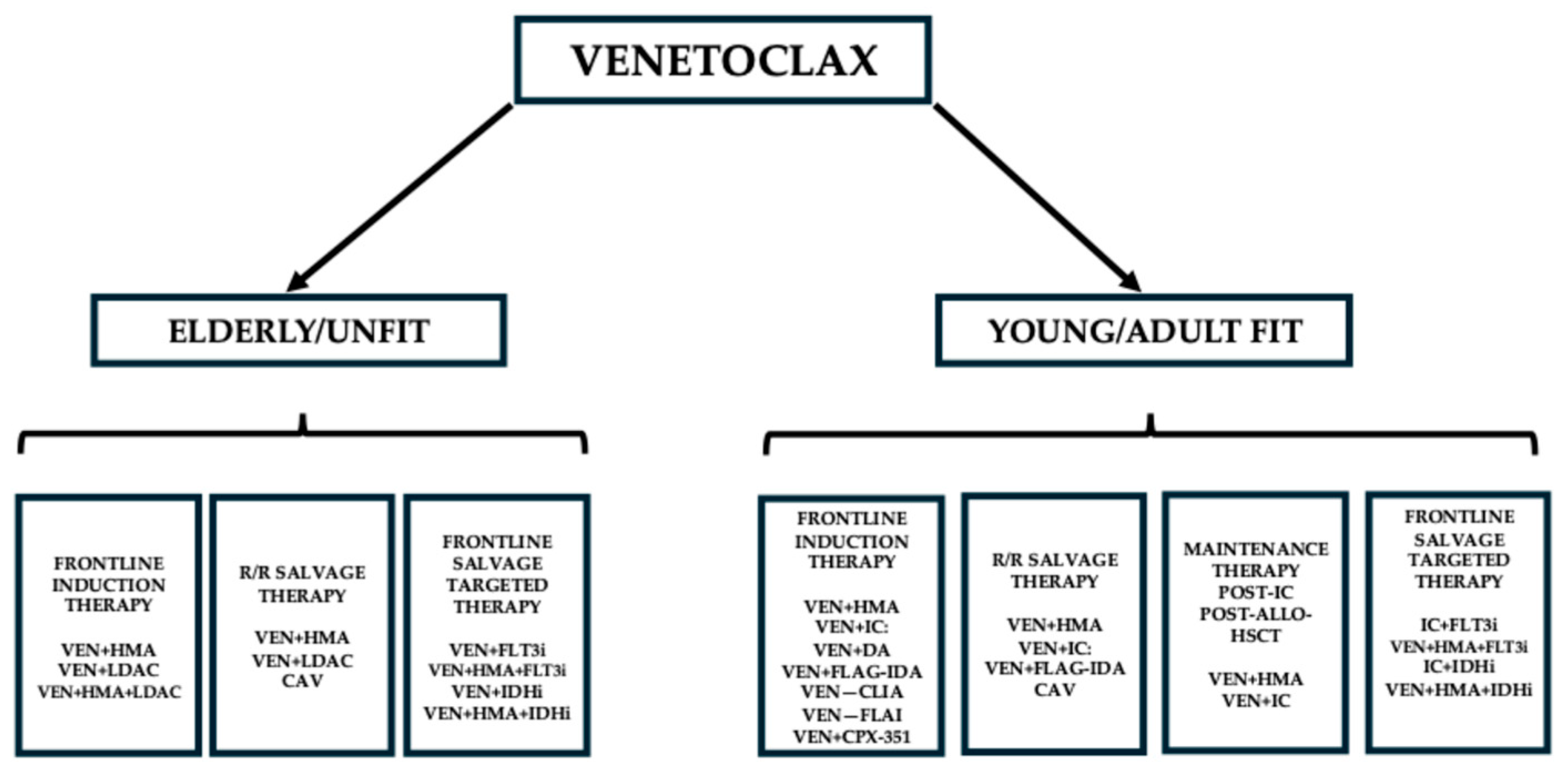
Figure 2.
Outcomes observed in phase II randomized clinical trial comparing the therapeutic activity of conventional Intensive Chemotherapy (IC, 7+3 regimen) to VEN+AZA among intensity chemotherapy eligible adult AML patients. Data reported in Faithi et al. [77].
Figure 2.
Outcomes observed in phase II randomized clinical trial comparing the therapeutic activity of conventional Intensive Chemotherapy (IC, 7+3 regimen) to VEN+AZA among intensity chemotherapy eligible adult AML patients. Data reported in Faithi et al. [77].
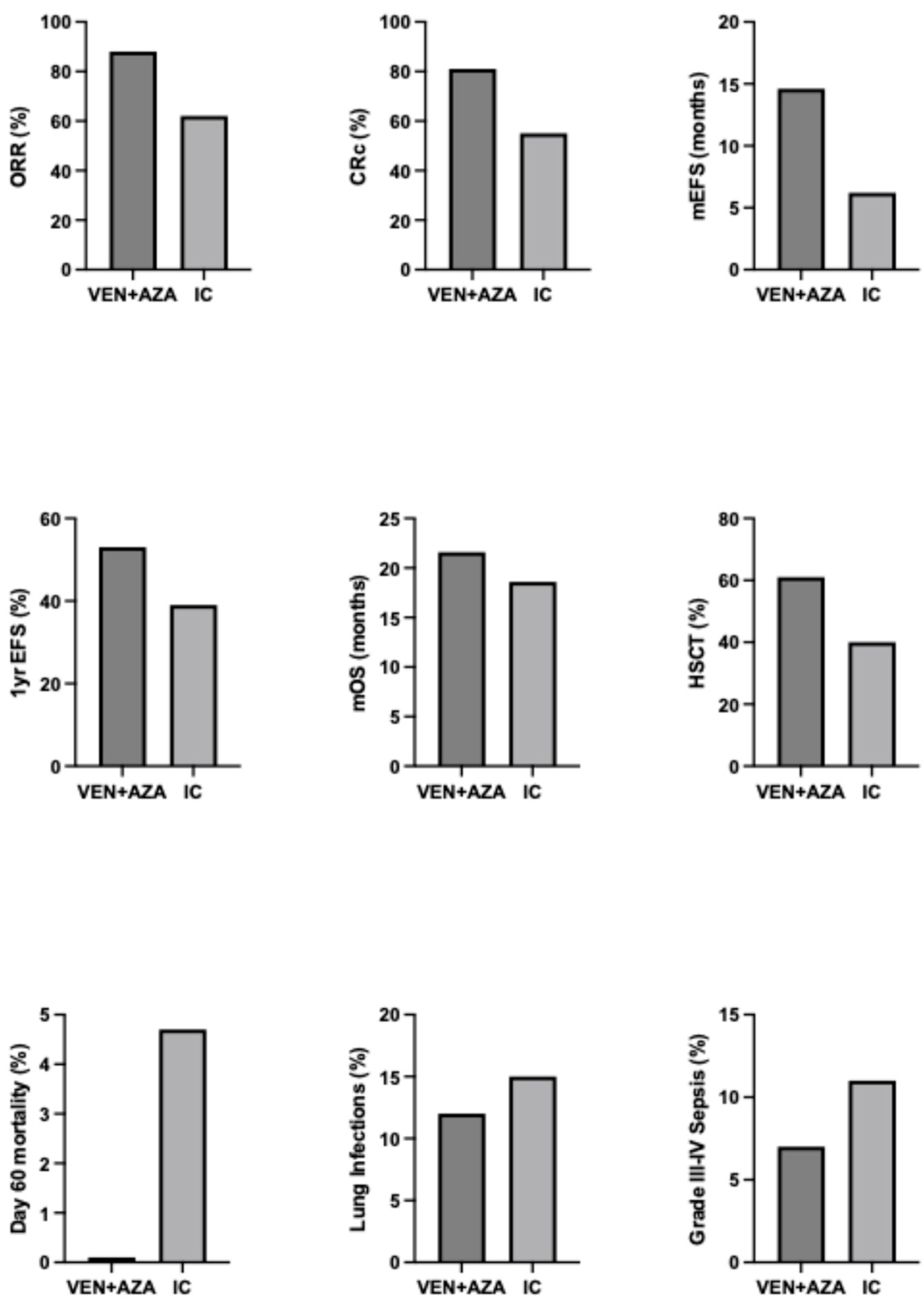
Figure 3.
Median OS in FLT3-mutant AML patients without or with baseline RAS pathway mutations who received a triplet regimen based on VEN+HMA+FLT3i. Patients without baseline RAS pathway mutations have a significantly better mOS (51.8 months) compared to those with RAS pathway mutations (24.5 months), following triplet regimen treatment. Data are reported in Short et al. [146].
Figure 3.
Median OS in FLT3-mutant AML patients without or with baseline RAS pathway mutations who received a triplet regimen based on VEN+HMA+FLT3i. Patients without baseline RAS pathway mutations have a significantly better mOS (51.8 months) compared to those with RAS pathway mutations (24.5 months), following triplet regimen treatment. Data are reported in Short et al. [146].
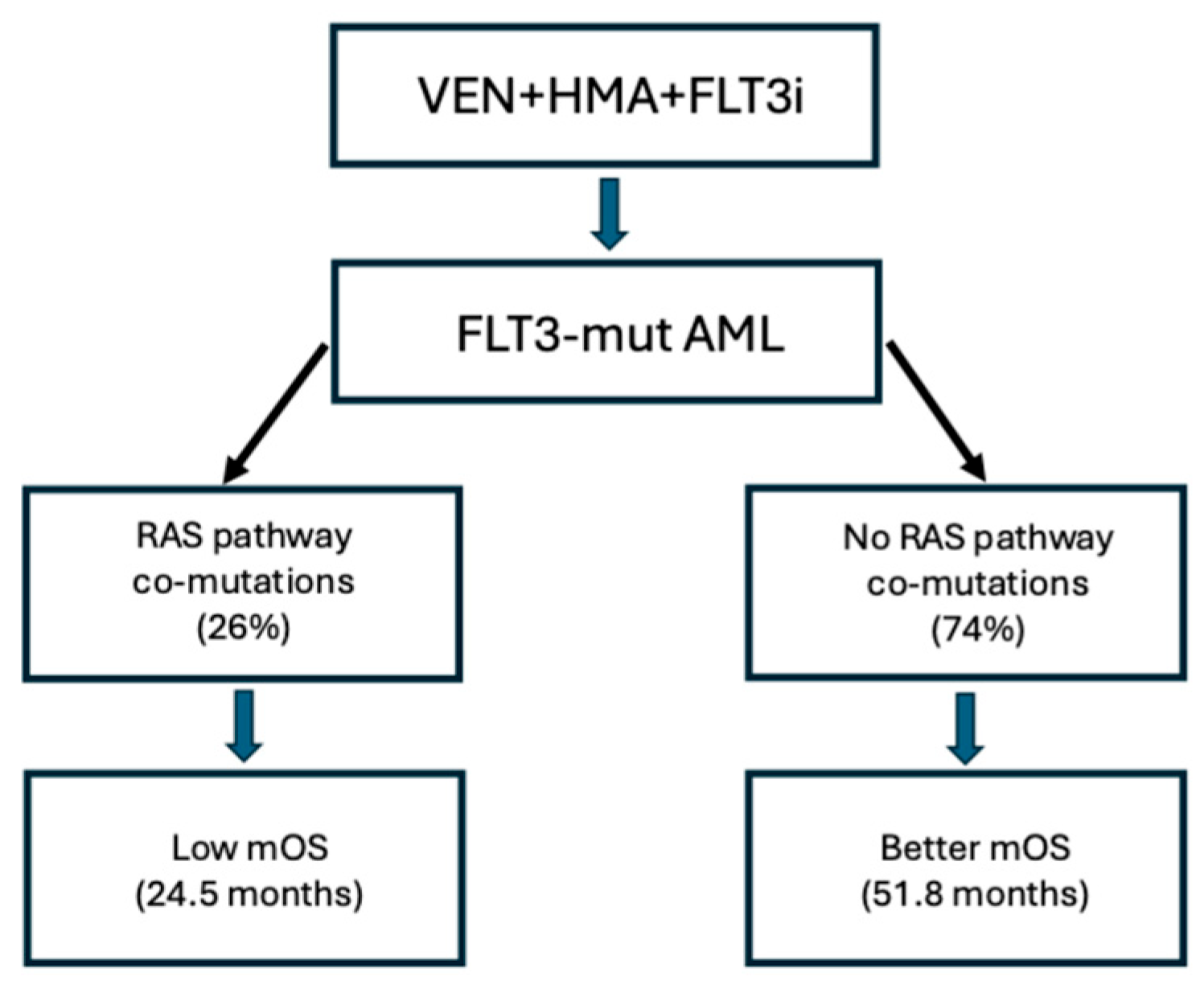
Figure 4.
New RAS and GATA-2 mutations in FLT3-mutant patients who relapsed with FLT3-WT or FLT3-mut AML after frontline treatment with triplet VEN+HMA+FLT3i. 73 patients with newly diagnosed FLT3-mutated AML received a frontline FLT3 inhibitor-containing triplet regimen and 93% of them achieved a CRc; 26% of these patients relapsed at early or late times: 24% of these relapsing patients relapsed with FLT3 mutations and 65% with leukemic cells without FLT3 mutations but acquiring new RAS and GATA-2 mutations. Data reported in Short et al [146].
Figure 4.
New RAS and GATA-2 mutations in FLT3-mutant patients who relapsed with FLT3-WT or FLT3-mut AML after frontline treatment with triplet VEN+HMA+FLT3i. 73 patients with newly diagnosed FLT3-mutated AML received a frontline FLT3 inhibitor-containing triplet regimen and 93% of them achieved a CRc; 26% of these patients relapsed at early or late times: 24% of these relapsing patients relapsed with FLT3 mutations and 65% with leukemic cells without FLT3 mutations but acquiring new RAS and GATA-2 mutations. Data reported in Short et al [146].
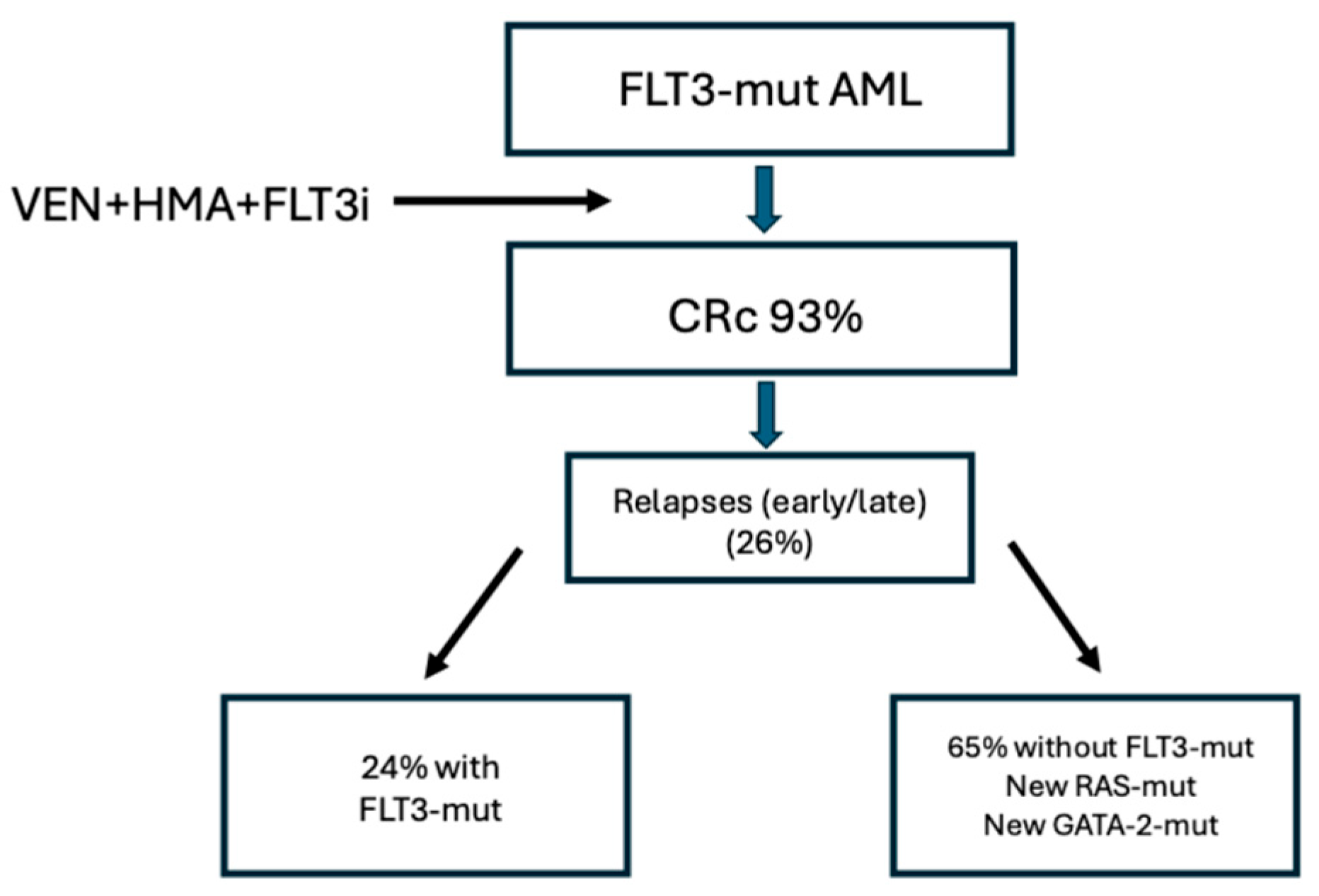
Figure 5.
Clonal evolution of IDH1-mutant AMLs undergoing treatment with VEN+AZA+IVO. After an initial response observed in virtually all IDH1-mutant patients a part of patients remains in remission, while other patients relapse with an AML generated either by de novo clones not detectable at baseline or by expansion of minoritary clones existing at diagnosis.
Figure 5.
Clonal evolution of IDH1-mutant AMLs undergoing treatment with VEN+AZA+IVO. After an initial response observed in virtually all IDH1-mutant patients a part of patients remains in remission, while other patients relapse with an AML generated either by de novo clones not detectable at baseline or by expansion of minoritary clones existing at diagnosis.
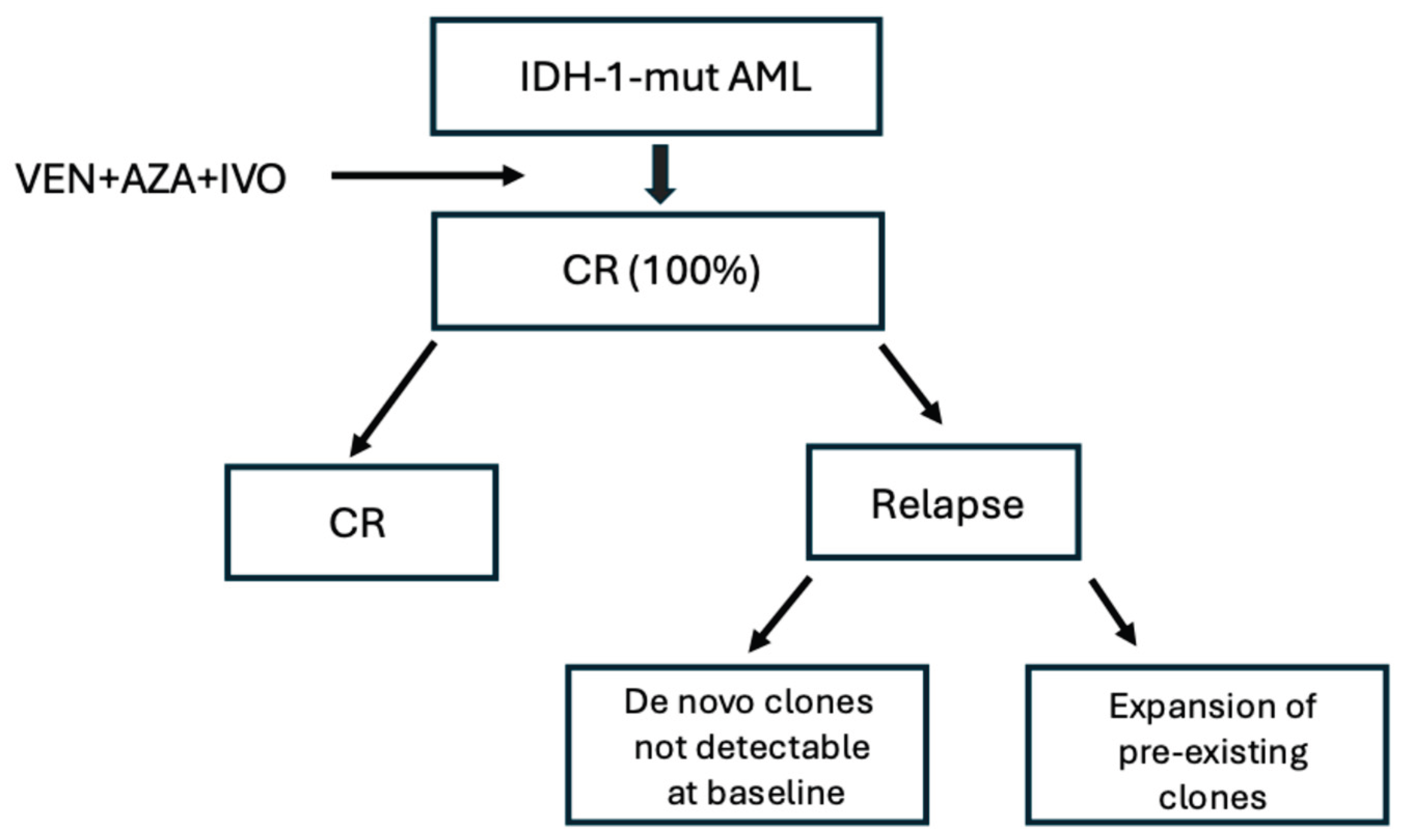
Disclaimer/Publisher’s Note: The statements, opinions and data contained in all publications are solely those of the individual author(s) and contributor(s) and not of MDPI and/or the editor(s). MDPI and/or the editor(s) disclaim responsibility for any injury to people or property resulting from any ideas, methods, instructions or products referred to in the content. |
© 2026 by the authors. Licensee MDPI, Basel, Switzerland. This article is an open access article distributed under the terms and conditions of the Creative Commons Attribution (CC BY) license (http://creativecommons.org/licenses/by/4.0/).
Copyright: This open access article is published under a Creative Commons CC BY 4.0 license, which permit the free download, distribution, and reuse, provided that the author and preprint are cited in any reuse.


