

Submitted:
21 March 2026
Posted:
23 March 2026
You are already at the latest version
Abstract
Recent Phase 3 clinical trials of selective kappa-opioid peptide (KOP) receptor antagonists – aticaprant (Johnson & Johnson, VENTURA trial, 2025) and navacaprant (Neumora, KOASTAL-1 trial, 2025) – failed to demonstrate sufficient clinical efficacy in treatment-resistant depression (TRD). We propose two hypotheses that could explain these setbacks: (1) neutral antagonists may be poorly effective in patients with TRD due to constitutive KOP receptor hyperactivation and (2) the KOP receptor paralog – nociceptin opioid peptide (NOP) receptor – can effectively compensate for KOP receptor blockade decreasing the magnitude of clinical efficacy. We hypothesize that functional redundancy provided by NOP receptor signaling requires dual KOP/NOP blockade to achieve clinically meaningful improvement in reward function. Recent insights gained from paralogous compensation in drug-resistant tumors underscore the need for dual-target approaches. We propose that future studies, if successful, may yield a novel pharmacological class targeting opioid-mediated hedonic suppression, advocating for the development of opioid inverse agonists (such as norBNI), pan-antagonists (such as AT-076), and combinations of selective blockers.
Keywords:
anhedonia
; dynorphin
; nociceptin
; kappa-opioid receptor
; NOP
; treatment-resistant depression
1. Introduction
Hedonic deficit, defined as a diminished capacity to experience pleasure, interest, and satisfaction from activities, is one of the most significant challenges in modern psychiatry and psychopharmacology. This phenomenon is central to the pathophysiology of depression, posttraumatic stress disorder, substance use disorders, and other conditions such as schizophrenia and Parkinson’s disease, which are characterized by impaired motivational functioning [1,2]. Anhedonia is considered a key suicide risk factor [3]. Despite advances in the development of antidepressants, antipsychotics, and other psychopharmacological agents, a significant proportion of patients continue to experience persistent symptoms of hedonic deficit, highlighting the need for novel therapeutic strategies [4].
A substantial body of research indicates that activity of the brain’s reward system, particularly the mesolimbic and mesocortical dopaminergic pathways, determines hedonic tone at a given moment. Accordingly, in a simplified model, increased synaptic dopamine levels or release are perceived as pleasure, whereas a decrease leads to dysphoria, depressed mood, apathy, or anhedonia [5]. The opioid system is one of the most potent regulators of the dopaminergic reward system. The hedomimetic effect is typical of mu-opioid peptide (MOP) receptor agonists and, to a lesser extent, delta-opioid peptide (DOP) receptor agonists. These receptors increase dopamine levels in the nucleus accumbens (NAc), a key center of the brain’s reward system. In contrast, stimulation of KOP and NOP receptors exerts a hedolytic effect, reducing dopaminergic neurotransmission in the NAc [6,7,8,9]. KOP agonists seemed promising for pain treatment because of their anti-nociceptive effects, reduced respiratory depression, and lack of abuse potential. However, their clinical use is limited because of their depressogenic, prodysphoric, proanhedonic, and psychotomimetic effects [10]. Thus, based on their influence on hedonic status, opioid receptors can be divided into two functionally opposing groups. The “anti-hedonic” pole of the opioid system is referred to as part of the brain’s “anti-reward” system [11].
Traditionally, the action of antidepressants has been targeted to enhance monoaminergic transmission in the limbic system and cortex [12,13]. The brain’s “anti-reward” system seems to be a promising target for the development of innovative antidepressants [14,15]. Preclinical studies suggest that KOP and/or NOP receptor blockers would increase dopaminergic neurotransmission in cases where reduced reward system activity is accompanied by increased tone of the kappa-opioid and/or nociceptin systems. Thus, as long as the dopamine system is under kappa-opioid suppression, antidepressants will not work. Three selective KOP receptor antagonists (aticaprant, navacaprant, and icalcaprant) and one selective NOP receptor antagonist (LY2940094 or BTRX-246040) have undergone clinical trials for the treatment of resistant depression (TRD), insufficient response to a first-line antidepressant, and depression with anhedonia [16]. However, their efficacy has been lower than anticipated.
Here we discuss the potential reasons for insufficient clinical efficacy of selective neutral antagonists of KOP or NOP receptors. KOP and NOP coding genes are evolutionary paralogs formed by the duplication of a single ancestor gene [17]. They diverged during evolution but retained some degree of functional homology, and can potentially compensate for each other’s loss of function. Simultaneous blockade of both KOP and NOP receptors could increase clinical efficacy. The development of dual inverse agonists for both KOP and NOP receptors may prove to be the most promising approach. This review represents a theoretical basis for the emergence of a new psychopharmacological class: antagonists of the hyperactive opioidergic negative feedback loop within the endogenous reward system. We also propose a name for this class at the end of this article.
2. Hedonic Capacity as an Independent Clinical Dimension
Hedonic tone or hedonic potential is a person’s capacity to experience positive emotions and pleasure from various life events and social interactions [18]. Anhedonia is the inability to experience pleasure from stimuli that were previously enjoyable or meaningful to an individual. Within the dimensional approach, anhedonia is a transdiagnostic phenomenon (observed in many mental disorders) and can be quantitatively assessed on a spectrum ranging from “mild” to “severe” or complete loss of pleasure. This dimension can intersect with others, such as low mood, anxiety, dysphoria, and apathy [2,4,19,20].
Dopaminergic system dysfunction, particularly in pathways from the ventral tegmental area (VTA) to the nucleus accumbens (NAc) and prefrontal cortex (PFC), plays a central role in anhedonia pathogenesis. Impaired dopaminergic transmission in these brain regions reduces motivation and the ability to anticipate pleasure [21]. Anhedonia is commonly observed in depressive syndrome, dissociative disorders following psychological trauma, and substance use disorders (SUD) [19,22].
Currently, anhedonia lacks specific therapy and low hedonic tone is a strong predictor of poor treatment response, independent of depression severity and the type of antidepressant used [18,20,23,24,25]. Anhedonia may also be a clinical predictor of unsuccessful treatment outcome and a potential target for pharmacological intervention in addiction [26]. Patients with substance use disorders exhibit reduced sensitivity to pleasurable non-drug-related stimuli [27]. The emergence of anhedonia marks the transition from recreational drug use to drug dependence. A strong correlation exists between anhedonia and craving, which is associated with vulnerability to relapse [22,26,28].
Dissociative symptoms are also linked to devitalization and hedonic deficit. This state is accompanied by a subjective feeling of inner emptiness, lifelessness of the surrounding world, and lack of emotional coloring of experience. Individuals with devitalization may describe their state as feeling “emotionally frozen,” “emotionally numb”, as if they have “stopped living,” “exist on autopilot,” or as “death with open eyes” [29,30].
In the psychological literature, the term “devitalization” is often used synonymously with anhedonia, as this state is characterized by a reduced capacity to experience not only negative but also positive emotions. In psychiatric literature, “devitalization” is rarely used as a clinical term; instead, the term “anesthesia psychica dolorosa” is more commonly used. Patients often describe it as an inability to love, feel joy, or grieve. Although this condition is most frequently observed in the context of depressive disorders, PTSD, and schizophrenia, the feeling of detachment from oneself or the surrounding world in its pure form is a characteristic of depersonalization-derealization disorder [29,30]. According to the ICD-11 (code 7B36) and DSM-5 (code 300.6), depersonalization-derealization disorder is characterized by persistent or recurrent episodes of derealization and/or depersonalization. Similar to anhedonia, dissociation is a significant predictor of treatment resistance, affecting therapeutic outcomes in patients with anxiety, depression, PTSD, and personality disorders [31,32,33].
3. Functional Polarization of the Opioid System During Evolution
The evolution of opioid receptors is closely linked to two rounds of whole-genome duplication that occurred early in vertebrates [34,35]. The common ancestor of vertebrates possessed a single prototype gene that encoded an ancient opioid receptor. The first round of duplication (R1) occurred approximately 500–550 million years ago in the common ancestor of vertebrates, leading to the formation of two opioid receptor genes: (1) a μ/δ precursor and (2) a κ/ORL1 precursor. These two receptors evolved independently, specializing in interactions with diverging peptide ligands. The second round (R2) occurred approximately 450 million years ago in the early Paleozoic era and gave rise to the four modern types of opioid receptors: μ- (MOP), δ- (DOP), κ- (KOP), and ORL1- (NOP) [17,35,36]. Thus, the closest evolutionary and genetic relationship was observed between the gene pairs encoding the KOP/NOP and MOP/DOP receptors. This explains the observed functional polarization in the regulation of dopaminergic neurotransmission within the mesocorticolimbic pathways, that is, suppression and facilitation.
KOP receptors are localized in the somatodendritic regions of dopaminergic neurons [37]. Notably, blockade of KOP receptors does not increase the firing rate of dopaminergic neurons in the reward system [38,39]. This indicates that dynorphinergic neurotransmission is “silent” – dynorphin is not tonically released and does not inhibit dopaminergic transmission under baseline conditions.
NOP receptors are similarly expressed on the cell bodies of VTA dopaminergic neurons (Figure 1) [40,41,42].
In the midbrain, 50–60% of neurons expressing prepronociceptin mRNA co-express the key GABA-synthesizing enzyme glutamate decarboxylase, a marker of GABAergic neurons, and are co-localized with neurons expressing tyrosine hydroxylase [40]. NOP receptor mRNA is expressed predominantly in dopaminergic neurons, whereas prepronociceptin mRNA is expressed predominantly in local GABAergic neurons, indicating that nociceptin, along with dynorphin, suppresses the bioelectrical activity of VTA and substantia nigra pars compacta (SNc) dopaminergic neurons [43]. Olianas et al. (2008) demonstrated the inhibitory effect of nociceptin on the activity of the dopamine-synthesizing enzyme TH in the presynaptic terminals of striatal dopaminergic projections [44]. Studies have shown that blockade of NOP receptors enhances dopaminergic neurotransmission [45] showing promise in Parkinson’s disease [46].
Duplicated genes likely contributed to the evolution of the mammalian brain [47]. Many paralogs perform similar functions, and if one is lost, the other can partially take over its functions to maintain homeostasis [48,49,50]. Regarding neurotransmitter systems, genes encoding β₁- and β₂-adrenergic receptors, cyclooxygenases (COX) types 1 and 2, and alcohol dehydrogenases represent classic examples of paralogs that diverged after the duplication of a single ancestral gene [51,52,53].
Our data suggest similar changes between the kappa-opioid and nociceptin systems in a rodent two-bottle choice alcohol-drinking test [54,55]. An increase in alcohol preference was associated with lower mRNA expression of both KOP and NOP receptors, as well as their endogenous ligands – dynorphin and nociception – in the ventral striatum and amygdala. Hyperfunction of the kappa-opioid system typically emerges only after the establishment of substance dependence. Prior to that, its tone may have been reduced, predisposing individuals to experience more intense positive reinforcement during initial exposure to psychoactive substances, which may increase the risk of developing addiction [54,55].
4. Dynorphin and Nociceptin Opioid Systems as Negative Regulators of Hedonic Homeostasis
Opioid systems play a key role in modulating pain perception. While mu-opioid activation by endorphins appears most effective in suppressing nociceptive physical pain, kappa-opioid and nociceptin receptor activation seem to play a key role in ‘emotional anesthesia.’ Salvia divinorum, a hallucinogenic plant containing the most potent and selective KOP agonist salvinorin A, induces strong dissociative effects. These include a sense of time stopping, intense derealization, depersonalization, loss of physical body sensation, and hallucinatory experiences [56,57,58]. In animal models, anhedonic states are accompanied by an increased intracranial self-stimulation (ICSS) threshold [59]. KOP receptor agonists, such as salvinorin A, increase the ICSS threshold, indicating suppression of the reward system and producing effects similar to the signs of depression in humans [60,61]. Importantly, systemic administration of KOP receptor agonists to intact animals increases the ICSS threshold [60,62], whereas administration of KOP receptor antagonists does not change it. This suggests that the “reward” system is not under tonic inhibitory influence from the kappa-opioid system under normal conditions. That is, in a baseline (euthymic) physiological state, KOP receptors are “silent.” In healthy volunteers, administration of KOP receptor agonists (ketazocine, spiradoline, enadoline, etc.) causes dysphoria, depression, dissociation, hallucinogenic effects, and increased prolactin and cortisol levels [63,64,65,66,67].
In rats, KOP receptor agonists induce conditioned place aversion (CPA) mediated by KOP localized on dopaminergic neurons [68,69]. Activation of these receptors reduces dopamine release in the nucleus accumbens and cerebral cortex [15]. Presynaptic KOP receptors in the striatum may be directly associated with DAT, positively modulating its activity and enhancing dopamine reuptake [70,71]. Direct microinfusion of a KOP blocker into the nucleus accumbens has been shown to produce an antidepressant effect [15,62,72]. Thus, the kappa-opioid system acts as a negative feedback mechanism to suppress excessive dopaminergic neurotransmission in the ventral striatum [73]. GABAergic medium-sized spiny neurons (MSNs) of the direct pathway express both dynorphin and D1 receptor (D1-MSNs) [74]. These neurons send projections to the VTA [72,75], where KOP receptors are localized on the cell bodies and dendrites of dopaminergic neurons of the mesocortical, but not mesolimbic, pathway [76,77,78]. This partly sheds light on the possible mechanism of reciprocal relations in activity between the mesolimbic and mesocortical systems: hyperactivation of dopaminergic neurotransmission in the mesolimbic system activates D1-MSNs, leading to increased dynorphin levels in the VTA. This causes selective inhibition of mesocortical dopaminergic neurons and decreases dopamine levels in the prefrontal cortex.
The influence of nociceptin on the brain’s reward system is suppressive and similar to that of dynorphins [79]. Similar to dynorphin, nociceptin and its agonists reduce or even abolish the positive reinforcing properties of alcohol and drugs of abuse (morphine, cocaine, and amphetamines), preventing the development of conditioned place preference [80,81,82,83] and locomotor sensitization [84]. Exogenous administration of nociceptin has been shown to reduce both basal and evoked dopamine release in the NAc, as well as to abolish the positive reinforcing effects of drugs and alcohol [85,86,87]. Phylogenetic proximity likely underlies the functional similarity between the dynorphin and nociceptin opioid systems observed in the cortical and limbic regions of the brain. Interestingly, unlike dynorphin, nociceptin does not induce conditioned place preference or conditioned place aversion [88].
Activation of nociceptinergic neurons innervating VTA suppresses reward motivation, while a single dose of a NOP receptor antagonist enhanced electrophysiological markers of reward learning [89,90].
Pizzagalli et al. (2025) demonstrated that a single dose of NOP antagonist BTRX-246040 significantly enhanced reward-based behavioral modulation in rats. Specifically, the treated animals exhibited a more pronounced bias toward stimuli associated with a higher reward frequency [91].
5. Dynorphin and Nociceptin Opioid Systems and Stress
KOP receptors play an important role in mediating the effects of stress, which is a risk factor for the development of several mental disorders, including depression [92]. Acute and subchronic stress in rodents induces immobility, which is prevented by KOP receptor blockers and is absent in animals with knockout of the genes encoding dynorphin or the KOP receptor [93,94]. The aversive effect of stress (stress-induced conditioned place aversion, CPA) is absent in prodynorphin gene knockout animals. Stressful events are major risk factors for the onset of addictive disorders [95]. Stress enhances cocaine-induced conditioned place preference (CPP), and this effect is mimicked by the intravenous administration of a KOP receptor agonist [96]. Pretreatment with a KOP receptor antagonist (JDTic or nor-BNI) significantly reduced stress-induced (foot-shock) reinstatement of extinguished cocaine self-administration [97,98]. Furthermore, exposure to acute or repeated stress reinstated cocaine CPP in wild-type mice but not in mice with a knockout of the gene encoding the KOP receptor or prodynorphin or after pharmacological blockade of KOP receptors [98].
Activation of NOP receptor as well as social defeat stress induce neuroinflammatory effects in the hippocampus and are associated with depressive-like behaviors in mice [99]. NOP receptor antagonists prevented the development of helplessness in mice exposed to inescapable stress [100]
Prolonged blockade of NOP receptors reversed the stress-induced reduction in sucrose consumption caused by chronic stress. A 21-day administration of UFP-101 abolished the behavioral, neurochemical, and endocrine changes induced by chronic mild stress [101]. Thus, nociceptin not only shares structural similarities with dynorphin but also exerts a functionally similar influence on hedonic tone under baseline conditions [91].
6. Dynorphin and Nociceptin Opioid Systems and Addiction
KOP receptor agonists reduce the reinforcing effects of alcohol and drugs of abuse [102,103] by suppressing mesolimbic dopaminergic neurotransmission [104]. For instance, systemic administration of KOP agonists dose-dependently reduces self-administration of cocaine and morphine in intact (non-dependent) rats [105,106]. Investigation of the reinforcing properties of cocaine in intact monkeys revealed that the KOP agonist U50,488 administered prior to cocaine self-administration significantly suppressed the motivation to obtain cocaine [107]. These results provide robust evidence for the inhibitory effect of KOP stimulation on the rewarding effects of drugs of abuse in non-dependent rats. However, in dependent animals, after the resolution of withdrawal syndrome, the administration of KOP agonists increases drug consumption, which can be interpreted as an attempt to overcome the anhedonia induced by KOP stimulation [108,109]. In animals with established dependence, a reduction in substance consumption can be achieved through the administration of KOP blockers. This indicates hyperactivation of the kappa-opioid system and reflecting the mechanism of drug tolerance and establishment of the anhedonic component of withdrawal syndrome [110].
Increased stress sensitivity and anxiety in ethanol-dependent subjects during protracted abstinence from alcohol may be partly associated with the dysregulation of the nociceptin system. In particular, CeA prepronociceptin gene expression in ethanol-dependent animals was markedly higher three weeks post-withdrawal compared with both nondependent controls and experimentally naïve rats [111].
Using a free-choice task combined with RT-PCR analysis, we measured prepronociceptin and NOP receptor mRNA levels in the mesolimbic areas of rats with different alcohol drinking behaviors. We found that alcohol rats have lower levels of prepronociceptin mRNA in the striatum and NOP receptor mRNA in the amygdala, suggesting that the nociceptin, along with dynorphin, may play a key role in addiction [112].
7. Clinical Trials of Kappa Opioid Receptor Antagonists
According to the WHO, 300 million people worldwide suffer from depressive disorders, and 1 million people die by suicide annually. One-third of patients with depression are resistant to treatment with two or more types of antidepressants. Approximately 30% of patients with TRD do not respond to any further treatment [113].
Table 1 summarizes the results of clinical trials of κ-opioid antagonists. A key clinical trial of selective KOP blockers was the aticaprant trial, which used the NIMH Fast-Fail methodology. This methodology assumes that biomarkers (brain activity) are more sensitive and allow for early confirmation of effects on target neural circuits using smaller sample sizes [114].
This randomized, double-blind, placebo-controlled Phase 2a proof-of-mechanism study investigated the use of aticaprant for treating anhedonia in patients with mood or anxiety disorders. Patients receiving aticaprant had a significant increase in ventral striatal activation during reward anticipation in a monetary incentive delay task, measured using functional magnetic resonance imaging (fMRI), compared with the placebo group. The observed effect of aticaprant on brain regions involved in pleasure was associated with a reduction in anhedonia, as assessed by the Snaith-Hamilton Pleasure Scale (SHAPS), indicating its potential as a therapy for anhedonia [114].
The efficacy and safety of aticaprant as an adjunct to antidepressants in major depressive disorder (MDD) were studied in a Phase 2 placebo-controlled trial. This study involved 184 patients with MDD experiencing an ongoing moderate-to-severe episode despite an adequate course of SSRI/SNRI antidepressants for ≥6 weeks. The primary endpoint was the improvement in the MADRS score after 6 weeks in those who did not respond to placebo during a 3-week lead-in phase. Although the overall difference in the MADRS score was only 2.1 points (a clinically insignificant difference) in favor of aticaprant, the difference was statistically significant. The greatest effect was observed in patients with high baseline anhedonia; however, no statistically significant improvement was observed in the SHAPS (anhedonia), CGI-S (severity), or HAM-A (anxiety) scores [115,116].
In March 2025, Johnson & Johnson announced the discontinuation of its Phase 3 (VENTURA) program because the drug did not demonstrate sufficient efficacy as an adjunctive therapy in patients with MDD despite having a good safety profile1. By the end of 2023, J&J had forecasted the annual peak sales of aticaprant to be between $1 and $5 billion 2.
In January 2025, Neumora Therapeutics reported that its selective kappa-opioid antagonist, navacaprant, did not demonstrate sufficient efficacy in KOASTAL-1 – the first of three Phase 3 trials 3. By week 6, the reduction in the total MADRS score from baseline was equivalent in both the navacaprant and placebo groups. The data revealed a sex-based divergence in the efficacy of navacaprant, with results favoring the drug among the 105 female patients based on the SHAPS scores. The proportion of female participants in the KOASTAL-1 trial was lower than that in Neumora’s earlier Phase 2 study 4.
In a Phase 2 study of navacaprant, the primary endpoint was not met in the efficacy population, which included participants with moderate depression without treatment resistance. At week 8, the difference in the HAMD-17 score for navacaprant compared with placebo was not statistically significant. However, navacaprant significantly improved depressive symptoms, including anhedonia, in a subgroup of patients with severe MDD. In a predefined subgroup with severe MDD, navacaprant significantly improved the HAMD-17 score at both time points and the SHAPS score at week 8. The safety profile was favorable [117].
Previously, the combined opioid antagonist ALKS-5461 from Alkermes did not receive FDA approval. ALKS-5461 is a combination of buprenorphine (a partial MOP agonist and neutral KOP antagonist) with samidorphan (a MOP antagonist). Before the clinical development stage of selective KOP receptor blockers, the kappa-opioid antagonism of buprenorphine was utilized by adding an MOP receptor antagonist to neutralize the abuse potential associated with stimulation of the latter [118,119]. A Phase 2 study enrolled patients with MDD who had an inadequate response to 1 or 2 courses of antidepressant treatment. At 4 weeks, ALKS-5461 outperformed the placebo on all three efficacy measures [120]. Despite the positive Phase 2 data, ALKS-5461 encountered significant challenges in Phase 3.
In the Phase 3 FORWARD-3 trial, ALKS-5461 failed to show superiority over placebo after 6 weeks [121]. Two other multicenter Phase 3 RCTs (FORWARD-4 and FORWARD-5) also evaluated the safety and efficacy of ALKS-5461 for the same indication [122]. The primary endpoint of FORWARD-4 was not met. However, FORWARD-5 met its primary endpoint. A pooled analysis of the FORWARD-4 and FORWARD-5 trials also demonstrated superiority over placebo [122]. Nevertheless, in 2018, the FDA refused to approve ALKS 5461 for the treatment of treatment-resistant depression due to “insufficient evidence of effectiveness for the pursued indication” 5.
Excessive and unpredictable placebo effects “dilute” the therapeutic response, thereby negating statistical significance. One approach to reduce the placebo response is to include a several-week lead-in period in the RCT design, during which all enrolled participants receive placebo and their initial response is tracked before randomization into active and control groups. It is assumed that participants who respond to placebo during the lead-in period are more likely to respond to placebo during the dosing period. Excluding this placebo-responsive group from the final analysis is thought to potentially benefit drug efficacy signal detection [123].
A placebo lead-in period was used as one of the optimization procedures in the aforementioned Phase 2 study of aticaprant. The authors defined two populations: the first, enriched with participants who did not respond to the placebo lead-in (eITT), and the second, including all participants regardless of their response during the lead-in period (fITT). However, the results were the opposite of what was predicted. The aticaprant-induced improvement in MADRS was stronger in the fITT population than in the eITT population [115]. It is hypothesized that effects associated with the placebo/nocebo are driven by an interaction between the reward system and interconnected systems of aversive emotions, which are also regulated by dynorphin [124,125]. This can be seen as an enhancement of reward/aversion dynamics, which should be particularly noticeable in subjects who maintained an active placebo response during the lead-in phase. This phenomenon will be discussed in detail below in the context of agonist-independent (constitutive) KOP receptor activation [125].
8. Clinical Trials of Nociceptin Opioid Receptor Antagonists
According to data from small-scale studies, plasma nociceptin levels are elevated in depressive states and negatively correlate with severity in manic states [126]. Gu et al. (2003) measured plasma levels of nociceptin and 5-HT in patients with postpartum depression and compared them with healthy controls. Plasma nociceptin levels were significantly elevated in the postpartum depression group. Conversely, serotonin levels were lower than those in the control group. This study found a negative correlation between nociceptin and 5-HT levels [127].
A single nucleotide polymorphism (rs6010719) in the NOP receptor gene is more frequent in individuals who develop PTSD symptoms following moderate or severe childhood abuse [128]. The study also reported that subjects with the NOP rs6010719 variant process fear-related images differently and exhibit increased amygdala reactivity and specific fMRI markers. Furthermore, a genome-wide association study conducted as part of a dedicated program (>200,000 participants) revealed a positive association between the NOP variant rs6090040 and anxiety-related personality traits [129].
PET imaging in humans has demonstrated that the NOP receptor is activated in healthy individuals under stress conditions. The acute rise in glucocorticoids during stress increases the density of NOP receptors in various brain regions [130]. In women who have experienced sexual abuse, a positive correlation was identified between NOP receptor density in the midbrain and the severity of PTSD symptoms, particularly those related to intrusive memories and avoidance behavior. The findings indicate that a lower number of NOP receptors in the midbrain is associated with less severe PTSD symptoms [131].
BTRX-246040 (also known as LY2940094) is a selective NOP antagonist [132,133]. In Phase 2 clinical trials involving patients with depression [134] and alcohol dependence [135], BTRX-246040 was safe and well tolerated. Table 2 summarizes the data on the results of clinical trials of BTRX-246040.
The first double-blind placebo-controlled study involved 184 patients with MDD who received BTRX-246040 for 8 weeks. The primary endpoint of the study, the probability of LY2940094 being better than placebo on the GRID-HAMD-17 depression scale, was not met in the full analysis set (intent-to-treat population) but was met in the per-protocol population [134].
Patients with depression exhibit a bias towards interpreting emotionally neutral information as negative. The Oxford Emotional Test Battery (ETB) is used to assess cognitive function and emotional processing in humans. The ETB can detect early effects of antidepressants, such as improved recognition of emotions from facial expressions, which often precedes mood improvement. The ETB assesses the ability to accurately identify emotions from facial expressions displaying varying levels of anger, disgust, fear, happiness, sadness, and surprise, as well as ten neutral expressions [136,137]. This battery was used to determine whether BTRX-246040 affects the processing of information contained in facial expressions. Emotional processing improved after 1 week of treatment in the BTRX-246040 group in terms of accuracy in identifying emotionally positive facial expressions compared with placebo. The BTRX-246040 group showed worsening sleep-related items, primarily early and middle insomnia, compared with placebo, which likely reflects the stimulant properties of the drug [134].
Another double-blind, placebo-controlled study involved patients with alcohol dependence who received BTRX-246040 for 8 weeks. The reduction in the mean number of drinking days (NDD) did not differ between the BTRX-246040 and placebo groups. However, the BTRX-246040 group showed a more pronounced reduction in the mean percentage of heavy drinking days (HDD) per month compared with the placebo group. An increase in the mean percentage of abstinence days per month relative to placebo was also observed. Patients receiving BTRX-246040 exhibited reduced plasma gamma-glutamyl transferase levels at multiple time points. The most common adverse events in the BTRX-246040 group included insomnia, vomiting, and anxiety [135].
BlackThorn Therapeutics has discontinued development of BTRX-246040 after it failed to meet its primary endpoints in its next Phase 2a clinical trial for MDD. Neumora Therapeutics, which acquired BlackThorn, has not announced plans to resume studies of the drug8.
Pizzagalli et al. (2025) present a landmark series of four complementary studies that elegantly bridge preclinical mechanisms to human clinical outcomes. The investigation establishes the NOP receptor system as a stress-sensitive modulator of reward learning and motivation across species. The study systematically progresses from molecular underpinnings (Studies 1-2) to behavioral pharmacology (Study 3) and culminates in a Phase 2a clinical trial reanalysis (Study 4) [91].
Most compellingly, 8-week BTRX-246040 treatment significantly increased the Effort Expenditure for Rewards Task (EEfRT) inverse temperature parameter (t) in MDD patients versus placebo, reflecting restored decision confidence known to be abnormally lowered in MDD patients [138]. This demonstrates NOP antagonism increases incentive motivation with significantly higher willingness to exert efforts to pursue high rewards among individuals with MDD. Despite this, primary (MADRS) and various secondary (SHAPS, DARS) endpoints demonstrated nonsignificant differences [91].
9. Novel Drugs Development Prospects
9.1. Ligand-Receptor Interactions
Clinically significant characteristics of ligand-receptor interactions extend beyond the simple continuum of a ligand intrinsic activity, ranging from –100% to +100%, where 100% represents the maximum level of activation of secondary messengers caused by the corresponding endogenous (or reference) agonist (e.g., a neurotransmitter) at its maximum concentration [139,140].
G-protein-coupled receptors (GPCRs) can adopt multiple active conformations spontaneously, even in the absence of an agonist. Each conformation is associated with the activation of a specific intracellular signaling pathway and its corresponding biological response [140].
At any given time, a certain proportion of receptors in a population exist in one active conformation or another, determining the basal level of activation of the respective secondary messenger system. This agonist-independent receptor activation is called constitutive activity. An endogenous neurotransmitter is considered a full agonist, and its maximal agonist efficacy (Emax) 9 is conventionally set at +100%. Agonists have the highest affinity for one or more active receptor conformations, whereas inverse agonists have the highest affinity for the inactive conformation. By binding to the receptor, they increase the duration for which the receptor remains in a specific spatial configuration. Thus, an inverse agonist decreases the basal level of activation of secondary messenger systems, conventionally taken as “0”. Accordingly, Emax for inverse agonists is a negative value. A ligand that competes with the neurotransmitter for receptor binding but does not shift the equilibrium in the percentage of active receptors is called a neutral antagonist. Thus, it does not decrease biological response in the absence of an agonist and creates an effect equivalent to the absence of an agonist (a “silent” antagonist). Thus, an inverse agonist, produces a biological effect opposite to that of an agonist. Therefore, inverse agonists can exert more pronounced clinical effects (therapeutic or adverse) than neutral antagonists [139,141,142].
In most preclinical studies on kappa-opioid receptors, selective antagonists such as nor-binaltorphimine (norBNI) or JDTic have been used. They possess unusual properties of delayed onset and very long duration of action in vivo. For example, a single injection of norBNI in mammals can block KOP receptors for several weeks [143,144,145].
Several naltrindole derivatives can also induce prolonged blockade of KOP receptors. 5’-AMN [5’-(2-aminomethyl)naltrindole] and 5’-MABN [N-(naltrindol-5-yl)methyl)pentanamideamide] produce continued anxiolytic and antidepressant effects in rats after a single injection, with KOP receptor blockade lasting up to 28 days [146,147,148,149].
The mechanisms underlying such a prolonged receptor blockade have remained unclear for a long time. Neither norBNI nor JDTic were found to be classical antagonists. Rather, they are functionally selective agonists of the KOP receptor that activate c-Jun N-terminal kinase (JNK) [150,151]. JNK recruits peroxiredoxin 6 (PRDX6) to the plasma membrane, which binds to the KOP receptor and stimulates NADPH oxidase to generate reactive oxygen species that oxidize sulfhydryl groups in exposed cysteine residues and depalmitoylates the Gαi protein. This hypothetically alters the orientation of the receptor-G protein binding interface and irreversibly blocks guanine nucleotide exchange, preventing receptor activation [152,153,154].
Pharmacological inhibition of JNK or PRDX6 components in this signaling pathway, or genetic deletion of JNK-1, prevented the long duration of action of norBNI, converting it into a short-acting competitive antagonist [150,151,152]. In this context, ligands such as norBNI are better described as “inactivating” or “desensitizing” antagonists. Classical kappa-opioid agonists, including endogenous dynorphin peptides, activate both heterotrimeric G-proteins and β-arrestin-dependent signaling cascades. β-arrestin, in turn, triggers the mitogen-activated protein kinase p38α MAPK. Because p38α MAPK inhibits JNK, classical KOP receptor agonists do not cause long-term inactivation [152].
Constitutive receptor activity can exert a tonic influence on the basal level of neuronal activity even in the absence of a neurotransmitter [139]. The degree of constitutive activity in a receptor population is influenced by several factors. Chronic GPCR stimulation can lead to an “accumulation” of constitutive activity, although the mechanism remains poorly understood. For instance, chronic morphine administration significantly increases the level of constitutive MOP receptor activity in the rat brain. This may be relevant to the development of withdrawal syndrome induced by naloxone and naltrexone, which in this case behave as inverse agonists of MOP receptors [141,155]. Moreover, chronic exposure to mu-opioid agonists causes constitutive activation of MOP receptors in direct proportion to their Emax magnitude – the more efficacious mu-agonist DAMGO causes a more pronounced increase in constitutive receptor activity than morphine [156]. An increase in the level of an endogenous agonist (neurotransmitter) also likely increases the level of constitutive receptor activity. Polter et al. (2017) showed that acute stress increases the constitutive activity of KOP receptors in inhibitory synapses of the VTA. They demonstrated that in GABAergic synapses on VTA dopamine neurons, a single exposure to brief cold-water swim stress induced constitutive activation of KOP receptors, which triggered a relapse to cocaine seeking behavior. Administration of the neutral KOP receptor antagonist 6β-naltrexol does not prevent such relapse, whereas the KOP receptor inactivator (inverse agonist) norBNI does. This study suggests that new KOP receptor antagonists (such as aticaprant), which likely lack negative agonistic efficacy, may not be ideal candidates for treating cocaine addiction [157]. Previously, Graziane et al. (2013) showed that blocking KOP receptors with norBNI within the VTA prior to forced swim stress prevents the reinstatement of cocaine seeking behavior [158]. Unfortunately, there are currently no data on the comparative efficacy of neutral and inactivating KOP receptor antagonists in other animal models (depression, anxiety, anhedonia). The chronicity and therapeutic resistance of depressive disorders may be largely related to a transition from elevated dynorphin levels at the onset of the disease to increased KOP receptor constitutive activity once the process becomes chronic. This could partially explain the paradoxical results published by Merlo Pich (2024), where aticaprant was most effective in participants who still retained an active response to placebo during the lead-in phase [125].
The response to placebo in RCTs is believed to be determined by various factors, mainly related to participants’ expectations based on the informational context surrounding treatment delivery. These expectations are common to all RCT participants, and this effect is often defined as the intrinsic placebo response. The response to placebo (mood improvement) likely reflects the corresponding increase in the activity of the dopaminergic system. If the assumption by Merlo Pich (2024) is correct and the dynorphin/kappa-opioid system plays a role in the development of the placebo effect, then a placebo response can likely be expected in those patients, whose reward system activity may still be increased by reducing dynorphin levels [125]. However, presumed patients whose dopaminergic neurotransmission is reduced due to high constitutive KOP receptor activity (rather than elevated dynorphin) would likely not demonstrate rapid restoration of dopaminergic neurotransmission. Reducing constitutive receptor activity may take much longer than reducing synaptic neurotransmitter levels, as perhaps illustrated by the time dynamics of resolving opioid withdrawal syndrome [141,155].
According to the data presented above, kappa-opioid neurotransmission is “silent,” meaning that under normal physiological conditions, dynorphin is not tonically released to suppress dopaminergic transmission. A homeostatically more ergonomic mechanism of long-term maintenance of the status quo in neural circuits would be one that does not require constant synthesis and release of a neurotransmitter. Such a mechanism could involve an increase in receptor expression or receptor constitutive activity.
We were unable to find data on the Emax value of aticaprant. However, the assumption that it is a neutral antagonist (rather than an inverse agonist) could explain its particular efficacy in hypothetical patients whose depression is specifically associated with excess of dynorphin peptide. Conversely, it may have lower efficacy in hypothetical patients resistant to the placebo effect due to high constitutive KOP receptor activity.
Furthermore, as the placebo response was assumed to be associated with a decrease in dynorphin levels, nocebo reactions might be associated with an increase in dynorphin levels. This could explain an interesting phenomenon: in the navacaprant group, adverse events leading to study discontinuation were observed 12 times less often than in the placebo group 10.
Promising efficacy results of JDTic observed in animal studies of cocaine abuse and acceptable preclinical safety led this compound to Phase 1 clinical trials in 12 healthy volunteers (six received JDTic 1 mg, six received placebo). 11-13 hours after administration of JDTic, two out of six subjects (and 0 out of six in the placebo group) experienced a single, few-second-long, asymptomatic episode of non-sustained ventricular tachycardia (NSVT). The prevalence of asymptomatic NSVT among healthy men ranges from 2 to 3.2% [50]. Therefore, these events led to the cessation of the clinical study. No differences were observed between the placebo and JDTic groups in terms of laboratory or other ECG parameters. The plasma levels of JDTic were below the lower limit of quantification (below 0.1 nM) in all subjects. Although the evidence is indirect, it suggests that NSVT may represent a cardiotoxic potential of JDTic in humans.
Previous studies in macaques showed that 11 h after oral dose of JDTic, one out of six cynomolgus monkeys (17%) experienced an NSVT event. However, the JDTic dose was 200 mg/kg, which corresponds to an equivalent adult human dose of 4500 mg. Spontaneous NSVT episodes are observed in 13% of the cynomolgus monkeys [50].
Advancement to Phase 1 clinical trials indicates acceptable safety of JDTic in preclinical studies. We also could not find evidence of the arrhythmogenic potential of clinically relevant doses of inactivating KOP receptor antagonists in animals [159]. Given the presence of KOP receptors in the myocardium, it has been suggested that NSVT might be a consequence of JNK activation in human cardiomyocytes, since neutral KOP receptor antagonists (buprenorphine, aticaprant) lack arrhythmogenic potential [160].
Despite the lack of conclusive evidence that NSVT is a class side effect of inactivating KOP receptor antagonists, attention in subsequent years has been focused only on the development of short-acting kappa-opioid antagonists. Given the disappointment in the clinical efficacy of aticaprant and navacaprant, and the potentially higher clinical efficacy of inactivating antagonists, further research is needed to determine whether the NSVT events in the JDTic group indeed represent a class pharmacological effect unique to humans (but not other primates), caused by JNK activation, and what the associated risks are. However, some attention to inactivating KOP receptor antagonists reemerges [161,162].
9.2. Receptor Profile
Given the paralogous relationship between the kappa-opioid and nociceptin systems, a profound synergy at the level of simultaneous blockade of KOP and NOP receptors, even with neutral antagonists, is plausible.
The hypothesis of paralog compensation is supported by oncology experience, where selective blockade of only one paralogous receptor can lead to compensatory activation of another, leading to resistance when using selective BCL-2 or PARP1 inhibitors, as opposed to non-selective ones [163,164]. Tumor cells tolerate disruption of paralogs better than perturbations of singleton genes, a phenomenon known as “proteomic compensation by paralogs” [48] or “paralog-based synthetic lethality” [50]. Given COX types 1 and 2 are paralogs [51], in some clinical situations, non-selective NSAIDs seem to be more effective analgesics than selective COX-2 inhibitors [165]. These examples highlight the need to consider the compensatory potential of paralogs in drug development.
Zaveri et al. (2015) demonstrated that removing the methyl groups at the 3 and 4 positions of the JDTic molecule yields AT-076, a blocker of all four opioid receptors, a pan-opioid antagonist. AT-076 is a potent competitive antagonist of MOP and DOP receptors but has the profile of a non-competitive (insurmountable) antagonist at both NOP and KOP receptors [166]. Rational modification of the AT-076 structure could lead to the creation of a dual KOP/NOP antagonist with an acceptable safety profile.
There are theoretical concerns that blockade of MOP receptors may cause (or worsen) depression and anhedonia, since endorphins and enkephalins increase the tone of the reward system. However, the results of our study refute this hypothesis. In a randomized double-blind placebo-controlled trial involving 306 patients with opioid dependence, the effects of oral naltrexone, long-acting naltrexone (implant), and placebo were compared. Patients receiving naltrexone (both oral and implant) showed no statistically significant differences compared with placebo on depression, anxiety, and anhedonia. This indicates that neutral MOP antagonism does not cause negative affective states [167].
We also present data on the efficacy of the novel non-selective opioid antagonist ondelopran (LY2196044) in patients with alcohol dependence, obtained from a Phase 3 double-blind placebo-controlled study. Ondelopran is an equally effective competitive blocker of KOP, MOP, and DOP receptors. Here, too, no differences were observed in the frequency of adverse events such as depression and other affective symptoms, despite the additional blockade of DOP receptors 11.
The results of these studies do not support the hypothesis that blockade of MOP and/or DOP receptors can cause or worsen depression and weaken the “hedoliberating” action associated with antagonism at KOP and/or NOP receptors. Thus, even if new drug candidates block MOP and DOP receptors in addition to KOP and/or NOP receptors, their therapeutic potential will not be reduced. This expands the opportunities for the development of effective antianhedonic drugs, up to the creation of pan-opioid antagonists.
10. Conclusions
Despite significant interest in the kappa-opioid system, driven by extensive and consistent preclinical data, large-scale trials of selective KOP or NOP receptor antagonists have demonstrated insufficient clinical efficacy in treatment-resistant or anhedonic depression. Preclinical data suggested potentially high efficacy of KOP blockers for a wide range of conditions associated with hedonic deficit.
One potential reason for this may be that in humans with resistant or anhedonic depression, the increase in kappa-opioidergic tone occurs to a greater extent through an increase in the proportion of spontaneously active (constitutively active) KOP receptors, rather than through elevated dynorphin levels, as in animal models. In such cases, neutral antagonists would be unable to exert significant inhibitory effects on agonist-independent receptor signaling. Inverse agonists or inactivating antagonists of the KOP receptor may be significantly more clinically effective. However, a safety signal related to the potential risk of non-sustained ventricular tachycardia (NSVT), observed in two healthy volunteers after JDTic administration, has impeded the development of this approach.
Another possible reason for the insufficient clinical efficacy of selective antagonists of both KOP and NOP receptors is the mutual functional complementation of these two evolutionarily related receptor systems. Almost all biological systems possess multiple complementing negative feedback loops. These loops can be represented by neurotransmitter systems that emerged during evolution as a result of genome duplications. The resulting duplicate genes (paralogs) retain core functional properties throughout subsequent evolution. Therefore, overcoming system resistance to change by blocking only one paralog (either KOP or NOP receptor), especially with a neutral antagonist, may prove challenging, thus suggesting the promise of developing dual blockers.
This review demonstrates the existence of a large number of research teams studying the kappa-opioid and nociceptin systems separately. However, few studies have drawn analogies between them or investigated their functional commonalities. The question of their paralogous compensation upon the loss of function of one of them remains unexplored.
The pharmacophore structure of a dual KOP/NOP antagonist has been described in the literature; therefore, we believe that clinically effective and safe inhibitors of these two opioid systems will eventually be found. Much like the emergence of dopamine receptor blockers (forming the class of antipsychotics) and monoamine reuptake inhibitors (forming the class of antidepressants), we are on the verge of a new psychopharmacological class for treating states of hedonic deficit caused by depression, PTSD, addictions, and other neuropsychiatric disorders.
The potential for the emergence of a novel psychopharmacological class in terms of receptor targets and clinical-dimensional profiles prompts consideration of a name for this class. One option could be the term “hedoliberants” – from Latin “hedon” (pleasure) and “liberatio” (liberation). This term emphasizes the nature of relieving excessive suppression of the reward system, likely reflecting a low or absent addictive potential for this class of positive regulators of hedonic tone.
Conflicts of Interest
The authors declare no conflicts of interest.
References
- Bassey, R.; Sun, X.; Jin, C.; Cui, C.; Chen, Z.; Dai, Q. Reward network mechanism in anhedonia and depression. PLOS One 2025, 20. [Google Scholar] [CrossRef]
- Wu, C.; Mu, Q.; Gao, W.; Lu, S. The characteristics of anhedonia in depression: a review from a clinically oriented perspective. Translational Psychiatry 2025, 15. [Google Scholar] [CrossRef]
- Lee, S.; Bae, S.-M. The Effect of Anhedonia on Suicidal Ideation: The Moderated Mediation Effect of Emotional Intelligence Through Loneliness. Psychiatry Investigation 2025, 22, 591–601. [Google Scholar] [CrossRef]
- Serretti, A. Anhedonia: Current and future treatments. Psychiatry and Clinical Neurosciences Reports 2025, 4. [Google Scholar] [CrossRef] [PubMed]
- Hoflich, A.; Michenthaler, P.; Kasper, S.; Lanzenberger, R. Circuit Mechanisms of Reward, Anhedonia, and Depression. Int J Neuropsychopharmacol 2019, 22, 105–118. [Google Scholar] [CrossRef]
- Wallace, C.W.; Holleran, K.M.; Slinkard, C.Y.; Centanni, S.W.; Lapish, C.C.; Jones, S.R. Kappa opioid receptors diminish spontaneous dopamine signals in awake mice through multiple mechanisms. Neuropharmacology 2025, 273. [Google Scholar] [CrossRef]
- Martinez Damonte, V.; Bailey, L.G.; Thakar, A.; Stralka, J.; Brown, T.E.; Kauer, J.A. Kappa Opioid Receptors Control a Stress-Sensitive Brain Circuit and Drive Cocaine Seeking. The Journal of Neuroscience 2025, 45. [Google Scholar] [CrossRef] [PubMed]
- Escobar, A.d.P.; Casanova, J.P.; Andrés, M.E.; Fuentealba, J.A. Crosstalk Between Kappa Opioid and Dopamine Systems in Compulsive Behaviors. Frontiers in Pharmacology 2020, 11. [Google Scholar] [CrossRef]
- Shamakina, I.Y.; Shagiakhmetov, F.S.; Anokhin, P.K.; Kohan, V.S.; Davidova, T.V. The Role of Nociceptin in Opioid Regulation of Brain Functions. Biochemistry (Moscow), Supplement Series B: Biomedical Chemistry 2021, 15, 171–183. [Google Scholar] [CrossRef]
- Dalefield, M.L.; Scouller, B.; Bibi, R.; Kivell, B.M. The Kappa Opioid Receptor: A Promising Therapeutic Target for Multiple Pathologies. Frontiers in Pharmacology 2022, 13. [Google Scholar] [CrossRef] [PubMed]
- Koob, G.F. Addiction is a Reward Deficit and Stress Surfeit Disorder. Frontiers in Psychiatry 2013, 4. [Google Scholar] [CrossRef]
- Jiang, Y.; Zou, D.; Li, Y.; Gu, S.; Dong, J.; Ma, X.; Xu, S.; Wang, F.; Huang, J.H. Monoamine Neurotransmitters Control Basic Emotions and Affect Major Depressive Disorders. Pharmaceuticals 2022, 15. [Google Scholar] [CrossRef] [PubMed]
- Martín-Hernández, D.; Pereira, M.P.; Tendilla-Beltrán, H.; Madrigal, J.L.M.; García-Bueno, B.; Leza, J.C.; Caso, J.R. Modulation of Monoaminergic Systems by Antidepressants in the Frontal Cortex of Rats After Chronic Mild Stress Exposure. Molecular Neurobiology 2019, 56, 7522–7533. [Google Scholar] [CrossRef] [PubMed]
- Dresp-Langley, B. From Reward to Anhedonia-Dopamine Function in the Global Mental Health Context. Biomedicines 2023, 11. [Google Scholar] [CrossRef]
- Lalanne, L.; Ayranci, G.; Kieffer, B.L.; Lutz, P.-E. The Kappa Opioid Receptor: From Addiction to Depression, and Back. Frontiers in Psychiatry 2014, 5. [Google Scholar] [CrossRef]
- Wong, S.; Le, G.H.; Vasudeva, S.; Teopiz, K.M.; Phan, L.; Meshkat, S.; Kwan, A.T.H.; Rhee, T.G.; Ho, R.; Choi, H.; et al. Preclinical and clinical efficacy of kappa opioid receptor antagonists for depression: A systematic review. Journal of Affective Disorders 2024, 362, 816–827. [Google Scholar] [CrossRef]
- Stevens, C.W. Bioinformatics and Evolution of Vertebrate Nociceptin and Opioid Receptors. In Nociceptin Opioid; Vitamins & Hormones, 2015; pp. 57–94. [Google Scholar]
- Katzman, M.; Sternat, T. Neurobiology of hedonic tone: the relationship between treatment-resistant depression, attention-deficit hyperactivity disorder, and substance abuse. Neuropsychiatric Disease and Treatment 2016, Volume 12, 2149–2164. [Google Scholar] [CrossRef] [PubMed]
- Pizzagalli, D.A. Toward a Better Understanding of the Mechanisms and Pathophysiology of Anhedonia: Are We Ready for Translation? American Journal of Psychiatry 2022, 179, 458–469. [Google Scholar] [CrossRef]
- Liang, S.; Wu, Y.; Hanxiaoran, L.; Greenshaw, A.J.; Li, T. Anhedonia in Depression and Schizophrenia: Brain Reward and Aversion Circuits. Neuropsychiatric Disease and Treatment 2022, Volume 18, 1385–1396. [Google Scholar] [CrossRef]
- Cooper, J.A.; Arulpragasam, A.R.; Treadway, M.T. Anhedonia in depression: biological mechanisms and computational models. Current Opinion in Behavioral Sciences 2018, 22, 128–135. [Google Scholar] [CrossRef]
- Janiri, L.; Giannantonio, M.D.; Martinotti, G.; Hatzigiakoumis, D.S. Anhedonia and Substance Dependence: Clinical Correlates and Treatment Options. Frontiers in Psychiatry 2011, 2. [Google Scholar] [CrossRef] [PubMed]
- Uher, R.; Perlis, R.H.; Henigsberg, N.; Zobel, A.; Rietschel, M.; Mors, O.; Hauser, J.; Dernovsek, M.Z.; Souery, D.; Bajs, M.; et al. Depression symptom dimensions as predictors of antidepressant treatment outcome: replicable evidence for interest-activity symptoms. Psychological Medicine 2011, 42, 967–980. [Google Scholar] [CrossRef]
- McMakin, D.L.; Olino, T.M.; Porta, G.; Dietz, L.J.; Emslie, G.; Clarke, G.; Wagner, K.D.; Asarnow, J.R.; Ryan, N.D.; Birmaher, B.; et al. Anhedonia Predicts Poorer Recovery Among Youth With Selective Serotonin Reuptake Inhibitor Treatment–Resistant Depression. Journal of the American Academy of Child & Adolescent Psychiatry 2012, 51, 404–411. [Google Scholar] [CrossRef]
- Dunlop, K.; Rizvi, S.J.; Kennedy, S.H.; Hassel, S.; Strother, S.C.; Harris, J.K.; Zamyadi, M.; Arnott, S.R.; Davis, A.D.; Mansouri, F.; et al. Clinical, behavioral, and neural measures of reward processing correlate with escitalopram response in depression: a Canadian Biomarker Integration Network in Depression (CAN-BIND-1) Report. Neuropsychopharmacology 2020, 45, 1390–1397. [Google Scholar] [CrossRef] [PubMed]
- Kiluk, B.D.; Yip, S.W.; DeVito, E.E.; Carroll, K.M.; Sofuoglu, M. Anhedonia as a Key Clinical Feature in the Maintenance and Treatment of Opioid Use Disorder. Clinical Psychological Science 2019, 7, 1190–1206. [Google Scholar] [CrossRef]
- Parvaz, M.A.; Gabbay, V.; Malaker, P.; Goldstein, R.Z. Objective and specific tracking of anhedonia via event-related potentials in individuals with cocaine use disorders. Drug and Alcohol Dependence 2016, 164, 158–165. [Google Scholar] [CrossRef]
- Vafaie, N.; Kober, H. Association of Drug Cues and Craving With Drug Use and Relapse. JAMA Psychiatry 2022, 79. [Google Scholar] [CrossRef]
- Sierra, M.; David, A.S. Depersonalization: A selective impairment of self-awareness. Consciousness and Cognition 2011, 20, 99–108. [Google Scholar] [CrossRef]
- Sass, L.; Feyaerts, J. Self-Disorder in Schizophrenia: A Revised View (2. Theoretical Revision – Hyperreflexivity). Schizophrenia Bulletin 2024, 50, 472–483. [Google Scholar] [CrossRef]
- Prasko, J.; Grambal, A.; Kasalova, P.; Kamaradova, D.; Ociskova, M.; Holubova, M.; Vrbova, K.; Sigmundova, Z.; Latalova, K.; Slepecky, M.; et al. Impact of dissociation on treatment of depressive and anxiety spectrum disorders with and without personality disorders. Neuropsychiatric Disease and Treatment 2016, Volume 12, 2659–2676. [Google Scholar] [CrossRef] [PubMed]
- Prasko, J.; Ociskova, M.; Latalova, K.; Kamaradova, D.; Grambal, A. Psychological factors and treatment effectiveness in resistant anxiety disorders in highly comorbid inpatients. Neuropsychiatric Disease and Treatment 2016, Volume 12, 1539–1551. [Google Scholar] [CrossRef]
- Prasko, J.; Vyskocilova, J.; Sipek, J. Cognitive behavioral therapy in pharmacoresistant obsessive–compulsive disorder. Neuropsychiatric Disease and Treatment 2016. [Google Scholar] [CrossRef]
- Stevens, C.W. The evolution of vertebrate opioid receptors. Frontiers in Bioscience 2009, Volume. [Google Scholar] [CrossRef] [PubMed]
- Dreborg, S.; Sundström, G.; Larsson, T.A.; Larhammar, D. Evolution of vertebrate opioid receptors. Proceedings of the National Academy of Sciences 2008, 105, 15487–15492. [Google Scholar] [CrossRef]
- Larhammar, D.; Dreborg, S.; Larsson, T.A.; Sundström, G. Early Duplications of Opioid Receptor and Peptide Genes in Vertebrate Evolution. Annals of the New York Academy of Sciences 2009, 1163, 451–453. [Google Scholar] [CrossRef] [PubMed]
- Hosseinzadeh Sahafi, O.; Sardari, M.; Alijanpour, S.; Rezayof, A. Shared Mechanisms of GABAergic and Opioidergic Transmission Regulate Corticolimbic Reward Systems and Cognitive Aspects of Motivational Behaviors. Brain Sciences 2023, 13. [Google Scholar] [CrossRef]
- Margolis, E.B.; Karkhanis, A.N. Dopaminergic cellular and circuit contributions to kappa opioid receptor mediated aversion. Neurochemistry International 2019, 129. [Google Scholar] [CrossRef] [PubMed]
- Edwards, N.J.; Tejeda, H.A.; Pignatelli, M.; Zhang, S.; McDevitt, R.A.; Wu, J.; Bass, C.E.; Bettler, B.; Morales, M.; Bonci, A. Circuit specificity in the inhibitory architecture of the VTA regulates cocaine-induced behavior. Nature Neuroscience 2017, 20, 438–448. [Google Scholar] [CrossRef]
- Norton, C.S.; Neal, C.R.; Kumar, S.; Akil, H.; Watson, S.J. Nociceptin/orphanin FQ and opioid receptor-like receptor mRNA expression in dopamine systems. Journal of Comparative Neurology 2002, 444, 358–368. [Google Scholar] [CrossRef]
- Khan, M.S.; Boileau, I.; Kolla, N.; Mizrahi, R. A systematic review of the role of the nociceptin receptor system in stress, cognition, and reward: relevance to schizophrenia. Translational Psychiatry 2018, 8. [Google Scholar] [CrossRef]
- Di Benedetto, M.; Cavina, C.; D’Addario, C.; Leoni, G.; Candeletti, S.; Cox, B.M.; Romualdi, P. Alterations of N/OFQ and NOP receptor gene expression in the substantia nigra and caudate putamen of MPP+ and 6-OHDA lesioned rats. Neuropharmacology 2009, 56, 761–767. [Google Scholar] [CrossRef]
- Gavioli, E.C.; Holanda, V.A.D.; Calo, G.; Ruzza, C. Nociceptin/orphanin FQ receptor system blockade as an innovative strategy for increasing resilience to stress. Peptides 2021, 141. [Google Scholar] [CrossRef]
- Olianas, M.C.; Dedoni, S.; Boi, M.; Onali, P. Activation of nociceptin/orphanin FQ-NOP receptor system inhibits tyrosine hydroxylase phosphorylation, dopamine synthesis, and dopamine D1 receptor signaling in rat nucleus accumbens and dorsal striatum. Journal of Neurochemistry 2008, 107, 544–556. [Google Scholar] [CrossRef] [PubMed]
- Marti, M.; Mela, F.; Veronesi, C.; Guerrini, R.; Salvadori, S.; Federici, M.; Mercuri, N.B.; Rizzi, A.; Franchi, G.; Beani, L.; et al. Blockade of Nociceptin/Orphanin FQ Receptor Signaling in Rat Substantia Nigra Pars Reticulata Stimulates Nigrostriatal Dopaminergic Transmission and Motor Behavior. The Journal of Neuroscience 2004, 24, 6659–6666. [Google Scholar] [CrossRef] [PubMed]
- Volta, M.; Viaro, R.; Trapella, C.; Marti, M.; Morari, M. Dopamine–nociceptin/orphanin FQ interactions in the substantia nigra reticulata of hemiparkinsonian rats: Involvement of D2/D3 receptors and impact on nigro-thalamic neurons and motor activity. Experimental Neurology 2011, 228, 126–137. [Google Scholar] [CrossRef]
- Soto, D.C.; Uribe-Salazar, J.M.; Kaya, G.; Valdarrago, R.; Sekar, A.; Haghani, N.K.; Hino, K.; La, G.; Mariano, N.A.F.; Ingamells, C.; et al. Human-specific gene expansions contribute to brain evolution. Cell 2025, 188, 5363–5383.e5322. [Google Scholar] [CrossRef] [PubMed]
- Venkatesh, A.; Quinn, N.; Upadhya, S.R.; De Kegel, B.; Bolado Carrancio, A.; Lefeivre, T.; Dennler, O.; Wynne, K.; von Kriegsheim, A.; Ryan, C.J. Proteomic compensation by paralogs preserves protein interaction networks after gene loss in cancer. Molecular Systems Biology 2025, 21, 1090–1118. [Google Scholar] [CrossRef]
- Ng, A.Y.E.; Chan, S.N.; Pek, J.W. Genetic compensation between ribosomal protein paralogs mediated by a cognate circular RNA. Cell Reports 2024, 43. [Google Scholar] [CrossRef]
- Xin, Y.; Zhang, Y. Paralog-based synthetic lethality: rationales and applications. Frontiers in Oncology 2023, 13. [Google Scholar] [CrossRef]
- Järving, R.; Järving, I.; Kurg, R.; Brash, A.R.; Samel, N. On the Evolutionary Origin of Cyclooxygenase (COX) Isozymes. Journal of Biological Chemistry 2004, 279, 13624–13633. [Google Scholar] [CrossRef]
- Yang-Feng, T.L.; Xue, F.Y.; Zhong, W.W.; Cotecchia, S.; Frielle, T.; Caron, M.G.; Lefkowitz, R.J.; Francke, U. Chromosomal organization of adrenergic receptor genes. Proceedings of the National Academy of Sciences 1990, 87, 1516–1520. [Google Scholar] [CrossRef] [PubMed]
- Robinson-Rechavi, M.; Carrigan, M.A.; Uryasev, O.; Davis, R.P.; Zhai, L.; Hurley, T.D.; Benner, S.A. The Natural History of Class I Primate Alcohol Dehydrogenases Includes Gene Duplication, Gene Loss, and Gene Conversion. PLoS ONE 2012, 7. [Google Scholar] [CrossRef]
- Shagiakhmetov, F.; Anokhin, P.; Shamakina, I.; Davydova, T. Comparative quantitative analysis of the brain opioid gene expression in rats with high and low voluntary alcohol consumption. ZHurnal «Patologicheskaia fiziologiia i eksperimental`naia terapiia» 2018, 53–57. [Google Scholar] [CrossRef]
- Shagiakhmetov, F.; Shamakina, I.; Davydova, T. Mechanisms underlying controlled alcohol consumption: nociceptine/kappa-opioid related gene expression in the rat brain. Nauchno-prakticheskii zhurnal «Patogenez» 2018, 112–114. [Google Scholar] [CrossRef]
- Maqueda, A.E.; Valle, M.; Addy, P.H.; Antonijoan, R.M.; Puntes, M.; Coimbra, J.; Ballester, M.R.; Garrido, M.; González, M.; Claramunt, J.; et al. Salvinorin-A Induces Intense Dissociative Effects, Blocking External Sensory Perception and Modulating Interoception and Sense of Body Ownership in Humans. International Journal of Neuropsychopharmacology 2015, 18. [Google Scholar] [CrossRef] [PubMed]
- MacLean, K.A.; Johnson, M.W.; Reissig, C.J.; Prisinzano, T.E.; Griffiths, R.R. Dose-related effects of salvinorin A in humans: dissociative, hallucinogenic, and memory effects. Psychopharmacology 2012, 226, 381–392. [Google Scholar] [CrossRef]
- Ranganathan, M.; Schnakenberg, A.; Skosnik, P.D.; Cohen, B.M.; Pittman, B.; Sewell, R.A.; D’Souza, D.C. Dose-Related Behavioral, Subjective, Endocrine, and Psychophysiological Effects of the κ Opioid Agonist Salvinorin A in Humans. Biological Psychiatry 2012, 72, 871–879. [Google Scholar] [CrossRef]
- Carlezon, W.A.; Chartoff, E.H. Intracranial self-stimulation (ICSS) in rodents to study the neurobiology of motivation. Nature Protocols 2007, 2, 2987–2995. [Google Scholar] [CrossRef] [PubMed]
- Carlezon, W.A.; Béguin, C.; DiNieri, J.A.; Baumann, M.H.; Richards, M.R.; Todtenkopf, M.S.; Rothman, R.B.; Ma, Z.; Lee, D.Y.W.; Cohen, B.M. Depressive-Like Effects of the κ-Opioid Receptor Agonist Salvinorin A on Behavior and Neurochemistry in Rats. The Journal of Pharmacology and Experimental Therapeutics 2006, 316, 440–447. [Google Scholar] [CrossRef]
- Carlezon, W.A.; Béguin, C.; Knoll, A.T.; Cohen, B.M. Kappa-opioid ligands in the study and treatment of mood disorders. Pharmacology & Therapeutics 2009, 123, 334–343. [Google Scholar] [CrossRef]
- Todtenkopf, M.S.; Marcus, J.F.; Portoghese, P.S.; Carlezon, W.A. Effects of κ-opioid receptor ligands on intracranial self-stimulation in rats. Psychopharmacology 2004, 172, 463–470. [Google Scholar] [CrossRef] [PubMed]
- Wadenberg, M.L. A review of the properties of spiradoline: a potent and selective kappa-opioid receptor agonist. CNS Drug Rev 2003, 9, 187–198. [Google Scholar] [CrossRef] [PubMed]
- Chappell, P.B.; Leckman, J.F.; Scahill, L.D.; Hardin, M.T.; Anderson, G.; Cohen, D.J. Neuroendocrine and behavioral effects of the selective kappa agonist spiradoline in Tourette’s syndrome: A pilot study. Psychiatry Research 1993, 47, 267–280. [Google Scholar] [CrossRef]
- Walsh, S.L.; Strain, E.C.; Abreu, M.E.; Bigelow, G.E. Enadoline, a selective kappa opioid agonist: comparison with butorphanol and hydromorphone in humans. Psychopharmacology (Berl) 2001, 157, 151–162. [Google Scholar] [CrossRef]
- Ur, E.; Wright, D.M.; Bouloux, P.M.G.; Grossman, A. The effects of spiradoline (U-62066E), a κ-opioid receptor agonist, on neuroendocrine function in man. British Journal of Pharmacology 2009, 120, 781–784. [Google Scholar] [CrossRef]
- White, K.L.; Roth, B.L. Psychotomimetic Effects of Kappa Opioid Receptor Agonists. Biological Psychiatry 2012, 72, 797–798. [Google Scholar] [CrossRef] [PubMed]
- Chefer, V.I.; Bäckman, C.M.; Gigante, E.D.; Shippenberg, T.S. Kappa Opioid Receptors on Dopaminergic Neurons Are Necessary for Kappa-Mediated Place Aversion. Neuropsychopharmacology 2013, 38, 2623–2631. [Google Scholar] [CrossRef]
- Wallace, C.W.; Holleran, K.M.; Slinkard, C.Y.; Centanni, S.W.; Jones, S.R. 2024. [CrossRef]
- Thompson, A.C.; Zapata, A.; Justice, J.B.; Vaughan, R.A.; Sharpe, L.G.; Shippenberg, T.S. κ-Opioid Receptor Activation Modifies Dopamine Uptake in the Nucleus Accumbens and Opposes the Effects of Cocaine. The Journal of Neuroscience 2000, 20, 9333–9340. [Google Scholar] [CrossRef]
- Kivell, B.; Uzelac, Z.; Sundaramurthy, S.; Rajamanickam, J.; Ewald, A.; Chefer, V.; Jaligam, V.; Bolan, E.; Simonson, B.; Annamalai, B.; et al. Salvinorin A regulates dopamine transporter function via a kappa opioid receptor and ERK1/2-dependent mechanism. Neuropharmacology 2014, 86, 228–240. [Google Scholar] [CrossRef]
- Tejeda, H.A.; Bonci, A. Dynorphin/kappa-opioid receptor control of dopamine dynamics: Implications for negative affective states and psychiatric disorders. Brain Research 2019, 1713, 91–101. [Google Scholar] [CrossRef]
- Trifilieff, P.; Martinez, D. Kappa-Opioid Receptor Signaling in the Striatum as a Potential Modulator of Dopamine Transmission in Cocaine Dependence. Frontiers in Psychiatry 2013, 4. [Google Scholar] [CrossRef] [PubMed]
- Korotkova, T.M.; Brown, R.E.; Sergeeva, O.A.; Ponomarenko, A.A.; Haas, H.L. Effects of arousal- and feeding-related neuropeptides on dopaminergic and GABAergic neurons in the ventral tegmental area of the rat. European Journal of Neuroscience 2006, 23, 2677–2685. [Google Scholar] [CrossRef] [PubMed]
- Smith, R.J.; Lobo, M.K.; Spencer, S.; Kalivas, P.W. Cocaine-induced adaptations in D1 and D2 accumbens projection neurons (a dichotomy not necessarily synonymous with direct and indirect pathways). Current Opinion in Neurobiology 2013, 23, 546–552. [Google Scholar] [CrossRef]
- Margolis, E.B.; Lock, H.; Chefer, V.I.; Shippenberg, T.S.; Hjelmstad, G.O.; Fields, H.L. κ opioids selectively control dopaminergic neurons projecting to the prefrontal cortex. Proceedings of the National Academy of Sciences 2006, 103, 2938–2942. [Google Scholar] [CrossRef]
- Spanagel, R.; Herz, A.; Shippenberg, T.S. Opposing tonically active endogenous opioid systems modulate the mesolimbic dopaminergic pathway. Proceedings of the National Academy of Sciences 1992, 89, 2046–2050. [Google Scholar] [CrossRef]
- Devine, D.P.; Leone, P.; Pocock, D.; Wise, R.A. Differential involvement of ventral tegmental mu, delta and kappa opioid receptors in modulation of basal mesolimbic dopamine release: in vivo microdialysis studies. J Pharmacol Exp Ther 1993, 266, 1236–1246. [Google Scholar] [CrossRef]
- Ciccocioppo, R.; Borruto, A.M.; Domi, A.; Teshima, K.; Cannella, N.; Weiss, F. NOP-Related Mechanisms in Substance Use Disorders. In The Nociceptin/Orphanin FQ Peptide Receptor; Handbook of Experimental Pharmacology, 2019; pp. 187–212. [Google Scholar]
- Sakoori, K.; Murphy, N.P. Central administration of nociceptin/orphanin FQ blocks the acquisition of conditioned place preference to morphine and cocaine, but not conditioned place aversion to naloxone in mice. Psychopharmacology 2004, 172, 129–136. [Google Scholar] [CrossRef]
- Sakoori, K.; Murphy, N.P. Endogenous Nociceptin (Orphanin FQ) Suppresses Basal Hedonic State and Acute Reward Responses to Methamphetamine and Ethanol, but Facilitates Chronic Responses. Neuropsychopharmacology 2007, 33, 877–891. [Google Scholar] [CrossRef] [PubMed]
- Murphy, N.P. Nociceptin/orphanin FQ, hedonic state and the response to abused drugs. Nihon Shinkei Seishin Yakurigaku Zasshi 2004, 24, 295–298. [Google Scholar]
- Rutten, K.; De Vry, J.; Bruckmann, W.; Tzschentke, T.M. Effects of the NOP receptor agonist Ro65-6570 on the acquisition of opiate- and psychostimulant-induced conditioned place preference in rats. Eur J Pharmacol 2010, 645, 119–126. [Google Scholar] [CrossRef]
- Vazquez-DeRose, J.; Stauber, G.; Khroyan, T.V.; Xie, X.S.; Zaveri, N.T.; Toll, L. Retrodialysis of N/OFQ into the nucleus accumbens shell blocks cocaine-induced increases in extracellular dopamine and locomotor activity. European Journal of Pharmacology 2013, 699, 200–206. [Google Scholar] [CrossRef]
- Lutfy, K.; Zaveri, N.T. The Nociceptin Receptor as an Emerging Molecular Target for Cocaine Addiction. In The Molecular Basis of Drug Addiction; Progress in Molecular Biology and Translational Science, 2016; pp. 149–181. [Google Scholar]
- Zaveri, N.T. Nociceptin Opioid Receptor (NOP) as a Therapeutic Target: Progress in Translation from Preclinical Research to Clinical Utility. Journal of Medicinal Chemistry 2016, 59, 7011–7028. [Google Scholar] [CrossRef]
- Zaveri, N.T.; Marquez, P.V.; Meyer, M.E.; Polgar, W.E.; Hamid, A.; Lutfy, K. A Novel and Selective Nociceptin Receptor (NOP) Agonist (1-(1-((cis)-4-isopropylcyclohexyl)piperidin-4-yl)-1H-indol-2-yl)methanol (AT-312) Decreases Acquisition of Ethanol-Induced Conditioned Place Preference in Mice. Alcoholism: Clinical and Experimental Research 2018, 42, 461–471. [Google Scholar] [CrossRef]
- Devine, D.P.; Reinscheid, R.K.; Monsma, F.J.; Civelli, O.; Akil, H. The novel neuropeptide orphanin FQ fails to produce conditioned place preference or aversion. Brain Research 1996, 727, 225–229. [Google Scholar] [CrossRef] [PubMed]
- Parker, K.E.; Pedersen, C.E.; Gomez, A.M.; Spangler, S.M.; Walicki, M.C.; Feng, S.Y.; Stewart, S.L.; Otis, J.M.; Al-Hasani, R.; McCall, J.G.; et al. A Paranigral VTA Nociceptin Circuit that Constrains Motivation for Reward. Cell 2019, 178, 653–671.e619. [Google Scholar] [CrossRef]
- Iturra-Mena, A.M.; Kangas, B.D.; Pizzagalli, D.A. Nociceptin Receptor Antagonism Modulates Electrophysiological Markers of Reward Learning. International Journal of Neuropsychopharmacology 2023, 26, 496–500. [Google Scholar] [CrossRef]
- Pizzagalli, D.A.; Treadway, M.T.; Kangas, B.D.; Romoli, B.; Breton, J.; Bruchas, M.R.; Graybiel, A.M.; Hueske, E.; Prakash, N.; Der-Avakian, A.; et al. 2025. [CrossRef] [PubMed]
- Charney, D.S.; Manji, H.K. Life Stress, Genes, and Depression: Multiple Pathways Lead to Increased Risk and New Opportunities for Intervention. Science’s STKE 2004 2004. [Google Scholar] [CrossRef] [PubMed]
- Bruchas, M.R.; Land, B.B.; Chavkin, C. The dynorphin/kappa opioid system as a modulator of stress-induced and pro-addictive behaviors. Brain Research 2010, 1314, 44–55. [Google Scholar] [CrossRef]
- Marchette, R.C.N.; Vendruscolo, L.F.; Koob, G.F. The Dynorphin/-Opioid Receptor System at the Interface of Hyperalgesia/Hyperkatifeia and Addiction. Current Addiction Reports 2025, 12. [Google Scholar] [CrossRef]
- Koob, G.F.; Volkow, N.D. Neurocircuitry of Addiction. Neuropsychopharmacology 2009, 35, 217–238. [Google Scholar] [CrossRef] [PubMed]
- McLaughlin, J.P.; Marton-Popovici, M.; Chavkin, C. κ Opioid Receptor Antagonism and Prodynorphin Gene Disruption Block Stress-Induced Behavioral Responses. The Journal of Neuroscience 2003, 23, 5674–5683. [Google Scholar] [CrossRef]
- Beardsley, P.M.; Howard, J.L.; Shelton, K.L.; Carroll, F.I. Differential effects of the novel kappa opioid receptor antagonist, JDTic, on reinstatement of cocaine-seeking induced by footshock stressors vs cocaine primes and its antidepressant-like effects in rats. Psychopharmacology 2005, 183, 118–126. [Google Scholar] [CrossRef]
- Redila, V.A.; Chavkin, C. Stress-induced reinstatement of cocaine seeking is mediated by the kappa opioid system. Psychopharmacology 2008, 200, 59–70. [Google Scholar] [CrossRef]
- Câmara, A.B.; Brandão, I.A. The neuroinflammatory effects of Nociceptin/Orphanin FQ receptor activation can be related to depressive-like behavior. Journal of Psychiatric Research 2025, 183, 174–188. [Google Scholar] [CrossRef]
- Holanda, V.A.D.; Oliveira, M.C.; Da Silva Junior, E.D.; Calo, G.; Ruzza, C.; Gavioli, E.C. Blockade of nociceptin/orphanin FQ signaling facilitates an active copying strategy due to acute and repeated stressful stimuli in mice. Neurobiology of Stress 2020, 13. [Google Scholar] [CrossRef]
- Vitale, G.; Ruggieri, V.; Filaferro, M.; Frigeri, C.; Alboni, S.; Tascedda, F.; Brunello, N.; Guerrini, R.; Cifani, C.; Massi, M. Chronic treatment with the selective NOP receptor antagonist [Nphe1,Arg14,Lys15]N/OFQ-NH2 (UFP-101) reverses the behavioural and biochemical effects of unpredictable chronic mild stress in rats. Psychopharmacology 2009, 207, 173–189. [Google Scholar] [CrossRef] [PubMed]
- Logrip, M.L.; Janak, P.H.; Ron, D. Blockade of ethanol reward by the kappa opioid receptor agonist U50,488H. Alcohol 2009, 43, 359–365. [Google Scholar] [CrossRef]
- Anderson, R.I.; Becker, H.C. Role of the Dynorphin/Kappa Opioid Receptor System in the Motivational Effects of Ethanol. Alcoholism: Clinical and Experimental Research 2017, 41, 1402–1418. [Google Scholar] [CrossRef]
- Wee, S.; Koob, G.F. The role of the dynorphin–κ opioid system in the reinforcing effects of drugs of abuse. Psychopharmacology 2010, 210, 121–135. [Google Scholar] [CrossRef]
- Glick, S.D.; Maisonneuve, I.M.; Raucci, J.; Sydney, A. Kappa opioid inhibition of morphine and cocaine self-administration in rats. Brain Research 1995, 681, 147–152. [Google Scholar] [CrossRef]
- Schenk, S.; Shippenberg, T.S.; Partridge, B. U69593, a kappa-opioid agonist, decreases cocaine self-administration and decreases cocaine-produced drug-seeking. Psychopharmacology 1999, 144, 339–346. [Google Scholar] [CrossRef] [PubMed]
- Mello, N.K.; Negus, S.S. Effects of kappa opioid agonists on cocaine- and food-maintained responding by rhesus monkeys. J Pharmacol Exp Ther 1998, 286, 812–824. [Google Scholar] [CrossRef]
- Valdez, G.R.; Platt, D.M.; Rowlett, J.K.; Rüedi-Bettschen, D.; Spealman, R.D. κ Agonist-Induced Reinstatement of Cocaine Seeking in Squirrel Monkeys: A Role for Opioid and Stress-Related Mechanisms. The Journal of Pharmacology and Experimental Therapeutics 2007, 323, 525–533. [Google Scholar] [CrossRef] [PubMed]
- Hölter, S.M.; Henniger, M.S.H.; Lipkowski, A.W.; Spanagel, R. Kappa-opioid receptors and relapse-like drinking in long-term ethanol-experienced rats. Psychopharmacology 2000, 153, 93–102. [Google Scholar] [CrossRef]
- Walker, B.M.; Zorrilla, E.P.; Koob, G.F. Systemic κ-opioid receptor antagonism by nor-binaltorphimine reduces dependence-induced excessive alcohol self-administration in rats. Addiction Biology 2011, 16, 116–119. [Google Scholar] [CrossRef] [PubMed]
- Aujla, H.; Cannarsa, R.; Romualdi, P.; Ciccocioppo, R.; Martin-Fardon, R.; Weiss, F. Modification of anxiety-like behaviors by nociceptin/orphanin FQ (N/OFQ) and time-dependent changes in N/OFQ-NOP gene expression following ethanol withdrawal. Addiction Biology 2012, 18, 467–479. [Google Scholar] [CrossRef]
- Anokhin, P.K.; Shagiakhmetov, F.S.; Kokhan, V.S.; Tarabarko, I.E.; Proskuryakova, T.V.; Shokhonova, V.A.; Shamakina, I.Y. PREPRONOCICEPTIN AND NOCICEPTIN RECEPTOR mRNA EXPRESSION IN THE BRAIN OF RATS WITH PROGRESSIVE INCREASE IN VOLUNTARY ALCOHOL CONSUMPTION. Voprosy narkologii 2020, 22–35. [Google Scholar] [CrossRef]
- McIntyre, R.S.; Alsuwaidan, M.; Baune, B.T.; Berk, M.; Demyttenaere, K.; Goldberg, J.F.; Gorwood, P.; Ho, R.; Kasper, S.; Kennedy, S.H.; et al. Treatment-resistant depression: definition, prevalence, detection, management, and investigational interventions. World Psychiatry 2023, 22, 394–412. [Google Scholar] [CrossRef]
- Krystal, A.D.; Pizzagalli, D.A.; Smoski, M.; Mathew, S.J.; Nurnberger, J.; Lisanby, S.H.; Iosifescu, D.; Murrough, J.W.; Yang, H.; Weiner, R.D.; et al. A randomized proof-of-mechanism trial applying the ‘fast-fail’ approach to evaluating κ-opioid antagonism as a treatment for anhedonia. Nature Medicine 2020, 26, 760–768. [Google Scholar] [CrossRef]
- Schmidt, M.E.; Kezic, I.; Popova, V.; Melkote, R.; Van Der Ark, P.; Pemberton, D.J.; Mareels, G.; Canuso, C.M.; Fava, M.; Drevets, W.C. Efficacy and safety of aticaprant, a kappa receptor antagonist, adjunctive to oral SSRI/SNRI antidepressant in major depressive disorder: results of a phase 2 randomized, double-blind, placebo-controlled study. Neuropsychopharmacology 2024, 49, 1437–1447. [Google Scholar] [CrossRef] [PubMed]
- Hampsey, E.; Jelen, L.; Young, A.H. Aticaprant: (a κ-opioid receptor antagonist) for major depressive disorder. Expert Opinion on Emerging Drugs 2024, 29, 193–204. [Google Scholar] [CrossRef]
- Mathew, S.J.; Cutler, A.J.; Visitacion, N.C.; Gold, M.; Yuan, J.; Aurora, B. Navacaprant, a Novel and Highly Selective Kappa Opioid Receptor Antagonist, in Adults With Major Depressive Disorder. Journal of Clinical Psychopharmacology 2025, 45, 267–276. [Google Scholar] [CrossRef] [PubMed]
- Gerra, G.; Fantoma, A.; Zaimovic, A. Naltrexone and buprenorphine combination in the treatment of opioid dependence. Journal of Psychopharmacology 2006, 20, 806–814. [Google Scholar] [CrossRef] [PubMed]
- Ling, W.; Hillhouse, M.P.; Saxon, A.J.; Mooney, L.J.; Thomas, C.M.; Ang, A.; Matthews, A.G.; Hasson, A.; Annon, J.; Sparenborg, S.; et al. Buprenorphine + naloxone plus naltrexone for the treatment of cocaine dependence: the Cocaine Use Reduction with Buprenorphine (CURB) study. Addiction 2016, 111, 1416–1427. [Google Scholar] [CrossRef]
- Fava, M.; Memisoglu, A.; Thase, M.E.; Bodkin, J.A.; Trivedi, M.H.; de Somer, M.; Du, Y.; Leigh-Pemberton, R.; DiPetrillo, L.; Silverman, B.; et al. Opioid Modulation With Buprenorphine/Samidorphan as Adjunctive Treatment for Inadequate Response to Antidepressants: A Randomized Double-Blind Placebo-Controlled Trial. American Journal of Psychiatry 2016, 173, 499–508. [Google Scholar] [CrossRef]
- Zajecka, J.M.; Stanford, A.D.; Memisoglu, A.; Martin, W.F.; Pathak, S. Buprenorphine/samidorphan combination for the adjunctive treatment of major depressive disorder: results of a phase III clinical trial (FORWARD-3). Neuropsychiatric Disease and Treatment 2019, Volume 15, 795–808. [Google Scholar] [CrossRef]
- Fava, M.; Thase, M.E.; Trivedi, M.H.; Ehrich, E.; Martin, W.F.; Memisoglu, A.; Nangia, N.; Stanford, A.D.; Yu, M.; Pathak, S. Opioid system modulation with buprenorphine/samidorphan combination for major depressive disorder: two randomized controlled studies. Molecular Psychiatry 2018, 25, 1580–1591. [Google Scholar] [CrossRef]
- Fava, M. How should we design future mechanistic and/or efficacy clinical trials? Neuropsychopharmacology 2023, 49, 197–204. [Google Scholar] [CrossRef]
- Wager, T.D.; Atlas, L.Y. The neuroscience of placebo effects: connecting context, learning and health. Nature Reviews Neuroscience 2015, 16, 403–418. [Google Scholar] [CrossRef]
- Merlo Pich, E. Placebo response in RCT for antidepressant may not always be the ‘villain’ to fight: are KOR antagonists possibly affecting the intrinsic placebo response? Neuropsychopharmacology 2024, 49, 1355–1356. [Google Scholar] [CrossRef]
- Wang, L.N.; Liu, L.F.; Zhang, J.X.; Zhao, G.F. Plasma levels of nociceptin/orphanin FQ in patients with bipolar disorders and health adults. Zhonghua Yi Xue Za Zhi 2009, 89, 916–918. [Google Scholar]
- Gu, H.; Hu, D.; Hong, X.R.; Mao, J.; Cui, Y.; Hui, N.; Sha, J.Y. Changes and significance of orphanin and serotonin in patients with postpartum depression. Zhonghua Fu Chan Ke Za Zhi 2003, 38, 727–728. [Google Scholar] [PubMed]
- Andero, R.; Brothers, S.P.; Jovanovic, T.; Chen, Y.T.; Salah-Uddin, H.; Cameron, M.; Bannister, T.D.; Almli, L.; Stevens, J.S.; Bradley, B.; et al. Amygdala-Dependent Fear Is Regulated by.
- Oprl1.
- in Mice and Humans with PTSD. Science Translational Medicine 2013, 5. [CrossRef]
- Levey, D.F.; Gelernter, J.; Polimanti, R.; Zhou, H.; Cheng, Z.; Aslan, M.; Quaden, R.; Concato, J.; Radhakrishnan, K.; Bryois, J.; et al. Reproducible Genetic Risk Loci for Anxiety: Results From ∼200,000 Participants in the Million Veteran Program. American Journal of Psychiatry 2020, 177, 223–232. [Google Scholar] [CrossRef] [PubMed]
- Flanigan, M.; Tollefson, S.; Himes, M.L.; Jordan, R.; Roach, K.; Stoughton, C.; Lopresti, B.; Mason, N.S.; Ciccocioppo, R.; Narendran, R. Acute Elevations in Cortisol Increase the In Vivo Binding of [11C]NOP-1A to Nociceptin Receptors: A Novel Imaging Paradigm to Study the Interaction Between Stress- and Antistress-Regulating Neuropeptides. Biological Psychiatry 2020, 87, 570–576. [Google Scholar] [CrossRef]
- Narendran, R.; Tollefson, S.; Fasenmyer, K.; Paris, J.; Himes, M.L.; Lopresti, B.; Ciccocioppo, R.; Mason, N.S. Decreased Nociceptin Receptors Are Related to Resilience and Recovery in College Women Who Have Experienced Sexual Violence: Therapeutic Implications for Posttraumatic Stress Disorder. Biological Psychiatry 2019, 85, 1056–1064. [Google Scholar] [CrossRef] [PubMed]
- Ferrari, F.; Rizzo, S.; Ruzza, C.; Calo, G. Detailed In Vitro Pharmacological Characterization of the Clinically Viable Nociceptin/Orphanin FQ Peptide Receptor Antagonist BTRX-246040. The Journal of Pharmacology and Experimental Therapeutics 2020, 373, 34–43. [Google Scholar] [CrossRef]
- Toledo, M.A.; Pedregal, C.; Lafuente, C.; Diaz, N.; Martinez-Grau, M.A.; Jiménez, A.; Benito, A.; Torrado, A.; Mateos, C.; Joshi, E.M.; et al. Discovery of a Novel Series of Orally Active Nociceptin/Orphanin FQ (NOP) Receptor Antagonists Based on a Dihydrospiro(piperidine-4,7′-thieno [2,3-c]pyran) Scaffold. Journal of Medicinal Chemistry 2014, 57, 3418–3429. [Google Scholar] [CrossRef]
- Post, A.; Smart, T.S.; Krikke-Workel, J.; Dawson, G.R.; Harmer, C.J.; Browning, M.; Jackson, K.; Kakar, R.; Mohs, R.; Statnick, M.; et al. Erratum: A Selective Nociceptin Receptor Antagonist to Treat Depression: Evidence from Preclinical and Clinical Studies. Neuropsychopharmacology 2016, 41, 2624–2624. [Google Scholar] [CrossRef]
- Post, A.; Smart, T.S.; Jackson, K.; Mann, J.; Mohs, R.; Rorick-Kehn, L.; Statnick, M.; Anton, R.; O’Malley, S.S.; Wong, C.J. Proof-of-Concept Study to Assess the Nociceptin Receptor Antagonist LY2940094 as a New Treatment for Alcohol Dependence. Alcoholism: Clinical and Experimental Research 2016, 40, 1935–1944. [Google Scholar] [CrossRef] [PubMed]
- Thomas, J.M.; Higgs, S.; Dourish, C.T. Test–retest reliability and effects of repeated testing and satiety on performance of an Emotional Test Battery. Journal of Clinical and Experimental Neuropsychology 2015, 38, 416–433. [Google Scholar] [CrossRef] [PubMed]
- Harmer, C.J.; Dawson, G.R.; Dourish, C.T.; Favaron, E.; Parsons, E.; Fiore, M.; Zucchetto, M.; Bifone, A.; Poggesi, I.; Fernandes, S.; et al. Combined NK1 antagonism and serotonin reuptake inhibition: effects on emotional processing in humans. Journal of Psychopharmacology 2013, 27, 435–443. [Google Scholar] [CrossRef]
- Pike, A.C.; Robinson, O.J. Reinforcement Learning in Patients With Mood and Anxiety Disorders vs Control Individuals. JAMA Psychiatry 2022, 79. [Google Scholar] [CrossRef]
- Seifert, R.; Wenzel-Seifert, K. Constitutive activity of G-protein-coupled receptors: cause of disease and common property of wild-type receptors. Naunyn-Schmiedeberg’s Archives of Pharmacology 2002, 366, 381–416. [Google Scholar] [CrossRef] [PubMed]
- Zhao, P.; Furness, S.G.B. The nature of efficacy at G protein-coupled receptors. Biochemical Pharmacology 2019, 170. [Google Scholar] [CrossRef]
- Meye, F.J.; Ramakers, G.M.J.; Adan, R.A.H. The vital role of constitutive GPCR activity in the mesolimbic dopamine system. Translational Psychiatry 2014, 4, e361–e361. [Google Scholar] [CrossRef]
- Michel, M.C.; Michel-Reher, M.B.; Hein, P. A Systematic Review of Inverse Agonism at Adrenoceptor Subtypes. Cells 2020, 9. [Google Scholar] [CrossRef]
- Carroll, I.; Thomas, J.B.; Dykstra, L.A.; Granger, A.L.; Allen, R.M.; Howard, J.L.; Pollard, G.T.; Aceto, M.D.; Harris, L.S. Pharmacological properties of JDTic: a novel κ-opioid receptor antagonist. European Journal of Pharmacology 2004, 501, 111–119. [Google Scholar] [CrossRef] [PubMed]
- Bruchas, M.R.; Yang, T.; Schreiber, S.; DeFino, M.; Kwan, S.C.; Li, S.; Chavkin, C. Long-Acting κ Opioid Antagonists Disrupt Receptor Signaling And Produce Noncompetitive Effects By Activating C-Jun N-Terminal Kinase. Journal of Biological Chemistry 2007, 282, 29803–29811. [Google Scholar] [CrossRef]
- Endoh, T.; Matsuura, H.; Tanaka, C.; Nagase, H. Nor-binaltorphimine: a potent and selective kappa-opioid receptor antagonist with long-lasting activity in vivo. Arch Int Pharmacodyn Ther 1992, 316, 30–42. [Google Scholar]
- Casal-Dominguez, J.J.; Clark, M.; Traynor, J.R.; Husbands, S.M.; Bailey, S.J. In vivo and in vitro characterization of naltrindole-derived ligands at the κ-opioid receptor. Journal of Psychopharmacology 2012, 27, 192–202. [Google Scholar] [CrossRef]
- Black, S.L.; Jales, A.R.; Brandt, W.; Lewis, J.W.; Husbands, S.M. The Role of the Side Chain in Determining Relative δ- and κ-Affinity in C5‘-Substituted Analogues of Naltrindole. Journal of Medicinal Chemistry 2002, 46, 314–317. [Google Scholar] [CrossRef]
- Olmsted, S.L.; Takemori, A.E.; Portoghese, P.S. A remarkable change of opioid receptor selectivity on the attachment of a peptidomimetic.kappa. address element to the.delta. antagonist, natrindole: 5’-[(N2-alkylamidino)methyl]naltrindole derivatives as a novel class of.kappa. opioid receptor antagonists. Journal of Medicinal Chemistry 2002, 36, 179–180. [Google Scholar] [CrossRef]
- Jales, A.R.; Husbands, S.M.; Lewis, J.W. Selective κ-opioid antagonists related to naltrindole. effect of side-chain spacer in the 5′-amidinoalkyl series. Bioorganic & Medicinal Chemistry Letters 2000, 10, 2259–2261. [Google Scholar] [CrossRef]
- Bruchas, M.R.; Land, B.B.; Aita, M.; Xu, M.; Barot, S.K.; Li, S.; Chavkin, C. Stress-Induced p38 Mitogen-Activated Protein Kinase Activation Mediates κ-Opioid-Dependent Dysphoria. The Journal of Neuroscience 2007, 27, 11614–11623. [Google Scholar] [CrossRef]
- Melief, E.J.; Miyatake, M.; Bruchas, M.R.; Chavkin, C. Ligand-directed c-Jun N-terminal kinase activation disrupts opioid receptor signaling. Proceedings of the National Academy of Sciences 2010, 107, 11608–11613. [Google Scholar] [CrossRef] [PubMed]
- Schattauer, S.S.; Bedini, A.; Summers, F.; Reilly-Treat, A.; Andrews, M.M.; Land, B.B.; Chavkin, C. Reactive oxygen species (ROS) generation is stimulated by κ opioid receptor activation through phosphorylated c-Jun N-terminal kinase and inhibited by p38 mitogen-activated protein kinase (MAPK) activation. Journal of Biological Chemistry 2019, 294, 16884–16896. [Google Scholar] [CrossRef] [PubMed]
- Schattauer, S.S.; Land, B.B.; Reichard, K.L.; Abraham, A.D.; Burgeno, L.M.; Kuhar, J.R.; Phillips, P.E.M.; Ong, S.E.; Chavkin, C. Peroxiredoxin 6 mediates Gαi protein-coupled receptor inactivation by cJun kinase. Nature Communications 2017, 8. [Google Scholar] [CrossRef] [PubMed]
- Neiswanger, C.; Ruiz, M.V.; Kimball, K.; Lee, J.D.; Land, B.B.; Berndt, A.; Chavkin, C. G Protein Inactivation as a Mechanism for Addiction Treatment. Biological Psychiatry 2026, 99, 80–90. [Google Scholar] [CrossRef]
- Sadée, W.; Wang, Z. Agonist Induced Constitutive Receptor Activation as a Novel Regulatory Mechanism. In The Brain Immune Axis and Substance Abuse; Advances in Experimental Medicine and Biology, 1995; pp. 85–90. [Google Scholar]
- Liu, J.-G.; Prather, P.L. Chronic Exposure to μ-Opioid Agonists Produces Constitutive Activation of μ-Opioid Receptors in Direct Proportion to the Efficacy of the Agonist Used for Pretreatment. Molecular Pharmacology 2001, 60, 53–62. [Google Scholar] [CrossRef]
- Polter, A.M.; Barcomb, K.; Chen, R.W.; Dingess, P.M.; Graziane, N.M.; Brown, T.E.; Kauer, J.A. Constitutive activation of kappa opioid receptors at ventral tegmental area inhibitory synapses following acute stress. eLife 2017, 6. [Google Scholar] [CrossRef]
- Graziane, Nicholas M.; Polter, Abigail M.; Briand, Lisa A.; Pierce, R.C.; Kauer, Julie A. Kappa Opioid Receptors Regulate Stress-Induced Cocaine Seeking and Synaptic Plasticity. Neuron 2013, 77, 942–954. [Google Scholar] [CrossRef] [PubMed]
- Grosse Hartlage, M.A.; Theisen, M.M.; Monteiro de Oliveira, N.P.; Van Aken, H.; Fobker, M.; Weber, T.P. ??-Opioid Receptor Antagonism Improves Recovery from Myocardial Stunning in Chronically Instrumented Dogs. Anesthesia & Analgesia 2006, 103, 822–832. [Google Scholar] [CrossRef] [PubMed]
- Chavkin, C.; Martinez, D. Kappa Antagonist JDTic in Phase 1 Clinical Trial. Neuropsychopharmacology 2015, 40, 2057–2058. [Google Scholar] [CrossRef]
- Tyson, A.S.; Khan, S.; Motiwala, Z.; Han, G.W.; Zhang, Z.; Ranjbar, M.; Styrpejko, D.; Ramos-Gonzalez, N.; Woo, S.; Villers, K.; et al. Molecular mechanisms of inverse agonism via κ-opioid receptor–G protein complexes. Nature Chemical Biology 2025, 21, 1046–1057. [Google Scholar] [CrossRef]
- An, X.; Bai, Q.; Bing, Z.; Zhou, S.; Shi, D.; Liu, H.; Yao, X. How Does Agonist and Antagonist Binding Lead to Different Conformational Ensemble Equilibria of the κ-Opioid Receptor: Insight from Long-Time Gaussian Accelerated Molecular Dynamics Simulation. ACS Chemical Neuroscience 2018, 10, 1575–1584. [Google Scholar] [CrossRef]
- Xu, Y.; Ye, H. Progress in understanding the mechanisms of resistance to BCL-2 inhibitors. Experimental Hematology & Oncology 2022, 11. [Google Scholar] [CrossRef]
- Murai, J.; Huang, S.-y.N.; Das, B.B.; Renaud, A.; Zhang, Y.; Doroshow, J.H.; Ji, J.; Takeda, S.; Pommier, Y. Trapping of PARP1 and PARP2 by Clinical PARP Inhibitors. Cancer Research 2012, 72, 5588–5599. [Google Scholar] [CrossRef] [PubMed]
- Eslambol Nassaj, A.; Nekouei, A.H.; Fereidooni, R.; Kamyabi, H.; Pardakhty, A.; Shahravan, A. Comparative Efficacy of Analgesics for Pain Relief in Patients with Symptomatic Irreversible Pulpitis Prior to Emergency Endodontic Treatment: A Randomized Controlled Trial. Iran Endod J 2023, 18, 194–201. [Google Scholar] [CrossRef]
- Zaveri, N.T.; Journigan, V.B.; Polgar, W.E. Discovery of the first small-molecule opioid pan antagonist with nanomolar affinity at mu, delta, kappa, and nociceptin opioid receptors. ACS Chem Neurosci 2015, 6, 646–657. [Google Scholar] [CrossRef] [PubMed]
- Krupitsky, E.; Zvartau, E.; Blokhina, E.; Verbitskaya, E.; Wahlgren, V.; Tsoy-Podosenin, M.; Bushara, N.; Burakov, A.; Masalov, D.; Romanova, T.; et al. Anhedonia, depression, anxiety, and craving in opiate dependent patients stabilized on oral naltrexone or an extended release naltrexone implant. The American Journal of Drug and Alcohol Abuse 2016, 42, 614–620. [Google Scholar] [CrossRef] [PubMed]
| 1 | Johnson & Johnson. (2025, 6 Mar). Johnson & Johnson statement on Ventura program [Press release]. https://www.jnj.com/media-center/press-releases/johnson-johnson-statement-on-ventura-program [Accessed 22.07.2025] |
| 2 | Fierce Biotech (2025, 7 Mar). J&J fails an Ace Ventura, stopping phase 3 depression program over insufficient efficacy. Fierce Biotech. https://www.fiercebiotech.com/biotech/jj-fails-ace-ventura-stopping-phase-3-depression-program-over-insufficient-efficacy [Accessed 22.07.2025] |
| 3 | Fierce Biotech (2025, 2 Jan). Neumora stumbles at start of phase 3 depression readout run, sending stock down 80%. Fierce Biotech. https://www.fiercebiotech.com/biotech/neumora-stumbles-start-phase-3-depression-readout-run-sending-stock-down-80 [Accessed 22.07.2025] |
| 4 | |
| 5 | FDA Advisors Overwhelmingly Reject Alkermes Depression Drug. BioSpace, 2 Nov. 2018 [cited 2025 Jan 10]. Available from: www.biospace.com/article/fda-advisors-overwhelmingly-reject-alkermes-depression-drug
|
| 6 | Johnson & Johnson. (2024). Johnson & Johnson statement on Ventura program. [cited 2025 Jan 10]. Available from: https://www.jnj.com/media-center/press-releases/johnson-johnson-statement-on-ventura-program
|
| 7 | Neumora Therapeutics. (2025). Neumora Therapeutics reports data from KOASTAL-1 study of navacaprant. [cited 2026 Jan 10]. Available from:https://ir.neumoratx.com/news-releases/news-release-details/neumora-therapeutics-reports-data-koastal-1-study-navacaprant
|
| 8 | BioCentury. (2019, 11 Jan). BlackThorn deprioritizing MDD compound after Phase IIa miss. https://www.biocentury.com/article/300266/blackthorn-deprioritizing-mdd-compound-after-phase-iia-miss [Accessed 22.07.2025] |
| 9 | Emax [agonist efficacy] –– the magnitude of the maximum activation of the secondary messenger system under the action of an agonist at its maximum concentration. Previously, the term intrinsic (agonistic) activity was used in the literature. |
| 10 | Neumora Therapeutics. Phase 2 results of NMRA-140 in major depressive disorder [poster presentation]. ACNP Annual Meeting; December 2023. https://neumoratx.com/wp-content/uploads/2024/08/ACNP23_Ph2_Poster_Final.pdf [Accessed 22.07.2025] |
| 11 | Shagiakhmetov F, Mukhametshina E, Samsonov M. Novel triple opioid receptor antagonist ondelopran (LY2196044) for the treatment of alcohol dependence. Phase III study: female subjects subset efficacy and safety analysis [poster]. Presented at: European Psychiatric Association Congress (EPA); 2019; Nice. Available from: https://doi.org/10.13140/RG.2.2.35480.96001. |
Figure 1.
Negative feedback in the reward system (anti-reward system). Activation of MOP and DOP receptors disinhibits dopamine neurons and significantly increases dopamine levels in the nucleus accumbens of the ventral striatum. In contrast, the activation of KOP and NOP receptors suppresses the release of dopamine, producing depression, dysphoria, and anhedonia. Stimulation of KOP and NOP receptors in animals cancels the antidepressant-like and positive reinforcing effects of opioids, cocaine, and alcohol. Thus, the KOP/NOP system functions as a powerful negative feedback mechanism within the dopaminergic reward system. NAc, nucleus accumbens; VTA, ventral tegmental area; D1-MSN, medium-sized spiny neurons expressing D1 receptors; Dyn, dynorphin; Noc, nociceptin; End, endorphin; Enk, enkephaline; DA, dopamine; GABA, gamma-aminobutyric acid; cAMP, cyclic adenosine monophosphate; CREB, transcription factor.
Figure 1.
Negative feedback in the reward system (anti-reward system). Activation of MOP and DOP receptors disinhibits dopamine neurons and significantly increases dopamine levels in the nucleus accumbens of the ventral striatum. In contrast, the activation of KOP and NOP receptors suppresses the release of dopamine, producing depression, dysphoria, and anhedonia. Stimulation of KOP and NOP receptors in animals cancels the antidepressant-like and positive reinforcing effects of opioids, cocaine, and alcohol. Thus, the KOP/NOP system functions as a powerful negative feedback mechanism within the dopaminergic reward system. NAc, nucleus accumbens; VTA, ventral tegmental area; D1-MSN, medium-sized spiny neurons expressing D1 receptors; Dyn, dynorphin; Noc, nociceptin; End, endorphin; Enk, enkephaline; DA, dopamine; GABA, gamma-aminobutyric acid; cAMP, cyclic adenosine monophosphate; CREB, transcription factor.
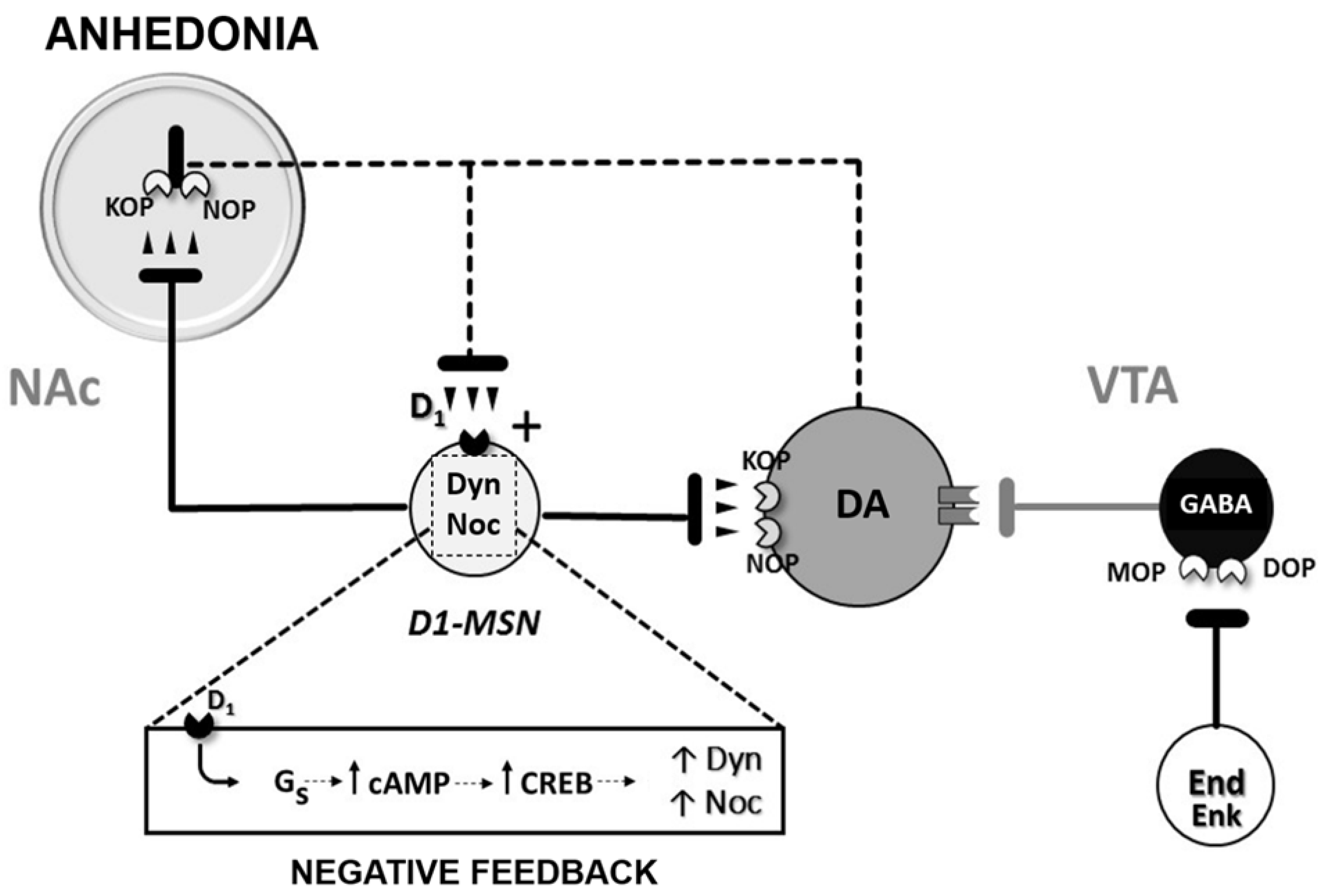

Table 1.
Selected clinical trials of kappa-opioid receptor antagonists.
| Study | Indication | Study Design | Number of Participants (N) | Groups and daily doses | Efficacy Results |
| Aticaprant Phase 2a FAST-MAS Proof-of-Mechanism Study [114] |
Anhedonia (MDD/anxiety disorders) | RCT, double-blind, 8 weeks | 89 | 10 mg | Aticaprant significantly increased fMRI ventral striatum activation during reward anticipation (primary outcome) compared with placebo. |
| Aticaprant Phase 2 [115] |
Major depressive disorder | RCT, double-blind, 6 weeks, placebo lead-in | 166 (fITT); 121 (eITT) |
10 mg (adjunctive to SSRI/SNRI) |
Improvement in MADRS total score for aticaprant was significant versus placebo (eITT: −2.1 [−1.09], 1-sided p = 0.044; effect size (ES) 0.23; fITT −3.1 [2.21], 1-sided p = 0.002; ES 0.36). The between-group difference was larger among participants with SHAPS score greater/equal to versus less than baseline median SHAPS. Responders: 36.4% (JNJ) vs 24.0% (PBO) fITT, p<0.05; QIDS: p=0.029; CGI-I: p=0.046 |
| Aticaprant Phase 3 VENTURA Program (2025) [J&J Press Release]6 |
MDD with moderate-to-severe anhedonia | RCT, double-blind, 42 days | Not disclosed | 10 mg (adjunctive to SSRI/SNRI) |
Insufficient efficacy; primary endpoint (change in MADRS) not achieved; Safety confirmed; secondary efficacy not disclosed |
| Navacaprant Phase 2a [117] |
MDD with anhedonia and anxiety | RCT, double-blind, 8 weeks | 204 | 80 mg | Primary endpoint (change in HAMD-17) not achieved; but was statistically significant in moderate-to-severe subgroup (n=100) at weeks 4 and 8 as well as SHAPS score at week 8 |
| Navacaprant Phase 3 KOASTAL-1 [Neumora Therapeutics press release]7 |
Moderate-to-severe MDD | RCT, double-blind, 6 weeks | 383 | 80 mg | Primary endpoint not achieved; change in SHAPS and MADRS was identical for both groups; change in SHAPS was statistically significant in favor of navacaprant in female subset of patients https://ir.neumoratx.com/news-releases/news-release-details/neumora-therapeutics-reports-data-koastal-1-study-navacaprant |
| ALKS-5461 Phase 2 [120] |
MDD with inadequate antidepressant response | RCT, double-blind, two-stage sequential parallel comparison design, 4 weeks | 142 | 2 mg/2 mg 8 mg/8 mg Placebo (adjunctive to antidepressant) |
Greater improvement over placebo was observed in the 2 mg /2 mg group across all three depression outcome measures (HAM-D; MADRS; CGI-S). There was also evidence of improvement in the 8 mg /8 mg dosage group, although it did not achieve statistical significance. HAM-D response rates: 60% (2 mg /2 mg dose) vs 20% (PBO); |
| ALKS-5461 Phase 3 FORWARD-3 [121] |
MDD with inadequate antidepressant response | Double-blind, placebo run-in, 10 weeks | 295 |
2 mg/2 mg Placebo (adjunctive to antidepressant) |
Change in MADRS-10 did not achieve statistical significance. Response rate 16.9% (ALKS-5461) vs 14.4% (placebo), non-significant; Remission 14.1% vs 12.3%, non-significant. |
| ALKS-5461 Phase 3 FORWARD-4 FORWARD-5 [122] |
MDD with inadequate antidepressant response | Two phase 3 RCT, double-blind, studies that utilized the same sequential parallel-comparison design, 2 stages, 11 weeks | Not formally reported | 2 mg/2 mg 1 mg/1 mg 0.5 mg/0.5 mg Placebo (adjunctive to antidepressant) |
FORWARD-5 achieved the primary endpoint (change from baseline through end of treatment (EOT) in MADRS-6 and -10) in 2 mg/2 mg group. FORWARD-4 did not achieve the primary endpoint (change from baseline in MADRS-10 at week 5 versus placebo, P = 0.109). The pooled analysis of the two studies demonstrated consistently greater reduction in MADRS-10 scores from baseline for 2 mg/2 mg group at multiple timepoints including primary endpoint. |
Table 2.
Clinical trials of nociceptin opioid receptor antagonist BTRX-246040 (LY2940094).
| Study | Indication | Study Design | Number of Participants (N) | Groups and daily doses | Efficacy Results |
| BTRX-246040 Phase 2 [134] |
Major Depressive Disorder | RCT, double-blind, 8 weeks | 136 | 40 mg | The primary endpoint (probability of BTRX-246040 being better than placebo⩾88% on the GRID-HAMD-17 depression scale) in the full analysis set was not met (the actual value was 82,9%), but was met in per protocol population (88,6%). When the analysis in the full analysis set was extended to include a follow-up visit (weeks 9-10), the probability of BTRX-246040 being better than placebo reached 97,4%. The probability of BTRX-246040 being better than placebo in improving the ability to recognize positive emotional expressions was 92.4% |
| BTRX-246040 Phase 2 [135] |
Alcohol dependence | RCT, double-blind, 8 weeks | 88 | 40 mg |
NDD did not differ versus placebo; HDD showed improvement versus placebo (-24.5 vs. -15.7%; 93% better than placebo); mean percentage of abstinent days was higher compared to placebo (9.1 vs. 1.9%; 91% better than placebo) |
| BTRX-246040 Phase 2 [91] |
Major Depressive Disorder | RCT, double-blind, 8 weeks | 102 | 40-80 mg | BTRX-246040 did not significantly separate from placebo on the primary MADRS or on secondary endpoints (DARS, SHAPS). EEfRT (t) parametr showed significant group×time interaction (b=0.84, p=0.015); was significantly increasing for the BRTX 246060 group (b = 0.88, p <0.001). |
Disclaimer/Publisher’s Note: The statements, opinions and data contained in all publications are solely those of the individual author(s) and contributor(s) and not of MDPI and/or the editor(s). MDPI and/or the editor(s) disclaim responsibility for any injury to people or property resulting from any ideas, methods, instructions or products referred to in the content. |
© 2026 by the authors. Licensee MDPI, Basel, Switzerland. This article is an open access article distributed under the terms and conditions of the Creative Commons Attribution (CC BY) license (http://creativecommons.org/licenses/by/4.0/).
Copyright: This open access article is published under a Creative Commons CC BY 4.0 license, which permit the free download, distribution, and reuse, provided that the author and preprint are cited in any reuse.


