

Submitted:
20 March 2026
Posted:
23 March 2026
You are already at the latest version
Abstract
Genetic variability is increasingly recognized as a key determinant of individual susceptibility to heavy metal-induced toxicity. Beyond exposure intensity and duration, inherited differences in genes regulating metal transport, detoxification, and DNA repair can substantially influence internal dose and biological response. To date, research has primarily focused on variants within these pathways, particularly single-nucleotide polymorphisms (SNPs), some of which have been proposed as potential susceptibility markers for toxic element (TE) toxicity.
Despite these advances, current findings remain inconsistent. Many studies are limited by small sample sizes, heterogeneous exposure assessment, and insufficient consideration of ethnic-specific allelic diversity and gene-environment interactions. Future research should prioritize large, well-characterized, and ethnically diverse populations, integrating detailed exposure profiling, lifestyle factors, and co-exposures to more accurately define the genetic architecture underlying susceptibility. Therefore, in this review, we summarize the principal toxic metals, synthesize epidemiological evidence linking exposure to adverse health outcomes, and explore the contribution of genetic variability in modulating individual risk of metal-induced disease.
Keywords:
toxic elements
; heavy metals
; gene-environment interaction
; single-nucleotide polymorphisms
; cardiovascular disease
; neurological disorders
; cancer risk
1. Introduction
Potentially toxic elements (PTEs) or simply toxic elements (TEs) are a group of substances which are attracting increasing interest in the scientific community for their spread as environmental pollutants and their impact on human health.
In several fields of literature, and especially in environmental sciences, they are commonly referred to as heavy metals or toxic heavy metals, but these terms are recommended to be avoided for the imprecision of their definition. In fact, TEs are a subgroup that may also have lower molecular density and mass and not necessarily be metals in the strict chemical sense (e.g. arsenic is a metalloid). Moreover, heavy metals can include elements that are essential for human physiology at trace levels [1]. Among TEs, arsenic (As), cadmium (Cd), chromium (especially hexavalent chromium, Cr(VI)), lead (Pb), and mercury (Hg) are the most consistently recognized as target toxic elements. Compared to other metals, these elements are particularly significant because they are highly toxic even at low concentrations, persist and bioaccumulate in the environment and living organisms, are widespread due to both natural and human activities, and are prioritized by international health and environmental agencies for monitoring and risk assessment. Generated by both natural and anthropogenic processes, these elements are widespread contaminants [2]. Their persistent nature promotes accumulation in environmental matrices and biomagnification along the food chain, leading to human dietary intake. In addition, inhalation of contaminated air represents a separate way of exposure, particularly in industrial areas and occupational settings [3].
Due to their widespread presence in air, water, soil, and food, toxic metals pose a significant public health concern. Unlike organic pollutants, toxic metals are non-biodegradable and cannot be broken down into less harmful substances. As a result, they accumulate overtime, creating long-term risks to human health. In this context, a growing body of epidemiological and toxicological evidence indicates that exposure to As, Cd, hexavalent chromium Cr(VI), Pb, and Hg is associated with a wide range of adverse health outcomes. These effects involve multiple organs and systems, including the nervous, renal, cardiovascular, immune, endocrine, and reproductive systems [4].
Given their pervasive nature and serious health risks, it is crucial to understand the factors that contribute to differences in susceptibility among individuals [5]. In fact, not all individuals exposed to similar levels of TEs develop the same health effects, reflecting substantial inter-individual variability.
A central mechanism underlying this phenomenon is gene-environment (G×E) interaction, whereby the effects of environmental exposures on disease risk are influenced by an individual’s genetic profile [6]. Among genetic determinants, single-nucleotide polymorphisms (SNPs) are the most common type of variation, present in a population with a frequency ≥ 1% [7]. They can be considered as internal contributing factors in susceptibility of individuals to TEs effects. In this regard, SNPs are considered relevant as they belong to essential pathways, such as TEs transport and detoxification, oxidative stress and DNA repair [8,9,10].
However, deeper investigations about mechanisms underlying genetic influence on response to toxic elements are needed and robust evidence about their potential role as disease predictors are required. Understanding the interplay between genetic factors and environmental exposures can be crucial for identifying individuals at higher risk of adverse health outcomes, improving risk assessment, and informing preventive or therapeutic strategies. Therefore, this review aims to describe the main toxic elements, examine epidemiological data of related health risks, and highlight the role of genetic variability in modulating susceptibility or providing partial protection against TE-related toxicity, based on the evidence available to date.
2. Sources of Toxic Elements and Routes of Exposure
Toxic elements are dispersed across ecosystems through a combination of natural and human-driven processes, contributing to their widespread presence in the atmosphere, hydrosphere, and lithosphere. They are constituents of Earth’s crust, and they are gradually released into air, water, and soils following some natural events, such as rock weathering, volcanic activity, and geochemical cycling. These pathways establish background concentrations that vary with local geology and environmental conditions. However, over the last century, a broad spectrum of human activities, ranging from waste management to agricultural and industrial practices, have been substantially intensifying TEs fluxes and expanding their distribution across environmental compartments [11,12].
In detail, As is naturally released into soils and waters through the oxidation and weathering of As-bearing minerals; moreover, As-rich fluids and gases, produced from geothermal systems and volcanic activity, mobilize the element into surrounding surface waters and groundwater. Additionally, As can be found as persistent contaminant in soils, sediments, and former industrial or agricultural sites, because of its past and extensive use in pesticides, animal feed additives, medicinal products, and wood preservatives. Currently, major anthropogenic sources include mining and smelting of metal ores (especially gold and sulfide deposits), coal combustion, and various industrial processes (e.g., glass, alloys, electronics), which release As into air, water, and waste streams [13].
Cd is naturally present as a trace component of zinc, lead, and copper ores and is released through the weathering of cadmium sulfide and volcanic emissions, contributing to its dispersion into soil, sedimentary deposits, and air. Anthropogenic Cd mainly comes from industrial processes (e.g., mining, smelting, and battery production, wastewater discharge). Additional inputs stem from agricultural use of fertilizers and some pesticides containing Cd impurities and from disposal or incineration of Cd-containing consumer products such as batteries, plastics, pigments, and paints [14].
Cr(VI) naturally origins from geochemical and microbially mediated oxidation of Cr(III)-containing minerals, especially in manganese oxide-rich or ultramafic soils [15]. Anthropogenic sources mainly include industrial operations such as mining, electroplating, leather tanning, and the production of pigments and dyes, along with inadequate management of industrial waste. These activities release Cr(VI) into the environment via effluents, solid residues, and air emissions, leading to contamination of soils, water bodies, and the atmosphere [16].
Natural Pb sources originate from mineral weathering, forest fires, and vegetation particles, with trace amounts naturally occurring in various igneous and sedimentary rocks. Human activities are responsible for an increase in Pb levels of more than 1000-fold over the last three centuries. This enrichment is primarily driven by industrial processes, such as mining, smelting, battery production, and the manufacturing of Pb-based paints, as well as combustion of fossil fuels, like coal and leaded gasoline, along with the use of lead-arsenate pesticides [17].
Natural Hg is released through geological and biological processes, including volcanic eruptions, the weathering of minerals, and emissions from oceans, soils, and burning biomass. Anthropogenic sources contribute about two-thirds of atmospheric mercury, substantially altering its natural cycle through industrial processes such as mining, cement production, and metal manufacturing, with coal and fossil fuel combustion as leading contributors [18].
In consequence to TEs sources and contaminated compartments, environmental and occupational exposures occur predominantly through ingestion and inhalation, with dermal contact and absorption generally representing a minor route.
Dietary intake though ingestion of contaminated food or drinking water accounts for a major way of exposure to: As, notably with rice and other crops grown in As-rich soils [19]; Cd, especially in vegetables, cereals and potato, but also some fishes [20]; Cr(VI), mainly through drinking water especially in areas impacted by industrial or geogenic contamination [21]; Pb, mostly contained in potatoes, carrots and vegetables [22] and drinking water from lead service lines or living in areas with environmental Pb contamination [23]; Hg, predominantly from consumption of fish and sea mammals [24].
Inhalation exposure represents the other major route of TEs intake, especially, but not exclusively, in occupational settings: high levels of As, Cd, and Pb were detected in foundry workers in correlation with their specific tasks [25]; mercury vapor exposure can occur during dental practices, as well as industrial processes [24]; whereas Cr(VI) inhalation mainly concerns occupational environments, such as chrome plating, welding, and surface treatment industries [26]. However, inhalation of TEs can worryingly occur in common social environments. Recent evidence indicates that airborne metals in households, educational settings, offices, commercial spaces, and public transport systems can lead to both non-carcinogenic risks and elevated lifetime carcinogenic risks for elements such as As, Cd, Cr, and Pb, with indoor exposure generally posing a greater threat than outdoor air, with a frequence exceeding international thresholds [27].
Moreover, another relevant contributor to TEs intake is represented by smoking: the combination of tobacco and rolling paper can substantially increase the exposure burden to several TEs, including As, Cd, Cr, Hg, and Pb [28]. Particularly, tobacco plant was discovered to be an efficient accumulator of Cr, As, and Pb in root tissues, while Cd is revealed in all parts of the plant, especially in the leaves for its more volatile nature [29]. The leaves were also identified as the part of Nicotiana tabacum where Hg accumulates the most [30]. Importantly, exposure to TEs, in particular Pb Cd, and As, via tobacco smoke does not affect only active smokers, but also poses significant risks to passive smokers, including household members exposed to secondhand and thirdhand smoke. This is particularly concerning for children, who are more susceptible to TEs accumulation in household dust and its subsequent ingestion or inhalation [31].
Dermal exposure to TEs is possible, but absorption is less frequent and significant than ingestion and inhalation routes. As, especially in its most toxic form, arsenite [32], can penetrate the skin [33]. Cd showed measurable skin bioaccessibility and cytotoxicity, especially in contaminated soils [34]. Polluted soils, along with leather products, represent sources of dermal exposure also to Cr(VI) [35]. Pb can also be absorbed through the skin, particularly in occupational settings, contributing to overall body burden despite its relatively lower dermal uptake [36]. Hg, especially inorganic forms, is absorbed through the skin, based on concentration, skin integrity, and vehicle, and can cause systemic toxicity, as seen in cases of mercury poisoning from skin-lightening cosmetics [37].
Environmental studies about sources and levels of TEs will keep growing, as a comprehensive evaluation is essential in predicting their potential health impacts.
3. Biomonitoring and Health Effects of Toxic Elements
Given their widespread distribution and persistence in the environment, human exposure to TEs is frequent, making the evaluation of their health effects increasingly relevant. In recognition of their potential impact on public health, several TEs - particularly As, Cd, Pb, and Hg- were included by the World Health Organization (WHO) among the top ten chemicals of major public health concern [38]. To assess human exposure to these elements, biomonitoring approaches are widely used, measuring TE concentrations in accessible biological matrices through spectrometric techniques and subsequently evaluating exposure-disease relationships through epidemiological studies. Blood and urine represent the most used matrices for TE biomonitoring, although other matrices, including saliva, hair, nails, teeth, and breast mill, may also provide useful information, each presenting specific advantages and limitations [39]. The choice of matrix often depends on the specific element and the timing or form of exposure. For instance, As exposure is commonly assessed through urinary measurements [40], while Pb levels are typically determined in whole blood [41]. Cr (VI) is preferentially measured in the erythrocytic fraction [42], while Cd can be detected in blood as an indicator of recent exposure or in urine to reflect chronic exposure [43]. Similarly, Hg can be measured in both blood and urine depending on the chemical species involved: urine is more suitable for inorganic Hg forms (including elemental mercury and mercury vapor), whereas blood is the preferred matrix for methylmercury, the organic form mainly derived from fish consumption [44].
A growing body of epidemiological evidence has correlated TE concentrations in the human body with adverse health outcomes affecting multiple physiological systems, particularly cardiovascular, neurological, and oncological diseases, which significantly impact global morbidity, mortality, and quality of life [4]. Chronic exposure to toxic TEs, including As, Cd, Pb, Hg, and Cr(VI), is increasingly recognized as an environmental contributor to major non-communicable diseases. In the cardiovascular system, exposure to several TEs has been associated with increased risk of cardiovascular diseases, particularly ischemic heart disease, the leading cause of mortality worldwide [45]. Meta-analyses indicate elevated risks associated with Pb, Cd, and As exposure, with more recent pooled analyses confirming increased cardiovascular disease risk also for Hg [46], while evidence for Cr(VI) remains limited and inconsistent [47]. Neurological disorders represent another major health concern linked to TE exposure. Alzheimer’s disease (AD), the most common cause of dementia accounting for approximately 60–70% of cases, has been associated with chronic exposure to several TEs [48]. Epidemiological studies have reported higher Cd levels in AD patients and evidence linking Cd exposure to cognitive decline [49], while Hg and Pb have also been associated with cognitive impairment and increased dementia risk [50]. In addition, cumulative Pb exposure has been linked to significantly higher incidence of AD [51], while altered As metabolism patterns, elevated blood Cr levels, and Cr(VI)-induced neurotoxicity have also been implicated in neurodegenerative processes [52,53,54]. Importantly, TE exposure is not limited to adult health effects: prenatal or early-life exposure to Pb, Hg, and As has been associated with impaired neurodevelopment, including deficits in cognitive and motor functions as well as behavioral disorders [55].
Beyond cardiovascular and neurological outcomes, several TEs exhibit well-established carcinogenic potential. According to the International Agency for Research on Cancer (IARC), As, Cd, and Cr(VI) are classified as Group 1 human carcinogens, inorganic Pb compounds as Group 2A, and methylmercury as Group 2B. Epidemiological studies consistently associate As exposure with increased risk of multiple malignancies, including lung, breast, liver, stomach, and hematological cancers [56]. Cd exposure has been linked to pancreatic [57], prostate [58], liver [59], renal [60], breast [47], and thyroid [61] cancers, while Pb exposure is associated with increased incidence and mortality of several cancers, particularly those of the gastrointestinal and urinary tracts [62]. Hg has also been implicated in thyroid cancer risk [63], and Cr(VI) exposure has been associated with modest but significant increases in overall cancer incidence and mortality, particularly for respiratory and gastrointestinal cancers [64]. Overall, these findings highlight TEs as significant environmental risk factors contributing to the onset and progression of several chronic diseases.
4. Gene-Environment Interaction: The Role of Single-Nucleotide Polymorphisms in Susceptibility to Toxic Element-Induced Effects
Multifactorial diseases, specifically cancer, CVD, and neurological disorders, are conditions resulting from the interaction of multiple factors. Among the primary determinants, genetic background and environmental exposures play a central role. In addition to acting independently, these factors interact to modulating phenotypic outcomes within the framework of G×E interaction, a dynamic relationship where the environment can modify the expression of genes, and genetic makeup determines sensitivity to environmental factors.
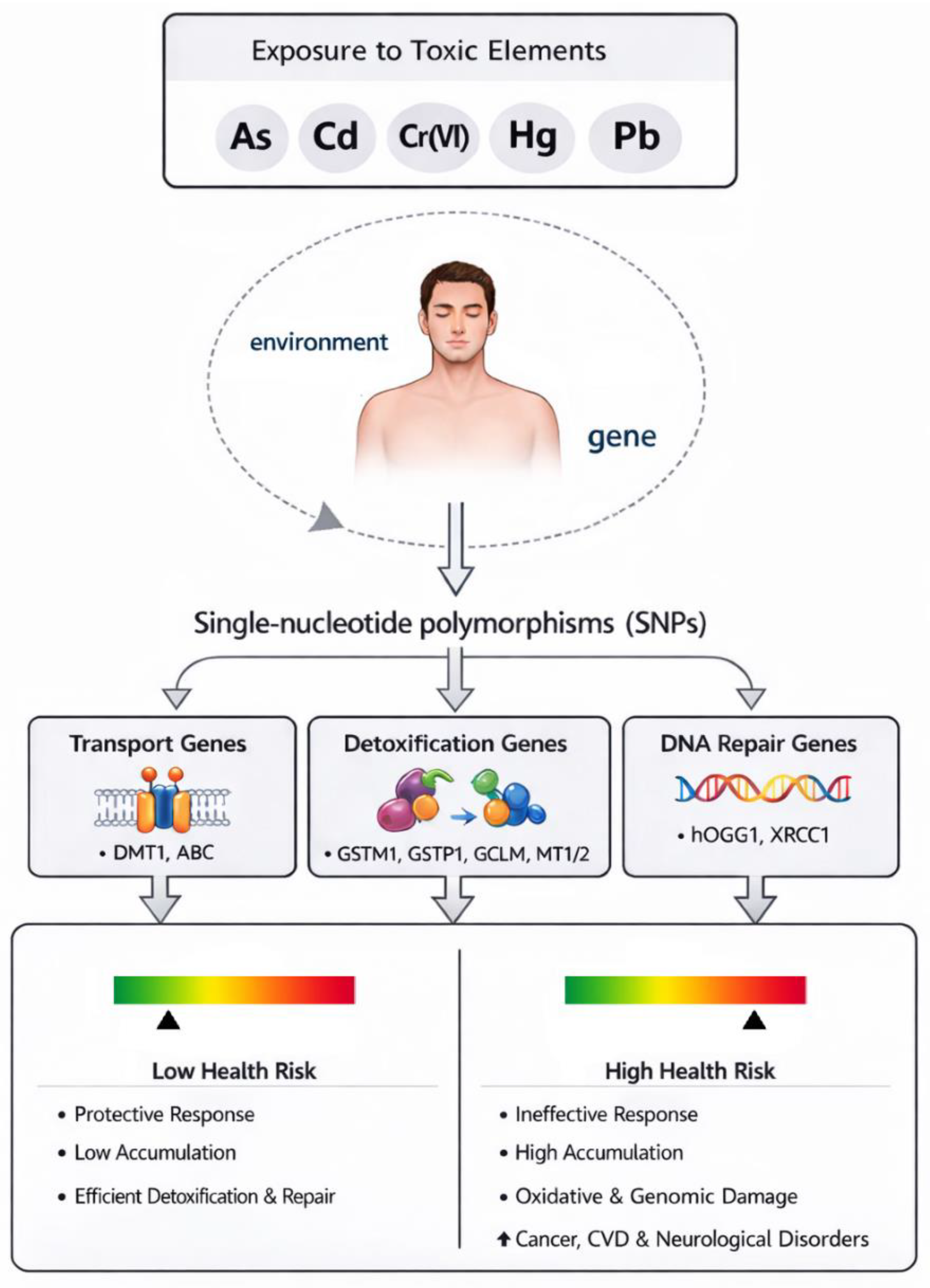
In this regard, variability within the genome, particularly in the form of SNPs, contributes to differences in individual responses to environmental exposures [65]. SNPs, by modulating susceptibility to TEs, can be functionally classified into key biological pathways, reflecting the multifaceted nature of their metabolism and toxicity: metal transport, detoxification, and DNA repair [8] (Figure 1). Best characterized SNPs are summarized in Table 1.
4.1. Transport
SNPs in genes encoding metal transporter proteins play an important role by directly influencing the uptake, distribution, and elimination of TEs.
Divalent Metal Transporter 1 (DMT1), encoded by SLC11A2 located on chromosome 12q13 in humans, is a transmembrane protein that allows the cellular entry of some divalent cations, including Cd, Pb, cobalt, manganese, nickel, zinc, and copper into the cells. DMT1 is also referred to as DCT1 (Divalent Cation Transporter 1), NRAMP2 (Natural Resistance Associated Macrophage Protein 2), and SLC11A2 (Solute Carrier Family 11, member 2). In a study conducted by Kim et al., the relationship between the DMT1 IVS4+44 C/A polymorphism and clinical parameters was investigated in 662 male Korean workers occupationally exposed to Pb. The findings suggested that this variant in the DMT1 gene may increase the risk of lead-associated hypertension in exposed individuals [66]. Moreover, from another study investigating the role of SLC11A2 (DMT1) polymorphism rs224589 and enrolling 113 workers occupationally exposed to Pb, it emerged that individuals carrying the heterozygous CA genotype (54%) for SLC11A2 showed higher blood Pb concentrations compared with both homozygous CC (wild-type) and AA (mutant) individuals. Furthermore, a significant inverse correlation was observed between blood Pb levels and hemoglobin exclusively in the CA subgroup, indicating a greater vulnerability to lead-related hematological alterations in correlation with this polymorphism [67].
Similarly, genetic variants of ATP-binding cassette transporters critically regulate the intracellular accumulation of TEs by mediating their transport outside from the cells. Polymorphisms in genes encoding for ABC transporter can influence Hg accumulation and perinatal outcomes. Offspring carrying the ABCC1 rs11075290 C-allele have significantly higher cord blood Hg levels and present increased odds of small-for-gestational-age. Similarly, carriers of ABCB1 rs2032582 GG genotype accumulate more mercury in cord blood and show a greater reduction in mental development index [68].
4.2. Detoxification
Substantial evidence is reported about the contribution in TEs toxicity exerted by SNPs of genes involved in detoxification processes, such as glutathione-related genes and metallothioneins, for their role in binding and metabolism of TEs.
4.2.1. Glutathione-Related Genes
Genes involved in the glutathione pathway are key mediators of detoxification processes, contributing to the conjugation and clearance of toxic compounds, while also counteracting oxidative stress. Genetic variants in these genes, including those encoding glutathione S-transferases (GSTM1, GSTT1, GSTP1) and the modifier (GCLM) and catalytic (GCLC) subunits of glutamate-cysteine ligase, can affect enzymatic function and glutathione biosynthesis, ultimately shaping interindividual susceptibility to TEs-induced toxicity. A study including a Chinese population of 850 subjects exposed to high levels of As in drinking water identified polymorphisms in glutathione-related genes GSTO1 (rs11191979, rs2164624, rs4925), GSTO2 (rs156697, rs2297235), and PNP (rs3790064) as associated with increased risk of As-induced skin lesions in individuals exposed to high-dose inorganic arsenic, for the impairment in body’s ability to methylate and detoxify arsenic efficiently consequently to the presence of these variants [69].
GSTP1 rs1695 polymorphism (AG + GG genotypes) is associated with increased urinary percentage of inorganic arsenic (%InAs) and decreased primary methylation index, indicating reduced efficiency of these individuals in methylating inorganic As to its less toxic metabolites and increased susceptibility to its toxicity [70]. Altered methylation and reduction steps in As metabolism was confirmed by a recent genome-wide association analysis that reported how genetic variation in the flavin-containing monooxygenase and GSTO gene clusters significantly impacts on blood and urinary levels of As metabolites [71].
Moreover, glutathione-related genes can play an important role in individual risk for arsenic-induced carotid atherosclerosis. GSTT1 polymorphism was correlated with high urinary As levels and higher carotid intima-media thickness (IMT), evaluated as marker of subclinical vascular damage in a cohort of Italian young adults exposed to environmental As [72].
Interestingly, polymorphisms can be also associated with protective effects. A meta-analysis including 9 articles and 3324 subjects found that GSTM1 null genotype (rs4025935) was significantly associated with a lower susceptibility to As poisoning [73].
The presence of SNPs of this pathway also contributes to the toxic effects observed in populations occupationally exposed to Cd. CAT rs7943316, GSTP1 rs1695, GSTM1 null genotype, and GSTT1 null genotype in workers were linked to differences in the phenotypic expression of antioxidant enzymes, suggesting that individuals carrying these genotypes may be more susceptible to oxidative damage from Cd exposure [74].
Genetic polymorphisms in glutathione (GSH)-related genes influence Hg levels. Notably, carriers of the GCLM rs41303970 TT genotype exhibited lower Hg concentrations in both blood and hair compared with C-allele carriers, suggesting more efficient mercury elimination or reduced retention. Conversely, individuals with the GSTM1 null genotype showed higher Hg, indicating greater accumulation of this TE [75].
GSTP1 rs1695 and CAT rs1001179 substantially increase the risk of lung cancer in the context of elevated Cr exposure [76]. Toxic effects due to Hg exposure could be revealed in the presence of GCLC rs1555903-C allele, as it correlates with lower estimated glomerular filtration rate in non-exposed individuals and lower beta-2-microglobulin in exposed individuals, both markers of impaired renal function. Similarly, the combined effect of GSTA1 rs3957356-C and GSS rs3761144-G alleles is associated with higher urinary Hg levels in exposed individuals, suggesting these variants may also contribute to increased metal retention and potentially greater toxicity. Conversely, GCLM rs41303970-T allele is associated with protection against toxicity, as this SNP is linked to higher urinary Hg clearance, indicating enhanced elimination of this TE [77].
A cross-sectional study with 236 adults reported that GCLC rs17883901 is linked to enhanced antioxidant response, with higher concentrations of GSH as a function of Pb levels and GCLM rs41303970 exerts a protective effect against Pb accumulation, as carriers of at least one polymorphic allele for this gene have significantly lower blood and plasma Pb levels compared to those with the non-polymorphic genotype [78].
Genotyping of the GSTM1, GSTT1, and GSTP1 genes was performed to investigate their potential association with heavy metal concentrations in 140 children exposed to Pb and Cd near an abandoned mining area in Kabwe, Zambia. The study found that the GSTT1 null genotype was positively correlated with both blood Pb and Cd levels, while the GSTP1 Ile/Val genotype (rs1695) was associated with a higher risk of Pb toxicity. This risk was even greater when these genetic variants co-occurred [79].
Furthermore, maternal polymorphisms in GSH-related genes can influence TEs levels, with consequences on perinatal and birth outcomes. Pregnant women with GSTM1-null and GSTT1-null, GCLM rs41303970 variants exhibit increased Hg accumulation and heightened oxidative stress, which were linked to an increased risk of preterm birth and reduced weight in offspring. Additionally, more frequence of children with lower mental development index occurs when mothers carry the rare G allele of GSTP1 rs1695. Moreover, increasing Hg exposure is associated with lower psychomotor development index among GCLC rs761142 TT carriers [68].
4.2.2. Metallothioneins
Metallothioneins (MTs) are cysteine-rich proteins that bind and sequester toxic elements, thereby reducing their bioavailability and protecting cells from metal-induced toxicity and oxidative stress [80]. Due to their abundant thiol groups, MTs bind biologically essential metals to help maintain metal homeostasis, as well as bind heavy metals to facilitate their transport and detoxification. Among all MT isoforms – including MT1, MT2, MT3, and MT4 – MT1A and the MT2A subtypes are the predominantly expressed isoforms in humans.
A study enrolling 321 women revealed that SNPs of metallothionein 1A and 1B, MT1A rs8044719 and MT1B rs1599823, and 2A, MT2A rs28366003 and MT2A rs10636, are associated with lower urinary Cd, indicating increased tissue retention and susceptibility to this TE [81]. In an analysis of 616 individuals, the MT2A gene polymorphism rs28366003 GG genotype was associated with significantly higher blood Cd and Pb levels compared to other genotypic subgroups [82], suggesting that individuals carrying the GG genotype may be more susceptible to metal toxicity and should take extra precautions to protect their health from the harmful effects of TEs.
MT1A gene polymorphisms rs11640851 and rs8052394 are associated with negative correlation between creatinine-adjusted urine uric acid concentrations and cumulative blood Pb exposure, indicating that these genotypes may increase susceptibility to Pb-induced renal tubular dysfunction as reflected by uric acid excretion [83].
Regarding susceptibility to Hg exposure, MT1M rs2270837 AA genotype and MT2A rs10636 CC genotype are associated with lower urinary Hg levels, while MT1A rs8052394 GA and GG genotypes and MT1M rs9936741 TT genotype are associated with lower hair Hg levels [84]. Influence on Hg levels by SNPs of metallothioneins was subsequently demonstrated by another study with 165 women, in which MT1M rs9936741 was confirmed to be associated with significantly lower hair total Hg levels, suggesting a protective effect against accumulation, while MT1M rs2270836 was linked with higher hair Hg levels, indicating increased susceptibility to retention of this TE [85].
Overall, further investigations are needed on these genetic polymorphisms to better understand their impact on TEs and TE-induced adverse effects.
4.3. DNA Repair: Focus on the Base Excision Repair Pathway
Polymorphisms in DNA repair genes, including hOGG1 and XRCC1, contribute to interindividual differences in disease susceptibility and cellular responses to DNA damage by altering the efficiency of the base excision repair pathway, which is involved in removing oxidative lesions and maintaining genomic stability.
The hOGG1 Ser326Cys variant is associated with reduced enzymatic activity and impaired removal of oxidative DNA lesions, particularly 8-oxoguanine, leading to increased DNA damage accumulation and genomic instability. This polymorphism is linked to elevated risk of cancer and other oxidative stress–related disorders, as well as altered sensitivity to chemotherapy and radiotherapy. Similarly, XRCC1 variants such as Arg399Gln and Arg194Trp influence BER efficiency by modifying protein interactions within the repair complex. The Arg399Gln polymorphism is associated with decreased repair capacity and greater cancer risk, particularly under exposure to genotoxic agents, whereas the role of Arg194Trp appears less defined, with some evidence suggesting a potential protective effect. Overall, these variants may modulate individual susceptibility to environmental toxins and ionizing radiation [86].
hOGG1 Ser326Cys (rs1052133) and XRCC1 Arg399Gln (rs25487) polymorphisms can influence susceptibility to TEs. Borghini et al. reported that these polymorphisms in DNA repair genes are associated with increased susceptibility to As exposure in a cohort of 241 Italian young adults. Carriers of the hOGG1 Cys allele and the XRCC1 Gln allele exhibited significantly shorter leukocyte telomere length in the context of higher urinary As levels, indicating enhanced genomic instability. These findings suggest that the combination of elevated As exposure and these DNA repair gene variants exacerbate telomeric DNA damage and may contribute to the development of arsenic-related health effects, highlighting a gene-environment interaction that increases individual vulnerability [87]. Moreover, hOGG1 rs1052133 and rs159153 polymorphisms interact with As exposure and methylation capacity to increase the risk of urothelial carcinoma [88].
hOGG1 rs1052133 and XRCC1 rs25487 are frequently associated with increased DNA damage in workers exposed to Cd, indicating reduced DNA repair capacity and greater susceptibility to genotoxic effects [9]. hOGG1 rs1052133, along with other polymorphisms in DNA repair genes, XPA rs1800975, and XPC rs2228000 are also associated with modulation of DNA instability biomarkers in workers occupationally exposed to Pb [89]. Moreover, individuals carrying XRCC1 Arg399Gln (rs25487) and hOGG1 Ser326Cys (rs1052133) polymorphisms exhibited increased DNA damage and oxidative stress when exposed to Hg [90].
Interestingly, the impact of XRCC1 polymorphism on the genotoxicity exerted by exposure to hexavalent chromium appears controversial. XRCC1 Arg399Gln (rs25487) homozygous variant genotype (Gln/Gln) is associated with increased chromosomal aberrations and greater susceptibility to chromosomal damage in workers exposed to this TE [91]. This result is in contrast with another study reporting that XRCC1 Arg399Gln (rs25487) variant is associated with reduced DNA damage in individuals occupationally exposed to Cr(VI), indicating a protective effect of this polymorphism against Cr(VI) toxicity [92]. This discrepancy likely reflects differences in the endpoints measured, population characteristics, or exposure levels. Other DNA repair polymorphisms, correlated with Cr effects, are XPD Lys751Gln (rs13181) and XPC Lys939Gln (rs2228000), that are associated with increased susceptibility to lung cancer in individuals exposed to this element [93]. Moreover, the interaction between chromate exposure and the XRCC3 rs2295152 T allele has a significant effect on micronuclei frequency, indicating a gene-environment interaction that increases susceptibility to chromate-induced genetic damage [94].

Table 1.
Best characterized single-nucleotide polymorphisms as promising markers of genetic susceptibility to TEs exposure. Circles in Effect column are green when SNPs are correlated with a protective action, red with increased toxic effects.
Table 1.
Best characterized single-nucleotide polymorphisms as promising markers of genetic susceptibility to TEs exposure. Circles in Effect column are green when SNPs are correlated with a protective action, red with increased toxic effects.
|
Toxic element |
Pathway | Reference | Gene | SNP | Effect | ||
| As | Detoxification | [69] | GSTO1 | rs11191979 | impairment in body’s ability to methylate and detoxify arsenic efficiently, ↑ risk of skin lesions |
||
| rs2164624 |  |
||||||
| rs4925 | |||||||
| GSTO2 | rs156697 | ||||||
| rs2297235 | |||||||
| PNP | rs3790064 | ||||||
| [70] | GSTP1 | rs1695 AG + GG genotypes |
↓ efficiency in methylating inorganic As, ↑ urinary percentage of inorganic arsenic, ↑ toxicity |
|
|||
| [72] | GSTT1 | + genotype | ↑ urinary As levels and ↑ carotid intima-media thickness | |
|||
| [73] | GSTM1 | rs4025935 null genotype |
↓ As poisoning |  |
|||
| DNA repair | [87] | hOGG1 | rs1052133 Ser326Cys |
↑ urinary As levels, ↓ leukocyte telomere length, ↑ genomic instability | |
||
| XRCC1 | rs25487 Arg399Gln |
||||||
| [88] | hOGG1 | rs1052133 | ↑ risk of urothelial carcinoma | |
|||
| rs159153 | |||||||
| Cd | Detoxification | [74] | CAT | rs7943316 | altered expression of antioxidant enzymes, ↑ oxidative damage | |
|
| GSTP1 | rs1695 | ||||||
| GSTM1 | null genotype | ||||||
| GSTT1 | null genotype | ||||||
| [79] | GSTT1 | null genotype | ↑ blood Cd levels | |
|||
| [81] | MT1A | rs8044719 | ↑ tissue Cd retention, ↓ urinary Cd | |
|||
| MT1B | rs1599823 | ||||||
| MT2A | rs28366003 | ||||||
| rs10636 | |||||||
| [82] | MT2A | rs28366003 GG genotype |
↑ blood Cd levels | |
|||
| DNA repair | [9] | hOGG1 | rs1052133 | ↓ DNA repair capacity, ↑ genotoxic effects | |
||
| XRCC1 | rs25487 | ||||||
| Cr(VI) | Detoxification | [76] | GSTP1 | rs1695 | ↑ risk of lung cancer | |
|
| CAT | rs1001179 | ||||||
| DNA repair | [91] | XRCC1 | rs25487 Arg399Gln |
↑ chromosomal aberrations and susceptibility to chromosomal damage |
|
||
| [92] | XRCC1 | rs25487 Arg399Gln |
↓ DNA damage | |
|||
| [93] | XPD | rs13181 Lys751Gln |
↑ susceptibility to lung cancer | |
|||
| XPC | rs2228000 Lys939Gln |
||||||
| [94] | XRCC3 | rs2295152 T allele |
↑ micronuclei frequency and genetic damage | |
|||
| Hg | Transport | [68] | ABCC1 | rs11075290 C-allele |
↑ cord blood Hg levels and ↑ odds of small-for-gestational-age |
|
|
| ABCB1 | rs2032582 GG genotype |
↑ cord blood Hg levels and ↓ mental development index |
|
||||
| Detoxification | [75] | GCLM | rs41303970 TT genotype |
↓ Hg concentrations in blood and hair, ↑ efficient mercury elimination |
|
||
| GSTM1 | null genotype | ↑ Hg accumulation | |
||||
| [77] | GCLC | rs1555903 C allele |
↓ estimated glomerular filtration rate (eGFR) in non-exposed individuals and ↓ beta-2- microglobulin in exposed individuals, impairment of renal function |
|
|||
| GSTA1 + GSS |
rs3957356 C allele + rs3761144 G allele |
↑ Hg retention | |
||||
| GCLM | rs41303970 T allele | ↑ urinary Hg clearance, ↑ elimination | |
||||
| [68] | GSTM1 | null genotype | ↑ Hg accumulation, ↑ oxidative stress, ↑ risk of preterm birth and ↓ weight in offspring | |
|||
| GSTT1 | null genotype | ||||||
| GCLM | rs41303970 | ||||||
| GSTP1 | rs1695 G allele |
↓ mental development index in offspring | |
||||
| GCLC | rs761142 TT genotype |
↓ psychomotor development index | |
||||
| [84] | MT1M | rs2270837 AA genotype |
↓ urinary Hg levels, ↑ Hg retention | |
|||
| MT2A | rs10636 CC genotype |
||||||
| MT1A | rs8052394 GA and GG genotypes |
↓ hair Hg levels | |
||||
| MT1M | rs9936741 TT genotype |
||||||
| [85] | MT1M | rs2270836 | ↑ hair Hg levels | |
|||
| rs9936741 | ↓ hair Hg levels | |
|||||
| DNA repair | [90] | XRCC1 | rs25487 Arg399Gln |
↑ DNA damage and oxidative stress | |
||
| hOGG1 | rs1052133 Ser326Cys |
||||||
| Pb | Transport | [66] | SLC11A2 | IVS4+44 C/A | ↑ risk of hypertension | |
|
| [67] | SLC11A2 | rs224589 CA genotype |
↑ blood Pb concentration and ↑ hematological alterations |
|
|||
| Detoxification | [78] | GCLC | rs17883901 | ↑ antioxidant response | |
||
| GCLM | rs41303970 | ↓ blood and plasma Pb levels |
|
||||
| [79] | GSTT1 | null genotype | ↑ blood Pb levels | |
|||
| GSTP1 | rs1695 Ile/Val genotype |
↑ risk of Pb toxicity | |
||||
| [82] | MT2A | rs28366003 GG genotype |
↑ blood Pb levels | |
|||
| [83] | MT1A | rs11640851 | ↓ uric acid elimination, ↑ renal dysfunction | |
|||
| rs8052394 | |||||||
| DNA repair | [89] | hOGG1 | rs1052133 | ↑ DNA instability and genotoxicity biomarkers | |
||
| XPA | rs1800975 | ||||||
| XPC | rs2228000 | ||||||
Abbreviations: ↓: decrease of; ↑: increase of; As: arsenic; Cd: cadmium; Cr(VI): hexavalent chromium; Hg: mercury; Pb: lead; SNPs: single-nucleotide polymorphisms; DNA: deoxyribonucleic acid;.
5. Conclusions and Future Perspectives
TEs are bioaccumulative and exert a wide range of adverse effects in the human body, including cancer, neurological, and cardiovascular disorders. Their accumulation is influenced not only by the level of environmental exposure but also by biological processes governing absorption, distribution, metabolism, and elimination, which vary between individuals and strongly affect internal metal burden and toxicity outcomes. Investigating genetic variants and their interactions with environmental factors provides crucial insight into individual susceptibility to toxic element-induced health risks. It is now well established that genetic background represents a central component of the complex network of determinants defining sensitivity to metals, while additional internal and external factors – such as lifestyle, nutritional status, and co-exposures – also modulate responses. The interplay between interindividual genetic differences and environmental influences contributes to unique phenotypes and distinct responses to toxic exposures.
Identifying variations in genes involved in toxic element metabolism is therefore essential, as such knowledge enhances understanding of individual susceptibility, identifies high-risk populations, and supports the development of targeted preventive and therapeutic strategies. Among the candidate genes extensively studied are those involved in transport, detoxification, and DNA repair, including DMT1, GSTP1, MT2A, hOGG1, and XRCC1. Various studies have explored the impact of SNPs within these genes, and some variants have been proposed as potential susceptibility markers for toxic element toxicity. However, findings remain inconsistent due to limitations such as small sample sizes, insufficient allelic diversity among populations, and differences in exposure assessment.
To overcome these gaps, future research should adopt multicentric study designs encompassing larger and more diverse populations with varying exposure levels (high, moderate, and low). Harmonization of measurement techniques, integration of epidemiological data with computational exposure models, and the use of artificial intelligence for data analysis can enhance reliability and predictive power. Additionally, combining multi-omics approaches – such as genomics, epigenomics, and exposomics –allows for a comprehensive characterization of the exposome, capturing both internal biological responses and external environmental exposures that collectively shape individual risk profiles.
Recent advances in induced pluripotent stem cell (iPSC) technology offer a complementary strategy for investigating the health effects of toxic metals. By reprogramming accessible cells (e.g., blood cells) into iPSCs and differentiating them into tissue-specific cell types, researchers can model human biology with high precision. These human-derived systems enable direct investigation of gene-environment interactions, identification of genetic variants influencing susceptibility, and detection of early cellular and molecular changes prior to clinical disease onset. This approach supports earlier prevention strategies, facilitates the discovery of novel biomarkers and therapeutic targets, and advances predictive, and precision medicine tailored to individual risk profiles [95,96].
Incorporating these integrative strategies, such as multicentric studies, advanced cellular models, AI-driven data integration, and multi-omics analyses, can significantly reduce existing gaps in our understanding of toxic element exposure and toxicity, ultimately improving risk assessment, prevention, and intervention strategies at both the individual and population levels.
| AD | Alzheimer’s disease |
| As | Arsenic |
| Cd | Cadmium |
| Cr | Chromium |
| Hg | Mercury |
| IARC | International Agency for Research and Cancer |
| MTs | Metallothioneins |
| Pb | Lead |
| PTEs | Potentially toxic elements |
| PVC | Polyvinyl Chloride |
| SNPs | Single-nucleotide polymorphisms |
| TEs | Toxic elements |
| WHO | World Health Organization |
Author Contributions
Conceptualization, A.B., and F.M.; writing—original draft preparation, M.P. and A.B.; writing—review and editing E.B., S.B., F.G., and F.M.. All authors have read and agreed to the published version of the manuscript.
Funding
This research was funded by the Ministry of Health as part of the National Plan for Complementary Investments - “Health, Environments, Biodiversity, and Climate”, project name PNC INSINERGIA, project code (National Research Council) PRR.AP015.165.
Acknowledgments
We acknowledge the use of AI assistance, specifically ChatGPT (version 5.0), in the revision of certain parts of this paper to enhance language quality, clarity, and conciseness.
Conflicts of Interest
The authors declare no conflicts of interest.
Abbreviations
The following abbreviations are used in this manuscript:
References
- Pourret, O.; Hursthouse, A. It’s Time to Replace the Term “Heavy Metals” with “Potentially Toxic Elements” When Reporting Environmental Research. Int. J. Environ. Res. Public Health 2019, 16, 4446. [Google Scholar] [CrossRef]
- Angon, P.B.; Islam, M.S.; Kc, S.; Das, A.; Anjum, N.; Poudel, A.; Suchi, S.A. Sources, Effects and Present Perspectives of Heavy Metals Contamination: Soil, Plants and Human Food Chain. Heliyon 2024, 10, e28357. [Google Scholar] [CrossRef] [PubMed]
- Järup, L. Hazards of Heavy Metal Contamination. Br. Med. Bull. 2003, 68, 167–182. [Google Scholar] [CrossRef] [PubMed]
- Cheng, Y.F.; Zhao, Y.J.; Chen, C.; Zhang, F. Heavy Metals Toxicity: Mechanism, Health Effects, and Therapeutic Interventions. MedComm 2025, 6, e70241. [Google Scholar] [CrossRef]
- Zeise, L.; Bois, F.Y.; Chiu, W.A.; Hattis, D.; Rusyn, I.; Guyton, K.Z. Addressing Human Variability in Next-Generation Human Health Risk Assessments of Environmental Chemicals. Environ. Health Perspect. 2013, 121, 23–31. [Google Scholar] [CrossRef]
- Ottman, R. Gene-Environment Interaction: Definitions and Study Designs. Prev. Med. 1996, 25, 764–770. [Google Scholar] [CrossRef]
- Azizzadeh-Roodpish, S.; Garzon, M.H.; Mainali, S. Classifying Single Nucleotide Polymorphisms in Humans. Mol. Genet. Genomics 2021, 296, 1161–1173. [Google Scholar] [CrossRef]
- Joneidi, Z.; Mortazavi, Y.; Memari, F.; Roointan, A.; Chahardouli, B.; Rostami, S. The Impact of Genetic Variation on Metabolism of Heavy Metals: Genetic Predisposition? Biomed. Pharmacother. 2019, 113, 108642. [Google Scholar] [CrossRef]
- Pinto, T.G.; Dias, T.A.; Renno, A.C.M.; Dos Santos, J.N.; Cury, P.R.; Ribeiro, D.A. The Impact of Genetic Polymorphisms for Detecting Genotoxicity in Workers Occupationally Exposed to Metals: A Systematic Review. J. Appl. Toxicol. 2025, 45, 1070–1079. [Google Scholar] [CrossRef]
- Kumar, P. Genetic susceptibility to heavy metal toxicity. In Heavy Metal Toxicity and Neurodegeneration; Kumar, P., Gogia, N., Eds.; Elsevier: Amsterdam, The Netherlands, 2025; pp. 179–201. [Google Scholar]
- He, Z.L.; Yang, X.E.; Stoffella, P.J. Trace Elements in Agroecosystems and Impacts on the Environment. J. Trace Elem. Med. Biol. 2005, 19, 125–140. [Google Scholar] [CrossRef] [PubMed]
- Briffa, J.; Sinagra, E.; Blundell, R. Heavy Metal Pollution in the Environment and Their Toxicological Effects on Humans. Heliyon 2020, 6, e04691. [Google Scholar] [CrossRef]
- Garelick, H.; Jones, H.; Dybowska, A.; Valsami-Jones, E. Arsenic Pollution Sources. Rev. Environ. Contam. Toxicol. 2008, 197, 17–60. [Google Scholar] [CrossRef]
- Sattar, S.; Yahya, M.; Aslam, S.; Hussain, R.; Mukkarram Shah, S.M.; Rauf, Z.; Zamir, A.; Ullah, R.; Shahzad, A. Environmental Occurrence, Hazards, and Remediation Strategies for the Removal of Cadmium from the Polluted Environment. Results Eng. 2025, 25, 104322. [Google Scholar] [CrossRef]
- Ao, M.; Sun, S.; Deng, T.; Zhang, F.; Liu, T.; Tang, Y.; Li, J.; Wang, S.; Qiu, R. Natural Source of Cr(VI) in Soil: The Anoxic Oxidation of Cr(III) by Mn Oxides. J. Hazard. Mater. 2022, 433, 128805. [Google Scholar] [CrossRef]
- Ukhurebor, K.E.; Aigbe, U.O.; Onyancha, R.B.; Nwankwo, W.; Osibote, O.A.; Paumo, H.K.; Ama, O.M.; Adetunji, C.O.; Siloko, I.U. Effect of Hexavalent Chromium on the Environment and Removal Techniques: A Review. J. Environ. Manag. 2021, 280, 111809. [Google Scholar] [CrossRef]
- Cheema, A.I.; Liu, G.; Yousaf, B.; Abbas, Q.; Zhou, H. A Comprehensive Review of Biogeochemical Distribution and Fractionation of Lead Isotopes for Source Tracing in Distinct Interactive Environmental Compartments. Sci. Total Environ. 2020, 719, 135658. [Google Scholar] [CrossRef]
- Kim, M.K.; Zoh, K.D. Fate and Transport of Mercury in Environmental Media and Human Exposure. J. Prev. Med. Public Health 2012, 45, 335–343. [Google Scholar] [CrossRef]
- Baker, B.A.; Cassano, V.A.; Murray, C. ACOEM Task Force on Arsenic Exposure. Arsenic Exposure, Assessment, Toxicity, Diagnosis, and Management: Guidance for Occupational and Environmental Physicians. J. Occup. Environ. Med. 2018, 60, e634–e639. [Google Scholar] [CrossRef] [PubMed]
- Zhang, H.; Reynolds, M. Cadmium Exposure in Living Organisms: A Short Review. Sci. Total Environ. 2019, 678, 761–767. [Google Scholar] [CrossRef]
- Tumolo, M.; Ancona, V.; De Paola, D.; Losacco, D.; Campanale, C.; Massarelli, C.; Uricchio, V.F. Chromium Pollution in European Water, Sources, Health Risk, and Remediation Strategies: An Overview. Int. J. Environ. Res. Public Health 2020, 17, 5438. [Google Scholar] [CrossRef] [PubMed]
- Nag, R.; Cummins, E. Human Health Risk Assessment of Lead (Pb) through the Environmental-Food Pathway. Sci. Total Environ. 2022, 810, 151168. [Google Scholar] [CrossRef]
- Lanphear, B.; Navas-Acien, A.; Bellinger, D.C. Lead Poisoning. N. Engl. J. Med. 2024, 391, 1621–1631. [Google Scholar] [CrossRef]
- Clarkson, T.W.; Magos, L.; Myers, G.J. The Toxicology of Mercury—Current Exposures and Clinical Manifestations. N. Engl. J. Med. 2003, 349, 1731–1737. [Google Scholar] [CrossRef] [PubMed]
- Freire, B.M.; Gonzaga, R.G.; Pedron, T.; Monteiro, L.R.; Lange, C.N.; Pedreira Filho, W.D.R.; Batista, B.L. Occupational Exposure to Potentially Toxic Elements in the Foundry Industry: An Integrated Environmental and Biological Monitoring. Environ. Sci. Pollut. Res. Int. 2021, 28, 34630–34641. [Google Scholar] [CrossRef]
- Viegas, S.; Martins, C.; Bocca, B.; Bousoumah, R.; Duca, R.C.; Galea, K.S.; Godderis, L.; Iavicoli, I.; Janasik, B.; Jones, K.; Leese, E.; Leso, V.; Ndaw, S.; van Nieuwenhuyse, A.; Poels, K.; Porras, S.P.; Ruggieri, F.; Silva, M.J.; Verdonck, J.; Wasowicz, W. HBM4EU Chromates Study Team. HBM4EU Chromates Study: Determinants of Exposure to Hexavalent Chromium in Plating, Welding and Other Occupational Settings. Int. J. Environ. Res. Public Health 2022, 19, 3683. [Google Scholar] [CrossRef] [PubMed]
- Khoshakhlagh, A.H.; Ghobakhloo, S.; Peijnenburg, W.J.G.M.; Gruszecka-Kosowska, A.; Cicchella, D. To Breathe or Not to Breathe: Inhalational Exposure to Heavy Metals and Related Health Risk. Sci. Total Environ. 2024, 932, 172556. [Google Scholar] [CrossRef]
- Zumbado, M.; Luzardo, O.P.; Rodríguez-Hernández, Á.; Boada, L.D.; Henríquez-Hernández, L.A. Differential Exposure to 33 Toxic Elements through Cigarette Smoking, Based on the Type of Tobacco and Rolling Paper Used. Environ. Res. 2019, 169, 368–376. [Google Scholar] [CrossRef]
- da Silva, C.P.; de Almeida, T.E.; Zittel, R.; de Oliveira Stremel, T.R.; Domingues, C.E.; Kordiak, J.; de Campos, S.X. Translocation of Metal Ions from Soil to Tobacco Roots and Their Concentration in the Plant Parts. Environ. Monit. Assess. 2016, 188, 663. [Google Scholar] [CrossRef] [PubMed]
- Uwiringiyimana, E.; Gao, J.; Zhang, D.; Biswash, M.R.; Shi, Y.X. Bioaccumulation and Translocation of Hg and Cr by Tobacco in Sichuan Province, China: Understanding the Influence of Soil pH. Environ. Monit. Assess. 2023, 195, 1193. [Google Scholar] [CrossRef]
- Lopez-Galvez, N.; Mahabee-Gittens, E.M.; Quintana, P.J.E.; Merianos, A.L.; Dodder, N.G.; Hoh, E.; Stone, L.; Watanabe, K.; Matt, G.E. Environmental Tobacco Smoke Is a Major Contributor to Lead, Cadmium, and Arsenic in Settled House Dust. Chemosphere 2026, 394, 144820. [Google Scholar] [CrossRef]
- Patel, K.S.; Pandey, P.K.; Martín-Ramos, P.; Corns, W.T.; Varol, S.; Bhattacharya, P.; Zhu, Y. A Review on Arsenic in the Environment: Contamination, Mobility, Sources, and Exposure. RSC Adv. 2023, 13, 8803–8821. [Google Scholar] [CrossRef]
- Ouypornkochagorn, S.; Feldmann, J. Dermal Uptake of Arsenic through Human Skin Depends Strongly on Its Speciation. Environ. Sci. Technol. 2010, 44, 3972–3978. [Google Scholar] [CrossRef] [PubMed]
- Wang, J.; Gao, P.; Li, M.Y.; Ma, J.Y.; Li, J.Y.; Yang, D.L.; Cui, D.L.; Xiang, P. Dermal Bioaccessibility and Cytotoxicity of Heavy Metals in Urban Soils from a Typical Plateau City: Implication for Human Health. Sci. Total Environ. 2022, 835, 155544. [Google Scholar] [CrossRef]
- Liu, C.; Liu, C.; Juhasz, A.L.; Dong, W.J.; Ma, L.Q. Human Health Risks of Chromium in Bright-Colored Leather Products: Speciation-Based Insights into Dermal Permeation. Environ. Int. 2025, 200, 109538. [Google Scholar] [CrossRef]
- Niemeier, R.T.; Maier, A.; Reichard, J.F. Rapid Review of Dermal Penetration and Absorption of Inorganic Lead Compounds for Occupational Risk Assessment. Ann. Work Expo. Health 2022, 66, 291–311. [Google Scholar] [CrossRef]
- Chan, T.Y. Inorganic Mercury Poisoning Associated with Skin-Lightening Cosmetic Products. Clin. Toxicol. 2011, 49, 886–891. [Google Scholar] [CrossRef]
- World Health Organization (WHO). 10 Chemicals of Public Health Concern. Available online: https://www.who.int/news-room/photo-story/detail/10-chemicals-of-public-health-concern (accessed on 19 February 2026).
- Gil, F.; Hernández, A.F. Toxicological Importance of Human Biomonitoring of Metallic and Metalloid Elements in Different Biological Samples. Food Chem. Toxicol. 2015, 80, 287–297. [Google Scholar] [CrossRef] [PubMed]
- Buekers, J.; Baken, K.; Govarts, E.; Martin, L.R.; Vogel, N.; Kolossa-Gehring, M.; Šlejkovec, Z.; Falnoga, I.; Horvat, M.; Lignell, S.; Lindroos, A.K.; Rambaud, L.; Riou, M.; Pedraza-Diaz, S.; Esteban-Lopez, M.; Castaño, A.; Den Hond, E.; Baeyens, W.; Santonen, T.; Schoeters, G. Human Urinary Arsenic Species, Associated Exposure Determinants and Potential Health Risks Assessed in the HBM4EU Aligned Studies. Int. J. Hyg. Environ. Health 2023, 248, 114115. [Google Scholar] [CrossRef] [PubMed]
- Barbosa, F., Jr.; Tanus-Santos, J.E.; Gerlach, R.F.; Parsons, P.J. A Critical Review of Biomarkers Used for Monitoring Human Exposure to Lead: Advantages, Limitations, and Future Needs. Environ. Health Perspect. 2005, 113, 1669–1674. [Google Scholar] [CrossRef]
- Ndaw, S.; Leso, V.; Bousoumah, R.; Rémy, A.; Bocca, B.; Duca, R.C.; Godderis, L.; Hardy, E.; Janasik, B.; van Nieuwenhuyse, A.; Pinhal, H.; Poels, K.; Porras, S.P.; Ruggieri, F.; Santonen, T.; Santos, S.R.; Scheepers, P.T.J.; Silva, M.J.; Verdonck, J.; Viegas, S. HBM4EU Chromates Study Team. HBM4EU Chromates Study—Usefulness of Measurement of Blood Chromium Levels in the Assessment of Occupational Cr(VI) Exposure. Environ. Res. 2022, 214, 113758. [Google Scholar] [CrossRef]
- Adams, S.V.; Newcomb, P.A. Cadmium Blood and Urine Concentrations as Measures of Exposure: NHANES 1999–2010. J. Expo. Sci. Environ. Epidemiol. 2014, 24, 163–170. [Google Scholar] [CrossRef]
- So, S.C.A.; Tsoi, M.F.; Cheung, A.J.; Cheung, T.T.; Cheung, B.M.Y. Blood and Urine Inorganic and Organic Mercury Levels in the United States from 1999 to 2016. Am. J. Med. 2021, 134, e20–e30. [Google Scholar] [CrossRef]
- Lamas, G.A.; Bhatnagar, A.; Jones, M.R.; Mann, K.K.; Nasir, K.; Tellez-Plaza, M.; Ujueta, F.; Navas-Acien, A. American Heart Association Council on Epidemiology and Prevention; Council on Cardiovascular and Stroke Nursing; Council on Lifestyle and Cardiometabolic Health; Council on Peripheral Vascular Disease; Council on the Kidney in Cardiovascular Disease. Contaminant Metals as Cardiovascular Risk Factors: A Scientific Statement from the American Heart Association. J. Am. Heart Assoc. 2023, 12, e029852. [Google Scholar] [CrossRef]
- Cheema, S.; Hussain, S.I.; Faheem, M.S.B.; Jalal, A.A.; Rifai, M.; Dar, A.; Burhan, M.; Shahid, A.; Ali, M.S.; Anwar, A.; Khalid, M.; Samadi, S. Toxic Heavy Metal Exposure and Heart Health: A Systematic Review and Meta-Analysis of 324,331 Patients. BMC Cardiovasc. Disord. 2025, 25, 792. [Google Scholar] [CrossRef] [PubMed]
- Liu, X.; Zhang, D.; Wu, X.; Tu, J.; Gong, C.; Li, Y.; Cui, W.; Chen, J.; Lu, S. Urinary metals as influencing factors of coronary heart disease among a population in Guangzhou, China. Ecotoxicol. Environ. Saf. 2022, 241, 113746. [Google Scholar] [CrossRef]
- Bashir, B.; Jarial, S.; Sood, S.; Vishwas, S. Heavy Metals and Alzheimer’s Disease: A Review. In Heavy Metal Toxicity and Neurodegeneration; Kumar, P., Gogia, N., Eds.; Academic Press, 2025; pp. 225–230. [Google Scholar] [CrossRef]
- Kooshki, A.; Farmani, R.; Mehrpour, O.; Naghizadeh, A.; Amirabadizadeh, A.; Kavoosi, S.; Vohra, V.; Nakhaee, S. Alzheimer’s Disease and Circulatory Imbalance of Toxic Heavy Metals: A Systematic Review and Meta-Analysis of Clinical Studies. Biol. Trace Elem. Res. 2025, 203, 1871–1885. [Google Scholar] [CrossRef] [PubMed]
- Song, Y.; Chen, Y.; Fu, Z.; Wen, Y.; Zhao, W.; Li, J.; Wang, H.; Du, Y.; Deng, Y. Heavy Metal Exposure and Cognitive Impairment: An Umbrella Review of Meta-Analyses. J. Hazard. Mater. 2025, 498, 139881. [Google Scholar] [CrossRef]
- Wang, X.; Bakulski, K.M.; Walker, E.; Mukherjee, B.; Dodge, H.; Albin, R.L.; Paulson, H.L.; Park, S.K. Exposure to Lead and Incidence of Alzheimer’s Disease and All-Cause Dementia in the United States. Alzheimers Dement. 2026, 22, e71075. [Google Scholar] [CrossRef]
- Yang, Y.W.; Liou, S.H.; Hsueh, Y.M.; Lyu, W.S.; Liu, C.S.; Liu, H.J.; Chung, M.C.; Hung, P.H.; Chung, C.J. Risk of Alzheimer’s Disease with Metal Concentrations in Whole Blood and Urine: A Case-Control Study Using Propensity Score Matching. Toxicol. Appl. Pharmacol. 2018, 356, 8–14. [Google Scholar] [CrossRef] [PubMed]
- Strumylaite, L.; Kregzdyte, R.; Kucikiene, O.; Baranauskiene, D.; Simakauskiene, V.; Naginiene, R.; Damuleviciene, G.; Lesauskaite, V.; Zemaitiene, R. Alzheimer’s Disease Association with Metals and Metalloids Concentration in Blood and Urine. Int. J. Environ. Res. Public Health 2022, 19, 7309. [Google Scholar] [CrossRef]
- Wise, J.P., Jr.; Young, J.L.; Cai, J.; Cai, L. Current Understanding of Hexavalent Chromium [Cr(VI)] Neurotoxicity and New Perspectives. Environ. Int. 2022, 158, 106877. [Google Scholar] [CrossRef]
- da Silva, A.S.; Santos, R.M.S.; De Marco, P.G.; Rezende, V.H.M.; Martins, T.C.; Silva, J.R.; Romano-Silva, M.A.; Miranda, D.M. Neurodevelopmental Outcomes Associated with Early-Life Exposure to Heavy Metals: A Systematic Review. Int. J. Environ. Res. Public Health 2025, 22, 1308. [Google Scholar] [CrossRef]
- Rahmani, A.; Khamutian, S.; Doosti-Irani, A.; Shokoohizadeh, M.J.; Shirmohammadi-Khorram, N.; Sahraeei, F.; Khodabakhshi, M.; Ahangaran, N. The Association of Arsenic Exposure with Mortality Due to Cancer, Diabetes, Alzheimer’s and Congenital Anomalies Using Poisson Regression. Sci. Rep. 2023, 13, 15456. [Google Scholar] [CrossRef]
- Lee, F.J.; Inchai, H.; Lin, J.T.; Koh, D.; Lin, R.T. Dose-Response Relationship of Cadmium and Pancreatic Cancer Risk: A Meta-Analysis. Occup. Environ. Med. 2025, 82, 407–414. [Google Scholar] [CrossRef] [PubMed]
- Firmani, G.; Chiavarini, M.; Dolcini, J.; Quarta, S.; D’Errico, M.M.; Barbadoro, P. The Association Between Cadmium Exposure and Prostate Cancer: An Updated Systematic Review and Meta-Analysis. Int. J. Environ. Res. Public Health 2024, 21, 1532. [Google Scholar] [CrossRef] [PubMed]
- Zhang, L.; Wang, Y.; Li, T.; Zhuo, W.; Zhu, Y. Elevated Serum and Hair Levels of Cadmium as a Risk Factor for Liver Carcinoma: A Meta-Analysis. Nutr. Cancer 2023, 75, 1438–1447. [Google Scholar] [CrossRef]
- Lee, H.; Jo, Y.; Jung, M.; Lee, J.H.; Kim, T.H.; Lee, J.; Kim, D.J.; Rahmati, M.; Smith, L.; Pizzol, D.; Son, Y.; Park, J.; Ahn, S.H.; Yon, D.K.; Choi, D.W.; Kang, J. Heavy Metal Exposure and All Health Outcomes: An Umbrella Review of Meta-Analyses. J. Hazard. Mater. 2026, 503, 141141. [Google Scholar] [CrossRef]
- Abdelgawwad El-Sehrawy, A.A.M.; Hsu, C.Y.; Saleh, E.A.M.; Moharam, M.M.; Rekha, M.M.; Kundlas, M.; Premkumar, J.; Ray, S.; Hussein, A.R.; Kadhim, M.A. Associations between Cadmium and Lead Exposure and Thyroid Disorders: A Systematic Review and Meta-Analysis. J. Trace Elem. Med. Biol. 2025, 92, 127781. [Google Scholar] [CrossRef]
- Vagnoni, G.; Bortolotti, E.; Checchi, S.; Saieva, C.; Berti, G.; Doccioli, C.; Caini, S. Lead (Pb) in Biological Samples in Association with Cancer Risk and Mortality: A Systematic Literature Review. Cancer Epidemiol. 2024, 92, 102630. [Google Scholar] [CrossRef] [PubMed]
- Webster, A.M.; Pinion, D.; Pineda, E.; Aboueisha, H.; Hussein, M.H.; Fawzy, M.S.; Toraih, E.A.; Kandil, E. Elucidating the Link between Thyroid Cancer and Mercury Exposure: A Review and Meta-Analysis. Environ. Sci. Pollut. Res. 2024, 31, 12841–12855. [Google Scholar] [CrossRef]
- Deng, Y.; Wang, M.; Tian, T.; Lin, S.; Xu, P.; Zhou, L.; Dai, C.; Hao, Q.; Wu, Y.; Zhai, Z.; Zhu, Y.; Zhuang, G.; Dai, Z. The Effect of Hexavalent Chromium on the Incidence and Mortality of Human Cancers: A Meta-Analysis Based on Published Epidemiological Cohort Studies. Front. Oncol. 2019, 9, 24. [Google Scholar] [CrossRef]
- Virolainen, S.J.; VonHandorf, A.; Viel, K.C.M.F.; Weirauch, M.T.; Kottyan, L.C. Gene-Environment Interactions and Their Impact on Human Health. Genes Immun. 2023, 24, 1–11. [Google Scholar] [CrossRef]
- Kim, H.K.; Lee, H.; Kim, H.J. A Polymorphism in DMT1 Is Associated with Lead-Related Hypertensive Status. Mol. Cell. Toxicol. 2013, 9, 415–420. [Google Scholar] [CrossRef]
- Mani, M.S.; Dsouza, V.L.; Dsouza, H.S. Evaluation of Divalent Metal Transporter 1 (DMT1) (rs224589) Polymorphism on Blood Lead Levels of Occupationally Exposed Individuals. Toxicol. Lett. 2021, 353, 13–19. [Google Scholar] [CrossRef]
- Sadana, A.A.S.; Bakri, S.; Tokonami, S.; Nugraha, E.D.; Amqam, H.; Muniroh, M. Genetic Modulation of Mercury Exposure on Perinatal and Birth Outcomes: A Systematic Review and Meta-Analysis of Gene-Environment Interactions. J. Xenobiot. 2026, 16, 28. [Google Scholar] [CrossRef]
- Luo, L.; Li, Y.; Gao, Y.; Zhao, L.; Feng, H.; Wei, W.; Qiu, C.; He, Q.; Zhang, Y.; Fu, S.; Sun, D. Association between Arsenic Metabolism Gene Polymorphisms and Arsenic-Induced Skin Lesions in Individuals Exposed to High-Dose Inorganic Arsenic in Northwest China. Sci. Rep. 2018, 8, 413. [Google Scholar] [CrossRef]
- González-Martínez, F.; Sánchez-Rodas, D.; Cáceres, D.D.; Martínez, M.F.; Quiñones, L.A.; Johnson-Restrepo, B. Arsenic Exposure, Profiles of Urinary Arsenic Species, and Polymorphism Effects of Glutathione-S-Transferase and Metallothioneins. Chemosphere 2018, 212, 927–936. [Google Scholar] [CrossRef] [PubMed]
- Tamayo, L.I.; Tong, L.; Davydiuk, T.; Vander Griend, D.; Haque, S.E.; Islam, T.; Jasmine, F.; Kibriya, M.G.; Graziano, J.; Chen, L.; Le, X.C.; Ahsan, H.; Gamble, M.V.; Pierce, B.L. Genetic Variation in the FMO and GSTO Gene Clusters Impacts Arsenic Metabolism in Humans. PLoS Genet. 2025, 21, e1011826. [Google Scholar] [CrossRef] [PubMed]
- Stea, F.; Faita, F.; Borghini, A.; Faita, F.; Bianchi, F.; Bustaffa, E.; Minichilli, F.; Andreassi, M. G.; Sicari, R. Arsenic and Subclinical Vascular Damage in a Sample of Italian Young Adults: A Cross-Sectional Analysis. Environ. Sci. Pollut. Res. Int. 2016, 23, 20307–20314. [Google Scholar] [CrossRef] [PubMed]
- Jin, B.; Wan, S.; Boah, M.; Yang, J.; Ma, W.; Lv, M.; Li, H.; Wang, K. GSTM1 and GSTT1 Null Genotype Polymorphisms and Susceptibility to Arsenic Poisoning: A Meta-Analysis. Biol. Trace Elem. Res. 2021, 199, 2085–2095. [Google Scholar] [CrossRef]
- Khan, S.A.; Nurulain, S.M.; Qureshi, R.N.; Zafar, A.; Riaz, Z.; Shoukat, A.; Muneer, Z.; Bibi, N.; Raza, S.; Hussain, S.; Shah, S.T.A. Exposure to Heavy Metals, Antioxidant Status, and the Interaction of Single Nucleotide Polymorphisms in the Genes CAT rs7943316, GSTP1 rs1695, as well as GSTM1 and GSTT1 Genes, among Workers in Occupational Settings. Environ. Toxicol. Pharmacol. 2024, 108, 104452. [Google Scholar] [CrossRef]
- Barcelos, G.R.; Grotto, D.; de Marco, K.C.; Valentini, J.; Lengert, A.V.; de Oliveira, A.Á.; Garcia, S.C.; Braga, G.Ú.; Schläwicke Engström, K.; Cólus, I.M.; Broberg, K.; Barbosa, F., Jr. Polymorphisms in Glutathione-Related Genes Modify Mercury Concentrations and Antioxidant Status in Subjects Environmentally Exposed to Methylmercury. Sci. Total Environ. 2013, 463–464, 319–325. [Google Scholar] [CrossRef]
- Baszuk, P.; Janasik, B.; Pietrzak, S.; Marciniak, W.; Reszka, E.; Białkowska, K.; Jabłońska, E.; Muszyńska, M.; Lesicka, M.; Derkacz, R.; Grodzki, T.; Wójcik, J.; Wojtyś, M.; Dębniak, T.; Cybulski, C.; Gronwald, J.; Kubisa, B.; Wójcik, N.; Pieróg, J.; Gajić, D.; Lener, M.R. Lung Cancer Occurrence—Correlation with Serum Chromium Levels and Genotypes. Biol. Trace Elem. Res. 2021, 199, 1228–1236. [Google Scholar] [CrossRef]
- Medina Pérez, O.M.; Flórez-Vargas, O.; Rincón Cruz, G.; Rondón González, F.; Rocha Muñoz, L.; Sánchez Rodríguez, L.H. Glutathione-Related Genetic Polymorphisms Are Associated with Mercury Retention and Nephrotoxicity in Gold-Mining Settings of a Colombian Population. Sci. Rep. 2021, 11, 8716. [Google Scholar] [CrossRef] [PubMed]
- Gomes, W.R.; Devóz, P.P.; Luiz, B.L.C.; Grotto, D.; Batista, B.L.; Barbosa, F., Jr.; Barcelos, G.R.M. Polymorphisms of Genes Related to Metabolism of Lead (Pb) Are Associated with the Metal Body Burden and with Biomarkers of Oxidative Stress. Mutat. Res. Genet. Toxicol. Environ. Mutagen. 2018, 836 Pt B, 42–46. [Google Scholar] [CrossRef] [PubMed]
- Yohannes, Y.B.; Nakayama, S.M.M.; Yabe, J.; Toyomaki, H.; Kataba, A.; Nakata, H.; Muzandu, K.; Ikenaka, Y.; Choongo, K.; Ishizuka, M. Glutathione S-Transferase Gene Polymorphisms in Association with Susceptibility to Lead Toxicity in Lead- and Cadmium-Exposed Children near an Abandoned Lead-Zinc Mining Area in Kabwe, Zambia. Environ. Sci. Pollut. Res. Int. 2022, 29, 6622–6632. [Google Scholar] [CrossRef] [PubMed]
- Yang, R.; Roshani, D.; Gao, B.; Li, P.; Shang, N. Metallothionein: A Comprehensive Review of Its Classification, Structure, Biological Functions, and Applications. Antioxidants 2024, 13, 825. [Google Scholar] [CrossRef]
- Adams, S.V.; Barrick, B.; Christopher, E.P.; Shafer, M.M.; Makar, K.W.; Song, X.; Lampe, J.W.; Vilchis, H.; Ulery, A.; Newcomb, P.A. Genetic Variation in Metallothionein and Metal-Regulatory Transcription Factor 1 in Relation to Urinary Cadmium, Copper, and Zinc. Toxicol. Appl. Pharmacol. 2015, 289, 381–388. [Google Scholar] [CrossRef]
- Kayaaltı, Z.; Aliyev, V.; Söylemezoğlu, T. The Potential Effect of Metallothionein 2A -5A/G Single Nucleotide Polymorphism on Blood Cadmium, Lead, Zinc and Copper Levels. Toxicol. Appl. Pharmacol. 2011, 256, 1–7. [Google Scholar] [CrossRef]
- Yang, C.C.; Chen, H.I.; Chiu, Y.W.; Tsai, C.H.; Chuang, H.Y. Metallothionein 1A Polymorphisms May Influence Urine Uric Acid and N-Acetyl-Beta-D-Glucosaminidase (NAG) Excretion in Chronic Lead-Exposed Workers. Toxicology 2013, 306, 68–73. [Google Scholar] [CrossRef]
- Wang, Y.; Goodrich, J.M.; Gillespie, B.; Werner, R.; Basu, N.; Franzblau, A. An Investigation of Modifying Effects of Metallothionein Single-Nucleotide Polymorphisms on the Association between Mercury Exposure and Biomarker Levels. Environ. Health Perspect. 2012, 120, 530–534. [Google Scholar] [CrossRef]
- Chan, P.H.Y.; Chan, K.Y.Y.; Schooling, C.M.; Hui, L.L.; Chan, M.H.M.; Li, A.M.; Cheung, R.C.K.; Lam, H.S. Association between Genetic Variations in GSH-Related and MT Genes and Low-Dose Methylmercury Exposure in Children and Women of Childbearing Age: A Pilot Study. Environ. Res. 2020, 187, 109703. [Google Scholar] [CrossRef] [PubMed]
- Vodicka, P.; Stetina, R.; Polakova, V.; Tulupova, E.; Naccarati, A.; Vodickova, L.; Kumar, R.; Hanova, M.; Pardini, B.; Slyskova, J.; Musak, L.; De Palma, G.; Soucek, P.; Hemminki, K. Association of DNA Repair Polymorphisms with DNA Repair Functional Outcomes in Healthy Human Subjects. Carcinogenesis 2007, 28, 657–664. [Google Scholar] [CrossRef] [PubMed]
- Borghini, A.; Faita, F.; Mercuri, A.; Minichilli, F.; Bustaffa, E.; Bianchi, F.; Andreassi, M. G. Arsenic Exposure, Genetic Susceptibility and Leukocyte Telomere Length in an Italian Young Adult Population. Mutagenesis 2016, 31, 539–546. [Google Scholar] [CrossRef]
- Huang, C. Y.; Pu, Y. S.; Shiue, H. S.; Chen, W. J.; Lin, Y. C.; Hsueh, Y. M. Polymorphisms of Human 8-Oxoguanine DNA Glycosylase 1 and 8-Hydroxydeoxyguanosine Increase Susceptibility to Arsenic Methylation Capacity-Related Urothelial Carcinoma. Arch. Toxicol. 2016, 90, 1917–1927. [Google Scholar] [CrossRef]
- Nunes, E.A.; Silva, H.C.D.; Duarte, N.A.A.; de Lima, L.E.; Maraslis, F.T.; Araújo, M.L.; Pedron, T.; Neves Lange, C.; Freire, B.M.; Matias, A.C.; Batista, B.L.; Barcelos, G.R.M. Impact of DNA Repair Polymorphisms on DNA Instability Biomarkers Induced by Lead (Pb) in Workers Exposed to the Metal. Chemosphere 2023, 334, 138897. [Google Scholar] [CrossRef]
- Andreoli, V.; Sprovieri, F. Genetic Aspects of Susceptibility to Mercury Toxicity: An Overview. Int. J. Environ. Res. Public Health 2017, 14, 93. [Google Scholar] [CrossRef]
- Halasova, E.; Matakova, T.; Musak, L.; Polakova, V.; Letkova, L.; Dobrota, D.; Vodicka, P. Evaluating Chromosomal Damage in Workers Exposed to Hexavalent Chromium and the Modulating Role of Polymorphisms of DNA Repair Genes. Int. Arch. Occup. Environ. Health 2012, 85, 473–481. [Google Scholar] [CrossRef] [PubMed]
- Zhang, X.; Zhang, X.; Zhang, L.; Chen, Q.; Yang, Z.; Yu, J.; Fu, H.; Zhu, Y. XRCC1 Arg399Gln Was Associated with Repair Capacity for DNA Damage Induced by Occupational Chromium Exposure. BMC Res. Notes 2012, 5, 263. [Google Scholar] [CrossRef]
- Sarlinova, M.; Majerova, L.; Matakova, T.; Musak, L.; Slovakova, P.; Skereňová, M.; Kavcová, E.; Halašová, E. Polymorphisms of DNA Repair Genes and Lung Cancer in Chromium Exposure. Adv. Exp. Med. Biol. 2015, 833, 1–8. [Google Scholar] [CrossRef]
- Long, C.; Liu, J.; Hu, G.; Feng, H.; Zhou, D.; Wang, J.; Zhai, X.; Zhao, Z.; Yu, S.; Wang, T.; Jia, G. Modulation of Homologous Recombination Repair Gene Polymorphisms on Genetic Damage in Chromate Exposed Workers. Environ. Toxicol. Pharmacol. 2019, 66, 126–132. [Google Scholar] [CrossRef] [PubMed]
- Fontanelli, L.; Castronovo, A.; Ferri, C.; Vozzi, F.; Recchia, F.A.; Borghini, A. iPSC-Derived Endothelial Cells as Experimental Models for Predictive and Personalized Strategies in Cardiovascular and Cerebrovascular Disease. Int. J. Mol. Sci. 2026, 27, 780. [Google Scholar] [CrossRef] [PubMed]
- Chandy, M.; Obal, D.; Wu, J.C. Elucidating Effects of Environmental Exposure Using Human-Induced Pluripotent Stem Cell Disease Modeling. EMBO Mol. Med. 2022, 14, e13260. [Google Scholar] [CrossRef] [PubMed]
Figure 1.
Gene-environment interaction in exposure to toxic elements: single-nucleotide polymorphisms can affect susceptibility to disease risk. Image partially generated with AI Microsoft Copilot 365. Abbreviations: As: arsenic; Cd: cadmium; Cr(VI): hexavalent chromium; Hg: mercury; Pb: lead; SNPs: single-nucleotide polymorphisms; DNA: deoxyribonucleic acid; CVD: cardiovascular disease.
Figure 1.
Gene-environment interaction in exposure to toxic elements: single-nucleotide polymorphisms can affect susceptibility to disease risk. Image partially generated with AI Microsoft Copilot 365. Abbreviations: As: arsenic; Cd: cadmium; Cr(VI): hexavalent chromium; Hg: mercury; Pb: lead; SNPs: single-nucleotide polymorphisms; DNA: deoxyribonucleic acid; CVD: cardiovascular disease.
Disclaimer/Publisher’s Note: The statements, opinions and data contained in all publications are solely those of the individual author(s) and contributor(s) and not of MDPI and/or the editor(s). MDPI and/or the editor(s) disclaim responsibility for any injury to people or property resulting from any ideas, methods, instructions or products referred to in the content. |
© 2026 by the authors. Licensee MDPI, Basel, Switzerland. This article is an open access article distributed under the terms and conditions of the Creative Commons Attribution (CC BY) license (http://creativecommons.org/licenses/by/4.0/).
Copyright: This open access article is published under a Creative Commons CC BY 4.0 license, which permit the free download, distribution, and reuse, provided that the author and preprint are cited in any reuse.


