

Submitted:
19 March 2026
Posted:
23 March 2026
You are already at the latest version
Abstract
Previous studies examining the link between urban health and land use have predominantly relied on qualitative or descriptive approaches, lacking comprehensive quantitative frameworks capable of systematically identifying influential factors and prioritizing interventions. This research introduces a multi-method analytical framework incorporating MAXQDA, Factor Analysis, and Importance–Performance Map Analysis (IPMA). In the first phase, MAXQDA was used to conduct qualitative content analysis and identify urban health indicators most influenced by land use. These indicators were assessed through a structured questionnaire comprising 41 items, distributed among residents of three neighborhood units within Phase 2 of Parand New Town, with a minimum residency requirement of five years to ensure data reliability. Factor Analysis was employed to reduce the broader set of indicators into a smaller number of latent constructs, each reflecting a distinct dimension and forming the basis for the composite Urban Health Index. Subsequently, IPMA was applied to evaluate the importance and performance of each indicator within individual neighborhoods, enabling the identification of local intervention priorities. The findings show a substantial influence of the land use system on urban health. The second neighborhood unit, characterized by superior accessibility and a broader range of land uses, achieved the highest score of 3.062. This analytical framework offers urban planners a replicable and practical tool for identifying and prioritizing interventions that promote health-oriented and sustainable urban development.
Keywords:
urban health
; land use
; importance-performance map analysis (IPMA)
; MAXQDA
; Parand New Town
1. Introduction
Urban health and urban planning have long been closely intertwined, even prior to their recognition as separate academic fields. As cities expanded throughout the 19th century, rapid urbanization, inadequate sanitation, poor water supply, inefficient waste management systems, and substandard housing created unhealthy urban environments that contributed to the spread of diseases (Corburn, 2009; Fee, 1987; Kenzer, 2000). These historical experiences underscored how urban environments could directly influence the physical and mental well-being of city residents. In the 21st century, it is widely recognized that urban environments not only contribute to health risks but also impact health equity (Houghton & Castillo-Salgado, 2017; Zhu et al., 2021; Van Cauwenberg et al., 2022; Xing et al., 2024). Factors such as land use patterns, access to green spaces, traffic management, urban climate regulation, and building standards all significantly influence public health outcomes (J. Kim et al., 2022; McGreevy et al., 2020; Mueller et al., 2023; Vegaraju & Amiri, 2024).Despite this awareness, the comprehensive examination of how spatial configurations of land use interact with urban health dimensions remains limited, particularly at the neighborhood scale, where such interactions are most palpable.
Although different studies have investigated urban health indicators, most have relied on qualitative or descriptive methodologies, lacking robust analytical frameworks that integrate spatial configurations and health metrics. Moreover, concepts such as Systems Thinking and Ecological Urbanism, which emphasize the complexity and adaptability of urban systems, are often overlooked in empirical studies focusing on urban health. These approaches recognize cities as complex adaptive systems where various social, ecological, and infrastructural elements interact and influence health outcomes through dynamic feedback loops.
Our aim was to develop a multi-method analytical framework combining Factor Analysis and Importance-Performance Map Analysis (IPMA) to evaluate urban health and its relationship with land use patterns within Parand New Town. By utilizing this integrated approach, the study seeks to identify and prioritize the most influential factors related to urban health and provide practical recommendations for enhancing the well-being of urban residents through targeted land use interventions.
2. Literature Review
The World Health Organization (WHO) is widely acknowledged as the originator of the “urban health” paradigm and the Healthy Cities movement, having laid the conceptual groundwork that has informed a broad spectrum of studies in recent decades. In most of these investigations, urban health is treated as a dependent outcome, shaped by diverse factors such as air pollution, land use patterns, housing quality, access to healthcare, and urban infrastructure (Galea et al., 2005; Kenzer, 2000; Moore et al., 2003; Rydin & Bleahu, 2012).
Recent scholarship has expanded this foundation by exploring the role of environmental exposures in shaping health outcomes across urban populations. For instance, Helbich et al. (2024) reviewed the impact of air pollution, noise, and green space deprivation on children's cognitive and physical development. Raza et al. (2024) focused on the implications of green space transformations for health and educational outcomes, highlighting underlying structural inequities.
Although recent studies have explored the link between land use and urban health, relatively few have employed integrative, spatially explicit frameworks at the neighborhood level. Many remain focused on single dimensions or rely on descriptive approaches, limiting their applicability for local planning. We developed a multi-method analytical framework—including qualitative coding using MAXQDA, factor analysis, and Importance–Performance Map Analysis (IPMA)—to identify and prioritize health indicators related to land use. Our primary aim is to provide a practical tool to support neighborhood-level, health-oriented urban planning. Although this study focuses on urban health, the proposed framework is adaptable and can be applied to other neighborhood-scale planning approaches—such as livability, spatial equity, or resilience—particularly in data-scarce environments.
Chronology of Urban Health
The idea of public responsibility for health has existed since long before the rise of modern urban planning and public health. Early actions like quarantine laws and sanitary reforms showed that cities were already seen as key spaces for managing health risks. As cities grew and industrialized, concerns about pollution, housing quality, and access to basic services led to greater attention on the urban environment's role in shaping health. Awofeso (2004) outlines five major phases in the history of urban health—from controlling miasma and infections to focusing on prevention, primary care, and finally, health promotion (Scali & Irwin, 2005; Barton, 2005; Corburn, 2009; Florida, 2014; Hancock, 1993; Ompad et al., 2007).
Figure 1 summarizes key developments across these periods. The timeline is not just historical; it shows how thinking around urban health has gradually changed toward more holistic and place-based approaches. This shift sets the stage for the current study, which builds on that legacy by offering a spatial framework to connect land use systems and neighborhood-level health priorities.
3. Land Use Planning: as A Tool for Applying Urban Health Policies
"Land Use" planning emerges as the outcome of a comprehensive planning process, wherein various stages gain significance. These stages include delineating spatial and functional needs, specifying land conditions for designated uses, analyzing the capacity of desired land, and presenting diverse options for the spatial organization of these uses. A historical review of "Land Use" planning reveals that, following the 1980s and the proliferation of the sustainable development concept, criticisms were directed toward the theoretical foundations and perspectives of "Land Use" planning. In response, substantial alterations to the foundational principles of "Land Use" planning were contemplated to enhance sustainability and focus on the social quality, health, and overall quality of life in cities and neighborhoods (Metternicht, 2017).
The utilization of land as a facet of urban planning comprises various forms, contingent upon the objectives of urban plans. Each form has the respective consequences that align with the goals of the studies and plans, and can be clearly defined and understood. For instance, incorporating urban green spaces is conducive to fostering a health-supportive urban environment and enhancing citizens' well-being by preserving citizens' connection, particularly the elderly, to nature and promoting physical activity (Ali et al., 2022). This study investigates the impact of "Land Use" on citizens' health by considering various forms of land use, including density, mixed-land use, transport-oriented, urban parks and green spaces, and regional access. Additionally, distinct land use types are examined, such as residential, commercial, industrial, redevelopment of brown lands, parks and green spaces, and roads. The study extracts both quantitative and qualitative health-related outcomes for each land use category (Table 1) (Cox et al., 2013). This section provides the conceptual basis for identifying land use-related health indicators and directly informed the MAXQDA content analysis and initial coding process.
4. Materials and Method
4.1. Research Design and Indicator Extraction
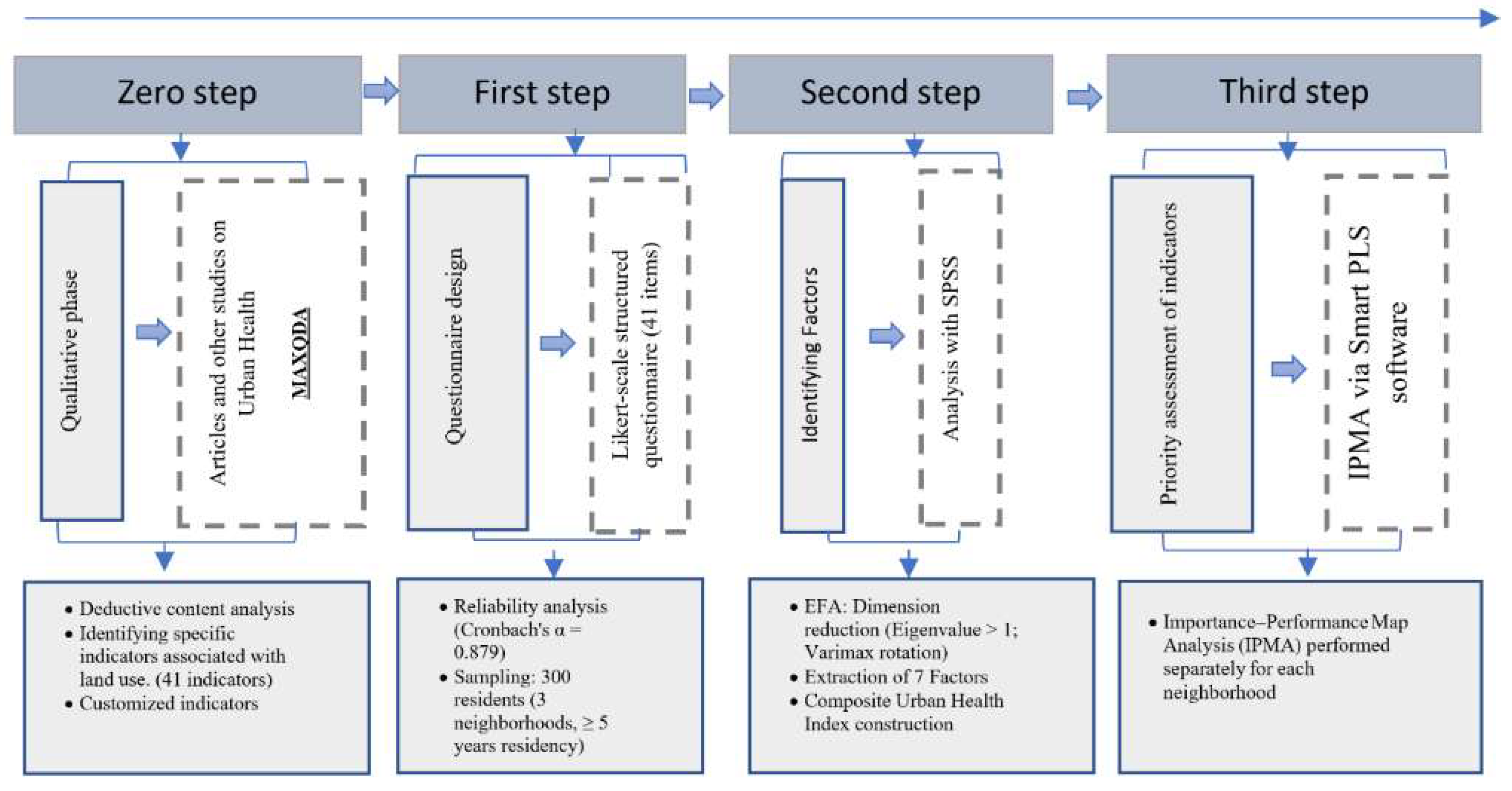
We employed a multi-method analytical framework to examine the relationship between urban land use and neighborhood-level health conditions. The research was conducted in two consecutive phases: (1) identification of relevant indicators through qualitative content analysis, and (2) quantitative assessment using Exploratory Factor Analysis (EFA) and Importance–Performance Map Analysis (IPMA). In the first phase, a deductive content analysis was carried out to extract urban health indicators influenced by land use planning. The analysis was based on a review of more than thirty academic and policy sources addressing the intersection between spatial planning and public health. Thematic coding was conducted using a predefined conceptual framework, resulting in the identification of 41 key indicators, which served as the foundation for questionnaire development.
4.2. Questionnaire Design, Sampling, and Validation
In the second phase, the finalized questionnaire—comprising the same 41 indicators was administered to 300 residents across three neighborhood units within Phase 2 of Parand New Town (100 respondents per unit). To ensure familiarity with the local context, only individuals with a minimum of five years of continuous residency were included in the sample. The sample size was determined based on fieldwork constraints and aligned with the common heuristic in factor analysis, suggesting a minimum of three responses per item—an accepted standard in social science research. Because neighborhood-level objective data were not available for many of the indicators—particularly those relatd to perceived quality—residents’ own lived experiences were used as a meaningful source of insight into local urban health realities. Instrument validity was ensured through multiple strategies. Content validity was addressed via systematic indicator selection from academic and policy literature, while face validity was confirmed through expert consultation with urban planning professionals. To evaluate internal consistency, Cronbach’s alpha was calculated for all questionnaire items, yielding a coefficient of 0.879, which reflects a high degree of internal reliability and structural validity.
4.3. Data Analysis (Efa and Ipma)
Subsequently, Exploratory Factor Analysis (EFA) was conducted to reduce and categorize the indicators into a set of latent constructs. Factor extraction was based on the eigenvalue >1 criterion and scree plot inspection, followed by varimax rotation to enhance interpretability. This process resulted in the identification of seven latent factors, which were then used to construct a composite Urban Health Index, with each factor weighted according to its explained variance. Following this, Importance Performance Map Analysis (IPMA) was performed to assess the relative importance and performance of each indicator with respect to the composite Urban Health Index, in accordance with the methodological guidelines outlined by Hair et al (2017). This allowed for the identification of high-priority indicators for targeted intervention within each neighborhood and enabled cross-neighborhood comparisons.
4.4. Spatial Visualization
Finally, the results were spatially visualized using GIS techniques to present neighborhood-level differences in urban health status. This spatial component served solely as a visual representation; no spatial statistical analysis was conducted.
Figure 2.
Research methodology.
4.5. Study Area
Parand New Town is located in the southwest of Tehran Province, along the most densely developed axis of the Tehran metropolitan area, on the southern slopes of Takht Rostam, at an elevation of approximately 1,200 meters above sea level. Between 2006 and 2016, its population grew dramatically from 5,706 to 97,464. Today, Parand accounts for 0.7% of the population of Tehran Province and 33% of Robat Karim County. According to the 2016 census, it recorded the highest population growth rate among Iranian cities during the decade. The data also show that a large portion of the workforce in Parand is employed in the service sector, suggesting that service-related occupations dominate the local labor market (Statistical Center of Iran, 2006 & 2016; Parand New City Comprehensive Plan, 2013).
The specific study area selected for evaluating urban health indicators is Phase 2 of Parand New Town. This area was chosen to assess the extent to which urban health principles have been incorporated into new town development. Additionally, its manageable scale allows for a more direct evaluation of how land use planning affects residents' lives, using a questionnaire based on simplified and easily understood indicators.
Phase 2 is one of the earliest and most established areas of Parand, with average residential tenure exceeding 20 years. Other parts of the city were excluded from the study due to recent influxes of new residents, which made certain questionnaire items inapplicable. In contrast, Phase 2 offers a diverse mix of land uses and a stable population, making it well suited for indicator evaluation. Three distinct neighborhood units within this phase were selected for comparative and in-depth analysis, incorporating both field observations and resident perspectives to enable a nuanced understanding (Figure 3) (Naqsh-va-Mohit Consulting Engineers, 2013; Statistical Center of Iran, 2016).
Phase 2 of Parand New Town has been home to residents for over a decade and is among the officially transferred areas under municipal administration. It encompasses all major commercial and service centers in the city and provides access to both local and intercity public transportation. Geographically, Phase 2 is divided into three main sections: north, center, and south.
The southern section contains the Parand Metro Station and the city's main transportation terminal (buses and taxis), offering a direct link to Tehran Metro Line 1 via Imam Khomeini Airport. The northern section features large single-family villas, each with a minimum area of 500 square meters, making it one of the most expensive areas in Parand in terms of land value and construction style. It also has the highest concentration of cafes and restaurants, surpassing other phases in the city. The central section combines residential and commercial developments, including three housing types—custom-built homes, villas, and apartments—and functions as the main commercial hub of Parand, attracting visitors from other areas for shopping and leisure. This section also hosts major public landmarks such as the Parand Grand Mosque and a religious seminary. On its western edge lies Fadak Park, the city's only public park, which offers green space and recreational facilities for children.
In the southern zone, development is predominantly residential, with over 80% of the area consisting of apartment buildings and villas. This section also houses the Parand New Town Construction Company, which is responsible for the city’s urban development. Having been under municipal management for more than five years, Phase 2 benefits from superior public services compared to other districts. It also hosts numerous public and private schools, as well as key infrastructure such as the telecommunications center, electricity, and gas departments—further strengthening its service provision.
Although the Parand Metro Station officially opened in late 2023, it was not yet operational during the questionnaire period. Therefore, it had no impact on residents’ travel behavior or perceptions of accessibility at the time of data collection (Based on field observations, Figure 3).
4.6. Identification of Target Indicators in Maxqda
We employed a structured deductive content analysis to identify urban health indicators that are conceptually and empirically related to land use planning. The process began with the extraction of more than 100 general urban health indicators from an extensive review of over thirty academic and policy documents. After removing duplicates and semantically overlapping items, the indicators were grouped into six conceptual categories: functionality, community, environment, management, landscape and individual perception, and urban morphology.
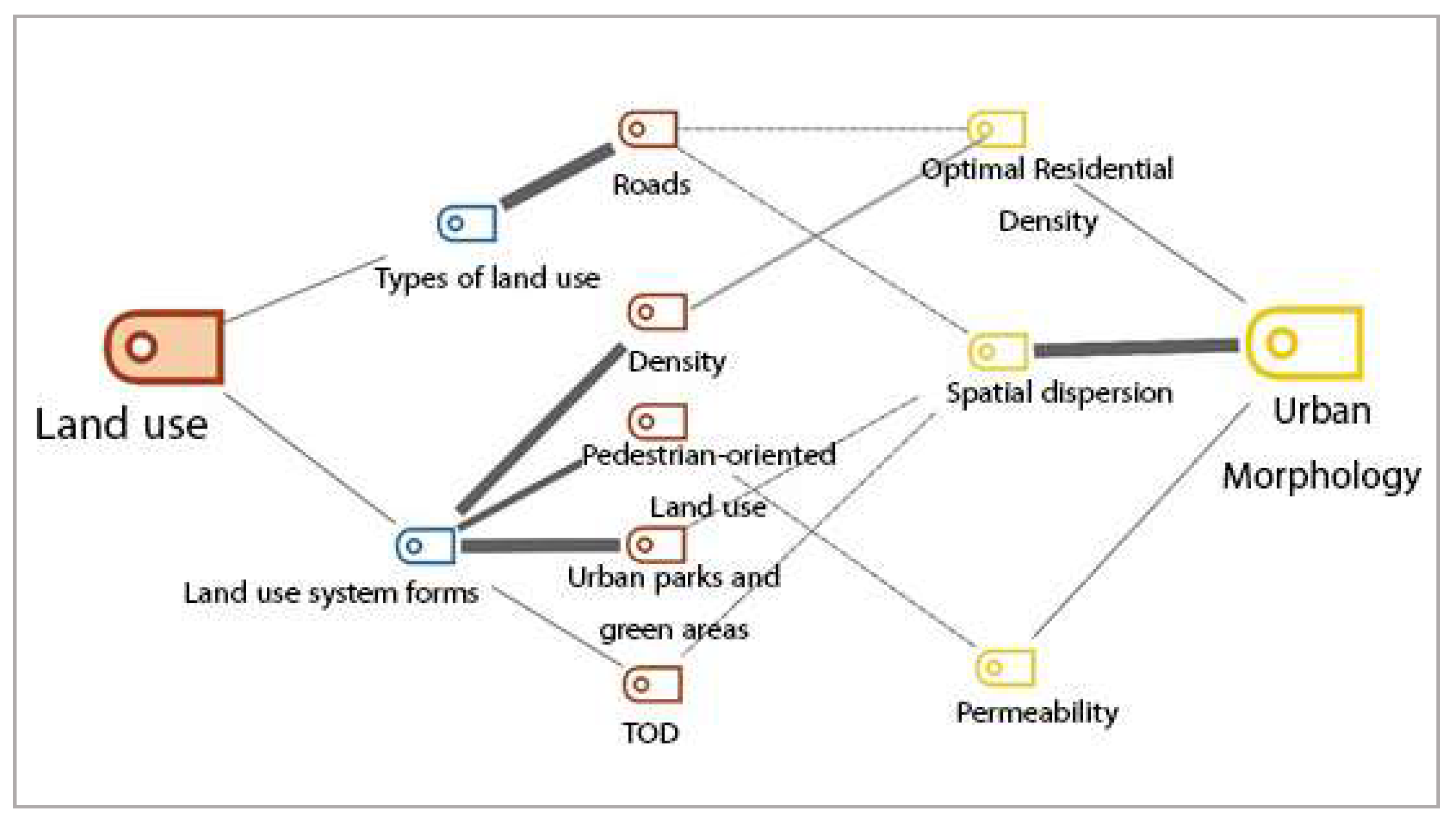
To identify which indicators were influenced by land use, we employed a thematic coding framework developed in MAXQDA based on established land use planning concepts. Two main code categories were created: land use system forms (e.g., density, mixed-use development, transit-oriented development, pedestrian-oriented layouts, and permeability) and land use types (e.g., residential, commercial, industrial, roads, green spaces, and brownfield sites). Each document was coded simultaneously for urban health indicators and land use–related content.
The aim of this phase was to identify conceptual or textual overlaps between health indicators and land use constructs. For example, in studies referring to Brownfield Site, it was reported that “the abandonment of these lands inflicts considerable harm upon local communities, primarily due to the considerable health risks arising from the pollution and environmental degradation associated with these lands”. As a result, “”—originally identified as a general health indicator—was recognized as directly linked to land use and retained for the next stage of analysis.
Only those indicators that showed a clear relationship with the use and organization of urban land were selected for inclusion in the subsequent stages. These final indicators informed both the questionnaire design and the quantitative analyses. Table 2 presents the refined list of indicators, while Figure 4 illustrates how general health concepts were connected to land use typologies through the coding process.
5. Results:
5.1. Measurement of Indicators and Modeling of Urban Health Related to "Land Use"
To assess the urban health indicators influenced by land use, Exploratory Factor Analysis (EFA) was conducted based on questionnaire data collected from three neighborhood units in Phase 2 of Parand New Town. The dataset, structured in SPSS, comprised 300 observations (100 per neighborhood), each representing responses to 41 health-related indicators.
The suitability of the dataset for factor analysis was first confirmed through the Kaiser–Meyer–Olkin (KMO) and Bartlett’s Test of Sphericity. The KMO value was 0.847, indicating a meritorious level of sampling adequacy. Bartlett’s test produced a chi-square value of 5919.863 with 820 degrees of freedom and a significance level of p < 0.001, confirming the appropriateness of the data for factor extraction.
The communalities table showed that all indicators had extraction values above 0.5, except for the indicator "Adequate number of residential buildings for the population’s needs", which had a value of 0.488. Furthermore, Factor 8, which included only one item "Essential services like banks and schools near public transport", was excluded from the final model due to insufficient statistical representation. These exclusions improved the robustness and interpretability of the model.
5.2. Identifying Urban Health Factors Related to Land Use Planning
To identify the underlying dimensions of urban health associated with land use, factor extraction was based on three statistical criteria: (1) eigenvalues greater than 1, (2) cumulative variance exceeding 60%, and (3) sufficient variance explained by individual components. As presented in Table 3, seven factors met these conditions, with a cumulative variance of 61.13%, indicating that the extracted components captured a substantial portion of the total variance in the dataset.
According to the eigenvalues presented in Table 3, seven factors with values greater than 1 were retained, explaining a cumulative variance of 61.139%. The Scree Plot (Scheme 1) supports this selection, showing a clear inflection point after the seventh factor. The indicator “Adequate number of residential buildings for the population’s needs” was removed due to a factor loading below 0.5 (See Table A1 in the Appendix A for the complete rotated factor matrix). Additionally, Factor 8, which contained only a single indicator, was excluded as it did not meet the requirements for retention.
5.3. Naming the Factors and Assessing Their Status in Neighboring Units
Based on the rotated factor matrix, seven latent factors were identified and labeled according to the indicators with the highest loadings within each group (See Table A1 in the Appendix A for the complete rotated factor matrix). To assess the condition of each neighborhood in relation to each factor, factor scores were averaged by neighborhood. This enabled a detailed comparison of how each latent construct contributed to the overall profile of each area. The factor-specific scores for each neighborhood are presented in Table 4. The structure and naming of the seven latent factors, including the indicators and their contributions to the total explained variance, are visually presented in Figure 5.
The spatial distribution of Urban Health factor scores and final composite scores across the three neighborhood units is visualized in Figure 6.
Following factor extraction and naming, we calculated a final composite score for each respondent by summing their individual factor scores. we then averaged these composite scores for each neighborhood to provide an overall measure of urban health-related performance. Neighborhood 2 achieved the highest composite score (+3.062), followed by Neighborhood 1 (–1.474) and Neighborhood 3 (–1.584), as shown in Table 4.
To determine whether the observed differences between the three neighborhoods were meaningful, a One-Way ANOVA test was conducted. The results revealed a statistically significant difference in average scores among the neighborhoods (F (2,97) = 306.732, p < 0.001). Additionally, Levene’s Test showed that the assumption of equal variances was met (p = 0.367), supporting the reliability of the ANOVA findings.
Post-hoc comparisons using Tukey’s HSD test further revealed that:
- Neighborhood 2 had significantly higher scores than both Neighborhoods 1 and 3 (p < 0.001),
- No statistically significant difference was observed between Neighborhoods 1 and 3 (p = 0.861).
These findings confirm that Neighborhood 2 exhibits the most favorable urban health conditions, while Neighborhoods 1 and 3 show comparably lower scores.

Table 4.
Composite Urban Health Factor Scores Across Neighborhood Units.
| Neighborhood | Access to Services and Sustainable Mobility | Access Justice and Environmental Sustainability | Neighborhood Vitality and Social Well-Being | Urban Safety and Integration | Quality of Life and Urban Equity | Pedestrian-Oriented Mobility and Effective Transportation | Social Equity and Environmental Sustainability | Final Score |
| 1 | -.280 | -.337 | -.25 | -.147 | -.246 | -.074 | -.140 | -1.474 |
| 2 | .457 | .523 | .406 | .368 | .512 | .415 | .381 | 3.062 |
| 3 | -.176 | -.186 | -.156 | -.220 | -.265 | -.341 | -.240 | -1.584 |
5.4. Prioritizing Urban Health Interventions Using Composite Index and Ipma
To identify which land use-related indicators most significantly influence urban health outcomes and require targeted intervention, we employed an integrated analytical approach combining factor score analysis and Importance–Performance Map Analysis (IPMA). This dual-method strategy enabled the assessment of both the relative contribution of each underlying factor to urban health and the variation in their perceived performance across different spatial contexts. The aim was to generate actionable insights that could guide neighborhood-scale health-promoting urban interventions.
To quantify urban health conditions and facilitate inter-neighborhood comparison, a composite indicator—referred to as the Urban Health Index (UHI)—was constructed. Rather than relying on a simple arithmetic summation of indicators, the UHI was calculated using a weighted aggregation of factor scores obtained from exploratory factor analysis (EFA). The relative weight of each factor was derived from its percentage of explained variance in the EFA, ensuring that more influential dimensions had a proportionally greater impact on the overall index. The UHI was first calculated for each individual respondent using the following formula. Final neighborhood-level scores were then obtained by averaging individual UHI values within neighborhoods.
- represents the final Urban Health Index.
- Fi is the individual factor score for each respondent
- Wi denotes the proportion of explained variance for the corresponding factor
This methodology is consistent with international best practices for composite indicator construction, particularly those outlined in the OECD-JRC Handbook (Nardo et al., 2005), which supports the use of variance-based weights as an empirically grounded and transparent aggregation strategy.
Following the construction of the UHI, each of the 41 land uses-related indicators was modeled as a formative input directly linked to the UHI within the SmartPLS environment. This allowed for the execution of the IPMA, providing a simultaneous view of standardized importance and perceived performance for each indicator. To better capture spatial variation in urban health conditions, the IPMA was conducted separately for each of the three neighborhoods. This allowed us to identify the most critical intervention areas specific to each local context. Such a place-based approach aligns with emerging perspectives in urban health research, which emphasize the importance of neighborhood-level disparities and tailored planning strategies.
5.5. Identifying Key Priorities Through Importance–performance and Priority Index Analysis
To translate the results of the IPMA into concrete and context-specific insights, this section presents a comparative evaluation of the 41 land uses-related indicators based on their standardized importance, mean performance, and calculated priority index. The purpose of this analysis is to identify which indicators require immediate intervention in each neighborhood, based on the combination of high influence on urban health and low perceived performance. The Priority Index (PI) was computed using PI = Importance × (4 – Performance), In this equation, Importance refers to the standardized total effect of each indicator on the Urban Health Index (UHI), as calculated in Smart PLS. Performance represents the mean score reported by respondents on a 5-point Likert scale. The number 4 was used as the ideal threshold for satisfactory performance, consistent with common practice in Likert-based perception studies, where a score of 4 generally indicates acceptable or expected quality.
While there is no universally standardized formula for calculating priority rankings, this formulation is widely recognized in planning and urban health research due to its transparency, interpretability, and policy relevance. It provides a clear operational method to prioritize planning efforts by highlighting indicators with both high importance and low observed performance—those falling into the lower-right quadrant of the IPMA matrix. To enhance place-based specificity, the Priority Index was calculated separately for each neighborhood, allowing for comparative analysis. Priorities were interpreted based on relative PI values rather than an absolute threshold. A summary table presents the full set of indicators alongside their respective importance, performance, and calculated priority scores for each neighborhood with a consistent color scheme reflecting urgency levels (Table 5). Additionally, bar chart was developed for neighborhoods to visualize the top intervention priorities in Figure 7The analysis enables policymakers and planners to effectively identify critical indicators in need of urgent attention and to prioritize interventions according to the most pressing challenges at the neighborhood scale.
6. Discussion
The built environment presents both opportunities and risks for promoting public health. As Kim et al. (2022) argue, urban health is not limited to physical outcomes but extends to the socio-spatial and political processes that shape those outcomes. This study, by focusing on land use systems and neighborhood-scale analysis of urban health, contributes to a deeper understanding of how the urban form in rapidly growing, socially and spatially unequal contexts—such as Parand New Town—affects residents' well-being.
Findings reveal that the urban environment influences health not only through tangible factors like infrastructure and service accessibility but also through intangible pathways such as perceived safety, social cohesion, and environmental satisfaction (Fernández Núñez et al., 2022; Van Cauwenberg et al., 2022). This duality underscores the importance of contextual and multidimensional planning that integrates both objective and subjective aspects of urban quality of life.
In Neighborhood 1, which is characterized by low-density, primarily detached housing and relatively higher socioeconomic status, indicators such as, Opportunities for active travel and recreational activities and effective sewage management were found to have low performance yet high importance. This apparent contradiction may stem from residents’ higher expectations regarding spatial quality—especially in areas with visually appealing and less dense urban forms. These findings align with previous research in affluent neighborhoods, suggesting that lower perceived quality may not reflect actual deficiencies but rather a relative gap between expectations and lived experience (Barnett et al., 2017). Thus, planning interventions in such areas should prioritize high-quality urban design, pedestrian infrastructure, and improved service provision, especially in terms of infrastructure like sanitation—where elevated expectations may lead to more critical evaluations.
In Neighborhood 2, the social and commercial core of Phase 2, the Urban Health Index (UHI) was significantly higher than in the other neighborhoods. This neighborhood benefits from better access to public services, transportation infrastructure, and land use diversity. However, indicators such as existence of sidewalks and bike lane, quality of police services and public trust and transport connectivity with the new residential area require immediate interventions. These findings echo Corburn (2009), who noted that urban vibrancy, when unmanaged, can contribute to social fragmentation. Future policies in this context should aim to reinforce public gathering spaces, enhance lighting and street design, and promote neighborhood belonging and cohesion to preserve quality of life and mitigate social disintegration.
Neighborhood 3, by contrast, exhibited lower socioeconomic and environmental conditions. Priority indicators in this area included accessibility to healthcare services and public transport station, existence of sidewalks and bike lanes. These priorities reflect more fundamental needs and suggest that the lack of essential infrastructure is the primary barrier to achieving urban health in this area. Consistent with Freeman et al. (2013) and Nieuwenhuijsen & Khreis. (2019), this neighborhood highlights the disproportionate burden of poor environmental and infrastructural quality in disadvantaged communities. Interventions here must go beyond compensatory approaches and instead focus on participatory and neighborhood-specific strategies—such as safe pedestrian-oriented design, co-creation of public spaces, and enhancing social ownership of the built environment.
The Importance–Performance Matrix Analysis (IPMA) offered additional insight by identifying indicators with high importance and low performance as priorities for intervention. this study isolated critical land use-related indicators that substantially influence health outcomes but suffer from insufficient perceived quality. The use of “4” as a reference threshold for acceptable performance aligns with best practices in Likert-based perceptual studies and provides a standardized lens for comparison across neighborhoods.
The results revealed significant inter-neighborhood disparities in the distribution of urban health opportunities—even within a planned city such as Parand New Town. This underscores the need for context-sensitive and neighborhood-specific policy responses. Importantly, the mixed-methods framework adopted in this research—grounded in factor analysis, composite health indexing, and IPMA—provides a theoretically robust and replicable model for urban health assessment in similar newly developed contexts.
Ultimately, our findings suggest that assessing urban health at the neighborhood level goes far beyond listing physical infrastructures. It involves understanding how planning and land use decisions shape people’s physical, mental, and social lives. By including land use-sensitive indicators in health assessments, we reveal specific ways in which spatial structures impact health. While land use is not the sole driver, it is clearly entangled with many other factors that shape well-being (Jennings et al., 2024).
Our findings offer practical guidance for policymakers and planners seeking to improve health at the neighborhood scale. IPMA results enable targeted, place-based interventions—especially in areas like Neighborhood 3 with acute infrastructure and environmental gaps. Specifically, local authorities can prioritize immediate upgrades in pedestrian infrastructure, enhance healthcare accessibility, and strengthen public transport connectivity. In higher-performing areas such as Neighborhood 2, interventions should focus on reinforcing existing infrastructure and addressing specific social cohesion gaps identified by residents.
Future research could adapt this framework to explore other neighborhood-scale planning priorities—such as livability, resilience, and spatial equity—particularly in contexts where data availability is limited. More broadly, this analytical framework is not limited to the land use–health nexus. It is transferable to a wide range of urban research contexts where the goal is to explore and quantify the relationship between a structural urban system (e.g., governance, transport, spatial equity) and a complex urban outcome (e.g., health, resilience, vitality). The framework enables the refinement of general concepts into context-specific indicators aligned with the selected analytical perspective, and supports the construction of composite indices that bridge disciplinary divides and enable evidence-based planning.
7. Conclusions
We explored how land use patterns relate to urban health in Phase 2 of Parand New Town. We found that the way land is organized and functions within neighborhoods can significantly influence the physical, mental, and social well-being of residents. Analyses conducted across three neighborhoods with distinct spatial and socio-economic characteristics highlighted the multi-dimensional nature of this relationship. Furthermore, an Exploratory Factor Analysis extracted seven latent factors, explaining a substantial portion of the total variance in Urban Health. This level of explained variance supports the strength of our analytical framework in capturing diverse dimensions of urban health.
In each neighborhood, specific indicators were identified as top to priorities for intervention. In Neighborhood 1, these included effective sewage system management and opportunities for active travel, In Neighborhood 2, the existence of sidewalks and trust in police services were emphasized. In Neighborhood 3, key priorities were access to health care services, proximity to public transport stations, and pedestrian infrastructure.
The comparison of three neighborhoods showed that even in a planned new town, urban health conditions can vary significantly depending on spatial structure and service provision. Neighborhood 2, with better access to services and diverse land uses, showed the highest overall health score. In contrast, Neighborhood 3, marked by fewer resources and infrastructure gaps, ranked lowest and revealed the most urgent needs.Among the seven identified domains, Access to Services and Sustainable Mobility, Neighborhood Vitality and Social Well-Being, and Access Justice and Environmental Sustainability emerged as the most critical, concentrating the majority of intervention-priority indicators. These domains should receive particular attention in future spatial health interventions. However, the specific indicators requiring intervention within each domain varied across neighborhoods, highlighting the need for localized strategies. This approach becomes even more effective when applied across a larger number of neighborhoods, enhancing the precision and generalizability of targeted interventions. Thus, this approach not only identifies what matters, but where it matters most.
In conclusion, we provide a hybrid and replicable framework that integrates qualitative and quantitative methods to identify urban health inequalities at the neighborhood scale. By emphasizing the role of land use systems in shaping health outcomes, the approach offers an evidence-based and spatially grounded tool for prioritizing context-specific urban interventions. Given its methodological flexibility and reliance on accessible data sources, the framework is particularly well-suited for application in newly planned urban developments, where place-sensitive planning can effectively promote health. Urban planners and local decision-makers can benefit from adopting this approach early in the planning process to systematically address spatial inequalities and enhance overall urban health outcomes.
Author Contributions
Conceptualization, Farnaz Eskandari, Ahmad Khalili and Mostafa Behzadfar; Methodology, Farnaz Eskandari, Ahmad Khalili, Mostafa Behzadfar, Momen Foadmarashi and Francisco Serdoura; Software, Farnaz Eskandari; Validation, Farnaz Eskandari, Ahmad Khalili, Mostafa Behzadfar, Momen Foadmarashi and Francisco Serdoura; Formal analysis, Farnaz Eskandari and Ahmad Khalili; Investigation, Farnaz Eskandari; Resources, Farnaz Eskandari; Data curation, Farnaz Eskandari and Momen Foadmarashi; Writing – original draft, Farnaz Eskandari; Writing – review & editing, Farnaz Eskandari, Mostafa Behzadfar and Momen Foadmarashi; Visualization, Farnaz Eskandari; Supervision, Ahmad Khalili, Mostafa Behzadfar, Momen Foadmarashi and Francisco Serdoura; Project administration, Ahmad Khalili and Mostafa Behzadfar; Funding acquisition, Francisco Serdoura. All authors have read and agreed to the published version of the manuscript.
Funding
This work is financed by national funds through FCT—Fundação para a Ciência e a Tecnologia, I.P., under the Strategic Project with the references UID/04008: Centro de Investigação em Arquitetura, Urbanismo e Design.
Data Availability Statement
The data presented in this study is available on request from the corresponding author due to the necessity to protect the proprietary modeling methodology and to ensure the proper context and interpretation of the complex simulated data by external researchers.
Conflicts of Interest
The authors declare no conflict of interest.
Appendix A
Table A1.
Factor loadings of urban health indicators related to land use (EFA output).
| Measures centered on urban health indicators related to land use | F1 | F2 | F3 | F4 | F5 | F6 | F7 | F8 |
| Accessibility to healthcare services within a 10-15 minute walk | .853 | |||||||
| Existence of sidewalks and bike lanes | .850 | |||||||
| Opportunities for active travel and recreational activities | .848 | |||||||
| Effective sewage system management and maintenance | .838 | |||||||
| Access to public transport stations within 10 minutes | .835 | |||||||
| Neighborhood energy consumption and sustainability | .858 | |||||||
| Child health risks and mortality in cities | .847 | |||||||
| Disadvantaged population with easy access to public transportation | .839 | |||||||
| Equal access to services for all ethnic and racial groups | .837 | |||||||
| Hierarchy of access network in street design | .734 | |||||||
| Sufficient tree cover and greenery along sidewalks | .580 | |||||||
| Easy access to shops and stores within walking distance | .849 | |||||||
| Opportunities for physical activity and sports within the neighborhood | .841 | |||||||
| Perceived civil stability and social conflict in the neighborhood | .839 | |||||||
| Efficient use of space with minimal vacant areas | .687 | |||||||
| Green ways and green buildings | .592 | |||||||
| Safe and well-maintained walking and cycling paths | .526 | |||||||
| The amount and quality of social interaction | .493 | |||||||
| Transport connectivity with the new residential area | .845 | |||||||
| Quality of police services and public trust | .825 | |||||||
| Optimized urban population density | .742 | |||||||
| Street network capacity and traffic flow | .652 | |||||||
| Community perception of safety and crime risk | .652 | |||||||
| Level of mixed residential, commercial, and recreational land uses | .554 | |||||||
| Feeling satisfaction and well-being | .841 | |||||||
| Socio-spatial disparities in urban land use planning | .792 | |||||||
| Access to daily necessities within a 10-minute walk from homes | .757 | |||||||
| Diversity of housing types | .673 | |||||||
| Neighborhood land use compatibility level | .552 | |||||||
| High permeability allowing easy movement | .511 | |||||||
| Streets suitable for both vehicles and pedestrians | .839 | |||||||
| Low need for frequent car use for daily activities | .818 | |||||||
| Integration of walking, cycling, and public transport options | .806 | |||||||
| Proximity to the city center for easy access | .718 | |||||||
| Accessibility and reliability of clean drinking water | .527 | |||||||
| Residential and economic isolation of ethnic and low-income populations | .851 | |||||||
| Ambient temperature and heat due to construction | .838 | |||||||
| Reliable water, electricity, and gas services | .819 | |||||||
| Easy access to public green spaces | .655 | |||||||
| Essential services like banks and schools near public transport | .444 | .523 | ||||||
| Adequate number of residential buildings for the population's needs | -.488 |
References
- Alberti, M.; Booth, D.; Hill, K.; Coburn, B.; Avolio, C.; Coe, S.; Spirandelli, D. The impact of urban patterns on aquatic ecosystems: An empirical analysis in Puget lowland sub-basins. Landscape and Urban Planning 2007, 80(4), 345–361. [Google Scholar] [CrossRef]
- Ali, Md. J.; Rahaman, M.; Hossain, Sk. I. Urban green spaces for elderly human health: A planning model for healthy city living. Land Use Policy 2022, 114, 105970. [Google Scholar] [CrossRef]
- Anderson, C. A. Heat and Violence. Current Directions in Psychological Science 2001, 10(1), 33–38. [Google Scholar] [CrossRef]
- Anderson, L. M.; St. Charles, J.; Fullilove, M. T.; Scrimshaw, S. C.; Fielding, J. E.; Normand, J. Providing affordable family housing and reducing residential segregation by income. American Journal of Preventive Medicine 2003, 24(3), 47–67. [Google Scholar] [CrossRef] [PubMed]
- Andreasen, M. H.; Møller-Jensen, L. Access to the city: Mobility patterns, transport and accessibility in peripheral settlements of Dar es Salaam. Journal of Transport Geography 2017, 62, 20–29. [Google Scholar] [CrossRef]
- Awofeso, N. What’s New About the “New Public Health”? American Journal of Public Health 2004, 94(5), 705–709. [Google Scholar] [CrossRef]
- Bahr, S. The relationship between urban greenery, mixed land use and life satisfaction: An examination using remote sensing data and deep learning. Landscape and Urban Planning 2024, 251, 105174. [Google Scholar] [CrossRef]
- Bain, R.; Cronk, R.; Hossain, R.; Bonjour, S.; Onda, K.; Wright, J.; Yang, H.; Slaymaker, T.; Hunter, P.; Prüss-Ustün, A.; Bartram, J. Global assessment of exposure to faecal contamination through drinking water based on a systematic review. Tropical Medicine & International Health 2014, 19(8), 917–927. [Google Scholar] [CrossRef]
- Baldauf, R.; Cahill, T.; Bailey, C.; Khlystov, A.; Max Zhang, K.; Cook, R.; Cowherd, C.; Bowker, G. Can roadway design be used to mitigate air quality impacts from traffic? Environmental Manager, 2009.
- Barnett, D. W.; Barnett, A.; Nathan, A.; Van Cauwenberg, J.; Cerin, E. Built environmental correlates of older adults’ total physical activity and walking: a systematic review and meta-analysis. International Journal of Behavioral Nutrition and Physical Activity 2017, 14(1), 103. [Google Scholar] [CrossRef]
- Barton, H. A Health Map for Urban Planners: Towards a Conceptual Model for Healthy, Sustainable Settlements; Built Environment., 2005. [Google Scholar]
- Barton, H. Land use planning and health and well-being. Land Use Policy 2009, 26, S115–S123. [Google Scholar] [CrossRef]
- Baumgardner, D.; Varela, S.; Escobedo, F. J.; Chacalo, A.; Ochoa, C. The role of a peri-urban forest on air quality improvement in the Mexico City megalopolis. Environmental Pollution 2012, 163, 174–183. [Google Scholar] [CrossRef] [PubMed]
- Braun, L. M.; Rodríguez, D. A.; Evenson, K. R.; Hirsch, J. A.; Moore, K. A.; Diez Roux, A. V. Walkability and cardiometabolic risk factors: Cross-sectional and longitudinal associations from the Multi-Ethnic Study of Atherosclerosis. Health & Place 2016, 39, 9–17. [Google Scholar] [CrossRef]
- Brender, J. D.; Maantay, J. A.; Chakraborty, J. Residential Proximity to Environmental Hazards and Adverse Health Outcomes. American Journal of Public Health 2011, 101(S1), S37–S52. [Google Scholar] [CrossRef]
- Brender, J. D.; Weyer, P. J.; Romitti, P. A.; Mohanty, B. P.; Shinde, M. U.; Vuong, A. M.; Sharkey, J. R.; Dwivedi, D.; Horel, S. A.; Kantamneni, J.; Huber, J. C.; Zheng, Q.; Werler, M. M.; Kelley, K. E.; Griesenbeck, J. S.; Zhan, F. B.; Langlois, P. H.; Suarez, L.; Canfield, M. A. Prenatal Nitrate Intake from Drinking Water and Selected Birth Defects in Offspring of Participants in the National Birth Defects Prevention Study. Environmental Health Perspectives 2013, 121(9), 1083–1089. [Google Scholar] [CrossRef] [PubMed]
- Bridgwater, E.; Rajpurohit, S.; Kennedy, K. Moving America Forward: Health, Safety, and Economic Benefits of Multimodal Transportation Systems; 2022. [Google Scholar]
- Buffoli, M.; Rebecchi, A. The Proximity of Urban Green Spaces as Urban Health Strategy to Promote Active, Inclusive and Salutogenic Cities; 2023; pp. 1017–1027. [Google Scholar] [CrossRef]
- Capolongo, S.; Buffoli, M.; Mosca, E. I.; Galeone, D.; D’Elia, R.; Rebecchi, A. Public Health Aspects’ Assessment Tool for Urban Projects, According to the Urban Health Approach; 2020; pp. 325–335. [Google Scholar] [CrossRef]
- Carlson, C.; Aytur, S.; Gardner, K.; Rogers, S. Complexity in Built Environment, Health, and Destination Walking: A Neighborhood-Scale Analysis. Journal of Urban Health 2012, 89(2), 270–284. [Google Scholar] [CrossRef]
- Colford, J. M.; Schiff, K. C.; Griffith, J. F.; Yau, V.; Arnold, B. F.; Wright, C. C.; Gruber, J. S.; Wade, T. J.; Burns, S.; Hayes, J.; McGee, C.; Gold, M.; Cao, Y.; Noble, R. T.; Haugland, R.; Weisberg, S. B. Using rapid indicators for Enterococcus to assess the risk of illness after exposure to urban runoff contaminated marine water. Water Research 2012, 46(7), 2176–2186. [Google Scholar] [CrossRef]
- Corburn, J. Toward the Healthy City: People, Places, and the Politics of Urban Planning (Urban and Industrial Environments); 2009. [Google Scholar]
- Cox, L.; Walters, C.; Jacobs, S. A.; Yuan, Y.; Zimmer, A.; Moore, T.; Hansen, V.; Andrews, J.; Thomas, J.; Heilke, I.; Flanders, N.; Weaver, J.; Daniels, R.; Yuen, T.; Payne-Sturges, D. C.; McCullough, M. W.; Rashleigh, B.; TenBrink, M.; Walton, B. T.; Bachle, L. Land Use: A Powerful Determinant of Sustainable & Healthy Communities SHC Land Use Planning. 2013. Available online: https://www.epa.gov/sites/default/files/2016-09/documents/fy13productnheerl4121land_use_synthesis.pdf.
- de Nazelle, A.; Nieuwenhuijsen, M. J.; Antó, J. M.; Brauer, M.; Briggs, D.; Braun-Fahrlander, C.; Cavill, N.; Cooper, A. R.; Desqueyroux, H.; Fruin, S.; Hoek, G.; Panis, L. I.; Janssen, N.; Jerrett, M.; Joffe, M.; Andersen, Z. J.; van Kempen, E.; Kingham, S.; Kubesch, N.; …; Lebret, E. Improving health through policies that promote active travel: A review of evidence to support integrated health impact assessment. Environment International 2011, 37(4), 766–777. [Google Scholar] [CrossRef]
- De Sousa, C.; Ann, L.-; Souza, D. ’. Atlantic Station, Atlanta, Georgia: A Sustainable Brownfield Revitalization Best Practice 1; 2013. [Google Scholar]
- Diez Roux, A. V.; Slesinski, S. C.; Alazraqui, M.; Caiaffa, W. T.; Frenz, P.; Jordán Fuchs, R.; Miranda, J. J.; Rodriguez, D. A.; Dueñas, O. L. S.; Siri, J.; Vergara, A. V. A Novel International Partnership for Actionable Evidence on Urban Health in Latin America: LAC-Urban Health and SALURBAL. Global Challenges 2019, 3(4). [Google Scholar] [CrossRef]
- Djurhuus, S.; Hansen, H. S.; Aadahl, M.; Glümer, C. The association between access to public transportation and self-reported active commuting. International Journal of Environmental Research and Public Health 2014, 11(12), 12632–12651. [Google Scholar] [CrossRef]
- Doyle, S.; Kelly-Schwartz, A.; Schlossberg, M.; Stockard, J. Active Community Environments and Health: The Relationship of Walkable and Safe Communities to Individual Health. Journal of the American Planning Association 2006, 72(1), 19–31. [Google Scholar] [CrossRef]
- EIA. Residential Energy Consumption Survey (RECS): 2009 Detailed Tables. U.S. Energy Information Administration. 2012. Available online: https://www.eia.gov/consumption/residential/data/2009/.
- Escobedo, F. J.; Nowak, D. J. Spatial heterogeneity and air pollution removal by an urban forest. Landscape and Urban Planning 2009, 90(3–4), 102–110. [Google Scholar] [CrossRef]
- Escobedo, F.; Varela, S.; Zhao, M.; Wagner, J. E.; Zipperer, W. Analyzing the efficacy of subtropical urban forests in offsetting carbon emissions from cities. Environmental Science & Policy 2010, 13(5), 362–372. [Google Scholar] [CrossRef]
- Ewing, R.; Cervero, R. Travel and the Built Environment. Journal of the American Planning Association 2010, 76(3), 265–294. [Google Scholar] [CrossRef]
- Ewing, Reid, Choi, Dong-ah, Kiani, Fatemeh, Kim, Junsik, Sabouri, & Sadegh. (n.d.). STREET NETWORK CONNECTIVITY, TRAFFIC CONGESTION, AND TRAFFIC SAFETY. www.udot.utah.gov/go/research.
- Fee, E. Disease and Discovery: A History of the Johns Hopkins School of Hygiene and Public Health; Johns Hopkins University Press; Baltimore., 1987. [Google Scholar]
- Fernández Núñez, M.-B.; Campos Suzman, L.; Maneja, R.; Bach, A.; Marquet, O.; Anguelovski, I.; Knobel, P. Gender and sex differences in urban greenness’ mental health benefits: A systematic review. Health & Place 2022, 76, 102864. [Google Scholar] [CrossRef]
- Florida, R. Startup city: The urban shift in venture capital and high technology . In Martin Prosperity Institute; University of Toronto, 2014. [Google Scholar]
- Fosu, G. B. Access to health care in urban areas of developing societies. Journal of Health and Social Behavior 1989, 30(4), 398–411. [Google Scholar] [CrossRef]
- Frank, L.; Bradley, M.; Kavage, S.; Chapman, J.; Lawton, T. K. Urban form, travel time, and cost relationships with tour complexity and mode choice. Transportation 2007, 35(1), 37–54. [Google Scholar] [CrossRef]
- Frank, L. D.; Sallis, J. F.; Conway, T. L.; Chapman, J. E.; Saelens, B. E.; Bachman, W. Many Pathways from Land Use to Health: Associations between Neighborhood Walkability and Active Transportation, Body Mass Index, and Air Quality. Journal of the American Planning Association 2006, 72(1), 75–87. [Google Scholar] [CrossRef]
- Fraser, S. D. S.; Lock, K. Cycling for transport and public health: a systematic review of the effect of the environment on cycling. European Journal of Public Health 2011, 21(6), 738–743. [Google Scholar] [CrossRef]
- Freeland, A. L.; Banerjee, S. N.; Dannenberg, A. L.; Wendel, A. M. Walking Associated With Public Transit: Moving Toward Increased Physical Activity in the United States. American Journal of Public Health 2013, 103(3), 536–542. [Google Scholar] [CrossRef]
- Freeman, L.; Neckerman, K.; Schwartz-Soicher, O.; Quinn, J.; Richards, C.; Bader, M. D. M.; Lovasi, G.; Jack, D.; Weiss, C.; Konty, K.; Arno, P.; Viola, D.; Kerker, B.; Rundle, A. G. Neighborhood Walkability and Active Travel (Walking and Cycling) in New York City. Journal of Urban Health 2013, 90(4), 575–585. [Google Scholar] [CrossRef]
- Friel, C.; Walsh, D.; Whyte, B.; Dibben, C.; Feng, Z.; Baker, G.; Kelly, P.; Demou, E.; Dundas, R. Health benefits of pedestrian and cyclist commuting: evidence from the Scottish Longitudinal Study. BMJ Public Health 2024, 2(1), e001295. [Google Scholar] [CrossRef] [PubMed]
- Friesen, J.; Georganos, S.; Haas, J. Differences in walking access to healthcare facilities between formal and informal areas in 19 sub-Saharan African cities. Communications Medicine 2025, 5(1), 41. [Google Scholar] [CrossRef] [PubMed]
- Fu, X.; Qiang, Y.; Wang, J.; Zhao, X.; Hwang, F.-J.; Chen, C.-H. Urban Public Transport Accessibility to Medical Services From the Perspective of Residents’ Travel: A Hybrid Assessment Based on the Whole Process. IEEE Access 2021, 9, 8977–8989. [Google Scholar] [CrossRef]
- Galea, S.; Freudenberg, N.; Vlahov, D. Cities and population health. Social Science & Medicine 2005, 60(5), 1017–1033. [Google Scholar] [CrossRef] [PubMed]
- Gibson; Daragh, A. A Health Impact Assessment of the George Road Complete Streets Implementation Plan, 2017.
- Haas, P.; Miknaitis, G.; Cooper, H.; Young, L.; Benedict, A. Transit Oriented Development and The Potential for VMT-related Greenhouse Gas Emissions Growth Reduction By Center for Neighborhood Technology. 2010. Available online: http://www.climatechange.ca.gov/inventory/index.html.
- Hair, J. F..; Hult, G. T. M..; Ringle, C. M..; Sarstedt, Marko. A primer on partial least squares structural equation modeling (PLS-SEM); Sage, 2017. [Google Scholar]
- Hancock, T. Health, human development and the community ecosystem: three ecological models. Health Promotion International 1993, 8(1), 41–47. [Google Scholar] [CrossRef]
- Heath, G. W.; Brownson, R. C.; Kruger, J.; Miles, R.; Powell, K. E.; Ramsey, L. T.; __. The Effectiveness of Urban Design and Land Use and Transport Policies and Practices to Increase Physical Activity: A Systematic Review. Journal of Physical Activity and Health 2006, 3(s1), S55–S76. [Google Scholar] [CrossRef]
- Hedayati Marzbali, M.; Abdullah, A.; Maghsoodi Tilaki, M. J. The effectiveness of interventions in the built environment for improving health by addressing fear of crime. International Journal of Law, Crime and Justice 2016, 45, 120–140. [Google Scholar] [CrossRef]
- HEI Panel on the Health Effects of Traffic-Related Air Pollution. Traffic-Related Air Pollution: A Critical Review of the Literature on Emissions, Exposure, and Health Effects (Special Report No. Special Report 17); Boston: Health Effects Institute., 2010. [Google Scholar]
- Helbich, M.; Danish, M.; Labib, S. M.; Ricker, B. To use or not to use proprietary street view images in (health and place) research? That is the question. Health & Place 2024, 87, 103244. [Google Scholar] [CrossRef]
- Hoehner, C. M.; Handy, S. L.; Yan, Y.; Blair, S. N.; Berrigan, D. Association between neighborhood walkability, cardiorespiratory fitness and body-mass index. Social Science & Medicine 2011, 73(12), 1707–1716. [Google Scholar] [CrossRef]
- Houghton, A.; Castillo-Salgado, C. Health Co-Benefits of Green Building Design Strategies and Community Resilience to Urban Flooding: A Systematic Review of the Evidence. International Journal of Environmental Research and Public Health 2017, 14(12), 1519. [Google Scholar] [CrossRef]
- Hsiang, S. M.; Burke, M.; Miguel, E. Quantifying the Influence of Climate on Human Conflict. Science 2013, 341(6151). [Google Scholar] [CrossRef] [PubMed]
- Jennings, V.; Bamkole, O. The Relationship between Social Cohesion and Urban Green Space: An Avenue for Health Promotion. International Journal of Environmental Research and Public Health 2019, 16(3). [Google Scholar] [CrossRef] [PubMed]
- Jennings, V.; Rigolon, A.; Thompson, J.; Murray, A.; Henderson, A.; Gragg, R. S. The Dynamic Relationship between Social Cohesion and Urban Green Space in Diverse Communities: Opportunities and Challenges to Public Health. International Journal of Environmental Research and Public Health 2024, 21(6), 800. [Google Scholar] [CrossRef] [PubMed]
- Joshi, K.; Khan, A.; Anand, P.; Sen, J. Understanding the synergy between heat waves and the built environment: a three-decade systematic review informing policies for mitigating urban heat island in cities. Sustainable Earth Reviews 2024, 7(1), 25. [Google Scholar] [CrossRef]
- Kanungo, S.; Chatterjee, P.; Saha, J.; Pan, T.; Chakrabarty, N. D.; Dutta, S. Water, Sanitation, and Hygiene Practices in Urban Slums of Eastern India. The Journal of Infectious Diseases 2021, 224 (Supplement_5), S573–S583. [Google Scholar] [CrossRef]
- Kenway, S. J.; Lant, P.; Priestley, T. Quantifying water–energy links and related carbon emissions in cities. Journal of Water and Climate Change 2011, 2(4), 247–259. [Google Scholar] [CrossRef]
- Kenzer, M. Literature review. Healthy cities: a guide to literature. Public Health Reports 2000, 115(2), 279–289. [Google Scholar] [CrossRef]
- Kim, H. S.; Kim, E. EFFECTS OF PUBLIC TRANSIT ON AUTOMOBILE OWNERSHIP AND USE IN HOUSEHOLDS OF THE USA. Review of Urban & Regional Development Studies 2004, 16(3), 245–262. [Google Scholar] [CrossRef]
- Kim, J.; de Leeuw, E.; Harris-Roxas, B.; Sainsbury, P. Four urban health paradigms: The search for coherence. Cities 2022, 128, 103806. [Google Scholar] [CrossRef]
- Kim, J.-P.; Guldmann, J.-M. Land-Use Planning and the Urban Heat Island. Environment and Planning B: Planning and Design 2014, 41(6), 1077–1099. [Google Scholar] [CrossRef]
- Lachapelle, U.; Frank, L.; Saelens, B. E.; Sallis, J. F.; Conway, T. L. Commuting by Public Transit and Physical Activity: Where You Live, Where You Work, and How You Get There. Journal of Physical Activity and Health 2011, 8(s1), S72–S82. [Google Scholar] [CrossRef] [PubMed]
- Lin, C.-Y.; Hadgraft, N.; Owen, N.; Sugiyama, T.; Chandrabose, M. Proximity to city centre and cardiometabolic risk in middle-aged and older Australians: Mediating roles of physically active and sedentary travel. Journal of Transport & Health 2024, 36, 101783. [Google Scholar] [CrossRef]
- Lindemann, C. L. Walkability and Mixed Land Use in German Cities: A Case in Heidelberg ( poster ). Journal of Transport & Health 2017, 7, S8. [Google Scholar] [CrossRef]
- Litman, T. Land Use Impacts on Transport How Land Use Factors Affect Travel Behavior; 2005. [Google Scholar]
- Litman, T.; Blair, R. Pedestrian and Bicycle Planning: A Guide to Best Practices. 2002. Available online: www.vtpi.org.
- Loo, B. P. Y.; Lian, T.; Frank, L. D. Walking (In)Convenience. Journal of the American Planning Association 2024, 90(4), 742–757. [Google Scholar] [CrossRef]
- Mahdi, A.; Hosseini, A.; Pourahmad, A.; Hataminejad, H. Analysis of effective environmental factors an urban health, a case study of Qom, Iran. Habitat International 2016, 55, 89–99. [Google Scholar] [CrossRef]
- Marques da Costa, E.; Louro, A.; Marques da Costa, N.; Dias, M.; Barata, M. Walking Accessibility to Primary Healthcare Services: An Inequity Factor for Olders in the Lisbon Metropolitan Area (Portugal) 2024. [CrossRef]
- Marvin, S.; Graham, S. Utility networks and urban planning: An issue agenda. Planning Practice & Research 1993, 8(4), 6–14. [Google Scholar] [CrossRef]
- Matisziw, T. C.; Nilon, C. H.; Wilhelm Stanis, S. A.; LeMaster, J. W.; McElroy, J. A.; Sayers, S. P. The right space at the right time: The relationship between children’s physical activity and land use/land cover. Landscape and Urban Planning 2016, 151, 21–32. [Google Scholar] [CrossRef]
- McGreevy, M.; Harris, P.; Delaney-Crowe, T.; Fisher, M.; Sainsbury, P.; Riley, E.; Baum, F. How well do Australian government urban planning policies respond to the social determinants of health and health equity? Land Use Policy 2020, 99, 105053. [Google Scholar] [CrossRef]
- Metternicht, G. GLOBAL LAND OUTLOOK WORKING PAPER LAND USE PLANNING DISCLAIMER, 2017.
- Moore, M.; Gould, P.; Keary, B. S. Global urbanization and impact on health. International Journal of Hygiene and Environmental Health 2003, 206(4–5), 269–278. [Google Scholar] [CrossRef]
- Mueller, M. A. E.; Midouhas, E.; Flouri, E. Types of greenspace and adolescent mental health and well-being in metropolitan London. Cities & Health 2023, 7(3), 378–397. [Google Scholar] [CrossRef]
- Mueller, N.; Daher, C.; Rojas-Rueda, D.; Delgado, L.; Vicioso, H.; Gascon, M.; Marquet, O.; Vert, C.; Martin, I.; Nieuwenhuijsen, M. Integrating health indicators into urban and transport planning: A narrative literature review and participatory process. International Journal of Hygiene and Environmental Health 2021, 235, 113772. [Google Scholar] [CrossRef] [PubMed]
- Mumford, K. G.; Contant, C. K.; Weissman, J.; Wolf, J.; Glanz, K. Changes in Physical Activity and Travel Behaviors in Residents of a Mixed-Use Development. American Journal of Preventive Medicine 2011, 41(5), 504–507. [Google Scholar] [CrossRef] [PubMed]
- Naqsh-va-mohit Consulting Engineers. Comprehensive Plan of Parand New Town, 2013.
- Nardo, M.; Saisana, M.; Saltelli, A.; Tarantola, S.; Hoffman, A.; Giovannini, E. OECD Statistics Working Papers 2005/03 Handbook on Constructing Composite Indicators: Methodology and User Guide; 2005. [Google Scholar] [CrossRef]
- Ngo, N. S.; Zou, Z.; Yang, Y.; Wei, E. The impact of urban form on the relationship between vehicle miles traveled and air pollution. Transportation Research Interdisciplinary Perspectives 2024, 28, 101288. [Google Scholar] [CrossRef]
- Nicoletti, L.; Sirenko, M.; Verma, T. Disadvantaged communities have lower access to urban infrastructure. Environment and Planning B: Urban Analytics and City Science 2023, 50(3), 831–849. [Google Scholar] [CrossRef]
- Nieuwenhuijsen, M. J. Urban and transport planning, environmental exposures and health-new concepts, methods and tools to improve health in cities. In Environmental Health: A Global Access Science Source; BioMed Central Ltd, 2016; Vol. 15. [Google Scholar] [CrossRef]
- Nieuwenhuijsen, M.; Khreis, H. Integrating Human Health into Urban and Transport Planning; Nieuwenhuijsen, M., Khreis, H., Eds.; Springer International Publishing, 2019. [Google Scholar] [CrossRef]
- Ompad, D. C.; Galea, S.; Caiaffa, W. T.; Vlahov, D. Social Determinants of the Health of Urban Populations: Methodologic Considerations. Journal of Urban Health 2007, 84(S1), 42–53. [Google Scholar] [CrossRef]
- Ortega-Reig, M.; Schürmann, C.; Ferrandis Martínez, A.; Copus, A. Measuring Access to Services of General Interest as a Diagnostic Tool to Identify Well-Being Disparities between Rural Areas in Europe. Land 2023, 12(5), 1049. [Google Scholar] [CrossRef]
- P. W. D., W. R. P. C. of O. (1995). Impervious Surface Reduction Study: Final Report. Olympia, WA.
- Powell, K. E. Land use, the built environment, and physical activity. American Journal of Preventive Medicine 2005, 28(2), 216–217. [Google Scholar] [CrossRef]
- Prior, J.; Liu, E.; de Leeuw, E.; Morrison, N.; Tsouros, A. Urban planning and development for health: key principles to guide action and change. Public Health Research & Practice 2023, 33(4). [Google Scholar] [CrossRef]
- Qi, J.; Mazumdar, S.; Vasconcelos, A. C. Understanding the Relationship between Urban Public Space and Social Cohesion: A Systematic Review. International Journal of Community Well-Being 2024, 7(2), 155–212. [Google Scholar] [CrossRef]
- Quistberg, D. A.; Diez Roux, A. V.; Bilal, U.; Moore, K.; Ortigoza, A.; Rodriguez, D. A.; Sarmiento, O. L.; Frenz, P.; Friche, A. A.; Caiaffa, W. T.; Vives, A.; Miranda, J. J. Building a Data Platform for Cross-Country Urban Health Studies: the SALURBAL Study. Journal of Urban Health 2019, 96(2), 311–337. [Google Scholar] [CrossRef] [PubMed]
- Ramírez-Saiz, A.; Baquero Larriva, M. T.; Lamiquiz Dauden, F. J.; Higueras García, E. Proximity planning for healthier cities: lessons from Barcelona, Bergamo, Ottawa, and Portland. Cities & Health 2024, 1–23. [Google Scholar] [CrossRef]
- Raza, W.; Bojke, L.; Coventry, P. A.; Murphy, P. J.; Fulbright, H.; White, P. C. L. A Systematic Review of the Impact of Changes to Urban Green Spaces on Health and Education Outcomes, and a Critique of Their Applicability to Inform Economic Evaluation. International Journal of Environmental Research and Public Health 2024, 21(11), 1452. [Google Scholar] [CrossRef] [PubMed]
- Rendana, M.; Idris, W. M. R.; Rahim, S. A.; Abdo, H. G.; Almohamad, H.; Al Dughairi, A. A.; Al-Mutiry, M. Relationships between land use types and urban heat island intensity in Hulu Langat district, Selangor, Malaysia. Ecological Processes 2023, 12(1), 33. [Google Scholar] [CrossRef]
- Rydin, Y.; Bleahu, A. Shaping cities for health: Complexity and the planning of urban environments in the 21st century; 2012. [Google Scholar]
- Scali, E.; Irwin, A. Social factors affecting health: measures taken, lessons from previous experiences, 2005.
- Scally, E. Action on the social determinants of health: learning from previous experiences; Niknam, M. H., Ed.; Vafaq, 2006. [Google Scholar]
- Sherman, S. A. From Revanchism to Inclusion: Institutional Forms of Planning and Police in Hyde Park, Chicago. Journal of Planning Education and Research 2020, 40(2), 139–150. [Google Scholar] [CrossRef]
- Smith, G. S.; Breakstone, H.; Dean, L. T.; Thorpe, R. J. Impacts of Gentrification on Health in the US: a Systematic Review of the Literature. Journal of Urban Health 2020, 97(6), 845–856. [Google Scholar] [CrossRef]
- Smith, M.; Hosking, J.; Woodward, A.; Witten, K.; MacMillan, A.; Field, A.; Baas, P.; Mackie, H. Systematic literature review of built environment effects on physical activity and active transport – an update and new findings on health equity. International Journal of Behavioral Nutrition and Physical Activity 2017, 14(1), 158. [Google Scholar] [CrossRef]
- South Coast Air Quality Management, D. Multiple air toxics exposure study in the South Coast Air Basin MATES-II: final report, 2000; Retrieved from.
- Statistical Center of Iran. National census of population and housing, 2016.
- Stone, B.; Hess, J. J.; Frumkin, H. Urban Form and Extreme Heat Events: Are Sprawling Cities More Vulnerable to Climate Change Than Compact Cities? Environmental Health Perspectives 2010, 118(10), 1425–1428. [Google Scholar] [CrossRef]
- Sturm, R.; Cohen, D. Proximity to urban parks and mental health. The Journal of Mental Health Policy and Economics 2014, 17(1), 19–24. [Google Scholar]
- Su, S.; Zhang, Q.; Pi, J.; Wan, C.; Weng, M. Public health in linkage to land use: Theoretical framework, empirical evidence, and critical implications for reconnecting health promotion to land use policy. Land Use Policy 2016, 57, 605–618. [Google Scholar] [CrossRef]
- Sypion, N. The Influence of High-Rise Buildings on Crime in Urban Environments. European Research Studies Journal 2023, Vol. XXVI (Issue 3). [Google Scholar] [CrossRef]
- Tanwar, R.; Agarwal, P. K. Multimodal Integration in India: Opportunities, Challenges, and Strategies for Sustainable Urban Mobility. Multimodal Transportation 2025, 100210. [Google Scholar] [CrossRef]
- Therrien, M.-C.; Tanguay, G. A.; Beauregard-Guérin, I. Fundamental determinants of urban resilience: A search for indicators applied to public health crisis. Resilience 2015, 3(1), 18–39. [Google Scholar] [CrossRef]
- Thomson, D. R.; Linard, C.; Vanhuysse, S.; Steele, J. E.; Shimoni, M.; Siri, J.; Caiaffa, W. T.; Rosenberg, M.; Wolff, E.; Grippa, T.; Georganos, S.; Elsey, H. Extending Data for Urban Health Decision-Making: a Menu of New and Potential Neighborhood-Level Health Determinants Datasets in LMICs. Journal of Urban Health 2019, 96(4), 514–536. [Google Scholar] [CrossRef]
- U. E. P, A. Industri-Plex Case Study, 1999.
- United States Environmental Protection Agency. Urban heat and environmental health: Key statistics. 2008. Available online: https://www.epa.gov/..
- U.S. Environmental Protection, A. Land-Use Scenarios: National-Scale Housing Density Scenarios Consistent with Climate Change Storylines, 2009; Retrieved from.
- US Environmental Protection Agency. North Portland Bible College, A Former Gas Station Site to be Reused for Higher Purposes. 2012.
- Valeri, J.; Hearing Co-Chairman, E.; Egenton, M.; Barr, H.; Opiekun, R. STATE OF NEW JERSEY Hearing Chairman Declining Trends During the Pandemic: Vehicle Miles Traveled and Air Pollutants, 2022.
- Van Cauwenberg, J.; Mertens, L.; Petrovic, M.; Van Dyck, D.; Deforche, B. Relations of the neighbourhood socio-economic and physical environment with 3-year changes in health-related quality of life among community-dwelling older adults in Belgium. Cities 2022, 128, 103732. [Google Scholar] [CrossRef]
- Van Nguyen, T. C.; Truong, T. M. T. Integrated Transport and Urban Development in Asian Developing Cities. Transportation Research Procedia 2025, 82, 1562–1577. [Google Scholar] [CrossRef]
- VandeWeghe, J. R.; Kennedy, C. A Spatial Analysis of Residential Greenhouse Gas Emissions in the Toronto Census Metropolitan Area. Journal of Industrial Ecology 2007, 11(2), 133–144. [Google Scholar] [CrossRef]
- Vegaraju, A.; Amiri, S. Urban green and blue spaces and general and mental health among older adults in Washington state: Analysis of BRFSS data between 2011-2019. Health & Place 2024, 85, 103148. [Google Scholar] [CrossRef]
- Wei, Y.; Xiao, W.; Wen, M.; Wei, R. Walkability, Land Use and Physical Activity. Sustainability 2016, 8(1), 65. [Google Scholar] [CrossRef]
- Welle, B. Health Impacts and Assessment from BRT and Complete Streets: Mexico City’s Line 5 Metrobus Corridor. Journal of Transport & Health 2017, 5, S66. [Google Scholar] [CrossRef]
- Whitehead, M.; Dahlgren, G. What can be done about inequalities in health? The Lancet 1991, 338(8774), 1059–1063. [Google Scholar] [CrossRef] [PubMed]
- Wolf, K. Public Response to Urban Forest in Inner-City Business Districts. Arboriculture & Urban Forestry 2003, 29(3), 117–126. [Google Scholar] [CrossRef]
- Wu, W.; Chen, W. Y.; Yun, Y.; Wang, F.; Gong, Z. Urban greenness, mixed land-use, and life satisfaction: Evidence from residential locations and workplace settings in Beijing. Landscape and Urban Planning 2022, 224, 104428. [Google Scholar] [CrossRef]
- Wu, Y.-T.; Prina, A. M.; Jones, A.; Barnes, L. E.; Matthews, F. E.; Brayne, C.; MRC, CFAS. Land use mix and five-year mortality in later life: Results from the Cognitive Function and Ageing Study. Health & Place 2016, 38, 54–60. [Google Scholar] [CrossRef]
- Xing, L.; Chen, Q.; Liu, Y.; He, H. Evaluating the accessibility and equity of urban health resources based on multi-source big data in high-density city. Sustainable Cities and Society 2024, 100, 105049. [Google Scholar] [CrossRef]
- Yamada, I.; Brown, B. B.; Smith, K. R.; Zick, C. D.; Kowaleski-Jones, L.; Fan, J. X. Mixed Land Use and Obesity: An Empirical Comparison of Alternative Land Use Measures and Geographic Scales. The Professional Geographer 2012, 64(2), 157–177. [Google Scholar] [CrossRef]
- Yan, J.; Yin, C.; An, Z.; Mu, B.; Wen, Q.; Li, Y.; Zhang, Y.; Chen, W.; Wang, L.; Song, Y. The Influence of Urban Form on Land Surface Temperature: A Comprehensive Investigation from 2D Urban Land Use and 3D Buildings. Land 2023, 12(9), 1802. [Google Scholar] [CrossRef]
- Yang, Y. Land use density, land use mix, and walking: insight from a simple theoretical model 2023. [CrossRef]
- Yeboah, G.; Porto, J.; Albuquerque, D.; Taiwo, O. Examining spatial proximity to health care facilities in an informal urban setting 2020. [CrossRef]
- Yu, J.; Gustafson, P.; Tran, M.; Brauer, M. Assessing Trade-Offs and Optimal Ranges of Density for Life Expectancy and 12 Causes of Mortality in Metro Vancouver, Canada, 1990-2016. International Journal of Environmental Research and Public Health 2022, 19(5). [Google Scholar] [CrossRef]
- Yu, J.; Zhang, H.; Dong, X.; Shen, J. The impact of street greenery on active travel: a narrative systematic review. Frontiers in Public Health 2024, 12. [Google Scholar] [CrossRef] [PubMed]
- Zapata-Diomedi, B.; Boulangé, C.; Giles-Corti, B.; Phelan, K.; Washington, S.; Veerman, J. L.; Gunn, L. D. Physical activity-related health and economic benefits of building walkable neighbourhoods: a modelled comparison between brownfield and greenfield developments. International Journal of Behavioral Nutrition and Physical Activity 2019, 16(1), 11. [Google Scholar] [CrossRef] [PubMed]
- Zapata-Diomedi, B.; Herrera, A. M. M.; Veerman, J. L. The effects of built environment attributes on physical activity-related health and health care costs outcomes in Australia. Health & Place 2016, 42, 19–29. [Google Scholar] [CrossRef] [PubMed]
- Zhang, Y.; Koene, M.; Reijneveld, S. A.; Tuinstra, J.; Broekhuis, M.; van der Spek, S.; Wagenaar, C. The impact of interventions in the built environment on physical activity levels: a systematic umbrella review. International Journal of Behavioral Nutrition and Physical Activity 2022, 19(1), 156. [Google Scholar] [CrossRef]
- Zhang, Y.; Li, W.; Deng, H.; Li, Y. Evaluation of Public Transport-Based Accessibility to Health Facilities considering Spatial Heterogeneity. Journal of Advanced Transportation 2020, 2020, 1–10. [Google Scholar] [CrossRef]
- Zhao, J.; Thinh, N.; Li, C. Investigation of the Impacts of Urban Land Use Patterns on Energy Consumption in China: A Case Study of 20 Provincial Capital Cities. Sustainability 2017, 9(8), 1383. [Google Scholar] [CrossRef]
- Zhao, M.; Kong, Z.; Escobedo, F. J.; Gao, J. Impacts of urban forests on offsetting carbon emissions from industrial energy use in Hangzhou, China. Journal of Environmental Management 2010, 91(4), 807–813. [Google Scholar] [CrossRef]
- Zhu, D.; Ye, X.; Li, W.; Ding, R.; He, P. Urban health advantage or urban health penalty? Urban-rural disparities in age trajectories of physiological health among Chinese middle-aged and older women and men. Health & Place 2021, 69, 102559. [Google Scholar] [CrossRef]
- Zotova, O.; Tarasova, L. Psychological Security of Urban Dwellers and the Subject–Spatial Environment of the City. Urban Science 2024, 8(3), 119. [Google Scholar] [CrossRef]
- Zukowska, J.; Gobis, A.; Krajewski, P.; Morawiak, A.; Okraszewska, R.; Woods, C. B.; Volf, K.; Kelly, L.; Gelius, P.; Messing, S.; Forberger, S.; Lakerveld, J.; den Braver, N.; Bengoechea, E. G. Which transport policies increase physical activity of the whole of society? A systematic review. Journal of Transport & Health 2022, 27, 101488. [Google Scholar] [CrossRef]
Figure 1.
Historical evolution and key milestones in Urban Health studies.
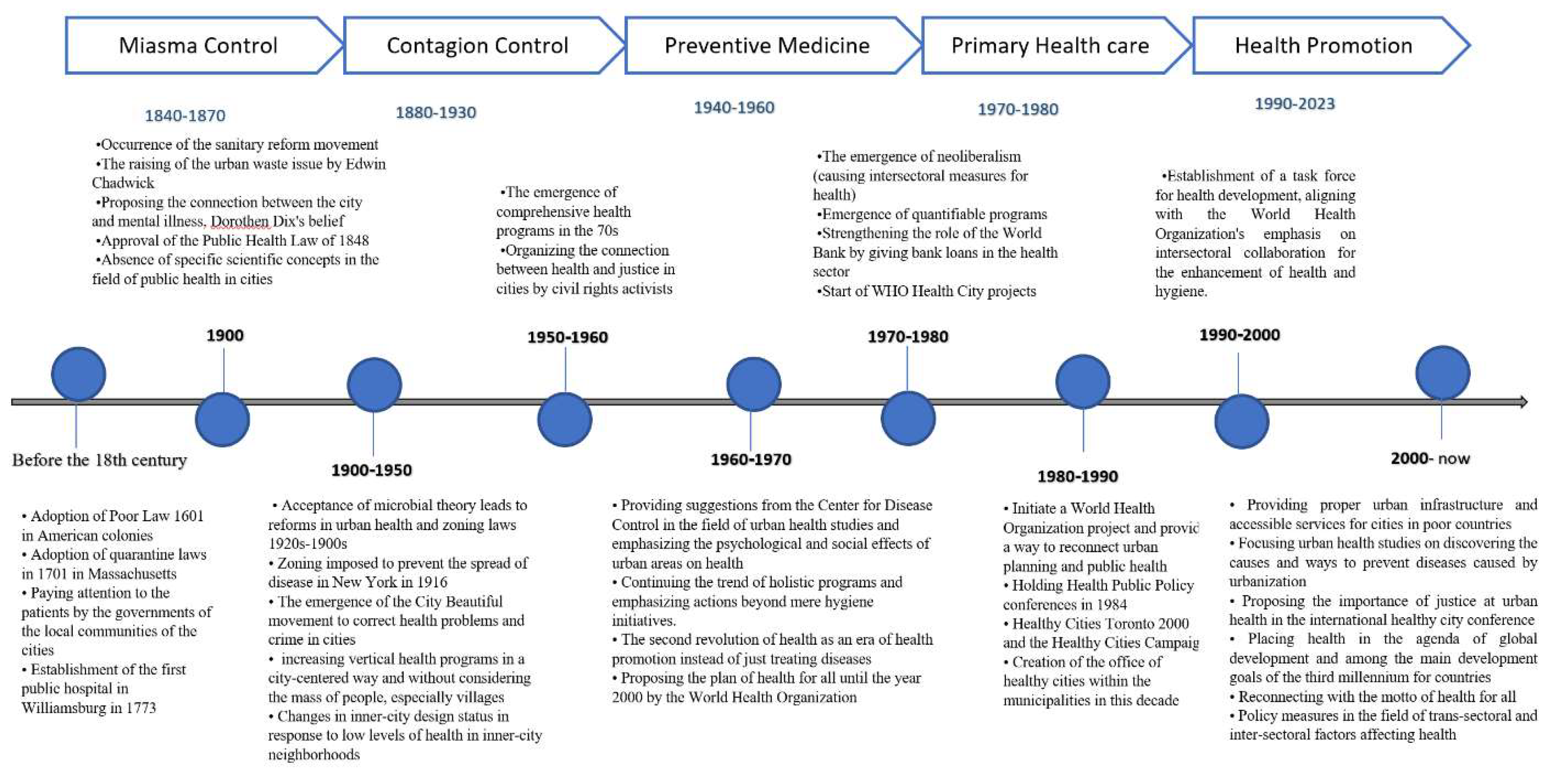
Figure 3.
The Study Area.
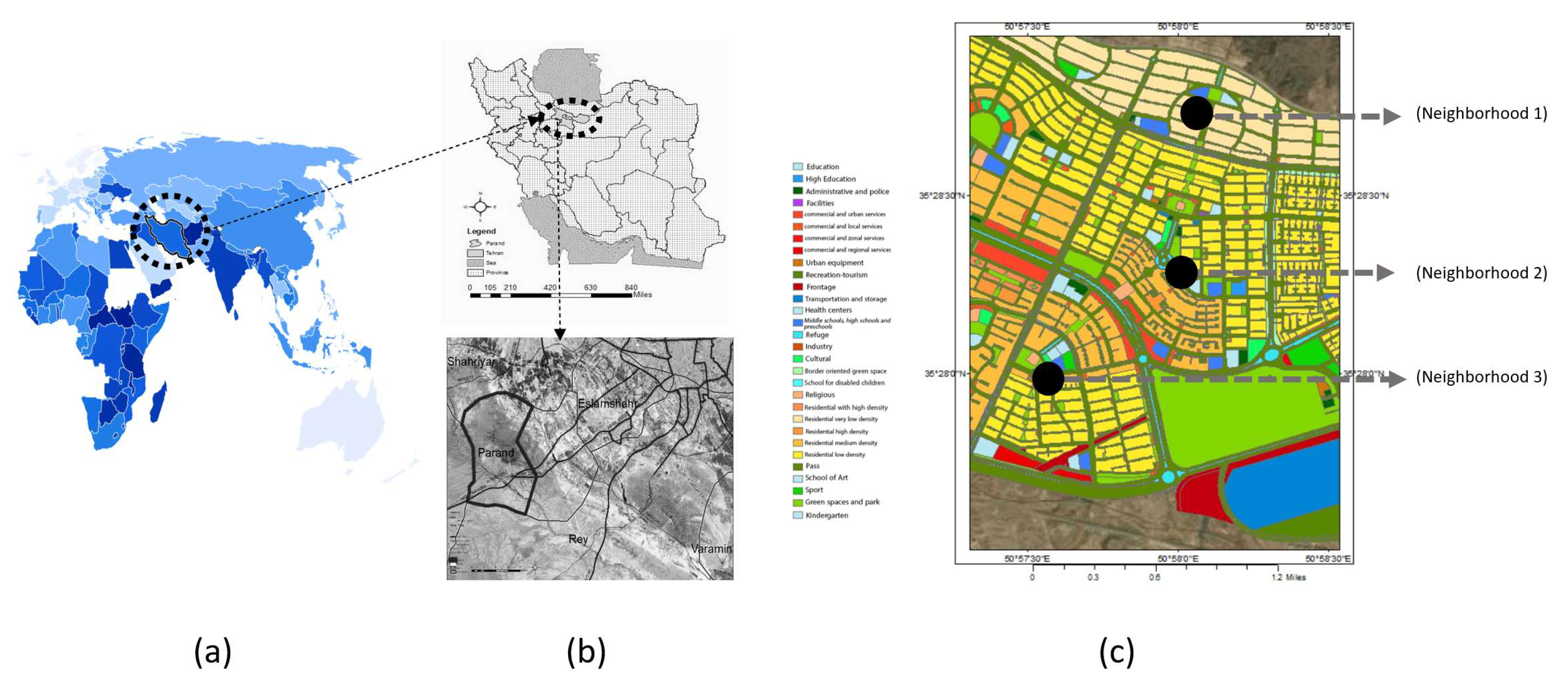
Figure 4.
Example of Conceptual linkage between urban health indicators and land use categories using MAXQDA.
Figure 4.
Example of Conceptual linkage between urban health indicators and land use categories using MAXQDA.
Scheme 1.
Scree Plot diagram of the contribution of each factor in the total variance.
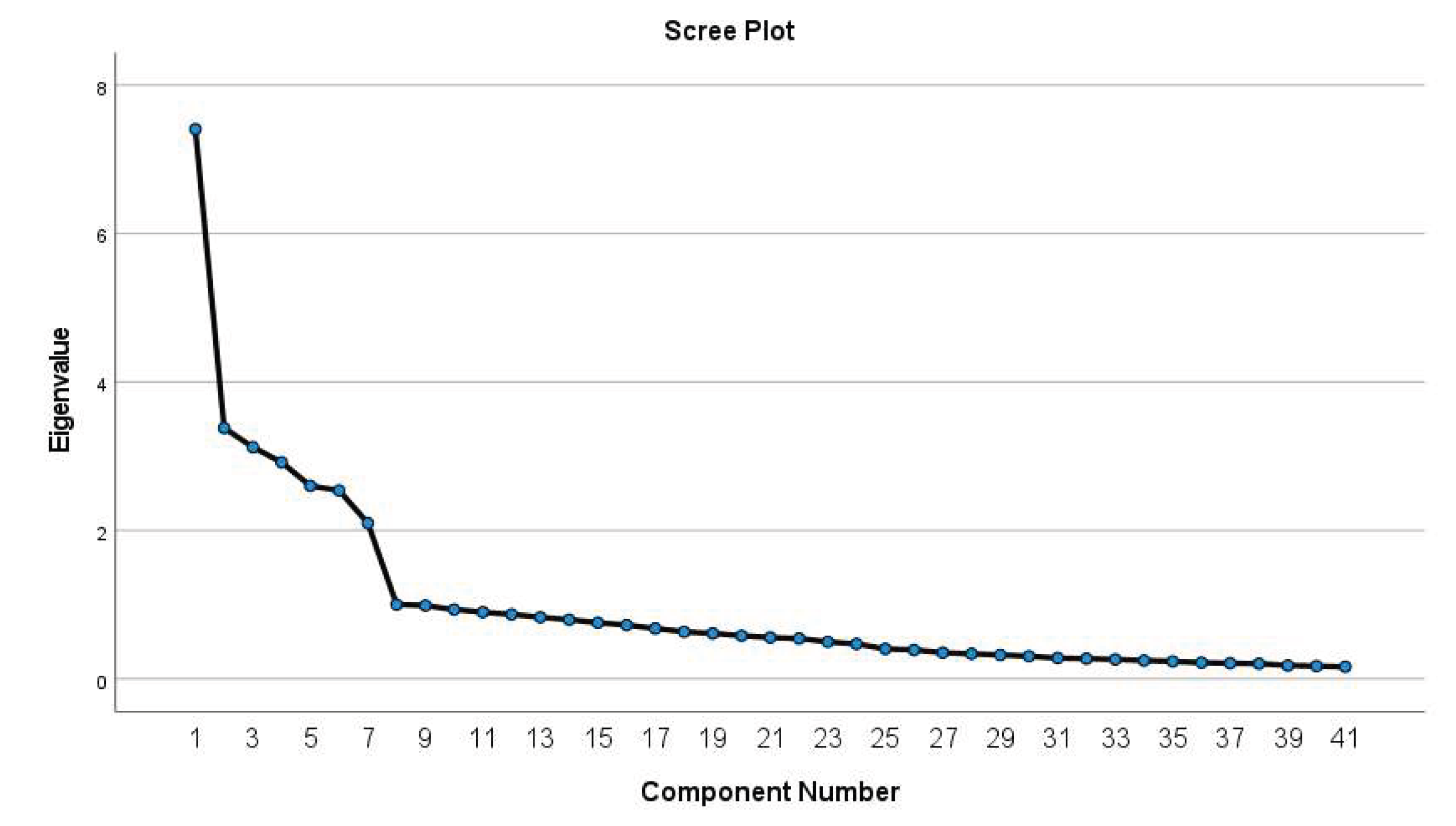
Figure 5.
Seven latent factors with key indicators and their rotated explained variance, derived from exploratory factor analysis (EFA).
Figure 5.
Seven latent factors with key indicators and their rotated explained variance, derived from exploratory factor analysis (EFA).
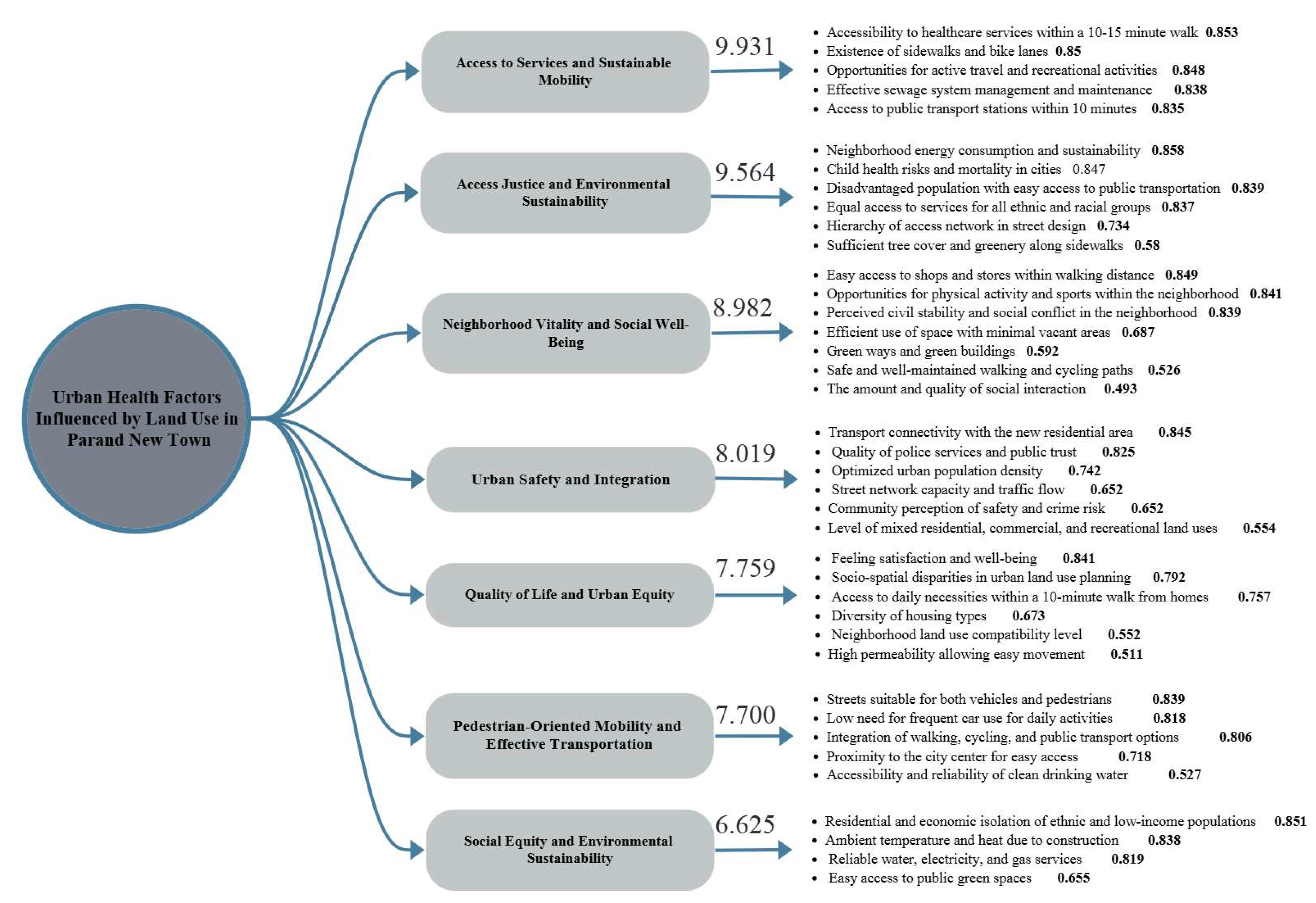
Figure 6.
Spatial representation of Urban Health scores across neighborhoods for each factor and final composite
score.
Figure 6.
Spatial representation of Urban Health scores across neighborhoods for each factor and final composite
score.
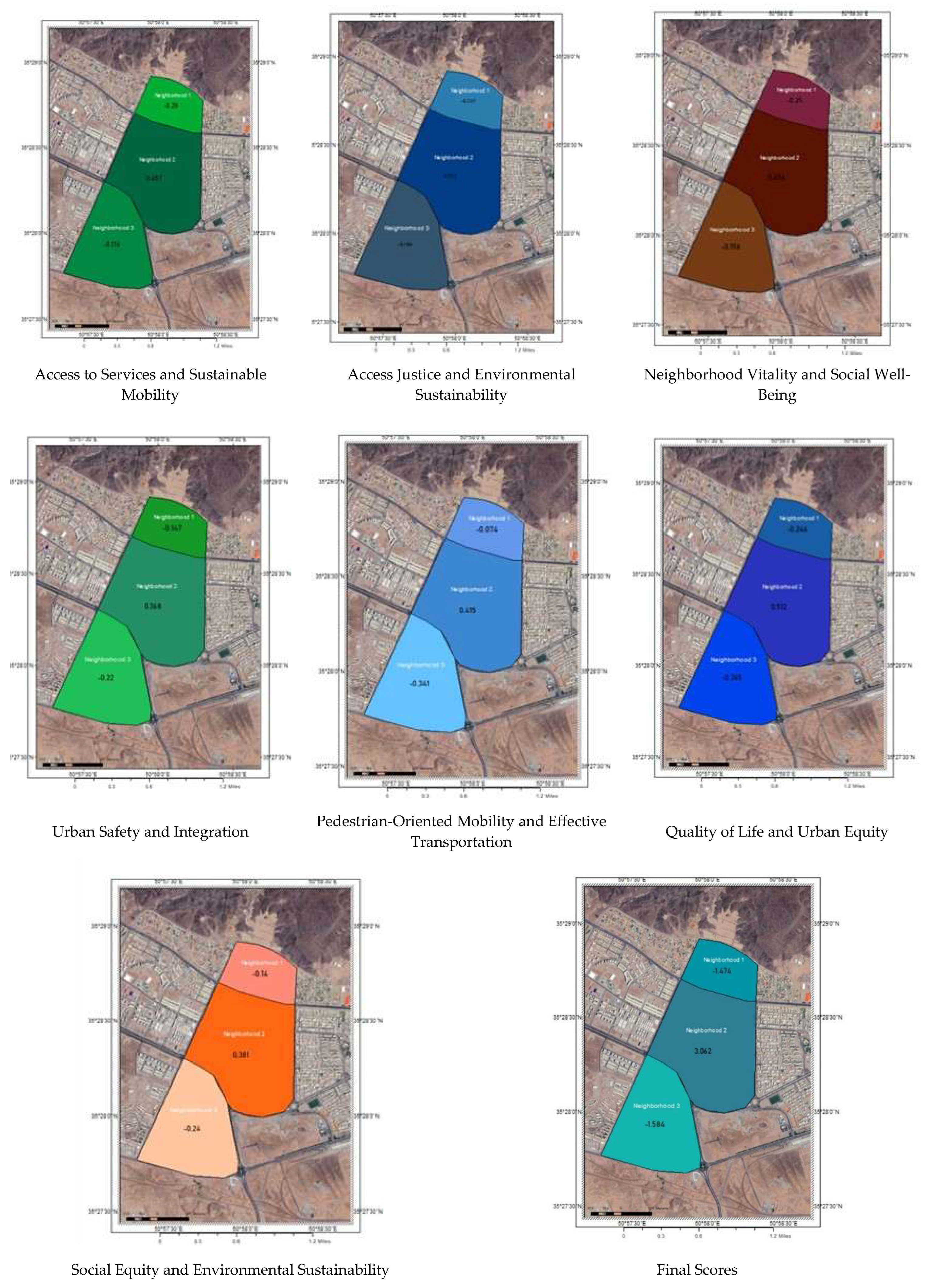
Figure 7.
Comparative Priority Index (PI) of urban health indicators in Neighborhoods 1, 2, and 3.
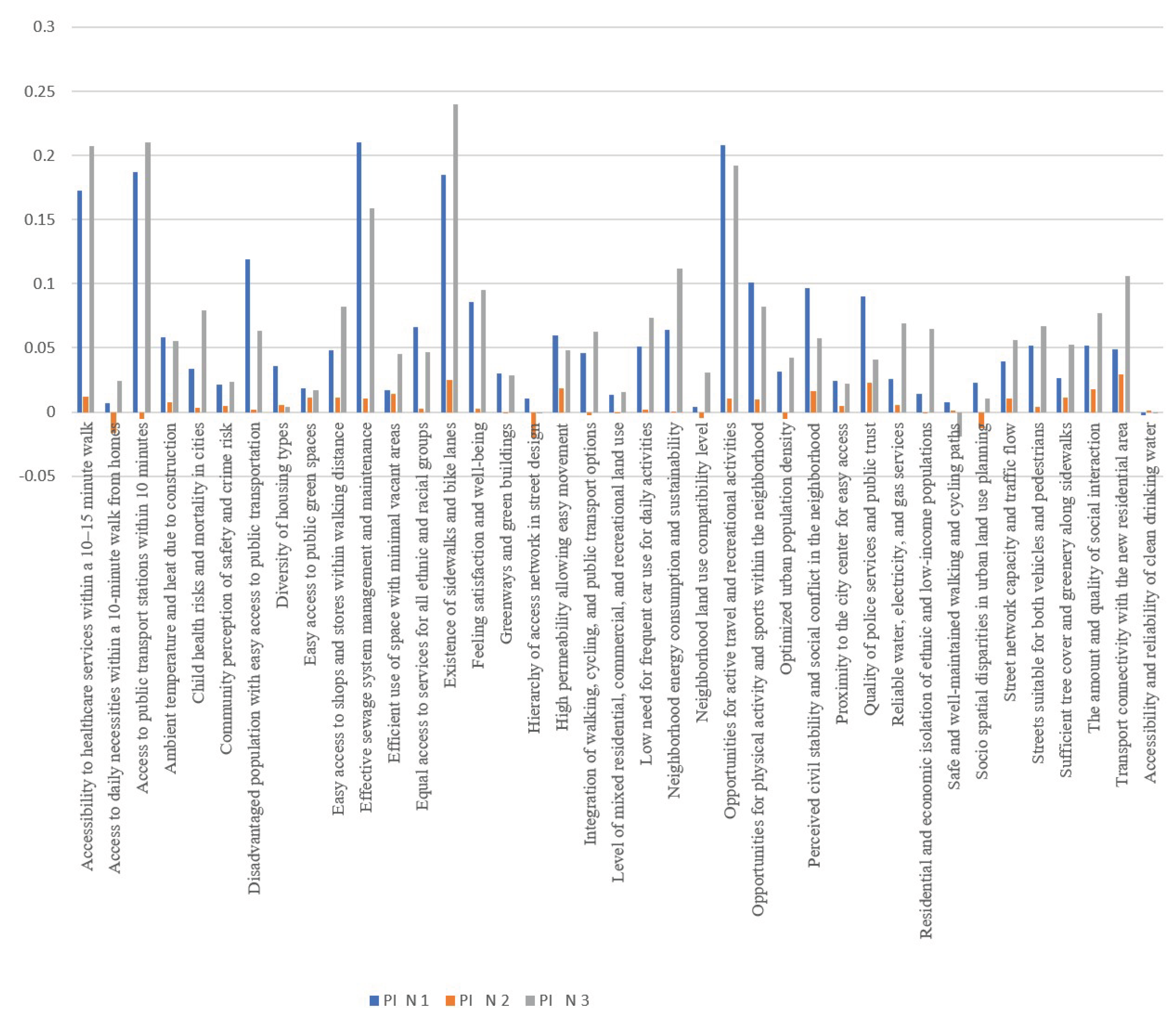
Table 1.
Quantitative effects of different land use system forms on urban health: Evidence from previous studies.
Table 1.
Quantitative effects of different land use system forms on urban health: Evidence from previous studies.
| Land use system | Quantitative effects of measured samples in some research | Cause | Consequences | Sources |
|---|---|---|---|---|
| Density | • A 1% increase in density results in a 0.07% increase in transit usage (assuming household and population densities are treated independently). • A 1% increment in intersection density is associated with a 0.23% rise in public transportation system utilization. • A 1% elevation in intersection density results in a 0.39% increase in pedestrian activity. • A 1% rise in intersection density causes a 0.12% reduction in Vehicle Miles Traveled (VMT). • Residents in these neighborhoods exhibit 5% to 15% less vehicular travel and reduced dependence on cars compared to less dense areas. |
• Support of mixed-land use • Increased density |
• Increasing the use of public transportation • Increasing walking and physical activity reduces the risk of BMI • Reducing greenhouse gas emissions • Reduce driving and reduce air pollution • Increasing traffic safety for pedestrians and cyclists |
(Ewing & Cervero, 2010) (Litman, 2005) (Haas et al., 2010) (Mumford et al., 2011) |
| Mixed-Land use | • Residents in single-land use neighborhoods exhibit a 5% to 15% reduction in vehicular travel. • A 1% increase in housing-to-job ratio leads to a 0.19% increase in walking • A 1% increase in mixed-land use development results in a 15% increase in walking behavior. |
•Attractiveness of mixed-land use for citizens | •Increasing the desire to walk to the public transportation station •Reducing driving and increasing walking and reducing BMI •Reduction of fuel consumption •Reducing greenhouse gas emissions and air pollution •Enhance perceived vitality and neighborhood safety |
(Ewing & Cervero, 2010) (Mumford et al., 2011) (Alberti et al., 2007) (VandeWeghe & Kennedy, 2007) (Lindemann, 2017) |
| TOD oriented transportation | • Doubling the neighborhood density, with all other factors held constant, results in a 5% reduction in per capita vehicle trips. • Homes situated within a 0.1-mile proximity to a public transportation system experience a 9% decrease in associated car numbers and an 11% reduction in Vehicle Miles Traveled (VMT). • A residential distance exceeding a quarter of a mile from a public transportation station leads to a 16% decline in public transportation utilization. • A workplace distance surpassing a quarter of a mile from a public transportation station leads to a 32% reduction in public transportation usage. |
• Increasing density near the public transport station | • Increasing the use of public transportation • reducing driving • Increasing walking and physical activity • Reducing the risk of obesity and BMI • Decreasing air pollution |
(Freeland et al., 2013) (Lachapelle et al., 2011) (H. S. Kim & Kim, 2004) (L. Frank et al., 2007) (Ewing & Cervero, 2010) |
| Pedestrian-oriented land use | • Neighborhoods characterized by walkability and high density exhibit a 5% to 15% reduction in Vehicle Miles Traveled (VMT) compared to car-dependent counterparts. • A 1% rise in intersection density correlates with a 0.39% increase in pedestrian activity. • Increasing neighborhood walkability is linked to 50 more minutes of walking per week • Increasing street connectivity, land use mix, residential density, and infrastructure ratio by 5% leads to a 32% rise in walking behavior. • Improving Walk Score by 10 points reduces diastolic blood pressure by 0.15 mmHg • pedestrian commuting lowers hospitalization and cardiovascular disease risks by 9–10% |
• Increased walkability | • Increasing the function of mixed-use • Reduce driving • Increasing physical activity • Decrease in BMI • Reducing the risk of cardiovascular diseases and type 2 diabetes • Reducing greenhouse gas emissions and air pollution • Increasing social connections and a sense of security in the neighborhood |
(Carlson et al., 2012) (Doyle et al., 2006) (Hoehner et al., 2011) (Litman, 2005) (Ewing & Cervero, 2010) (Braun et al., 2016; L. D. Frank et al., 2006) (Friel et al., 2024) |
| Urban parks and green areas | • In areas with a 26% tree cover, the concentration of PM10 is 1.6% lower than in areas lacking tree cover, as evidenced by a study conducted in Santiago, Chile. • The utilization of green covers and trees serves to offset 18% of industrial carbon emissions in Hangzhou, China. • Urban trees contribute to the neutralization of 1.8% to 3.4% of the total carbon content within the city. • Urban garden spaces experience an air temperature that is approximately 9 degrees Fahrenheit lower than open areas lacking tree cover. • Suburbs with tree cover exhibit temperatures about 4 to 6 degrees Fahrenheit cooler than those without tree cover. • A temperature increase of 2°F is projected to result in an additional nine deaths per 100,000 people in the United States. • A 1% standard deviation rise in temperature is associated with a 4% increase in the incidence of individual violence and a 14% increase in the frequency of group conflict. |
• Better processing of information in the human brain in open spaces | • Increase concentration of mind • Increasing social relations • Reducing stress • Reduction of depression • Reduction of children's BMI • Reducing health inequalities • Reducing crime • Increasing physical activity • Increase in retail income |
(F. J. Escobedo & Nowak, 2009) (M. Zhao et al., 2010) (F. Escobedo et al., 2010) (United States Environmental Protection Agency, 2008) (C. A. Anderson, 2001) (Hsiang et al., 2013) (Wolf, 2003) (Friel et al., 2024) |
| Regional access | • A 1% increase in access to workplaces is accompanied by a 0.2% decrease in Vehicle Miles Traveled (VMT) • According to an extensive study encompassing data from numerous major cities worldwide over several decades, an average rise of 1% in parking spaces per 1,000 employees within a central business district leads to an annual decrease of 1.27% in transit ridership. |
• Creating access with short distances • Less use of roads (highways and thoroughfares) to create access |
• Decreased VMT • Decreasing air pollution |
(Ewing & Cervero, 2010) |
| Intensive development pattern | • Metropolitan areas with sprawling development are more than twice as susceptible to the consequences of increased urban air temperatures compared to compact cities. | •Increasing density in developments | • Reducing the consequences of warming the air temperature in cities • Preservation of open lands around the city • Preventing the increase of impervious surfaces |
(U.S. Environmental Protection, 2009) (Stone et al., 2010) |
| Residential use | • They constitute 31% of the overall volume of greenhouse gas emissions. • The proportion of residential electricity allocated to electronics and consumer goods has nearly doubled in the last three decades, surging from 17% to 31%. • The residential sector accounts for 40% of the entire energy consumption associated with water usage in an urban setting. |
• Increased impervious surfaces • Disposing of toxins, garbage, sewage overflow, vehicle washing • Residential classification based on social class |
• Contamination of surface water and runoff • Increased energy consumption • Health inequalities • Increased exposure to crime |
(Colford et al., 2012) (Kenway et al., 2011) (L. M. Anderson et al., 2003) (VandeWeghe & Kennedy, 2007) (EIA, 2012) |
| Commercial use | • The commercial sector utilizes 14% of the overall energy consumption associated with water in an urban context. • Commercial activities contribute to approximately 30% of the total greenhouse gas emissions and 14% of the total energy consumption linked to water. |
• Attracting pedestrians and bicycles | • Climbing pedestrians and cyclists • Increasing traffic safety • Increasing physical activity • Decrease in BMI |
(Kenway et al., 2011) (VandeWeghe & Kennedy, 2007) |
| Industrial use | •A study conducted in Los Angeles revealed that air pollution in the region is projected to result in an additional 1,400 cancer cases per million residents. | •Toxic emissions | • Increasing in cancer • Increasing in birth defects • Increasing pollution of underground water and runoff |
(South Coast Air Quality Management, 2000) (Brender et al., 2011) (Corburn, 2009) |
| Parks and green spaces | •A sprawling urban forest park spanning 4,000 hectares contributes to a reduction in the city's air pollutant concentrations, yielding an approximate decline of 0.02% for carbon monoxide (CO), 1% for ozone, and 2% for PM10. | • Filtering air pollutants Evaporation and transpiration |
• Decreasing air pollution • Lowering the temperature of the city • Reducing the effects of heat islands in cities • Preventing drought and desertification |
(Baumgardner et al., 2012) |
| Roads | • Approximately 97% of runoff from parking lots situated along major roads consists of toxic zinc and copper, often accompanied by detectable amounts of motor oil. • The predominant focus of research in this domain has been on roads experiencing a daily traffic volume of 100,000 or more. However, certain health studies have indicated the vulnerability and sensitivity of specific groups, including children, the elderly, individuals engaged in outdoor exercise, and those with particular physical conditions, to the pollution associated with roads with a daily traffic volume as low as 10,000. |
• Proper connection between streets • Small combined blocks • Allocation of land for roads and major passages • Increased impervious surfaces |
• Increased permeability • Increasing the number of pawns • Increasing traffic safety • Soil compaction and pollution • Reducing groundwater and increasing runoff containing toxic substances • Air pollution • Birth defects |
(City of Olympia 1995) (HEI Panel on the Health Effects of Traffic-Related Air Pollution, 2010) (Baldauf et al., 2009) |
| Brownfield Site | •The abandonment of these lands inflicts considerable harm upon local communities, primarily due to the considerable health risks arising from the pollution and environmental degradation associated with these lands. | • The property of self-contamination • Prone to crime |
• Increasing environmental damage • Increasing disease prevalence • Decreasing the value of surrounding properties |
(U. E. P, 1999) (De Sousa et al., 2013) (US Environmental Protection Agency, 2012) |
Table 2.
Urban health indicators conceptually linked to land use, extracted through MAXQDA content analysis.
Table 2.
Urban health indicators conceptually linked to land use, extracted through MAXQDA content analysis.
| Category | General indicators | Sources | Customized indicators |
| Function | Access to clean, safe drinking water and sanitation | (Bain et al., 2014; Capolongo et al., 2020; Kanungo et al., 2021; M. Nieuwenhuijsen & Khreis, 2019; Quistberg et al., 2019; Thomson et al., 2019) | Accessibility and reliability of clean drinking water |
| Neighborhood cleanliness and waste management | (Capolongo et al., 2020; G. S. Smith et al., 2020; Thomson et al., 2019) | Effective sewage system management and maintenance | |
| Accessibility to retail and commercial services | (Barnett et al., 2017; Barton, 2009; Quistberg et al., 2019; Su et al., 2016; Zapata-Diomedi et al., 2016) | Easy access to shops and stores within walking distance | |
| Vehicle Miles Traveled (VMT) | (Mahdi et al., 2016; Ngo et al., 2024; M. J. Nieuwenhuijsen, 2016; M. Nieuwenhuijsen & Khreis, 2019; Valeri et al., 2022) | Low need for frequent car use for daily activities. | |
| Continuity of multimodal transportation options | (Bridgwater et al., 2022; Tanwar & Agarwal, 2025) | Integration of walking, cycling, and public transport options | |
| Access to public transportation | (Djurhuus et al., 2014; Su et al., 2016; Zapata-Diomedi et al., 2016; Y. Zhang et al., 2020) | Access to public transport stations within 10 minutes | |
| Proximity of public service centers to public transportation stations | (Fosu, 1989; Fu et al., 2021; Zapata-Diomedi et al., 2016, 2019) | Essential services like banks and schools near public transport | |
| Transportation Connectivity with New Settlements | (Andreasen & Møller-Jensen, 2017; Freeman et al., 2013; Van Nguyen & Truong, 2025) | Transport Connectivity with the New Residential Area | |
| Travel and active recreation | (Barton, 2009; de Nazelle et al., 2011; Zukowska et al., 2022) | Opportunities for active travel and recreational activities. | |
| Proximity to healthcare services | (Friesen et al., 2025; Mahdi et al., 2016; Marques da Costa et al., 2024; M. Nieuwenhuijsen & Khreis, 2019) | Accessibility to healthcare services within a 10-15 minutes walk | |
| Access to complete streets | (Fraser & Lock, 2011; Gibson & Daragh A, 2017; N. Mueller et al., 2021; Ramírez-Saiz et al., 2024; Welle, 2017) | Streets suitable for both vehicles and pedestrians | |
| The proximity of the neighborhood to the city center | (Lin et al., 2024; Quistberg et al., 2019; Ramírez-Saiz et al., 2024) | Proximity to the city center for easy access | |
| Sidewalks and bike lanes | (Fraser & Lock, 2011; N. Mueller et al., 2021; Ramírez-Saiz et al., 2024; Thomson et al., 2019; Zapata-Diomedi et al., 2016) | Existence of Sidewalks and Bike Lanes | |
| Access to daily services | (Freeman et al., 2013; Mahdi et al., 2016; Su et al., 2016) | Access to daily necessities within a 10-minute walk from homes. | |
| Mixed Land use | (Bahr, 2024; Lindemann, 2017; W. Wu et al., 2022; Y.-T. Wu et al., 2016; Yamada et al., 2012; Zapata-Diomedi et al., 2016, 2019) | Level of Mixed Residential, Commercial, and Recreational Land Uses in the Neighborhood | |
| Land Use Compatibility | (Whitehead & Dahlgren, 1991) | Neighborhood Land Use Compatibility Level | |
| Hierarchy of urban access networks and accessibility | (M. Smith et al., 2017; Zapata-Diomedi et al., 2019) | Hierarchy of Access Network in Street Design | |
| Street capacity | (M. Smith et al., 2017; Ewing & Cervero, 2010) | Street network capacity and traffic flow | |
| Community | Injustice and discrimination | (Friesen et al., 2025; Ortega-Reig et al., 2023; Quistberg et al., 2019; Yeboah et al., 2020) | Socio-Spatial Disparities in Urban Land Use Planning |
| Child mortality | (Therrien et al., 2015) | Child health risks and mortality in cities | |
| Neighborhood Social Cohesion and Quality | (Jennings & Bamkole, 2019; Qi et al., 2024; Su et al., 2016; Thomson et al., 2019) | The amount and quality of social interaction | |
| Urban population density | (Quistberg et al., 2019; Therrien et al., 2015; Yu et al., 2022) | Optimized urban population density | |
| Crime and neighborhood safety | (Barnett et al., 2017; Sypion, 2023; Thomson et al., 2019) | Community Perception of Safety and Crime Risk | |
| Civil conflict in the neighborhoods | ( Jennings & Bamkole, 2019; Quistberg et al., 2019) | Perceived Civil Stability and Social Conflict in the Neighborhood | |
| Variety of residential uses | (Zapata-Diomedi et al., 2016) | Diversity of housing types | |
| Equal access to public transport | (Ortega-Reig et al., 2023) | Disadvantaged population with easy access to public transportation | |
| Access to services and jobs for disadvantaged populations. | (Friesen et al., 2025; Prior et al., 2023) | Equal access to services for all ethnic and racial groups | |
| Ethnic and socioeconomic segregation in underserved areas | (Nicoletti et al., 2023; M. Nieuwenhuijsen & Khreis, 2019) | Residential and Economic Isolation of Ethnic and Low-Income Populations | |
| Effective law enforcement ensuring neighborhood safety | (Sherman, 2020) | Quality of police services and public trust | |
| Environment | Density of street trees and green spaces | (Barnett et al., 2017; N. Mueller et al., 2021; Yu et al., 2024) | Sufficient tree cover and greenery along sidewalks |
| Availability and access to parks and green areas | (Bahr, 2024; Buffoli & Rebecchi, 2023; Freeman et al., 2013; Sturm & Cohen, 2014) | Easy access to public green spaces | |
| Urban heat island effects and climate regulation | (Joshi et al., 2024; J.-P. Kim & Guldmann, 2014; Rendana et al., 2023; Yan et al., 2023) | Ambient temperature and heat - due to construction | |
| Management | Energy consumption and management | (Capolongo et al., 2020; J. Zhao et al., 2017) | Neighborhood Energy Consumption and Sustainability |
| Infrastructure resilience (water, electricity, gas) | (Marvin & Graham, 1993) | Reliable water, electricity, and gas services | |
| Convenience and safety of sidewalks and bicycle lanes | (Freeman et al., 2013; Litman & Blair, 2002; Loo et al., 2024) | Safe and well-maintained walking and cycling paths | |
| Landscape, and individual perception | Green corridors and sustainable urban planning | (Barton, 2009; Yu et al., 2024) | Green ways and green buildings |
| Safety and security in public spaces | (Barton, 2009; Mahdi et al., 2016; W. Wu et al., 2022; Zotova & Tarasova, 2024) | Feeling satisfaction and well-being | |
| Physical activity | (Heath et al., 2006; Matisziw et al., 2016; Powell, 2005; Wei et al., 2016; Yang, 2023; Y. Zhang et al., 2022) | Opportunities for physical activity and sports within the neighborhood | |
| Urban Morphology |
Optimal residential density | (M. Nieuwenhuijsen & Khreis, 2019; Zapata-Diomedi et al., 2016, 2019) | Adequate number of residential buildings for the population's needs |
| Spatial dispersion | (Diez Roux et al., 2019) | Efficient use of space with minimal vacant areas | |
| Permeability of streets | (Hedayati Marzbali et al., 2016; Mahdi et al., 2016) | High permeability, allowing easy movement |
Table 3.
Calculation of eigenvalues and percentage of extracted variances.
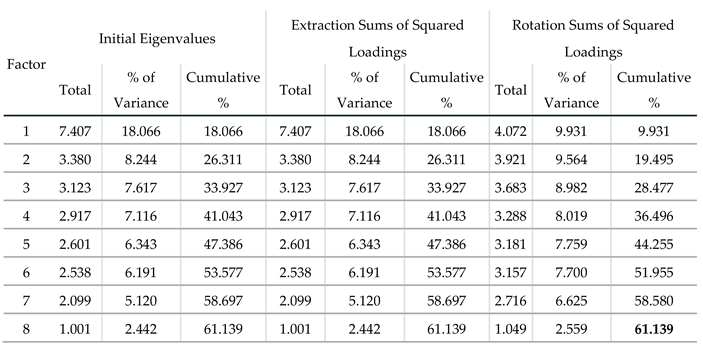 |
Table 5.
Integrated table of land use–related indicators showing Importance, Performance, and calculated Priority Index (PI) across three neighborhoods.
Table 5.
Integrated table of land use–related indicators showing Importance, Performance, and calculated Priority Index (PI) across three neighborhoods.
| Indicators | ImportanceN1 | PerformanceN1 | ImportanceN2 | Performance N2 | ImportanceN3 | PerformanceN3 | PI_N 1 | PI _N 2 | PI _N 3 |
| Accessibility to healthcare services within a 10–15 minute walk | 0.178 | 3.03 | 0.245 | 3.95 | 0.218 | 3.05 | 0.17266 | 0.01225 | 0.2071 |
| Access to daily necessities within a 10-minute walk from homes | 0.013 | 3.45 | 0.042 | 4.39 | 0.04 | 3.4 | 0.00715 | -0.01638 | 0.024 |
| Access to public transport stations within 10 minutes | 0.18 | 2.96 | 0.174 | 4.03 | 0.221 | 3.05 | 0.1872 | -0.00522 | 0.20995 |
| Ambient temperature and heat due to construction | 0.058 | 2.99 | 0.056 | 3.86 | 0.055 | 2.99 | 0.05858 | 0.00784 | 0.05555 |
| Child health risks and mortality in cities | 0.033 | 2.98 | 0.064 | 3.95 | 0.073 | 2.91 | 0.03366 | 0.0032 | 0.07957 |
| Community perception of safety and crime risk | 0.02 | 2.92 | 0.021 | 3.78 | 0.022 | 2.93 | 0.0216 | 0.00462 | 0.02354 |
| Disadvantaged population with easy access to public transportation | 0.1 | 2.81 | 0.057 | 3.97 | 0.065 | 3.03 | 0.119 | 0.00171 | 0.06305 |
| Diversity of housing types | 0.034 | 2.94 | 0.045 | 3.87 | 0.004 | 2.92 | 0.03604 | 0.00585 | 0.00432 |
| Easy access to public green spaces | 0.018 | 2.97 | 0.033 | 3.66 | 0.016 | 2.94 | 0.01854 | 0.01122 | 0.01696 |
| Easy access to shops and stores within walking distance | 0.052 | 3.07 | 0.064 | 3.82 | 0.085 | 3.03 | 0.04836 | 0.01152 | 0.08245 |
| Effective sewage system management and maintenance | 0.186 | 2.87 | 0.177 | 3.94 | 0.167 | 3.05 | 0.21018 | 0.01062 | 0.15865 |
| Efficient use of space with minimal vacant areas | 0.017 | 3.01 | 0.045 | 3.68 | 0.043 | 2.95 | 0.01683 | 0.0144 | 0.04515 |
| Equal access to services for all ethnic and racial groups | 0.064 | 2.97 | 0.066 | 3.96 | 0.054 | 3.13 | 0.06592 | 0.00264 | 0.04698 |
| Existence of sidewalks and bike lanes | 0.197 | 3.06 | 0.195 | 3.87 | 0.233 | 2.97 | 0.18518 | 0.02535 | 0.23999 |
| Feeling satisfaction and well-being | 0.083 | 2.97 | 0.029 | 3.91 | 0.097 | 3.02 | 0.08549 | 0.00261 | 0.09506 |
| Greenways and green buildings | 0.041 | 3.26 | 0.04 | 4.03 | 0.061 | 3.53 | 0.03034 | -0.0012 | 0.02867 |
| Hierarchy of access network in street design | 0.06 | 3.83 | 0.039 | 4.5 | 0.047 | 4.02 | 0.0102 | -0.0195 | -0.00094 |
| High permeability allowing easy movement | 0.056 | 2.93 | 0.07 | 3.74 | 0.061 | 3.21 | 0.05992 | 0.0182 | 0.04819 |
| Integration of walking, cycling, and public transport options | 0.05 | 3.08 | 0.073 | 4.03 | 0.06 | 2.96 | 0.046 | -0.00219 | 0.0624 |
| Level of mixed residential, commercial, and recreational land use | 0.024 | 3.43 | 0.036 | 4.01 | 0.033 | 3.53 | 0.01368 | -0.00036 | 0.01551 |
| Low need for frequent car use for daily activities | 0.057 | 3.1 | 0.076 | 3.98 | 0.077 | 3.05 | 0.0513 | 0.00152 | 0.07315 |
| Neighborhood energy consumption and sustainability | 0.056 | 2.86 | 0.075 | 3.99 | 0.115 | 3.03 | 0.06384 | 0.00075 | 0.11155 |
| Neighborhood land use compatibility level | 0.011 | 3.65 | 0.047 | 4.1 | 0.045 | 3.32 | 0.00385 | -0.0047 | 0.0306 |
| Opportunities for active travel and recreational activities | 0.198 | 2.95 | 0.213 | 3.95 | 0.216 | 3.11 | 0.2079 | 0.01065 | 0.19224 |
| Opportunities for physical activity and sports within the neighborhood | 0.09 | 2.88 | 0.087 | 3.89 | 0.092 | 3.11 | 0.1008 | 0.00957 | 0.08188 |
| Optimized urban population density | 0.065 | 3.51 | 0.061 | 4.09 | 0.062 | 3.32 | 0.03185 | -0.00549 | 0.04216 |
| Perceived civil stability and social conflict in the neighborhood | 0.101 | 3.04 | 0.1 | 3.84 | 0.058 | 3.01 | 0.09696 | 0.016 | 0.05742 |
| Proximity to the city center for easy access | 0.04 | 3.4 | 0.02 | 3.76 | 0.021 | 2.93 | 0.024 | 0.0048 | 0.02247 |
| Quality of police services and public trust | 0.094 | 3.04 | 0.085 | 3.73 | 0.043 | 3.05 | 0.09024 | 0.02295 | 0.04085 |
| Reliable water, electricity, and gas services | 0.027 | 3.04 | 0.058 | 3.91 | 0.062 | 2.89 | 0.02592 | 0.00522 | 0.06882 |
| Residential and economic isolation of ethnic and low-income populations | 0.016 | 3.11 | -0.003 | 3.83 | 0.064 | 2.99 | 0.01424 | -0.00051 | 0.06464 |
| Safe and well-maintained walking and cycling paths | 0.008 | 3.08 | 0.005 | 3.73 | -0.019 | 2.99 | 0.00736 | 0.00135 | -0.01919 |
| Socio spatial disparities in urban land use planning | 0.047 | 3.51 | 0.038 | 4.33 | 0.018 | 3.41 | 0.02303 | -0.01254 | 0.01062 |
| Street network capacity and traffic flow | 0.041 | 3.04 | 0.031 | 3.67 | 0.045 | 2.75 | 0.03936 | 0.01023 | 0.05625 |
| Streets suitable for both vehicles and pedestrians | 0.062 | 3.16 | 0.043 | 3.9 | 0.066 | 2.99 | 0.05208 | 0.0043 | 0.06666 |
| Sufficient tree cover and greenery along sidewalks | 0.031 | 3.15 | 0.039 | 3.71 | 0.053 | 3.01 | 0.02635 | 0.01131 | 0.05247 |
| The amount and quality of social interaction | 0.049 | 2.95 | 0.046 | 3.62 | 0.086 | 3.1 | 0.05145 | 0.01748 | 0.0774 |
| Transport connectivity with the new residential area | 0.048 | 2.98 | 0.086 | 3.66 | 0.104 | 2.98 | 0.04896 | 0.02924 | 0.10608 |
| Accessibility and reliability of clean drinking water | -0.005 | 3.46 | 0.009 | 3.87 | -0.001 | 3.2 | -0.0027 | 0.00117 | -0.0008 |
Note: Colors indicate urgency: red = high, yellow = moderate, green = low, Negative Priority Index values indicate indicators performing above the ideal threshold and thus requiring no intervention.
Disclaimer/Publisher’s Note: The statements, opinions and data contained in all publications are solely those of the individual author(s) and contributor(s) and not of MDPI and/or the editor(s). MDPI and/or the editor(s) disclaim responsibility for any injury to people or property resulting from any ideas, methods, instructions or products referred to in the content. |
© 2026 by the authors. Licensee MDPI, Basel, Switzerland. This article is an open access article distributed under the terms and conditions of the Creative Commons Attribution (CC BY) license.
Copyright: This open access article is published under a Creative Commons CC BY 4.0 license, which permit the free download, distribution, and reuse, provided that the author and preprint are cited in any reuse.


