

Submitted:
20 March 2026
Posted:
23 March 2026
You are already at the latest version
Abstract
Background: Organized colorectal cancer (CRC) screening programs have been widely implemented across Europe; however, robust population-level evaluations of their real-world effectiveness, particularly for programmes based exclusively on faecal immunochemical testing (FIT), remain limited. The Galician CRC screening programme was progressively implemented between 2013 and 2019. Methods: We conducted a population-based ecological time-series study using data from the Galician Tumour Registry (ICD-10 C18–C21) for 2015–2023. Age-standardized mortality (ASMR) and incidence (ASIR) rates were analyzed. Structural changes associated with program implementation were evaluated using interrupted time-series (ITS) models, estimating annual percent change (APC) before and after implementation and the net change in slope (ΔAPC). Absolute and relative changes in ASMR and ASIR were calculated by comparing 2015–2017 and 2019–2023. Analyses were performed for the overall population and for individuals aged 50–69 years. Results: Between 2015 and 2023, overall CRC mortality declined significantly (APC −3.00%; 95% CI −3.37 to −2.63). ITS analysis demonstrated a marked modification of mortality trajectories following program implementation. Mortality shifted from an increasing pre-implementation slope (APC +13.70%; 95% CI 10.12, 17.39) to a significant annual decline post-implementation (APC −3.62%; 95% CI −4.47, −2.76), yielding a ΔAPC of −17.32. In individuals aged 50–69 years, the structural change was more pronounced (ΔAPC −19.88), with post-implementation mortality decreasing by −8.08% annually (95% CI −10.43, −5.66). Incidence showed a comparable structural modification. Overall APC changed from +15.26% (95% CI 5.48, 25.95) before implementation to −2.48% (95% CI −5.29, 0.41) afterwards (ΔAPC −17.74). In the screening-eligible population, APC shifted from +21.32% (95% CI 4.60, 40.71) to −3.74% (95% CI −7.62, 0.30), corresponding to a ΔAPC of −25.06. Descriptively, ASMR declined from 41.92 to 35.91 per 100,000 (−14.33%), and ASIR from 98.37 to 85.16 per 100,000 (−13.42%) between 2015–2017 and 2019–2023. Relative reductions were larger in individuals aged 50–69 years and were more pronounced for colon cancer than for rectal cancer. Conclusions: Implementation of an organized FIT-based screening program was associated with a structural change in CRC mortality and incidence trends, particularly among individuals aged 50–69 years.
Keywords:
colorectal cancer
; population-based screening
; fecal immunochemical test
; effectiveness
; cancer registry
1. Introduction
Colorectal cancer (CRC) represents a major public health challenge in the Western world, and particularly in Spain, where it is the most frequently diagnosed malignancy and the second leading cause of cancer-related death. However, its natural history—characterised by slow progression from precursor lesions and a prolonged asymptomatic phase—provides a critical window of opportunity for early detection and for interrupting the adenoma–carcinoma sequence before the disease progresses to advanced, life-threatening stages [1].
The implementation of population-based CRC screening programmes has been underpinned by robust evidence derived from randomised controlled trials conducted in Western populations. Early landmark studies based on guaiac faecal occult blood testing (gFOBT) demonstrated that screening significantly reduces CRC-specific mortality, with relative reductions ranging from approximately 16% in intention-to-treat analyses to up to 33% among adherent participants. However, these trials did not demonstrate a short-term reduction in CRC incidence[2,3,4].
The introduction of the faecal immunochemical test (FIT) substantially improved diagnostic performance, offering higher sensitivity for advanced neoplasia and enabling quantitative threshold adjustment. Observational population-based studies have reported substantial reductions in CRC mortality and, in some settings, incidence following organised FIT-based screening [5,6]. Large longitudinal population studies in Italy and the United States have reported mortality reductions exceeding 50% among highly adherent participants[6,7,8]. Similarly, national experience in Taiwan has confirmed these benefits in Asian populations, showing a 35% reduction in CRC mortality [9]. These analyses have also documented reductions in CRC incidence, ranging from 10% to 25%, likely reflecting the detection and removal of precursor lesions [10].
A recent global systematic review and meta-analysis of 58 organised CRC screening programmes across 22 countries reported an overall 41.8% reduction in CRC-related mortality associated with organised screening [11] However, the majority of included programmes were originally based on guaiac faecal occult blood testing (gFOBT) or mixed modalities, and only a minority were implemented as exclusively FIT-based strategies from inception. Moreover, FIT-specific mortality reductions were strongly influenced by programme duration, with limited statistical significance observed in programmes with shorter follow-up. These findings highlight the need for long-term, real-world evaluations of organised FIT-based screening programmes using high-quality population registry data.
To address this evidence gap, we evaluated the population-level impact of the Galician Colorectal Cancer Early Detection Programme (PGDPCC) [12], an organised FIT-based screening programme implemented asynchronously across healthcare areas. Using population-based cancer registry data, we analysed trends in colorectal cancer mortality and incidence and formally assessed structural changes in temporal trajectories following programme implementation.
2. Materials and Methods
Study Design and Setting
We conducted a retrospective, population-based observational study to evaluate temporal changes in colorectal cancer (CRC) mortality and incidence following the implementation of the organised population-based screening programme (PGDPCC) in Galicia, Spain. The study period extended from 1 January 2015 to 31 December 2023, enabling assessment of epidemiological trends after the phased roll-out of the programme.
The PGDPCC is an organised screening programme based on biennial faecal immunochemical testing (FIT), using a threshold of 20 μg haemoglobin per gram of faeces, targeting individuals aged 50–69 years. Implementation occurred asynchronously across the seven healthcare areas between 2013 and 2019.
This study represents an analysis of routinely collected public health data derived from established administrative and cancer registry databases. All data were fully anonymised prior to analysis, and no individual-level identifiers were accessible to the investigators. In accordance with Spanish legis-lation, formal research ethics committee approval was not required, and informed consent was not applicable.
Study Population and Data Sources
The study covered the entire Autonomous Community of Galicia. Population denominators were obtained from the official regional health insurance registry (SIAC). CRC mortality and incidence data were obtained from the Galician Tumour Registry (REGAT) [13], a cancer population-based registry. All malignant neoplasms coded as ICD-10 C18–C21 diagnosed or recorded between 2015 and 2023 were included. REGAT provided annual age-standardised mortality rates (ASMR) and age-standardised incidence rates (ASIR), expressed per 100,000 inhabitants. Rates were available stratified by age group (<50, 50–69, ≥70 years), sex, tumour location (colon and rectum), and healthcare area.
Outcomes
The primary outcomes were ASMR and ASIR for CRC, expressed per 100,000 inhabitants.
Statistical Analysis
Interrupted time series analysis
The primary analytical approach was interrupted time series (ITS) analysis using segmented log-linear regression. This quasi-experimental method allows estimation of changes in outcome trajec-tories following the introduction of a population-level intervention while accounting for underlying secular trends.
Given the asynchronous roll-out of the PGDPCC, pre- and post-implementation periods were defi-ned separately for each healthcare area. To reflect the expected delay between screening exposu-re and measurable population-level impact, a two-year latency period following programme initiation was incorporated into the definition of the post-implementation phase (Supplementary Table S1).
For each area and cohort, annual age-standardised rates were modelled as a function of time, with parameters representing the baseline pre-implementation trend and the change in slope after im-plementation. From these segmented models, the Annual Percent Change (APC) was estimated for both pre- and post-implementation periods, calculated as:
APC = (e^β − 1) × 100.
The net change in slope (ΔAPC) was defined as the difference between post- and pre-implementation APC estimates and interpreted as a measure of structural change in trend.
Area-specific APC estimates were aggregated at regional level using population-weighted ave-rages. Statistical inference was restricted to periods with at least three annual observations to ensu-re stability of slope estimation. Because ΔAPC represents the difference between correlated slope estimates derived from the same segmented model, formal confidence intervals were not calcula-ted for this metric; it was interpreted descriptively alongside the statistical significance of the pre- and post-implementation slopes.
Model assumptions were evaluated by inspection of residual plots and assessment of first-order autocorrelation. Given the limited number of annual observations per segment, formal autoregressi-ve correction was not implemented. No consistent residual autocorrelation patterns were detected that would materially affect slope estimation.
Overall secular trend analysis
In addition to the ITS approach, we summarised overall secular trends across 2015–2023 using log-linear models to provide a global APC estimate independent of programme timing, as a descriptive complement to the segmented ITS results. These models characterised the general temporal evolu-tion of CRC mortality and incidence and were interpreted in conjunction with the ITS results.
Absolute and relative changes in age-standardised rates
To contextualise the magnitude of changes at the population level, complementary descriptive analyses compared two aggregated periods: a pre-screening reference period (2015–2017) and a post-implementation period (2019–2023). The year 2018 was considered transitional and excluded from these comparisons to minimise contamination by partial implementation effects.
For each stratum, we computed the mean annual ASMR/ASIR in 2015–2017 and 2019–2023. 95% confidence intervals (95% CI) for period means and for absolute differences were derived using t-distribution methods based on the annual observations within each period; relative changes were expressed as percentage variation relative to the pre-period mean.
Estimation of potentially avoided deaths and incident cases
As an extension of the descriptive pre–post comparison, the number of potentially avoided deaths and incident CRC cases during 2019–2023 was estimated using a counterfactual approach. For each stratum, the mean crude rate observed during 2015–2017 was applied to the corresponding population size of each year in the post-implementation period to derive the expected number of events under the assumption of continuation of pre-screening rates. Observed counts were obtai-ned from registry data. The difference between expected and observed events was interpreted as the number of potentially avoided cases or deaths. Confidence intervals were estimated using non-parametric bootstrap resampling of annual counts within each period (1,000 resamples), and per-centile-based 95% CIs were reported.
Stratified and exploratory analyses
All analyses were conducted for the overall population and separately for individuals aged 50–69 years. Stratified analyses by sex, age group, and tumour location were performed to assess consis-tency and specificity of observed effects. Given the small number of healthcare areas, the partici-pation–impact association was assessed using Spearman’s rank correlation (two-sided α=0.05).
Statistical software
All statistical analyses were performed using IBM SPSS Statistics version 25.0 (IBM Corp., Ar-monk, NY, USA). Two-sided p-values <0.05 were considered statistically significant.
3. Results
Area-Level Analysis
Segmented regression models incorporating area-specific implementation dates revealed heterogeneity in post-implementation trends across healthcare areas (Supplementary Table S2). In the post-implementation period, significant declines in CRC mortality were observed in A Coruña, Santiago, Ourense, Pontevedra, and Vigo. In Ferrol and Lugo, mortality slopes were negative but did not reach statistical significance. In the screening-eligible population (50–69 years), post-implementation mortality reductions were more pronounced, particularly in A Coruña (APC −14.27%; 95% CI −17.57 to −10.85), Lugo (−10.68%; 95% CI −19.65 to −1.10), Vigo (−7.96%; 95% CI −14.90 to −0.46), and Santiago (−4.78%; 95% CI −8.80 to −0.59). Post-implementation incidence slopes were more variable and did not consistently achieve statistical significance across areas.
Aggregated Regional ITS Analysis
Before programme implementation, overall CRC mortality exhibited a statistically significant increasing trend (APC +13.70%; 95% CI 10.12 to 17.39). Following implementation, this trend reversed to a statistically significant decline (APC −3.62%; 95% CI −4.47 to −2.76), corresponding to a net change in slope (ΔAPC) of −17.32 percentage points. In the screening-eligible population (50–69 years), the structural change was more pronounced (ΔAPC −19.88), with slopes shifting from +11.80% (95% CI 1.86 to 22.72) before implementation to −8.08% (95% CI −10.43 to −5.66) thereafter (Table 1, Supplementary figure S1).
Among individuals aged ≥70 years, mortality also shifted from a marked pre-implementation increase (APC +20.35%; 95% CI 14.42 to 26.60) to a significant post-implementation decline (−2.22%; 95% CI −3.40 to −1.02), yielding ΔAPC −22.57. In contrast, among individuals aged <50 years, no consistent reversal of trend was observed; estimates were imprecise and slopes did not demonstrate clear structural modification.
Sex-specific analyses demonstrated a substantial structural change in men (ΔAPC −20.99), with slopes shifting from +17.59% to −3.40%. In women, although the pre-implementation slope was positive but not statistically significant (+7.55%; 95% CI −1.54 to 17.49), the post-implementation decline was significant (−3.41%; 95% CI −5.47 to −1.31), yielding ΔAPC −10.97. By tumour location, both colon and rectal cancers demonstrated reversal of slope following programme implementation. The structural change was slightly greater for colon cancer (ΔAPC −14.94) than for rectal cancer (ΔAPC −15.19), consistent with the expected biological performance of FIT-based screening.
For incidence, the overall APC changed from +15.26% (95% CI 5.48 to 25.95) to −2.48% (95% CI −5.29 to 0.41), with ΔAPC −17.74. Among individuals aged 50–69 years, ΔAPC reached −25.06, reflecting a marked modification in incidence trajectory after programme implementation (Table 1, Supplementary figure S2).
Overall Secular Trend Analysis (2015–2023)
Across the full study period, independent of programme timing, overall CRC mortality showed a significant downward trend (APC −3.00%; 95% CI −3.37 to −2.63) (Table 2, Figure 1). A similar decline was observed for incidence (APC −2.58%; 95% CI −5.60 to 0.40). The reduction in mortality was more pronounced in the screening-eligible population (APC −5.18%; 95% CI −7.40 to −3.30), whereas trends were attenuated in individuals aged ≥70 years and non-significant among those aged <50 years (Table 2, Figure 2). These estimates describe the overall temporal evolution and provide contextual information for the segmented ITS findings.
Age-standardised mortality and incidence rates are presented per 100,000 inhabitants. Dashed lines represent fitted log-linear regression models used to estimate the overall annual percent change (APC) across the full 2015–2023 period. APC values and 95% confidence intervals were derived from regression coefficients (β) of the model ln(rate) = α + β × year. Statistical significance was assessed using two-sided Wald tests for β = 0. The vertical dashed line indicates the transitional year (2018) following programme implementation.
Absolute and Relative Changes in Age-Standardised Rates
Complementary pre–post comparisons (2015–2017 vs 2019–2023) further contextualised the magnitude of observed changes (Table 3 and 4). The overall ASMR declined from 41.92 (95% CI 40.26 to 43.58) to 35.91 (95% CI 33.92 to 37.90) per 100,000 inhabitants, corresponding to an absolute reduction of −6.01 per 100,000 (95% CI −8.00 to −4.02) and a relative decrease of −14.33% (95% CI −17.53 to −11.06) (Table 3, Figure 1). Among individuals aged 50–69 years, the relative reduction reached −20.98% (95% CI −29.92 to −11.78). Reductions were observed in both men (−15.61%) and women (−13.74%). By tumour site, mortality declined more markedly for colon cancer (−15.67%) than for rectal cancer (−10.62%) (Figure 2).
The overall ASIR declined from 98.37 (95% CI 94.10 to 102.60) to 85.16 (95% CI 81.40 to 88.90) per 100,000 inhabitants (Table 4, Figure 1), corresponding to an absolute reduction of −13.20 per 100,000 (95% CI −21.49 to −4.87) and a relative decrease of −13.42% (95% CI −21.60 to −5.10). In individuals aged 50–69 years, the relative reduction was −14.78% (95% CI −25.58 to −3.61). As with mortality, declines were more pronounced for colon than rectal cancer (Figure 2).

Table 3.
Age-standardised mortality rates (ASMR). Comparison between 2015–2017 and 2019–2023.
| Stratum | ASMR 2015–2017 (95% CI) |
ASMR 2019–2023 (95% CI) |
Absolute change (95% CI) |
Relative change (%) (95% CI) |
Avoided deaths 2019–2023 (95% CI) |
|---|---|---|---|---|---|
| Overall | 41.92 (40.26, 43.58) | 35.91 (33.92, 37.90) | −6.01 (−8.00, −4.02) | −14.33% (−17.53, −11.06) | 476 (380, 578) |
| Sex | |||||
| Men | 61.33 (57.90, 64.80) | 51.75 (49.90, 53.60) | −9.58 (−11.92, −7.17) | −15.61% (−19.33, −11.80) | 301 (182, 435) |
| Women | 28.06 (25.90, 30.20) | 24.21 (23.10, 25.30) | −3.86 (−5.85, −1.95) | −13.74% (−20.08, −7.17) | 173 (25, 320) |
| Age | |||||
| 18–49 years | 1.64 (1.32, 1.96) | 2.03 (1.65, 2.42) | 0.39 (−0.11, 0.81) | 23.51% (−5.93, 53.12) | −31 (−56, 0) |
| 50–69 years | 38.06 (35.20, 40.90) | 30.08 (28.40, 31.80) | −7.98 (−11.41, −4.48) | −20.98% (−29.92, −11.78) | 316 (186, 457) |
| ≥70 years | 168.78 (162.50, 175.00) | 147.26 (143.10, 151.40) | −21.52 (−27.42, −16.37) | −12.75% (−15.93, −9.82) | 590 (462, 712) |
| Location | |||||
| Colon | 30.83 (29.10, 32.60) | 26.00 (24.90, 27.10) | −4.83 (−6.26, −3.42) | −15.67% (−19.94, −11.34) | 389 (298, 496) |
| Rectum | 11.09 (10.30, 11.90) | 9.92 (9.30, 10.60) | −1.18 (−1.66, −0.75) | −10.62% (−14.82, −6.87) | 87 (11, 167) |
Mean ASMR values were calculated for 2015–2017 and 2019–2023. Absolute and relative changes were computed directly from period means. Ninety-five percent confidence intervals (95% CI) were estimated using parametric methods based on the t-distribution. Potentially avoided deaths were estimated using a counterfactual approach based on pre-implementation crude rates applied to post-period population denominators. Confidence intervals were derived using non-parametric bootstrap resampling of annual event counts.
A-Mortality according to age groups, B-Incidence according to age groups, C-Mortality according to sex, D-Incidence according to sex, E-Mortality according to tumour location, F-Incidence according to tumour location
Annual percent changes (APC) were estimated using log-linear regression models fitted to age-standardised rates over the full study period (2015–2023). APC and 95% confidence intervals were calculated from model coefficients using APC = (e^β − 1) × 100. Statistical significance was assessed using two-sided Wald tests.
Estimated Potentially Avoided Deaths and Cases
Using a counterfactual approach based on pre-screening crude rates, an estimated 476 CRC deaths (95% CI 380 to 578) may have been avoided in Galicia during 2019–2023 (Table 3). Within the screening-eligible population, approximately 316 deaths (95% CI 186 to 457) were potentially avoided. For incidence, an estimated 1,034 cases (95% CI −27 to 2,195) may have been avoided during 2019–2023 (Table 4), although uncertainty was greater due to temporal variability.
Participation and Exploratory Analysis
First-round participation ranged from 36.9% to 50.9% across healthcare areas. No statistically significant correlation was observed between participation rates and post-implementation mortality APC in the 50–69-year cohort (Spearman’s ρ = 0.429; p = 0.337) (Supplementary figure S3).
4. Discussion
In this population-based study evaluating the implementation of an organised biennial FIT-based CRC screening programme in Galicia, we observed a structural modification in mortality trends following programme roll-out, particularly in the screening-eligible population aged 50–69 years. ITS analysis showed a reversal from increasing pre-implementation mortality slopes to sustained declines in the post-implementation period. Complementary analyses of age-standardised rates confirmed absolute and relative reductions in both mortality and incidence between the aggregated pre- and post-implementation periods. These effects were more pronounced in the target age group and for colon cancer, while no consistent trend reversal was observed in individuals younger than 50 years. Together, these findings support a population-level impact of organised FIT-based screening in a real-world setting and contribute to the limited body of evidence on the effectiveness—rather than efficacy—of contemporary CRC screening programmes.
The efficacy of CRC screening has been firmly established in randomised controlled trials (RCTs) and meta-analysis[14]. Classic guaiac-based faecal occult blood test (gFOBT) trials demonstrated reductions in CRC mortality ranging from 15% to 33% among participants, laying the foundation for organised screening strategies. Flexible sigmoidoscopy trials subsequently demonstrated reductions in both incidence and mortality, reinforcing the preventive potential of endoscopic screening.
More recently, pragmatic RCTs have added new evidence. The NordICC trial evaluating colonoscopy versus no screening reported a reduction in CRC incidence but only modest mortality effects at 10 years in intention-to-screen analysis, strongly influenced by participation rates[15]. Similarly, the Swedish SCREESCO trial comparing colonoscopy, FIT, and usual care demonstrated stage shift and increased early detection, although mortality results require longer follow-up[16]. The Spanish COLONPREV trial confirmed comparable detection performance between colonoscopy and FIT strategies[17] While these RCTs establish screening efficacy under controlled conditions, they do not directly address how organised programmes perform at the population level once scaled within public health systems.
Despite widespread adoption of FIT as the primary screening modality, robust evaluations of its real-world population effectiveness remain comparatively scarce. Several observational studies have suggested substantial mortality reductions in organised settings. Zorzi et al. reported significant mortality declines associated with FIT-based screening in Italy[6,18]. Levin et al., analysing Kaiser Permanente data, demonstrated marked reductions in CRC mortality following organised FIT implementation[8]. Similarly, Su et al. described reductions in incidence and mortality following programme introduction in a large community-based population[9].
However, much of the published evidence reflects programmes that initially relied on guaiac-FOBT before transitioning to FIT, complicating attribution of observed effects specifically to FIT-based strategies. A recent systematic review and meta-analysis[11] highlighted that relatively few evaluated programmes were exclusively FIT-based from inception. Furthermore, heterogeneity in participation, programme maturity, and analytical design limits comparability across settings. In this context, our study adds population-level evidence from a region-wide organised FIT programme with asynchronous implementation and a unified public health framework. By applying interrupted time series methods with area-specific roll-out definitions and latency assumptions, we attempted to disentangle secular trends from structural changes attributable to screening introduction.
Unlike simple pre–post comparisons, ITS analysis allows formal modelling of pre-existing trends and estimation of slope changes following intervention introduction. This quasi-experimental approach is recommended when randomisation is not feasible[19,20]. By modelling pre- and post-implementation slopes separately and estimating ΔAPC, our study provides a measure of structural modification rather than mere temporal coincidence. The absence of comparable changes in the <50-year cohort strengthens causal plausibility.
Observed differences in the magnitude of incidence and mortality reductions according to sex are consistent with patterns previously described in population-based colorectal cancer screening programmes. In our study, reductions appeared more pronounced in men than in women. This finding is biologically and epidemiologically plausible and has been repeatedly observed in FIT-based screening settings, where men tend to have higher faecal haemoglobin concentrations, higher positivity rates, and higher detection rates for advanced neoplasia compared with women. As a result, FIT-based programmes may achieve greater early detection efficiency in men under a single threshold strategy.[21,22] Large population studies from organised screening programmes have consistently reported higher detection rates and positivity among men, as well as sex-related differences in interval cancer proportions and screening sensitivity. For example, analyses from the Basque population screening programme demonstrated substantially higher positivity and advanced neoplasia detection rates in men compared with women across different FIT thresholds.[23] Similarly, evaluations of the Scottish FIT programme have shown that interval cancer proportions are higher in women, suggesting lower test sensitivity when a single faecal haemoglobin threshold is applied to both sexes.[22]
Differences between colon and rectal cancers should be interpreted cautiously. Most stu-dies evaluating the effectiveness of colorectal cancer screening analyse outcomes ac-cording to proximal versus distal colon, rather than separating rectal cancer as an inde-pendent subsite. These subsite-specific analyses reflect known biological and epidemio-logical differences along the colorectum and have shown that screening effectiveness may vary by tumour location, particularly between proximal and distal disease.[24] In our study, registry data did not allow a robust stratification distinguishing distal colon from rec-tal cancers within the analytical framework used. Therefore, although reductions in inci-dence and mortality appeared smaller for rectal cancer, the mechanisms underlying this pattern remain uncertain. Earlier symptomatic presentation of rectal tumours may partly contribute, but current evidence specifically addressing rectal cancer within population screening programmes remains limited.[25]
Several strengths reinforce the interpretability of our results. We analysed consolidated population-based registry data covering the entire Autonomous Community, ensuring complete capture of CRC mortality and incidence. The asynchronous implementation across healthcare areas provided natural variation in intervention timing, strengthening quasi-experimental leverage. Age-stratified analyses, including individuals younger than screening age, functioned as internal negative controls. Moreover, the combination of segmented ITS, overall secular trend estimation, and complementary pre–post comparisons allowed triangulation of findings rather than reliance on a single analytical framework.
Nonetheless, several limitations merit consideration. First, this was an ecological population-level analysis; individual-level linkage between screening participation, adherence, and outcomes was not available. Consequently, causal attribution cannot be considered definitive. Although the <50-year cohort functioned as an internal negative control, the absence of an external contemporaneous comparison region limits the ability to fully exclude residual confounding by unmeasured temporal factors. Second, improvements in CRC management—including advances in surgical techniques, perioperative care, and systemic therapies—may have contributed to mortality reductions during the study period. However, the observed structural reversal of pre-existing upward trends and the age-specific concentration of effects within the screening-eligible population argue against purely treatment-driven explanations. Third, in some healthcare areas, the limited number of pre-implementation observations reduced precision of slope estimation. ΔAPC was therefore interpreted descriptively, without formal confidence intervals. In addition, the relatively short post-implementation follow-up precludes definitive assessment of long-term incidence dynamics and potential overdiagnosis. Finally, the COVID-19 pandemic introduced short-term disruptions in diagnostic activity, which may have influenced incidence patterns and contributed to temporal variability unrelated to screening performance. However, no corresponding interruption in mortality trends was observed, supporting the stability of the primary outcome[26].
Our findings suggest that organised FIT-based screening can be associated with measurable population-level reductions in CRC mortality within a relatively short post-implementation timeframe. The magnitude of effect appears concentrated in the screening-eligible age group, consistent with biological plausibility and trial evidence. However, we also observed mortality reductions in older age groups not actively invited to screening during the study period. This pattern may reflect a carry-over effect of prior screening exposure, whereby individuals previously invited within the eligible age range continue to benefit after ageing out of the programme. Such cohort effects have been described in long-term follow-up of organised screening programmes and may contribute to sustained population-level mortality reductions beyond the actively screened age band[9].
Future research should focus on longer follow-up, stage distribution dynamics, overdiagnosis assessment, participation optimisation, and comparative evaluations across regions with differing programme performance. Integration with cost-effectiveness modelling and health equity analyses will be essential to inform policy decisions.
5. Conclusions
In summary, in a real-world public health context, implementation of an organised FIT-based CRC screening programme was associated with a structural reversal in mortality trends and meaningful reductions in age-standardised rates. These findings contribute to the evolving evidence on the effectiveness of organised CRC screening beyond controlled trial settings and support continued optimisation of programme delivery at population level.
Supplementary Materials
The following supporting information can be downloaded at the website of this paper posted on Preprints.org, Table S1. Area-specific implementation timeline and definition of analytical periods for interrupted time series analysis; Table S2. Interrupted time series analysis by healthcare area: pre- and post-implementation anual percentage change (APC) estimates for colorectal cancer mortality and incidence (overall and 50–69 years); Figure S1. Comparison of annual percent change (APC) pre- and post-implementacion in colorectal cancer mortality by cohort (95%CI); Figure S2. Comparison of annual percent change (APC) pre- and post-implementacion in colorectal cancer incidence by cohort (95%CI); Figure S3. Association between first-round participation in the Galician Colorectal Cancer Early Detection Programme and post-implementation mortality APC in the 50–69-year cohort.
Author Contributions
Conceptualization, JC. and M.C.; methodology, A.D and P.D..; software, A.D and P.D..; validation, J.C, R.A, AGA and CR.; formal analysis, A.D..; investigation, A.D and P.D..; resources, J.C..; data curation, I.S..; writing—original draft preparation, A.D.; writing—review and editing, J.C..; visualization, J.C..; supervision, J.C..; project administration, J.C and C.R.; funding acquisition, J.C and C.R.. All authors have read and agreed to the published version of the manuscript.
Funding
This work was supported by grants from the Fundación Científica de la Asociación Española contra el Cáncer (ECAEC211612CAST) Axencia Galega de Innovación (IN607B-2023/09, IN606A-2025/013), Instituto de Salud Carlos III (INT25/00072, PI24/00710, FI22/00203, PI21/01771 and CD22/00087) and the Fundación Eugenio Rodríguez Pascual (FERP-2023-071).
Institutional Review Board Statement
The study used anonymized population-level registry data and complied with Spanish data protection regulations. According to national legislation governing secondary analysis of anonymized public health data, formal ethical committee approval and infor-med consent were not required.
Informed Consent Statement
No informed consent was required.
Data Availability Statement
The data that support the findings of this study are derived from the Galician Tumour Registry (REGAT) and the Galician Health Service administrative databases. Access to these data is subject to institutional approval and data protection regulations and is therefore not publicly available. Aggregated data used in the analyses may be made available from the corresponding author upon reasonable request and with permission of the data providers
Acknowledgments
The authors acknowledge the use of ChatGPT (OpenAI, San Francisco, CA, USA) for support with language editing and refinement of statistical descriptions. The authors remain solely responsible for the accuracy and integrity of the manuscript.
Conflicts of Interest
The authors declare no conflicts of interest.
Abbreviations
The following abbreviations are used in this manuscript:
APC – Annual Percent Change
ASIR – Age-Standardized Incidence Rate
ASMR – Age-Standardized Mortality Rate
CI – Confidence Interval
CRC – Colorectal Cancer
FIT – Faecal Immunochemical Test
gFOBT – Guaiac Faecal Occult Blood Test
ITS – Interrupted Time Series
PGDPCC – Galician Colorectal Cancer Early Detection Programme (Programa Galego de Detección Precoz do Cancro Colorrectal)
REGAT – Galician Tumour Registry
RCT – Randomized Controlled Trial
References
- Roselló S, Simón S, Cervantes A. Programmed colorectal cancer screening decreases incidence and mortality. Translational Gastroenterology and Hepatology. 2019;4. [CrossRef]
- Faivre J, Dancourt V, Lejeune C, Tazi MA, Lamour J, Gerard D, et al. Reduction in colorectal cancer mortality by fecal occult blood screening in a French controlled study. Gastroenterology. 2004;126:1674–80. [CrossRef]
- Hamza S, Cottet V, Touillon N, Dancourt V, Bonithon-Kopp C, Lepage C, et al. Long-term effect of faecal occult blood screening on incidence and mortality from colorectal cancer. Digestive and Liver Disease. 2014;46:1121–5. [CrossRef]
- Libby G, Brewster DH, McClements PL, Carey FA, Black RJ, Birrell J, et al. The impact of population-based faecal occult blood test screening on colorectal cancer mortality: A matched cohort study. Br J Cancer. 2012;107:255–9. [CrossRef]
- Leleu H, Vimont A, Barré S, Taleb S, de Bels F. PCN255 ESTIMATION OF THE POTENTIAL IMPACT OF THE FRENCH CRC SCREENING PROGRAM BASED ON REAL-WORLD PARTICIPATION RATES. Value in Health. 2019;22:S485. [CrossRef]
- Zorzi M, Fedeli U, Schievano E, Bovo E, Guzzinati S, Baracco S, et al. Impact on colorectal cancer mortality of screening programmes based on the faecal immunochemical test. Gut. 2015;64:784–90. [CrossRef]
- Dubé C. Organized Screening Is Better Than Opportunistic Screening at Decreasing the Burden of Colorectal Cancer in the United States. Gastroenterology. 2018;155:1302–4. [CrossRef]
- Levin TR, Corley DA, Jensen CD, Schottinger JE, Quinn VP, Zauber AG, et al. Effects of Organized Colorectal Cancer Screening on Cancer Incidence and Mortality in a Large Community-Based Population. Gastroenterology. 2018;155:1383-1391.e5. [CrossRef]
- Su SY, Huang JY. Effect of nationwide screening program on colorectal cancer mortality in Taiwan: a controlled interrupted time series analysis. Int J Colorectal Dis. 2020;35:239–47. [CrossRef]
- Rossi PG, Vicentini M, Sacchettini C, Di Felice E, Caroli S, Ferrari F, et al. Impact of Screening Program on Incidence of Colorectal Cancer: A Cohort Study in Italy. American Journal of Gastroenterology. 2015;110:1359–66. [CrossRef]
- Ding H, Lin J, Xu Z, Wang HHX, Huang L, Huang J, et al. The association between organised colorectal cancer screening strategies and reduction of its related mortality: a systematic review and meta-analysis. BMC Cancer. 2024;24. [CrossRef]
- Programa Galego de Detección Precoz do Cancro Colorrectal. https://www.sergas.gal/Saude-publica/Programa-de-detecci%C3%B3n-precoz--do-cancro-colorrectal?idioma=es. Accessed 25 Feb 2026.
- Registro Gallego de Tumores. https://observatoriosaudepublica.sergas.gal/es/temas/registro-gallego-de-tumores. Accessed 25 Feb 2026.
- Lin JS, Perdue LA, Henrikson NB, Bean SI, Blasi PR. Screening for Colorectal Cancer: Updated Evidence Report and Systematic Review for the US Preventive Services Task Force. JAMA - Journal of the American Medical Association. 2021;325:1978–97. [CrossRef]
- Bretthauer M, Løberg M, Wieszczy P, Kalager M, Emilsson L, Garborg K, et al. Effect of Colonoscopy Screening on Risks of Colorectal Cancer and Related Death. New England Journal of Medicine. 2022;387:1547–56. [CrossRef]
- Westerberg M, Ludvigsson JF, Metcalfe C, Strömberg U, Blom J, Engstrand L, et al. Colonoscopy and fecal immunochemical testing versus usual care in diagnostic colorectal cancer screening: the SCREESCO randomized controlled trial. Nat Med. 2026. [CrossRef]
- Castells A, Quintero E, Bujanda L, Castán-Cameo S, Cubiella J, Díaz-Tasende J, et al. Effect of invitation to colonoscopy versus faecal immunochemical test screening on colorectal cancer mortality (COLONPREV): a pragmatic, randomised, controlled, non-inferiority trial. The Lancet. 2025;405:1231–9. [CrossRef]
- Zorzi M, Urso EDL. Impact of colorectal cancer screening on incidence, mortality and surgery rates: Evidences from programs based on the fecal immunochemical test in Italy. Digestive and Liver Disease. 2023;55:336–41. [CrossRef]
- Bernal JL, Cummins S, Gasparrini A. Interrupted time series regression for the evaluation of public health interventions: A tutorial. Int J Epidemiol. 2017;46:348–55. [CrossRef]
- Kontopantelis E, Doran T, Springate DA, Buchan I, Reeves D. Regression based quasi-experimental approach when randomisation is not an option: Interrupted time series analysis. BMJ (Online). 2015;350. [CrossRef]
- Sarkeala T, Färkkilä M, Anttila A, Hyöty M, Kairaluoma M, Rautio T, et al. Piloting gender-oriented colorectal cancer screening with a faecal immunochemical test: Population-based registry study from Finland. BMJ Open. 2021;11. [CrossRef]
- Clark GRC, Fraser CG, Strachan JA, Steele RJC. Sex variation in colorectal cancer mortality: trends and implications for screening. Eur J Public Health. 2023;33:331–5. [CrossRef]
- Arana-Arri E, Idigoras I, Uranga B, Pérez R, Irurzun A, Gutiérrez-Ibarluzea I, et al. Population-based colorectal cancer screening programmes using a faecal immunochemical test: Should faecal haemoglobin cut-offs differ by age and sex? BMC Cancer. 2017;17. [CrossRef]
- Brenner H, Stock C, Hoffmeister M. Effect of screening sigmoidoscopy and screening colonoscopy on colorectal cancer incidence and mortality: Systematic review and meta-analysis of randomised controlled trials and observational studies. BMJ (Online). 2014;348. [CrossRef]
- Hamilton W, Sharp D. Diagnosis of colorectal cancer in primary care: the evidence base for guidelines. Fam Pract. 2004;21:99–106. [CrossRef]
- Cubiella J, Calderón-Cruz B, Almazán R, Gómez-Amorín Á. Impact of the COVID-19 Pandemic on the Diagnosis of Colorectal Cancer within a Population-Based Organized Screening Program. Cancers (Basel). 2023;15. [CrossRef]
Figure 1.
Global temporal trend of age-standardized colorectal cancer mortality and incidence rates in Galicia (2015-2023) with annual percent change (APC) estimates.
Figure 1.
Global temporal trend of age-standardized colorectal cancer mortality and incidence rates in Galicia (2015-2023) with annual percent change (APC) estimates.
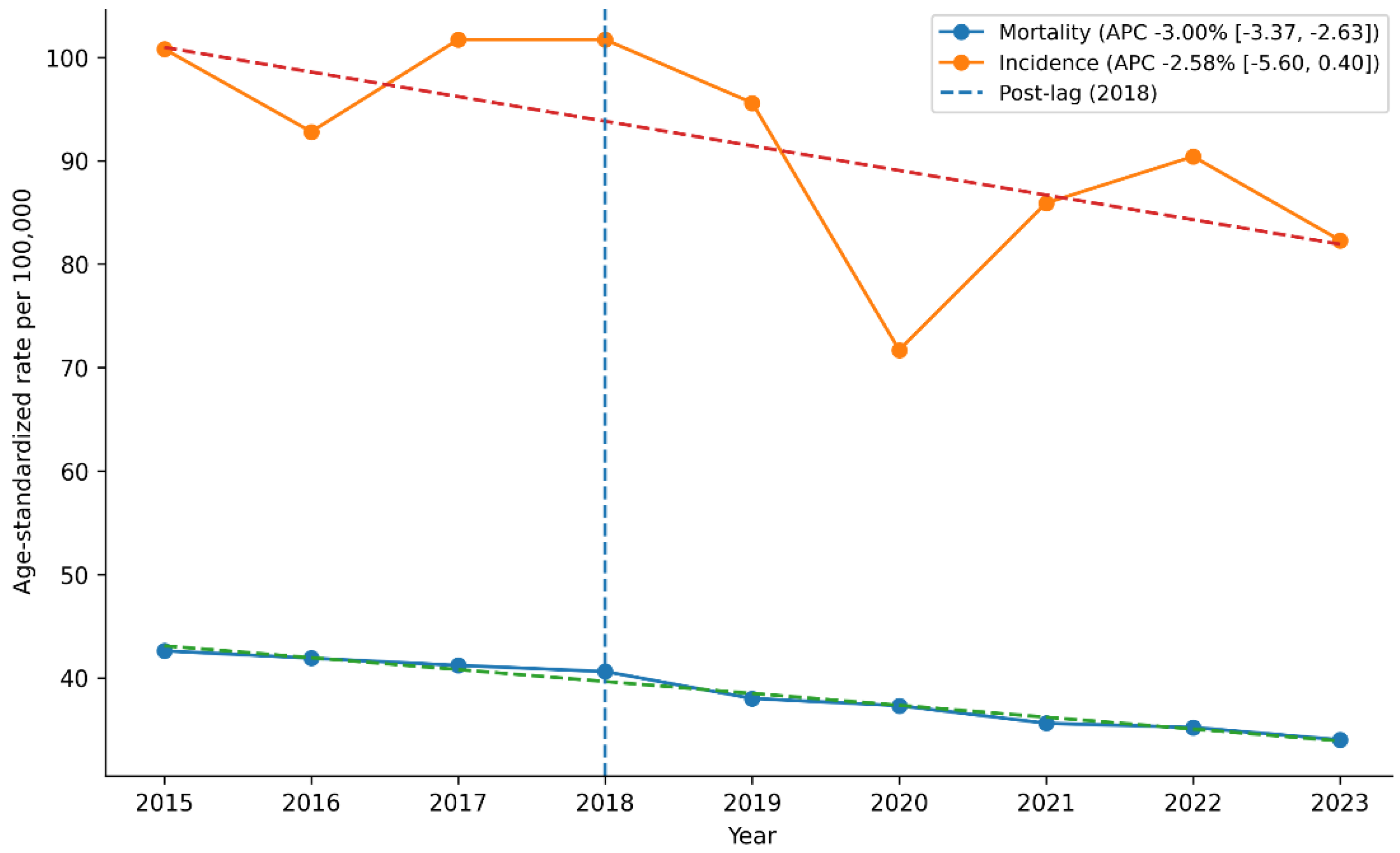
Figure 2.
Temporal trend of age-standardized colorectal cancer mortality and incidence rates in Galicia (2015-2023) according to age, sex and tumour location with annual percent change (APC) estimates.
Figure 2.
Temporal trend of age-standardized colorectal cancer mortality and incidence rates in Galicia (2015-2023) according to age, sex and tumour location with annual percent change (APC) estimates.
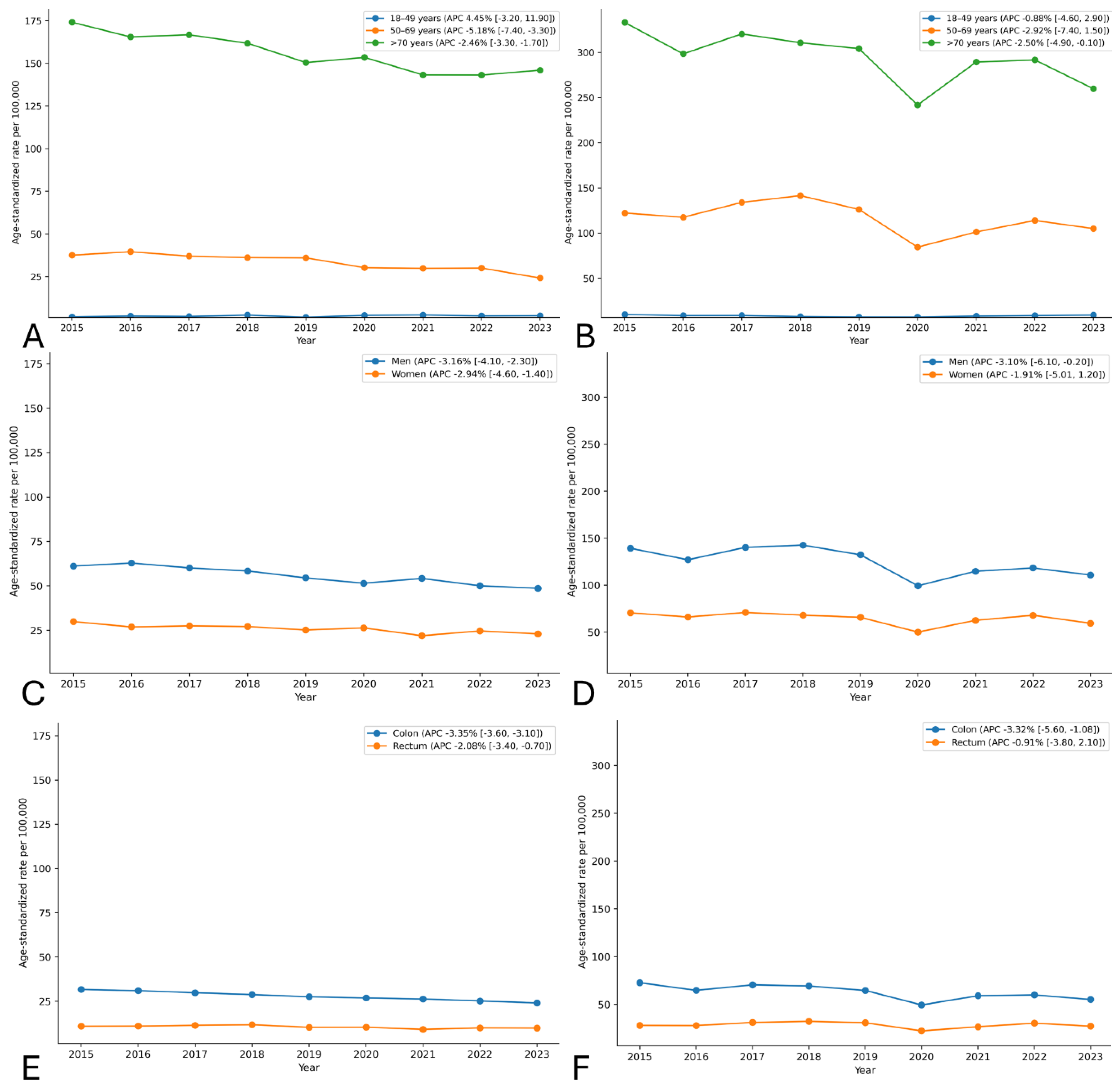
Table 1.
Interrupted time series analysis: Annual percentage change (APC) before and after implementation and net change in trend (ΔAPC) in colorectal cancer mortality and incidence in Galicia.
Table 1.
Interrupted time series analysis: Annual percentage change (APC) before and after implementation and net change in trend (ΔAPC) in colorectal cancer mortality and incidence in Galicia.
| Cohort | Mortality APC PRE (%) (95% CI) | Mortality APC POST (%) (95% CI) | Δ Mortality (%) (POST–PRE)* | Incidence APC PRE (%) (95% CI) | Incidence APC POST (%) (95% CI) | Δ Incidence (%) (POST–PRE)* |
|---|---|---|---|---|---|---|
| Global | 13.70 (10.12, 17.39) | -3.62 (-4.47, -2.76) | -17.32 | 15.26 (5.48, 25.95) | -2.48 (-5.29, 0.41) | -17.74 |
| Sex | ||||||
| Men | 17.59 (11.35, 24.17) | -3.40 (-5.20, -1.56) | -20.99 | 13.76 (4.65, 23.66) | -3.30 (-6.11, -0.41) | -17.07 |
| Women | 7.55 (-1.54, 17.49) | -3.41 (-5.47, -1.31) | -10.97 | 14.61 (-0.18, 31.59) | -1.59 (-5.12, 2.07) | -16.20 |
| Age | ||||||
| ≥70 years | 20.35 (14.42, 26.60) | -2.22 (-3.40, -1.02) | -22.57 | 20.64 (10.66, 31.53) | 1.09 (-3.89, 6.33) | -19.55 |
| 50–69 years | 11.80 (1.86, 22.72) | -8.08 (-10.43, -5.66) | -19.88 | 21.32 (4.60, 40.71) | -3.74 (-7.62, 0.30) | -25.06 |
| 18–49 years | 11.56 (-51.04, 154.41) | -1.44 (-8.10, 5.71) | -13.00 | 1.60 (-34.03, 56.41) | 0.72 (-6.67, 8.69) | -0.88 |
| Location | ||||||
| Colon | 12.35 (4.18, 21.15) | -2.60 (-4.51, -0.65) | -14.94 | 14.41 (2.53, 27.67) | -1.69 (-5.15, 1.90) | -16.10 |
| Rectum | 12.71 (2.12, 24.39) | -2.49 (-5.34, 0.45) | -15.19 | 12.58 (1.31, 25.11) | -1.37 (-5.10, 2.50) | -13.96 |
APC values were estimated using segmented log-linear regression models of the form ln(rate) = β₀ + β₁(time) + β₂(post) + β₃(time × post). Pre- and post-implementation slopes were derived from model coefficients and transformed as APC = (e^β − 1) × 100. *The net change in trend (ΔAPC) was calculated as the difference between the post-implementation APC and the pre-implementation APC. As this measure derives from the difference between two correlated estimates, it is presented as a descriptive indicator and was not accompanied by confidence intervals.
Table 2.
Pre–post variation and annual percent change (APC) in colorectal cancer mortality in Galicia, stratified by cohorts.
Table 2.
Pre–post variation and annual percent change (APC) in colorectal cancer mortality in Galicia, stratified by cohorts.
| CRC mortality | CRC incidence | |||||||
|---|---|---|---|---|---|---|---|---|
| Cohort | Pre–post variation (%) | p1 | APC (%) | p1 | Pre–post variation (%) | p1 | APC (%) | p1 |
| Global | -14.33 (-17.37, -10.95) | <0.001 | -3.00 (-3.37, -2.63) | <0.001 | -13.42 (-21.60, -5.02) | <0.001 | -2.58 (-5.60, 0.40) | 0.07 |
| Sex | ||||||||
| Men | -15.61 (-19.46, -12.01) | <0.001 | -3.16 (-4.10, -2.30) | <0.001 | -15.06 (-22.75, -7.10) | <0.001 | -3.10 (-6.10, -0.20) | 0.03 |
| Women | -13.74 (-19.89, -6.97) | <0.001 | -2.94 (-4.60, -1.40) | 0.003 | -11.61 (-20.08, -2.86) | <0.001 | -1.91 (-5.01, 1.2) | 0.1 |
| Age | ||||||||
| ≥70 years | -12.75 (-15.93, -9.82) | <0.001 | -2.46 (-3.30, -1.70) | <0.001 | -12.61 (-20.68, -4.52) | <0.001 | -2.50 (-4.90, -0.10) | 0.04 |
| 50–69 years | -20.98 (-29.92, -11.78) | <0.001 | -5.18 (-7.40, -3.30) | <0.001 | -14.78 (-25.58, -3.61) | <0.001 | -2.92 (-7.40, 1.50) | 0.1 |
| 18–49 years | 23.51 (-5.93, 53.12) | 0.12 | 4.45 (-3.20, 11.90) | 0.2 | -11.89 (-21.81, -1.40) | 0.02 | -0.88 (-4.60, 2.90) | 0.6 |
| Location | ||||||||
| Colon | -15.67 (-19.94, -11.34) | <0.001 | -3.35 (-3.60, -3.10) | <0.001 | -16.82 (-24.50, -8.49) | <0.001 | -3.32 (-5.60, -1.08) | 0.02 |
| Rectum | -10.62 (-15.05, -6.80) | <0.001 | -2.08 (-3.40, -0.70) | 0.02 | -5.32 (-15.04, 4.74) | 0.3 | -0.91 (-3.8, 2.10) | 0.5 |
Pre–post variation compares mean age-standardised rates between 2015–2017 and 2019–2023. Differences were calculated using arithmetic means, and 95% confidence intervals (95% CI) were estimated using parametric methods based on the t-distribution. APC values were estimated using log-linear regression across the full 2015–2023 period. Statistical significance was assessed using two-sided Wald tests. p¹: Differences considered statistically significant at p < 0.05.
Table 3.
Age-standardised mortality rates (ASMR). Comparison between 2015–2017 and 2019–2023.
| Stratum | ASMR 2015–2017 (95% CI) |
ASMR 2019–2023 (95% CI) |
Absolute change (95% CI) |
Relative change (%) (95% CI) |
Avoided deaths 2019–2023 (95% CI) | |
|---|---|---|---|---|---|---|
| Overall | 41.92 (40.26, 43.58) | 35.91 (33.92, 37.90) | −6.01 (−8.00, −4.02) | −14.33% (−17.53, −11.06) | 476 (380, 578) | |
| Sex | ||||||
| Men | 61.33 (57.90, 64.80) | 51.75 (49.90, 53.60) | −9.58 (−11.92, −7.17) | −15.61% (−19.33, −11.80) | 301 (182, 435) | |
| Women | 28.06 (25.90, 30.20) | 24.21 (23.10, 25.30) | −3.86 (−5.85, −1.95) | −13.74% (−20.08, −7.17) | 173 (25, 320) | |
| Age | ||||||
| 18–49 years | 1.64 (1.32, 1.96) | 2.03 (1.65, 2.42) | 0.39 (−0.11, 0.81) | 23.51% (−5.93, 53.12) | −31 (−56, 0) | |
| 50–69 years | 38.06 (35.20, 40.90) | 30.08 (28.40, 31.80) | −7.98 (−11.41, −4.48) | −20.98% (−29.92, −11.78) | 316 (186, 457) | |
| ≥70 years | 168.78 (162.50, 175.00) | 147.26 (143.10, 151.40) | −21.52 (−27.42, −16.37) | −12.75% (−15.93, −9.82) | 590 (462, 712) | |
| Location | ||||||
| Colon | 30.83 (29.10, 32.60) | 26.00 (24.90, 27.10) | −4.83 (−6.26, −3.42) | −15.67% (−19.94, −11.34) | 389 (298, 496) | |
| Rectum | 11.09 (10.30, 11.90) | 9.92 (9.30, 10.60) | −1.18 (−1.66, −0.75) | −10.62% (−14.82, −6.87) | 87 (11, 167) | |
Mean ASMR values were calculated for 2015–2017 and 2019–2023. Absolute and relative changes were computed directly from period means. Ninety-five percent confidence intervals (95% CI) were estimated using parametric methods based on the t-distribution. Potentially avoided deaths were estimated using a counterfactual approach based on pre-implementation crude rates applied to post-period population denominators. Confidence intervals were derived using non-parametric bootstrap resampling of annual event counts.
Disclaimer/Publisher’s Note: The statements, opinions and data contained in all publications are solely those of the individual author(s) and contributor(s) and not of MDPI and/or the editor(s). MDPI and/or the editor(s) disclaim responsibility for any injury to people or property resulting from any ideas, methods, instructions or products referred to in the content. |
© 2026 by the authors. Licensee MDPI, Basel, Switzerland. This article is an open access article distributed under the terms and conditions of the Creative Commons Attribution (CC BY) license (http://creativecommons.org/licenses/by/4.0/).
Copyright: This open access article is published under a Creative Commons CC BY 4.0 license, which permit the free download, distribution, and reuse, provided that the author and preprint are cited in any reuse.


