
Submitted:
11 March 2026
Posted:
23 March 2026
You are already at the latest version
Abstract
A cover-based notion of topological sensitivity and sensitivity at a point is introduced, which is the same as the popular concept of sensitivity in metric spaces. The basin of attraction of infinity, the point of compactification of locally compact, non-compact topological spaces, is studied in this paper. It is proved that, under certain conditions on the underlying map f , the set of points whose orbits have compact support, the basin of attraction of infinity, and the set of sensitive points are identical, thus generalizing the standard Julia sets on the Riemann sphere.
Keywords:
topological dynamics
; escaping set
; one-point compactification
; proper maps
; topological sensitivity
; compact orbits
MSC: 37B02; 37B25; 37F10
1. Introduction
The study of dynamical systems on non-compact spaces requires tools that distinguish between bounded and unbounded orbit behaviour. While much of classical topological dynamics has been developed for compact phase spaces [1,2], several important classes of systems arise naturally on locally compact but non-compact spaces, including iterations of polynomials, translation-type maps, and systems admitting escape to infinity.
A common approach in this setting is to pass to the one-point compactification and to regard infinity as a fixed point of the extended map. This allows divergence of orbits to be interpreted as convergence to the point ∞ and enables the use of compactness arguments [3]. In this framework, two sets play a fundamental role. The first is the set , consisting of points whose forward orbits are contained in some compact subset of X. The second is the basin of attraction of the point at infinity, consisting of all points whose orbits escape to infinity under iteration.
In complex dynamics, analogous constructions appear in the theory of polynomial iteration, where the filled Julia set consists of points with bounded orbits and the basin of infinity describes escaping behaviour [4]. Motivated by this analogy, we investigate the topological properties of and for general continuous self-maps of locally compact spaces, without assuming any algebraic or metric structure beyond continuity.
The main objectives of this paper are threefold. First, we study basic topological properties of the set , including forward invariance, closedness, and local compactness under suitable hypotheses on the phase space. Second, we analyze the basin as an open, absorbing, forward invariant set and establish its relationship with via complementarity and boundary results. Third, we connect these global invariant sets with notions of sensitivity, which play a central role in topological dynamics and chaos theory [5,6].
A key observation is that, in general, the inclusion may be strict. We provide explicit examples showing that non-escaping behaviour does not necessarily imply the existence of a compact trapping region for the orbit.
The results presented here provide a topological framework for studying boundedness, escape to infinity, and sensitivity in non-compact dynamical systems, extending several classical ideas from compact dynamics and complex iteration to a broader setting.
2. Preliminaries
2.1. Historical Development of Julia Sets
The study of Julia sets originated in the early investigations of iteration theory in complex analysis during the first decades of the twentieth century. The subject was ddeveloped independently by Gaston Julia and Pierre Fatou, whose pioneering works between 1917 and 1920 initiated the systematic study of the dynamics of rational functions on the Riemann sphere .
Given a rational map of degree at least two, Julia and Fatou observed that the qualitative behavior of the iterates naturally divides the phase space into two invariant regions. The first region, later known as the Fatou set , consists of points where the iterates behave in a stable and regular manner. Its complement, the Julia set , captures points where arbitrarily small perturbations lead to drastically different dynamical outcomes. This dichotomy marked one of the earliest rigorous distinctions between regular and chaotic behavior in deterministic systems.
Gaston Julia focused on the geometric and topological complexity of the unstable set , establishing its complete invariance under f and demonstrating that it often forms highly irregular, infinitely detailed structures [7]. In parallel, Pierre Fatou developed powerful analytical tools based on normal family theory, proving fundamental results concerning the structure and classification of components of and their boundaries [8]. Their combined contributions showed that the Julia set is either the entire Riemann sphere or a perfect, nowhere dense subset of it.
Following this early period, research activity in complex dynamics slowed considerably for several decades. A renewed interest arose in the late twentieth century, largely motivated by computational experiments and visualizations. In particular, the work of Benoît Mandelbrot revealed the striking self-similar geometry of Julia sets associated with quadratic polynomials and uncovered their intimate relationship with the Mandelbrot set [9]. These discoveries played a crucial role in popularizing the subject and highlighting its relevance to fractal geometry and nonlinear science.
The modern mathematical framework of Julia sets was further strengthened by the seminal work of Douady and Hubbard, who introduced polynomial-like mappings and developed renormalization techniques to analyze local and global properties of complex dynamical systems [10]. Their results clarified the topological organization of Julia sets and established deep connections between local dynamics and global parameter spaces.
Today, Julia sets are regarded as fundamental examples of chaotic invariant sets in holomorphic dynamics. They exhibit characteristic features of chaos, including topological transitivity, dense periodic points, and sensitivity to initial conditions. As such, they continue to play a central role in contemporary research, linking complex analysis with ergodic theory, fractal geometry, and the general theory of dynamical systems.
2.2. Basic Properties of Julia Sets
Let be a rational map of degree . The Julia set plays a central role in the qualitative description of the dynamics generated by the iterates of f. We summarize below some of its fundamental properties that are well established in the literature.
2.3. The Julia Set
The Julia set is completely invariant under the action of f, that is,
2.4. Perfectness and Density of Repelling Periodic Points
For any rational map of degree at least two, the Julia set is a perfect set; that is, it is closed and has no isolated points. Furthermore, the set of repelling periodic points of f is dense in . This density result highlights the intrinsic instability of the dynamics on the Julia set and provides a strong link between local expansion and global chaotic behavior [12,13].
2.5. Sensitivity to Initial Conditions [2]
The map f exhibits sensitive dependence on initial conditions; that is, there exists such that for any open set U and for any point , there exists a point and an integer such that . The positive number is called a sensitivity constant; it only depends on the space X and the function f.
The dynamics restricted to the Julia set exhibits sensitive dependence on initial conditions. More precisely, for any and any neighborhood U of z, there exist points and an integer such that the spherical distance between and exceeds a fixed positive constant. This sensitivity property is a hallmark of chaotic dynamics and contrasts sharply with the equicontinuous behavior observed on Fatou components [2,4].
2.6. Topological Transitivity
The map f is topologically transitive on its Julia set. That is, for any pair of nonempty open subsets , there exists an integer such that
Topological transitivity reflects the indecomposable nature of the dynamics on and ensures that the orbit of a typical point in the Julia set is distributed throughout the entire set. [14].
2.7. Relation to the Fatou Set
The Julia set coincides with the boundary of every Fatou component. In particular, if U is a connected component of , then
This boundary characterization emphasizes the role of the Julia set as the interface between stable and unstable dynamics and underscores its significance as the locus of chaotic behavior [11].
3. Examples of Julia Sets
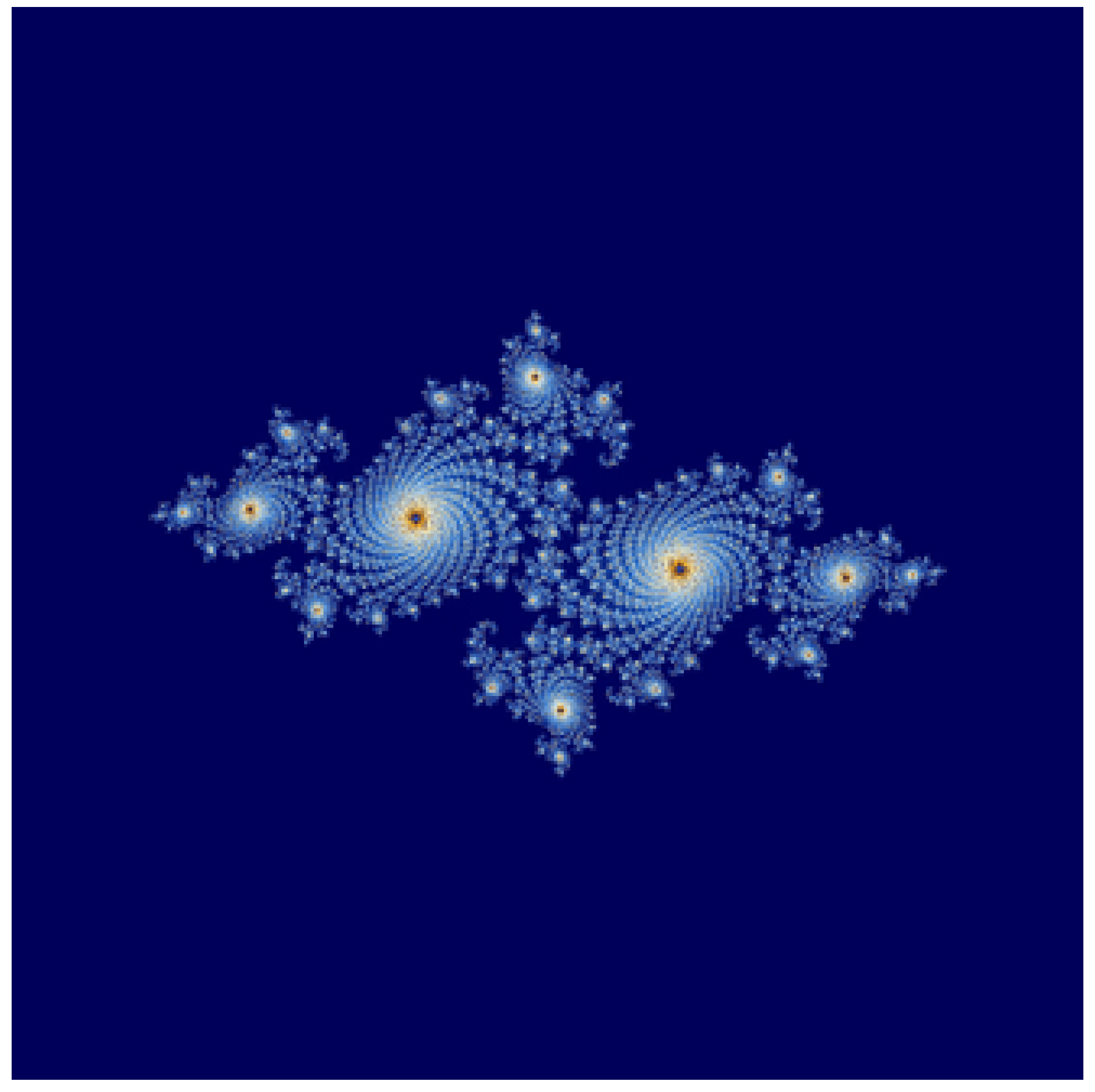
We present several classical examples of Julia sets arising from polynomial and rational maps. These examples illustrate the wide variety of geometric and dynamical behaviors exhibited by Julia sets.
3.1. Quadratic Polynomial
Consider the map . In this case, the Fatou set consists of two invariant components: the basin of attraction of 0 and the basin of attraction of ∞. The Julia set is given explicitly by
the unit circle. On , the dynamics is conjugate to the angle-doubling map on the circle, which is expanding and chaotic. This example demonstrates that Julia sets can be smooth manifolds, although this is exceptional among polynomial maps [4,11].
3.2. Quadratic Polynomial
For the polynomial , the Julia set is the real interval
Despite its simple geometric appearance, the dynamics on this set is highly chaotic. The restriction of f to is topologically conjugate to the tent map, and hence exhibits sensitive dependence on initial conditions and dense periodic points [2,4].
Figure 1.
Julia set for z2 + i.
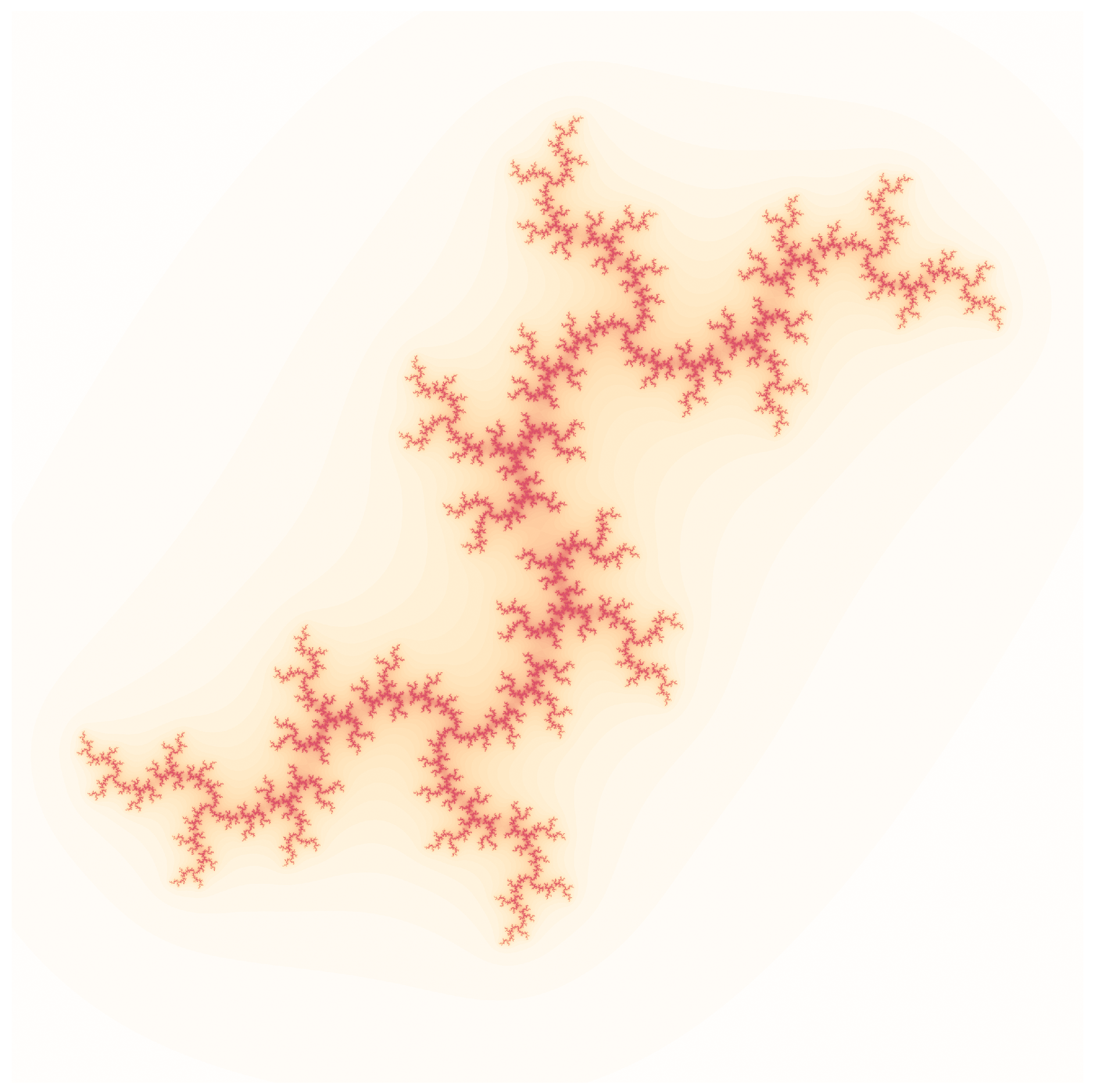
Figure 2.
.
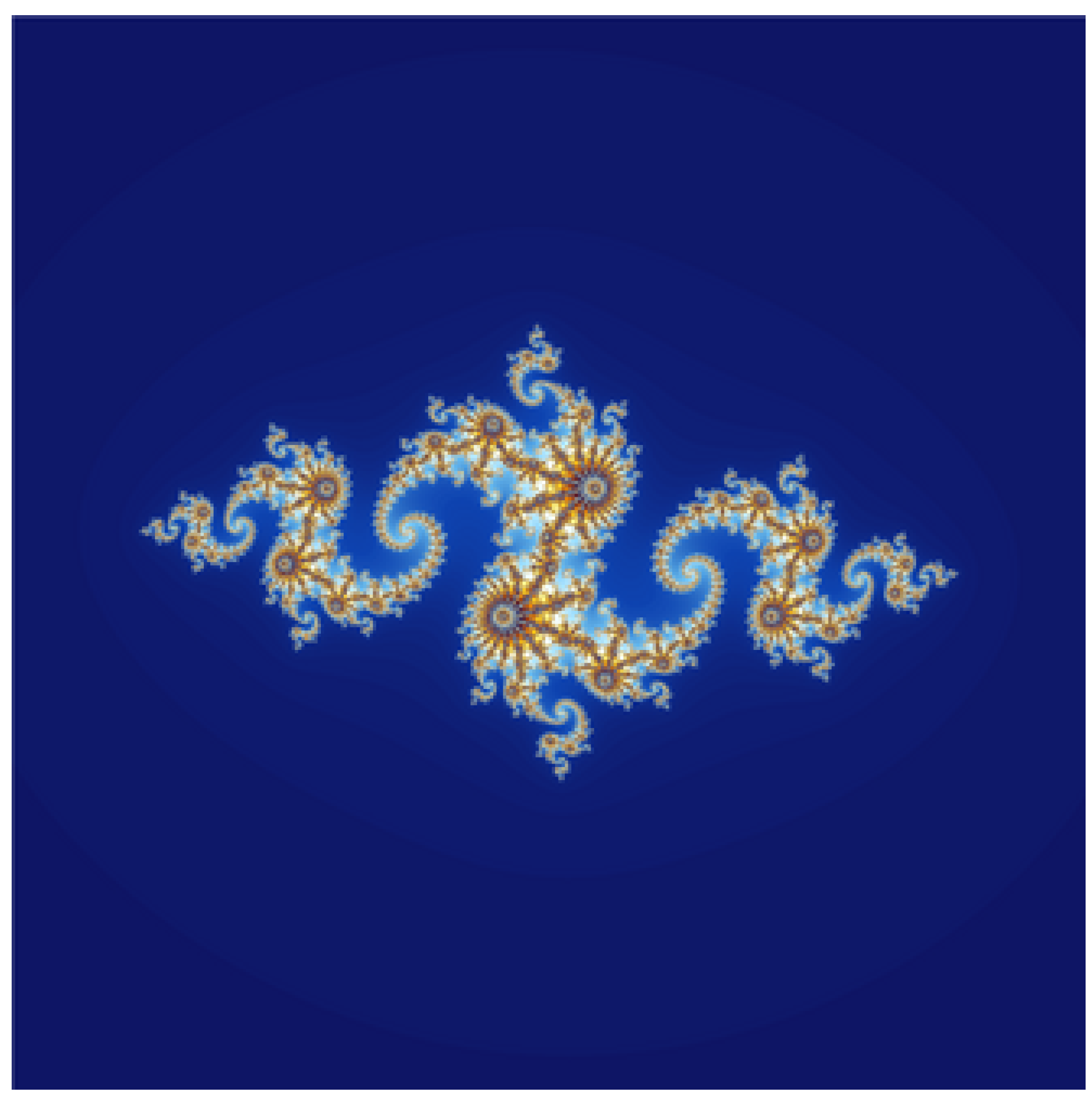
Figure 3.
.
3.3. Quadratic Polynomial
3.4. Rational Map
Consider the rational function . The Julia set of this map is the real line together with the point at infinity. The dynamics exhibits strong expansion away from critical points, and the Julia set forms the boundary between regions of regular and chaotic behavior [11].
3.5. Lattès Maps
Lattès maps arise from affine transformations on complex tori projected onto the Riemann sphere. The Julia set of a Lattès map is the entire Riemann sphere . These examples are distinguished by the fact that chaotic behavior occurs everywhere, with no nontrivial Fatou components [4,15].
One example is the map .
4. Orbits with Compact Support
Definition 1.
Let X be a non-compact locally compact Hausdorff space and let be continuous. Define
is the set of points whose orbit has compact support.
4.1. Forward Invariance
Let X be a topological space and let be continuous. A subset is said to be forward invariant under f if
Definition 2
(Completely Invariant Set). Let X be a topological space and let be a map. A subset is said to becompletely invariantunder f if
Equivalently,
Remark 1.
Complete invariance is stronger than forward invariance. A set A is:
- Forward invariant if .
- Backward invariant if .
A set is completely invariant if and only if it is both forward and backward invariant.
4.2. We Prove Some Properties of
Proposition 1.
is forward invariant. ie
Proof.
Let , then , for some compact subset K.
⇒
⇒
⇒
Hence is forward invariant. □
Proposition 2.
Let X be a locally compact Hausdorff space and let be a homeomorphism. Then the boundary is completely invariant, i.e.,
Proof.
Step 1: is completely invariant.
Forward invariance. Let . Then there exists a compact set such that
For we have
so the forward orbit of is also contained in C. Hence , and therefore
Backward invariance. Let and let C be a compact set containing the forward orbit of x. Since f is a homeomorphism, is continuous and is compact.
For ,
and for , . Hence
which is compact. Thus , so
Combining both inclusions,
Step 2: Closure and interior are invariant.
Since f is a homeomorphism, for any subset ,
Applying this to and using the invariance of ,
Step 3: Invariance of the boundary.
Recall that
Since f is bijective,
for all subsets . Therefore,
Using Step 2,
Step 4: Backward invariance of the boundary.
Since f is bijective and , applying gives
Hence,
; see [1]. Applying the same argument to gives □
Proposition 3.
, where is the family of compact subsets of X.
Proof.
Let . Then there exists a compact set such that , ,
,
.
Conversely , let , for some compact C.
,
.
Hence . □
Proposition 4.
If X is locally compact Hausdorff and σ-compact and is continuous, then is an subset of X.
Proof.
Choose a compact exhaustion of X, i.e. compact sets with . We claim that
If , then for some compact . Since and C is compact, there exists m with . Hence for all , i.e. .
Conversely, if for some m, then for all n, so .
Finally, each is closed and hence is closed. Therefore is a countable union of closed sets, i.e. an set. □
4.3. Proper Map
Let X and Y be topological spaces and let be a continuous map. The map f is said to be proper if for every compact set , the preimage is compact in X.
Proposition 5.
Let X be a non–compact locally compact Hausdorff space and let be a continuous proper map. Define
Then is closed in X.
Let be the one-point compactification. Since f is proper, it extends to a continuous map with .
Define the escaping set
Claim 1: is open in X. Let . Choose a neighbourhood U of ∞ such that (which exists by continuity of at ∞ and ). Since , there exists N such that . By continuity of , there is a neighbourhood W of x with . Then for every and every ,
so , i.e. .
Claim 2: . If , then the orbit eventually leaves every compact subset of X, so cannot be compact; hence .
Conversely, if , then ∞ is not a limit point of in the compact space . Therefore the orbit closure in is a compact subset of contained in X, so the orbit closure in X is compact and .
Thus , and since is open, is closed.
4.3.1. Note: Closedness of May Fail without Local Compactness
.
Let with the subspace topology, which is not locally compact and define , identity map.
Then for any , which is compact. Hence , but is not closed in
Proposition 6.
Let X be a locally compact Hausdorff space and continuous. If is closed, then is locally compact (and Hausdorff). In particular, if X is non–compact and f is proper, then is locally compact.
Proof.
Since is closed in the Hausdorff space X, it is Hausdorff. Let . Choose an open neighbourhood of x with compact (local compactness of X). Then is an open neighbourhood of x in and
which is compact as a closed subset of the compact set . Hence is locally compact.
If f is proper and X is non-compact locally compact Hausdorff, then is closed by Proposition 5, hence locally compact. □
Proposition 7.
is the largest forward invariant subset of X on which f acts as a proper map.
Proof.
First, is forward invariant . Moreover, is proper: if is compact, then C is compact in X, and is compact as a closed subset of the compact set (when f is proper on X; if you do not assume global properness, state and prove the needed restriction-property carefully).
Now let be forward invariant and assume is proper. Fix . Choose a compact neighbourhood C of y in Y. Then each is compact, hence their intersection is compact and contains y. Thus for all , so and . Hence . □
Proposition 8.
If f is a homeomorphism,
Proof.
The Proposition follows from Proposition 4.7 □
Proposition 9.
If is a homeomorphism, are continuous, and (ie h is a topological conjugacy), then
Proof.
Let , then ∃ a compact set such that
.
, since is compact.
.
Applying the above argument for , gives the reverse inclusion.
Hence . □
Proposition 10.
Proof.
Assume that ,
Then ∃ a non empty open set such that
But
ie ,
So U is an open set such that and
Let
Hence Our assumption is false, so . □
4.4. Depends on the Metric
Consider . Let .
Let .
- 1.
- Let , then clearly .
- 2.
- Let then .
- 3.
- Let , then .
- 4.
- Let by , then is a homeomorphism. Let , , then . Then , which is the axis.
- 5.
-
DefineSince is a homeomorphism onto a bounded interval, the metric space is bounded.Moreover, every closed and bounded subset of is compact, and compactness in corresponds to compactness in that interval.Now observe thatHence the setis bounded in a compact interval, and therefore relatively compact in .Thus every orbit is relatively compact in , and so
The filled set depends crucially on the choice of metric, and hence on the topology
Proposition 11.
Let and be two equivalent metrics on a set X, that is, they induce the same topology on X. Then a subset is compact with respect to if and only if it is compact with respect to . Consequently, for any continuous map ,
where denotes the set of points whose forward orbits are relatively compact with respect to the metric .
Proof.
Since and induce the same topology on X, the identity map
is a homeomorphism, and its inverse is again the identity map. It is a standard topological fact that homeomorphisms preserve compactness [16, Theorem 26.6].
Let be compact in . Because is continuous, the image is compact in . Applying the same argument to the inverse identity map shows that compactness in implies compactness in . Hence the two metrics determine exactly the same compact subsets of X.
By definition,
Since the families of compact sets induced by and coincide, a forward orbit is relatively compact with respect to if and only if it is relatively compact with respect to . This proves that
□
4.5. Example 4.1 : on a Non-Metrizable Locally Compact Space
Let , where I is an index discrete space and is the usual metric.
Then clearly X is locally compact, not compact, and non-metrizable.
We define as
Then clearly
Then
Next we set by
Clearly .
Hence .
We define , by , if and , where
Then .□
4.6. Example 4.2: Can Be Disconnected
Let , we define
Let be defined by
If , then , if then and if , then
Hence
∴ is disconnected.□
4.7. Example 4.3
Let of smooth, - periodic functions.
Define .
Let be defined as .
Using Fourier Series,
Hence . ∴ orbit of f lies in a finite dimensional space and hence is relatively compact.
∴. □
4.7.1. Example 4.4
Let be the first uncountable ordinal. Let .
Let , with the product order topology.
is defined as
Then .
Let be defined as
Then .
These examples shows that even in a non-metrizable locally compact space, the non-escaping set can range from empty to the entire space and can realize arbitrary “vertical slices” of the form . The structure of is therefore highly sensitive to the dynamics along different components of the space.
5. Basin of Attraction of Infinity
Definition 3.
Let be the one point compactification of X, so we can extend the continuous function to by and . We define the basin of attraction of ∞ as
Proposition 12.
Proof.
Since , we have for all , and hence . Hence . □
Proposition 13.
Let X be a locally compact Hausdorff space and let be continuous and proper. Let be the one-point compactification and let be the extension with . Define
Then for every neighbourhood U of ∞ in ,
In particular, is a subset of , and is a subset of X.
Proof.
Fix a neighbourhood U of ∞. A point satisfies if and only if there exists N such that for all . Equivalently, for some N. Taking the union over all yields the stated formula.
Since each is open (as U is open and is continuous), is a , and the union over N is again a . □
Proposition 14.
Let X be a locally compact Hausdorff space and let be a continuous map. Let denote the basin of attraction of the point ∞ in the one–point compactification . Then
Proof.
Let . By definition, for some compact subset of X.
Hence there exists a compact set such that
Suppose, on the contrary, that . Then, by the definition of the basin of attraction of ∞, for every compact set there exists such that
Taking , this contradicts the fact that for all .
Therefore , and hence . Since x was arbitrary, we conclude that
□
Proposition 15.
Proof.
For iff for every compact such that .
, for any compact set C of X.
Hence . □
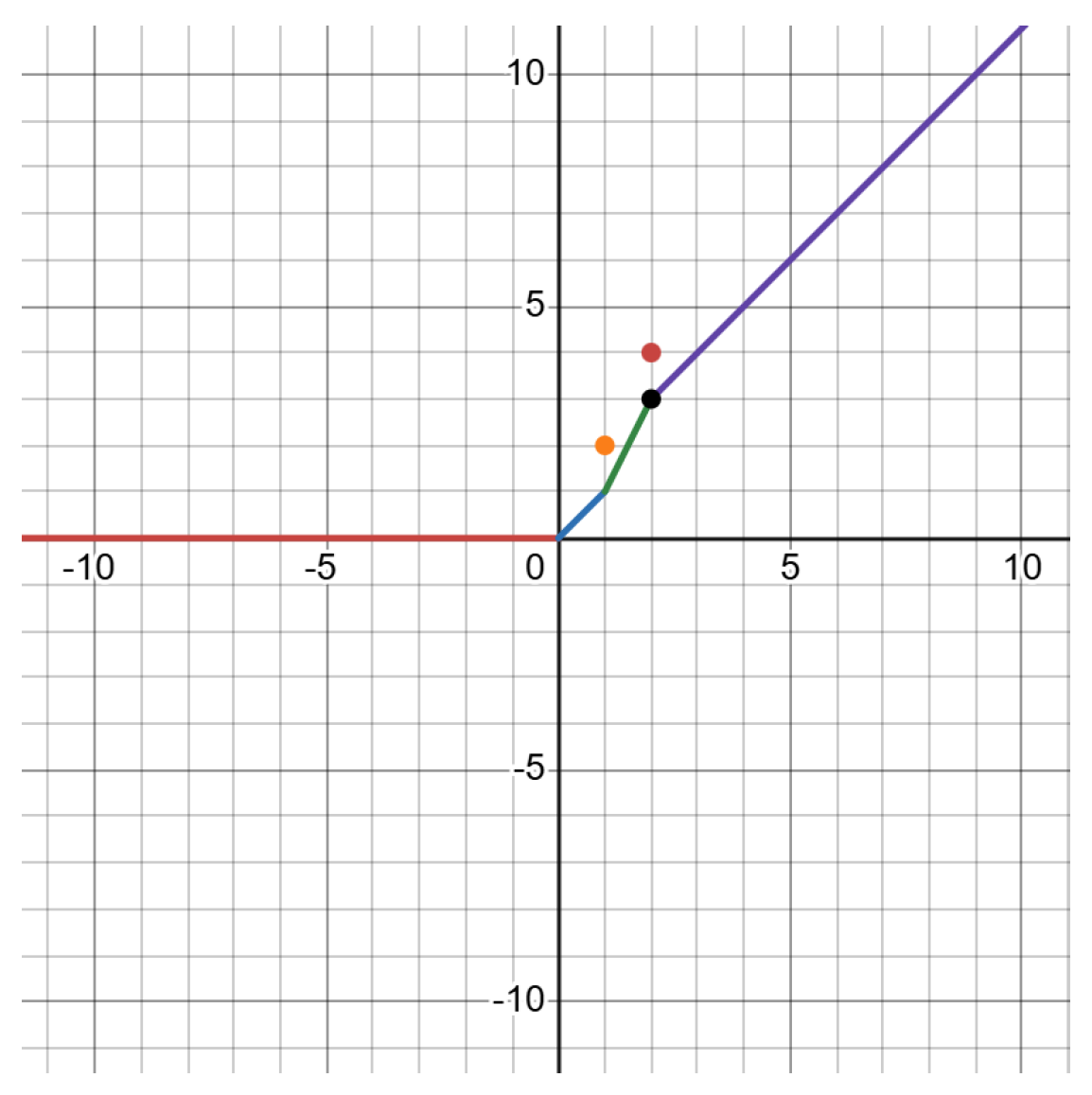
5.0.1. An Example to Show That
clearly , for hence .
Hence in this case . □
Figure 4.
graph of .
Proposition 16.
is forward invariant.
Proof.
Let , then .
as .
Hence .
ie . □
Proposition 17.
If f is proper, then is open in X.
Proof.
Let , then in .
Since the neighborhood’s of ∞ in are of the form , for some compact set , therefore
ie
Let and let be compact. By the characterization of escape, there exists such that . Since is proper, the preimage is compact. Thus is an open neighbourhood of x consisting entirely of points whose n-th iterate lies outside C. Hence this neighbourhood is contained in . □
Properness Is Essential in the above Result
If f is not proper, the preimage of a compact set may be non-compact. In this case, sequences of points arbitrarily close to an escaping point may have iterates that return to compact regions. Consequently, the set need not be open.
5.1.1. Example (Failure of Openness Without Properness)
Let and define
Then f is continuous but not proper. Indeed, there exist sequences such that remains bounded, so the preimage of a compact set need not be compact.
For large x, the map satisfies , so many points escape to . However, due to the oscillatory term, there exist arbitrarily large points whose orbits repeatedly return to bounded regions.
Thus escaping points accumulate at non-escaping points, and the basin of attraction is not open.
This shows that properness is essential for openness of .
Proposition 18.
is closed and nowhere dense.
Proof. We have .
Clearly as the intersection of two closed sets is closed, is closed.
Also and
Since, , any open subset have to be in both and , Hence . □
5.1.2. Examples 5.2
1. Let defined by , then
2. Let defined by , then . 3. Let defined by , then
Proposition 19.(Characterization of escape).
A point if and only if for every compact set such that
see [3]
Proof.
Suppose . By definition, in the one-point compactification . Let be compact. Then is a neighbourhood of ∞. Hence there exists such that .
Conversely, suppose that for every compact set , there exists such that . Let U be an arbitrary neighbourhood of ∞ in . Then for some compact . By assumption, there exists n such that . Hence , and therefore . □
6. Sensitivity
6.1. Metric Sensitivity
Definition 4.
nDefinition[2] Let be a metric space and be continuous. We say that f is sensitive on X if there exists such that for every and every , there exist and such that
The number δ is called a sensitivity constant.
6.1.1. L
et be a metric space, and let be continuous. f is sensitive at a point if there exist such that for every , there exist and such that .
Set of all sensitive points at which f is sensitive is denoted by .
6.1.2. Remark
Sensitivity depends on the defined metric
Let , and let .
Let .
Then f is sensitive on but not on .
If is a compact metric space, the sensitivity is preserved within the class of equivalent metrics.
6.1.3. Examples
- 1.
- It is well known that the tent mapis sensitive on [0,1] [2].
- 2.
-
Let and be .f is continuous on X.If , then f is not sensitive at x, since x is an isolated point. But for , given there exists such that .Hence .
- 3.
-
Let be defined asIfIfSo if , then .∴.if , then∴.If .∴, which is the Julia set of f.
Proposition 20.
Proposition 21.
Let be a metric space and be continuous. Assume that the sensitive set is closed. If , then
Proof. By Proposition 20, is forward invariant. Hence and is closed, we obtain
Hence every point in the orbit closure of x is sensitive. □
Proposition 22.
is a - set.
Proof. For a fixed , let .
We prove that.
We have .
∴.
Let . Then there exists such that where (if then , contradicts .
So .
Hence .
Hence the result.
□
6.1.4. Note
Sensitivity can be generalized to non- metrizable topological spaces.
Definition 5.
topological sensitivity
Let X be a topological space and be continuous. The function f is topologically sensitive at a point with respect to an open cover if for every neighbourhood G of x, there exists and , , such that
.
ie .
is called sensitivity cover for f[17].
If f is sensitive at every point of X w.r.t , we say that f is topologically sensitive on X, w.r.t .
Let .
f is topologically sensitive on X w.r.t open cover .
Proposition 23.
The following statements are equivalent.
(1) .
(2) For every non-empty open set G of X, there exist and such that for all .
Proof.
(1) ⇒ (2):
Assume . Let be a non-empty open set. Choose . Since , by definition, for every neighbourhood H of x there exist and such that
Taking , we obtain and with the required property. Thus (2) holds.
(2) ⇒ (1):
Assume (2). Let and let G be any open neighbourhood of x. Since G is non-empty and open, by (2) there exist and such that
We claim that x is sensitive.
Since
is open in , its complement is closed. Let
Then is continuous. Hence
is closed in .
Since belongs to this closed set, there exists an open neighbourhood of such that
Because W is open in , there exist open sets such that
Since and , we may choose an open neighbourhood with and .
Then for every ,
Thus x is topologically sensitive. Since x was arbitrary, .
□
Proposition 24.
Let be a metric space and be continuous. Let denote the topology on X generated by metric d. Then if f is metrically sensitive on X, then f is topologically sensitive.
Proof. Let be a sensitive constant for f.
Let , then is a sensitivity cover for f. So if G is an open set in X and , then there existts such that .
, for every .
is a sensitivity cover for f. Hence f is topologically sensitive. □
Proposition 25.
If is compact then f is topologically sensitive ⇒f is metrically sensitive.
Proof. Let be a sensitive cover for f and let be a Lebesgue number of (Since X is compact every open cover has a Lebesgue number).
There exists such that if , then lie in some common .
Let G be any non- empty subset of X, By assumption, such that .
.
is metrically sensitive. □
6.1.5. Example 7.1
Compactness in the above theorem is necessary
Let .
Note that .
Let , Let be an open cover of .
Let be an open interval.
then .
As , two points land in different elements of .
is a sensitivity cover for f.
ie f is topologically sensitive.
Suppose f is metrically sensitive. ∃ such that
Now .
As .
For large n, and tends to .
is not metrically sensitive. □
Proposition 26.
f is topologically sensitive iff is topologically sensitive.
Proof. If is a sensitive cover for , then is a sensitive cover for f.
Assume that is a sensitivity cover for f.
For every let .
Let be the join of .
ie .
We now prove that is a sensitivity cover for .
Let G be a non-empty open subset of X. Then there exist and such that .
Let and be such that .
Because if for some , them , which is a contradiction.
So is a sensitivity cover for .
Hence is topologically sensitive.
□
Proposition 27.
is forward invariant.
Proof. Let .
Let be open.
Then is a neighbourhood of x.
with .
∴.
Since , is sensitive. □
Proposition 28.
.
Proof. Follows from the above proposition. □
Proposition 29.
Let X be metrizable. Let , . Then sensitivity w.r.t is equivalent to metric sensitivity at x.
Proof. Topological sensitivity w.r.t is metric sensitive. □
Proposition 30.
The sensitive set is forward invariant; that is,
Proof. Let and let U be an open neighbourhood of . By continuity of f, there exists an open neighbourhood W of x such that . Since x is sensitive, there exist , , and an open cover of X such that
It follows that
showing that is topologically sensitive. Hence . □
6.2. Examples Illustrating Topological Sensitivity
In this section we present explicit examples that clarify the definition of topological sensitivity introduced in Definition. These examples demonstrate both the presence and absence of sensitivity in purely topological terms.
6.2.1. Example: The Full Shift
Let endowed with the product topology, and let be the left shift defined by
The space X is compact, totally disconnected, and metrizable, but the argument below is purely topological.
Result 1.The shift map σ is topologically sensitive at every point of X. Hence
Proof. Let and let U be any open neighbourhood of x. Then U contains a basic cylinder set determined by a finite initial block of coordinates. Choose such that y differs from x at some coordinate k outside this finite block.
Let be the open cover of X consisting of cylinder sets determined by the first coordinate. Then and differ in the first coordinate, and hence cannot lie in the same element of . Thus
Therefore is topologically sensitive at x. Since x was arbitrary, . □
6.2.2. Example: Expanding Map on the Circle [18]
Proposition 31.
Let and define by
The map is topologically sensitive at every point of .
Proof. Let and let U be any open arc containing x. Since f is expanding, there exists such that covers the entire circle.
Let be any finite open cover of by proper arcs. Then there exist such that and lie in distinct elements of . Hence the sensitivity condition is satisfied at x. □
6.2.3. Example: Translation on the Real Line
Let with the usual topology and define
Proposition 32.
The map is not topologically sensitive at any point. Thus
Proof. Fix . Let be the open cover of consisting of unit intervals . For any neighbourhood U of x and any , we have
Hence and always remain in the same element of . Therefore the sensitivity condition fails at x. □
6.2.4. Example: Constant Map
Let X be any topological space and define by for a fixed point .
Proposition 33.A constant map is never topologically sensitive.
Proof. For every and every ,
Hence for any open cover of X, there exists such that , and therefore
Thus the sensitivity condition cannot be satisfied at any point. □
Remark 2.
The above examples show that topological sensitivity captures genuine chaotic behavior. Expanding and shift-type systems exhibit sensitivity at every point, while equicontinuous or rigid systems fail to exhibit sensitivity anywhere.
7. Relation Between
7.0.1. Lemma 1
Proof. Since , Suppose , then there are two possibilities, or . □
Case 1
Let
a compact set such that .
Fix any , Since is continuous and C is compact, is equicontinuous on C.
Hence, ∃ a neighbourhood of x such that .
Hence f is not sensitive at x.
Case 2
Let .
Thus for every in
Since convergence to infinity is uniform on compact sets, where is compact.
Let be aby open neighborhood of ∞ in
Then .
Hence , for large n, So f is not sensitive at x.
ie , ie .
7.0.2. Counter Example
ie to show that .
Let defined as
.
Let G be a neighbourhood of 0, let , choose ,
Then, .
All iterates remain in the compact interval , ie , for any any cover . Hence f is not sensitive at 0.
Proposition 34.
iff the following condition holds, for every neighbourhood and an integer , such that ......(*).
Proof. Let f be sensitive at
Let G be any neighbourhood of x.
Since , .
By sensitivity,
If .
If .
Since eventually leaves every compact set , remains in a compact set, .
Hence (*) is proved.
Conversly assume (*), let G be an open neighburhood of x.
Then by (*), there exist , , and an integer such that
Since is continuous, or .
ie . □
Proposition 35.
Let X be a locally compact Hausdorff space. Fix a compact exhaution , such that with . Let be continuous. We say that the property as
"For every such that with ." If holds w.r.t then .
Proof. We have . Hence we have to prove that . We will prove that if then .
So let . Since covers X, for each ,
ie such that ...........(1).
Fix an arbitrary , by property (p), such that whenever an orbit leaves at some time t, it never returns after
ie if for some y and t, then .
Apply this to x , from pick with .Then by property , , ie such that .
But is arbitrary. For any neighborhood U of ∞ in , we can choose m so large that .
From , we have such that .
ie the tail of the orbit eventually lies in U. Since this holds for every neighborhood U of , when .
ie . □
Proposition 36.
Let X be a locally compact space and be continuous. Suppose there exists a continuous proper function and constants and such that
Then .
Proof. We have, . We will prove .
Let . Then the orbit is not contained in any compact subset of X. Since is proper (inverse images of compact subsets are compact), is compact. Since , such that (because, if there were M with then would lie in the compact set , which contradicts the fact that . .
Since the sequence is unbounded above. So there exists such that , (if not, ie if , hence bounded a contradiction). By the hypothesis (*), , inductively we get .
for .
ie linearly (at least) as . Since is proper and , give .
ie eventually leave every compact set . ie for every compact set with .
ie in . □
Remark
For complex polynomial of degree , , thus for polynomials .
Proposition 37.
Let X be a locally compact, non-compact, Hausdorff space and let be a proper continuous map. Extend f to the one-point compactification by setting . Assume that there exists a continuous, proper function and constants and such that whenever and there exists a finite open cover of X, such that for every x with and every neighborhood there exists and such that , Then
Proof. By previous proposition as satisfies , we have .
Next we will show that .
Let . Then for so-e , .
Let V be any neighborhood of x.
Since is continuous, is a neighborhood of .
By applied to , there exists such that .
ie .
Let . Then the orbit of x lies in a compact set . Since f is continuous and C compact, all iterates remain in C.
Fix . Since each is continuous at x, for each open set U contasining , there exists a neighborhood of x such that .
For each n, choose such that .
Then by continuity, there exists a neighborhood of x, such that . Thus for every , .
Since C is compact define for sufficiently large N.
We can choose a neighborhood V of x, such that , .
Thus for all and all n, , for all .
Hence
Hence the result.
□
8. Conclusions
In this paper we examined the relationship between three fundamental objects in topological dynamics: the escaping set defined via the one-point compactification, the set of points with relatively compact forward orbits, and the set of topologically sensitive points. Working in the general setting of locally compact Hausdorff spaces, we showed that these notions are inherently topological and do not rely on any metric structure.
Our results demonstrate that escape to infinity is equivalent to the failure of relative compactness of forward orbits, yielding the identity . Moreover, escape to infinity always produces topological sensitivity, reflecting the intrinsic instability of unbounded dynamics. The central conclusion of the paper is that, under the additional assumption of properness, this instability is complete: sensitivity, escape to infinity, and non-compactness of forward orbits coincide. Thus, for proper maps, local and global dynamical behaviors are perfectly aligned.
Examples show that this equivalence breaks down in the absence of properness, where bounded forward orbits may coexist with sensitive dependence due to the accumulation of preimages at infinity. This highlights properness as the decisive condition ensuring local stability of non-escaping dynamics and openness of the escaping set.
The framework developed here provides a natural foundation for further study of sensitivity and escape in broader settings, including non-locally compact spaces, n-sensitivity, and applications to complex dynamical systems beyond the polynomial case.
References
- Auslander, J. Minimal Flows and Their Extensions; North-Holland, 1988. [Google Scholar]
- Devaney, R.L. An Introduction to Chaotic Dynamical Systems, 2 ed.; Addison–Wesley, 1989. [Google Scholar]
- Willard, S. General Topology; Addison–Wesley, 1970. [Google Scholar]
- Milnor, J. Dynamics in One Complex Variable, 3 ed.; Princeton University Press, 2006. [Google Scholar]
- Auslander, J.; Yorke, J.A. Interval maps, factors of maps, and chaos. Tohoku Mathematical Journal 1980, 32, 177–188. [Google Scholar] [CrossRef]
- Li, T.Y.; Yorke, J.A. Period three implies chaos. American Mathematical Monthly 1975, 82, 985–992. [Google Scholar] [CrossRef]
- Julia, G. Mémoire sur l’itération des fonctions rationnelles. Journal de Mathématiques Pures et Appliquées 1918, 8, 47–245. [Google Scholar]
- Fatou, P. Sur les équations fonctionnelles. Bulletin de la Société Mathématique de France 1919, 47, 161–271. [Google Scholar] [CrossRef]
- Mandelbrot, B.B. The Fractal Geometry of Nature; W. H. Freeman, 1982. [Google Scholar]
- Douady, A.; Hubbard, J.H. On the dynamics of polynomial-like mappings. Annales Scientifiques de l’École Normale Supérieure 1985, 18, 287–343. [Google Scholar] [CrossRef]
- Beardon, A.F. Iteration of Rational Functions; Springer, 1991. [Google Scholar]
- Carleson, L.; Gamelin, T.W. Complex Dynamics; Springer, 1993. [Google Scholar]
- de Vries, J. Topological Dynamical Systems; De Gruyter: Berlin, Boston, 2014. [Google Scholar] [CrossRef]
- Blanchard, F. Fully positive topological entropy and topological mixing. In Symbolic Dynamics and Its Applications; 1992. [Google Scholar]
- Przytycki, F.; Urbański, M. Conformal Fractals; Cambridge University Press, 2010. [Google Scholar]
- Munkres, J.R. Topology, 2nd ed.; Prentice Hall, 2000. [Google Scholar]
- Fedeli, A. Topologically sensitive dynamical systems. Topology and its Applications 2018, 248, 192–203. [Google Scholar] [CrossRef]
- Blanchard, P. Complex analytic dynamics on the Riemann sphere. Bulletin (New Series) of the American Mathematical Society 1984, 11, 85–141. [Google Scholar] [CrossRef]
Disclaimer/Publisher’s Note: The statements, opinions and data contained in all publications are solely those of the individual author(s) and contributor(s) and not of MDPI and/or the editor(s). MDPI and/or the editor(s) disclaim responsibility for any injury to people or property resulting from any ideas, methods, instructions or products referred to in the content. |
© 2026 by the authors. Licensee MDPI, Basel, Switzerland. This article is an open access article distributed under the terms and conditions of the Creative Commons Attribution (CC BY) license (http://creativecommons.org/licenses/by/4.0/).
Copyright: This open access article is published under a Creative Commons CC BY 4.0 license, which permit the free download, distribution, and reuse, provided that the author and preprint are cited in any reuse.


