
Submitted:
20 March 2026
Posted:
23 March 2026
You are already at the latest version
Abstract
Corylin (3-(2,2-dimethylchromen-6-yl)-7-hydroxychromen-4-one), a bioactive flavonoid, has been reported to exercise anti-inflammatory, anti-neoplastic, and antioxidant effects, and may also possess lifespan-extending properties. However, any modifications of transmembrane ionic currents produced by corylin remain largely unknown. In pituitary GH3 somatolactotrophs, we found that the presence of corylin concentration-dependently augmented the magnitude of M-type K+ current (IK(M)) with effective EC50 of 3.8 μM; concurrently, a shortening in activation time constant of the current was observed in its presence. Further addition of linopirdine (10 μM), an inhibitor of IK(M), but still in the presence of 10 μM corylin, almost fully suppressed IK(M) amplitude. Application of this compound induced a leftward shift in the steady-state activation curve of IK(M). The amplitude of IK(M) elicited during pulse train stimulation was enhanced in its presence. The exposure to corylin could augment hysteretic strength of IK(M) evoked by the long-lasting triangular ramp pulse; and corylin-enhanced strength was attenuated by further addition of linopirdine. Corylin-stimulated IK(M) failed to be altered by subsequent addition of either carvedilol or iberiotoxin, but it was attenuated by dapagliflozin. The depolarization-activated IK(M) was not affected by the presence of 17β-estradiol alone. Under cell-attached current recordings, the corylin application to bath increased the activity of M-type K+ (KM) channels with minimal change in single-channel amplitude; however, the mean open time of the channel became lengthened in its presence. Corylin-stimulated KM-channel activity was reversed by subsequent addition of either linopirdine or dapagliflozin. The erg-mediated current in GH3 cells was slightly inhibited by exposure to corylin. The docking analysis showed the ability of corylin to bind to certain residues in KCNQ2 or KCNH2 by using hydrogen bond and hydrophobic contact. Collectively, the present findings provide evidence that corylin modulates ionic currents, with KM (or KCNQ/KV7) channels serving as a key target underlying its in-vivo actions, as well as those of structurally related flavonoids. The ability of corylin or similar compounds to regulate ionic currents may contribute to their effects on the functional activities of neuronal, neuroendocrine or endocrine cells.
Keywords:
corylin (3-(2
; 2-dimethylchromen-6-yl)-7-hydroxychromen-4-one)
; M-type K+ current
; M-type K+ (KCNQ/KV7) channel
; current kinetics
; voltage-dependent hysteresis
; docking analysis
1. Introduction
Corylin (3-(2,2-dimethylchromen-6-yl)-7-hydroxychromen-4-one) is a major bioactive flavonoid isolated from the fruit of Psoralea corylifolia Linne (Fabaceae), also known as buguchi or Bo-Gol-Zhee. It has been increasingly demonstrated to exert a wide range of pharmacological actions, including direct free radical scavenging, inhibition of biomolecules, suppression of lipopolysaccharide-induced inflammation, and modulation of antioxidant defense [1,2,3,4,5,6,7,8,9,10,11,12,13,14,15,16,17,18,19,20]. This compound might also have potential in treating brain inflammation and attenuating the progression of neurodegeneration. For example, the extract from the seeds of Psoralea corylifolia has been demonstrated to be against palmitate-induced neuronal apoptosis in PC12 cells [21] and to exert neuroprotective and anti-neuroinflammatory effect in hippocampal cells, microglia and retinal ganglion cells [4,22]. Notably, in addition to stimulating L-type Ca2+ currents [23,24], quercetin—another flavonoid—has been reported to enhance the activity of M-type K+ channels [25,26,27]. Several botanical medicines have also been recently shown to activate KCNQ channels [26,27]. However, the extent to which corylin or other related compounds can alter the magnitude, gating properties, and voltage-dependent hysteresis (Hys(V)) of plasmalemmal ionic currents in excitable cells remains largely unresolved.
The KCNQ (KV7) family of K+ channels consists of five members, designated KCNQ1-KCNQ5 (KV7.1-KV7.5). Among these, KCNQ2, KCNQ3, and KCNQ5 encode the principal subunits of KV7.2, KV7.3, and KV7.5 channels, respectively, which are broadly expressed in both nervous and endocrine tissues. Notably, heteromeric KCNQ2/KCNQ3 channels closely replicate the native M-type K+ current (IK(M)), sharing its biophysical properties and sensitivity to pharmacological inhibitors such as linopirdine. The designation “M-type” reflects the current’s regulation by muscarinic acetylcholine receptors [27,28,29]. The magnitude of these currents can widely regulate membrane excitability in varying types of excitable cells that include endocrine cells [28,29,30]. Once activated by membrane depolarization, they exhibit slow activation and deactivation kinetics [31,32,33,34]. It has also been shown that by enhancing Na+-current recovery, the IK(M) amplitude induced by high frequency stimulation can expedite action potential (AP) firing with stable waveforms and reliable synaptic transmission [34,35]. Moreover, pharmacological targeting of IK(M) (or KCNQ/KV7 channel-mediated currents) has been recently recognized as a potential adjunctive strategy for a range of neurological disorders characterized by neuronal hyperexcitability, including cognitive dysfunction, epilepsy, major depression, and neuropathic pain [29,35,36,37].
Building on these considerations, the present study investigated whether and how corylin modulates the magnitude, gating kinetics, and Hys(V) behavior of IK(M) in pituitary tumor (GH3) cells. Importantly, our findings demonstrate that, beyond its previously described anti-inflammatory, anti-neoplastic, and anti-oxidative actions, corylin can interact with KM (KCNQ or KV7) channels to enhance IK(M) in a concentration-, time-, voltage-, and Hys(V)-dependent manner in excitable cells such as GH3 lactotrophs.
2. Results
2.1. Stimulatory Effect of Corylin on M-Type K+ Current (IK(M)) Recorded from Pituitary GH3 Cells
In the initial set of experiments, we examined whether IK(M) in GH3 cells can be modified by corylin. Cells were bathed in a high-K+, Ca2+-free solution containing 1 μM tetrodotoxin (TTX) and 0.5 mM CdCl2, while the recording pipette was filled with a K+-based internal solution. After establishing whole-cell current recordings, a 1-sec depolarizing voltage pulse from −50 to −10 mV was applied to evoke inward IK(M), which displayed a slowly activating, non-inactivating time course, consistent with previous reports [26,31,32,34,38,39,40]. However, of additional interest, as cells were exposed to corylin, the amplitude of IK(M) activated by long-lasting step depolarization became progressively increased (Figure 1A). For example, the IK(M) during the exposure to 10 μM corylin evidently arose from 194 ± 25 to 348 ± 31 pA (n = 8, P < 0.05). Following the removal of corylin, the current amplitude returned to 202 ± 26 pA (n = 8). Concurrently, the value of activation time constant (τact) of IK(M) became shortened, as evidenced by a significant reduction in τact from 144.6 ± 9.6 to 99.7 ± 7.4 msec (n = 8, P < 0.05) by adding 10 μM corylin (Figure 1B,C). Furthermore, as cells were continually exposed to 10 μM corylin, subsequent addition of 10 μM linopirdine could attenuate current amplitude as well decrease τact value effectively (Figure 1C). Linopirdine was reported to be an inhibitor of IK(M) [31,34,40,41]. These results suggest that corylin is capable of modulating the activation kinetics of IK(M).
We subsequently established the concentration-dependent relationship of corylin-induced stimulation of IK(M) and the findings are presented in Figure 1D. Notably, this compound can increase the amplitude of IK(M) in a concentration-dependent manner. Based on a least-squares fit to the modified equation (as indicated in Materials and Methods), the data yielded a half-maximal effective concentration (EC50) for IK(M) stimulation of 3.8 μM and a Hill coefficient of 1.2. The results lead us to indicate that the addition of corylin would exert a stimulatory effect on IK(M) in these cells.
2.2. Effect of Corylin on the Steady-State Current Versus Voltage (I-V) Relation and Activation Curve of IK(M)
Next, we wanted to test if IK(M) activated by different levels of membrane potential can be altered by the existence of corylin. As illustrated in Figure 2A,B, when a series of voltage steps ranging from −60 to −10 mV was applied to the test cells from a holding potential of −50 mV, the absolute amplitude of IK(M) increased progressively, particularly at membrane potentials more depolarized to −40 mV. In addition, the quasi-steady-state activation curve of IK(M), in the absence and presence of corylin, was constructed and the results are presented in Figure 2C. The relationship between membrane potential and normalized IK(M) amplitude was also fitted with a Boltzmann function (see Materials and Methods), and the fit was evaluated using goodness-of-fit analysis. In control (i.e., corylin was not present), V1/2 = −25.1 ± 1.5 mV and q = 4.9 ± 0.2 e (n = 8), while during cell exposure to 10 μM corylin, V1/2 = −31.8 ± 1.7 mV and q = 5.1 ± 0.2 e (n = 8). Moreover, corylin increased the absolute amplitude of the deactivating tail IK(M). For instance, during membrane depolarization from −50 to −10 mV, the tail IK(M) measured upon repolarization to −80 mV increased from 252 ± 14 to 321 ± 19 pA (n = 8, P < 0.05). The results indicated that, in the presence of corylin, the quasi-steady-state IK(M) activation curve was shifted leftward (toward more hyperpolarized potentials) by approximately 7 mV in the presence of corylin, without any noticeable change in the gating charge associated with channel activation.
2.3. Corylin Effect on IK(M) Amplitude Evoked During a Train of Depolarizing Command Voltages in GH3 Cells
Recent work has demonstrated the effectiveness of the train of depolarizing pulses in modifying the IK(M) magnitude [26,34,35]. For this reason, we continued to explore whether corylin-mediated stimulation of IK(M) in these cells can be modified during pulse-train stimulation. In this set of whole-cell current measurements, we applied a 20 Hz train of depolarizing pulses from −50 to −10 mV to the tested cell. As demonstrated in Figure 3A,B, the current activation and deactivation evoked by responding to such pulse-train stimulation was robustly observed. Furthermore, exposure of cells to corylin increased IK(M) during a train of depolarizing pulse (Figure 3C). Concomitantly, the time course of current activation became faster in the presence of corylin. For instance, exposure to 10 μM corylin significantly increased the absolute amplitude of IK(M) measured at the end of pulse-train stimulation, rising from 254 ± 21 to 369 ± 28 pA (n = 7, P < 0.05). In parallel, the amplitude of deactivating IK(M) was markedly elevated from 623 ± 43 to 983 pA (n = 7, P < 0.05). Additionally, the τact value for IK(M) during a train of command voltages was measurably shortened to 53 ± 9 msec (n = 7, P < 0.05) from a control value of 114 ± 14 msec (n = 7). It is therefore clear that exposure to corylin produced a considerable increase in the amplitude of IK(M), along with a reduction in the τact value during a train of depolarizing pulses.
2.4. Augmentation of the Strength in Voltage-Dependent Hysteresis (Hys(V)) of IK(M) Caused by Corylin
It has been demonstrated that Vramp-induced Hys(V) of IK(M) could contribute to AP firing in various types of excitable cells [26,32,34]. Hys(V) refers to a pronounced lag in current magnitude when the membrane potential is linearly ramped in the opposite direction. Accordingly, the experiments were designed to determine whether Vramp-induced Hys(V) was functionally active in GH3 cells and to evaluate how cell exposure to corylin may influence the Hys(V)’s strength in IK(M). In whole-cell voltage-clamp recordings, the cell was held at −50 mV, after which a series of double triangular Vramp pulses (ranging between −60 and 0 mV, 3.6 sec in duration, delivered at 0.05 Hz) was applied via a digital-to-analog conversion. In accordance with previous observations [26,32,34], when a double Vramp was applied to the examined cells, the current amplitude at a given membrane potential evoked during the ascending (forward or upsloping) limb of Vramp was markedly smaller than that measured at the same voltage during the descending (backward or downsloping) limb of the voltage (Figure 4A). For example, in the control period (i.e., in the absence of corylin), the absolute amplitude of IK(M) at −20 mV differed significantly between the ascending (upsloping) and descending (downsloping) phases of Vramp, measuring 198 ± 22 and 418 ± 28 pA (n = 8, P < 0.05). These findings strongly indicate the presence of IK(M)’s Hys(V) in response to an upright isosceles-triangular Vramp in GH3 cells [34].
Of additional notice, as GH3 cells were continually exposed to corylin, the Hys(V) strength of IK(M) became accentuated. For example, in the presence of 10 μM corylin, IK(M) amplitude (in absolute value) at the level of −20 mV evoked during the ascending or descending end of Vramp became measurably raised to 218 ± 23 pA (n = 8, P < 0.05) or 682 ± 38 pA (n = 8, P < 0.05), respectively. It was therefore observed that the current magnitude at the descending end of Vramp increased more significantly than that at the ascending phase of Vramp. We then quantify the strength of Hys(V) loop by estimating the total area (∆area, shaded region) which encircles the current amplitude between the ascending and descending end of Vramp. The experimental data were compiled and are summarized in Figure 4B. These observations clearly demonstrate that corylin (3 or 10 μM) increased Hys(V)’s ∆area of IK(M) in GH3 cells. Additionally, during continued presence of corylin (10 μM), the subsequent addition of linopirdine (10 μM) was able to attenuate corylin-increased ∆area of IK(M) evoked during isosceles-triangular Vramp. Therefore, it is amenable to reflect that the corylin presence can increase IK(M) in a concentration- and Hys(V)-dependent fashion in these cells.
2.5. Comparison Among Effect of Corylin, Corylin Plus Carvedilol (Carv), Corylin Plus Iberiotoxin (Iber), 17β-Estradiol, and Corylin Plus Dapagliflozin (Dapa) on IK(M) Amplitude Observed in GH3 Cells
Recent reports have demonstrated the ability of corylin to bind to β3-adrenergic receptors in adipocytes [11,18,42]. The induction of osteoblastic differentiation caused by corylin was mediated through its binding to and interaction with estrogen receptors [18,42]. Pituitary lactotrophs have been previously reported to express the activity of estrogen receptors [43]. It would thus be important to examine whether corylin-stimulated IK(M) presented herein could be a result of its binding to β-adrenergic or estrogen receptors. Under our experimental conditions, as cells were continually exposed to 10 μM corylin, the addition of neither carvedilol (Carv, 10 μM) nor iberiotoxin (200 nM) was able to have any modifications on corylin-stimulated IK(M), as summarized in Figure 5. Carvedilol, a non-selective β-adrenergic blocker, was shown previously to antagonize the activity of β3-adrenergic receptors expressed in cardiac tissue [44]. It is thus thought that carvedilol might block IK(M)-stimulating effects of corylin via β-adrenergic receptors. Iberiotoxin was an inhibitor of large-conductance Ca2+-activated K+ channels [45]. Moreover, the addition of 17β-estradiol (10 μM) was found to have no effect on IK(M). In the continued presence of 10 μM corylin, subsequent addition of dapagliflozin (10 μM) could attenuated corylin-induced stimulation of IK(M). Dapagliflozin (Dapa), an inhibitor of Na+-dependent glucose co-transporters, has been reported to suppress IK(M) directly [39]. Based on the present observations, it is therefore unlikely that the corylin-stimulated IK(M) observed in GH3 cells results primarily from its binding to β-adrenergic or estrogen receptors.
2.6. Effect of Corylin on M-type K+ (KM) Channels Recorded from GH3 Cells
The corylin-induced enhancement of whole-cell IK(M) may result from several mechanisms. Specifically, alterations in channel open probability, single-channel conducance, gating kinetics (e.g., mean open time), or a combination of these factors could underlie the observed stimulation of IK(M). To further investigate single-channel activity in KM channels in the presence or absence of corylin, additional measurements were performed. In these cell-attached recordings, cells were maintained in a high-K+, Ca2+-free solution, while the recording electrode was filled with a low-K+ (5.4 mM) solution. As illustrated in Figure 6, when the tested cell was voltage-clamped at +20 mV relative to the bath, the activity of single KM channels was robustly observed [31,39,40]. When corylin was applied to the bath, the channel open probability became progressively increased. In continued presence of corylin, further addition of linopirdine attenuated corylin-induced increase of channel activity. For example, the presence of 10 μM corylin conceivably increased the probability of KM-channel openings from 0.023 ± 0.004 to 0.041 ± 0.006 (n = 8, P < 0.05); however, no modification in the single-channel amplitude was found (3.3 ± 0.2 pA [control] versus 3.4 ± 0.3 pA [in the presence of corylin]; n = 8, P > 0.05).
We further examined and analyzed the kinetic properties of KM channels obtained with or without addition of corylin. As demonstrated in Figure 6B, the distribution of open durations was least-squares fitted by a single exponential. The mean open time of KM channels arose from 1.5 ± 0.2 to 2.8 ± 0.3 msec (n = 8, P < 0.05). The corylin-induced modulation of KM-channel activity likely reflects an increase in channel open duration rather than any change in single-channel amplitude.
Moreover, in the continued presence of 10 μM corylin, further addition of linopirdine (10 μM) or dapagliflozin (10 μM) was able to attenuate corylin-enhanced channel activity effectively (Figure 6C). Linopirdine can suppress the activity of KM channels, while dapagliflozin, known to be an inhibitor of Na+-dependent glucose co-transporter, was reported to inhibit IK(M) amplitude [34,39]. Therefore, corylin-stimulated IK(M) could be reasonably explained by the increased channel open probability as well as by its prolongation in mean open time of KM channels.
2.7. Effect of Corylin on erg-Mediated K+ Current (IK(erg)) Recorded from GH3 Cells
In another set of measurements, we attempted to examine if another types of K+ current (e.g., IK(erg)) would be sensitive to any perturbations by the presence of corylin. To measure IK(erg) [39,46], we put GH3 cells in high-K+, Ca2+-free solution, and we then filled up the recording pipette with K+-enriched solution. As the whole-cell configuration was established, we held the examined cell at −10 mV and a series of command voltage steps ranging between −90 and 0 mV with varying durations was imposed on it. As shown in Figure 7, under cell exposure to 10 μM corylin, the IK(erg) amplitudes measured throughout the entire voltage-clamp voltages imposed were conceivably reduced. For example, upon exposure to 10 μM corylin, the absolute peak amplitude of deactivating IK(M), elicited by membrane hyperpolarization from −10 to −90 mV, decreased from 729 ± 70 to 607 ± 38 pA (n = 8, P < 0.05). After washout of the compound, current amplitude was returned to 724 ± 68 pA (n = 8). Therefore, unlike its stimulation of IK(M), the IK(erg) observed in GH3 cells [30,39,46] was susceptible to being mildly inhibited by adding corylin.
2.8. Docking Results of the Molecular Interactions Between Corylin and the KCNQ2 or KCNH2 Channel
In this study, we extended to examine how the protein of KCNQ2 could be auto-docked by corylin through PyRx software (https://pyrx.sourceforge.io, accessed on 27 March 2026/. The predicted binding sites of corylin are presented in Figure 8. It needs to be emphasized that corylin can form hydrophobic contact with several amino acid residues, including Thr276, Thr277, Val302, Ala306, Ala309, Gly310 and Gly313, while it forms hydrogen bonds with residue Ser 314 with the distance of 2.70 and 2.76 Å, and that the estimated binding affinity among this interaction was −8.4 kcal/mol. In keeping with the experimental observations made above, these results can thus be interpreted to mean that the corylin molecule may bind to the intracellular domain adjacent to transmembrane segment of the channel (S6 region). The activity of KM (KCNQ or KV7) channels occurring in excitable cells is thus expected to confer the susceptibility to modifications by corylin or its structurally similar compounds [26,27].
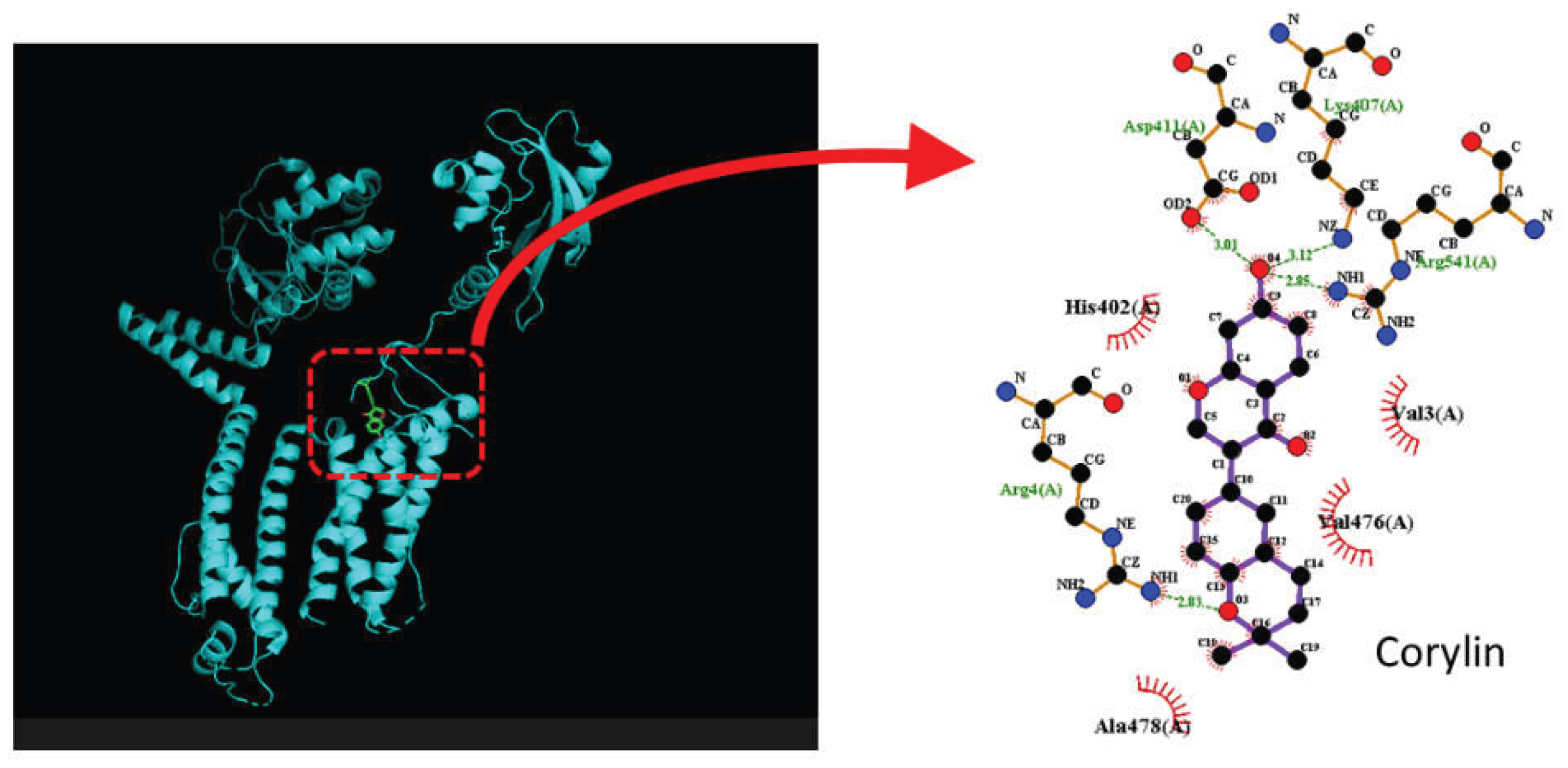
Because corylin can inhibit the amplitude of IK(erg), the KCNH2 (HERG, human ether-à-go-go-related gene) protein was further docked with corylin using PyRx software. The predicted binding sides of corylin on this channel protein are illustrated in Figure 9. This compound was observed to establish hydrophobic interactions with several residues, including Val3(A), His402(A), Val476(A), and Ala478(C). The corylin molecule can form hydrogen bonds with residues Arg4(A), Lys407(A), Asp411(A), and Arg541(A), with bond lengths of 2.81, 3.12, 3.01, and 2.85 Å, respectively. The results estimate a strong binding affinity of −7.8 kcal/mol. The predicted interaction thus suggests that corylin-mediated inhibition of IK(erg) in GH3 cells is due to its binding to KCNH2 channels.
3. Discussion
The striking findings demonstrated in this work are that corylin, a bioactive flavonoid currently recognized as a potential life prolonging agent [47], produces a stimulatory action on IK(M) in a concentration, voltage-, and Hys(V)-dependent fashion in GH3 lactotrophs. A leftward shift in the steady-state activation curve of IK(M) was observed in the presence of this compound with no change in the gating charge of the curve. Cell exposure to it can elevate the probability of KM channels that would be open, in combination with a measurable lengthening in mean open time of the channel. However, the IK(erg) in GH3 cells was slightly suppressed by the presence of corylin. Docking analysis revealed specific atomic-level interactions between the corylin molecule and the KCNQ2 or KCNH2 channel structure.
The magnitude of Na+ currents can rapidly decline in an exponential manner during high-frequency stimulation, as previously demonstrated in GH3 cells [48]. However, it needs to be emphasized that because of its slow activation and deactivation kinetics, the IK(M) amplitude can progressively arise during repetitive firing of APs. During high-frequency stimulation, the accumulation of IK(M) is hence allowed to hyperpolarize the afterpotential and hence to speed the recovery of Na+ channels from inactivation. As a corollary, the augmentation of IK(M) magnitude caused by corylin during high-frequency activity is of particular significance and thus capable of facilitating the firing of neuronal APs with stable waveform and high-fidelity synaptic signaling [26,34,35].
Like the Hys(V) behavior existing in solar cells [34,49], the current investigations clearly observed the appearance of the overall behavior in IK(M)’s Hys(V) evoked by a long-lasting upright isosceles-triangular Vramp [30,32,39]. That is, the magnitude of these instantaneous currents measured between ascending and descending ends of double Vramp turned out to be strikingly distinguishable. Alternatively, as the membrane potential becomes depolarized (i.e., upward ramp of triangular Vramp), the voltage dependence of KM channels may shift the mode of Hys(V) to one which occurs at less negative potentials with smaller current magnitude, leading to a minor effect on the rising phase of AP. However, as the membrane potential is hyperpolarized (i.e., during the downward limb of Vramp or repolarizing phase of AP), the voltage dependence of IK(M) activation would switch to more hyperpolarized voltages with a higher current magnitude, thereby having the tendency to increase membrane repolarization as well as to increase recovery of Na+ currents. Furthermore, findings from these observations led us to unravel that the triangular Vramp-induced IK(M) did undergo striking Hys(V) change in the voltage dependence, and such Hys(V) loops were subjected to being accentuated by adding corylin. In other words, the ∆area (indicated in shaded area of Figure 4A) of IK(M) loop evoked in response to long-lasing triangular Vramp significantly arose following the application of corylin. As such, the existence of corylin may increase IK(M) magnitude in a concentration- and Hys(V)-dependent fashion. However, further work needs to be conducted to examine if corylin-perturbed modifications in Hys(V) behavior of IK(M) are tightly linked to conformational changes or docking interactions in the voltage sensors of the KM channel.
Earlier investigations have revealed the ability of corylin to bind to and then to activate β 3-adrenergic receptors present in adipocytes [11,42]. It has been also demonstrated that corylin might interact with estrogen receptors to induce osteoblastic differentiation [18,50]. Estrogen receptors was noticed to express in pituitary lactotrophs [43]. However, in our study, during the continued exposure to corylin, further application of carvedilol, known to block β3 adrenoceptors in cardiac tissue, failed to have any adjustments on corylin-stimulated IK(M). Moreover, the presence of 17β-estradiol alone did not cause any pertubations on IK(M) observed in GH3 cells. In this scenario, it appears unlikely that under our experimental conditions, corylin-mediated stimulation of IK(M) or KM-channel activity is attributed to its high-affinity binding to either β-adrenergic or estrogen receptors
The EC50 of corylin required to stimulate IK(M in GH3 cells was determined to be approximately 3.8 μM. This value aligns closely with the concentration rages (1-300 μM) previously reported for its anti-oxidative, anti-inflammatory, and antineoplastic effects [4,7,8,9,11,12,15,16,47,51,52]. It should also be noted that the perturbations of corylin on membrane excitability may be strongly influenced by several confounding factors, including the concentration of corylin, the baseline resting potential, the firing patterns of APs, or a combination of these variables. It is, therefore, anticipated that the KM channel is an important target for the action of corylin. The concentrations used to affect magnitude, gating kinetics and Hys(V) behaviors of IK(M) presented herein would be pharmacologically significant in body fluids and tissues. The corylin molecule may have the propensity to exercise a higher affinity to the open state than to the resting (closed) state in the KM channel, thereby de-stabilizing the open conformation, while the detailed ionic mechanism of corylin actions on ionic currents is not thoroughly understood.
A previous paper [53] reported that the single-channel amplitude of KM channels was lower than that observed in the present study. The reason for this discrepancy remains unclear. One possible explanation is that single-channel conductance of KM channels may vary among different tissue preparations. Our findings are consistent with those reported earlier studies [31,38,54]. Because single-channel conductance of KCNQ2 and KCNQ3 channels is higher than that of KCNQ4 and KCNQ5 channels. It remains to be determined whether corylin differentially regulates distinct populations of KM (KCNQ/K7) channels.
4. Materials and Methods
4.1. Chemicals, Drugs, Reagents and Solutions
Corylin (IUPAC name: 3-(2,2-dimethylchromen-6-yl)-7-hydroxychromen-4-one, 53947-92-5, SCHEMBL1096083, CHEMBL1271888, C20H16O4, CAS: 53947-92-5; PubChem CID: 5316097) was supplied by MedChemExpress (GeneChain, Kaohsiung, Taiwan). Iberiotoxin was purchased from Alomone Labs (Asia Bioscience, Taipei, Taiwan), dapagliflozin (Dapa) was from Cayman (Ann Arbo, MI), carvedilol (Carv) was from Tocris (Union Biomed, Taipei, Taiwan), while 17β-estradiol, linopirdine (Lino), and tetrodotoxin (TTX) were from Sigma-Aldrich (Merck, Taipei, Taiwan). Corylin, carvedilol, dapagliflozin, and linopirdine were dissolved in dimethyl sulfoxide (DMSO) as 20 mM stock solution, and there were thereafter diluted in extracellular solution to the final concentration achieved, while iberiotoxin was dissolved in 0.9% NaCl. For cell preparations, all culture media, horse and fetal calf sera, L-glutamine, and trypsin/EDTA were acquired from HyCloneTM (Thermo Fisher, Logan, UT), while other chemicals or reagents were of laboratory grade and taken from standard sources.
The extracellular solution (normal Tyrode’s solution buffered with HEPES) contained the following ionic composition (in mM): NaCl 136.5, KCl 5.4, MgCl2 0.53, CaCl2 1.8, glucose 5.5, and HEPES 5.5, adjusted to pH 7.4 with NaOH. For recording of macroscopic K+ currents (IK(M) or IK(erg)), the pipette solution consisted of (in mM): KCl 140, MgCl2 1, Na2ATP 4, Na2GTP 0.1, EGTA 0.1, and HEPES, titrated to pH 7.2 with KOH. To measure IK(M), IK(erg), or KM-channel activity, the bath solution contained a high K+ solution (in mM): KCl 130, NaCl 10, MgCl2 3, glucose 6, and HEPES 10, adjusted to pH 7.4 with KOH. To record the activity of single KM channel, the pipette solution was composed of the following (in mM): NaCl 136.5, KCl 5.4, MgCl2 0.53, and HEPES-NaOH buffer 5 (pH 7.4).
4.2. Cell Preparations
GH3 pituitary tumor cells (BCRC-60015; Bioresources Collection and Research Center, Hsinchu, Taiwan) were cultured in Ham’s F-12 media supplemented with 15% horse serum (v/v), 2.5% fetal calf serum (v/v), and 2 mM L-glutamine [23,48,55]. To induce differentiation, cells were transferred to a serum-free, Ca2+-free medium. Under these experimental conditions, cell viability typically remained at 80-90% for up to two weeks. Cultures were maintained at 37 °C in a humidified incubator with a CO2/air mixture (1:19).
4.3. Electrophysiological Measurements
Before each experiment, GH3 cells were carefully dispersed with 1% trypsin/EDTA solution, and we thereafter quickly put an aliquot of cells suspension in a recording chamber mounted on the stage of a CKX-41 inverted microscope (Olympus; Yuan Yu, Taipei, Taiwan). Cells were immersed at room temperature (20-25 °C) in HEPES-buffered normal Tyrode’s solution that contained 1.8 mM CaCl2. When they were left to adhere to the chamber’s bottom for several minutes, the measurements were performed. Ionic currents were recorded with patch electrodes in the cell-attached or whole-cell configuration of a modified patch clamp technique, as described elsewhere [34,38,54,55]. GΩ-seals were typically formed in an all-or-none manner, leading to an improvement in signal-to-noise ratio. The recording pipette was connected to the input stage of an RK-400 (Bio-Logic, Claix, France) or an Axopatch-200B patch-clamp amplifier (Molecular Devices, Bestgen Biotech, New Taipei City, Taiwan). Patch electrodes (3-5 MΩ in bathing solution) were made from Kimax®-51 borosilicate capillary tubes (#34500; Merck, Taipei, Taiwan) using a two-step vertical puller (PB-7; Narishige, Taiwan Instrument, Tainan, Taiwan) and their tips were heat-polished in an MF-83 microforge (Narishige). All potentials were corrected for the liquid junction potential that would develop at the pipette tip in situations where the composition of the pipette internal solution was different from that in bath medium. Tested compounds were applied by perfusion or added to the bath to obtain the final concentration indicated. In the experiments with corylin plus linopirdine, linopirdine was applied after addition of corylin. When high-frequency stimuli were needed, we used an Astro-Med Grass S85X dual output pulse stimulator (Grass; Zhong Yan, Kaohsiung, Taiwan) [26,48,56].
The current and voltage signals were monitored in real time and recorded onto a laptop computer. The recorded data were low-pass filtered at 2 kHz using an FL-4 four-pole Bessel filter (Dagan, Minneapolis, MN) and digitized at 10 kHz or more with a Digidata 1440A interface (Molecular Devices). The device was connected to either an RK-400 or Axopatch-200B patch-clamp amplifier, which was controlled via a universal series bus (USB) connection using the pClamp 10.6 software (Molecular Devices). Ionic currents obtained from whole-cell and single-channel recordings were analyzed offline using pClamp 10.7, OriginPro® (OriginLab; Scientific Formosa, Kaohsiung, Taiwan), and custom-written macros in Excel® 2021 (Microsoft, Redmond, WA) running on Windows 11. Capacitive transients following repolarization were commonly observed; therefore, the tail deactivating K+ currents were measured after the capacitive currents had settled, typically between 10 and 20 msec after the end of voltage pulse.
4.4. Data Analyses
To determine the concentration-dependent stimulatory effect of corylin on the amplitude of IK(M), GH3 cells were bathed in a high-K+, Ca2+-free solution, while the recording electrode was filled with a K+-containing solution. To measure IK(M) amplitude, we voltage-clamped each tested cell at −50 mV, and the depolarizing pulse up to 1 sec in duration to −10 mV was imposed on it. The IK(M) amplitude measured at the end of depolarizing pulses in the presence of 300 μM corylin was defined as 1.0 (i.e., 100%). The corresponding amplitudes obtained during the control period (in the absence of corylin) and during exposure to different concentrations of corylin (1-300 μM) were measured and compared. The concentration required to stimulate 50% of the current amplitude was determined according to a modified Hill function. That is,
In this equation, EC50 = the concentration required for 50% stimulation; nH = the Hill coefficient; [C] = the corylin concentration applied; and Emax = maximal stimulation. This formula enables optimal convergence, providing the best fit line and accurate parameter estimates (e.g., EC50 and nH).
The activation time constants (τact) of IK(M) in response to prolonged membrane depolarization, obtained in the absence or presence of corylin, were determined by fitting the digitized current traces with a single-exponential function, as indicated in Figure 1B.
To characterize the stimulatory action of corylin on IK(M) amplitude, we constructed the quasi-steady-state activation curve of the current. The relationships between the membrane potentials and the normalized amplitudes of IK(M) with or without the existence of this compound were established and thereafter fitted with a Boltzmann function given by:
where Imax = the maximal activated current of IK(M); V = the membrane potential; V1/2 = the voltage for half-maximal stimulation; q = the apparent gating charge of the activation curve; F = Faraday’s constant; R = the universal gas constant; and T = the absolute temperature.
Linear (e.g., single-channel conductance) or nonlinear (e.g., concentration-dependent relationships and voltage-dependent activation curves) curve fitting to data sets was performed using an interactive least-squares method. The analysis was conducted using tools such as the Solver add-in in Excel® 2021 (Microsoft) and OriginPro® 64-bit (OriginLab).
4.5. Single-Channel Analysis of the KM Channel
Single KM-channel currents in GH3 cells were recorded and analyzed by pClamp 10.7 (Molecular Devices). To evaluate single-channel opening events, amplitude distributions were fitted with multi-Gaussian adjustments. Channel open probabilities were determined through an iterative process to minimize the χ 2 values across a sufficiently large set of independent observations. Open lifetime distributions of KM channels (i.e., mean open time), obtained with or without corylin presence, were fitted using least-squares analysis with logarithmically scaled bin widths.
4.6. Statistical Analyses
The presented data are expressed as mean ± standard error of the mean (SEM), with n representing the number of cells from which the samples were obtained. Comparisons between two groups were performed using paired or unpaired Student’s t-tests, as appropriate. For multiple-group comparisons, one-way analysis of variance (ANOVA) was conducted, followed by Fisher’s least significant difference (LSD) post hoc test to assess individual group differences. Statistical significance was defined as P < 0.05 and is indicated in the figure by *, **, or +
Author Contributions
Writing—review & editing, Supervision, Validation, Investigation, Dara curation, Conceptualization—S.-N.W.; Investigation, Data curation, Funding acquisition, Conceptualization, Project administration—R.L.; Investigation, Data curation, Funding acquisition, Conceptualization, Project administration—S.-C.L. All authors have read and agreed to the published version of the manuscript.
Funding
This work was supported in part by the National Science and Technology Council (NSTC), Taiwan (NSTC-112-2923-B-006-0016-028), and by An Nan Hospital-China Medical University, Taiwan (AHRF113-37 and ANHRF113-49). This research was also funded by the Lithuania-Latvia-Taiwan collaborative project. All conclusions, recommendations, and expressed opinions within this work are based on the authors’ independent research. They do not reflect the official policies or views of the funding organizations or institutions that supported this research.
Institutional Review Board Statement
Not applicable.
Informed Consent Statement
Not applicable.
Data Availability Statement
The original contributions presented in this study are included in the article. Further inquiries can be directed to the corresponding authors.
Acknowledgments
The authors are grateful to Zi-Han Gao for her assistance during the early stage of the experiments.
Conflicts of Interest
All authors declare that they have no conflicts of interest relevant to this study. The content and writing of this paper are solely the responsibility of the authors.
Abbreviations
The following abbreviations are used in this manuscript:
| AP | action potential |
| Carv | carvedilol |
| Corylin | 3-(2,2-dimethylchromen-6-yl)-7-hydroxychromen-4-one |
| Dapa | dapagliflozin |
| EC50 | concentration required for 50% stimulation |
| Erg | ether-à-go-go-related gene |
| HERG | human ether-à-go-go-related gene |
| Hys(V) | voltage-dependent hysteresis; |
| I-V | current versus voltage |
| IK(erg) | erg-mediated K+ current |
| IK(M) | M-type K+ current |
| KM channel | M-type K+ (KCNQ/K7) channel |
| Lino | linopirdine |
| SEM | standard error of the mean |
| TTX | tetrodotoxin |
| τact | activation time constant |
| Vramp | ramp voltage |
References
- Khushboo, P.S.; Jadhav, V.M.; Kadam, V.J.; Sathe, N.S. Psoralea corylifolia Linn.-”Kushtanashini”. Pharmacogn. Rev. 2010, 4, 69–76. [Google Scholar] [CrossRef]
- Lee, S.W.; Yun, B.R.; Kim, M.H.; Park, C.S.; Lee, W.S.; Oh, H.M.; Rho, M.C. Phenolic compounds isolated from Psoralea corylifolia inhibit IL-6-induced STAT3 activation. Planta Med. 2012, 78, 903–906. [Google Scholar] [CrossRef]
- Chopra, B.; Dhingra, A.K.; Dhar, K.L. Psoralea corylifolia L. (Buguchi) - folklore to modern evidence: review. Fitoterapia 2013, 90, 44–56. [Google Scholar] [CrossRef]
- Kim, K.A.; Shim, S.H.; Ahn, H.R.; Jung, S.H. Protective effects of the compounds isolated from the seed of Psoralea corylifolia on oxidative stress-induced retinal damage. Toxicol. Appl. Pharmacol. 2013, 269, 109–120. [Google Scholar] [CrossRef]
- Wang, T.X.; Yin, Z.H.; Zhang, W.; Peng, T.; Kang, W.Y. Chemical constituents from Psoralea corylifolia and their antioxidant alpha-glucosidase inhibitory and antimicrobial activities. Zhongguo Zhong Yao Za Zhi 2013, 38, 2328–2333, Chinese. [Google Scholar]
- Alam, F.; Khan, G.N.; Asad, M.H.H.B. Psoralea corylifolia L: Ethnobotanical, biological, and chemical aspects: A review. Phytother. Res. 2018, 32, 597–615. [Google Scholar] [CrossRef] [PubMed]
- Hung, Y.L.; Fang, S.H.; Wang, S.C.; Cheng, W.C.; Liu, P.L.; Su, C.C.; Chen, C.S.; Huang, M.Y.; Hua, K.F.; Shen, K.H.; Wang, Y.T.; Suzuki, K.; Li, C.Y. Corylin protects LPS-induced sepsis and attenuates LPS-induced inflammatory response. Sci. Rep. 2017, 7, 46299. [Google Scholar] [CrossRef]
- Chen, C.C.; Chen, C.Y.; Ueng, S.H.; Hsueh, C.; Yeh, C.T.; Ho, J.Y.; Chou, L.F.; Wang, T.H. Corylin increases the sensitivity of hepatocellular carcinoma cells to chemotherapy through long noncoding RNA RAD51-AS1-mediated inhibition of DNA repair. Cell Death Dis. 2018, 9, 543. [Google Scholar] [CrossRef] [PubMed]
- Chen, C.Y.; Chen, C.C.; Shieh, T.M.; Hsueh, C.; Wang, S.H.; Leu, Y.L.; Lian, J.H.; Wang, T.H. Corylin Suppresses Hepatocellular Carcinoma Progression via the Inhibition of Epithelial-Mesenchymal Transition, Mediated by Long Noncoding RNA GAS5. Int. J. Mol. Sci. 2018, 19, 380. [Google Scholar] [CrossRef]
- Chen, C.C.; Li, H.Y.; Leu, Y.L.; Chen, Y.J.; Wang, C.J.; Wang, S.H. Corylin Inhibits Vascular Cell Inflammation, Proliferation and Migration and Reduces Atherosclerosis in ApoE-Deficient Mice. Antioxidants (Basel) 2020, 9, 275. [Google Scholar] [CrossRef] [PubMed]
- Chen, C.C.; Kuo, C.H.; Leu, Y.L.; Wang, S.H. Corylin reduces obesity and insulin resistance and promotes adipose tissue browning through SIRT-1 and β3-AR activation. Pharmacol. Res. 2021, 164, 105291. [Google Scholar] [CrossRef]
- Chen, I.C.; Wang, S.C.; Chen, Y.T.; Tseng, H.H.; Liu, P.L.; Lin, T.C.; Wu, H.E.; Chen, Y.R.; Tseng, Y.H.; Hsu, J.H.; Dai, Z.K.; Suen, J.L.; Li, C.Y. Corylin Ameliorates LPS-Induced Acute Lung Injury via Suppressing the MAPKs and IL-6/STAT3 Signaling Pathways. Pharmaceuticals (Basel) 2021, 14, 1046. [Google Scholar] [CrossRef] [PubMed]
- Huang, M.Y.; Tu, C.E.; Wang, S.C.; Hung, Y.L.; Su, C.C.; Fang, S.H.; Chen, C.S.; Liu, P.L.; Cheng, W.C.; Huang, Y.W.; Li, C.Y. Corylin inhibits LPS-induced inflammatory response and attenuates the activation of NLRP3 inflammasome in microglia. BMC Complement. Altern. Med. 2018, 18, 221. [Google Scholar] [CrossRef]
- Qin, Z.; Li, S.; Yao, Z.; Hong, X.; Xu, J.; Lin, P.; Zhao, G.; Gonzalez, F.J.; Yao, X. Metabolic profiling of corylin in vivo and in vitro. J. Pharm. Biomed. Anal. 2018, 155, 157–168. [Google Scholar] [CrossRef]
- Che, L.; Yang, H.; Wang, D.; Liu, S. Corylin sensitizes breast cancer cells to overcome tamoxifen resistance by regulating OAS1/miR-22-3p/SIRT1 axis. Acta Biochim. Pol. 2021, 68, 757–764. [Google Scholar] [CrossRef] [PubMed]
- Liu, S.; Wang, L.; Zhang, R. Corylin suppresses metastasis of breast cancer cells by modulating miR-34c/LINC00963 target. Libyan J. Med. 2021, 16, 1883224. [Google Scholar] [CrossRef]
- Zhao, Z.; Liu, T.; Zhu, S.; Yang, Y.; Wang, Z.; Ma, H.; Wang, X.; Liu, T.; Guo, P.; Pi, J.; Qi, D.; Tian, B.; Liu, Z.; Li, N. Development and evaluation studies of Corylin loaded nanostructured lipid carriers gel for topical treatment of UV-induced skin aging. Exp. Gerontol. 2021, 153, 111499. [Google Scholar] [CrossRef]
- Yu, A.X.; Xu, M.L.; Yao, P.; Kwan, K.K.; Liu, Y.X.; Duan, R.; Dong, T.T.; Ko, R.K.; Tsim, K.W. Corylin, a flavonoid derived from Psoralea Fructus, induces osteoblastic differentiation via estrogen and Wnt/β-catenin signaling pathways. FASEB J. 2020, 34, 4311–4328. [Google Scholar] [CrossRef] [PubMed]
- Yu, A.X.; Xiao, J.; Zhao, S.Z.; Kong, X.P.; Kwan, K.K.; Zheng, B.Z.; Wu, K.Q.; Dong, T.T.; Tsim, K.W. Biological Evaluation and Transcriptomic Analysis of Corylin as an Inhibitor of Osteoclast Differentiation. Int. J. Mol. Sci. 2021, 22, 3540. [Google Scholar] [CrossRef]
- Chang, Z.Y.; Liu, H.M.; Leu, Y.L.; Hsu, C.H.; Lee, T.Y. Modulation of Gut Microbiota Combined with Upregulation of Intestinal Tight Junction Explains Anti-Inflammatory Effect of Corylin on Colitis-Associated Cancer in Mice. Int. J. Mol. Sci. 2022, 23, 2667. [Google Scholar] [CrossRef]
- Lee, Y.; Jun, H.S.; Oh, Y.S. Protective effect of Psoralea corylifolia L. seed extract against palmitate-induced neuronal apoptosis in PC12 cells. Evid. Based Complement. Alternat. Med. 2016 2016, 5410419. [Google Scholar] [CrossRef]
- Kim, Y.J.; Lim, H.S.; Lee, J.; Jeong, S.J. Quantitative Analysis of Psoralea corylifolia Linne and its Neuroprotective and Anti-Neuroinflammatory Effects in HT22 Hippocampal Cells and BV-2 Microglia. Molecules 2016, 21, 1076. [Google Scholar] [CrossRef]
- Wu, S.N.; Chiang, H.T.; Shen, A.Y.; Lo, Y.K. Differential effects of quercetin, a natural polyphenolic flavonoid, on L-type calcium current in pituitary tumor (GH3) cells and neuronal NG108-15 cells. J. Cell. Physiol. 2003, 195, 298–308. [Google Scholar] [CrossRef] [PubMed]
- Fusi, F.; Spiga, O.; Trezza, A.; Sgaragli, G.; Saponara, S. The surge of flavonoids as novel, fine regulators of cardiovascular Cav channels. Eur. J. Pharmacol. 2017, 796, 158–174. [Google Scholar] [CrossRef] [PubMed]
- Redford, K.E.; Abbott, G.W. KCNQ Potassium Channels as Targets of Botanical Folk Medicines. Annu. Rev. Pharmacol. Toxicol. 2022, 62, 447–464. [Google Scholar] [CrossRef]
- Liu, Y.C.; So, E.C.; Wu, S.N. Cannabidiol Modulates M-Type K+ and Hyperpolarization-Activated Cation Currents. Biomedicines 2023, 11, 2651. [Google Scholar] [CrossRef] [PubMed]
- Abbott, G.W.; Redford, K.E.; Yoshimura, R.F.; Manville, R.W.; Moreira, L.; Tran, K.; Arena, G.; Kookootsedes, A.; Lasky, E.; Gunnison, E. KCNQ and KCNE Isoform-Dependent Pharmacology Rationalizes Native American Dual Use of Specific Plants as Both Analgesics and Gastrointestinal Therapeutics. Front. Physiol. 2021, 12, 777057. [Google Scholar] [CrossRef]
- Brown, D.A.; Adams, P.R. Muscarinic suppression of a novel voltage-sensitive K+ current in a vertebrate neurone. Nature 1980, 283, 673–676. [Google Scholar] [CrossRef] [PubMed]
- Springer, K.; Soh, H.; Paz Zavala, R.; Varghese, N.; Lutz, C.; Zuberi, A.R.; Jackson, A.C.; Tzingounis, A.V. Mislocalization of KCNQ2 Channels as a Pathogenic Mechanism in KCNQ2 Developmental and Epileptic Encephalopathy. J. Neurosci. 2026, 46, e0947252025. [Google Scholar] [CrossRef]
- Wu, S.N.; Huang, C.W. Editorial to the special issue “Electrophysiology”. Int. J. Mol. Sci. 2021, 22, 2956. [Google Scholar] [CrossRef]
- Selyanko, A.A.; Hadley, J.K.; Wood, I.C.; Abogadie, F.C.; Delmas, P.; Buckley, N.J.; London, B.; Brown, D.A. Two types of K+ channel subunit, Erg1 and KCNQ2/3, contribute to the M-like current in a mammalian neuronal cell. J. Neurosci. 1999, 19, 7742–7756. [Google Scholar] [CrossRef]
- Chang, W.T.; Liu, P.Y.; Gao, Z.H.; Lee, S.W.; Lee, W.K.; Wu, S.N. Evidence for the Effectiveness of Remdesivir (GS-5734), a Nucleoside-Analog Antiviral Drug in the Inhibition of IK(M) or IK(DR) and in the Stimulation of IMEP. Front. Pharmacol. 2020, 11, 1091. [Google Scholar] [CrossRef]
- Lu, T.L.; Gao, Z.H.; Li, S.W.; Wu, S.N. High Efficacy by GAL-021: A Known Intravenous Peripheral Chemoreceptor Modulator that Suppresses BKCa-Channel Activity and Inhibits IK(M) or Ih. Biomolecules 2020, 10, 188. [Google Scholar] [CrossRef]
- Lu, T.L.; Liutkevičienė, R.; Rovite, V.; Gao, Z.H.; Wu, S.N. Evaluation of Small-Molecule Candidates as Modulators of M-Type K+ Currents: Impacts on Current Amplitude, Gating, and Voltage-Dependent Hysteresis. Int. J. Mol. Sci. 2025, 26, 1504. [Google Scholar] [CrossRef] [PubMed]
- Zhang, Y.; Li, D.; Darwish, Y.; Fu, X.; Trussell, L.O.; Huang, H. KCNQ channels enable reliable presynaptic spiking and synaptic transmission at high frequency. J. Neurosci. 2022, 42, 3305–3315. [Google Scholar] [CrossRef] [PubMed]
- Costi, S.; Han, M.H.; Murrough, J.W. The potential of KCNQ potassium channel openers as novel antidepressants. CNS Drugs 2022, 36, 207–216. [Google Scholar] [CrossRef]
- Li, S.B.; Damonte, V.M.; Chen, C.; Wang, G.X.; Kebschull, J.M.; Yamaguchi, H; Bian, W.J.; Purmann, C.; Pattni, R.; Urban, A.E.; Mourrain, P.; Kauer, J.A.; Scherrer, G.; de Lecea, L. Hyperexcitable arousal circuits drive sleep instability during aging. Science 2022, 375, eabh3021. [Google Scholar] [CrossRef]
- Sankaranarayanan, S.; Simasko, S.M. Characterization of an M-like current modulated by thyrotropin-releasing hormone in normal rat lactotrophs. J. Neurosci. 1996, 16, 1668–1678. [Google Scholar] [CrossRef]
- So, E.C.; Liu, P.Y; Wu, S. N, Effectiveness in the inhibition of dapagliflozin and canagliflozin on M-type K+ current and α-methylglucoside-induced current in pituitary tumor (GH3) and pheochromocytoma PC12 cells. Eur. J. Pharmacol. 2020, 879, 173141. [Google Scholar] [CrossRef] [PubMed]
- Lo, Y.C.; Lin, C.L.; Fang, W.Y.; Lőrinczi, B.; Szatmári, I.; Chang, W.H.; Fülöp, F.; Wu, S.N. Effective activation by kynurenic acid and its aminoalkylated derivatives on M-type K+ current. Int. J. Mol. Sci. 2021, 22 1300. [Google Scholar] [CrossRef]
- Passmore, G.M.; Selyanko, A.A.; Mistry, M.; Al-Qatari, M.; Marsh, S.J.; Matthews, E.A.; Dickenson, A.H.; Brown, T.A.; Burbidge, S.A.; Main, M.; Brown, D.A. KCNQ/M currents in sensory neurons: significance for pain therapy. J. Neurosci 2003, 23, 7227–7236. [Google Scholar] [CrossRef]
- Qiu, Z.C.; Tang, X.Y.; Wu, Q.C.; Tang, Z.L.; Wong, M.S.; Chen, J.X.; Yao, X.S.; Dai, Y. A new strategy for discovering effective substances and mechanisms of traditional Chinese medicine based on standardized drug containing plasma and the absorbed ingredients composition, a case study of Xian-Ling-Gu-Bao capsules. J. Ethnopharmacol. 2021, 279, 114396. [Google Scholar] [CrossRef]
- Zárate, S.; Seilicovich, A. Estrogen receptors and signaling pathways in lactotropes and somatotropes. Neuroendocrinology 2010, 92, 215–223. [Google Scholar] [CrossRef]
- Zhang, R.; Kang, X.; Wang, Y.; Wang, F.; Yu, P.; Shen, J.; Fu, L. Effects of carvedilol on ventricular remodeling and the expression of β3-adrenergic receptor in a diabetic rat model subjected myocardial infarction. Int. J. Cardiol. 2016, 222, 178–184. [Google Scholar] [CrossRef]
- Meera, P.; Wallner, M.; Toro, L. A neuronal beta subunit (KCNMB4) makes the large conductance, voltage- and Ca2+-activated K+ channel resistant to charybdotoxin and iberiotoxin. Proc. Natl. Acad. Sci. U S A 2000, 97, 5562–5567. [Google Scholar] [CrossRef] [PubMed]
- Wu, S.N.; Yang, W.H.; Yeh, C.C.; Huang, H.C. The inhibition by di(2-ethylhexyl)-phthalate of erg-mediated K+ current in pituitary tumor (GH3) cells. Arch. Toxicol. 2012, 86, 713–723. [Google Scholar] [CrossRef] [PubMed]
- Wang, T.H.; Tseng, W.C.; Leu, Y.L.; Chen, C.Y.; Lee, W.C.; Chi, Y.C.; Cheng, S.F.; Lai, C.Y.; Kuo, C.H.; Yang, S.L.; Yang, S.H.; Shen, J.J.; Feng, C.H.; Wu, C.C.; Hwang, T.L.; Wang, C.J.; Wang, S.H.; Chen, C.C. The flavonoid corylin exhibits lifespan extension properties in mouse. Nat. Commun. 2022, 13, 1238. [Google Scholar] [CrossRef]
- Wu, C.L.; Chuang, C.W.; Cho, H.Y.; Chuang, T.H.; Wu, S.N. The Evidence for Effective Inhibition of INa Produced by Mirogabalin ((1R,5S,6S)-6-(aminomethyl)-3-ethyl-bicyclo [3.2.0] hept-3-ene-6-acetic acid), a Known Blocker of CaV Channels. Int. J. Mol. Sci. 2022, 23, 3845. [Google Scholar] [CrossRef] [PubMed]
- Meng, G.; Shi, Y.; Wang, Y.; Shi, Y. Modulation of SpiroOMeTAD Hole-Transport Layers for Carbon-Based Perovskite Solar Cells. Small 2026, 22, e12519. [Google Scholar] [CrossRef]
- Zhang, T.; Zhong, S.; Meng, Y.; Deng, W.; Hou, L.; Wang, Y.; Xing, X.; Guan, T.; Zhang, J.; Li, T. Quantitative structure-activity relationship for estrogenic flavonoids from Psoralea corylifolia. J. Pharm. Biomed. Anal. 2018, 161, 129–135. [Google Scholar] [CrossRef]
- Men, W.J.; Cheng, L.Y.; Chen, M.Y.; Zhang, X.Y.; Zhang, Y.; Zhou, K. Study on pharmacokinetics of eight active compounds from Bufei-Huoxue Capsule based on UHPLC-MS/MS. J. Chromatogr. B Analyt. Technol. Biomed. Life Sci. 2021, 1184, 122974. [Google Scholar] [CrossRef]
- Lin, Z.R.; Yin, H.; Wan, T.F.; Ruan, Z.; Mao, J.Y.; Pan, Z.Y.; Huang, Y.; Zeng, S.Y.; Ran, L.; Liu, J.H.; Xiao, X.H.; Xie, H.; Hu, Y. Corylin ameliorates diabetic osteoporosis by inhibiting inflammation via targeting RAG1. Phytomedicine 2026, 150, 157671. [Google Scholar] [CrossRef] [PubMed]
- Li, Y.; Gamper, N.; Shapiro, M.S. Single-channel analysis of KCNQ K+ channels reveals the mechanism of augmentation by a cysteine-modifying reagent. J. Neurosci. 2004, 24, 5079–5090. [Google Scholar] [CrossRef] [PubMed]
- Selyanko, A.A.; Brown, D.A. Regulation of M-type potassium channels in mammalian sympathetic neurons: action of intracellular calcium on single channel currents. Neuropharmacology 1996, 35, 933–947. [Google Scholar] [CrossRef] [PubMed]
- Wu, S.N.; Wang, Y.J.; Gao, Z.H.; Liutkevičienė, R.; Rovite, V. Recent Advances in Ionic Mechanisms in Pituitary Cells: Implications for Electrophysiological and Electropharmacological Research. J. Clin. Med. 2025, 14, 3117. [Google Scholar] [CrossRef]
- Lin, C.Y.; Gao, Z.H.; Cheung, C.W.; So, E.C.; Wu, S.N. Modulation of Voltage-Gated Na+ Channel Currents by Small Molecules: Effects on Amplitude and Gating During High-Frequency Stimulation. Sci. Pharm. 2025, 93, 33. [Google Scholar] [CrossRef]
Figure 1.
Effect of corylin on M-type K+ current (IK(M)) recorded from pituitary tumor (GH3) cells. In these experiments, we used high-K+, Ca2+-free solution as a bathing solution, and the recording electrode was filled with K+-containing solution. (A) Superimposed current traces acquired in the control period (i.e., corylin was not present, a, black color) and during cell exposure to 3 μM corylin (b, blue color) or 10 μM corylin (c, red color) or 10 μM corylin plus 10 μM linopirdine (Lino) (d, brown color). The top part indicates the voltage-clamp protocol applied, (i.e., 1-sec depolarizing step from −50 to −10 mV). (B) Enhancing effect of corylin on the activation time course of IK(M). The time course of IK(M) activation in the presence (a, open black circles) and in the presence of 3 μM corylin (b, open blue circles) or 10 μM corylin (c, open red circles) was fitted using a single-exponential function (gray lines). The current trajectory labeled ‘d’ in (A) is not shown. The current traces in (B) were an expanded record from the purple dashed box of (A). (C) Scatter graph summarizing effects of corylin (3 or 10 μM) and corylin (10 μM) plus linopirdine (10 μM, Lino) on the value of activation time constant (τact) of IK(M) in GH3 cells (mean ± SEM; n = 8 for each point). The IK(M) was evoked by the depolarizing command voltage pulse to −10 mV for a duration of 1 sec from a holding potential of −50 mV. * Significantly different from control (P < 0.05), ** significantly different from corylin (3 μM) alone group (P < 0.05), and + significantly from corylin (10 μM) alone group (P < 0.05). (D) Concentration-dependent effect of corylin (1-300 μM) on the percentage increase in IK(M) amplitude (mean ± SEM; n = 8 for each point). The smooth gray line represents best fit to the data points with a modified Hill equation, as mentioned in Materials and Methods. The EC50 and Hill coefficient for corylin-stimulated IK(M) were 3.8 μM and 1.2, respectively.
Figure 1.
Effect of corylin on M-type K+ current (IK(M)) recorded from pituitary tumor (GH3) cells. In these experiments, we used high-K+, Ca2+-free solution as a bathing solution, and the recording electrode was filled with K+-containing solution. (A) Superimposed current traces acquired in the control period (i.e., corylin was not present, a, black color) and during cell exposure to 3 μM corylin (b, blue color) or 10 μM corylin (c, red color) or 10 μM corylin plus 10 μM linopirdine (Lino) (d, brown color). The top part indicates the voltage-clamp protocol applied, (i.e., 1-sec depolarizing step from −50 to −10 mV). (B) Enhancing effect of corylin on the activation time course of IK(M). The time course of IK(M) activation in the presence (a, open black circles) and in the presence of 3 μM corylin (b, open blue circles) or 10 μM corylin (c, open red circles) was fitted using a single-exponential function (gray lines). The current trajectory labeled ‘d’ in (A) is not shown. The current traces in (B) were an expanded record from the purple dashed box of (A). (C) Scatter graph summarizing effects of corylin (3 or 10 μM) and corylin (10 μM) plus linopirdine (10 μM, Lino) on the value of activation time constant (τact) of IK(M) in GH3 cells (mean ± SEM; n = 8 for each point). The IK(M) was evoked by the depolarizing command voltage pulse to −10 mV for a duration of 1 sec from a holding potential of −50 mV. * Significantly different from control (P < 0.05), ** significantly different from corylin (3 μM) alone group (P < 0.05), and + significantly from corylin (10 μM) alone group (P < 0.05). (D) Concentration-dependent effect of corylin (1-300 μM) on the percentage increase in IK(M) amplitude (mean ± SEM; n = 8 for each point). The smooth gray line represents best fit to the data points with a modified Hill equation, as mentioned in Materials and Methods. The EC50 and Hill coefficient for corylin-stimulated IK(M) were 3.8 μM and 1.2, respectively.
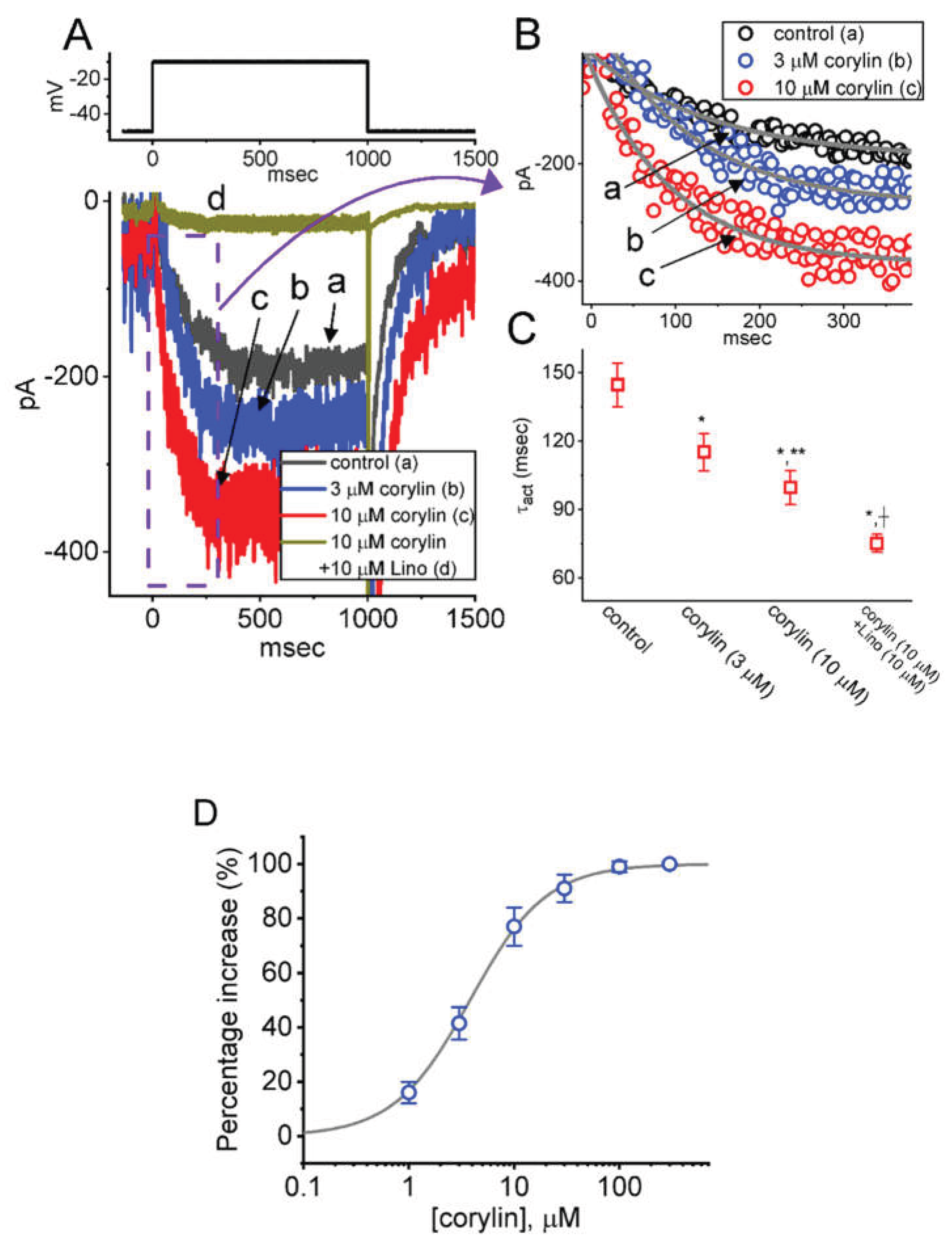
Figure 2.
Effect of corylin on the steady-state current versus voltage (I-V) relationship (A) and activation curve (B) of IK(M) present in GH3 cells. (A) Representative current traces acquired in the control period (i.e., corylin was not present, upper), and during cell exposure to 10 μM corylin (lower). The top part indicates the voltage-clamp protocol applied, and the voltage shown in different colors corresponds to current trace evoked by the voltage at the same color. (B) Mean I-V relationship of IK(M) acquired in the control (filled black squares) and during exposure to 10 μM corylin (open red circles) (mean ± SEM; n = 8 for each point). (C) Mean relationship of the relative current amplitude (I / Imax) versus membrane potential of IK(M) (i.e., the steady-state activation curve of the current) (mean ± SEM; n = 8 for each point). ■: control; ○: corylin (10 μM).
Figure 2.
Effect of corylin on the steady-state current versus voltage (I-V) relationship (A) and activation curve (B) of IK(M) present in GH3 cells. (A) Representative current traces acquired in the control period (i.e., corylin was not present, upper), and during cell exposure to 10 μM corylin (lower). The top part indicates the voltage-clamp protocol applied, and the voltage shown in different colors corresponds to current trace evoked by the voltage at the same color. (B) Mean I-V relationship of IK(M) acquired in the control (filled black squares) and during exposure to 10 μM corylin (open red circles) (mean ± SEM; n = 8 for each point). (C) Mean relationship of the relative current amplitude (I / Imax) versus membrane potential of IK(M) (i.e., the steady-state activation curve of the current) (mean ± SEM; n = 8 for each point). ■: control; ○: corylin (10 μM).
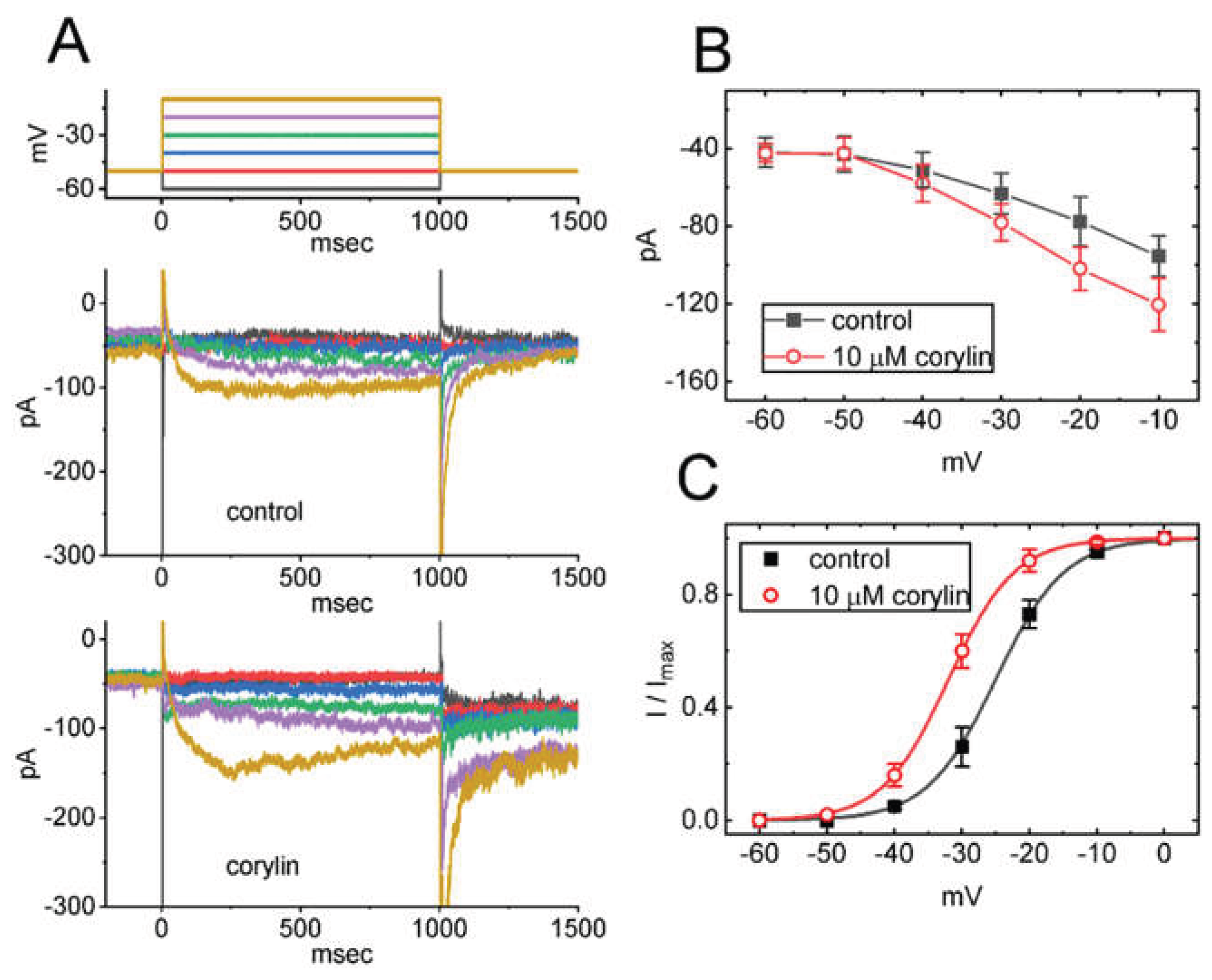
Figure 3.
Stimulatory effect of corylin on IK(M) amplitude induced during a 20 Hz train of depolarizing pulses in GH3 cells. The train was specifically designed to consist of 20 40-msec pulse separated by 10 msec intervals at −50 mV for a duration of 1 sec, and through digital-to-analog conversion, it was imposed over the tested cell. (A) Representative current traces acquired in the control period (a, black color) and during cell exposure to 1 μM corylin (b, blue color) or 10 μM corylin (c, red color). The voltage-clamp protocol is indicated in the top part. To provide high resolution, current traces in (B) denote an expanded record from the dashed yellow box in (A). (C) Summary graph demonstrating effect of corylin (1 and 10 μM) on the IK(M) amplitude in response to a train of depolarizing command voltage from −50 to −10 mV (mean ± SEM; n = 7 for each point). Current amplitude was measured at the end of each train of depolarizing pulse. Of notice, cell exposure to corylin produces an increase in IK(M) amplitude activated by a train of pulses. * Significantly different from control (P < 0.05), and ** significantly different from corylin (1 μM) alone group (P < 0.05).
Figure 3.
Stimulatory effect of corylin on IK(M) amplitude induced during a 20 Hz train of depolarizing pulses in GH3 cells. The train was specifically designed to consist of 20 40-msec pulse separated by 10 msec intervals at −50 mV for a duration of 1 sec, and through digital-to-analog conversion, it was imposed over the tested cell. (A) Representative current traces acquired in the control period (a, black color) and during cell exposure to 1 μM corylin (b, blue color) or 10 μM corylin (c, red color). The voltage-clamp protocol is indicated in the top part. To provide high resolution, current traces in (B) denote an expanded record from the dashed yellow box in (A). (C) Summary graph demonstrating effect of corylin (1 and 10 μM) on the IK(M) amplitude in response to a train of depolarizing command voltage from −50 to −10 mV (mean ± SEM; n = 7 for each point). Current amplitude was measured at the end of each train of depolarizing pulse. Of notice, cell exposure to corylin produces an increase in IK(M) amplitude activated by a train of pulses. * Significantly different from control (P < 0.05), and ** significantly different from corylin (1 μM) alone group (P < 0.05).
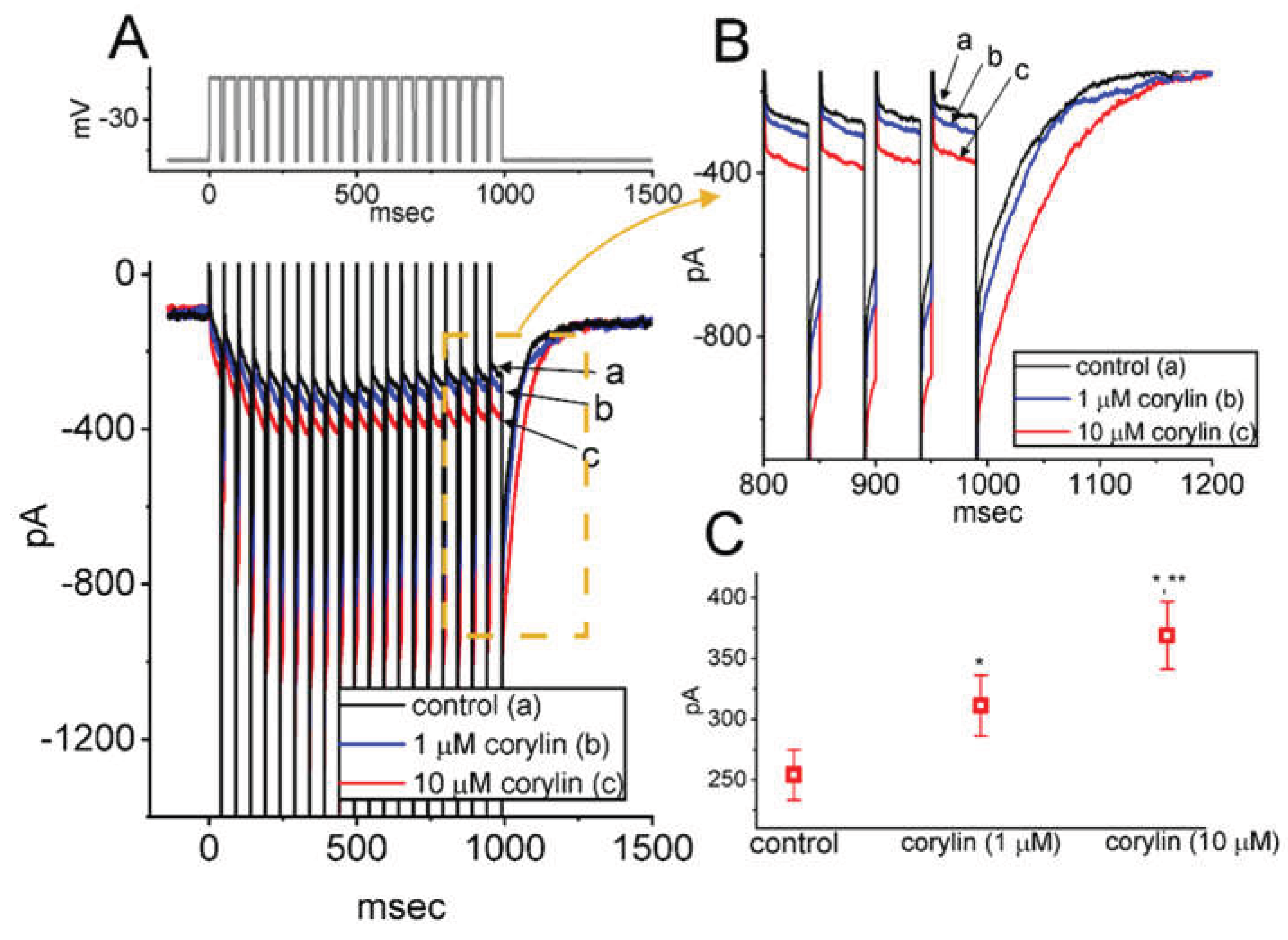
Figure 4.
Stimulatory effect of corylin on the strength of voltage-dependent hysteresis (Hys(V)) activated by upright isosceles-triangular ramp pulse (Vramp). In this series of whole-cell current recordings, the tested cell was voltage-clamped at −50 mV, and a triangular Vramp with a duration of 3.6 sec (ramp speed ±16.7 mV/sec) was applied to elicit instantaneous IK(M). Under these conditions, whole-cell IK(M) was robustly evoked during the forward (ascending from −60 to 0 mV) and backward (descending from 0 to −60 mV) limbs of Vramp commands. (A) Relationship between IK(M) and membrane potential (i.e., Hys(V) behavior) obtained under the control conditions (blue trace) and during exposure to 10 μM corylin (red trace). The inset illustrates the voltage-clamp pulse protocol, and the dashed purple arrows in both the inset and panel (A) indicate the direction of the current trajectory over time. A clockwise Hys(V) loop evoked by the double Vramp protocol (duration 3.2 sec; ramp speed ±16.7 mV/sec) was clearly observed. Application of corylin (10 μM) increased the strength of the Vramp-induced Hys(V), as indicated by the shaded region. (B) Scatter plot summarizing changes in the hysteresis area ( ∆area) of Vramp-induced Hys(V) loop measured during exposure to 3 or 10 μM corylin, as well as 10 μM corylin in the presence of 10 μM linopirdine (Lino) (mean ± SEM; n = 8 for each point). The ∆area of Hys(V) loop was calculated as the area enclosed by the current traces generated during the forward (upsloping) and backward (downsloping) limbs of the triangular Vramp. * Significantly different from control (P < 0.05), * significantly different from corylin (3 μM) alone group (P < 0.05), and + significantly different from corylin (10 μM) alone group (P < 0.05).
Figure 4.
Stimulatory effect of corylin on the strength of voltage-dependent hysteresis (Hys(V)) activated by upright isosceles-triangular ramp pulse (Vramp). In this series of whole-cell current recordings, the tested cell was voltage-clamped at −50 mV, and a triangular Vramp with a duration of 3.6 sec (ramp speed ±16.7 mV/sec) was applied to elicit instantaneous IK(M). Under these conditions, whole-cell IK(M) was robustly evoked during the forward (ascending from −60 to 0 mV) and backward (descending from 0 to −60 mV) limbs of Vramp commands. (A) Relationship between IK(M) and membrane potential (i.e., Hys(V) behavior) obtained under the control conditions (blue trace) and during exposure to 10 μM corylin (red trace). The inset illustrates the voltage-clamp pulse protocol, and the dashed purple arrows in both the inset and panel (A) indicate the direction of the current trajectory over time. A clockwise Hys(V) loop evoked by the double Vramp protocol (duration 3.2 sec; ramp speed ±16.7 mV/sec) was clearly observed. Application of corylin (10 μM) increased the strength of the Vramp-induced Hys(V), as indicated by the shaded region. (B) Scatter plot summarizing changes in the hysteresis area ( ∆area) of Vramp-induced Hys(V) loop measured during exposure to 3 or 10 μM corylin, as well as 10 μM corylin in the presence of 10 μM linopirdine (Lino) (mean ± SEM; n = 8 for each point). The ∆area of Hys(V) loop was calculated as the area enclosed by the current traces generated during the forward (upsloping) and backward (downsloping) limbs of the triangular Vramp. * Significantly different from control (P < 0.05), * significantly different from corylin (3 μM) alone group (P < 0.05), and + significantly different from corylin (10 μM) alone group (P < 0.05).
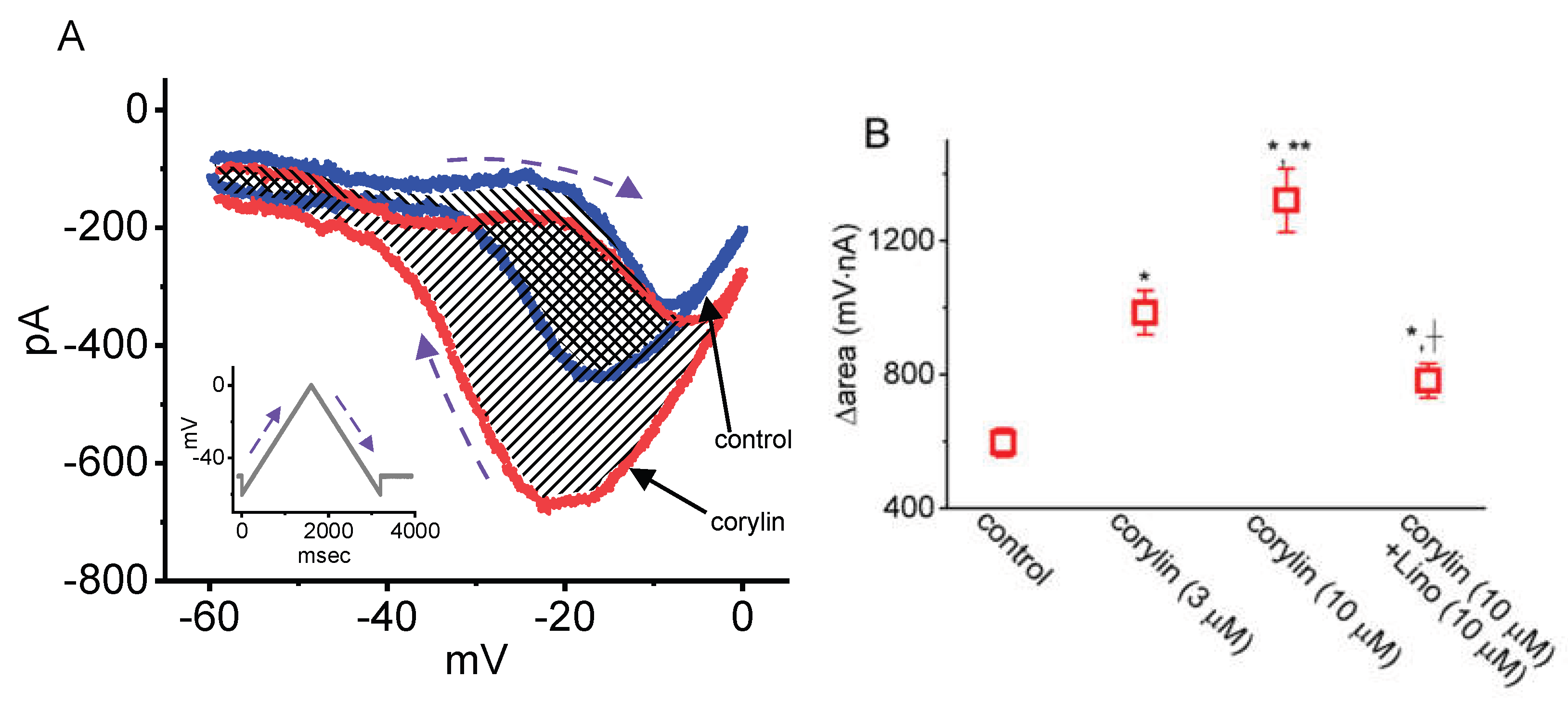
Figure 5.
Summary scatter graph demonstrating effects of corylin, corylin plus carvedilol (Carv), corylin plus iberiotoxin (Iber), 17β-estradiol (β-estradiol), and corylin plus dapagliflozin (Dapa) on IK(M) amplitude in GH3 cells. In these experiments, we placed cells in high-K+, Ca2+-free solution and the recording pipette was filled up with K+-containing solution. In absolute value, current amplitudes during cell exposure to different tested compounds were measured at the end of 1-sec depolarizing pulse from −50 to −10 mV. Each data point represents the mean ± SEM (n = 8). * Significantly different from control (P < 0.05 and ** significantly different corylin (10 mM) alone (P < 0.05).
Figure 5.
Summary scatter graph demonstrating effects of corylin, corylin plus carvedilol (Carv), corylin plus iberiotoxin (Iber), 17β-estradiol (β-estradiol), and corylin plus dapagliflozin (Dapa) on IK(M) amplitude in GH3 cells. In these experiments, we placed cells in high-K+, Ca2+-free solution and the recording pipette was filled up with K+-containing solution. In absolute value, current amplitudes during cell exposure to different tested compounds were measured at the end of 1-sec depolarizing pulse from −50 to −10 mV. Each data point represents the mean ± SEM (n = 8). * Significantly different from control (P < 0.05 and ** significantly different corylin (10 mM) alone (P < 0.05).
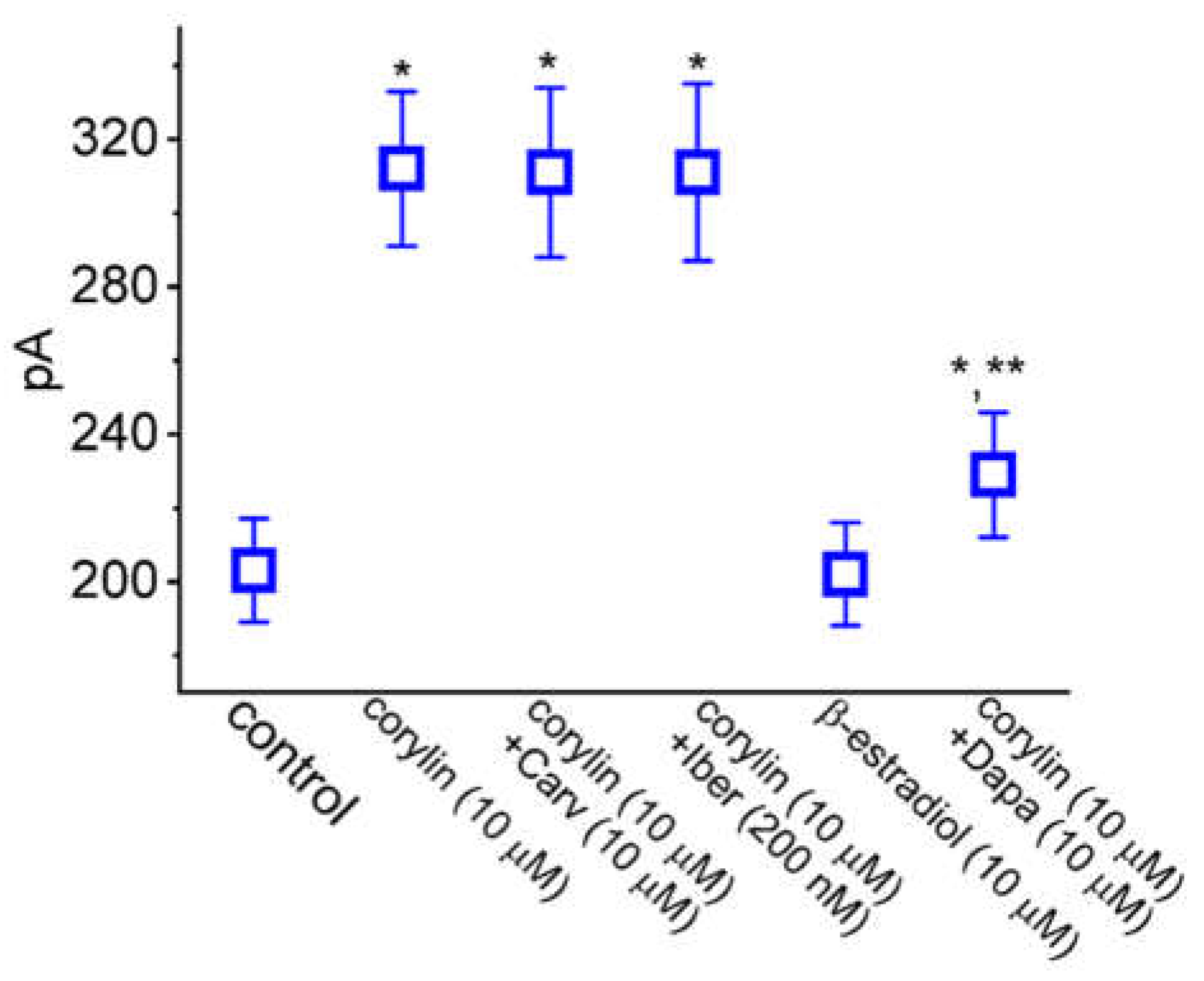
Figure 6.
Effect of corylin on the activity of M-type K+ (KM) channels recorded from GH3 cells. This set of cell-attached recordings was made in cells maintained in high-K+, Ca2+-free solution, and filled up the recording pipette by using a low-K+ (5.4 mM) solution. (A) Representative channel activity acquired in the control period (left, blue color), after bath addition of 10 μM corylin (middle, red color), and after addition of 10 μM corylin plus 10 μM linopirdine (Lino) (right, brown color). The single channel events were measured as the tested cell was voltage-clamped at +20 mV relative to the bath. The upward deflection indicates the opening event of the KM channel which occurs with rapid open-closed transitions. (B) Effect of corylin on mean open time of KM channels. In control (left), data were obtained from measurements of 243 channel openings, with a total recording time of 2 min, whereas in the presence of 10 μM corylin (right), data were from 278 channel openings, with a total recording time of 1 min. Of note, the x- and y-axis indicate the square root of the event number and the logarithm of open time (msec), respectively. In each lifetime distribution, the continuous line represents the optimal fit to a single-exponential function, while the vertical dashed line marks the corresponding constant, indicating the mean open time). (C) Summary scatter graph demonstrating effects of corylin (3 or 10 μM), corylin plus linopirdine (Lino), and corylin plus dapagliflozin (Dapa) on channel open probability (mean ± SEM; n = 8 for each point). Channel activity was measured at +20 mV relative to the bath. * Significantly different from control (P < 0.05), ** significantly different from corylin (3 μM) alone group (P < 0.05), and + significantly different from corylin (10 μM) alone group (P < 0.05).
Figure 6.
Effect of corylin on the activity of M-type K+ (KM) channels recorded from GH3 cells. This set of cell-attached recordings was made in cells maintained in high-K+, Ca2+-free solution, and filled up the recording pipette by using a low-K+ (5.4 mM) solution. (A) Representative channel activity acquired in the control period (left, blue color), after bath addition of 10 μM corylin (middle, red color), and after addition of 10 μM corylin plus 10 μM linopirdine (Lino) (right, brown color). The single channel events were measured as the tested cell was voltage-clamped at +20 mV relative to the bath. The upward deflection indicates the opening event of the KM channel which occurs with rapid open-closed transitions. (B) Effect of corylin on mean open time of KM channels. In control (left), data were obtained from measurements of 243 channel openings, with a total recording time of 2 min, whereas in the presence of 10 μM corylin (right), data were from 278 channel openings, with a total recording time of 1 min. Of note, the x- and y-axis indicate the square root of the event number and the logarithm of open time (msec), respectively. In each lifetime distribution, the continuous line represents the optimal fit to a single-exponential function, while the vertical dashed line marks the corresponding constant, indicating the mean open time). (C) Summary scatter graph demonstrating effects of corylin (3 or 10 μM), corylin plus linopirdine (Lino), and corylin plus dapagliflozin (Dapa) on channel open probability (mean ± SEM; n = 8 for each point). Channel activity was measured at +20 mV relative to the bath. * Significantly different from control (P < 0.05), ** significantly different from corylin (3 μM) alone group (P < 0.05), and + significantly different from corylin (10 μM) alone group (P < 0.05).
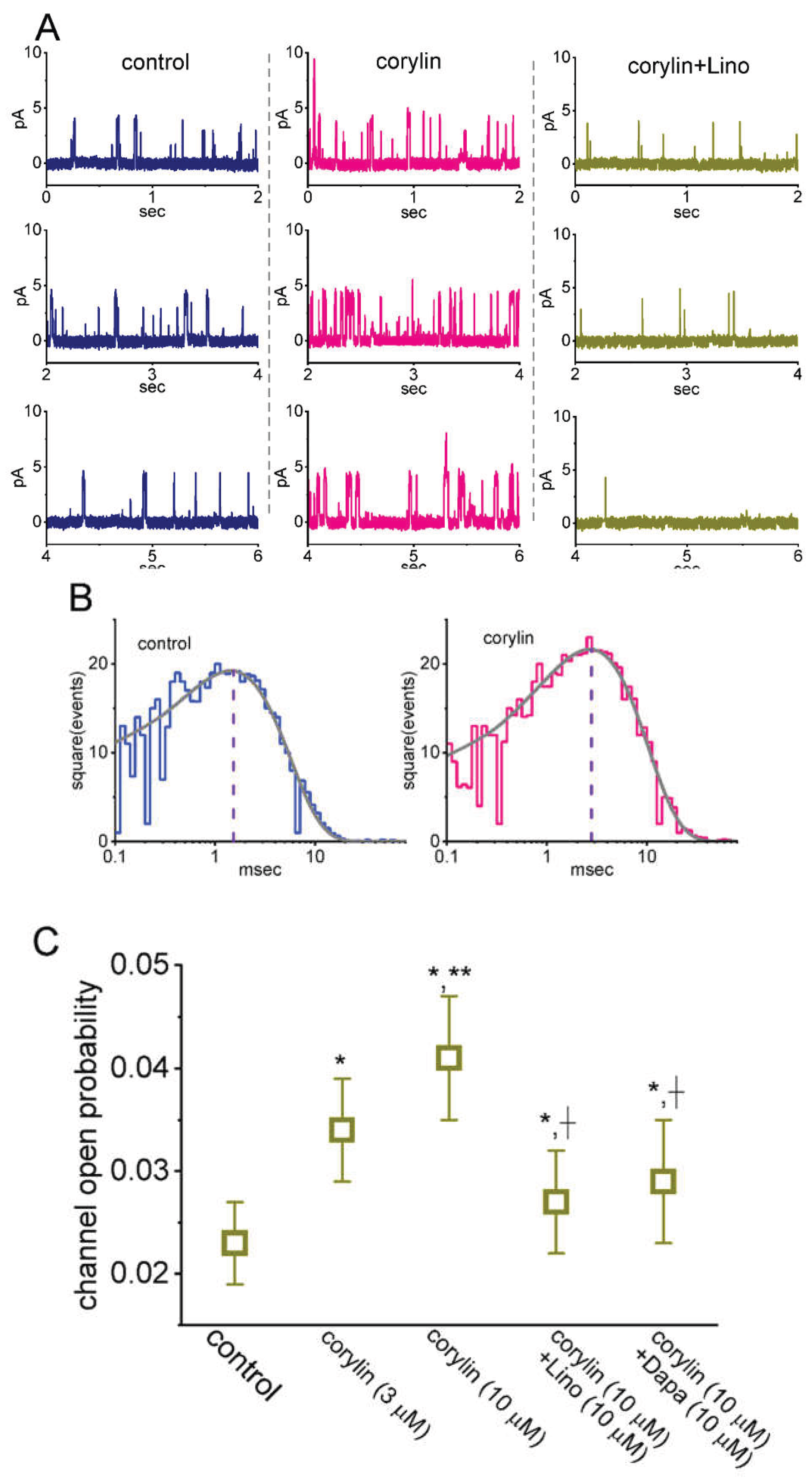
Figure 7.
Inhibitory effect of corylin on erg-mediated K+ current (IK(erg)) residing in GH3 cells. In these experiments, cells were suspended in high-K+, Ca2+-free solution containing 1 μM TTX and 0.5 mM CdCl2, and the recording pipette used was filled with K+-enriched solution. After establishing the whole-cell configuration, the tested cell was held at −10 mV, and a series of rectangular voltage pulses ranging from −90 to 0 mV in 10-mV increments was applied. (A) Superimposed current traces acquired in the absence (upper part) and presence (lower part) 10 μM corylin. The uppermost graph in (A) denotes the voltage-clamp protocol applied to the examined cell. The voltage traces shown in different colors correspond with current ones evoked by the same levels of membrane potential. (B) Average I-V relationship of peak (upper, filled symbols) and sustained (lower, open symbols) components of deactivating IK(erg) obtained in the absence (black squares) or presence (red circles) of 10 μM corylin (mean ± SEM; n = 8 for each point). Current amplitudes were measured at the start (peak component) and end pulse (sustained component) of various command voltage steps. Current amplitudes measured between −50 and −80 mV exhibit an inwardly rectifying property of the absolute IK(erg). Of notice, the IK(erg) in GH3 cells was subjected to mild inhibition by the existence of corylin (10 μM).
Figure 7.
Inhibitory effect of corylin on erg-mediated K+ current (IK(erg)) residing in GH3 cells. In these experiments, cells were suspended in high-K+, Ca2+-free solution containing 1 μM TTX and 0.5 mM CdCl2, and the recording pipette used was filled with K+-enriched solution. After establishing the whole-cell configuration, the tested cell was held at −10 mV, and a series of rectangular voltage pulses ranging from −90 to 0 mV in 10-mV increments was applied. (A) Superimposed current traces acquired in the absence (upper part) and presence (lower part) 10 μM corylin. The uppermost graph in (A) denotes the voltage-clamp protocol applied to the examined cell. The voltage traces shown in different colors correspond with current ones evoked by the same levels of membrane potential. (B) Average I-V relationship of peak (upper, filled symbols) and sustained (lower, open symbols) components of deactivating IK(erg) obtained in the absence (black squares) or presence (red circles) of 10 μM corylin (mean ± SEM; n = 8 for each point). Current amplitudes were measured at the start (peak component) and end pulse (sustained component) of various command voltage steps. Current amplitudes measured between −50 and −80 mV exhibit an inwardly rectifying property of the absolute IK(erg). Of notice, the IK(erg) in GH3 cells was subjected to mild inhibition by the existence of corylin (10 μM).
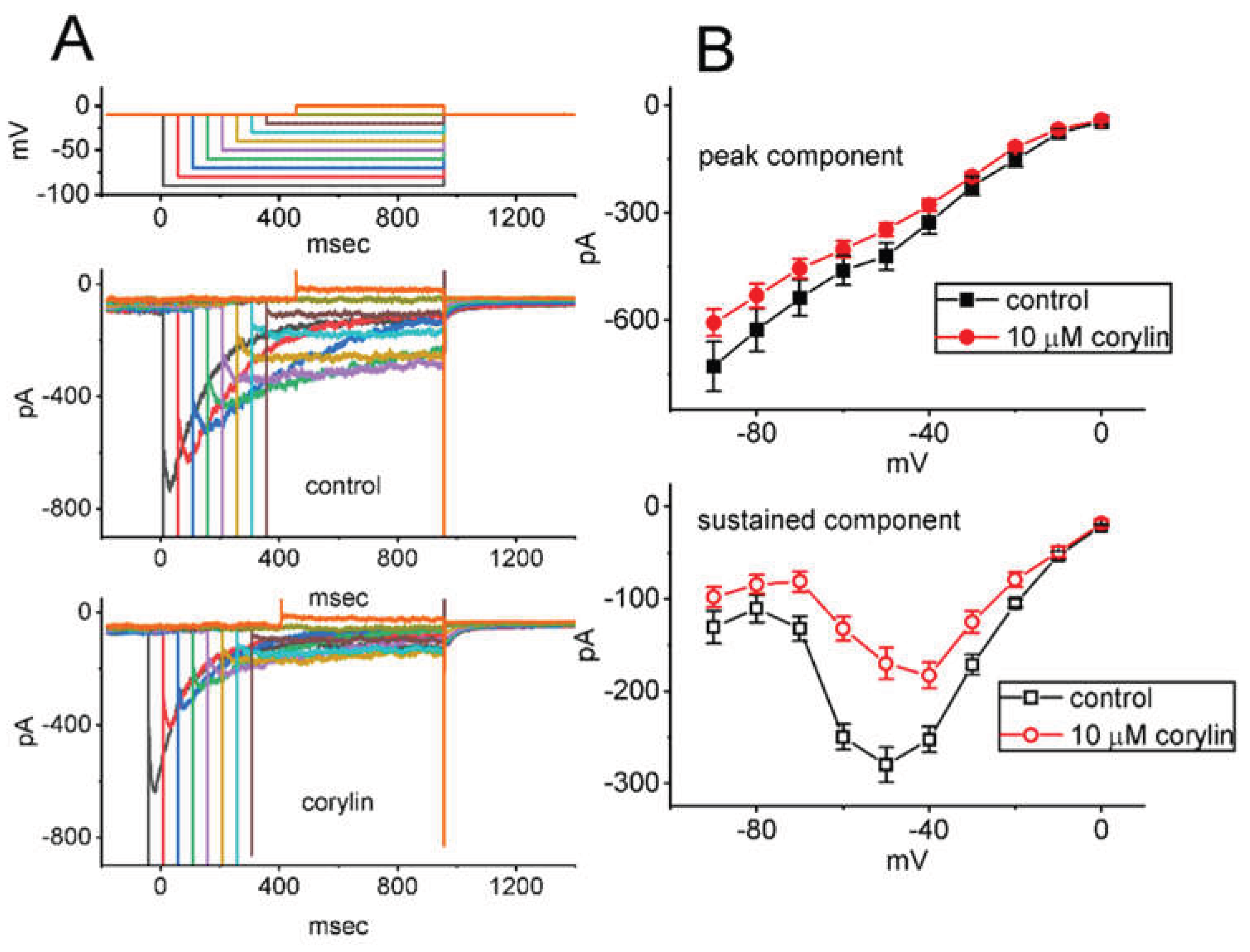
Figure 8.
Docking results of KCNQ2 channel and corylin. Protein structure of KCNQ2 channel was acquired from PDB (PDB ID: 7CR1), while three-dimensional structure of corylin was from PubChem (compound CID: 5316097). The structure of KCNQ2 auto-docked with the corylin molecule was made through PyRx (http://pyrx.sourceforge.io/). The diagram of interaction between KCNQ2 and the corylin molecule was generated by LogPlot+ (https://www.ebi.ac.uk/thornton-srv/software/LIGPLOT/). The right panel shows an enlarged view of the region highlighted by the pink box with the curved arrow in the left panel. Notably, in this and the subsequent figures, red arcs with spokes directed toward the ligand (corylin) denote hydrophobic interactions between the protein and the corylin molecule, whereas green dotted lines indicate hydrogen bonds. In the central part of the right panel of this and the next figures, the chemical structure of corylin is shown. The parenthesis following the amino acid indicates the chain identifier.
Figure 8.
Docking results of KCNQ2 channel and corylin. Protein structure of KCNQ2 channel was acquired from PDB (PDB ID: 7CR1), while three-dimensional structure of corylin was from PubChem (compound CID: 5316097). The structure of KCNQ2 auto-docked with the corylin molecule was made through PyRx (http://pyrx.sourceforge.io/). The diagram of interaction between KCNQ2 and the corylin molecule was generated by LogPlot+ (https://www.ebi.ac.uk/thornton-srv/software/LIGPLOT/). The right panel shows an enlarged view of the region highlighted by the pink box with the curved arrow in the left panel. Notably, in this and the subsequent figures, red arcs with spokes directed toward the ligand (corylin) denote hydrophobic interactions between the protein and the corylin molecule, whereas green dotted lines indicate hydrogen bonds. In the central part of the right panel of this and the next figures, the chemical structure of corylin is shown. The parenthesis following the amino acid indicates the chain identifier.
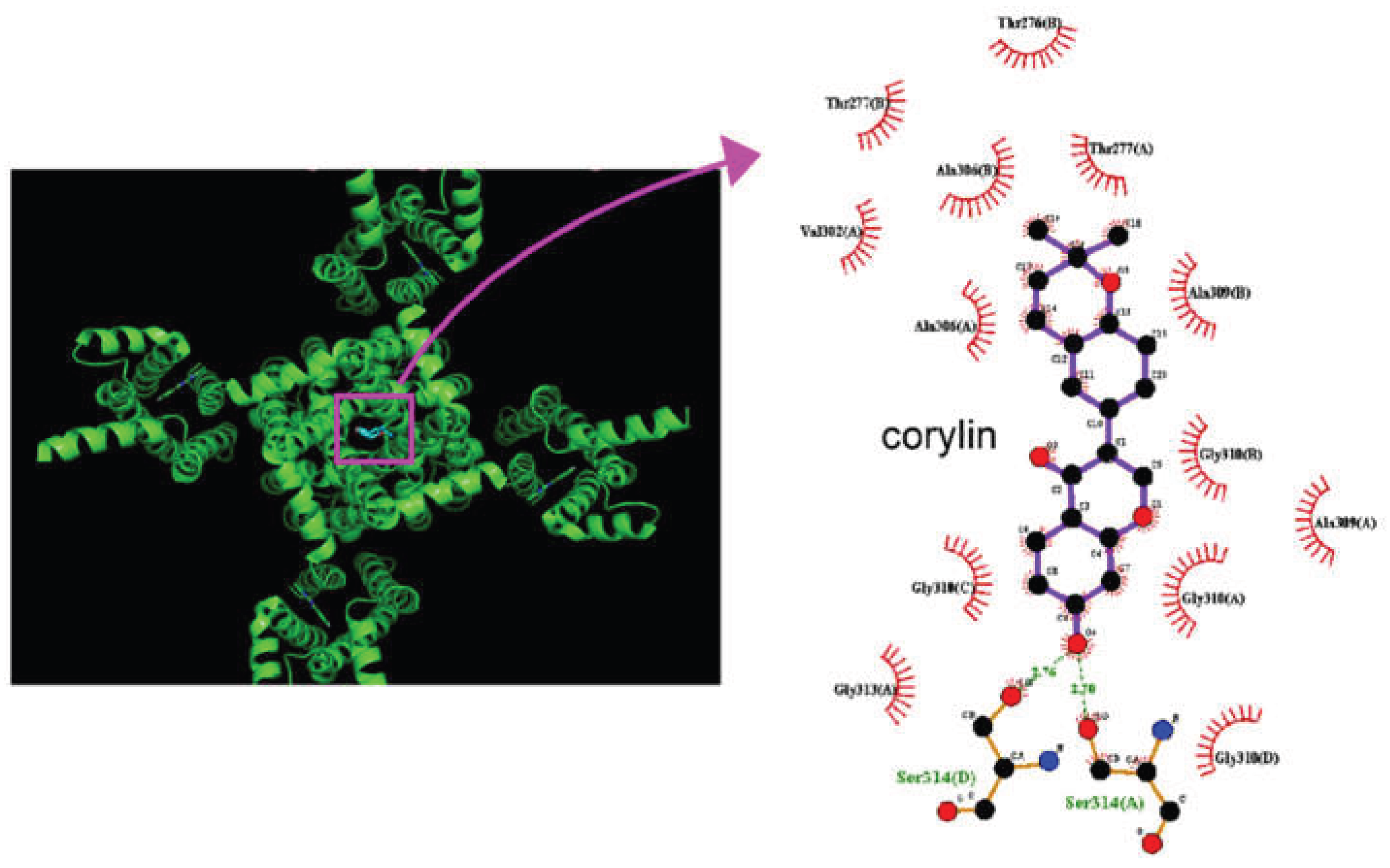
Figure 9.
Docking results of HERG (KCNH2) and corylin. The protein structure of KCNH2 was acquired from PDB (PDB ID:5VA1) and the three-dimensional structure of corylin was from PubChem (Compound CID: 5316097). The structure of KCNH2 was optimally docked with corlyin using PyRx, as highlighted in the red dashed box on the left and indicated by the red curved arrow.
Figure 9.
Docking results of HERG (KCNH2) and corylin. The protein structure of KCNH2 was acquired from PDB (PDB ID:5VA1) and the three-dimensional structure of corylin was from PubChem (Compound CID: 5316097). The structure of KCNH2 was optimally docked with corlyin using PyRx, as highlighted in the red dashed box on the left and indicated by the red curved arrow.
Disclaimer/Publisher’s Note: The statements, opinions and data contained in all publications are solely those of the individual author(s) and contributor(s) and not of MDPI and/or the editor(s). MDPI and/or the editor(s) disclaim responsibility for any injury to people or property resulting from any ideas, methods, instructions or products referred to in the content. |
© 2026 by the authors. Licensee MDPI, Basel, Switzerland. This article is an open access article distributed under the terms and conditions of the Creative Commons Attribution (CC BY) license (http://creativecommons.org/licenses/by/4.0/).
Copyright: This open access article is published under a Creative Commons CC BY 4.0 license, which permit the free download, distribution, and reuse, provided that the author and preprint are cited in any reuse.


