

Submitted:
19 March 2026
Posted:
20 March 2026
You are already at the latest version
Abstract
While total solar PV capacity in Hungary was only 1 MW in 2010, this figure has grown to 7,551 MW by 2024 as a result of the favorable settlement system, available subsidies, and uncertainty caused by the Russian-Ukrainian war. More than 6.4% of households are already prosumers. In our study, we focus on Hungarian districts, examining the spatial patterns of household-scale solar PV systems and the main drivers of technology adoption in 2024. We use the Theil T index to examine spatial heterogeneity and the Moran’s I statistic to test for spatial dependence. Spatial autocorrelation is further explored using maps based on the Local Moran’s I and Local Geary statistics. Finally, a spatial error model is applied to identify the factors influencing the share of household-scale solar PV systems per 100 households. Our results show that the spatial error variable has the largest effect, complemented by household education, the age and size of the building stock, population growth, and the built-up area. It confirms the need for a spatially sensitive policy approach and the importance of space and spatial relations in energy economic studies.
Keywords:
solar PV system
; spatial econometrics
; Theil T
; Local Moran’s I
; Local Geary
; prosumers
; energy transition
; solar energy
1. Introduction
The energy transition is a complex, multidimensional process and, contrary to all expectations, a non-linear one [1,2]. It can be defined as a „switch from an economic system dependent on specific energy sources and technologies to a different economic system” [1]. Within this broader transition, the household sector plays a particularly important role, as energy consumption patterns and technological choices at the household level directly influence the pace and direction of decarbonization. In the household sector, new carbon-neutral technological solutions are required for all activities (e.g., heating, water heating, cooking, and lighting). During electrification, households replace fossil-fuel-based devices (e.g., gas stoves, gas boilers, mixed-fuel boilers) with modern, efficient electric alternatives. The resulting increase in household electricity demand can also be met by the use of renewable energy sources, such as solar photovoltaic (PV) systems.
Solar energy technologies convert the sun's heat and light into electrical or thermal energy. Among renewable energy sources, the share of solar energy is growing the fastest, and solar-based electricity-generation technologies are now considered the most affordable in the world [3]. There are two ways to use solar energy: solar collectors for hot water systems and conventional solar PV panels for electricity generation. According to the energy ladder theory [4], electricity produced from solar energy is the highest-quality secondary energy carrier not only because of its safe use, cleanliness, and other physical characteristics, but also because it is the only energy source that can be applied to all major household activities, and it is characterized by flexible use and substitutability [5,6].
Forecasts indicate further growth in solar PV capacities, primarily due to decreasing investment costs. In 2023, the total cost of installing a 1 kW solar PV system was USD 758 (global average), which represents an 86% decrease compared to USD 5310 in 2010, and it is highly competitive with any technology based on fossil energy sources [7,8,9]. Solar energy systems help to reduce dependence on energy imports, contribute to mitigation efforts, and also help to protect consumers from fluctuations in energy prices. They fit the priorities defined by the energy trilemma, thus the expectations of energy security, environmental sustainability, and equity [10].
Solar PV systems can also be used at the household level and are widely available. The social acceptance of the technology is outstanding [11]; in addition to its affordability, the other socio-economic advantages of the technology also make its application extremely attractive for households. Households that become prosumers become much more informed about energy issues, change and rationalize their energy-use habits with the help of smart meters, and become supportive of environmental protection activities and movements [12]. In many cases, solar systems also offer an opportunity to eliminate energy poverty.
These relationships are particularly pronounced in Hungary, where the rapid expansion of solar PV systems is remarkable even by international standards. The solar energy market has grown significantly in the past few years here. The year 2010 was considered a milestone when the total solar PV capacity reached 1 MW [13]. After 2020, the installation of these systems accelerated significantly, driven by the newly adopted energy strategy, available subsidies, the very favorable compensation system, the COVID-19 pandemic, the 2021-2022 energy crisis, and the uncertainty caused by the Russian-Ukrainian war.
The aim of this study is to build on existing research [13,14,15] and to conduct further, more in-depth spatial analyses regarding the Hungarian household-scale solar PV systems. This study addresses the following research questions: 1) How can the spatial distribution of household-scale solar PV systems in Hungary be characterized? Is there evidence of a strong neighborhood effect? 2) What spatial clusters of Hungarian districts can be identified in the distribution of these systems? 3) Which additional socio-economic and other factors explain the number of household-scale solar PV systems per 100 inhabitants in Hungary?
Analyzing the spatial distribution of household-scale solar PV systems is important for several reasons. First, the distribution of these systems is not even. Their output is highly weather-dependent, which poses serious challenges for electricity system operators. Understanding the spatial distribution of residential PV systems can improve system predictability and planning, thereby reducing network planning and operational challenges for grid operators [16]. Second, understanding the factors contributing to territorial heterogeneity within the country is crucial for effective policymaking.
The remainder of the paper is structured as follows. Section 2 presents the expansion of household-scale solar PV systems in Hungary, highlighting the trends and policies. International and Hungarian experience in the spatial econometric analysis of household-scale PV systems is also summarized. Section 3 introduces the data and methodology, presents the spatial distribution of household-scale solar PV systems, analyzes their spatial heterogeneity and spatial dependence, and identifies the main drivers of their spatial differences. Finally, we summarize the results and draw conclusions.
2. Theoretical Background
2.1. The Expansion of Household-Scale Solar PV Systems in Hungary – Trends and Policy
In 2024, solar energy accounted for 24% of gross electricity generation in Hungary, while in the EU Member States, this share was 11% on average [17,18]. This electricity is generated by both industrial-scale systems (above 50 kW) and household-scale solar PV systems (up to 50 kW). According to the official statistics of the Hungarian Energy and Public Utility Regulatory Authority [19], the total solar PV capacity was 7551 MW in 2024, of which 2690 MW was household-scale solar PV capacity.
Private individuals owned 255,691 household-scale solar PV systems in 2024, while the remainder were owned by companies, institutions, and other non-natural persons (Figure 1). According to data from the 2022 census, the number of occupied dwellings in Hungary was 4,008.5 thousand, of which more than 6% had a household-scale solar PV system [20]. It is noteworthy that the revised Hungarian National Energy and Climate Plan sets a target of 12,000 MW of total installed PV capacity by 2030 [21], and according to estimates in the National Energy Strategy 2030, more than 200,000 households were expected to have household-scale PV systems by 2030 [22]. This latter target was in fact already achieved by 2023, while the updated 2024 version of the National Energy and Climate Plan foresees further expansion [21].
However, a significant change occurred in the support schemes in the second half of 2023, which − according to market opinions − is expected to lead to a substantial decline in the number of newly installed household-scale solar PV systems. Since 8 September 2023, for newly installed household-scale solar PV systems (where the application request was not submitted by 7 September 2023), the option of net metering is no longer available, and users are instead placed under the so-called gross metering [23]. Net metering refers to the yearly netting of electricity volumes fed into and withdrawn from the grid. In contrast, the gross metering means a separate metering and billing: the electricity withdrawn from the grid and electricity exported to the grid are measured and paid for separately (including grid fees), the latter at a selling price of 5 HUF/kWh (~ 0.01 EUR/kWh) [24]. Even in the case of net metering, non-volume-based system usage fees must still be paid.
One of the reasons for the change is a modification in European Union legislation, which states that “Member States that have existing schemes that do not account separately for the electricity fed into the grid and the electricity consumed from the grid, shall not grant new rights under such schemes after 31 December 2023” [25]. Net and gross metering schemes significantly affect the payback period of PV systems. According to our calculations, this is approximately 7 years under net metering, whereas under gross metering it is around 15 years.
2.2. International and Hungarian Experience in the Spatial Econometric Analysis of Household-Scale PV Systems
The literature on residential solar energy use, the factors influencing it, and technological diffusion can be considered extensive; however, far fewer studies address territorial relationships and spatial patterns. Table 1 summarizes the most relevant international literature for this article, presenting the spatial dimension of the analysis, the models applied, and the explanatory variables found significant in determining the adoption of household-scale solar PV systems.

Table 1.
International literature review of the spatial econometrics of household-scale solar PV systems.
Table 1.
International literature review of the spatial econometrics of household-scale solar PV systems.
| Study | Significant variables | Applied model | Spatial dimension |
|---|---|---|---|
| Dharshing, 2017 [26] | economic factors, socio-demographic and attitudinal adopter characteristics (age, income, education, unemployment), settlement structure, building stock (share of single-family homes and new buildings), regional spillover effects, annual global irradiation | Structural Equation Modeling (SEM) |
Germany, 807,969 residential photovoltaic systems (2000–2013) |
| Jayaweera et al., 2018 [27] | social (age and education), demographic (population and housing density), residential (housing quality, size of residence) and environmental (irradiation) variables | Zero Inflated Negative Binomial Multilevel (ZINBM) |
Srí Lanka, Colombo (2010–2016) |
| Pronti and Zoboli, 2024 [28] | housing market, electricity consumption, social capital, socio-demographic indicators, economic factors (average income), solar irradiation, policies on energy efficiency and renewable energy in the housing sector, spatial dependence | Spatial Error Model (SEM) | Italy, province-level data, 2014–2021 |
| Zhang et al., 2023 [16] | spatial dependence, household income, property value, population density, housing type and household type | Spatial Durbin model | Netherlands, 3,205 Dutch neighbourhoods |
| Graziano and Gillingham, 2015 [29] | demographics and built environment variables (housing density, share of renter-occupied dwellings), household income, political affiliation, spatial neighbor effects (often known as ‘peer effects’) | Optimized Getis-Ord method (OGO) and Anselin’s cluster and outlier analysis (COA) | USA, Connecticut (2000, 2010) |
| Kosugi et al., 2019 [30] | social attributes (population structure, population density, number of household members), living environment (share of detached houses), neighbor effect | Spatial Durbin model | Japan, Kyoto City (2003–2014) |
Source: own compilation.
Based on the studies summarized in Table 1, the adoption of household-scale solar PV systems is influenced by a wide range of economic, socio-demographic, housing-related, and environmental factors [16,26,27,28,29,30]. All of them highlight the importance of household income, education level, age, and other socio-demographic characteristics, as well as built-environment features such as population density, housing density, housing quality, and the share of detached houses. Environmental conditions, particularly solar irradiation, also play a significant role in explaining the spatial distribution of installations. In addition, most of them (except [27]) emphasize the importance of spatial spillover or neighbor effects (often referred to as peer effects), indicating that the diffusion of residential PV systems is often spatially clustered, as the presence of installations in neighboring areas can encourage further adoption.
The methodological approaches used in the literature are also diverse. Many studies apply spatial econometric and spatial statistical models, including Spatial Error Models, Spatial Durbin Models, and Structural Equation Modeling, while some analyses employ cluster detection techniques and multilevel regression models. These studies are conducted at different spatial scales, ranging from national-level analyses, such as the examination of more than 800,000 residential PV systems in Germany, to regional, city-level, or neighborhood-level investigations in countries such as the Netherlands, Japan, the United States, and Sri Lanka.
Relevant Hungarian studies [4,13,14,15,31,32] analyze the spatial distribution of different types of heating fuels and technologies in the residential sector, including solar PV systems, the factors influencing their installation, and the implementation process. [14,15] apply Pearson correlation and Spearman rank correlation, a non-parametric method, [13] employ project management analysis (similar to the PM2 model developed by the European Commission), the rest [4,31,32] applies spatial econometric techniques (Global and Local Moran’s I, spatial LAG model).
Beyond traditional economic factors, [14] also highlights social, housing-related, and attitudinal factors, complemented by what they call a “small-settlement effect.” This refers to the observation that, in several cases, villages also have a significant number of household-scale solar PV systems and a substantial installed capacity, likely related to peer effects. However, [15,31] did not find a significant relationship among GDP per capita, average monthly gross wages, and the location (density) of household-scale solar PV systems. These results clearly indicate that the installation of household-scale power plants (which in Hungary almost exclusively refers to solar PV systems) is generally concentrated in areas dominated by detached houses [14,15] and higher educated households [31,32]. Interestingly, in Budapest, the number of household-scale solar PV systems per 10,000 inhabitants is far below that of other NUTS2 regions. The dense urban housing stock is one of the main barriers to installing conventional PV systems due to limited space (building roofs may be shaded by others) and high population density. In addition, roof orientation is often suboptimal, while regulatory frameworks and local rules may make it more difficult to establish resident-driven energy projects and energy communities (involving both owners and tenants) in large apartment buildings. In contrast, the Budapest agglomeration already stands out and, together with the Pécs and Balaton agglomerations, shows a significant concentration of household-scale PV systems, both in terms of the number of installations and installed capacity [14,31,32].
3. Methodology and Results
3.1. Spatial Pattern of Distribution of Household-Scale Solar PV Systems
The territorial distribution is examined using a topological map. Based on the work of [33] and [34], these are special thematic maps, or cartograms, in which the basic elements of the original topology are retained, i.e., territorial units that were adjacent in the original map remain adjacent here. However, the size of the territorial units is proportional to the socio-economic volume to be depicted. [35] also includes a typology of cartograms including cartograms. In the current study, we applied this method by adjusting district sizes according to the number of household-scale solar PV systems installed and depicting the ratio of systems per hundred households by colouring the surface (Figure 2). The maps were created using ScapeToad 1.1 software. The source of the number of household-scale solar PV systems is the district-level database of the Hungarian Energy and Public Utility Regulatory Authority (MEKH), which includes Budapest’s districts. The data is available for the period of 2019−2024 [19].
The highest number of household-scale solar PV systems is found in the capital and its agglomeration, the districts of our county-level cities, and the Balaton region. By contrast, the districts on the inner and outer peripheries along the county border have few systems. When we compare the number of household-scale solar PV systems with the number of households, the Budapest agglomeration and the Balaton region aside, the districts of Gárdony, Bóly, and Mórahalom also stand out. Data from the latter two districts suggests that, in addition to the prominent position of resorts, other factors may also be important.
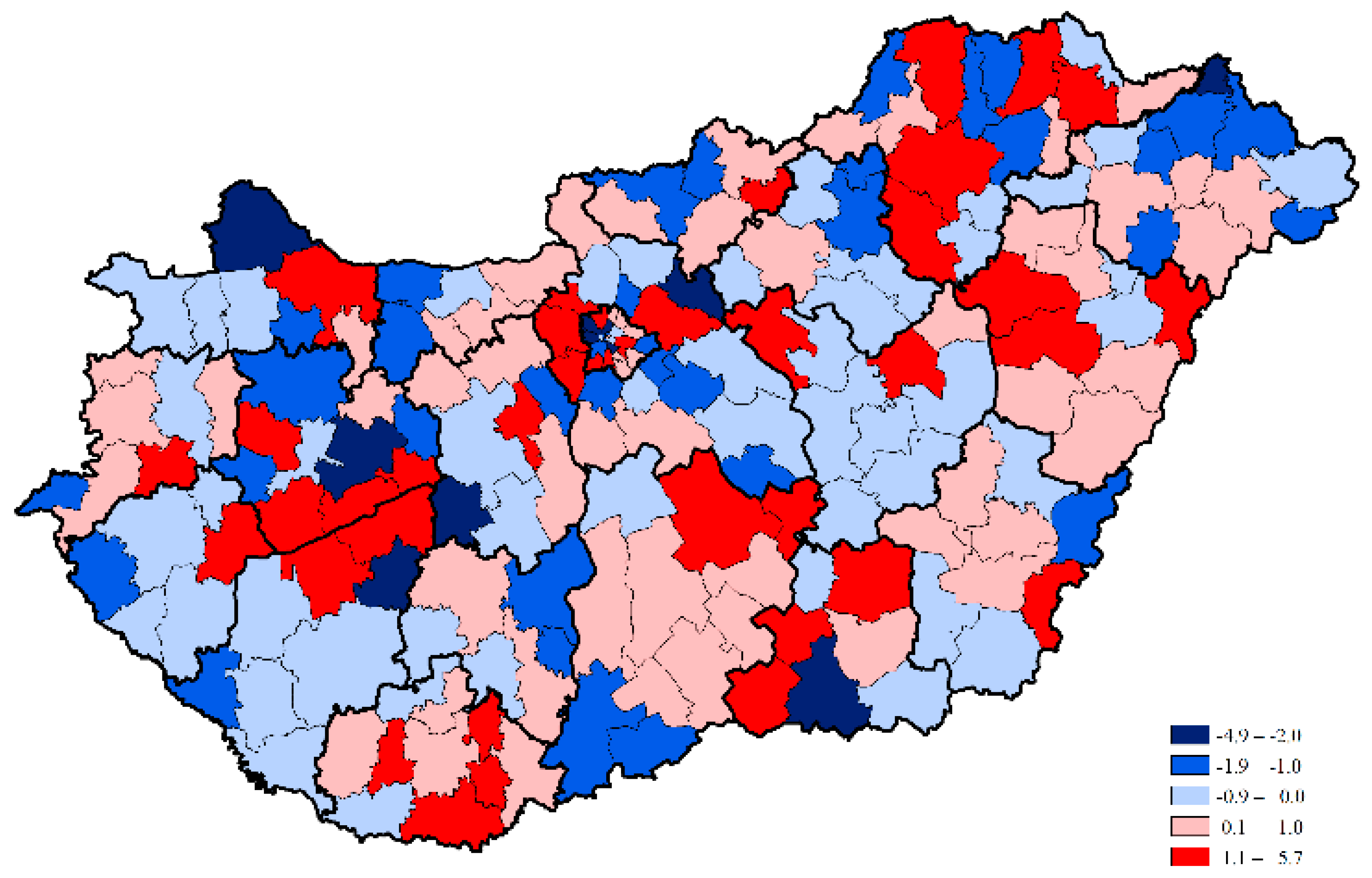
In 2019, there were 59,106 household-scale solar PV systems in operation; this figure increased to 296,231 by 2024. This represents a national average increase of 398%. The largest change occurred in the Aszód district (see Figure 3). The top ten districts with the highest increase were: Aszód, Cegléd, Mezőcsát, Kecskemét, Dabas, Gyál, Tét, Kalocsa, Eger, and Vecsés.
3.2. Spatial Heterogeneity and Dependence of Household-Scale Solar PV Systems
The analysis of spatial data continues with an examination of heterogeneity and dependence. Spatial heterogeneity refers to the variability of spatial phenomena, arising from the characteristics of spatial units and their differences from one another. Spatial dependence essentially means a functional relationship between the values of the same variable measured at different locations [36].
In what follows, we focus on these two factors together. Our approach is similar to that of [37], who performed calculations on income data for US states and state groupings. To examine spatial heterogeneity, we used the Theil T-index [38,39,40] (Eq. 1 and 2):
where:
We used Moran’s I statistic to test for spatial dependence. As with all spatial autocorrelation tests, Moran’s I begins with the null hypothesis that there is no spatial dependence in the sample. We explored this. The formula for Moran’s I (see Eq. 3) is as follows [41]:
where N is the number of area units, xi and xj are the values of the variable to be examined in each area unit, is the arithmetic mean of the examined indicator, and Dij is the adjacency matrix. In this case, we used queen adjacency, meaning that polygons that touch each other either with their vertices or edges are adjacent.
The indicator is interpreted in the following ranges:
I > –1/N – 1, positive spatial autocorrelation,
I = –1/N – 1, no spatial autocorrelation,
I < –1/N – 1, negative spatial autocorrelation.
Moran’s I can take values between -1 and +1. The closer it is to –1, the stronger the negative autocorrelation; the closer it is to +1, the more significant the positive autocorrelation phenomenon (0 indicates the absence of autocorrelation) [42].
Determining the strength of autocorrelation is more difficult because the indicator's minimum and maximum values cannot be defined as precisely as those of the correlation coefficient. This is because the magnitude of the indicator depends on the distribution of the values, the number of area units, and the territorial configuration recorded in the Dij matrix. The expected values of Moran’s I are: E[I] = Central Hungary: –0.025; Great Plain and North: –0.011; Transdanubia: –0.015; Hungary: –0.005. Compared with these values, higher I values were observed during the examined period, indicating positive spatial autocorrelation in the spatial location of the solar panels.
In this analysis, because we only have the 2022 census household numbers for the review period, we first determine the territorial pattern using absolute numbers rather than the number of household-scale solar PV systems per hundred households. In the next part of our study, we will work with specific data.
In terms of basic spatial processes, heterogeneity increased nationally and within large regions until 2023, after which it decreased slightly. However, we can conclude that this is a general, country-wide process (see Table 2). The greatest heterogeneity is observed in the Great Plain and North regions, and the least in Transdanubia. Additionally, an increase in dependency is evident at the national level. This is due to an increase in spatial dependency in Transdanubia, albeit to a small extent. Nevertheless, we can conclude that the spatial distribution of household-scale solar PV systems in all large regions and at the national level exhibits positive autocorrelation. That is to say, high or low values tend to be found closer together than we would expect from a random spatial process.
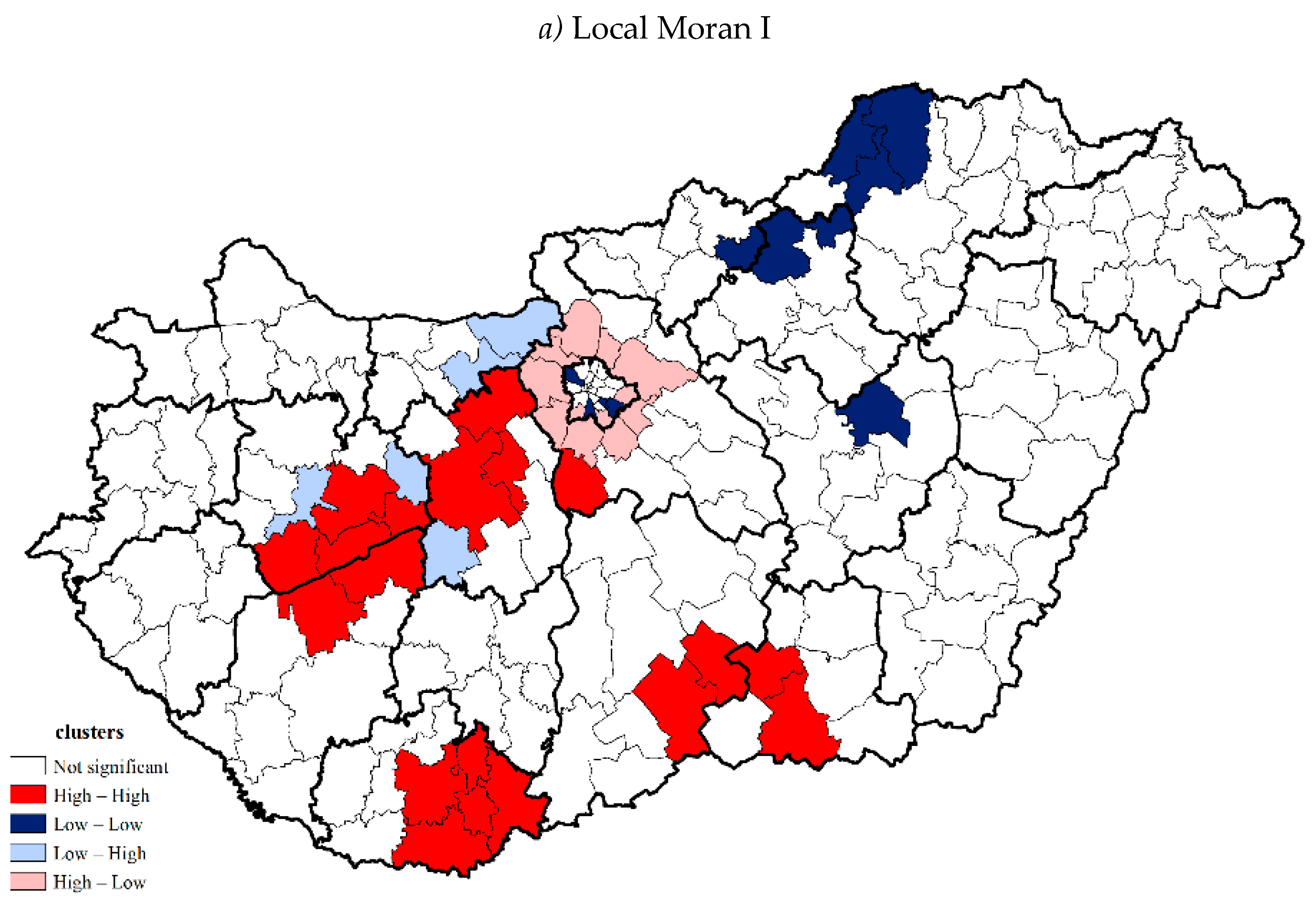
Figure 3a shows the Local Moran I map of household-scale solar PV systems per hundred households. As the background to and practical application of the method have already been described in several of our studies [43,44] and are widespread in the literature (see, for example, [45,46,47], we will not describe it further here. However, we present the Local Geary statistic in detail due to its novelty (see [48]).
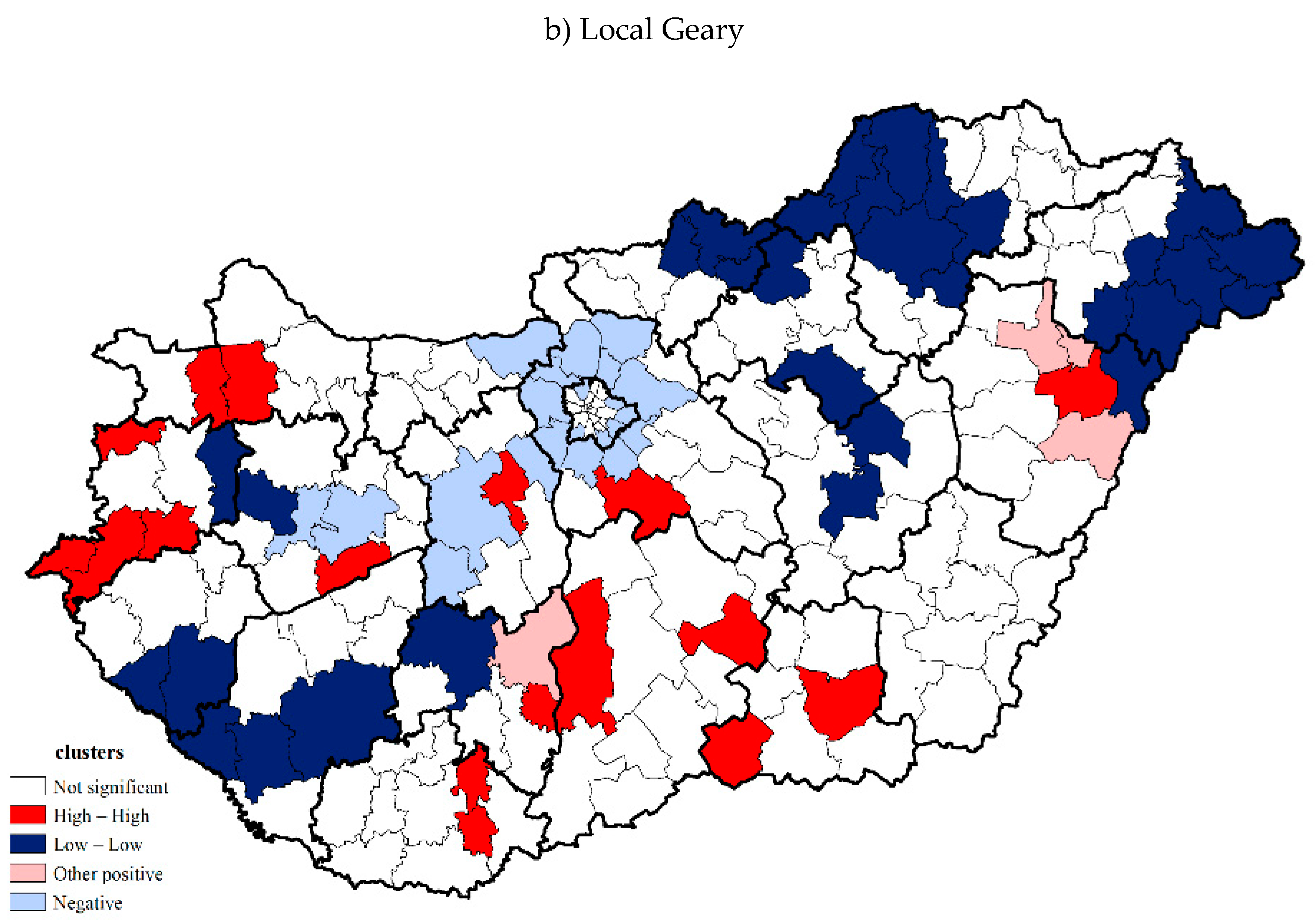
First outlined in [49] and further developed in [50], the Local Geary statistic is a measure of local spatial autocorrelation. Like its global counterpart, the emphasis is on squared differences, or rather, on variances. In other words, small values of the statistic indicate positive spatial autocorrelation, while large values indicate negative spatial autocorrelation. The [51] c-statistic for spatial autocorrelation takes the following form (see Eq. 4):
where xi and xj are the values of the studied phenomenon in area units, is the average of the studied phenomenon, n is the number of area units, and wij is the adjacency matrix, , where the x in the numerator does not need to be in standardized form due to the squared difference. Under the null hypothesis of spatial randomness, the mean of the statistic is 1. Significant values less than 1 indicate positive spatial autocorrelation, and values greater than 1 indicate negative spatial autocorrelation.
After checking the parts of the expression that do not change with i, the local version of the statistic can be given as follows, using the usual notations (Eq. 5) (for technical details, see [49,50]:
This statistic is the weighted sum of the squared distances in the attribute space of the geographical neighbors of observation i. Since Local Geary uses a different criterion for measuring attribute similarity, it can detect patterns that Local Moran I cannot, and vice versa.
Based on the Local Moran I statistic, the high-high cluster (where high values are surrounded by nearby high values) comprises 19 districts (see Figure 3, Map A). These districts are mainly located in Fejér County, around Lake Balaton, and in Baranya, Pest, and Csongrád-Csanád counties. The low-low cluster (where low values are surrounded by nearby low values; 11 districts) mainly comprises districts in Budapest, the border district in north-eastern Hungary, and one district in Jász-Nagykun-Szolnok County. The districts of Ajka, Enyingi, Esztergom, Tatabánya, and Várpalota have lower values than their neighbours. Conversely, higher values are seen in the two Budapest districts and the agglomeration districts than in their neighbors.
The spatial picture drawn by Local Geary differs somewhat from those seen previously (Figure 3, Map B). The high-high cluster is somewhat narrower, comprising 17 districts. Only the districts of Bóly, Balatonfüred, Gárdony, and Pécsvárad are included in this cluster in both local autocorrelation tests. Thirty-one districts belong to the low-low cluster, more than double the number identified using the Local Moran I.
Based on the results of both tests, the following districts belong to the low-low cluster: Bátonyterenye, Edelény, Kazincbarcika, Kunhegyes, Pétervásár, and Putnok. The low-low cluster resulting from Local Geary is much more extensive, including peripheral districts in both north-eastern and south-western Hungary. In this method, districts in the other positive category can be considered positive outliers, i.e., districts that differ positively from their surroundings. Examples include Derecske, Hajdúböszörmény, Hajdúhadháza and Paks. Those that differ negatively from their environment include the three districts of Budapest, a significant part of the Budapest agglomeration, and the districts of Ajka, Veszprém, Enying, and Esztergom.
3.3. Explaining the Spatial Distribution of Household-Scale Solar PV Systems per Hundred Households
As a continuation of our study, we calculated the heterogeneity and dependency indices of the number of household-scale solar PV systems per hundred households. In the latter case, we also calculated the Moran I-index, while in the former case, we calculated the Theil L-index (Eq. 6) [52].
where μ is the average of household-scale solar PV systems per hundred households.
In terms of heterogeneity, the highest values are seen in the Great Plain and North, and in terms of dependency, in Central Hungary. In both cases, the lowest values are seen in Transdanubia.
Table 1.
Theil L and Moran I indicators of the number of household-scale solar PV systems per hundred households in the NUTS1 regions of Hungary, 2024.
Table 1.
Theil L and Moran I indicators of the number of household-scale solar PV systems per hundred households in the NUTS1 regions of Hungary, 2024.
| Macro regions (NUTS-1) | Theil L | Moran I |
|---|---|---|
| Central Hungary | 0.142 | 0.542 |
| Great Plain and North | 0.244 | 0.405 |
| Transdanubia | 0.022 | 0.316 |
| Hungary | 0.056 | 0.460 |
Source: own calculation.
The following study attempted to explain the number of household-scale solar PV systems per hundred households using a spatial econometric model.
A previous study found spatial dependence in the number of household-scale solar PV systems. However, when we examine the spatial dependence of household-scale solar PV systems per 100 households, the values obtained are much higher than those for the spatial distribution of absolute values (Moran's I = 0.460). Therefore, geographical location affects the actual relationships in models estimating the specific values of household-scale solar PV systems, and thus, traditional econometric estimates will be biased.
When selecting the indicators to include in the study, we considered the results of the reviewed literature (Table 41 and started with the list of variables that had previously been shown to be significant. The selected indicators cover six areas: the economic and social characteristics of households in settlements; the built environment; energy characteristics; environmental conditions affecting investment and returns; and the characteristics of settlement structures (Table 4).
Before starting the study, we hypothesized that the ratio of household-scale solar PV systems per hundred households is fundamentally explained by income; that is, the higher the per-capita income, which forms the basis for personal income tax, the higher the ratio. However, although this may be somewhat related to income, we still consider it important to examine education. In other words, the higher the proportion of people with a high school diploma, the higher the proportion of household-scale solar PV systems.
We considered the type of building an important factor, hypothesising that the higher the proportion of newly built apartments (after 2000), the higher the ratio of household-scale solar PV systems. We hypothesised that the type of housing greatly influences the proportion of household-scale solar PV systems; that is, where the share of single-family homes (defined as homes with a floor area of 100 square metres or more) is higher, the proportion of household-scale solar PV systems is also higher. We also assumed that connection to pipeline natural gas and electricity consumption per consumer would have a positive effect on the proportion of household-scale solar PV systems.
We thought it would be worthwhile examining the impact of climate on the installation of household-scale solar PV systems. To this end, we accounted for global radiation. We hypothesized that in districts with relatively high levels of global radiation, residents would be more motivated to mitigate, resulting in a higher proportion of household-scale solar PV systems. Lastly, we accounted for district population and population density, assuming that higher values of these indicators correspond to a higher proportion of household-scale solar PV systems. We also considered the built-up area of the districts, assuming that the smaller the inner area of the settlements compared to the administrative area, the higher the proportion of household-scale solar PV systems would be.
However, our preliminary studies only partially confirmed our hypotheses. Some indicators showed no significant effect, such as per capita income, global radiation, and the proportion of households connected to pipeline natural gas. Of these, we considered the most significant finding to be that increases in income do not affect the proportion of solar panels installed. This also corroborates the findings of [15]. In other cases, however, we found that including additional variables increases multicollinearity in the model, since most of their explanatory power is already captured by other indicators. Therefore, they cannot be used.
Ultimately, we opted to retain five explanatory variables in our model: the proportion of individuals holding a high school diploma or higher education; the proportion of apartments with a floor area of 100 square metres or more; the proportion of the inner area of settlements within districts relative to the administrative area; the proportion of apartments constructed since 2000 relative to occupied apartments; and population.
The fit of the multivariate linear regression model was moderately strong (adjusted R² = 0.671), and all five indicators were significantly related to the explanatory variable. The proportion of solar panels can be characterized as either spatially separated or clustered (see global Moran's I results). We therefore deemed it necessary to examine the spatial dependence further. This was confirmed by the significant results of the normality and heteroscedasticity tests, meaning that our indicators show spatial dependence. Therefore, it is necessary to create a spatial model that accounts for these characteristics.
Figure 4.
Spatial clusters of the proportion of household-scale solar PV systems at district level, 2024. Source: own compilation.
Figure 4.
Spatial clusters of the proportion of household-scale solar PV systems at district level, 2024. Source: own compilation.
3.4. Spatial Models Used
The concept of lag is used when performing spatial analyses. The general model of spatial lag can be written as follows (Eq. 7):
where y is the vector of values of the outcome variable, ρ is the coefficient of the outcome variable lagged in space (i.e. the spatial autoregression parameter), W is the row-standardized weight matrix, β is the parameter vector of exogenous explanatory variables, X is the matrix of exogenous explanatory variables, ε is the vector of values of the error term [36,53].
Another common form of spatial econometric modeling is the application of the spatial error-autocorrelation model (error). The general formula of this model is illustrated by the following equations (Eq. 8 and 9):
and
where ε is the vector of autoregressive error terms, λ is the spatially lagged parameter coefficient of the autoregressive error terms, and ξ is the vector of independent, identically distributed error terms with zero expected value (Eq. 9) [36]. It may indicate spatial dependence if λ is significant, since in this case the interactions between spatial units close to each other appear in the values of the error term.
There is also a combination of the two spatial econometric models presented above, in which both spatial-lag and spatial-error autocorrelation are present.
Our calculations were performed using the GeoDaSpace software using the queen-neighborhood1. We used White's standard errors to account for heteroscedasticity. The multicollinearity of our model is 23.1, which is in line with expectations. The Lagrange multiplier test was significant for the spatial error model, so we estimated the model accordingly.
Table 5.
Results of the applied models.
| Indicators | OLS | Spatial error |
|---|---|---|
| Constans | -3.138*** | -5.085*** |
| Ratio of apartments built since 2000 to occupied apartments | 0.245*** | 0.232*** |
| Proportion of people with a high school diploma or higher education degree | 0.182*** | 0.140*** |
| Proportion of apartments with a floor area of 100 square meters and larger | 0.105*** | 0.188*** |
| Population | 0.000*** | 0.000*** |
| Ratio of the inner area of settlements in districts to the administrative area | -0.105*** | -0.060*** |
| Lambda | 0.723*** | |
| Adjusted R2 | 0,671 | 0,807 |
Note: OLS: Ordinary Least Squares; *** p < 0,001, ** p < 0,01, * p < 0,1. Source: own calculation.
Compared to traditional OLS, the explanatory power of spatial models has improved, with an adjusted R² of 0.807. The spatial error variable has the greatest impact. This indicates that the error terms are not normally distributed and that nonlinear relationships between the variables are present. There may be several reasons for this. Firstly, the range of regressor variables involved is small and inadequate. It is also possible that the spatial weight matrix used is inappropriate; however, we attempted to address this by performing the test on a different weight matrix, but the outcome remained unchanged. We believe that the explanation for this phenomenon is that, as of 31 October 2022, the possibility of feeding into the public grid was temporarily suspended in Hungary by [54]. This was lifted on 1 January 2024 by [55]. However, this did not apply to household-scale power plants implemented in response to applications submitted before 31 October 2022.
The moratorium may significantly affect the spatial distribution, and it can be assumed that the inhabitants of the settlements behaved similarly to their neighbors in response to the feed-in stop. This is consistent with [56]’s view on the imitative behavior of economic actors, which provides a reasonable explanation for the development of the specific spatial pattern.
The second-largest impact on the proportion of household-scale solar PV systems is the share of apartments built since 2000 among occupied apartments; consequently, a high share of relatively new apartments is also associated with a high share of solar panels. Next is the proportion of apartments with a floor area of 100 square metres or more. The high proportion of large apartments, essentially family homes, results in an increase in the number of solar panels. Fourth is the proportion of people with a high school diploma or higher education, which is a positive sign. Therefore, the increase in the proportion of solar panels is related to higher education. The built-up area is also important: the larger the proportion of the inner area of settlements compared to the administrative area, the smaller the proportion of solar panels. Finally, population growth is accompanied by an increase in the proportion of solar panels, but it plays the smallest role.
4. Conclusion
The number of household-scale solar PV systems increased rapidly after 2010, with a threefold rise between 2019 and 2024. This study aimed to map, quantify, and explain the territorial distribution of household-scale solar photovoltaic (PV) installations across Hungary’s districts in 2024. The assembled empirical evidence demonstrates that household PV adoption in Hungary has become a mainstream phenomenon. Between 2019 and 2024, the number of household-scale solar PV systems increased from 59,106 to 296,231 units, representing a near fourfold increase (approximately 398%), with private households accounting for about 255,691 of these systems by 2024. National PV capacity also expanded significantly, reaching 7,551 MW in 2024, of which roughly 2,690 MW is household-scale. As a result, more than 6% of occupied dwellings are now prosumers. These developments position Hungary among the most rapidly evolving solar markets in Europe and render the observed spatial patterns both policy-relevant and operationally significant.
In our study, we examined the spatial characteristics of these systems. According to our findings, the majority of these systems are located in Budapest and its surrounding areas, in the districts of county-level cities and around Lake Balaton. Three districts stand out in the data by number of households – they are also important holiday areas: Bóly, Gárdony, and Mórahalom. Moran’s I statistic confirms positive spatial autocorrelation in the number of household-scale solar PV systems, while the Theil T-index highlights increased heterogeneity.
Global Moran’s I and local LISA tests indicate clear positive spatial autocorrelation: districts with numerous installations tend to cluster, as do those with few systems. Based on Local Moran’s I, the high-high cluster encompasses 19 districts. These districts are mainly located in Fejér County, around Lake Balaton, and in Baranya County, Pest County, and Csongrád-Csanád County. The low-low cluster (11 districts) mainly comprises districts in Budapest, the border district in north-east Hungary, and one district in Jász-Nagykun-Szolnok County.
The spatial picture drawn by Local Geary is somewhat different. The high-high cluster includes 17 districts. Only the districts of Bóly, Balatonfüred, Gárdony, and Pécsvárad are present in both clusters. Thirty-one districts belong to the low-low cluster. Based on both tests, the low-low cluster includes the following districts: Bátonyterenye, Edelény, Kazincbarcika, Kunhegyes, Pétervásár, and Putnok. However, the low-low cluster resulting from Local Geary is much more extensive, covering not only north-eastern Hungary but also peripheral south-western districts.
In the second part of our analysis, we focused on household-scale solar PV systems per hundred households. The Moran I statistic confirms spatial dependence. When we move from maps to multivariate spatial econometrics (a spatial error model tailored to the distribution of systems per 100 households), the spatial error term is the dominant explanatory factor — stronger than conventional socioeconomic predictors such as local income. Based on the spatial error autocorrelation model, the proportion of household-scale solar PV systems is most influenced by the construction period, the size of occupied properties, residents' education level in the district, and the built-up area and population. Notably, per-capita income and insolation (global radiation) were not significant once spatial structure and building characteristics were accounted for. The spatial error terms are not normally distributed, and there is a nonlinear relationship between the variables. This is likely related to the permits and the long-standing moratorium, though further analysis would be needed to confirm.
The rapid expansion observed up to 2023 occurred within a policy environment characterized by highly favorable compensation and support schemes. The removal of net metering for new installations from 8 September 2023 and the shift toward gross metering with very low feed-in compensation substantially increase payback periods (approximately 7 years under net metering compared to around 15 years under gross metering). Given the strong spatial dependence and local network effects identified, regulatory changes are likely to affect not only the national growth rate but also the spatial distribution of installations. Areas with robust peer effects and established local financing or installer networks may sustain growth longer than peripheral districts where adoption has depended more on financial incentives. Consequently, policy changes interact with spatial path-dependence to produce divergent regional outcomes.
Centralized, uniform policy instruments are likely to be inefficient. The identified clusters indicate three policy categories: (a) high-uptake, innovation-rich districts where market instruments and grid integration support should be prioritized; (b) transition districts with medium uptake, where targeted information campaigns, group purchasing, and low-interest financing can leverage peer effects; and (c) peripheral, low-uptake districts where subsidies combined with renovation and social-welfare measures are necessary to prevent increasing inequalities. Given the strength of neighbor effects, public investment in local demonstration projects, community energy facilitators, and installer networks can reduce information and coordination costs and convert latent interest into actual installations. In contexts where apartment-block ownership and tenancy complicate rooftop access, municipal or cooperative models warrant explicit support.
The clustering of distributed generation results in concentrated injection points that exert varying effects on distribution networks. Grid reinforcement, smart-meter deployment, and localized storage or demand-response capacity should be prioritized in areas where “high-high” clusters are projected to expand. Without compensatory measures, the benefits of prosumption (cost savings, resilience) will accrue disproportionately to residents in detached homes and to better-educated populations. Social tariffs, targeted grants for low-income households, and combined retrofit and PV programs should be considered to prevent the widening of regional and household inequality.
Author Contributions
Conceptualization, G.T. and T.SZ.; methodology, G.T.; software, G.T.; validation, G.T.; formal analysis, G.T.; investigation, G.T. and T.SZ.; resources, T.SZ.; data curation, G.T.; writing—original draft preparation, G.T., T.SZ. and M.J.; writing—review and editing, G.T., T.SZ. and M.J.; visualization, G.T., T.SZ.; supervision, T.SZ. All authors have read and agreed to the published version of the manuscript.
Funding
This paper was supported by the János Bolyai Research Scholarship of the Hungarian Academy of Sciences.
Data Availability Statement
Dataset available on request from the authors.
Acknowledgments
This content was originally published in Hungarian language [31]. Current publication is an extended and updated version of the Hungarian one.
Conflicts of Interest
The authors declare no conflicts of interest.
Appendix A
Appendix A.1
Figure A1.
Number of household-scale solar PV systems per hundred households, 2024. Source: own compilation.
Figure A1.
Number of household-scale solar PV systems per hundred households, 2024. Source: own compilation.
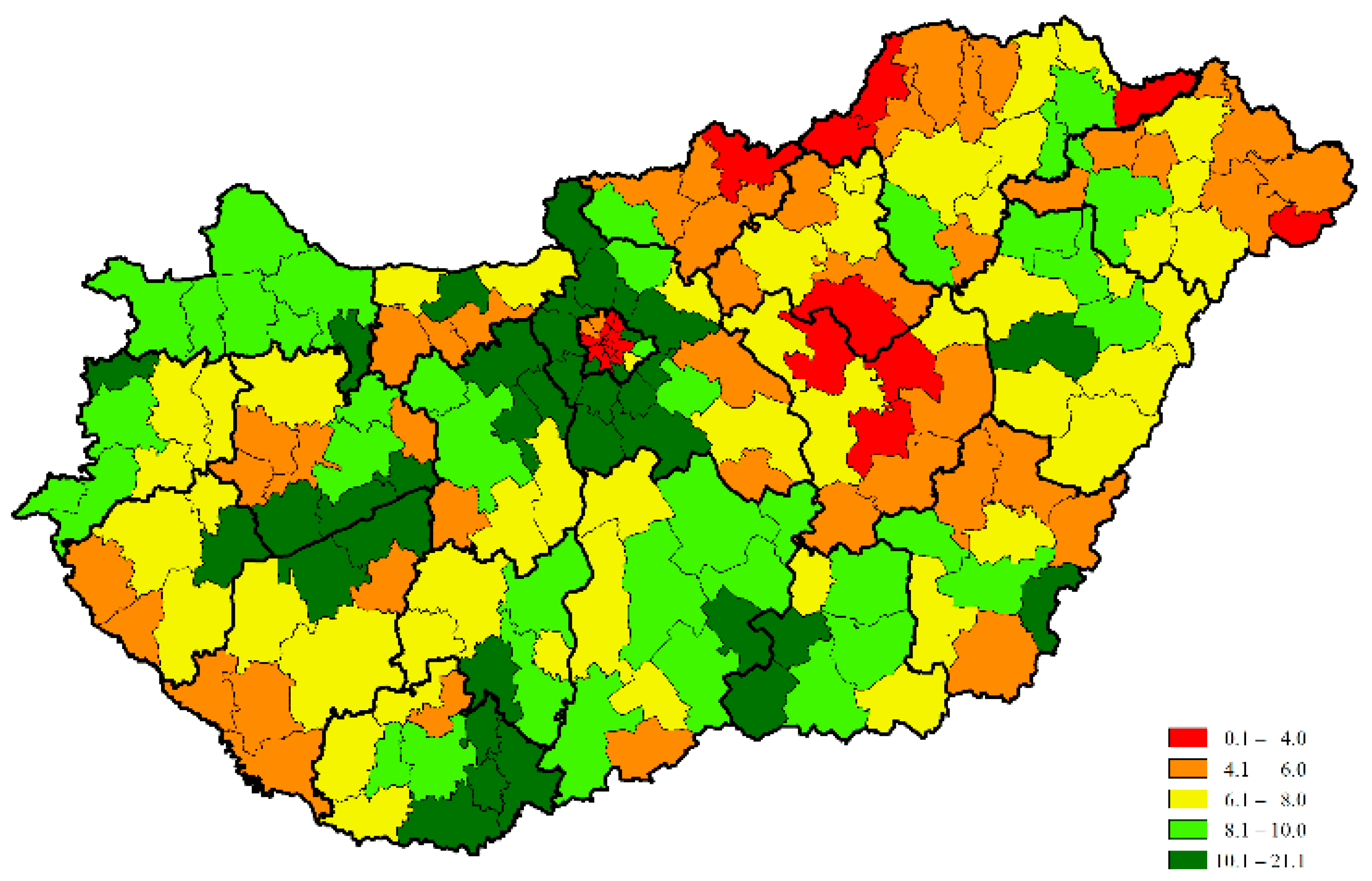
Figure A2.
Values of the spatial error model estimating the number of household-scale solar PV systems per hundred households, 2024. Source: own compilation.
Figure A2.
Values of the spatial error model estimating the number of household-scale solar PV systems per hundred households, 2024. Source: own compilation.
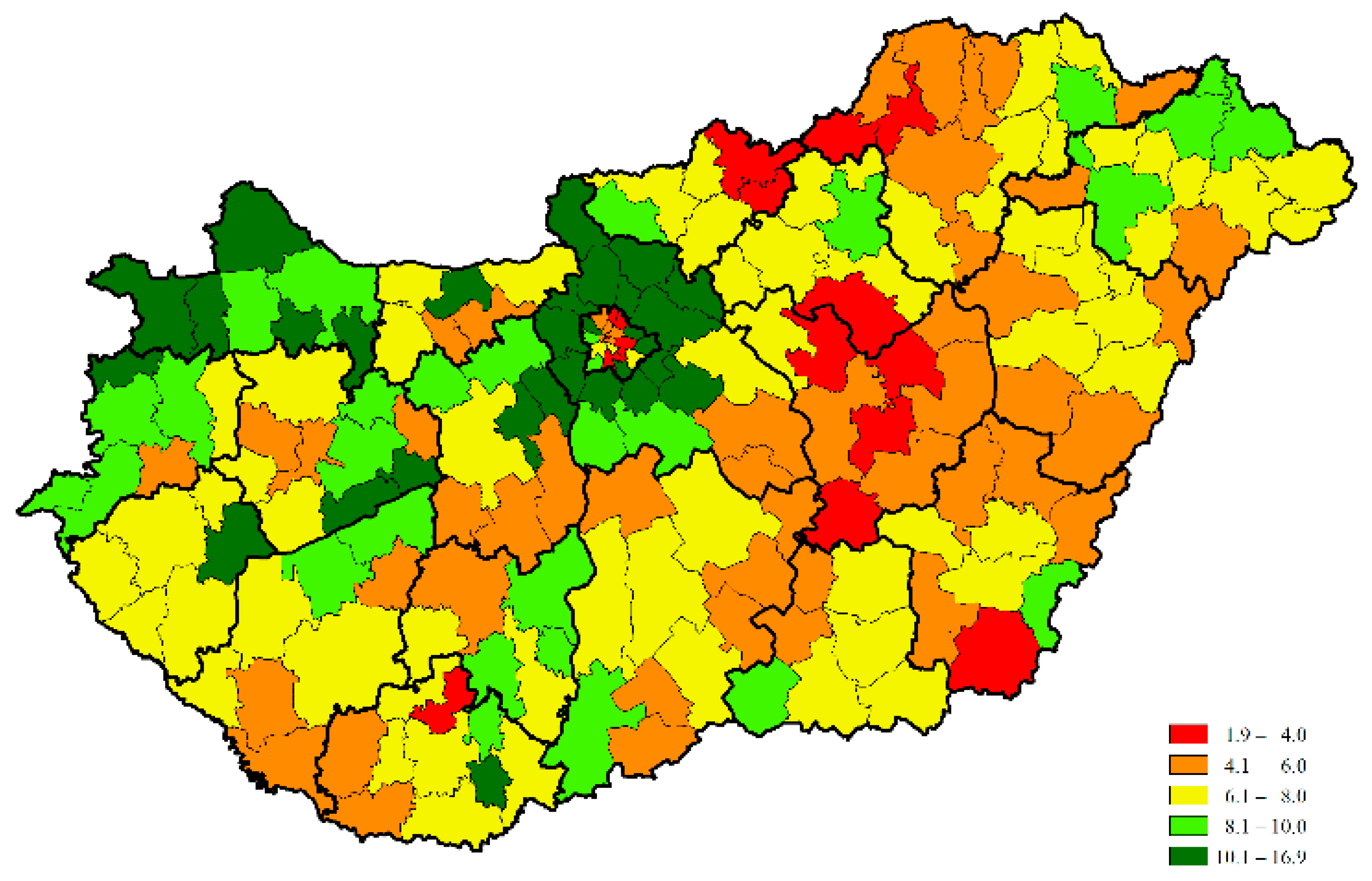
Figure A3.
Residuals of the spatial error model estimating the number of household-scale solar PV systems per hundred households, 2024. Source: own compilation.
Figure A3.
Residuals of the spatial error model estimating the number of household-scale solar PV systems per hundred households, 2024. Source: own compilation.
References
- Blazquez, J.; Fuentes-Bracamontes, R.; Manzano, B. A Road Map to Navigate the Energy Transition; The Oxford Institute for Energy Studies, 2019; p. 18;
- Yadav, P.; Davies, P.J.; Asumadu-Sarkodie, S. Fuel Choice and Tradition: Why Fuel Stacking and the Energy Ladder Are out of Step? Sol. Energy 2021, 214, 491–501. [CrossRef]
- European Commission Solar Energy Available online: https://energy.ec.europa.eu/topics/renewable-energy/solar-energy_en (accessed on 6 May 2024).
- LaBelle, M.C.; Szép, T.; Tóth, G. Why Neighbors Matter in the Energy Transition: The Diffusion of Social Practices, Technologies, and Knowledge between Municipalities. Renew. Sustain. Energy Transit. 2025, 7, 100109. [CrossRef]
- Hassan, Q.; Nassar, A.K.; Al-Jiboory, A.K.; Viktor, P.; Telba, A.A.; Awwad, E.M.; Amjad, A.; Fakhruldeen, H.F.; Algburi, S.; Mashkoor, S.C.; et al. Mapping Europe Renewable Energy Landscape: Insights into Solar, Wind, Hydro, and Green Hydrogen Production. Technol. Soc. 2024, 77, 102535. [CrossRef]
- Stern, D.I. Energy Quality. Ecol. Econ. 2010, 69, 1471–1478. [CrossRef]
- IEA Renewables 2023 – Analysis; 2024; p. 143;
- IRENA Renewable Capacity Statistics 2025; 2025;
- IRENA Renewable Power Generation Costs in 2023; International Renewable Energy Agency: Abu Dhabi, 2023; p. 211;
- World Energy Council World Energy Trilemma Framework Available online: https://www.worldenergy.org/transition-toolkit/world-energy-trilemma-framework (accessed on 6 May 2024).
- Marzouk, M.A.; Salheen, M.A.; Fischer, L.K. Towards Sustainable Urbanization in New Cities: Social Acceptance and Preferences of Agricultural and Solar Energy Systems. Technol. Soc. 2024, 77, 102561. [CrossRef]
- Öhrlund, I.; Stikvoort, B.; Schultzberg, M.; Bartusch, C. Rising with the Sun? Encouraging Solar Electricity Self-Consumption among Apartment Owners in Sweden. ENERGY Res. Soc. Sci. 2020, 64. [CrossRef]
- Zsiborács, H.; Vincze, A.; Háber, I.; Pintér, G.; Hegedűsné Baranyai, N. Challenges of Establishing Solar Power Stations in Hungary. Energies 2023, 16, 530. [CrossRef]
- Horváth P.J.; Tóth T.; Somossy É.S. A háztartási napelem-telepítéseket meghatározó tényezők nemzetközi és hazai vizsgálata = Factors influencing household solar panel investments in Hungary and abroad. TÉR ÉS Társad. 2021, 35, 209–233.
- Pintér, G.; Zsiborács, H.; Hegedűsné Baranyai, N.; Vincze, A.; Birkner, Z. The Economic and Geographical Aspects of the Status of Small-Scale Photovoltaic Systems in Hungary—A Case Study. Energies 2020, 13, 3489. [CrossRef]
- Zhang, J.; Ballas, D.; Liu, X. Neighbourhood-Level Spatial Determinants of Residential Solar Photovoltaic Adoption in the Netherlands. Renew. Energy 2023, 206, 1239–1248. [CrossRef]
- Hungary - Countries & Regions Available online: https://www.iea.org/countries/hungary/electricity (accessed on 9 March 2026).
- Rosslowe, C.; Petrovich, B. European Electricity Review 2025; EMBER, 2025; p. 47;
- MEKH Hivatalos Statisztika Available online: http://www.mekh.hu/hivatalos-statisztika (accessed on 23 December 2022).
- Hungarian Central Statistical Office Census 2022 Available online: https://nepszamlalas2022.ksh.hu/en/index (accessed on 14 September 2023).
- Energiaügyi Minisztérium Nemzeti Energia- És Klímaterv. 2024. Évi Aktualizált Változat.; 2024; p. 272;
- Innovációs és Technológiai Minisztérium Nemzeti Energiastratégia 2030; 2020; p. 132;
- Hungarian Gazette 427/2023. (IX. 13.); 2023;
- MVM Hálózat Háztartási Méretű Kiserőművek Available online: https://www.mvmhalozat.hu/aram/oldalak/1644 (accessed on 7 September 2024).
- European Parliament, E.C. Directive (EU) 2019/944 of the European Parliament and of the Council of 5 June 2019 on Common Rules for the Internal Market for Electricity and Amending Directive 2012/27/EU Available online: https://eur-lex.europa.eu/eli/dir/2019/944/oj/eng (accessed on 14 January 2025).
- Dharshing, S. Household Dynamics of Technology Adoption: A Spatial Econometric Analysis of Residential Solar Photovoltaic (PV) Systems in Germany. Energy Res. Soc. Sci. 2017, 23, 113–124. [CrossRef]
- Jayaweera, N.; Jayasinghe, C.L.; Weerasinghe, S.N. Local Factors Affecting the Spatial Diffusion of Residential Photovoltaic Adoption in Sri Lanka. Energy Policy 2018, 119, 59–67. [CrossRef]
- Pronti, A.; Zoboli, R. Something New under the Sun. A Spatial Econometric Analysis of the Adoption of Photovoltaic Systems in Italy. Energy Econ. 2024, 134.
- Graziano, M.; Gillingham, K. Spatial Patterns of Solar Photovoltaic System Adoption: The Influence of Neighbors and the Built Environment ‡. J. Econ. Geogr. 2015, 15, 815–839. [CrossRef]
- Kosugi, T.; Shimoda, Y.; Tashiro, T. Neighborhood Influences on the Diffusion of Residential Photovoltaic Systems in Kyoto City, Japan. Environ. Econ. Policy Stud. 2019, 21, 477–505. [CrossRef]
- Szép T.; Tóth G. A háztartási méretű napelemes rendszerek térbeli mintázata a hazai járásokban. Statisztikai Szle. 2025, 103, 113–137. [CrossRef]
- Tóth G.; Szép T.; LaBelle M.C. A lakossági fűtési célú energiafelhasználás térbeli mintázata Magyarországon. Területi Stat. 2025, 65, 555–581. [CrossRef]
- Duncan, I.K.; Tingsheng, S.; Perrault, S.T.; Gastner, M.T. Task-Based Effectiveness of Interactive Contiguous Area Cartograms. IEEE Trans. Vis. Comput. Graph. 2021, 27, 2136–2152. [CrossRef]
- Gastner, M.T.; Seguy, V.; More, P. Fast Flow-Based Algorithm for Creating Density-Equalizing Map Projections. Proc. Natl. Acad. Sci. 2018, 115, E2156–E2164. [CrossRef]
- Dusek T.; Szalkai G. Területi adatok ábrázolási lehetőségei speciális kartogramokkal. Területi Stat. 2007.
- Varga, A. TÉRÖKONOMETRIA. STATISZTIKAI Szle. 2002, 80, 354–370.
- Rey, S.J. Spatial Analysis of Regional Income Inequality. Urban/Regional 2001.
- Berisha, E.; Meszaros, J. Household Debt, Consumption, and Income Inequality. Int. Econ. J. 2018, 32, 161–176. [CrossRef]
- Brown, C. Does Income Distribution Matter for Effective Demand? Evidence from the United States. Rev. Polit. Econ. 2004, 16, 291–307. [CrossRef]
- Novotný, J. On the Measurement of Regional Inequality: Does Spatial Dimension of Income Inequality Matter? Ann. Reg. Sci. 2007, 41, 563–580. [CrossRef]
- Moran, P. a. P. The Interpretation of Statistical Maps. J. R. Stat. Soc. Ser. B Methodol. 1948, 10, 243–251. [CrossRef]
- Dusek, T. A Területi Elemzések Alapjai; Regionális Tudományi Tanulmányok 10.; ELTE Regionális Földrajzi Tanszék – MTA–ELTE Regionális Tudományi Kutatócsoport: Budapest, 2004;
- Kincses Á.; Tóth G. A szomszédos országokban született népesség területi mintázata Magyarországon, 2011, 2017. Területi Stat. 2020, 60, 155–178. [CrossRef]
- Kincses Á. A Magyarországon élő külföldi kötődésű népesség területi jellegzetességei, 2011–2017 =Spatial characteristics of the foreign population living in Hungary, 2011–2017. TERÜLETI Stat. 2019, 59, 463–497.
- Duran, H.E.; Karahasan, B.C. Heterogenous Responses to Monetary Policy Regimes: A Regional Analysis for Turkey, 2009-2019. Reg. Stat. 2022, 12, 56–91. [CrossRef]
- Győri, T. Categorisation of Regions in the European Union Based on Smart and Inclusive Growth Indicators for the Europe 2020 Strategy. Reg. Stat. 2023, 13, 299–323. [CrossRef]
- Hajdú, D.; Koncz, G. Employment Data of Participants in Supported Adult Training for Jobseekers and Their Territorial Pattern in Hungary, 2010-2020. Reg. Stat. 2022, 12, 117–148. [CrossRef]
- Tóth G.; Kincses Á.; Kovács M. A termékenység térbelisége Magyarországon, 2021. Területi Stat. 2024, 64, 30–50. [CrossRef]
- Anselin, L. Local Indicators of Spatial Association—LISA. Geogr. Anal. 1995, 27, 93–115. [CrossRef]
- Anselin, L. A Local Indicator of Multivariate Spatial Association: Extending Geary’s c. Geogr. Anal. 2019, 51, 133–150. [CrossRef]
- Geary, R.C. The Contiguity Ratio and Statistical Mapping. Inc. Stat. 1954, 5, 115–146. [CrossRef]
- Ren, Z.; Song, P.; Chang, X.; Wang, J.; An, L. Inequality of Obstetric and Gynaecological Workforce Distribution in China. Int. J. Equity Health 2018, 17, 3. [CrossRef]
- Anselin, L.; Rey, S.J. Modern Spatial Econometrics in Practice: A Guide to GeoDa, GeoDaSpace and PySAL; GeoDa Press LLC, 2014; ISBN 978-0-9863421-0-3.
- Government Decree 413/2022. (X. 26.); 2022;
- Government Decree 461/2023. (X. 5.); 2023;
- Anselin, L. Spatial Econometrics. In A Companion to Theoretical Econometrics; John Wiley & Sons, Ltd, 2003; pp. 310–330 ISBN 978-0-470-99624-9.
Figure 1.
Total installed capacity (MW) and number of the household-scale solar PV systems in Hungary. Source: own compilation based on [19].
Figure 1.
Total installed capacity (MW) and number of the household-scale solar PV systems in Hungary. Source: own compilation based on [19].
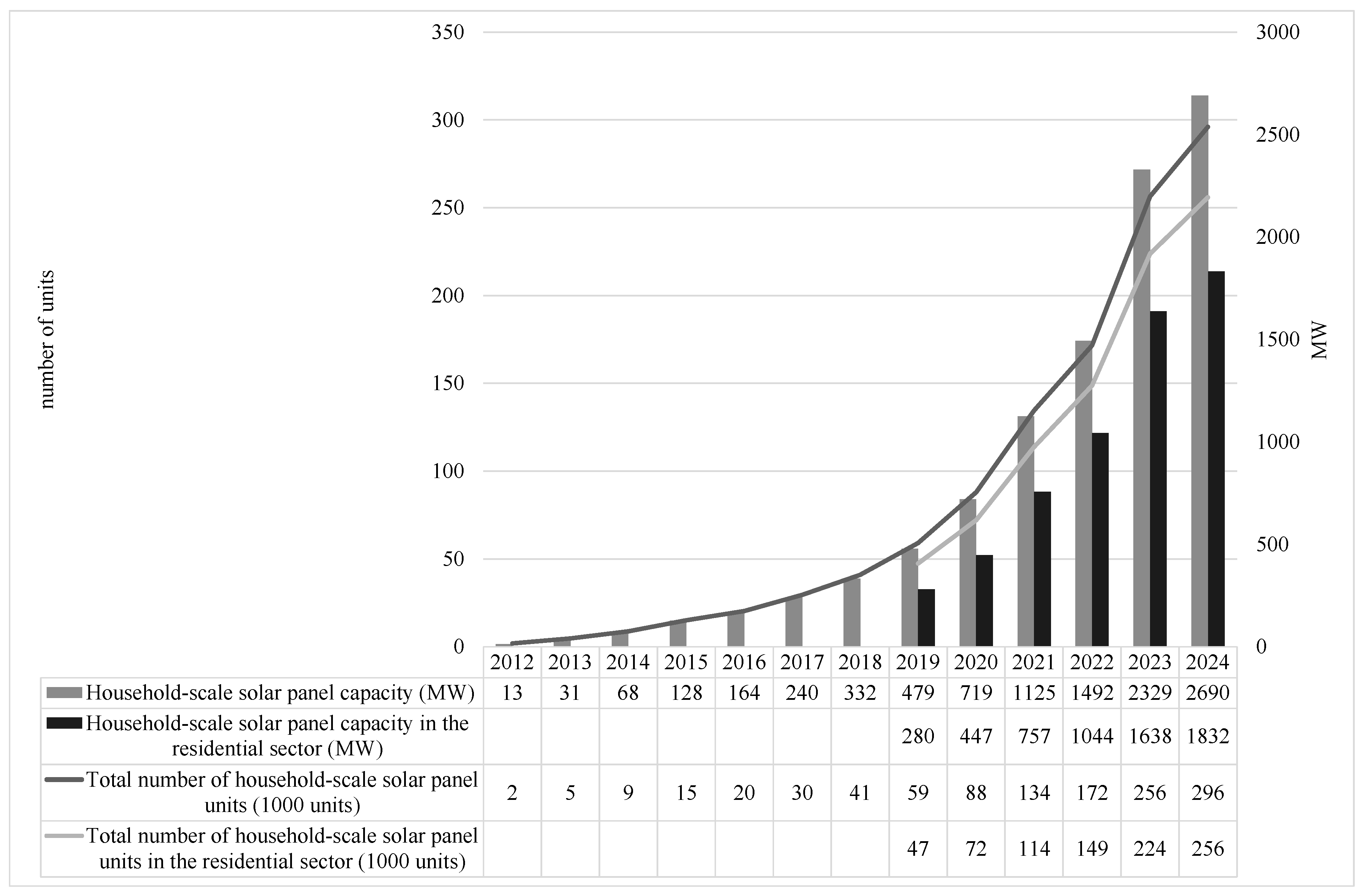
Figure 2.
Spatial image of the number of household-scale solar PV systems and their ratio per one hundred households, 2024. Source: own compilation.
Figure 2.
Spatial image of the number of household-scale solar PV systems and their ratio per one hundred households, 2024. Source: own compilation.
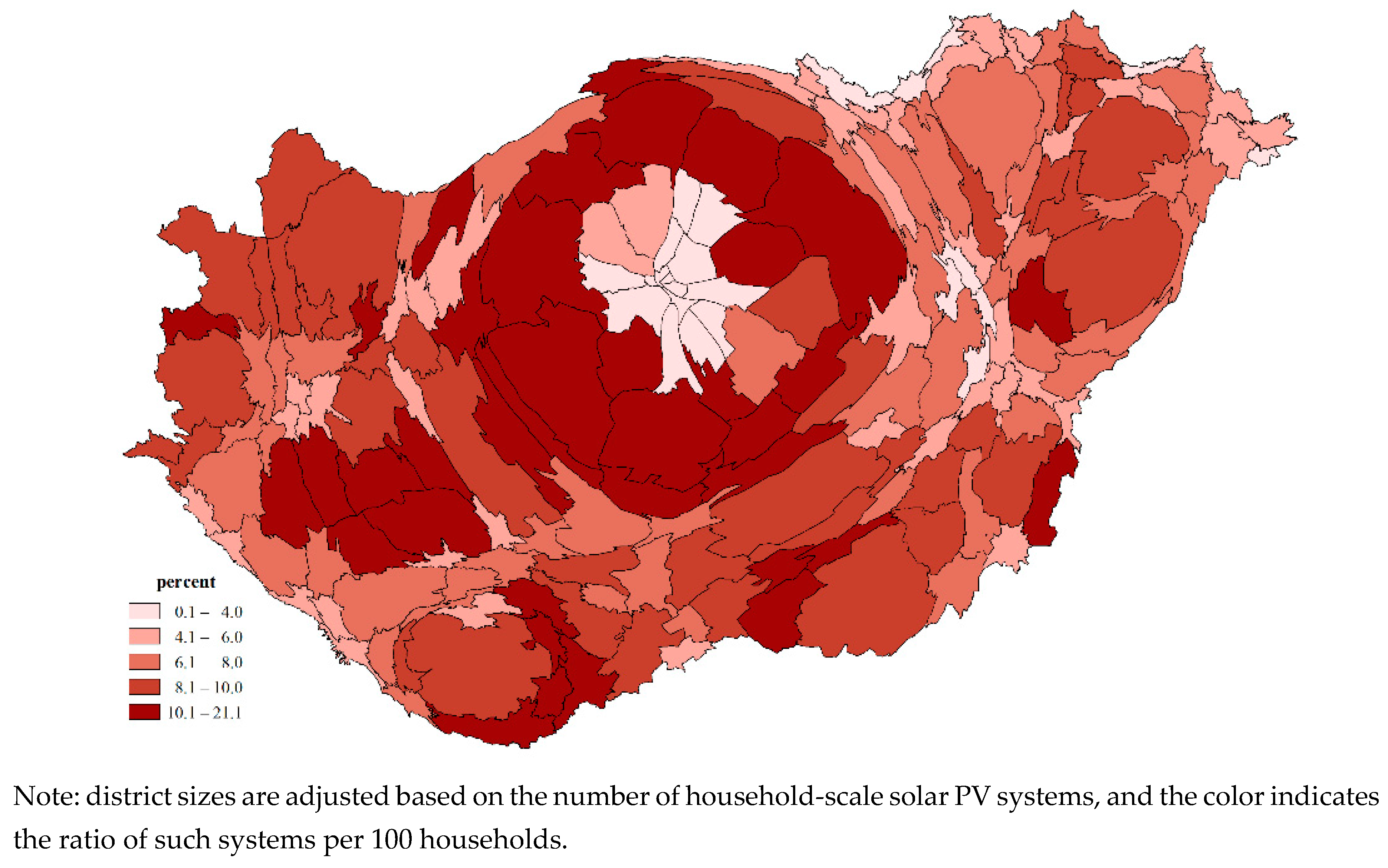
Figure 3.
Number of household-scale solar PV systems per district, 2024 (2019 = 100%). Source: own compilation.
Figure 3.
Number of household-scale solar PV systems per district, 2024 (2019 = 100%). Source: own compilation.
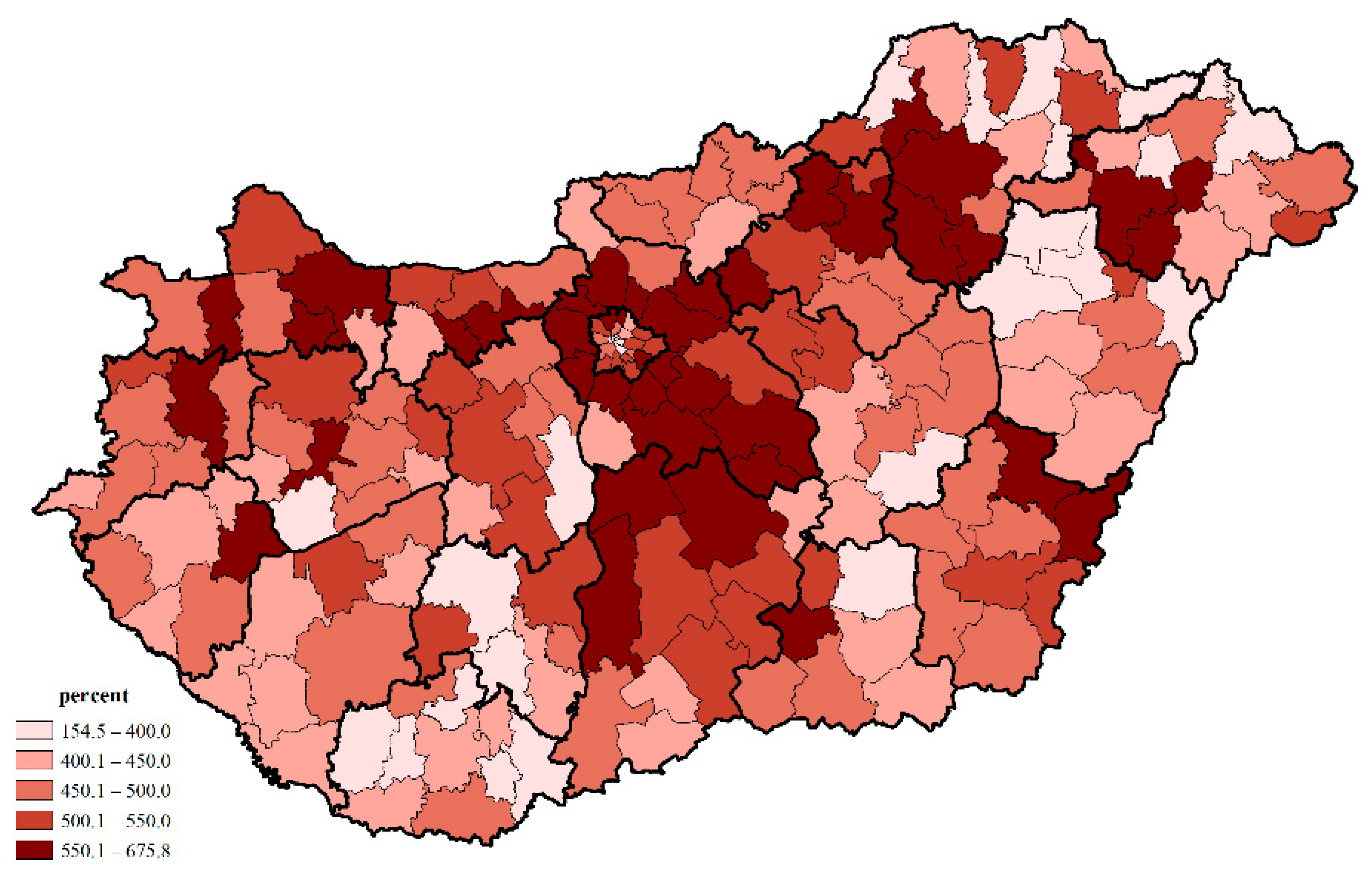
Table 2.
Theil T and Moran I indicators of the district number of household-scale solar PV systems in the NUTS1 regions of Hungary (2019–2024).
Table 2.
Theil T and Moran I indicators of the district number of household-scale solar PV systems in the NUTS1 regions of Hungary (2019–2024).
| Regions | 2019 | 2020 | 2021 | 2022 | 2023 | 2024 |
|---|---|---|---|---|---|---|
| Theil T | ||||||
| Central Hungary | 0.166 | 0.170 | 0.180 | 0.181 | 0.180 | 0.180 |
| Great Plain and North | 0.175 | 0.170 | 0.184 | 0.192 | 0.200 | 0.194 |
| Transdanubia | 0.151 | 0.144 | 0.148 | 0.156 | 0.163 | 0.157 |
| Hungary | 0.170 | 0.164 | 0.175 | 0.183 | 0.190 | 0.186 |
| Moran I | ||||||
| Central Hungary | 0.276 | 0.274 | 0.268 | 0.268 | 0.260 | 0.259 |
| Great Plain and North | –0.030 | –0.034 | –0.039 | –0.043 | –0.042 | –0.039 |
| Transdanubia | –0.106 | –0.108 | –0.109 | –0.102 | –0.096 | –0.100 |
| Hungary | 0.049 | 0.033 | 0.044 | 0.055 | 0.070 | 0.073 |
Source: own calculation.
Table 4.
Indicators.
| Group of indicators | Indicator | Year |
|---|---|---|
| Economic characteristics | Per capita income forming the basis for personal income tax | 2024 |
| Social characteristics | Proportion of people with a high school diploma or higher education degree | 2022 |
| Built environment | Ratio of apartments built since 2000 to occupied apartments | 2022 |
| Proportion of apartments with a floor area of 100 square meters or larger | 2022 | |
| Energetic characteristics | Number of households connected to pipeline natural gas | 2024 |
| Electricity consumption per household | 2024 | |
| Environmental conditions | Annual amount of global radiation | 2024 |
| Characteristics of settlement structure | Ratio of the inner area of the settlements of districts to the administrative area | 2024 |
| Population of districts | 2024 | |
| Population density of districts | 2024 |
Source: own calculation.
| 1 | We also performed the modeling with several types of adjacency matrices (e.g., rook and second- and third-degree queen adjacency, etc.), but the fit of the model deteriorated in each case. |
Disclaimer/Publisher’s Note: The statements, opinions and data contained in all publications are solely those of the individual author(s) and contributor(s) and not of MDPI and/or the editor(s). MDPI and/or the editor(s) disclaim responsibility for any injury to people or property resulting from any ideas, methods, instructions or products referred to in the content. |
© 2026 by the authors. Licensee MDPI, Basel, Switzerland. This article is an open access article distributed under the terms and conditions of the Creative Commons Attribution (CC BY) license (http://creativecommons.org/licenses/by/4.0/).
Copyright: This open access article is published under a Creative Commons CC BY 4.0 license, which permit the free download, distribution, and reuse, provided that the author and preprint are cited in any reuse.


